i
EXPERIENCES, BEHAVIOURS AND
PERCEPTIONS OF GAMBLERS TOWARDS THE
EFFICACY OF RESPONSIBLE GAMBLING IN
MINIMISING ‘PROBLEM GAMBLING’
Caroline Jawad
Director of Studies Dr Howard Tanner
Second Supervisor Dr Carolyn Downs
STATEMENT:
This research was undertaken under the auspices of the University of Wales Trinity Saint David
Submitted in partial fulfilment for the award of a Degree of PhD University of Wales
ii
This work has not previously been accepted in substance for any degree and is not being concurrently submitted in candidature for any degree.
Signed (candidate)
Date 25 July 2017
STATEMENT 1
This thesis is the result of my own investigations, except where otherwise stated. Where correction services have been used, the extent and nature of the correction is clearly marked in a footnote(s).
Other sources are acknowledged by footnotes giving explicit references. A bibliography is appended.
Signed (candidate)
iii
I hereby give consent for my thesis, if accepted, to be available for photocopying and for inter-library loan, and for the title and abstract to be made available to outside organisations.
Signed (candidate)
Date 25 July 2017
I hereby give consent for my thesis, if accepted, to be available for photocopying and for inter-library loans after expiry of a bar on access approved by the University of Wales on the special recommendation of the Member Institution concerned.
Signed (candidate)
iv
The premise of this thesis is that all business is embedded in society and needs to be responsible for the socio-cultural problems it creates. This thesis examines the social responsibilities operators should have to gamblers and wider society and seeks to understand if responsible gambling can empower gamblers to minimise harms. The aim of this thesis is to evaluate critically the extent to which responsible gambling is possible in relation to the interests of society and gamblers themselves and an examination of the efficacy of responsible gambling features in the online environment. Gambling-harms have been studied by researchers from many different disciplines however few are situated from the perspective of business. There has been a dominance of quantitative gambling research but a lack of qualitative investigation into harms from the perspective of gamblers. This thesis seeks to address these issues using a pragmatic, mixed methods approach and presents empirical findings drawn from the approaches used. A group interview gathered qualitative data about the behaviour and experiences of ‘problem gamblers’ in the development of their problems and specifically what measures would have been useful for them in controlling their ‘problem gambling.’ The rich information provided by the group-interview contributed to the development of an informed online questionnaire, completed by key stakeholders in the setting which provided insights on the phenomena of ‘problem gambling’ and responsible gambling. The lived experience of ‘problem gamblers’ is at variance with key stakeholders. The findings point to a need for a new model of ‘problem gambling’ one which recognises how gambling activity has become normalised in modern culture. Research findings are discussed in relation to implications for key stakeholders who need to participate in the socio-cultural debate that surrounds gambling becoming directly involved in its complex moral issues. Recommendations discuss policy changes, drawing on both health and consumer protection for the market to improve gambler safety and responsibility of the industry.
v Acknowledgements
My gratitude is expressed to the University of Wales Trinity Saint David for its support during the research and writing of my thesis with special thanks to Dean, Roger Maidment, Head of School, Dr Maggie Inman and all colleagues at the Swansea Business School. I would like to thank Dr Howard Tanner, UWTSD, who sadly passed away on Christmas Day 2016, for his considerable patience, dedication and professionalism. My kindest thanks to Dr Carolyn Downs, University of Lancaster, for her inspiration, guidance and commitment. I thank Steve Griffiths for inspiring this thesis and the research of many other students. My thanks also to Professor Jane Waters for her guidance and support during the last stages of writing the thesis.
I thank the many participants who generously contributed to the work presented in this thesis. They remain anonymous but without their help this thesis would not have been possible. Many of these participants were vulnerable individuals who gave up their time freely and shared personal stories which were difficult to hear and no doubt difficult to voice.
To my sons, Louis and George – I love you xx
I dedicate this thesis to my beloved brother, Christopher Carl Bevan, who sadly passed away on 16 March 2016
vi Contents
Chapter 1 ... 1
Introduction ... 1
Social policy ... 4
The gambling industry ... 6
Research aim and objectives ... 8
Rationale ... 10
Personal experience with gambling research ... 11
Thesis structure ... 13
Methodology ... 15
Conclusion ... 16
Chapter 2: Literature review ... 17
Section A: Ethics ... 17 Introduction ... 17 Ethics ... 17 Moral rules ... 18 Virtue ethics ... 19 Ethical theories ... 21 Utilitarianism ... 22 Deontology ... 23 Rights theories ... 24
Ethical theory applied to online gambling ... 26
Ethics and gambling ... 27
Defending gambling ... 30
Conclusion ... 31
Section B: Corporate Social Responsibility ... 32
Introduction ... 32
Origins of corporate social responsibility ... 32
Overlapping of corporate social responsibility concepts ... 32
Theories of corporate social responsibility ... 33
vii
Sustainability ... 39
Corporate stakeholders ... 41
Kant and the stakeholder approach ... 43
Ethical decision-making ... 43
Corporate social responsibility dilemma ... 47
Corporate social responsibility and harm ... 50
Corporate social responsibility and the online gambling industry ... 52
Corporate social responsibility and education ... 53
Corporate social responsibility and the tobacco industry ... 54
Corporate social responsibility and ethics ... 55
Corporate social responsibility and responsibilisation ... 56
Conclusion ... 56
Section C: Problem Gambling and Responsible Gambling ... 58
Gambling research ... 58
Defining ‘problem gambling’ ... 61
Reith’s cultural model of ‘problem gambling’ ... 63
Models of ‘problem gambling’ ... 65
Public health and gambling-harms ... 71
Problem gambling and behaviour changing models ... 72
Problem gambling and accessibility ... 72
‘Problem gambling’ and exposure ... 73
‘Problem gambling’ and online gambling ... 74
‘Problem gambling’ and government revenue ... 75
Responsible gambling ... 76
Responsible gambling and harm minimisation ... 77
Responsible gambling as a competitive feature ... 79
Informed choice ... 79
Duty of care ... 80
Public health ... 82
Frameworks for minimising ‘problem gambling’ ... 85
Conclusion ... 88
Section D: Regulation ... 89
viii
A history of regulation ... 89
Dilemma of regulation ... 90
A history of regulation ... 90
Betting and Gaming Act 1960 ... 91
Gaming Act 1968 ... 92
Between 1968 and 2005 ... 93
National Lottery ... 94
Liberalisation ... 94
The Gambling Act 2005 ... 96
Online gambling and regulation ... 97
Social responsibility and regulation ... 98
Self-regulation and ‘self-control’ ... 99
Self-regulation ... 100
Codes of Practice ... 101
Conclusion ... 103
Section E: Responsible Gambling Features ... 104
Introduction ... 104
Responsible gambling and harm minimisation ... 104
Responsible gambling features ... 106
Conclusion ... 124
Section F: Sociological Perspectives ... 125
Introduction ... 125
The sociology of gambling ... 125
Gambling as action ... 126
Liminality ... 131
Edgework ... 132
Action, liminality and edgework and online gambling ... 135
Gambling careers ... 136
Risk society ... 139
CSR and Goffman ... 142
Framing norm-breaking behaviours ... 143
Counter-neutralisation ... 145
ix
Corporate social responsibility and neutralisation theory ... 147
Unethical online behaviour ... 148
Detecting unethical online behaviour ... 149
Neutralisation and rationalisation ... 150
Ethical decision-making and neutralisation ... 152
Globalisation ... 152
Rationalisation ... 154
McDonaldisation ... 155
Gambling and sociology ... 155
Conclusion ... 156
Chapter 3 ... 157
Introduction ... 157
Aim and objectives ... 157
Research context ... 157
Epistemology ... 158
Constructionism ... 159
Social constructionism ... 160
Theoretical perspective ... 161
Pragmatic mixed methods approach with a social constructionist stance .... 161
Matching research objectives with mixed methods ... 164
Rejection of triangulation ... 164
Pragmatic mixed methods approach applied to this study ... 165
Group interview methodology ... 166
Sampling and gatekeepers ... 167
Moderator-Counsellor ... 169
Sampling and group interview ‘problem gambler’ selection ... 170
Participants ... 172
Group interview method ... 173
Group interview procedures ... 174
Online questionnaire methodology ... 175
Justification for data collection via online questionnaires ... 177
Online questionnaire participants ... 179
x
Gambling research methodological concerns ... 182
Methodological rigour ... 183 Ethics ... 189 Conclusion ... 195 Chapter 4 ... 196 Introduction ... 196 Narrative analysis ... 196 The stories ... 200 Recovery ... 200 Analysis of data ... 202 Main findings ... 202
The meaning of responsible gambling is unclear ... 202
‘Problem gambling’ is a complex issue that affects gamblers and others .... 207
Different motivations were identified for ‘problem gamblers’ seeking help ... 213
Key characteristics of ‘problem gambling’ are the emergence of negative consequences and a lack of self-control ... 215
Gamblers recognised development of their ‘problem gambling’ ... 217
Immediate triggers for getting help ... 218
Responsibility ... 219
An account of sociology of gambling and the group interview ... 222
Conclusion ... 223
Chapter 5 ... 224
Data analysis online questionnaire ... 224
Introduction ... 224
Analysis of the online questionnaire ... 224
Online questionnaire participants ... 225
General analysis of the online questionnaire ... 226
Statistical tests ... 229
Mann Whitney U-test ... 231
Statistical analysis ... 231
Top ten effective responsible gambling features identified by gamblers ... 232
Conclusion ... 252
xi Open-ended Responses ... 253 Introduction ... 253 Research method ... 253 Individual responsibility ... 254 Government responsibility ... 257
Operator comments supporting government regulation ... 258
Academic comments supporting government regulation ... 259
Counsellors’ comments supporting government regulation ... 261
Gamblers’ comments supporting government regulation ... 263
Outliers ... 270
Conclusion to analysis of the comments of gamblers ... 271
Self-regulation ... 271
Conclusion ... 272
Chapter 7 ... 273
Introduction ... 273
Synthesis of the main findings ... 273
Main conclusion related to objectives 1 and 2 ... 283
Summary of quantitative analysis ... 285
Summary of qualitative analysis ... 287
An overview of the main original contributions ... 290
Recommendations ... 294
Further research ... 295
Limitations of the thesis ... 296
Summary ... 297
Concluding remarks ... 297
Appendices ... 298
Bibliography ... 299
Appendix 1 DSM-5 Diagnostic Criteria: Gambling Disorder ... 408
Appendix 2 All analysis from Chapter 5 ... 410
Appendix 3 Responsible Gambling Features Online Questionnaire All Responses ... 459
Appendix 4 Design of the online questionnaire ... 467
xii List of Tables
Table 2.1 Moral cognitivism and gambling ... 22
Table 3.1 Matching of research objectives with research approaches ... 164
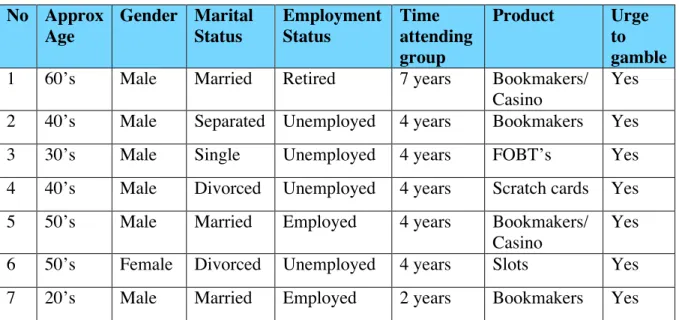
Table 3.2 Basic information about GI participants ... 172
Table 3.3 Key strategies for rigour in research ... 184
Table 3.4 Adapted from Flinders’ Ethical Frameworks and Aspects of Research applied to the GI (Flinders, 1992) ... 193
Table 3.5 Adapted from Flinders’ Ethical Frameworks and Aspects of Research applied to the OQ (Flinders, 1992) ... 194
Table 5.1 Key stakeholders in the OQ ... 225
Table 5.2 Top Ten Effective RGFs identified by gamblers (Percentage of stakeholders agreeing or strongly agreeing) ... 227
Table 5.3 Top Ten Effective RGFs identified by academics/counsellors (Percentage of stakeholders agreeing or strongly agreeing) ... 228
Table 5.4 Explanation of variables ... 229
Table 5.5 Group interview statistics ... 230
Table 5.6 Most effective RGF: Providing accurate information on chances of winning ... 233
Table 5.7 Second most effective RGF: Providing age verification controls ... 235
Table 5.8 Third most effective RGF: Displaying gambling activity in cash value instead of credits ... 237
Table 5.9 Fourth most effective RGF: Providing self-exclusion options ... 239
Table 5.10 Fifth most effective RGF: Requiring gamblers to set predetermined spending limits ... 241
Table 5.11 Sixth most effective RGF: Providing regular financial statements . 243 Table 5.13 Eighth most effective RGF: Promoting advertising standards that responsibly promote gambling with clear warnings of the dangers of gambling ... 247
Table 5.14 Ninth most effective RGF: Identification of ‘PGs’ by operators ... 249
xiii
Table 7.1 Nadirs in Personal Gambling Experience ... 281
Table 7.2 RGFs identified as effective by gamblers and academics/counsellors 286 Table 7.3 Stakeholder comments about responsibility ... 288
Table A2 Slowing Play ... 411
Table A4 Reducing audio-visual effects ... 414
Table A6 Reducing maximum bet size ... 416
Table A8 Increasing minimum bet size ... 418
Table A10 Decreasing game variety ... 420
Table A12 Removal of some types of games from OG ... 422
Table A14 Eliminating bonus rounds ... 424
Table A16 Removing number of high stake, high risk games ... 426
Table A18 Prohibiting free play mode ... 428
Table A20 Decreasing the chances of a win occurring ... 430
Table A22 Increasing the chances of a win occurring ... 432
Table A24 Displaying time of day on screen ... 434
Table A26 Displaying total time of play on screen ... 436
Table A28 Requiring players to set a predetermined time limit ... 438
Table A30 Enforcing play stoppage, break or interruption ... 441
Table A32 Providing general information about RG on welcome screen ... 443
Table A34 Displaying RG messages during play ... 446
Table A36 Allowing only one credit card per account ... 449
Table A38 Eliminating advertising of big prizes on websites ... 451
Table A40 RGF - Delaying immediate access to large wins (e.g., paying out large wins in the form of cheques) ... 454
Table A42 Sharing problem gambler identification information with other operators ... 456
Table A44 Reducing OG marketing ... 458
Table A45 Responsible Gambling Features Online Questionnaire All Responses ... 466
xiv List of Figures
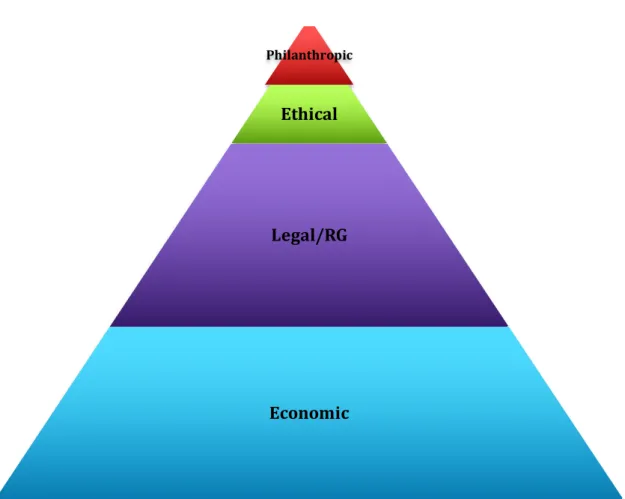
Figure 1.1 Structure of thesis ... 16 Figure 2.1 Pyramid of CSR (Carroll, 1991, p. 42) ... 35 Figure 2.2 Adapted from Representation of relationship between the
organisation and stakeholders (Donaldson and Preston, 1995, p. 69) ... 42 Figure 2.3 Adapted from Carroll’s CSR Pyramid Applied to post-Gambling Act
2005... 50 Figure 2.4 Integrated model of ‘problem gambling’ with harm minimisation
strategies (Blaszczynski and Nower, 2002) ... 69 Figure 2.5 Public Health Framework for Gambling Model (Korn and Shaffer,
1999) ... 71 Figure 2.6 Adaptation of Blaszczynski’s (2001) Three-tiered approach to harm
minimisation ... 105 Figure 2.7 Goffman’s action ... 127 Figure 3.1 Adapted from McFadyen and Rankin (2016) Access participants with
influencing factors ... 168 Figure 3.2 Seedhouse’s Ethical Grid (2007) ... 190 Figure 5.1 First most effective RGF: Providing accurate information on chances
of winning ... 232 Figure 5.2 Second most effective RGF: Providing age verification controls .... 234 Figure 5.3 Third most effective RGF: Displaying gambling activity in cash value
instead of credits ... 236 Figure 5.4 Fourth most effective RGF: Self-exclusion options ... 238 Figure 5.5 Fifth most effective RGF: Requiring gamblers to set predetermined
spending limits ... 240 Figure 5.6 Sixth most effective RGF: Providing regular financial statements .. 242 Figure 5.7 Seventh most effective RGF: Providing ‘PG’ education and
xv
Figure 5.8 Eighth most effective RGF: Promoting advertising standards that responsibly promote gambling with clear warnings of the dangers of winning
... 246
Figure 5.9 Ninth most effective RGF: Identification of ‘PGs' by operators ... 248
Figure 5.10 Tenth most effective RGF: Requiring mandatory registration ... 251
Figure A1 Slowing Play ... 410
Figure A3 Reducing audio-visual effects ... 413
Figure A5 Reducing maximum bet size ... 415
Figure A7 Increasing minimum bet size ... 417
Figure A9 Decreasing game variety ... 419
Figure A11 Removal of some types of games from online gambling ... 421
Figure A13 Eliminating bonus rounds ... 423
Figure A15 Removing number of high stake, high risk games ... 425
Figure A17 Prohibiting free play mode ... 427
Figure A19 Decreasing the chances of a win occurring ... 429
Figure A21 Increasing the chances of a win occurring ... 431
Figure A23 Displaying time of day on screen ... 433
Figure A25 Displaying total time of play on screen ... 435
Figure A27 Requiring players to set a predetermined time limit ... 437
Figure A29 Enforcing play stoppage, break or interruption ... 440
Figure A31 Providing general information about RG on welcome screen ... 442
Figure A33 Displaying RG messages during play ... 445
Figure A35 Allowing only one credit card per account ... 448
Figure A37 Eliminating advertising of big prizes on websites ... 450
Figure A39 Delaying immediate access to large wins (e.g., paying out large wins in the form of cheques) ... 453
Figure A41 Sharing problem gambler identification information with other operators ... 455
xvi Abbreviations
Anti-social behaviour orders ASBOs
British Gambling Prevalence Survey BGPS
British Medical Association BMA
Corporate Citizenship CC
Corporate Social Responsibility CSR
Department of Culture, Media and Sports DCMS
Difficult to control gambling DCG
Electronic Gaming Machine EGM
Fixed Odds Betting Terminal FOBT
Gambling Commission GC
Gaming Board for Great Britain GBGB
Group interview GI
Gambling Restraint Erosion Theory GRET
General Betting Duty GBT
Harm minimisation HM
Moderator-Counsellor MC
National Lottery NL
Online gamblers OGs
Online gambling OG
Online questionnaire OQ
Organisation for Economic Co-operation and Development OECD
Polluter Pays Principle PPP
Problem gamblers PGs
Problem gambling PG
Public Health PH
Responsible Gambling Council RGC
Responsibility in Gambling Trust RiGT
Responsible gambling RG
Responsible gambling feature RGF
Social responsibility SR
1 Chapter 1 Introduction
Eadington (1976, p. 1) wrote that “the oldest profession known to civilised society may very well be prostitution, but probably just as old as a leisure activity or as a more serious endeavour is the phenomenon of gambling.” Gambling is a controversial leisure activity and despite its popularity has negative social and cultural implications. Governments have recognised that gambling is an effective means of generating revenue; but is also can produce harmful effects for the gambler, their family, communities and society. The industry would probably like nothing more than to be acultural, asocial and amoral; the problem is that this is simply not possible and the industry has to embrace social responsibility. Corporate social responsibility (CSR) or social responsibility (SR) is an ethical theory that business has responsibility to society. There is no single, commonly accepted definition of the concept but this thesis understands SR as every organisation having responsibility to act in a manner that is beneficial to society and not solely to the organisation and consequently, the industry must address the gambling-harms it creates in a responsible way. CSR is an increasingly important objective for organisations but the obligation to act responsibly in contentious industries is debateable.
Business is embedded in society and not separate from the socio-cultural aspects with which their business interacts. Eberstadt (1977, p. 22) wrote that “business has seldom enjoyed so much power with little responsibility” and CSR has raised the profile of responsibilities that businesses must have to society. Contentious industries have their legitimacy and CSR policies questioned (Miller and Michelson, 2012) and controversial products, services and industries have traditionally included gambling along with tobacco, alcohol and pornography (Meier, 1994). However, gambling has undergone significant changes due to liberalisation and some aspects of the changes have not been researched. Its current omnipotence has renewed interest in the sociological and cultural analysis of
2
gambling (McMillen, 1996; Castellani, 2000; Reith, 2002; 2003; 2007; Cosgrave, 2006).
This thesis seeks to analyse the lived experiences, the behaviour and responses of ‘problem gamblers’ (‘PGs’) and the extent to which responsible gambling (RG) and responsible gambling features (RGFs) are effective in coping with ‘problem gambling’ (‘PG’). The term ‘PG’ is always in inverted commas in this thesis to indicate the lack of clarity with the term which is discussed in depth in section C. ‘PGs’ and key stakeholders provide expert opinion and contribute to the analysis of the efficacy of RGFs and it is necessary to listen to key stakeholders to develop a better understanding of ‘PG’ and harm minimisation (HM) measures.
This chapter introduces the key ideas that relate to the aim and objectives of the thesis, the multidisciplinary context of the issues and literature, the structure of the thesis and outlines the original contribution the study makes to the field.
‘Problem gambling’
Gambling has been presented historically as a moral problem, a sin, vice or criminal activity condemned by society and regulated by government (Jones et al, 2013, p. 69). It was not until 1943 and the publication of Edmund Bergler’s ‘The Gambler: The Misunderstood Neurotic’ that a shift was signalled. ‘PGs’ were individuals “caught in the grips of an illness that necessitated medical treatment rather than moral condemnation” (p. 69). This new construct, a medical model of gambling regarded ‘PG’ as psychologically abnormal and emphasised the individual’s responsibility to treat their illness. There are three repercussions of this. First, links with governmentality which is how governments try to produce individuals best suited to fulfil their policies and by responsibilising ‘PGs’ the government’s responsibility for intervention is reduced (Foucault, 1991). By emphasising responsibilisation government removes its burden of responsibility for the care of ‘PGs.’ The central aim of governmentality is to establish social conditions that produce the responsibilised individual who is morally responsible and who uses rational choice when making market decisions. Second, understanding ‘PG’ as an
3
individual pathology means that the structural factors of ‘PG’ are under-played. Third, individualising ‘PG’ means that behaviour change must be targeted at the individual (ibid). This narrow focus on the ‘PG’ removes attention from gambling’s impact on society and communities (Reith, 2006). Medicalisation introduced new ways of regarding ‘PG’ and turned the consumer into a new type of person – an addict (Reith, 2004). This process is related to Foucault’s (1976) ‘constitution of subjects’ where the classification of types and features of behaviour provides tools for new ways of thinking and talking about individuals. Just as there are new ways of conceptualising consumers, there are new ways of shaping and controlling patterns of consumption. The ‘PG’ would have been constructed as the outcome of dangerous and powerful substances but with the development of new forms of governance associated with the move to neo-liberal societies, ‘PGs’ came to be defined in terms of subjective, individual behaviour of loss of control. Tieu (2010) suggests that ‘PGs’ may not be in control and therefore unaccountable for their behaviour due to diminished agency. Several models are examined in this thesis to understand ‘PG’ and Reith’s cultural model aligns with the perspective that gambling can be explained as rational in a socio-economic setting. Reith (2007a) argues that ‘PG’ is the result of modern consumer societies, the decline of external forms of regulation and the rise of demands for individual self-control. The liberalisation of the industry and the expectation that gamblers govern themselves creates the conditions for the emergence of ‘PG.’ The study of ‘PG’ is dominated by medical and psychological perspectives and this narrow focus tends to draw attention from the wider effects on communities and societies which has implications for RG. Both the medical and cultural models of ‘PG’ seek to minimise it through individual interventions including responsibility to seek help in the medical model and self-restraint in the cultural model.
Responsible is a keyword in neo-liberal modes of governance and focuses on individualised risk-management. ‘PG’ is immersed in neoliberalism; the rational, self-interested consumer is supposed to be capable of balancing costs and benefits and make choices that maximise personal welfare (Adams, 2016). The construct of the rational consumer has given rise to multidisciplines including economics, law, sociology and psychology underpinning the development of understanding normal
4
consumer behaviour. Rational choice theory contends that it is deliberative and consistent and the consumer seeks to maximise choices in relation to resources. Instead of examining internal concepts like needs and desires, consumer behaviour identifies external benefits and costs. There are always factors that can be applied to make a case understandable and sensible. Benefits and costs can always be used to protect rationality; in the case of ‘PG’ - enjoyment, illness, chasing losses and Goffman (1967) emphasised positive qualities associated with gambling like skill and courage.
Social policy
In the post-war period after the Second World War, governments had a central role in ensuring the rights of individuals to have a minimum standard of life, economic welfare and security (Kennett, 2001). This was underpinned by mass production and mass consumption and the welfare state model was seen an inevitable outcome of a modern society. In recent times, this post-war consensus and social Keynesianism has been dismissed, accompanied by increasing inequality and a different social contract between government and individual. The rights of individuals are being eroded by new economic policies that emphasise duties. This renegotiated social contract has significant application to understanding the responsibility of government, industry and gambler in this thesis.
The government is not the sole institution to provide welfare and Baldock et al (1999, p. xxi) identify families, communities, market and the third sector organisations as welfare providers. Kennett (2001) argues that in the UK, an institutionalised and established private sector has promoted and provided welfare. The morality of government has been transformed into a market, targeted at gamblers who are now increasingly expected to manage their risky business. Gambling social policy relies on responsibilisation of the gambler; ‘PGs’ are expected to develop and manage their ‘self-control’ and learn that ‘PG’ is their responsibility. Government and industry have designed new types of responsibility which are promote through a largely compliant media and managed at arms-length by organisations tasked with the job of raising and distributing funds from the
5
industry to prevent and manage harms caused by the industry. The abrogation of direct government responsibility for managing RG and identifying and supporting ‘PG’ and the polluter pays principle (PPP) has ensured a significant role for the industry in the decision-making processes around RG, PG and the funding of research into these two important areas. Arguably a consequence of this is that rather than independent evidence-based social policy development we have industry-compliant social policy defining RG. The endorsed philosophy holds that gamblers are capable of ‘self-control’ and that RG is most effective when managed and controlled by the gambler. They may just need some RG instruction and utilisation of RGFs represent ideal and balanced market behaviour. The philosophy is that gambling social policy be produced, distributed and actively realised through consumption.
PPP was first mentioned in an OECD (1972) recommendation where pollution costs should be financed by the polluters and not the public in general. PPP is a popular retrospective notion of historical responsibility. This perspective is advocated by government and industry with the aim of minimising harm funded by a contribution from operators who make their money out of gamblers themselves. However, not all the costs associated with ‘PG’ is borne by gamblers. Communities and society are damaged; family, work, education, health and personal relationships also suffer (Downs, 2010). Industry money is not spent on these issues and operators do not pay an additional tax to compensate for this harm. Economic theory recommends that regulation to correct these costs and usually taxes and charges on goods are used and a reliable source of government revenue (Enoch and Potter, 2003). George and Bowden-George (2016, p. 115) say that “the Gambling Act 2005 enshrined the principle of ‘polluter pays’” regarding gambling-harms channelled through voluntary contributions to the Responsibility in Gambling Trust (RiGT) initially but now Gamble Aware. It has been argued that industry funding influences the nature of treatment and research and that research funded by the industry were ‘benefit-benefit’ studies rather than cost benefit studies (Passas and Goodwin, 2010). Of the eleven board members at Gamble Aware, six are from the industry and there is not an independent chair (www.gambleaware.com, 2017).
6
PPP rests on neoliberal economics and there a question concerning why the polluters are not responsible so that society does not suffer. There is no mandatory tax applied to address gambling-harms and this is complicated by globalised gambling and how to apply PPP equitably. Operators paying for the social costs reflects the most fundamental principles of justice and responsibility, however the current model of voluntary contributions raises just over £7m per year whereas the government provided £650m on drug misuse services in England in 2013/14 (Crawford et al, 2015). Social policy regarding addiction to drugs is firmly in the hands of the Home Office and Department of Health and is based on independent academic research from the UK and around the world. The underpinning rationale for this is that these are illegal drugs and this approach is needed to reduce crime and minimise harm. There is a similar picture in social policy regarding alcohol, a legal part of mainstream leisure provision and here the underpinning rationale for government-led social policy is the potential to harm others. Gambling has the potential for harm to others and to lie behind criminal activities among ‘PG’ but since gambling moved from the Home Office to the Department of Culture, Media and Sports (DCMS) and applied PPP, there has been no attempt to establish levels of gambling-harms to society and no government-led social policy developments to manage either RG or ‘PG.’
The gambling industry
The industry dwarfs all other forms of entertainment combined and the global gambling industry has remarkable size and power (Mizerski, 2013; Markham et al, 2014) estimated to be worth more than half a trillion dollars $525tr by 2019 (Graham, 2015). The total contribution to the UK economy is 0.5% GDP, 0.3% total employment, including a significant number of unskilled jobs and £1.5 billion paid in gambling taxes annually (Deloitte, 2010). Global losses in gambling have risen from approximately $250b in 2003 to $450b in 2013 (The Economist, 2014). Gambling has changed from low profile, limited and an expression of local culture (Binde, 2005) to a globalised industry, fundamental to market liberalisation associated with the development of an international consumer society (Reith, 2013). Markham et al (ibid) say that the ‘emergence of Big Gambling’ (p. 1) is driven by
7
politics and economics and that gambling has permeated vulnerable communities paralleling tobacco and alcohol with similarly harmful consequences. Economic interests have an important role in rationalising gambling and separating it from moral and cultural arguments and government.
Livingstone and Adams (2011) argue that globalised gambling has only been possible with the collusion of the state. Liberalisation was a political strategy to promote gambling (Jones et al, 2013). Liberalisation was part of the neo-liberal economic project which also emphasised free markets, fiscal austerity and privatisation (Harvey, 2005). There was pressure from operators over public policy-making (Gaming Board for Great Britain (GBGB) 1995) envious of the National Lottery’s (NL) success and selective liberalisation in the industry. Liberalisation increased the industry’s political power with wide scale societal acceptance that gambling is not addictive nor the cause of ‘PG.’ Markham et al (2014) say that liberalisation was a form of exploitation of the working-class by the elite and that the industry used its political power to fast-track liberalisation and expansion and resist ‘PG’ concerns. Further there was limited debate regarding gambling’s social and economic desirability and without ethical debate (Black and Ramsay, 2003). Historically, governments have opposed gambling for social, moral and ethical reasons (Kearney, 2005) and though limited types of gambling have been permitted, in many jurisdictions it has been prevented from thriving as a commercially independent industry. This picture however has changed rapidly as the internet destroyed physical barriers to gambling expansion (Wiebe and Lipton, 2008).
Online gambling
Online gambling (OG) is popular due to advances in technology, penetration of high-speed broadband and liberalisation, which has led to a globalised industry. The potential for OG was harnessed when Microgaming developed gambling software in 1994/1995 and in 1995 CryptoLogic created software to process secure monetary transactions online (Wood and Williams, 2009). In 1995, Internet Casinos Inc was the first online site (Drayman, 2006). OG is an exponential sector of e-commerce which developed quickly (Gainsbury et al, 2012). It has the heaviest concentration
8
of high-risk features for ‘PG’ such as 24-7 usage, access from any location, fast gambling and regambling, multiple and continuous play and credit card play. In many countries, the development of OG coincided with the relaxation of legislative control of land-based gambling and government-sponsored lotteries which proliferated since the 1990s. Increases in participation has the compound cumulative effect of removing negative stigma attributed to risky behaviour (Hagen et al, 2005) and its justification as a socially acceptable leisure activity (LaPlante and Shaffer, 2007). Hancock (2011) goes further and suggests that the increase in OG is matched by increases in ‘PG’ and that RGFs should be used by regulators to prevent ‘PG’ to better protect online gamblers. She concludes that the Gambling Act 2005 must be amended to ensure appropriate consumer protection for online gamblers as well as a review of ‘PG.’
Research aim and objectives
The presentation of gambling as exciting, harmless entertainment is the result of many overlapping media messages as well as everyday practices (Sklar and Derevensky, 2010). When governments support the development and proliferation of gambling, the implicit message is that it is acceptable. The message is reinforced at home and work, where individuals engage in gambling in popular culture where it is depicted as exciting and socially desirable in social contexts. International evidence indicates that the greater availability and accessibility of opportunities is likely to result in an increase in ‘PG’ with more gamblers, families and communities affected by addiction (George and Bowden-Jones, 2014). ‘PG’ is disproportionately represented in under-privileged groups such as the poor, low-income, working-class, women, older people and immigrants (Casey, 2008). The current situation is being overlooked and a preventable future trend in addiction that we are ill equipped to treat is being ignored (George and Bowden-Jones, 2014). Given the gaps in the literature, it is necessary to conduct a review of the possible efficacy of RGFs and to contribute to current knowledge about RG and a better understanding of ways in which ‘PG’ could be minimised.
9
Aim and objectives
This thesis aims to evaluate critically the extent to which RG is possible in relation to the interests of society and gamblers themselves. It examines the efficacy of RGFs in the online environment. To achieve these aims, the following objectives were established:
• Objective 1: to explore what ‘PGs’ say about their gambling life-stories
• Objective 2: to explore what ‘PGs’ consider might have prevented them from experiencing ‘PG’
• Objective 3: to analyse the opinions of stakeholders towards the efficacy of RGFs
To achieve objectives 1 and 2, it was necessary to meet with ‘PGs’ to discuss the genesis of their ‘PG.’ The third objective was achieved through an online questionnaire (OQ).
OG has evoked the interest of the research community over concerns that its availability and accessibility will lead to an increase in the number of ‘PGs’ (Griffiths, 1999; Parke et al, 2004; Orford, 2005a; George and Bowden-Jones, 2014). RG is the range of policies, strategies and programmes designed to prevent or limit ‘PG’ and to minimise harmful societal impacts. RG may enable and support gamblers to make informed choices and to take responsibility for gambling decisions. It should inform gamblers when and where to get help if they experience ‘PG’ (Verlik, 2007). Campbell (2002) says it is a unifying concept bringing governments, industry and the academic community together to prevent or minimise ‘PG.’ However, RG repositions social problems associated with ‘PG’ into individual problems and removes from them political influence or control, whereby public issues are private problems (ibid).
RG was more a result of accident than planning and consisted of self-regulation and voluntary codes of practice (Smith and Rubenstein, 2011). Helping gamblers maintain a level of control, giving options if they experience problems and
10
preventing underage gambling is not only the right thing to do, it makes good business sense (Gambling Commission (GC) 2006; Grayson, 2006; Jawad, 2006). The initiative for RG has been held back by the disinclination of successive governments to accept the findings of empirical research, the aims of RG and the mechanisms to achieve these aims (Hing and Mackellar, 2004). Modest progress has been made (Smith and Rubenstein, 2011) but the risk of ‘PG’ should stimulate government and operators to be proactive in ensuring safety (Hancock et al, 2008; Miers, 2008; Livingstone and Woolley, 2007). There is insufficient published research that provides adequate information to design an effective response to ‘PG’ (Smith and Rubenstein, 2011). It is critical that evidence-based recommendations are developed to assist ‘PGs’ or gamblers at-risk and it is a small part of this gap that this thesis intends to fill.
It is necessary to understand if RGFs can be effective. Research shows that they must be perceived as effective if gamblers are to benefit from them (Parke et al, 2007, E-Cogra; Griffiths et al, 2009 Svenska Spel; Nelson et al, 2008 Bwin). Operators legally provide gambling but gambling-harms affect some individuals and necessitates the development of effective SR to minimise risk as well as to promote a positive image for the operator. There are many factors that impact on corporate decision-making and in the case of gambling, a decision to be responsible is weighed against a range of factors including legislative necessity, shareholder demands, customer needs, the impact on operating factors and profitability.
Rationale
There are three specific points that characterise the rationale for undertaking this study. First, on a personal note, this study builds on work undertaken for an MBA award which evaluated how online operators presented responsibility on their sites. A recommendation was made by the examiners that research should be continued and specifically to explore contributions from key stakeholders about SR. Second, there is a gap in the gambling literature relating to SR from the business lens. Most of the research in this thesis has been conducted by psychologists and the research has largely been conducted in Australia, New Zealand, Canada or the US and in
11
those countries (other than the US) ‘PG’ is a public health (PH) issue. A less common discipline examined in the thesis is sociology; legal experts and historians are cited. There are only a small number of business researchers including Hancock (Australia, UK) Hing (Australia) and Yani-de-Soriano (UK). There are several key researchers including Orford and Monaghan (psychologists) and Goffman and Reith (sociologists) who are key to the literature in the thesis but they are not business specialists. Third, there is a paucity of qualitative research discussing behaviours and experiences with gamblers and a methodological tendency to focus on quantitative accounts of ‘PG’ (Casey, 2008). Finally there is limited consideration of the perceptions of gamblers particularly from a bottom-up perspective.
The number of ‘PGs’ are rising and social impacts are poorly understood and this study seeks to provide some input into these gaps in knowledge. We are short of a robust RG policy and so this thesis is very important.
Personal experience with gambling research
This thesis experienced certain difficulties in getting research approved and funded. The following details are set out in chronological order. The university was reluctant to use the term gambler in the OQ and as a result the researcher was required to use the term user of gambling sites when seeking to understand the participant’s interest in the research. The researcher was also requested to not contact university staff and students as a group for study. This was never the intention of the researcher but the university was concerned that if staff and students participated, the findings could have implications for the university. If, for example, findings concluded that staff and students at this university have a high rate of ‘PG’ or the incidence of gambling-harms is significant, this would be negative to the good standing of the university. The research was monitored closely prior to the data collection stage to ensure that every step taken in the research process was approved before execution to uphold the good standing of the university. It was clear that the university was anxious about this research and its possible implications. As the university was inexperienced in conducting gambling research,
12
it was important to have an experienced academic and researcher in the subject area in the supervisory team. A highly qualified and experienced individual was recruited to the supervisory team to contribute her wealth of knowledge to the uniqueness of conducting gambling research. This supervisory team member was a member of another university.
The researcher sought funding from the Responsibility in Gambling Trust (RGT) and completed numerous applications and submitted multiple proposals. The researcher made short-lists of six candidates and then two for funded research. Considerable expense was involved in travelling to London on several occasions was which difficult without funding. Eventually the panel decided to fund psychology-based research which sought to examine how psychological processes affect gambling behaviour. The industry prefers psychology-based research because individuals differ in their behaviour and personal qualities and therefore problems are blamed on individual characteristics, therefore absolving the government and industry of responsibility. A positive outcome of the RGT decision was that the research in this thesis was completely independent.
As the research progressed, the Gambling Commission contacted the researcher and requested a copy of the thesis. It was a flattering request and the response has not been finalised. Conjecture could be that viewing completed PhD research studies is a measure to save expenditure on research. There are many practical questions this thesis seeks to answer including effective RGFs. The findings of this thesis therefore could have relevance and application for regulatory bodies which may be why the GC made an approach. BBC Wales also requested access to the research and again the response has not been finalised but the researcher is reluctant for journalists to use the findings for their own purposes. Using the findings of this study would save BBC Wales research costs and reflects the problems involved in conducting ‘PG’ research.
13 Thesis structure
The thesis has been structured into seven chapters. It utilises theoretically informed and related literatures that seek to establish a compelling interdisciplinary framework. Eadington (1976) and Schellink and Schrans (2005) argue that gambling is a natural interdisciplinary subject and when studied from an interdisciplinary perspective there are direct and pragmatic benefits. This thesis uses an interdisciplinary method so that when the different disciplines cross and merge, they will be synthesised to the ultimate benefit of understanding more about RG.
The business discipline in social science does not contribute significantly to the understanding of gambling. Research that has examined SR and gambling is psychology-based and the focus is on the individual. This thesis needed to explore the role of the operator, which is why wider fields have been employed. Consequently, the research has investigated the fields of ethics, CSR, social policy, psychology and sociology.
This first chapter provides some background related to setting up the study, the resistance felt initially and the interest the study has generated. The second chapter is sub-divided into 6 sections so that the relevant material from across the multidisciplines can be appropriately set out in the literature review. Section A evaluates ethical theory seeking to understand how it can underpin the development RG. Ethical issues surround the industry because of its propensity to create gambling-harms and ethical theory explores why operators should be responsible in the development and delivery of their business model. Section B examines CSR from the main theoretical perspectives looking at the importance of theory-driven explanations of CSR. It links theory to practice and considers how a SR framework can be effective for key stakeholders. Section C examines the ‘elephant in the room’ and explores ‘PG.’ It looks at models and their implications for key stakeholders including wider society. Section D discusses regulation and liberalisation and looks at the move from minor vice status, constrained by the Home Office and forbidden from developing demand to a lightly-regulated leisure sector with unprecedented
14
growth and a concomitant rise in ‘PG.’ Section E explores RG strategies that can assist gamblers and are later examined for perceived effectiveness. Finally, section F reviews literature relating to sociological perspectives of gambling. It was important to examine sociology because first gambling takes place in a social setting and second sociological approaches to gambling seek to move beyond individual-based explanations of the activity and place gambling in the context of family, community and wider society, enabling notions of problem and responsible gambling to be placed in a social context.
Following the substantial literature review, there is a chapter in which the chosen research methodology of pragmatic mixed methods was discussed. The chapter describes the research approach linking the choice with a constructivist stance and why these choices were appropriate to meeting the aim and objectives of the thesis. The chapter looks at issues of context, access, trust and ethics. The methods of data collection are discussed and the measures taken to ensure methodological rigour.
The findings and discussion elements of the thesis are set out under three chapters, which sit in a sequential order, reflecting the chronology of the research process. At the beginning of each chapter there is a discussion of the data was handled and analysed. The first of these findings and discussion chapters critically considers the outcomes and implications of the group interview. The second details the outcomes and implications of the quantitative elements of the study and the final findings and discussion chapter describes the grounded theory arising from the analysis of the open-ended questions in the online questionnaire.
The final chapter of the thesis, offers a final conclusion and the recommendations draw out the overarching messages from the study; namely the need for a partnership approach including gamblers and arguments for government action. The thesis is concluded by discussing the implications of the research in terms of the future development of minimising ‘PG.’
15 Methodology
A pragmatic mixed methods approach was adopted for the theoretical framework which allowed the use of any reasoning from qualitative and quantitative research suitable for producing defensible and usable research findings. Pragmatism allows mixed methods when social science researchers agree that neither quantitative nor qualitative research single-handedly will provide satisfactory answers for research questions (Tashakkori and Creswell, 2007). Considerable gambling research has been quantitative so this thesis uses mixed methods and was eager to obtain rich qualitative data about the behaviours and experiences of ‘PGs.’ First, narrative analysis was adopted following a group interview (GI) to analyse accounts of the individual, lived experiences of ‘PGs.’ It is very unusual for a researcher to secure access to a group of ‘PGs.’ ‘PG’ is highly stigmatised and there are difficulties in finding willing research participants (Scull et al, 2002). This research experienced such difficulties and is discussed in chapters 3 and 4. Second, an OQ sought to quantitatively analyse participants’ opinions about RGFs using statistical applications. Third, analysis of open-ended questions in the OQ using grounded theory. They were analysed in order that the data was collected and the GI was conducted first as it was anticipated that it would inform the construction of the OQ (Harrington and Mickelson, 2009).
16 Figure 1
Figure 1.1 Structure of thesis
Conclusion
The liberalisation of gambling is new and there is no precedent on which regulators can base effective CSR. The thesis seeks to contribute to understanding the responsibility of operators, government and gamblers. Operators claim to promote RG but it is a market not known for high ethical standards. It will be argued that currently there is a responsibility vacuum and regulation is needed to secure responsibility.
Introduction
Ethics CSR Responsible Gambling
Research Methodology GI Narrative Analysis OQ Quantitative Analysis Conclusion OQ Qualitative Analysis
Regulation RGFs SociologicalPerspective Literature
17
Chapter 2: Literature review
Section A: Ethics Introduction
Whilst gambling may be viewed as ethically or morally wrong in many situations, gambling itself is not regarded as unjust. Rawls, for example, would make no judgement about the morality of gambling but writes that the “inequalities of wealth and authority are just only if they result in compensating benefits for everyone and in particular for the least advantaged members of society” (Rawls, 2005, p. 206). Rawls would not have had a problem with the institution of gambling if it redistributed money to the poorest in society but the moral issues that surround gambling pose the question if we would be better off without it. This chapter seeks to explore the relationship between ethics and gambling.
Ethics
‘Ethics’ is derived from the Greek word ‘ethos’ meaning customs and can refer to the principles or standards upon which a group or community acts (Somerville, 2008). This is a descriptive definition of ethics and whilst useful to historians and anthropologists, it may be inappropriate for normative thinking, which is often at the heart of ethical questions, for example, ‘What do I do in this situation?’ (ibid). Holmes (1984) summarises that ethics is about the good which is values and virtues that must be cultivated and about the right, what our moral duties may be. Dienhart (2000) relates this to the practical question of how to apply ethics in the business world: “business ethics focuses on how we use and should use traditional ethical views to evaluate how institutions orchestrate human behaviour” (p. xvi).
Blundel et al (2008) suggest there is a link between moral philosophy and a prescription of what behaviour should be and that CSR is a term embedded in societal expectations of organisations which has wider currency in the corporate
18
world. CSR has developed concepts derived from the main ethical doctrines and these have influenced ethical debate since the Enlightenment of the eighteenth century. This has led to significant claims for CSR programmes. For example, organisations may argue that CSR is the fulfilment of the duties and responsibilities that they owe to the wider community or that CSR contributes to the common good by benefiting both the organisation and society (Somerville, 2008). As gambling is increasingly supported by new technologies, new variations on ethical issues have arisen and impact on CSR is under-researched.
Moral rules
Somerville and Wood (2008) state that “societies have developed various kinds of social rules, such as legal rules and rules of etiquette, which act as a framework or guide to behaviour” (p. 144). Moral rules are social rules around which societies are structured and can be applied to criticise the social rules which guide human behaviour. Moral rules can be established through popularity and can be considered valid if supported by society, which is the case with gambling (Sheng and Sheng, 2012).
Rules and legislation have a close relationship but are not necessarily the same and there can be conflict between moral and legal rules (Somerville and Wood, ibid). Examples include previous race laws in America and apartheid laws in South Africa. These were eventually seen to be so immoral that the only moral action was to go against them. It is possible to disagree with some moral rules (abortion, capital punishment, euthanasia) and to question the likelihood that there are clear answers to ethical problems. However, in all societies most individuals recognise that some basic moral rules are essential and that breaking them can be met with sanctions ranging from disapproval to legal penalties. Moral rules underpin society and many decisions made by both individuals and organisations need to consider them. However ethical behaviour in this basic and passive sense is not what is truly meant by CSR which is based on businesses being proactive in relationships with stakeholders and doing more than just not breaking moral rules (ibid).
19 Virtue ethics
The application of virtue ethics to contemporary moral issues has received little attention (Austin, 2008). Virtue ethics rely on Aristotle’s Nicomachean Ethics (350 BC) which examines how to achieve happiness and happiness depends on virtue. A virtuous person behaves right, for the right reasons and enjoys behaving right. Aristotle was one of the first philosophers to stress the importance of practical reasoning. Living one’s life according to reason is vital: individuals will follow reason willingly with a rational checking of passion/s. Reason leads to a virtuous life. In virtue ethics, the role of one’s character is important and performing one’s duty or in a good consequential way. Virtue ethics are not based on moral laws, rules and or principles (Slote, 1977) but on inner qualities, character and motives that qualify an individual as being considered virtuous. Aristotle, a teleologist argued that all activity, including moral activity, aims at some good (Te, 2009). For instance, the end of gambling is winning or wealth. These ends are not good in themselves and are pursued not for their own sake, but for something else; winning may give satisfaction or wealth and wealth provide others benefits. There must be some good such as the enjoyment of gambling and is pursued for its own sake and therefore can be the end of all other ends. Collins (2007) supports the Aristotelian approach of virtue ethics to gambling; too much gambling may have negative consequences but in moderation may have good consequences.
“Amusement is for the sake of relaxation and relaxation must necessarily be pleasant, since it is a kind of cure for the ills that we suffer in working hard.” Aristotle (Politics, VIII 5, 1339b, pp. 15-17, trans. T.A. Sinclair).
For Aristotle society shapes an individual’s morality through its traditions and the laws of the political community. Human excellence is achieved within the political community that supports virtue. Aristotle’s notion of making individuals good through public responsibility happens when responsible government acts to protect the public interest. For Aristotle, it is the government’s responsibility to determine if the ends justify the means and if it is ever justified to enact laws to protect individuals. Government needs to encourage responsibility by leading by example
20
and develop skills in individuals that are central to being virtuous and successful (Atkinson and Butler, 2012). Moral and practical questions about how government may share from the profits of an industry that preys on greed and desperation were simply not dealt with during liberalisation and consequently RG receives inadequate government attention.
Aristotle argued that there is a means and an end to everything. The individual must use reason and if this is based on proper virtues, the individual reaches the end, which is the good life. Virtue ethics looks at reaching a ‘eudemonia’ in life, where life comes to the best possible outcome. This requires good character traits including personal reasoning and responsibility. Aristotle states that a person understands being happy based on the kind of life that the individual leads. He outlines three kinds of people. First, for most individuals, happiness equates to sensual pleasure. Second, there are individuals who equate happiness with virtue. Third, there are individuals whose happiness is synonymous with the true good, eudemonia. If an individual derives happiness from only gambling, then gambling prevents them from having a truly good life: if this individual is a ‘PG’ the individual is without reason and so no gambler is experiencing the good life because they is not fulfilling themselves through behaving in a virtuous way. Stanford (2007) argues that it is imperative to always behave in a virtuous manner rather than to develop specific good actions. Aristotle (like Mill who will be examined later) subscribed to higher and lower notions of pleasure and would have shunned casinos in favour of the theatre.
Aristotle defined ethics as a practical science and said that the practice of virtues can lead to a better life (Sicart, 2005). Individuals must use their judgement to evaluate situations and make choices based on being a good individual (ibid). If Aristotle’s virtue ethics are applied to gambling, there are definite rules that the gambler must follow to win. In an Aristotelian sense, it is possible to argue that a good gambler obeys the rules and uses their judgement to achieve the goal (winning). However, there is more to gambling than just playing by the rules and a good gambler from an ethical perspective is one who more than follows the rules. Arguably ‘PGs’ want to win and are unable to play in an ethical way. Aristotle’s
21
virtue ethics may restrain or prohibit activities that are damaging to individuals and society. Aristotle would agree with laws against gambling because he would believe gambling is destructive to individuals, families and communities.
Gambling is an interesting case for virtue ethics. Gambling can be defended on a personal rights argument if an individual is not harming anyone else directly and gambled voluntarily with his personal money. Criticism of the promotion of gambling is based on the negative externalities which affects individuals and society (the consequentialist argument) and because gambling, particularly the harder forms, is not in keeping with values which most individuals support (the values-based argument). In defining hard and soft gambling, speed of play is the main factor in determining the hardness of gambling forms (DCMS, 2012).
Regulation can stipulate behaviour and actions in certain clearly defined cases, but to make well-formed decisions in complex social environments, more guidance is required. This has been recognised in Aristotle’s virtue ethics which demands that individuals must be virtuous to achieve a good life (Atkinson and Butler, 2012). Regulation however is unable to control the behaviour of all individuals. If applying Aristotelian virtue ethics to gambling, it could be argued that regulation is incapable of preventing ‘PG.’ Something else is needed, which is good character of the individual; the trait of responsibility is especially key. It is also important to consider virtue when trying to understand the ambitions of operators and the needs of gamblers and not the profit made. For Aristotle, gamblers were on the same level as thieves and plunderers (Ethic ad Nicomachum, lib. IV) Gandhi (trans. Vyas, 1962, p. 20) compared gambling to drinking, a destructive vice that ruins men’s souls and makes them a burden on the earth. Gambling does not pre-date ethics and vice versa and the debate about the morality of gambling and balancing the individual and social costs continues.
Ethical theories
Seeking to understand good and bad morality is important. Cognitivism argues that there are known objective moral truths and therefore a statement of moral belief can
22
be true or false (Somerville, 2008). Non-cognitivism argues that morality is subjective (or culturally relative) and moral rights and wrongs can only ever be perceptions (ibid). Utilitarianism, Kantianism and rights theories which are cognitivist perspectives generally presume that individuals make rational decisions choosing the option that gives maximum total utility.
Cognitivist perspectives
Virtue Ethics Deontology Consequentialism
Stresses moral qualities Stresses duties/rules at the core
Stresses proper actions
Operators praised or blamed for behaving appropriately
Regulation cannot prevent ‘PG’, good character is required
Operators have a moral duty to gamblers
It is wrong to violate any gambler’s right to treat them as not having inherent value
Operators should pay attention to stakeholders
RG should be promoted (so that operators do not get bad publicity)
Individuals should choose to not gamble
Individuals have a moral duty to not gamble
Most gambling does not do most gamblers more harm than good
2.1 Moral cognitivism and gambling
Table 1
Table 2.1 Moral cognitivism and gambling
Utilitarianism
Utilitarianism is the traditional consequentialist theory and views actions as not good or bad in themselves, but based on what they are good or bad for. Utilitarianism is the notion that an action is right only if it causes more good than bad to be produced. English philosophers Bentham (1748–1832) and Mill (1806– 1873) identified utility with happiness (ibid). The only thing desirable as an end is happiness and all other things are only desirable as means to the end of happiness. From a utilitarian perspective, actions are right to the point that they maximise happiness or at least minimise unhappiness. Bentham however was unconcerned
23
with the happiness or unhappiness of individuals; he was interested in the common good that is the judge of right and wrong. Bentham’s greatest happiness principle proposes that an action can be categorised as good when it gives the greatest happiness for the greatest possible number. The usual objection to utilitarianism is that it demands the maximisation of goods, including economic growth, in order to achieve utility and this allows the forfeiting of individuals and minorities for the greater good (Somerville, 2008). Donaldson (1992) suggests that whilst utilitarianism starts out with principles of benevolence, it finishes with the malevolence of the Victorian workhouse. Valued groups are protected and unvalued groups pay the price because of the inability to prevent punishment of the innocent or because of the biased application of law (Somerville, 2008).
Utilitarianism can allow telling lies, for example, to safeguard an organisation’s reputation and consequently to safeguard employees’ jobs. If an organisation was saved from bankruptcy due to lies told by its managers to improve its image and reputation, this would be viewed as permissible. Utilitarianism would balance the welfare of individuals whose jobs had been saved against the breaking of trust with other individuals (Somerville, 2008).
Deontology
Utilitarianism can be differentiated with the non-consequentialist ethical position that argues that motivation and not consequences is the determining factor regarding whether actions are ethical (ibid). The deontological viewpoint is based on the Greek word for duty (deon) principally associated with the German philosopher Kant (1724–1804). In Kant’s view ethics are based on the notion of duty and that some actions are morally obligatory despite the consequences. Kant adds that an act is carried out from a sense of duty when it is implemented to the categorical imperative. He defines the categorical imperative in two distinct but supportive parts.
“I ought never to act except in such a way that I can also will (desire) that my maxim should become a universal law . . . Act in such a way that you