Strategy
for Retail
This strategy, the first to be
produced by Retail Ireland, outlines
the depth and breadth of our sector.
It outlines the vision retailers have
for their industry for the next three
years. It sets out the necessary
actions to achieve that vision.
And crucially, it envisages
what it would mean for
the Irish economy if the
potential of the retail
These two facts highlight the potential the retail sector has in helping Ireland return to growth. With the scale and breadth of our industry at its disposal, the Irish economy can deliver jobs growth throughout the country.
To do this, retail must be put on a path to sustainable growth. That will require action from all stakeholders – Government, regulatory bodies and representative bodies. It will require the appropriate regulatory framework to ensure retail businesses grow, to allow retailers protect jobs and to help them hire new employees.
Retailers themselves will have a role as well. The need to ensure that the retail workforce is adequately trained to meet the challenges of a changing retail landscape is of critical importance. So too is the need for retailers to get a fair share of Ireland’s growing online market. This strategy, the first to be produced by Retail Ireland, outlines the depth and breadth of our sector. It outlines the vision retailers have for their industry for the next three years. It sets out the necessary actions to achieve that vision. And crucially, it envisages what it would mean for the Irish economy if the potential of the retail sector is realised.
It establishes a set of strategic objectives and a framework of strategic actions designed to support them. These strategic actions focus on four areas identified by Retail Ireland members as crucial to their future – a supportive policy ecosystem, investment in people and talent, attention to responsible retailing and the promotion of e-retailing to position the Irish industry for the future.
The retail industry is a huge contributor to the Irish economy, a responsible member of the communities in which it operates and is ambitious for its future. After several years of falling sales, the period to the end of 2016 offers an opportunity for renewal and growth.
Let us grasp it.
Frank Gleeson Chairperson Stephen Lynam Director
The retail sector is Ireland’s largest employer. With
a footprint in every town in the land, it is also this
country’s most geographically diverse industry.
This strategy sets out:
n The current scale of the retail sector and its contribution to the Irish economy.
n A vision for the sector in the years to come.
n A series of strategic objectives that, if achieved, will make the vision a reality.
n A number of strategic actions, under four themes, that support the objectives.
n The potential contribution that a growing retail sector can make to the Irish economy in the years ahead.
The contribution of the retail sector
to Irish society
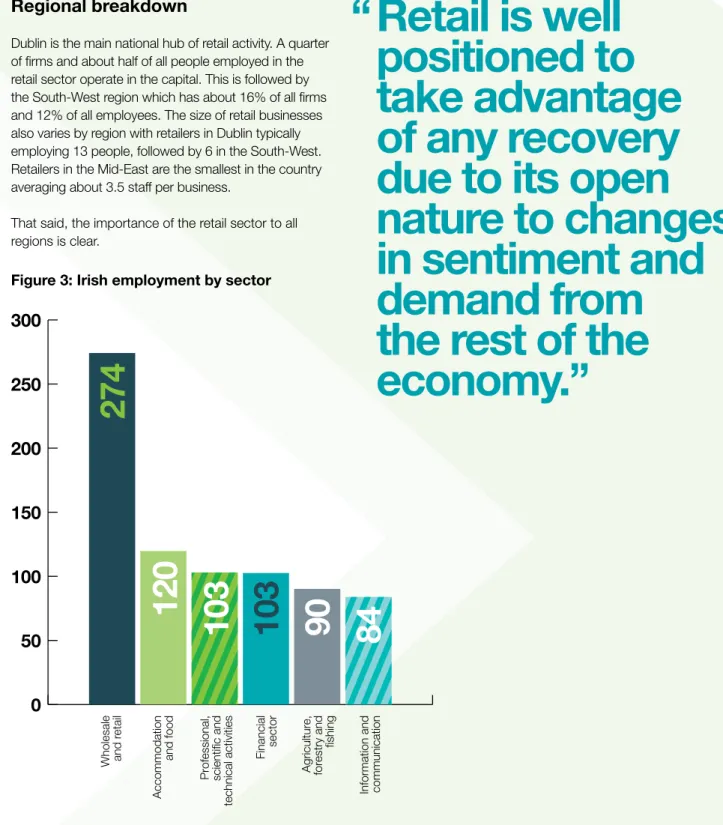
n At present, the Irish retail sector employs 275,000 people. This is the same as the numbers employed in IT, agriculture, forestry and fishing and the financial and insurance sector combined.
n Retail generates €5 billion in taxes every year, including €1 billion in employment taxes. The sector paid over €8 billion in wages in 2010. n 90% of Irish retail businesses are Irish owned
and 77% are family owned.
This is the first strategy produced by Retail
Ireland which is aimed at preparing the sector
for a return to growth in the coming years.
Executive summary
Figure 1: Ownership of Irish retail businesses
90%
Irish-owned
77%
family-owned
Vision for retail
Retail Ireland consulted with its members on their vision for the sector in the years to come. As a result of that consultation, the sector’s vision has been established as follows:
The Irish retail sector shall, in the coming years, grow on the basis of increased, sustainable demand, while proudly playing its role as a sizeable and responsible employer, recognised and widely respected as a significant contributor to the Irish economy.
Strategic objectives
To achieve our vision, four strategic objectives have been identified:
n A return to growth in the retail sector and making Ireland a recognised world leader in retail. n A maximisation of the benefit of increased
consumer spend to retail by operating within a competitive and consumer-focused policy environment.
n An increase in the scope and pace of innovation in order to benefit from any upturn in consumer spending from 2014.
n The promotion of retail as an exciting, progressive sector that is at the forefront of design and innovation.
Strategic actions
To support the strategic objectives a number of actions to be carried out by Retail Ireland are identified under the following themes:
n Ecosystem
- Retail Ireland will help create the appropriate policymaking ecosystem that adequately reflects the importance of the retail sector. - Among the actions to achieve this will be
stakeholder engagement, alliance building and deepening of EU ties.
n People and talent
- Retail Ireland will assist the retail sector to upskill its workforce in the face of a constantly evolving retail landscape.
- Among the actions to achieve this will be the promotion of the Ibec Retail Skillnet and the opportunity it offers to help retailers transform the public image of a “job in a shop” to “a career in retail”.
n Responsible retailing
- Retail Ireland will enhance the sector’s reputation as a responsible member of the community.
- Among the actions to achieve this will be the furthering of responsibility initiatives on the sale of alcohol, children’s clothing, healthy food and fair business practices. We will highlight the contribution of retail to stated policy goals such as achieving balanced regional development and promoting youth employment.
n eCommerce
- Retail Ireland will assist Irish retailers gain a larger share in the growing online market. - Among the actions to achieve this will be the
promotion of polices that tackle barriers to entry to online trading.
How retail can drive Ireland’s
economic growth
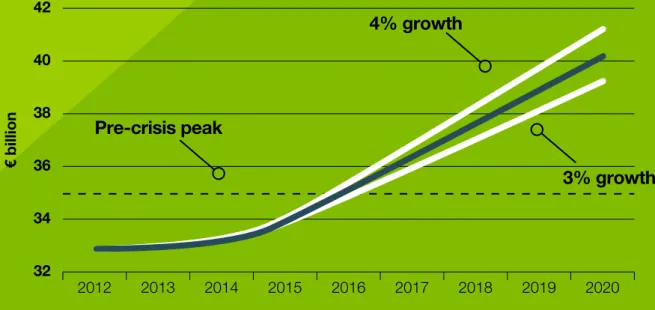
Ireland can reach pre-crisis levels of output by 2016 if the economy grows by 3-4% per annum in that period and can achieve GDP of €240 billion by 2020. Using this model, but building in a delay in retail sales recovery due to the overhang of high household debt, the consumer market can reach pre-crisis levels by 2017. On the basis of annual growth in retail sales of 3-4% until 2020, the Irish retail sector has the potential to reach €46 billion in value terms.
Such growth would lead to total employment in the retail sector of over 310,000 people – an increase of almost 40,000 on the current number.
“ Such growth would lead to total
employment in the retail sector
of over 310,000 people – an
In summary
n Retail employs 275,000 people – this is the total number of those employed in IT, agriculture, forestry and fishing and the financial and insurance sector combined.
n The retail and wholesale sector spent about €8.2 billion in wages and salaries in 2010, or an average of €30,000 per person.
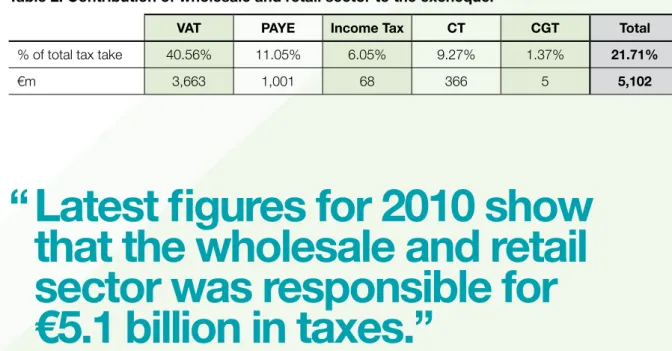
n Latest figures for 2010 show that the wholesale and retail sector generated €5.1 billion in taxes. This constituted over 20% of the total tax take from business in that year.
n Broken down by category, €3.6 billion of this came from VAT, while a further €1 billion came from PAYE. This shows the wholesale and retail sector as a major conduit to tax takes in the country.
n 90% of retail businesses in Ireland are Irish owned.
n 77% of retail businesses are family-owned.
n 38% of retailers have a turnover of less than €200,000.
n 77% of retailers have a turnover of less than €1 million.
Profile
The Irish wholesale and retail sector is Ireland’s largest business sector. One in four Irish businesses are involved in the sector, employing about 15% of the Irish workforce. There are nearly 40,000 retail firms in the country employing around 275,000 people. Almost 90% of firms in the sector are Irish owned making it Ireland’s largest indigenous economic sector also. Within these 40,000 firms there is a large amount of diversity in both the size of wholesalers and retailers and the type of products they are selling. About 38% of the sector’s firms are SMEs with a turnover of less than €200,000 per annum. A further 39% have a turnover of less than €1 million while only 3% of Irish wholesale and retail firms have a yearly turnover of more than €5 million. Irish owned businesses account for about 60% of this turnover.
Retailers themselves can be broadly divided into two categories, specialised stores and non-specialised stores. One in five Irish retailers are non-specialised, meaning they sell a broad range of goods. Among the other 81% or so of specialised stores the largest groups are sellers of food, beverages and tobacco (15%), household equipment (15%) and recreational goods (8.5%).
Table 1: Wholesale and retail
– an economic profile
Firm type % of firms
Irish 90%
Family-owned 77%
Non-specialised 19%
The contribution of
the retail sector to
Irish society
Figure 2: Turnover of Irish retail companies
38%
<€200,000
39%
€200,000
- €1m
20%
€1m-€5m
1.8%
€5m-€10m
1%
€10m
-€50m
0.2%
€50m+
Regional breakdown
Dublin is the main national hub of retail activity. A quarter of firms and about half of all people employed in the retail sector operate in the capital. This is followed by the South-West region which has about 16% of all firms and 12% of all employees. The size of retail businesses also varies by region with retailers in Dublin typically employing 13 people, followed by 6 in the South-West. Retailers in the Mid-East are the smallest in the country averaging about 3.5 staff per business.
That said, the importance of the retail sector to all regions is clear.
The sector employs between 24% and 30% of the private sector workforce in all Irish regions. In the Midlands about 30% of all people employed work in the retail sector, compared with 24% in the Mid-West and South East. Retail therefore is not only an important sector in terms of national employment but regionally as well.
It is clear that the wholesale and retail sector is a large, diverse, indigenous sector with great economic
importance, particularly when it comes to employment. Despite this, the sector has suffered more than most during the economic downturn. This is illustrated by the fact that almost 15% of all job losses since 2008 have come from wholesale and retail sectors. However, retail is well positioned to take advantage of any recovery due to its open nature to changes in sentiment and demand from the rest of the economy. As large open employers, retail is a sector which is vital to support if we are to have a jobs recovery.
Figure 3: Irish employment by sector
0
50
100
150
200
250
300
274
120
103
103
90
84
Wholesale and r etail Accommodation and foodProfessional, scientific and
technical activities
Financial sector Agriculture, forestry and
fishing
Information and communication
“ Retail is well
positioned to
take advantage
of any recovery
due to its open
nature to changes
in sentiment and
demand from
the rest of the
economy.”
Figure 4: Regional location of retail companies,
as % of national total of retailers
Figure 6: Average employees per enterprise
Figure 5: % of total private
sector workforce engaged
in retail, by region
25%
Dublin
16%
South-West
11%
West
12%
Border
10%
Mid-West
11%
Mid-East
9%
South
-East
6%
Midlands
0
2
4
6
8
10
12
14
4.4
4.5
5.0
13.0
3.5
5.0
4.5
6.0
Border Midlands West Dublin
Employment
As we have seen, one of the major economic contributions the retail sector makes to the Irish economy is through employment. The employment impact of the sector comes through two distinct avenues, direct employment and indirect employment. Wholesale and retail directly employs nearly 275,000 people, the same as IT, agriculture, forestry and fishing and the financial and insurance sector combined. Over half of these are employed in businesses of less than 50 people and 90% of these businesses are Irish owned (around 77% are family firms). The fact that this is over a large geographical spread gives the sector extra importance in bringing jobs to rural areas. A healthy wholesale and retail sector should also contribute to employment indirectly. Indirect employment is provided within Ireland through providing an intermediary function for other sectors to sell their goods and by supporting consumer activity through wages from employees from the wholesale and retail sector. This is complicated by the fact that some proportion of the jobs supported by wages from the sector will be within the sector itself. The wholesale and retail sector spent about €8.2 billion in wages and salaries in 2010, an average of €30,000 per head. This represents a significant economic outlay which supports a large number of jobs, households and communities.
Tax contribution
The contribution of the wholesale and retail sector to the exchequer comes not only through additional employment, income tax, PRSI and corporation tax but also through indirect taxes such as VAT and excise. Latest figures for 2010 show that the wholesale and retail sector was responsible for €5.1 billion in taxes. This constituted over 20% of the total tax take from business in 2010.
Broken down by category, €3.6 billion of this came from VAT, while a further €1 billion came from PAYE. This shows the wholesale and retail sector as a major conduit to tax takes in the country.
“ Latest figures for 2010 show
that the wholesale and retail
sector was responsible for
€5.1 billion in taxes.”
Table 2: Contribution of wholesale and retail sector to the exchequer
VAT PAYE Income Tax CT CGT Total
% of total tax take 40.56% 11.05% 6.05% 9.27% 1.37% 21.71%
Throughout the consultation period, members said that the retail sector should be recognised and widely respected as a significant contributor to the Irish economy and society, in terms of its direct and indirect economic impact, its role as a sizeable and responsible employer, and an investor in the fabric of Irish society.
They also stated that the sector should, with the support of local and national government, play a leading role in Ireland’s recovery and sustainable growth. This can be achieved through innovation, research and development, renewed capital
investment and education, training and development of people to provide high quality sustainable employment that benefits all stakeholders.
Accordingly, Retail Ireland has established the following vision for the sector:
The Irish retail sector shall, in the coming years, grow on the basis of increased, sustainable demand, while proudly playing its role as a sizeable and responsible employer, recognised and widely respected as a significant contributor to the Irish economy.
It is this vision that informs the strategic objectives and the actions to support them.
Vision for retail
With the current scale and breadth of the retail
sector made clear, Retail Ireland consulted with
its members to determine what the sector’s
The objectives represent four key areas of opportunity that Retail Ireland has identified for the retail sector in the coming years.
• A return to growth in the retail sector and the making of Ireland as a recognised world leader in retail.
• A maximisation of the benefit of increased consumer spend to retail by operating within a competitive and consumer-focussed policy environment. • An increase in the scope and pace of
innovation in order to benefit from any upturn in consumer spending from 2014. • The promotion of retail as an exciting,
progressive sector that is at the forefront of design and innovation.
Strategic objectives
In order to achieve the strategy’s vision,
a series of objectives have been established.
These objectives, set out by Retail Ireland,
underpin the vision and will be supported by
a series of specific actions.
“ About 38% of the sector’s firms
are SMEs with a turnover of less
than €200,000 per annum.”
A. Ecosystem
Retail Ireland will help create the appropriate policy making ecosystem that adequately reflects the importance of the retail sector to the Irish economy in the following ways:
• Further deepening engagement with stakeholders to promote the strategic importance of retail to the Irish economy. • Building on the work of the 2013
Inter-Departmental Group on Retail by assisting, where possible, in the implementation of its recommendations.
• Continuing regular consultation with the Department of Jobs, Enterprise and Innovation as the sponsoring department of the sector. • Engaging in greater cooperation with Enterprise
Ireland, building on existing retailer schemes such as the Innovation Development Programme and Foodworks.
• Deepening engagement with the National Consumer Agency (NCA) and its successor with Retail Ireland acting as a point of first contact on relevant consumer issues
and initiatives.
• Building of alliances with representative bodies of other parts of the supply chain (including Food and Drink Industry Ireland) to develop our industry.
• Promoting greater understanding at European level of the importance of retail and the contribution, in particular, of retail to the Irish
B. People and talent
Retail Ireland will assist the retail sector to upskill its workforce in the face of a constantly evolving retail landscape in the following ways:
• Promoting the take up of Ibec Retail Skillnet FETAC and HETAC accredited qualifications in retail. • Encouraging retailers to,
where appropriate, enrol staff in the Degree and Masters Degree programmes offered by the Ibec Retail Skillnet. • Highlighting to stakeholders
the sector’s determination to transform the image of retail employment from a “job in a shop” to a “career in retail”.
Strategic actions
To support the strategic objectives, and help
achieve the overarching vision as set out above,
Retail Ireland has identified four specific themes
and a number of strategic actions that it will
carry out, or urge others to carry out, in order to
promote the sustainable growth of Irish retail.
“ There are nearly 40,000 retail
firms in the country employing
around 275,000 people.”
C. Responsible retailing
Retail Ireland will maintain and enhance the retail sector’s reputation as a responsible member of the communities in which our members operate in the following ways:
• Promoting and enhancing responsibility initiatives including Responsible Retailing of Alcohol in Ireland (RRAI), Retail Ireland Childrenswear Guidelines, retailers’ own initiatives around promotion of healthy choices and other such initiatives.
• Encouraging all Irish grocery retailers to become signatories to the Principles of Good Practice in Vertical Relations in the Food Supply Chain, agreed by retailers and suppliers at EU level. • Highlighting the contribution of retail to balanced
regional development, youth employment and other stated Government policy aims.
• Tracking and promoting retailer investment in the Irish economy, including the purchase of Irish produce.
D. eCommerce
Retail Ireland will play a role in assisting retailers operating bricks and mortar outlets in Ireland gain a larger share in the growing online market in the following ways:
• Annually surveying members regarding their existing online presence, their plans to develop that presence and their experience of online retailing.
• Identifying barriers to online trading and drawing up proposals that would help our members to provide an online offering.
• Presenting proposals to increase domestic retailers share of this market to the Department of Jobs, Enterprise and Innovation and other stakeholders.
• Work with the Ibec Retail Skillnet to provide advice and training to retailers seeking to trade online, or improve their online offering.
Ireland’s growth potential
It is important to underline that this is not a forecast: it is, however, a pace of expansion that the Irish economy can achieve, if we make the correct policy choices domestically and sustained growth takes hold internationally. Our view of the capacity of the Irish economy is supported by the ESRI’s recent Medium-Term Review 2013-2020, which estimates Ireland’s potential growth rate at about 3.5%.
Figure 7 below shows the evolution of Ireland’s GDP under the assumption of 3-4% growth from 2015 onwards (for 2013 and 2014 we have used forecasts from Ibec’s July 2013 Quarterly Economic Outlook). Ireland can exceed the pre-crisis level of output in 2016. By the end of the decade, the volume of GDP has the potential to exceed €207 billion. Coupled with the normalisation in the growth rate, we also expect that price inflation will return to more normal levels. Factoring in price growth of about 2% per year, the value of GDP would exceed the pre-crisis peak by 2016 and would come in at about €240 billion by 2020.
How retail can
drive Ireland’s
economic growth
In the campaign Driving Ireland’s Recovery,
launched in April 2012, Ibec estimated that the
Irish economy has the capacity to grow by 3-4%
per year for the remainder of this decade.
220
210
200
190
€ billion
180
170
160
2012
2013
2014
2015
2016
2017
4% growth
3% growth
Pre-crisis peak
2018
2019
2020
Consumer spending and retail sales
Consumer spending in the Irish economy typically increases at about the same rate as GDP; for the period 2000-2012 average annual growth in the volume of consumer spending was 3.1%, compared with an average increase of 2.9% for GDP. However, it is likely that the recovery in consumer spending will be slightly delayed, when compared with the revival in the wider economy. Employment and income growth tend to follow an upturn in exports and investment with a lag. In addition, it will take some time for Irish households to work through the current debt overhang, so the savings rate may well remain elevated for the next few years. We therefore do not expect the consumer market to return to its potential growth rate until 2016.Even taking account of the delayed recovery, the consumer market can reach the pre-crisis peak by
2016. By 2020, the potential size of the total consumer market in Ireland is just above €100 million in volume terms. Factoring in a normalisation in the pricing environment, the value of the consumer market would exceed the pre-crisis peak by 2017 and be worth in excess of €115 billion by the end of the decade. Figure 8 below shows the developments for the retail market in Ireland. Retail sales (excluding car sales and repairs, but including motor fuels) account for about 40% of total consumer spending. We have assumed that this relationship will hold constant until the end of the decade. Given the increasing importance of online shopping, we have also assumed that Irish-based retailers will be able to capture this growing market segment. Given these assumptions, the retail market in Ireland can reach the pre-crisis peak by 2016. In volume terms, the size of the market may reach €40 billion by the end of the decade and exceed €46 billion in value terms.
42
40
38
€ billion 36
34
4% growth
3% growth
Pre-crisis peak
Employment impact
In 2012, employment in the wholesale and retail sectors averaged 275,000 people. Historically, employment growth has been about one percentage point lower than the volume of sales growth. This reflects the high employment intensity of the sector coupled with productivity improvements that have been in line with the performance of the other sectors of the domestic economy. Figure 9 below shows that wholesale and retail employment has the capacity to reach the pre-crisis peak by the end of this decade and employ in excess of 310,000 people, accounting for about 15% of total employment in Ireland.
330
320
310
300
290
thousand
280
270
260
250
240
2012
2013
2014
2015
2016
2017
4% growth
3% growth
Pre-crisis peak
2018
2019
2020
Figure 9: Employment potential of wholesale and retail, based on 3-4% GDP growth from 2015
Source: CSO and Ibec calculations
The scale of any recovery is not something that we have attempted to calculate in this strategy. Instead, the document shows how the right conditions for recovery can be put in place and, should a sustainable increase in consumer spending come about, the employment benefit that the Irish economy will experience. Retail Ireland will meet its commitments to our members by delivering on this strategy, engaging with stakeholders and communicating effectively on behalf of the retail sector. We will lead our members through a difficult and changing trading environment while offering a unified voice for retailers, large and small.
Conclusion
Ireland’s retail sector is large, diverse and
nationwide. After several years of decline,
brought about by the deepest domestic
recession in many years, the conditions
may now exist for a return to growth.
About this report
This report was drawn up in consultation with Retail Ireland members and a number of external stakeholders. Qualitative and quantitative methods were used to gather retailer opinion.
The data and projections were compiled by the Ibec Economics and Taxation unit. For further information, contact [email protected].
Strategy
for Retail
Retail Ireland
84/86 Lower Baggot Street Dublin 2
T: + 353 (0)1 605 1500 E: [email protected] W: www.retailireland.ie
Retail Ireland is a part of Ibec which represents Irish business; home grown, multinational, big and small, spanning every sector of the economy. Ibec and its sector associations, work with government and policy makers nationally and internationally, to shape business conditions and drive economic growth. We also provide a wide range of professional services direct to members. Visit www.ibec.ie and www.retailireland.ie for more information.
Ibec Head Office
84/86 Lower Baggot Street Dublin 2
T: + 353 1 605 1500 E: [email protected] W: www.ibec.ie/membership
Limerick
Gardner House Bank
Place Charlotte Quay Limerick T: + 353 61 410411 E: [email protected] W: www.ibec.ie/midwest Galway Ross House Victoria Place Galway T: + 353 91 561109 E: [email protected] W: www.ibec.ie/west Donegal
3rd Floor, Pier One Quay Street Donegal Town Donegal T: + 353 74 9722474 E: [email protected] W: www.ibec.ie/northwest Cork Knockrea House Douglas Road Cork T: + 353 21 4295511 E: [email protected] W: www.ibec.ie/cork Waterford
Waterford Business Park Cork Road Waterford T: + 353 51 331260 E: [email protected] W: www.ibec.ie/southeast Brussels Avenue de Cortenbergh 89, Box 2 B-1000 Brussels BELGIUM T: + 32 (0)2 512.33.33 F: + 32 (0)2 512.13.53 E: [email protected] W: www.ibec.ie/europe