Final presentation and evaluation of epidemiological
findings in the
EHEC O104:H4 Outbreak
Germany 2011
Map showing HUS incidence in the outbreak
EHEC bacteria of the outbreak strain O104:H4 Scanning electron microscope. Scale: 1 µm Source: Holland, Laue (Robert Koch Institute)
Edition information
Final presentation and evaluation of the epidemiological findings in the EHEC O104:H4 outbreak, Germany 2011
Robert Koch-Institute, September 2011 Available online at www.rki.de
Publisher
Robert Koch-Institute (RKI) Nordufer 20
13353 Berlin - Germany Editorial team
RKI, Department for Infectious Disease Epidemiology, Division 35 Press
RKI-Print Shop Suggested citation
Robert Koch Institute. Report: Final presentation and evaluation of epidemiological findings in the EHEC O104:H4 outbreak, Germany 2011. Berlin 2011.
Contents
Abstract ... 2
1 Descriptive Epidemiology ... 4
1.1 German Notification Data ... 4
1.2 Surveillance of bloody diarrhoea ... 8
1.3 Case reports abroad (as of 18 August, 2011) ... 10
1.4 Incubation period ... 11
1.5 Estimate of the exposure period ... 13
1.6 Reporting delays ... 14
1.7 “Now-Casting” ... 17
2 Investigations on the vehicle of infection ... 19
2.1 Early epidemiological studies ... 19
2.2 Analysis of a satellite outbreak in two canteens of a Frankfurt-based company .... 19
2.3 Recipe-based restaurant cohort study ... 20
2.4 Findings from additional case-control studies on the consumption of sprouts ...21
2.4.1 “Raw Vegetables” Case-Control Study ... 22
2.5 Investigations of disease clusters ... 23
2.5.1 Cooperation with the EHEC Task Force ... 23
2.5.2 Cohort studies of selected clusters ... 24
3 Bacteriology of the outbreak strain ... 25
3.1 Detection and characteristics of the pathogen ... 25
3.2 Laboratory tests at the NRC ... 26
4 Focus of other epidemiological studies ... 28
4.1 Studies of population consumption patterns ... 28
4.2 “Late cases” ... 31
4.3 Domestic environment and shedders ... 33
5 External communication by the RKI during the outbreak ... 34
5.1 Forwarding of information within the Public Health Service (ÖGD) and to national and international public authorities ... 34
5.2 Media- and public relations ... 36
6 Appendix ... 38
6.1 Schedule of documents provided via Early Warning and Response System during the outbreak ... 38
6.2 Schedule of documents provided during the outbreak on the RKI website (new or updated, as of 25 August 2011) ... 39
Abstract
From May to July 2011, primarily in northern Germany, there was a large outbreak of ill-nesses characterized by haemolytic-uremic syndrome (HUS) and bloody diarrhoea associ-ated with infections by enterohemorrhagic Escherichia coli (EHEC) of the serotype O104:H4. In this report, results from the surveillance, the epidemiological studies and microbiology of the Robert Koch-Institute (RKI) are presented. The contributions by the RKI to the identification of disease clusters and tracing of food items are found in a report by the EHEC Task Force at the Federal Office for Consumer Protection and Food Safety (BVL).
Epidemiological characterization and course of the outbreak
The outbreak (based on the date of onset of diarrhoea symptoms) began at the beginning of May 2011 and reached its peak on 22 May 2011. Since then, both the number of report-ed cases of EHEC gastroenteritis associatreport-ed with the outbreak and the number of new HUS cases decreased. Since mid-June, only sporadic cases of HUS occurred. On 26 July, the Robert Koch-Institute declared that the outbreak had ended. At that point, there had been no new cases clearly associated with the outbreak for 3 weeks, since the last illness on 4 July.
A total of 855 cases of HUS and 2,987 cases of acute gastroenteritis attributed to the break were contracted (as of 16 August 2011). The number of cases affecting women out-numbered men in both HUS (68%) and EHEC (58%). The majority of cases involved adults. This is in stark contrast to the observed cases of EHEC gastroenteritis and HUS reported in the last years, in which small children were predominantly affected. Death was reported for 35 (4.1%) of the patients identified with HUS and 18 (0.6%) of the pa-tients with EHEC gastroenteritis.
Cases of illness were reported from all federal states, but the 5 most northern states were most affected, including Hamburg, Schleswig-Holstein, Bremen, Mecklenburg-Western Pomerania and Lower Saxony, with HUS incidence in these states up to 10 cases per 100,000 persons.
Once the infection vehicle (sprouts) was identified and its distribution was stopped at the beginning of June, there were no further clusters associated with the consumption of this vehicle. In the late stages of the outbreak, cases of secondary transmission by infected persons via close contact within households occured, as well as distinct localized out-breaks that could be attributed to secondary contamination of food products by employees (EHEC shedders) in the food industry. There were also a few recorded laboratory infec-tions.
Intensive surveillance for EHEC O104 was continued after the official end of the outbreak in order to identify a potential transition of the infection to an endemic phase. After July 4, 7 additional infections from EHEC O104 were recorded, as yet exclusively cases of ap-parent transmission within households or from occupational exposure (data as of August 30, 2011). Overall, the frequency of EHEC and HUS reported after July 4 sharply de-creased to a rate interpretable as “background”.
Evidence for sprouts as the vehicle of infection
Large-scale EHEC infection outbreaks typically originate from fecal contamination of veg-etable or animal foods which are not sufficiently heated prior to consumption or are typi-cally consumed raw. Evidence for sprouts as the responsible vehicle in this outbreak in Germany arose from epidemiological studies by the Robert KochInstitute in collaboration with regional and local public health authorities, as well as with clinics and the investiga-tions of the federal food safety authorities. Epidemiological studies show a statistically
significant association between the consumption of sprouts and risk of disease (e.g. reci-pe-based restaurant cohort study: relative risk 14.2; 95% CI 2.6 - ∞; all 31 cases in the co-hort study explained by the consumption of sprouts). Investigations by the EHEC Task Force at the BVL revealed that 41 of 41 well-documented localities (e.g. restaurants) in each of which several cases were exposed (so-called clusters) can be traced back to sprouts from Company A in Lower Saxony.
In the synopsis of the available results, the RKI, the Federal Institute for Risk Assessment (BfR) and the BVL concordantly concluded that the outbreak in Germany caused by EHEC O104:H4 was attributable to the consumption of contaminated sprouts from Company A. An outbreak involving EHEC O104:H4 reported in France (illness onset be-tween 15 and 20 June) likewise indicated a connection with the consumption of locally produced sprouts. Investigations by national and international food authorities revealed that fenugreek seeds involved in France and in Company A could be traced back to the same supplier.
Conclusions for further epidemiological surveillance and recommendations This outbreak of EHEC infections is the largest recorded up to now in Germany and, based on the number of cases of HUS, is the largest outbreak of this sort worldwide. Within a relatively short period of time, epidemiological studies and systematic tracing of food products led to the discovery of sprouts as the vehicle of infection. Currently there is no evidence to suggest that the EHEC O104:H4 pathogen has become endemically estab-lished in Germany after the end of the outbreak.
The activities of epidemiological surveillance were constant and focussed on surveillance in accordance with the Protection Against Infection Act (IfSG) for EHEC and HUS, as well as emergency room monitoring of cases of bloody diarrhoea in selected hospitals. Furthermore, doctors and the public health services maintained increased vigilance for the occurrence of bloody diarrhoea and HUS including a rapid diagnosis (with differenti-ation with respect to the outbreak strain) and notificdifferenti-ation of in- and outpatients. Further-more, within the context of the notification requirements for EHEC and HUS, all new cases of EHEC and HUS that meet the outbreak case definition continue to be scrutinized by local health authorities based on a questionnaire developed by the RKI (e.g. regarding secondary transmission, laboratory infection) in order to be able to identify the source of infection of these new cases.
The explicit advice to consistently observe personal hygiene and food hygiene measures continues to be vital. Strict adherence to hand hygiene (http://www.bzga.de/?sid=663) and other standard measures of hygiene are of central importance. Stringent adherence to hygienic practices is generally essential in a household, but particularly in the presence of EHEC-infected persons or persons with diarrhoea. This means that the utmost cleanli-ness is especially imperative in the kitchen and bathroom. Apart from direct consumption of contaminated food, the bacteria can also be transmitted via hand contact or contami-nated kitchen utensils. This is of particular importance if potentially contamicontami-nated food is not subsequently heated. The risk can be reduced if hands and kitchen utensils are
washed thoroughly with water and soap/detergent and dried carefully before preparing food, especially food that will not be subsequently cooked. (The recommendations of the BfR can be found at: www.bfr.bund.de > A - Z Index > EHEC). Objects, clothing or sur-faces contaminated with feces or vomit should be immediately washed or cleaned; typical household gloves should be worn if there is contact. Recommendations are available at
1
Descriptive Epidemiology
On 19 May 2011, the RKI was invited by the Health and Consumer Protection Agency in Hamburg to assist the responsible authorities in the investigation of a cluster of three paediatric HUS cases. Upon arrival of the RKI team on 20 May, it quickly became clear that adults were atypically also affected by HUS, and that the number of cases continued to rise rapidly. An outbreak investigation was initiated.
1.1
German Notification Data
The electronic reporting system in Germany has collected standardized data covering HUS and EHEC gastroenteritis cases since 2001. Suspicion of disease, disease and death from HUS are notifiable by the treating physician according to §6 of the IfSG (Protection Against Infection Act), and EHEC-detection is notifiable by laboratories according to §7 IfSG. All information pertaining to the cases is amalgamated by the local public health departments (a case is either an EHEC gastroenteritis case OR an HUS case). In addition to the routine surveillance, on 23 May local and state public health departments were re-quested in a newsletter to report HUS and HUS suspected cases to the RKI immediately after receiving the notification and to add subsequent case investigation results.
In contrast to the usual surveillance reference definitions of EHEC gastroenteritis (toxin-based laboratory detection, serogroup optional, and illness with symptoms of gastroenter-itis) and HUS (purely clinical case definition, EHEC detection by laboratory diagnostics is optional), the following restrictions were set in place in order to define the cases likely attributable to the outbreak: cases with onset of disease (the typical first symptom is diar-rhoea) between 1 May and 4 July 2011 were included (“outbreak time period”). Cases with unknown illness dates were counted from reporting week 19 (beginning 9 May) to 28 (ending 17 July). Cases with evidence for EHEC sub types that do not correspond to the characteristics of the outbreak strain were excluded. This applies to EHEC of serogroups other than the outbreak strain O104:H4 (for details see section 3), as well as to EHEC without serogroup information reported to be only stx1-positive. With data as of 1pm on 16 August 2011, all reported HUS cases (including any remaining suspected cases) and all EHEC cases that met the clinical description were analysed.
A total of 855 cases of HUS and 2,987 cases of EHEC gastroenteritis (without develop-ment of HUS) were reported, hence a total of 3,842 cases is attributable to the outbreak. For 5% of HUS cases and 9% of EHEC gastroenteritis cases, a date of disease onset is not available.
An additional 19 HUS cases and 719 EHEC cases were recorded, which were not ascribed to the outbreak because of the exclusion criteria described above. In the same time period in the previous 5 years (2006-2010), a median of 13 HUS cases and 218 EHEC gastroen-teritis cases were reported. For the 2011 outbreak period, this corresponds to a 67-fold increase in HUS and a 17-fold increase in EHEC. The increase in the number of 2011 EHEC cases not ascribed to the outbreak (n=719), well beyond the total EHEC cases in the previous year (n=218), reflects the strongly increased attention to and higher clinical in-vestigation rates for EHEC.
Among the HUS cases, 68% were female and the median age was 42 years (range from 0 to 91 years). Among EHEC cases, 58% were female and the median age was 46 years (range from 0 to 100 years). Figure 1 shows the incidence of reported HUS cases by age and gender. Hospitalization is likely in all HUS cases (for EHEC reported for 54%). Among HUS patients, 35 (4.1%) died and among the patients with EHEC gastroenteritis, 18 (0.6%) died.
0 1 2 3 4 0-9 10-19 20-29 30-39 40-49 50-59 60-69 70-79 80+ Age group C o lu m n s: H U S I n z id en ce ( C ases/ 100, 000 p o p .) 0 10 20 30 40 50 60 70 80 L in e: P ro p o rt io n o f f em al e case p at ien ts ( % ) Incidence female Incidence male Proportion female
Figure 1: Incidence of HUS by age category and gender (left y axis) and the proportion of cases that were female (right y axis) in each age category (n=855 HUS cases).
Disease onset (based on diarrhoea symptoms) of the first case of HUS in an adult was 8 May, which is also the date of the first case of HUS with detection of EHEC O104. On 1 May, a 45-year-old male from Aachen became ill with EHEC. In that case, other diarrhoea pathogens in addition to EHEC O104 were detected, so it is not clear whether the disease onset with respect to EHEC really is 1 May. In the next EHEC case with detection of O104, onset of illness was 8 May, the same as for HUS. This case involved a 42-year-old female from Lower Saxony.
Among the HUS cases, the proportion of bloody diarrhoea reported was 79%, and among EHEC cases this proportion was 56%. These values are taken as minimum percentages, since the input screen of the current electronic reporting system only offers the options “bloody diarrhoea” and “diarrhoea, not specified”.
Data on laboratory detection of EHEC O104 in known cases is currently still forwarded to RKI. Currently there is information confirming the outbreak strain EHEC O104 for 42% of laboratory-confirmed cases of HUS and 21% of EHEC diarrhoea cases. Based on the distinct excess of cases due to the outbreak compared to the previous year as outlined above, it must however be assumed that almost all these HUS cases can be attributed to the outbreak, and a large percentage of the EHEC cases, the size of which cannot be de-termined precisely because of the lack of microbiological data.
Figure 2 shows the epidemiological curve of HUS and EHEC cases. Both curves sharply rise from 8 May on, peak on the 21 and 22 May, respectively, and then decline quickly at first and more slowly later on. Considering only cases with detection of O104, the peaks are on 20 May (HUS) and 22 May (EHEC gastroenteritis).
As of 27 July, no new cases that could be clearly attributed to the outbreak were reported (criteria: HUS in an adult with O104 or no serogroup confirmed, or EHEC with O104 confirmed). Therefore, whe the outbreak was deemed ended as of 5 July the active phase of the outbreak investigation ended and the post-outbreak surveillance phase began. Un-der these conditions (as of 30 August 2011), 7 additional cases with disease onset dates between 17 July and 14 August came to the attention of the RKI, in which O104 was de-tected and/or infection with it was probably: one household secondary HUS case in an adult with detection of O104 in the primary case only, as well as 6 EHEC cases with de-tection of O104. 0 50 100 150 200 250 1 2 3 4 5 6 7 8 9 10111213141516171819202122232425262728293031 1 2 3 4 5 6 7 8 9 101112131415161718192021222324252627282930 1 2 3 4
May June July
Date of disease onset (diarrhea), 2011
N u m b er o f cases EHEC-gastroenteritis HUS
Figure 2: Epidemiological curve for HUS and EHEC outbreak cases (809 HUS and 2,717 EHEC cases with known date of disease onset (diarrhoea) within the outbreak time period.
Within the outbreak time period, cases were reported from all 16 states; however, the five most northern federal states (Hamburg, Schleswig-Holstein, Bremen, Lower Saxony and Mecklenburg-Western Pomerania) were most affected (HUS disease incidences from 1.8 to 10.0 cases per 100,000 persons – all other states had incidence rates <1 cases per 100,000 persons).
Figure 3 illustrates the HUS incidences per county (including independent cities). Case persons with travel history within Germany are counted in the county in which they were probably infected.
Figure 3: Incidence (cases per 100,000 persons) of HUS during the outbreak, illustrated by county, in which infection likely occurred (residence county, or in cases with travel history, the county of presence at the time of infection).
Compared to the HUS and EHEC data reported from previous years, the following differ-ences can be noted:
• Compared to 696 cases of HUS reported to the RKI from 2001 to 2010, the affect-ed persons in the HUS outbreak cases are much older. Only 2% of outbreak cases are under age 5, compared to 69% of HUS cases in previous years in which HUS was primarily a paediatric problem.
• The proportion of women among the EHEC outbreak cases (58%) is similar to their proportion among the adult EHEC cases from 2001 to 2010 (61%). However, the proportion of women among the HUS outbreak cases (68%) compared to the 63 adult HUS cases from 2001 through 2010 (56%) is higher.
The current outbreak is the largest HUS/EHEC outbreak that has ever been described in Germany, and in terms of the number of reported cases of HUS, it is also by far the world's largest described outbreak of this kind. For a more detailed description of the re-ported data, see also the various scientific publications on the outbreak in Eurosurveil-lance1,2 as well as other publications currently in preparation. A final version of the New
England Journal of Medicine3 article is expected to be published by the end of 2011.
1.2
Surveillance of bloody diarrhoea
Since bloody diarrhoea is frequently the first symptom EHEC patients experience, the development of an EHEC outbreak can be assessed almost real-time by ascertaining pa-tients presenting with these symptoms, e.g. in emergency departments. On 27 May 2011, syndromic surveillance of patients with bloody diarrhoea was established in emergency departments of voluntarily participating hospitals. Because reported numbers of emer-gency admissions fluctuated daily, on 1 July, daily case reporting was carried on in those emergency departments participating as constantly as possible, in order to enhance inter-pretation possibilities of the data. The surveillance was continued through 30 September, 2011, since even after the end of the outbreak itself, people could have excreted O104:H4 and isolated EHEC O104:H4 cases could have been reported to the Public Health Service. The participating emergency departements represented all states, both in areas more affected (Bremen, Hamburg, Schleswig-Holstein as well as parts of Lower Saxony (north) and North Rhine-Westphalia (Paderborn)) as well as in areas less affected by the out-break. Data collection included the total daily number of all patients visiting the partici-pating emergency departments and the number of patients with bloody diarrhoea by gen-der and age group (<20 years, >= 20 years).
The data were sent to the RKI via e-mail or fax on a daily basis. As of 30 June, a total of 193 emergency departments had participated in the syndromic surveillance; of these, 28 were located in areas more affected. As the surveillance continued from 1 July onward, 75 emergency departments were participating; of these, 16 were located in the more affected areas described above. The number of actively participating emergency departments var-ied from day to day. Therefore, results may subsequently change if further, retrospective data are sent from emergency departments. All the analyses that follow are based only on the data from those emergency departments that took part after the continuation of the surveillance after a July.
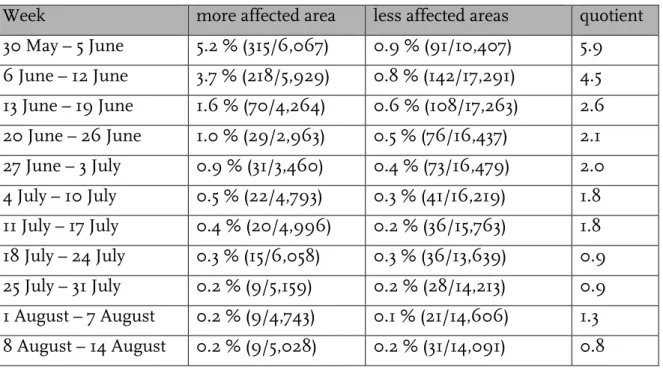
From the start of of the bloody diarrhoea surveillance, the proportion of patients with bloody diarrhoea among all patients visiting emergency departments in more affected areas progressively converged with the proportion among patients visiting emergency departments in less affected areas. After the reporting week from 18-24 July, there was no
1 Frank C, Faber M, Askar M, et al. Large and ongoing outbreak of haemolytic uraemic syndrome, Germa-ny, May 2011. Euro Surveill 2011;16:pii=19878.
2 Askar M, Faber M, Frank C, et al. Update on the ongoing outbreak of haemolytic uraemic syndrome due to Shiga toxin-producing Escherichia coli (STEC) serotype O104, Germany, May 2011. Euro Surveill 2011;16; pii=19883.
3 Frank C, Werber D, Cramer JP, et al. Epidemic Profile of Shiga-Toxin-Producing Escherichia coli O104:H4 Outbreak in Germany - Preliminary Report. N Engl J Med 2011.
difference in the proportion between groups (Table 1). Figure 4 illustrates the proportion of patients with bloody diarrhoea among all emergency department patients by gender and age group in more affected areas. Women were more frequently affected by bloody diarrhoea than men. After 30 May, a decreasing proportion of females among the cases was observed.
Table 1: The proportion of patients with bloody diarrhoea out of all patients visiting emergency de-partments by area and week. Quotient represents the “Proportion in more affected areas relative to the proportion in less affected areas”. EHEC/HUS outbreak, Germany 2011.
Week more affected area less affected areas quotient 30 May – 5 June 5.2 % (315/6,067) 0.9 % (91/10,407) 5.9 6 June – 12 June 3.7 % (218/5,929) 0.8 % (142/17,291) 4.5 13 June – 19 June 1.6 % (70/4,264) 0.6 % (108/17,263) 2.6 20 June – 26 June 1.0 % (29/2,963) 0.5 % (76/16,437) 2.1 27 June – 3 July 0.9 % (31/3,460) 0.4 % (73/16,479) 2.0 4 July – 10 July 0.5 % (22/4,793) 0.3 % (41/16,219) 1.8 11 July – 17 July 0.4 % (20/4,996) 0.2 % (36/15,763) 1.8 18 July – 24 July 0.3 % (15/6,058) 0.3 % (36/13,639) 0.9 25 July – 31 July 0.2 % (9/5,159) 0.2 % (28/14,213) 0.9 1 August – 7 August 0.2 % (9/4,743) 0.1 % (21/14,606) 1.3 8 August – 14 August 0.2 % (9/5,028) 0.2 % (31/14,091) 0.8
0 5 10 15 20 0 1 2 3 4 5 30 31 1 2 3 4 5 6 7 8 9 10 11 12 13 14 15 16 17 18 19 20 21 22 23 24 25 26 27 28 29 30 1 2 3 4
May June July
N um be r o f e m er ge nc y d ep ar tm en ts Pr opo rt io n o f bl oo dy di ar rho ea am on g al l E D pat ie nt s ( % )
Day of visit to emergency department
Participating EDs Female, ≥20 years Male, ≥20 years Female, <20 years Male, <20 years 0 5 10 15 20 0.0 0.2 0.4 0.6 0.8 1.0 5 6 7 8 9 10 11 12 13 14 15 16 17 18 19 20 21 22 23 24 25 26 27 28 29 30 31 1 2 3 4 5 6 7 8 9 10 11 12 13 14 July August N um be r o f e m er ge nc y d ep ar tm en ts Pr opo rt io n o f bl oo dy di ar rho ea am on g al l E D pat ie nt s ( % )
Day of visit to emergency department
Participating EDs Female, ≥20 years Male, ≥20 years Female, <20 years Male, <20 years
Figure 4: Surveillance of bloody diarrhoea in emergency departments in more affected areas: propor-tions of patients with bloody diarrhoea among all patients visiting emergency departments, by gender and age group, EHEC/HUS outbreak, Germany 2011 (n=747), for each time period (A): 30 May – 4 July and (B): after 5 July. Forenhanced legibility, the figure have different scales on the y-axis.
1.3
Case reports abroad (as of 18 August, 2011)
France reported a local EHEC O104 outbreak in Bordeaux that was not associated with a stay in Germany4. The outbreak comprised 15 cases with onsets of disease between 15 and
20 June, which are probably associated with the consumption of sprouts grown in France. This suggests that contaminated sprouts (and/or their seeds) as a vehicle for infection were not confined to Germany and needed to be taken into consideration as vehicle in other occurring disease clusters domestically and internationally. For details, see
4 Gault G, Weill FX, Mariani-Kurkdjian, et al. Outbreak of haemolytic uraemic syndrome and bloody diar-rhoea due to Escherichia coli O104:H4, south-west France, June 2011. Euro Surveill. 2011;16(26):pii=19905. Available online: http://www.eurosurveillance.org/ViewArticle.aspx?ArticleId=19905
an Food Safety Authority (EFSA) and European Centre for Disease Prevention and Con-trol (ECDC) statement from 29 June 20115.
There were two additional cases reported that did not involve stay in Germany or con-firmed consumption of sprouts from Sweden (1 case) and Austria (1 case).6
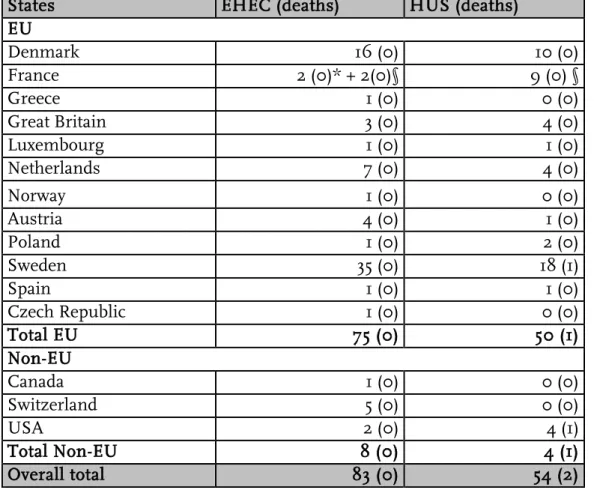
In addition to these cases, all EHEC or HUS cases which occurred internationally to date have directly or indirectly been linked to a stay in Germany (see Table 2).
Table 2: Number of cases and deaths in countries in the European Union (Source: ECDC, as of 26 July 2011 11:00 a.m., WHO: as of: 21 July 2011 6:00 p.m.)
States EHEC (deaths) HUS (deaths)
EU Denmark 16 (0) 10 (0) France 2 (0)* + 2(0)§ 9 (0) § Greece 1 (0) 0 (0) Great Britain 3 (0) 4 (0) Luxembourg 1 (0) 1 (0) Netherlands 7 (0) 4 (0) Norway 1 (0) 0 (0) Austria 4 (0) 1 (0) Poland 1 (0) 2 (0) Sweden 35 (0) 18 (1) Spain 1 (0) 1 (0) Czech Republic 1 (0) 0 (0) Total EU 75 (0) 50 (1) Non-EU Canada 1 (0) 0 (0) Switzerland 5 (0) 0 (0) USA 2 (0) 4 (1) Total Non-EU 8 (0) 4 (1) Overall total 83 (0) 54 (2)
* Cases in connection with stay in Germany
§ Cases in connection with the outbreak in Bordeaux (only 11 of the 15 cases are listed)
1.4
Incubation period
During the investigation of the outbreak, evidence emerged indicating a prolonged incu-bation period for infections with the outbreak strain (compared to information in the lit-erature and experience from previous outbreak investigations with other EHEC sero-types). Knowledge of the incubation period is of central importance for epidemiological studies (e.g. in order to consider the correct exposure period when interviewing patients), for the evaluation of epidemiological trends and for the establishment of preventative measures. On the basis of known exposure time points in selected cases and their date of disease onset, the incubation period wasestimated for the outbreak strain. In this
5http://www.efsa.europa.eu/de/press/news/110629a.htm
6 EFSA/ECDC joint rapid risk assessment: Outbreak of Shiga toxin-producing E. coli (STEC) O104:H4 2011 in the EU 8 July 2011 (updated from 29 June)
tion, only cases with known date of onset and a known exposure period of a maximum of 2 days were included (compare publication in NEJM7).
Cases for which area of residence and presumed exposure site were exactly the same or located within the outbreak area were excluded. The data analyzed originated from the statutory notification system, from restaurant-clusters and from international cases. Within these criteria, the incubation period could be analyzed for 91 cases. The resulting probability mass function is illustrated in Figure 5.
0 1 2 3 4 5 6 7 8 9 10 11 12 13 14 15 16 17 18
Days since exposure
P robabi li ty 0. 00 0. 05 0. 10 0. 15 0. 20
Figure 5: Estimated probability mass function on the incubation period (based on 91 individuals) with corresponding pointwise 95% confidence intervals.
The median incubation period up to the onset of diarrhoea symptoms is 8 days, with the 25th percentile at 6 days and the 75th percentile at 10 days. Compared to the incubation period of EHEC O157 (3 to 4 days), the incubation period for EHEC O104 is significantly longer.
To estimate the duration from the onset of diarrhoea until the onset of HUS, data from the statutory notification system were analysed. The calculation is based on 98 cases: the median between the onset of diarrhoea and the onset of HUS was 5 days, with the 25th percentile at 4 days and the 75th percentile at 7 days. The average duration between the onset of diarrhoea and HUS appears to be shorter for the outbreak strain than for infec-tions with enterohemorrhagic E. coli serotype O157 (7 days).
7 Frank C, Werber D, Cramer JP, et al. Epidemic Profile of Shiga-Toxin-Producing Escherichia coli O104:H4 Outbreak in Germany - Preliminary Report. N Engl J Med. 2011 Jun 22. [Epub ahead of print]
1.5
Estimate of the exposure period
The incubation period estimated in Section 1.4 can be used to estimate the possible time point of exposure of the cases. For this, HUS cases with known date of onset of diarrhoea were used (as of 23 August 2011: 809 of 854 cases).
The back-projection from the onset of diarrhoea to the time of exposure is performed by the method of Becker et al.8, which was developed for the back calculation from AIDS
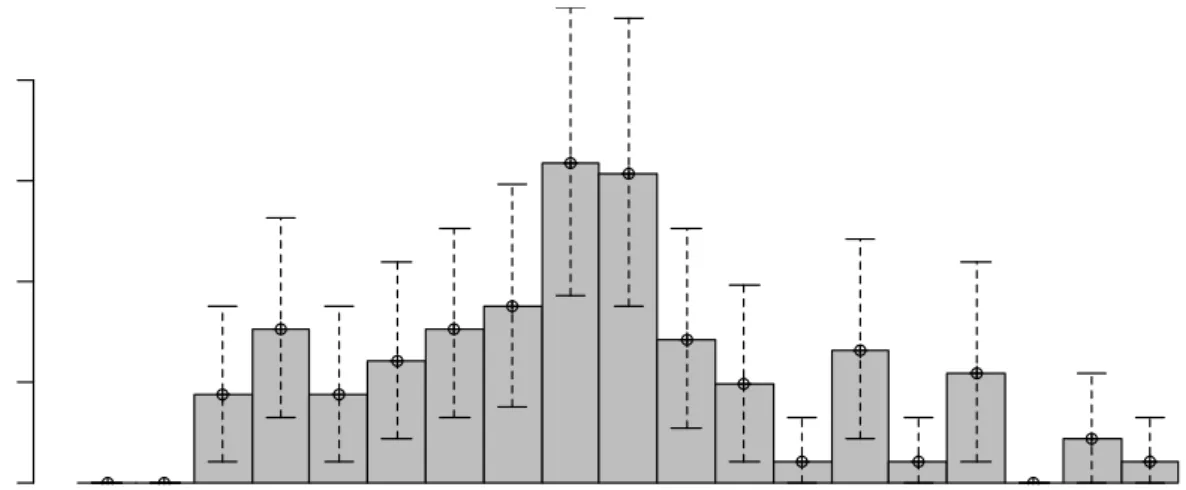
incidence to HIV incidence. In Figure 6, the blue bars (i.e. λt) indicate the estimates for the expected number of exposures per day. The figure also contains 95% bootstrap confi-dence intervals for λt to account for the uncertainty in the estimate of the incubation peri-od used for the back-projection.
C as es 20-04 23-04 26-04 29-04 02-05 05-05 08-05 11-05 14-05 17-05 20-05 23-05 26-05 29-05 01-06 04-06 07-06 10-06 13-06 16-06 19-06 22-06 25-06 28-06 01-07 04-07 Yt t 0 20 40 60 80 100
Figure 6: Back-projection from the daily onsets of disease to daily exposures. The thin orange bars Yt show the actual observed cases by onset of disease, the thick blue bars λt show the estimated expected number of exposures per day (including 95% confidence intervals).
The back-projection indicates that 90% of HUS cases, which were reported as part of the outbreak, are likely to have had their exposure before 23 May. Furthermore, the greatest number of new daily infections occurred in the period between 12 May and 14 May.
8 Becker NG, Watson LF, Carlin JB (1991), A method of non-parametric back-projection and its application to AIDS data, Statistics in Medicine, 10(10):1527–1542.
1.6
Reporting delays
EHEC and HUS cases occur in low numbers throughout the year, without them being attributed to an extraordinary cluster or other unusual event. The RKI was initially in-formed by email about a small cluster (n = 3) of paediatric HUS cases in Hamburg on 19 May 2011. Before this date, no increase of the reported EHEC and HUS cases compared to the number to be expected was evident. After 20 May 2011, the RKI investigated the outbreak in northern Germany in close collaboration with health and food safety authori-ties of the federal and state level.
All cases with disease onset after 1 May 2011, but typically reported later, were retrospec-tively included in the epidemiological analysis. This date was chosen to describe the be-ginning of the outbreak as completely as possible. Distinction must be made between the date of onset of disease, date of hospitalization, date of diagnosis and date of report to the local health authority and receipt of the notification at the RKI.
According to the specifications of the German Infection Protection Act, a case of disease must be reported by the diagnosing physician and detection of a pathogen by the labora-tory to the appropriate local health authority within 24 hours. The local health authority reviews the information and enters it into an electronic database. By the third business day of the following week at the latest, the information is notified electronically to the re-sponsible state health authority and then within another week (at the latest) it is electroni-cally sent to the RKI (according to § 11 IfSG). After the EHEC/HUS outbreak became known, from the week beginning 23 May 2011 onward, the Robert Koch Institute request-ed daily notification of new HUS cases and updates on previously known cases. Between 24 May and 27 July, more than 50% of the cases were notified to the RKI within two days and 75% were notified within four days after receipt of the report at the local health au-thority.
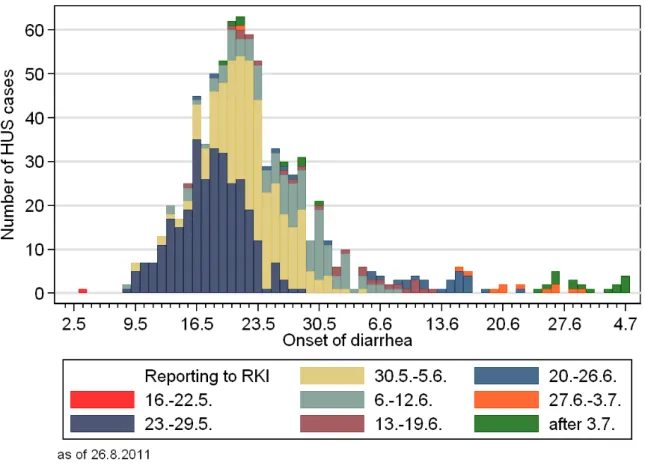
In practice, from the onset of disease until the visit with the doctor and/or until hospital admission and then until report to the local health department and electronic notification of these data via the responsible state authorities to the RKI, there is a period between a few days and several weeks. Figure 7 shows the current (as of 26 August 2011, 10:00 a.m.) number of HUS cases reported to the RKI by onset of disease. Displayed in colour is the date (week of receipt of the notification at the RKI) on which the cases were notified to the RKI. It is clear that only one case of HUS with the onset of disease on 3 May 2011 was known to the RKI before 23 May 2011, but this could not be recognized as exceptional due to the undetermined serotype at that time. It was not until the week from 23 to 29 May 2011 that a greater number of HUS cases were notified to the Robert Koch Institute. At that point, investigations conducted by the RKI had already begun.
Figure 7: HUS cases by onset of disease and week of receipt of the notification at the RKI.
Likewise in the EHEC reporting category, in which there is a "background" of a few cases per week, only 3 cases were notified in the week from 9 until 15 May 2011, another 5 cases from 16 until 19 May 2011 (in the week from 16 until 22 May 2011, a total of 14 cases) without specified serotype; only in the week from 23 to 27 May 2011 was a larger number of cases sent to the RKI.
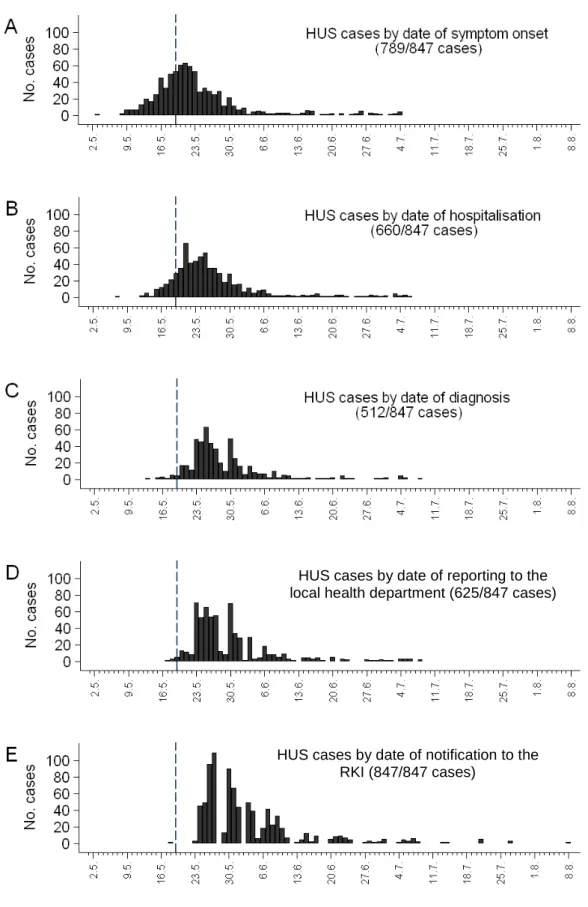
Figure 8 illustrates the epidemic curve of HUS cases by onset of disease, beginning of hospi-talization, date of diagnosis, date of reporting to the local health department (GA) and receipt of the notification at the RKI. This analysis considered only those date data, which follow the natural temporal sequence from onset of disease, to diagnosis, to reporting and finally notifi-cation transmission. The delays between the level of the entire process become apparent. Re-garding HUS, at the beginning of the outbreak onset of disease and hospitalization dates lie well before the date of notification, which is also true for the diagnoses dates of the first cases. The receipt of the notification at the RKI is again a few days after the report to the local health authority. The sum of these individual delays leads to the total delay between disease onset
and notification received at the RKI9.
9 Altmann M, Wadl M, Altmann D, et al. Timeliness of surveillance during outbreak of Shiga toxin– producing Escherichia coli, Germany, 2011. Emerg Infect Dis. 2011 Oct; [Epub ahead of print] http://www.cdc.gov/eid/content/17/10/pdfs/11-1027.pdf
Figure 8: HUS cases, according to outbreak case definition, presented chronologically by: date of disease onset (A), date of hospitalization (B), date of diagnosis (C), date of reporting to health author-ities (D), and date of receipt of notification at the RKI (E). The vertical line marks 19 May, the date on which RKI received the report on a cluster of 3 HUS cases in Hamburg.
HUS cases by date of reporting to the local health department (625/847 cases)
HUS cases by date of notification to the RKI (847/847 cases)
1.7
“Now-Casting”
During the course of the epidemic, it was important to take into account the reporting and notification delay in the interpretation of the number of reported HUS cases by date of disease onset. Therefore, for each day, the number of hospitalized cases, which had not yet been sent to the RKI, was retrospectively estimated (a kind of "now-casting").
In order to estimate the reporting/notification delay distribution, dates of hospitalization and dates of receipt of the corresponding notifiation at the RKI of HUS cases notified to the RKI between 23 May and 1 June were utilised. Based on this distribution, from 2 June on, now-casting was conducted as follows:
Let yt,s be the number of hospitalizations on day t, which were reported to the RKI at the
time s≥t, and let yt be the number of actual hospitalizations on day t, i.e.
∑
∞ = = t s s t t y y , . In
other words, at time s only yt,s =F(s−t)⋅yt hospitalizations were observed at the RKI.
Here, F is the estimated distribution function of the notification and reporting delay, us-ing the data from the period 23 May to 1 June. A forecast on day s for the actual number on day t is thus ) ( , t s F y yt ts − = .
To take into account the uncertainty in the estimation of the distribution function F in the calculation of the forecast, 95% prediction intervals were also calculated for F and then correspondingly transformed to obtain a 95% prediction interval for yt.
Figure 9 ilustrates the results of the now-casting on 7 June 2011. The cases, by date of hospital admission, reported to the RKI by this date can be discerned (in green). Also shown are the estimated number of hospitalized cases, which until then had not been reported/notified because of the reporting/notification delay (orange).
Figure 10 depicts the result of the now-casting as of 23 June 2011. It is evident that after 13 June – even when taking into account the delay in notifying and reporting – only few HUS cases were predicted and have occurred.
Figure 9: Now-Casting on 7 June 2011. The green bars show the situation of HUS, reflected by the data available to RKI as of 7 June 2011. The now-cast forecasts are illustrated in orange and the 95% prediction intervals (PI) in blue.
Figure 10: Now-Casting on 23 June 2011. The green bars show the situation of HUS, reflected by the data available to RKI on 23 June 2011. The now-cast forecasts are illustrated in orange and the 95% prediction intervals (PI) in blue.
2
Investigations on the vehicle of infection
Since 20 May 2011, the RKI investigated the outbreak of haemolytic-uremic syndrome (HUS) and bloody diarrhoea associated with infections by enterohemorrhagic Escherichia coli in northern Germany in collaboration with health and food safety authorities of the federal and state governments. The cause of the outbreak could be narrowed down by a number of consecutive epidemiological studies. The most important studies and results are presented below.
2.1
Early epidemiological studies
The time course, geographic and demographic distribution of cases and the initial explor-atory interviews with patients early on indicated the transmission route in this outbreak to be food-borne. Vehicles such as raw milk, raw meat or sprouts that had been identified as a source of infection in previous EHEC/HUS outbreaks appeared to play no role in cur-rent events according to exploratory interviews.
The first case-control study of patients in Hamburg was limited for methodological rea-sons to those exposures that were able to explain a large proportion of cases. Thel analysis showed a significant association of being a case with consumption of raw tomatoes, cu-cumbers, and lettuce. On 25 May, these findings were released in a joint news conference with the Federal Institute for Risk Assessment (BfR)10, communicated within the Early
Warning and Response System (EWRS) of the EU and on 26 May together with a prelim-inary description of the outbreak in a publication in the online-journal Eurosurveillance11.
Since neither thiss study nor evidence from the food safety sector could narrow down this list of vegetables at this time, the RKI initiated and conducted further studies.
2.2
Analysis of a satellite outbreak in two canteens of a
Frankfurt-based company
Between 9 and 17 May 2011, a total of 60 employees at two locations of a Frankfurt-based company contracted bloody diarrhoea, nine of which were laboratory-confirmed (to be EHEC infected); 18 of the 60 employees developed HUS. On 19 May 2011, the health de-partment of the city of Frankfurt am Main was informed of the events by the personnel office of the company and initiated an investigation of the outbreak.
The Health Protection Authority City and the Veterinary Service of Frankfurt am Main, together with the Robert Koch Institute and the operators of the canteens, were able to acquire a list of the purchases made in the canteen in the weeks from 2 to 16 May for case persons (n = 23) and for randomly selected healthy persons (n = 30) with the help of elec-tronic billing documentation. A logistic regression analysis (Table 3) was performed. The risk of contracting bloody diarrhoea for employees who had bought and consumed a salad in the canteen in the above mentioned period was six times higher compared to employees who had not bought any salad. A total of 20 of the 23 cases (87%) could be explained by the salad purchase. The consumption of other foods from the canteen was not significantly associated with the disease. With this study, a salad bar item available in the canteen could be identified as the most likely vehicle.
10 Preliminary results of the EHEC/HUS study (Statement of the BfR and RKI of 25 May 2011),
http://www.rki.de/cln_178/nn_467482/DE/Content/InfAZ/E/EHEC/Gemeinsame__Stellungnahme__RKI __BfR.html
11 Frank C, Faber M, Askar M, et al. Large and ongoing outbreak of haemolytic uraemic syndrome, Germa-ny, May 2011. Euro Surveill 2011;16:pii=19878.
The results of the subsequently conducted nationwide traceback analyses revealed that the operator of the two canteens was connected through one distributor to the producer of sprouts in Lower Saxony (Company A). These were also offered in the two canteens. After becoming aware of this connection, a new, more specific survey among the employees regarding the actual salad bar components to confirm the sprout hypothesis was unfortu-nately not possible any more 12.
.
Table 3: Results of the univariable and multivariable analyses (odds ratios and associated 95% confi-dence intervals, 95% CI) of risk factors for the development of bloody diarrhoea for guests at two canteens in Frankfurt am Main.
Univariable Multivariable
Odds ratio (95% CI) Odds ratio (95% CI) Salad consumption 5.83 (1.42-23.88) 6.57 (1.37-31.39) Dessert consumption 1.52 (0.48-4.81) Fruit consumption 0.53 (0.15-1.81) Asparagus consump-tion 0.75 (0.24-2.41) Gender (♀=1) 2.28 (0.73-7.15) 2.63 (0.63-10.96) Age <30 2.80 (0.62-12.66) 2.13 (0.41-11.17)
30-<40 Reference value Reference value 40-<50 0.43 (0.09-2.14) 0.53 (0.09-2.98)
≥50 0.70 (0.09-5.43) 0.31 (0.03-3.07)
2.3
Recipe-based restaurant cohort study
In order to be less dependent on raw vegetable consumption memory of patients and con-trol subjects during the analysis, the RKI pursued the following approach with the help of a "recipe-based restaurant cohort study": 13
Partly in the context of cluster detection with the support of information from public health services, and partly as a result of active case finding by means of the order books of a restaurant, 10 groups with a total of 176 participants could be identified, who dined in the same restaurant during the period from 12 to 16 May 2011. Individuals who could not be reached and for whom no other person could give details concerning the meal that was served to them, or who could not remember the dish they had eaten, were excluded. A total of 31 (18%) individuals from the groups contracted bloody diarrhoea or EHEC/HUS. This exposure information came from two sources:
12 Wilking H, Götsch U, Meier H, et al. Use of payment system information for detection of risk factors during an outbreak of Shiga-Toxin–Producing Escherichia coli (STEC) O104. Emerg Infect Dis. 2011 [ac-cepted]
13 Buchholz U, Bernard H, Werber D, et al. German Outbreak of Escherichia coli =104:H4 Associated with Sprouts. NEJM 2011; [accepted]
• The group participants were asked which meal they had ordered (photographs were used as a reminder), though in principle, the pre-ordered meals were already known for most groups from the booking lists of the restaurant
• The chef of the restaurant was interviewed in detail concerning the quantities of each ingredient went into which meals and how each meal was prepared.
The information from these interviews was evaluated in a cohort approach that retrospec-tively calculates the relative risk of disease (RR) for restaurant customers in the corre-sponding period. Here, the analyses showed that customers, who had been served
sprouts, had a 14.2 times higher risk of contracting the disease in the univariable analysis (95% CI 2.6 - ∞, p <0.01) according to the case definition, compared to people who had not been served sprouts. All 31 case subjects had been served a meal that contained
sprouts. The result of the univariable analysis was confirmed in the multivariable analysis (RR: 14.2, 95% CI 2.4 - ∞, p<0.01). The use of other raw ingredients such as tomatoes, cucumbers or green salad in the served meals yielded no significant p-values (p> 0.15) in the analysis for an increased relative risk of disease.
Table 4: Results of univariable and multivariable analyses of the recipe-based restaurant cohort study. RR = relative risk; 95% CI.
In the period in which the groups dined in the restaurant, the restaurant used only one mixture of sprouts, containing fenugreek sprouts, alfalfa sprouts, adzuki bean sprouts and lentil sprouts. The supplier of sprouts for the restaurant received the sprouts from the incriminated Company A in Lower Saxony.
2.4
Findings from additional case-control studies on the
consump-tion of sprouts
A variety of animal and vegetable foods, including sprouts, had already been taken into account during the first intensive survey of patients from Hamburg (20/21 May). In these exploratory interviews, only 3 of 12 patients declared having eaten sprouts. Overall, the patients interviewed stood out because of very conscious and careful eating habits, which made a relevant under-reporting of sprouts unlikely. It is a methodological requirement and standard practice to include only those exposures that are potentially able to epidemi-ologically explain a large part of the outbreak in further analyses.14 Otherwise, the risk of
false positive correlations increases with the inclusion of an excessive number of expo-sures. Therefore, the sprouts were not initially pursued as a vehicle for the outbreak. Sprouts were taken into account in subsequent detailed studies conducted by the RKI.
14 World Health Organization (WHO), 2008: Foodborne Disease Outbreaks: Guidelines for Investigation and Control. http://www.who.int/foodsafety/publications/foodborne_disease/outbreak_guidelines.pdf)
Ingredient Total
Cases among the exposed
Total number exposed
Cases among the
non-exposed Total number non-exposed RR 95% CI p-value Univariatel Sprouts 152 31 115 0 37 14.23 2.55-infinity <0.01 Tomatoes 152 14 50 17 102 1.68 0.77-3.62 0.18 Cucumbers 152 14 50 17 102 1.68 0.77-3.62 0.18 Chinese cabbage 152 13 45 18 107 1.72 0.77-3.71 0.17 Radicchio 152 13 45 18 107 1.72 0.77-3.71 0.17 Iceberg lettuce 152 13 45 18 107 1.72 0.77-3.71 0.17 Multivariate Sprouts 14.17 2.40-infinity <0.01
2.4.1 “Raw Vegetables” Case-Control Study
In order to further narrow down the list of raw vegetables suspected as potential vehicles of infection, another case-control study was conducted. The study involved interviewing case subjects in three cities strongly affected by the outbreak (Lübeck, Bremerhaven and Bremen). Case patients were adult HUS patients who were hospitalized during the study period in one of three hospitals in Lübeck, Bremerhaven or Bremen. Controls were indi-vidually matched to case patients by age group (18-34 years, 35-44 years, 45 years or older), gender and place of residence, with a target ratio of 1:3. Recruitment of the controls was carried out by contacting residents at their homes. A starting point was set approximately 50m from the address of the case subject.
On the basis of previous exploratory interviews with other HUS patients, the cases and controls in this study were interviewed regarding the consumption of primarily vegetable foods, such as fruits and raw vegetables, during the 2 weeks before the onset of diarrhoea (cases) or prior to the interview (controls). In addition, sprouts were included in the list of potential risk foods, although only 25% of HUS patients had reported their consumption in exploratory interviews. Conditional logistic regression was used for statistical analyses. Multivariate models were determined using a manual forward/backward strategy based on p-values.
A total of 26 cases (9 men, 17 women) and 81 controls were included in the study. The median age of cases was 47.5 years (interquartile range 29-75 years). With respect to sprout consumption, 6 (25%) of the 24 cases indicated they had eaten sprouts in the as-sumed infection period, compared to 7 (9%) of the 80 controls with information on this item. Table 5 lists all exposures with p <0.1.
Table 5: Fruit and vegetable exposures associated with adult HUS (p-value <0.1) in univariate analysis of the “raw vegetable” case-control study.
Exposure Exposed cases Exposed controls Matched Odds Ratio
(95% CI) p No./Total No. (%) No./Total No. (%) Sprouts 6/24 (25) 7/80 (9) 4.35 (1.05-18.0) 0.043 Cucumbers 22/25 (88) 52/79 (66) 3.53 (0.96-12.9) 0.057 Apples 22/24 (92) 57/81 (70) 3.91 (0.86-17.7) 0.077 Peppers 16/24 (67) 35/80 (44) 2.66 (0.90-7.9) 0.077 Strawberries 19/26 (73) 43/81 (53) 2.33 (0.90-6.0) 0.082
*Exposures with p>0.1: raw onions, lettuce, asparagus, carrots, tomatoes, basil.
In multivariate analysis, sprouts and cucumbers were first examined together: both varia-bles remained significant, with an Odds Ratio (OR) of 5.8 for sprouts (95% CI 1.2-28.6; p=0.032) and an OR of 6.0 (95% CI 1.1-31.3) for cucumber. None of the other above-mentioned exposures that were then tried in the model had a significant associations with disease.
In the study, information on the source of supply for some of the exposures was also col-lected. Consumption of raw vegetables (cucumbers, carrots, tomatoes or lettuce) outside the home was positively associated with HUS (OR=9.4, 95% CI, 2.7-32.8). This could in-dicate that people were infected, for example, by eating salads outside the home (e.g. in canteens, restaurants). The above-mentioned foods are commonly consumed together (in the form of a salad), wherein a contamination may have affected these and/or another food product which was not remembered.
As part of a subsequent survey of cases and controls who at first had denied eating
sprouts or could not remember having done so (20 cases, 73 controls), 8 (40%) cases and 37 (51%) controls were re-interviewed. Overall, 3 of the 8 (37.5%) interviewed cases
changed their original statement and now reported to have definitely eaten sprouts in the surveyed period. None of the 37 re-interviewed controls changed their original statement. If the results of the re-interviewed cases are extrapolated to all cases that denied having eaten sprouts or were uncertain they had done so, the proportion of remembered sprout consumption out of all cases can be estimated as 52%.
2.5
Investigations of disease clusters
2.5.1 Cooperation with the EHEC Task Force
The EHEC Task Force convened by the Federal Ministry of Food, Agriculture and Con-sumer Protection (BMELV) consisted of experts from the state food safety authorities in five states (Lower Saxony, Schleswig-Holstein, Mecklenburg-Western Pomerania, Ham-burg and Bavaria), the BVL, BfR, EFSA and RKI. The EHEC Task Force was coordinated by the BVL and the Bavarian Health and Food Safety Agency (LGL). So-called disease clusters were analyzed with respect to supply channels and supply chains for certain food items.
A cluster was defined as occurrence of at least one case of disease (EHEC or HUS) at an exposure site, when there were strong indications that the infection could only have oc-curred at this place. This was the case, for example, when members of a tour group, in which there were several cases of disease, had eaten together only at one particular res-taurant.Locations where individual cases had consumed food were considered for follow-up, if only a single exposure site was likely, e.g. Danish tourists travelling through north-ern Germany had only eaten at one specific motorway service station. As a first step, the identification of clusters was essentially conducted by means of information on cases ob-tained by the RKI. The information came from physicians, e.g., in hospitals, local and state health departments, health authorities from other countries, e.g., Sweden, Denmark and USA, from data reported to the RKI via the surveillance system and also from pa-tients themselves, e.g., through patient questionnaires in epidemiological studies con-ducted by the RKI.
Overall, the Task Force was able to identify 41 outbreak clusters according to the above definition in six affected states (Lower Saxony, Schleswig-Holstein, Mecklenburg-Western Pomerania, Hamburg, Hessen, and North Rhine-Westphalia). These 41 clusters involved more than 300 cases. All 41 clusters could be linked to sprouts from sprout-producing Company A in Lower Saxony.
Two individuals in Lower Saxony infected with the outbreak strain had exclusively con-sumed sprouts that they themselves had grown from a sprout seed mix (“self-sprouters”). This suggested that contaminated sprout seeds must underlie the outbreak. Fenugreek and lentil seeds presented as the common denominator among all 41 outbreak clusters and the “self-sprouters”. The results of the investigation into the HUS/EHEC O104:H4 outbreak in France in June 2011, in which the disease was similarly linked to consump-tion of privately-grown sprouts (see Secconsump-tion 1.3), allowed the identification of the vehicle of infection to be narrowed to fenugreek seeds from Egypt. The detailed results of this
investigation are presented and explained in a separate report on the work of the EHEC Task Force at BVL15 and the European Task Force coordinated by the EFSA16.
2.5.2 Cohort studies of selected clusters
Disease clusters were identified using reporting data, international data sharing, anecdo-tal evidence and standardized interviews of HUS patients in clinics17. Before sprouts were known to be the likely infection vehicle, cohort studies were carried out by the RKI using three early identified clusters. In this epidemiological approach, individuals from travel groups were interviewed in detail regarding their food consumption with the help of menu item lists, when a common exposure site was probable. The aim of the cohort studies was to identify the food item(s) the consumption of which was associated with increased risk of bloody diarrhoea/HUS. Groups of persons with a manageable number of members (diseased and healthy individuals) and with available contact information (phone numbers or e-mail addresses), who had a limited period of exposure (e.g. a partic-ular weekend) at a common potential exposure site (e.g. a restaurant, hotel) and who were willing to participate in a survey by the Robert Koch Institute were suitable for cohort studies. A statistically significant association between consumption of particular foods (primarily lettuce, cucumbers and tomatoes) and the disease was partly found in the ini-tial analyses of the cohort studies, but there was no single meal or food item that could explain all the disease cases. After there had been indications from other studies suggest-ing sprouts as infection vehicle, follow-up inquiries were conducted in the restaurants. Retrospectively, all cases could be explained through the consumption of sprouts (for ex-ample, in salads or as garnish for certain dishes). The fact that consumption of sprouts was commonly not remembered is consistent with the follow-up interviews of case per-sons in the “raw vegetable case-control study”. Through analysis of the supply channels, the sprouts could be traced back to the sprout-producing Company A in Lower Saxony and, moreover, to seed batches imported from Egypt for use in sprout production (see Section 2.5.1)
15 Die Task Force EHEC: Adolphs J, Appel B, Bernard H, et al.: Ergebnisbericht der Task-Force EHEC zur Aufklärung des EHEC O104:H4 Krankheitsausbruchs in Deutschland. Journal für Verbraucherschutz und Lebensmittelsicherheit (http://www.springerlink.com/content/1661-5751), DOI 10.1007/s00003-011-0710-7, 2011
16 European Food Safety Authority (2011): Tracing seeds, in particular fenugreek (Trigonella foenum-graecum) seeds, in relation to the Shiga toxin-producing E. coli (STEC) O104:H4 2011
Outbreaks in Germany and France, http://www.efsa.europa.eu/de/supporting/doc/176e.pdf
17 Deleré Y, Eckmanns T, Krause G, et al.: Screening-/Kurzfragebogen zur explorativen Befragung von Pati-enten mit blutigem Durchfall während des EHEC/HUS-Ausbruchs in Deutschland. DN-Mitteilungen (Mit-teilungsblatt der Deutschen Gesellschaft für Nephrologie). Heft 3, 2011.
3
Bacteriology of the outbreak strain
3.1
Detection and characteristics of the pathogen
A cluster of patients with the clinically very characteristic disease pattern for HUS in Northern Germany reported to the RKI on 19 May 2011 quickly directed attention to the Shigatoxin-producing E. coli (EHEC) as the pathogen.
On 23 May 2011, the information was received at the National Reference Centre (NRC) for Salmonella and other Bacterial Enteric Pathogens that samples received there on 19 and 20 May 2011 might be connected to the outbreak. The result of the detection of the EHEC virulence markers stx1 (negative), stx2 (positive) and eae (negative) routinely tested by means of PCR was available on 23 May 2011 for 2 isolates of the outbreak strain (11-01997, 11-02027). On 24 May 2011, the consulting laboratory for HUS was informed about the determination of the O-antigen O104. Further characterization of the pathogen as Shigatoxin 2 (variant vtx 2a)-producing E. coli of serovar O104:H4 took place on 25 May 2011, coinciding with the results from the consulting laboratory for HUS at the Uni-versity of Münster (Prof. Karch). On 25 May 2011, preliminary information on the strain (E. coli O104, stx2+, eae-, hly- with resistance to 3rd-generation cephalosporines (ESBL)) was placed on the ECDC outbreak information platform EPIS. On 26 May 2011, the NRC demonstrated by means of macrorestriction analysis (PFGE) on five selected isolates (in-cluding isolates from Bremerhaven and Frankfurt) that it is very likely that the respective patients belong to one epidemiological event.
Further investigations (see also the ongoing updates of the EHEC-data sheet on the web-site of the Robert Koch Institute18 and at EPIS) showed numerous specifics of the
patho-gen, which are described in detail in the appendix, together with concrete information on microbiological diagnostics.
For international communication and strain comparisons, the PFGE pattern was submit-ted to the EPIS platform and a reference strain was sent to the Clinical Reference Labora-tory for E. coli (Dr. Caprioli) in Rome, the WHO RL for E. coli (Dr. Scheutz) in Copenha-gen, the National Reference Laboratory for E. coli at the BfR in Berlin (Dr. Beutin) and the consulting laboratory for HUS (Prof. Karch) in Münster.
Although Shigatoxin-producing E. coli of the serotype O157:H7 or O157:H- are most fre-quently responsible for causing HUS globally, other EHEC serotypes (non-O157) with the potential to cause HUS have also been identified. The most comprehensive collection of EHEC strains of different serovars, known as the HUSEC collection, is located at the con-sulting laboratory for HUS (Prof. Karch, University of Münster). Among others, the O104:H4 HUSEC041 strain isolated at the NRC/RKI in 2001 was also integrated into this collection.
The current outbreak involves the rare EHEC serotype O104:H4, which up to now had not been described in animals and only rarely in humans [Germany 2001/HUSEC041, France 2004, Korea 2006, Georgia 2009 and Finland 2010, additional isolates of the O-antigen type O104 exhibit a different H-O-antigen (O104:H2; O104:H7; O104:H16;
O104:H21)].
18 For characteristics of the pathogen as well as information and assistance of the RKI in the diagnosis of the outbreak strain, visit www.rki.de;
Particularly noteworthy is that the outbreak strain in addition to the Shigatoxin 2a
• possesses virulence characteristics of enteroaggregative E. coli (the typical EAEC virulence plasmid with the adhesion fimbriae type AAF/I described here for the first time in EHEC, any other to date known EAEC or STEC/EAEC O104:H4 had AAF/III fimbriae) and
• has special resistance characteristics (see Appendix: Characteristics of the path-ogen as well as information and assistance of the RKI in the diagnosis of the out-break strain currently circulating, www.rki.de).
Meanwhile, there are sequence data from the outbreak strain, showing a strong homology to enteroaggregative E. coli (55989) 19.
Since the species E. coli is also part of the normal flora of the human intestine, the detec-tion of pathogenic E. coli variants requires specific sub-taxonomic diagnostic methods. Here, in particular, the detection of certain virulence markers, including an isolation and availability of a pure culture, plays an important role. This is especially important in the framework of less characteristic disease patterns, such as (bloody) diarrhea, but also for the detection in asymptomatic shedders.
In particular, the search is facilitated by the E. coli antibiotic resistance phenotype (ESBL), unusual for intestinal E. coli, because it allows for the use of corresponding selective me-dia for a targeted search. The NRC detected this resistance and immeme-diately used it for the systematic search for the pathogen (using the ESBL- selective medium combined with a multiplex PCR screening for stx1, stx2 and eae or using the ESBL-selective medium
combined with a multiplex PCR for the stx2, rfbO104 and fliCH4 genes (protocol accord-ing to Prof. Karch from 06 June 2011)).
Especially in the late phase of the outbreak of the Shigatoxin-producing E. coli O104:H4, the differentiation from sporadically circulating strains without the ability to produce ESBL becomes increasingly important to correctly identify infected individuals and shed-ders with strains different from the outbreak strain. The labs need to follow a search strategy that does not only focus on the use of selective media.
Such a non-selective search strategy (without ESBL selective medium) is routine practice at the NRC. This was continued parallel to the epidemic strain special diagnostics. These investigations are critical for assessing the "background action" and hence for the final assessment of the progression of the outbreak.
3.2
Laboratory tests at the NRC
Between 20 May 2011 and 5 August 2011, a total of 3224 samples from suspected cases were sent to the NRC. 1023 strains were allocated to the outbreak by means of serovar determina-tion, PCR of virulence factors ESBL production and the resistance profile. In 590 samples, no evidence for an EHEC/EPEC infection was found. Submissions from several northern Ger-man laboratories are included in the total number, which have made collections of their sam-ples available to the NRC. These 450 samsam-ples are processed separately.
Apart from the outbreak strain O104:H4, 87 EPEC and 702 EHEC cases were also identi-fied as additional E. coli pathogens. A total of 311 of these EHEC isolates and 53 of the EPEC isolates could be allocated to 42 different serotypes with very different virulence
19Mellmann A, Harmsen D, Cummings CA, et al. 2011: Prospective Genomic Characterization of the Ger-man Enterohemorrhagic Escherichia coli O104:H4 Outbreak by Rapid Next Generation Sequencing Tech-nology. PLoS ONE 6(7): e22751. doi:10.1371/journal.pone.0022751
patterns. Strain isolation for further molecular subtyping was not successful for 209 samples.
From the perspective of the NRC, the collected data still provides no evidence for another concurrent event.
4
Focus of other epidemiological studies
4.1
Studies of population consumption patterns
Between 24 May and 24 June, repeated surveys with participants of an online-panel were carried out in order to gather information on population consumption patterns. In partic-ular, this forum addressed the following issues:
• How much have consumption patterns changed in the regions more affected by the outbreak following the consumption recommendations and the media cover-age?
• How much have patterns changed with respect to personal hygiene (e.g. more fre-quent hand washing) or in meal preparations?
The interviews were conducted as an online survey by the Society for Consumer Research (GfK), with preparation of the questions by RKI. Invitation to participate in the survey, programming of the questions, and the delivery of information was conducted by the GfK in order to achieve a representative random sample (by age group, gender and socio-economic status). The random sample comprised individuals from all federal states; how-ever, the analysis on which this report is based considered only the data from Northern Germany. Registered and “selected” participants were invited by email to take part in the online survey. For each round of questions, the online survey was open for a period of a week, as in a survey wave. Overall, there were 4 waves: wave 1 from 27 May to 3 June, wave 2 from 3 June to 10 June, wave 3 from 10 June to 17 June, and wave 4 from 17 June to 24 June. For each survey wave, 2100 individuals were surveyed, of whom 1831 individ-uals took part in all four weeks and were subsequently analysed. In order to reflect the opinions of all levels of the population and to account for variable response rates (e.g. be-tween different age groups), the sample was weighted by age, gender, socio-economic status and state.
Based on the statements of 1831 wave 3 study participants that were included in the analy-sis, more than two-thirds (76%) of the population in northern Germany completely or partially quit consuming raw vegetables following the 25 May 2011 public recommenda-tion (in the middle of the 21st calendar week; not to consume raw tomatoes, cucumbers or lettuce in northern Germany).
The analysis by gender indicated only a marginal difference (men 73%, women 78%). Almost half the population (43%) of northern Germany completely stopped eating “raw vegetables”.
In a differentiated treatment of consumption of tomatoes, cucumbers and lettuce, it was apparent from wave 3 that cucumbers (66%) and lettuce (64%) in particular were com-pletely relinquished, whereas the percentage of the population comcom-pletely giving up to-matoes was somewhat lower (57%). There was only negligible difference between men and women.
On 10 June 2011 (at the end of the 23rd calendar week) a new public advisory ecommend-ed consumers avoiding eatingsprouts. At the same time, previous advisories recommend-ing consumers avoid eatrecommend-ingraw cucumbers, tomatoes and lettuce were repealed. In wave 4 approximately 20% of individuals who had previously quit eating raw cucumbers, toma-toes and lettuce stated that they were once again consuming as much of these raw vegeta-bles as they had prior to the warning (tomatoes 22%; cucumbers 18%; lettuce 16%). Al-most a quarter (tomatoes 25%; cucumbers 23%, lettuce 18%) of these individuals ate
more of these vegetables again, although not in the same quantities as before the con-sumption warning. In this case too, there was no difference between genders.
Once sprouts came under suspicion of being the EHEC O104 outbreak vehicle, 84% of the population quit eating raw sprouts according to the statements in wave 3, and 80% gave them up according to wave 4.
Since the increased reporting of EHEC cases, approximately 2/3 (63%) of the population paid more attention to personal hygiene, for example in the form of more frequent hand washing. In this, there was a more obvious gender difference (men 59%; women 68%). For people involved in meal preparations, 62% (men 57%; women 67%) of the population of northern Germany paid more attention to cleanliness.
Figures 11 and 12 illustrate the proportion of the consumption of each of raw tomatoes, cucumbers, lettuce and carrots by the population during the calendar weeks 19t through 23. For all food products shown, there was a clear decrease in consumption particularly within the 21st and 22nd calendar weeks, although the trend for carrots is less
pro-nounced. Consumption of sprouts is included after the 21st calendar week. Overall, only a very small percentage of those surveyed declared eating sprouts. Figure 12 shows the de-velopment of cucumber consumption for different age groups and genders. The trend in cucumber consumption is similar for men and women, but starts at the lowest level for men in all age groups (with the exception of over 59 year olds). The decrease between weeks 19 and 20 is conspicuous and could be related to a subjective influence of memory against the background of the consumption warning during the week in which the ques-tion was asked. In the 23rd calendar week, the proporques-tion of the populaques-tion eating these foods clearly increased, but did not reach the same magnitude as in the 19th week. This corresponds to the statements given above, where only around 20% of the population returned to their previous consumption behaviour after the consumption warning was repealed. Overall, these data make clear how the population actually reacted to the con-sumption warning, and also that concon-sumption of other raw vegetables, such as carrots, decreased somewhat even though no warning was issued against them.
Figure 11: Estimated proportion of the adult population in northern Germany who said they had con-sumed raw tomatoes, cucumbers and lettuce during the 19th through 23th calendar week.
Figure 12: Estimated proportion of the northern Germany adult population, displayed by age group and gender, who said they had consumed raw cucumbers during the 19th through 23th calendar week.