NBER WORKING PAPER SERIES
DEBT AND CONDITIONALITY UNDER ENDOGENOUS TERMS OF TRADE ADJUSTMENT
Joshua
Aizerunan Eduardo R.Borensztein
Working Paper No. 2582
NATIONAL BUREAU OF ECONOMIC RESEARCH 1050 Massachusetts Avenue
Cambridge, MA 02138 May 1988
The Hebrew University at Jerusalem and NBER, and International Monetary Fund, respectivitely. The paper was written while Joshua Aizenman was consultant at the Research Department of the I.M.F. While being responsible for remaining errors, the authors wish to thank Mike Dooley, Sebastian Edwards, Elhanan Helpinan, Peter Isard, Mohsin Khan, Assaf Razin, Blair Rourke, Sweder van Wijnbergen, the participants in the NBER Mini- Conference on International Trade and Finance with Limited Global Integration and in the Research Department Seminar at the IMF for many comments and suggestions. The research reported here is part of the NBER's research program in International Studies. Any opinions expressed are
NSER Working Paper #2582 May 1988
Debt and
Conditionality
under Endogenous Termsof
Trade AdjustmentASS TDACT
The purpose of this study is to identify conditions under which
renewed international lending will benefit both the developed and the
developing countries. Our analysis will evaluate how the presence of terms of trade adjustient and distorted credit markets affect the
conditions for the existence of beneficial lending. We demonstrate
that in the presence of endogenous terms of trade adjustment, there
are cases in which a competitive international banking systen nay not revitalize lending for investment purposes, even if such renewed
lending is socially desirable Renewed lending nay require the
appropriate conditionality, and the presence of endogenous terms of trade adjustment puts greater weight on investment conditionality.
Joshua Aizeninan Eduardo
R. Borenszte
Econonjjts
Departsent
in
Th:tHa1iversity
I. Introduction
The international capital market is presently characterized by effective credit rationing to developing countries. Most developing countries cannot obtain new credits from the international banking
system. This situation is in sharp contrast with the 1970's, when the international banking system engaged willingly in substantial resource
transfer to the developing countries. This remarkable switch from a functioning international credit market to a market characterized by credit rationing reflects the growing awareness of the country risk
involved in further lending to developing countries. Most developing
countries have reached a point where their willingness or ability to
service their debt is questionable, thereby increasing the reluctance of the international banking system to extend new credits. This
situation is further complicated by the drop in export prices
experienced by the developing nations in recent years, a process that has further reduced their ability and willingness to service their
debt.
A
significant literature has evolved in recent years which attempts to study the unique characteristics of international country risk. The lack of simple enforcement mechanisms for international debt repayment tends to degenerate the international credit marketinto an equilibrium where the volume of international credit is limited by the effective penalties associated with defaults. These penalties are potential embargoes that would restrict the flow of both temporal and intertemporal trade (i.e., trade in goods and financial assets, respectively)
While the above literature has provided clues regarding the problems of country risk, it has raised important policy questions of what can be (Or should be) done in the present situation characterized by "over—borrowing" and debt overhang.2 An open question is the degree to which the international system will be capable of
revitalizing the resource transfer for investment purposes from the developed to the developing nations.
The purpose of this paper is to identify conditions under which renewed lending may benefit both the developed and the developing countries. We evaluate how the presence of endogenous terms of trade effects--that is, a situation in which terms of trade between debtor and creditor nations are significantly affected by the financial flows between them——affects the conditions for the existence of beneficial lending. This analysis has special relevance because a competitive
international banking system does not internalize terms of trade effects, and may not revitalize lending for investment purposes, even in situations in which renewed lending is socially desirable. This may suggest an important role for policy-makers in imposing the
appropriate conditionality (i.e., by imposing guidelines regarding the domestic policies that should follow renewed lending). We will
attempt to evaluate conditions under which such a role is desirable. We start our analysis by reviewing the behavior of the terms of trade of developing nations in recent years. The relevance of terms of trade effects for the debt situation depends mainly on the existence of a less than perfectly elastic demand for developing countries' exports. Existing econometric studies conclude that developing countries face a downward—sloping demand curve for their exports, at least when taken as a group. In addition, the sharp
deterioration in terms of trade of debtor countries since the start of
the debt crisis, and the recent behavior of commodity prices suggest the existence of a strong connection between terms of trade changes and the debt situation.
We continue our analysis by describing a model of the
international credit market which is characterized by insolvency on
the part of debtor countries. This means that repayments do not suffice to cover all obligations, and therefore become nore closely
related to available resources in the debtor economy than to existing
debt. As a consequence, the debtor countries cannot borrow as much as they would like to3, and find themselves credit rationed. In these circumstances, we assume that debtors and creditors negotiate
'contracts' that offer increased lending based on some conditions on
the use of the resources agreed to by the debtor country, and on the extent of the attachment of the debtors output to repayment. This
simple framework is intended to capture some of the main features of the current rescheduling negotiation process.
The debt negotiations are assumed to take place in the context of
a two—period, two—good world economy composed of two blocks of nations: creditors and debtors. Each block produces one good, and consumes both. In the first period, debtors and creditors try to reach a deal, or contract, to increase lending. The contracts are defined as
a
resource transfer to the developing nations in the firstperiod that specifies a marginal propensity to invest out of the
transfer and a marginal propensity to repay out of the proceeds of the
new investment in the second period.
A
contract is a'Pareto—improving contract' if both blocks of nations benefit from the
existence of Pareto contracts, and describe them. In the absence of terms of trade effects (perfect
substitutability between the two goods) the key results can be summarized in the following way. The conditiofl guaranteeing the existence of Pareto contracts is that the marginal productivity of capital in the developing countries should exceed that in the developed countries. In the absence cf iistortions (other than the international credit market insolvency situation) this condition is
identical to the requirement that the interest rate be higher in the developing than in the developed nations. The larger the excess of the marginal productivity of capital in the developed countries, the larger the range of Pareto contracts, The presumption is that this condition is indeed satisfied because the interest rate in the heavily indebted countries tends to be higher than in the. industrial
countries. Nevertheless, in a real world situation, the marginal resource transfer will not occur in the absence of either appropriate
incentives or conditionality on the debtor country.
We turn then to the analysis of the consequences of endogenous terms of trade adjustment due to limited goods substitutability on the region of Pareto contracts. We show that the Pareto region is
enlarged for strict conditionality contracts (contracts that require
high marginal propensity to invest in the debtor country) and is reduced for contracts requiring low marginal propensity to invest on the part of the debtor country. We also analyze an alternative type of contract between debtors and creditors. In this case the amount of the repayment is the only variable to be agreed upon, and investment is assumed to be undertaken in an optimal manner by the developing country. We show how, in this framework, the existence of endogenous
terms of trade modifies the region of Pareto—improving contracts. It is noteworthy that the terms of trade effect is not
internalized by the international banking system. This has the consequence that in the negotiation process the interests of the banking system may diverge from those of
a
representative consumer in the creditor country. Tlis possibility may suggest an important role in the debt renegotiation process for governmental institutions that may provide the international banking system with the properincentives needed to implement the desirable contracts.
II. The Empirical Relevance of Terms of Trade Effects
The relevance of terms of trade effects for the debt situation depends on the answer to the following question: do debtor countries face a downward—sloping demand curve for their export products? There are two reasons to believe that they do. The first is that although perhaps all debtor countries can be considered small economies, often they are all simultaneously affected by the same shocks, and their joint response is of a large magnitude. For example, the increasing unavailability of foreign borrowing since 1982 affected most debtor countries; their response included a generalized increase in exports, and a terms of trade deterioration followed.4 This means that even
if the actions of each individual debtor country cannot affect its terms of trade, on occasions the debtor country may find falling
prices every time it tries to increase the volume of its exports
The second reason is that an increasing portion of debtor countries' exports are manufactured products, the markets for which are, in many cases, well described by a differentiated products structure, In a differentiated—products framework (such as Spence (l976)) there is a whole continuum of goods that can be produced by a given industry, each of them differing only slightly from the
point
of
view of consumers' preferences. Wit) increasing returns, each firmwill
specialize ina
different product on the continuum, and it willcommand
a
certain degree of marketpower6
If this is the case, the manufactured exports from debtor countries will face adownward—sloping demand curve, irrespective of
size
considerations. Econometric studies of the elasticity cf demand for developing country exports by industrial economies have usually taken developing countries asa
group. Estimates of this import demand elasticity range from somewhat less than 1 to over 4,7 The studies use, however, different aggregations for the definition of the import commodity, and different aggregations for the importer economy, apart from different sample periods. Despite that fact, it appears that a number slightly above 1 is a reasonable synthesis of econometric estimates of import demand elaSticity. It is interesting to note that the median (across products) elasticity estimated by Grossman (1982) is equal to 1.2, the median (across countries) elasticity estimated by Marquez and McNeilly (1987) is also equal to 1.2, and the elasticity estimated by Dornbusch (1985) for the aggregate of non—oil developing countries is also equal tol.2.
Such a figure is also in line with estimates of import price elasticities for industrial goodsirrespective of the country of origin of exports (see Goldstein and Khan (1985)). This elasticity applies, however, to the aggregate of
developing country exports, although for some particular goods, a few exporters account for most of the supply.
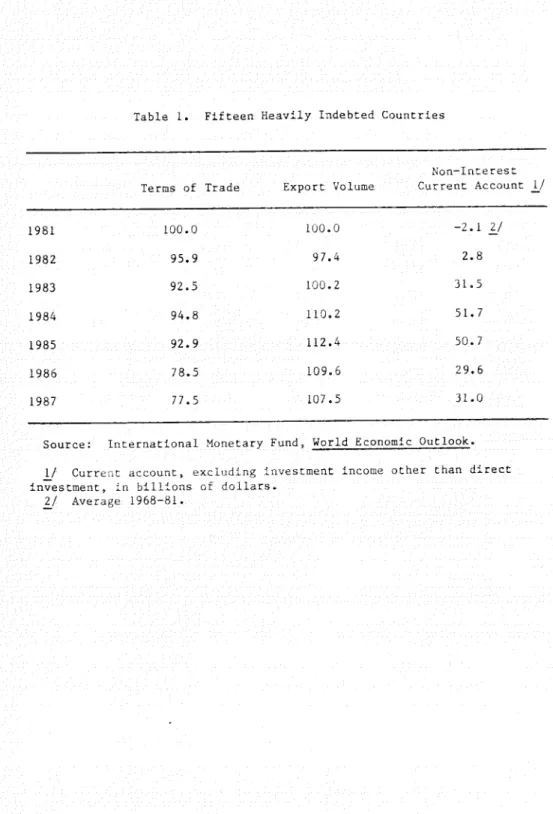
In fact, the evolution of the terms of trade of the group of fifteen heavily indebted countries appears to reflect quite strongly the debt problems faced by them since 1982, as suggested by the data displayed in Table 1. Sin'e 1982, the combined non-interest current account for this group of countries displays a sharp turnaround. The non—interest current account, that averaged a deficit of over $2 billion in the period 1968—81, moved to an average surplus of over $32 billion during 1982-87. This turnaround reflects the loss of access to international credit from private sources of many debtor countries.
At the same time, these fifteen debtor countries experienced a sharp deterioration in terms of trade, a cumulative 22 percent relative to
1981 levels. Despite that deterioration, the volume of exports showed a cumulative increase of over 10 percent in the same period.
In addition to the general picture portrayed by Table 1, there are other pieces of evidence that indicate an interaction between the foreign debt situation and terms of trade developments. One of these is the behavior of the prices of non-oil commodities produced by
developing countries. Despite continuous economic expansion in industrial countries the relative price of non—oil commodities fell sharply since 1983. Econometric studies have often found that non—oil
commodity prices can be explained well by business cycle developments in industrial countries and the dollar exchange rate (see Dornbusch
(1985)). However, since 1983, there appears to be break in
traditional relationships, (Morrison and Wattleworth, (1987)>. Chart
1, that plots an index of industrial production and the relative price of non—oil commodities since 1975, also suggests the existence of such
break in the relationship between these two variables,
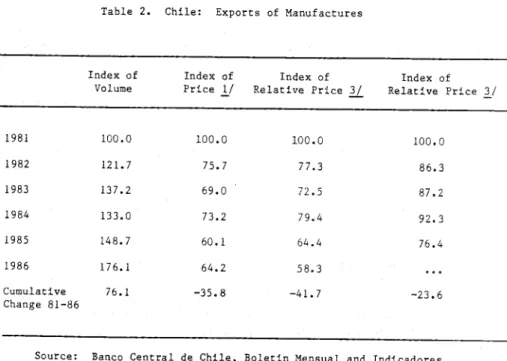
An additional piece of evidence concerns the differentiated products argument. A large part of the increase in debtor countries' exports since 1982 consisted of manufactures, among which there are a number of goods which can easily fit the differentiated products description. Although disaggregated data on price and quantity indices of industrial exports are hard to obtain, there exists published information in the case of Chile. These data do show large
increases in the volume of industrial exports accompanied by sharp drops in prices, as displayed in Table 2. Since 1982, the volume of manufactured exports grew by a cumulative 76 percent. However, this
growth required deep cuts in prices, and the dollar prices of
manufactured exports fell by a cumulative 36 percent. Relative to the prices of manufactures exported by industrial countries, the fall in
export prices is even larger. Relative to the unit value index of their own imports, however, the decrease is smaller, which is partly explained by the decrease in commodity prices and in prices of exports originated in other developing countries. In addition, we conjecture that there might be a quality effect hidden in the data, As imports became more expensive and real income adjusted downwards, there might have been a switch towards lower quality products in imports. This interpretation is suggested by a disaggregation of import price data, which shows
a
very sharp decrease in the prices of consumption goodimports, and only a slight decrease in the prices of capital good imports.
III.
A
Framework of AnalysisThe purpose of our analysis is to identify conditions under which an increase in the resource transfer from developed to developing countries would be beneficial, and to study the consequences of
eridogenous terms of trade adjustment. The simplest framework to deal
with these issues is a two-period, two—good world economy composed of two blocks of nations: developed and developing nations. Each block produces one good, and consumes both. For simplicity of exposition it is convenient to assume that in the long-run the relative price of the two goods is exogenously fixed by the technology of production. In the short-run the supply is given, and the relative price of the two
goods is determined by the prevailing demand conditions. We will
identify the short run with the first period, and the long run with
the second.
On the supply side, let X and Y denote the good produced by the
developed and the developing nations, respectively. Let and
denote the output level of the two goods in period i, i=l,2. The output level is exogenously given in period one. In the second period, the output level is determined by investment carried out in period one, which is denoted by I. We assume an asymmetric
environment: good X can be either consumed or invested to increase the future output of both good X and Y, while good Y can only be used for consumption purposes. The investment technologies also differ. In the developed economy, second—period output is linked to investment according to:
where I refers to investment in the production of good X by the
developed economy, and r is the interest rate in the developed
country. Thus, optimality conditions ensure that the marginal product of capital is always equal to the interest rate in the developed economy. The supply level of a good is indicated by a bar over its name. In the debtor economy, investment translates into output according to:
dY2 m(I) dI*
*
where
I refers to the use of goodX
for investment purposes in the developing country, andm
is a function of the volume of investment, displaying decreasing returns. We do not make the assumption that the marginal product of capital equals the interest rate in the developing economy. Instead, the volume of investment is determined by aneconomic authority, and it is the subject of bargaining between debtor and creditor. Specifically, we assume that a fraction is invested out of every extra dollar of net borrowing:
-
(1)
and that the value of is subject to debt negotiations. In fact, the actual subject of the debt negotiations could be an economic policy package for the debtor economy, which contains a set of measures (say taxes and subsidies> that ensure that the level of investment in the economy is consistent with the given value of 5.
Note that the domestic interest rate in the debtor country (Which
we will denote by r*) will not be equal to the interest rate in the
creditor country, r. This is
a
consequence of the situation of insolvency which we assume the debtor country to be in. Thissituation implies that, in period one, the debtor country can obtain net foreign resources only up to a certain limit B, which it cannot control. Thus, if this is a binding constraint, the debtor country is credit—rationed, and r* will exceed r.
The situation of insolvency also implies that repayments by the debtor country will fall short of its obligations and will thus be linked the debtor's capacity to pay. Specifically, we assume that, in
period two, the debtor country repays an amount
R
which is linked to its available resources by:dR
—
-
x
(2)dY2
The value of x is determined by negotiations between the debtor country and its creditors. We assume that there exists previous indebtedness, contracted before period one, of a level that is larger
than any value that R can attain. Note that this also implies that R
can be larger or smaller than (1+r)B. In the absence of credit rationing and insolvency, interest rates would be equalized, and repayment would equal total existing debt (plus the corresponding interest).
Let
P
denote the price of good z in period i, where z X,Y, and i =1,2;
and by=
1
)
the
relative price in period i. It is convenient to use good X as the nuineraire, normalizingone. We will assume that the future relative price of the two goods is constant, say =
1.
The motivation is basically toconcentrate on the terms of trade effects in the first period, when the flow of international resources is from the developed country to the developing country. The budget constraints faced by the
developing country are:
*
*
*
*
x2 +*
Y2 R xi + +*
QY1 + B I +*
(3 l+r j+r + QY1 QY1 + B 1* (4jwhere all variables are defined in terms of good X, B stands for net borrowing by the developing nations from the developed nations in period one, R stands for the flows of payments in the second period
*
from
the developing to the developed nation, and r is the domestic interest rate in the debtor economy. Stars identify a variable as corresponding to the debtor country. Q is used as shorthand for Equation (3) is the standard lifetime budget constraint faced by the representative agent in the debtor country. In addition, the credit constraint puts a separate restriction on the debtor country in period one, namely that the debtor country cannot borrow beyond the exogenous limit B. This restriction is represented by equation (4).Similarly, the budget constraints faced by the developed economy are:
X
+Y
X+R
X1+QY1+
2 2 — 2 (5) l+r l+rX1÷QY1
—(6)
1. Debt NegotiationsIn this sub—section, we will discuss the existence of contracts
that could make an increase in lending attractive to both debtors and creditors. We assume that negotiations may take place over the value of two parameters: and
x
that is, over the proportion of newlending that is devoted to investment and over the proportion of the increase in debtor country's GDP that will be paid back to creditors.
We will identify values of and x for which both the debtor and the creditor countries will find it worthwhile to engage in increased lending. In the presence of risk of debt repudiation, there are reasons to believe that the optimal contract may not be implemented by a competitive banking system. Consequently, it may be useful to
identify conditions under which policy actions can lead to such
contracts.
Let
us
assume that utility functions of the representative consumer in the developing and the developed countries are given by:*
* *
*
*
*
*
*
*
*
*
U(X1,Y1,X2,Y2) — u (X1Y1) + pu (X2,Y2) (7)
We can obtain the welfare effects on the creditor and debtor economies derived from increased lending by differentiating (7) and
(8), and making use of the standard optinality conditions on the marginal rates of substitution, and of the budget constraints (the detailed derivation is presented in the Appendix):
-
-
+ +f(l-)m
(9)dE dB l+r
The first term in (9) measures the welfare consequences of the
change in the terms of trade, given by the volume of exports (Y1
=
—
1)
times the improvement in the terms of trade. The other terms reflect the increase in consumption. Consumption goes up in period one by 1—a, and in period two by m(l-x). The second-period increasein consumption stems from an increase in output equal to
m,
with a fraction x of that increase being paid back to the developedcountries.
The same procedure applied to the developed economy leads to:
—
—
- 1 +—4--
(10)
dE 'l,X dB +r
Equation (10) shows that welfare in the developed countries changes in proportion to the amount of imports due to the terms of trade effect, decreases due to the direct drop in wealth resultant from the transfer, and increases due to the increase in repayment from the developing nation in the second period.
2. The Existence of Pareto—Improving Contracts
The international capital market setup is one in which the debtor
country cannot service its obligations in full (or cannot be forced to>. Its creditors nay nevertheless be willing to provide additional
resources, perhaps as a defensive strategy for previously contracted loans (Krugman (1987)). In this context, we assume that debtors and
creditors bargain over the conditionality attached to any additional lending. This conditionality is summarized by the two parameters (fi
10 and x) that determine investment and repayment.
We will now try to identify the range of values of the parameters
x arid for which both blocks of nations could benefit from increased resource transfers to the developing nations. We will call this region the region of Pareto—improving contracts.
A
region ofPareto—improving contracts will exist if additional lending increases the world's total welfare. We can compute the global change in world
welfare generated by an increase in international lending by adding up the welfare changes in each block, equations (17) and (18):
-
r
* + —
iJ
(11)
(l+r)(1+r ) 1+r
The first term measures the consequences of shifting resources from developed to developing nations. It is proportional to the
interest rate differential, and to the marginal investment rate in the developing nations (a).
This corresponds
to the fact that resources are being transfered from a low toa
high interest rate country, where more productive investment projects exist. The second term measures the potential distortion in the capital markets of the developingnations. In the absence of distortions——other than the international credit market situation——this term is zero, because investors will
equate the marginal product of capital (m) to the interest rate (l+r*) In the presence of distortions, the term in brackets is a
measure of the distortion wedge, and the change in welfare is proportional to the distortion times the change in the distorted
activity (fi) Note that the overall change in world welfare is
proportional to the marginal investment rate in the developing country. If no new investment is triggered by the transfer there are no aggregate wealth changes.
We start our analysis considering the limiting case in which the two goods are perfect substitutes (dQ/dB =
0),
and we will later evaluate the consequences of imperfect substitutability on the region of Pareto contracts.3. Pareto-Improving Contracts with Perfect Substitutability
To obtain the region of Pareto—improving contracts we start by tracing an indifference curve on the ($,x) plane. This curve is the locus of the pairs of values of and for which the country is indifferent with respect to (marginal) additional lending. The curve forms the boundary of the region where the country benefits from a marginal increase in the resource transfer. Applying the same procedure to the two countries allows us to identify the conditions under which the region of (x,8) where both countries will benefit from resource transfer is not empty.
are indifferent with respect to increasing credit in the margin are obtained from (9):
—
I
(1-x)(12)
l+r
Equation (12) defines he curve DD in Figure 1. In Figure 1, a point like
H
corresponds to a contract that increases the credit available to the developing countries under the conditions that a fraction of the marginal credit is devoted to investment and that a fractionxH of the increase in future output is paid to the developed countries. All points to the southwest of DD form the region for
which the developing countries benefit from an increase in the resource transfer.12 Therefore, as long as 0 < x,,8
1,
the developing countries benefit for all possible contracts.3The parallel condition for developed countries is given by:
—
(13)
This condition defines curve CC (Figure 1), drawn for the case in which the marginal productivity of investment in the developing
nations exceeds the interest rate in the developed nations. All
points to the northeast of CC form the region for which the developed countries will benefit from an increase in resource transfer. The interpretation of (13) is straightforward. An increase in lending in period one of one dollar generates an increase in payoff in period two of
mx.
That implicit rate of return is compared to the domestic rate r to determine the convenience of increasing lending.The area between the two curves in Figure 1 defines the Pareto contracts. The condition that guarantees the existence of
Paretoimproving contracts is that the marginal productivity of capital in the developing countries exceeds that in the developed countries. The greater is the excess of the marginal productivity of capital, the greater is the area of Pareto contracts.
There is a strong presumption that this condition for the existence of Paretoimproving contracts is indeed satisfied in the real world, because interest rates in heaviiyindebted countries tend to be much higher than in creditor countries, and presumably the divergence of the marginal product of capital with respect to the interest rate is not so large, However, also in a real world situation, the marginal resource transfer will not occur in the absence of proper incentives or of conditionality on the debtor country to satisfy the terms (,x) of the contract.
4. Pareto-Improving Contracts with Imperfect Substitutability
Under limited goods substitutability, an increase in the resource transfer will have some impact on terms of trade. In the next
section, we develop a model that determines the terms of trade effect explicitely. In the meantime, an approximate analysis can be made using only information on the sign of dQ/dB.14
From (9) and (10) we obtain the new boundaries of the sets of contracts that are advantageous to the debtor and the creditor country, respectively:
1 + —
(14)
m(l-X) 1 * 1+r I +Y1——
—(15)
1+rConsider first the case in which -l < dQ/dB <
0.
Both the CC and DD curves shift towards the origin. The set of contracts for which developing countries are willing to receive additional resources is in fact smaller. Some contracts in the upper-left part of the unit square are no longer beneficial because the welfare effect of the terms of trade deterioration offsets the additional consumption possibilities generated by the increased lending. In contrast, the set of contracts for which developed nations are willing to increase lending is now larger, because the existence of a relative price effect is favorable to the developed countries.We conclude that a deterioration in the terms of trade of
developing countries has the consequence of shifting the location of the Pareto region leftwards and downwards. This means that the
developed countries may obtain "softer conditionality terms, because part of the economic repayment is implemented via terms of trade adjustment. This effect would be larger the lower is the
substitutability between the two goods. It is noteworthy that from the point of view of the banking system the curve CC continues to be
the relevant contract indifference curve. This has the potential consequence that at the negotiation process the interests of the
exist some contracts that are Pareto-improving but are associated with losses to the banking system. This possibility suggests an important role in the process for policy actions to provide international banks with the proper incentives needed to implement such contracts.
Consider now the case of dQ/dB positive. Both the CC and PD curves will shift outwards. The developing countries will now be willing to accept some contracts that produce a negative payoff when evaluated at the domestic interest rate, because the terms of trade
improvement more than compensate for that, From the point of view of creditor countries, however, the set of beneficial contracts is now smaller, This would be
a
situation in which the creditor country would attempt to regulate banks in order to restrain them fromincreasing lending under some contracts that generate profits for the banks but make the creditor country worse of f.
Consequently, the impact of endogenous terms of trade is determined by the direction of the terms of trade adjustment to the marginal increase in credit. We now turn to study the factors determining the sign of dQ/dB.
5. A Model Linking Terms of Trade to International Lending
The framework of lending and investment is as described above, and the budget constraints (3) to (6) apply. We assume that the demand structure in the developed nation can be summarized
byJ5
X1 —
Eg(Q);
'1
E1(l.g(Q)) (16) —E2g(l);
Y2 —E2(l-g(1))
(17) E2 —p(l+r)E1
(18)where is total expenditure in period i
(E
=
X+
Q1Y).
Thefunction g(Q) determines the distribution of expenditure between the
two goods as a function of Lhe relative price.
The demand functions for the developing world are entirely symmetrical. However, we assume that each country may consume a
larger proportion of the domestically produced good. This can be
represented by:
—
Eag(Q); QYj —
E(1-ag(Q))
(19)E2ag(1); Y2 — E2(1-ag(1)) (20)
E2 p(1+r*)E (21)
where a <
1.
The parameter a measures the domestic bias in consumption.16 To simplify further, it is useful to consider the special case in which the g functions are given by:17g(Q) — hQa h < 1
(22)
Therefore, a is equal to the elasticity of demand with respect to the relative price of the two goods.
Regarding investment demand, we assume an assymetric structure. In the creditor country, there exists a linear technology that
transforms investment into output dX/dI = 1+r, r being a technological constant.18 Therefore, in the creditor country, investment is the
variable that adjusts to support the savings/investment/current account balance. By contrast, in the debtor country, investment is determined by the economic authority, as explained above.
6. Adjustment to an Increase in Net Borrowing
Given the demand and supply structure detailed above, the
equilibrium of the system can be represented in the following way. In period one, with the credit constraint binding, consumption in the debtor country cannot exceed the exogenous limit QY1
+
B —1*.
The domestic interest rate adjusts to obtain that level of consumption. The distribution of consumption across goods is given by (19) and(20). In the developed economy, consumption is set according to the level of wealth but, given the exogeneity of B, the investment level I has to adjust to satisfy the first-period budget constraint. This is of no consequence, because of the linear technology. Market—clearing in the first period is then given by:
+ B -
Iy)a(Q)
+ - B - +I
+I
(23) QY1 - [QY1 + B -I*](l.ag(Q))
+ {x1 - B -I](1.g(Q))
(24)In the second period, there is effectively only one good, since supply can costlessly accomodate any combination of
X
and Y. Then, there is only an income/expenditure equilibrium condition in each country. Given the credit constraints, second period consumption, which is determined according to the intertemporal conditions (18) and(21) equals:
+ —
p(l+r)[QY1
+ 8 -Iy(r*)J
(25)+ —
p(l+r)[k1
- B -ij
(26)And consumption must equal income in each country, which is given
by production and repayment:
Y2(I) - R(Y2) — p(l+r*)[QY1 + 8 - 1*) (27)
X2(I) + R(Y2) P(1+r)[X1
- B
I] (28)
Equilibrium can then be represented by equations (23), (or (24)), (27), and (28) These equilibrium conditions determine the value of the following endogenous variables: the first period terms of trade, the interest rate in the developing countries, and investment in the
*
developed
countries (Q, r ,and
I). The levels of net borrowing B, and of investment by the debtor country 1* are exogenously determined in the debt negotiation process.Suppose now that the developed nations initiate a marginal increase in the available credit (dB >
0),
and let us evaluate the normative and positive aspects of the adjustment to such an increase in lending. The response of the terms of trade to the increase in lending, evaluated at Q 1, is equalto:19
{(lh
dI+dI*
+
with c2 =
ahY1
h(aE+
E1). This expression is positive for values of that are in the Pareto region defined above curve CC (i.e.for ,6xm/(1+r) >
1),
The change in investment is given by:- 1 -
(-1
(30)
dB
l+
Consider
the case of a=
1.20 The homothesticity of utilities and the absence of a local habitat effect imply that wealth increases or welath redistributions will not affect the relative priceQ
Therefore, the change in investment in the two countries will detennine the change in tenns of trade, From (30) it can be seen*
that
the change in I is given by,
while
the change in I is a one—for—one fall with the increases in lending and in consumption, where the latter is proportional to the change in wealth in the creditor country: —l +Note
that (30) implies that, when xTn/(l+r)=
I
(which defines curve CC, i.e. the lower bound of contracts acceptable to the creditor when terms of trade do not change), for=
1 there is no change in aggregate investment and thus in Q, for < 1 aggregate investment andQ
fall, and for fi >1,
aggregate investment and Q increase, This means that only when investment in the debtor country increases more than one for one with increases in borrowing will terms of trade turn in favor of the creditor country.We cam now use (14), (15), and (29) to determine the region of
Pareto—improving contracts. The new boundary for the creditor country is defined by:
1 + +
(la)h)
(31) Y (1-h) Y xm I 1 i 1 —i-;— - cl(l+p)J
+ (1-h) + (1-a)hThis
means that with imperfect substitutability (Q < C.'),the
curve CC rotates to a position like C'C' (see Figure 2). For values of<
1,
the terms of trade move in favor of the debtor economy, and this fact excludes some contracts that would be beneficial without therelative price change. Note that, for < 1, there is now
a
region(labeled region A) of contracts that are profitable for banks (whose relevant cut-off continues to be still CC), but not for the
representative consumer in the creditor country. At fi = 1 the two
curves overlap because, as can be seen from (29), there would be no change in terms
of
trade. For values of fi >1,
the terms of tradechange in favor of the developed economy, and a typical consumer in the developed economy would benefit from contracts that are not acceptable to banks, such as those in region B.21
Therefore, accounting for imperfect substitutability between goods produced by different countries changes the conditions under
which
a
beneficial increase in lending may exist and creates adivergence of opinion between international banks and
a
representativeconsumer in the creditor country. In the context of the present
model, this divergence of opinion can be summarized in the following way: for contracts with flsofterlt investment conditionality
(
<1),
banks
are more likely to find opportunities for increased lending, but the creditor country will find convenient contracts with "harder" investment conditionality(
> 1) and smaller repayment (x) that actually produce losses to creditor banks.7. An Alternative Framework 22
The model above assumed that debtors and creditors negotiate over the addition to investment () and to repayment (x) that should be
attached to an increase in lending. Such framework appears to be in line with observed behavior in the recent rescheduling negotiations. Often in those negotiations, some conditionality on the debtor
country's policies——usually within the framework of
a
Fund-supported program——is part of the agreement. In the model this policyconditionality is represented as
a
certain value for the composition of spending, that is, the value of the parameter.
In
addition, negotiations determine how much is paid and how much is rescheduled, a decision that is highly dependent on the economic performance of the debtor. In the model, this is represented by the parameter x•It can be argued, however, that negotiating over (8,) is not the best policy for the creditor. The creditor could leave the investment decision entirely up to the debtor, which (in the absence of
distortions in the debtor economy) would maximize second—period output if the proper incentives are in place. In order to provide such proper incentives, repayment should be agreed as
a
fixed amount, because then the debtor can keep the return to any increase in investment that it achieves.23The alternative framework for negotiations would therefore not attach policy conditionality to the increased lending. In the absence of domestic distortions, investment in the debtor economy would therefore be determined by equating the marginal product of capital to
the domestic interest rate r*. The new contract being negotiated would simply determine the marginal repayment that will follow the
increase in lending, which we will denominate
Z
That is, Z is defined by:Z —
(32)
d8
The equilibrium of this system is essentially the same as the one above. It is still represented by equations (23), (27), and (28), but now the effect of an increase in lending has to consider (32) and that investment in the debtor economy will be
given
by:dY2 *
s
l--r (33)dl
-
<0
(34)
where
m
m(I*) The effect on terms of trade of an increase in lending can now be computed:-
-
[r[(1h)()
+h(la))
-{p(l÷r*)+z}]
(35) where: l-ah * - —cr
+ —i--p(l+r
)Y1 > 0 (l+r*)(l+p) - < 0and n
is
as defined under equation (29). It can be shown that ispositive for all relevant values of a.
The region of Pareto—improving contracts can now be determined. This region only refers to values of Z. If there are no changes in terms of trade, it is clear that the creditors would not accept any contract unless it sets Z >
l+r,
and debtors would not accept any contract unless it sets Z <l+r*.
As before, r* >r
is the necessary condition for the existence of a non—empty Pareto—improving region.In Figure 3 we plot the region of Pareto—improving contracts as a function of a, which represents the degree of substitutability between the two goods. In the limit, as a goes to infinity and the two goods are perfect substitutes, there is no terms of trade effect, and the Pareto region is as described above. In contrast, for finite values of a, creditor countries require a value of Z exceeding l+r to engage
in further lending, and debtor countries accept a value of Z higher *
than
l+r ,because
the terms of trade effect benefits the debtor country.These results qualify the conclusions from the previous framework, in the sense that if investment is done in an optimal
manner in the debtor country and debt negotiations provide the correct incentives to achieve such investment, there are no contracts that the creditor country would be willing to engage in that would not be achieved by a decentralized banking system. But, in addition, there is a set of contracts under which the decentralized banking system would engage in further borrowing that are not optimal from the point of view of the representative consumer in the creditor economy. Ultimately, the relevance of this and the previous framework depends on an explicit account of the reasons for credit rationing and
under—investment. We suspect that the existence of defensive lending, different time horizons between governments and the private sector, distorted capital markets, and asymmetric information make the conclusions of the former framework the more relevant ones.
IV. Concluding Remarks
This
paper
studied the conditions under which renewed lending to heavily—indebted countries could be advantageous for both creditor anddebtor countries. In dealing with the debt overhang issue it is usefui to
distinguish
between tne redistributive versus the efficiencyissues. The purpose of our analysis was to highlight the potential
efficiency losses emerging from the drop in investment in the
developing countries due to the presence of credit rationing, and to investigate mechanisms to revitalize tne investment process. The analysis focused on the case where there are two dimensions for the conditionality: the determination of the marginal propensity to
invest out of the new funds and of the marginal propensity to repay out of future output. We demonstrated the potential trade of f between these two dimensions and pointed out that endogenous terms of trade adjustment gives greater weight to investment conditionality. We now close the paper with some interpretive comments regarding
qualifications and extensions.
Our discussion demonstrated that (in the absence of strict investment conditionality) renewed lending to developing countries tends to be associated with an improvement in the terms of trade of the developing countries and vice versa. This is consistent with the
terms of trade deterioration observed in recent years. In the
eighties, there was a switch from a regime that transferred resources to the developing countries to
a
regime that transfers resources from the developing countries. The importance of the terms of trade adjustment stems from the observation that it has first-order welfareeffects on the consumers in the creditor and debtor nations, despite the fact that it is not internalized by the private banking system.
There are some qualifications to our results in this paper. The framework developed in the paper considers debt and credit rationing at the global level. Even if each indebted country has limited market power in its products, the group of indebted countries as a whole has significant market power. Because most indebted countries are facing
presently similar constraints, we have used an aggregate version of a two-block world--creditors and debtors. However, if it is only the collective response of debtor countries that is large enough to produce terms of trade changes, individual debtor countries would not be willing to accept a less favorable contract in consideration of the terms of trade effect. If this is the case, the set of contracts acceptable to debtors is not changed by the existence of a terms of trade effect of increased lending. Another qualification is that it is not entirely clear that the decisions of economic authorities are consistent with the representative consumer's interest when it comes to issues such as terms of trade changes. It appears that the
protection of import-competing industries in industrial countries may
be, in fact, more important for the authorities.
This last point suggests an interesting extension to the present framework. Some consistency is required between the conditionality attached to renewed credit and commercial policies adopted in the two
blocks of countries, particularly in the creditor countries. Even in the absence of renewed lending, repayment of past loans will require
Consistent commercial policy (i.e., intensive application of quotas may defeat any sincere attempt for debt repayment). This suggests that the incorporation of commercial policy actions to the policies considered in the debt negotiation process could have important
APPENDIX
Some Derivations
This appendix provides the details of the derivation of two expressions used in the main body of the paper. The first expression concerns the effects of increased lending on utility. Differentiating the utility functions (7) and (8) we obtain:
*
*
*
dtJ* **1y
* *U2y
+dY
'
÷ p'
+ dY2 p(al)
ulx
01X
lx
uix
UU
- U — dx + dx ,v + dX p + dY p(a2)
1 1 2 2We assume that marginal rates of substitution are given by the standard optimality conditions:
*
U1Y - 1,Y =
(a3)
UlX
1,X **
U2x
2Y
1 *' = c''
—*
(a4)
1+0u2x
U2Y
1 p = p = 1+0 (aS)*
dU *
*
1 **
dX
+QdY1 + 1+r +
dY)
(a6)dX1 QdY1 ÷ dX2 ÷ dY2) (a7)
Differentiating the budget constraint (3), we obtain: *
*
-Y -R)
*
*
*
*
*
2 2 *d +
QdY1 + Y1dQ f
2
+dY)
2 dr1-fr
1+r
Y1dQ + dB -dl
+——
(dY2 dR) (a8) 1+r Note thatY2+ X = Y2— R, because of the credit constraint, which
means that the change in the interest rate in the developing nations *
(r
) does not generate a direct wealth effect. In fact, neither thedomestic nor the foreign interest rate affect wealth of the debtor
country. This is a consequence of the credit rationing/insolvency situation. Because of credit rationing, the country as a whole does not have a net position on assets carrying the domestic interest rate
*
r
,and
because of insolvency, repayments R are not linked to interes'rates. With "normal', fully—integrated capital markets, an increase in the world
interest
rate reduces the borrower's wealth by the changein the interest rate times the external indebtedness position. The credit rationing and insolvency situation truncates this channel,
because it de—links debt service from the world interest rate. Finally, from (a6) and (a8), and making use of our assumptions
regarding marginal investment and repayment rates in the debtor country, we obtain expression (9) in the paper, and an entirely
parallel procedure applied to the developed economy leads to equation (10)
____
—Y1-2
+l-fi+
(l-x)
(9) dB dB l+r -Y-l+----
(10) dB dE l+rThe second expression this appendix is concerned with is the change in the
tens
of trade generated by an increase in lending, dQ/dB. We recall that the system can be represented in the following way (the equation numbers are the same as in the paper):QY1 = [Q1 ÷ B -
I*](lag(Q))
+ [*1 - B -I)(1-g(Q))
(24)Y(I)
- BC?2) —(1+r){QY1
+ B -iJ
(27)
X2(I) + R(?2) p(l+r){X1 - B - 1] (28)These equilibrium conditions detenine the value of the following endogenous variables: the first period
tens
of trade, the intereat rate in the developing nations, and investment in the developed*
countries
(Q,r
,and
I). The levels of net borrowing B, and of investment by the debtor country 1* are exogenously detenined in the debt negotiation process. Differentiating the system, at Q= 1,
we obtain:—
(1ah){—
+I
- +E[aczh
J + + (1-h) -)
E1{-czh J(a9)
*
*IdQ
nfl - XTflfl p(1+r)—
Y, + 1 - flJ +E
——
(alO,
dB dB(1+r)
+ XTUfl —P(1+r){-i
-]
(all)
It
can be seen that there is some recursivity in the system, in *tnat
the variable r can be determined after the rest of the system is solved. The role of r* is only to ensure that spending in the debtoreconomy, E1 is equal
to
the resources avaiable in the first period, and only the level of matters for the rest of the equilibrium.Collecting terms in (all> we obtain:
dl
-
xnifl - p(1+r)
—
(a12)
dB (1+r)(1+p;
Using (a12) in (a9), we obtain:
+
ah(E
+ E1)J-
(1-ah)(I-fl)
-(1-h)
+(1h))1
(a13)And
some
further
transformations produce equation (29) in the paper:- 1
[j
1
- 1 -(-1
+ +(ls)h(lfl)}
(29)with =
Footnotes
1 For an analysis of country risk see for example, Harberger (1976),
Kharas (1981), Eaton and Gersovitz (1981), Sachs (1984), Kletzer (1984) , Cohen and Sachs (1985) , Dornbusch (1985) , Krugman (1985)
Smith and Cuddington (1985), Edwards (1985), Folkerts-Landau (1985),
Dooley
(1986), Aizenman (1986), Bulow and Rogoff (1986) , Aizenman(1987), Helpman (1987), and Borensztein and Ghosh (1988).
2 The literature on "solutions" to the debt situation is also quite
impressive.
Important studies that summarize advantages anddisadvantages of existing proposals include: Krugman (1985), Dornbusch (1987), Fischer
(1987),
Feldstein
at
al
(1987),
and
Bergsten
et
al
(1985)
3 That is, as much as it is necessary to equate the domestic interest
rate to the international rate.
4 The link between real commodity prices and debt service is suggested in Feldstein et al (1987).
5 An extensive analysis of this market structure in the context of international trade can be found in Helpman and Erugman (1985).
6 Alternatively, the differentiation could arise from reputational or
learning problems.
7 This range is taken from the survey included in Marquez and
McNeilly (1987)
8 The estimates reported by Khan and Knight (1988) also lie between 1
9 This would be consistent with an environment where there exists a
technology in period two that costlessly transforms good Y into good
X
at a fixed rate (say one) . The existence of credit rationing would
prevent the exploitation of arbitrage opportunities. The assumption is also consistent with the idea that the second period represents a long—run position in the context of constant returns to scale and perfect competition.
10 We abstract from monitoring problems, assuming that contract conditions are perfectly enforceable.
11 Note that the consequence of credit rationing is 'under—investment' in the developing nations relative to the first best. The distortion
wedge is measured by the interest rate differential. The change in
welfare is the result of multiplying the distortion by the change in
the distorted activity.
*
12 In fact, this requires (l-x)m/(l±r ) <
1,
which we assume to hold *in
the relevant range. It will always hold if, for example,m
=l±r
13 But contracts with (,x) outside the unit square are also possible, and some of them benefit the debtor country.
14 This analysis is not fully correct because dQ/dB will itself depend on the parameters $ and x.
15 An example of a utility function that generates this type of demand
function is:
xl__
yl_Y
U(X1,Y1,X2,Y2)
=
ln[_I_
+
+in[_1
+1-7
}16 The case of a
=
1 corresponds to the case where there is no 'localhabitat', and the demand functions are the same in both countries. The case of a <
I
corresponds to the case where each country prefers its own good.17 We assume that the range of values of
Q
is such that hg(Q) < 1always.
18 This linear technology serves the purpose of isolating
intertemporal marginal rates of substitution in the developed economy from
feedback
from international lending to the developing world, Our analysis can be extended to the case where r is endogenously determined, without affecting the logic of our discussion.19 The derivation is contained in the Appendix.
20 Note that, for a <
I,
in the absence of new investment we get an improvement in the terms of trade of developing countries due to the "local habitat" effect. This is in line with the classical transfer criterion (for analysis using transfer considerations see Frenkel and Razin (1987) and van Wijnbergen (1988)). Note also that, with a unitary marginal investment(
=1),
the terms of trade adjustment is independent of any local habitat effect.21 The closer substitutes goods X and Y are, the smaller the terms of trade change that would occur, and the smaller the shift in the CC curve.
This
can be seen from equation (32), where the elasticity of substitution is positivaly associated with c. Also, the larger the local habitat effect (smaller a) the larger the impact of the terms of trade change on the Pareto region (i.e. the larger the shift in Cc).22 We thank Elhanan Helpman and Assaf Razin for coirurtents that led to this section.
23 In fact, the optimal policy for the creditor is
dependent on the nature of uncertainty in the model, and on the Possible existence of asymmetric information, as the results in Krugman (1987) and Froot, Sharfstein and Stein (1988) show.
iiO
1
0
Chart 1. Industrial Production and Real Commodity Pricest'
Real Commodity Prices
i0
90 SO Industrial Production 'I80
1977 1979 1921 1983 1955Table 1. Fifteen HeavIly Indebted Countries
Non—Interest Terms of Trade Export Volume Current Account 1/
1981 100.0 100.0 —2.1
2/
1982 95.997.4
2.8
198392.5
100.231.5
1984 94.8 110,251.7
198592.9
112.450.7
198678.5
109.6 29.6 198777.5
107.5 31.0Source: InternatIonal Monetary Fund, World EconomIc Outlook. 1/ Curre
t
account, excluding Investment Incorue other than dIrect Investment, in bIllIons of dollars.Table 2. Chile: Exports of Manufactures Index of Volume Index of Price 1/ Index of Relative Price 3/ Index a Relative f Price 3/ 1981 100.0 100.0 100.0 100.0 1982 121.7 75.7
77.3
86.3 1983 137.269.0
72.5 87.2 1984 133.073.2
79.4
92.3
1985 148,7 60.1 64.4 76.4 1986 176.1 64.258.3
.,.
Cumulative Change 81—86 76.1 —35.8 —41.7 —23.6Source: Banco Central de Chile, Boletln Mensual and Indlcadores de Comercio Exterior.
!/ In current US$.
2/ Relative to Index of Industrial CountrIes Manufactures export
prices (IMP: World Economic Outlook). 3/ Relative Co Import Unit Values.
0
/
U
—Ui
CDt
** *\ * N * ** * * * *\ .*\* * * * *'*'N*''\*
U:
o
=
z
I+r*
-
1+r
-D
D
FIGURE 3
References
Aizenman, Joshua, "Country Risk, Incomplete Information and Taxes on International Borrowing," manuscript, 1986.
"Country Risk and Contingencies," NBER Working Paper No. 2236, 1987.
Borensztein, Eduardo and A. Rex Ghosh, "Foreign Borrowing and Export
Promotion Policies," manuscript, 1988.
Bulow, I. Jeremy, and Kenneth Rogoff, "A Constant Recontracting Model of Sovereign Debt," NBER Working Paper No. 2088, 1986.
Bergsten, C. Fred, William R.
dine
and John Williamson, Bank Lending to Developing Countries: The Policy Alternatives, Institute for International Economics, Washington DC: 1985.Cohen, Daniel and Jeffrey Sachs, "Growth and External Debt under Risk of Debt Repudiation," NBER Working Paper No. 1703, 1985.
Dooley, Michael P., "Country—specific Risk Premiums, Capital Flight and Ne
Investment
Income Payments in Selected Developing Countries," manuscript, International Monetary Fund, 1986.Dornbusch, Rudiger, "External Debt, Budget Deficits and Disequilibrium
Exchange Rates," in Smith, W.G. and Cuddington, J.T., ads.,
International Debt and the Developing Countries, A World Bank symposium, The World Bank, Washington, D.C., l985a.
"Policy Performance Links between LDC Debtors and Industrial
Nations", Brookings Papers on Economic Activity, No. 2, l985b:
3 03—366.
Eaton, Jonathan and Mark Gersovitz, "Debt .ith Potential Repudiation Theoretical and Empirical Analysis," Review of Economic Studies 48, 1981.
Edwards, Sebastian, "Country Risk, Foreign Borrowing and the Social Discount Rate in an Open Developing Economy," NBER Working Paper Series No. 1651, 1985.
Feldstein, Martin, Nerve de Carnioy, Koei Narusawa, and Paul Krugman, "Restoring Growth ln
the
Debt-Laden Ihirld World," mimeo, 1987, Folkerts—Landau, David, "The Changing Role of international Bank Lending iDevelopment Finance," IMF Staff Papers 32, 1985.
Frenkel, Jacob and Assaf Razin, Fsca1 Polic:es and the World Economy, Cambridge, MA: The MIT Press, 198'.
Fischer, Stanley "Resolving the International Debt Crisis", NBER Wor,inT Paper No, 2379, September 1987.
Froot, Ken, David Sharfstein and Jeremy Stein, "LDC Debt: Forgiveness, Indexation, and Investment Incentives," oimeo, 1988.
Goldstein, Morris and Mohain Khan, "Income and Price Effects in Foreign Trade," in Jones, R.W. and P.B. Kenen, ads, Handbook of lnternatonal Economics, vol II, Elsevier Science publishers B.V., 1985.
Grossman, Gene, "Import Competition from Developed and Developing Countries," Review of Economics and Statistics, 64, 1982: 271-281. Harbarger, Arnold C., "On Country Risk and the Social Cost of Foreign
Borrowing by Developing Countries," manuscript, 1976.
Helpman, Elharian, "The Simple Analytics of Debt—Equity Swaps and Debt Forgiveness," International Monetary Fund, WP/88/30, 1988.
and Paul Krugman, Market Structure and Foreign Trade, Cambridge, MA: The MIT Press, 1985.
Ithan, Mohsin and Malcolm Knight, "Import Compression and Export Performanc in Developing Countries," forthcoming Review of Economics and
Statistics, 1988.
Kharas, Homi J., "Constrained optimal Foreign Borrowing by LDC's," Domesti Finance Study No. 75, The World Bank, Washington, D.C., 1981.
Kletzer, Kenneth N., "Asymmetries of Information and LDC borrowing with Sovereign Risk," Economic Journal 94, 1984.
Krugman, Paul, "International Debt Strategies in an Uncertain World," in
Smith, W,G. and Cuddington, J.T., ads., International Debt and the
Developing Countries,
A
World Bank Symposium, The World Bank, Washington, D.C., 1985."Private Capital Flows to problem Debtors," paper presented at the NBER Conference on Developing Country Debt, Washington, DC, 2987.
"Financing vs. Forgiving a Debt Overhang: Some Analytical Notes," NBER Working Paper No. , 1987.987.
Marguez, Jaime and Caryl NcNeilly, "Income and Price Elasticities for
Exports of Developing Countries," Review of Economic and Statistics, forthcoming.
Morrison, Thomas and Michael Wattleworth, "The 1984—86 Commodity Recession An Analysis of the Underlying Causes", INF Working Paper No. 87/71,
1987.
Sachs, Jeffrey D., "Theoretical Issues in International Borrowing,"
Princeton Studies in International Finance 54, 1984.
Smith, Gordon W., and John T. Cuddington, International Debt and the
Developing Countries, A World Bank Symposium, The World Bank,
Washington, D.C., 1985.
Spence, Michael E. "Product Selection, Fixed Costs, and Monopolistic
van Wijnbergen, Sweder, "Fiscal Policy, Trade Intervention and World Interest Rates——An Empirical Analysis," in J. A. Frenkel (Eth) International Apects of Fiscal Policy, University of Chicago Press, forthcoming.