Content comparison of instruments assessing participation based on the
International Classification of Functioning, Disability and Health
Vanessa K. Noonan1,2*; Jacek A. Kopec2,3; Luc Noreau4,5; Joel Singer2,6; Anna Chan1; Louise C. Mâsse7; Marcel F. Dvorak1
1.
Division of Spine, Department of Orthopaedics, University of British Columbia, Vancouver, BC, Canada
2.
School of Population and Public Health, University of British Columbia, Vancouver, BC, Canada
3.
Arthritis Research Centre of Canada, Vancouver, BC, Canada 4.
Rehabilitation Department, Laval University, Québec City, QC, Canada 5.
Centre for Interdisciplinary Research in Rehabilitation and Social Integration (CIRRIS), Québec City, QC, Canada
6.
Canadian HIV Trials Network, Vancouver, BC, Canada 7.
Department of Pediatrics, University of British Columbia, Vancouver, BC, Canada
* Corresponding author Email addresses: VKN:[email protected] JAK:[email protected] LN:[email protected] JS:[email protected]
AC:[email protected] LCM:[email protected] MFD:[email protected]
Abstract
Background
The concept of participation is recognized as an important rehabilitation outcome and instruments have been developed to measure participation using the International
Classification of Functioning, Disability and Health (ICF). To date, there has not been a review of the content of these instruments to determine how participation has been
operationalized. The purpose of this study is to compare the content of instruments assessing participation based on the ICF.
Methods
A systematic search of the literature was conducted to identify instruments which assess participation using the ICF. Instruments were considered to be assessing participation if the questions contain content from a minimum of three ICF chapters ranging from chapter 3
communicationto chapter 9community, social and civic life. The content in each question, referred to as meaningful concepts, was identified and then linked to the most precise ICF category. Content validity in each instrument was assessed by rating the coverage of content among the questions and whether all questions contain concept(s) related to participation. Results
Eight instruments were included: Impact on Participation and Autonomy; Keele Assessment of Participation (KAP); Participation Survey Mobility (PARTS/M); Participation Measure-Post Acute Care (PM-PAC); Participation Objective Participation Subjective (POPS); Participation Scale; Rating of Perceived Participation (ROPP); and the World Health
Organization Disability Assessment Schedule II. 1350 meaningful concepts were identified in the eight instruments. There were differences among the instruments regarding how
participation was operationalized. All the instruments contain content covering five ICF domains ranging from chapters 3 to 9 and mainly differ in whether content from the chapters, communication and self-care is included. There are also differences in how other ICF
components (body functions, environmental factors) and health are operationalized in the instruments. Six of the eight instruments (IPA, KAP, PARTS/M, PM-PAC, POPS, ROPP) met the criteria used to evaluate content validity, suggesting these instruments most clearly assess the concept of participation.
Conclusions
Linking the content in the participation instruments to the ICF was informative. The content analysis revealed that there are differences in how the concept of participation is
operationalized. The IPA, KAP, PARTS/M, PM-PAC, POPS and ROPP have good content validity.
Keywords:validity, disability; functioning; activity; participation; World Health Organization
Background
Participation is cited as central to a person’s quality of life and well-being[1]. The reduction of disabilities and improving participation for individuals with disabilities are therefore important goals of rehabilitation.[2] Working for pay, attending school and joining in community activities are all examples of life situations that comprise participation. Participation is defined in the International Classification of Functioning, Disability and Health (ICF) as the involvement in a life situation and participation restrictions are defined as problems an individual may experience in the involvement in life situations.[3] Although the idea of participation is not new, participation as defined in the ICF is a relatively new
concept and as a result the conceptualization and measurement of participation continues to evolve.[4]
Whiteneck[5] in his critique of the ICF recommended that new instruments operationalizing the concepts in the ICF are developed and tested to assess the relationship between the concepts in the ICF model. In particular, Whiteneck[5] recommended that the measurement properties of instruments must first be assessed to obtain consensus on how each concept within the ICF is quantified before it will be possible to test the relationship between concepts. He stated that it is important to develop new instruments which are designed to measure the ICF concepts rather than trying to retrofit existing instruments to the ICF classification.[5]
It is therefore necessary to first assess how the concepts such as participation are being measured by examining the content validity of instruments. Content validity assesses how
well the questions cover the health components being measured[6] and this is important since it determines if the content of the instrument is appropriate for measuring the construct or concept.[7] A recently proposed method for evaluating content validity involves identifying the content within the questions of an instrument and linking or mapping this content to the ICF classification. This methodology has been recommended since the ICF provides a standardized framework for evaluating content[8] and to date, this methodology has been used to compare the content of both generic and disease-specific instruments.[8,9]
In 2003 Perenboom and Chorus[2] reviewed the literature and examined how existing
generic instruments assess the concept of participation. These authors concluded that most of the instruments assess one or more domains related to participation described in the ICF but none of them measured all the domains.[2] Although this study provides an important
contribution to the literature, the results cannot be used to understand how the ICF concept of participation has been operationalized since only a few of the instruments included in the review were developed based on the ICF.[2] A draft version of the ICF was published in 1997 and the first version was published in 2001 and so an updated review needs to be conducted.[3] In addition, the methodology for linking the content in the questions to the ICF was published in 2002 and revised in 2005, and this methodology was not used in the study by Perenboom and Chorus[2].
Thus, to address the recommendations proposed by Whiteneck[5], it is important to build on the work of Perenboom and Chorus[2] and examine the content of instruments developed based on the ICF using published methodology for linking the content to the ICF. Thus the
purpose of this study was to conduct a detailed content analysis of participation instruments to elucidate how participation has been operationalized. Content validity of instruments was ranked according to whether the content in the instruments adequately cover the ICF concept of participation and whether any questions were irrelevant by not including content related to the definition of participation used in this study. Findings from this study will assist in determining which instrument(s) best cover the concept of participation as defined by ICF and will serve to identify possible revisions of these instruments needed in order to test the relationships between the concepts in the ICF model.
Methods
A systematic search of the literature was conducted to identify all instruments that were developed to assess the ICF concept of participation. Each instrument was then reviewed to evaluate the content in the questions and to link the content to the ICF classification. Finally, the instruments were rated according to two criteria which were used to assess content
validity (described below). An overview of the ICF model and classification is provided below to assist in explaining how the instruments were selected and how the content was linked.
Overview of the ICF
The ICF consists of two parts: functioning and disability and contextual factors. Functioning and disability contains the components: body structures; body functions; and activity and participation. Activity is defined as the execution of a task or action by an individual.[3] Although activity and participation are differentiated in the model, in the classification they
are combined and there is a single list of domains covering various actions and life areas. The user is provided with four options on how activity and participation can be considered: 1) divide activity and participation domains and do not allow for any overlap; 2) allow for partial overlap between activity and participation domains; 3) operationalize participation as broad categories within the domains and activity as the more detailed categories, with either partial or no overlap; and 4) allow for complete overlap in the domains considered to be activity and participation.[3]
Contextual factors comprise the background of a person’s life and living which interact with individual and determine their level of functioning.[3] They include environmental and personal factors. Environmental factors include the physical, social and attitudinal
environment in which people live.[3] These factors are external to individuals and can have a positive or negative influence on an individual’s performance as a member of society, on an individual’s capacity to execute actions or tasks, or on an individual’s body functions or structures.[3] Personal factors are the particular details of an individual’s life and living and include factors such as gender, age and coping style.[3] A detailed classification of
environmental factors was first introduced in the ICF and currently a classification does not exist for personal factors. In addition, the ICF model includes the concept health condition (disorder or disease) which are classified using the World Health Organization’s etiological classification, the International Classification of Diseases-10 (ICD-10).[3]
In the ICF classification the components are labeled with letters: body structures (s); body functions (b); activity and participation (d); and environmental factors (e). As mentioned
previously, personal factors are not specified. Within each component the categories are organized hierarchically and assigned a numeric code. The categories are nested so the chapters also referred to as domains, include all the detailed subcategories. The first-level category is the chapter number (1 digit) then there is the second-level category (2 digits), third (1 digit) and sometimes fourth-level (1 digit). An example demonstrating the coding from the activities and participation component is:d4 mobility(chapter/first-level category);
d450 walking(second-level category); andd4500 walking short distances(third-level category).
Instruments
A systematic search of seven databases [i.e. Medline; CINAHL; EMBASE; HaPI; Psyc (Info, Articles, Books)] was conducted to identify all the instruments that assess participation and were based on the ICIDH-2 or ICF model. The ICIDH-2 was first released in 1997 and so the search included articles published between 1997 and March 2008. Instruments including questions covering a minimum of three domains (ICIDH-2 or ICF chapters) from either the ICIDH-2 participation dimension[10] or the ICF chapters 3 to 9 in the activities and
participation component in ICF were considered to assess participation[3]. Instruments which met this definition of participation were then included if they were: designed to assess participation in the community; either self-administered or interview administered; generic in content; developed for adults; and published in English.
Linking to the ICF
The questions in the instruments were assigned ICF categories, also known as linking or cross-walking. First the content contained within each of the questions and, if applicable, response options (response scale) was identified using standardized linking rules[11]. This content is referred to as the meaningful concept(s) in the published methodology.[11] The meaningful concept(s) capture all of the ideas or information contained within a question and these concepts are used to identify the ICF categories in the classification. Examples of the meaningful concepts extracted from the questions and the assigned ICF categories are provided in Table 1.
To determine if contextual factors and health conditions are included in the participation instruments, relevant information stated in the instructions was also used to identify
meaningful concepts, which is a modification to the published linking rules. For example, if the instructions stated the respondent should consider the impact of their health condition or the use of assistive devices when thinking about participating in certain life roles, then ‘health conditions’ and ‘assistive devices’ were included as meaningful concepts. Any terms referring to a time period (e.g. in the past four weeks) and qualifiers such as ‘difficulty’, ‘satisfaction’ or ‘importance’ were not considered to be meaningful concepts.
Once all the meaningful concepts were identified, then the meaningful concepts were linked to the most suitable ICF category. The meaningful concept was classified as ‘not definable’ if there was not enough information to select the most precise ICF category or if a meaningful concept was not included in the ICF (e.g. suicide attempts) it was coded as ‘not covered’. A
meaningful concept was coded as a ‘personal factor’ if it asks about age or other factors that relate to the background of the person. Meaningful concepts such as health, illness or physical disability were coded as ‘health condition’.
Two coders linked all the meaningful concepts in the instruments. The coders then reviewed their results and discussed the questions where different ICF categories were selected. If there was consensus on the code it was finalized and if there was no consensus, then a third coder reviewed the results and made a decision. All the coders were familiar with the ICF and the linking rules[11].
The percentage of observed agreement between the two coders ranged between 91-98% for the first level ICF categories, 77-95% for the second level ICF categories and 77-94% for the third level ICF categories. The level of agreement was not assessed for the one of the
instruments [Impact on Participation and Autonomy (IPA)] since this instrument was linked to the ICF in a previous study conducted by one of the authors.
Analysis
First a descriptive analysis was conducted. The number of meaningful concepts linked to categories in the ICF components and the number of meaningful concepts which could not be linked were reported. The most precise categories selected from the components activities and participation (d-categories) as well as body functions (b-categories), body structures (s-categories) and environmental factors (e-(s-categories) were recorded and reported up to the second-level ICF categories.
Second, content validity for each instrument was assessed using by considering the coverage (i.e. do the questions adequately cover the concept) and whether the questions are all relevant (i.e. do all the questions include content related to participation). Since the instruments have a different number of questions, the percentage of questions containing ICF categories from the chapters included in the activities and participation component was first estimated. Similar estimates were made for the ICF components body functions and environmental factors as well as for ‘health conditions’ and ‘not defined/not covered’. Instruments were then evaluated based on whether an instrument contains questions related to 5 out of 7 possible chapters (first-level categories) considered to assess the concept of participation (d3 communicationtod9 community, social and civic lifein the activities and participation component). Coverage in 5 out of a possible 7 chapters was selected since this covers at least two-thirds of the chapters used to operationalize participation in this study and this was felt to be acceptable coverage.
The relevance of the questions was assessed by examining if all the questions have
meaningful concepts linked to ICF categories from chapters fromd3 communicationtod9 community, social and civic life. Since it is possible that an instrument contains meaningful concept(s) related to participation but an ICF category could not be selected, meaningful concepts linked to ‘not defined’ and ‘not covered’ were reviewed to determine if the
meaningful concepts were similar to the content included in the chaptersd3 communication
Results
Identification of the Participation Instruments
A review of the literature in September 2007 identified 3087 articles. After reviewing the articles based on the two stage eligibility process ten instruments were included.[12-19] The ten instruments included: Impact on Participation Autonomy (IPA)[12,20]; Keele
Assessment of Participation (KAP)[18]; PAR-PRO[14]; Participation Measure-Post Acute Care (PM-PAC)[13]; Participation Objective Participation Subjective (POPS)[21];
Participation Scale (P-Scale)[17]; Participation Survey/Mobility (PARTS/M)[22]; Perceived Impact of Problem Profile (PIPP)[15]; Rating of Perceived Participation (ROPP)[16]; and World Health Organization Disability Assessment Schedule II (WHODAS II)[23]. The Participation Measure-Post Acute Care-Computerized Adaptive Test version (PM-PAC-CAT)[24] was added when the systematic search was updated in March 2008. For eight of the instruments (IPA, KAP, PARTS/M, PM-PAC, POPS, P-Scale, ROPP, WHODAS II) a copy of the instrument was available and so these instruments were included in the content analysis.
Linking the Meaningful Concepts to the ICF
A total of 1350 meaningful concepts were identified in the 8 instruments. If examples are used to describe an aspect of participation then all the examples were coded as meaningful concepts and linked to ICF categories. Two instruments include screening questions (KAP, PARTS/M) and the meaningful concepts in the screening questions were also included. In the P-Scale there are a total of 36 questions, however only 18 questions were assessed in this study since the meaningful concepts are not explicitly stated in 18 questions which ask “how
big a problem is it to you?” which follow the first question. In addition, there was no impact on the results by only including 18 questions from the P-Scale.
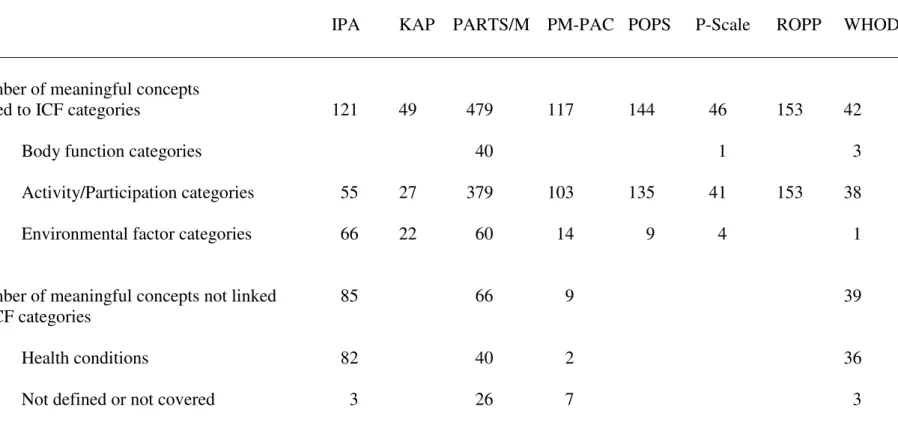
A summary of the meaningful concepts identified in each of the participation instruments is included in Table 2. The PARTS/M has the highest number of meaningful concepts (n=545). Sixty nine percent (931/1350) of the meaningful concepts were linked to categories in the component activities and participation. Three instruments (PARTS/M, P-Scale, WHODAS II) have meaningful concepts linked to body functions and all the instruments with the exception of the ROPP have meaningful concepts linked to the component environmental factors. Four of the eight instruments (IPA, PARTS/M, PM-PAC, WHODAS II) have meaningful concepts which could not be linked to the ICF. Out of the 199 meaningful concepts which could not be linked to the ICF, 160 were coded as health conditions and 39 were either ‘not defined’ or ‘not covered’. Examples of meaningful concepts that were coded as ‘not defined’ are ‘other activities’ (PM-PAC), ‘days away from home’ (PM-PAC) / ‘staying by yourself for a few days’ (WHODAS II). Examples of meaningful concepts coded as ‘not covered’ are ‘control over your own life’ (IPA) and ‘impact on your family’
(WHODAS II). The meaningful concept ‘health condition’ was identified in 4 of the 8 instruments (Table 1). Instructions in the WHODAS II and IPA ask the respondent to consider all the questions in the context of difficulties due to health conditions and so all questions contain meaningful concepts linked to ‘health conditions’. No meaningful concepts were linked to personal factors as defined in the ICF.
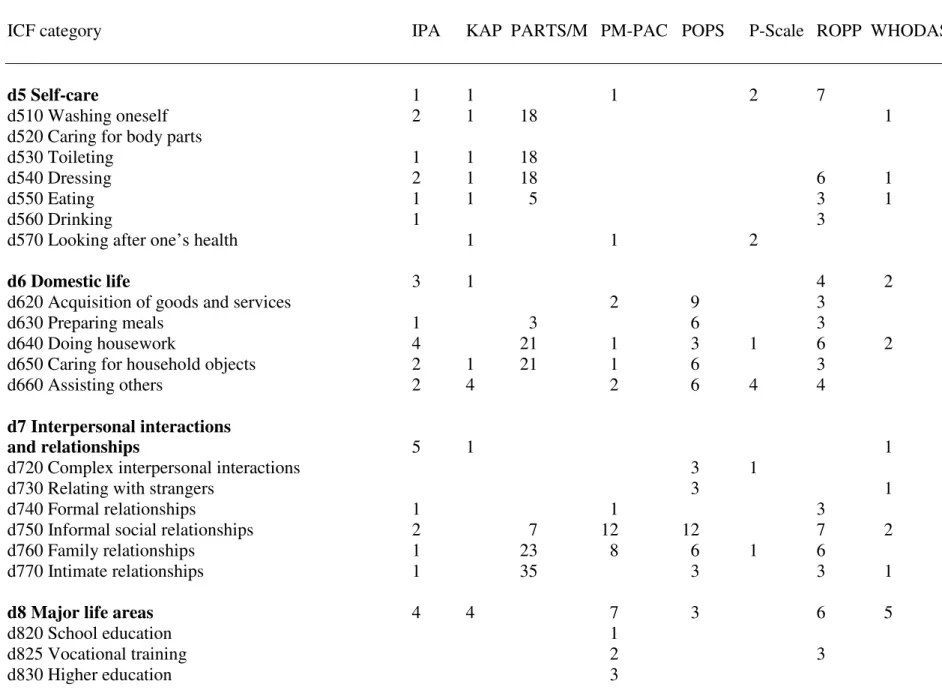
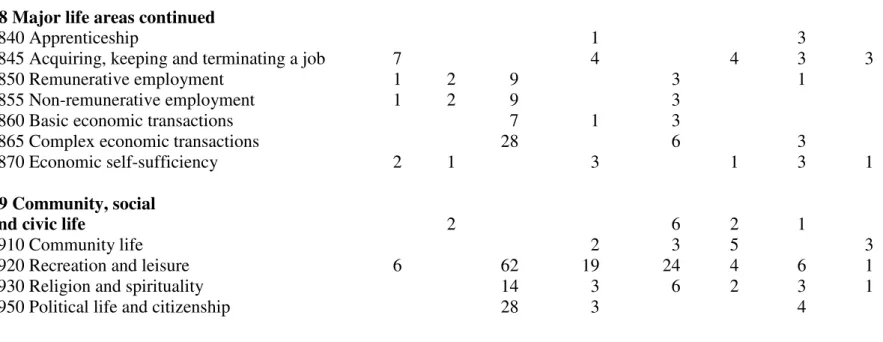
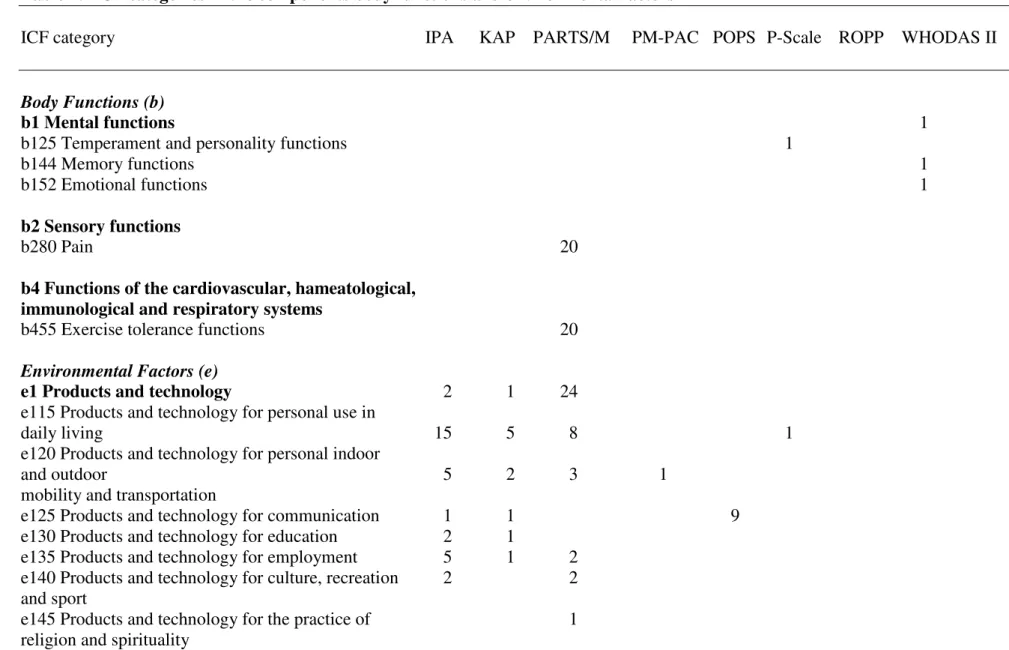
Table 3 lists all of the categories from activities and participation component which the meaningful concepts were linked to. All of the instruments contain meaningful concepts linked to the following chapters:d4 mobility,d6 domestic life,d7 interpersonal interactions and relationships,d8 major life areasandd9 community, social and civic life. Table 4 illustrates the categories within the ICF components body functions (b-categories) and environmental factors (e-categories) included in the instruments.
In the PARTS/M for each of the 20 aspects of participation assessed there is a question which asks if either ‘pain’ (linked tob280 pain) or ‘fatigue’ (b4552 fatiguability), limits
participation. The P-Scale contains a meaningful concept ‘confidence’ (linked tob126 temperament and personality functions). The WHODAS II contains three questions which ask about ‘remembering to do important things’, being ‘emotionally affected’ and ‘living with dignity’, which were linked tob144 memory,b152 emotional functionsandb1 mental functions, respectively.
Seven instruments include meaningful concepts which were linked to categories in the ICF component environmental factors. Six instruments (IPA, KAP, PARTS/M, PM-PAC, POPS, P-Scale) either ask about the use ofassistance (e3)or the use ofproducts and technology (e1)in either a specific question or ask the respondent to consider these factors when
considering aspects of participation. In three instruments (WHODAS II, IPA, P-Scale) there are questions asking about attitudes of others, where the meaningful concepts were linked to categories ine4 attitudes. The PM-PAC has two questions which ask about ‘filing your taxes’ / ‘completing forms for insurance or disability benefits’ and the e-categories were
related to the instructions which told the respondent to consider any assistance or services available to them (e3 support and relationshipsande5 services, systems and policies).
Assessing Content Validity
In terms of content coverage, the number of questions with content from the ICF chapters 3 to 9 ranges from 0 (0%) ford3 communication(IPA, PARTS/M) andd5 self-care(POPS) to 58 (36%) ford9 community, social and civic lifein the PARTS/M (Table 5). All of the instruments met the criteria of having questions containing content covering 5 out of 7 ICF chaptersd3 communicationtod9 community, social and civic life, in the activities and participation component. In terms of relevance, there are questions in the IPA, PM-PAC and WHODAS II which do not contain d-categories fromd3 communicationtod9 community, social and civic life, but the meaningful concepts were considered to be related to
participation (e.g. WHODAS II ‘staying by yourself’). There are 2 instruments (P-Scale, WHODAS II) have questions which do not contain d-categories fromd3 communicationto
d9 community, social and civic lifeand were considered to assess something other than participation. The P-Scale has two questions which just contain e-categories assessing attitudes and a question asking about ‘feeling confident trying new things’ which was linked to d1. The WHODAS II has nine questions which do not contain meaningful concepts related to d3 to d9; these questions have meaningful concepts linked tomental functions (b1),
learning and applying knowledge (d1),attitudes (e4), health condition and ‘not covered’ or ‘not defined’ and were not considered related to participation (e.g. ‘barriers or hindrances in the world around you’). The IPA, KAP, PARTS/M, PM-PAC, POPS and the ROPP met both criteria for content validity and therefore are considered to have superior content
validity compared to the P-Scale and WHODAS II. A table summarizing the results on the content validity is provided in Table 6.
Discussion
Defining the Concept of Participation
By linking the meaningful concepts identified in the participation instruments, it was possible to determine which ICF categories the instruments include. In this study an instrument was considered to assess the concept of participation if its domains cover a minimum of three chapters between chapter 3 and chapter 9 in the ICF component activities and participation. This broad definition of participation was used since there is no consensus regarding how activity is differentiated from participation[2,5,5,25-28] and selecting chapter headings provided objective criteria. Perenboom and Chorus[2] however, considered a question to be assessing participation if it asked about actual or perceived participation (i.e. involvement, autonomy, social role) (page 578) and so different results would be obtained using this definition.
Content Validity of the Participation Instruments
Although all the instruments adequately covered the requirement for including content from 5 of the 7 ICF chapters, there are differences in the actual content. All of the instruments include content from chaptersd6 domestic life,d7 interpersonal interactions and
relationships,d8 major life areasandd9 community, social and civic life. There are
differences however, in whether the chapterscommunication (d3),self-care (d5)and certain aspects ofmobility (d4)are considered part of participation.
Four instruments (PM-PAC, P-Scale, ROPP, WHODAS II) intend to assesscommunication (d3)based on the original articles and ICF categories fromcommunication (d3)were noted for all these instruments. Meaningful concepts linked to categories incommunication (d3)
were also identified in the KAP and POPS which was likely unintentional. In the KAP and POPS there are questions which contain meaningful concepts linked to multiple ICF
domains, including communication, but the latter was not the major focus. For example, in the POPS the question ‘how many times do you speak with your neighbour?’ includes the meaningful concept ‘conversation’ which was coded asd350 conversationbut it is only a minor meaningful concept and the major meaningful concept is ‘relationship with
neighbour(s)’, coded asd7501 informal relationships with neighbours. In some instruments, such as the PM-PAC, assessing communication is a major focus (i.e. ‘how much are you limited in watching or listening to the television or radio?’). Empirical findings suggest that it is difficult to demonstrate discriminant validity among participation domains[12,18] and this may be a result of overlapping content. In future studies it may be beneficial to identify and code the major and minor meaningful concepts, since this could assist with developing a priori hypotheses regarding expected correlations between instrument domains.
All of the instruments contain meaningful concepts linked to categories inself-care (d5)with the exception of the POPS. When the POPS was developed self-care was not included since participation was operationalized as “engagement in activities that are intrinsically social, that are part of household or other occupational role functioning, or that are recreational activities occurring in community settings” (page 463) and self-care did not qualify.[21] The
PM-PAC does not intend to assess self-care[13] but there were two meaningful concepts linked toself-care (d5). One question in the PM-PAC asks about ‘exercising’ which was coded asd570 managing diet and fitnessand the other question asks about ‘providing self-care to yourself’, which was coded asd5 self-care. In terms of mobility, all of the
instruments contain meaningful concepts linked to categories inmobility (d4)and all the instruments intend to include content in this domain. Three instruments (IPA, PARTS/M, WHODAS II) operationalize moving in the home using specific phrases such as ‘getting out of bed, getting out of a chair…’ (PARTS/M) or ‘getting up and going to bed’ (IPA). In the other instruments, mobility includes broader statements such as ‘moving around the home’ (KAP; ROPP) or ‘getting around’ (PM-PAC, P-Scale, ROPP) and in the POPS mobility includes only using transportation.
In terms of the relevance of the content, the P-Scale and WHODAS II were considered to have content not related to the concept of participation. When the P-Scale was developed, participation was considered to include content from chapterd1 learning and applying knowledge[17] and so it is not surprising that this question did not meet the criteria for content relevance. There were however, other questions in the P-Scale which did not meet the criteria for content relevance. In the P-Scale there are questions which include
meaningful concepts considered to be primarily assessing environmental factors (e.g. in your home, are the eating utensils you use kept with those used by the rest of the household?). Similarly, the WHODAS II contains questions with meaningful concepts linked tod1 learning and applying knowledgewhich is expected since this instrument was developed to assess the concepts of activity and participation.[19] The WHODAS II, like the P-Scale also
contains meaningful concepts which do not contain any d-categories and so it was not just due to differences in how participation was operationalized.
Linking the Meaningful Concepts to the ICF
The methodology published by Cieza et al.[29] was used to identify and link meaningful concepts to the ICF. Our results for the d-categories selected for the WHODAS II can be compared to a study by Cieza and Stucki[9], which also linked the WHODAS II to the ICF. It is difficult to compare the results from these two studies directly since Cieza and Stucki[9] used an older version of the linking rules[29] and we modified the linking rules by including ‘health condition’ as a meaningful concept if it was included in the instructions. Cieza and Stucki[9] identified 38 meaningful concepts and in our study we had 45 not including coding ‘health condition’, however, we did not include the 5 questions in the WHODAS II on
general health and it appears that Cieza and Stucki[9] did. Both studies had the same number of meaningful concepts linked to body functions (n=3), environmental factors (n=1) and ‘not defined’ (n=2). There were some differences. We linked 38 meaningful concepts to
categories from activities and participation and Cieza and Stucki[9] linked 30 meaningful concepts and we linked 1 meaningful concept to ‘not covered’ whereas they linked 2 meaningful concepts. Overall, it appears that the linking rules were applied similarly in the two studies. The percentage of observed agreement linking the meaningful concepts to ICF categories was quite high between the 2 coders in this study, ranging between 91-98% for the first-level ICF categories (chapters) and 77-95% for the second-level suggesting the assignment of ICF categories was fairly consistent. It has been recognized that there are a number of challenges with using the linking rules (e.g. establishing the meaningful concepts
contained in the assessment items) and future work will further enhance the standardization of these rules.[30]
Participation and Other ICF Categories
It was informative to examine the ICF categories within each question to determine which other ICF categories were used in conjunction with the categories from the ICF component activities and participation. The ICF states that disability is a dynamic process which results from the interaction of the ICF components (body structures, body functions, activities and participation) and the contextual factors (environment, personal factors).[3] It is therefore helpful to identify what is asked in relation to participation. For example, for every
participation topic area (e.g. dressing, working inside the home) included in the PARTS/M, a question is asked if participation is impacted by pain and/or fatigue. Clinically it is useful to determine the impact of factors such as pain and fatigue, since similar to environmental factors they can be potentially modified in order to enhance participation.
As stated by Nordenfelt[27] and others[31], activity and participation must occur in an environment. In the ICF there is reference to a ‘standard environment’ versus ‘usual environment’ and this distinction is one way activity is differentiated from participation.[3] It is interesting how environmental factors asking about assistance or equipment are included in some instruments (IPA, KAP, PARTS/M, PM-PAC, POPS, P-Scale) but not in other instruments (ROPP, WHODAS II). The PARTS/M specifically assesses the use of assistance and the frequency which accommodations, adaptations or special equipment is used. Asking about the use of equipment and assistance is important clinically since if a person does not
have a suitable environment, this can be modified to enhance their participation. Further qualitative and quantitative studies will determine if respondents inherently consider their environment when answering the questions.
Similar to environmental factors, there is variation in whether a participation restriction is attributed to a health condition. In the WHODAS II and the IPA the instructions state that the respondent should consider their health condition. In the PARTS/M there are specific questions which ask if the person’s participation is limited by their illness or physical impairment and is asked in relation to ICF d-categories. Dubuc et al.[32] demonstrated the importance of specifying whether the participation restriction is a result of a health condition or not, especially for areas which are highly influenced by environmental factors. By asking if the participation restriction is a result of a health condition, it removed the influence of the environment.[32] More research should assess the best way to assess these influencing factors. The PARTS/M offers the advantage of asking specific questions related to these areas and this may provide a means to determine their effects. It is also interesting to note that none of the questions contain meaningful concepts coded as personal factors, which is not surprising since this data is collected separately (e.g. age, gender) in research studies. Further studies should compare questions that either attribute or do not attribute participation to factors such as the environment or health conditions to determine if these phrases
Study Limitations
There are several limitations to this study which need to be considered when interpreting the results. The methodology for assessing content validity was developed for this study which limits comparisons to other studies but it may be useful in future studies. The criteria used for evaluating content validity in this study assume that it is desirable to have an instrument cover the majority of areas within a multidimensional concept such as participation and so it may not be suitable for instruments which focus on selected areas such as employment. Conclusions using this methodology are based on the linking the content to the ICF and do not consider the intent of the instrument developer and this should possibly be included in future studies to ensure the original purpose of the instrument is not omitted. As very few studies have linked the instruments used in this study to the ICF classification, the results from this study should be confirmed in other studies. Interpreting the questions and
determining the meaningful concepts can be influenced by culture and the experience of the coders and enhancements to the ICF linking rules will help improve the assessment of content validity in these types of studies.
Conclusion
In summary, this study linked eight instruments measuring participation to the ICF. The benefits of linking the content of the instruments to the ICF has been described in various studies[8,9,33] and these benefits include enabling users to review the content as part of the selection process, to provide a standardized approach to comparing the content and to inform revisions of existing instruments. An enhancement to the linking methodology enabled the role of contextual factors to be examined within each question. Including contextual factors
in the ICF is an important step forward and empirical research comparing results from instruments which either include and or do not include contextual factors will further advance the measurement of participation. The instruments all contain content from the chaptersd6 domestic lifetod9 community, social and civic lifebut there is variability in whether content from chaptersd3 communication,d4 mobilityandd5 self-careis included. Although all the instruments contain content covering five chapters included in the ICF component activities and participation, only the IPA, KAP, PARTS/M, PM-PAC, POPS, ROPP do not include any superfluous content and are therefore considered to have good content validity for assessing participation.
Competing Interests
The authors declare that they have no competing interests.
Authors’ Contributions
VKN conceived the idea, conducted the literature review, was involved with the data coding, analyzed and assisted in the interpretation of the results and wrote the manuscript. JAK, LN conceived the idea, assisted in the interpretation of the results and commented on the
manuscript. AC assisted with the data coding and assisted in interpreting the results. JS, LCM and MFD were involved in the interpretation of the results and commented on the manuscript. All authors read and approved the final manuscript.
Acknowledgements
Table 1: Examples of linking questions to ICF categories
Question Meaningful Concept ICF Category Assigned
During the past 4 weeks, I have moved around in my moving around in my home d4600 moving around within the home home, as and when I have wanted to.
It does not matter if you require the help of other people assistance from others e3 support and relationships or from gadgets and machines*. use of gadgets/machines e120 products and technology for
(KAP) personal indoor and outdoor mobility
and transportation
In the last 30 days how much difficulty did you have dealing with strangers d730 relating with strangers in dealing with people you do not know.
This questionnaire asks about difficulties due to health health condition health condition conditions.
(WHODAS II)
Abbreviations:
KAP, Keele Assessment of Participation; WHODAS II, World Health Organization Disability Assessment Schedule II Note:
Table 2: Summary of the data abstracted from the participation instruments
IPA KAP PARTS/M PM-PAC POPS P-Scale ROPP WHODAS II
Number of meaningful concepts
linked to ICF categories 121 49 479 117 144 46 153 42
Body function categories 40 1 3
Activity/Participation categories 55 27 379 103 135 41 153 38
Environmental factor categories 66 22 60 14 9 4 1
Number of meaningful concepts not linked 85 66 9 39
to ICF categories
Health conditions 82 40 2 36
Not defined or not covered 3 26 7 3
Abbreviations:
IPA, Impact on Participation and Autonomy; KAP, Keele Assessment of Participation; PARTS/M, Participation Survey/Mobility; PM-PAC, Participation Measure-Post Acute Care; POPS, Participation Objective Participation Subjective; P-Scale, Participation Scale; ROPP, Rating of Perceived Participation; WHODAS II, World Health Organization Disability Assessment Schedule II
Table 3: ICF categories in the component activities and participation
ICF category IPA KAP PARTS/M PM-PAC POPS P-Scale ROPP WHODAS II
d1 Learning and applying
knowledge 1
d155 Acquiring skills 2
d160 Focusing attention 1
d175 Solving problems 1
d2 General tasks and demands
d3 Communication 1 4 1
d310 Communicating with-receiving-spoken messages 2 1
d325 Communicating with-receiving-written messages 3
d330 Speaking 3
d335 Producing nonverbal messages 12
d345 Writing messages 1 3
d350 Conversation 6 2
d355 Discussion 1
d360 Using communication devices and techniques 4 12
d4 Mobility 1 4 10
d410 Changing basic body position 1 10 1
d415 Maintaining a body position 1
d450 Walking 1
d455 Moving around
d460 Moving around in different locations 2 2 43 7 10 6 2
d470 Using transportation 12 9
Table 3: ICF categories in the component activities and participation
ICF category IPA KAP PARTS/M PM-PAC POPS P-Scale ROPP WHODAS II
d5 Self-care 1 1 1 2 7
d510 Washing oneself 2 1 18 1
d520 Caring for body parts
d530 Toileting 1 1 18
d540 Dressing 2 1 18 6 1
d550 Eating 1 1 5 3 1
d560 Drinking 1 3
d570 Looking after one’s health 1 1 2
d6 Domestic life 3 1 4 2
d620 Acquisition of goods and services 2 9 3
d630 Preparing meals 1 3 6 3
d640 Doing housework 4 21 1 3 1 6 2
d650 Caring for household objects 2 1 21 1 6 3
d660 Assisting others 2 4 2 6 4 4
d7 Interpersonal interactions
and relationships 5 1 1
d720 Complex interpersonal interactions 3 1
d730 Relating with strangers 3 1
d740 Formal relationships 1 1 3
d750 Informal social relationships 2 7 12 12 7 2
d760 Family relationships 1 23 8 6 1 6
d770 Intimate relationships 1 35 3 3 1
d8 Major life areas 4 4 7 3 6 5
d820 School education 1
Table 3: ICF categories in the component activities and participation
ICF category IPA KAP PARTS/M PM-PAC POPS P-Scale ROPP WHODAS II
d8 Major life areas continued
d840 Apprenticeship 1 3
d845 Acquiring, keeping and terminating a job 7 4 4 3 3
d850 Remunerative employment 1 2 9 3 1
d855 Non-remunerative employment 1 2 9 3
d860 Basic economic transactions 7 1 3
d865 Complex economic transactions 28 6 3
d870 Economic self-sufficiency 2 1 3 1 3 1
d9 Community, social
and civic life 2 6 2 1
d910 Community life 2 3 5 3
d920 Recreation and leisure 6 62 19 24 4 6 1
d930 Religion and spirituality 14 3 6 2 3 1
d950 Political life and citizenship 28 3 4
Abbreviations:
IPA, Impact on Participation and Autonomy; KAP, Keele Assessment of Participation; PARTS/M, Participation Survey/Mobility; PM-PAC, Participation Measure-Post Acute Care; POPS, Participation Objective Participation Subjective; P-Scale, Participation Scale; ROPP, Rating of Perceived Participation; WHODAS II, World Health Organization Disability Assessment Schedule II
Table 4: ICF categories in the components body functions and environmental factors
ICF category IPA KAP PARTS/M PM-PAC POPS P-Scale ROPP WHODAS II
Body Functions (b)
b1 Mental functions 1
b125 Temperament and personality functions 1
b144 Memory functions 1
b152 Emotional functions 1
b2 Sensory functions
b280 Pain 20
b4 Functions of the cardiovascular, hameatological, immunological and respiratory systems
b455 Exercise tolerance functions 20
Environmental Factors (e)
e1 Products and technology 2 1 24
e115 Products and technology for personal use in
daily living 15 5 8 1
e120 Products and technology for personal indoor
and outdoor 5 2 3 1
mobility and transportation
e125 Products and technology for communication 1 1 9
e130 Products and technology for education 2 1
e135 Products and technology for employment 5 1 2 e140 Products and technology for culture, recreation 2 2 and sport
e145 Products and technology for the practice of 1 religion and spirituality
Table 4: Links between the ICF body functions and environment categories and participation instruments
ICF category IPA KAP PARTS/M PM-PAC POPS P-Scale ROPP WHODAS II
e3 Support and relationships 32 11 20 7
e4 Attitudes 1 1
e410 Individual attitudes of immediate family
members 2
e425 Individual attitudes of acquaintances, peers,
colleagues, neighbours and community members 1 1
e5 Services, systems and policies 3
e575 General social support services, systems and policies 3
Abbreviations:
IPA, Impact on Participation and Autonomy; KAP, Keele Assessment of Participation; PARTS/M, Participation Survey/Mobility; PM-PAC, Participation Measure-Post Acute Care; POPS, Participation Objective Participation Subjective; P-Scale, Participation Scale; ROPP, Rating of Perceived Participation; WHODAS II, World Health Organization Disability Assessment Schedule II
Table 5: Number of questions with ICF categories (%, number questions with ICF categories/total questions)
IPA KAP PARTS/M PM-PAC POPS P-Scale ROPP WHODAS II
Number of questions in the instrument 41 15 159 51 78 18* 69 36
d1 Learning and applying knowledge
# questions containing categories from d1 (%) 0 (0) 0 (0) 0 (0) 0 (0) 0 (0) 1 (6) 0 (0) 3 (8)
d2 General tasks and demands
# questions containing categories from d2 (%) 0 (0) 0 (0) 0 (0) 0 (0) 0 (0) 0 (0) 0 (0) 0 (0)
d3 Communication
# questions containing categories from d3 (%) 0 (0) 1 (7) 0 (0) 7 (14) 6 (8) 1 (6) 13 (19) 2 (6)
d4 Mobility
# questions containing categories from d4 (%) 4 (10) 2 (13) 19 (12) 8 (16) 6 (8) 3 (17) 13 (19) 5 (14)
d5 Self-care
# questions containing categories from d5 (%) 5 (12) 1 (7) 29 (18) 2 (4) 0 (0) 1 (6) 10 (14) 3 (8)
d6 Domestic life
# questions containing categories from d6 (%) 9 (22) 4 (27) 17 (11) 4 (8) 18 (23) 2 (11) 7 (10) 4 (11)
d7 Interpersonal interactions and relationships
# questions containing categories from d7 (%) 9 (22) 1 (7) 22 (14) 11 (22) 24 (31) 2 (11) 13 (19) 5 (14)
d8 Major life areas
# questions containing categories from d8 (%) 9 (22) 5 (33) 25 (16) 14 (27) 12 (15) 3 (17) 15 (22) 5 (14)
d9 Community, social and civic life
Table 5: Number of questions with ICF categories (%, number questions with ICF categories/total questions)
IPA KAP PARTS/M PM-PAC POPS P-Scale ROPP WHODAS II
Body Functions
# questions containing categories from
body functions (b-categories) (%) 0 (0) 0 (0) 20 (13) 0 (0) 0 (0) 1 (6) 0 (0) 3 (8)
Environmental Factors
# questions containing categories from
environmental factors (e-categories) (%) 34 (83) 11 (73) 40 (25) 7 (14) 9 (12) 3 (17) 0 (0) 1 (3)
Health Conditions
# questions containing meaningful concepts
coded as health conditions (%) 41 (100) 0 (0) 20 (13) 1 (2) 0 (0) 0 (0) 0 (0) 36 (100)
Not Defined/Not Covered
# questions containing meaningful concepts
coded as not defined/ not covered (%) 1 (2) 0 (0) 26 (16) 7 (14) 0 (0) 0 (0) 0 (0) 3 (8)
Abbreviations:
IPA, Impact on Participation and Autonomy; KAP, Keele Assessment of Participation; PARTS/M, Participation Survey/Mobility; PM-PAC, Participation Measure-Post Acute Care; POPS, Participation Objective Participation Subjective; P-Scale, Participation Scale; ROPP, Rating of Perceived Participation; WHODAS II, World Health Organization Disability Assessment Schedule II
Note:
* The P-Scale has 36 questions but only 18 questions are considered since the meaningful concepts are not explicitly stated in 18 questions which ask ‘how big a problem is it to you?’ for each question.
Table 6: Assessing the Participation Instruments for Content Validity
Instrument Criteria #1: Criteria #2:
Cover five ICF All questions chapter headings contain categories between in the ICF activities and d3 to d9 participation component
IPA Yes Yes*
KAP Yes Yes
PARTS/M Yes Yes
PM-PAC Yes Yes*
POPS Yes Yes
P-Scale Yes No
ROPP Yes Yes
WHODAS II Yes No*
Abbreviations:
IPA, Impact on Participation and Autonomy; KAP, Keele Assessment of Participation; PARTS/M, Participation Survey/Mobility; PM-PAC, Participation Measure-Post Acute Care; POPS,
Participation Objective Participation Subjective; P-Scale, Participation Scale; ROPP, Rating of Perceived Participation; WHODAS II, World Health Organization Disability Assessment Schedule II
Note:
* Contains ‘not defined’ or ‘not covered’ codes that are considered to be similar in content to d3 to d9.
Reference List
1. Reinhardt JD, Stucki G:Rheumatoid arthritis and participation--the social animal revisited.J Rheumatol2007,34:1214-1216.
2. Perenboom RJ, Chorus AM:Measuring participation according to the International Classification of Functioning, Disability and Health (ICF).Disabil Rehabil2003,25: 577-587.
3. World Health Organization:International Classification of Functioning, Disability and Health. Geneva: World Health Organization; 2001.
4. Noreau L, Fougeyrollas P, Post M, Asano M:Participation after spinal cord injury: the evolution of conceptualization and measurement.Journal of Neurological Physical Therapy2005,29:147-156.
5. Whiteneck G:Conceptual models of disability: past, present, and future.InWorkshop on Disability in America: A New Look. Edited by Institute of Medicine. Washington, D.C.: National Academies Press; 2006:50-66.
6. Fitzpatrick R, Davey C, Buxton MJ, Jones DR:Evaluating patient-based outcome measures for use in clinical trials.Health Technol Assess1998,2:i-74.
7. Sireci SG:The construct of content validity.Social Indicators Research1998, 83-117. 8. Stucki A, Stucki G, Cieza A, Schuurmans MM, Kostanjsek N, Ruof J:Content
comparison of health-related quality of life instruments for COPD.Respir Med2007, 101:1113-1122.
9. Cieza A, Stucki G:Content comparison of health-related quality of life (HRQOL) instruments based on the international classification of functioning, disability and health (ICF).Qual Life Res2005,14:1225-1237.
10. World Health Organization:International Classification of Functioning and Disability Beta-2 Draft Full Version. Geneva: World Health Organization; 1999.
11. Cieza A, Geyh S, Chatterji S, Kostanjsek N, Ustun B, Stucki G:ICF linking rules: an update based on lessons learned.J Rehabil Med2005,37:212-218.
12. Cardol M, de Haan RJ, de Jong BA, van den Bos GA, de Groot IJ:Psychometric properties of the Impact on Participation and Autonomy Questionnaire.Arch Phys Med Rehabil2001,82:210-216.
13. Gandek B, Sinclair SJ, Jette AM, Ware JE, Jr.:Development and Initial Psychometric Evaluation of the Participation Measure for Post-Acute Care (PM-PAC).Am J Phys Med Rehabil2006,86:57-71.
14. Ostir GV, Granger CV, Black T, Roberts P, Burgos L, Martinkewiz Pet al.:Preliminary results for the PAR-PRO: a measure of home and community participation.Arch Phys Med Rehabil2006,87:1043-1051.
15. Pallant JF, Misajon R, Bennett E, Manderson L:Measuring the impact and distress of health problems from the individual's perspective: development of the Perceived Impact of Problem Profile (PIPP).Health Qual Life Outcomes2006,4:36.
16. Sandstrom M, Lundin-Olsson L:Development and evaluation of a new questionnaire for rating perceived participation.Clin Rehabil2007,21:833-845.
17. Van Brakel WH, Anderson AM, Mutatkar RK, Bakirtzief Z, Nicholls PG, Raju MSet al.: The Participation Scale: Measuring a key concept in public health.Disabil Rehabil
2006,28:193-203.
18. Wilkie R, Peat G, Thomas E, Hooper H, Croft PR:The Keele Assessment of
Participation: a new instrument to measure participation restriction in population studies. Combined qualitative and quantitative examination of its psychometric properties.Qual Life Res2005,14:1889-1899.
19. World Health Organization. WHODAS II.http://www.who.int/icidh/whodas. 27-11-2001. 10-3-2006.
Ref Type: Electronic Citation
20. Sibley A, Kersten P, Ward CD, White B, Mehta R, George S:Measuring autonomy in disabled people: Validation of a new scale in a UK population.Clin Rehabil2006,20: 793-803.
21. Brown M, Dijkers MP, Gordon WA, Ashman T, Charatz H, Cheng Z:Participation objective, participation subjective: a measure of participation combining outsider and insider perspectives.J Head Trauma Rehabil2004,19:459-481.
22. Gray DB, Hollingsworth HH, Stark SL, Morgan KA:Participation survey/mobility: psychometric properties of a measure of participation for people with mobility impairments and limitations.Arch Phys Med Rehabil2006,87:189-197.
23. World Health Organization. WHO-DAS II.http://www.who.int/icidh/whodas. 27-11-2001. 10-3-2006.
Ref Type: Electronic Citation
24. Haley SM, Gandek B, Siebens H, Black-Schaffer RM, Sinclair SJ, Tao Wet al.: Computerized adaptive testing for follow-up after discharge from inpatient
rehabilitation: II. Participation outcomes.Arch Phys Med Rehabil2008,89:275-283. 25. Badley EM:Enhancing the conceptual clarity of the activity and participation
components of the International Classification of Functioning, Disability, and Health.
26. Jette AM, Haley SM, Kooyoomjian JT:Are the ICF Activity and Participation dimensions distinct?J Rehabil Med2003,35:145-149.
27. Nordenfelt L:Action theory, disability and ICF.Disabil Rehabil2003,25:1075-1079. 28. Schuntermann MF:The implementation of the International Classification of
Functioning, Disability and Health in Germany: experiences and problems.Int J Rehabil Res2005,28:93-102.
29. Cieza A, Brockow T, Ewert T, Amman E, Kollerits B, Chatterji Set al.:Linking health-status measurements to the international classification of functioning, disability and health.J Rehabil Med2002,34:205-210.
30. Xiong T, Hartley S:Challenges in linking health-status outcome measures and clinical assessment tools to the ICF.Advances in Physiotherapy2008,10:152-156.
31. Fougeyrollas P, Beauregard L:An interactive person-environment social creation.In
Handbook of Disability Studies. Edited by Albretch GL, Seelman K.D., Bury M. Thousand Oaks: Sage Publications; 2001:171-194.
32. Dubuc N, Haley SM, Kooyoomjian JT, Jette AM:Assessing disability in older adults: the effects of asking questions with and without health attribution.J Rehabil Med
2004,36:226-231.
33. Geyh S, Cieza A, Kollerits B, Grimby G, Stucki G:Content comparison of health-related quality of life measures used in stroke based on the international classification of functioning, disability and health (ICF): a systematic review.Qual Life Res2007, 16:833-851.