Published Online April 2009 in SciRes (http://www.SciRP.org/journal/wsn/).
The Influence of LOS Components on the Statistical
Properties of the Capacity of Amplify-and-Forward Channels
Gulzaib RAFIQ, Matthias PÄTZOLD
Faculty of Engineering and Science, University of Agder, Grimstad, Norway E-mail: {gulzaib.rafiq, matthias.paetzold}@uia.no
Received February 26, 2009; revised March 5, 2009; accepted March 7, 2009
Abstract
Amplify-and-forward channels in cooperative networks provide a promising improvement in the network coverage and system throughput. Under line-of-sight (LOS) propagation conditions in such cooperative networks, the overall fading channel can be modeled by a double Rice process. In this article, we have stud-ied the statistical properties of the capacity of double Rice fading channels. We have derived the analytical expressions for the probability density function (PDF), cumulative distribution function (CDF), level- crossing rate (LCR), and average duration of fades (ADF) of the channel capacity. The obtained results are studied for different values of the amplitudes of the LOS components in the two links of double Rice fading channels. It has been observed that the statistics of the capacity of double Rice fading channels are quite dif-ferent from those of double Rayleigh and classical Rice fading channels. Moreover, the presence of an LOS component in any of the two links increases the mean channel capacity and the LCR of the channel capacity. The validity of the theoretical results is confirmed by simulations. The results presented in this article can be very useful for communication system designers to optimize the performance of cooperative networks in wireless communication systems.
Keywords: Amplify-and-Forward Channels, Channel Capacity, Cooperative Networks, Line-of-Sight Component, Double Rice Process, Double Rayleigh Process, Level-Crossing Rate, Average Duration of Fades
1. Introduction
Increased network coverage, improved link quality, and provision of new applications with increased mobility support are the basic demands imposed on future wireless communication systems. One promising solution to fullfil these requirements is the use of cooperative diversity techniques [1-3]. Single-antenna mobile stations in co-operative networks assist each other to relay the trans-mitted signal from the source mobile station (SMS) to the destination mobile station (DMS). The cooperation of single-antenna mobile stations in such networks to share their antennas for transmission of the signal makes it possible to form the so-called virtual multiple-input mul-tiple-output (MIMO) system [4], thus, achieving the di-versity gain. Moreover, such cooperation between mo-bile stations results in increased network coverage with
enhanced mobility support.
For the development and analysis of wireless commu-nication systems that exploit cooperative diversity, a solid knowledge of the multipath fading channel charac-teristics is required. Recent studies illustrate that mo-bile-to-mobile (M2M) fading channels associated with relay-based cooperative networks under non-line-of-sight (NLOS) propagation conditions in different propagation scenarios can be modeled either as a double Rayleigh process [5-8] or an NLOS second-order scattering (NLSS) process [9]. On the other hand, different scenar-ios under LOS propagation conditions lead to modeling the overall M2M fading channel either by a double Rice process [10], a single-LOS double-scattering (SLDS) process [11], a single-LOS second-order scattering (SLSS) process [9], or a multiple-LOS second-order scattering (MLSS) process [12,13]. These studies pro-vide results for the statistical characterization of M2M fading channels in cooperative networks under different propagation conditions. The impact of double Rayleigh fading on the performance of a communication system is investigated in [14]. Even with all this research going on, February 26, 2009. The material in this paper is based on “On the
the important question regarding the maximum possible information transfer rate in such fading channels is still unanswered. Thus, the purpose of this paper is to fill in this gap in information regarding the capacity of am-plify-and -forward channels in cooperative networks.
Studies pertaining to the analysis of the outage capac-ity of double Rayleigh channels can be found in [15,16]. However, to the best of the authors’ knowledge, the sta-tistical properties of the capacity of double Rice channels have never been investigated. The analysis of the statis-tical properties of the channel capacity can be very help-ful to study the dynamic behavior of the channel capacity. Here, the statistical properties of interest include the PDF, CDF, LCR, and ADF of the channel capacity. The PDF and CDF of the channel capacity provide the information regarding mean value and variance of the channel capac-ity. The LCR and ADF of the channel capacity, on the other hand, give a deep insight into the temporal varia-tions of the channel capacity [17]. The LCR of the chan-nel capacity is a measure of the rate at which the chanchan-nel capacity crosses a certain threshold level from up to down or vice versa. However, the ADF of the channel capacity is defined as the average duration of time over which the channel capacity is below a certain threshold level [18,19].
In this paper, we have investigated the statistical prop-erties of the capacity of amplify-and-forward channels in cooperative networks. The transmitted signal from the SMS is received at the DMS via a mobile relay (MR). The MR amplifies the received signal and forwards it to the DMS. We have assumed that there is no direct trans-mission link between the SMS and the DMS. Moreover, it is also assumed that the LOS components exist in both of the transmission links, i.e., the SMS-MR and MR- DMS links. Hence, the overall fading channel is modeled by a double Rice process [10]. We have derived exact analytical expressions for the PDF, CDF, LCR, and ADF of the channel capacity of double Rice channels. The results are studied for different values of the amplitudes of the LOS components in the two transmission links of double Rice channels. It has been observed that the sta-tistics of the capacity of double Rice channels are quite different from those of double Rayleigh and classical Rice/Rayleigh channels. Specifically, for medium and high signal levels, the presence of LOS components in the two cascaded transmission links increases the mean channel capacity and the LCR of the channel capacity. However, it results in a decrease in the ADF of the channel capacity.
The rest of the paper is organized as follows. In Sec-tion 2, we describe briefly the double Rice channel model and some of its statistical properties. The statisti-cal properties of the capacity of double Rice channels are studied in Section 3. Section 4 presents the statistical properties of the capacity of double Rayleigh channels. Numerical results are discussed in Section 5. Finally, the concluding remarks are given in Section 6.
2. The Double Rice Channel Model
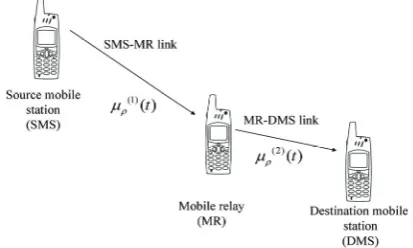
In cooperative networks employing amplify-and-forward relay, the channel between the SMS and the DMS via a MR can be represented as a concatenation of the SMS- MR and MR-DMS channels [8,10]. Figure 1 depicts an example of the transmission link from the SMS to the DMS via the MR in such amplify-and-forward relay- based networks. For the case when an LOS component is present in both of the transmission links, i.e., the SMS- MR link and the MR-DMS link, the overall fading chan-nel can be modeled as a product of two non-zero- mean complex Gaussian processes given by [10].
(2) (1) MR
( )
t
A
ρ( )
t
ρ( )
t
χ
=
μ
μ
(1)where AMR is a real positive constant representing the
relay gain and μ(i)(t)=μ(i)(t)+m(i)(t) (i=1,2)
ρ
mod-els the fading in the ith link. Here, μ(i)(t) denotes the scattered component and m(i)(t) is the LOS component. The scattered component μ(i)(t) can be modeled in the complex baseband as a complex Gaussian process with zero mean and variance 2 2
i
σ , i.e.,
) ( ) ( )
( () ()
1 ) (
2 t
j t
t i i
i μ μ
μ = + where, ()()
1 t
i
μ and ()()
2 t
i
μ
are the underlying zero-mean real-valued Gaussian processes. The LOS component m(i)(t) having ampli-tude ρi , Doppler frequency fρi, and phase θρi i can be expressed as ()() j(2 f it i)
i
i t e
m =ρ π ρ +θρ . Let
SMS,
fρ
MR,
fρ and fρDMS represent the respective Doppler fre-quencies of the SMS, MR, and DMS, then it can be eas-ily observed from Figure 1 that fρ1 = fρSMS+ fρMR and
2 MR DMS
fρ = fρ + fρ . The envelope of the process
χ
( )
t
in (1) results in a double Rice process given by [10](1) (2) MR
[image:2.595.319.526.598.722.2]MR 1 2
( ) | ( ) | | ( ) ( ) | ( ) ( )
t t A t t
A t t
ρ ρ
χ μ μ
ξ ξ
Ξ = =
= (2)
where ξi(t) (i=1,2)represents the classical Rice process.
The PDF of double Rice processes Ξ(t)is given by [10] 2 2 2 2
1 MR 2 2 1 MR ( / ) 2 2 2 2
1 MR 0
1 MR 0 2 0 2
1 MR
1 ( )
, 0
z y y
z
p z e e
y
z y
I I dy z
y ρ ρ σ σ σ σ ρ ρ σ σ + + ∞ − − Ξ = ⎛ ⎞ ⎛ ⎞ ≥ ⎜ ⎟ ⎜ ⎟ ⎝ ⎠ ⎝ ⎠
∫
(3)where I0(⋅) is the modified Bessel function of the first kind of order zero [20], 2 2
MR (AMR 2)
σ = σ , and ρMR =AMRρ2.
In order to derive the expressions for the statistical properties of the capacity of double Rice channels, we need the PDF pΞ2(z) of the squared process ()
2 t Ξ
as well as the joint PDF pΞ2Ξ&2(z,z&) of ()
2 t
Ξ and its time derivative Ξ&2(t)1. The joint ( , )
2
2 z z
pΞΞ& & can be found using the joint PDF pΞΞ&(z,z&) [10] and by using the concept of transformation of random variables [21] as
(
)
2 2
2 2 2 2
1 MR MR 2 2( , , , ) 1 2
2 2 2
1 MR MR
1 1 2
1 2
4 4 2
1 2 1 2
/ cos 1
2 2 2
2 4 0
1 MR 1 2 / cos
( ) ( , , , ) 2
8 ( ) 2 1 1 2 1 ( , ) , 4 2 1 1
2 (4 )
,
z y
z y y y
K
z y
yz yz K Z Y
z y z zy z
z
p z z p z
z z
e e e e
z y z
e e d d dy z
θ θ
ρ ρ π ρ θ π
σ σ σ
π π
ρ θ
θ θ
σ β β β β
π
πσ σ
β
β
θ θ
ΞΞ Ξ Ξ + + ∞ − − − − − − − − − + + ⎛ ⎞ = ⎜ ⎟ ⎝ ⎠ = + ×∫
∫
∫
& & & & & &0,| |z
≥ & < ∞
(4) where ) ( ) ( 2 2 max 2 max 2 1
1= πσ f 1+ f 2
β (5)
2 3
2 2 2 2 2( MR) (fmax fmax )
β = πσ + (6)
and
2
1 1 1 MR 2 2
1 2 4 2
1 2
2 sin 2 sin
( , , , ) = f y f z .
K z y
zy z
ρ ρ
πρ θ πρ θ
θ θ
β β
+ +
(7)
Here fmax1, fmax2, and fmax3 denote the maximum Doppler frequencies of the SMS, MR and DMS, respec-tively. The expression for the PDF pΞ2(z) can be ob-tained by integrating the joint PDF pΞ2Ξ&2(z,z&) over z&. Alternatively, in our case the PDF pΞ2(z) can also be found from the PDF pΞ(z) in (3) using the concept of transformation of random variables [21] as
2
2 2 2 2
/ 1 MR
2
2 2
21 MR
2 2 1 MR 0
MR 1
0 2 0 2
1 MR 1 ( ) = ( ) 2 1 1 = 2 , 0. y z y
p z p z
z
e e
y
y z
I I dy z
y ρ ρ σ σ σ σ ρ ρ σ σ Ξ Ξ + + − − ∞ ⎛ ⎞ ⎛ ⎞ ≥ ⎜ ⎟ ⎜ ⎟ ⎜ ⎟ ⎜ ⎟ ⎝ ⎠ ⎝ ⎠
∫
(8)In the next section, we will derive the statistical prop-erties of the capacity of double Rice channels using the results found in this section.
3. Statistical Properties of the Capacity of
Double Rice Channels
The instantaneous capacity C(t) of double Rice channels can be expressed using a similar formula found in [22] as
(
2)
2 1 ( )
log = )
(t t
C +γsΞ
(
2)
2
=log 1+ Ξγs ( ) (bits / s / Hz)t (9)
where γs denotes the average received signal-to-noise
ratio (SNR) at the DMS. Equation (9) can be considered as a mapping of a random process Ξ(t) to another ran-dom process C(t). Hence, the expressions for the statis-tical properties of the channel capacity C(t) can be derived by using the results for the statistical properties of the process Ξ(t) obtained in the previous section. The PDF pC(r) of the channel capacity C(t) can be found using (8), (9), and by applying the concept of transformation of random variables as
⎟ ⎟ ⎠ ⎞ ⎜ ⎜ ⎝ ⎛ − Ξ s r s r
C r p
p γ γ 1 2 (2) ln 2 = ) ( 2 2 2 2 2
2 1/ 1 MR
2
2 2
21 MR
2 2 1 MR 0
MR 1
0 2 0 2
MR 1
2 ln(2) 1 = 2 2 1 , 0. y r y s r s r s e e y y
I I dy r
y
ρ
γ ρ
σ σ
γ σ σ
ρ ρ σ γ σ + − + − − ∞ ⎛ − ⎞ ⎛ ⎞ ⎜ ⎟ ⎜⎜ ⎟⎟ ≥ ⎜ ⎟ ⎝ ⎠ ⎝ ⎠
∫
(10)
The CDF FC(r) of the channel capacity C(t) can now be obtained by solving the integral given by
0
( ) = ( ) . r
C C
F r
∫
p z dz (11)By substituting (10) in (11) and doing some mathe-matical manipulations, the CDF of the channel capacity can be expressed as follows
2 2 MR 2 2 MR 2 MR 0 MR 1
0 2 1
1
MR 1
1 ( ) = 1
2 1
, , 0
y
C
r
s
F r ye
y
I Q dy r
y ρ σ σ ρ ρ σ
σ γ σ
+ − ∞ − ⎛ ⎞ ⎛ ⎞ − ⎜ ⎟ ≥ ⎜ ⎟ ⎜ ⎟ ⎜ ⎟ ⎝ ⎠ ⎝ ⎠
∫
(12)where Q1(⋅,⋅) is the generalized Marcum Q-function [20]. The LCR NC(r) of the channel capacity C(t) is defined as [19]
0 , ) , ( = ) ( 0 ≥
∫
∞ r z d z r p z rNC & CC& & & (13)
where pCC&(z,z&) represents the joint PDF of C(t) and its time derivative C&(t). The joint PDF pCC&(z,z&) can be obtained from the joint PDF pΞ2Ξ&2(z,z&) by applying again the concept of transformation of random variables as
⎟ ⎟ ⎠ ⎞ ⎜ ⎜ ⎝ ⎛ − ⎟ ⎟ ⎠ ⎞ ⎜ ⎜ ⎝ ⎛ Ξ Ξ s z s z s z C C z p z z p γ γ γ (2) ln 2 , 1 2 (2) ln 2 = ) ,
( 2 2
2 & & & &
(
) (
)
(
)
2 22 1/ 1 2 MR2 MRcos 2 2 1/ 2 cos
2 1/ 2 2 2 1 1
2 2
1 2 MR 2
MR 1
2 3/ 2 2 2 4 0
1 MR 1 2
2 ln(2)
2
1
=
(4 )
2
2
1/
z y
s y y z y
s
z z
z
s s
e
e
e
e
y
γ ρ ρ ρ θ
γ ρ θ
σ σ π σ π
σ
π π
π
πγ σ σ
β
β
γ
− + + − − − − − − ∞ − −
−
+
−
∫
∫
∫
(
) ( )
( )
(
)
( )
( )
(
)
1/ 2 2 1ln(2)2 2 1
ln(2)2 2 1 2 1
, , ,1 2 1 2 4
4 2 2 1 2 1/ , , ,
8 1 2 2 1 1 2 2 1 2
1 2
z z
z z yz z
yz
K y
z z
z y s K y
y s s
s
e
e
e
d d dy
θ θ
γ γ θ θ
γ β β
γ β β
θ θ
− − ⎛ ⎞ − − ⎜ − ⎟ − − ⎜ ⎟ ⎛ ⎞ ⎜ ⎟ − ⎜ − ⎟ + − + − ⎝ ⎠ ⎝ ⎠×
& & (14)for z≥0, <z& ∞, where K
( )
⋅,⋅,⋅,⋅ is defined in (7). After substituting (14) in (13) and carrying out some algebraic cal-culations, we obtain2 cos
2 2 2 1/ cos
2 1/ 1 MR 2 1 1
2
2 2
2 1 MR 1
1 2 4
5/ 2 2 2
0 1 MR
2 1 2 1
( ) = (2 )
r y
r y y
s s r r C s s
N r e e e
y
ρ θ γ ρ θ
γ ρ π σ σ σ π β β γ π γ σ σ
− − + − − − ∞ − ⎛ ⎞ − + − ⎜ ⎟ ⎝ ⎠
∫
∫
(
)
1 21 2 2 1/ , , , 1 2 2 1 2 2 1 , , , 2 1
1 , , , 1
2 2
r
r r
K s y s
s
K y
e K y
π γ θ θ
π
θ θ
γ
π
θ θ
γ
⎛ − ⎞ ⎜ ⎟ ⎝ ⎠ − ⎤ ⎧ ⎛ ⎛ − ⎞ ⎞ ⎫ ⎥ ⎪ ⎜ ⎜⎜ ⎟⎟ ⎟ ⎪ ⎡ ⎛ − ⎞ ⎪⎪ ⎜ ⎝ ⎠ ⎟ ⎪⎪⎥ ⎢ ⎜ ⎟× + ⎜ ⎟ ⎨ + Φ⎜ ⎟ ⎬⎥
⎢ ⎝ ⎠ ⎪ ⎜ ⎟ ⎪⎥ ⎣ ⎥ ⎜ ⎟ ⎪ ⎜ ⎟ ⎥⎪ ⎪ ⎝ ⎠ ⎪ ⎩ ⎭⎦
∫
(
)
2 2 MR 1 22 2 1/ , , , 2 MR 2 1 2
1 2 , 0
y
r
K s y
e e d d dy r
ρ
γ θ θ σ θ θ + − − ⎛ − ⎞ ⎜ ⎟ ⎝ ⎠ × ≥ (15)
where Φ(⋅) denotes the error function [20]. Finally, from (15) and (12), the ADF TC(r) of the channel ca-pacity C(t) can be obtained using [19]
( ) ( ) = . ( ) C C C F r T r
N r (16) The results found in this section will be used in the
following section to derive the statistical properties of the capacity of double Rayleigh channels.
4. Statistical Properties of the Capacity of
Double Rayleigh Channels
the double Rice channel when ρi→0 (i=1,2). Hence, by letting ρi→0 (i=1,2) in (10), (12), and (15), the PDF, CDF, and LCR of the channel capacity of double Rayleigh channel can be expressed as
2 2 1
2 2 2 2 21 MR 0 2 2
1 MR 0
2 ln(2) 1
( ) = , 0
2 r y r y s C i s
p r e e dy r
y
σ σ γ ρ γ σ σ
− − − ∞ →
∫
≥ (17) 2 2 12 2 2
2 MR 21
0 2
MR 0
1
( ) = 1 , 0
r y
y s
C i
F r ρ ye σ e σ γ dy r
σ − − − ∞ → −
∫
≥ (18) and0 2 2
1 MR
2 2 1
2
2 2 2
2 1 MR
1 2 4
0
2 1
( ) =
2
2 1 , 0
r C i s r y r y s s N r
e e dy r
y ρ
σ σ γ
πγ σ σ
β β γ → − − − ∞ − ⎛ − ⎞ + ⎜ ⎟ ≥ ⎝ ⎠
∫
(19)respectively. The ADF of the channel capacity C(t) of dou-ble Rayleigh channel can be found using (16), (18), and (19).
5. Statistical Properties of the Capacity of
Rayleigh and Rice Channels
In this section, we will present the PDF, CDF, and LCR of the capacity of Rayleigh and Rice channels. We will study these results along with the statistical properties of the capacity of double Rice channels in the next section for comparison purposes. The PDF pC(r) of the ca-pacity C(t) of Rice channels can be found using the PDF pξ2(r) of the squared Rice process ( )
2 t
ξ and by employing the expression presented in (9) corresponding to Rice processes ξ(t) as
⎟⎟ ⎠ ⎞ ⎜⎜ ⎝ ⎛ − s r s r
C r p
p γ γ ξ 1 2 (2) ln 2 = ) ( 2
(
2 1)
, 02 (2) ln 2 = 4 0 2 0 2 0 2 2 1 2 2 0 ≥ ⎟ ⎟ ⎠ ⎞ ⎜ ⎜ ⎝ ⎛ − + − − r I e s r s s r s r γ σ ρ σ γ γ σ ρ γ (20)
where ρ represent the amplitude of the LOS com-ponent and 2
0
σ denotes the variance of the underlying Gaussian processes. By substituting (20) in
dx x p r F C r
C( )=
∫
0 ( ) , the CDF FC(r) of the capacity of) (t
C of Rice channels can be written as
(
2 1)
, 0, 1 = ) ( 2 0 0
1 ⎟⎟ ≥
⎠ ⎞ ⎜ ⎜ ⎝ ⎛ −
−Q r
r F
s r
C σ σ γ
ρ (21)
By solving NC(r)=
∫
0pCC&(r,z&)dz&∞
, the LCR NC(r) of the capacity of C(t)of Rice channels can be repre-sented by
(
)
2 1 2(
)
2 2 0
0
4 4 2
0 0
2 1 2 1
( ) = , 0
2 / r s r r s C s s
N r e I r
γ ρ σ γ
β
π σ γ σ γ ρ
− + − ⎛ ⎞ − ⎜ − ⎟ ≥ ⎜ ⎟ ⎝ ⎠ (22)
where β under isotropic scattering conditions is
given by
(
)
20 max
2
= π σ
β f . Here, pCC&(z,z&) represents the joint PDF of the capacity C(t) and its time deriva-tive C&(t) and fmax denotes the maximum Doppler
frequency.
The results for the PDF, CDF, and LCR of the capac-ity C(t) of Rayleigh channels can be obtained from (20)-(22), respectively, by letting ρ→0 as follows:
0 , 2 (2) ln 2 = )
( 2 02
1 2 2 0 0 ≥ ⎟⎟ ⎟ ⎠ ⎞ ⎜⎜ ⎜ ⎝ ⎛ − −
→ e r
r p s r s r C σ γ
ρ γ σ (23)
0 , 1
= )
( 2 02
1 2
0 − ≥
⎟⎟ ⎟ ⎠ ⎞ ⎜⎜ ⎜ ⎝ ⎛ − −
→ e r
r F s r C σ γ
ρ (24)
(
)
2 12 2 0 0 2 0 2 1 1
( ) = , 0.
2 r r s C s
N r ρ e γ σ r
β πγ σ ⎛ − ⎞ ⎜ ⎟ −⎜⎜ ⎟⎟ ⎝ ⎠ → −
≥ (25)
The expressions (23)-(25) have already been pre-sented in [23, Equations (23-25)]. However, we have presented these equations here for the sake of complete-ness.
6. Numerical Results
This section aims at the validation and analysis of the analytical results presented in the previous section, using simulations. We have also included the results for double Rayleigh, classical Rayleigh [19], and classical Rice channels in our study for comparison purposes. For the case of classical Rice channels, we denote the amplitude of the LOS component as ρ . The Rice processes
) ( ) ( = ) ( () () )
(i t μi t +mi t
μρ (i=1,2) were simulated us-ing the sum-of-sinusoids model [24]. The model pa-rameters were computed using the generalized method of exact Doppler spread (GMEDS1) [25]. The number of
sinusoids (N1(i) and N2(i)) for the resulting determinis-tic processes ()( )
1 t
~i
μ and ()()
2 t
~i
μ in GMEDS1 were
chosen to be = () =20
2 ) ( 1 i i N
N for i=1,2, respectively. The maximum Doppler frequencies fmax 2 and fmax 3 were taken to be 91 and 125 Hz, respectively. We have assumed that the Doppler frequency
SMS
fre-quencies
MR
fρ and fρDMS were set to be equal to
max 2
f and fmax 3, respectively. The SNR γs was set to
20 dB. The parameters AMR and σi (i=1,2) were
chosen to be unity. Finally, using (2) and (9) the simulation results for the statistical properties of the channel capacity were found.
The PDF pΞ(z) of double Rice processes Ξ(t) are shown in Figure 2 for different values of the amplitudes of the LOS components ρi (i=1,2). In Figure 2, the PDF of the double Rayleigh process is also shown, which represents a special case of the double Rice process when
0
2 1=ρ =
ρ . It is observed that the presence of the LOS components has a dominant effect on the mean value and spread of the PDF of double Rice processes. It can also be seen that the PDF of double Rice processes is identical for the cases ρ2=0; ρ1=2 and ρ2=2; ρ1=0.
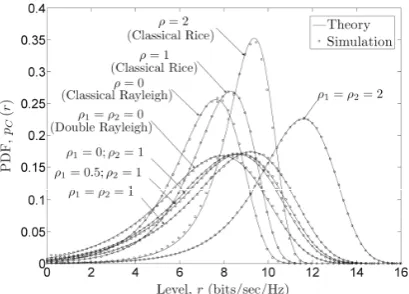
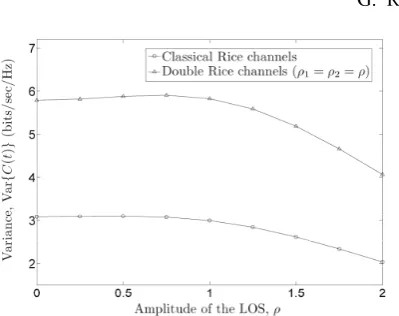
[image:6.595.321.526.212.359.2]Figures 3 and 4 present the PDF and CDF of the ca-pacity of double Rice channels, respectively. It is ob-served that the amplitude of the LOS component has a significant influence on the PDF and CDF of the channel capacity. Specifically, the presence of an LOS compo-nent in one or both of the links (i.e., the SMS-MR and MR-DMS links) increases the mean channel capacity. Hence, double Rayleigh channels have a lower mean channel capacity compared to double Rice channels, (e.g., when ρ2=ρ1=2). It is also observed that the capacity of classical Rice channels has a lower mean value com-pared to that of double Rice channels. These facts are specifically studied in Figure 5, where the mean channel capacity of classical Rice as well as double Rice chan-nels is studied for different values of the amplitudes of the LOS component. Figure 6 shows the influence of the amplitude of LOS component on the variance of the classical Rice and double Rice channels. It is observed that increasing the value of ρ decreases the spread of the channel capacity for medium and large values of ρ, say ρ≥1. Moreover, the variance of the capacity of double Rice channels is much higher as compared to that of classical Rice channels.
Figure 2. The PDF pΞ(z) of double Rice processes Ξ(t).
The LCR and ADF of the channel capacity of double Rice channels are presented in Figures 7 and 8, respec-tively. It is evident from Figure 7 that the maximum value of the LCR of the channel capacity increases with an increase in the value of the amplitude of the LOS component ρi (i=1,2). It is also observed that the
LCR of the capacity of classical Rice channels is much lower compared to that of double Rice channels. The converse statements with respect to the LCR of the chan-nel capacity are true for the ADF, as can be seen in Figure 8.
Figure 3. The PDF pC (r) of the capacity of double Rice
[image:6.595.67.275.585.734.2]channels.
Figure 4. The CDF FC (r) of the capacity of double Rice
channels.
[image:6.595.321.522.586.725.2]Figure 6. The variance Var{C(t)} of the capacity of classical Rice and double Rice channels.
Figure 7. The LCR NC (r) of the capacity of double Rice
channels.
Figure 8. The ADF TC (r) of the capacity of double Rice
channels.
Figures 9 and 10 illustrate the effect of the Doppler frequency on the LCR and ADF of the channel capacity. From Figures 9 and 10, it can clearly be seen that the LCR and ADF are strongly dependent on the Doppler frequencies of the MR and the DMS. It is ob-served that increasing the Doppler frequencies
MR
fρ and
DMS
fρ from 0 to fmax 2 and fmax 3, respectively,
[image:7.595.71.275.262.403.2]results in a significant increase in the LCR. However, the ADF decreases by increasing the Doppler frequen-cies of the MR and the DMS.
Figure 9. The LCR NC (r) of the capacity of double Rice
[image:7.595.317.529.269.416.2]channels.
Figure 10. The ACF TC (r) of the capacity of double Rice
channels.
7. Conclusions
In this paper, we have studied the statistical properties of the channel capacity of the double Rice channels. We have derived analytical expressions for the PDF, CDF, LCR, and ADF of the channel capacity. The findings of this paper give a deep insight into the influence of the LOS components, corresponding to the two links of am-plify-and-forward channels, on the statistical properties of the channel capacity. It has been observed that for medium and high signal levels, the presence of the LOS components in one or both of the links of the double Rice channel model increases the mean channel capacity and the LCR of the channel capacity. However, it decreases the ADF of the channel capacity. Moreover, the Doppler frequencies of the MR and the DMS have a significant impact on the LCR and ADF of the channel capacity. The validity of all the presented analytical results is confirmed by simulations, whereby a very good fitting between the analytical and simulation results is found.
8. References
[image:7.595.70.273.443.585.2]coopera-tion diversity—Part I: System description,” IEEE Trans-actions on Communications, Vol. 51, No. 11, pp. 1927-1938, November 2003.
[2] A. Sendonaris, E. Erkip, and B. Aazhang, “User coopera-tion diversity—Part II: Implementation aspects and per-formance analysis,” IEEE Transactions on Communica-tions, Vol. 51, No. 11, pp. 1939-1948, November 2003. [3] J. N. Laneman, D. N. C. Tse, and G. W. Wornell,
“Coop-erative diversity in wireless networks: Efficient protocols and outage behavior,” IEEE Transactions on Information Theory, Vol. 50, No. 12, pp. 3062-3080, December 2004. [4] M. Dohler, “Virtual antenna arrays,” Ph. D. dissertation,
King’s College, London, United Kingdom, 2003.
[5] J. B. Andersen, “Statistical distributions in mobile com- munications using multiple scattering,” in Proceedings of 27th URSI General Assembly, Maastricht, Netherlands, August 2002.
[6] I. Z. Kovacs, P. C. F. Eggers, K. Olesen, and L. G. Peter-sen, “Investigations of outdoor-to-indoor mobile-to-mobile radio communication channels,” in Proceedings of IEEE 56th Vehicular Technology Conference, VTC’02 Fall, Vancouver BC, Canada, pp. 430-434, September 2002. [7] V. Ercerg, S. J. Fortune, J. Ling, A. J. Rustako Jr., and R.
A. Valenzuela, “Comparison of a computer based propa-gation prediction tool with experimental data collected in urban microcellular environment,” IEEE Journal on Se-lected Areas in Communications, Vol. 15, No. 4, pp. 677-684, May 1997.
[8] C. S. Patel, G. L. Stüber, and T. G. Pratt, “Statistical properties of amplify and forward relay fading channels,” IEEE Transactions on Vehicular Technology, Vol. 55, No. 1, pp. 1-9, January 2006.
[9] J. Salo, H. M. El Sallabi, and P. Vainikainen, “Statistical analysis of the multiple scattering radio channel,” IEEE Transactions on Antennas Propagation, Vol. 54, No. 11, pp. 3114-3124, November 2006.
[10] B. Talha and M. Pätzold, “On the statistical properties of double Rice channels,” in Proceedings of 10th Interna-tional Symposium on Wireless Personal Multimedia Communications, WPMC 2007, Jaipur, India, pp. 517-522, December 2007.
[11] B. Talha and M. Pätzold, “On the statistical properties of mobile to mobile fading channels in cooperative net-works under line of sight conditions,” in Proceedings of 10th International Symposium on Wireless Personal Mul-timedia Communications, WPMC 2007. Jaipur, India, pp. 388-393, December 2007.
[12] B. Talha and M. Pätzold, “A novel amplify-and-forward relay channel model for mobile-to-mobile fading chan-nels under line-of-sight conditions,” in Proceedings of 19th IEEE International Symposium on Personal, Indoor and Mobile Radio Communications, PIMRC 2008, Cannes, France, September 2008.
[13] B. Talha and M. Pätzold, “Level-crossing rate and av-erage duration of fades of the envelope of mobile-
to-mobile fading channels in cooperative networks under line-of-sight conditions,” in IEEE Conference Proceed-ings Globecom’08, New Orleans, LA, USA, November /December 2008.
[14] J. Salo, H. M. El-Sallabi, and P. Vainikainen, “Impact of double-Rayleigh fading on system performance,” in Pro-ceedings of 1st IEEE International Symposium on Wire-less Pervasive Computing, ISWPC 2006. Phuket, Thai-land, January 2006.
[15] P. Almers, F. Tufvesson, and A. F. Molisch, “Keyhole effect in MIMO wireless channels: Measurements and theory,” IEEE Transactions on Wireless Communications, Vol. 5, No. 12, pp. 3596-3604, 2006.
[16] D. Gesbert, H. Bölcskei, D. A. Gore, and A. J. Paulraj, “Outdoor MIMO wireless channels: Models and per-formance prediction,” IEEE Transactions on Wireless Communications, Vol. 50, No. 12, pp. 1926-1934, De-cember 2002.
[17] A. Giorgetti, P. J. Smith, M. Shafi, and M. Chiani, “MIMO capacity, level crossing rates and fades: The im-pact of spatial/temporal channel correlation,” Journal of Communications and Networks, Vol. 5, No. 2, pp. 104-115, June 2003.
[18] B. O. Hogstad and M. Pätzold, “Capacity studies of MIMO models based on the geometrical one-ring scat-tering model,” in Proceedings of 15th IEEE International Symposium on Personal, Indoor and Mobile Radio Communications, PIMRC 2004, Vol. 3. Barcelona, Spain, pp. 1613-1617, September 2004.
[19] B. O. Hogstad and M. Pätzold, “Exact closed-form ex-pressions for the distribution, level- crossing rate, and average duration of fades of the capacity of MIMO channels,” in Proceedings of 65th Semiannual Vehicular Technology Conference, IEEE VTC 2007-Spring, Dublin, Ireland, pp. 455-460, April 2007.
[20] I. S. Gradshteyn and I. M. Ryzhik, “Table of Integrals, Series, and Products,” 6th edition, Academic Press, 2000. [21] A. Papoulis and S. U. Pillai, Probability, “Random vari-ables and stochastic processes,” 4th edition, New York: McGraw-Hill, 2002.
[22] G. J. Foschini and M. J. Gans, “On limits of wireless communications in a fading environment when using multiple antennas,” Wireless Personal Communications, Vol. 6, pp. 311-335, March 1998.
[23] G. Rafiq and M. Pätzold, “A study of the influence of shadowing on the statistical properties of the capacity of mobile radio channels,” Wireless Personal Communica-tions, DOI 10.1007/s11277-008-9545-7, June 2008. [24] M. Pätzold, “Mobile fading channels,” Chichester: John
Wiley & Sons, 2002.