Volume 29, Issue 2
A model of customer e-loyalty in the online banking
Yuan-shuh Lii
College of Business, Feng Chia University, Taiwan
Abstract
With the rapid growth of online banking, it has been reinforced that companies need to build and maintain loyal customers. This study models e-loyalty as the endogenous variable that includes three exogenous variables (website quality, corporate image and perceived social presence) and two mediating variables (satisfaction and trust). The model was empirically tested using data collected from an online survey of Internet forums based in Indonesia. Using structural equation modeling, the results of statistical analysis show that the model is an adequate fit to the data. All the causal relationships in this model were found to be significant. We discuss some interesting results and provide several implications for those banks which want to enhance loyalty of e-banking customers.
Citation: Yuan-shuh Lii, (2009) ''A model of customer e-loyalty in the online banking'', Economics Bulletin, Vol. 29 no.2 pp. 891-902.
Submitted: Nov 04 2008. Published: May 06, 2009.
1 1. Introduction
With the rapid growth of Internet banking, it has been reinforced that companies need to build and maintain loyal customers. The profit impact of having a loyal customer base to a given company may be worth up to 10 times as much as its average customer (Health 1997; Newell 1997). Thus, in order to reap the benefits of having loyal customers, it is critical that companies understand the antecedents of building customer loyalty on the Internet
(e-loyalty)( Srinivasan et al. 2002; Floh and Treiblmaier 2006).
Research into the antecedents of e-loyalty in consumer services has come into sharper focus. Srinivasan et al. (2002), for instance, identifies eight factors that potentially impact e-loyalty. Anderson and Sromovasam (2003) investigate the impact of satisfaction on loyalty in the context of electronic commerce. Semeijn et al. (2005) models the combined effects of online and offline service components on e-loyalty. Floh and Treiblmaier’s (2006) analysis examines the effects of overall satisfaction and trust on e-loyalty in online banking services.
This research integrates previous research in the field of e-loyalty to present a
conceptual framework of e-loyalty and its antecedents. Specifically, little is known about the intricate relationships between perceived website quality, perceived corporate image,
perceived social presence, consumer satisfaction, consumer trust, and e-loyalty. The study is especially significant given the growth of Internet banking and its high potential for building individual relationships on the World Wide Web (WWW) (Kierzkowki et al. 1996). This research will contribute to an increased understanding of consumer online banking behavior, to determine the key antecedents that influence e-loyalty, and to offer suggestions for
developing Internet banking strategies.
2. Literature Review
As noted by Reichheld and Schefter (2000), the secret weapon on the web is to cultivate loyal customers. Not only do loyal customers increase sales and profits of the business, they also enable it to reduce costs associated with attracting new customers. In particular, since the competition is just a mouse click away, e-loyalty appears to be essential for online banks both in an economic as well as a competitive sense (Semeijn et al. 2005).
While there is rich body of literature on Internet banking ranging from Sathye’s (1999) study in Australia to Ndubisi and Sinti’s (2006) research in Malaysia, more research still need to be conducted to investigate how to keep customers loyal to an online bank (Floh and Treiblmaier 2006).
The concept of e-loyalty extends the traditional loyalty concept to online consumer behavior. Cyr (2004, 2005) defined e-loyalty as intention to revisit a website or to make a transaction from it in the future. Strauss and Frost (2001) suggest that, given the relatively compressed buying cycle time, the main emphasis of e-loyalty should be on converting behavioral intent to immediate buying behavior. However, behavioral loyalty is much more complex and harder to achieve in the virtual than in the real world, where the customer often has to make the purchase decision with limited amount of information (Gommans, Krishnan, and Scheffold 2001).
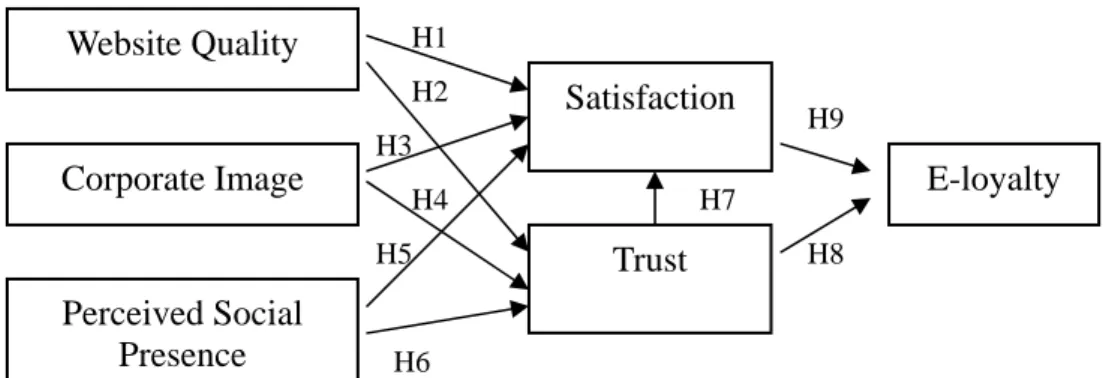
An attempt to add more to our understanding of e-loyalty in online banking environment, this research proposed a model (Figure 1) that describes e-loyalty as the endogenous variable that includes three exogenous variables (website quality, corporate image and perceived social presence) and two mediating variables (satisfaction and trust).
2 Figure 1: Conceptual framework
2.1 Website Quality
In contrast with traditional banking, online banking customers typically do not interact with individuals. Instead, they interact with an online bank through a user interface that enables them to initiate the desired transactions themselves. Thus, customers are more likely to visit and transact at websites that exhibit highly desirable qualities.
Previous research has identified the relationship between website quality, satisfaction, and trust. Bhattacherjee (2001), for example, found that experience on the brokerage website is a significant predictor of satisfaction with the brokerage service. A qualitative study of online pharmacy patrons found that website quality is associated with customer satisfaction (Yang et al. 2001). Floh and Treiblmaier (2006) investigated the importance of antecedents of e-loyalty in the financial service industry. Their research found that website quality has a direct impact on both satisfaction and trust. Accordingly, we expect website quality to have a positive influence on both satisfaction and trust:
H1: Website quality has a positive effect on consumer satisfaction of online banking. H2: Website quality has a positive effect on consumer trust of online banking. 2.2 Corporate Image
According to GrÖnroos (1990), corporate image functions as a filter which influences
customer perceptions of the operation of the company. Corporate image can be seen as customer affective preconceptions towards the company, which was created by continuous experiences (Zins 2001). Hence, it is the result of an evaluation process that creates an overall impression on the minds of consumers about a firm (MacInnis and Price 1987; Barich and Kotler 1991).
Corporate image has found to be inextricably linked with customer satisfaction (Nguyen and LeBlanc 2001). It has been considered to create a halo effect on customer satisfaction (Andreassen and Lindestad 1998). Previous research has found the support for the direct and positive effect of corporate image on customer satisfaction (Nguyen and LeBlanc 2001). We assume that the same effect will occur in the online banking environment.
Corporate image is one of the most influential factors in determining the degree of trust. Yoon (2002) found that corporate image significantly affects the trust of the customer toward specific website. Accordingly, we expect corporate image to affect customer trust toward online banking.
H3: Corporate image has a positive effect on consumer satisfaction of online banking. H4: Corporate image has a positive effect on consumer trust of online banking.
H9 H8 H1 H6 H5 H4 H3 H2 H7 Website Quality Corporate Image Perceived Social Presence Satisfaction Trust E-loyalty
3 2.3 Perceived Social Presence
Social presence refers to the extent to which a medium allows users to experience psychological presence of others (Fulk et al. 1987). A medium that can be characterized as social presence is in its capacity to provide human warmth. Hence, a medium is perceived to be warm if it creates a feeling of human contact, sociability, and sensitivity (Yoo and Alavi 2001). Examples of website features that conveys social presence include personalized greetings (Gefen and Straub 2003), human audio (Lombard and Ditton 1997), human video (Kumar and Benbasat 2002), as well as emotive text and pictures of humans (Hassanein and Head 2007).
Gunawardena and Zittle (1997) examined the social presence of a computer-mediated conferencing environment and found that social presence is a strong predictor of overall course satisfaction. The research of Dixon et al. (2006) has shown that learner satisfaction is greater when they have high levels of social presence.
Social presence of websites has been found to help reduce ambiguity, increase trust, and encourage users to purchase with lower levels of dissonance (Simon 2001). Similar results were also found in the work of Hassanein and Head (2007) whereas higher user perceptions of social presence on website selling apparel result in higher levels of trust in the online vendor. Accordingly, we expect consumer perception of social presence to affect consumer satisfaction and trust toward online banking.
H5: Consumer perception of social presence has a positive effect on consumer satisfaction of online banking.
H6: Consumer perception of social presence has a positive effect on consumer trust of online banking.
2.4 Trust
Moormann et al. (1993) defined trust as the willingness to rely on an exchange partner
in which one has confidence. Online trust can be seen as users interacting with transactional or informational websites that encompasses an attitude of confident expectation in an online situation or risk that one’s vulnerabilities will not be exploited (Corritore et al. 2003). The lack of trust has been found to be one of the major obstacles to the popularity of Internet banking (Rexha et al. 2003).
Trust has been recognized as an important antecedent in most models dealing with relationships that include loyalty or satisfaction as dependent variables (Schaupp and Bélanger 2005). Razzaque and Boon (2003), for instance, found a significant effect of trust on satisfaction in the context of channel relationship. Trust was also found to play a significant role in affecting willingness to transaction as well as loyalty in online vendors
(Flavian et al. 2005; Luarn and Lin 2003; Ribbink et al. 2004; Gefen 2002). Following
previous research findings, we hypothesize a positive effect of trust on both satisfaction and loyalty toward online banking.
H7: Consumer trust has a positive effect on consumer satisfaction of online banking. H8: Consumer trust has a positive effect on e-loyalty in online banking.
2.5 Satisfaction
Customer satisfaction has attracted much attention in the literature owing to its potential influence on consumer behavioral intentions and customer retention (Cronin et al. 2000). Customer satisfaction is the degree of overall contentment felt by the customer (Hellier et al.
4 2003), resulting from the outcome of a comparison process between expectations and perceived performance (Wirtz and Bateson 1999).
Much research and numerous empirical studies have shown the level of satisfaction experienced by the customer affects loyalty (e.g., Oliver 1997; Drake et al. 1998; Nguyen and LeBlanc 2001; Mountinho and Brownlie 1989; Mountinho and Smith 2000).
Satisfaction has been shown to be positively related to loyalty (Hallowell 1996; Strauss and Neuhaus 1997; Anderson et al. 1999; Ellinger et al. 1999; Oliver 1999) and this effect also occurs in online environment (Cho et al. 2002; Gummerus et al. 2004). Shankar et al. (2003) indicated that the effect of satisfaction on loyalty is stronger online than offline. Consistent with previous findings we hypothesized a positive impact of customer satisfaction on customer loyalty.
H9: Consumer satisfaction has a positive effect on e-loyalty in online banking.
3. Research Method 3.1 Participants and Procedure
The model was empirically tested using data collected from an online survey of Internet forums based in Indonesia, such as [email protected],
[email protected], [email protected], and [email protected].
Before sending the questionnaire in the main study, a pretest was first conducted to native speakers from Indonesia. No incentives were offered for their participation, hence the information they provided was completely voluntary. The final questionnaire was fine tuned based on the feedbacks given by the pretest samples. To obtain responses from forum
members, this study sent out private messages to registered members who participated in the respective forums. The questionnaire was translated from English to Bahasa using the back translation technique.
A total of 800 questionnaires were sent out, and 213 valid surveys were obtained. The sample consists of 97 female (45.54%) and 116 male respondents (54.46%). Majority of the respondents have college degree (70.42%). The average monthly salary was about 7,000,000 Indonesian Rupiah (USD 715). The average time span (experience) of using Internet banking amounts to 3 years, with frequency visiting the bank websites 2-3 times a week. Moreover, more than sixty percent of the respondents (66.20%) using Bank Central Asia (BCA) as their primary Internet banking with a large majority respondents using the banking facilities for account statement, transaction, and money transfer.
3.2 Construct Measurement and Validation
The scale items were taken from previous studies and modified to suit the context of the current study. The detail of all measurement items is listed in Appendix A. Structural equation modeling (SEM) was adopted to validate the instruments for unobserved constructs and test the research models. The reliability of measurement items was assessed by the internal consistency method. Cronbach’s alpha provides a reasonable estimate of internal consistency. These values range from 0.79 to 0.92 (See Table 1). All values surpass the recommended value of 0.6 or 0.7 (Nunnally 1978).
Convergent validity was also assessed. Convergent validity of research instruments is commonly estimated by assessing item reliability, construct reliability, and average variance extracted (AVE) (Fornell and Larcker 1981). All constructs exceed the recommended level of
5 construct reliability 0.70 and AVE 0.5 (Chau 1997). The details of the convergent validity test in Table 1 show that these results provide support for the convergent validity.
Table 1: Result of Factor Loading and AVE of Constructs
Latent variable Item name Factor loading Reliability AVE
Web site quality X1 X2 X3 0.90 0.90 0.85 0.87 0.71 Corporate image X4 X5 X6 0.77 0.74 0.76 0.81 0.63 Perceived social presence X7 X8 X9 0.85 0.82 0.89 0.83 0.60 Satisfaction Y1 Y2 Y3 Y4 Y5 0.77 0.84 0.72 0.83 0.78 0.92 0.62 Trust Y6 Y7 Y8 0.78 0.75 0.80 0.84 0.55 E-loyalty Y9 Y10 Y11 0.91 0.88 0.96 0.79 0.56
4. Analysis and Result
Structural equation modeling (SEM) analysis was also employed to assess the proposed model. SEM has been suggested as being useful for examining theoretically justified model such as the one in this study (Bagozzi and Yi 1988; Bentler 1989). The maximum likelihood estimation (MLE) was used to estimate variables.
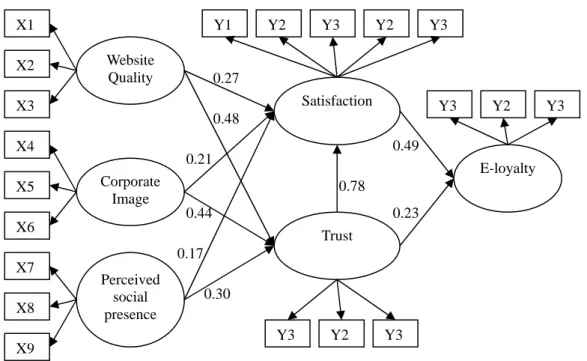
The test results indicate that all fit indices (GFI=0.88, AGFI=0.84, NFI=0.94, NNFI=0.94, CFI=0.94, IFI=0.95, RMSEA=0.08) correspond with their recommended values commonly suggested in prior literature (Chau 1997), providing support for an adequate model fit with data gathered. The path coefficients show the strengths of the relationships between the dependent and independent variables. Figure 2 shows the results of the structural model.
The statistical significance of all individual relationships provides empirical support for the hypotheses. In order of decreasing importance, variance in satisfaction seems to be
determined by: website quality (β = 0.27, t = 4.12, p<0.01), corporate image (β = 0.21, t =
3.72, p<0.01), and perceived social presence (β = 0.17, t = 3.32, p<0.01). H1, H3, and H5
were supported. With regard to trust, our analysis reveals that trust is determined by, in order
of decreasing importance, website quality (β = 0.48, t = 4.89, p<0.01), corporate image (β =
0.44, t = 5.04, p<0.01), and perceived social presence (β = 0.30, t = 4.24, p<0.01). We
therefore accept H2, H4, and H6.
Consistent with H7 and H8, trust has a significant influence on both satisfaction (β =
0.78, t = 6.51, p<0.01) and e-loyalty (β = 0.23, t = 3.41, p<0.01). Finally, in accordance with H9, satisfaction has a strong positive influence on e-loyalty (β = 0.49, t = 2.63, p<0.01).
6 Figure 2: Structural equation model with path coefficients
5. Discussion and Conclusion 5.1 Discussion
The objective of the current research is to study a model that describes e-loyalty as the endogenous variable that includes three exogenous variables (website quality, corporate image and perceived social presence) and two mediating variables (satisfaction and trust). The model demonstrated adequate fit with the data. Further, all the causal relationships in this model were found to be significant. We discuss some interesting results and provide several implications for those banks which want to enhance loyalty of e-banking customers.
Our results reveal that loyalty of e-banking customers is directly affected by satisfaction
(β = 0.49) and trust (β = 0.23) in an online bank. Trust is also found to have a direct effect on
satisfaction (β = 0.78). Based on the path coefficient analysis results, satisfaction mediates
the relationship between trust and e-loyalty. The direct path coefficient between trust and
e-loyalty (β = 0.23) is smaller than the indirect path coefficient through satisfaction (β:
0.49*0.78=0.38). Therefore, it is evident from the research findings that online banks can achieve customer loyalty through improving customer satisfaction and providing trustworthy banking environment, with satisfaction exhibiting more critical effect.
Our results indicate that both satisfaction and trust are determined by consumer perceptions of website quality, corporate image, and social presence, with website quality exhibiting the strongest impact. Given the importance of website quality, online banks have to design their web site with a view to enhancing satisfaction by providing ease of use, usefulness, enjoyment, and the speed of transaction (Pikkarainen et al. 2004; Floh and Treiblmaier 2006). 0.49 0.23 0.78 0.30 0.44 0.21 0.17 0.48 0.27 Website Quality X1 X2 X3 Corporate Image X4 X5 X6 Perceived social presence X7 X8 X9 Satisfaction Y1 Y2 Y3 Trust Y2 Y3 E-loyalty Y3 Y2 Y3 Y3 Y2 Y3
7 In addition, online bank must build a strong brand image in order to signal satisfaction and trustworthiness to its customers given that users of Internet banking do not have well-known contact persons and must rely completely upon the website. Online banks should also design rich multimedia content that will engender a human warmth feeling such as providing virtual assistant for customer support, online video tours and demos, and online interactive features.
5.2 Limitations and Future Research
One limitation originates in the biases inherent in most research. The current study only considers Indonesian online banking users and hence we should be cautious about the generalization of the results. However, while this limitation is noted, it should not undermine the results because the increasing use of online banking. More research is needed to further validate the model with a population of a different type of online banking users. It will be interesting to know if the model can hold across different cultures. Introducing moderating effects of user characteristics is also another way to further the knowledge such as need for cognition and degree of elaboration. Another intriguing line of research would be to investigate the longitudinal effects of trust and satisfaction on e-loyalty.
Appendix Website quality
Five-point Likert scale of strongly disagree to strongly agree (1) Website design:
1. Learning to operate the website is easy for me. 2. The display pages within the website are easy to read. (2) Website structure:
1. The website loads quickly.
2. When I use the website there is very little waiting time between my actions and the website’s response.
(3) Website content:
1. The website adequately meets my information needs.
2. It is easier to use the website to complete my business with the bank than the others facilities.
Corporate image
Five-point Likert scale of strongly disagree to strongly agree 1. The bank has a good reputation.
2. The bank has a better image than its competitor.
3. The bank fulfills the promises that it makes to its customers. Perceived social presence
Five-point Likert scale of strongly disagree to strongly agree 1. There is a sense of human contact in the website.
2. There is a sense of personalness in the website. 3. There is a sense of socialibility in the website. 4. There is a sense of human warmth in the website.
8 Trust
Five-point Likert scale of strongly disagree to strongly agree 1. I can trust this website.
2. I trust the information presented on the website.
3. I feel this online bank would provide me with good service. Satisfaction
Five-point Likert scale of strongly disagree to strongly agree 1. I am completely happy with my Internet banking.
2. I am very pleased with what the Internet bank does for me. 3. My experience with the Internet banking have always been good. 4. Overall, I am very satisfied with my Internet banking.
5. If I had to do it all over again, I would still choose to use the Internet banking. E-loyalty
Five-point Likert scale of strongly disagree to strongly agree 1. I would use this bank’s website again.
2. I would consider using this bank’s website in the future.
3. I would consider transaction with this bank’s website in the future. References
1. Anderson, R.E. and Srinivasan, S.S. (2003), E-satisfaction and e-loyalty: a contingency
framework, Psychology and Marketing, 20(2), 123-138.
2. Anderson, E.W., Fornell, C. and Rust, R.T. (1997), Customer satisfaction, productivity,
and profitability: Differences between goods and services, Marketing Science, 16(2), 129-145.
3. Andreassen, W. and Lindestad, B. (1998), Customer loyalty and complex services: the
impact of corporate image on quality, customer satisfaction and loyalty for customer with varying degrees of service expertise, International Journal of Service Industry
Management, 9(1), 7-23.
4. Bagozzi, R.P. and Yi, Y. (1988), On the evaluation structural equation models, Academic
of Marketing Science, 16, 74-94.
5. Barich, H. and Kotler, P. (1991), A framework for marketing image management, Sloan
Management Review, 32(2), 94-104.
6. Bentler, P.M. (1989), EQS structural equations program manual, BMDP Statistical
Software, Los Angeles.
7. Bhattacherjee, A. (2001), An empirical analysis of the antecedents of electronic
commerce service continuance, Decision Support Systems, 32(2), 201-214.
8. Chau, P.Y.K. (1997), Reexamining a model for evaluating information for evaluation
information center success using a structural equation modeling approach, Decision Sciences, 28(2), 309-334.
9. Cho, Y., Im, I., Hiltz, R., and Fjermestad, J. (2002), The effects of post-purchase
evaluation factors on online vs offline customer complaining behavior: implications for customer loyalty, Advances in Consumer Research, 29(1), 318-26.
10. Corritore, C.L., Kracher, B., and Weidenbeck, S. (2003). On-line trust: Concepts,
evolving themes, a model, International Journal of Human-Computer Studies, 58, 737-758.
9 and customer satisfaction on consumer behavioural intentions in service environments, Journal of Retailing, 76(2), 193-218.
12. Cyr, D., Hassanein, K., Head, M. And Ivanov, A. (2007), The role of social presence in
establishing loyalty in e-service environments, Interacting with Computers, 19(1), 43-56.
13. Dixon, K.C., Scott, S.and Dixon, R.C. (2006). The academics’ perspective on the quality
teaching agenda: How to meet all the demands on their time and maintain personal equilibrium and sound practice. Paper presented at the European Conference on Educational Research (ECER), Geneva, Switzerland, October.
14. Drake, C., Gwynne, A., and Waite, N. (1998), Barclays life: Customer satisfaction and
loyalty tracking survey: A demonstration of customer loyalty research in practice, International Journal of Bank Marketing, 16(7), 287-292.
15. Ellinger, A.E., Daugherty, P.J., and Plair, Q.J. (1999), Customer satisfaction and loyalty
in supply chains: the role of communication, Transportation Research: Part E: The Logistics and Transportation Review, 35(2), 121-34.
16. Flavian, C., Guinaliu, M. And Guirrea, R. (2005), The role played by perceived usability,
satisfaction and consumer trust on website quality, Information and Management, 43(1), 1-14.
17. Floh, A., and Treiblmaier, H. (2006), What keeps the e-Banking customer loyal? A
multigroup analysis of the moderating role of consumer characteristics on e-loyalty in the financial service industry, Journal of Electronic Commerce Research, 7(2), 97-110.
18. Fornell, C. and Larcker D.F. (1981), Evaluating structural equation models with
unobservable variables and measurement error, Journal of Marketing Research, 27, 39–50.
19. Fulk, J., Steinfield, C.W., Schmitz, J., and Power, J.G. (1987), A social information
processing model of media use in organizations, Communication Research, 14(5), 529-552.
20. Gefen, D. and Straub, D. (2003), Managing user trust in B2C e-services, e-Service
Journal, 2(2), 7-24.
21. Gefen, D. (2002). Customer loyalty in e-commerce, Journal of the Association for
Information Systems, 3(1), 27-51.
22. Gommans, M., Krishnan, K.S. and Scheffold, K.B. (2001), From brand loyalty to
e-loyalty: A conceptual framework, Journal of Economic and Social Research, 3(1), 43-58.
23. GrÖnroos, C. (1990). Service management and marketing: Managing the moment of truth
in service competition, Lexington, MASS: Lexington Books.
24. Gummerus, J., Liljander, V., Pura, M., and van Riel, A. (2004), Customer loyalty to
content-based Web sites: the case of an online health care service, Journal of Services Marketing, 18(3), 175-86.
25. Gunawardena, C.N. and Zittle, F.J. (1997), Social presence as a predictor of satisfaction
within a computer-mediated conferencing environment, The American Journal of Distance Education, 11(3), 8-26.
26. Hallowell, R. (1996), The relationships of customer satisfaction, customer loyalty, and
profitability: an empirical study, International Journal of Service Industry Management, 7(4), 27-42.
27. Hassanein, K. and Head, M. (2007), The impact of infusing social presence in the Web
interface: An investigation across different products, International Journal of Electronic Commerce (IJEC), 10(2), 31-55.
28. Health, R.P. (1997), Loyalty for Sale: Everybody’s doing frequency marketing-- but only
10 40.
29. Hellier, P.K., Geursen, G.M., Carr, R.A. and Rickard, J.A. (2003), Customer repurchase
intention, a general structural equation model, European Journal of Marketing, 37(11/12), 1762-1800.
30. Kierzkowski, A.S., McQuade, S., Waitman, R. and Zeisser, M. (1996), Marketing to a
digital consumer, The Mckinsey Quartely, 33(3), 4-21.
31. Kumar, N. and Benbasat, I. (2002), Para-social presence and communication capabilities
of a website: A theoretical perspective, e-Service Journal, 1(3), 5-24.
32. MacInnis, D.J, Price, L.L. (1987), The role of imagery in information processing: review
and extensions, Journal of Consumer Research, 13, 473-91.
33. Moorman, C., Zaltman, G. and Deshpandé, R. (1993), Factors affecting trust in market
research relationships. Journal of Marketing, 57, 81–101
34. Mountinho, L. and Brownlie, D.T. (1989), Customer satisfaction with bank services: A
multidimensional space analysis, International Journal of Bank Marketing, 7(5), 23-27.
35. Mountinho, L. and Smith, A. (2000), Modeling bank customer satisfaction through
mediation of attitudes towards human and automated banking, International Journal of Bank Marketing, 18(3), 124-134.
36. Ndubisi, N.O. and Sinti, Q. (2006), Consumer attitudes, system’s characteristics and
Internet banking adoption in Malaysia, Management Research News, 29(1/2), 16-27.
37. Newell, F. (1997), The new rules of marketing:How to use one-to-one relationship
marketing to be the leader in your industry, New York: McGraw-Hill, 10-32.
38. Nguyen, N. and Leblanc, G. (2001), Corporate image and corporate reputation in
customers retention decisions in services, Journal of Retailing and Customer Services, 8, 227-236.
39. Nunnally, J (1978), Psychometric Theory, McGraw-Hill, New York, NY.
40. Oliver, R.L. (1997), Satisfaction: A Behavioral Perspective on the Consumer,
McGraw-Hill, New York, NY.
41. Oliver, R.L. (1999), Whence customer loyalty?, Journal of Marketing, 63(4), 33-44.
42. Pikkarainen, T., Pikkarainen, K., Kirjaluoto, H., and Pahnila, S. (2004), Consumer
acceptance of online banking: An extension of the technology acceptance model, Internet Research, 14(3), 224-235.
43. Razzaque, M. A. and Boon, T. G. (2003), Effects of dependence and trust on channel
satisfaction, commitment and cooperation, Journal of Business-to-Business Marketing, 10(4), 23-48.
44. Reichheld, F.F. and Schefter, P. (2000), E-loyalty: Your secret weapon on the Web,
Harvard Business Review, 78(4), 105-114.
45. Rexha, N., John, R.P. and Shang, A.S. (2003), The impact of the relation plan on adoption
of electric banking, Journal of Services Marketing, 17(1), 53-67.
46. Ribbink, D., Riel, A., Liljander, V. and Streukens, S. (2004), Comfort your online
customer: Quality, trust, and loyalty on the Internet, Managing Service Quality, 14(6), 446-456.
47. Sathye, M. (1999), Adoption of internet banking by Australian consumers; an empirical
investigation, International Journal of Bank Marketing, 17(7), 324-334.
48. Schaupp, L.C. and Bélanger, F. (2005), A conjoint analysis of on-line consumer
satisfaction, Journal of Electronic Commerce Research, 6(2), 95-111.
49. Semeijn, J., van Riel, A.C.R., van Birgelen, M.J.H. and Strevkens, S. (2005), E-services
and offline fulfillment: How e-loyalty is created, Managing Service Quality, 15(2), 182-194.
11 in online and offline environments, International Journal of Research Marketing, 20(2), 153-175.
51. Srinivasan, S.S., Anderson, R., and Ponnavolu, K. (2002), Customer loyalty in
e-commerce: an exploration of its antecedents and consequences, Journal of Retailing, 78, 41-50.
52. Strauss, J. and Frost, R. (2001), E-marketing, New Jersey: Prentice Hall.
53. Strauss, B., Neuhaus, P. (1997), The qualitative satisfaction model, International Journal
of Service Industry Management, 9(2), 169-88.
54. Wirtz, J. and Bateson, J.E.G. (1999), Consumer satisfaction with services Integrating the
environment perspective in services marketing into the traditional disconfirmation paradigm, Journal of Business Research, 44, 55-66.
55. Yang, Z., Peterson, R.T. and Huang, L. (2001), Taking the pulse of internet pharmacies,
Marketing Health Services, 21(2), 5-10.
56. Yoo, Y. and Alavi, M. (2001), Media and group cohesion: Relative influences on social
presence, task participation, and group consensus, MIS Quarterly, 25(3), 371-390.
57. Yoon, S. (2002), The antecedents and consequences of trust in online-purchase decisions,
Journal of Interactive Marketing, 16(2), 47-63.
58. Zins, A.H. (2001), Relative attitudes and commitment in customer loyalty models:
Some experiences in the commercial airline industry, International Journal of Service Industry Management, 12(3), 269-294.