Mcdonald, G., García-Pedrajas, N., Macdonald, C. and Ounis, I. (2017) A Study of
SVM Kernel Functions for Sensitivity Classification Ensembles with POS Sequences.
In: SIGIR 2017: The 40th International ACM SIGIR Conference on Research and
Development in Information Retrieval, Tokyo, Japan, 7-11 Aug 2017, pp. 1097-1100.
ISBN 9781450350228.
There may be differences between this version and the published version. You are
advised to consult the publisher’s version if you wish to cite from it.
http://eprints.gla.ac.uk/142960/
Deposited on: 26 June 2017
Enlighten – Research publications by members of the University of Glasgow
http://eprints.gla.ac.uk
A Study of SVM Kernel Functions for Sensitivity Classification
Ensembles with POS Sequences
Graham McDonald
University of Glasgow Glasgow, Scotland, UK [email protected]Nicol´as Garc´ıa-Pedrajas
University of C´ordoba C´ordoba, Spain [email protected]Craig Macdonald
University of Glasgow Glasgow, Scotland, UK [email protected]Iadh Ounis
University of Glasgow Glasgow, Scotland, UK [email protected]ABSTRACT
Freedom of Information (FOI) laws legislate that government docu-ments should beopenedto the public. However, many government documents containsensitiveinformation, such asconfidential infor-mation, that is exempt from release. Therefore, government docu-ments must besensitivity reviewedprior to release, to identify and
closeany sensitive information. With the adoption of born-digital documents, such as email, there is a need for automatic sensitiv-ity classification to assistdigital sensitivity review. SVM classifiers and Part-of-Speech sequences have separately been shown to be promising for sensitivity classification. However, sequence classifi-cation methodologies, and specifically SVM kernel functions, have not been fully investigated for sensitivity classification. Therefore, in this work, we present an evaluation of five SVM kernel func-tions for sensitivity classification using POS sequences. Moreover, we show that anensembleclassifier that combines POS sequence classification with text classification can significantly improve sen-sitivity classification effectiveness (+6.09% F2) compared with a text
classification baseline, according to McNemar’s test of significance.
1
INTRODUCTION
Freedom of Information (FOI) laws state that government docu-ments should be open to the public. However, many government documents containsensitiveinformation, such asconfidential in-formation. Therefore, FOI laws exempt sensitive information from release and government documents must besensitivity reviewed
prior to release, to identify andcloseany sensitivities. However, with the introduction ofborn-digitaldocuments, such as email, the volume of documents has increased and document creation pro-cesses have become less structured. Hence, traditional sensitivity review processes are not viable fordigital sensitivity review.
Automatic classification techniques can potentially be adapted to assist the digital sensitivity review process and reduce the time
Permissiontomakedigitalorhardcopiesofallorpartofthisworkforpersonalor classroomuseisgrantedwithoutfeeprovidedthatcopiesarenotmadeordistributed forprofitorcommercialadvantageandthatcopiesbearthisnoticeandthefullcitation onthefirstpage.Copyrightsforcomponentsofthisworkownedbyothersthanthe author(s)mustbehonored.Abstractingwithcreditispermitted.Tocopyotherwise,or republish,topostonserversortoredistributetolists,requirespriorspecificpermission and/[email protected].
SIGIR’17,August 07-11, 2017, Shinjuku, Tokyo, Japan
©2017Copyrightheldbytheowner/author(s).PublicationrightslicensedtoACM. 978-1-4503-5022-8/17/08...$15.00
DOI:http://dx.doi.org/10.1145/3077136.3080731
taken to review documents. McDonaldet al.[12] showed that sen-sitivities relating toinformation supplied in confidencecould be cap-tured in the grammatical structure of documents, by representing the documents as sequences of Part-of-Speech (POS) n-grams [11]. For example, sensitivities relating to information supplied in con-fidence are often recounts of dialogues or actions and, therefore, can contain strings such as “an informer gave him”, “the ambas-sador said she” or “a detainee showed us”. These strings can all be represented by the POS sequenceDT NN VB PR, or subsequently
as a sequence of POS n-grams, e.g. as POS 2-gramsDTNN NNVB VBPR. McDonaldet al.[12] showed that the frequencies of certain
POS sequences can be an indicator of potential sensitivity. Representing documents by an abstraction, such as the POS tags they contain, has an additional attractive by-product. In effect, a document’s tokens (POS n-grams) can be viewed as a sequence of symbols from an alphabet, rather than terms from a vocabulary and, hence, gives rise to the possibility of developing techniques based on sequence classification [18]. Sequence classification has been shown to be effective in fields such as Bioinformatics (e.g. classifying protein sequences) and Cyber-Security (e.g. intrusion detection), in addition to Information Retrieval (IR) tasks (e.g. bot detection from query log sequences). An intrinsic component of se-quence classification is selecting a classificationkernel functionthat is suitable for the classification task being attempted, for example, sequence-similarity kernels such as the Spectrum kernel [10].
Our contributions in this work are two-fold. Firstly, we present a thorough evaluation of five SVM kernel functions for POS sequence classification of sensitive information that would be exempt from release under UK FOI laws. Secondly, we show that a weighted majority voteensembleclassifier that combines POS sequence classi-fication with text classiclassi-fication can significantly improve sensitivity classification (+6.09% F2) compared to a text classification baseline,
according to McNemar’s test of significance.
This paper is structured as follows: Section 2 discusses prior work; Section 3 provides an overview of the kernel functions that we deploy; We present our experimental setup in Section 4 and our results in Section 5; Concluding remarks follow in Section 6.
2
RELATED WORK
Most of the existing literature on automatically identifying sensitive information has addressed the task ofmaskingpersonal data [2, 5]. However, sensitive information in government documents is more
wide-ranging than personal information and can include, for exam-ple, issues of confidentiality or international relations. Gollinset al.[6] posited that IR technologies could assist the digital sensitivity review process. They also noted that some sensitivities, such as international relations, can pose more of a risk due to the potential effect of accidental release. Hence, there is a need for automatic tech-niques for classifying these more wide-ranging types of sensitivity. Text classification has been shown to be an effective approach as a basis for automatic sensitivity classifiers [1, 13]. Text classifi-cation relies on there being a specific set of terms, for which their distribution can be a reliable indicator of the class that is to be identified. However, as Gollinset al.[6] noted, sensitivity arises not only from the terms in a document but also from thecontext
in which they appear and, therefore, sensitivity classification must go beyond term features (and text classification). In this work, we focus on combining text classification with sequence classification techniques for sensitivity identification.
McDonaldet al.[12] showed that Part-of-Speech (POS)n-gram sequences can be effective for identifyingsupplied in confidence
sensitivities. They adapted an approach from Lioma and Ounis [11], who showed that more frequent POSn-grams in a collection are likely to bear morecontent. McDonaldet al.used the distributions of POSn-grams in sensitive and non-sensitive text to measure the
sensitivity loadof text sequences. Differently from the work of [12], in this work, we use POS sequences to study different SVM kernel functions for sensitivity classification. Moreover, we investigate methods of ensemble learning for effectively combining POS se-quence classification with text classification for sensitivity.
Ensemble classification [3] methods combine the decisions from acommitteeof individual classifiers with a view to improving the overall classification performance. The simplest, but often most ef-fective, of these approaches combines the predictions from the com-mittee classifiers by viewing each classifier’s prediction as a vote for the class of a document [9]. Another popular approach, namely stacking [17], is to learn a separate (meta-learner) combiner func-tion from the predicfunc-tions of the committee classifiers. In this work, we investigate weighted voting and stacking ensembles for com-bining sequence and text classification for sensitivity classification.
3
SVM KERNEL FUNCTIONS
As previously stated in Section 1, an intrinsic component of a new sequence classification task is to identify a suitable kernel function for the task. Therefore, in this section we provide an overview of the kernel functions and classifier that we deploy for POS sequence classification for sensitivity.
Support Vector Machines (SVM) [16] are a type of supervised learning algorithm that learn a linear separating hyperplane be-tween two classes within a vector space. SVM achieves this by solv-ing a dual optimisation problem on a setSof traininginstance vec-tors,xi, with corresponding class labels,yi, wherei=1..m,xi ∈Rn
andyi ∈ {±1}. The SVM optimisation aims to 1) maximise the
dis-tancebetween the hyperplane and theclosestinstances in either of the classes, and, 2) minimise the classification error. The resulting optimisation problem,MaximiseÍ
iαi−12Í
iÍjαiαjyiyjxi,xj,
requires learning the optimal weights,αifori=1..m, whereαi ≥0.
Since this optimisation problem relies only on the inner products
xi,xj, which can be viewed as a distance measure, this component
of the optimisation can besubstitutedby akernel function,K(xi,xj),
that computes a measure that is selected for the classification task. The linear kernel, defined asKlinear(xi,xj)=xTixj, is the
sim-plest kernel. However,Klinearhas desirable properties in that it is
very fast to train and does not tend toover-fitthe learned model toSwhen|x|is very large [7]. For non-linearly separable data, a
more suitable kernel is the Gaussian kernel,Kдaussian(xi,xj) =
exp− | |xi−xj| |2
2σ2
, whereσis a parameter that determines thewidth
of the Gaussian function, i.e. the region of influence for an instance in vector space. A properly tuned Gaussian kernel will always be able to learn the optimal decision of a linear kernel [8], yet tuningσ
can be expensive and does not guarantee obtaining a better model. By substitutingx
i,xjwith a kernel function, we effectively
create afeaturemap,ϕ, which maps an instance,x, to a new (possi-bly higher dimensional) space. For the linear and Gaussian kernels,
ϕis implicit within the dot products defined in the functions. Often, however, kernels explicitly define this mapping as the input to the kernel function. String kernels operate on finite sub-sequences of strings and the Spectrum kernel [10] is a simple string ker-nel defined by its mapϕover all sub-sequences in an alphabet
A. For a given alphabetA,|A| = l, a document’s feature map,
Φk(x)=(ϕa(x))a∈Ak, is the frequency weighted set of all
contigu-ous subsequences of lengthk≥1, that the document contains, i.e.
itsk-spectrum, and whereϕa(x)is the frequency ofainx. The
Spec-trum kernel is then defined asKspectrum(x,y)=hΦk(x),Φk(y)i.
One limitation of the Spectrum kernel is that it is constrained to exact matches when calculating the similarity of instances. The Mismatch Kernel [4] addresses this by allowing for a pre-defined number of mismatched symbols within sequences. For a given sequenceα =a1..ak,a ∈A,N(k,m)(α)is the set of allk-length
sequences,β=b1..bk,b∈Athat differ fromαby≤mmismatches.
The Mismatch kernel’s feature map is then defined asΦ(k,m)(α)=
(ϕβ(α))β∈Ak, whereϕβ(α)=1 ifβ ∈N(k,m)(α), elseϕβ(α)=0.
From this feature map, the (k,m)-mismatch kernel is defined as
K(k,m)(x,y)=Φ(k,m)(x),Φ(k,m)(y).
Finally, the Smith-Waterman kernel,Ksw, is based on the
Smith-Waterman sequence similarity algorithm [15]. Unlike the kernels presented thus far, it is not strictly a kernel function, since it does not satisfy certain mathematical conditions, e.g. it is not always positive definite. However, in this work, we test its effectiveness as a kernel function for POS n-gram sequence classification.
For complex sequence classification tasks, a single SVM kernel may not provide an optimal solution. One method of addressing this is to combine multiple simpler kernels as a hybrid kernel, with the aim of considering multiple aspects of an instance vector. We hypothesise that different types of kernels will identify different aspects of sensitivity and, therefore, in this work, we evaluate two hybrid kernels that are a linear combination of the scores from two simpler kernels, namely Spectrum+Linear and Spectrum+Gaussian.
4
EXPERIMENTAL SETUP
Collection:Our test collection is 3801 government documents that
have been sensitivity reviewed by government reviewers. All docu-ments that contain any sensitivity relating toPersonal Information
orInternational RelationsFOI exemptions were labeled assensitive. All other documents were labelednot-sensitive, resulting in a bi-nary classification task with 502sensitiveand 3299not-sensitive
Table 1: The total unique POSn-gram tokens in each collection representation.
1-gram 2-gram 3-gram 4-gram 5-gram 6-gram 7-gram 8-gram 9-gram 10-gram
Unique Tokens
15
209
1877
11408
51238
172109 441251 888837 1465215 2052063
documents. We perform a 5-fold Cross Validation and randomly down-sample non-sensitive documents to balance the training data.
Baseline:As a baseline we use a text classification approach with
binary bag-of-words features. For this approach, we use SVM with a linear kernel andC =1.0, since thesedefault parameters are known to be effective for text classification [7, 14] and can provide a strong baseline for sensitivity classification [1, 13].
Sequence Classification:For the POS sequence representations,
following [11, 12], we use the TreeTagger1part-of-speech tagger
to POS tag documents using a reduced set of 15 POS tags. We then create separaten-gram sequence representations of the collection, resulting in individualn-gram sequence collections forn={1...10}.
Table 1 presents the number of observed unique tokens in the alpha-bet,A, for each size ofn. For the linear and Gaussian kernels, we represent documents as token frequency vectors. For the Spectrum, Mismatch and Smith-Waterman kernels, we count the frequency ofklength sub-sequence matches in a pair of documents. We train a separate committee classifier for each size ofn-gram sequence, resulting inn votesper kernel as input to the ensemble approaches.
Ensemble Classification:For the ensemble approaches, we
com-bine the predictions of the text classificationPtwith the predictions
ofnsequence classifiersPs, resulting inn+1 document features f,f ∈ {pt,ps}. We test four combination methods. Firstly, in
Weighted Majority Vote (WMV), to predict a document’s class,ptis
assigned a weightwfor each fold and the document’s overall pre-diction score is calculated as(pt·w)+Íni=1ps i
n+1 . The remaining three
combination methods arestackingapproaches. These require an intermediate step wherePtandPs are predictions for a validation
set for each of the 5-fold Cross Validation folds.PtandPs are then
concatenated and the resultingn+1 predictions (per document) are used to train the combiner. We test three classifiers as combiners, namely Logistic Regression (LR), SVM and Random Forests (RF).
Classification and Parameters:We use scikit-learn2and extend
LibSVM3with the Spectrum, Mismatch and Smith-Waterman
ker-nels. Parameter values for the sequence and combinator classifiers are selected by 10-fold Cross Validation on training and validation sets respectfully, for each of the 5-fold Cross Validation folds. We vary SVM’sCparameter exponentially in the range [0.001,10000], and similarly forγ parameters in [0.0001,10]. For sequence classifi-cation, sub-sequences are varied fork={3,6,9,12}. For ensemble
combinators: for WMV, we testw={1..100}; for LR we select L1 as
our loss function and varyCin the same range as for SVM; for RF, we test number of treest={100,250,500,750,1000}. We optimise
for area under the Receiver Operating Characteristic curve (auROC).
Metrics:We select auROC as our main metric for measuring kernel
effectiveness, since it is calculated over all decision thresholds for a classifier. Additionally, we report precision (P), True Positive Rate (TPR), True Negative Rate (TNR), F1, F2and Balanced Accuracy
(BAC) metrics. We report statistical significance using McNemar’s non-parametric test, withp<0.001. Significant improvements com-pared to the text classification baseline are denoted by†in Table 4.
1http://www.cis.uni-muenchen.de/∼schmid/tools/TreeTagger/
2http://scikit-learn.org/
3https://csie.ntu.edu.tw/∼cjlin/libsvm/
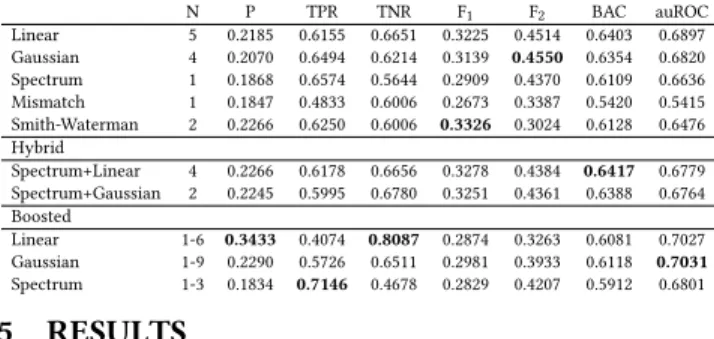
Table 2: Results for the best performing size ofn-gram for
stand-alone POS sequence classification, according to the area under the ROC curve (auROC).
N P TPR TNR F1 F2 BAC auROC Linear 5 0.2185 0.6155 0.6651 0.3225 0.4514 0.6403 0.6897 Gaussian 4 0.2070 0.6494 0.6214 0.3139 0.4550 0.6354 0.6820 Spectrum 1 0.1868 0.6574 0.5644 0.2909 0.4370 0.6109 0.6636 Mismatch 1 0.1847 0.4833 0.6006 0.2673 0.3387 0.5420 0.5415 Smith-Waterman 2 0.2266 0.6250 0.6006 0.3326 0.3024 0.6128 0.6476 Hybrid Spectrum+Linear 4 0.2266 0.6178 0.6656 0.3278 0.4384 0.6417 0.6779 Spectrum+Gaussian 2 0.2245 0.5995 0.6780 0.3251 0.4361 0.6388 0.6764 Boosted Linear 1-6 0.3433 0.4074 0.8087 0.2874 0.3263 0.6081 0.7027 Gaussian 1-9 0.2290 0.5726 0.6511 0.2981 0.3933 0.6118 0.7031 Spectrum 1-3 0.1834 0.7146 0.4678 0.2829 0.4207 0.5912 0.6801
5
RESULTS
In this section, we first review the performance of each of the kernels asstand-aloneclassifiers for POS sequence classification without text features, before evaluating the combinedensemble
approaches, compared to the text classification baseline.
Table 2 presents the results for thestand-aloneclassifiers. The ta-ble shows the best performing size ofn-gram for each of the individ-ual kernels and for two hybrid classifiers, namelySpectrum+Linear
andSpectrum+Gaussian, according to auROC. Additionally, Table 2 also presents the results of a simple boosting classification approach where, for a specific kernel, we add the output from ann-gram clas-sification as an additional feature for then+1-gram classification.
As shown in Table 2, the linear kernel achieves the best auROC score (0.6897). However, the Gaussian and Spectrum kernels per-form competitively with the linear kernel, achieving 0.6820 and 0.6636 auROC respectively. Moreover, in sensitivity classification the cost of mis-classifying a sensitive document is far greater than that of mis-classifying a not-sensitive document and the highest F2
(0.4550) and TPR (0.6574) scores are achieved by the Gaussian and Spectrum kernels respectively. The Mismatch and Smith-Waterman kernels perform less well, achieving 0.5415 and 0.6476 auROC re-spectively. Therefore, in the remaining approaches, we focus on the Spectrum, Gaussian and linear kernels.
When evaluating the effectiveness of kernels, we are interested in notable differences in the correctness of predictions for sensitive documents. As shown in Table 3, there is substantial Fleiss’κ agree-ment between the linear and Gaussian kernels, but only moderate agreement between the Spectrum and linear or Gaussian kernels. This is in line with our expectation that sequence-based kernels, such as String kernels, can identify different features of sensitivity than vector space kernels, such as linear or Gaussian. Therefore, we select the Spectrum kernel as our base kernel for hybrid kernels. As can be seen from Table 2, the hybrid kernels achieve 0.67 au-ROC. This is slightly less than the 0.68 auROC achieved by the linear and Gaussian kernels individually. However, in terms of balanced accuracy, the hybrid kernels improve overall performance (0.6417
Table 3: Fleiss’κagreement between the linear, Gaussian
and Spectrum kernels for predictions on sensitive docu-ments, i.e. True Positive or False Negative predictions.
Lin-Gau-Spec Lin-Gau Lin-Spec Gau-Spec
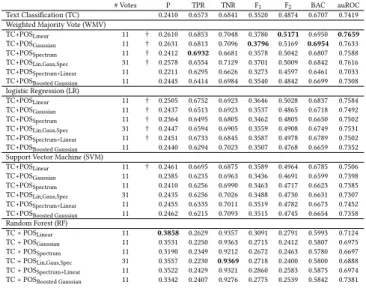
Table 4: Results forensembleclassification and TC baseline.
# Votes P TPR TNR F1 F2 BAC auROC Text Classification (TC) 0.2410 0.6573 0.6841 0.3520 0.4874 0.6707 0.7419 Weighted Majority Vote (WMV)
TC+POSLinear 11 † 0.2610 0.6853 0.7048 0.3780 0.5171 0.6950 0.7659
TC+POSGaussian 11 † 0.2631 0.6813 0.7096 0.3796 0.5169 0.6954 0.7633 TC+POSSpectrum 11 † 0.2412 0.6932 0.6681 0.3578 0.5042 0.6807 0.7588 TC+POSLin,Gaus,Spec 31 † 0.2578 0.6554 0.7129 0.3701 0.5009 0.6842 0.7616 TC+POSSpectrum+Linear 11 0.2211 0.6295 0.6626 0.3273 0.4597 0.6461 0.7033 TC+POSBoosted Gaussian 11 0.2445 0.6414 0.6984 0.3540 0.4842 0.6699 0.7308 logistic Regression (LR) TC+POSLinear 11 † 0.2505 0.6752 0.6923 0.3646 0.5028 0.6837 0.7584 TC+POSGaussian 11 † 0.2437 0.6513 0.6923 0.3537 0.4865 0.6718 0.7492 TC+POSSpectrum 11 † 0.2364 0.6495 0.6805 0.3462 0.4805 0.6650 0.7502 TC+POSLin,Gaus,Spec 31 † 0.2447 0.6594 0.6905 0.3559 0.4908 0.6749 0.7531 TC+POSSpectrum+Linear 11 † 0.2451 0.6733 0.6845 0.3587 0.4978 0.6789 0.7502 TC+POSBoosted Gaussian 11 0.2440 0.6294 0.7023 0.3507 0.4768 0.6659 0.7352 Support Vector Machine (SVM)
TC+POSLinear 11 † 0.2461 0.6695 0.6875 0.3589 0.4964 0.6785 0.7506 TC+POSGaussian 11 0.2385 0.6235 0.6963 0.3436 0.4691 0.6599 0.7398 TC+POSSpectrum 11 0.2410 0.6256 0.6990 0.3463 0.4717 0.6623 0.7385 TC+POSLin,Gaus,Spec 31 0.2435 0.6236 0.7026 0.3488 0.4730 0.6631 0.7307 TC+POSSpectrum+Linear 11 0.2455 0.6335 0.7011 0.3519 0.4782 0.6673 0.7452 TC+POSBoosted Gaussian 11 0.2462 0.6215 0.7093 0.3515 0.4745 0.6654 0.7358 Random Forest (RF) TC + POSLinear 11 0.3858 0.2629 0.9357 0.3091 0.2791 0.5993 0.7124 TC + POSGaussian 11 0.3531 0.2250 0.9363 0.2715 0.2412 0.5807 0.6975 TC + POSSpectrum 11 0.3190 0.2349 0.9212 0.2672 0.2463 0.5780 0.6697 TC + POSLin,Gaus,Spec 31 0.3557 0.2230 0.9369 0.2718 0.2400 0.5800 0.6888 TC + POSSpectrum+Linear 11 0.3522 0.2429 0.9321 0.2860 0.2583 0.5875 0.6974 TC + POSBoosted Gaussian 11 0.3342 0.2407 0.9276 0.2775 0.2539 0.5842 0.7381
Spectrum+Linear vs. 0.6109 Spectrum and 0.6403 Linear, 0.6388 Spectrum+Gaussian vs. 0.6109 Spectrum and 0.6354 Gaussian).
The boosted classification approach, presented in Table 2, markedly improves auROC for the linear and Gaussian kernels (Linear 0.7027 vs. 0.6897, Gaussian 0.7031 vs. 0.6820). For these kernels, boosting notably increases precision (0.2290 vs. 0.2070 Gaussian, 0.3433 vs. 0.2185 Linear). The boosted Gaussian achieves the best auROC for stand-alone sequence classifiers (0.7031).
Moving on toensembleclassification, Table 4 presents the results for the four ensemble combination approaches WMV, LR, SVM, and RF. For each approach, the table presents the individual ker-nels (separately and together) and the best performing hybrid and boosted kernels, along with the text classification baseline.
Firstly, we note that text classification achieves 0.6707 BAC, markedly better than random (0.5 BAC), and 0.7419 auROC. Notably, text classification also performs better than thestand-alone classi-fiers from Table 2 (however, the stand-alone boosted approaches are competitive and achieve higher TPR and TNR scores).
Reviewing Table 4, we conclude that the linear kernel performs best for ensemble approaches, since it achieves significant improve-ments (denoted as†), and performs better for all measures,
com-pared to the text classification baseline, when either of the WMV, LR or SVM combinators are deployed. This is surprising, since the hybrid and boosted kernels perform best for stand-alone classifiers. This appears be due to the liner kernel model being more similar to the (better) text classification model than the other kernel models are, while having enough uncorrelated variations to enhance the predictions. We will investigate this further as future work.
Turning our attention to the combinator methods, we see that LR achieves significant improvements compared to text classification for five of the six kernel combinations tested (+1.2-2.3% auROC) and is clearly the most effective stacked ensemble approach. However, we conclude that WMV performs better than the stacked approaches since it achieves the highest TPR, F1, F2, BAC and auROC scores.
Currently, WMV appliespt·wglobally and we expect to be able to
further improve these results by learning more fine grained weights, at the instance or vote level. Again, we leave this as future work.
Overall, combining text classification with linear kernel POS sequence classification (TC+POSLinear) and WMV performs best
for sensitivity classification, from the combinations we tested. This approach achieves significant improvements according to McNe-mar’s test withp<0.001 (+6.09% F2, +3.24% auROC), compared to
the text classification baseline. Moreover, the approach correctly predicted 4.25% more sensitive documents (0.6853 TPR vs. 0.6573 TPR), while achieving a 3.02% increase in correct not-sensitive pre-dictions (0.7048 TNR vs. 0.6841 TNR). This results in an additional 83 correct predictions on our collection.
These results show that combining text classification with POS sequence classification can be effective for classifying documents that contain sensitivities relating to FOI exemptions. Moreover, the largest gains in overall classification performance can be achieved when deploying a simple weighted majority vote combination strat-egy and a linear SVM kernel for POS sequence classification. This, in turn, has the additional advantage of reducing training times.
6
CONCLUSIONS
In this work, we presented a thorough investigation of five SVM kernel functions (Linear, Gaussian, Spectrum, Mismatch and Smith-Waterman) for sensitivity classification using Part-of-Speechn -gram sequences. We showed that an ensemble classification ap-proach that combines text classification with sequence classification can significantly improve sensitivity classification effectiveness. Moreover, we found that combining linear kernel POS sequence classification with text classification by Weighted Majority Vote lead to the largest increase in sensitivity classification effectiveness (+ 6.09% F2), when compared to a text classification baseline.
REFERENCES
[1] Giacomo Berardi, Andrea Esuli, Craig Macdonald, Iadh Ounis, and Fabrizio Sebastiani. 2015. Semi-automated text classification for sensitivity identification. InProc. CIKM.
[2] Bee-Chung Chen, Daniel Kifer, Kristen LeFevre, Ashwin Machanavajjhala, and others. 2009. Privacy-preserving data publishing.Foundations and Trends® in Databases2, 1–2 (2009).
[3] TG Ditterrich. 1997. Machine learning research: four current directions.Artificial Intelligence Magzine4 (1997).
[4] Eleazar Eskin, Jason Weston, William S Noble, and Christina S Leslie. 2002. Mismatch string kernels for SVM protein classification. InProc. NIPS. [5] Aris Gkoulalas-Divanis, Grigorios Loukides, and Jimeng Sun. 2014.
Publish-ing data from electronic health records while preservPublish-ing privacy. Journal of Biomedical Informatics50 (2014).
[6] Timothy Gollins, Graham McDonald, Craig Macdonald, and Iadh Ounis. 2014. On using information retrieval for the selection and sensitivity review of digital public records. InProc. PIR.
[7] Thorsten Joachims. 1998. Text categorization with support vector machines: Learning with many relevant features. InProc. ECML.
[8] S Sathiya Keerthi and Chih-Jen Lin. 2003. Asymptotic behaviors of support vector machines with Gaussian kernel.Neural computation15, 7 (2003). [9] Ludmila I Kuncheva and Juan J Rodr´ıguez. 2014. A weighted voting framework
for classifiers ensembles.Knowledge and Information Systems38, 2 (2014). [10] Christina S Leslie, Eleazar Eskin, and William Stafford Noble. 2002. The spectrum
kernel: A string kernel for SVM protein classification. InProc. PSB.
[11] C. Lioma and I. Ounis. 2006. Examining the content load of part-of-speech blocks for information retrieval. InProc. COLING/ACL.
[12] Graham McDonald, Craig Macdonald, and Iadh Ounis. 2015. Using part-of-speech n-grams for sensitive-text classification. InProc. ICTIR.
[13] Graham McDonald, Craig Macdonald, Iadh Ounis, and Timothy Gollins. 2014. Towards a classifier for digital sensitivity review. InProc. ECIR.
[14] Fabrizio Sebastiani. 2002. Machine learning in automated text categorization.
ACM computing surveys34, 1 (2002).
[15] Temple F Smith and Michael S Waterman. 1981. Identification of common molecular subsequences.Journal of molecular biology147, 1 (1981). [16] Vladimir Naumovich Vapnik and Vlamimir Vapnik. 1998.Statistical learning
theory. Vol. 1. Wiley New York.
[17] David H Wolpert. 1992. Stacked generalization.Neural networks5, 2 (1992). [18] Zhengzheng Xing, Jian Pei, and Eamonn Keogh. 2010. A brief survey on sequence