
he Internet of Things (IoT) is a novel network archi-tecture that is rapidly gaining attention in the sce-nario of next-generation wireless telecommunications. The basic idea of IoT is perva-sively providing us with a variety of things or objects, such as radio frequency identification (RFID) tags, sensors, actuators, and mobile phones, which are able to interact and cooperate with each other to realize the tasks of communication, compu-tation, and service [1]. Such a network poses a bright fore-ground for large-data multimedia applications as demand for emerging applications like video on demand (VoD), IPTV, and voice over IP (VoIP) has grown tremendously [2]. Figure 1 provides a classic example of multimedia service architec-ture in the context of IoT.
Nowadays, security is of critical importance for various multimedia applications in IoT [3]. Since the IoT is built to broadly execute unverified user-implemented applications from different users, both applications and users can be sources of security threats to the IoT [4, 5]. For example, the vulnerabilities of applications and sensors can be exploited by hackers, and malicious users can access the IoT to launch vicious service attacks. Moreover, a legitimate user may tam-per with shared multimedia data or excessively exhaust net-work resources to interrupt services available to other legitimate users. On the other hand, however, the existing IoT has not employed a specific security mechanism to deal with the threats mentioned above [5]. Thus, it is very important and necessary to deploy a security strategy to protect security-critical multimedia applications streaming over the IoT.
As we know, traffic management plays a key role in achiev-ing high multimedia quality of service (QoS) in a network [1]. Unfortunately, conventional multimedia traffic management algorithms, developed mainly to guarantee delay and distor-tion constraints while usually neglecting security requirements, are not appropriate for security-aware multimedia
applica-tions. In this article, we propose a security-critical multimedia service architecture in the IoT context, which jointly considers traffic analysis, security requirements, and traffic scheduling for multimedia applications. To illustrate the effectiveness, the proposed media-aware traffic security architecture (MTSA) is applied to obtain satisfying traffic management based on the given media-aware traffic classification and anal-ysis. MTSA is one of the first security-aware traffic manage-ment strategies for multimedia applications running over the IoT. The fundamental contributions of this article include the following aspects:
• Traffic classification and analysis for various multimedia applications streaming over IoT
• Developing a novel architecture for media-aware traffic security
• Designing and evaluating the proposed security-critical traf-fic management scheme
The rest of this article is organized as follows. We present the multimedia traffic classification and analysis in the context of the IoT. We provide the media-aware traffic security archi-tecture and specify the interaction and cooperation between the different parts. Moreover, the corresponding design rule and strategy are proposed. Finally, we conclude this article.
Multimedia Traffic Classification and Analysis
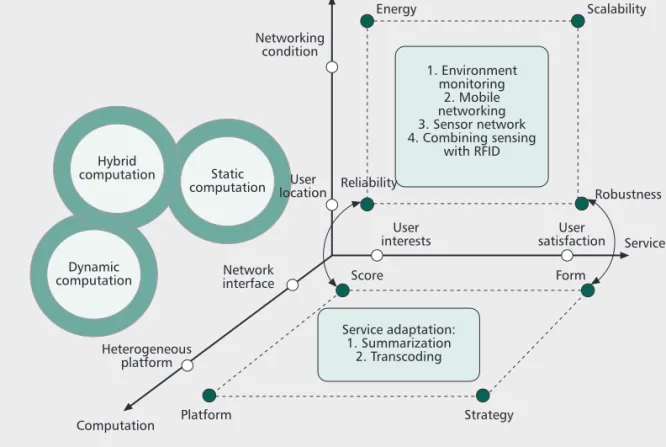
The characteristics of the IoT make it possible to develop a huge amount of multimedia traffic. Usually, an IoT is realized by equipping multiple sensors with high intelligence of com-munication, computation, and service capabilities. Specifically, we can divide the multimedia traffic running over IoT into three categories: communication, computation, and service. In this section, we analyze the above three kinds of multimedia traffic. Figure 2 illustrates multimedia traffic classification and analysis in the context of an IoT.T
T
Liang Zhou, Nanjng University of Posts and Telecommunications
Han-Chieh Chao, National Ilan University
Abstract
An important challenge for supporting multimedia applications in the Internet of Things is the security heterogeneity of wired and wireless sensor and actuator net-works. In this work, we design a new and efficient media-aware security frame-work for facilitating various multimedia applications in the Internet of Things. First, we present a novel multimedia traffic classification and analysis method for han-dling the heterogeneity of diverse applications. Then a media-aware traffic security architecture is proposed based on the given traffic classification to enable various multimedia services being available anywhere and anytime. Furthermore, we pro-vide a design rule and strategy to achieve a good trade-off between a system’s flexibility and efficiency. To the best of our knowledge, this study is the first to pro-vide general media-aware security architecture by jointly considering the character-istics of multimedia traffic, security service, and the Internet of Things.
Multimedia Traffic Security Architecture for
the Internet of Things
Communication Traffic
“Anytime, anywhere, anymedia” has been the communica-tions goal for the IoT. In this context, the core component is an RFID system that consists of several readers and RFID tags. Each tag is characterized by a unique identifier and applied to different objects. Readers trigger tag transmission by generating a message, which represents a query for the possible presence of tags in the circumference of the reader [6]. For a practical IoT, an RFID tag is a small microchip attached to an antenna, and the antenna is used for both receiving the reader’s message and transmitting the tag ID to the reader.
Actually, sensor networks are the major components of an IoT, and they can cooperate with RFID systems to complete the communication function. As we know, sensor networks are composed of a number of sensing nodes communicating in a multihop fashion. Usually, nodes report the results of their sensing to sink nodes. As to the communication traffic over the IoT, IEEE 802.15.4 does not include specifications on the higher layers of the protocol stack, which is necessary for the seamless integration of sensor nodes into the Internet [1].
Therefore, how to design appropriate communication traffic is an interesting and changeling task:
• The maximum physical layer packet in the framework of IEEE 802.15.4 is 127 bytes, while the maximum frame size at the medium access control (MAC) layer is 102 bytes. Moreover, due to the security algorithm employed at the link layer, which results in overhead, the frame size may further decrease [2].
• Different from traditional IP networks, in many scenarios sensor nodes are set in sleep mode to save energy and can-not work during communication periods.
In general, integrating sensing technologies into passive RFID systems would enable various multimedia traffic types available in the IoT context. Recently, several works have been conducted in this area. For example, a project on wire-less identification and sensing platforms is being carried out at Intel Labs, powered and read by standard RFID readers, har-vesting the power from the reader’s querying message [6]. Briefly speaking, the objectives of designing appropriate mul-timedia traffic are energy efficiency, scalability, reliability, and robustness.
Figure 1.An example of multimedia service architecture in the context of IoT [6]. External comm. device Gateway system Transmission system Client terminal
Multimedia service system Data server Access point Link Wired link Camera 3 Sensor node Camera 2 Sensor node Camera 1 Source system Object RFID reader Sensor node Wireless link: 802.15.4 Data sink Micro-computer
Computation Traffic
Usually, computation traffic over an IoT can be processed by mobile agents or sink nodes autonomously. The sequence in which a mobile agent visits the selected source nodes can have a significant impact on computation traffic [1]. Note that find-ing an optimal source-visitfind-ing solution is a typical non-deter-ministic polynomial-time-complete problem [3]. Computation traffic can be categorized as follows:
•Static computation:The computation state of the mobile agent is determined by the source node before it is dis-patched.
•Dynamic computation: The agent autonomously determines the source nodes, and decides the dynamic route or resource allocation according to the current network condi-tions.
•Hybrid computation: The set of source nodes is decided by the sink nodes, while the source-visiting sequences are pro-cessed by the mobile agents.
Static Computation— It makes use of current global network conditions and finds an efficient path before the mobile agents are sent. In [1], the authors summarize two approach-es, Local Closest First (LCF) and Global Closest First (GCF). Specifically, both approaches start at the sensor node closest to the dispatcher. When source nodes intend to form multiple clusters with similar distance to the sink, GCF causes zigzag routing due to the itinerary fluctuations among those clusters.
Dynamic Computation— Because the global information col-lected at the sink node may become outdated due to varia-tions over the IoT, dynamic computation can enable the mobile agents or sink nodes to decide the next hop at each step of the routing establishing process. In addition, in the process of deciding a dynamic route, it is necessary to take into account the trade-offs between the cost of migration and the benefit of migration accuracy. The dynamic computation
approach seeks the sensor node that satisfies both the largest available remaining energy and the least energy consumption for the agent’s migration.
Hybrid Computation— In hybrid computation, the decision of the source-visiting set is static, whereas the selection of the testing sequence is dynamic. In particular, a hybrid computa-tion scheme called mobile-agent-based directed diffusion is proposed in [7]. Specifically, if the sources in the target region detect an event of interest, they flood or broadcast explorato-ry packets to the sink nodes. The whole process is determined by the source-visiting sequence as it migrates among the nodes in the source-visiting set. Therefore, the mobile agent follows a cost-efficient path among target sensors.
Service Traffic
Service traffic contains two aspects: scoreandform. The score implies the degree of interest a user has in multimedia traffic, while the form denotes the content features on a particular device. For the purpose of efficiently operating various types of multimedia traffic, we classify the data into three cate-gories: preference data, situation data, and capability data. At first, the multimedia traffic server calculates the similarity between the media service and the preference data by employ-ing the method in [7]. Then it evaluates the probability of the media service belonging to one of the servers. We can get the score from the weighted sum of the above calculated similari-ty and probabilisimilari-ty.
Additionally, multimedia traffic adaptation mainly uses two techniques: summarization and transcoding [3]. Multimedia summarization means summarizing a media service into a short one (from the perspective of data size) that can be viewed on a short timescale. Multimedia transcoding means transforming the content from one media type to another so that the content can be suitably processed by a particular device or efficiently transmitted in a specific communication condition.
Figure 2.Multimedia traffic classification and analysis in the IoT context.
1. Environment monitoring 2. Mobile networking 3. Sensor network 4. Combining sensing with RFID Service adaptation: 1. Summarization 2. Transcoding Form Score Platform Computation Strategy User interests User satisfaction Service Scalability Energy Reliability Robustness Networking condition Network interface Communication Heterogeneous platform User location Static computation Hybrid computation Dynamic computation
Media-Aware Traffic Security Architecture
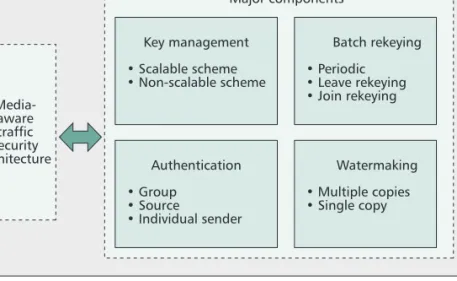
In order to meet the information security requirements for multimedia communication, computation, and service in the environment of an IoT, it is necessary to consider some crite-ria that refer to the traffic security strategy and performance. In this section, we provide a novel media-aware traffic security architecture (MTSA) to solve this problem. It should be noted that MTSA is a development of the information security framework, and multimedia traffic and contents are embed-ded into the existing architecture [8]. Figure 3 shows the four major components of MTSA.Key Management
Many network-based key management schemes have been proposed in the last decade, and they can be divided into three classes [7]:
• Non-scalable and scalable schemes. Scalable schemes can also be divided into three groups: hierarchical key manage-ment, centralized flat key management, and distributed flat key management.
• Flat schemes, clustered schemes, tree-based scheme,s and other schemes [6].
• Centralized schemes, distributed subgroup schemes, and distributed schemes [5].
We propose a new classification using two criteria: the mul-timedia traffic that exercises the control and whether the scheme is scalable or not. Thus, we get three classes: service control, user control, and flow control. Each class is further classified into scalableand non-scalableschemes. In the con-text of IoT key management, scalability refers to the ability to provide a larger group of multimedia contents without any prior knowledge. A scalable scheme is able to manage a large group over a wide area with highly dynamic sensors. If the computation and communication traffic at the sources increase dramatically with the size of the group, the scheme is treated as non-scalable.
Batch Rekeying
In spite of the efficiency of scalable schemes for multicast applications, changing the key has two major weak points: synchronization and inefficiency [6]. Periodic batch rekeying provides a good trade-off between security improvement and computation complexity. Usually, a new user has to wait longer to join the service group, and the period of batch rekeying is thus a design parameter that can be adjusted according to different security requirements and current net-work conditions. To accommodate different multimedia
appli-cation needs, three modes of operation are suggested [9]:
• Periodic batch rekeying: The key server han-dles both join and leave requests periodical-ly in a batch.
• Periodic batch leave rekeying: Tthe key server deals with each join request immediately to reduce the delay for a new user to access the IoT but processes leave requests in a batch. • Periodic batch join rekeying: The key server
deals with each leave request immediately to reduce the exposure to users who have left but handles join requests in a batch.
Authentication
User authentication involves methods ranging from the use of access control and capability certificates to mutual authentication between the server and user [3, 4].
•Access control: The multimedia server maintains a list of hosts who are either authorized to join the service group or excluded from it. When a user sends a join request, the server checks its ID in the access control list to determine whether membership is permitted or not. It is necessary to note that update of this list is important since the list may change dynamically with new authorizations or exclusions. •Ability certificates: Usually, it is issued by a designated
cer-tificate authority. An ability cercer-tificate contains information about the identity of the host and a set of rights. It is used to authenticate the user and give him/her rights to access multimedia data.
•Mutual authentication: The server and user authenticate each other via cryptographic means. From [8], we know that the public key scheme can be used for this purpose. As we know, multimedia authentication is a challenging problem in secure heterogeneous communications. According to different types of multimedia applications and the network resources available to users, three levels of multimedia authentication can be used:
•Group authentication: provides assurance that the packets are transmitted by a registered group member (a registered server or a registered user)
•Source authentication: provides assurance that the packets are transmitted by a registered user
•Individual sender authentication: provides assurance of the identity of the registered user of the packets
Watermarking
Typical uses of watermarks include identification of the origin of content, tracing illegally distributed copies,and disabling unauthorized access to content[8]. Generally speaking, charac-teristics and requirements for watermarks in multimedia applications are totally different. Identification of the origin of multimedia content requires the embedding of a single water-mark into the content at the server. To trace illegal copies, a unique watermark is needed based on the location or identity of the recipient in multimedia applications. For general delay-sensitive multimedia applications, watermark extraction or detection needs to take place only when there is a dispute regarding a user’s rights.
Frankly speaking, the copyright protection problem in the IoT is also a challenging problem. All users in a network group receive the same watermarked content. If a copy of this content is illegally distributed to other users, it may be diffi-cult to find out who is responsible for this action. Such a problem can be eliminated in a homogeneous network envi-ronment by embedding a unique watermark for each user. Figure 3.Major components of MTSA.
Major components • Scalable scheme • Non-scalable scheme Key management Media-aware traffic security architecture • Periodic • Leave rekeying • Join rekeying Batch rekeying • Group • Source • Individual sender Authentication • Multiple copies • Single copy Watermaking
Design Rule and Strategy
MTSA provides a systematic framework for multimedia infor-mation security, however, designing the corresponding rule and strategy for MTSA is still a challenging task. The decen-tralized data acquisition process in MTSA offers opportunities to exploit the distributed nature of the network. We provide a novel distributed privacy paradigm for MTSA, in which the authority, cost, and encryption are obtained in a decentralized manner. Figure 4 illustrates the corresponding general rule and strategy.
Goal and Model
The above discussion motivates us to aim at the following goals for a distributed privacy system:
• Each sensor or mobile agent must create its own share with-out the need for a central authority.
• From the perspective of size, each secret sharing must not be larger than the original secret.
• From the perspective of an attacker, obtaining multimedia contents will not degenerate the secret sharing size.
Specifically, the first goal makes it necessary to employ a distributed method with traditional service architecture. The second one promotes cost-effective share processing and excludes the method of straightforward encryption. Since each sensor in IoT has correlated information, it is essential that this similarity can be used for reducing the secret sharing size. The third one protects the IoT system from an attacker who may access to the static multimedia contents by reconstructing a secret. In particular, the characteristics of the threat model we employ are as follows:
• Each user can eavesdrop on only a small subset of commu-nication paths.
• Once a node is hijacked, it will be removed from the system. • An active attack on multimedia applications is performed at
normal sensors.
The first threat assumption reflects a reasonable level of capability of the attacker. To reduce the share size, an attack-er must be physically distributed across the entire IoT. The second and third threat requirements make it impossible to corrupt the server content during the process of share genera-tion.
Distributed Secret Sharing
The approach we consider is different from the traditional secret sharing problem. In secret sharing, a trusted central authority (sometimes a multimedia server) shares a single
secret for many users. Here, unconditional secre-cy is achieved through the server’s use of hash functions for share generation that are known only to the server; not even the users can access the share.
There are several differences between the secret sharing for MTSA and traditional secret sharing algorithms. First, traditional secret shar-ing is designed to create shares from a sshar-ingle unique secret. In the case of MTSA, each sensor has a correlated reading of the others represent-ing a composite secret; direct application of secret sharing to each component of the com-posite secret would be bandwidth-inefficient, making it crucial to design a nontrivial method to account for correlations. Second, given the centralized nature of secret sharing, where a server creates the shares, one straightforward adaptation is to have the sensors in a group exchange their information to a single node. However, given the high possibility of an inside attack, tradi-tional algorithms suffer from a single point of failure. In par-ticular, an attacker just needs to physically compromise the server to eavesdrop. Third, if each sensor can access all the servers, each node would necessarily have to share the ran-dom multimedia content with one server, making it again easi-er for an eavesdroppeasi-er to obtain the values by compromising any one of the sensors.
According to the above analysis, we develop a new paradigm that is suitable for MTSA. Although secret sharing and visual secret sharing have been proposed for a while, a distributed variant of the visual secret sharing paradigm is our contribution. Our proposed algorithm sacrifices unconditional secrecy to provide a general multimedia security solution for all the sensors in an IoT. In particular, we employ a visual secrecy measure that degrades proportional to the number of shares in possession of an eavesdropper. Such a relaxed defi-nition of secrecy is based on perceived multimedia distortion [5, 7]. Compared to traditional visual secret sharing solutions, the proposed scheme reduces the complexity of multimedia computations and decreases the size of the shares. This point is very important for MTSA. The framework of the proposed paradigm for implementing MTSA is shown in Fig. 5.
Further Discussion
Here, we discuss the possible directions for further developing the proposed distributed secret sharing for MTSA.
•As the key management is an important issue in all encryption based security systems, it cannot be separated from the design of secure multimedia distribution. In most distribu-tion architectures, multimedia content is encrypted with a symmetric key which also needs to be protected in transmis-sion to the user. A common tool of achieving the protection of the decryption key is public-key cryptography. The difficul-ty in cryptanalyzing public-key ciphers would provide reason-able security for all kinds of multimedia applications [9].
•It is necessary to develop new models that specify how digital copyrighted content can be consumed from the per-spective of multimedia service providers in an IoT. The usage rights need to be delivered to the users together with the mul-timedia content and the decryption keys. The simplest form of this strategy is copy control information (CCI). It expresses the conditions under which a user is allowed to copy multime-dia content legally. An important subset of CCI is the two copy generation management systems: “11” (copy-never), “10” (copy-once), “01” (no-more-copies), and “00” (copy-free). It is possible to associate CCI with content in two ways: included Figure 4.Design rule and strategy for a distributed privacy paradigm.
Exchange Share
Secret sharing
Key management Copyright content Sensor Energy
Authority Cost Encryption
in a designated field in a multimedia stream, and embedded as a watermark in a multimedia stream.
Conclusions
In this work, we design a new and efficient media-aware secu-rity framework for facilitating diverse multimedia services in internet of things environment. At first, we present the multi-media traffic classification and analysis for handling the het-erogeneity of diverse networks. After that, a novel media-aware traffic security architecture is presented based on the proposed traffic classification to enable diverse multi-media services provisioning to users anywhere at any time. At last, we propose the design rule and strategy to achieve a good trade-off between system flexibility and efficiency.
Acknowledgment
This work is supported in part by the National Science Coun-cil, Taiwan under Grant NSC 99-2219-E-197-001 and Grant NSC 99-2219-E-197-002.
References
[1] L. Atzori, A. Iera, and G. Morabito, “The Internet of Things: A Survey,” Computer Networks, vol. 54, no. 15, Oct. 2010, pp. 2787–805.
[2] M. Chen, S. Gonzalez, and V. Leung, “Applications and Design Issues of Mobile Agents in Wireless Sensor Networks,” IEEE Wireless Commun., vol. 14, no. 6, 2007, pp. 20–26.
[3] L. Zhou et al., “Context-Aware Multimedia Service in Heterogeneous Net-works,” IEEE Intelligent Sys., vol. 25, no. 2, Mar./Apr. 2010, pp. 40–47.
[4] L. Zhou et al., “Distributed Scheduling Scheme for Video Streaming over Multi-Channel Multi-Radio Multi-Hop Wireless Networks,” IEEE JSAC, vol. 28, no. 3, Apr. 2010, pp. 409–19.
[5] H. V. Zhao, W. S. Lin, and K. J. R Liu, “A Case Study in Multimedia Finger-printing: Behavior Modeling and Forensics for Multimedia Social Networks,” IEEE Sig. Proc. Mag., vol. 26, no. 1, Jan. 2009, pp. 118–39.
[6] M. Chen et al., “Software Agent-based Intelligence for Code-centric RFID Systems,” IEEE Intelligent Sys., vol. 25, no. 2, Mar./Apr. 2010, pp. 12–19. [7] D. Kundur et al., “Security and Privacy for Distributed Multimedia Sensor
Networks,” Proc. IEEE, vol. 96, no. 1, Jan. 2008, pp. 112–30.
[8] A. M. Eskicioglu, “Multimedia Security in Group Communications: Recent Progress in Key Management, Authentication, and Watermarking,” Multime-dia Systems, vol. 9, 2003, pp. 239–48.
[9] H. Susanto and F. Muhaya, “Multimedia Information Security Architecture Framework,” Proc. FutureTech 2010.
Biographies
LIANGZHOU[M] ([email protected]) received his Ph.D. degree in electronic engineering from both Ecole Normale Superieure, Cachan, France, and Shang-hai Jiao Tong University, China, in March 2009. From 2009 to 2010 he was a postdoctoral researcher at ENSTA-ParisTech, France. Since October 2010 he has been a Humboldt Research Fellow at the Technical University of Munich, Ger-many. His research interests are in the area of networked multimedia communi-cations and computing.
HAN-CHIEHCHAO[SM] ([email protected]) is a joint appointed full professor of the Department of Electronic Engineering and Institute of Computer Science & Information Engineering, National Ilan University, Taiwan. His research interests include high-speed networks, wireless networks, IPv6-based networks, digital cre-ative arts, and the digital divide. He currently serves as Editor-in-Chief for IET Communications, International Journal of Ad Hoc and Ubiquitous Computing, Journal of Internet Technology, and International Journal of Internet Protocol Technology. He is a Fellow of the Institution of Engineering and Technology (FIET) and a Chartered Fellow of the British Computer Society (FBCS).
Figure 5.The framework of the proposed paradigm for implementing MTSA [3]. Application agent Security operation Traffic analysis User profile Multimedia service Multimedia traffic flows Access network-1 Access network-2 Access network-3 Access network-4 Multimedia service provider IoT PAN Agent
![Figure 1. An example of multimedia service architecture in the context of IoT [6].](https://thumb-us.123doks.com/thumbv2/123dok_us/778155.2598411/2.985.120.872.94.769/figure-example-multimedia-service-architecture-context-iot.webp)
![Figure 5. The framework of the proposed paradigm for implementing MTSA [3].](https://thumb-us.123doks.com/thumbv2/123dok_us/778155.2598411/6.985.171.809.99.532/figure-framework-proposed-paradigm-implementing-mtsa.webp)
