Wright State University Wright State University
CORE Scholar
CORE Scholar
Kno.e.sis Publications The Ohio Center of Excellence in Knowledge-Enabled Computing (Kno.e.sis)
9-2015
Automatic Emotion Identification from Text
Automatic Emotion Identification from Text
Wenbo WangWright State University - Main Campus, [email protected]
Follow this and additional works at: https://corescholar.libraries.wright.edu/knoesis
Part of the Bioinformatics Commons, Communication Technology and New Media Commons, Databases and Information Systems Commons, OS and Networks Commons, and the Science and Technology Studies Commons
Repository Citation Repository Citation
Wang, W. (2015). Automatic Emotion Identification from Text. . https://corescholar.libraries.wright.edu/knoesis/1075
This Thesis is brought to you for free and open access by the The Ohio Center of Excellence in Knowledge-Enabled Computing (Kno.e.sis) at CORE Scholar. It has been accepted for inclusion in Kno.e.sis Publications by an
Automatic Emotion Identification from Text
A thesis submitted in partial fulfillment
of the requirements for the degree of
Doctor of Philosophy
by
Wenbo Wang
M.S., Beijing University of Posts and Telecommunications, 2008
B.S., Central South University, 2005
2015
Wright State University GRADUATE SCHOOL
September 4, 2015 I HEREBY RECOMMEND THAT THE THESIS PREPARED UNDER MY SUPER-VISION BY Wenbo Wang ENTITLED Automatic Emotion Identification from Text BE ACCEPTED IN PARTIAL FULFILLMENT OF THE REQUIREMENTS FOR THE DE-GREE OF Doctor of Philosophy.
Amit P. Sheth, Ph.D. Dissertation Director
Arthur A. Goshtasby, Ph.D. Director, Department of Computer Science and Engineering
Robert E. W. Fyffe, Ph.D. Vice President for Research and Dean of the Graduate School Committee on Final Examination
Keke Chen, Ph.D.
Kevin Haas, M.S.
Krishnaprasad Thirunarayan, Ph.D.
ABSTRACT
Wang, Wenbo. Ph.D., Department of Computer Science and Engineering, Wright State University, 2015.Automatic Emotion Identification from Text.
Peoples emotions can be gleaned from their text using machine learning techniques to build models that exploit large self-labeled emotion data from social media. Further, the self-labeled emotion data can be effectively adapted to train emotion classifiers in different target domains where training data are sparse.
Emotions are both prevalent in and essential to most aspects of our lives. They in-fluence our decision-making, affect our social relationships and shape our daily behavior. With the rapid growth of emotion-rich textual content, such as microblog posts, blog posts, and forum discussions, there is a growing need to develop algorithms and techniques for identifying people’s emotions expressed in text. It has valuable implications for the studies of suicide prevention, employee productivity, well-being of people, customer relationship management, etc. However, emotion identification is quite challenging partly due to the following reasons: i) It is a multi-class classification problem that usually involves at least six basic emotions. Text describing an event or situation that causes the emotion can be devoid of explicit emotion-bearing words, thus the distinction between different emotions can be very subtle, which makes it difficult to glean emotions purely by keywords. ii) Manual annotation of emotion data by human experts is very labor-intensive and error-prone. iii) Existing labeled emotion datasets are relatively small, which fails to provide a comprehensive coverage of emotion-triggering events and situations.
This dissertation aims at understanding the emotion identification problem and de-veloping general techniques to tackle the above challenges. First, to address the chal-lenge of fine-grained emotion classification, we investigate a variety of lexical, syntactic,
knowledge-based, context-based and class-specific features, and show how much these fea-tures contribute to the performance of the machine learning classifiers. We also propose a method that automatically extracts syntactic patterns to build a rule-based classifier to im-prove the accuracy of identifying minority emotions. Second, to deal with the challenge of manual annotation, we leverage emotion hashtags to harvest Twitter ‘big data’ and collect millions of self-labeled emotion tweets, the labeling quality of which is further improved by filtering heuristics. We discover that the size of the training data plays an important role in emotion identification task as it provides a comprehensive coverage of different emotion-triggering events/situations. Further, the unigram and bigram features alone can achieve a performance that is competitive with the best performance of using a combination of ngram, knowledge-based and syntactic features. Third, to handle the paucity of the la-beled emotion datasets in many domains, we seek to exploit the abundant self-lala-beled tweet collection to improve emotion identification in text from other domains, e.g., blog posts, fairy tales. We propose an effective data selection approach to iteratively select source data that are informative about the target domain, and use the selected data to enrich the target domain training data. Experimental results show that the proposed method outperforms the state-of-the-art domain adaptation techniques on datasets from four different domains including blog, experience, diary and fairy tales.
Finally, we apply the proposed research to analyze cursing, an emotion rich activity, on Twitter. We explore a set of questions that have been recognized as crucial for un-derstanding cursing in offline communications by prior studies, including ubiquity, utility, contextual dependencies, and people factors.
Contents
1 Introduction 1
2 Related Work 5
2.1 Emotion Resources . . . 6
2.2 Self-labeled Emotion Data Creation . . . 9
2.3 Rule-based Emotion Classification . . . 11
2.4 Supervised Emotion Classification . . . 13
2.5 Hybrid Emotion Classification . . . 15
2.6 Instance-based Domain Adaptation . . . 16
2.7 Emotion Analysis on Social Media . . . 18
3 Emotion Classification 22 3.1 Overview . . . 22
3.2 Problem Definition . . . 24
3.3 Methods . . . 24
3.3.1 Features for the Supervised Classifier . . . 25
3.3.2 Constructing the Rule-based Classifier . . . 28
3.4 Experiments . . . 30
3.4.1 Experiments on Suicide Notes . . . 30
3.4.2 Experiments on Twitter Data . . . 37
3.5 Conclusions and Future Work. . . 42
4 Self-labeled Data Creation 43 4.1 Overview . . . 43
4.2 Problem Definition . . . 44
4.3 Methods . . . 45
4.3.1 Collecting Emotion Hashtags . . . 45
4.3.2 Filtering Heuristics . . . 46
4.4 Experiments . . . 48
4.4.1 Evaluation of Filtering Heuristics . . . 48
4.4.2 Evaluation of Benefits with Large Training Data . . . 48
4.6 Conclusions and Future Work. . . 54
5 Domain Adaptation for Emotion Identification 56 5.1 Overview . . . 56
5.2 Problem Definition . . . 58
5.3 The Proposed Approach . . . 59
5.3.1 The Bootstrapping Framework . . . 59
5.3.2 Selecting Informative Instances . . . 62
5.4 Experiments . . . 68
5.4.1 Data and Experimental Setting . . . 68
5.4.2 Baseline Approaches . . . 70
5.4.3 Evaluations on Domain Adaptation . . . 71
5.5 Conclusions and Future Work. . . 75
6 Cursing in English on Twitter 76 6.1 Motivation. . . 76
6.2 Method and Analysis . . . 79
6.2.1 Data Collection and Cleansing . . . 79
6.2.2 Cursing Lexicon Coding . . . 80
6.2.3 Cursing Frequency and Choice of Curse Words . . . 82
6.2.4 Cursing vs. Emotion . . . 83
6.2.5 Cursing vs. Time . . . 88
6.2.6 Cursing vs. Message Type . . . 90
6.2.7 Cursing vs. Location . . . 92
6.2.8 Cursing vs. Gender . . . 93
6.2.9 Cursing vs. Social Rank . . . 96
6.3 Limitations . . . 99
6.4 Conclusions and Future Work. . . 100
7 Conclusions 103 7.1 Summary . . . 103
7.2 Future Work . . . 105
List of Figures
3.1 Precision-recall curve of the rule-based classifier with varying thresholdτ
on the testing data . . . 35
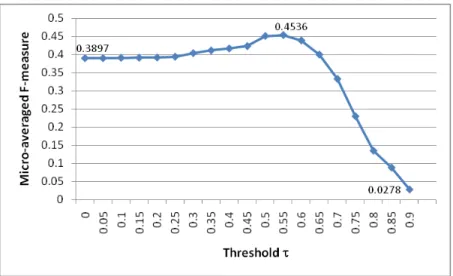
3.2 F-measure of the rule-based classifier with varying thresholdτ on the test-ing data . . . 36
3.3 F-measure of the combined classifier on the test data . . . 36
4.1 Accuracies of LIBNEAR and NB with varied sizes of training data . . . 50
5.1 Effects of different sample sizes . . . 72
5.2 Effects of various gap thresholds . . . 73
5.3 Results of applying different strategies to select informative instances on four datasets. . . 74
6.1 Counts of curse words: only top 20 curse words are shown due to space limitation. . . 83
6.2 Cumulative distribution of curse words: The top 7 curse words cover 90.40% of all the curse word occurrences. . . 84
6.3 Performance of emotion identification on the development dataset . . . 86
6.4 Emotion distributions in both cursing and non-cursing tweets. This shows that curse words are usually used for venting out negative emotions: 21.83% and 16.79% of the cursing tweets express the emotions sadness and anger, respectively; in contrast, 11.31% and 4.50% of the non-cursing tweets ex-press sadness and anger emotions, respectively . . . 87
6.5 Cursing volume and ratio at different times of a day . . . 89
6.6 Cursing ratios in different days of a week . . . 91
List of Tables
1.1 People express their emotions in social media (Twitter) posts . . . 2
3.1 The number of sentences in different categories . . . 29
3.2 Candidate feature notations . . . 32
3.3 Performance of the SVM classifier with different feature combinations on the testing data . . . 34
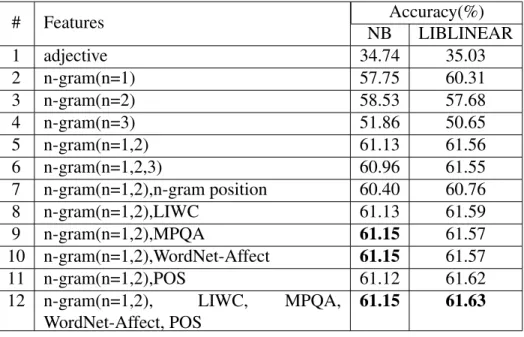
3.4 Accuracies of NB and LIBLINEAR on Tr1 dataset with different feature sets: boolean value (presence) is used for all n-gram features; percentages were used for LIWC, MPQA and POS features; frequency (counts) were used for WordNet-Affect features. . . 41
4.1 Emotion words used for collecting tweets and the number of collected tweets for each emotion (after filtering) . . . 47
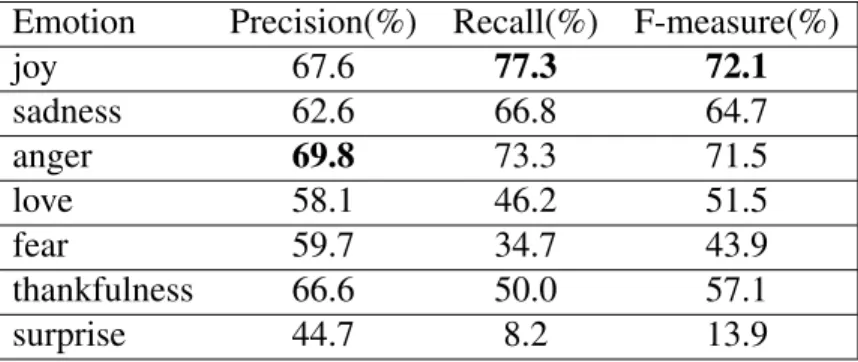
4.2 Detailed result of LIBLINEAR with the largest training data . . . 51
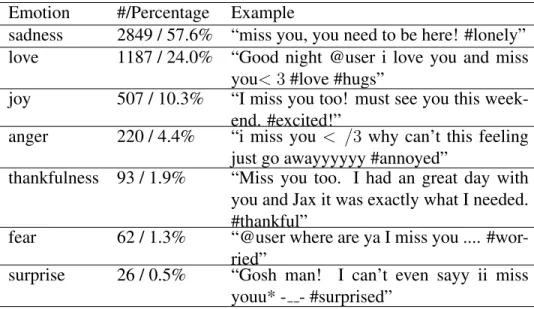
4.3 The diversity of emotions of tweets containing “miss you” . . . 52
5.1 Emotion tweets: the emotion label in front of each tweet is inferred from the emotion hashtag in bold; informal expressions (misspellings, abbrevia-tions and multi-word concatenaabbrevia-tions) are underlined. . . 58
5.2 Table of notation . . . 60
5.3 Dataset statistics. . . 69
5.4 Results for all approaches on four target datasets. For each row, thebest ap-proach is in bold, the second bestis underlined, and thethird:::::::::best is under-waved. . . 72
6.1 Statistics of overall tweets and cursing tweets per user . . . 81
6.2 Cursing frequency over different datasets: Cursing on Twitter is more fre-quent than that in the other two datasets – 0.80% of all words vs. 0.5% of all words, and 7.73% of all tweets vs. 3% of all utterances . . . 82
6.3 Performance of emotion identification on the testing dataset. * micro-averaged metrics. (Surpriseand Fear were dropped because we couldn’t detect it with a reasonably high precision on the development dataset) . . . 86
6.5 Cursing ratios from different places. Field: lakes, beach, mountain, etc.; Travel & Transport: train, plane, ferry, etc.; Professional Places: police station, city hall, office, etc.; College Academic Place: law school, engi-neering building, math building, etc.; Residence: home, residential build-ing, hotel, etc. . . 94
6.6 Cross-gender cursing statistics. Statistics of each row are drawn on ran-domly sampled 100K tweets. Reported cursing ratio in each row is the percentage of cursing tweets out of all the tweets within each correspond-ing group. . . 95
6.7 The frequency of curse words out of 100K tweets posted or received by males and females. *** p≤0.001, ** p≤0.01 . . . 96
6.8 Cursing Ratio vs. Social Ranking (followers) for both senders and recipi-ents. µpopulation mean,σ standard deviation. For senders and recipients, we show statistics regarding their posted and received tweets, respectively . 97
6.9 The frequency of curse words out of 100K tweets based on the social rank (follower counts) of senders. χ2 results are based on the comparison of frequencies of each word across different sender groups. *** p≤0.001 for all the values in this column . . . 98
6.10 The frequency of curse words out of 100K tweets based on the social rank (follower counts) of recipients. χ2 results are based on the comparison of frequencies of each word across different recipient groups. *** p≤0.001, ** p≤0.01 * p≤0.05 . . . 98
Acknowledgment
A lot of sweet stories vividly show up in my mind when I am writing this acknowl-edgement, which fills my heart with love, happiness and thankfulness. These stories are so touching that I wish I could write down all of them here. I want to thank every person involved with these stories. I hope that each and every one of you knows how much I appreciate your help and that I would really like to return the favor in the future.
First and foremost, I would like to thank my advisor, Dr. Amit P. Sheth. I have been greatly inspired by his passion and enthusiasm towards pursuing research problems with real world impact. I am grateful to him for his constant support, guidance, and encourage-ment. Dr. Sheth helped me to understand how to think clearly about research problems by asking the “why” question with use-case scenarios and real world applications. I found this method very beneficial to approach research problems. He helped me not only in develop-ing my research and technical skills but also soft skills such as communication skills and good work ethics, which would be helpful for rest of my career. I greatly benefited from his education philosophy of “learning how to learn.”
I would like to express my gratitude to my dissertation committee members. I have gained a lot from Dr. Keke Chen’s rich knowledge and research experience. He has also shown me how to explore a research problem from different potential directions. I still re-member many advices that Kevin Haas gave me during my Yahoo! internship and benefited a lot from these advices, one of which is “more Eclipse, less PowerPoint.” Dr. T.K. Prasad always provided positive and constructive feedback for my research. I always became a happier person every time after I met him. Dr. Ramakanth Kavuluru has been inspiring me with his sincere curiosity and love for tackling research problems and making method-ological contributions. He has been encouraging me throughout the program: he sent me a congratulations email whenever I had a paper accepted.
I would like to thank my seniors who have been offering help to me since the first day I joined Kno.e.sis: Christopher Thomas, Pablo Mendes, Cartic Ramakrishnan, Karthik
Gomadam, Meenakshi Nagarajan, Ajith Ranabahu, Satya Sahoo and Prateek Jain. I am grateful to have Christopher as my mentor and elder brother. Christopher took me under his wings and I will never forget the countless hours that he spent to teach me how to solve research problems. Pablo has always believed in my talent and ideas, although I sometimes doubt about them. Cartic fervently offered me his help, even before I got the chance to ask for his help. With his hacking spirit, Karthik demonstrated me how boring Computer Science theories can be applied in our daily lives, which gave me a fresh perspective.
I would like to thank my friends at Kno.e.sis center, with whom I spent wonderful time and shared great moments together: Delroy Cameron, Ming Tan, Harshal Patni, Raghava Mutharaju, Ashutosh Jadhav, Pramod Anantharam, Pavan Kapanipathi, Vinh Nguyen, He-mant Purohit, Fengguang Tian, Ashwin Manjunatha, Kalpa Gunaratna, Sarasi Lalithsena, Sujan Perera, Alan Smith, Maryam Panahiazar, Sanjaya Wijeratne, Huiqi Xu, Pramod Koneru, Revathy Krishnamurthy, Shreyansh Bhatt, Swapnil Soni, Jeremy Brunn, Lu Zhou, Gaurish Anand, Farahnaz Golroo and Dan Vanuch. Delroy taught me how to make smooth transitions in paper writing. Ashutosh gave me emotional support and excellent suggestions when facing difficult situations. Pavan provided me critical and constructive feedback on my papers and presentations. Alan has a great gift to polish an idea and make it a far better one by brainstorming. Vinh demonstrated to me that our lives could stay simple if we stay simple. I would also like to thank Tonya Davis for her friendliness and help.
My basketball/football and BBQ buddies made my graduate life much happier: Tian Xia, Shaodan Zhai, Zhongliang Li, Jian Chen, and Lebin Lin. Our weekly activity was a very important way for me to vent out stress and pressure, and have more fun. Thanks to Zhuo Wang, Yanzhe Gao, Tammy Jean, and Shuai Wang, for the wonderful time that I spent with them.
My special thanks go to my family. My wife, Lu, is the most beautiful thing that ever happened to me. Without her, I would have never finished my PhD. I feel so fortunate to love her and being loved by her every day. I am grateful to be the son of my mother, Yanli.
She keeps giving me endless, unconditional support and love. She has shown me how to stay positive and strong even in the toughest time of life. To my parents-in-law, Guilan and Baoshan, both of you keep thinking what else you can do for me and Lu, but never ask anything for return. To my grandmother-in-law, Yuwen, you are the most awesome grandmother in the world and I wish I could be as awesome as you are when I grow old. To my grandparents, Keying and Kaichen, thank you for giving me a happy childhood and spoiling me as much as you could. I wish you could witness my graduation.
This material is based upon work supported by the National Science Foundation un-der Grant IIS-1111182 “SoCS: Collaborative Research: Social Media Enhanced Organiza-tional Sensemaking in Emergency Response.” Any opinions, findings, and conclusions or recommendations expressed in this material are those of the author(s) and do not necessar-ily reflect the views of the National Science Foundation.
Dedicated to
Introduction
“Your emotions are the slaves to your thoughts, and you are the slave to your emotions.” -Elizabeth Gilbert
Emotions influence most aspects of our lives with or without our notice (Dolan,2002). This makes emotion analysis very important in various problem settings. For example, emotions play a fundamental role in most aspects of work behavior (Briner,1999): positive emotions can promote the job performance of employees (Staw et al., 1994;Cropanzano and Wright,2001). Positive emotions can also sharpen people’s thought-action processing skills and improve well-being over time (Fredrickson,2001). Moreover, from the business point of view, emotions have a predictive power on customer satisfaction and recommen-dation, and hence can help companies gain more loyal customers (Walden and Dibeehi,
2012). The traditional way to assess people’s emotions is to invite them to fill up some questionnaires (Watson et al.,1988), which usually takes a large amount of time and is lim-ited to a small group of respondents. On the other hand, more and more users are sharing their life moments on social networking sites: in 2014, 74% of online adults used social networking sites (Pew Research Center,2014). Access to their social media posts provides us with a valuable opportunity to analyze people’s emotions in an unobtrusive and scalable way.
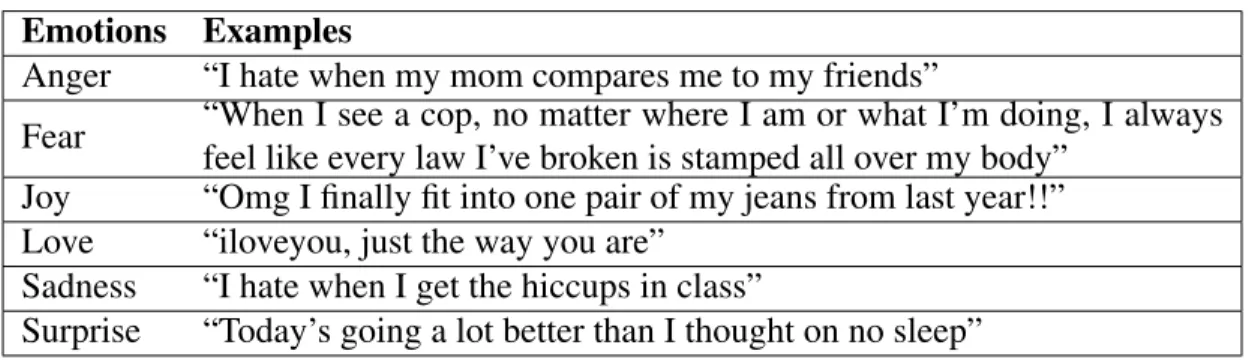
Table 1.1: People express their emotions in social media (Twitter) posts Emotions Examples
Anger “I hate when my mom compares me to my friends”
Fear “When I see a cop, no matter where I am or what I’m doing, I always feel like every law I’ve broken is stamped all over my body”
Joy “Omg I finally fit into one pair of my jeans from last year!!” Love “iloveyou, just the way you are”
Sadness “I hate when I get the hiccups in class”
Surprise “Today’s going a lot better than I thought on no sleep”
as love, anger, joy, hate, or fear)” (Merriam-Webster Online Dictionary, 2014). In this dissertation, we are interested in automatically detecting people’s emotions embedded in their text (e.g., notes, blog posts, diaries and tweets). Table 1.1shows a few Twitter posts in which people describe what has happened in their lives and convey various emotions.
Identifying people’s expressed emotions from text is very challenging for at least the following reasons. First, we aim at fine-grained emotion identification that usually involves at least six different emotions. Emotions can be expressed in a subtle way and different emotions may not be differentiated by simple keywords. For example, although both the examples for sadness and example anger in Table 1.1 contain the same keyword “hate”, they express two different emotions. Second, emotions can be implicit and triggered by specific events or situations: text describing an event or situation that causes the emotion can be devoid of explicit emotion-bearing words. We can infer emotion fear from the example fear in Table1.1 because of “see a cop”, although its author did not apply fear-related adjectives, e.g., fearful, scared, frightened, horrific, awful and formidable. Third, it is time-consuming and error-prone to create a labeled dataset for experiments: it takes time for annotators to decide the most appropriate label out of multiple emotion labels; annota-tors may misinterpret the emotion expressed by the author because nobody knows the exact emotional state of the author except the author himself/herself. Fourth, it requires a large labeled dataset so that assorted emotion-triggering events and situations (e.g., “hiccups in class”, “see a cop”, “mom compares me to my friends”) can be covered, while existing
labeled emotion datasets are relatively small in many domains. To tackle these challenges, this dissertation will approach the problem of emotion identification from the following three synergistic aspects.
Feature analysis: The first question we address is which features are effective for su-pervised emotion identification? We used two domains as our test bed: suicide notes written by people who committed suicide (Wang et al.,2012a) and emotional tweets (Wang et al.,
2012b). We experimented with a variety of features, including n-gram features, knowledge-based (sentiment/emotion lexicon) features, syntactic features and context features for the machine learning classifier. For suicide notes, on top of the supervised learning approach, we proposed an algorithm to automatically extract features from a large feature pool to build a simple but effective rule-based classifier. By combining the machine learning clas-sifier and the rule-based clasclas-sifier, the hybrid system achieved improved performance over both component classifiers.
Self-labeled data creation: The second question we study is how to automatically create a large labeled emotion dataset. This would be a game changer because most existing labeled datasets are relative small, due to the labor-intensive nature of annotating emotions. Therefore, they cover emotional moments in people’s lives at a limited scale. We applied a set of emotion hashtags to filter emotional moments from big ‘Twitter data’ and designed simple heuristics to clean collected data and infer emotion labels out of these hashtags (Wang et al., 2012b) based on the emotion taxonomy from a psychology study (Shaver et al.,1987). Our proposed approach to create a labeled emotion dataset is different from most existing approaches in two ways: (1) the emotion labels are assigned by the tweet authors instead of annotators who may misinterpret the authors’ emotions, and (2) the emotion labeling process is automatically conducted, which can be used to glean a large, labeled dataset with minimum efforts. When we kept increasing the size of the training data from 1,000 to about 2 million, the performances of two classifiers demonstrated steady improvements, which shows that the large size of the training data plays an important role
in improving the performance of emotion identification.
Domain adaptation for emotion identification: The third question we explore is how to leverage large, self-labeled Twitter data to improve emotion identification in target domains where there is a short supply of labeled data. We proposed an effective data selection approach to iteratively select source data that are informative about the target domain, and used the selected data to enrich the target domain training data. We proposed to measure the informativeness of a source instance using three factors: consistency, diversity, and similarity. Experiments on four datasets show that our approach performs effectively for cross-domain emotion identification and outperforms several baseline approaches.
Finally, we apply part of the proposed research to study the cursing behavior, an emotion-rich activity, on Twitter (Wang et al., 2014). Specifically, we identified a set of research theories on cursing in offline environments by prior studies and explored whether they would be supported if tested on Twitter. For example, we tested and confirmed the hypothesis that the main objective of cursing is to express negative emotions on Twitter. After detecting emotions (anger, joy, love, sadness and thankfulness) from both cursing and non-cursing tweets, we confirmed that cursing tweets express more negative emotions (sadnessandanger) than non-cursing tweets.
Related Work
Emotion analysis has attracted increasing attention in recent years due to its applications in many areas such as workplace performance (Briner,1999), well-being of people ( Fredrick-son, 2001), customer relationship management (Walden and Dibeehi, 2012), suicide pre-vention (Pestian et al., 2012), and depression detection (Choudhury et al., 2013b). One fundamental technique in many of these applications is emotion classification; that is, clas-sifying textual units into different emotion categories such asjoy, anger, andfear. In this chapter, we review relevant work on emotion identification and analysis. We start with introducing manually created emotion lexicons and approaches on how to automatically glean emotion lexicons from corpus in Section2.1. Since it is time-consuming and error-prone for annotators to manually label emotion datasets, we will cover research efforts on how to create a self-labeled emotion dataset in Section 2.2. We will discuss rule-based emotion classification approaches in Section2.3, supervised machine learning approaches in Section2.4, and hybrid emotion classification approaches in Section2.5. Finally, we talk about recent studies that unobtrusively analyze people’s emotions (e.g., happiness, subjec-tive well-being, depression) on social media, and introduce existing studies on, cursing, an emotion rich activity that remains largely unexplored on social media in Section2.7.
2.1
Emotion Resources
Emotion lexicons and knowledge bases are important for many emotion analysis applica-tions because they are not only used to make identification rules in unsupervised emotion classification systems but also used to derive effective features for supervised machine learning-based approaches. In this section, we describe several popular emotion lexicons and knowledge bases that may benefit the field of emotion analysis.
LIWC:Linguistic Inquiry and Word Count (Pennebaker et al.,2014) is a text analysis program that calculates how often people use words in some psychologically meaningful categories based on an built-in dictionary. The basic idea is to measure people’s “various emotional, cognitive, structural, and process components” through text analysis. The latest dictionary contains about 4,500 words and word stems from more than 70 categories such as 1st person singular, past tense, family, money, and health. The emotion-related cate-gories (with example words following in parentheses) include: affective processes(cried, abandon),positive emotion(nice, sweet),negative emotion(ugly, nasty),anxiety(worried, fearful),anger(kill, annoyed) andsadness(grief, crying).
WordNet-Affect: WordNet-Affect (Strapparava and Valitutti, 2004) is a lexical re-source that provides a hierarchy of “affective domain labels”. 2,874 synsets and 4,787 words in WordNet (Miller, 1995) are annotated with the emotion labels from this hier-archy. For example, in the hierarchy, labels positive-emotion, negative-emotion, neutral-emotion andambiguous-emotion belong to the parent label emotion; the labelsjoy, love, and affection belong to the parent label positive-emotion; the labels amusement, elation, andgladnessbelong to the parent labeljoy; the WordNet words “gladfulness”, “gladness”, and “gladsomeness” are labeled asgladnessfrom the label hierarchy.
ANEW:Affective Norms for English Words (Bradley and Lang,1999) provides stan-dardized quantified metrics on how people rate English words from the aspects of emotions and attention. Specifically, there are 1,034 words labeled by a group of students on three dimensions:affective valence(from unpleasant to pleasant),arousal(from calm to excited)
anddominance(from dominated to in control). For example, the word “happy” is gener-ally rated towards pleasant (valence), excited (arousal) and in control (dominance), while the word “murderer” is generally rated towards unpleasant (valence), excited (valence) and dominated (dominance).
Norms of valence, arousal, and dominance for English lemmas: Similar to ANEW, it provides ratings from the same three dimensions (valence, arousalanddominance) to a set of English words (Warriner et al.,2013), but it extends ANEW to 13,915 words that are rated using Amazon Mechanical Turk1. In addition, it provides demographic information about people who labeled these words, e.g., gender, age, and education.
ISEAR:International Survey on Emotion Antecedents and Reactions (Swiss Center for Affective Sciences, 2014) is a database containing events invoking any of the seven emotions: joy, fear, anger, sadness, disgust, shame, and guilt. Specifically, it contains answers of about 3,000 student respondents from 37 countries to the questionnaire of ex-perienced emotion events. For example, what was the event about? When did it happen? How intense was the feeling?
EmoLex: EmoLex (Mohammad and Turney, 2010) is an emotion lexicon annotated using Amazon Mechanical Turk. In total, it contains about 14K words/phrases that are selected from: frequent unigrams (adjective, adverbs, nouns, verbs) and bigrams (adjective phrases, adverbs phrases, nouns phrases, verbs phrases) from the Macquarie Thesaurus (Bernard, 1984), positive/negative words from General Inquirer (Stone et al., 1966), and affective words in WordNet-Affect (Strapparava and Valitutti,2004). Each word/phrase is annotated with 1 (yes) or 0 (no) based on whether it is associated with any of the eight emotions (anger, fear, anticipation, trust, surprise, sadness, joy, and disgust) and two sentiments (negativeandpositive). For example, the word “annoy” is associated with anger, disgust and negative sentiment.
1
https://www.mturk.com/mturk/welcome. Amazon Mechanical Turk is a crowdsourcing plat-form where a large number of turkers follow predefined instructions to perplat-form designed tasks (e.g., assigning valence scores to different words) at a relatively small price.
GI:General Inquirer (Stone et al., 1966) has 11,788 words that are labeled with tags from a number of categories. The following categories are very relevant for emotion anal-ysis: EMOT (311 words related to emotions), PosAff (126 words with positive affect),
NegAff (193 words with negative affect), Pleasur (168 words expressing joy), Pain (254 words conveying hardship), Feel(49 words indicating feelings), and Arousal (166 words expressing excitement).
CLex:Different from the above general purpose lexicons,Volkova et al.(2012) build a specific emotion lexicon for colors through crowdsourcing. Specifically, for a given im-age of a specific color, each Mechanical turker will be asked to describe the color, the emo-tion triggered by the color, the concepts associated with the color, for example: “brown-darkness-boredom; red-blood-anger.”
NRC Hashtag Emotion Lexicon: Besides efforts to create an emotion lexicon by manually annotating words with related emotions, there are some studies trying to do this automatically. Mohammad (2012) uses emotion hashtags (e..g, #anger, #joy, #fear) to filter Twitter streaming data and collect more than 20,000 emotion tweets that are auto-matically labeled by the emotion hashtags they contain. The association between a word and an emotion is calculated by P M I(word, emotion)−P M I(word, emotion), where
P M I(word, emotion)is the pointwise mutual information between a word and an
emo-tion, and P M I(word, emotion)is the pointwise mutual information between a word and
the complement of the specified emotion. When the association is greater than zero, this word has a stronger association with the specified emotion than other emotions. Since it is created out of tweets, the generated lexicon contains informal language, such as: “ewwwwwww”, “#perv.”
This above-mentioned PMI-based approach is similar to (Turney, 2002), where the the polarity of a word (e.g., positive, negative) is determined by treating the entire Web as an underlying corpus. Yang et al.(2007b) apply a variant of PMI to a collection of blog sentences that are automatically labeled by emoticons, such as: “:)”, “:(”, “:D”.Bandhakavi
et al. (2014) observe that not all the words in a tweet contribute to its emotion label, for example, in “a nice Sunday #joy,” “nice” is a good indicator of emotion joy, while “Sunday” is not. To capture this intuition, they apply a language model-based approach that models each tweet as a mixture of emotion terms (“nice”) and general terms (“a”, “Sunday”). Experiments show that the quality of the extracted lexicon is higher than that of the lexicon extracted by a PMI-based approach.
Xu et al.(2010) apply an iterative framework that starts with a few seed words that have emotion label information. Then, they apply a graph-based algorithm to propagate the label information from seed words to new words, based on their similarities computed on multiple resources, such as: synonym dictionary, and unlabeled news corpus. To further en-sure the lexicon quality, annotators will manually double check the newly inferred emotion labels during each iteration. Perrie et al.(2013) propose to infer word-emotion relations from a large Web corpus: Google N-gram corpus. It contains unigrams to 5-grams and their corresponding frequencies, calculated from a large collection of Web pages. N-grams with frequencies less than 40 times are not included in this corpus. The proposed approach uses 1,000 seed words whose emotion information is obtained from an emotion lexicon. For a target word whose emotion information is unknown, Perrie et al. (2013) make use of the emotion information of its surrounding words in all the tri-grams in Google N-gram corpus to infer this target word’s emotion.
2.2
Self-labeled Emotion Data Creation
Many emotion classification techniques require annotated training data. Some studies em-ploy human annotators to manually label text with emotions (Alm et al.,2005;Aman and Szpakowicz,2007;Neviarouskaya et al.,2010;Roberts et al.,2012). However, manual an-notation of emotions is usually labor-intensive, time-consuming, and error-prone, because of which there is a lack of large labeled datasets for emotion research. It is appealing to
explore methods that automatically create labeled emotion datasets.
A few studies investigate automatic ways of assigning emotion labels to documents (Mishne, 2005; Leshed and Kaye, 2006). When a user posts a blog on the LiveJournal website2, one can specify a mood label from a predefined list of 132 moods (e.g.,amused, tired,sleepy,happy) or create a new label that reflects his/her mood at the time of posting. This user-specified label is used as the mood label for the entire post. Since one post may contain a mixture of various emotions in different sentences, this document-level labeling is coarse-grained and cannot be applied to the sentence level. Moreover, while most of the labels (e.g., happy, cheerful) indicate people’s emotional states, some labels (e.g., awake,
busy) do not refer to specific emotions.
Another line of work is to automatically label emotions at the sentence level. Yang et al.(2007a) label blog sentences with emoticons used in these sentences. For example, the sentence “hah hah :) I am getting lucky” is labeled by emoticon “:)”. Tokuhisa et al.
(2008) exploit the sentence pattern “I was ** that ...”, in which “**” and “...” refer to an emotion word and the clause that conveys the emotion, respectively. Then, the sentence is labeled with the emotion indicated by the emotion word accordingly. For example, from the sentence “I was disappointed that it suddenly started raining.”, we know that “it suddenly started raining.” conveys the emotiondisappointment(Tokuhisa et al.,2008).
Several studies (Kouloumpis et al., 2011; Go et al., 2009; Pak and Paroubek, 2010;
Davidov et al.,2010) leverage hashtags and emoticons in tweets to build training datasets for sentiment analysis. The basic idea is to collect tweets containing sentiment hashtags (e.g., “#sucks”, “#notcute”) or emoticons (e.g., “:)”, “:D”, “:-(” ), and label each tweet as positive or negative according to the polarity of hashtags and emoticons. However, stud-ies that explore the potential of using Twitter data for emotion identification are rare so far. In this dissertation, we propose to automatically create a large emotion dataset with self-reported emotion labels from Twitter by leveraging hashtags, and study the
construc-2
tion of accurate fine-grained emotion classifiers with the dataset. Choudhury et al.(2012) filter tweets via mood hashtags, and their study focuses on analyzing users’ mood expres-sions through affective space (valence and activation). Another study (Mohammad,2012) collects emotional tweets with six emotion hashtags (one hashtag per emotion), while our study is at a much larger scale in terms of both the number of emotion hashtags and the number of collected tweets. Instead of focusing on building an accurate emotion classi-fier,Purver and Battersby(2012) focus on the investigation of the difference between two datasets collected via emoticons and hashtags, respectively. They cross-validate classifiers by training them using one dataset and testing them on the other dataset. They find that the classifiers achieve good performance on some emotions (i.e., happiness, sadness and anger) and poor performance on other emotions (i.e., fear, surprise and disgust). While many studies follow the six basic emotion categories by Ekman (i.e., anger, disgust, fear, joy, sadness and surprise),Suttles and Ide(2013) apply Plutchik’s eight basic bipolar emo-tion categories (i.e., joy vs. sadness, anger vs. fear, trust vs. disgust, and surprise vs. anticipation) to collect emotion tweets.
2.3
Rule-based Emotion Classification
Because of the intuitiveness and efficiency, several studies (Zhe and Boucouvalas, 2002;
Liu et al.,2003;Chaumartin,2007;Kempter et al.,2014) on emotion identification usually applied manually crafted rules to identify emotions from text. Many of them start with building a knowledge base, in which each word is assigned weights indicating different emotions. For every word in an input sentence, they look up the knowledge base to retrieve its weights. Then, a set of grammar rules is applied to infer the emotion of a phrase/-clause/sentence out of the weights of its component words. For example, since the word “happy” is labeled with a weight (range [0:1]) of 1.0 to indicate emotionjoyin the knowl-edge base, the phrase “not happy” will have a weight of 1.0 to indicate emotion sadness
because of the negation word “not”; the phrase “very happy” will have a weight of 2.0 to indicate emotionjoybecause the adverb “very” intensifies the emotionjoy.
One of the early works (Zhe and Boucouvalas, 2002) applies eight types of rules to identify emotions from instant messages, e.g., negation rule, intensify rule. Some of the rules are quite naive, e.g., if an affective word is negated, then the negation rule assumes that the corresponding sentence does not convey any emotion. Liu et al. (2003) use pre-defined unambiguous emotion words (e.g., “happy”, “depression”, “love”) to retrieve sen-tences. Within the sentences, the emotion-indicating weights of these emotion words are propagated to other uncertain words. For example, from the sentence “Car accidents can be scary”, it learns that “car accidents” can trigger emotion scary. Once it finishes pop-ulating emotion-indicating weights to new words, for a new sentence, it can apply the emotion-indicating weights of both unambiguous words and new words to decide the most likely emotion. Task 14 of SemEval-2007 (Strapparava and Mihalcea, 2007;Chaumartin,
2007;Andreevskaia and Bergler,2007) was to annotate news headlines with emotions: 250 headlines for development and 1,000 headlines for testing purpose. Chaumartin (2007) utilizes a language parser to locate the head word (the root of the dependency tree) in a sentence and aggregates emotion-indicating weights of all the component words, with the weight of the head word multiplied by six because they believe the head word has a much higher influence among all the words in triggering emotions. Both (Chaumartin,2007) and (Andreevskaia and Bergler, 2007) employ dependency tree to detect valence shifts, e.g., negation, increment, and decrement. After looking up emotion-indicating weights for each word in a sentence,Neviarouskaya et al.(2011) follow a set of detailed rules to propagate the weight from a word to a phrase and from a phrase to a sentence (in cases of a simple sentence, a compound sentence, a complex sentence and a complex-compound sentence).
While many rule-based approaches heavily rely on a predefined emotion lexicon re-source, Sahlgren et al. (2007) take a “resource-poor but data-rich” approach: a positive point and a negative point are represented by vectors that consist of context words of eight
manually chosen positive and negative words from a news corpus. Then, they project news headlines into the same space and observe whether this vector is closer to the positive vec-tor or negative vecvec-tor by calculating corresponding cosine similarities. Instead of using two vectors, Danisman and Alpkocak (2008) use five vectors to represent five emotions and each vector is the mean of the vectors of the documents belonging to this emotion. Moreover, emotion lexicons, such as WordNet-Affect, are also employed. Strapparava and Mihalcea (2008) share a similar idea of comparing the news headline vector with differ-ent emotion vectors but in a low dimension space obtained by Latdiffer-ent Semantic Analysis technique. Moreover, it uses emotion words from WordNet and WordNet-Affect to define emotion vectors to achieve a better representation.
Rule-based algorithms are generally easy to interpret and debug. Since the rules are manually crafted, they usually provide good precisions and are suitable for solving prob-lems where only a small amount of labeled data is available. However, the performance of rule-based systems is usually limited by the quality and coverage of the underlying emotion knowledge base. While it is relatively easy to craft rules to cover most of the cases in small datasets, improving the recall on large datasets remains a challenge.
2.4
Supervised Emotion Classification
Supervised machine learning algorithms require a sufficient amount of labeled data for training. The ever growing user-generated content describing people’s emotional moments becomes an invaluable source for feeding these algorithms. One line of work (Leshed and Kaye, 2006; Mishne, 2005) is to identify the overall emotion of a blog post at the document level by utilizing the mood labels chosen by the authors at the time of writing these posts. Specifically, Leshed and Kaye(2006) apply an SVM classifier with standard information retrieval techniques, e.g., stop word removal, bag-of-words model, and TF-IDF weighting.Mishne(2005) retrieves labeled blog posts in the same fashion, and experiments
with more features, e.g., document length, polarity orientation of the post (i.e., the number of positive/negative words), PMI-IR (the pointwise mutual information between a word and a mood, calculated by utilizing the entire Web as the corpus (Turney, 2002)), and emoticons. However, the contribution of different types of feature is not demonstrated.
Ni et al.(2007) tackle the problem of separating blog posts with rich emotions from ones with rich information by performing a binary classification. There are some studies on predicting the emotions that are triggered by different news articles (Lin et al.,2007;Bao et al.,2012).
Another line of work is to classify emotions at the sentence level. Yang et al.(2007a) collect blog sentences containing emoticons and employ emoticons to infer the emotion label of a sentence. Instead of separately predicting emotions of multiple sentences in the same post, they cast the problem as a structure prediction problem and predict the emotions of all the sentences at one time so that the previous sentence and the following sentence can be taken as context to improve the emotion prediction of the current sentence. Aman and Szpakowicz (2008) demonstrate the usefulness of features derived from two knowledge bases: WordNet-Affect (Strapparava and Valitutti,2004) and Roget’s Thesaurus (Jarmasz and Szpakowicz,2001). Martineau et al.(2014) explore the use of active learning approach to improve the quality of the emotion annotation labels.Tokuhisa et al.(2008) apply a two-step approach for emotion classification: a positive/negative/neutral classification followed by further fine-grained emotion classification among positive and negative emotions. Be-sides blog posts, there are some works dealing with fairy tales (Alm et al.,2005) and news headlines (Katz et al., 2007). Alm et al.(2005) add many folk-tale specific features such as the thematic story type and the story progress (the position of the sentence in the whole story) to tailor the model to fairy tales. Katz et al. (2007) combine the outputs of three classifiers (Naive Bayes, Decision Lists, and Nearest Neighbor Cosine) to make joint deci-sions of the emotion categories of news headlines. Besides answering the question “what is the expressed emotion?” there are work on “who experienced the expressed emotion?”
(Mohammad et al., 2014), “what triggered the emotion?” (Chen et al.,2010;Mohammad et al.,2014), and how to identify emotions in real time (Janssens et al.,2013).
In this dissertation, we focus on how to collect a large self-labeled emotion tweet dataset and build accurate emotion classifiers out of it. Since the performance of the classi-fication model largely depends on the quality of the labeled dataset, we first investigate the quality of emotion hashtags on Twitter, i.e., whether the emotion hashtags truly indicate the authors’ emotional states, and design filtering heuristics to remove noisy tweets from the dataset. We study a comprehensive set of features for building the emotion classifi-cation models for tweets, and compare our findings with those of contemporary research on other types of textual content such as blog posts. Since our emotion classification is at a much larger scale compared with the prior emotion analysis work, we also explore the performance gain that can be achieved by increasing the size of training data.
2.5
Hybrid Emotion Classification
Hybrid approaches usually apply both a rule-based technique and a supervised machine learning technique as both techniques can complement each other to better identify emo-tions. Machine learning techniques are suitable and effective when there is a large amount of labeled training data; rule-based approaches are beneficial in expressing well-known aspects of emotion-expression (declarative knowledge) when the labeled data is so sparse that machine learning algorithms cannot effectively capture signals. Take the suicide notes dataset (Pestian et al.,2012), for example: there are 16 categories in total, with 13 emotion-related categories (e.g., love, sorrow, anger), and three other categories (information, in-structionandother). While 80% of the instances in the labeled dataset belong to the most frequent six categories, the remaining categories make up the remaining small portion. Be-cause of this imbalanced data distribution, one would apply machine learning techniques to detect the most frequent emotions and craft rules to identify infrequent emotions. Prior
studies (Yang et al.,2012;Sohn et al.,2012;Xu et al.,2012b) usually make use of existing emotion lexicons to define rules and manually go through the data to spot more emotion words to add new rules. To build machine learning classifiers,Yang et al.(2012) combine four classifiers (SVM, Maximum Entropy, Naive Bayes, and Conditional Random Field) to make a joint decision (any vote, majority vote, and combined vote) on the most frequent emotions. Sohn et al. (2012) apply majority votes to the decisions from an ensemble of five MNB classifiers (with different information gain thresholds) and nine RIPPER mod-els (combinations of different pruning sizes and random seeds) to detect the most frequent emotions. Xu et al.(2012b) apply spanning n-gram features to detect frequent emotions, normal n-grams for information and instruction, and pattern matching for infrequent emo-tions.
In this dissertation, we also explore the hybrid approaches for emotion classification of suicide notes. Specifically, we propose an algorithm to automatically extract effective syntactic and lexical patterns from training examples to build the rule-based classifier, and investigate a variety of lexical, syntactic and knowledge-based features to build the machine learning classifier. The hybrid system outperforms both the rule-based classifier and the machine learning classifier.
2.6
Instance-based Domain Adaptation
Domain adaptation has attracted attention recently (Pan and Yang, 2010). Previous work along different lines includes techniques for domain adaptation via pivot features (Blitzer et al., 2006, 2007), regression-tree adaptation (Chen et al., 2008), feature alignment (Pan et al., 2010), dimensionality reduction (Pan et al., 2011), a simple mixture distribution model (Daum´e III and Marcu,2006), deep learning (Glorot et al., 2011), and hierarchical Bayesian prior (Finkel and Manning, 2009). Due to its being simple to understand and to interpret, we explore this problem from the instance adaptation perspective and hence we
will limit our attention to the instance-based approaches.
Jiang and Zhai(2007) train an adaptive classifier on the union of both source and target domain instances, where the target domain labeled data are assigned larger weights since they are more representative of the target domain. Dai et al.(2007) extend the AdaBoost algorithm to adjust the weights of training instances. Some studies (Jiang and Zhai,2007;
Xu et al.,2011) apply a classifier trained on target domain labeled data to identify “good” and “bad” instances from source data: a source instance is considered to be a good (or bad) one if it can be correctly (or incorrectly) classified by the classifier. We attempt to selectinformative instances from the incorrectly classified instances rather than correctly classified ones, because their being incorrectly classified may suggest that they contain knowledge that the target data lacks. Data selection has been frequently used in machine translation to select sentences that are very similar to these in target data (Hildebrand et al.,
2005;L¨u et al., 2007; Foster et al., 2010; Axelrod et al., 2011). By doing so, the formed training data can hopefully better match the target data in text contents. In this dissertation, we aim at leveraging self-labeled tweets to improve the emotion identification in target domains, e.g., blogs and diaries. We apply a bootstrapping framework to iteratively select informative tweets to enrich the target domain training data. We define the informativeness of a source instance using three factors: consistency, diversity, and similarity. Moreover, we find that selecting tweets that are similar to target data is not sufficient, because tweets with nearly identical content can have contradicting labels. This fact makes it necessary to check whether tweets contain consistent knowledge about the target data or not before being selected.
Adapting self-labeled emotion tweets for emotion identification in other domains re-mains largely unexplored. Mohammad(2012) applies the feature augmentation proposed in (Daum´e,2007) to make use of Twitter data to improve emotion identification from news headlines, but domain adaptation is not the main focus of their work. We systematically study the problem of domain adaptation for emotion analysis using a large number of
self-labeled emotion tweets.
2.7
Emotion Analysis on Social Media
With users generating more and more data on social media, the data becomes a valuable source for studying people’s emotions in an unobtrusive way. There are many studies on public happiness and subjective well-being. Mihalcea and Liu (2006) use a LiveJournal blog corpus to study “happiness factors” and happy moments (e.g., time of day and day of week). Bollen et al.(2011) track six dimensions of mood (tension, depression, anger, vigor, fatigue, confusion) of the public via Twitter and find that major events and holidays in the physical world have “significant, immediate and highly specific effect” on the public mood.
Schwartz et al. (2013) predict the life satisfaction in one county via tweets posted from that area. Similarly,Quercia et al.(2012) use tweets to track the subjective well-being of communities in London and find the emotion scores of tweets and the socio-economic well-being to be highly correlated.Kramer(2010) proposes calculating the positive and negative emotion scores from Facebook status updates, and aggregating them to measure the overall happiness of a nation. Dodds et al. (2011) study the temporal patterns of happiness and information on Twitter, and find interesting weekly and daily happiness patterns. Besides the study of positive emotions, there are studies focusing on negative emotions, such as depression and stress. Choudhury et al. (2013b) find that clues such as decreased social activity and increased negative emotions, contribute to the detection of a major depressive disorder in Twitter users. Park et al.(2015) discover that depression is correlated with the frequency and diversity of interactions on Facebook among young adults. Coppersmith et al.(2014) train a statistical classifier to identify military personnel who suffer from Post Traumatic Stress Disorder by leveraging language trails. There are also some studies on how people’s emotions get affected due to changes in life. Choudhury et al.(2013a) show that there are significant changes in online activity and expressed emotions for about 15% of
the new mothers after their childbirth.Kramer et al.(2014) conduct a large-scale emotional contagion experiment and find that people’s emotions can get affected by the positive and negative emotions expressed in their news feeds.
In contrast with the above studies, our work focus on an emotion-rich activity that has been examined extensively in the physical world but remains largely unexplored on social media: cursing. Cursing is not uncommon during conversations in the physical world: 0.5% to 0.7% of all the words we speak are curse words, given that 1% of all the words are first-person plural pronouns (e.g., we, us, our). On social media, people can instantly chat with friends without face-to-face interaction, usually in a more public fashion and broadly disseminated through a highly connected social network. Will these distinctive features of social media lead to a change in people’s cursing behavior? Before answering the question, we first consider the previous research on cursing in offline communications, and organize them into four groups corresponding to the four questions we address in this study.
The Ubiquity of Cursing: Cursing is more common than people might think. Jay
(1992, 2009b) find 70 curse words in an 11,609-word tape-recorded conversation of el-ementary school students and college students. In another study, Mehl and Pennebaker
(2003) report that curse words occurred at a rate of 0.5% over two 2-day periods among undergraduate students, which may not seem significant except that the first person plural pronouns – words likewe,us, andour– occurred at a 1.0% rate. They also find substantial differences among individuals regarding curse words usage: the word rates varied from a minimum of 0% to a maximum of 3.4%. Some recent studies suggest that people have been hearing and using profanity words more often than ever before (Associated Press,
2006). More (a 69% increase) and harsher curse words have been used in TV programs in 2010 compared to 2005 (Parents Television Council, 2010). Jay(1992) also finds that a few most frequently used words (e.g.,fuck, damn, hell, and shit) account for most of the cursing expressions in conversations (a long tail phenomenon).
glance. Prior studies (Jay,1992,2000;McEnery,2006;Nasution and Rosa,2012) suggest that the main reason that people use swearing words is to express some strong emotions, es-pecially anger and frustration, for emphasis. As a common conversational practice, cursing rarely results in obvious harm. Only when cursing occurs in the form of insults toward oth-ers, such as name-calling, harassment, hate speech, and obscene telephone calls, it becomes harmful (Jay,2009a). Researchers also find that other positive effects could be achieved by swearing. For example,Stephens et al.(2009) report that swearing increased pain tolerance and decreased perceived pain compared with not swearing. In addition, people may find relief and positive effects of laughing at jokes, humor and sarcasm in which curse words are used (Jay,2000,2009a).
Contextual Variables: Prior studies suggest that cursing is very sensitive to contex-tual influences (Jay, 2000). More specifically, people’s propensity to curse, the particular curse words people use, and how others perceive the cursing behavior, are dependent on various contextual variables. Generally, the context of cursing activity is defined by those variables about when, where, how, whoandwith whomthe cursing occurs. Among those variables, while the whoand with whom variables have attracted the most attention from researchers, the physical location has also been recognized as important (Jay,1992,2000;
Jay and Janschewitz, 2008). Jay and Janschewitz(2008) find that “people are more likely to swear in relaxed environments than in formal environments” (e.g., pub vs. office). Since such observations are made in the setting of oral communication in the physical world, it is not clear whether the physical location still matters for cursing on social media that occurs as written messages in the digital world. In addition, little is known about how thewhen
andhowfactors may affect cursing. In this study, we examine the effect of location variable as well as the variables of time of day, day in a week, and message types, on cursing on social media.
Who Says Curse Words to Whom:There have been a considerable number of stud-ies on understanding the characteristics of people who use and hear curse words. A set
of important variables have been identified and investigated (Jay, 1992, 2000; McEnery,
2006), including gender, age, race, religion and power. Unfortunately, many of these vari-ables such as age, race and religion remain difficult to measure on Twitter, thus, we limit our focus on gender and power. Some well-recognized patterns about gender in swearing research include: (1) Gender affects cursing frequency. Many studies (Jay,1980;Mehl and Pennebaker, 2003; Thelwall, 2008;Pilotti et al., 2012) suggest that men curse more fre-quently than women. (2) Gender affects the choice of curse words. For example, according to (McEnery, 2006), women use the wordsgod,hell,bitch, andpissmore often than men, and men use the wordsfuckandcuntmore often than women. (3) People are more likely to curse in same-gender contexts than in mixed-gender contexts (Jay and Janschewitz,2008;
Pilotti et al., 2012). People’s power or social rank also plays a role in cursing. McEnery
(2006) finds that frequency of cursing is inversely proportional to the social rank.
Cursing on social Media: Only a few efforts have been made to explore cursing on social media. Thelwall(2008) studies the use of curse words in MySpace profiles and the effects of gender and age factors. Sood et al.(2012) investigate profanity usage in Yahoo! Buzz communities and found that different communities (e.g., politics or sports) use pro-fanity with varied frequencies and in different ways. Turning to Twitter,Bak et al.(2012) study self-disclosure behavior in Twitter conversations. As one aspect of self-disclosure, profanity is used more frequently between users with higher relationship strength. While other researchers have mainly focused on investigating algorithms to automatically detect offensive tweets (Xiang et al.,2012;Xu et al.,2012a), our understanding of the basic ques-tions regarding the use of offensive words on Twitter still remains unexplored, such as why people use curse words, who uses it, and whether these words are always harmful and should be removed. The insights gained in our study can shed light on these questions.
Emotion Classification
In this chapter, we study the problem of emotion identification by casting it as a classifi-cation problem. We investigate a variety of lexical, syntactic, knowledge-based, context-based features and show how their relative contributions to the performance of the super-vised machine learning classifier when the training data are not sparse. We also propose an algorithm to automatically extract effective syntactic and lexical patterns from training data to build the rule-based classifier when training data are sparse. We evaluate the proposed approach in two different domains: suicide notes and Twitter data.
3.1
Overview
Previous text mining research has mostly focused on dealing with the factual aspects in the text, such as identifying entities (e.g., people’s names, organizations), classifying articles based on whether the article discusses a given topic (e.g., sports, finance), and extracting relationships (e.g., is located at, was born in). More recently, increasing attention has been paid to the analysis of sentiments in subjective text. Such sentiment analysis is concerned about the polarity of people’s opinions regarding certain entities (Chen et al., 2012a). For example, does the person like or dislike the restaurant mentioned in the text? Does the person support this presidential candidate or not (Chen et al.,2012b)? However, relatively few studies focus on our own emotional states. For example, is this person suffering from depression?
With the rise in the popularity of social networking sites, users interact with each other on these sites and a large amount of User Generated Content (UGC) is being pro-duced: more than 500 million tweets are posted every day 1. These social networking
sites encourage users to record their thoughts and moments in life, e.g., Facebook (“what’s on your mind?”), Twitter (“what’s happening?”). Because of this, a lot of UGC naturally reflects people’s emotional states, e.g., “when you talk to that person and she makes you smile. what a feeling. #happy ” (a status update from Twitter) and “So excited for a brand new day. The future is so exciting!!!” (a post from Facebook). This provides an invalu-able opportunity for social media analytics (Sheth et al.,2014), such as analyzing people’s emotions in an unobtrusive way.
However, identifying the expressed emotions in text is very challenging for at least the following reasons. First, emotions can be implicit and triggered by specific events or situations. Text describing an event or situation that causes the emotion can be devoid of explicit emotion-bearing words. Consider the examples in Table 1.1: in the second example, fear is inferred from “see a cop”; in the first example, anger is inferred from “mom compares me to my friends”; and in the fifth example, embarrassment (a subcategory of sadness) is inferred from “hiccups in class”. We can recognize fear from the text even though there is no explicit reference to words such as “scare” and “panic”. Second, gleaning distinctions between different emotion categories purely on the basis of keywords can be very subtle. The first example and the fifth example in Table 1.1 have similar sentence patterns and contain the same emotion-bearing word “hate”, but they belong to different emotion categories (i.e.,angerandsadness).
We tackle the problem of emotion classification by studying the effectiveness of dif-ferent features (lexical, syntactic, knowledge-based, context-based, and class-specific fea-tures) on two domains: suicide notes and Twitter data. For suicide notes, we find that a combination of lexical, knowledge-based, syntactic and class-specific features are effective
1
for identifying majority emotion classes. For improving the identification of minority emo-tion classes, we propose an algorithm to automatically discover beneficial features that are ignored by the supervised classifier and to build a rule-based classifier consisting of these features. The experiments demonstrate that the final hybrid system, consisting of both the supervised classifier and the rule-based classifier, achieves a better performance than its component classifiers. For Twitter data, the combination of lexical, POS (part-of-speech) and knowledge-based features achieves the best accuracy; we also find that lexicon-based features become less important on large training data.
3.2
Problem Definition
For an input instance (i.e, a sentence or tweet)s, the problem of emotion classification is
to decide the most appropriate emotion classcj ∈C(1≤j ≤w)for the instances, where
C ={c1, c2, . . . , cw}represents a set of candidate emotion classes. Because there are many
different emotions with different granularities, the research community has not reached a consensus on the exact emotion classes. Ekman et al. (1972) propose six basic emotion classes: anger, disgust, fear, joy, sadness, and surprise. In this dissertation, the emotion classes may vary from one dataset to another, but they usually contain these basic emotion classes.
3.3
Methods
Supervised machine learning algorithms do not directly deal with input text; instead they make decisions based on the feature vector representation of each input text. Thus, how we abstract and represent input text using features is an important research question, which will be covered in Section3.3.1. We show how to spot beneficial features that are ignored by the supervised machine learning algorithm and how to build the rule-based classifier
with these spotted features in Section3.3.2.
3.3.1
Features for the Supervised Classifier
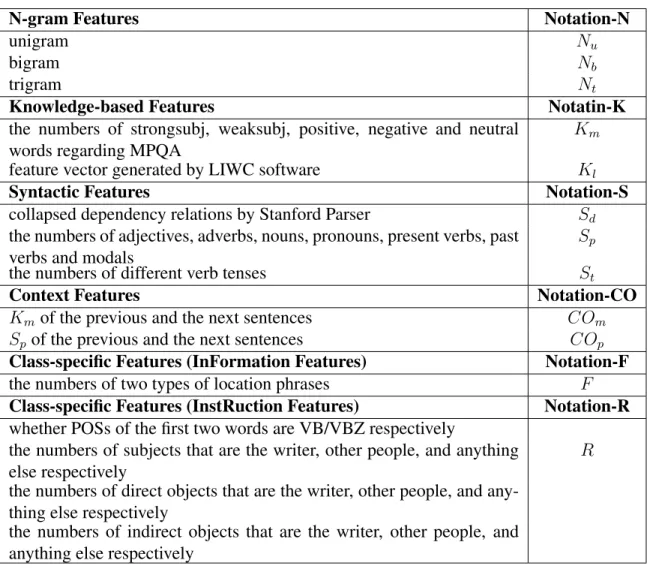
N-gram features: N-gram features are widely used in a variety of tasks in text classifica-tion, including emotion analysis. Despite its simplicity, unigrams (n=1) have been used for emotion classification effectively (Aman and Szpakowicz, 2008). Bigrams (n=2) and tri-grams (n=3) capture context better than unitri-grams do (Tokuhisa et al., 2008). In our study, we experimented with unigrams, bigrams, trigrams and their combinations. Punctuation (e.g., !!, ??) and emoticons (e.g., :P, <3, </3) were also included in the n-gram model.
Stop words elimination was not used because prior studies observe that stop words might be helpful in capturing the properties of some categories.
N-gram Position: Similar to (Pang et al.,2002), we also hypothesize that the words located towards the end of a sentence are more important than other words, because people usually summarize or highlight their points in the end. For example, “I hate it when stuff like that happens,.. thank god it worked out.<3 #thankful. ”. Although “hate” appears in
the first half of the sentence, the overall emotion is dominated by “thank” in the latter half. We encoded the position information into a feature by attaching a number (i.e, 1 or 2) to each n-gram to indicate whether it is in the first half or the second half of the instance. For example, if an instance has 10 unigrams, then the first 5 unigrams belong to the first half of the instance and are attached with 1. We also experimented with dividing an instance into three parts, but the results got worse.
Knowledge-based features: These are features based on prior knowledge about the subjectivity, sentiments, or semantic categories of English words. Specifically, we used MPQA (Wilson et al.,2005), LIWC (Pennebaker et al.,2014), and WordNet-Affect ( Strap-parava and Valitutti, 2004). MPQA is a subjective lexicon, which provides the sentiment polarities (positive/negative/neutral) and strength (strongsubj/weaksubj) of 8,211 words. For each input sentence, we count the numbers of positive, negative, neutral, strongsubj,
and weaksubj words according to MPQA as features. LIWC is a text analysis program with a built-in dictionary. For each piece of input text, the program outputs a vector with 69 dimensions covering positive/negative sentiments, casual words, numbers, etc. From WordNet-Affect, we collected the words from 32 direct subcategories ofpositive-emotion
(e.g., joy, and love.),negative-emotion(e.g., anxiety, and sadness.),neutral-emotion (e.g., apathy.), and ambiguous-emotion (e.g., surprise.) defined in WordNet-Affect. For each instance, we used 32 features, each of which represents the number of words from one of the 32 subcategories.
Syntactic features: These are features based on syntactic information of the text, including dependency relation, POS tag, and sentence tense. We first apply the Stanford Parser (Klein and Manning,2003) to parse each sentence and get corresponding collapsed dependencies. For each collapsed dependencyd, we define the associated relation feature
as(d.name, d.gov, d.dep), whered.nameis the type of dependency,d.govis the stemmed
governor token of dependencyd, andd.depis the stemmed dependent token of dependency
d. Take an artificial sentence “Please pay them,” for example; we generate the following
relation features: (dep, please, pay) and (dobj, pay, them). Moreover, considering that some types of words (e.g., adverbs, adjectives, etc) are likely to convey sentiments, we obtain POS features by counting the numbers of words with the following POS tags: adjec-tive (JJ/JJR/JJS), adverb (RB/RBR/RBS), noun (NN/NNS/NNP/NNPS), pronoun (PRP), present verb (VB/VBG/VBP/VBZ), past verb (VBD/VBN), and modal (MD). To explore whether there are associations between different categories and sentence tenses, we use the counts of different verb tenses in each sentence as features.
Context features: We hypothesize that the sentiments of the surrounding sentences may affect the sentiment of the current sentence. So we use the MPQA featureKmand POS
count featureSp of the previous and next sentences. If the previous or the next sentence is
missing, we set the corresponding features to0.