DISCUSSION PAPER SERIES
Forschungsinstitut zur Zukunft der Arbeit Institute for the Study of Labor
The Effect of Family Separation and Reunifi cation
on the Educational Success of Immigrant Children
in the United States
IZA DP No. 4887
April 2010 T. H. Gindling Sara Z. Poggio
The Effect of Family Separation and
Reunification on the Educational Success
of Immigrant Children in the United States
T. H. Gindling
University of Maryland Baltimore County and IZA
Sara Z. Poggio
University of Maryland Baltimore County
Discussion Paper No. 4887 April 2010 IZA P.O. Box 7240 53072 Bonn Germany Phone: +49-228-3894-0 Fax: +49-228-3894-180 E-mail: [email protected]
Any opinions expressed here are those of the author(s) and not those of IZA. Research published in this series may include views on policy, but the institute itself takes no institutional policy positions. The Institute for the Study of Labor (IZA) in Bonn is a local and virtual international research center and a place of communication between science, politics and business. IZA is an independent nonprofit organization supported by Deutsche Post Foundation. The center is associated with the University of Bonn and offers a stimulating research environment through its international network, workshops and conferences, data service, project support, research visits and doctoral program. IZA engages in (i) original and internationally competitive research in all fields of labor economics, (ii) development of policy concepts, and (iii) dissemination of research results and concepts to the interested public. IZA Discussion Papers often represent preliminary work and are circulated to encourage discussion. Citation of such a paper should account for its provisional character. A revised version may be available directly from the author.
IZA Discussion Paper No. 4887 April 2010
ABSTRACT
The Effect of Family Separation and Reunification on the
Educational Success of Immigrant Children in the United States
For many immigrants, especially those from Central America and Mexico, it is common for a mother or father (or both) to migrate to the United States and leave their children behind. Then, after the parent(s) have achieved some degree of stability in the United States, the children follow. Using qualitative and quantitative methods, we examined the hypothesis that separation during migration results in problems at school after re-unification. We find that children separated from parents during migration are more likely to be behind others their age in school and are more likely to drop out of high school.
JEL Classification: I2, J13, J61
Keywords: immigrant children, education, family separation
Corresponding author: T. H. Gindling
Department of Economics
University of Maryland Baltimore County Baltimore, Maryland 21250
USA
1
The Effect of Family Separation and Reunification on the
Educational Success of Immigrant Children in the United States
1I. Introduction
Because of the recent surge in immigration to the United States, immigrant children are one of the fastest growing segments of the U.S. school-age population. One in five children of school age in the United States is an immigrant or child of immigrants (The Urban Institute, 2006). Special challenges and opportunities face immigrant children in school. On the positive side, immigrant children recognize the sacrifices they and their parents make for their benefit, and many are therefore highly motivated to succeed in school (Rumbaut, 2005a). On the other side, challenges that immigrant children face include lack of English proficiency, culture shock and the low socioeconomic status of many immigrant parents (Suarez-Orozco, et. al., 2008).
We hypothesize that another factor common to the migration experiences of many recent immigrant children may also contribute to the difficulties some immigrant children face in school—separation from parents during migration. For many immigrants, especially those from Central America and Mexico, it is common for a mother and/or father to migrate to the United States and leave their children behind, in the care of relatives or family friends. Then, after the parent(s) have achieved some degree of stability in the United States, the children follow (Suarez-Orozoco, Todorava and Louie, 2002). The trauma, grief and disruptions caused by separation, migration and reunification of families have profound negative psychological effects on children and their parents (Schen, 2005 and Smith, Lalonde and Johnson, 2004). It is
reasonable to hypothesize that separation during migration will result in problems at school after reunification.
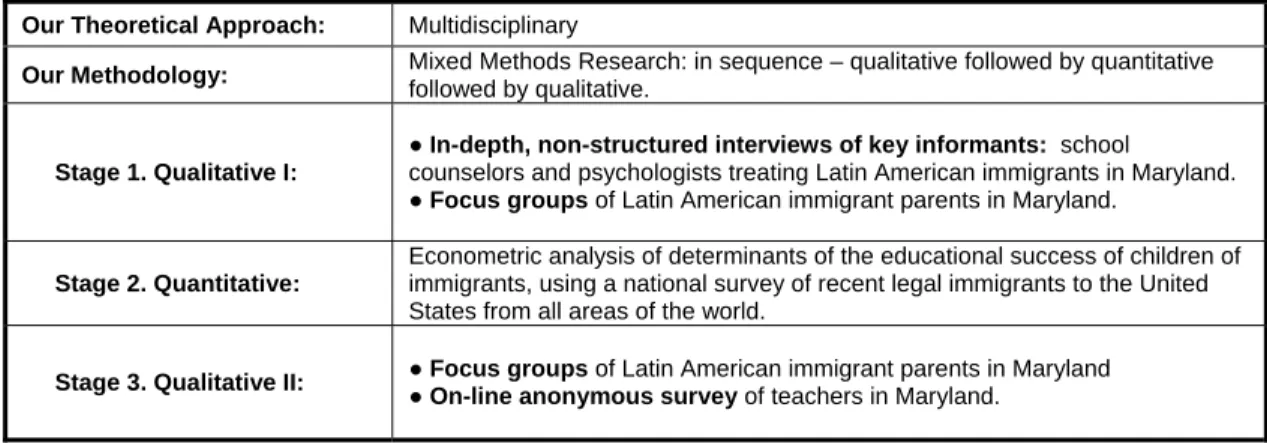
We study this issue using a mixed qualitative-quantitative methodology with three stages. The first stage was qualitative, and focused on the state of Maryland. We began this stage by
1
We are grateful for financial support received for this research project from: the Spencer Foundation through grant number 200800052; the UMBC Graduate School through a Special Research Initiative Support grant; and the Maryland Institute for Policy Analysis and Research (MIPAR) through a MIPAR Fellowship. Helpful comments were received from Ramona Bock, Patricia Chiancone, Dennis Coates, Lisa Dickson, Dave Marcotte, the participants at the conference on “Emerging Perspectives on Children in Migratory Circumstances,” Drexel University, June 20-22, 2008 and the participants of a UMBC Public Policy-Economics seminar. Leif Huber, Luis Peralta, Elizabeth Arevalo, Lisa Fink and Claudia Rybero provided valuable research assistance. Focus group participants were recruited by Evelyn Rosario of the Hispanic Apostolate of Baltimore.
2
conducting two focus groups of parents of Latin American immigrant children who had been separated during migration, and in-depth, non-structured interviews of school counselors and psychologists. The insights gained from these focus groups and interviews then guided our quantitative analysis.
The second stage was a quantitative, multiple regression analysis of data from the New Immigrant Survey, a nationally representative survey of new legal immigrants (Latin American and others) conducted by the Office of Population Research of Princeton University. We tested whether there is evidence from this survey that the insights gained from the qualitative analysis of Latin American immigrants in Maryland can be generalized to the broader immigrant
population in the country as a whole. We found evidence that family separation during migration has a negative impact on the educational success of immigrant children in U.S. schools. Children separated from parents during migration are more likely to be behind others their age in school and are more likely to drop out of high school. The negative impact of separation during migration on educational success is largest for Latin American immigrants, for children separated from their mothers (as opposed to fathers), for those whose parents have lived in the United States illegally, and for those who were separated from their parents at older ages and reunited with parents as teenagers.
In the final qualitative stage of our research, we conducted an additional focus group of Latin American immigrant parents in Maryland, as well as an on-line anonymous survey of teachers in Maryland schools. The focus group of parents and teacher surveys provided insights into the interpretation of the quantitative results and suggestions for policies to address the challenges faced by immigrant students who have experienced family separation.
Table 1: Methodology
Our Theoretical Approach: Multidisciplinary
Our Methodology: Mixed Methods Research: in sequence – qualitative followed by quantitative
followed by qualitative.
Stage 1. Qualitative I:
● In-depth, non-structured interviews of key informants: school
counselors and psychologists treating Latin American immigrants in Maryland.
● Focus groups of Latin American immigrant parents in Maryland.
Stage 2. Quantitative:
Econometric analysis of determinants of the educational success of children of immigrants, using a national survey of recent legal immigrants to the United States from all areas of the world.
Stage 3. Qualitative II: ●● Focus groups of Latin American immigrant parents in Maryland On-line anonymous survey of teachers in Maryland.
3
II. Literature Review
The existing literature on immigrant children rarely distinguishes between immigrant children who migrate with parents and those who are separated from parents during the migration process. Yet studies that have made this distinction indicate that it is common for child migrants to the United States to be separated from parents during migration. For example, Suarez-Orozco, et. al, (2002 and 2008) report results from the Longitudinal Immigrant Student Adaptation Study (LISA), a survey is of young recent immigrants from Central America, China, the Dominican Republic, Haiti and Mexico recruited from 51 schools in 7 school districts in the Boston and San Francisco greater metropolitan area. 85% of the youth in this sample were separated from one or both parents during the migration process. Separation was most likely for immigrants from Central America (96%--with 80% of Central American children separated from both parents).
In our work, we carefully distinguish between children of recent immigrants who have been born in the United States, children born abroad who migrated with their parents, and children born abroad who were separated from their parents during the process of migration. Literature from a variety of disciplines leads us to suspect that separation during migration will have a further negative effect on educational attainment that goes beyond any negative effect on child migrants in general.
Early studies on the effects of immigration in family relations showed that families tend to be affected by the experiences of immigration. Particularly, relationships between parents and children could become conflictive until the family dynamic is restored. Sluzki (1979) analyzed the effects of cultural, economic and emotional changes on immigrant families and showed how family roles and specific family dynamics are transformed with the immigration process
Relationships between parents and children in early childhood can affect a wide range of behaviors later in life. Attachment Theory, for example, argues that disruptions in “affection bonds” with parental figures (especially mothers) can have profound negative psychological and developmental implications later in life. Separation from parents is particularly important when the child is young (Winnicott, 1958; Ainsworth, 1989). Young children can interpret separation from parents as a complete loss of their love and protection. Attachment theory focuses on the effect of the bond that children develop in their relationship with parents and in the meaning of the interruption of the relationship reflected in the child’s behavior. The loss of this bond with
4
parents triggers grief responses that affect behavior. Separation from parents during migration, in particular, can lead to emotional distress and have an impact on later relationships and behavior.
Immigrants in general experience "ambiguous loss" in relation to friends and family members in the country of origin (Boss, 1991). Ambiguous loss is defined as the impossibility to mourn and heal after losing a loved one in the case of someone who is physically absent but psychologically present--friends and relatives who are alive but do not interact with the
immigrant anymore. Immigrant children have to deal with ambiguous loss after their mother or father leaves them, when they have to leave their caregiver in the country of origin, and when they leave the rest of their family and friends. This burden that immigrant children bring to their new country and new school can become a significant constraint for them to succeed at school in America. The emotional impacts of separation and reunification are further complicated by pre-and post arrival events pre-and conditions that the child experiences in relation with his/her particular family situation.
It is reasonable to expect that school performance in the country of origin will also be affected by the sense of ambiguous loss that children have to endure. In some cases when the child is expecting to be reunited with his/her parents in United States, he/she will be not concentrate enough on learning in their local school.2 Children with a family member in the United States (a “migrant network”) may also be more likely to see migration, rather than education, as the route to higher earnings, and therefore less likely to find schooling in the home country to be worthwhile, and are therefore likely to get less educational attainment while separated from their parents (McKenzie and Rappaport, 2006 and Miranda, 2007). In a study of children of immigrants from Oaxaca, Sawyer and Keyes (2008) find that while remittances from extended family members abroad contribute to increased education levels of children, having a close family member in the United States actually reduces the education of children left behind. Similarly, Amuedo-Dorantes (2008) finds evidence that in some communities in Haiti
remittances raise school attendance only for children from households who do not experience any family out-migration. In another study, based on a survey of 1,500 households in five
2
Children left behind are, in effect, living in two worlds. “Piedras Blancas, El Salvador fourth grade teacher Roney Ramirez on Josselin Mendez, whose parents are both in the United States: 'I try to tell her that what she learns here can serve her over there…But she really doesn’t take it in. Her mind is so focused on over there that it’s as though she’s left already.'” (Aizenman, 2006).
5
Mexican municipalities where family separation is prevalent, Lahaie, et. al. (2008) find that one of the strongest predictors of educational and emotional health outcomes of Mexican children is whether a caregiver has left the household to migrate to the United States. Lahaie, et. al. (2008) also find that the impact of family separation depends on whether the family member who migrates is the mother or father. A household where the caregiver-spouse (generally the mother) has migrated is 3.6 times as likely to include a child with educational or behavioral problems, while a household where a spouse who is not the caregiver (generally the father) migrates is less likely to include a child with educational or behavioral problems.
The emotional distresses that immigrant children experience before their arrival to the United States will complicate their adjustment to family, school and culture in the United States. The literature on the adjustment of immigrant children to the host society suggests that such adjustment is a complex process that is likely to differ for immigrant children with different characteristics. For example, Portes and Rumbaut (2001) present evidence that the impact of many variables that affect the educational success of immigrants have different effects on boys and girls. A number of strands of the literature also suggest that the impact of immigration on the education of children will differ depending on the age of migration. For example, because language acquisition becomes more difficult as children age, adaptation to a new language, culture and educational system will be more difficult for children who migrate when they are older (Scovel, 2000 and Chiswick and Miller, 2008).
Literature from economics, sociology and education find that factors related to the separation of children from parents during migration have negative effects on school success. For example, Chartrand, et. al. (2008) finds that children 1-5 years old in families where one parent as been deployed abroad as a soldier have more behavioral problems than do children in military families where both parents are present at home. “Stressful events during childhood (e.g. changes in geographic location) appear to have large and independent negative effects on a variety of indicators of children's (educational) attainments" (Haveman and Wolfe, 1995). A large body of research in the United States finds that children who grow up with only one birth parent are disadvantaged across a range of outcomes. For example, they are less likely to complete high school and are more likely to have poor mental health in adulthood (Case, McLanahan and Lin, 2000). Based on a longitudinal survey of children of immigrants in California, Rumbaut (2005a) also finds that school performance is strongly correlated with
6
family dynamics and family cohesion. Camaron and Heckman (2001) find that family factors explain most of the Hispanic-White gap in high school dropout rates. Our study, however, is the first to explicitly test the hypothesis that family separation during migration negatively affects the school performance of children after they have reunited with their parents.
The recent study that is most similar to ours is described in Orozco, Suarez-Orozco and Todorova (2008). Suarez-Suarez-Orozco, et. al. collect longitudinal (1999-2002) data on 407 recently arrived immigrants, ages 9-14 in 1997, in San Francisco and Boston (the
Longitudinal Immigrant Student Adaption, or LISA, study). Suarez-Orozco, et. al use a mixed method (qualitative and quantitative) to study many aspects of the lives of immigrant children, including the factors that affect the educational success of immigrants. Specifically, they examined the factors influencing GPA and Woodcock-Johnson achievement test scores. They found that the following factors affect academic achievement: English language proficiency, parental education, income, gender, behavioral engagement, school characteristics, peers, and family structure. Unlike in our paper, in their quantitative analysis Suarez-Orozco, et. al.(2008) did not explicitly test for an impact of separation during migration on academic performance. However, in the qualitative portraits of high and low achievers at school they write that among “protracted decliners” “many families had been strained by protracted separations and
complicated reunifications” (p. 170), while the “high achieving students…were also much less likely to report long separations from their parents” (p. 296).
III. Stage 1: Qualitative I i) Interviews with Psychologists
We interviewed psychologists from Johns Hopkins University who were treating immigrant families at the Catholic Hispanic Apostolate in Baltimore, Maryland.3 These
psychologists noted that family separation has a negative impact on the mental health of family members. Mothers, in particular, often experienced depression and/or physical illness because of separation. While most of the patients who had been separated from their families during
migration were mothers who were currently separated, the few children who were seen also reported being depressed as a result of family separation.
3
The Hispanic Apostolate has for many years provided free or subsidized legal services, health care services, English instruction and other social services to a large proportion of the immigrant population of Southeast Baltimore (no matter their religion).
7
ii) Interviews with School Counselors
We interviewed counselors in the International Counselors Office of the Prince George’s County Maryland Public School system, a school district with a large and growing population of immigrant students from Latin America. The counselors with whom we spoke believed that separation during migration, and subsequent reunification, has a negative impact on the
educational success of high school students. The counselors also noted that problems at school tend to show up in those who migrated as teenagers more than those who migrated at younger ages. Children who are reunited at younger ages are generally respectful of authority and more easily adapt to a new school, while those who are reunited as teenagers are more often
disrespectful and have a difficult time integrating into the academic and social life at school.
iii) Focus Groups
We conducted two focus groups of parents (mostly mothers) of Hispanic students in Baltimore City at the Hispanic Apostolate. The participants in our focus groups were immigrant parents (mostly mothers) from Latin America who had been separated at least two years from their children before reunification in the United States. The first focus group included eight parents (seven mothers and one father) and the second included six mothers. The main questions to orient the discussion among immigrant parents were: (1) how did parents react to the
separation and reunification with their children; (2) how did children react to the separation and reunification with their parents; (3) did separation during migration have negative consequences for school performance?
The parents in our focus group agreed that separation of their children from parents had negative psychological consequences for both children and mothers. They agreed that children are most affected by separation from their mothers (compared to fathers). The parents lamented that in many cases during separation children became attached to their caretaker and estranged from the mother. Almost universally, parents were dissatisfied with the caretakers children lived with while the family was separated. When children leave their country to join their parents in US, most children express pain because of separation from the caretaker (they express grief at their loss).
8
Reunification with parents is followed by a short period of euphoria, which in turn is almost always followed by problems with family relationships and discipline. Often the mother or father has formed a new family in the United States, and it is not uncommon for the immigrant child to enter a family with siblings who have been born in the U.S. Parents report that new family members, husbands and siblings find it difficult to accept the immigrant child who feels he/she is the stranger, and that it is difficult for the child to accept authority from mother and new relatives.
Emotional and discipline problems of separation and reunification are most noticeable for children who arrive as teenagers. Mothers reported that children who reunited at younger ages are respectful of parental authority and responsive to strong positive parental expectations regarding school, while those who are reunited as teenagers were resentful, disrespectful and hard to control. As one mother said, “Young children suffer, but they do what their parents tell them to do.”
We heard horrible stories of “coyotes” mistreating children entering the U.S. without documents. In one situation, during the focus group a parent in our group was frantic because her six year old daughter had been turned back at the Miami airport, and she did not know to which airport (or even which country) her child was sent. This suggests that children of undocumented immigrants are more likely to experience trauma during migration and are therefore more likely to have greater psychological problems after reunification than children of legal immigrants.
When we directed the conversation to the question of whether separation during
migration had an impact on the success of their children at school, mothers said that they did not think so (even though they agreed that separation affected family relationships, discipline and psychological health). The mothers, in general, either expressed the belief that their children were doing well at school, or attributed any lack of educational success to other factors (especially the lack of good schools, the lack of understanding from teachers and school administrators, and harassment from U.S.-born students). Yet some mothers also told stories about teachers calling about problems their children were having at school, children who were afraid to go to school, and children who were not “learning.”
At the end of the discussion, parents were asked if they were satisfied with their migration decision. To our surprise, most said that the pain and disruption caused by family
9
separation were so great that they doubted that they would have migrated at all given what they now know.
IV. Stage 2: Quantitative Analysis; Impact of Separation on the Education Gap and Drop-Out Rates
Based on our literature review and the data collected in the first qualitative analysis stage, we arrived at the following hypotheses to guide our quantitative analysis: immigrant children separated from parents during migration have less educational success compared to (a) children who immigrated with their parents, and (b) U.S.-born children of immigrants. Further, our qualitative research leads us to suspect that the impact of separation will be larger for: (a) those that migrated at older ages (especially teenagers), (b) undocumented immigrants, and (c) separation from mother (compared with separation from father).
i) Data—The New Immigrant Survey
The New Immigrant Survey (NIS) is a public use data base of new legal immigrants to the United States and their children. The survey was conducted by the Office of Population Research, Princeton University (described in G. Jasso, D. S. Massey, M. R. Rowenzweig and J.P. Smith, 2008.) 4 A four percent sample of all who received Legal Permanent Residence (a “green card”) in the period May-November 2003 was collected. This resulted in data on 8,573 new immigrant families collected from June 2003 to July 2004. Data were collected on the families of three types of immigrants: new arrivals, adjustee immigrants and children adopted from abroad. In our research, because we are interested in studying children who could have been separated from their parents during the migration process, we use only data on the families of adult adjustee immigrants (already living in the U.S.)—not new arrivals in 2003 or children adopted from abroad. Children who migrate with new arrivals by definition have not been separated from their parents during the migration process, and children adopted from abroad are different enough from other immigrants that they are not a good control group. The units of analysis in our empirical work are the biological children of adult adjustee immigrants, who live in the U.S. with at least one biological parent, and are between 6 and 22 years old (with different age groups depending on the measure of educational success we are using). In our analysis we
4
10
compare immigrant children who were separated from parents during migration with two “control” groups: immigrant children who migrated with their parents and children of immigrants born in the U.S.
The New Immigrant Survey is the first publicly available data set to include enough information on the educational achievements of children of recent immigrants, combined with immigration histories of recent immigrants and their children, to test our hypotheses. The data set contains: detailed information on the migration history of family members (including the date when each arrived in the United States); whether each family member is currently attending school, the highest grade attended by each family member; information about language
proficiency, and many other personal, workplace and demographic characteristics of each of the family members.
Because we expect the impact of separation to differ depending on the region of the world from which the immigrants come, and because the focus of our qualitative analysis is immigrants from Latin America, we divide our sample into three groups: Latin Americans, Asians and others.5 In our sample, more than half of children (59%) have parents born in Latin America, compared with 19% from Asia and 22 % from other areas of the world.
We identify the biological children of recent adjustee immigrants who were separated from their families during migration using the answers to questions on the demographic and migration questionnaires, which were administered to all immigrants and their spouses (if available). Children separated during migration were identified by comparing the year of the most recent entry of immigrant parents to the first year the child entered the U.S. We compared the first year the child entered the U.S. with the most recent entry of both the immigrant and his/her spouse. Children who were separated from at least one parent for two years or more are considered separated during migration.6 Table 2 shows the distribution of children of recent legal immigrants in our sample who were born in the U.S., who migrated with their parents, or
5
Latin Americans include those from South America, Central America, Mexico, Cuba and the Dominican Republic. Asians include those from Asia and the Pacific Islands, but not from the former Soviet Republics or the Middle East. “Others” include those from Europe, the former Soviet Union, the Middle East, Africa and the non-Spanish speaking Caribbean.
6
Note that many parents had multiple entries and exits to and from the United States. By comparing the first year the child entered the U.S. with the most recent entry of the immigrant parents, we may be misclassifying some children who were separated from parents in an earlier immigration experience. For example, if parents return to their home country and then accompany their children back to the United States, they are classified as migrating with parents even though they had spent an earlier time separated.
11
who were separated from at least one parent during migration. Slightly over 50% of children immigrants in our sample were born the United States, 34% migrated with their parents and 15% were separated from their parents during migration. There are substantial differences in these patterns depending on region of origin. Latin American children are much more likely to have been born in the United States while Asian and others are much more likely to have migrated with their parents.
Table 2: Immigration Experiences of Children, By Region of Origin
Immigration
Experience Percent of all Children of Immigrants
All Latin
American Asian Others
Born in U.S. 50.7% 72.6% 17.7% 20.1%
Migrated with Parents 34.0% 15.2% 59.1% 62.9% Separated during
Migration1 15.3% 12.2% 23.2% 17.0%
Number of observations 1772 1050 328 394
Immigration
Experience Percent of Immigrant Children All Immigrants Latin
American Asian Others
Born in U.S. - - - -
Migrated with Parents 69.0% 55.5% 71.8% 78.7% Separated during
Migration 1 31.0% 44.5% 28.2% 21.3%
Source: New Immigrant Survey, a sample of all immigrants who received lawful permanent status (a "green card") between May-November of 2003. We use data on the biological children of the adjustee immigrants, who live with their biological parent, and are between 6-18 years old. Adjustee immigrants are those who had been living in the United States before receiving their green cards (as opposed to immigrants who arrived in 2003).
Notes:
1. Constructed by comparing the year of the most recent entry of immigrant parents to the first year the child entered the U.S. (for biological children of the immigrant respondents
who are living in the U.S. with an adjustee immigrant parent and who are between 6 and 18 years old).
Children who were separated from at least one parent for 2 years or more are considered separated during migration.
While Latin American children are more likely to have been born in the United States, immigrant children from Latin America are more likely than immigrant children from other parts of the world to have been separated from their parents during migration. 45% of Latin American immigrant children in our sample were classified as separated from parents during migration, compared to less than 30% of Asians and others. Compared with the population of immigrants in the United States, even these numbers probably underestimate the proportion of children separated from parents during migrations (see Suarez-Orozco, Suarez-Orozco and Todorova, 2008).
12
We expect that the impact of separation will differ depending on whether the child and/or their parents are undocumented. In the New Immigrant Survey data there is no information on the legal status of the children, but we can identify children whose parents were undocumented before receiving their green cards. We do this using the type of visa received and information about whether the parent entered the U.S. without documents. The different types of visas received by adjustee immigrants are: legalization; refugee/asylee/parolee; diversity immigrants; employment preferences; family fourth preference; child of U.S. citizen; parent of U.S. citizen; spouse of legal permanent resident; or spouse of U.S. citizen. We classify adjustee immigrants who receive a “legalization” visa as undocumented. However, other classes of adjustee
immigrants (such as those who receive a visa because they are the spouse, parent or child of a U.S. citizen) may also have been undocumented before receiving their green card (Jasso, Massey, Rosenzweig and Smith, 2008). Therefore, we also class as undocumented any
immigrant who reports that on their most recent entry to the United States they entered without documents. 7
Table 3 shows the proportion of children in our sample whose parents were
undocumented prior to receiving their green cards, by region of origin and family migration experiences. On average, 51% of the children in our sample had parents who were
undocumented. The proportion of Latin American children of immigrants with undocumented parents is close to 80%, much larger than for immigrants from any other region of the world.
Even this number is likely to be an underestimate of the proportion of all children of Latin American immigrants whose parents entered the U.S. without documents because undocumented immigrants are less likely to apply for legal permanent residency than are those who immigrated with documents. Children separated during migration, and those born in the United States, are more likely to have parents who were undocumented before legalization than are those who migrated with their parents.
7
With the 2003 NIS data we cannot capture other forms of previous illegal experience of adult immigrants such as visa overstays or unauthorized employment. Jasso, Massey, Rosenzweig and Smith (2008) estimate that of those who received green cards in 1996, 12% had a visa overstay experience and 11% had engaged in unauthorized employment.
13
Table 3: Percent of children whose parents were undocumented before receiving Legal Permanent Residency
Immigration Experience Percent of children with undocumented parents, by immigration status
All Latin
American Asian Others
Born in U.S. 76.9% 87.5% 10.3% 22.8%
Migrated with Parents 14.6% 41.6% 4.6% 4.8% Separated during Migration 44.6% 76.6% 17.1% 9.1%
Total 50.8% 79.6% 8.5% 9.1%
ii) Results; Impact of Separation from Parents During Migration on the Educational Success of Children of Immigrants
In this paper, we present tests for an impact of family separation on two measures of the educational success of children of immigrants: the education gap (for 6-18 years olds) and high school dropout rates (for 18-22 year olds).
a) Education gap (probability that students are “on grade level”)
We borrow the concept of an education gap from Birdsall, Behrman and Szekely (2000). We consider a child to have an education gap if they are significantly older compared with other children in their grade (that is, compared to those who entered school at the appropriate age and then moved on to the next grade each year thereafter). Because the age of entry into school differs between countries, states and even school districts, we are conservative in identifying children who have an education gap and identify children as having an education gap only if they are clearly older than they “should” be. Specifically, we classify a child as having an education gap if they are at least 8 years old and attending the first grade, at least 9 years old and attending second grade, etc. Whether or not children are “on grade” given their age is a common measure of educational success used in the education literature (i.e. Fitzpatrick, 2008 and Cascio, 2005).8 The education gap is defined (measured) for children between 6 and 18 years old who are at least in first grade.9
8
Whether children are on grade or not for their age is often used as a proxy for grade retention (repetition), although Cascio (2005) criticizes this interpretation.
9
A common measure of educational attainment for adults is the highest grade completed. The education gap is one way of measuring the level of educational attainment, or lack of educational attainment, of children who are still of
14
Children may have an education gap for a variety of reasons: they may have repeated a grade in the United States; they may have repeated a grade in their country of origin; they may have interrupted their schooling, or dropped out, while in their home country (this may be especially likely for those who come from isolated rural areas); they may have lost a year of schooling during the time it took to migrate; they may have been assigned to a lower grade in the United States than they had completed in their home country (possibly because of low English proficiency); or they may have dropped out of school while in the United States. A disadvantage of the education gap as a measure of educational success is that we do not know the reason why a child might have an education gap.
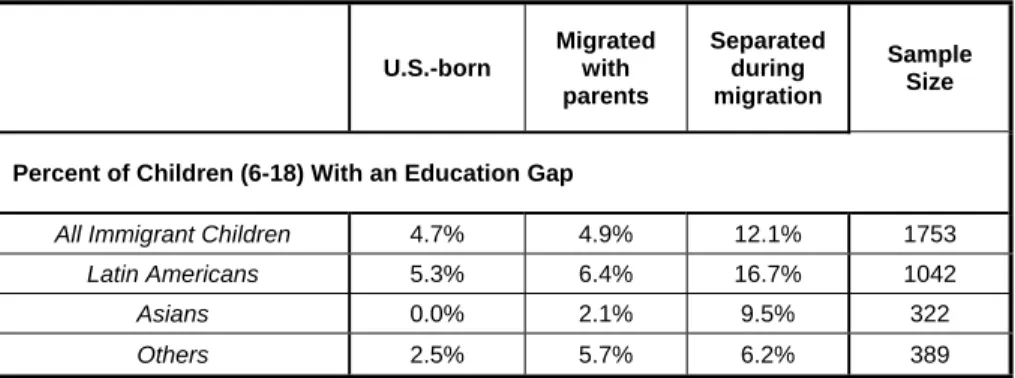
Table 4: Education Gap by Immigrant Status and Region of Origin
U.S.-born Migrated with parents Separated during migration Sample Size
Percent of Children (6-18) With an Education Gap
All Immigrant Children 4.7% 4.9% 12.1% 1753
Latin Americans 5.3% 6.4% 16.7% 1042
Asians 0.0% 2.1% 9.5% 322
Others 2.5% 5.7% 6.2% 389
Note: A child is considered to have an education gap if they are significantly older compared with other children in their grade. Specifically, we classify a child as having an education gap if they are at least 8 years old and attending the first grade, at least 9 years old and attending second grade, etc.
Table 4 presents the percent of children in our sample who have an education gap. Children separated from parents during migration are much more likely to have an education gap than are children of immigrants born in the United States or those who migrated with their parents. On average, 12.4% of children separated from parents during migration have an
education gap, compare with 4.7% for those born in the U.S. and 4.9% for those born abroad but who migrated with their parents. There are no significant differences between the U.S. born and those who immigrated with their parents. Clearly, there is something about being separated from parents during migration (beyond simply the process of migration) that is affecting the education gap. The impact of separation during migration shows up for all immigrant children, no matter school age. The education gap may also be an indication of other educational problems. For example, children who are older than others in their grade are significantly more likely to drop out of high school and less likely to
15
the region of the world from which they come. The impact of separation is larger for Latin American immigrants than for immigrants from other parts of the world.
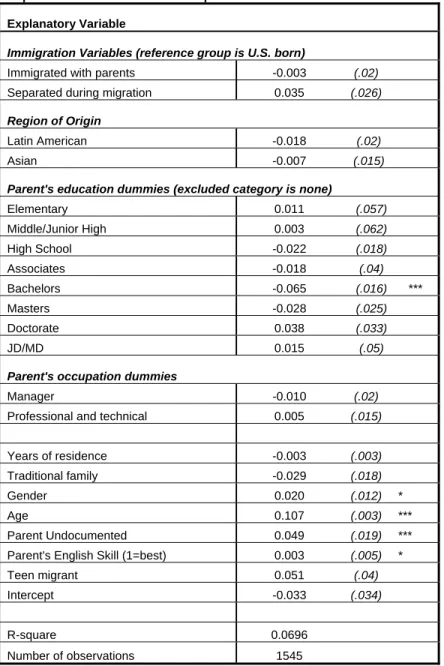
In order to examine whether there are other factors that can explain the differences in the education gap between those separated during migration and those who migrated with their parents, we estimate regressions where the dependent variable is a dummy variable that is one if the child has an education gap (and zero otherwise). The independent variables include a dummy variable identifying children who migrated with their parents, a dummy variable identifying children who were separated from their parents during migration, and other variables that might affect the educational success of immigrant children.10 Other independent/control variables include: region of origin; socioeconomic status; years of residence in the United States; whether the child lives in a two-parent family; the gender and age of the child; whether the immigrant parent was undocumented prior to receiving their green card; the English proficiency of parents; and the age at which the child migrated.11 The coefficients on the independent variables in this regression can be interpreted as the change in the probability that a child has an education gap given a change in the independent variable (holding the other independent variables constant). Table 5 presents the results from an education gap regression using data for all children of immigrants. The coefficient on the dummy variable indicating if the child migrated with parents measures the difference in the probability that a child has an education gap between children who migrated with their parents and U.S.-born children. The coefficient on the dummy variable indicating if the child was separated from parents during migration measures the
difference between children separated from parents and U.S.-born children. For example, the results presented in Table 5 suggest that, after controlling for other influences on the education gap, the probability that a child has an education gap is 3.5 percentage points higher for those who were separated during migration compared to the U.S. born. To calculate the difference in the probability of an education gap between those who were separated from their parents and those who migrated with their parents, subtract the two coefficients. The results presented in
10
The education gap regression is estimated using OLS (a linear probability model), where the standard errors of the coefficients are robust to heteroskedasticity. As a specification test, where possible we also re-estimated these equations using the probit technique. Probit estimation results in similar signs, significance levels and magnitudes for all coefficients when compared to the linear probability model results presented in this paper.
11
We have no data on some important determinants of the educational attainment of immigrants (according to the literature). These are school and neighborhood characteristics and the English language ability of 13 to 18 year old children. Measures of the English language ability of children are only available for a sub-set of 6 to 12 year olds.
16
Table 5 suggest that the difference in the probability that a child has an education gap between those who were separated during migration and those who immigrated with their parents is 3.8 percentage points, and that this difference is statistically significant using a one-tailed test at the 10% significance level.12
The other variables in the education gap regression are often significant and all have the expected signs. Having parents with more education (especially a university education)
significantly reduces the probability that a student has an education gap. A longer time living in the United States reduces the education gap, as does living in a family with two biological parents. Boys are significantly more likely to have an education gap than girls, as are older students and those students whose parents were undocumented before obtaining their green card. Children whose parents have higher proficiency in the English language are significantly less likely to have an education gap, while those who migrated as teenagers are more likely to have an education gap than those who migrated at younger ages. The coefficients on the dummy variables that indicate region of origin are not significantly different from zero.
12
Even after controlling for the additional variables that are available in the data set, interpreting the coefficient on the separation dummy variable as the causal impact of separation during migration on the education gap is
problematic because the measured negative correlation between separation and education could be due to bias caused by a variable missing from the regression. For example, some other factor might be causing both the
separation during migration and the lack of educational success. Such factors might include a divorce, the death of a family member or other family trauma that may have caused both the separation during migration and the
contributed to a lack of academic success. Unfortunately, we have no data on these variables. Nor do we have available in the data set an appropriate instrumental variable for separation. However, our interpretation of the regression results as a causal relationship between separation and educational success is strengthened by the results of our qualitative analysis, which clearly indicate the existence of such a causal relationship.
17 Table 5: Education Gap Regression
Dependent Variable: Education Gap=1
Explanatory Variable
Immigration Variables (reference group is U.S. born)
Immigrated with parents -0.003 (.02) Separated during migration 0.035 (.026)
Region of Origin
Latin American -0.018 (.02)
Asian -0.007 (.015)
Parent's education dummies (excluded category is none)
Elementary 0.011 (.057) Middle/Junior High 0.003 (.062) High School -0.022 (.018) Associates -0.018 (.04) Bachelors -0.065 (.016) *** Masters -0.028 (.025) Doctorate 0.038 (.033) JD/MD 0.015 (.05)
Parent's occupation dummies
Manager -0.010 (.02)
Professional and technical 0.005 (.015)
Years of residence -0.003 (.003) Traditional family -0.029 (.018) Gender 0.020 (.012) * Age 0.107 (.003) *** Parent Undocumented 0.049 (.019) *** Parent's English Skill (1=best) 0.003 (.005) *
Teen migrant 0.051 (.04)
Intercept -0.033 (.034)
R-square 0.0696
Number of observations 1545
Notes: Estimated with Ordinary Least Squares (Linear Probability Model), standard errors are robust to heteroskedasticity.
Traditional Family = 1 if child lives with both biological parents, 0 otherwise Gender = 1 if child is male, 0 if female
Teen migrant = 1 if child migrated at age 12 or later, 0 if migrated at a younger age. Parent Undocumented = 1 if parent was undocumented before receiving a green card. Parent's English Skill = 1 if very good, 2 if good, 3 if fair, 4 if poor.
* = Significant at 10% ** = Significant at 5% *** = Significant at 1%
18
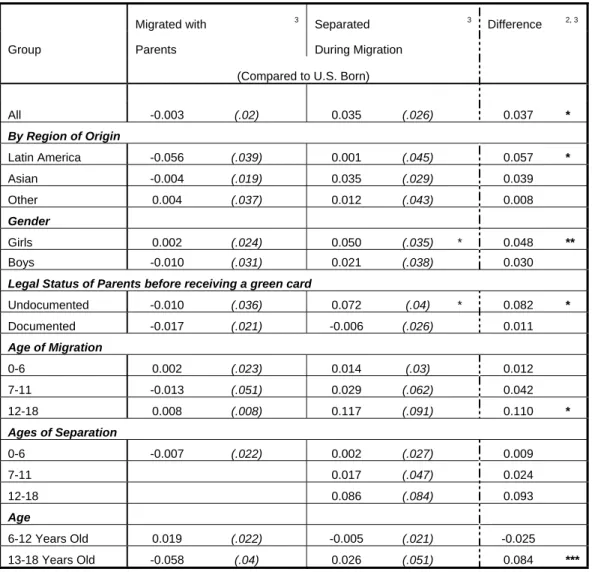
We hypothesized that the impact of separation on educational success would differ depending on the characteristics of the immigrant student and his/her family. Specifically, we hypothesized that the negative impact of separation would be larger for those whose parents were undocumented before receiving their green cards, for those who migrated at older ages
(especially as teenagers) and for those whose separation was from their mother rather than their father. Table 6 presents the results of estimates of the impact of separation for different types of children of immigrants. The first column of Table 6 presents the coefficients that measure the difference between children who migrated with their parents and U.S.-born children in the probability that a child has an education gap. The second column presents the coefficients that measure the difference between children separated from parents and U.S.-born children. The third column in this table presents our measures of the difference in the probability of an
education gap between those who were separated from their parents and those who migrated with their parents. The significance level reported is for a one-tailed test of the hypothesis that the education gap is larger for those who were separated during migration than for those who migrated with their parents.
Our results are consistent with our expectations. First, for every subset of the data, the probability of an education gap is larger for those separated during migration than for those who migrated with their parents or those born in the United States, while there is no significant difference between the education gaps for those who migrated with their parents and those born in the U.S. The impact of separation during migration (compared with migrating with parents) on education success is larger for children from Latin America compared to those from Asia and other areas of the world. The impact of separation is larger for children whose parents were undocumented prior to receiving their green card. The impact of separation on the education gap is larger for girls than for boys. 13
13
Adding country of origin dummy variables for immigrants as an explanatory variable to control for quality of education in the origin country did not affect the signs or significance levels of the differences between those separated during migration and those who migrated with their parents (although it did lower the magnitude of the migration variables because the country of origin dummy variables captured much of the impact of migration).
19
Table 6: Impact of Separation During Migration on the Education Gap, For Different Groups
Migrated with 3 Separated 3 Difference 2, 3
Group Parents During Migration
(Compared to U.S. Born)
All -0.003 (.02) 0.035 (.026) 0.037 * By Region of Origin Latin America -0.056 (.039) 0.001 (.045) 0.057 * Asian -0.004 (.019) 0.035 (.029) 0.039 Other 0.004 (.037) 0.012 (.043) 0.008 Gender Girls 0.002 (.024) 0.050 (.035) * 0.048 ** Boys -0.010 (.031) 0.021 (.038) 0.030
Legal Status of Parents before receiving a green card
Undocumented -0.010 (.036) 0.072 (.04) * 0.082 * Documented -0.017 (.021) -0.006 (.026) 0.011 Age of Migration 0-6 0.002 (.023) 0.014 (.03) 0.012 7-11 -0.013 (.051) 0.029 (.062) 0.042 12-18 0.008 (.008) 0.117 (.091) 0.110 * Ages of Separation 0-6 -0.007 (.022) 0.002 (.027) 0.009 7-11 0.017 (.047) 0.024 12-18 0.086 (.084) 0.093 Age 6-12 Years Old 0.019 (.022) -0.005 (.021) -0.025 13-18 Years Old -0.058 (.04) 0.026 (.051) 0.084 *** Notes:
1. * = Significant at 10%, ** = Significant at 5%, *** = Significant at 1% 2. Significance levels for the difference are for the hypothesis that the coefficient on separated during migration is greater than the coefficient on migrated with parents. 3. Standard errors are robust to heteroskedasticity.
A particularly interesting finding relates to the ages at which children are separated from, and reunited with, their parents. The impact of separation is larger for children who migrated at older ages and for children who were separated from their parents during their teenage years. Among children who migrated as teenagers, those separated from their parents have a probability of an education gap that is 11 percentage points higher than for teenagers who migrated with their parents (compared with a difference of only 1% for those who migrated before they were 6 years old). For those separated from their parents as teenagers, the probability of an education
20
gap that is 9 percentage points higher than for those who migrated with their parents (compared with a difference of only 1% for those who were separated with parents only when they were very young — 0-6 years old). One might suspect that these age results reflect the probability that children separated from their parents at older ages are likely to have been separated from their parents for a longer period of time. That is, the results may not reflect the impact of age but rather the impact of a longer time separated from parents. To test this possibility we re-estimated the education gap regression, adding a variable that indicated the number of years a child was separated from at least one parent. The results of this estimate are presented in table A1 in the Appendix. The coefficient on the variable indicating the number of years of separation is not significant (and negative) at any reasonable level of significance (the separation dummy variable remained positive and was statistically significant). That is, the regressions results suggest that the impact of separation does not get larger the longer the child is separated from the parents. Rather, our regression results suggest that the age at which children are separated from their parents, not the length of time, has the biggest influence on the impact of separation. 14
Consistent with the results that suggest that the impact of migration is largest for teenagers, we find a larger impact of separation on the education gap for 13-18 year olds
(compared with 6-12 year olds). In fact, the impact of separation for those less than 13 years old is not statistically significant and not of the expected sign. This suggests that separation has an impact on the education gap, but this impact shows up only for older migrants.15
Table 7 presents the results of regressions that examine whether the impact of separation differs depending on whether the separation is from the mother, father or both.16 The first two rows show that the impact of separation from both parents is greater than the impact of
14
These age-related results are consistent with those reported by Gonzalez (2002) for immigrants to the United States. Gonzalez (2002) reports that age of arrival has a significant negative impact on years of schooling completed, but only for children who arrive as teenagers and only for Latin American, Mexican and European immigrant children. On the other hand, immigrants who arrive as preteens complete more years of education compared with immigrants who arrived as infants. Gonzalez (2002) conducts a cost-benefit analysis, and concludes that a policy of allowing Latin American children to enter the United States before first grade is cost effective because the higher wages brought about by more schooling in the United States results in increased tax revenues that more than offsets the cost of education for these children in elementary, middle and high school.
15
For younger students we have a variable that measures the English language skill of the child. It is possible that the negative impact of separation may only show up for those immigrant children with less English language skill. To test this hypothesis, we interacted the separation dummy variable with the variable that measures English language skill. The results of these regressions do not change our conclusions; even for younger children with almost no English skill we still do not find a significant impact of separation on the education gap and dropout rates. 16
Data for the regressions which measure different impacts for separation from mother and father are limited to those children currently living with both biological parents.
21
separation from only one parent (the difference is significant at 10%). If children are separated from only one parent, that parent is generally the father. Therefore, this result suggests that the negative impact of separation on the education gap is larger when the child is separated from his/her mother compared with father. The last two columns of Table 7 show that this is true.
Table 7: Impact of Separation During Migration on the Education Gap for Separation from One or Both Parents, from Mother or Father
Migrated with Parents
Separated from One Parent during Migration
Separated from Both Parents during Migration
(Compared to U.S. Born) From Education Gap Regressions
All Immigrants -0.003 (.02) 0.021 (.026) 0.093 (.059) * Latin Americans -0.057 (.039) -0.019 (.045) 0.065 (.088) Migrated with Parents Separated from Father during Migration Separated from Mother during Migration (Compared to U.S. Born)
From Education Gap Regressions
All Immigrants 0.022 (.021) 0.043 (.024) * 0.053 (.04) Latin Americans 0.000 (.041) 0.015 (.039) 0.100 (.074) Notes: * = Significant at 10% ** = Significant at 5% *** = Significant at 1%
b) High school dropouts
The most common measure of educational success in the immigration literature is the high school dropout rate. For the biological children of adjustee immigrants who live in the United States (they need not live with their parents) who are between 18 and 22 years old and who migrated before they were 18 years old, we identify those who are high school dropouts. High school dropouts are identified as those who are not currently attending school and who report less than a completed high school education.
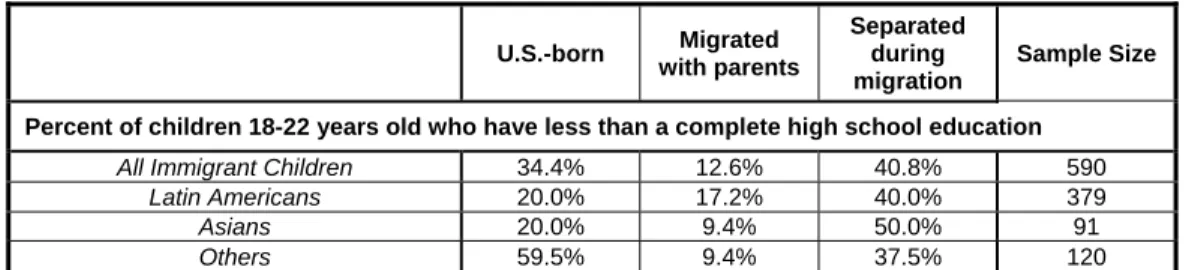
Table 8 presents the percent of 18-22 year old biological children of adult immigrants in our sample who are not in school and have less than a complete high school education. The sample size for our analysis of dropout rates is small because recent migrants tend to be young and therefore few have children over 18 years old. Nevertheless, the measured impact of separation on dropout rates is similar to that reported for the education gap. For immigrants from whatever region of the world, dropout rates are higher for those separated during migration than for those who migrated with their parents. For example, dropout rates of Latin American children separated during migration are 40%, compared with 17% for those who migrated with parents (and 20% for those born in the United States to immigrant parents). The dropout rates
22
that we calculate from our sample for Latin American immigrants separated from parents during migration are similar to dropout rates reported for Latin American immigrants from other
sources (for example, Pew Hispanic Trust, 2002). In fact, our results suggest that the higher dropout rates of Latin American immigrant children is entirely due to the impact of family separation during migration. Dropout rates for children who migrated with their parents are lower than dropout rates for those children born in the United States. The pattern is similar for immigrant children from Asia; dropout rates are highest for those separated during migration and lowest for those who migrated with their parents.
Table 8: High School Drop-Out Rates, by Immigrant Status and Region of Origin
U.S.-born Migrated with parents Separated during migration Sample Size
Percent of children 18-22 years old who have less than a complete high school education
All Immigrant Children 34.4% 12.6% 40.8% 590
Latin Americans 20.0% 17.2% 40.0% 379
Asians 20.0% 9.4% 50.0% 91
Others 59.5% 9.4% 37.5% 120
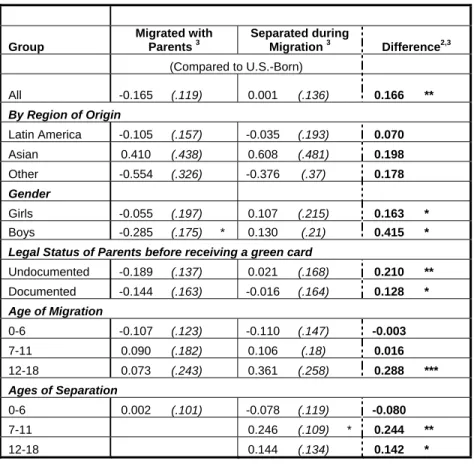
We estimate a regression where the dependent variable is one if the child is a high school dropout, and zero otherwise. The independent variables in the dropout regression are the same as those in the education gap regressions. The full results of this regression are presented in appendix table A2. The coefficients on the migration dummy variables are presented in table 9. The coefficient estimates on the migration dummy variables suggest that immigrant children who were separated from their parents during migration are more likely to drop out than those
children who immigrated with their parents (while immigrant children who migrated with their parents are less likely to drop out than those born in the U.S.) Predicted dropout rates for children who migrated with their parents are almost always lower than predicted dropout rates for U.S.-born children. The signs and significance levels for the other variables in the regression are similar to those reported in the education gap regressions.
23
Table 9: Impact of Separation During Migration on High School Drop-Outs For Different Groups
Group Migrated with Parents 3 Separated during Migration 3 Difference2,3 (Compared to U.S.-Born) All -0.165 (.119) 0.001 (.136) 0.166 ** By Region of Origin Latin America -0.105 (.157) -0.035 (.193) 0.070 Asian 0.410 (.438) 0.608 (.481) 0.198 Other -0.554 (.326) -0.376 (.37) 0.178 Gender Girls -0.055 (.197) 0.107 (.215) 0.163 * Boys -0.285 (.175) * 0.130 (.21) 0.415 *
Legal Status of Parents before receiving a green card
Undocumented -0.189 (.137) 0.021 (.168) 0.210 ** Documented -0.144 (.163) -0.016 (.164) 0.128 * Age of Migration 0-6 -0.107 (.123) -0.110 (.147) -0.003 7-11 0.090 (.182) 0.106 (.18) 0.016 12-18 0.073 (.243) 0.361 (.258) 0.288 *** Ages of Separation 0-6 0.002 (.101) -0.078 (.119) -0.080 7-11 0.246 (.109) * 0.244 ** 12-18 0.144 (.134) 0.142 * Notes:
1. * = Significant at 10%, ** = Significant at 5%, *** = Significant at 1% 3. Standard errors are robust to heteroskedasticity.
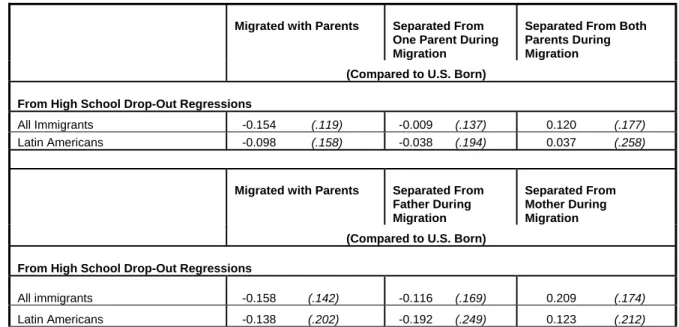
When we look at the impact of separation for different groups, the results are generally similar to the results of the education gap regressions (see Tables 9 and 10). Specifically, the impact of separation is larger for children whose parents were undocumented before they received their green cards and is largest for children who migrated at older ages and who were separated from their parents as teenagers. There is something about separation during migration (beyond just the impact of migrating) that causes teenage child immigrants to have higher dropout rates. As in the education gap regressions, when we add a variable that indicated the number of years a child was separated from at least one parent, the coefficient on the variable indicating the number of years of separation was negative and not significant at any reasonable level of significance. As in the education gap regressions, the impact of separation from both parents is greater than the impact of separation from only one parent, and larger when the child is
24
separated from his/her mother compared with father.17 The only difference from the results of the education gap regression is that the impact of separation on dropout rates is larger for boys than for girls. After controlling for other factors, predicted dropout rates for boys separated from their parents during migration are 41.5 percentage points higher than for boys who migrated with their parents, compared to only 16.3% for girls.18
Table 10: Impact of Separation During Migration on Drop-outs
For Separation from One or Both Parents, from Mother or Father
Migrated with Parents Separated From One Parent During Migration
Separated From Both Parents During Migration
(Compared to U.S. Born)
From High School Drop-Out Regressions
All Immigrants -0.154 (.119) -0.009 (.137) 0.120 (.177) Latin Americans -0.098 (.158) -0.038 (.194) 0.037 (.258)
Migrated with Parents Separated From Father During Migration
Separated From Mother During
Migration
(Compared to U.S. Born)
From High School Drop-Out Regressions
All immigrants -0.158 (.142) -0.116 (.169) 0.209 (.174) Latin Americans -0.138 (.202) -0.192 (.249) 0.123 (.212) Notes: * = Significant at 10% ** = Significant at 5% *** = Significant at 1%
The negative impact of separation on the education gap and probability of dropping out are likely related phenomenon. Deming and Dynarski (2008) show that children who are older
17
We examined the same alternative specifications for the dropout regressions as for the education gap regressions. Probit estimation results in similar signs, significance levels and magnitudes for all coefficients. Adding family size did not change the signs of the migration coefficients nor the signs of the difference between those separated during migration and those who migrated with their parents, although it did reduce the number of these differences that were statistically significance. Adding country of origin dummy variables had a bigger impact on the dropout regressions than it did in the education gap regressions. Adding country of origin dummy variables for immigrants as an explanatory variable made the impact of separation during migration statistically insignificant (although the signs of the differences did not change).
18
For a subsample of up to two 6-12 year old children per household, the NIS includes data on Woodcock-Johnson achievement test scores. It is unfortunate that these scores are only for 6-12 year olds, since in the quantitative analysis we present in this paper we did not find an impact of separation during migration for this age group. Consistent with the results presented in this paper, we did not find an impact of separation on test scores for this age group. The results of our analysis of achievement test scores for 6-12 year olds are available in another working paper available at www.umbc.edu/mipar.
25
than others in their grade are significantly more likely to drop out of high school and less likely to complete college. The negative impact of separation during migration is larger if parents were undocumented before receiving their green cards, larger for children separated from mothers and/or both parents compared to separation from fathers, and largest for immigrants from Latin America.
iii) Summary and discussion of the results of quantitative analysis
Taken together, the results of the quantitative analysis provide evidence that children who are separated during migration have less educational success than children who migrated with their parents. That is, there is something about being separated during migration that has a negative effect on educational success that goes beyond a generalized impact of immigrating. Indeed, we find no evidence that those who migrate with their parents do worse in school than children of immigrants born in the United States (there is evidence that on some measures of educational success, those who immigrated with their parents actually do better than children of immigrants born in the United States).
The impact of separation is larger for children who migrated at older ages and for
children who were separated from their parents during their teenage years. We find no evidence that these age results reflect the probability that children separated from their parents at older ages are likely to have been separated from their parents for a longer period of time. That is, our regression results suggest that the age at which children are separated from their parents, not the length of time, has the biggest influence on the impact of separation. There is something about being a teenager that makes the negative impact of separation during migration and family reunification worse. The negative impact of separation on educational success only shows itself for teenagers. We find no empirical evidence of a negative impact on children who are less than 13 years old.
There are several reasons why we might expect separation to have a bigger impact on those who were separated from parents as teenagers. One set of explanations has to do with the children and the special challenges faced by teenagers. In our focus groups, for example, parents suggested that younger children are more responsive to parental expectations regarding success in school compared with teenagers. School counselors made similar comments. The teenage years are already a period when the child-parent relationship experiences significant strain. It is
26
likely that adding family separation and reunification to the mix adds an additional level of stress to this process. The evidence is also clear that language acquisition is easier for younger
children, and some researchers have argued that the best time to learn a language is before puberty. According to this view, at puberty there is a significant and dramatic decline in the ability of children to learn languages (Scovel, 2000). Since adaptation is already harder for those separated from their parents, this suggests that teenagers with poor English skills may have an even harder time adapting to U.S. schools than younger children with poor English skills.
Another set of explanations for why the impact of separation is likely to be greater for teenagers focuses on the different nature of elementary, middle, and high school in the United States. Elementary schools are generally more supportive of students personally than are middle and high schools; teachers are with the same children all day and get to know them and their individual problems. Elementary school teachers also may, in general, be better able to help children separated during the migration experience adapt to U.S. schools because elementary school teachers have training in teaching English reading and writing, while it is generally assumed by middle and high school teachers that students already know how to read and write English. School counselors suggested to us that these differences could explain why those who were separated and reunited with their families as teenagers have a more difficult problem adapting to U.S. schools.
Another possible reason could be that the education of these children was interrupted in their home country or during the migration process. Many Central American immigrants are from rural areas, where interrupted education for children is common, especially for older children who can work productively on farms. This could also explain why children who migrated when they were older are more likely to have an education gap or drop out. Because older children are more likely to be taken out of school to work on the farm than younger children, it is reasonable to suppose that only older immigrants will be more likely to have an education gap.
It may also be that immigrant children are older than others in their grade in the United States because the process of migration may take time away from school or that, when they enter school in the United States, immigrant children are assigned to a lower grade than the grade that they completed in their home country. Finally, a growing literature suggests that older children who migrate never really “drop in” to school, and are more interested in entering the labor