National Louis University
Digital Commons@NLU
Dissertations12-2019
An Evaluation Of A Sixth Grade Intensive
Mathematics Program And Impacts On Student
Achievement
Tammy Dery
Follow this and additional works at:https://digitalcommons.nl.edu/diss
Part of theCurriculum and Instruction Commons, and theEducational Methods Commons
This Dissertation - Public Access is brought to you for free and open access by Digital Commons@NLU. It has been accepted for inclusion in Dissertations by an authorized administrator of Digital Commons@NLU. For more information, please [email protected]. Recommended Citation
Dery, Tammy, "An Evaluation Of A Sixth Grade Intensive Mathematics Program And Impacts On Student Achievement" (2019). Dissertations. 396.
AN EVALUATION OF A SIXTH GRADE INTENSIVE MATHEMATICS PROGRAM AND IMPACTS ON STUDENT ACHIEVEMENT
Tammy Lynn Dery
Educational Leadership Doctoral Program
Submitted in partial fulfillment of the requirements of
Doctor of Education
in the Foster G. McGaw Graduate School
National College of Education National Louis University December 2019
Copyright by Tammy Dery, 2019 All rights reserved
NLU Digital Commons Document Origination Statement
This document was created for the dissertation requirement of the National Louis University (NLU) Educational Leadership (EDL) Doctoral Program. The National Louis Educational Leadership EdD is a professional practice degree program (Shulman et al., 2006).
For the dissertation requirement, doctoral candidates are required to plan, research, and
implement a major project within their school or district that relates to professional practice. The three foci of the project are:
• Program Evaluation
• Change Leadership
• Policy Advocacy
For the Program Evaluation focus, candidates are required to identify and evaluate a program or practice within their school or district. The “program” can be a current initiative; a grant project; a common practice; or a movement. Focused on utilization, the evaluation can be formative, summative, or developmental (Patton, 2008). The candidate must demonstrate how the evaluation directly relates to student learning.
In the Change Leadership focus, candidates develop a plan that considers organizational possibilities for renewal. The plan for organizational change may be at the building or district level. It must be related to an area in need of improvement and have a clear target in mind. The candidate must be able to identify noticeable and feasible differences that should exist as a result of the change plan (Wagner et al., 2006).
In the Policy Advocacy focus, candidates develop and advocate for a policy at the local, state or national level using reflective practice and research as a means for supporting and promoting reforms in education. Policy advocacy dissertations use critical theory to address moral and ethical issues of policy formation and administrative decision making (i.e., what ought to be). The purpose is to develop reflective, humane and social critics, moral leaders, and competent
professionals, guided by a critical practical rational model (Browder, 1995). Works Cited
Browder, L. H. (1995). An alternative to the doctoral dissertation: The policy advocacy concept and the policy document. Journal of School Leadership, 5, 40-69.
Patton, M. Q. (2008). Utilization-focused evaluation (4th ed.). Thousand Oaks, CA: Sage. Shulman, L. S., Golde, C. M., Bueschel, A. C., & Garabedian, K. J. (2006). Reclaiming
education’s doctorates: A critique and a proposal. Educational Researcher, 35(3), 25-32. Wagner, T., et al. (2006). Change leadership: A practical guide to transforming our schools. San
Francisco: Jossey-Bass. 4.21.16
i
ABSTRACT
The purpose of this evaluation is to analyze an Intensive Math program’s quality and design, as well as, address the impact of the program to determine whether the intensive mathematics class, and the use of computer-based support, impacts student achievement. The program design incorporates a two-prong model of teacher-directed and computer-based intervention. The relationship of the intensive mathematics curriculum implemented with struggling learners and closing the mathematics achievement gap are evaluated through the analyses of student data, the quality of implementation and program usability and teacher and teacher leader perspectives. The findings indicate that small groups and individualized attention for students is vital to student success and the misalignment of content with the core mathematics course should be addressed.
ii
PREFACE
My 28-year career in education began in a middle school mathematics classroom where my love of teaching mathematics developed. I taught middle and high school level mathematics over a period of 10 years in both low and high socio-economic schools. Following my years in the classroom, I expanded my impact through serving as a district wide resource teacher in mathematics and leading as a supervisor in mathematics for a large school district. The context of my program evaluation developed from my
intentional focus on ensuring all students have an equal opportunity to learn mathematics especially for students who need intensive support by the time they reach middle school. In my roles in district level positions, I have seen the impacts of curriculum,
implementation and assessment on struggling learners. Seeing their challenges inspired me to begin a journey to ensure that there is equal access and opportunity to learn mathematics, so they can begin a road to success.
My topic is relevant to all stakeholders including parents, teachers, schools, and university personnel in that having mathematics content and thinking skills impacts student’s personal and professional trajectory. The focus on low level performing math students in this research is to look at avenues to support their needs and look for paths to break the cycle of students who continue in low level courses year after year. The need to support their learning is vital to changing the education landscape for the students. By having students who develop confidence in mathematics, they then have a greater
opportunity to approach mathematics with open eyes as they progress through school and transition to college and the work force.
iii
The main leadership lessons learned through this process focused primarily on the impacts of research has for analysis. By understanding the importance of using multiple layers of research methods for analysis, I gained a richer understanding of the factors that can influence issues around mathematics education. Additionally, by gaining input from teachers and teacher leaders through the program evaluation, I learned the value of practitioner input and in the process of a research evaluation.
Through this experience, I gained insight into my own leadership. From beginning to end, the process taught me the value of a broader perspective of an evaluation. The multiple layers of impact on a study was a key learning lesson by
knowing that a suggested policy change can have impacts not only for education but also political, social, economic, moral and legal impacts so arise and this was a step that helped me understand the greater impact. My passion lies in high quality mathematics programs and ensuring that all students have access to equitable opportunities in
mathematics education. This evaluation project allowed me to learn more about ways to impact the change to ensure high level programs are developed but also anticipate possible barriers to change.
As a leader in mathematics education, I feel this process prepared me to take the steps to have even a bigger impact on change in mathematics curriculum. The experience gave me insight into data analysis as a springboard for change, communication skills and a more holistic view of educational change. Knowing that change, even when in best interest of students comes with challenges, I have learned that at a system level, change must be grounded in research and stakeholder input. By leading with thoughtful,
data-iv
driven decision making, I believe that changes in mathematics education can take place to create a pathway for all students to succeed.
v
ACKNOWLEDGEMENTS
I would like to acknowledge the people that I have had the joy of crossing paths with in this life’s journey. They have inspired this doctorate dream and supported me as this work become a reality.
Dr. Carol Burg for her direction, encouragement and support every step of the way. I could not have done it without such intentional and methodical side-by-side feedback throughout the writing process. She taught me to “trust the process” and for that I am forever grateful.
Dr. Susan Moxley and Dr. Dale Moxley for the words of wisdom shared as true education practitioners. For giving feedback to push my thinking as well as words of encouragement throughout the program, I am grateful you were a part of my journey. I have learned so much through the shared experiences and the focused input on my dissertation. This support helped me grow as a writer, thinker and researcher.
Janet Bauman, for seeing my love of teaching mathematics and leading
mathematics education and supporting me through every step of the way. Janet you were my early inspiration to begin the race and run after this amazing career in mathematics education.
To my doctoral classmates, LeShea Serrano, my partner in this from the beginning, my go to for support. Every step of the way, we learned, questioned, and cheered each other on! I am so grateful for this time in our lives. Jeremy Johns-Klein, you make me smile! Being in class with you made me be a better thinker and learner! Your passion for leading in education is powerful. Thank you for being a light in this work!
vi
DEDICATION
I dedicate this work to those who had to share in the sacrifices that were made to make this research and doctorate a reality for me.
First, my husband Brian who learned very early on in the process that he would have to fill time during my doctorate journey. He used the time well and began work on his own dream. Together we sacrificed, encouraged each other and loved each other through it.
To my son Jacob, may this work be an inspiration to you. Your work ethic and determination are and always will be inspiring. You will forever be an example to everyone who has ever said or ever will say, you can’t as you are proof that you can!
To my son Caleb, your spirit is contagious. Some of our best moments in life have been when it is just me and you. We have laugh so hard together! When you saw my books everywhere and watched me write for hours, you said, “nope, not doing that.” Know that someday you just might! Dream big and lead with your spirit.
To my mom, for being there for me every time I need it. Your support has helped me through many challenges and journeys!
My final dedication is to my dad who left this world way too young. I am where I am today because of the foundation he built in my life. He taught me the value and rewards of hard work. This dissertation became a reality because of those deep-rooted values instilled in me so long ago. Dad, thank you and I did it!
vii TABLE OF CONTENTS ABSTRACT ... i PREFACE ... ii ACKNOWLEDGEMENTS……...v DEDICATION………...vi
SECTION ONE: INTRODUCTION...1
Purpose of the Evaluation ...3
Rationale ...5
Goals of the Program Evaluation ...8
Exploratory Questions ...9
Conclusion ...9
SECTION TWO: REVIEW OF LITERATURE ...11
Introduction ...11
Mathematical Mindsets ...11
Framing Student Learning ...13
Conceptual Understanding and Procedural Interventions...14
Fluency Interventions...15
Technology interventions...16
Conclusion ...18
SECTION THREE: METHODOLOGY ...19
Research Design Overview ...19
Participants ...20
viii
Document Review ...22
Surveys ...22
Individual Interviews ...23
Ethical Considerations ...23
Data Analysis Techniques...24
Document Review Analysis ...25
Conclusion ...26
SECTION FOUR: RESULTS ...28
Findings...28
Overview ...28
Intensive Mathematics Teacher Surveys ...28
District Reports ...59 Organizational Changes ...63 Context ...65 Culture...65 Conditions ...66 Competencies ...67 Interpretation ...70 Judgments ...73 Recommendations ...77
SECTION FIVE: TO-BE FRAMEWORK ...81
ix
Review of Literature Related to Change ...81
Mathematics Content for All ...82
Early Learning of Mathematics Impacts on Student Achievement ...83
Supporting the Art of Teaching Mathematics ...84
Changes in System Structures ...86
Envisioning the Success TO-BE ...88
Contexts ...89
Culture...90
Conditions ...92
Competencies ...92
Conclusion ...94
SECTION SIX: STRATEGIES AND ACTIONS ...95
Introduction ...95
Strategies and Actions...95
Focus Area: Student Supports ...95
Focus Area: Time & Teacher Allocations ...97
Focus Area: Curriculum Alignment...98
Focus Area: Leadership Support ...99
Conclusion ...101
SECTION SEVEN: IMPLICATIONS AND POLICY RECOMMENDATIONS ..102
Introduction ...102
Policy Statement ...103
x
Economic Analysis ...104
Social Analysis...105
Political Analysis ...106
Legal Analysis ...107
Moral and Ethical Analysis ...108
Implications for Staff and Community Relationships ...109
Conclusion ...110
SECTION EIGHT: CONCLUSION ...112
Introduction ...112 Discussion ...112 Leadership Lessons ...115 Conclusion ...116 REFERENCES ...119 APPENDICES ...123
Appendix A: Grade 6 Teacher Intensive Math Survey ...123
Appendix B: Grade 6 Intensive Math Interview Questions for Mathematics Leader at the School Level ...126
Appendix C: Email Letter for Participation in the Teacher Survey ...128
Appendix D: Informed Consent: Adult Participant Survey ...129
Appendix E: Informed Consent: Adult Participant Interviews ...130
Appendix F: Baseline AS IS 4 C’s Analysis ...131
Appendix G: Vision TO BE 4 C’s Analysis ...132
xi
TABLE
xii
FIGURES
Figure 1: Survey Question 1 & 2: grade 6 intensive math teachers’ responses to years of
teaching mathematics and teaching grade 6 intensive...30
Figure 2: Survey Questions 4 & 5: grade 6 intensive math teachers’responses to attending training for implementation and coach assigned for support implementation…………...32
Figure 3: Survey Question 7: grade 6 intensive math teachers’ responses to number of days they used the suggested implementation two-prong model for teaching…….……..33
Figure 4: Survey Question 9 grade 6 intensive math teachers’ responses……….….35
Figure 5: Survey Question 10: grade 6 intensive math teachers’ responses………..36
Figure 6: Survey Question 11: grade 6 intensive math teachers’ responses………….….37
Figure 7: Survey Question 12: grade 6 intensive math teachers’ responses………….….38
Figure 8: Survey Question 13: grade 6 intensive math teachers’ responses………..39
Figure 9: Survey Question 14: grade 6 intensive math teachers’ responses.….…………40
Figure 10: Survey Question 15: grade 6 intensive math teachers’ responses………41
Figure 11: Survey Question 16: grade 6 intensive math teachers’ responses………42
Figure 12: Survey Question17: grade 6 intensive math teachers’ responses.………43
Figure 13:Pre and Post Math Inventory Results………61
Figure 14:Placement of students in computer software and results based on level placement………...62
1
SECTION ONE: INTRODUCTION
Struggling students in mathematics in Gilbert School District (pseudonym) a large diverse urban district in Florida are often enrolled in two mathematics courses. In middle school, students are enrolled in a traditional mathematics course for each grade level, grade 6, grade 7 and pre-algebra for grade 8. Each course contains the standards for the grade level as defined by the Mathematics Florida Standards (MAFS). Near the end of each school year, the students take the Florida Standards Assessment (FSA) which evaluates their level of proficiency on the grade level specific MAFS. Students scoring at a level 3 are considered to be satisfactory, proficient at a level 4 or mastery when scoring a level 5. When a student scores a level 1 on the FSA for mathematics, the student’s performance is identified as inadequate. A student scoring at a level 1 is described, based on the Florida Standards Assessment achievement level chart, as a student “highly likely to need substantial support for the next grade/course” (FLDOE, 2016, p. 3). In the school district, when a student scores a level 1, they are scheduled to take an additional
mathematics class, Intensive Mathematics, alongside their traditional mathematics grade level class. This Intensive Mathematics course is designed to address the need for the substantial support for the next grade level. Approximately 3,500 students across the school district are impacted by this dual course process for intensive mathematics.
The Intensive Math course is one method of supporting the students in need. The support is in an effort to help close the gap of student’s continually scoring low in
mathematics throughout middle school. The data statewide shows that 26% of students in 2015 scored a level 1 in mathematics on the FSA which indicates these students will need additional support (FLDOE, 2106). Additionally, the results from the 2016 FSA
2
administration show the student data remained stagnant with 26% of grade 6 students still scoring a level 1 on the FSA (FLDOE, 2016). In Gilbert School District, the results mirror the state results in that the results remain the same year to year. Gilbert County had 28% of the students score a level 1 on the Spring 2016 and 2017 FSA. Additionally, in Gilbert County School District from school year 2015 to 2016, out of the 3,143
students who were a level 1 on the FSA, 24.4% of them gained enough points to move to a level 2. Thus, the results from the FSA is one factor to prompt a need for the Intensive Mathematics class specifically designed to support student gaps in their mathematics learning from prior grades.
Intensive Mathematics is a second mathematics class that the students take in addition to their traditional mathematics class and occurs during the school day, thus impacting the other courses students can take. The issue surrounding this is that the students who take the additional Intensive Mathematics class are removed from either physical education or an elective class. The concern this brings about is that the students are then prevented from having an opportunity to get the much-needed exercise for an adolescent, or an opportunity to explore electives such as art, band, orchestra or technology.
In addition to students losing much needed elective time for adolescent
development, there is concern over the structure of the schedule, the curriculum, and the impact on student achievement over time in mathematics. The students in grade 6 take the Intensive Mathematics class for the entire school year while students in grade 7 and grade 8 take a semester course of Intensive Mathematics. The curriculum for the courses is designed to support the grade level standards currently taught in their traditional
3
mathematics class, but also to help fill any mathematics gaps in their learning from prior standards in previous grade levels. The impact on student achievement over time when a student takes Intensive Math is a focus of my evaluation of the Intensive Math program.
Purpose of the Evaluation
The program I will be evaluating is the Intensive Mathematics program
specifically used in grade 6 Mathematics in a large urban district. The program is used as a full year curriculum for students enrolled in Intensive Mathematics which is the
secondary mathematics class for students who score a Level 1 on the Florida Standards Assessment. The students engage in a curriculum that is a blended model program of teacher directed and computer-based learning. The teacher directed portion of the program allows the teacher to teach approximately half of the students in a small group while the other group of students work on the computer-based portion of the curriculum. The teacher directed portion is the same for all students and the computer-based portion is differentiated for each student based on diagnostic testing at the beginning of the school year to determine what level the students begin for initial placement in the program. The program is designed as a two-prong model that allows for half of the class time per week to be teacher directed and the other half to be computer- directed
instruction. The students typically spend 20 minutes per day with the teacher and 20 minutes using the computer-directed instruction time.
I first became aware of the Intensive Math program when it was used as a pilot for select schools in the Gilbert School District. Following the pilot year of implementation, was the state of Florida’s adoption for instructional materials for mathematics. The program, Math 180, was on the state textbook adoption list in 2013 during the state of
4
Florida’s adoption for new mathematics textbooks and programs. Gilbert School District chose to adopt the Intensive Math program, Math 180, for the 2014-2015 school year to be used in grade 6 Intensive Mathematics. The use of the program stemmed from the ability to adopt resources for the course while in the past the curriculum was developed by the district. As implementation of the program became more wide scale in the
district’s 48 middle schools, I was able to observe the new blended model of instruction, as well as, observe teachers and students using the program through my role as a
mathematics supervisor.
The Intensive Math program directly relates to student learning as it is designed to help fill gaps and misconceptions in student’s mathematical prior learning. The students who are enrolled in the grade 6 Intensive Math class that use Math 180 are often referred to as struggling mathematics learners. Struggling learners will at times have temporary struggles or have ongoing persistent conceptual understanding challenges that can cause the learning of mathematics to be difficult (Tapper, 2012, p.4). The program is designed to address the temporary struggles through the teacher small group time, and then during the adaptive computer-based portion of the class, the students are remediated to address any conceptual understanding misconceptions from prior learning. For some students, this remediation through the online portion may go back to third grade mathematics content. Other students who have more foundational skills and fewer gaps may be moved to higher level material thus meeting the needs of each learner individually.
The purpose of my evaluation is to analyze the Intensive Math program’s quality and design, as well as, address the impact of the program to determine whether the intensive mathematics class and the use of Math 180 impacts student mathematics
5
achievement. In the Gilbert School District, some schools have been looking for options other than the Intensive Mathematics class to meet student needs for additional support in mathematics. The students in some cases truly have a need for additional support through a structured course such as Intensive Mathematics. There are also some students whose school leaders have voiced they may not need the defined structure of a class but some additional time on certain skills may prove to meet the student’s needs. Additionally, some schools may find that they could offer other scheduling options such as a thirty-minute lunch and learn time that could meet the needs of the students in mathematics without losing physical education or an elective course. My review of the district and school policies to evaluate systemic programs that are targeted at a particular group of students should be reviewed through an analysis of tracking, how students are placed, the opportunities they have for remediation and to look at student outcomes (NCTM, 2014, p.69). Through my review of Intensive Mathematics as a program and looking at student outcomes, the results may impact systemic practices in the school district.
Rationale
I chose to select the Intensive Math program used in grade 6, Math 180, to evaluate in order to analyze what the impact of taking an additional mathematics class has on student achievement. As a supervisor specializing in mathematics instruction, my rationale for selecting this program to evaluate is to ensure students have access to high quality programs that impact student learning and overall achievement. An additional reason is to analyze the results in order to determine if systemic changes should be made to the program itself, the scheduling procedures and to determine the impact of the support systems in place for struggling learners. Students who are identified as a
6
struggling learner in middle school often lose elective time such as music, art or technology due to the added mathematics course in their daily course schedule. This analysis is important to help determine if the program adds value to our student’s development and academic achievement.
Throughout my career as a teacher, I often took the opportunity to tutor students in mathematics outside of the school day. This time of tutoring one-one-one provided insight into the struggling student’s thinking and, at times, understanding their dislike of mathematics. During tutoring sessions, instead of working on current mathematics, typically the students and I worked on past skills that were gaps in learning. On one occasion a student seemed frustrated and not sure why she would continually not score well on tests even when she studied. Once I determined her frustration was impacting her mindset and desire to do math either in school or outside of school, I then knew where to begin. We began to look at the gaps in learning and find success in the content that was confusing for her and through understanding the mathematics conceptually and not just rote procedures, she began to gain confidence. Through this experience, the need to go beyond teaching only the content and build mathematical confidence and mindset became clear to me that it is vital to student success long term. These two, mathematical
confidence and mindset, are the foundation for making change in student learning and in programs that support struggling learners, thus creating my personal interest in the impact of Intensive Mathematics as an additional course for students.
The critical issues related to the Intensive Mathematics program are twofold. The first critical issue is related to the mindsets of students who are tracked into low level courses. The tracking of students has been shown to reduce achievement due to the fixed
7
versus growth mindset that develops due to the grouping of students (Boaler, 2016, p. 113). The Math 180 program has embedded growth mindset development within the program, yet the critical issue to explore is whether these embedded pieces counteract the tracking impact. An additional critical issue related to the program is the long-term impact of Intensive Mathematics. Once completing the program in grade 6, it is important to determine if the students have sufficient gains in mathematics achievement to no longer need an additional mathematics class. These critical issues are focused on determining if the program is helping students reach the untapped potential they may have and close the mathematics gap with the struggling students. A student’s untapped potential is often due to student’s not having the opportunity to develop their
mathematical knowledge to their fullest potential (Seeley, 2009, p.8).
This evaluation is important to school districts in that it impacts student and teacher scheduling, curriculum budgets and the results in students’ mathematics
achievement. Through my experience as a mathematics supervisor, I often evaluate the impact of programs on student achievement, as well as financial impacts of purchased curriculum. When a curricular program is not showing a positive impact on student achievement, it is often eliminated for use with students or evaluated to propose possible changes in implementation. The evaluation of this program is important to the
community at large as it will assist other schools and districts in determining the impact of Intensive Mathematics on student achievement and what impact the program Math 180 has on student performance over time. The parent stakeholder group often voices concern when students are taking a second Intensive Mathematics class. The parents desire to know that there is a positive impact on their child’s overall mathematics performance if
8
they indeed participate in the Intensive Math program. I often receive phone calls from parents when their child is placed in an Intensive Mathematics course to help them understand the purpose of the placement and to discuss possible support options. To that end, this evaluation is valuable to address the parent concerns of their child’s placement and mathematics performance.
Goals of the Program Evaluation
The goals of my program evaluation are to examine the use of the Intensive Math program to determine the impact of the two-prong design on student engagement, what implementation challenges teachers face and what can be improved in the program to determine the impact on student achievement. In addition, by design the Intensive Math program creates tracking of low performing students. Through the focus on evaluating what is working and what the challenges are for the program, there may be a possible impact of the tracking of students. Students who are tracked are limited in their achievement and teachers report that these students in low level classes are capable of work at a higher-level (Boaler, 2016, pp.113-115).
The program evaluation goals are directly related to student performance and learning as the focus of the evaluation is on low performing, struggling mathematics students. When students are enrolled in a class to support their learning, there are two factors that may play a role in their performance: first, the program used with the students and second, the role of the teacher in implementation and support. The program
evaluation focus is on Math 180 as a program and its impact on student learning. A supporting focus is on the impact the teacher has on the implementation of the program which may in turn impact student learning.
9
Exploratory Questions
The primary research question to drive the evaluation of the Intensive
Mathematics program used in grade 6 is: What impact does the Intensive Math program implemented in grade 6 mathematics classrooms have on struggling learners’
mathematics achievement?
From this overarching question, the supporting questions to the main primary question include: (1) What do teachers report is working well in the Intensive
Mathematics program? (2) What do teachers report is not working well in the Intensive Mathematics program? (3) What do school level leaders and teachers report as the greatest challenges with the Intensive Mathematics program? (4) What do the school level leaders and teachers report as ways to improve the Intensive Math program?
The additional secondary research questions related to the evaluation are: (1) , When comparing students who have intensive math to those who do not take it along-side their core math class, do teachers see evidence of increased confidence in mathematics? (2) In the Math 180 program, the students use the computer portion of the program, as well as, the small group teaching component; does the amount of time on the computer based differentiated portion impact student achievement in Math 180?
Conclusion
Through my role as a mathematics supervisor, I support the need to evaluate programs and teacher practice to ensure that high quality instruction is taking place in mathematics classrooms. This evaluation addresses the Intensive Mathematics program’s quality through teacher and school leader input as well as the impact on student learning
10
and achievement. The support of struggling learners through high quality mathematics curriculum and instruction is vital to closing the mathematics achievement gap.
11
SECTION TWO: REVIEW OF LITERATURE Introduction
Many people in society share that they have struggled in mathematics through their school years. In addition, many will share even though they struggled with the content themselves, they still feel mathematics should be taught exactly the way they were taught in school through memorizing facts and formulas, learning procedures and repeating them (Sam & Ernest, 2000, pp. 7-12). Learning mathematics without
conceptual understanding creates gaps in a student’s mathematics understanding. The base understanding that “conceptual understanding establishes the foundation, and is necessary, for developing procedural fluency” (NCTM, 2014, p. 7) is the building block of strong programs to support struggling math learners.
Students at times need additional mathematics support or intensive programs to fill the gaps in learning. In order to provide students with a program that will meet their needs, it is vital to understand the learner and what types of interventions provide academic solutions for success. To build on this understanding of meeting the needs of struggling learners through additional support, a review of literature that focuses on mathematical mindsets, interventions for instruction and studies for students with learning difficulties will provide opportunity for analysis of intensive math programs.
Mathematical Mindsets
Looking at research related to why teachers think students struggle in
mathematics, Seeley (2014) shares reasons from teachers for the lack of success, which include more than just the student factor such as a lack or gap in their knowledge. Other factors that impact student’s success include school related issues such as lack of content coverage and a lack of quality resources, as well as, community or family factors that
12
occur through low expectations or beliefs around mathematics that some people can do math and some cannot (p. 3) While many students face obstacles that may impact their success in mathematics, no one factor should be the sole factor for a student’s lack of success. Many students with these factors that can impact of mathematics can be successful when appropriate support and interventions are in place.
The connection between how a student and the adults around them view intelligence may be one of the biggest factors in student’s success in mathematics (Seeley, 2014, p. 4). All students have a mindset that they come with to a classroom that is a core belief that defines how they learn (Dweck, 2006). Dweck (2006) shares that the two types of mindset, fixed and growth, impact our learning behaviors which can impact learning outcomes for students. In a growth mindset, there is belief that “smartness increases with hard work, whereas those with a fixed mindset believe that you can learn things, but you can’t change your basic level of intelligence” (Boaler, 2016, p. ix). Students will bring the ideas around mathematics from their environment into the classroom and when surrounded by a fixed or growth mindset about the learning of mathematics it can transcend into the classroom environment.
In a study of seventh-grade students by Blackwell, Trzesniewski, and Dweck (2007), the students asked to complete a survey designed to measure what would show insight into their mindset and then were followed for over two years in order to continue to monitor the student’s mathematical achievement. The results were telling as they showed that the student achievement for those with a fixed mindset remained constant and those with a growth mindset increased (Blackwell et al., 2007). In addition, the study included a motivation intervention with the students in the experimental group. The
13
results showed with even a small intervention focused on a key belief, there is impact on motivation and achievement (Blackwell et al., 2007, p. 258).
Framing Student Learning
Further research shares, changing mindset may not be enough for all struggling students to experience success (Slossan, 2004, pp. 45 - 48). Teachers need to recognize that some students do have challenges with mathematics; and students know that just telling them work harder and they will improve isn’t always true (Slossan, 2004, pp. 45-48). In addition, three main intersecting categories, environmental factors which include language, culture and socioeconomic status, cognitive challenges such as memory issues and attention deficits and the quality of instruction stemming from a mismatch between the student learner and instruction are the three factors that are related to math difficulty for students. (Tapper, 2012, pp. 5-7). The intersection of these three factors is are not the cause of the math difficulty but can be impactful and associated with student difficulties (Tapper, 2012, p. 5).
Through analysis of the frame of student learning to understand student thinking, a better understanding of the struggling learner will emerge. Tapper (2012) shares, “If we want to reach all our students, especially those who struggle, we need to first develop a deep and personal understanding of their learning.” The learner frame serves as a platform for determining qualities of intervention programs for struggling learners.
The Learner Frame defined by Tapper (2012) addresses the student and their understanding of concepts. There are two types of learning, one being procedural which involves using steps to solve problems and the other is conceptual which involves understanding of the larger mathematical ideas (Tapper, 2012, p. 12). When learning
14
mathematics, students benefit in understanding the connections of the mathematical ideas. For the students who understand the concept behind the learning it becomes as Tapper (2012) states, “a gateway to deeper mathematical ideas” (p. 14). This idea of understanding concepts is vital to the struggling learner. By teaching conceptually to students who struggle, they begin to see connections and can make meaning of the mathematics.
Conceptual Understanding and Procedural Interventions
Highly effective teaching of mathematics stems from the development of an integration of both conceptual understanding and procedural skill and fluency processes (NCTM, 2014, pp. 42 – 43). Determining the balance of these in teaching of mathematics to students who struggle is essential to their long term success. If there is a rush to
fluency, it could weaken a student’s confidence and possibly interest in mathematics which in turn is often considered a cause for a student to have math anxiety (Ashcraft, 2002).
Research by Ketterlin-Geller, Chard and Fein (2008) analyzed a conceptually based intervention for students who were low-performing students in the intermediate-grades in mathematics. This intervention provided a re-teaching of fundamental
mathematics and extended time in the core curriculum. The intervention was two-prong including a defined program, Knowing Math, shared with a schedule for extended time in core mathematics content. The program intervention included conversations with students on the concepts learned as well as discourse with students on their learning while the extended core time included the teacher supporting concrete examples and feedback on the students’ thinking (Ketterlin-Geller, Chard, & Fien, 2008, p. 38).
15
Findings from this study share that this intervention may support students who struggle as the results show that when students used the Knowing Math intervention the students developed foundational skills for application to advanced concepts due to the previous re-teaching fundamental skills. “indicate that both strategies may help students gain proficiency in mathematics” (Ketterlin-Geller et al., 2008, p. 41). Furthermore, Ketterlin-Geller et al. (2008) share the mathematics interventions with teacher feedback may in fact support the learning of the conceptual as well as the procedural knowledge of the students. Additionally, results from the study would suggest when a mathematics intervention supports the re-teaching of mathematical concepts and procedures of fundamental mathematics alongside additional core content time, the students’ achievement in mathematics may improve (Ketterlin-Geller et al., 2008, p. 42)
Fluency Interventions
In an effort to support students who have math difficulties, the use of programs to address fluency and automaticity is a method of addressing the gaps in learning. The students’ gaps in learning can be related to the student’s lack of number sense, memory processes or processing ability. Additionally, the gaps in learning may be related to issues concerning the teaching of the content or curriculum inadequacies. (Graham, Bellert, & Pegg, 2007, p. 173). While the cause of the difficulty may vary, Graham, Bellert and Pegg (2007) study the need for a focused fluency intervention to determine the effect on student learning in their traditional mathematics classroom (p. 173). The program used for the intervention in the study was designed to address mathematics mathematic? basic fluency skills and student learning of the basic skills. Then, observe students in higher level tasks to determine if the intervention impacted their higher level learning. Next,
16
through standardized testing results, the researchers determined if the intervention to close the fluency gap did narrow the gap and result in academic gain (Graham et al., 2007, p. 174).
The intervention was done outside the traditional classroom in small groups in three 30-minute sessions per week for 26 weeks (Graham et al., 2007, p. 175). This intervention created an opportunity to support the students with learning difficulties by focusing on the basic skills and automaticity. The program used, QuickSmart, included a number fact check, flashcard activity, speed challenge, independent work, assessment and game time (Graham et al., 2007, p. 175).
The results of the intervention showed that students who experienced the
QuickSmart program did positively impact achievement for most students. Out of the 42 students, 32 of them showed an increase in the post test percentile scores from the standardized test (Graham et al., 2007, p. 176). The findings supported the use of
programs that focus on basic facts and automaticity. The results show that when students have increased basic facts and automaticity they can in turn have increased performance when more complex skills are tested (Graham et al., 2007, p. 176). This intervention was completed outside the traditional class time in the study, although the components of the study could be completed through a traditional class time when adapted for teaching and instructional practices with the intervention that allow students to experience success (Graham et al., 2007, p. 181).
Technology Interventions
The use of technology, including everything from calculators to software
17
community. Many reform-minded teachers are supportive of technology that supports students gaining a clearer and deeper understanding of concepts in mathematics
(Checkley, 2006, p. 31). The concern with the use of technological interventions is when the tool isn’t used as intended to support the learning. A few practices that will handicap the use of computers to support learning include: training for teachers that focuses on the skills in the product instead of implementation for student learning, the lack of support for teachers with ongoing professional development to support integration into the classroom, and teachers who choose easier software to use with students because it appears engaging instead of higher order aligned software (Burns, 2005, p. 49). Ultimately, the use of any technology should be used to deepen student learning (Checkley, 2006, p. 35).
In a study to determine if technological interventions improve student academic achievement, Jerry Mathews and Mark Neill (2009) specifically looked at subgroup results including students who have English as a second student language, students with learning exceptionalities or economically disadvantaged students. In the study, Neill and Mathews (2009) included three study groups of students, with two of the groups having academically at risk students involved in two different types of learning interventions using technology and a third group with a traditional teaching strategy. The results
showed that students who were at-risk and participated in the technology intervention had an increase on their state test from the prior year which indicated the technology
intervention was a possible cause and effect (Mathews & Neill, 2009, p. 64). The results of the study can inform teachers to potentially support learning for struggling students through the use of technology.
18
The use of technology is one method of impacting student achievement when it is implemented to do more than just enhance the learning (Leinwand, 2009, p. 93). When selecting technological supports, “the key is how students experience these technologies and how the classrooms use them to support the development of mathematical concepts” (NCSM, 2014, p.34). The technology intervention should be well planned, appropriate for the student and intentional to support the student’s development of mathematical thinking processes (Leinwand, 2009, p. 94).
Conclusion
Through evaluation of the student learner and mathematical mindset research, the understanding of knowledge related to student learning for struggling math students can provide insight into intervention programs that will best support their learning. In addition, through the analysis of programs from the lens of conceptual understanding, procedural skills, fluency intervention and technology supports an increased repertoire of programs will give insight into the most effective learning environments for struggling learners Through this research and the program evaluation, it is my hope that this will provide recommendations for best practices in future designed programs and appropriate support recommendations for students struggling in mathematics.
19
SECTION THREE: METHODOLOGY Research Design Overview
Patton (2008) shares, “Improvement-oriented approaches tend to be more open-ended, gathering varieties of data about strengths and weaknesses with the expectation that both will be found, and each can be used to inform and ongoing cycle of reflection and innovation” (p. 116). Through evaluation of the intensive mathematics program used with grade 6 students, I evaluated the strengths of the program that impact student
achievement and analyzed any weaknesses to inform ongoing improvements. By using the data collected in my evaluation, it helped serve to define the progression towards outcomes, implementation problems, and perception of the program (Patton, 2008, pp. 116-117).
The formative evaluation involves collecting data for a period of time to look for possible improvements and to make sure outcomes are being met (Patton, 2008, p. 118). My evaluation of the intensive math program implementation was designed to gather student achievement data on the Florida Standards Assessment (FSA) from the school district for students in the intensive math program. Information was gathered from teacher input and math leaders and administrators through interview responses on implementation perceptions and processes.
The program lends itself to formative evaluation in that I was looking at how the program is perceived by educators and the impact on student achievement. The
perception and implementation input provided qualitative information on the success of the program for students. Thus, the focus on improvement implications in mathematics intensive programs to impact student learning was the nature of analysis.
20
My main research question related to what impact does the Intensive Math program implemented in grade 6 mathematics classrooms have on struggling learners’ mathematics achievement. In my research, through evaluation findings looking at student achievement data for students with fidelity implementation usage who were on the program the minimum hours suggested by the program, through the experience of the practitioners who use the program with students daily (teachers) and through experience reported through the program support personnel (the coaches who work with the
program), I aimed to answer the main question of impact of struggling learners. Patton shares (2008) that using different groups leads to the triangulation. My intention in the research was to have triangulation through the use of student data, survey results of the teachers with fidelity in implementation and the Math Coach interview input.
Participants
The participants of the study were grade 6 intensive math teachers from up to 48 middle schools who choose to participate in the online survey (Appendix A). The participants were mathematics teachers who teach grade 6 intensive mathematics at middle schools in Gilbert School District. The number of participants were up to 55 total teachers and males or females with an age range of 21 to 75. The teachers for the online survey were teachers of grade 6 intensive math in one of the 48 middle school sites. Each of the teachers received the voluntary participation letter (Appendix C) by email to them along with a copy of the Informed Consent for survey participation (Appendix D) as an attachment. By accessing the online survey, the teachers showed agreement to the informed consent.
Additionally, I conducted interviews with mathematics leaders (mathematics coaches, mathematics subject area leaders or assistant principals) at up to 48 of the
21
middle schools. The interviews lasted up to 30 minutes and provide perception insight regarding implementation and connections to other mathematics programs (Appendix B). The participants were mathematics leaders including math coaches, math subject area leaders or assistant principals for curriculum who oversee or supervise implementation of intensive mathematics at middle schools. The number of participants were up to 48 total math leaders and will be males or females with an age range of 21 to 75. The
mathematics leaders were able to voluntarily participate in the study. During a meeting with all math leaders, I provided the overview of the study and asked for volunteers to participate. Those that wished to participate, they signed up and I contact them
individually for an interview time at their convenience. During the interview time, I provided the math leader with the Informed Consent (Appendix E) and let the
participants know they had the opportunity to answer all of the questions or could choose to not answer any questions that they decided they preferred not to answer (Appendix B). The participants were given the option to discontinue participation in the interview at any time.
Data Gathering Techniques
To gain insight into the evaluation of this program, I used the following processes and procedures to gain data. The review of district data gave insight into the student data across the district over time. The surveys gave a view into the teacher’s perceptions of the program both the compute portion and the book resources. The interviews allowed for input from mathematics leaders to look deeper at school level implementation and overall perception of the program.
22
Document Review
District Level reports from the Math 180 computer portion of the program that are available to the Supervisor of Middle School Mathematics in Gilbert School District to view for school level information. The district level reports for all 48 middle schools that included data from approximately 3,000 students each year that used the computer portion of the intensive math program will be reviewed. The reports were range from school years 2015-2016, 2016-2017 and 2017 -2018. The reports included school level data of time on computer by school total, how many lessons are completed in a time frame and total number of students in each quantile based on the computer-based test in the program.
A Gilbert School District level report entitled, “Movement of Students Achieving a Level 1 on FSA Math 2015 by Intensive Math Participation and School” that is
provided by the district Assessment and Accountability Office was reviewed. This report provided school level data for all 48 middle schools related to the percentages of students showing increases in state levels of achievement and mean scale scores comparisons from the 2015 school year to the 2016 school year on the Florida Standards Assessment.
Surveys
The survey for up to 55 grade 6 intensive math teachers at the 48 middle schools was a computer based online survey (Appendix A). The survey was sent as a link on the Informed Consent letter (Appendix D). Teachers were asked once initially to complete the survey and then one reminder email was sent to complete the survey. The teachers took the survey during non-student time which could have been done before school, after school or on a planning time. The online survey, which took approximately 10 minutes to
23
complete, provides usage and perception input related to the program and student learning. The teachers received a letter to indicate that the participation was voluntary (Appendix C) and was embedded in the email text and the informed consent (Appendix D) as an attachment to the email. By accessing the online survey, the teachers accepted the consent form and then access the survey to complete.
Individual Interviews
The interviews were for up to 48 mathematics leaders at the 48 middle school sites. The mathematics leader could include the mathematics coach, mathematics subject area leader or the assistant principal for curriculum. The interview occurred during non-student time which was before school, after school or on a non-non-student time during the school day. The mathematics leaders participated in this study by signing the consent form (Appendix E) indicating that they understand the purpose of the interviews and agree to participate in one 30-minute interview, with possibly up to 4 email exchanges in order clarify any questions I may have regarding interview data. I was able contact the participants for clarification by email or phone. The mathematics leaders were given to opportunity to answer all or any of the questions they choose (Appendix B).
Ethical Considerations
Through the research on the program, all processes to provide privacy and confidentiality for the teachers and Math Coaches who participate in surveys and interviews were maintained. Participation in this study was voluntary and participants were able to discontinue participation at any time with absolutely no negative effects. I respected all participant views and followed all required procedures for informed consent forms.
24
For the teacher online survey, I provided the grade 6 intensive mathematics teachers at the 48 middle schools, which could be up to 55 teachers total, with the survey informed consent form (Appendix D) through an email to the teachers.
For the mathematics leadership interviews, I interviewed up to 48 mathematics leaders and prior to the interview process, I explained the interview informed consent form (Appendix E) and answered any questions. I shared with participants that the interview was audio taped to record the participant’s responses and gained their verbal response of approval to audio tape the interview. The participants kept one copy, and I retain a signed copy. The participants were provided with the informed consent at the beginning of the interview (Appendix E). During the interview the participants answered all questions or those that they choose to answer. The participation in the interview was voluntary and the responses are kept anonymous. For the data requested from the district, I included the request for the data related to the district level results for schools and program usage reports in the district level application for research request.
There was no impact on minors in this research as no student was interviewed or used for survey data collection. I kept the identity of participants, the school, the district, and all participants confidential, as it will not be attached to the data and I used
pseudonyms for all participants in the report. Only I will have access to all of the survey and interview data and transcripts, in a locked cabinet at my home or on a password protected hard drive for up to 5 years after the completion of this study, at which time I will shred all data.
Data Analysis Techniques
For the data analysis, I used data from district level reports, teacher surveys and teacher leader interviews. The data from the teacher surveys was compiled to analyze
25
themes that developed related to the program. The process allowed me to gain an
understanding of the teacher’s response to using the program with students and also their perceptions as to what worked well and what was not working well in the intensive math program. The data from the teacher leader interviews I used their open responses to analyze trends from the leaders as to their perception of the implementation of the program. Using both teacher and teacher leader responses, I analyzed the responses to gain insight through a cross analysis with the surveys and interviews to look for any indication of a common theme from both groups. The data from the district was analyzed to gain insight into student performance and impacts on student achievement for students who were in the intensive math class.
Document Review Analysis
An analysis of reports that include school level data of time on computer by school total, how many lessons are completed in a time frame, and total number of students in each quantile based on the computer-based test in the program provided a comparison for fidelity on program usage. Students that are not using the program as prescribed were used in the data analysis. This evaluation included information to indicate usage and if time on the computer portion impacts student quantile scores.
Additionally, a district level report entitled, “Movement of Students Achieving a Level 1 on FSA Math 2015 by Intensive Math Participation and School” that was
provided by the district Assessment and Accountability Office provided comparison data for students in the program and those who are in the Intensive Math program and their achievement level on FSA. This report provided school level data for all 48 middle schools related to the percentages of students showing increases in state levels of achievement. The mean scale scores comparison from the 2015 school year to the 2016
26
school year on the Florida Standards Assessment were also included for all 48 middle schools.
Surveys
The teacher surveys allowed for information on what is perceived to be working well in the program and what is not working well. A qualitative evaluation provided insight into the teacher perspectives. Looking for themes related to the responses allowed for qualitative data trends analysis. For the questions in the study that included a Likert scale, a quantitative process provided comparison data.
Interviews
The interviews were with math leaders at any of the 48 middle school sites which included a subject area leader for mathematics, a mathematics coach or an assistant principal for curriculum. The responses to the interview questions provided insight into what was perceived to be working well with the program in a more global view of the program impacts. The responses allowed for trends analysis for a qualitative evaluation. The qualitative analysis stems from the coding in the interviews to look for trends together for all interviewees regardless of leadership position as well as by the position they hold to gain their perspective on the program.
Conclusion
The analysis of student data combined with teacher and coach input provided an evaluation for the Intensive Math program. The detailed review of the data allowed for triangulation of the data for purposes of future implications and recommendations for mathematics programs in education. This evaluation suggested organizational change to provide impact on student achievement in mathematics.
27
This evaluation is important to school districts at large in that it impacts student and teacher scheduling, curriculum budgets and the results in students’ mathematics achievement. Through my experience as a mathematics supervisor, I often evaluate the impact of programs on student achievement, as well as, financial impacts of purchased curriculum. When a curricular program is not showing a positive impact on student achievement, it is often eliminated for use with students or evaluated to propose possible changes in implementation. The evaluation of this program is important to the
community at large as it will assist other schools and districts in determining the impact of Intensive Mathematics on student achievement and what impact the of such programs have on student performance over time. Students who are tracked are limited in their achievement and teachers report that these students in low level classes are capable of work at a higher-level (Boaler, 2016, pp. 113-115). The parent stakeholder group often voices concern when students are taking a second Intensive Mathematics class. The parents desire to know that there is a positive impact on their child’s overall mathematics performance if they indeed participate in the Intensive Math program. Parents often have questions when their child is placed in an Intensive Mathematics course and need help to understand the purpose of the placement and to discuss possible support options. To that end, this study is valuable to address the parent concerns of their child’s placement and mathematics performance.
28
CHAPTER FOUR: RESULTS Findings
Overview
The study conducted included the use of surveys, interviews and data review to develop the evaluation of the grade 6 mathematics intensive math program. The surveys were provided to the teachers who were teaching and using the program during the survey time frame, the interviews were held with math leaders who serve as a coach or subject area leader. The data review was completed by reviewing district data and program data. The results of all the data collection instruments and methods allowed for an evaluation that provided multiple perspectives of the program.
Intensive Mathematics Teacher Surveys
The Grade 6 Intensive Math Survey (Appendix A) was sent to 42 grade 6 intensive math teachers in Gilbert County Schools. The teachers were sent an email that included an overview, the consent form, and a link to the online survey. I sent one reminder to complete the survey seven days after the initial survey was sent. Only one respondent requested additional information and requested that the survey link be resent. I responded to the email and forwarded the information. Of the 42 surveys sent to the grade 6 intensive math teachers, I received 10 completed surveys thus giving a response rate of 23.8% for the survey results.
The survey was designed to collect some initial demographic data on the teachers who teach grade 6 intensive math. The first three questions provide information on teaching years overall, with intensive and use of the intensive math program. By looking
29
at the demographics, I was able to consider implementation and teaching experience in the overall study.
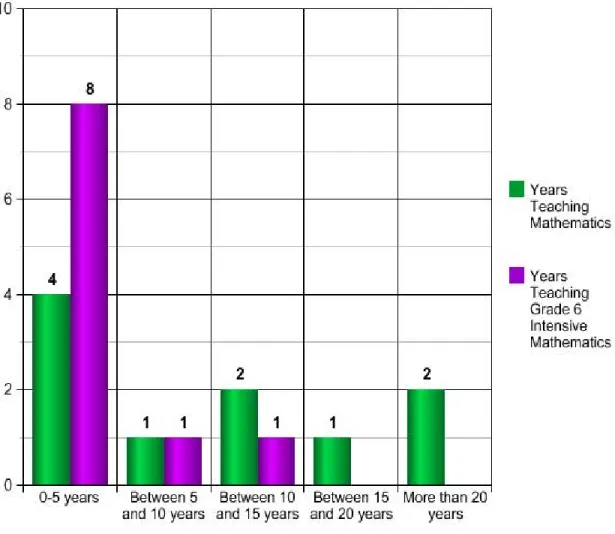
For question 1, which asked the respondents how long they have been teaching mathematics, the category of 0-5 years with 4 teachers (40%) responding. Only one respondent was in the range between 5 and 10 years as well as the range of 15 and 20 years with only one respondent. For the category of between 10 and 15 years, there were 2 respondents and for the more than 20 years teaching mathematics, there were 2
teachers. This information was in line with what I have experienced in mathematics departments at schools. Typically, when working in schools, I experience newer teachers often are assigned to the intensive classes as this data indicates40% of the respondents where teachers between 0 and 5 years were teaching the program.
For question 2, the question asked for the years teaching grade 6 intensive math. The data showed that the majority of the respondents were new to teaching grade 6 intensive math. For the category of 0-5 years, the response at 80% which was the highest with 8 respondents selecting that category. The next two categories, between 5 and 10 years and between 10 and 15 years each had only one respondent. The other categories of 15-20 years and more than 20 years had a response of zero. I would expect the data to yield these results as it is in line with more new teachers teaching the intensive course as well as the formal grade 6 intensive math program was developed over the last 5 years. The other 2 respondents who have been teaching intensive math longer would have experience with a less formal intensive program or experience outside of Gilbert County Schools.
30
Figure 1. Survey Question 1 & 2: grade 6 intensive math teachers’ responses to years of teaching mathematics and teaching grade 6 intensive mathematics. (n = 12)
Question 3 asked the respondents to share how long they have used the grade 6 intensive math program, Math 180. All 10 respondents (100%) gave the response of 0-5 years. All other categories were zero. I expected this data as the formal Math 180 has been in the district for just 5 years. If the data would have shown a respondent who had more than 5 years, then they would have had experience outside of Gilbert County Schools with the Math 180 program.
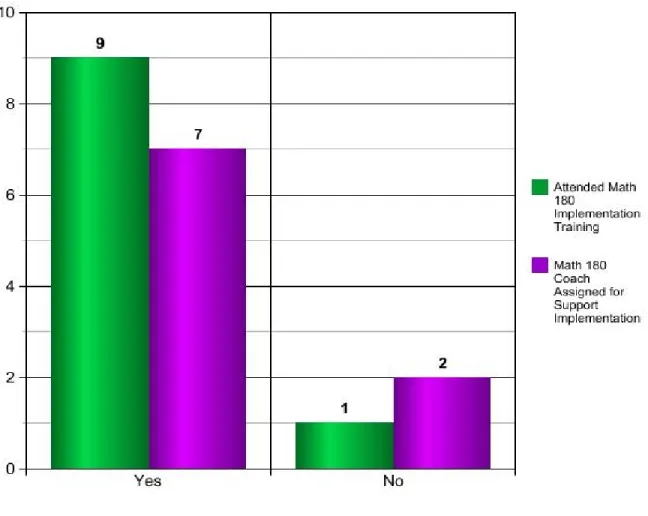
For Questions 4 and 5, the questions were designed to determine implementation support. Question 4 asked if the teachers attended the training to learn how to implement the Math 180 program. Of the 10 responses, nine teachers (90%) did attend the initial
31
training for implementation support. One teacher reported that the training was not attended. I was pleased to see this data and it confirmed that the training being offered for the teachers in a largegroup training or on school site campuses was attended by the majority of the respondents. This shows that the opportunity to have support in order implement the program was acquired by the teachers. In Question 5, the teachers were asked if they had a Math 180 Coach assigned to them for support of the implementation of the program. Seven of the teachers (70%) responded that they received the support of the coach. Two teachers (20%) chose the option, no, to the question and one teacher (10%) did not respond to the question. This data supports the implementation and follow up of having a coach to support the program at the school level with teachers. I was surprised to see that two teachers did not have coach support. This would mean they either opted out of having support or no support was provided to the teacher during the use of the program throughout the school year.
32
Figure 2. Survey Questions 4 & 5: grade 6 intensive math teachers’ responses to attending training for implementation and coach assigned for support implementation. (n=10)
For question 6, the respondents were asked about the use of the suggested implementation model. The question asked if they used the “two-prong” model of implementation with half of the instruction on the computer and the other half in small group. Of the 10 responses, 8 of the teachers shared that they did follow the suggested implementation model while 2 teachers shared they did not use the suggested model. I was pleased to see that the majority of the teachers were using the recommended model of implementation. The data showed that from question 4 that 9 out of 10 teachers went to the training on implementation and 8 out of 10 teachers wereusing the model of instruction. The training that teachers attended specifically shared with teachers the steps
33
to take to implement the two-prong model of instruction. The data shows that the
majority of the teachers were able to implement the model that was presented during the training directly in their classrooms as a result of attending the training.
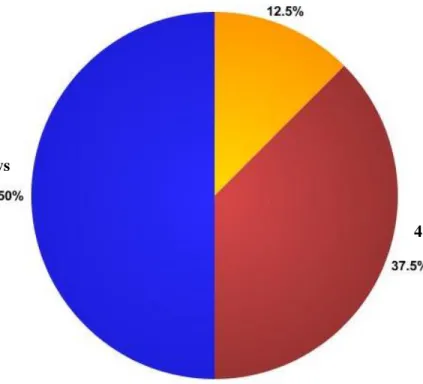
Question 7 relates to the implementation of the two-prong model in the grade 6 intensive mathematics class. For the 8 teachers that responded yes for using the suggested two-prong model, 4 out of 8 teachers (50%) responded that the model was used five days a week with the students in their intensive math classroom. Three of the teachers
responded that they used the model 4 days a week. One respondent gave a response of using the model 3 days per week. I was pleased to see that all respondents that did use the recommended model for the program at least 3 days as this shows they were using the program as intended and making steps toward following the two-prong model for implementation.
Figure 3. Survey Question 7: grade 6 intensive math teachers’ responses to number of days they used the suggested implementation two-prong model for teaching. (n=8)
5 days
4 days 3 days