Georgia Southern University
Digital Commons@Georgia Southern
Electronic Theses and Dissertations Graduate Studies, Jack N. Averitt College of
Summer 2020
Perceptions of the Impact Mathematics Support Classes
Have on Student Achievement
Cordaryl Charles Middleton
Follow this and additional works at: https://digitalcommons.georgiasouthern.edu/etd Part of the Curriculum and Instruction Commons, Educational Leadership Commons, Elementary and Middle and Secondary Education Administration Commons, and the Science and Mathematics Education Commons
Recommended Citation
Middleton, Cordaryl Charles, "Perceptions of the Impact Mathematics Support Classes Have on Student Achievement" (2020). Electronic Theses and Dissertations. 2117. https://digitalcommons.georgiasouthern.edu/etd/2117
This dissertation (open access) is brought to you for free and open access by the Graduate Studies, Jack N. Averitt College of at Digital Commons@Georgia Southern. It has been accepted for
inclusion in Electronic Theses and Dissertations by an authorized administrator of Digital Commons@Georgia Southern. For more information, please contact
HAVE ON STUDENT ACHIEVEMENT by
CORDARYL CHARLES MIDDLETON (Under the Direction of Teri Denlea Melton)
ABSTRACT
Many students today struggle with mastering grade-level mathematics standards. School leaders have implemented mathematics support classes as a possible solution; however, not all students are showing significant improvement. The challenge is determining an effective mathematics support class that has the most positive impact on student achievement. As a result, the purpose of this research study was to examine the perceptions of principals, mathematics teachers, and mathematics support teachers on the impact mathematics support classes had on student
achievement. This study employed a qualitative case study research design that consisted of one overarching research question and three sub-research questions that framed this research study that sought to uncover best practices within the mathematics support class, barriers within the mathematics support class, and ways in which the mathematics support class could be improved. Interview data were obtained from middle school personnel consisting of three triads of
principals, mathematics teachers, and mathematics support teachers, with a total of nine participants, in a suburban public-school system in the state of Georgia during the Spring of 2020. The findings of this study provided insight of the perceptions of middle school educators on the impact mathematics support classes had on student achievement. Descriptive data
mathematics support classes in order to increase student achievement in mathematics. As a result, the analysis of data uncovered six overarching themes: best practices identified were implemented instructional strategies; barriers includedlack of students’ cognitive ability and skills, lack of educator’s subject and pedagogical knowledge, and conditions of the class; and, improvements consisted of structure of the class and recommended instructional strategies. It can be concluded that the implementation of the mathematics support class was not as impactful as expected due to the myriad of barriers that exist. While there was not a mathematics support class that was deemed effective, the findings expressed a need to re-evaluate the current mathematics support class and make adjustments to meet the needs of the students to increase student achievement.
INDEX WORDS: Interventions, Mathematics, Mathematics achievement, Mathematics support class, Middle school, Perceptions, Prerequisite mathematics skills
HAVE ON STUDENT ACHIEVEMENT DISSERTATION
by
CORDARYL CHARLES MIDDLETON B.S., Augusta State University, 2009 M.Ed., Augusta State University, 2010
Ed.S., Augusta State University, 2011 Ed.S., Georgia Regents University, 2015
A Dissertation Submitted to the Graduate Faculty of Georgia Southern University in Partial Fulfillment for the Requirements for the Degree
© 2020
CORDARYL CHARLES MIDDLETON All Rights Reserved
PERCEPTIONS OF THE IMPACT MATHEMATICS SUPPORT CLASSES HAVE ON STUDENT ACHIEVEMENT
by
CORDARYL CHARLES MIDDLETON
Major Professor: Teri Denlea Melton
Committee: Antonio P. Gutierrez de Blume Gregory Chamblee
Electronic Version Approved: July 2020
2
DEDICATION
This dissertation is dedicated to my spiritual partner, my best friend, my wife: Tikki Middleton for encouraging me throughout this process and being my rock when I needed you the most. I am truly blessed to have you in my life and thank you so much for your love and support throughout this process. I love you immensely.
Also, this dissertation is dedicated to my three sons: Ezzard, Thomas, and Cortland. Through this journey, I know that my time was very limited, but you all understood the process in which this journey took. I am so thankful for you all and know that hard pays off and you can do anything you put your mind to. I love each of you.
Lastly, this dissertation is dedicated to my mom: Ruthie and my sister: Shante’. Your continuous support to my family and me during this process was more than enough. You all never wavered in your support and it is greatly appreciated. I am blessed to have each of you in my life and a part of my family. I love each of you.
ACKNOWLEDGMENTS
I first acknowledge God who is the head of my life. I could not have finished this journey without the help of God. I so grateful to my wife, Tikki; my sons, Ezzard, Thomas, and Cortland; my mom, Ruthie; my sister, Shante’; my niece, Jameka; my mother-in-law, Frankie; my sister-in-law, Trellani; my godsons: Keontae, Jakarri, and Michael; my family; and, my friends for standing in the gap when I needed you all the most. I am definitely blessed to have each of you in my life and sincerely acknowledge the level of support that you have provided to me during this journey.
A sincere appreciation to Dr. Teri Denlea Melton (Chair), Dr. Antonio P. Gutierrez de Blume (Methodologist), and Dr. Gregory Chamblee (Content Specialist) for your dedication and support in my dissertation journey. Each of you were an intricate part in this journey and were phenomenal. A special thanks to Dr. Teri Denlea Melton for your mentorship, guidance, and unwavering support that you have provided to me during this journey which will never be forgotten.
I acknowledge my staff at Richmond Hill K-8 for your encouragement throughout this process. Your words of encouragement and support were greatly appreciated. This journey was not easy with opening up a brand-new school and with me working on my doctorate at the same time, but you all never missed a beat resulting in us successfully completing our first year. #OneTeamSharedDream
I thank the Richmond County School System Board of Education and Senior Leadership for giving me an opportunity to lead in such an amazing district where I can have impact on the lives of the students that I encounter on a daily basis. Your investment into me is unremarkable,
4
and I must say that I love what I do every day in helping individuals identify their purpose. #MoveOnPurposeWithAPurpose
Lastly, I thank my Richmond County School System colleagues for the different measures of support that you have provided to me in my dissertation journey as well as the opening of a brand-new school. I personally thank you for the services that you provide to our students of the Richmond County School System.
TABLE OF CONTENTS Page ACKNOWLEDGMENTS... 3 LIST OF TABLES ... 8 CHAPTER 1 INTRODUCTION ... 9 Background ... 13 Mathematics Achievement... 14
Mathematics Support Class... 17
Barriers of Mathematics Support Classes ... 18
Statement of the Problem ... 23
Purpose Statement ... 23
Research Questions ... 24
Significance of the Study ... 24
Procedures ... 25
Definition of Key Terms ... 27
Chapter Summary ... 28
2 REVIEW OF LITERATURE ... 30
Organization of Literature Review ... 30
Mathematics Achievement... 31
Mathematics Anxiety ... 36
Prerequisite Mathematics Skills ... 40
Mathematics Support Class... 45
Barriers of Mathematics Support Classes ... 51
Teacher-Involved Barriers ... 51 Leader-Involved Barriers ... 55 Chapter Summary ... 58 3 METHODOLOGY ... 60 Research Questions ... 60 Research Design... 61 Site Information ... 62
6
Population, Sample, and Sampling ... 63
Ethical Considerations ... 66
Role of the Researcher ... 66
Instrumentation ... 67
Data Collection ... 68
Data Analysis ... 69
Reporting the Data ... 70
Establishing Trustworthiness ... 71
Limitations, Delimitations, and Assumptions ... 72
Chapter Summary ... 73
4 RESEARCH FINDINGS ... 74
Description of Participants ... 75
Findings... 76
Best Practices that Positively Impact Student Achievement ... 78
Barriers that Negatively Impact Student Achievement ... 80
Mathematics Support Class Improvements for Academic Gains ... 87
The Impact of Mathematics Support Class on Student Achievement ... 91
Chapter Summary ... 94
5 SUMMARY, CONCLUSIONS, & IMPLICATIONS... 96
Summary of Findings ... 97
Discussion of Findings ... 99
Best Practices that Positively Impact Student Achievement ... 99
Barriers that Negatively Impact Student Achievement ... 101
Mathematics Support Class Improvement for Academic Gains ... 104
Conclusions ... 105
Implications... 107
Impact Statement ... 108
Recommendations ... 109
Recommendations for Practice ... 109
Dissemination ... 112 Internal Dissemination ... 112 External Dissemination ... 112 Concluding Thoughts ... 112 REFERENCES ... 114 APPENDICES A IRB APPROVAL LETTER ... 121
B INTERVIEW QUESTIONNAIRE ... 122
8
LIST OF TABLES
Page Table 1: Students’ Mathematics Performance on GMAS 2016-2017 ... 32 Table 2: Students’ Mathematics Performance on GMAS 2017-2018 ... 33 Table 3: Students’ Mathematics Performance on GMAS 2018-2019 ... 34 Table 4: Participants’ Description by Position, School’s Pseudonym,
CHAPTER 1 INTRODUCTION
Mathematics has become one of the most essential subjects for students to comprehend and endure. Although students encounter mathematics in their everyday lives, in formalized mathematics classrooms, they are challenged with developing a clearer and more in-depth understanding of the various mathematics concepts. According to Boaler (2014), “a third of all schoolchildren end up in remedial mathematics courses, and the level of interest in the subject is at an all-time low” (p. 469). Students’ low-interest level in mathematics can be attributed to students’ experiences with mathematics and the consecutive years of struggle with understanding mathematics concepts that result in many students developing intense mathematics anxiety. Luttenberger, Wimmer, and Paechter (2018) stated in a national survey that “approximately 93% of adult US-Americans indicate that they experience some level of mathematics anxiety.
Estimations are that approximately 17% of the US-American population suffers from high levels of mathematics anxiety” (p. 312). Consequently, both the mathematics struggle and mathematics anxiety become some of the underlying causes of students’ inadequate performance in
mathematics.
According to the International Association for the Evaluation of Educational
Achievement’s Third International Mathematics and Science Study (IEAs TIMSS 2015; as cited in Ryan 2013), students in the US are not performing as well as students in other countries, such as Singapore and Korea, in mathematics because other countries are focused on rigor and higher-order thinking skills. Students in other globalized countries are more self-motivated and highly involved in their learning processes because they are challenged at various levels (Ryan, 2013). In fact, many students in other countries initiate their own learning processes by teaching
10
themselves how to solve various mathematics problems or algorithms. Additionally, these students employ their higher-order thinking skills to derive solutions to mathematics problems. However, many students in the US lack the interest and motivation to be challenged at various levels of rigor due to the lack of familiarity with concepts (Ryan, 2013). Students tend to prefer mathematics concepts that are simple to do and understand. In addition, students in the US rely heavily on the teacher and the textbook to teach them how to derive solutions to mathematics problems. The lack of self-sufficiency is prohibiting students from tapping into their higher-order thinking skills; instead, leading students to employ surface-level thinking by mindlessly
memorizing mathematics material (Inprasitha, Kongthip, Sangpom, & Suthisung, 2016). The employment of surface-level thinking “results in students’ inability to concretely learn, fully comprehend and understand mathematical concepts and practices” (Inprasitha et al., 2016, p. 72). Consequently, students in the US experience a mathematics disadvantage because they are not accustomed to rigorous mathematics as students in other countries that have seamlessly
embedded these strategies in their mathematics curriculum.
Changes to the mathematics standards from Georgia Performance Standards to Georgia Standards of Excellence now require students in Georgia to develop a deeper understanding of mathematics (GaDOE, 2015). In addition to the changes in the mathematics standards, students are now evaluated using a more rigorous assessment called the Georgia Milestones Assessment (GMAS). The GMAS requires students to complete selective responses and show their
understanding by completing both constructed responses and extended constructed responses, which require students to justify their answers through writing. Although the Georgia
Department of Education (GaDOE) is trying to make mathematics learning more in-depth via testing for students in the state of Georgia, it is evident that students are experiencing a
considerable amount of difficulty in achieving the new expected mathematics level of
performance. Examining the overall mathematics performance for students in 6th through 8th grade on the Spring 2019 GMAS administration, 22% of the students scored in the achievement level of beginning learner, and 36% of the students scored in the achievement level of
developing learning (GaDOE, 2019). Beginning learners are defined as “learners who do not yet demonstrate proficiency in the knowledge and skills necessary at their specific grade level/course of learning, as specified in Georgia’s content standards” (GaDOE, 2015, p. 1). Developing learners are defined as “learners who demonstrate partial proficiency in the knowledge and skills necessary at this grade level/course of learning, as specified by Georgia’s content standards” (GaDOE, 2015, p. 1). Based on the Spring 2019 GMAS administration, it is evident that 58% of the students in 6th through 8th grade in the state of Georgia are struggling in mathematics. The GaDOE (2015) recommends that a student who is classified as a beginning learner “needs substantial academic support to be prepared for the next grade level or course and to be on track for college and career readiness” (p. 1). Additionally, the GaDOE (2015) recommends that a student who is classified as a developing learner “needs additional academic support to ensure success in the next grade level or course and to be on track for college and career readiness” (p. 1). Therefore, school leaders are challenged with providing low performing students, as defined by the GMAS, with the necessary academic support in moving students to either the expected achievement level of a proficient or a distinguished learner.
Proficient learners are defined as “learners who demonstrate proficiency in the
knowledge and skills necessary at this grade level/course of learning, as specified in Georgia’s content standards” (GaDOE, 2015, p.1). Distinguished learners are defined as “learners who demonstrate advanced proficiency in the knowledge and skills necessary at this grade
12
level/course of learning, as specified in Georgia’s content standards” (GaDOE, 2015, p. 1). The expected achievement levels demonstrate the student’s proficiency based on the obtained knowledge and skills of the grade-level standards. In addition, performance at the expected achievement level ensures students are prepared for “the next grade level or course and are on track for college and career readiness” (GaDOE, 2015, p. 1).
As previously indicated, 58% of students in 6th through 8th grade in the state of Georgia are struggling in mathematics. Middle school leaders have implemented mathematics support classes as a possible solution for supplementing students’ core mathematics classes to broaden students’ understanding of mathematics and to close mathematics gaps directly related to prerequisite skills. A mathematics support class is defined as a class that provides students with additional support in meeting grade-level standards. This class is taught concurrently with the student’s other grade-level mathematics class. Within the mathematics support class, students are provided with additional time and are exposed to multiple instructional strategies and
interventions to aid in the development of adequate mathematics skills to be successful in the current mathematics class and future mathematics classes and to perform at a proficient or higher level on state assessments (“Georgia Standards,” n.d.). Studies (e.g., Bragelman, Martinez, & Stoelinga, 2016; Durwood, Krone, & Mazzeio, 2010) have revealed that the implementation of the mathematics support class has resulted in students developing the necessary mathematics skills that are needed and an increase in academic gains for students who are enrolled.
Despite the implementation of mathematics support classes, students continue to perform poorly on state-mandated tests such as the GMAS, which has a negative impact on the school’s overall College and Career Readiness Performance Index (CCRPI) score. With this setback, school leaders are still faced with the challenge of increasing students’ performance in
mathematics and are strongly encouraged by both the local board of education, as well as the GaDOE, to revise the school’s current action plan or develop other potential action plans to remedy this problem. Failure to do so could result in a decrease within the school’s CCPRI score, which could cause a school to be classified as low performing school where additional monitored support is provided to the school from both the local and state level to aid in improving the school’s overall performance (GaDOE, 2015).
Background
The development of a society is heavily measured by the quality of education that is provided. Within each culture, educational systems have been established to collaborate in the development of educational systems that promote quality education, express the uniqueness of the socio-cultural identity, and identify educational challenges of the times (Adjabui, Asiedu-Owuba, & Churcher, 2014). One would agree that a continuing educational challenge of the time is in mathematics education. The importance of providing quality mathematics education
instruction is at the forefront for many educational systems due to students’ low performance on state assessments, which has a negative impact on the educational systems’ measurement tool of effectiveness and achievement in mathematics. Due to a high percentage of students’ low performance in mathematics, educational systems attempt to develop and implement other strategies, such as mathematics support classes for low performing students, with hopes for a potential solution. Despite these mathematics support classes; student achievement is not improving as anticipated. There are some mathematics support classes, but not all, that are producing positive results. Perhaps the different models or elements of the mathematics support classes are believed to produce better results. There is, in fact, a distinct need to study the implementation of the mathematics support classes to determine which model yields higher
14
academic success. The background will address students’ struggle in mathematics and a potential solution to overcome the struggle in mathematics and increase students’ achievement by
discussing the current mathematics achievement, the mathematics support class itself, and the barriers that exist within the mathematics support class.
Mathematics Achievement
The struggle in mathematics among students in 6th through 8th grades in the state of Georgia is at the forefront with school leaders. School leaders must face reality and try to address the challenge that has been presented to them. Georgia students’ low performance in
mathematics has produced an adverse impact on students’ achievements on mandated
assessments and has further negatively affected schools’ overall CCRPI score, leading students not to be on track for college and career readiness and schools potentially to be labeled as low performing (GaDOE, 2015).
Students’ mathematics struggles begin at an early age, and most students continue to struggle in mathematics throughout their educational careers (Chang & Beilock, 2016). Students fall below the expected mathematics achievement level for multiple reasons. According to Shellard (2004), students are “unable to see the larger picture, make associations, or remember basic facts” (p. 41). Also, Sherman, Richardson, and Yard (2014) posited that the reason students fall below the expected mathematics achievement level is that students “never understood
mathematics, or never liked it because it was too abstract, and it did not relate to them” (p. 1). These identified reasons make it difficult for students to be successful in mathematics and lead students to develop mathematics anxiety that remains active as students matriculate throughout their educational careers (Chang & Beilock, 2016).
Mathematics Anxiety. With mathematics challenges faced by the students continually, students begin to develop a strong dislike for mathematics, which further develops into anxiety. “Mathematics anxiety is the feeling of worry, frustration, agitation, and a fear of failure with regard to taking a mathematics class, completing mathematics problems, and/or taking a mathematics exam” (McMahon, 2015, p. 1). Ching (2017) further explained that “mathematics anxiety refers to the feelings of tension and anxiety that interfere with the manipulation of numbers and the solving of mathematical problems in a wide variety of ordinary life and academic situations” (p. 99). Mathematics anxiety is crucial and hinders students’ ability to effectively perform well in the mathematics classroom due to the fear that has been developed. As McMahon (2015) stated:
Unfortunately, when faced with a mathematics problem that he or she does not
understand, the child suffering from mathematics anxiety becomes filled with negativism and focuses on that, distracting him- or herself from attempting to work through the problem. Furthermore, this distraction can start a negative cycle in which the same child rushes through the problem and makes a mistake because he or she is not focusing on the problem itself. (p. 1)
As a result of rushing through the problems, students are unsuccessful at correctly solving the problem and are furthered affected by the low grade received, which in turn leads to the development of more intense mathematics anxiety. With the development of mathematics
anxiety, students cringe when faced with mathematics problems. Ching (2017) conducted a study that “examined the longitudinal associations between mathematics anxiety and mathematical performance in 246 Chinese children followed from second to third grade” (p. 99). Based on study findings, Ching (2017) concluded that mathematics anxiety is directly associated with poor
16
performance within the classroom as well on state-mandated assessments. In addition, the “severity of mathematics anxiety in children tended to increase over time” (p. 100). As a result, students’ mathematics ability is directly impacted, and students either fail mathematics courses or perform at a minimal level, essentially doing just enough to pass mathematics courses without fully developing a clear understanding of the different mathematics concepts. The compound effects of consecutive years of mathematics challenges lead to poor performance and low scores in the classroom as well as on state assessments. As a result of the mathematics struggle and the development of mathematics anxiety, students must have “high-quality teaching, but
well-planned instruction explicitly structured to develop a specific sequence of skills” (Shellard, 2004, p. 41). With this support, low performing students, students who are not performing on grade level, may be able to reach the expected mathematics achievement level.
PrerequisiteMathematics Skills. For students to meet the expected achievement level, they must perform satisfactorily in the prerequisite mathematics skills, because prerequisite mathematics skills are needed for students to be successful in other mathematics concepts. However, “students lack well-developed mental strategies for remembering how to complete algorithmic procedures and combinations of basic facts” (Sherman et al., 2014, p. 1). Students are not challenging themselves to remember the necessary procedures and facts to be successful in mathematics concepts, which hinders overall performance.
In addition to the lack of the students’ memory ability, students have trouble
understanding the language of mathematics. Within mathematics, there is an enormous amount of terminology that students must know to be successful. When mathematics terms are presented, students develop a sense of confusion, which negatively impacts their overall performance. Sherman et al. (2014) suggested terms such as “multiple,” “power,” “factor,” and “area,” if not
understood by students, could create a misconception among the students’ understanding of the terms. Consequently, students’ ability to select the appropriate operations for the algorithms and problem solve could be impacted.
Mathematics Support Class
Due to students’ lack of performance on standardized testing, educational systems are mandated to intervene to support students’ performance. One way in which support is provided is by filling in mathematics gaps by requiring underprepared students to take two mathematics classes: one class serving as the core mathematics class and the other class serving as a
mathematics support class. In essence, not all students are exposed to double mathematics classes.
The impact of the effectiveness of double-dose mathematics classes has been evaluated to see if students’ mindset changed and achievement increased. Bragelman, Martinez, and Stoelinga (2016) conducted a study to examine the effectiveness of a double-dose of mathematics classes. The quantitative study focused on the implementation of an Intensified Algebra I (IA) program that enabled students who were off-track to get back on track along with their peers. The IA program consisted of students taking a double period of algebra to provide students with
additional support in algebra. The implementation of the IA program for underprepared students, students who have not mastered previously taught content, demonstrated that students who consistently had trouble in learning mathematics showed significant gains on grade-level material. Durwood, Krone, and Mazzeio (2010) researched the effectiveness of double-dose mathematics classes for low performing students, which are students that are performing below grade level. The quasi-experimental study discussed the implementation of two algebra classes for all ninth graders who were performing below average on state assessments in the Chicago
18
Public Schools. As a result of implementing the two algebra classes, the researchers found that the two algebra classes yielded a higher percentage of students improving their academic skills. The researchers concluded that students who were enrolled in the two algebra classes benefited from having additional teacher support and extra instructional time in mathematics.
Barriers of Mathematics Support Classes
Within support classes, there are identified barriers that could hinder the success of the mathematics support classes and the impact the classes have on student achievement. One barrier includes but is not limited to the role of the teacher and the attitude and knowledge the teacher may possess. Another barrier includes but is not limited to the role of the leader and the ability of the leader to provide resources and appropriately schedule the mathematics support classes.
Teacher-related barriers. With the development of the mathematics support classes, teachers may already anticipate a challenge being that the students are already performing at a lower level in mathematics. In addition, teachers are now required to utilize their talents and skills to further develop students’ understanding of prerequisite mathematics skills and assist the students in achieving grade-level content. The expectations that are placed on teachers to teach mathematics support classes could result in the teachers becoming extremely frustrated due to various limited mathematics skills that exist within the students or the teachers’ ability to teach mathematics concepts effectively. These factors could harm students’ overall performance in mathematics support classes.
Student achievement is often contingent upon teachers’ attitudes. Biggs, Dill, Fonagy, Twemlow, and Vembery (2008) studied the impact teachers’ attitudes had on student
achievement and student behavior within the classroom. The study revealed that teachers who demonstrated dedication to educating students had a positive impact on student achievement and
development of students’ behavior. On the other hand, teachers who demonstrated less commitment to educating the students had a negative impact on students’ performance. They were more prone to have student behavior issues and classroom management challenges, which makes the classroom environment not conducive for learning.
The impact that teachers have on student achievement is crucial in the educational process. Teachers who support students, encourage students and share the love they have for educating students may ignite student achievement and desired behavior within the classroom. Unfortunately, many teachers fail to realize that their method of teaching, the way they interact with students, and the behavior that they display is more significant than what they are actually teaching (Yara, 2009). In a study conducted by Henderson and Rodrigues (2008), the researchers found that teachers’ perceptions of mathematics, including anxiety level, comfort level, and dislike or like toward mathematics, have a direct relationship to teachers’ attitudes toward mathematics. These perceptions have an impact student achievement levels. Students examine teachers’ dispositions in order to develop an opinion about their own learning, which affects the students’ learning outcomes. Guerriero (2014) stated that teaching is viewed as a
Knowledge-rich profession with teachers as ‘learning specialists.’ As professionals in their field, teachers can be expected to process and evaluate new knowledge relevant for their core professional practice and to regularly update their knowledge to improve their practice and to meet new teaching demands. (p. 3)
However, because some teachers are accustomed to teaching higher levels of
mathematics, teachers may not necessarily know instructional strategies to teach students’ who do not possess all necessary prerequisite mathematics skills to master grade-level content. This complex issue poses a problem for teachers as well as for students within the classroom. Some
20
mathematics support teachers may not have received the pedagogical knowledge through
training or professional learning needed to teach students within the mathematics support classes effectively. Due to a lack of content knowledge or pedagogical skills, teachers frequently
develop a negative attitude toward the mathematics support class, which eventually affects students’ overall performance. Guerriero (2014) concluded that teachers with better content knowledge and well-defined pedagogical skills yield higher student achievement.
Leader-related barriers. The role of the leader is a vital contribution to student achievement. It is the leader’s responsibility to put things in place in order to promote student achievement within the learning environment. Within this learning environment, the leader should incorporate the mathematics support class into the school’s master schedule.
Additionally, he or she should provide viable resources to further promote the success of the students.
As leaders incorporate mathematics support classes into the master schedule, they must consider all factors. Considering all factors will require the educational leaders to be innovative to ensure that student’s learning needs are addressed. The mathematics support class is generally offered during students’ connections block in middle school. A connections block is a block of time where electives are taken in school. “Electives are taught by specific, specialized teachers to give students a more rounded education. They are an addition to regular classroom studies, including physical education, arts and technology” (GaDOE, 2019, p. 1). Bragelman et al. (2016) stated that the incorporation of mathematics support classes should provide little disruption within the school. However, students may become disgruntled having to take a mathematics support class as part of their core curriculum and as an elective and develop a negative attitude toward the subject matter. In a study conducted by Zan (2012), it was reported that individuals
who develop negative attitudes toward mathematics were profoundly affected by past
encounters, such as recurring failures or problems with mathematics. It is essential that school leaders schedule support classes such that students are receptive to the support provided within the classes to diminish the negative attitude of students. As Mata, Monterio, and Peixoto (2012) stated, “the more positive the attitude, the higher the level of achievement for the student” (p. 8).
In addition, the availability of resources within the classroom is crucial. According to Chandrasegaran and Lay (2016):
Resources are crucial for improving schooling, perhaps even more so in developing countries than in economically developed countries, where adequate school structures and material resources can be taken for granted. The extent and quality of school
resources can have an important impact on the quality of classroom instruction. (p. 3077) Similarly, Lee and Zuze (2011) stated that “resources are essential for schooling and can take many forms, but they all share one feature: they cost money” (p. 370). Therefore, having adequate resources are necessary for the classroom to yield higher student achievement.
However, as stated by Lee and Zuze (2011), resources cost money. Not having adequate funding could result in limited resources being made available for the students. As a result of the limited resources, student achievement is negatively impacted. Resources can consist of but are not limited to textbooks, technology, and instructional materials such as manipulatives and interactive notebooks.
The impact resources have on student achievement can be supported by the study conducted by Chandrasegaran and Lay (2016); the researchers studied 8th graders in two countries: Singapore and Malaysia. Within each country, some schools had adequate resources, and some schools had limited resources. After the 2000 TIMSS test was administered, the results
22
illustrated that students who were in classrooms that provided adequate resources performed higher than students who had limited resources within the classroom. In another study conducted by Lee and Zuze (2011), the researchers studied 6th graders in four countries: Malawi, Namibia, Uganda, and Botswana. The availability of resources differed in each of the countries. Echoing other studies’ results, the researchers were able to conclude that students who attended schools with more resources achieved higher than students who attended schools with limited resources. As evidenced in the above-cited results, it is best practices for leaders to ensure classrooms have enough resources that are made available for students in order to improve students’ performance and increase students’ mastery of the content taught.
In summary, based on the provided background, one can conclude that students’ struggle in mathematics is present. With this struggle at the forefront, students’ performance on state assessments is not improving. The struggle students may be experiencing could be attributed to the developed mathematics anxiety among students and disengagement among students within the mathematics classroom. In support of these concerns, mathematics support classes have been established as an intervention to address student’s limited skills. Studies have been conducted (e.g., Bragelman, Martinez, & Stoelinga, 2016; Durwood, Krone, & Mazzeio, 2010) that
communicated that the implementation of mathematics support classes has resulted in improved student achievement. However, there exist potential barriers that could negatively impact the success of the mathematics support class, such as the role of the teacher as it is related to the teacher attitude, teacher anxiety, and lack of teacher content and pedagogical knowledge. In addition, barriers could consist of the role of the leader regarding the scheduling of the class and the availability of resources. It is expected based on the review of literature that this study will
assist in bridging the gap in the literature by contributing valuable information to an already large puzzle with efforts toward increasing student achievement in mathematics.
Statement of the Problem
Mathematics is an essential subject for students to comprehend and understand. Many students today struggle with mastering grade-level mathematics standards resulting in the development of mathematics anxiety and disengagement in the mathematics classroom. Due to this development, students’ performance on state assessments is negatively impacted, which has an adverse effect on schools’ overall student achievement within mathematics. School leaders are identifying a higher percentage of students who are one or more grade levels behind in mathematics. This factor is alarming to school leaders.
To overcome the challenge, school leaders have implemented multiple mathematics interventions to provide a solution to students’ limited mathematics skills and shortcomings. One intervention that has been implemented within school districts is a mathematics support class to supplement students’ core mathematics class. Despite the utilization of mathematics support classes, not all students are showing sufficient improvement in achievement. Therefore, school leaders are faced with the challenge of determining an effective mathematics support class that has the most positive impact on student achievement. There exist limited studies in the state of Georgia to date that support school leaders in determining an effective mathematics support class, which further hinders student achievement in mathematics at the middle school level.
Purpose Statement
The purpose of this study was to examine the perceptions of principals, mathematics teachers, and mathematics support teachers on the impact that mathematics support classes had on student achievement at the middle school level. Based on the examination of the perceptions
24
of the impact that mathematics support classes had on student achievement, commonalities were discovered, and a recommended mathematics support class will be communicated to school leaders in schools that had implemented or were planning on implementing mathematics support classes to increase student achievement in mathematics at the middle school level.
Research Questions
The following overarching research question guided this study: How impactful is the mathematics support class on student achievement? In addition, the following sub-questions served to add clarity to the investigation:
1. According to principals and teachers, what are best practices within the mathematics support class that positively impact student achievement?
2. According to principals and teachers, what are barriers within the mathematics support class that negatively impact student achievement?
3. According to principals and teachers, in what ways could the mathematics support class be improved to obtain greater academic gains in mathematics?
Significance of the Study
With the lack of mathematics skills that exist among the student population at all levels, school leaders and teachers are challenged with the responsibility to solve the problem of mathematics deficiencies among students. This research allowed the researcher to communicate the impact that various components of the mathematics support class had on student
achievement. Additionally, the study examined the perceptions of principals, mathematics teachers, and mathematics support teachers at the middle school level on the implementation the mathematics support classes as related to student achievement. The examination of the
research involving the impact mathematics support classes have on student achievement. In addition, limited research exists on the impact mathematics support classes have on student achievement at the middle school level. The majority of the research illustrates the impact the mathematics support classes have on the high school level. As a result, this research was intended to provide school leaders with pertinent information that was needed in order to improve student achievement and provide an effective mathematics support class that increased student achievement at the middle school level, which could result in the closing of the current mathematics gaps.
Procedures
In an effort to evaluate the perceptions of principals and teachers as they relate to the impact mathematics support classes had on student achievement, the researcher employed a qualitative approach in this study. According to Creswell and Creswell (2018), “qualitative approaches focus on exploring and understanding the meaning individuals or groups ascribe to a social or human problem” (p. 4). The justification for utilizing this approach within the current study was that the qualitative data was vital in the discovery of themes obtained from the responses to the conducted interviews as related to the impact the mathematics support classes had on student achievement. With the qualitative approach being the overall research approach of this research study, the researcher utilized a case study design to further evaluate the
perceptions of principals and teachers in reference to the implementation of the mathematics support class. Merriam and Tisdell (2016) stated: “a case study [involves] an empirical inquiry that investigates a contemporary phenomenon (the ‘case’) within its real-life context” (p. 37). Taking this approach provided valuable information to the researcher by identifying common perceptions of the impact the mathematics support classes had on student achievement.
26
To fully evaluate the perceptions of principals and teachers related to the impact
mathematics support classes had on student achievement, the researcher utilized one southeastern rural school district due to the easy accessibility of the school personnel to answer the given research questions. The researcher solicited three middle schools to participate in this case study, the participants of which consisted of one principal, one mathematics teacher, and one
mathematics support teacher from each school for the purpose of this study. In order for the middle schools to participate in this study, their 2019 CCRPI score had to be 59 or below due to a higher percentage of students within these schools performing below grade level in
mathematics resulting in mathematics support classes being more prevalent; whereas, schools with a 2019 CCRPI score with 60 and above had a higher percentage of students who were performing at or above grade level resulting in mathematics support classes not being evident in these schools.
The mode of data collected was virtual interviews. Once data were collected, the
researcher conducted a thematic analysis based on the data collected from the virtual interviews. Taking this approach required the researcher to take the following steps: “organize the data in preparation for analysis, read through all data, code the data, generate a description and themes, and interpret the meaning of themes/descriptions” (Creswell & Creswell, 2018, p. 194). Through the conduction of this data analysis, the researcher was able to report out common perceptions of the mathematics support class as related to the impact the class had on student achievement. As a result, the researcher was able to share with leaders in the school district an identified
mathematics support class that positively impacted student achievement yielding higher growth in students’ performance in mathematics and on state assessments, which would have a greater impact on the school’s overall CCRPI score.
Definition of Key Terms
The following terms below are intended to provide clarity and an understanding of the meaning of specific terms utilized within the context of this research study:
College and Career Readiness Performance Index (CCRPI): CCRPI is a performance
measurement platform that is utilized by educational stakeholders that focus on school improvement and accountability (GaDOE, 2015).
Georgia Milestones Assessment (GMAS): GMAS is a comprehensive assessment administered to students in grades 3rd to high school. The intent of the assessment is to evaluate students’
understanding and knowledge of specific content taught (GaDOE, 2015).
Interventions: Interventions are instructional strategies implemented within classrooms with the intent to support the learning process of the students (What Works Clearinghouse, 2017). Low Performance: Low performance is a classification of students who are performing more
than two or more grade levels below the student’s current grade level (Purpura, Day, Napoli, & Hart, 2017).
Mathematics Anxiety: Mathematics anxiety is the feeling of nervousness, apprehension, frustration, agitation, and a fear of failure with regard to taking a mathematics class, completing mathematics problems, and/or taking a mathematics exam (McMahon, 2015, p. 1).
Mathematics prerequisite skills: Mathematics prerequisite skills are defined as skills that are necessary as a prior condition for something else to happen or exist. Therefore, mathematics prerequisite skills describe the skills or background knowledge a student needs (prior condition) before working on a specified concept (National Center and State Collaborative, n.d.)
28
Mathematics Support Class: Mathematics support class is a class that provides students with additional support in meeting grade-level standards. This class is taught concurrently with the student’s other grade level mathematics class. Within the mathematics support class, students are provided with additional time and exposed to multiple instructional strategies to aid the students in the development of adequate mathematics skills to be successful in their current mathematics class and future mathematics classes and perform at a
proficient level on state assessments (“Georgia Standards,” n.d.).
Chapter Summary
Low mathematics performance has been moved to the forefront of many educational systems improvement plans today. Educational leaders need to identify solutions in order to address the given issue of the lack of mathematics skills and insufficient math test scores among students. A solution that has been implemented thus far was the implementation of the
mathematics support class for students who were consistently performing low in mathematics. With the implementation of this solution, the researcher investigated the effectiveness of the mathematics support class based on the perceptions of the principals, mathematics teachers, and mathematics support teachers on the impact the mathematics support classes had on student achievement at the middle school level. Most research studies on mathematics support classes discussed the impact mathematics support class had on student achievement at the high school level. However, this study took a different approach in reference to investigating the
mathematics support class and looked deeper into the mathematics support class by examining the perceptions of the impact the mathematics support classes had on student achievement at the middle school level. The purpose of the qualitative approach complemented with a case study design supported in the evaluation of the perceptions of principals and teachers as related to the
mathematics support class and the impact the class had on student achievement at the middle school level. As a result of this study, an identified mathematics support class based on perceptions was determined and recommended to be implemented to improve students’ achievement at the middle school level and yield an increase in the school’s CCRPI score.
30
CHAPTER 2
REVIEW OF LITERATURE
The vast majority of students in the United States struggle with mathematics; in fact, 63.5% of the students in the United States scored below the proficiency level and above on the 2017 administration of the National Assessment of Educational Progress (NAEP). This
assessment is utilized to “measure the progress of our nation’s fourth- and eighth-graders in mathematics, reading, and various subjects” (National Assessment of Educational Progress, 2017, para. 1). Unfortunately, mathematics literacy is an integral part of everyday life, regardless of a person’s chosen profession. While there is a myriad of reasons found in the literature for why students struggle in mathematics, mathematics support classes have been identified as a possible solution to this problem. Unfortunately, research has shown that some mathematics support classes are successful, and others are not. What makes one successful and the other not has yet to be determined. Therefore, the purpose of this study was to examine the perceptions of principals, mathematics teachers, and mathematics support teachers on the impact the
mathematics support classes had on student achievement at the middle school level. Based on the examination of the perceptions of the impact the mathematics support classes had on student achievement, commonalities were discovered, and a recommended mathematics support class was communicated to school leaders in schools that had implemented or were planning on
implementing mathematics support classes in order to increase student achievement at the middle school level.
Organization of Literature Review
For the purpose of this study and the review of literature, the literature is organized in a manner that showcased students’ struggle in mathematics and a potential solution to overcome
the struggle in mathematics and increase student achievement. Within this chapter, current literature is presented that highlights students’ struggle in mathematics and the impact of mathematics support classes. Based on the review of the literature, results in this chapter are divided into multiple sections: mathematics achievement, mathematics support class, and barriers of the mathematics support class. Within each section, there are subsections that support the students’ struggle in mathematics and a potential solution to overcome the mathematics struggle.
In an effort to obtain quality scholarly articles, the researcher utilized Georgia Southern library resources. Based on the resources provided, the following databases were identified that deemed more useful in identifying relevant literature for this study: Galileo, ERIC, EBSCOhost, ProQuest, JSTOR, and Wiley Online Library. With these identified databases, the following search terms were utilized to identify literature that was aligned to this study: mathematics, mathematics support classes, double-dosing classes, interventions, mathematics anxiety, mathematics performance, mathematics achievement, prerequisite mathematics skills,
mathematics basic skills, disengagement, manipulatives, teacher attitude, teacher anxiety, teacher knowledge, master schedule, and availability of resources.
Mathematics Achievement
In the state of Georgia, students in 6th through 8th grade are required to demonstrate their understanding in mathematics on a summative assessment called the GMAS. The GMAS in mathematics consists of the following items: selective responses, open-ended responses, and norm-referenced responses. Students in 8th grade are required to receive a passing score on the assessment in order to be considered for promotion to the next grade level. It is evident that this assessment system has established high expectations for students in the state of Georgia, and the intended purpose is to hold schools accountable for students’ performance (GaDOE, 2015).
32
Students’ performance on the GMAS impacts schools’ CCRPI scores, which affects schools’ performance designation as either a priority school, focus school, or alert school. The designation of the school determines the level of financial support that will be received from the district and state levels. Schools designated as a priority school receive intensive support from the GaDOE by assigning each school a school improvement specialist (SIS); however, schools designated as focus or alert schools have to implement similar requirements as priority schools but do not receive an SIS for each school (The Governor’s Office of Student Achievement, n.d.).
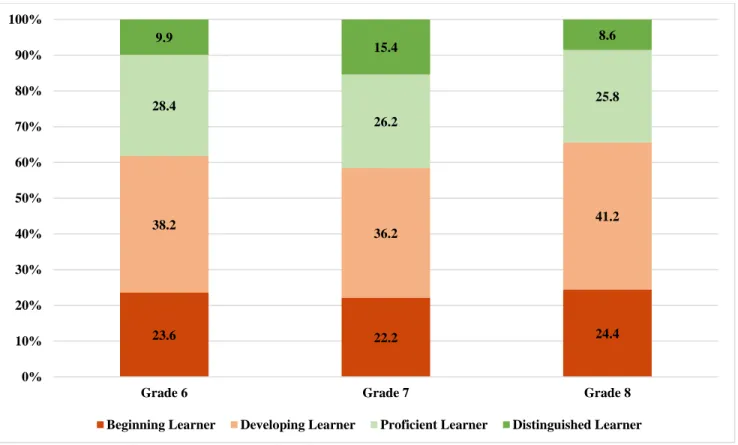
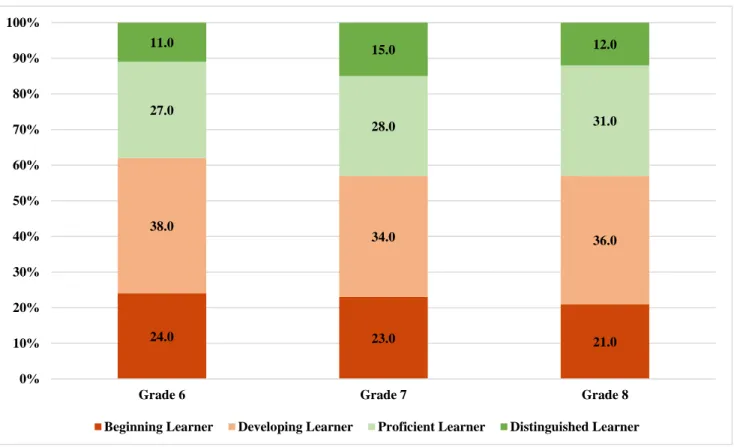
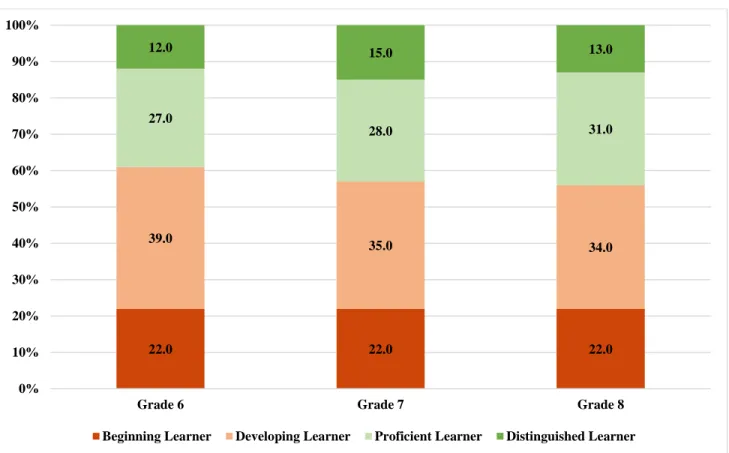
Tables 1, 2, and 3 represent middle school students in the state of Georgia mathematics performance on the GMAS in 6th through 8th grade for the past three years.
Table 1:Students’ Mathematics Performance on GMAS 2016-2017
Note. Adapted from “Georgia Milestones 2016-2017 Statewide Scores,” by The Georgia Department of Education, 2017. 23.6 22.2 24.4 38.2 36.2 41.2 28.4 26.2 25.8 9.9 15.4 8.6 0% 10% 20% 30% 40% 50% 60% 70% 80% 90% 100%
Grade 6 Grade 7 Grade 8
Based on the data presented in Table 1, it is evident that during the administration of the 2016-2017 GMAS in mathematics, 61.93% of the middle school students in the state of Georgia scored either as a beginning learner or a developing learner; only 38.07% scored in the area of proficient or distinguished learner. As indicated in Table 1, in the academic year 2016-2017, the range of students reaching a minimum score of proficient on the GMAS was 25.8 - 28.4%.
Table 2:Students’ Mathematics Performance on GMAS 2017-2018
Note. Adapted from “Georgia Milestones 2017-2018 Statewide Scores,” by The Georgia Department of Education, 2018.
Based on the data presented in Table 2, it is evident that during the administration of the 2017-2018 GMAS in mathematics, 58.7% of the middle school students in the state of Georgia scored either as a beginning learner or a developing learner; only 41.3% scored in the area of
24.0 23.0 21.0 38.0 34.0 36.0 27.0 28.0 31.0 11.0 15.0 12.0 0% 10% 20% 30% 40% 50% 60% 70% 80% 90% 100%
Grade 6 Grade 7 Grade 8
34
proficient or distinguished learner. As indicated in Table 2, in the academic year 2017-2018, the range of students reaching a minimum score of proficient on the GMAS was 27.0 - 31.0%.
Table 3:Students’ Mathematics Performance on GMAS 2018-2019
Note. Adapted from “Georgia Milestones 2018-2019 Statewide Scores,” by The Georgia Department of Education, 2019.
Lastly, based on the data presented in Table 3, it is evident that during the administration of the 2018-2019 GMAS in mathematics, 58.0% of middle school students in the state of
Georgia scored either as a beginning learner or a developing learner; only 42.0% scored in the area of proficient or distinguished learner. As indicated in Table 3, in the academic year 20182019, the range of students reaching a minimum score of proficient on the GMAS was 27.0 -31.0%. 22.0 22.0 22.0 39.0 35.0 34.0 27.0 28.0 31.0 12.0 15.0 13.0 0% 10% 20% 30% 40% 50% 60% 70% 80% 90% 100%
Grade 6 Grade 7 Grade 8
According to the GaDOE (2015), the following definitions are used to interpret each level in the table:
Beginning learners do not yet demonstrate proficiency in the knowledge and skills necessary at this grade level/course of learning, as specified in Georgia’s content standards… developing learners demonstrate partial proficiency in the knowledge and skills necessary at this grade level/course of learning, as specified in Georgia’s content standards… proficient learners demonstrate proficiency in the knowledge and skills necessary at this grade level/course of learning… distinguished
learners demonstrate advanced proficiency in the knowledge and skills necessary at this grade level/course of learning. (p. 1)
It is evident that the number of beginning learners and developing learners are decreasing after each year as represented in the tables above; however, that decrease is almost negligible as in percentage from year to year, as evident in the tables above, which is a concern. This struggle challenges teachers and educational leaders. They must consider the implementation of
instructional practices that could address this struggle to ensure that educational institutions are aligned to the mission of the GaDOE which is “preparing all students for college or a career in a safe and drug-free environment where we ensure that no child is left behind” (GaDOE, 2015, p. 1). According to Heim (2016):
Students in the United States have not gained any ground [in mathematics] and continue to trail students in a slew of developed countries around the globe… In the latest Program for International Student Assessment (PISA) measuring mathematics literacy in 2015, U.S. students ranked 40th in the world. (p. 1)
36
Therefore, grade-level standards mastery, as measured by the GMAS testing poses a concern for educational leaders within the United States as students’ low performance in mathematics has had a negative impact on the overall performance ratings of schools. As teachers attempt to teach grade-level content, students experience difficulty in mastering the content due to the students already being behind in mathematics, which has an adverse impact on the students’ present performance in their current mathematics class. Heim (2016) stated that students being behind makes it difficult for the teacher to teach the current content, which is known as losing ground in mathematics. According to current research (e.g., Chang & Beilock, 2016; Harris, 2018; Martin, Anderson, Bobis, Way, & Vellar, 2012; Ruff & Boes, 2014),
students’ low performance in mathematics could be attributed to the following: the development of mathematics anxiety, the possession of limited mathematics skills, or the lack of student engagement within the mathematics classroom. Each of these topics will be discussed, focusing on the impact it has on student achievement in mathematics.
Mathematics Anxiety
McMahon (2015) defined mathematics anxiety as feelings of nervousness, apprehension, frustration, agitation, and a fear of failure with regard to taking a mathematics class, completing mathematics problems, or taking a mathematics exam. Blazer (2011) defined mathematics anxiety as “negative emotions that interfere with the solving of mathematical problems” (p. 1). Sparks (2011) characterized mathematics anxiety as a form of a disease, or negative emotion developed when one is required to either conduct mathematics computation or institute mathematics problem techniques. Sparks continued by stating that the development of
mathematics anxiety results in a discomfort level in mathematics, which has an adverse effect on students’ willingness to seek career opportunities in mathematics.
Leppavirta (2011) defined mathematics anxiety “as a feeling of tension and anxiety that interferes with the manipulation of numbers and the solving of mathematical problems in both everyday life and academic situations” (p. 425). Leppavirta’s study focused on the relationship mathematics anxiety has with students’ performance in electromagnetics. In relationship to mathematics, engineering students must be proficient in mathematics in order to be successful in electromagnetics. In an effort to examine mathematics anxiety and the impact it has on students’ performance in electromagnetics, the study involved 118 undergraduate students enrolled in a Static Field Theory course at the Helsinki University of Technology in Finland. Leppavirta (2011) evaluated students’ mathematics anxiety by using an Electromagnetics Mathematics Anxiety Rating Scale (EMARS), which consisted of five qualitatively different components: usefulness, mathematics confidence, interpretation anxiety, fear of asking for help, and
persistency. After the administration of the EMARS, students’ data were collected and analyzed using descriptive statistics, correlation, and analysis of variance (ANOVA). Leppavirta
concluded that mathematics anxiety did have a significant impact on students’ performance in electromagnetics.
Chang and Beilock (2016) explained possible factors that cause mathematics anxiety: individual possesses a lower competency level than his/her counterparts in mathematics, previous poor performance in mathematics, and experience difficulties with mathematics
prerequisite skills that are the building blocks to other advanced mathematics concepts. Ruff and Boes (2014) further explained that:
…contributing factors of mathematics anxiety in students involves various social, cognitive, and academic elements. Social factors include continued race and gender stigmas and lack of parental support in low socioeconomic (SES) households. Cognitive
38
factors comprise dyscalculia and deficits in working memory. Academic factors encompass the traditional mathematics curriculum used in classrooms, ineffective
teaching styles, and the influence of mathematics anxious teachers. (p. 2) Ruff and Boes (2014) stated that with these contributing factors, students experience
extreme difficulty within the mathematics classroom that negatively impacts their performance. As students’ performance is impacted, limited growth is established in mathematics.
Beilock and Maloney (2015) stated that “mathematics anxiety is a multifaceted
phenomenon that arises due to a combination of cognitive predispositions, as well as exposure to negative attitudes about mathematics” (p. 6). The research conducted by Beilock and Maloney (2015) focused on the characteristics of mathematics anxiety and the impact it has on
mathematics achievement. Within their research, the researchers highlighted other research findings (e.g., Ferguson, Maloney, Fugelsang, & Risko, 2015; Maloney, Risko, Ansari, & Fugelsang, 2010; Ramirez, Gunderson, Levine, & Beilock, 2013) in psychology, education, and neuroscience on mathematics anxiety. Based on the analysis of the research findings on
mathematics anxiety, Beilock and Maloney (2015) concluded that mathematics anxiety should not be ignored but should be addressed in order to promote mathematics achievement.
“Mathematics anxiety appears to increase across development until it peaks at about ninth or tenth grade and then plateaus thereafter” (Beilock & Maloney, 2015, p. 6). However, in order to prevent the increase in mathematics anxiety as individuals develop, it is essential to implement interventions that could aid in reducing mathematics anxiety within an individual. Park, Ramirez, and Beilock (2014) recommended utilizing an expressive writing technique that aids in the reduction of mathematics anxiety. The expressive writing technique allows students to freely write about their feelings and thoughts related to a significant stressor that they may be facing.
The study conducted by Park et al. (2014) consisted of the identification of students with various levels of mathematics anxiety by utilizing a pre-screener known as a Short Mathematics Anxiety Rating Scale that consisted of a 25-item self-report measure. Based on the pre-screener, 44 participants were identified as having high mathematics anxiety, and 39 participants were identified as having low mathematics anxiety. Participants were randomly assigned to either the control group or the experimental group; the experimental group was the expressive writing group. The instrument used in this study consisted of an exam that consisted of 60 mathematics problems and 60-word problems (half high-demand, half low-demand). “The exam was divided into a series of consecutive mathematics and word problem blocks, each containing 12 problems (half high-demand, half low demand).” (Park et al., 2014, p. 105). As a result of the
implementation of the expressive writing technique, students’ anxiety level decreased, resulting in a positive impact on students’ performance in mathematics. The implementation of the expressive writing technique may be an effective strategy utilized to allow students with mathematics anxiety to reassess a potentially negative situation, such as a mathematics task or mathematics test. This strategy could also change students’ mindset, which could aid in their success in their current situation.
In order to prevent mathematics anxiety from robbing individual working memory, Beilock and Willingham (2014) stated that teachers need to reinforce fundamental skills, institute professional learning for students, provide flexibility within assessments, and incorporate a writing exercise. In addition, Ruff and Boes (2014) stated that incorporating professional counseling sessions with students with mathematics anxiety could reduce nervousness in mathematics. Ruff and Boes (2014) utilized a mixed-methods approach to determine the
40
study sample consisted of 14 fifth graders who did not meet the target on a winter benchmark; as a result, these students were placed in a small intervention group that received counseling. As a result of the implementation of the intervention, students within the small group experienced a reduction in their mathematics anxiety and an increase in mathematics achievement on district assessments. The researchers concluded that allowing students to communicate with an expert and receive strategies to overcome mathematics anxiety is essential for the success of the student. Based on the solutions recommended by the above researchers, it is evident that mathematics anxiety can be reduced; however, it requires the necessary efforts of the professionals to support students in this manner with intentions on increasing students’ achievement. However, with limited support, students will remain stagnant in their current mathematics intellectual abilities, which will further contribute to their mathematics anxiety.
Prerequisite Mathematics Skills
Low mathematics performance could be attributed to students lacking the prior
knowledge that is needed for them to be successful in a mathematics classroom. Prior knowledge begins with a clear understanding of the prerequisite mathematics skills that have been taught prior to the current mathematics class. These skills are the key components to any mathematics algorithm.
Prerequisite skills are essential in stimulating mathematical development because this is when the informal competences (acquired outside of the school setting) can become formal knowledge and skills that facilitate acquisition of subsequent mathematical competences, especially taking into account that such competences evolve hierarchically and integratively. (Gonzalez-Castrol, Cueli, Cabeza, Alvarez-Garcia, & Rodriguez, 2014, p. 378)
Therefore, students must have the prerequisite skills that are needed due to these skills being building blocks to other mathematics concepts. Harris (2018) further stated that “it is essential to have the necessary basic prerequisite knowledge before beginning to study a new mathematics topic” (p. 1).
Often, students who fail to acquire the prerequisite skills are not identified early on, which can result in mathematics struggles throughout the students’ education. In a study
conducted by Hudson, Kadan, Lavin, and Vasquez-Berger (2010), students in fourth, fifth, sixth, and ninth grade mathematics classrooms were targeted as the sample. Based on their assessment of the students’ mathematics skills, the researchers were able to conclude that the majority of students in the targeted grade-level “exhibited difficulties with number sense that interfered with understanding and recall of basic mathematics facts” (Hudson et al., 2010, p. 1).
In another study conducted by Kerr and Krull (2017), they too identified accounting students on the college-level struggling with the prerequisite mathematics skills, which caused increased frustration for the faculty and students. As a result of the delayed detection of students’ lacking the prerequisite skills, educators are faced with challenges in addressing the learning needs of the students. Therefore, it is essential to identify mathematics challenges early on to reduce frustration later. Lago and DiPern (2010) stated that early identification of challenges within mathematics is essential. “First, children are most receptive to intervention during early developmental periods… Second, researchers have demonstrated that it is better to intervene early before learning problems become chronic and secondary problems arise” (Lago & DiPern, 2010, p. 165).
Incorporating an ongoing screening process that is conducted several times throughout the early years of a students’ education to identify students’ challenges could be a solution to