Hamline University
DigitalCommons@Hamline
School of Education Student Capstone Theses andDissertations School of Education
Summer 2017
Developing Academic Language In The Context
Of A Fourth Grade Mathematics Geometry
Curriculum Unit
Rachel J. Pazandak Hamline University
Follow this and additional works at:https://digitalcommons.hamline.edu/hse_all
Part of theEducation Commons
This Thesis is brought to you for free and open access by the School of Education at DigitalCommons@Hamline. It has been accepted for inclusion in School of Education Student Capstone Theses and Dissertations by an authorized administrator of DigitalCommons@Hamline. For more information, please [email protected], [email protected].
Recommended Citation
Pazandak, Rachel J., "Developing Academic Language In The Context Of A Fourth Grade Mathematics Geometry Curriculum Unit" (2017).School of Education Student Capstone Theses and Dissertations. 4306.
DEVELOPING ACADEMIC LANGUAGE IN THE CONTEXT OF A FOURTH GRADE MATHEMATICS GEOMETRY CURRICULUM UNIT
by
Rachel J. Pazandak
A capstone submitted in partial fulfillment of the requirements for the degree of Master of Arts in Education
Hamline University St Paul, Minnesota
August, 2017
Primary Advisor: James Brickwedde, Ph.D. Secondary Advisor: Heidi Wheelock Peer Reviewer: Annette Walen
1
TABLE OF CONTENTS
CHAPTER 1: Introduction………..5
Personal History………...5
Capstone Focus………9
CHAPTER 2: Literature Review………...11
Overview………11
English as a Second Language………...12
Academic Language………...15
Vocabulary………18
Language Form and Function………20
Mathematics Teaching Methods………23
Representations………..26 Communication………..28 Engagement………30 Equity……….31 Geometry………32 Conclusion……….35 CHAPTER 3: Methods………..37 Overview………37
2
Curricular Framework………38
Setting and Participants………..40
Curriculum Elements……….42
Desired Results………..42
Cognition Based Assessment of Geometric Reasoning………44
Level 1: Visual-Holistic Reasoning………...44
Level 2: Analytic-Componential Reasoning………..45
Level 3: Relational-Inferential Property-Based Reasoning……...45
Level 4: Formal Deductive Proof………..46
WIDA Standards Framework………47
Assessment Evidence……….50
Planning for Misconceptions……….51
Learning Plan……….52
Word and Phrase Dimension……….54
Sentence Dimension………...54
Discourse Dimension……….55
Conclusion……….59
CHAPTER 4: Curriculum Unit………..61
Overview………61
Module 1: Angles………...63
Desired Results………..63
3
Learning Plan………64
Which One Doesn’t Belong?………64
Angle Sort………67
Hidden Shape Angles………69
Photo Scavenger Hunt………70
Lesson Conclusion………70 Module 2: Triangles………71 Desired Results………71 Assessment Evidence………71 Learning Plan………71 Open Sort………71
Angles and Sides Sort………73
Venn Diagram and Gallery Walk………74
Toothpick Investigation………78 Lesson Conclusion………79 Module 3: Quadrilaterals………79 Desired Results………79 Assessment Evidence………80 Learning Plan………80 Constructing Shapes………...80
Name that Quadrilateral………85
4
Lesson Conclusion: Hierarchical Classification………88
Module 4: Guess My Rule Game………92
Desired Results………92
Assessment Evidence………92
Learning Plan………92
Guess My Rule Game: Whole Class………92
Guess My Rule Game: Small Group Practice………94
Lesson Conclusion………95
Conclusion………95
CHAPTER 5: Conclusion………97
Capstone Process Reflection………..98
Literature Review Revisited………..99
Limitations………...101
Further Study………...102
Conclusion………...103
REFERENCES………105
APPENDICES………101
Appendix A – Module 1 Blackline Masters………110
Appendix B – Module 2 Blackline Masters ………117
Appendix C – Module 3 Blackline Masters ………124
5
CHAPTER ONE
Introduction
My students need to develop a strong understanding of functional academic vocabulary in order to access grade-level mathematics content. Using a variety of learning styles, and engaging tasks that utilize reading, writing, speaking, and listening skills, my goal is for students to understand and use specific vocabulary and functional language. In this capstone, I am pursuing the question: How can a mathematics geometry curriculum unit be organized to support and develop academic language for fourth grade students through meaningful engagement strategies?
Personal History
From a young age, I had an interest and talent for mathematics. In third grade, I loved the logic puzzles and problem-solving challenges my teacher posed as a warm-up every day. Starting in fourth grade, I participated in a pull-out group that was part of the district gifted education program called Challenge Math, that presented advanced math in open-ended, visual, and otherwise different forms. In middle school and high school, I was always ahead in math courses, and within my classes I often acted as a peer tutor for
6 my classmates. As a student, I liked learning math through small-group work, rather than teacher lecture and individual work. In college, I decided to major in Elementary
Education with a Teaching Math minor, thinking I would teach math with a focus on differentiation for gifted learners like myself through problem solving, algebraic thinking, and logic based strategies. Over the next several years as a new teacher, this thinking would change.
When I first began my teaching career, I had very little experience working with students who were English learners. My first teaching job was teaching fifth grade in a first-ring suburb of the Minneapolis/St.Paul area. I had several students who were ELL students with varying proficiency levels, including three students who I was told were Level 2 EL’s, and a few others at Levels 3, 4, and 5. As a new teacher, I did not have much frame of reference as to what these levels meant, other than knowing that my students were learning English as a second language. I’ve since developed a better understanding of the six levels of language proficiency as defined by WIDA, the multi-state group that defines the standards and assessments used for English Language Learners cooperative (“WIDA FAQ’s”). I didn’t know how much or how little English the ELL students in my classroom knew, and I wasn’t really sure what, if anything, I needed to do as their teacher to help them learn. The first few weeks of school, I observed and got to know my students, hoping to figure out what it meant to teach students with limited English proficiency. I noticed that my ELL students followed directions, most of the time, and although they were very quiet, I didn’t immediately see a need to change
7 my teaching methods or lesson plans. Their scores were low, but my curriculum didn’t really offer much help to me as a new teacher for differentiation.
As that first year continued, I found out my Level 2 ELL students needed small-group guided reading instruction at a first-grade reading level. This was new to me, since I had student-taught in fifth grade and was used to teaching guided reading using chapter books and other fluent-reader texts. The school literacy coach met with me after school, talked me through the key components of an emergent or early guided reading lesson, and gave me enough resources to get started. It was a little bumpy at first, but teaching that low-level guided reading group soon became one of my favorite lessons of the day. In the small group setting, my otherwise timid and quiet students opened up, using the simple non-fiction texts about animals, seasons, and other topics as a starting point for making connections and sharing in conversation about their summer visit to the zoo, the pet dog they left behind in the Thai refugee camp, and more. Mid-year, following a staff development session, I started tracking my students’ fluency scores and reading level. One day a week I would conduct a quick running record, and the resulting graph showed the students’ improving reading level. It was motivating for them and for me to see the improved score, though I think our connections and conversations were more beneficial for overall language learning.
My principal was in the process of implementing SIOP (Sheltered Instruction Observation Protocol) strategies for all teachers in mainstream classrooms, and I had the opportunity to attend the four-day SIOP training in the summer of 2012. Sheltered Instruction Observation Protocol (SIOP) is a “research-based measurement tool designed
8 to measure the quality of instruction delivered in multilingual contexts” (Freeman & Crawford, 2008). SIOP helps teachers organize their instruction in ways that
systematically develop academic language and literacy skills (Freeman & Crawford, 2008). The eight components of SIOP provide scaffolding and support within the mainstream classroom for English learners to access grade-level academic content. One of my biggest take-aways from SIOP is the philosophy that what is good for English learners is good for all learners. This teaching practice can be applied in many settings- what is good for special education students is good for all students, what is good for gifted learners is good for all learners. To me, best practice teaching has come to mean teaching that gets students moving, interacting, using creativity, and accessing new skills in scaffolded settings.
At first thought, teaching math to ELL students seems like it should be easier than teaching reading. Numbers are the same in any language, right? Upon closer analysis, I saw that there is an immense amount of language embedded in even the simplest math lesson. Teaching and doing math involves a lot of steps, and the functional language needed to comprehend is a process in and of itself. The academic language of math is specific and requires explicit instruction. I spent two years specializing in teaching math to a cluster group of ELL students, often completely re-writing homework assignments and creating content when the Everyday Math curriculum used in the district was not accessible for my students’ levels.
The following year I took a teaching position in another district. The ESL population at my current school isn’t quite as large as my previous building, and I spent
9 my first two years with a small cluster of gifted-identified students in my classroom, so my focus for differentiation shifted. However, even though I was no longer teaching as many ELL students, I found that my passion for helping ELL students continued, and that the teaching strategies that I had learned through SIOP training truly benefit all students, not only ELL students. Many native-English speaking students struggle with academic vocabulary, and need direct instruction and meaningful practice with reading, writing, speaking, and listening skills around specific and functional academic language. Lesson activities are meaningful when students are engaged and using language, collaborating with each other, and thinking critically.
Capstone Focus
I spent a long time reflecting and thinking about an area in which to focus for this capstone project. My experiences in the classroom as a teacher over the past several years have shaped my teaching philosophy to what it is today. My own experiences as a student in elementary, high school, college, and professional life have also influenced my
passions and worldview. Classrooms are not what they were 20 or 30 years ago, and teachers need curriculum and tools that reflect the need for 21st century learning skills for all students. All students need opportunities to interact with content and build skills of inquiry and collaboration that prepare them for an information-rich world. In the age of Google and Smartphones, memorization is less important than application, and my student’s future employers will be looking for strong communication skills. Also, all students need a strong foundation in mathematics to be college and career ready. It is my
10 hope that through this capstone project, I will develop curriculum that addresses these needs.
In the following chapters, I will describe, rationalize, and develop a fourth grade geometry math curriculum unit. Chapter 2 reviews the literature that supports best practice for curriculum design and development as well as research-based strategies for vocabulary development, language acquisition, and student engagement. Chapter 3 discusses the methodology used in developing the curriculum unit following the Understanding by Design framework developed by Wiggins and McTighe (2005). Chapter 4 narrates the resulting curriculum unit and individual lesson plans. Chapter 5 summarizes the project and my final reflections on the process and outcome. Teaching academic language is a complex process, and as an effective teacher, my hope is to make learning engaging and meaningful. This project is the result of my exploration and curriculum unit design surrounding the question: How can a mathematics geometry curriculum unit be organized to support and develop academic language for fourth grade students through meaningful engagement strategies?
11
CHAPTER TWO
Literature Review
Overview
What are the components of an effective curriculum? Who benefits from lesson activities designed to increase student engagement and develop academic language? How should curriculum be planned to meet the needs of diverse student populations, and specifically the needs of English Language Learners (ELL)? These are some of the many questions I considered as the topic of this research was developed. This chapter discusses themes and research necessary to support the exploration of the research question: How can a mathematics geometry curriculum unit be organized to support and develop academic language for fourth grade students through meaningful engagement strategies?
The first area of the literature that will be discussed is English as a Second Language. How are ELL students unique in their learning needs? My research topic focuses on academic language and engagement, which are both important topics for ELL students. I will then go on to further discuss academic language, the various components of language use and development that must be considered and why attention to academic language is crucial for student success. Mathematics teaching methods are driven by today’s academic standards, but attention must also be given to the research that supports
12 proven methods and the skills, including language skills, students need to access the mathematics content. Next, this chapter will give attention to discussing the importance of student engagement and the impact that effective engagement strategies have shown on academic performance. Finally, I give attention to mathematics teaching methods that support best practice instruction as illustrated by research studies and experts in the field, specifically noting those practices that show meaningful impact on the geometry and measurement strand of mathematics.
English as a Second Language
This section will examine the unique challenges and learning needs of students who are not yet proficient in the language of instruction. Around the world, students who are minority language speakers struggle in schools because “they lack the valued skills of school literacy and language use” (Zwiers, 2008, p. xv). In the United States, students who are not yet proficient in academic English are usually identified and labeled as English Language Learners, or ELLs. English as a Second Language (ESL) programs support the academic needs and English language development of students learning English (Bardak, 2010). Many resources are available to teachers and schools through the WIDA Consortium, which is made up of 27 states that share a framework of English language proficiency standards as well as assessments, professional development
resources, and current research (Cook, Boals, & Lundberg, 2011). WIDA formerly stood for World-Class Instructional Design and Assessment, however, the consortium has since determined that the acronym does not adequately describe its mission, and now, WIDA simply stands for WIDA (“WIDA FAQs”). The WIDA framework is an excellent
13 resource for both mainstream academic content teachers and ESL teachers alike.
Additionally, many states use the WIDA assessments to measure and track the progress of English learners as mandated by the federal No Child Left Behind Act (Cook, et al., 2011).
In Minnesota, all students are assessed in reading and math from third grade through high school using the Minnesota Comprehensive Assessments (MCA) standardized tests that were implemented to meet the requirements of the federal No Child Left Behind Act. Standardized testing has come to exert a significant influence on the instructional decisions and practices in schools since the passing of the No Child Left Behind Act in 2001 (Bielenberg & Fillmore, 2004). Standardized testing is especially challenging for ESL students. When students are not proficient in a language, yet are given standardized tests in that language, the test is often not a valid measure of the students’ knowledge and skills in that content area (Haag, Heppt, Stanat, Kuhl, & Pant, 2013). Yet, the results of high-stakes standardized tests can “undermine English
Language learners' opportunities for high school graduation and education beyond high school” (Bielenberg & Fillmore, 2004, p. 45). Mathematics standardized assessments are linguistically complex. Martiniello (2009) analyzed this linguistic complexity in a study of the performance of English Language Learners on a state fourth-grade mathematics test. Test items that contain complex grammatical structures and specific terms whose meaning cannot be derived from context are considered most linguistically complex and have the lowest expected item score for ELL students, while non-ELL students do not demonstrate the same difficulty with the test items (Martiniello, 2009). Similar results
14 have been found in other studies, indicating that word problems and other mathematics items containing varying amounts of language negatively affect the overall mathematics test performance of ELL students (Haag, Heppt, Stanat, Kuhl, & Pant, 2013). When further analyzed by strand, Martiniello (2009) found that ELL students were at highest disadvantage with data analysis, statistics, and probability standards, but also had difficulties with the language barriers in number sense and operations strands and geometry and measurement strands. Test items in the algebra, patterns, and functions strands often include more visual schematic representations, making them more easily comprehensible to ELL students (Martiniello, 2009).
Students who speak dialects other than standard English also face challenges when it comes to academic performance. It is widely known that African American students underperform when compared to white students, even when factors such as socioeconomic status are removed from comparison. Recognizing and validating students’ cultures plays an important role in effective teaching (Blake & Van Sickle, 2001). The Oakland School Board in California formally recognized Ebonics as a primary home language in the 1990’s, sparking controversy ever since (Blake & Van Sickle, 2001). In the classroom, students are often able to code-switch between their social dialect and more formal academic language when provided adequate support structures, but standardized tests do not typically provide linguistic support.
Code-switching, or being able to seamlessly navigate between cultures and language dialects, is a learned skill, and is necessary for both ELL students and for native English speaking students who do not identify with the mainstream culture of schools. Mastering academic
15 language means that students can “negotiate multiple academic environments, make sense of complex content, articulate their understanding of that content in academic forms, and assess their own growing understanding” (Cook et al., 2011, p. 66). In the next section, academic language development and its implications for English language learning and academic content learning will be explored.
Academic Language
This section will explore the complexities of what it means to learn language through academic content and language implications for content instruction. The
American Educational Research Association defines Academic English as “the ability to read, write, and engage in substantive conversations about math, science, history, and other subjects” (cited in Freeman & Crawford, 2008). Academic language differs from everyday language in all subject areas. “English used in informal settings has less complex grammatical forms, few uses of technical vocabulary, frequent use of slang and idioms, frequent cultural and contextual references, and a much more personal sense” (Cook et al., 2011, p. 67).
Cummins (cited in Zwiers, 2008), a well-known researcher of bilingualism, was the first to define academic language using the terms basic interpersonal communicative skills (BICS) and cognitive academic language proficiency (CALP). The terms have become an important foundation for teachers in understanding ELL students’ language development needs. BICS encompasses the less complex language used in everyday social situations. Often, social language used in conversation includes other helpful comprehensible input such as picture clues, gestures, facial expressions, real objects, or
16 shared background knowledge (Zwiers, 2008). Regardless of the language spoken at home, most students possess the linguistic skills and resources for everyday
communication when they enter school, or at least can quickly transfer their social skills from their home language to the target language used at school (Bielenberg & Fillmore, 2004). On the other hand, academic language (CALP) is more abstract, formal, and usually lacks such supports and comprehensible input. Zwiers (2008) asserts that ideas surrounding the study of academic language have shifted over the years, and various researchers have penned specific definitions. Zwiers’ (2008) own definition identifies academic language as the “the set of words, grammar, and organizational strategies used to describe complex ideas, higher-order thinking processes, and abstract concepts” (p. 20).
In order to be successful in core content areas, students must learn and utilize academic language. Academic language is the vehicle through which students acquire new content knowledge and communicate their understanding (Haag, et. al., 2013). Leung (2005) describes two interpretations of the usefulness of specific and technical academic language: some view language as a sign of expertise and valued knowledge, and others see it as unnecessary jargon. A very common misconception among teachers when considering academic language is thinking that academic language is just a “long list of key content words” (Zwiers, 2008, p. xiii). However, academic language is much more complex than just teaching vocabulary terms. Recognizing the complexities of academic language is challenging for teachers, who have spent years studying and teaching their content, to the point that “academic language for most teachers is our
17 everyday language, which makes it hard to notice and, therefore, hard to teach” (Zwiers, 2008, p. 39).
All students enter school with a foundation of language and thinking skills that represent their home culture and community (Zwiers, 2008). At school, students construct varying levels of general and specialized language to access the culture and content of different academic disciplines. This is easier for students whose home and community language and culture significantly overlaps with the mainstream language and culture of school. Particularly important to note are the general language skills for knowing, thinking, reading, and writing that are used across the disciplines. Students from diverse language and cultural backgrounds “need rich classroom experiences that accelerate the language that supports their content knowledge, thinking skills, and literacy skills” (Zwiers, 2008, p. xiv).
In mathematics, demonstrating knowledge and expertise through the
understanding and use of language is an important part of making meaning (Leung, 2005). Students draw upon subject-specific vocabulary, discourse, and grammar in communicating their understanding of academic content (Cook et al., 2011). When students are limited to informal everyday language, they are not always able to access or accurately explain knowledge specific to the subject of mathematics. Students often might know and understand more than they are able to show through typical assessments, because they lack the language skills needed to demonstrate and explain their
understanding (Blake & Van Sickle, 2001). In writing, students will omit words or choose simpler language when they do not know the vocabulary terms needed. When
18 responding to a problem in context, students might miss what the problem is asking because they are unfamiliar with the context or misunderstand embedded figurative language.
Understanding and utilizing the academic language of mathematics, or any subject, is not simply learning a set of vocabulary words and their meanings. Zwiers (2008) uses bricklaying as a metaphor to explain the multi-faceted process of supporting language development, stating, “Students need to learn not only the big words (bricks) but also how to explain and link these bricks together with more subtle expressions (mortar) and grammar” (p. 39). In planning lessons to meet the academic language needs of learners, teachers must consider the language needed for full participation in lesson content, “including vocabulary and language that teachers would use during instruction, as well as language that students would need to use to let us know if they had met our mathematical goals” (Bresser, Melanese, & Sphar, 2009). The following sections will further discuss components and strategies for academic language development alongside content instruction in the mathematics classroom.
Vocabulary. It is important for students to learn vocabulary within context so
they can connect new understandings and meaning with prior knowledge. Students must also be given the opportunity to recognize and reflect upon differences between everyday definitions of words and the mathematical application of the same term or concept (Chen & Li, 2008). Many vocabulary terms do not have fixed meanings, but are open to
interpretation dependent on context (Leung, 2005). Freeman and Crawford (2008) describe the language of mathematics as “deceptively familiar” (p. 11). This is because
19 many words used in mathematics have meaning specific to the content of mathematics that differs greatly from the word’s more common everyday definition. Barrow (2014) gives examples of math vocabulary terms such as “chord, foot, and volume” that can cause confusion for ELL students because they have multiple meanings in both everyday contexts and academic content (p. 36). Moschkovich describes mathematical vocabulary learning as constructing multiple meanings for words, not just learning a list (as cited in Chen & Li, 2008). As summarized by Leung (2005), vocabulary instruction is most effective when it is a tool for exploring and expanding content knowledge, not a fixed endpoint in instruction. According to Sheffield and Cruikshank, “terms are most effectively understood when taught concurrently with hands-on experiences” (cited in Sherman & Randolph, 2004, p. 28). When students are given multiple opportunities to explore and apply technical vocabulary terms and their meanings, they develop a deeper understanding and are able to apply their knowledge in new ways.
One common support that can be used after explicitly teaching vocabulary or developing working definitions is to provide sentence frames to guide student dialogue (Bresser et al., 2009). Other common teaching strategies include teacher-student discussion and questioning that allows for clarification and expansion of meaning and ideas (Chen & Li, 2008). Moschkovich (1999) describes a lesson in which the teacher uses the instructional strategies of interpreting, clarifying, and rephrasing student responses. Building vocabulary does not need to be the focus of the lesson, but is
developed through academic content when the teacher uses strategies to uncover content in student talk and bring different points of view and meanings into working definitions
20 (Moschkovich, 1999). Teaching strategies include “1) using several expressions for the same concept; 2) using gestures and objects to clarify meaning; 3) accepting and building on student responses; 4) revoicing student statements using more technical terms; and 5) focusing not only on vocabulary development but also on mathematical content and argumentation practices” (Moschkovich, 1999, p. 11). Students also benefit from using their native language in defining and making meaning of vocabulary terms in addition to speaking and writing in English (Chen & Li, 2008). Often, students might be unfamiliar with a context in English, but when they are given the opportunity to blend understanding in their native language with new English language learning, comprehension is enhanced and the previous knowledge is used to build new understanding (Barrow, 2014). Barrow (2014) describes the strategies of chunking, which allows students to learn new concepts in connection with background knowledge in context, and journaling, which provides opportunities for students to reflect upon and expand their understanding. Ultimately, providing language support allows students, especially ESL students, the opportunity to participate in their learning more than they would otherwise.
Language Form and Function. As stated earlier, academic language is
composed of both linguistic “bricks” and “mortar,” that is to say the specific content vocabulary and “the general but sophisticated words used across a variety of domains that mature users use to communicate complex thoughts” (cited in Zwiers, 2008, p. 22). “Mortar” language is often abstract, often overlooked, and yet integral to the “tasks, test, and texts of school” shared across content areas (Zwiers, 2008, p. 22). Academic
21 and describe abstract concepts (Zwiers, 2008). One of the challenges of guiding students towards mastery of language function and grammar is the complexity involved. Fillmore (2014) asserts that teaching academic discourse in isolation is not possible. Instead, teachers should expose students to text rich in academic content and complex language, and through carefully planned discussions, unpack the meaning that contributes to enhanced student understanding (Fillmore, 2014).
Grammatical competence is essential to understanding, expressing, and
participating in classroom activities and greater academic fields. Zwiers (2008) defines grammar as “the set of rules that govern language in a community” (p. 34). An especially important component is syntax, “which is the set of conventions for putting words and phrases together into sentences” (Zwiers, 2008, p. 34). Students who are native speakers of the mainstream language often don’t notice or consciously know the rules of grammar, but rather use correct grammar due to natural immersion in rich language contexts. However, directly teaching grammar to ESL students is necessary, because teaching highly important grammar rules and patterns in context allows students to apply them without waiting many years for them to sink in (Zwiers, 2008). Modeling language through strategies such as sentence starters, emphasis, teacher repetition, and think alouds gives students opportunities to isolate important language functions and practice
producing increasingly complex structures with scaffolded support, repeated practice, and immediate feedback (Zwiers, 2008). Learning a new language involves learning to
navigate and utilize the language within a social context, which in turn means that grammar and function cannot be taught in isolation (Fleming, Bangou, & Fellus, 2011).
22 "Educators must set up learning environments in which students feel safe to take risks with their evolving academic language" (Zwiers, 2005, p. 62). Fillmore’s (2014) strategy centralizes around a guided discussion of a text selection rich in complex language and related content. Teachers select interesting and informative passages, and carefully plan questions to guide students in unpacking the language structures, forms, and functions in the process of understanding the meaning being expressed (Fillmore, 2014).
Bielenberg and Fillmore (2004) describe the benefits of planning and
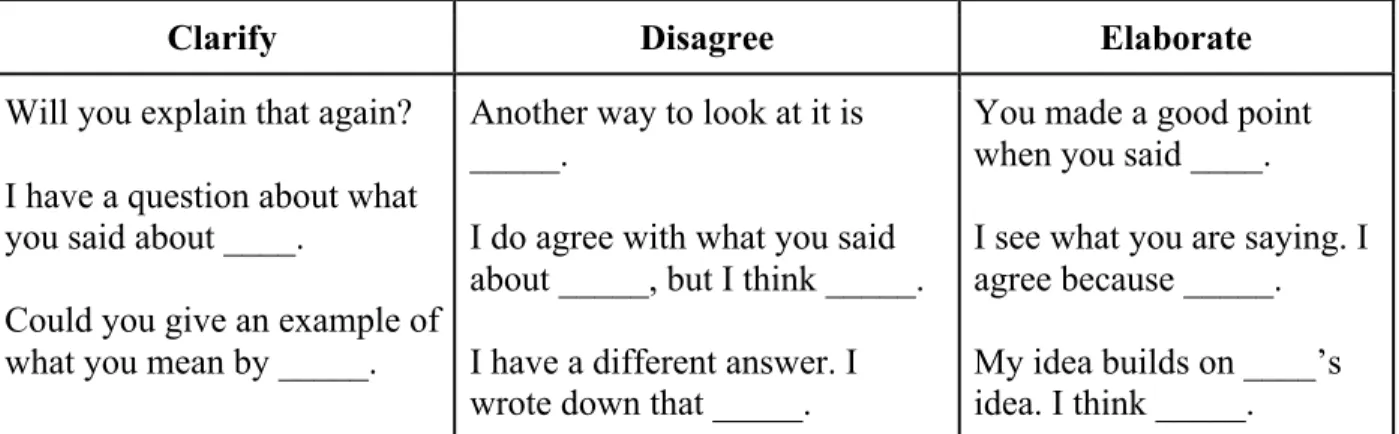
communicating language objectives alongside content objectives in daily lesson plans. These language objectives remind teachers and students alike to pay attention to features of academic English, such as those illustrated here. Language objectives may focus on academic English vocabulary, common academic English
structures, or such language functions such as explaining, defending, and
discussing. Highlighting academic language—however briefly—as an objective in every lesson enhances student awareness of academic English and promotes student achievement (Bielenberg & Fillmore, 2004, p. 49).
Language objectives are then translated into intentional learning activities that engage students in comprehending and producing language in increasingly complex forms. Through meaningful content and engaging activities rich in linguistic interactions, students build the capacity to interact with both the content and language at increasingly complex levels.
As described above, explicit teaching of academic language is beneficial to all students, and is critical for ELL’s and students who speak nonstandard dialects of
23 English. ELL students can appear to understand English when their social language is fluent, but mastering academic language requires carefully planned instructional activities that focus on building language form and function as well as specific vocabulary terms. In the next section, methods that contribute to best practice mathematics learning will be discussed.
Mathematics Teaching Methods
A wide variety of teaching methods contribute to successful mathematics instruction in the classroom, however, an emphasis on standards to guide instruction ensures that students are held to high achievement goals regardless of the textbook or curriculum available. Standards-based instruction started with mathematics standards created by the National Council of Teachers of Mathematics (NCTM). The NCTM first published the Professional Standards for Teaching Mathematics in 1991 (Firmender, Gavin, & McCoach, 2014). Prior to these standards, teachers used textbooks as the primary curriculum, but teaching to instructional content standards has now become the norm expectation in teaching. Over 40 states have adopted the Common Core State Standards (CCSS) (Firmender et al., 2014), which include eight Standards for
Mathematical Practices that “describe how students should interact with and engage in learning mathematical content” (Firmender et al., 2014). The “how” of learning
mathematics is often just as critical in instruction as the “what” of mathematics content. According to Freeman and Crawford (2008), the NCTM standards and principles are widely accepted without much debate, and many states, including Minnesota, have developed state mathematics standards based on the NCTM principles, including a
24 “critical emphasis on principles and processes and promotes exploratory [discovery] learning through ‘real-world’ issues” (Freeman & Crawford, 2008, p. 10).
In 2000, the NCTM published an updated Principles and Standards for School Mathematics (PSSM) that further identifies and emphasizes six fundamental principles for “creating a mathematics learning community that accentuates problem solving, reasoning, and conceptual understandings” (McKinney, Chappell, & Berry, 2009, p. 278). These principles are similar to the mathematical practices in the Common Core State Standards, and promote mathematics instructional activities that help students develop conceptual understanding, flexible thinking, problem-solving abilities, and communication skills (Neumann, 2014). However, traditional mathematics teaching methods that do not align with the NCTM principles and standards continue to be commonplace in elementary classrooms (McKinney et al., 2009). According to Hiebert (1999), the majority of students learn basic arithmetic by eighth grade, as evidenced by the National Assessment of Educational Progress (NAEP). However, students’
knowledge and skills lack depth and conceptual understanding, as evidenced by
performance on any tasks that “require students to extend their skills, reason about them, or explain why they work” (Hiebert, 1999, p. 12). Many teachers continue to use lecture, rote memorization, drill and practice methods, and a set curriculum to teach math because it is how they were taught and it is what they know. Further, in high poverty and urban settings, where the achievement gap is most prominent, instruction that focuses on basic skills without attention to problem solving is even more frequently found as standard practice (McKinney et al., 2009).
25 What does current research say are the best practice teaching methods for
teaching mathematics, especially mathematics that prepares students for complex problem-solving and application-based projects? Major theories agree that
“mathematical ideas must be personally constructed by students as they intentionally try to make sense of situations, and that to be effective, mathematics teaching must carefully guide and support students’ construction of personally meaningful mathematical ideas” (Battista, 2012, p. xv). Most sources support student problem solving and teaching through mathematical reasoning and critical thinking as means of facilitating
understanding (Anhalt, Farias, Farias, Olivas, & Ulliman, 2009; Firmender, Gavin, & McCoach, 2014). Additionally, it is beneficial for teachers to use students’ knowledge and ideas as a starting point for new instruction (Battista, 2012). It is important to note that it is not possible to draw an explicit connection between research and standards. This is because standards are ultimately value statements about the priorities and goals
determined as “best” (Hiebert, 1999). Research can inform standards, but human judgment places value (Sriraman & Pizzulli, 2005). Hiebert (1999) and Sriraman and Pizzulli (2005) offer a discussion of the relationship between the NCTM standards and mathematics research, and the planning and self-reflection required of teachers
committed to including both as the basis for instruction. The process standards offered by the NCTM promote problem solving, reasoning, communication, and other cognitive skills that are much more rigorous than what traditional mathematics instruction approaches encompass (McKinney et al., 2009). Best-practice pedagogy often is cross-categorical and the Principles and Standards of Mathematical Practice set forth by the
26 NCTM are interconnected and equally essential to high-quality instruction. In the
following sections, several components of the principles and process standards will be further explained as they apply to quality mathematics instruction in the elementary classroom.
Representations.
The NCTM Process Standards state that students should be given opportunities to represent mathematics in a “variety of ways: pictures, concrete materials, tables, graphs, number and letter symbols, spreadsheet displays, and so on” (Executive summary:
Principles and standards for school mathematics, 2000).Clements, Battista, Sarama, and Swamintathan (1997) assert the theory that “mathematical understanding is constructed to a large extent in images, many of which are spatial in nature” (p. 172). Developing spatial abilities is considered a valuable skill by the NCTM, is related to mathematical
competencies, and contributes to the development of flexible thinking (Clements et al., 1997). Math manipulatives give students hands-on practice in the formation of basic mathematical understanding, and are an important instructional method in the
introduction of new concepts. Children at the elementary school level primarily reason at the concrete operational stage, making hands-on learning opportunities especially vital in developing new mathematical concepts (Sherman & Randolph, 2004). As noted in the previous section, utilizing hands-on materials is also an important strategy for building EL students’ academic language. Manipulating shapes also plays a role in deductive reasoning at all levels of spatial understanding (Shannon, 2002). Students can start with describing what they know, and use gestures, familiar words, and written drawings
27 symbols to communicate their understanding and reasoning. The NCTM recommends that students are actively involved in measuring objects and space in familiar
surroundings (Sherman & Randolph, 2004). It is also important to note the benefits of students creating and using multiple representations, recognizing that “the term representation refers both to process and to product—in other words, to the act of capturing a mathematical concept or relationship in some form and to the form itself” (Boss, Lee, Swinson, & Faulconer, 2010, p. 264). Representations are used to organize, record, and communicate mathematical ideas (Boss, Lee, Swinson, & Faulconer, 2010).
Representations also include the context for problems and mathematical
reasoning. Capraro and Capraro (2006) studied the effects of utilizing content literature books to create dynamic and interactive learning environments that help students make sense of mathematical vocabulary. The study results indicate improved performance in geometry (Capraro & Capraro, 2006) for middle grades students. Within the context of the literature, students interact with mathematical ideas using the book as a starting point for representing content and vocabulary (Capraro & Capraro, 2006). Martiniello (2009) describes the effects of utilizing pictorial and schematic representations to help ESL students make sense of linguistically complex text. Connecting to what students already know helps all students build upon their knowledge as they develop more sophisticated mathematical and linguistic understandings. In schematic representations, relationships between elements or parts are used to make connections and instruct meaning
28
Communication.
Many important mathematics instructional strategies utilize language and communication tools. Math talks, teacher-student discussion, and small-group student discussion all can be used to help students develop and further process mathematical understanding (Bresser et al., 2009). According to the NCTM, mathematical
communication allows students to further their understanding by sharing their own ideas and analyzing the ideas of others (Firmender, Gavin, & McCoach, 2014). Student talk as a mathematics instructional activity leads to increased understanding in two ways: the teacher can formatively assess students’ mathematical thinking and the act of talking itself can help develop deeper understanding (Franke et al., 2009). To elaborate on the latter, as students describe, explain, and justify their thinking, they “internalize principles, construct specific inference rules for solving problems, [and] become aware of
misunderstandings and lack of understanding” (Franke et al., 2009, p. 381). Using classroom discussion and small group talk is also a primary strategy in best practice recommendations for teaching ELL’s, as discussed in the academic language section previously. Students learn from each other as they talk through challenging mathematical problems. “Thinking together” encourages students to strive for “clarity and justification of ideas that push them to think about the quality and nature of abstract ideas” (Zwiers, 2008, p. 139). Often, these abstract ideas are the very essence of academic language skills students must develop in order to master academic content.
Despite the many benefits of student voice in the mathematics classroom, there are also challenges to consider. When students are expected to be able to “communicate
29 mathematically, both orally and in writing, and to participate in mathematical practices such as explaining solution processes, describing conjectures, proving conclusions, and presenting arguments” (Chen & Li, 2008), students with limited English language skills are at a disadvantage and require additional instructional support. Many mathematics word problems are made up of complex sentences with multiple subordinate and independent clauses (Barrow, 2014). Students must be able to navigate both the context of the problem, which may be unfamiliar, as well as comprehend the language used. Multiple opportunities to practice comprehending such problems with scaffolded strategies such as acting out the problem, creating visual support diagrams, and
identifying key terms are just some of the ways teachers can help ESL students and all students navigate mathematical discourse (Barrow, 2014).
When students are asked to explain their thinking rather than just give an answer or repeat a formula or procedure, they are developing the cognitive skills needed to learn new information (Neumann, 2014). “Sharing strategies also enables other students in the classroom to become flexible thinkers because they are now aware of other ways to solve a problem. These alternative strategies may be more efficient, easier to perform, or simply present a different method than the student had first considered” (Neumann, 2014, p. 3). Additionally, listening to others’ explanations gives students the opportunity to deepen their own understanding, and multiple perspectives contribute to sharper thinking and connected ideas (Boss et al., 2010). Speaking in groups and listening to peers is authentic and rich language practice for ESL students. Teachers can clarify, but the explanations and ideas are constructed in the students’ own words. By providing support
30 and instruction for all students to meet rigorous expectations, students learn to be “clear, convincing, and precise in their use of mathematical language” (Executive summary: Principles and standards for school mathematics, 2000). Precision is important when eliciting student responses, so that the teacher and other students can understand their ideas and support or clarify mathematical understanding as necessary (Franke et al., 2009).
One commonly used strategy in teaching mathematics is having students work together in small groups to discuss and solve problems. Edwards (2003) conducted a study on the effects of collaborative problem solving within fifth and sixth grade classrooms consisting of native English speaking and ELL students. The results were mixed, showing mostly positive improvement in students’ overall problem solving skill, but also noting that not all students could gain maximum benefit from the setting
(Edwards, 2003). English Language Learners must have appropriate support and feel comfortable participating with their peers. Cohen suggests the use of assigned roles, such as summarizer, recorder, and “checker,” to encourage active participation (cited in Edwards, 2003). When organized to maximize student engagement, small group learning can give students opportunities to learn using several of the methods described in this section, including hands-on learning, real-world problem solving, and discussion of academic content.
Engagement.
Engagement is a measure of the student's "involvement in learning tasks, or the extent to which behavior aligns with teacher expectations" and includes active behaviors
31 such as asking and answering questions as well as passive behaviors such as listening and writing (Lan et al., 2009, p. 200). High levels of student engagement can be achieved in both large-group and small-group settings, though the success of each is dependent on several factors, including teacher organization. When teachers organize instruction with proactive strategies towards student behavior and self-regulation, students are more engaged in learning (Lan et al., 2009, p. 199). The socio-cultural theories initiated by Vygotsky argue that significant learning takes place through social interaction, and in the mathematics classroom, this means engaging students in teacher-student interaction or student-to-student interaction (Firmender, Gavin, & McCoach, 2014). Engagement strategies also help students utilize and develop language in the content areas. In the study by Hwang, Lin, Ochirbat, Shih, and Kumara (2015), students engaged in giving and receiving peer-to-peer feedback during a technology-integrated project. Peer assessment enhanced higher-level thinking and promoted high student motivation. Students were also more receptive to peer suggestions when compared with single instructor assessment (Hwang, Lin, Ochirbat, Shih, & Kumara, 2015). The research study conducted by Sherman and Randolph (2004) showed how classroom discussion can be used as a quick and effective tool for correcting student misunderstandings by sharing and analyzing correct and incorrect responses. In mathematics, engaging students effectively leads to learning that extends beyond rote memorization to applied understanding.
Equity.
The NCTM Principles and Standards for School Mathematics (Executive
32 can learn mathematics when they have access to high-quality mathematics instruction. This includes setting rigorous expectations for all students and using alternative methods of instruction that meet students’ differentiated needs. McKinney, Chappell, and Berry (2009) recommend that teachers who promote the equity principle in their classrooms “strive to address students’ learning profiles, learning preferences, readiness levels, and cultural differences so as to tap into all students’ capabilities and unique strengths that they bring to mathematics understandings.” The equity principle is also a key component of best practice for academic language instruction to support ELLs. Many research studies connect the significant influence of students’ oral and literacy experiences outside of school with access to learning and success at school (Zwiers, 2008). By taking a critical look at not only the mathematics content but also the reading, writing, speaking, and thinking skills expected to meet the criteria and expectations in the classroom, and then making those expectations explicit and clear, the gap between non-mainstream and mainstream students narrows (Zwiers, 2008).
Geometry
“The word geometry was derived from the Greek words with the original meaning of measuring the land.” (Hwang, Lin, Orchirbat, Shih, & Kumara, 2015, p. 27). Geometry was a key component in the study of mathematics from the time of the ancient Greeks until about the 1960’s (Shannon, 2002). This study of geometry was based in deductive reasoning, but has gradually been replaced in recent years by a heavy emphasis on
numerical reasoning and less on spatial reasoning (Shannon, 2002). Today, when students learn geometry they study shapes, space, and the tools used to measure and define them.
33 Geometry is an essential building block towards advanced math and science (Hwang, et al., 2015). As such, the traditional and typical methods in elementary school mathematics of memorizing and calculating formulas are not enough in teaching geometry. Students are much more motivated when geometry is taught through methods that “enhance children’s imagination, critical thinking, and spatial reasoning” (Hwang et al., 2015, p. 27). Furthermore, a strong spatial awareness is applicable in many problem-solving situations outside of the classroom, such as parking cars, playing tennis, putting up shelves, and in vocations such as brick-laying, dress-making, and drafting (Shannon, 2002). Burns (2007) also emphasizes the real-world importance of spatial reasoning skills, offering examples that adults encounter such as “when having to figure quantities for wallpaper, floor covering, paint, fabric, lawn needs, or a myriad of other home projects” (p. 108) and the vocational industries of building trades, interior design, and architecture.
When students are only taught to memorize formulas, their understanding lacks a foundation in concepts of shape and physical awareness. When geometry is taught with an understanding of how students construct knowledge, the resulting student learning has meaning and a foundation in spatial structure (Battista, 1999). The National Council of Teachers of Mathematics (NCTM) also recommends that students be given opportunities to develop understandings and procedures through investigation rather than memorize prescribed formulas (Capraro & Capraro, 2006). Geometry is full of formulas and procedures, such as calculating the area of a rectangle. Hwang, Lin, Ochirbat, Shih, and Kumara (2015) give examples of having students find the surface area of various blocks
34 and boxes, study and make observations about shapes in the world around them, and other real-world applications of basic geometric principles. When students are guided through learning activities that lead to the construction of mathematical ideas, the resulting knowledge is personally meaningful and less fragile when applied to new problems (Battista, 2012).
One important concept that is part of the MN State Standards for Mathematics in fourth grade is the concept of angles. Devichi and Munier (2013) summarize previous research on children’s construction of the angle concept following a historically Piagetian approach. “The same steps are taken to build representational space as those taken for perceptual-motor space” (cited in Devichi and Munier, 2013, p. 2). A common
misconception for students when comparing angle size is to focus on the length of line segments rather than recognizing the two-dimensional space in relation to lines (Devichi & Munier, 2013). Students also “frequently fail to recognize that two angles are the same measure if they are oriented in non-standard directions” (cited in Smith, King, & Hoyte, 2014, p. 96). Typical classroom activities such as worksheets or identifying and
classifying angle examples on the board make it difficult for students to jump straight to abstract thinking and understanding without any concrete understanding to build upon (Smith, King, & Hoyte, 2014). Activities that allow students to manipulate and explore relationships with concrete objects, as well as activities with dynamic elements, have been shown to have the most positive impact in teaching angle concepts to young learners (Devichi & Munier, 2013). Body-based movement activities in which students act out angle movements provide the opportunity for students to draw connections in the
35 development of the mathematical concepts (Smith et al., 2014). Visual representations also play an important role, providing documentation for what students do and see and facilitating connections between the concrete and abstract representations (Smith et al., 2014). Keeping this research in mind along with possible implications for other geometry and measurement concepts will be important in the construction of a successful
curriculum plan.
Another geometry and measurement concept included at the fourth grade level is understanding and calculating area and perimeter for rectangles and geometric figures that can be divided up into rectangular shapes. This can be very challenging for students, as argued by Sherman and Randolph (2004), citing statistics from the National
Assessment of Educational Progress (NAEP) and other sources that show “that fourth and eighth grade students sometimes confuse area and perimeter” and “that this lack of
understanding continued to affect children in older grades” (Sherman & Randolph, 2004), p. 26). It is important that students develop an understanding beyond simply memorizing formulas in order minimize student misconceptions such as these. There are many
drawbacks to not taking the time to build conceptual understanding of geometric concepts such as area and perimeter. Sherman and Randolph (2004) argue that “memorizing
misunderstood formulas is a short term solution that does not provide for long term retention, conceptual understanding or procedural skills” (p. 35).
Conclusion
Freeman and Crawford (2008) state, “To understand mathematics, a student needs to be able to read, solve problems, and communicate using technical language in a
36 specialized context (p. 12). For English Language Learners, this is no easy task. Teachers of ESL students must utilize specific and engaging strategies to facilitate student learning of both academic language skills and mathematics content. Chapter 2 has outlined several important components necessary for teaching mathematics to ESL students. Academic language considerations are vital for making academic content accessible for ESL students and benefit other students as well. Mathematics teaching methods are rooted in the standards that guide best-practice mathematics instruction and teaching strategies that have been proven to work well.
It is important to rely on evidence-based strategies when designing effective learning activities, which in this case will meet the goal of exploring the research
question: How can a mathematics geometry curriculum unit be organized to support and develop academic language for fourth grade students through meaningful engagement strategies? The learning and themes gathered in this literature review will now be used in the creation of an effective and engaging curriculum unit for a fourth grade mathematics class in the area of geometry and measurement. Chapter 3 will describe the curriculum design process that will be guide and shape the learning plans and curriculum unit.
37
CHAPTER 3
Methods
Overview
Previous chapters have discussed the need for and benefits of a mathematics curriculum that develops students’ academic language through academic content. This is a need within my current school setting, as I will describe further in this chapter. It is also a need in diverse classrooms everywhere, and it is my hope that the geometry curriculum developed through this capstone project will be a helpful resource for others teaching fourth grade mathematics as well. I am exploring the research question: How can a mathematics geometry curriculum unit be organized to support and develop academic language for fourth grade students through meaningful engagement strategies?
This chapter will begin by detailing the rationale and outline by which I have organized the unit and lessons, based on the Understanding by Design framework by Wiggins and McTighe (2005). I also give attention to the work of Battista (2012) that outlines mathematical understanding as a cognitive process rooted in logical reasoning and the WIDA Standards Framework (“WIDA ELD Standards”), which organizes the
38 necessary supports for ELL students at all proficiency levels to access the academic content and cognitive thinking processes. The next section describes the setting and participants for which the curriculum unit is designed. More detail regarding the planning for language and cognition is included in the desired results, assessment evidence, and learning plan sections. Finally, Chapter 3 will conclude by describing in detail a plan for developing each element of the mathematics geometry curriculum unit that will support and develop academic language for fourth grade students through meaningful
engagement strategies.
Curricular Framework
The curriculum unit is designed using the Understanding by Design framework as developed by Wiggins and McTighe (2005). Understanding by Design calls for planning with the end in mind and ensuring that all elements of the lessons planned align with the overall goals for student learning. The first step in backwards design is to determine goals (Wiggins & McTighe, 2005). In this unit, goals are derived from the Minnesota State Standards in Mathematics for fourth grade. The planned unit goals also consider levels of language and levels of mathematical understanding, as informed by the WIDA Standards for Language Acquisition (“WIDA ELD Standards”), the Cognition Based Assessment (CBA) Levels of Understanding of Geometric Shapes (Battista, 2012), and other literature sources as referenced in Chapter 2. In the Understanding by Design process, enduring understandings, essential questions, knowledge, and skills are identified in alignment with the standards-based unit goals (Wiggins & McTighe, 2005).
39 reading, writing, speaking, and listening and communicated to teachers and students through content and language objectives. Needs across all language dimensions are considered, including discourse, sentence, and word/phrase, and will be included in the unit goals. Keeping the focus on the “big ideas” or enduring understandings is important in order to promote academic talk and thinking in deep and connected ways (Zwiers, 2008). Specific attention to the less obvious and more general academic terms,
grammatical structures, and content-specific vocabulary will require attention as language and content outcomes are identified.
The next step in the design process is to select assessments that will accurately and logically measure the identified goals (Wiggins & McTighe, 2005). The final step in backwards design is to select or create engaging and appropriate learning activities (Wiggins & McTighe, 2005). The learning activities included in the proposed curriculum unit align with the several of the teaching best practices for academic language and mathematics instruction highlighted in Chapter 2, including math talks, collaboration, math manipulative use, and technology integration.
It is important to note that the design process following the Understanding by Design framework is not a linear plan (Wiggins & McTighe, 2005). The elements of goals, assessments, and learning activities are carefully developed with the mindset of always prioritizing the overall goal of aligning all elements to maximize student learning through concurrent engagement with academic content and language skills. The end product is an organized unit consisting of carefully chosen goals, assessments, and learning activities that other teachers and I can follow for teaching in a fourth grade
40 classroom setting. More specific details about the school and students for which this curriculum unit is designed are described in the next section.
Setting and Participants
This curriculum unit is designed for fourth grade students at an elementary school in a large suburban district of the Twin Cities area in Minnesota. According to the
Minnesota Department of Education website’s “Minnesota Report Card”, in 2016, this elementary school has a total enrollment of 702 students in pre-kindergarten through fifth grade. The school is racially diverse, with 38.5% of students identifying as Black, not Hispanic origin, 31.6% of students identifying as Asian/Pacific Islander, 20.7% of students identifying as White, not Hispanic origin, 8.4% of students identifying as Hispanic, and 0.8% of students identifying as American Indian (“Minnesota Report Card,” 2016). At the school, 23.4% of all students are English Learners, and 12.0% of all students are Special Education students. 64.5% of students participate in the
Free/Reduced Price Lunch program and 1.9% of students reported as homeless.
(“Minnesota Report Card,” 2016). This information about student demographics plays an important role in the planning and creation of curriculum. Mathematics content lessons that focus on building academic language will benefit all students, but will especially benefit English Learners, who make up nearly one-fourth of the student population at the school.
There are four sections of fourth grade for the 2016-2017 school year, each with an average of 28 students. Each class is a heterogeneous mix of gender, race, and ability. English Language Learners at the school come from a variety of home language
41 backgrounds, including Hmong, Vietnamese, Lao/Laotian, Russian, Arabic, and Spanish. Most are first or second generation Americans, and were born in the United States, but a few students have moved here more recently. Students use their home language for speaking and listening in social and everyday situations at home and sometimes among friends. About half of the parents of English Language Learners have some English language understanding, and some students have older siblings or other family members who are fluent in English who provide academic support at home such as helping with homework.
Fourth grade students learn the core subjects of math, language arts, science, and social studies within their homeroom classroom. Sixty minutes each day are scheduled for math instruction. As of the 2016-2017 school year, every fourth grade student in the district has use of a district iPad for school and home use. Utilizing this technology in the development of new curriculum offers many opportunities to support and extend learning for all students. The curriculum unit developed will teach the Minnesota state standards in Mathematics from the geometry and measurement strand. The district and school currently use Math Expressions (Fuson, 2008) curriculum; however, many students struggle with this curriculum so teachers often use additional resources to supplement.
It is my hope to not only create an organized geometry curriculum unit that will be used year after year without piecemealing together various activities, but also differentiate to meet the specific needs of English Learners and other students who are developing academic vocabulary and language skills for classroom discourse. Keeping in mind the mathematics content standards and the academic language skills necessary for
42 accessing the content will be the focus that drives the planning of this curricular unit. The next section will outline the steps of the planning process within the Understanding by Design framework.
Curriculum Elements Desired results.
The first stage in the Understanding by Design process is to identify curricular goals. There are many possible approaches for beginning this stage of the design process, including studying the essential language features at the discourse, sentence, and
word/phrase levels, analyzing the ideas in state content standards, considering real-world applications, beginning with an existing resource or favorite activity, reflecting around a key skill, focusing on an important assessment, or starting with an existing unit for
refinement (Wiggins & McTighe, 2005). I have chosen to focus on identifying goals from the standards, which in this setting are the Minnesota State Standards in Mathematics. First, the mathematics content standards from the geometry strand were analyzed in consideration of unit goals, including necessary knowledge and skills. The WIDA
Framework for Language Development was then consulted to align and identify language skills that students will need in order to successfully access the mathematics content. Figure 3.1 below shows the fourth grade geometry and measurement benchmarks from the Minnesota State Standards in Mathematics that are used as the starting point for developing the lesson and unit goals.
43 4.3.1.1 Triangles
Describe, classify and sketch triangles, including equilateral, right, obtuse and acute triangles. Recognize triangles in various contexts.
4.3.1.2 Quadrilaterals
Describe, classify and draw quadrilaterals, including squares, rectangles, trapezoids, rhombuses, parallelograms and kites. Recognize quadrilaterals in various contexts. 4.3.2.2 Compare & Classify Angles
Compare angles according to size. Classify angles as acute, right and obtuse. Figure 3.1. 4th Grade Geometry and Measurement Benchmarks
It is important to note that the Mathematics Standards provide benchmarks for defining what fourth grade students are expected to know and be able to do at the end of the curricular unit. What the benchmarks lack is a description of the developmental levels that lead to students obtaining the desired knowledge and skills. In the next section, a more detailed geometric framework as supported by the work of Battista (2012),
Clements and Sarama (2009), and others will be described as it applies to the goals of this curricular setting.
The process of determining desired results and setting unit goals is carried out in a fluid process along with the two stages that follow: the assessment evidence and the learning plan. As noted in the Curriculum Framework section, the Understanding by Design framework is not intended to be a strict sequence but rather a flexible process that results in an organized and logical product (Wiggins & McTighe, 2005). Battista’s (2012) levels of reasoning of Geometric Shapes are situated within the Cognition Based
Assessment (CBA) system, so references to assessment and cognition level are correlated.
44
Cognition Based Assessment of Geometric Reasoning.
Before specific levels of geometric reasoning are detailed in the following sub-sections, the distinction must be made that the defined levels are designed to highlight and assess thinking and reasoning, not levels of students (Battista, 2012, p. 47). That is to say, some students may operate at more or less advanced levels of reasoning when presented with different tasks, dependent on background knowledge, availability of physical manipulatives, connections to other problems, or a variety of other factors (Battista, 2012). The following sub-sections will describe characteristics of each level of reasoning, as well as implications for lesson planning and classroom discussion.
Level 1: Visual-Holistic Reasoning. The most basic level of geometric reasoning within the context of a Cognition Based Assessment (CBA), as described by Battista (2012), is Visual-Holistic Reasoning. Students at this level see and identify shapes as whole objects, base their understanding in what an object “looks like,” and use familiar objects to define and make connections (Battista, 2012). Shapes are recognized as wholes, but the student can’t yet define attributes or properties of shapes (Clements & Sarama, 2008). Orientation of shapes greatly affects students’ reasoning at Level 1 (Battista, 2012). For example, students commonly misidentify shapes if the figure is “upside down,” or use rotation to justify an incorrect shape name. While the majority of fourth grade students are capable of reasoning beyond Level 1 of the CBA system (Battista, 2012), misconceptions that stem from viewing shapes as wholes are common and must be addressed in developing geometric understanding that meets the standards and benchmarks outlined previously.