Leader Ethics and Organizational Commitment
Teresa Watson
Winner of the Prize for Outstanding Quantitative Paper Presentation
at the Mid-Atlantic Leadership Scholars Forum, April 2010
Teresa Watson is the Contracting Program Manager for the Coast Guard in Chesapeake, Vir-ginia. Ms. Watson is a PhD student in Leadership and Organizational Development in Regent University’s School of Global Leadership and Entrepreneurship. In addition to the paper that she presented at Christopher Newport University on Ethical Leadership, Ms. Watson presented a scholarly paper on Narcissistic Leadership at Regent University’s 2010 Leadership
Roundtable in Servant Leadership. Her current research interests focus on examining contextu-al factors that may impact the leader-follower relationship.
Abstract
Public examples of corruption and wrongdoing by managers have led to an increase in interest about ethically sound behaviors and decision making within organizations. One question asked is whether or not an employ-ee’s perception of a leader’s values will impact their relationship with the organization? This study references findings by Brown, Trevino, and Harrison (2005), Mayer et al. (2008), Peterson (2002), and White and Lean (2008). The study, based on a study conducted by Herrbach and Mignonac (2007), examines employees’ per-ceptions of a leader’s values of courtesy, consideration, fairness, moral integrity, and social equality as percep-tions of ethical leader values and examines the impact of these perceppercep-tions on the employees’ level of organi-zational commitment. Results indicate an employee’s perception of a leader’s ethical values has the potential to impact the employee’s level of organizational commitment. The study results contribute to the body of re-search examining employees’ perceptions about their leaders’ ethics and the potential impact on the organiza-tion itself.
Leader Ethics and Organizational Commitment
Recently ethical leadership has become prominent in the media due to public examples of corporate executives epitomizing corruption and wrongdoing. This increasing interest and the desire to better understand ethical conduct and decision-making has led to much speculation about the nature of ethical leadership as well as its impact within an organization. Maxwell (2003) asserts that “there are only two important points when it comes to ethics. The first is a standard to follow. The second is the will to follow it” (p. 23). Soutar et al. (1994) reported that most unethical behavior in business environments involve acts that adversely affect one of three entities: the organization, co-workers, or the customers. As such, ethical behavior of a leader in an organ-ization is an appropriate level of inquiry as an ethical standard may be personified in the form of a leader’s be-havior.
Supervisors deliver an organization’s vision to their subordinates in order to build up value and organi-zational commitment. They also have to lead by example and give subordinates the best model to follow. Giv-en that their behaviors directly affect employee outcomes, ethical leader behaviors may result in higher em-ployee satisfaction, commitment, and productivity. Since a leader’s behavior may be viewed as representative of the organization’s environment, these reflections (either positive or negative) may impact an employee’s perceptions of the leader as well as their organizational commitment.
Theoretical Background and Hypothesis Development
Literature Review
Various studies have addressed the impact of leader values: Peterson (2002) reported findings wherein the perceived impact of the leader’s values affected employees’ intentions; the leader’s power and authority set the tone and ethical atmosphere of the organization (Trevino, 1986); perceived leader values impacted ethical behavior of followers (White & Lean, 2007); Wayne and Green (1993) showed that corporate leadership was strongly associated with employee behavior at the individual level, and team leaders influenced their organiza-tional environment through their management techniques and their leadership abilities (Thamhain, 2004).
Values as Representative of Ethics
Morality is “the discipline that is dealing with what is good and bad or right and wrong; A group of moral principles or a set of values” (Jackson, 1984, p. 319). According to Carnell, “Ethics is the science of conduct, and the fundamental problem of ethics is determining what constitutes proper conduct” (1948, p. 315). In order to apply this definition to practical decision-making, it is necessary to specify the nature of the moral obligations considered intrinsic to ethical behavior through individual values.
Rokeach (1979) defines value as “an enduring belief that a specific mode of conduct or end-state of existence is personally or socially preferable to an opposite or converse mode of conduct or end-state of exist-ence,” while Nystrom (1990) defines values as “normative beliefs about proper standards of conduct and pre-ferred or desired results.” Although these definitions differ, they both imply that values are viewed outside of one’s self.
McDonald and Gandz (1991) conducted empirical research on values relevant to business research to derive 24 work values from interviews with representatives of business industries. According to Dose (1997), ethical values are considered relevant not only at the individual level but also at the organizational level. As such, the intersection and relation between personal values of a leader and organizational values may be rele-vant (Agle & Caldwell, 1999). Herrbach and Mignonac’s (2007) business work values are identified by McDonald and Gandz to derive work values that corresponded to ethical behavior. They selected values of courtesy, consideration, fairness, moral integrity, and social equality in an application of ethical behavior where their results indicated a tendency toward higher beneficial outcomes when individuals perceived that their companies endorsed ethical values. The implication here is that companies can benefit from being per-ceived as ethical to generate commitment and other beneficial outcomes.
Leader Values and Employee Behavior
Some researchers have presented theories that different values reflect different aspects of ethical behav-ior. For instance, Fritzsche and Oz (2007) found that a set of values comprising a value structure (altruistic val-ues) was positively related to ethical behavior and another set of values defining a value structure
(self-enhancement) was negatively related to ethical behavior. Thus, values do appear to be related to behavior. Several empirical studies have demonstrated how values impact personal and organizational effective-ness. For instance, Meglino et al. (1989) demonstrated that an accurate understanding of the job requirements and the organization’s values enhanced employees’ adjustment to their jobs as well as their subsequent level of satisfaction and organizational commitment. Shared (person-organization) values have reflected a direct rela-tionship to positive work attitudes (Posner et al., 1985; Balazas, 1990). The fit between person-organization values has predicted job satisfaction and organizational turnover (O’Reilly et al., 1991). Social exchange theo-ry (Settoon et al, 1996; Wayne et al, 1997) suggests that when team members perceive that they are being treated ethically, they will feel an obligation to reciprocate this positive behavior to the organization. There-fore, if the leader, who is perceived as an agent of the organization, creates an atmosphere of trust and loyalty through positive, personal integrity, the team member will replicate the leader’s behavior and display positive, responsible behavior.
Brown, Trevino, and Harrison (2005) defined ethical leadership as “the demonstration of normatively appropriate conduct through personal actions and interpersonal relationships, and the promotion of such con-duct to followers through two-way communication, reinforcement, and decision-making” (p. 120). Mayer, Kuenzi, Greenbaum, Bardes, and Salvador (2008) presented findings that indicated that leaders play an im-portant role in the occurrence of both dysfunctional and positive behaviors of employees in organizations through processes such as modeling behavior and implementing policies. Studies have shown a positive rela-tionship between leader fairness and citizenship-type behavior: leader fairness accounted for variance in altru-ism among employees (Farh et al., 1990) and leader fairness was associated with subordinate intentions to en-gage in organizational citizenship behavior (Williams et al., 2002).
Dubinsky et al. (1989) presented findings that indicated a positive correlation between job satisfaction and organizational commitment. Findings from a study by Dale and Fox (2008) are similar to results obtained by Pearce (1981) and Randall and Code (1991) that suggest that supervisory consideration lends congeniality to the work environment that can enhance workers’ emotional needs as well as the development of social in-volvements. It is conceivable that it is through the supervisor that the employee begins identifying with the goals of the organization and internalizing its values. The actions of the supervisor may be viewed as actions of the organization itself; thus the organization is personified through the supervisor.
Leader Ethical Values and Organizational Commitment
Organizational commitment is traditionally defined as “a strong belief in and acceptance of the organi-zation’s goals and values, a willingness to exert considerable effort on behalf of the organization, and a defi-nite desire to maintain organizational membership” (Mowday, Porter, & Steers, 1979, p. 604). Within this study, the focus is on the multidimensional construct identified by Meyer and Allen (1991) expressed in the following three forms: continuance commitment (instrumental evaluation of organizational membership), af-fective commitment (emotional attachment to the organization), and normative commitment (perceived moral obligation to remain in the organization). According to Cullen, Parboteeah, and Victor (2003), only a small number of studies have examined the relationship between issues related to ethics and organizational commit-ment. While Rich (1997) bypasses the issue of commitment, he is one of a number of researchers to suggest that the role model of managers, including the manager’s ethical behavior, influences an employee’s job per-formance. Peterson (2004) showed that employee organizational commitment is related to the perception of employer ethicality. Of the three forms, affective commitment and normative commitment are potentially re-lated to ethical values. Meyer & Herscovitch (2001) describe affective commitment as developing when an individual becomes involved in, recognizes the value-relevance of, and derives their identity from association with an organization. Normative commitment develops as a result of the internalization of norms through
so-cialization, the receipt of benefits that induces a need to reciprocate, or acceptance of the terms of a psycholog-ical contract. As such, both forms of commitment have the potential to be impacted by an employee’s percep-tion of a leader’s values.
In a study of ethical value congruence, Herrbach et al (2007) determined that followers’ perceptions of organizational ethical values were found to be directly associated with organizational commitment, job satis-faction, perceived procedural justice, adaptive behaviors, and turnover intentions. Erben and Guneser (2008) found that climate regarding ethics played a mediating role between benevolent paternalistic leadership and affective commitment. Carlson (2005) presented findings that indicated that higher perceived leader integrity related to a higher level of affective commitment. Dubinsky and Levy (1989) presented findings where organi-zational fairness was identified as being positively related to organiorgani-zational commitment. As such, leaders, be-ing role models for employees in displaybe-ing behaviors that are ethically acceptable, play an important role in forming psychologically meaningful perceptions concerning ethical procedures and policies in an organization which, in turn, affects the commitment of the employees to the organization.
Hypothesis 1 (H1): The employee’s perception of a leader’s values will impact their view of the organ ization such that the employee’s level of commitment to the organization will be positively correlated with a leader’s values that are considered ethical.
Leader Ethics, Values, and Subordinate Effect
Results from Peterson’s (2002) study demonstrated that deviant workplace behavior could be partially predicted from the ethical climate of an organization. Schminke et al. (2005) provided results indicating that the correlation between leader moral development and ethical climate was moderated by the degree to which the leader used his or her moral development. They further found that the leader’s moral development and the consistency between the leader’s moral development and actions interacted to affect ethical climate. Team leaders influenced their organizational environment through their management techniques, leadership abilities, assignment organization, monitoring, and performance rewards (Thamhain, 2004). Team leaders exercising this control define the environment through their own actions and, thus, build either a favorable, moral, team-friendly environment, or they build an environment based on selfish, unethical actions designed to achieve in-dividual goals.
White and Lean (2008) found that perceived leader integrity does indeed have an impact on the ethical intentions of team members. The relationship was strongest in ethical situations impacting the team itself and the organization as a whole.
Papavero (2009) describes relativism as “a personal moral philosophy where the correctness of a moral judgment is not considered absolute. Rather, moral judgment is correct relative to the convictions and practices of a culture. Relativists consider situation and personal values over ethical principles when making
deci-sions” (p. 30). In contrast, Papavero (2009) describes universalism as “a personal moral philosophy where the correctness of a moral judgment is based on absolute and universal principles” (p. 31). Peterson (2004) pre-sented findings that indicated a different impact of a leader’s perceived ethical integrity when the follower ad-hered to a universal code of ethics as opposed to a relativist code of ethics. His findings indicated that a lead-er’s influence on subsequent behavioral intent was higher for those individuals who did not adhere to a univer-sal code of ethics.
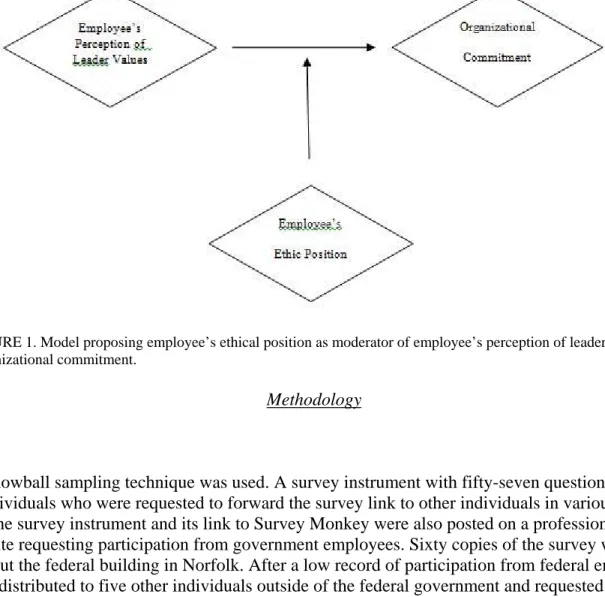
Hypothesis 2 (H2): The impact of an employee’s perceptions of a leader’s values on the employee’s level of commitment to the organization will be moderated by the employee’s ethics position such that when an employee’s ethics position is idealistic, the impact of the employee’s perception of the lead er’s values will be higher.
FIGURE 1. Model proposing employee’s ethical position as moderator of employee’s perception of leader values and organizational commitment.
Methodology
Sample
A snowball sampling technique was used. A survey instrument with fifty-seven questions was forward-ed to 10 individuals who were requestforward-ed to forward the survey link to other individuals in various government agencies. The survey instrument and its link to Survey Monkey were also posted on a professional associa-tion’s website requesting participation from government employees. Sixty copies of the survey were distribut-ed throughout the fdistribut-ederal building in Norfolk. After a low record of participation from fdistribut-ederal employees, the survey was distributed to five other individuals outside of the federal government and requested to be distribut-ed to as many persons as possible. This distribution creatdistribut-ed a relatively homogenous sample in terms of length of socialization in the workplace. The email message included the link to Survey Monkey, the questionnaire addressing the variables of interest, and a cover memo that assured respondents that confidentiality would be respected. As an incentive, participants were offered a copy of the study findings in exchange for returning their questionnaire and a chance to have their name placed in a drawing for one of two Starbucks giftcards.
Measures
The survey instrument consisted of three independent sections.
The ethical views of respondents have been assessed in order to incorporate potential effects in relation to universalism and relativism as derived from Peterson’s (2004) study findings. This study uses Forsyth’s (1980) Ethics Position Questionnaire (EPQ) which measures two orthogonal dimensions of moral philosophy, idealism and relativism, using 10 items per dimension. Each item is rated using a scale of 1 = Strongly disa-gree and 5 = Strongly adisa-gree.
Perceived ethical values of supervisors have been measured using items taken from the set of values identified by McDonald and Gandz (1991). Five values have been selected as representative of ethical behav-ior: courtesy, consideration, fairness, moral integrity, and social equality. Respondents have been asked to rate their work values on a five-point scale anchored with the adjectives “not important” and “extremely important” with respect to their perception of how their supervisor regards the value. The five values of ethical behavior were originally derived by Herrback et al. (2007) where interaction effects were found for affective
commit-ment, job satisfaction, and perceived organizational justice. Organizational commitment is measured using the 22-item Organizational commitment Scale developed by Meyer and Allen (1997). It has three subscales: affec-tive, continuance, and normative commitment. The affective commitment scale has eight items to assess how the individual feels about remaining with the organization. The normative commitment scale, consisting of six items, assesses the level of obligation an individual feels to continue with the organization. The continuance commitment subscale measures eight items and assesses the costs associated with leaving the organization and availability of attractive alternatives. Responses are obtained on 5-point Likert-type scales where 1 = Strongly disagree and 5 = Strongly agree. Semi-structured questions were added to collect information for the control variables of age, gender, length of time at organization, and type of agency.
Analytical procedures
Data analysis is conducted in three phases. First, factor analysis is conducted on the five items to be used as representative of the perception of leader ethical values. Second, all scales and subscales are subjected to reliability analysis. Third, hierarchical regression analysis is used to test the hypotheses.
Results
A student t-test has been performed on the leader ethical values as data were collected from two sepa-rate groups. A p-value of .156 means that the means for ethical values are not different between the two groups. The difference between the sample means is .39. The t-value is .96 and the degrees of freedom is 53.
Factor Analysis
Exploratory factor analysis shows that the five values of courtesy, consideration, fairness, moral integ-rity, and social equality are highly correlated and loaded onto one scale. As verification of the construct result-ed from the factor analysis, the five values are identifiresult-ed under the heading of leader ethical values in subse-quent analyses within this paper.
Reliability Analysis
The dependent variable in the study is organizational commitment comprised of three subscales: nor-mative, affective, continuance. As shown in Table I, the coefficient alpha values for normative commitment of .82 and continuance commitment of .83 are consistent with previous studies which indicated a range be-tween .65 to .86 and a range from .69 to .84, respectively (Fields, 2002). The coefficient alpha value for affec-tive commitment (r = .67) was somewhat lower than that obtained from previous studies. The independent var-iable in this study is employee perception of leader ethical values. The leader’s ethical values are represented by five work values: courtesy, consideration, fairness, moral integrity, and social equality. There are three con-trol variables in the study: age, gender, and length of service in the organization. Prior studies suggest that age and gender may be related to ethical attitudes (Ford and Richardson, 1994). Prior studies also indicated a rela-tionship between length of service and affective commitment (Robin and Babin, 1997). The moderating varia-ble is employee’s ethical position which is represented by idealism and relativism. The summary statistics and reliabilities for the relevant variables are presented in Table 1.
Table 1
Means, standard deviations and reliability coefficients of scales and subscales
Notes: Ethical values = courtesy, consideration, fairness, moral integrity, and social equality
The moderating effect of the employee’s ethics position was presented in a study conducted by Peter-son (2004). The correlation coefficients for the relevant variables are presented below in Table 2.
Table 2
Intercorrelations between Scales and Subscales
**Correlation is significant at the 0.01 level (2-tailed). N = 70 *Correlation is significant at the 0.05 level (2-tailed). N = 70
Hierarchical regression analyses are used to analyze the three types of organizational commitment for the ethical variable and for each type of subordinate ethical position to test the hypotheses. The relationships between the variables are represented in Table 3.
Table 3
Results of hierarchical regression analysis
In the first step of the model, an analysis is run for each type of dependent variables: affective commit-ment, normative commitcommit-ment, and continuance commitment where the control variables of age, gender, and length in organization are entered. In the second step, the independent variable of leader ethical values is en-tered into the model. Results indicate a significant change in R-square as well as a significant coefficient for the leader’s values.
In the third step, the product of the leader’s ethical variable and the ethical position of employees are computed and a regression model is estimated. Idealism is examined in the first series and relativism is exam-ined in the second series. The first step contains the control variables, leader ethical values, and idealism. The second step contains the product of idealism and leader ethical values. There is no significant change in R-square for the second step and, as such, no moderating effect is discovered for idealism. The same analyses are conducted for relativism and no moderating effect is discovered for relativism.
Discussion
These results indicate that there is a relationship between an employee’s perception of a leader’s values and affective organizational commitment (emotional attachment to the organization) as well as normative com-mitment (perceived moral obligation to remain in the organization). This is consistent with findings of the study conducted by Herrbach and Mignonac (2007). As such, HI is supported.
The primary purpose of the study is to investigate a relationship between an employee’s perceptions of their leader’s values and its impact on the employee’s level of organizational commitment. The secondary pur-pose is to analyze whether or not this relationship is moderated by the employee’s ethical position. Although previous results (Peterson, 2004) indicated that an employee’s perception of a leader’s ethical values may
af-fect their level of afaf-fective organizational commitment and their level of normative organizational commit-ment, there is insufficient evidence to support a relationship between the employee’s ethics position and their perception of a leader’s ethical values as indicated by the results of the regression analysis for the moderating variable in this study. This may be due to the fact that the majority of the participants are females and the cor-relation analysis indicates a significant cor-relationship between females and idealism. Though it was not hypothe-sized, there is some evidence of a relationship between the length of service and affective commitment increas-es for both interaction effects (idealism and relativism) when the interaction of the two variablincreas-es are entered into the model. This finding may be indicative of the fact that people with a certain number of years of services may be impressed and open to influence from someone who is perceived by them as being ethical irrespective of their own ethical position. In the case of this study, there is the possibility that a leader who is perceived to have ethical values has the potential to impact the level of organizational commitment of their employee.
Conclusions and Future Research
This study is limited in that its sample size is 70. Hair, Black, Babin, and Anderson (2006) recommend a preferred ratio of 15:1 or 20:1 ratio of observations for sample size in multiple regression. The minimum ra-tio, however, is 5:1. The sample size of 70 exceeds the minimum threshold which would be 35:1. The study results contribute to the body of research examining employees’ perceptions about their leaders’ ethics and the potential impact on the organization itself. Also, although participants are fairly homogenous in several of the control factors (e.g. 84% female, with 57% having 10 or more years of service, and a mode of 50 years of age); it should not be discounted that other extraneous factors may have impacted the relationship between the inde-pendent and deinde-pendent variables. For example, the correlations indicated a possible relationship between fe-male respondents and the tendency towards idealism and there may be other differences between the genders in regards to ethical perspectives that were not detectable due to the homogeneity of the group. Future study efforts in this area may seek to address a more diverse group. Also, future efforts may yield more conclusive results with case studies being conducted where the actual values of the leader are examined within the context of the employees’ responses. Another type analysis that could be conducted would be an investigation of whether or not different people in the same population would perceive the same leader has having the same ethical values.
References
Agle, B. R. & Caldwell, C. B. (1999). Understanding research on values in business: A level of analysis framework. Business and Society, 38, 326-387.
Barling, J., Christie, A., & Turner, N. (2008). Pseudo-transformational leadership: Towards the development and test of a model. Journal of Business Ethics, 81, 851-861.
Brown, M. E., Trevino, L. K., & Harrison, D. A. (2005). Ethical leadership: A social learning perspective for construct development and testing. Organizational Behavior and Human Decision Processes, 97(2) 117-134.
Carlson, S. C. (2005). Ethical leadership: Influences of ethical climate, perceived organizational support, and perceived leader integrity. Unpublished doctoral dissertation, Nova Southeastern University, Florida. Chich-Peng, L., Wei-Ting, H., & Chou-Kang, C. (2008). Being good citizens: Understanding a mediating
mechanism of organizational commitment and social network ties in OCBs. Journal of Business Eth-ics, 81, 561-578.
Craig, S. B. & Gustafson, S. (1998). Perceived leader integrity scale: An instrument for assessing employee perceptions of leader integrity. The Leadership Quarterly, 9(2), 127-145.
Dale, K., Fox, M. L. (2008). Leadership style and organizational commitment: mediating effect of role stress. Journal of Managerial Issues,20(1), 109-130.
Dubinsky, A. J. & Levy, M. (1989). Influence of organizational fairness on work outcomes. Journal of Re-tailing, 65(2), 221-243.
Erben, G. S. & Guneser, A. B. (2008). The relationship between paternalistic leadership and organizational commitment: Investigating the role of climate regarding ethics. Journal of Business Ethics, 82, 955-968.
Erkutlu, H. (2008). The impact of transformational leadership on organizational and leadership effective-ness: The Turkish case. The Journal of Management Development,27(7), 708-726.
Farh, J. L., Podsakoff, P. M., & Organ, D. W. (1990). Accounting for organizational citizenship behavior: Leader fairness and task scope versus satisfaction. Journal of Management, 16, 705-721.
Ferrell, O. C. & Gresham, L. G. (1985). A contingency model framework for understanding ethical decision-making in marketing. Journal of Marketing, 49(2), 87-96.
Fields, D. L. (2002). Taking the measure of work: A guide to validated scales for organizational research and diagnosis. Thousand Oaks, CA: Sage Publications.
Ford, Robert C., & Richardson, Woodrow D. (1994). Ethical decision making: A review of the empirical lit-erature. Journal of Business Ethics, 13(3), 205-221.
Forsyth, D. R. (1980). A taxonomy of ethical ideologies. Journal of Personality and Social Psychology, 39, 175-184.
Fritzsche, D. J., & Oz, E. (2007). Personal values’ influence on the ethical dimension of decision making.
Journal of Business Ethics, 75, 335-343.
Granitz, N. & Loewy, D. (2007). Applying ethical theories: Interpreting and responding to student plagia-rism. Journal of Business Ethics, 72, 293-306.
Grover, S. L. & Hui, C. (1994). The influence of role conflict and self-interest on lying in organizations.
Journal of Business Ethics, 13(4), 295-303.
Hair, J. F., Black, W. C., Babin, B. J., & Anderson, R. E. (2006). Multivariate data analysis. Upper Saddle River, NJ: Prentice Hall.
Herrbach, O. & Mignonac, K. (2007). Is ethical P-O fit really related to individual outcomes: A study of management-level employees. Business & Society, 46(3), 304-330.
McDonald, P. & Gandz, J. (1991). Identification of values relevant to business research. Human Resource Management, 30(2), 217-236.
Maxwell, J. C. (2003). There’s no such thing as “business” ethics: There’s only one rule for making deci-sions. New York: Center Street.
Mayer, D. M., Kuenzi, M., Greenbaum, R., Bardes, M., & Salvador, R. (2008). How low does ethical leader-ship flow? Test of a trickle-down model. Organizational Behavior and Human Decision Processes,
108, 1-13.
Meyer, J. P. & Allen, N. J. (1991). A three-component conceptualization of organizational commitment, Hu-man Resource Management Review, 1, 61-98.
O'Neill J. W., Harrison M. M., Cleveland J., Almeida D., Stawski R., & Crouter A. C. (2009). Work-family climate, organizational commitment, and turnover: Multilevel contagion effects of leaders. Journal of Vocational Behavior, 74(1), 18.
O’Reilly, C. A., Chatman, J., & Caldwell, D. (1991). People and organizational culture: A Q-sort approach to assessing person-organizational fit. Academy of Management Journal, 74(3), 424-432.
Papavero, E. M. (2009). Assessing the relationships between person-organization fit, moral philosophy, and the motivation to lead. Unpublished doctoral dissertation, Northcentral University, Arizona.
Peterson, D. K. (2002). Deviant workplace behavior and the organization’s ethical climate. Journal of Business and Psychology, 17, 47-61.
Peterson, D. K. (2004). Perceived leader integrity and ethical intentions of subordinates. Leadership and Or-ganizational Development Journal, 25, 7-23.
Portman (2009). What is ethics? Retrieved April 4, 2009 from http://sun.menloschool.org/~sportman/ethics/ definition.html.
Posner, B. Z. & Schmidt, W. H. (1993). Values congruence and differences between the interplay of personal and organizational value systems. Journal of Business Ethics, 12(5), 341-347.
Reynolds, S. J. (2006). A neurocognitive model of the ethical decision-making process: Implications for study and practice. Journal of Applied Psychology, 91(4), 737-759.
Rich, G. (1997). The sales manager as a role model: Effects on trust, job satisfaction, and performance of salespeople. Journal of the Academy of Marketing Science, 25(4), 319-328.
Robin, D., & Babin, L. (1997). Making sense of the research on gender and ethics in business: A critical analy-sis and extension. Business Ethics Quarterly, 7(4), 61-90.
Schminke, M., Ambrose, M. L., & Neubaum, D. O. (2005). The effect of leader moral development on ethical climate and employee attitudes. Organizational Behavior and Human Decision Processes, 97, 135-151.
Thamhain, H. J. (2004). Team leadership effectiveness in technology based project environments. Project Management Journal, 35, 35+46.
Thompson, B. (2000). The effect of situation ethics upon moral values. Retrieved April 2, 2009 from http:// www.apologeticspress.org/rr/reprints/Effect-of-Situational-Ethics.pdf.
Trevino, L. K. (1986). Ethical decision making in organizations: A person-situation interactionist model.
Academy of Management Review, 11, 601-617.
Trevino, L. K., Butterfield, K. D., & McCabe, D. L. (1998). The ethical context in organizations: Influences on employee behaviors. Business Ethics Quarterly, 8(3), 447-476.
White, D. W., & Lean, E. (2008). The impact of perceived leader integrity on subordinates in a work team en-vironment. Journal of Business Ethics, 81, 765-778.