in Construction Management
Amlan Mukherjee
A dissertation submitted in partial fulfillment of the requirements for the degree of
Doctor of Philosophy
University of Washington
2005
This is to certify that I have examined this copy of a doctoral dissertation by Amlan Mukherjee
and have found that it is complete and satisfactory in all respects, and that any and all revisions required by the final
examining committee have been made.
Chair of Supervisory Committee:
Eddy M. Rojas Reading Committee: Eddy M. Rojas William D. Winn Joe P. Mahoney Thomas Furness Date:
freely available for inspection. I further agree that extensive copying of the dissertation is allowable for scholarly purposes, consistent with “fair use” as prescribed in the U.S. Copyright Law. Requests for copying or reproduction of this dissertation may be referred to Proquest Information and Learning, 300 North Zeeb Road, Ann Arbor, MI 48106-1346, or to the author.
Signature
A Multi-Agent Framework for General Purpose Situational Simulations
in Construction Management by Amlan Mukherjee Chair of Supervisory Committee: Associate Professor Eddy M. Rojas Department of Construction Management
There is a concern that the fragmented and decontextualized nature of the construction management (CM) curricula (McCabe et. al. 2000, Sawhney et.al. 2001) does not ad-equately prepare students for the industry. In order to do so we feel it is imperative to examine the nature of learning in the CM domain. How do novice construction managers learn? How do they build intuition through experience? Most importantly, what tools do we have that will allow us to train novice construction managers and provide educators with answers to the above questions. This research effort proposes that agent-driven situa-tional simulations provide us with such tools, because they provide an interactive, dynamic, contextually rich, self organizing environment in which participants can explore “what-if” scenarios and test the validity of their decisions. The focus of this dissertation was to de-velop and test a general-purpose multi-agent framework that can be used by a community of developers to create situational simulations for the construction management domain.
Conceptually the framework is based on the understanding that problems in the con-struction management domain can be expressed as constraint satisfaction problems (CSP) and the constraints can be categorized as either temporal or resource constraints. The for-mal foundations of the multi-agent framework are set in the semantics of interval temporal
for autonomous agents to use for their interaction. The autonomous agents can commu-nicate and reason about the evolution of the simulation, while being sympathetic to user interaction. The grammar also forms the basis of an API that can be used by developers to create their own special purpose situational simulations. The Virtual Coach, an inter-active situational simulation was implemented and tested using the proposed multi-agent framework in Sun Java 1.4.2 SDK.
List of Figures iv
List of Tables v
Glossary vi
Chapter 1: Introduction: Bridging the Disconnect 1
1.1 Background . . . 1
1.2 The Challenge . . . 4
1.3 Hypothesis and Objectives . . . 5
1.4 Contributions . . . 7
Chapter 2: Literature Review 9 2.1 Introduction . . . 9
2.2 Simulations in Construction . . . 10
2.3 Agents . . . 16
2.4 Education . . . 22
2.5 The System Dynamics/Systems Thinking Perspective . . . 23
2.6 Mental Models . . . 26
Chapter 3: Conceptualization 37 3.1 Conceptual Framework . . . 37
3.2 Conceptual Foundations of the General Purpose Framework (GPF) . . . 42
3.3 Summary . . . 44
4.2 Background . . . 47
4.3 Representation . . . 48
4.4 Agent Reasoning . . . 62
4.5 Summary . . . 65
Chapter 5: The Mathematical Model 66 5.1 Mathematical Agent Reasoning: Unite and Compute . . . 67
5.2 Variable Synchronization . . . 70
Chapter 6: The General Purpose Multi-Agent Framework 72 6.1 The General Purpose Framework (GPF) . . . 73
6.2 Summary . . . 78
Chapter 7: The Virtual Coach: Implementing and Testing the General Purpose Multi-Agent Framework 79 7.1 The Virtual Coach Implementation . . . 79
7.2 Testing the Virtual Coach . . . 85
Chapter 8: Results and Discussion: Understanding Cognitive and Meta-Cognitive Processes in Construction Management 87 8.1 The Hypothesis . . . 87
8.2 Pretest/Posttest Performance Analysis . . . 88
8.3 Think-Aloud Analysis and Feedback . . . 88
8.4 Discussion . . . 91
Chapter 9: Conclusions 93 9.1 Summary . . . 94
9.2 Future Research . . . 96
A.1 Pre and Post Test . . . 111 A.2 The Debriefing Survey . . . 115
Appendix B: Mental Models Exploration Scenario 118
B.1 Information Provided . . . 118 B.2 A Construction Management Scenario . . . 119 B.3 The Survey . . . 121
Figure Number Page
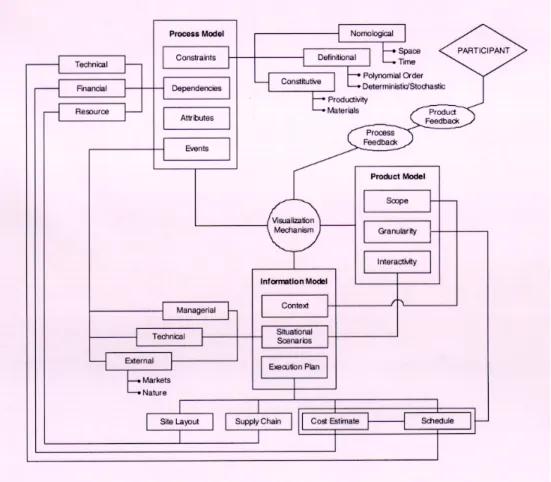
3.1 The Conceptual Framework . . . 38
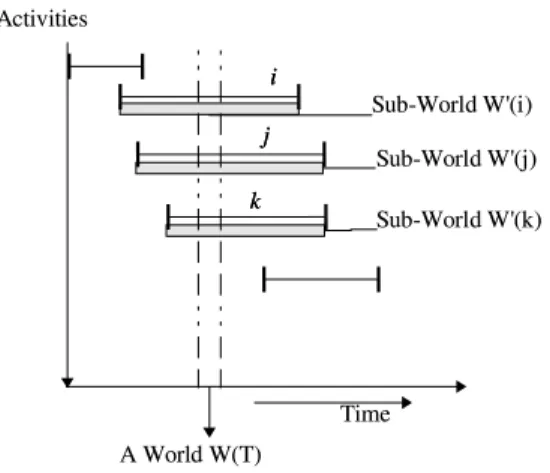
4.1 Worlds and Sub-Worlds in the Activity-Time Plane . . . 49
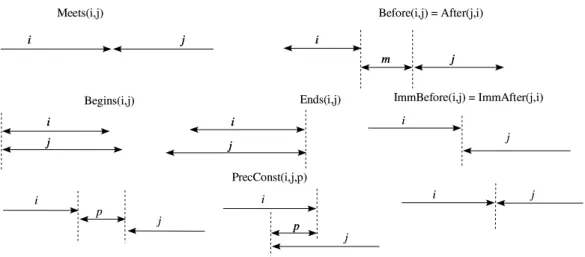
4.2 Axioms defined on Intervals . . . 54
4.3 Agent Algorithm . . . 65
6.1 The Agent-Operator-Entity-Base Framework . . . 75
7.1 Resource Allocation Interface . . . 84
7.2 End-of-day Report . . . 85
A.1 Activity Schedule . . . 112
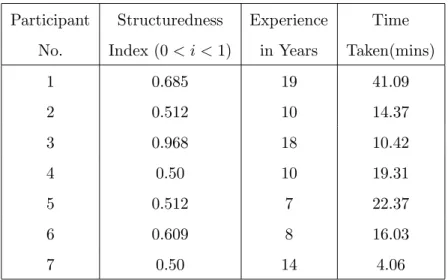
Table Number Page 2.1 Structuredness Index, Experience of subjects and Time Taken . . . 33
ACTIONS: Actions are triggers which create events and situations.
ACTIVITY: An activity is an emulation of a real life construction operation and is rep-resented by an interval which has the same length as its’ duration.
ACTIVITY CYCLE DIAGRAMS: A network used to represent the relationships between the activities, conditions, outcomes using directional arcs that go from condition to activity to outcome.
AGENT: An agent is anything which can perceive its environment through sensors and can act upon that environment through effectors. All agents in this dissertation are software programs.
CM: Short for Construction Management.
ENVIRONMENT: The environment sets the scene for the situational simulation. It is the participant’s perception of the simulated construction project. It is interactive, tempo-rally dynamic and virtual in nature. The environment emulates activities, events and processes pertaining to construction projects. It is characterized by a set of entities, each of which describes an unique aspect of the environment.
EVENTS: Events reflect the effects of real life episodes involving resource and precedence constraint violations within the construction management domain. Events are of two types: Independent Events and Dependent Events.
where x is a member of the domain of discourse.
GPF: Short for General Purpose Framework
GPMAF: Short for General Purpose Multi-Agent Framework
MENTAL MODELS: Conceptualizations of the world that the mind builds by incorporat-ing the individuals views of the world, of themselves, of their own capabilities and of the tasks that they are required to perform
SYSTEM DYNAMICS: A professional field that combines the theory, methods, and philos-ophy needed to analyze the behavior of complex systems using a common foundation that can be applied whenever we want to understand and influence the change of behavior over time
VARIABLES: A Variable is a symbolic representation of an entity.
In the last few years, I have been guided, supported and indulged in by a number of people without whom, it would have been very difficult to navigate the Ph.D. journey.
To start with I want to thank my advisor Dr. Eddy Rojas. I am very grateful to him for having provided me with ample scope to freely explore research avenues and learn from my adventures! He has also taught me by example to give attention to detail without loosing sight of the bigger picture.
Dr. Bill Winn has also greatly guided my work and influenced my thinking. I am grateful to him for having introduced me to the fascinating world of human cognition and learning. Needless to say, his friendship, understanding and encouragement has provided me with great strength and inspiration.
A special word of gratitude also goes to Dr. Joe Mahoney, who has been instrumental in arranging timely financial support and mentored me in better understanding my strengths and weaknesses.
I must specially thank everybody at the Human Interface Technology Laboratory for having provided me with an intellectually rich and supporting environment in conducting my research. Specifically, I want to thank the Director, Dr. Tom Furness, for his belief in my work and for his visionary ideas. In addition I must acknowledge Suzanne Weghorst and Konrad Schroeder, with whom I greatly enjoyed working on the Surgical Simulator project. A very special word of thanks is due to Konrad for having generously provided technical support as and when required.
I also take this opportunity to thank Dr. Scott Rutherford, the Chair of the Civil and Environmental Engineering department for his advice and for giving me the opportunity to teach. I also express my gratitude to the Chair, Dr.John Schaufelberger, and all the faculty and staff at the Construction Management department. I also thank Dr. Henry Kautz,
helping me navigate the university bureaucracy.
A special word of gratitude also goes out to Mr.Ted Herb and the entire crew at GLY Construction for helping me in collecting data for the mental models study.
I thank all my colleagues Steve Muench, Ruth Fruland, Bruce Campbell, Eliana Medina, Yuchien Nancy Chen, Sairam Rajagopal, Bob Burstein and Arnab Gupta for their feedback and for supporting me through all the strange situations I tend to get into.
I take this opportunity to thank my friends Shohini Ghosh, Bipasha Barua and Jayant Madhavan for their caring warmth and support. A very special token of gratitude goes out to Sorin Lerner who has challenged me intellectually and supported me as a friend through the worst and the best times. I also need to thank Keunwoo Lee, Krishna Gummadi, Joyeeta Banerjee, Swati Sircar, Paramita Chakrabarty and Gary Streile for being very good friends. I also thank my uncle Dr.Abhijit Biswas, for having greatly inspired me. A special word for Anasua Mukherjee, Mousumi Gupta, Sirsha Chatterjee, Subhamoy Pal, Abhishek Singh, Anyesha Mukherjee, Sunayana Saha and Gayathri Gopalakrishnan for their patience and unconditional support. A very special thank you is also due to Didi, a woman I greatly respect and honor.
In perspective, I must also mention that through the long sleepless nights spent working on my dissertation, I have been inspired by the musical and lyrical genius of Pink Floyd, Rabindranath Tagore and Bach.
I shall not attempt to thank my parents. Everything I am and will be is a complex combination of their unconditional love, patience and unique ways. I dedicate this effort to them and hope to be worthy of the lives they live.
To
My Dear Parents
Chapter 1
INTRODUCTION: BRIDGING THE DISCONNECT
1.1 Background
Barab et al. (2001) argue that the core of cognitive science and the resultant pedagogical models are based on the Cartesian philosophy of mind-matter dualism. This has resulted in a disconnect between the abstract and reflective mind and the material world in which the body is situated (Thelen 1995). As it is the case in other fields, this duality has resulted in a disconnect between the theory and practice of construction management (CM). In practice CM problems and crisis scenarios are complex and involve multiple resource interactions and feedback loops resulting from human decision making and its impacts on resource interactions. In contrast, the academic understanding of the domain relies on strategies that mostly focus on modeling construction operations as interactions between multiple resources (including material, equipment and labor), each of which can take finite states and where logical complexities are best described in terms of the conditions required to carry out the activities (Martinez and Ioannou 1999). Such methods isolate construction operations and processes from the human contexts in which they occur and thus do not analyze the impacts of decision-making on resource interaction.
The lack of a holistic approach to studying human-resource interactions in the CM domain has had implications in CM education. McCabe et al. (2000) argue that current civil engineering coursework teaches only the theories of CM and that students may encounter difficulties applying these theoretical principles when exposed to real world situations upon employment. Sawhney et al. (2001) suggest that civil and construction engineering curricula do not allow the inclusion of issues of importance to construction, nor the participation of practitioners or hands-on experience. AbouRizk and Sawhney (1994) recognize that
traditional teaching methods are not fully capable of providing students with all the skills necessary to solve real-world problems encountered in construction or conveying complex engineering knowledge. If construction education does not provide students with the skills to solve real-world problems or to apply theoretical concepts to practice, then the effectiveness of the problems studied or the methodologies applied in CM can be questioned.
Traditional CM classroom training methods deliver concepts that are presented as fixed, well-structured, independent entities. Classroom activities are disconnected from authentic context resulting in fragmentation and specialization of courses and educational experiences. This fragmentation of knowledge (Chinowsky and Vanegas 1996, Fruchter 1997) has resulted in a polarization of the learner and learning context and is not preparing students to apply theoretical concepts to real life construction scenarios (McCabe et al. 2000).
Meanwhile, as experienced construction managers are retiring there is an increasing knowledge void in the industry that cannot be easily replaced. Fledgling construction managers lack the skills that are gained through years of experience and the traditional CM curriculum does not expose them to any kind of training that allows appreciation of systemic dependencies in the construction domain and the ability to anticipate problems that arise during the project execution.
This disconnect between theory and practice is manifesting itself as a serious problem for the CM community. On the one hand academia is not appropriately preparing fledgling construction managers to meet the needs of the industry. This is furthering the notion that academic success is irrelevant to success in practice. Such notions feedback to reinforce the disconnect between theory and practice. On the other hand as experienced construction managers are retiring, the industry is loosing expert knowledge workers who are leaving behind a void that fresh graduates are in no position to fill. In addition, there are few methods that allow us to analyze and study how expert managers engage in decision-making and capture their expertise in a way to enhance academic understanding of human decision-making and its impacts on the CM domain. This is not only widening the expertise gap in the industry but also reinforcing the disconnect between theory and practice. The widening gap in turn feeds back to enhance the original problem at hand: of studying the CM domain only as resource interaction instead of as a combination of human and resource interactions.
We have a systemic problem with the dual symptoms of a widening expertise gap and a widening disconnect between theory and practice. Unfortunately the system involves reinforcing feedback loops that are further reinforcing the symptoms at hand.
Efforts have been made to reduce the expertise gap by introducing case studies and construction site visits in the CM curriculum to generate usable and robust knowledge based in experience with partial success. Case studies can give the impression that there are easy-to-find and universally correct responses due to the necessary simplifications (Pennell et al 1997). Also site visits of large groups to construction sites may not be welcome, involve risk, and be unpractical (Echeverry 1996). Finally, case studies do not allow students to explore “what-if” scenarios and explore the validity of their decisions within the context of rapidly unfolding scenarios where they can directly find the impacts of their decisions. One could argue that internships often provide such opportunities, however in such situations students seldom enjoy positions of responsibility and cannot experiment with their decision making skills due to the real stakes involved.
A lot of work has been done in the field of simulations to explore their usefulness in bridging the disconnect between theory and practice. Researchers have explored alterna-tives in construction education using gaming and simulation environments such as Superbid (AbouRizk 1993), STRATEGY (McCabe et al. 2000), ICMLS (Sawhney et al. 2001) and VIRCON (Jaafari et al. 2001). Some of these efforts have been inspired by earlier research efforts in the area such as CONSTRUCTO (Halpin, 1970) and AROUSAL (Ndekugri and Lansley 1992). CONSTRUCTO has also provided the launching pad for a wide range of simulation frameworks that have been used to better understand CM operations and pro-cesses. The emphasis has been on developing specific purpose simulations of construction operations and processes and general purpose languages for developing simulations of op-erations. However, much of this work has limited human interactivity and is based on the understanding of the domain as an interaction of resources. While such efforts have had great successes in terms of furthering construction productivity, they have not really looked at bridging the disconnect.
1.2 The Challenge
The challenge is to systemically approach the CM domain by understanding the reasons which trigger the symptoms instead of the traditional approach which attempts to solve the dual inter-related symptoms of a widening disconnect between theory and practice and a widening expertise gap. Given that experienced decision-making plays a critical role in the success of construction projects, such an approach involves studying the CM domain as an interdependent system of human and resource interactions and better understanding research questions such as: How do experienced construction managers deal with critical problems and crisis scenarios? How can we analyze and leverage such information to develop the foundations of a systemic understanding of CM practices? How can we feedback such understandings into the CM curriculum to prepare students in the skill of decision-making and to better manage crisis scenarios? Given the recent advances made in computer science and the available computation power, what methods can we employ to answer the above questions?
The above questions, while being different approaches to the same challenge, involve a broad area of work spanning an understanding of CM, cognitive science and computer science and information technology. For the sake of this research effort it was imperative to identify the single question that is critical in developing a rigorous approach to studying and analyzing human-resource interaction in the CM domain, while enhancing construction education.
In a field such as CM where problems present multi-faceted situations dependent on context it is critical to develop dynamic, interactive, context-sensitive, adaptive experien-tial simulation environments. There is evidence from other fields (Windschitl and Winn, 2000, Oppenheimer, P. and Weghorst, S. 1999) that such environments can be useful for educational purposes. Also such environments can prove to be effective test-beds for collect-ing data regardcollect-ing how experts deal with domain specific simulated scenarios and analyzcollect-ing such information to learn about the impacts of human interaction in the domain.
The challenge that has been addressed in this research effort has been to develop a technology framework that can be used as a contextually rich education environment for
construction management while providing a test-bed to capture and analyze expert inter-actions in the domain, to generate knowledge that can in the long run add to the body construction management knowledge. This is no more than a stepping stone toward the bigger challenge of bridging the disconnect between the theory and practice of construction management.
1.3 Hypothesis and Objectives
I propose that situational simulation environments can be used as educational environments for construction managers while also providing a testbed to collect and analyze information about human interaction in crisis scenarios, thus allowing us to study the CM domain as a dynamic system, consisting of human and resource interactions.
Situational simulations simulate the CM domain as an interdependent system of human and resource interactions. They are dynamic, interactive, context-sensitive, adaptive envi-ronments powered by autonomous agents that can simulate future project scenarios that can arise out of resource and activity scheduling decisions taken by participants, consistent with rules that govern the CM domain and the project being simulated. In such environments, participants are exposed to diverse project management scenarios and situations rapidly unfolding in time and can explore what-if scenarios that may develop as a consequence of their decisions.
The necessity of situational simulation environments to have some sense of in- built autonomous agency requires them to be capable of expressively representing CM informa-tion and reasoning about wide range of construcinforma-tion scenarios. Also given the diversity of CM scenarios and projects, it is important to have a simple framework that can be easily programmed and extended to simulate different kinds of construction projects and scenarios. The objective of this dissertation is to develop and implement a general purpose multi-agent framework for situational simulations for CM. Such a framework is driven by multi-agents that have the ability to reason about CM scenarios and problems using the conceptual ab-straction that all such problems can be modeled as constraint satisfaction problems and crisis scenarios are combinations of multiple constraint violations. The general purpose
framework makes the situational simulations extensible and reusable. It allows educators and construction managers to include project specific constraints, cost and schedule in-formation and thus simulate different construction projects for different purposes without having to interfere with the underlying representation, reasoning and numerical models.
The specific objectives that were pursued are as listed:
• Conceptualize problems in the construction management domain and classify them into defined classes (such as a Constraint Satisfaction problem (CSP) or a planning problems).
• Develop a conceptual framework for situational simulations based on product, process and information models of construction.
• Develop an ontology that can be used to formally represent information pertinent to the construction management domain.
• Define a formal axiomatic system to describe the situational simulation environment using interval temporal logic.
• Develop inference rules representing agent reasoning.
• Develop a system dynamics approach to capture the concept of equilibrium during the implementation of a construction project.
• Suggest a model of the construction domain, which can be used by an agent to reason about the sensitivities of the simulated system to changes in the different aspects in the environment.
• Develop a multi-agent framework to create general purpose situational simulations in construction.
• Develop a framework that can be used as the foundation for the development of a programming language for general purpose situational simulations in construction.
• Implement a prototype of the proposed multi-agent framework.
• Develop a specific situational simulation to test the multi-agent framework.
• Experiment with the prototype system through interaction with expert and novice construction managers.
1.4 Contributions
The contributions of this research effort have a multi-disciplinary footprint. Beyond the immediate contributions to the field of construction engineering and management, this re-search also has contributions to the field of simulations and the cognitive sciences. This is apparent from the papers that have been published from this work in the American Society of Civil Engineers (ASCE) journals, the Winter Simulation Conference and the American Education Research Association (AERA) annual meeting. Specifically the contributions can be enlisted as below:
1. Construction Engineering and Management
• The development of a framework for independent developers to build customized situational simulations that suit their educational requirements
• The conceptualization of problems in the CM domain in terms of constraint satisfaction and planning
• The development of a formalism that provides an expressive language to represent and reason about construction knowledge
• The development of a collaborative environment that solicits participation from academia and industry and can be used for educational purposes and as a test-bed for conducting research on mental models of experienced construction managers • The development of a system dynamics approach to understand meta-cognition
in CM
• The development of a multi-agent framework for interactive and adaptive simu-lations. Such simulations can be used for exploring “what-if” scenarios to impact policy making in areas such as the ocean sciences and urban planning. They can also be used to train responders to emergency situations like terrorist attacks
3. Cognitive Sciences
• The development of an understanding of meta-cognition of construction man-agers and a system dynamics/systems thinking approach to better understanding human cognition in the CM domain
This dissertation starts with a review of the literature in the areas of construction man-agement simulations, agent technologies and the cognitive sciences. This is followed by a discussion of the conceptual and formal foundations of the general-purpose framework for situational simulations and details of the Virtual Coach, a particular implementation of the framework.
Chapter 2
LITERATURE REVIEW
2.1 Introduction
The objective of this dissertation is to provide a technology framework that can be used across the academic and industrial branches of construction management for educational and research purposes with a long term goal of studying the CM domain more holistically. Such an effort requires a multi-disciplinary approach because the area of application of the research (CM) is not the same as the knowledge areas (information technology, education, cognitive science) that provide the theoretical underpinning. Therefore it is imperative to survey multiple areas of work and get an understanding of each of these areas to appropri-ately justify the work to be done and the methods to be employed.
The chief areas of work to be analyzed and the contexts in which they need to be analyzed are:
1. Simulation systems in construction: A survey of the existing simulation paradigms with a focus on simulations in construction. Why are these methods not appropriate for developing the multi-agent framework.
2. Agents: A survey of agents and the span of work relevant to artificial intelligence (AI) and agent driven environments similar to the envisioned multi-agent framework.
3. Education: A survey of the theory and evidence that exists in education literature to support the use of interactive and adaptive simulation environments for education
4. System Dynamics: A survey of the System Dynamics/Systems Thinking perspective and its utility in better understanding cognitive and meta-cognitive processes in CM
5. Mental Models: A survey of methods and research in understanding the differences between expert and novice knowledge organization patterns, and the usefulness of such an understanding in exploring the nature of expertise in CM.
In the rest of this chapter each of the above areas will be surveyed in detail.
2.2 Simulations in Construction
A survey of simulations in construction engineering and management suggests that they can be classified using three different approaches. The first approach classifies simulations based on whether they are simulating construction management processes or construction operations. While, Superbid (AbouRizk 1993), STRATEGY (McCabe et al. 2000), ICMLS (Sawhney et al. 2001), CONSTRUCTO (Halpin 1970) and VIRCON (Jaafari et al. 2001) are all examples of simulations which deal with construction management processes, Simphony (Hajjar et al.1999) and STROBOSCOPE (Martinez et al. 1999) are examples of simulations which deal with construction operations like tunneling and earthmoving.
The second approach to classifying simulations is based on whether they are of a special purpose or a general purpose in nature. The difference between special purpose and general purpose simulations are:
• Special purpose simulations are restricted in scope (to a particular operation like tunneling or a particular management process like bidding)
• General purpose simulations unlike special purpose simulations allow for greater flex-ibility of scope since they are programmable.
• General purpose simulations can be used to promote new simulations and collabora-tions amongst developers.
A survey of current research indicates that there exist general purpose and special purpose simulation tools and techniques for simulating construction operations (Simphony: Hajjar, et al.1999 and STROBOSCOPE: Martinez et al. 1999). All the simulations in the area of
construction management processes are special purpose in nature. They deal with specific problems in planning (Veshosky, et al. 1991) or bidding (AbouRizk 1993) or negotiation (Dubziak 1988).
The third approach to classifying simulations can be based on how interactive they are. I define situational simulations as temporally dynamic, interactive simulations. In their simplest form simulations of construction processes use a set of initial conditions and parameters, and a well defined model to project outcomes regarding the simulated operation. For example, given information regarding the availability of trucks and loaders, their unit costs and the amount of earth to be moved a process simulation would be able to project the total time and cost for an excavation operation.
2.2.1 Simulation Paradigms in Construction
Most simulations of design and construction processes are instances of discrete event simula-tions. Martinez and Ioannou (1999) explains in detail the essence of construction simulation systems and justifies the use of discrete event simulations for modeling construction oper-ations. They go on to study the applicability of the Activity Scanning (AS) and Process Interaction (PI) simulation strategies to construction operations. Gil and Tommelein (2001) have also discussed the Event Scheduling paradigm. This section shall do a brief survey of the different simulation systems in construction.
Activity Scanning simulation models are based on a set of “activities” each of which has a set of defined conditions and outcomes. The “activity” in this context typically represents a single construction task and a construction operation can be simulated by a sequence of such activities. Hence an earth moving operation can be represented by the activities: PushLoad, BackTrack, Haul, DumpAndSpread, Return each of which has a condition and an outcome (Martinez and Ioannou 1999). An activity cannot occur if the condition is not fulfilled and and when it occurs it always produces the predicted outcome. This scheme provides a way of representing simple networks which represent the relationships between the activities, conditions, outcomes using directional arcs. The direction of the arcs go from condition to activity to outcome. Such networks are referred to as Activity Cycle Diagrams
(ACD). The major languages used for modeling construction simulation namely CYCLONE and STROBOSCOPE, both use ACDs.
The Process Interaction paradigm uses processes or entities which compete for scarce resources as they flow through the system. The SLAM II simulation language uses the PI paradigm and can be successfully used for both discrete event and continuous simulations. A simulation begins with a network model or flow diagram showing the flow of entities. A SLAM II network is made up of nodes at which processing is performed. Common functions are entering and leaving the system, reserving resources, starting and stopping flows etc. Nodes are connected via ‘activities’ which define the routing of the entities. Time delays represent processing times, travel times, or waiting times. Entities proceeding from node to node have ‘attributes’ which determine their processing.
Finally, the Event Scheduling (ES) systems use event graphs which comprise vertices and edges where the vertices are associated with changes in states while the edges represent conditions and delays. The simulation language SIGMA is based on the event schedul-ing paradigm. It has wide applications in various simulation problems, includschedul-ing system dynamics problems (Gil and Tommelein 2001).
Situational simulation environments simulate the reality of the construction process. None of the surveyed methods can provide a framework to effectively represent situational simulations. In real life, events and activities take time to occur. Also, events are unpre-dictable, can occur simultaneously, have deterministic outcomes, are causal in nature and are motivated by a logic specific to the simulated domain. The discussed methods usually tend to treat time as a sequence of states or instantaneous events. This makes representation of parallel events over time very difficult. Different aspects within the domain also interact dynamically making it necessary that the simulation reflect the sensitivities of the system to changes in the individual aspects. Finally, a situational simulation is interactive and as time passes it evolves based on participant interaction and the events simulated within the environment. This means that the system should possess a perceptive reasoning ability. Therefore, in order to describe a situational simulation environment it is very important to have a framework which can represent and reason about events and activities within a formal temporal model. Based on the different functionalities a framework consisting
of multiple agents, can autonomously reason and perform different tasks in the simulated environment.
2.2.2 Simulations of Construction Operations
Each of the above paradigms are very useful for special and general purpose discrete event simulations where activities do not consume time or overlap in time or in which the sim-ulation time changes during an event rather than in between events. The Simphony envi-ronment suggested by Hajjar and AbouRizk (1999) can be used to build special purpose construction simulation tools. AbouRizk et al. (1999) demonstrate a special purpose tun-neling simulation template that was developed based on tuntun-neling operations performed by the City of Edmonton Public Works Department for shielded tunnel boring machines.
Martinez and Ioannou (1999) use the STROBOSCOPE and later the EZSTROBE (Mar-tinez 2001) to suggest a general purpose simulation system based on ACDs. An ACD can be used to represent resource flow and precedence between activities but it treats activities as instantaneous time points. This makes representation of parallel activities overlapping in time difficult to express. The multi-faceted nature of real-life construction situations require the ability to express multiple activities across multiple tasks which overlap in time. Clearly an ACD representation is not suited for representation of situations in a situational simulation. ACDs are very useful for expression of specific construction operations (like an earth moving operation) but not necessarily for the expression of multiple events occurring simultaneously during the construction process.
Simulatons of construction operations built using STROBOSCOPE and Simphony are usually not interactive. They provide special and general purpose simulation environments for effectively simulating construction operations, however they are not very useful for build-ing simulations of management processes which involve unpredictable and time consumbuild-ing events within a system that evolves over time based on participant interaction and the outcome of events simulated within the environment.
2.2.3 Simulations of Construction Management Processes
The Construction Management Game and CONSTRUCTO are the earliest efforts at using games in to simulate construction management processes. The Construction Management Game developed by Au et al. (1969) is a simulation of the bidding process in construction and allows the participation of multiple teams. While a project management game developed at the University of Illinois by Halpin (1973) to integrate the effects of weather and labor productivity, using the CYCLONE simulation language. It simulates real life construction project scenarios facing construction managers. This was probably the very first attempt at a situational simulation environment. However, the lack of appropriate computing power at the time resulted in it not being interactive.
The Negotiation Game (Dubziak 1988) simulated contract negotiation between an util-ity and a design-build firm. Abourizk (1993) also developedSuperbid which is a stochastic simulation of the bidding process in construction and trains players to increase profitabil-ity by optimizing bidding decisions. Beliveau (1991a, 1991b) also has conducted research efforts like the Lego Bridge Game and Road Building Negotiation Game which amongst other things, study the interactions between multiple team strategies in solving problems of negotiation and estimation in a competitive environment. These are fine examples of sim-ulations of construction management processes dedicated to the special purpose of bidding and negotiation.
Veshosky and Egbers, (1991) developed a Civil Engineering Project Management game which deals with the planning phase of project management and allows students to un-dertake tasks specific to project design definition, specification reviews and scheduling and planning. STRATEGY (McCabe, et al., 2000) is another simulation environment that mod-els the construction process for instructional purposes. It incorporates multi-team participa-tion and situaparticipa-tions, which raise random events. STRATEGY, is programmed in Microsoft Visual Basic, interfaced with Microsoft Access for database management. STRATEGY “borrows the bidding theme” from Superbid (Abourizk 1993), scheduling and planning from Veshosky and Egbers (1991) and the construction management aspects from CON-STRUCTO (implying that it uses the ACD simulation paradigm). It also uses MSBN, a
probabilistic expert system to provide intelligent guidance to the automation of stochastic functions within the program. While STRATEGY does provide limited interactivity, it is limited to the pre-planning phase and can be classified as a special purpose simulation.
The Parade of Trades (Choo, et al. 1999) game demonstrates to students the impacts of small variability of tasks on the construction environment. In the game, multiple trades are queued linearly and chained by dependency of input of each trade on the output of a previous trade. This is a special purpose simulation of a management process, and it does not allow users interact dynamically with it
Jaafari, et al. (2001) have worked at developing an interactive system for teaching construction management, VIRCON (VIRtual CONstruction), a system which combines traditional construction planning with 3D/4D models of the project. This system was implemented in classroom environments through student group projects for a class that taught project management. They used the C++ programming environment to provide an interface for data input as well as analysis and reporting. The system also implemented a non-immersive virtual reality visualization of the project through a module that would communicate with information stored in a database across a client server configuration. The system supports ’What-if’ scenario analysis, integrates dynamic scheduling and estimation planning, is armed with stochastic analysis techniques and also provides for monitoring risks. Like STRATEGY, VIRCON also deals with simulating the pre-planning phase.
Sawhney, et al., (2001), have developed an Internet-based Interactive Construction Man-agement Learning System (ICMLS), which is an advising and mentoring program that en-hances participant involvement. The system uses multimedia, internet-based computing, databases and Virtual Reality Modeling Language (VRML) as their chief tools. ICMLS makes an approach to bridging the gap between the classroom and actual construction site using an interactive and adaptive learning environment, which “mimics the challenges faced by a construction manager on a real life construction project”. The system is process-oriented (uses the the PI simulation paradigm) and makes use of discrete event simulation technology. Also, the environment simulated usually reflects a particular case study. The case studies are specific to construction operations chosen by a participant. The environ-ment allows students to understand process interactions and equipenviron-ment requireenviron-ments for
the particular operation in the given scenario.
Amongst various in-class techniques that have also been reported recently is use of web-based tools to enhance collaborative learning by Rojas, (2002). The author explored the pedagogical and motivational goals behind the implementation of web-centric educational models while using MAESTRO, a software tutorial application, in a class of construction management graduate students.
Commercially there are various packages such as Primavera’s Project Planner P3e, which can be used within the classroom environment to expose students to techniques used in the field in areas of scheduling and planning. However, these are better classified as tools rather than simulations.
All the surveyed methods in this section are best classified as special purpose simulations.
2.3 Agents
An agent is anything which can perceive its environment through sensors and can act upon that environment through effectors (Russell and Norvig, 2002). Agents are also attributed a notion of intelligence. They can reason logically and act autonomously (free of human control) towards a goal. They are aware of the repercussions of their actions on the environ-ment and dynamically integrate their experiences into existing reasoning mechanisms. In the computer mediated simulation domain there can be two kinds of agents: software agents (programs) and humans (interacting with a computer mediated environment). In a situa-tional simulation environment, the “coupled” agent is a human while the “outside” agents are software agents. Each agent handles a specific reasoning aspect of the environment.
A problem solver is a component of an agent (Talukdar 1998). Problem solvers perceive problems in the environment and solve them using a set of defined tools. In the quest for an abstraction of processes in the construction management domain, I decided to use a hypothetical problem-solver and a hypothetical agent. While the problem solver allows us to abstract the classes of problems involved, the notion of intelligence in the agent allows us to grasp the underlying threads of reasoning in the world of construction.
of human intervention. Autonomous decisions cannot be taken by agents which function by looking up matching facts from a set of built in assumptions and knowledge, because that limits the agents’ ability to deal with undefined situations. Autonomy of an agent calls for an ’intentional stance’ (Woodridge and Jennings, 1995). To take an intentional stance is ’to be the subject of beliefs, desires, etc.,’ (Seel, 1995) and intentional notions are abstraction rules which allow us with a convenient way of describing, explaining and predicting behav-ior. For instance, some simple abstraction rules for the construction environment are ’Bad weather adversely affects productivity’, ’productivity affects duration’ etc. These intentions are essentially attitudes which represent the agent and influences its behavior. The attitudes can be information attitudes or pro-attitudes. While information attitudes are related to the knowledge that an agent has about the world, pro-attitudes guide the agent’s behavior. The agent has to have access to both these attitudes in behaving autonomously and ratio-nally within the environment. The Waffler architecture (Anderson and Evans 1996) is an instance of an agent architecture that adopts and applies intentions under resource and time constraints. It uses the concepts of a ’long-term memory’ and a ’working memory’. While the former provides the conceptual knowledge possessed by an agent specific to the domain and the simulated project, the latter includes its awareness of the environment based on its perception.
The literature provides a rich variety of agent based frameworks that have been used in distributed environments. The Generalized Partial Global Planning (GPGP) (Lesser et al. 2002) and its associated TAEMS hierarchical task network representation were developed as a domain-independent framework for coordinating the real time activities of small teams of cooperative agents working to achieve a set of high-level goals. Coordination between multiple agents running different algorithms has been exploited to develop efficient solutions to complex problems. A-Team (Talukdar et al. 1996), a scale-efficient network of distributed computer agents were used to solve non-linear algebraic equations in a shorter time, using the Newton-Raphson and Genetic Algorithms as agents, than the individual processes. The M-RAM (Soibelman et al. 2000), a multi-reasoning model uses an agent-like approach to develop modules, each of which is specialized to perform particular tasks. The M-RAM model was used to support the conceptual phase of structural design and to study the
applicability of agents to support the sub-processes of a divided structural design process. This dissertation looks at using agent modules, each of which are specialized to perform a particular thread of reasoning pertinent to the implementation phase of the construction project. The autonomous reasoning and problem solving capabilities of the agents allow us to efficiently design situational simulation environments for the construction domain.
Agent architectures have also been used in synthetic, software and testbed environments. However, as Tambe et al. (1995) explains, though closely related the concept of using agents for synthetic environments differs from software (Etzioni 1993), robotic (Brooks 1991) and testbed (Hanks, Pollack, Cohen 1993) environments distinctly. The most significant difference between software and synthetic environments is that, the latter requires real time behavior in dynamic, limited information worlds, and therefore cannot be strongly dependent on traditional planning. Unlike robotic environments synthetic environments don’t need to deal with low-level motor control and perception. Test-bed environments differ from synthetic environments often because of the domain of problems they handle. Synthetic domains tend to handle real life domains (like construction in this case) while test-bed environments tend to deal mostly with domains, which often tend to have greater complexity than test-bed domains where developers can “prestructure the environment, choose which aspects of behavior, or instrument the domain for experimental purposes.” (Tambe et al. 1995).
There has been a great deal of investigation in the use of agents in interactive simu-lation environments, which are very similar to situational simusimu-lation environments. The obvious benefit of using agents is that they can replace humans when a large number of entities are needed to populate a virtual world (Tambe et al. 1995). Notably, Cremer et al, (1994) suggested the use of intelligent agents in traffic simulators, to simulate scenar-ios involving slowing and speeding of vehicles, pedestrians, traffic jams and other complex traffic patterns. Tambe et al.(1995), have explored the use of intelligent automated agents for battelfield simulation environments. Their environments are based on Distributed In-teractive Simulation (DIS) technology, in which large scale interactive simulations are built from a set of independent simulators linked together by a network. They developed inde-pendent, intelligent automated pilots in the environment based on the underlying SOAR
integrated architecture for general intelligence (Laird, Newell and Rosenbloom 1987). The SOAR architecture is investigated in greater detail in the next section.
SOAR has an explicit symbolic representation of its tasks which it manipulates by sym-bolic processes. Domain specific knowledge is also symsym-bolically coded and used as a guideline for behavior. Intentions are represented by a general scheme of goals and sub-goals. Goal formulation is achieved by finding a desired state in a problem space, which is defined as a space with a set of operators that apply to a current state to yield a new state (Laird, Newell and Rosenbloom 1987). Thus all goal formulation tasks can be completed using some heuristic search technique. If knowledge to immediately formulate a goal (say select an operator) is insufficient, then a goal is created which in turn can further create sub-goals. Hence the behavior of SOAR involves a tree of sub-goals and problem spaces. The ability to recursively create sub-goals allows SOAR to learn continuously and automatically by storing the “results of its sub-goals as productions.” For example, if at any point more than one operator can be choosen, a sub-goal is created to break the tie, and the final result of problem solving within this sub-goal creates a preference which resolves the tie. The operator sequence is stored as a production and is delivered as the preferred solution in a relevantly similar situation. In this way the architecture uses a production system for single memory organization of all long term knowledge. The SOAR architecture was illustrated by the authors using the Eight Queen Puzzle problem amongst other problems.
The reason why the SOAR architecture is of great interest to us is because, Tambe et al.(1995) have successfuly used it to create situational simulations for the air-combat domain. They created pilot agents that participate in battlefield simulations using ModSAF (Calder et al. 1993) a distributed simulator that has been commercially developed for the military. Using DIS technology, copies of ModSAF are used to simulate a number of different fighter aircraft, across a network of workstations. The aircraft can participate in simulated combat with or against each other. The simulation is run by ModSAF sequentially invoking each agent. The simulation model is affected by action of all agents across the network, and allows predictions regarding future states of the simulation. Depending on the predictions and the actions of the agents the simulation is updated at the end of each cycle. The SOAR architecture has been used to implement this environment. The states in the SOAR
architecture represent situations and operators represent actions, which can be in the form of simple primitive actions that modify internal states or arbitrarily complex ones.
At this point it is important to compare the SOAR multi-agent architecture with the proposed multi-agent architecture for situational simulations in construction. The SOAR architecture represents situations as states. Operators facilitate state transformations. This means that in such an architecture time is represented as a sequence of states. Also the op-erators which represent actions in the real world will tend to be instantaneous. Intervals can be defined as a sequence of states, but it would make representation of multiple overlapping events difficult. As in the case of the interactive simulation developed for the air-combat domain by Tambe et al.(1995), the simulation of multiple interacting simulated aircrafts is achieved using DIS technology, which involves running multiple copies of the simulation over a network and coordinating them in parallel. In the construction domain, this would entail running multiple copies of the simulation for each construction activity. However, in the absence of DIS technology the agent framework that I propose intends to use temporal reasoning based on an interval representation of time (Allen and Ferguson 1994) to repre-sent parallel activities within the construction domain. The proposed architecture ascribes operations to agents. However, the operations are not defined to create transitions between states. Instead the agent operators change attribute values of entities which are logical aggregates of variables. Each variable defines some aspect of the environment. The time interval reasoning allows the description of an aspect of the environment as an assertion about a variable attribute over a time interval. Different entities are affected at different times by different agent operations and at any time it is possible to have persistent states of variables or multiple operators acting on multiple entities each specific to a particular context or activity.
Tambe et al. (1995) argues that finite state machine (FSM) languages are too restrictive to represent human like intelligence. Similarly, situational calculus, an FSM language, is inadequate for representing information about the parallel nature of events in the construc-tion domain. Even though the situaconstruc-tional calculus approach was used in the air-combat domain, parallelism and simulation of multiple fighter planes could be achieved through DIS technology. By running multiple copies of ModSAF, they were running multiple FSMs
in parallel. The proposed framework runs multiple finite state machines (for each activity context) within a single simulation model. This has been explained in detail in chapter 4.
There are many formal agent theories. A very good survey of these theories has been done by Wooldridge and Jennings (1994). Agent theories use formalisms which can be used to effectively capture the desirable properties of agents. All formalisms need two indepen-dent attributes: a language of formulation and a semantic model. The two fundamental formulation languages used are (i) a language which uses non-truth functional modal op-erators, which can be used to qualify formulae and (ii) a meta-language, which is some kind of a first-order language containing terms that denote formulae about some other ob-ject language. The semantic problem can be also resolved through two basic approaches: the possible worlds semantic model and the sentential or interpreted symbolic structures approach. The possible worlds model is formulated using modal logic and deals with an agent’s belief characterized by the different directions in which the present world can evolve in future. In the sentential approach an agent’s beliefs are viewed as symbolic formulae explicitly represented in a data structure associated with it.
The agent framework proposed in this thesis will develop a formalism which uses first-order logic syntax and semantics based on a deduction model of belief (Konolige 1986). Konolige’s model is based on the observation that a knowledge-based system is based on the two components of (i) a data base of symbolically represented ’beliefs’ (this could include rules, frames, semantic nets or logical formulae) and (ii) a logically incomplete inference mechanism. He defined this observation in terms of a deduction structure which can be expressed a d = (∆, ρ) where ∆ is a base set of formula in some logical language and a set of inference rules representing the agent’s reasoning mechanism. Deductive closure of the agent’s base beliefs under its deduction rules is given by the function close() which is given by:
close((∆, ρ)) ={ϕ|∆`ρϕ}
where φ|∆`ρ φmeans that ϕcan be proved from ∆ using only the rules in ρ.
An autonomous agent framework appears to be suitable for a situational simulation environment. As the simulation proceeds, the agent takes intentional stances while
au-tonomously generating events. It can also perceive the state of the environment at any point of time and be able to predict the outcomes based on its knowledge of the domain. It should be noted the reasoning involved in this process is rule based rather than case based. The knowledge base associated with an agent is a repository of rules and definitions regard-ing the causal nature of events. The environment is coded in terms of variables and defined by a set of axioms which always hold true. The variables define aspects of the environment by taking up values from a discrete set of attributes. Depending upon the values of the set of variables, and its knowledge of the inference rules, the agent can reason about the unfolding situations and accordingly plan the future evolution of the environment.
2.4 Education
The prevalent approach to understanding how people learn has been the computational approach to human cognition. Such an approach assumes that the world can be represented by static structures of discrete symbols, and cognitive operations are essentially discrete, sequential and instantaneous transformations from one structure to the next. However, crit-icisms that cognitive activity is contextually situated (Brown, Collins and Duguid, 1989) and is not simply a mapping of external events to an internal symbolic system (Maturana and Varela 1987) has lead researchers to study the context and culture in which cogni-tion occurs (Winn 2002). The more recent constructivist school of thought has explained learning in terms of students evolving to a greater contextualized understanding of their ex-periential world. It holds that learning is a process in which individuals construct their own meanings of the world they observe, and that the psychological processes involved are “es-sentially the same as the epistemological processes by which new knowledge is constructed by professionals in a discipline” (Novak 1993).
With the advances in the fields of information technology, virtual environments have proved to be extremely good test beds for the constructivist approach to learning. The Virtual Gorilla Project at the Atlanta Zoo (Allison et al, 1997) and the Virtual Puget Sound (Windschitl and Winn, 2000) and the Surgical Simulator (Oppenheimer, P. and Weghorst, S. 1999) efforts at the Human Interface Technology Laboratory, at the University
of Washington are just a few instances. However, critics of constructivism argue that it borders ”towards relativism, or towards treating the justification of our knowledge as being entirely a matter of socio-political processes or consensus, or towards the jettisoning of any substantial rational justification or warrant” (Phillips 1995).
Winn (2002) provides an alternative framework, for describing learning in artificial envi-ronments, based on the three concepts of embodiment, embeddedness and adaptation. One of the implications of the framework is that it couples the learner and the environment into ”one evolving system rather than two interacting ones.” Learning thus can be thought of as a ”organization by the system and new knowledge as an emerging property of that self-organizing activity.” This is of great significance with respect to educational environments in construction. The success of a construction project (a system which evolves from start to completion) in terms of time and budget is dependent on the skill of the construction manager (the learner in our environment). As students learn within the environment, their performances improve and directly affect the evolution of the environment itself. It allows us to conclude that a successful learning environment in construction would have to conceive the learner and the environment as a coupled system.
The framework (Winn 2002), also resurrects the importance of the computational ap-proach to cognition. Understandably, virtual environments being computationally generated need to be represented and reasoned about. The computational approach to cognition al-lows us to decompose an intelligent agent’s reasoning mechanisms within complex domains (Beer, 1995). It also allows us to develop a representation for the domain which defines the context as well as reflects the dynamic nature of such environments. The framework also proposes that the environment be an adaptive one. It should be perceptive to the level of the participant’s abilities and simulate situations, which challenge them accordingly, thereby providing the necessary scaffolding to the student.
2.5 The System Dynamics/Systems Thinking Perspective
In this dissertation I have argued that in order to effectively educate CM students to face real world scenarios, it is necessary to understand learning as a cognitive activity and how
it happens in the CM domain and I suggest the adoption of a systems perspective in better understanding cognition and meta-cognition in CM.
As explained by Richmond (1994), systems thinking can be explained as a paradigm and a learning method. The paradigm provides us with a vantage point of view of the domain and a set of thinking skills, which focus on understanding the underlying structure of a system in terms of reciprocal inter-relationships of the components and how they unfold in time. The learning method supports the paradigm. I have used the Virtual Coach, a situational simulation of the CM domain, as our method to explore the usefulness of employing the systems thinking paradigm in CM. The success of such an environment lies in providing students with the above mentioned “vantage point.” At the same time it is also important for the researcher to be able to study the human-resource interaction in the simulation environment from a similar “vantage point.” At this point it is important to analyze the system dynamics perspective in greater detail.
The systems perspective has its origins in the domains of System Dynamics / Systems Thinking (SD/ST). A system is defined as a group of interacting, interrelated, or interde-pendent elements acting as a complex whole. A complex system is one in which the elements interact to create multi-loop non-linear feedback. Most social systems can be classified as complex systems. Jay Forrester, considered to be the father of the field of system dynamics, defines it as a professional field that combines the theory, methods, and philosophy needed to analyze the behavior of complex systems using a common foundation that can be ap-plied whenever it is necessary to understand and influence the change of behavior over time (Forrester 1991, 1994). System dynamics involves interpreting real life systems into com-puter simulation models that allow us to understand how the structure and decision-making policies in a system create its behavior.
Richmond (1991, 1994) has defined systems thinking as the art and science of mak-ing reliable inferences about behavior by developmak-ing an increasmak-ingly deep understandmak-ing of underlying structure. He explains that the systems thinking is system dynamics with an aura, that is, it provides a laymans approach to understanding the emergent behavior of complex systems, without being intimidated by the mathematical methodologies employed in analyzing system dynamics.
Richmond (1991) further goes on to explain that SD/ST in practice is a continuum of activities, which range from the conceptual to the technical. On the far left is the purely conceptual systems viewpoint, that is arrived at by standing back far enough from a system in both space and time to see the underlying web of ongoing, reciprocal relationships which are cycling to produce patterns of behavior. Proceeding rightwards along the continuum, the emphasis shifts toward implementing the viewpoint and becomes more analytical. This involves the use of influence diagrams and formal models to conceptualize and eventually mathematically express the inter-relationships and feedback loops that are present in the system. Finally, the formal mathematical models can be used to power simulations that can allow us to simulate and verify the models, explore what-if scenarios and forecast emergent behavior of the system.
The main advantage of using a SD/ST approach in order to understand a domain is that it allows researchers to stand back and be able to adjudge the impacts of events and decisions that are often not limited locally in time. It also helps in developing solutions to problems by getting a better understanding of the feedbacks and counter-actions that occur because of the immediate problem at hand. Forrester (1971) analyzes the counter-intuitive behavior of social systems, and explains that orderly processes in creating human judgment and intuition lead people to counterintuitive decisions arising out of a conflict between the goals of a component of the system and its greater good. Sterman (1992) explains why the domain of CM is counterintuitive. For example, a delayed project tends to get even more delayed when more resources are added to it. This kind of behavior is typical with respect to complex and highly interacting systems.
The SD/ST approach is also critical in better understanding meta-cognition1in a domain as it can be used to analyze cognitive processes. As discussed in the previous section, the computational approach to human cognition ignores that cognitive activity has a dynamical component and as Port and Van Gelder (1995) explains, the computational approach to cog-nition fails to recognize that “cognitive processes and their contexts unfold continuously and 1The term “meta-cognition” in this dissertation refers to the researcher’s understanding of cognition in a particular domain. Thus it still refers to the second order cognition (cognition about cognition) but in a sense that is different from that traditionally used in education literature.
simultaneously in real time.” They conclude that an alternative approach to understanding cognitive processes is by treating natural cognitive systems as dynamical systems.
This echoes Winn’s (2002) notion of the learner and the learning environment being a coupled system and strengthens the argument that human cognition is not only contextu-alized and adaptive, but also dynamic. Knowledge is an emergent property of the coupled dynamical system consisting of the learner and the learning context. This is particularly significant with respect to the CM domain, because of the critical role of human decision-making in it.
The construction management domain can be studied as a complex system, which has multiple interacting components (schedule, cost, resource distribution and availability, etc.) with multiple feedback loops. Using the SD/ST approach to model CM projects is not an entirely new idea. Sterman (1992) correctly asserts that attributes of construction projects are complex, consisting of multiple inter-dependent parts, involving multiple feedback pro-cesses and non-linear relationships. He explains that system dynamics can be used to capture the interdependencies in the CM domain so that causal impact of changes can be traced throughout the system.
The success of a construction project (a system which evolves from start to completion) in terms of time and budget is dependent on the skill of the construction manager (the learner in our environment). As students learn within the environment, their performances improve and directly affect the evolution of the environment itself. Hence, a learning environment for the CM domain that aims at bridging disconnect between fragmented presentation of theory and practice in CM courses needs to be interactive and adaptive and it should present the CM domain to the students as a dynamical system. This would facilitate and aid the process of learning by helping students cognitively better understand the systemic nature of the CM domain.
2.6 Mental Models
A long term goal of situational simulation environments is to serve as test-beds for cap-turing expert interaction in simulated crisis scenarios to facilitate the exploration of expert
mental models. Besides, giving us a picture of how experts deal with crisis scenarios, such explorations will also help us understand the shift between expert and novice mental models and the nature of expertise among construction managers. Such knowledge when integrated with the curriculum will prevent the loss of expert knowledge from the industry and thus help in bridging the disconnect between theory and practice in the long run. Thus is it is important to understand mental models and their relation to expertise.
Experiential learning allows expert construction managers to develop an intuition that sets them apart from novice construction managers. There is provocative evidence in Edu-cation literature to support the above claim. Studies of experts and novices in Physics (Chi et al. 1982), exploring organization of knowledge structures have found that in represent-ing a schema for an inclined plane novices tend to concentrate on the surface features of inclined planes, while experts connect the notions of the inclined plane with laws of physics and the conditions under which such laws apply. Experts notice features and meaningful patterns of information, which cannot be reduced to isolated facts and propositions but are instead ’conditionalized’ to specific circumstances (Bransford et al. 2000). The process of conditionalizing allows experts to develop the expertise that guide their decision making processes. Experts also have the ability to retrieve information on a selective basis befitting the context of the problem at hand.
More than fifty years ago, Craik (1943) suggested that the mind constructs ”small-scale models” of reality that it uses to anticipate events (Johnson-Laird and Byrne 2000). Such models are conceptualizations of the world that the mind builds by incorporating the in-dividuals views of the world, of themselves, of their own capabilities and of the tasks that they are required to perform (Norman 1983) and are referred to as mental models. Indi-viduals construct mental models of themselves and the environment that they are required to interact with from perception, imagination, the comprehension of discourse, or, more importantly for this study, as they solve problems. Mental models provide predictive and explanatory power for the understanding of such interaction, and experts, unlike novices, have them already in place to draw on. They underlie visual images, but they can also be abstract representations of situations that cannot be visualized.
knowl-edge about the world (Gentner and Stevens 1983). Specifically, scientists have studied men-tal models to explicitly reveal human understanding of limited content domains. Hutchins (1983) has used mental models in explaining the cognitive structures involved in Micronesian navigation techniques. De Kleer and Brown (1983) developed a framework for investigating the structure of peoples mental models of physical devices. Other related work on expert cognition includes Chi et al. (1988) investigation into the nature of expertise and Noices (1997) investigation into the expertise of professional dancers.
The shift from novice to expert is a shift from one system of beliefs about the world, one set of concepts and one set of problem solving capabilities to another (Carey and Wiser 1983). I believe that such a shift is in essence a shift in the underlying mental models of novices and experts. By studying the differences in the mental models of novice and expert construction managers, the critical differences in their problem solving approaches can be understood.
In the next section we have reported a pilot study that was conducted to explore and understand the expertise of construction managers by exploring their mental models.
2.6.1 Exploring Mental Models of Construction Managers
The scope of this dissertation is in developing general purpose simulation environments. However, in keeping with what motivated this research effort, I have also made a preliminary exploration into existing tools and methods that can be used to analyze and learn about expertise from human decision making data. In this chapter I have investigated the nature of expertise in construction managers by exploring experimentally the existence of a difference in the mental models among construction managers.
A group of construction managers with varying levels of experience were asked to respond to a construction management crisis scenario. Using the ConProFacsoftware to calculate an indexi indicative of the structuredness of the responses I found a significant correlation between i and the number of years of experience of the respondent.