Semantic-Preserving Transformations
for Stream Program Orchestration
on Multicore Architectures
A thesis submitted in fulfilment of the requirements for the
degree of Doctor of Philosophy in the School of Information Technologies at The University of Sydney
Yousun Ko 2016
ABSTRACT
Because the demand for high performance with big data processing and distributed computing is increasing, the stream programming paradigm has been revisited for its abundance of parallelism in virtue of independent actors that communicate via data channels. The synchronous data-flow (SDF) programming model is frequently adopted with stream programming languages for its convenience to express stream programs as a set of nodes connected by data channels. Unlike general data-flow graphs, SDF re-quires the specification of the number of data items produced and consumed by a node already at compile-time. Static data-rates enable program transformations that greatly improve the performance of SDF programs on multicore architectures. The major appli-cation domain is for SDF programs are digital signal processing, audio, video, graphics kernels, networking, and security.
The major optimization objective with stream programs is data throughput. Stream program orchestration is a term that denotes compiler optimizations and run-time tech-niques that aim at performance improvements of stream programs on multicore archi-tectures. A large body of research has already been devoted to stream program orches-tration. Nevertheless, current compilers and run-time systems for stream programming languages are not able yet to harvest the raw computing power of contemporary paral-lel architectures. We identify data channels as the dominating roadblock for achieving high performance of SDF programs. Data channels between communicating nodes, i.e., between a producer and a consumer, employ FIFO-queue semantics. Funneling a data item (token) from a producer to a consumer through a FIFO queue incurs non-negligible overhead. The producer is required to perform an enqueue-operation, followed by a dequeue operation in the consumer. The enqueue and dequeue operations induce the
run-time overhead of the underlying queue implementation. Queues on shared-memory multicores are implemented as buffers that are indexed via read- and write-pointers. En-queueing and dequeuing tokens via such indirect address operations obscures the data-dependencies between producer and consumer. As a result, compiler optimizations are rendered ineffective. Although FIFO queues are a valuable abstraction mechanism to separate concerns (i.e., implementation details) between producer and consumer nodes, they represent an insurmountable abstraction barrier for current optimizing compilers.
This thesis makes the following three contributions that improve the performance of SDF programs: First, a new intermediate representation (IR) called LaminarIR is introduced. LaminarIR replaces FIFO queues with direct memory accesses to reduce the data communication overhead and explicates data dependencies between producer and consumer nodes. We provide transformations and their formal semantics to con-vert conventional, FIFO-queue based program representations to LaminarIR. Second, a compiler framework to perform sound and semantics-preserving program transforma-tions from FIFO semantics to LaminarIR. We employ static program analysis to resolve token positions in FIFO queues and replace them by direct memory accesses. Third, a communication-cost-aware program orchestration method to establish a foundation of LaminarIR parallelization on multicore architectures. The LaminarIR framework, which consists of the aforementioned contributions together with the benchmarks that we used with the experimental evaluation, has been open-sourced to advocate further research on improving the performance of stream programming languages.
Keywords: Multicore Architecture, Stream Programming Languages, Synchronous Data Flow, Com-piler Optimization, Performance Analysis, Static Program Analysis
국
문
요
약
멀
티
코
어
컴퓨
터
구
조
에
서
의
스
트
림
프
로
그
램
편
성
을 위
한
의
미
보
존적
프
로
그
램
변
환
에
대
한
연
구
최근효율적인빅데이터처리방식과분산처리시스템에대한요구가증가함에따 라,계산을수행하는액터와액터간의통신을 위한데이터채널을독립적으로정의하 는스트림프로그래밍패러다임의풍부한병렬성이 재조명되고있다.동기성데이터흐름(synchronous data flow)프로그래밍모델은스트림프로그래밍언어를꼭짓점과
그점을 잇는변의집합,즉그래프로추상화하는데에용이하게활용된다. 일반적인 데이터 흐름 그래프와는 달리, 동기성 데이터 흐름 그래프로 표현되는 프로그램은 프로그램을 구성하는 최소 단위인 액터(actor)가 소모하고 생성하는 데이터의 양을 소스코드 단에서 미리 정의하고, 이 특성으로 인해 동기성 데이터 흐름 프로그램은 추가적인메모리 소모없이무한히 동작할수있다.동기성 데이터흐름 프로그램은 디지털신호처리, 오디오, 비디오, 그래픽커널, 네트워크, 데이터암호화및 해독과 같은분야에서널리활용되고있다. 스트림 프로그램 최적화의 주된 목표는 단위시간 당 데이터 처리량의 증진이다. 스트림프로그래밍언어의성능을 향상시키기위한다양한컴파일러기법과최적화 방법이 선행연구되었지만, 현대의 병렬 컴퓨터 구조 본래의 연산 능력을 오롯이 활 용하기에는개발된기법들의최적화도가충분하지못했다.본논문은고성능동기성 데이터흐름프로그래밍언어를개발함에있어서가장큰장애물은데이터채널의생 산자와소비자모델을 구현하기위해활용된 선입선출(FIFO)식의미론임을보인다. 선입선출식 의미론은 데이터를 접근함에 있어 무시할 수 없는 부하를 일으킬 뿐만 아니라,선입선출식의미론으로인해간접화된 데이터접근방식은데이터간의 의존 도를모호하게하여결과적으로컴파일러최적화기법들의효용성을저하시킨다. 본 논문은 동기성 데이터 흐름 프로그램의 성능을 향상시키기 위해 다음과 같은 세가지새로운 최적화방식을 제시한다: (1) 선입선출의미론을 직접적인데이터 접 근방식으로 대체할 새로운 중간 표현형(intermediate representation)인 LaminarIR을
정의하고선입선출의미론을사용하는프로그램을LaminarIR로변환하는제반이론 을확립한다. (2)정적프로그램분석기법을기반으로선입선출의미론을LaminarIR 로 변환하기 위한 온전(sound)하고 의미 보존적인 프로그램 변환 기법을 지원하는 컴파일러프레임워크를개발한다. (3)통신부하를고려한 프로그램편성기법을설계 하고그기법을 LaminarIR에 적용하여LaminarIR이멀티코어컴퓨터구조에서 활용 될수있도록한다. 위의기법들이구현된LaminarIR프레임워크와성능실험을 위해 활용된 벤치마크는스트림프로그래밍 언어의 성능을 향상시키기 위한 후속연구를 용이하게하기위해오픈소스화되었다. 핵심되는말:멀티코어컴퓨터구조,스트림프로그래밍언어,동기성데이터흐름,컴파일러최적화, 성능분석,정적프로그램분석
Acknowledgments
Yousun(1) Yousun(1)
NAME
Yousun - the command-line interface to develop Yousun Ko into a holder of a doctoral degree
SYNTAX
Yousun [options]
DESCRIPTION
This interface enables the thesis author to interact with great people around her, who have contributed to expand her perceptions of research and society.
OPTIONS
--advisors advisor
Consult with advisor(s). The advisors are: Professor Bernd Burgstaller:
A scholar who astonishes all the time by his depth of intelligence, enthusiasm, and patience. He also knows how to hit the rock with a shovel.
Professor Bernhard Scholz:
A scholar of great insights and talent, who bridges the gap between theory and practice. He knows how to brainstorm in the middle of stagnating ideas. --committee-members
Consult with committee members Professor Sang-hyun Park, Professor Yo-Sub Han and Professor Kyoungwoo Lee, for insightful comments and guidances which enrich research perspectives.
--colleagues
Meet lab members from the ELC Lab., Minyoung, Wasuwee, Edy, Shinhyung, Hyoseok, Yoojin, Yong-hyun and Seongho, to develop reasoning ability and tackle research issues together. Share joys and sorrows of night shifts.
--friends
Meet dear friends, Soojin, Woojin, Jongchoel, Hoyoung and Jeongho, for considerate support and intense
discussions. Meeting them is very effective, especially to relieve tension from pursuing research.
--family
Meet parents and Joohyoung who are always supportive and instructive, to seek questions not only in research but also in life. They provide a space to breathe, think, and eventually come up with inspiring ideas.
Contents
Abstract ii 국문요약 iv Acknowledgments vi List of Figures ix List of Tables xi Listings xii Algorithms xiii 1 Introduction 11.1 Stream Programming Paradigm . . . 1
1.2 Thesis Contributions . . . 2 1.3 Thesis Organization . . . 6 2 Background 7 2.1 Synchronous Dataflow (SDF) . . . 7 2.2 Scheduling of SDF programs . . . 9 2.2.1 Steady-state Scheduling . . . 9 2.2.2 Pre-steady-state Scheduling . . . 10
2.2.3 Steady-state Scheduling of SDF Graphs with Cycles . . . 11
3 Overview: LaminarIR Compiler Framework 14
3.1 Frontend . . . 16
3.2 Orchestration . . . 18
3.3 Backend . . . 19
3.4 Run-time Support for Performance Evaluation . . . 19
4 LaminarIR 20 4.1 FIFO Queue Overhead with Stream Programs . . . 20
4.2 Motivating Example . . . 23
4.3 LaminarIR . . . 26
4.3.1 Local Direct Access Transformation . . . 28
4.4 Global Direct Access Transformation . . . 29
4.4.1 Background and Notation . . . 29
4.4.2 Concrete SDF Semantics . . . 32 4.4.3 Auxiliary Semantics . . . 34 4.5 Experimental Results . . . 38 4.5.1 Performance . . . 40 4.5.2 Communication Elimination . . . 45 4.5.3 LLVM Optimization Statistics . . . 47
5 Abstract Interpretation-based Static Analysis to Resolve FIFO Queue Ac-cess Overhead 49 5.1 Complex Control-flow and Direct Memory Access of Stream Programs 49 5.2 Motivating Example . . . 51
5.3 SDF Program Analysis . . . 57
5.3.1 Determining Queue Positions by Abstract Interpretation . . . . 58
5.3.2 Derivation of Loop Bounds by Partial Constant Propagation . . 60
5.3.3 Narrowing Operator . . . 61
5.4 Program Transformation . . . 62
5.4.1 AST Transformation . . . 63
5.4.3 Local Direct Access Transformation . . . 64
5.5 Experimental Results . . . 65
5.5.1 Performance Evaluation . . . 66
5.5.2 Case Studies . . . 71
6 Communication Cost Aware Orchestration 77 6.1 Communication Overhead of Stream Programs from Parallelization . . 77
6.2 Motivating Example . . . 79
6.3 Actor Placement Problem (APP) . . . 82
6.3.1 NP-hardness of APP . . . 82
6.4 Approximation . . . 83
6.5 Dynamic Program forPackPSubroutine . . . 87
6.5.1 Structured Stream Graphs . . . 87
6.5.2 Dynamic Programming Model . . . 89
6.5.3 Reduced Stream Graphs for LaminarIR . . . 96
6.6 Time Complexity . . . 98
6.7 Experimental Results . . . 98
7 Related Work 104 7.1 Compiler Optimizations to Overcome FIFO Queue Overhead . . . 104
7.2 Static Analysis of Stream Programs . . . 105
7.3 SDF Scheduling Algorithms for Parallelization . . . 106
8 Conclusion 109 8.1 Summary . . . 109
8.2 Opportunities for Future Work . . . 111
Appendices 114
A An Optimal, ILP-based Solution for the Min-Max AP Problem 115
List of Figures
2.1 An example program of SDF semantics . . . 8
2.2 An SDF with a cycle. . . 11
3.1 LaminarIR compiler framework . . . 15
4.1 A motivating example of LaminarIR . . . 21
4.2 Implementations of FIFO queues vs. LaminarIR . . . 22
4.3 Abstract Syntax of LaminarIR . . . 26
4.4 LaminarIR framework . . . 27
4.5 Speedup of LaminarIR vs. FIFO queues . . . 41
4.6 Speedup of LaminarIR vs. StreamIt . . . 42
4.7 Effectiveness of the LaminarIR with compiler optimizations . . . 44
4.8 Contribution rate of particular LLVM optimization passes . . . 48
5.1 Original actor code and corresponding plain LaminarIR code . . . 52
5.2 Motivating examples for partial constant propagation, initial data rate intervals, and improved data rate intervals after narrowing . . . 53
5.3 Intermediate actor code after complete AST transformation, and Lami-narIR code with named tokens . . . 55
5.4 Abstract syntax of actor codes . . . 58
5.5 Abstract semantics of actor codes . . . 59
5.6 Semantic definitions for narrowing operator . . . 61
5.7 Analysis compilation path . . . 63
5.8 Speedup and code size growth rate of LaminarIR over FIFO queues by number of transformations . . . 67
5.9 Representative control-flow cases in stream programs . . . 72
5.10 Experimental results on Case 1 and Case 2 . . . 74
5.11 Experimental results on Case 3 and Case 4 . . . 75
6.1 An example source code and corresponding stream graph . . . 80
6.2 Actor placement considering actor execution times only and considering both actor execution times and communication overhead . . . 81
6.3 Composites of structured stream programs . . . 81
6.4 An example structured stream graph and corresponding binary tree de-composition . . . 88
6.5 Dynamic program for composites . . . 90
6.6 An example structured stream graph and corresponding reduced stream graph . . . 97
6.7 Speedup comparison of communication-aware scheduling with computation-only scheduling . . . 102
List of Tables
4.1 Benchmark specification . . . 38
4.2 Hardware configuration . . . 39
4.3 Communication reduction from the elimination of splitters and joiners with the LaminarIR direct access format . . . 45
4.4 Improvements of the LaminarIR direct access format over FIFO queues and StreamIt on the Intel i7-2600K . . . 46
4.5 Enhanced SSA promotion . . . 47
5.1 Hardware configuration . . . 65
5.2 Benchmark characteristics . . . 66
5.3 Speedup of LaminarIR over FIFO queues with the base AST and with the transformed AST . . . 68
6.1 Example of tabularized values of the objective function ofPackP. . . 91
6.2 Benchmark characteristics . . . 99
6.3 Approximate vs. optimal result . . . 100
6.4 AAP and ILP solving times in seconds for 2, 4, and 6 processors . . . . 101
A.1 Comparison of the objective function values of the ILP and the linear relaxation for two processors . . . 116
Listings
2.1 An example code of SDF semantics . . . 8
4.1 An example SDF source code . . . 21
4.2 An example LaminarIR code . . . 21
4.3 An example generated C code from LaminarIR . . . 21
4.4 Implementation of concrete semantics of SDF . . . 34
5.1 Original actor code of RadixSort . . . 52
5.2 Corresponding plain LaminarIR code of RadixSort . . . 52
5.3 Result code of partial constant propagation and loop unrolling . . . 53
5.4 Intermediate code after complete AST transformation . . . 55
5.5 LaminarIR code with named tokens after local direct access transforma-tion . . . 55
List of Algorithms
1 Find Actor Allocation . . . 84 2 Actor Allocation Oracle . . . 86
Chapter 1
Introduction
The increasing demand for high performance with big data processing and distributed computing demands novel parallel programming paradigms. Sequential programming languages provide insufficient parallel hardware abstractions, which greatly hampers performance and portability of software on multi/many-core architectures. With sequen-tial programming languages, it is left to the programmer to identify parallelism in pro-grams, which is tedious and error-prone. In contrast, the stream programming paradigm provides an abundance of parallelism already in the source-code, through its program-ming abstraction of independent actors that communicate via FIFO data channels.
1.1
Stream Programming Paradigm
The stream programming paradigm facilitates application domains characterized by regular sequences of data. These characteristics occur with digital signal processing, audio, video, graphics kernels, networking, and data encryption and decryption algo-rithms. In the stream programming model, computations are expressed through a set of actors that are connected by FIFO data channels. An actor is said to befireable, if there are sufficient tokens on its incoming data channels. An actor firing removes to-kens from the incoming data channels, executes the operation of the actor, and places the computed tokens in the outgoing data channels [42]. Except the data-dependencies between a producer and a consumer, actors are independent of each other, e.g., actors are not allowed to communicate via shared variables. Because each actor contains its
own program counter, actors can execute in parallel. The actor programming paradigm, thus, enforces a programming style where ample parallelism is already expressed in the source-code.
Examples of stream programming languages and environments that adopts the stream programming paradigm include Baker [19], Brook [17], Cg [55], CQL [7], Lime [8], StreamFlex [71], StreamIt [77],ΣC [32], OpenCL [72], and SPUR [85]. Systems based on the streaming model are acknowledged by various previous researches such as Bore-alis [4], Flextream [37], and DANBI [58].
1.2
Thesis Contributions
A major challenge with stream programs is to fully harvest the raw computing power of contemporary parallel architectures. This problem is paraphrased by the term “The Parallel Programming Gap”, expressing the steady increase in the number of cores over time, and the slow adoption of new programming models to effectively utilize the com-putational power of parallel cores. Current compilers and programming language imple-mentations for stream programming languages are in their infancy and cannot leverage the available parallelism to utilize the underlying hardware to the maximum. Until now, the traditional focus of stream programming language compilers has been to leverage the available parallelism during compilation, auto-tuning and run-time adaptation by ex-ploiting underlying stream graph structure with an objective to maximize data through-put [15, 26, 37, 46]. However, the optimization opportunities with actual data transfers between communicating actors have been neglected from the considerations. Such op-timization opportunities are particularly imminent in structured stream programs that re-distribute data via structural components, such as split-joins, pipelines and feedback loops.
In this thesis, we capitalize on the fact that the stream programming model is designed to process regular data streams, which means that communication overhead between ac-tors is a major contributing factor to the performance of stream programs. In particular, even a small inefficiency in the data-item access model will accumulate quickly and
im-pact overall performance. Thus, we propose three optimization techniques which tackle performance issues related to data communication to improve the performance of stream programs on multicore architectures.
In this work, we employ the semantics ofSynchronous Data Flow(SDF) [11], which restricts the general Kahn’s process [43]. In SDF, an actor consumes and produces a fixed number of tokens when it is fired. The fixed number of tokens consumed and pro-duced in an actor firing permits the computation of astatic finite periodic schedule[11], simplifying the processing model. Further background knowledge on SDF semantics are discussed in Chapter 2.
Contribution 1: LaminarIR—a Novel IR for Stream Programs
First, we present a new intermediate representation (IR) calledLaminarIR, to replace FIFO (first-in, first-out) semantics with direct memory accesses and its underlying the-ory for program transformation. Stream programming languages employ FIFO seman-tics to model data channels between producers and consumers. A FIFO data channel stores tokens in a buffer that is accessed indirectly via read- and write-pointers. This in-direct token-access decouples a producer’s write-operations from the read-operations of the consumer, thereby making data-flow implicit. For a compiler, indirect token-access obscures data-dependencies, which renders standard optimizations ineffective and impacts stream program performance negatively. Thus we propose a transforma-tion for structured stream programming languages such as StreamIt that shifts FIFO buffer management from run-time to compile-time and eliminates splitters and joiners, whose task is to distribute and merge streams. To show the effectiveness of our lower-ing transformation, we implemented a LaminarIR compilation framework, and report on the enabling effect of the LaminarIR on LLVM’s optimizations, which required the conversion of several standard StreamIt benchmarks from static to randomized input, to prevent computation of partial results at compile-time.
The goal of the new IR is to remedy the current situation by shifting FIFO queue-management from run-time to compile-time. A key observation is that the abstraction level of stream program representations is too high for compilers to map stream
pro-grams effectively onto von Neumann architectures. We also propose a lowering transfor-mation that converts a stream program toLaminarIR. Lowering proceeds in two steps: first, a local direct access transformation explicates the token-flow within actors if a programming language employs a push/pop semantic (as with StreamIt [77]). The sec-ond step performs aglobal direct access transformationfor inter-actor communication across the whole stream graph. In LaminarIR, actor declarations mustnamethe tokens on each incoming and outgoing data channel. Work functions explicitly refer to named tokens rather than relying on FIFO queue operations for data communication.
Contribution 2: Specification-driven Static Analysis for Actor
Trans-formations
The local direct access transformation is the former transformation step of the two steps in the LaminarIR program transformation, which replaces queue operations with static local positions in the queue for each actor. To perform a one-to-one mapping of a queue statement and a queue position, a control-flow update of actor code may be inevitable, because a given statement can be mapped to multiple queue positions, e.g. queue operations in a loop. Therefore, a loop-bound analysis is essential to per-form our local direct access transper-formation. To the courtesy of the static characteristic of SDF programs, the control-flow of all but five actor definitions in the StreamIt bench-mark suite [76] are data independent, and partial constant propagation of static variables are sufficient to determine loop bounds statically, so as the queue positions denoted by the queue operations in the loops. Yet, data dependent control-flow is commonplace in real-world applications. Thus we propose a sound static program analysis technique that exploits actor specifications to resolve data dependent control-flow. By abstract interpre-tation [22, 81], an integer interval is employed to abstract the space of possible data rates for each statement of an actor code. A narrowing operator is provided to enhance the analysis quality and the narrowing condition is driven by the actor specification.
Based on the static analysis, standard loop unrolling and trace partitioning tech-niques [10, 56, 68] are applied on the AST of a program to flatten control-flow paths.
Thus more queue operations can be mapped with a static queue position as a result. Static analysis is performed iteratively until an internal inspector decides an input AST is fully transformed and no further transformations are possible.
Contribution 3: Communication-aware Orchestration
In the third contribution, we design a communication-aware orchestration algorithm which will be a foundation to expand the target hardware of LaminarIR to parallel archi-tectures. Load-balancing actors among available processor cores is a major challenge. The mapping of stream graphs on processor cores (known as orchestration) has received a lot of attention already in the literature [18, 19, 26, 27, 31, 33, 44, 47, 75, 78, 79, 80, 84]. The traditional load-balancing problem that only considers computational over-heads are known to be NP-hard. The LaminarIR model requires an a further advanced load-balancing technique than the traditional approach. The model weighs benefits from data communication cost elimination by LaminarIR and benefits from parallel execu-tion despite of accompanying communicaexecu-tion overhead. The gains obtained from par-allel execution are easily overshadowed by communication overhead. The workload of a processor core comprises both the execution time of actors and the communication overhead of data channels. In [27], it was shown that the makespan can worsen by up to346%if communication costs of data channels are not considered. A unified integer linear programming (ILP) formulation has been presented by Farhad et al. [27], which considers communication costs of data channels on cache-coherent multicore architec-tures. However, as the number of processor cores increases, the ILP program quickly becomes intractable and does not present a practical solution for the actor placement problem. We present an approximation algorithm for placing stream programs on mul-ticores that takes communication costs of data channels into account. The algorithm balances the workload of processor cores such that the makespan becomes minimal. The theory of approximation algorithms [82] was used to design our actor placement. Approximation algorithms are an active field of research in optimization theory and theoretical computer science. Unlike load-balancing heuristics, our approximation al-gorithm runs in polynomial time with solutions within a factor oflog2nof the optimal
solution, wherenis the number of actors in a stream program. Also, our approximation algorithms provide solutions whose value is within a factor of the optimal solution.
1.3
Thesis Organization
This thesis is organized as follows: in Chapter 2, we present background material. Chapter 3 introduces the LaminarIR compiler framework and provides an overview of its three main research contributions. Chapter 4 describes theoretical background of LaminarIR, including proofs of semantic preserving transformations from FIFO se-mantics to LaminarIR. Chapter 5 introduces static program analyses deployed with the local direct access transformation of LaminarIR. In Chapter 6, we present the approx-imation algorithm that exhibits a polynomial run-time, and prove its correctness and approximation bounds. We survey related work in Chapter 7 and draw our conclusions in Chapter 8.
Chapter 2
Background
This chapter presents the background of SDF programs including graph theory, par-allel scheduling and its formulation, and code generation to maximize data throughput of SDF programs.
2.1
Synchronous Dataflow (SDF)
An SDF graph is a data-flow graph, which statically specifies the number of samples produced or consumed by each node on each invocation a priori [11]. An SDF graph is represented by a tuple (V, E) where V and E are finite sets of nodes and edges, respectively. An edge e ∈ E is a tuple of two nodes (u, v), which indicates a data channel from nodeuto nodev. We usenfor the size of setV, andmfor the size of set
E.
Each nodev ∈V has two properties,preds(v)andsuccs(v)which indicate the sets of predecessors ofvand successors ofv, respectively.
With graphG = (V, E), we definesrc(G)as a set of any source nodev ∈ V which has no u ∈ V that satisfies (u, v) ∈ E. Similarly,sink(G) is a set of any sink node
v ∈V which has now∈V that satisfies(v, w)∈E. We assume that an SDF graph has a single source node and a single sink node. An SDF graph has three vectorscns, prd anddelwhose elements correspond to edges in the SDF graph [59]. The consumption ratecns((u, v))is a positive integer that represents the number of tokens associated with edge(u, v)by each invocation of nodev. The production rate prd((u, v))is a positive
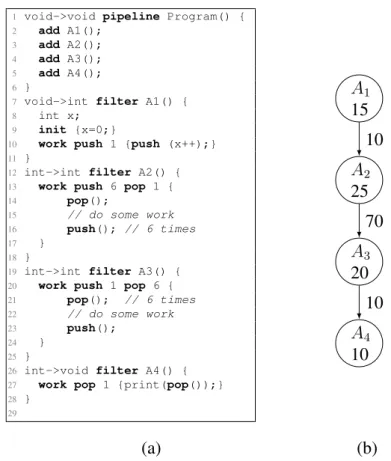
1 void->void pipeline Program() { 2 add A1(); 3 add A2(); 4 add A3(); 5 add A4(); 6 }
7 void->int filter A1() {
8 int x;
9 init {x=0;}
10 work push 1 {push (x++);}
11 }
12 int->int filter A2() {
13 work push 6 pop 1 {
14 pop();
15 // do some work
16 push(); // 6 times
17 }
18 }
19 int->int filter A3() {
20 work push 1 pop 6 {
21 pop(); // 6 times
22 // do some work
23 push();
24 }
25 }
26 int->void filter A4() {
27 work pop 1 {print(pop());}
28 } 29 A1 15 A2 25 A3 20 A4 10 10 70 10 (a) (b)
Figure 2.1: (a) Actor source code (b) Corresponding stream graph.
integer that indicates the number of tokens produced on edge(u, v)by each invocation of nodeu. Bydel((u, v)), we present a non-negative integer which indicates number of initial tokens on edge(u, v).
The Synchronous data-flow (SDF) programming model [11] is frequently adopted to the design of stream programming languages for its convenience to abstract stream programs into a set of nodes and channels in between. SDF defines data-flow graph that restricts the general Kahn’s process [43] by statically specifying the number of data tokens produced or consumed by each actor on each invocation a priori. The fixed number of tokens consumed and produced in an actor firing permits the computation of astatic finite periodic schedulemaking the processing model simple.
2.2
Scheduling of SDF programs
Significance of scheduling for the throughput of SDF graphs has been recognized from the early stage of the SDF paradigm. Murthy et al. [61] introduced Single Appear-ance Scheduling (SAS), where each actor only appears once in the schedule to avoid code-size explosion. Compared to a schedule where an actor may appear in multiple parts, SAS comes at the cost of larger buffer sizes. For a given SDF graph more than one SAS schedule may exist. Ritz et al. [65] introduced two variants of SAS, Single Appearance Single Activation Schedules (SASASs) and Single Appearance Minimum Activation Schedules (SAMASs). SASAS was designed for minimum program memory usage and SAMAS pursues minimum context switch overhead. As an opposite schedul-ing to SASAS, push schedulschedul-ing executes downmost node which has sufficient number of available tokens to invoke even once. Push scheduling results in the minimal buffer size at the expense of code size. Karczmarek et al. [44] proposed a new scheduling algorithm, phased minimum latency scheduling, which is an alternation between SAS.
2.2.1
Steady-state Scheduling
A periodic static schedule [49] consists a finite sequence of node invocations; the periodic schedule is computed at compile time, invokes each node of the SDF graph at least once, and produces no net change in the system state, i.e., the number of tokens on each edge is the same before and after executing the schedule. Thus, a periodic schedule can be executed ad-infinitum without exhausting memory, and we refer to the state before and after the execution of a periodic schedule as thesteady-state.
A periodic schedule has two properties denoted by two positive integer vectors. First vector isr∈Nncalledrepetition vector[49] whose elements correspond to nodes in the
SDF graph. Elementr(v)for allv ∈ V is equal to the number of occurrences of node
v in the periodic schedule. Because every node needs to be invoked at least once in the schedule,r(v)≥ 1, ∀v ∈ V. To run the nodes of an SDF graph in parallel, a sufficient number of initial tokens must exist on all edges(u, v) ∈E. This number of pre-loaded tokens is denoted by vectors∈Nm, which is the second property of a periodic schedule.
Definition 1. Given an SDF graphGfor which a periodic schedule exists, we call this graphparallel-executableif the following condition holds for all edges(u, v)∈E,
s((u, v))≥r(v)×cns((u, v)).
To run a parallel periodic schedule ad-infinitum without exhausting memory, the fol-lowingbalance equationmust hold for all edges(u, v)∈E of the SDF graph.
Definition 2. For each edge(u, v)of a parallel-executable graph, the balance equation is denoted by
r(u) = r(v)× cns((u, v))
prd((u, v))
for any edge(u, v)∈E.
2.2.2
Pre-steady-state Scheduling
The initial idea of a pre-steady-state schedule has been borrowed from software-pipelining. The prolog in software-pipelining denotes the sequence of instructions used to fill a software-pipelined loop [5]. Gordon et al. [31] introduced a loop prologue, which serves to advance each node to a different iteration of the stream graph.
StreamIt [77], which is one of the stream programming languages, allows a node to have a preworkstage which is executed once before the periodic static schedule. It permits programmers to insert tokens on particular edges of the SDF graph. A node’s production and consumption rates may differ from its steady state. In addition, nodes may use a peekoperation where tokens are read in a non-consuming way. Nodes may peek more tokens than they consume, which must be considered in a pre-steady-state schedule. To account for prework stages and peek operations, an initialization sched-ule has been proposed in [30, 44]. Therefore, the pre-steady-state phase of StreamIt programs is a composition of an initialization schedule followed by a pre-steady-state schedule.
To run a node as part of a static periodic schedule, each incoming edge has to con-tain sufficient number of tokens. If this condition holds for all nodes, then all nodes can
execute completely independent to each other. The easiest way to fill each edges with a sufficient number of tokens is to fill edges with zero data tokens [51]. With this ap-proach, the first few results of the SDF program will have undefined values. But based on the ideal assumption that the SDF program runs infinitely, an initial small and constant number of undefined values would be tolerable for SDF program execution. However, filling edges with zero data tokens will not execute correctly if an actor contains input-data-dependent state variables. For such actors called stateful actors, pre-steady-state schedule prior to the steady-state schedule are necessary to advance the SDF graph into a state with a sufficient number of tokens for a periodic static schedule.
2.2.3
Steady-state Scheduling of SDF Graphs with Cycles
Existence of cycles in an SDF graph makes the computation of a schedule not trivial. If we defineCas a set of at least two edges which forms a single cycle in an SDF graph
G, Reiter showed in [64] that the SDF graph is free of deadlock if and only if every cycleCin the SDF graph satisfies
X
(u,v)∈C
del((u, v))≥ min
(u,v)∈C(
cns((u, v))×r(v))*. (2.1)
Even though the SDF graph is deadlock free, it does not guarantee that a cycle can execute in parallel.
A B
2 4
1 2
Figure 2.2: An SDF with a cycle.
Figure 2.2 shows an SDF graph with a cycle. Numbers written on each edge indicates production and consumption rate of the edge e.g., for the edge(A, B),cns((A, B)) = 2
*Reiter considers homogeneous SDF (HSDF) graphs in [64]: HSDF graphs are SDF graphs which
consume and produce only a single token for each invocation of nodes. Thus, the original condition to be a deadlock free SDF graph written in [64] isP
and prd((A, B)) = 1. If del((A, B)) = del((B, A)) = 0, then there is no schedule to run the SDF graph as none of A or B has available tokens to execute, ending up in deadlock. If edge (A, B) satisfies Equation (2.1), for example del((A, B)) = 2, then valid periodic schedules exist such as BAA. However, these schedules are only valid when executed on a single processor, and no valid parallel periodic schedule exists unless all edges are filled with sufficient number of tokens to run the parallel periodic schedule. Thus, every cycleC in an SDF graph must satisfy the following condition if and only if the SDF graph is deadlock free for parallel execution.
del((u, v))≥(cns((u, v))×r(v)),∀(u, v)∈C. (2.2) With the example in the Figure 2.2, the condition to be deadlock free for parallel execution isdel(B, A) = 4anddel((A, B)) = 2.
In the thesis, we consider two ways to ensure that the SDF graph is deadlock free for parallel execution. First is to urge users to program SDF graphs which at least satisfies the Equation (2.1) in compile time, and introduces an algorithm to transform the SDF graph into acyclic SDF graph by condensing nodes in a cycle in a new merged node. This transformation does not change any semantic of an SDF program, but only forces to execute all nodes of a cycle on a processor. Basic algorithms to transform a cycle into a new merged node is introduced by Bhattacharya et al. [11]. The other approach is to guide users to provide sufficient delays to satisfy Equation (2.2) in compile-time. These two approaches are realistic as SDF programs are static already in compile-time.
2.3
SDF Code Optimization
Although buffering techniques and scheduling are inter-dependent, there is a large body of work focusing mainly on buffering techniques. The common idea is to put ad-jacent nodes to different iterations to run them independently during each subsequent iteration of the SDF graphs. The buffer space must be provided to store at least one steady state of tokens between each pair of adjacent nodes [31, 60]. Murthy et al. [60] introduced a buffering technique that retains separated buffers for each input and output
buffers of an edge but which shares the memory space as much as possible. This ap-proach could further minimize buffer sizes compared to the results of the previous work of the time [66, 74]. But this work did not take the performance of the SDF programs into account, and it required the programmer to supply annotations or static program analysis techniques which can comprehend semantics of each nodes’ computations. Furthermore, their buffer design is coarse-grained which considers number of tokens produced and consumed in a steady-state iterations but does not consider individual tokens.
Regarding techniques to manage buffers, a straight-forward and the most popular approach to implement communication of two actors is to use First-In-First-Out (FIFO) queues. But queues are costly, so Lee et al. [51] introducedstatic bufferingwhich reads its input directly from specified memory locations and writes its outputs directly to specified memory locations within buffer. This method was applied to Gabriel[13], a design environment for digital signal processing, but the idea was introduced briefly only to be applied on the buffers connect two nodes in a same processor.
Chapter 3
Overview:
LaminarIR Compiler Framework
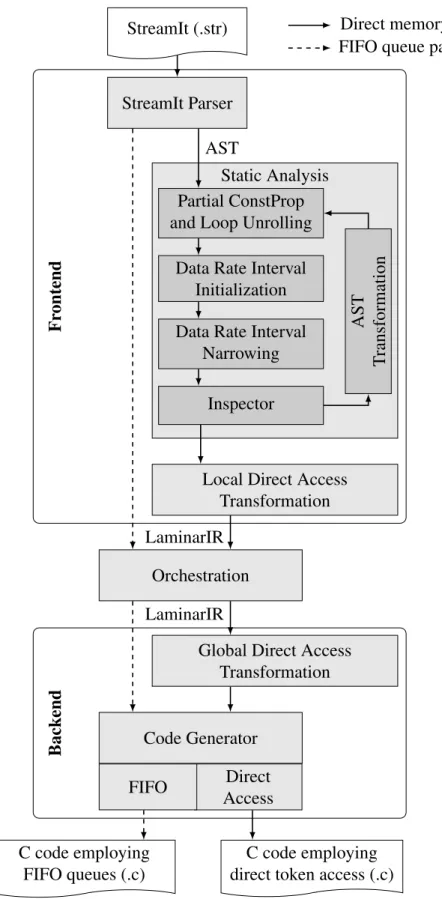
This chapter introduces each step of LaminarIR compiler framework and describes its software engineering aspects. LaminarIR compiler framework is a source to source com-piler framework which accepts a structured stream program e.g., StreamIt, and gener-ates C code that employs FIFO queues or direct token accesses as depicted in Figure 3.1. The LaminarIR compiler frontend parses structured stream programs and lowers them to LaminarIR by applying local and global direct access transformations. Astatic analysis pass is employed on the Abstract Syntax Tree (AST) in the frontend phase to enhance replacement of queue operations with local named tokens. Anorchestration pass pro-vides actor allocation information on processor(s) which is incorporated into LaminarIR after the global direct access transformation. The code generator subsequently generates C code from LaminarIR. To enable rapid prototyping, LaminarIR compiler framework employs object-oriented design including the strategy pattern [28] for parser, sched-uler and code generator. For example, as shown in Figure 3.1, the LaminarIR compiler framework provides a code generator interface for two different implementations of the code generator, i.e., FIFO queues and Direct Access. The intention of implementing own FIFO queue backend is to isolate effects of LaminarIR as the independent variable in our experimental evaluation from the input language specific optimizations. For example, the StreamIt compiler applies its own graph transformation methods on input programs, e.g., combining multiple actors into a single aggregate actor (fusion) or by instantiating
StreamIt Parser
Static Analysis Partial ConstProp and Loop Unrolling
Data Rate Interval Initialization Data Rate Interval
Narrowing Inspector
AST
T
ransformation
Local Direct Access Transformation
Orchestration
Global Direct Access Transformation Code Generator Direct Access FIFO StreamIt (.str) C code employing direct token access (.c) C code employing FIFO queues (.c) Fr ontend Back end
Direct memory access path FIFO queue path
AST
LaminarIR
LaminarIR
an actor multiple times (fission) and wrapping the instances by a round-robin split-join combination to achieve data parallelism [30]. Similarly, scheduler interface can be im-plemented by various actor allocation algorithms, and parser interface can support any structured stream programming languages, independent to the functionalities of other passes.
The LaminarIR framework and the benchmarks that we used with the experimental evaluation are available online [1].
3.1
Frontend
The frontend of the LaminarIR compiler framework is composed of three major parts: (1) A parser for the input language to generate ASTs, (2) a local direct access trans-formation that replaces FIFO queues with local named tokens from ASTs of a stream program and generates LaminarIR code, and (3) a static program analyzer that performs AST transformations to foster replacement of FIFO queues with local named tokens in the local direct access transformation.
Parser The parser of the frontend comes with the input programming language that the LaminarIR compiler framework supports. For the StreamIt parser, the ANTLR parser generator is adopted from the StreamIt compiler to accept StreamIt programs as input programs. In addition to AST generation, the parser generates stream graph information, such as actor instances and topology of actor instances. For the sake of programmability, structured stream programs facilitate constant stream parameters to scale each compo-nent. For example, the StreamIt parser generates a java bytecode that evaluates con-stant stream parameters and finally results an end stream graph of a StreamIt program. Topology of actor instances in the stream graph is an essential information to lower the structured stream programs into LaminarIR. The frontend may be expanded to support other stream languages. For a new language, a parser is required that generates an AST and a stream graph from the input code.
analyzer pass and the local direct access transformation pass to generate LaminarIR code with FIFO queues directly from parser.
Static program analyzer The generated AST is passed on to the static program an-alyzer. The static analyzer is not technically mandatory to perform the local direct ac-cess transformation path generating LaminarIR code, and can be bypassed by letting the inspector exit the static analyzer pass without visiting the AST transformation pass. However, the quality of local direct access transformation is heavily dependent on the static analysis pass. The local direct access transformation replaces a queue operation with a direct access token when a queue operation is statically mapped to a queue po-sition, otherwise the local direct access transformation path will keep queue operations in form of local array accesses. Multiple mapping of queue positions in a queue op-eration happens when the queue opop-eration is invoked in loops, and the static analyzer employs static specification of actors to resolve the loop bounds of loops that contain queue operations.
When loop bounds are data independent, partial constant propagation of constant stream parameters derived from the parser is sufficient to resolve loop bounds in most of cases. On the other hand, data dependent loop bounds which are more frequently used in real-world applications, cannot be resolved during compile time in general. However, in our static analysis, we resolve the data dependent loop bounds by using abstract interpretation [22, 81] to denote the range of possible loop bounds, and narrow the range of possible loop bounds by the static data rates given by the actor specification. Standard loop unrolling and trace partitioning [10, 56, 68] are performed on AST to improve the analysis quality and the static analysis is revisited until the inspector decides to stop. Because loop unrolling combined with trace partitioning may explode code size, the inspector exams feasibility of the AST transformation in advance. Inspector also checks soundness of the analysis. Chapter 5 covers the static analysis pass in detail.
Local direct access transformation The local direct access transformation path re-places queue operations with local named tokens inside to actors. The local named
to-kens from producer and consumer are mapped to a global symbol later through the global direct access transformation path. Because most of complex mappings of queue operations to queue positions are resolved via the means of static program analysis, the replacement of queue operations to local direct access tokens are performed rather mechanically. Yet, two phase direct access transformations have its virtue on simplify-ing theoretical problems especially in case of transformsimplify-ing cyclic graphs or multi-phase scheduling. The design of LaminarIR including syntax is presented in Chapter 4.
3.2
Orchestration
Orchestration is an essential pass to expand the target hardware of LaminarIR to par-allel architectures. Orchestration computes the mapping of stream graphs on multicores to achieve load-balancing among available processors. The traditional load-balancing problem that only considers computation overhead is known to be NP-hard, and yet it is hard to achieve the estimated load-balancedness by the traditional approach because the influence of data communication cost to the makespan is non-neglectable. In [27], it was shown that the makespan can worsen by up to356% if communication cost of data channels are not considered. Even more, a further advanced load-balancing tech-nique is essential to orchestrate LaminarIR because FIFO queues are required again for inter-processor communication where intra-processor communications are transformed into direct token access. Thus the orchestration should be able to weigh benefits from data communication cost elimination by LaminarIR and benefits from parallel execution despite of accompanying communication overhead.
As a foundation of the parallel LaminarIR, we introduce a new orchestration algo-rithm which considers communication costs of FIFO queues. The novelty of our or-chestration algorithm is that we use an approximation algorithm to consider communi-cation costs in a practical time and within a reasonable quality bound. Farhad et al. [27] showed a unified ILP formulation that considers communication costs of data channels, however, the ILP program quickly becomes intractable as the number of processor cores increases. The approximation algorithm for communication-cost-aware orchestration is
3.3
Backend
The backend of the LaminarIR compiler framework consists of two major passes, the global direct access transformation pass that maps the producer- and consumer-side of local named tokens, and the code generator that generates C target source code from LaminarIR. The underlying theory and the proof of our semantic-preserving transfor-mation are presented in Chapter 4.
3.4
Run-time Support for Performance Evaluation
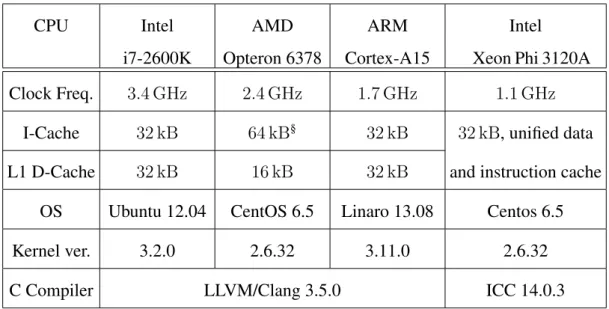
The LaminarIR compiler framework provides a run-time support system for precise and accurate performance measurement. For the processors that support CPU frequency scaling, scaling governors are employed to lock the clock frequency to the value stated in the hardware specification. In addition, affiliation of processes are finely controlled by the lightweight performance tool (LIKWID, [2]). For ARM architectures which LIK-WID dost not support, we usesched_setaffinityfunction from the GNU C Li-brary to dedicate a specific core to a thread. To observe effect of our approaches on microarchitectural CPU events that are highly CPU-specific [40], the LaminarIR com-piler framework provides a run-time support system that collects notable hardware per-formance counters by aid of PAPI [16]. LaminarIR compiler framework uses LLVM compiler infrastructure for an in-depth analysis of the profitability of each optimization on the evaluated formats.
Chapter 4
LaminarIR
4.1
FIFO Queue Overhead with Stream Programs
Streaming applications contain an abundance of parallelism due to independent ac-tors that communicate via data channels. Hence, the traditional focus of stream pro-gramming compilers has been to leverage the available parallelism during compilation, auto-tuning and run-time adaptation by exploiting the underlying stream graph structure with the objective to maximize data throughput [15, 26, 37, 46]. However, the optimiza-tion opportunities with the actual data transfers between communicating actors have been neglected. Such optimization opportunities are particularly imminent in structured stream programs that re-distribute data via split-join constructs.
Actor communication is based on the notion of FIFO queues that isolate the pro-ducer from the consumer. Although the FIFO queue is an elegant conceptual model for communication, it is nevertheless obscuring the access of information between pro-ducer and consumer. Hence, optimizing compilers cannot automatically discover the information flow due to indirect memory accesses, and standard compiler optimizations including register allocation and constant propagation become ineffective across actor boundaries. I.e., FIFO queues perforate each data channel by an indirect token store op-eration on the producer side, plus an indirect token load opop-eration on the consumer side. Queues as data channels are thus a dead-end performance-wise, and a valid question is whether the problem of FIFO queues could be ignored by scaling to a larger number of cores instead. Unfortunately, stateful actors, which are actors that pass state information
1 void->void pipeline Prog{
2 add A();
3 add float->float splitjoin
4 { 5 split duplicate; 6 add B(); 7 add C(); 8 join roundrobin; 9 } 10 add D(); 11 }
12 void->float filter A(){
13 work push 1
14 {push(my.frand());}
15 }
16 float->float filter B(){
17 work push 1 pop 2{
18 push(pop()+pop()/2);}
19 }
20 float->float filter C() {
21 work push 1 pop 2{
22 push(sqrt(pop()*pop()));}
23 } 24 float->void filter D(){ 25 work pop 2{ 26 println(pop()); 27 println(pop());} 28 } (a) 1 sdf Prog { 2 float A ->S(1); 3 float S(1)->B; 4 float S(1)->C; 5 float B ->J(1); 6 float C ->J(1); 7 float J(2)->D; 8 actor A{ 9 firing:{y=frand();} 10 output: S: y; 11 } 12 actor B{ 13 input : S: x1,x2; 14 firing:{y=(x1+x2)/2;} 15 output: J: y; 16 } 17 actor C { 18 input : S: x1,x2; 19 firing:{y=sqrt(x1*x2);} 20 output: J: y; 21 } 22 actor D { 23 input : J: x1,x2; 24 firing:{println(x1); 25 println(x2);} 26 } 27 } (b) 1 void Prog(){ 2 float x1; 3 float x2; 4 float x3; 5 float x4; 6 7 for(;;){ 8 // actor A 9 x1=frand(); 10 x2=frand(); 11 12 // actor B 13 x3=(x1+x2)/2; 14 15 // actor C 16 x4=sqrt(x1*x2); 17 18 // actor D 19 printf("%f\n",x3); 20 printf("%f\n",x4); 21 } 22 } (c) A S B C J D 1 1 1 2 12 1 1 11 2 2 (d) frand() frand() (_+_)∗1 2 √ _∗_ printf(_) printf(_) (e)
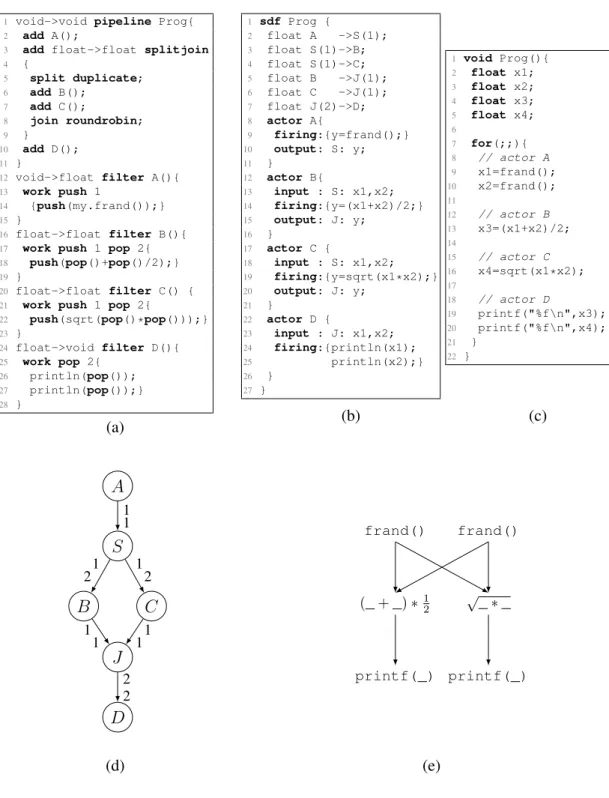
Figure 4.1: (a) An example SDF source code, (b) LaminarIR, (c) generated C code, (d) streamgraph, and (e) dataflow-graph for schedule2A,2S, B, C, J, D,
A enq deq S enq deq enq deq C B enq deq enq deq J enq deq D (a) A1 A2 C B D A1.y A2.y C.x1 C.x2 B.x1 B.x2 C.y B.y D.x2 D.x1 (b)
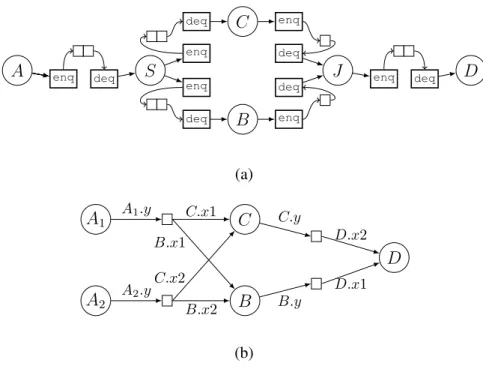
Figure 4.2: Implementations of (a) FIFO queues vs. (b) LaminarIR
from one invocation to the next, limit the available parallelism as reported in the liter-ature [26, 46]. Also, high performance applications that require peak performance will not seek a compromise.
The goal of the presented work is to remedy the current situation by shifting FIFO queue-management from run-time to compile-time. A key observation is that the ab-straction level of stream program representations is too high for compilers to map stream programs effectively onto von Neumann architectures.
We propose a lowering transformation that converts a stream program toLaminarIR, our stream program IR. Lowering proceeds in two steps: first, alocal direct access trans-formationexplicates the token-flow within actors if a programming language employs a push/pop semantic (as with StreamIt [77]). The second step performs aglobal direct access transformationfor inter-actor communication across the whole stream graph. In LaminarIR, actor declarations must name the tokens on each incoming and outgoing data channel. Work functions explicitly refer to named tokens rather than relying on FIFO queue operations for data communication.
1. We identify FIFO queues as the dominating roadblock for achieving high perfor-mance with stream programming languages. This roadblock hampers the imple-mentation of structured stream programs on von-Neumann architectures.
2. We establish the program transformation and its underlying theory to replace FIFO queues by the LaminarIR format, which manages buffers already at compile-time.
3. We evaluate the proposed transformation across four hardware platforms in terms of performance and energy consumption. Our evaluation is based on a represen-tative set of StreamIt benchmarks.
The remainder of this chapter is organized as follows. In Section 4.2 we present a motivating example for our framework. In Section 4.3 we describe the LaminarIR, the local direct access transformation with StreamIt as a case-study, and the LaminarIR code generator. Section 4.4 describes our global direct access transformation. Section 4.5 contains the experimental evaluation.
4.2
Motivating Example
Let us consider the example in Fig. 4.1a. This example uses StreamIt, but our pro-posed technique applies to any stream programming model that employs static data rates. Our example computes the arithmetic and geometric means from pairs of num-bers produced by the source actor A. Actor A lifts input data into the stream-graph by calling a native functionmy.frand(), which is a floating-point random number gen-erator that employs glibc’s rand() function under the hood. Each invocation of the source actor produces one random number that is then passed to the splitter S, which duplicates its input stream for actors B and C to compute the arithmetic and the geo-metric mean, respectively. The output streams of actors B and C are joined for actor D to output the results. The stream graph of this example is depicted in Figure 4.1d; the numbers stated with each stream-graph edge denote the number of data-items (tokens) produced and consumed by one invocation of the respective edge’s producer and
con-sumer actors. During code generation, a stream compiler will use these production and consumption rates to dimension the buffer capacity required on each stream-graph edge. These capacities will depend on the chosen actor execution schedule; To keep the ex-ample simple, we assume the sequential schedule2A,2S, B, C, J, D, where actor A ex-ecutes twice, followed by two executions of the splitter S, and then single invocations of actorsB,C, J andD. An implementation for this schedule is depicted in Figure 4.2a. Therein eachpush() statement has been mapped to an enq operation that places a token in the corresponding actor’s output queue.deq operations read tokens from an actor’s input queue. On a shared-memory CPU, these queues will be implemented as buffers that are accessed indirectly via read- and write-pointers. Everyenq anddeq
operation entails the overhead of maintaining the read- and write-pointers, plus the cost of indirect token-access itself.
We can specialize our program by connecting producer-side operands to the opera-tions in the consumer that process them. For example, from the above schedule we can easily infer that the tokens produced by two invocations of actor A become the input for the arithmetic and the geometric mean computations of actors B and C in lines 18 and 22 of Figure 4.1a. Instead of routing these tokens through the duplicating splitter S and its associated queues, we explicate the token-flow through the stream graph as depicted by the data dependence graph in Figure 4.1e. There, each operation from a consumer actor (e.g., (_+_) ∗ 1
2 and
√
_∗_) directly accesses its operands from the producer actor. Direct token-access eliminates splitters, joiners and FIFO queues altogether. Cre-ated by a compiler, the direct access format effectively shifts FIFO buffer management from run-time to compile-time. This transformation cannot be established solely from an actor’s source-code, because the amount of tokens that occur on a data channel at any given point in time is determined by the actor execution schedule. E.g., although it is true that thepush statement in line 14 of actor A always enqueues a token at the back of the queue, the memory address of the accessed queue position depends on the state of the queue, i.e., the number of elements already in the queue. Thus, in the sched-ule2A,2S, B, C, J, D the first invocation of actor A will write to a different memory address than the second invocation.
As an example transformation, consider actor C in Figure 4.1b, which is the result of the local direct access conversion of our motivating example. Theinputsection of actor C states two named tokens x1and x2, which are written in this order by split-ter S. The actor stores its output in token y; the geometric mean computation in the
firing section is defined in terms of the named tokensx1, x2and y. We refer to named tokens asindirections, because they divert a token access inside of an actor to an abstract storage location, where it can be aliased with the corresponding token access at the opposite endpoint of the respective data channel during the second step of our low-ering transformation. This second step is a global graph transformation that employs the stream graph topology to pair producer- and consumer-side indirections. The result of this transformation on our motivating example is depicted in Figure 4.2b. Boxes ( ) denote abstract token storage locations between actors. Tokens are passed explicitly by a write-operation of the producer on an indirection which is aliased by an indirection in the consumer. E.g., the first invocation of actor A, i.e.,A1, writes its output to indirection
A1.y, which is aliased by indirections C.x1 andB.x1 of actors C and B respectively. Splitters and joiners are eliminated during the global indirect access transformation. The LaminarIR format is on a sufficiently low abstraction level for LLVM to promote all to-ken variables to SSA form. The data-flow graph in Figure 4.1e depicts the dependencies that LLVM generated from the LaminarIR of our motivating example.
For the sake of readability we have restricted the size of the motivating example. Note however that the proposed technique applies to synchronous data flow (SDF) graphs in general. Our experimental evaluation in Section 4.5 applies this technique to entire StreamIt applications. Our proposed technique is applicable to static-rate sub-graphs of hybrid approaches like the one from [70]. With such a hybrid approach, edges with dynamic data rates are kept as FIFO queues, whereas edges with static data rates are transformed to the LaminarIR format. Conversely, the LaminarIR doesnotinhibit par-allelization. Rather, our technique can be applied to any stream sub-graph with static data-rates. Although outside the scope of this work, such sub-graphs can be produced by state-of-the-art multicore parallelization techniques. Our optimization is thus orthog-onal to stream parallelization techniques to enhance performance.
program ::= sdfid{edge node}
edge ::= type id .idx? (((rate)))?->id .idx? (((rate)))? delay ::= = {val}
node ::= actorid{StateDef?NodeDef } StateDef ::= state:code init:code
NodeDef ::= input? firing output? input ::= input:channel firing ::= firing:code output ::= output:channel channel ::= id:indirections indirections ::= id,id
Figure 4.3: Abstract Syntax of LaminarIR. For brevity, constructs not relevant for buffer management have been omitted.
4.3
LaminarIR
The LaminarIR is a domain-specific program representation for stream programming languages that employ static data rates. Unlike StreamIt, which represents programs as hierarchies of pipelines, loops and split-join compound statements, LaminarIR employs a flat, directed graph structure which is not restricted to structured stream graphs. Lam-inarIR provides an actor withdirect accessto the tokens of its incoming and outgoing data channels. The LaminarIR is thus on a lower abstraction level than StreamIt, which abstracts away direct token access adapting a queue model with the push, pop, and
peekstatements.
LaminarIR’s abstract syntax is summarized in Figure 4.3. Each program starts with a sequence ofedgedeclarations that define the topology of the program’s stream graph. Here,edgedenotes a list of edgecomponents; we use similar notation for other lists in the LaminarIR grammar. Lines 2–7 from Figure 4.1b constitute the edge section of our motivating example’s stream graph. Anedgedeclaration consists of the token-type and
P arser StreamIt (.str) Local Direct Access T ransformation Global Direct Access T ransformation Code Generator Direct Access FIFO C code employing direct token access (.c)
C code employing FIFO queues (.c) AST Laminar IR Laminar IR
Figure 4.4: LaminarIR framework
the producer and consumer actor of the edge. With splitters and joiners, we additionally require the specification of input and output data-rates from which LaminarIR can de-duce whether the actor is either a splitters or joiner. If an actor is not a splitter/joiner, the actor requires an explicitnodedeclaration that includes data-rates for consumption and production. As an example, splitterSreferred in line 2 of Figure 4.1b will consume one token on the edgeA->S on each invocation. An actor can have several instances, for which the LaminarIR provides optional indexes (idx). The indexes are appended to the produced/consumer declarations of an edge declarations. Throughout this chapter we distinguish actor instances by subscripts.
Actors other than splitters and joiners are declared in thenode section of the Lam-inarIR. A node declaration defines incoming channels and channel indirections in the node’sinputsection, and outgoing channels and their indirections in theoutputsection. The order of stated indirections (left-to-right) corresponds to their positions (front-to-back) in the associated queue. Actor computations are defined in thefiring section of an actor declaration. Indirections are referenced like regular variables, except that in-put indirection are restricted to read-accesses, and outin-put indirections to write-accesses, respectively. No constraints are imposed on the order of indirection accesses within an actor’s firingsection. An actor is stateful if an optional state section is defined. State variables declared in the state section are initialized in the init section, which is run once before execution of the program’s steady-state.
The code generator of the LaminarIR framework, as shown in Figure 4.4, uses actor functions as code templates, computes a schedule and produces a single block to execute a finite periodic schedule. Hence, tokens become local and the data-flow between actor
4.3.1
Local Direct Access Transformation
StreamIt provides a queue semantics to access input and output tokens of an actor, whereas LaminarIR has named tokens only. To lower queue operations for accessing input and output tokens, LaminarIR requires a mapping from StreamIt’s push state-ments to named output tokens and from StreamIt’spopandpeekoperations to named input tokens. This mapping must be static, i.e., for all possible program paths in the control-flow of the actor, the conversion must be semantically correct. However, the queue operations may be dependent on data-dependent control-flow constructs. Hence, an automatic conversion may fail. To overcome this issue, we have devised a translation scheme that performs constant propagation and loop-unrolling, which covers almost all practical cases to convertpushandpopoperations of StreamIt to named tokens. Our local conversion covers all but 3 actors of the StreamIt benchmarks with static data-rates from [76].
If the translation fails, we introduce dynamic read/write counters for the queue posi-tion that are incremented whenpush/popstatements are executed. Depending on the counters, the appropriate named token is accessed via a switch/case statement. This is possible, because the number of named tokens for each channel is a constant. However, the dynamic conversion frompushand popstatements imposes a run-time overhead as discussed in the experimental evaluation in Section 4.5.
Our StreamIt-to-C source to source transformation framework is depicted in Fig-ure 4.4. Parsed StreamIt programs are lowered to LaminarIR by the local and global direct access transformations, to be followed by C code generation. The StreamIt com-piler applies its own set of graph transformations, e.g., by combining multiple actors into a single aggregate actor (fusion) or by instantiating an actor multiple times (fission) and wrapping the instances by a round-robin split-join combination to achieve data par-allelism [30]. To isolate the effects of the LaminarIR as the independent variable in our experimental evaluation, we have implemented our own FIFO queue backend. Unlike StreamIt, our FIFO queue backend does not change the underlying stream graph struc-ture. (Our experimental evaluation in Section 4.5 compares LaminarIR to both StreamIt
and our own FIFO queue backend.) The LaminarIR framework and the benchmarks that we used with the experimental evaluation are available online [1].
4.4
Global Direct Access Transformation
We give two types of semantics for the SDF programming model. The first semantics may be considered as a concrete semantics for SDF. The state of the data channels in the concrete semantics are modeled via an array of lists. A list in the array represents state of a data channel between two actor firings. Actors are fired according to a sequential schedule. An actor firing (1) dequeues tokens from its incoming data channels, (2) the dequeued tokens are applied to the firing function of the actor, and (3) the produced tokens of the firing function are enqueued on its outgoing data channels. The second semantics is an auxiliary semantics, which stores tokens by indirections. Instead of hav-ing data channels storhav-ing tokens, symbols with an environment are used to represent the state between actor firings. The auxiliary semantics results in a non-constructive impera-tive program of infinite length with infinite number of program variables. We finitize the imperative program using the finite admissible periodic schedule of the SDF program.
4.4.1
Background and Notation
An SDF program is a data-flow graph which statically specifies the number of data tokens produced or consumed by each actor on each invocationa priori[11]. An SDF program is expressed as a directed graph with a set of actors V = {1, . . . , n} and a set of data channels E = {1, . . . , m} that connect actors. When an actor i is fired, the consumption of tokens on the incoming channels is represented by function c :
V → (E → N). For example c3(1) denotes the consumption rate of actor 3 on data channel1. If data channel1 is not an incoming edge of actor3, then the consumption is set to zero. Similarly, the production of tokens is modeled by function p : V →
(E → N). An SDF program has a delay, which represents the initial tokens in the data channel before firing actors in a schedulehu1, u2, . . .i.It is assumed that an SDF program has a finite admissible periodic schedule hu1, u2, . . . , uki that consists of a
finite sequence of actor invocations [49]; the periodic finite schedule is computed at compile time, invokes each actor of the SDF graph at least once, and produces no net change in the system state, i.e., the number of tokens on each edge is the same before and after executing the schedule. Thus, a periodic finite schedule can be executed ad-infinitum without exhausting memory, and we refer to the state before and after the execution of a periodic finite schedule as thesteady-state.
For representing the state of a data channel, we resort to simple lists for which we introduce two functions. Functionheadk: (t1, . . . , tk−1, tk, tk+1, . . . , tl)7→(t1, . . . , tk)
extracts the firstkelements from the list and functiontailk : (t1, . . . , tk−1, tk, tk+1, . . . ,
tl)7→(tk+1, . . . , tl)extracts the elements fromtk+1 onwards. The concatenation of two listsl1 andl2 is denoted byl1·l2. We extend the functions for lists to array of lists, e.g., head(k1,...,km)(l1, . . . , lm) = (headk1(l1), . . . ,(headkm(lm))to represent the state of an
SDF program.
Boot Schedule The boot schedule of an SDF graph G = (V, E) denotes a sequence of node invocations of any nodev ∈ V to arrange a sufficient number of tokens for all edgese ∈E according to Definition 1. We define a non-negative integer vectori ∈Nn
0 called the init vector whose elements correspond to nodes in the SDF graph. Element i(v)for allv ∈V indicates the number of occurrences of nodevin the boot schedule.
The number of tokens that reside on edge(u, v)after booting can be written asi(u)×
prd((u, v))−i(v)×cns((u, v)). Therefore, we can derive Definition 3.
Definition 3. s((u, v)) = i(u)×prd((u, v))−i(v)×cns((u, v)),∀(u, v)∈E
To compute the vectori of a boot schedule, we introduce thelevel* of node, which
indicates the depth of the node from the sink node. We define vectorlwhose elements correspond to the levels of node in the SDF graph.
l(v) = 0 ifv ∈sink(G), max w∈succs(v)l(w) + 1 otherwise. (4.1)
*In [49], Lee et al. defined the level of a given node is the longest number of invocations of a given