D Y N A M I C A D A P T I V E V I D E O S T R E A M I N G
W I T H M I N I M A L B U F F E R S I Z E S
DISSERTATION
zur Erlangung des Grades des
Doktors der Ingenieurwissenschaften (Dr.-Ing.) der Naturwissenschaftlich-Technischen Fakultäten
der Universität des Saarlandes
vorgelegt von
Yongtao Shuai
Dekan der Fachrichtung: Prof. Dr. Sebastian Hack
Prüfungsausschuss
Vorsitzender: Prof. Dr. Christian Rossow
Gutachter der Dissertation: Prof. Dr.-Ing. Thorsten Herfet Prof. Dr. José Manuel Menéndez Akademischer Mitarbeiter: Dr. Pascal Peter
Dynamic Adaptive Video Streaming with Minimal Buffer Sizes
A B S T R A C T
Recently, adaptive streaming has been widely adopted in video streaming services to improve the Quality-of-Experience (QoE) of video delivery over the Internet. However, state-of-the-art bitrate adaptation achieves satisfactory performance only with extensive buffering of several tens of seconds. This leads to high playback latency in video delivery, which is undesirable especially in the context of live con-tent with a low upper bound on the latency. Therefore, this thesis aims at pushing the application of adaptive streaming to its limit with respect to the buffer size, which is the dominant factor of the streaming latency.
In this work, we first address the minimum buffering size required in adaptive streaming, which provides us with guidelines to determine a reasonable low latency for streaming systems. Then, we tackle the fundamental challenge of achieving such a low-latency streaming by developing a novel adaptation algorithm that stabilizes buffer dynamics despite a small buffer size. We also present advanced improve-ments by designing a novel adaptation architecture with low-delay feedback for the bitrate selection and optimizing the underlying transport layer to offer efficient real-time streaming. Experimental evaluations demonstrate that our approach achieves superior QoE in adaptive video streaming, especially in the particularly challenging case of low-latency streaming.
In letzter Zeit setzen immer mehr Anbieter von Video-Streaming im Internet auf adaptives Streaming um die Nutzererfahrung (QoE) zu verbessern. Allerdings er-reichen aktuelle Bitrate-Adaption-Algorithmen nur dann eine zufriedenstellende Leistung, wenn sehr große Puffer in der Größenordnung von mehreren zehn Se-kunden eingesetzt werden. Dies führt zu großen Latenzen bei der Wiedergabe, was vor allem bei Live-Übertragungen mit einer niedrigen Obergrenze für Verzögerun-gen unerwünscht ist. Aus diesem Grund zielt die vorlieVerzögerun-gende Dissertation darauf ab adaptive Streaming-Anwendung im Bezug auf die Puffer-Größe zu optimieren da dies den Hauptfaktor für die Streaming-Latenz darstellt.
In dieser Arbeit untersuchen wir zuerst die minimale benötigte Puffer-Größe für adaptives Streaming, was uns ermöglicht eine sinnvolle Untergrenze für die erreich-bare Latenz festzulegen. Im nächsten Schritt gehen wir die grundlegende Herausfor-derung an dieses Optimum zu erreichen. Hierfür entwickeln wir einen neuartigen Adaptionsalgorithmus, der es ermöglicht den Füllstand des Puffers trotz der gerin-gen Größe zu stabilisieren. Danach präsentieren wir weitere Verbesserungerin-gen indem wir eine neue Adaptions-Architektur für die Datenraten-Anpassung mit geringer Feedback-Verzögerung designen und das darunter liegende Transportprotokoll op-timieren um effizientes Echtzeit-Streaming zu ermöglichen. Durch experimentelle Prüfung zeigen wir, dass unser Ansatz eine verbesserte Nutzererfahrung für ad-aptives Streaming erreicht, vor allem in besonders herausfordernden Fällen, wenn Streaming mit geringer Latenz gefordert ist.
E X T E N D E D A B S T R A C T
As video streaming rapidly gains on popularity and quality, it already represents a dominant share of Internet traffic and its share will constantly grow in the near future. To be effective, video needs to be presented to users in high quality and without interruptions. However, the delivery of such video over best-effort packet-switched networks is challenging due to unknown and time-varying network condi-tions, including available throughput, delay and losses. A state-of-the-art approach to tackle this challenge is adaptive streaming, in which the video stream is divided into small segments and encoded using multiple quality levels with respect to vi-deo characteristics (e.g., resolution and bitrate). This allows streaming applications to respond to varying network by selecting and retrieving the most suitable quality level for each segment to obtain a seamless playback. Adaptive streaming is desig-ned to deliver the highest possible Quality-of-Experience (QoE) — e.g., maximizing the bitrate while minimizing the likelihood of playback stalls (interruptions) and avoiding frequent bitrate switches. Hence, nowadays, it has become ubiquitous in video delivery, especially in Internet-based video distribution.
Despite the facility of dealing with varying network conditions, one of open is-sues with adaptive streaming is that existing bitrate adaptation only reaches accep-table video quality when buffering several tens of seconds. This leads to high playback latency in video streaming, which is undesirable especially in the context of live content with a low upper bound on the latency. In this thesis, we present an efficient algorithm and architecture to support low-latency streaming. Our goal is to improve the user’s QoE in adaptive streaming while reducing the latency. Several contributions to this area of the research are outlined as follows.
In order to cope with efficient streaming systems with respect to low latency, it will be necessary to determine a reasonable lower bound of the latency for adaptive streaming. In our first contribution, we focus on the analytic study of streaming la-tency. We analyze the components affecting the latency and determine the buffering size as the main component. We present an analytical model of adaptive streaming for buffer size, which can generalize various streaming scenarios concerning the latency. Given the characteristics of a network (e.g., throughput and delay) and the available video profiles (e.g., segment duration and video bitrates), we derive a theoretical minimum of the buffering size required by adaptive streaming and an approximation of the minimum buffering size. This allows us to determine a reasonable low latency for streaming applications.
With the guidelines of the minimum buffering delay, our second contribution addresses the challenge to design an adaptation algorithm which approaches the lower bound requirement of streaming latency. The main challenge is the stabiliza-tion of client buffer dynamics, because a small buffer lacks resilience to the buffer fluctuation imposed by the mismatch between the network throughput and the vi-deo bitrate of the selected vivi-deo segment. We tackle this fundamental challenge by developing a novel algorithm that minimizes buffer deviation from the desired level despite a small client buffer and jointly reduces the frequency of bitrate switching.
compared to other state-of-the-art algorithms. It achieves the best performance with a buffering size as small as a single segment duration.
The majority of bitrate adaptations do not explicitly take the network delay into consideration during their design. However, the network delay is critical to low-latency streaming. First, it introduces a significant delay for client feedback and thus limits the effectiveness of the adaptation. Second, it incurs the reception delay of consecutive segments, which directly influence the overall latency budget for the streaming. In our third contribution, we present an adaptive streaming architecture designed to address this issue. The key advantage of our architecture is a server-side adaptation based on the throughput and buffer information, which provides a low-delay feedback for the video bitrate selection and near-zero values for the reception delay. Furthermore, we optimize the underlying transport layer of the streaming architecture in order to support predictable delay variation and a high throughput utilization for video streaming. With these refinements, our approach exhibits advanced improvements in terms of user-perceived video quality.
Silent gratitude
— Xiaomei
Gratitude is the memory of the heart.
— Jean Massieu
A C K N O W L E D G M E N T S
Many people helped me in this challenging endeavor I took up. To all of them I would like to express mysilent gratitude!
The greatest gratitude goes to my supervisor, Prof. Dr.-Ing. Thorsten Herfet, for providing me the opportunity, the scientific and monetary foundation to accomplish this research work. Definitely, this work was significantly shaped due to his in-depth comments and the numerous inspiring discussions we had. I also express my gratefulness to all my committee members for their time and willingness being a part of my dissertation defense, especially to Prof. Dr. José Manuel Menéndez for agreeing to serve as an external reviewer and to Prof. Dr. Christian Rossow for being the chair of the committee. This work was further financially supported by the Intel Visual Computing Institute.
I also express my deep gratitude to a number of colleagues and friends at Saar-land University, whose research excellence has served as a role model for me and whose wonderful personalities have made a long-lasting impact on me. In par-ticular, thank you, Dr.-Ing Manuel Gorius, who has shown tremendous patience in guiding me and bootstrapping me at the early stage of my video streaming re-search; thank you, Dr. Goran Petrovic, who has advised me a lot in research and other things, and whose enormous support and encouragement have brought me to the end of the Ph.D. process; thank you, Tobias Lange, for his extensive feedback and detailed comments that significantly improved the presentation quality of my thesis and earlier papers. I would like to thank Dr. Michelle Carnell and other members in the Graduate School of Computer Science for the great event organ-izations throughout my Ph.D. years and for the financial support during the final thesis write-up stage.
I had the pleasure to work with a number of colleagues and students at the TC Lab: Ing Manuel Gorius, Ing. Jochen Miroll, Ing. Michael Karl, Dr.-Ing. Christopher Haccius, Dr. Goran Petrovic, Prof. Dr.-Dr.-Ing. Guoping Tan, Dr.-Dr.-Ing. Zhao Li, Tobias Lange, Jochen Grün, Nasimi Eldarov, Andreas Schmidt, Pablo Gil Pereira, Ramakrishna Mundugar, Frank Waßmuth, Kelvin Augustin Chelli, Harini Priyadarshini Hariharan, Su-A Kim, Manpreet Kaur, Muhammad Arhum Gulzar, Santhosh Nayak, Vinayak Hegde, Dimitrina Krasteva, Vassilena Slaveva, and Pra-harsha Sirsi. I am glad that we have shared interests, scientific and personal discus-sions. I also want to give credit to their fruitful cooperation. I would additionally like to thank Diane Chlupka at the lab for providing mission-critical administrative support. Likewise, I owe Zakaria Keshta for keeping the computing infrastructure
Taking this opportunity, I would like to thank all those people not being listed so far that directly and indirectly contributed to my research work. These also include the anonymous reviewers whose comments helped me considerably in improving both the results and the presentation of the topic.
Without some of the people in my life, I would never have been able to reach the finish line. My gratitude also goes to all my friends accompanying me on the way and my family for their encouragement, support, and love. One needs a lot of them for the long-distance march of pursuing a Ph.D. I dedicate this work to all of you.
C O N T E N T S
1 i n t r o d u c t i o n 1
1.1 Rising of Internet Video . . . 1
1.2 Challenges in Internet Video . . . 2
1.3 Rising of Adaptive Streaming . . . 2
1.4 Challenges in Adaptive Streaming . . . 3
1.5 Research Contributions and Thesis Outline . . . 4
2 b a c k g r o u n d 7 2.1 Video Streaming . . . 7
2.2 Adaptive Bitrate Streaming . . . 8
2.2.1 Dynamic Quality Switching . . . 8
2.2.2 Client Playback Buffer . . . 9
2.2.3 ON-OFF Streaming Pattern . . . 11
2.2.4 Video Bitrate . . . 14
2.2.5 Segmentation . . . 14
2.2.6 MPEG-DASH . . . 16
2.2.7 Adaptation Controller . . . 17
2.3 Quality of Experience . . . 18
2.3.1 Assessing Quality of Experience . . . 19
2.3.2 Quality of Experience for Adaptive Bitrate Streaming . . . 21
3 t o wa r d s r e d u c e d l at e n c y i n a d a p t i v e s t r e a m i n g 27 3.1 Latency in Adaptive Streaming . . . 27
3.1.1 Live Latency . . . 27
3.1.2 Latency in VoD streaming . . . 30
3.2 Adaptive Streaming Model for Buffer Size . . . 32
3.3 Minimum Buffering Size . . . 34
3.4 An Approximation of Minimum Buffering Size . . . 38
3.5 Validity of Approximations . . . 41 3.5.1 Methodology . . . 41 3.5.2 Experimental Results . . . 43 3.6 Summary . . . 45 4 a d a p tat i o n a l g o r i t h m: b i t r at e s e l e c t i o n f o r b u f f e r s ta b i l -i z at -i o n 47 4.1 Challenges in Low-latency Adaptive Video Streaming . . . 47
4.2 Bitrate Selection for Buffer Stabilization . . . 49
4.2.1 Modeling buffer dynamics . . . 49
4.2.2 Estimating the network throughput . . . 50
4.2.3 Stabilizing buffer dynamics (basic bitrate selection) . . . 51
4.2.4 Stabilizing video quality levels (improved bitrate selection) . . 52
4.3 Optimal Bitrate Selection . . . 52
4.3.1 QoE function . . . 53
4.3.2 QoE Optimization Problem . . . 54
4.4 Performance Evaluation . . . 55
4.4.1 Methodology . . . 55
4.4.2 Benchmark Results . . . 57
4.4.3 Impact of parameters . . . 59
4.4.4 Performance with Minimum Buffering Size . . . 60
4.4.5 Discussion . . . 62
4.5 Summary . . . 64
5 a d va n c e d i m p r ov e m e n t s i n l o w-l at e n c y a d a p t i v e v i d e o s t r e -a m i n g 65 5.1 Introduction . . . 65
5.2 Open Loop Dynamic Rate Control . . . 66
5.2.1 Virtual Client Buffer . . . 67
5.2.2 Adaptation Controller . . . 67
5.2.3 End-to-end Synchronization . . . 68
5.3 Real-Time Transport . . . 68
5.3.1 Predictable Reliability . . . 69
5.3.2 Delay-based congestion control . . . 70
5.4 Performance Evaluation . . . 70
5.4.1 Methodology . . . 71
5.4.2 Mirror the Client Buffer Dynamics . . . 74
5.4.3 Performance Comparison . . . 76
5.4.4 Impact of OLAC . . . 81
5.4.5 Impact of Client Buffer Size . . . 81
5.5 Summary . . . 82
6 r e l at e d w o r k 85 6.1 Latency Landscape in Adaptive Streaming . . . 85
6.1.1 Industry . . . 85 6.1.2 Academia . . . 86 6.1.3 Reduced Latency . . . 86 6.2 Throughput Estimation . . . 87 6.3 Adaptation Algorithm . . . 90 6.3.1 Throughput-based Approach . . . 90 6.3.2 Buffer-based Approach . . . 91
6.3.3 Buffer- and Throughput-based Approach . . . 92
6.3.4 Approach with Buffer Stabilization . . . 93
6.4 Transport Protocols . . . 95
6.4.1 Error Control . . . 95
6.4.2 Congestion Control . . . 96
6.5 Video Encoding Schemes . . . 96
6.5.1 Single-View Video . . . 97
6.5.2 Multi-View Video . . . 97
6.6 Global Optimization . . . 98
7 c o n c l u s i o n s a n d f u t u r e w o r k 99 a a p p e n d i x 101 a.1 Derivation of Approximation for Minimum Buffering Size . . . 101
a.2 Proof of Minimum Quantization Error . . . 105
a.3 Publications . . . 106
L I S T O F F I G U R E S
Figure2.1 Illustration of segment requests and bitrate adaptation in ABS 9
Figure2.2 Illustration of the client playback buffer . . . 10
Figure2.3 Bitrate selection based on average HTTP throughput in DASH
with client buffer size and segment duration under the ON-OFF streaming pattern . . . 13
Figure2.4 Average bitrate of segments in variable bitrate encoding with
various quality profiles . . . 15
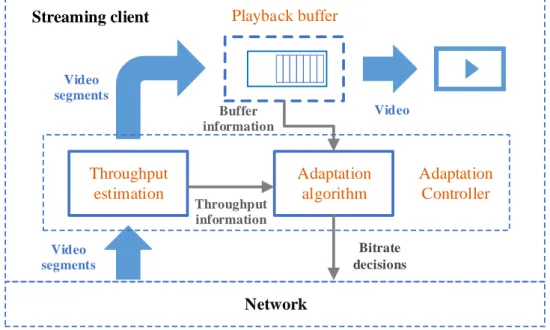
Figure2.5 An abstract model of common ABS adaptation . . . 18
Figure3.1 An example of Live latency with a buffering size of two
seg-ments. . . 28
Figure3.2 An example of VoD streaming with a buffering size of two
segments. . . 31
Figure3.3 An example of solving the minimum buffering size for a live
streaming session . . . 36
Figure3.4 The theoretical and approximate minimum buffer levels
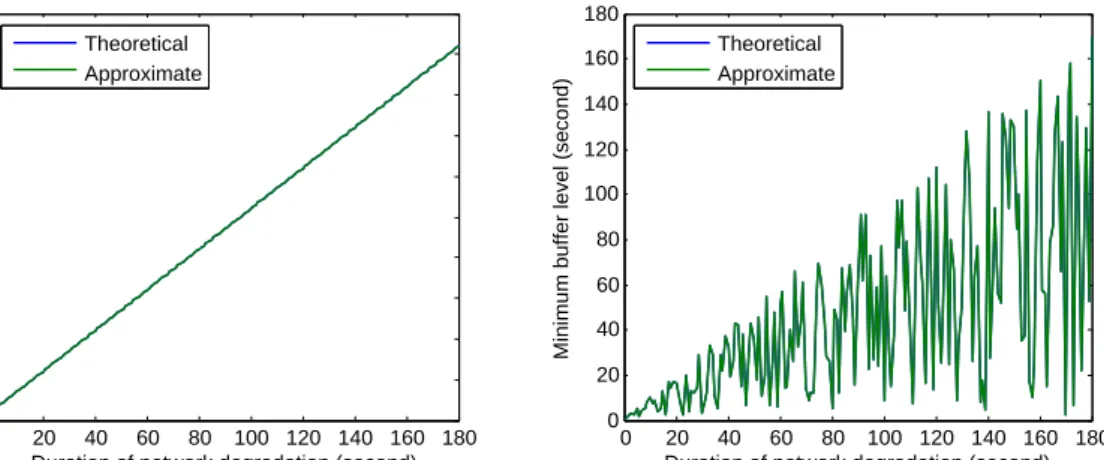
re-quired prior to one single network degradation event with the constant network throughput . . . 43
Figure3.5 Error ratio of the approximate and theoretical minimum
buf-fering size in the case of one single network degradation event with the non-constant network throughput . . . 44
Figure3.6 Error ratio of the approximate and theoretical minimum
buf-fering size in the case of multiple network degradation events 45
Figure4.1 Average bitrate of each segment in variable bitrate encoding . 48
Figure4.2 QoE performance of the five adaptation algorithms . . . 57
Figure4.3 Impact of BDS’s parameters on normalized QoE for scenarios
with various client buffer sizes . . . 60
Figure4.4 Performance evaluation of bitrate adaptation algorithms with
respect to the total time of playback stalls and the normalized QoE during the streaming session under the constraint of various buffering sizes . . . 62
Figure4.5 Network throughput scenarios . . . 63
Figure4.6 The optimum OPT of bitrate selection under each of three
scenarios: (a) long-term throughput variations; (b) short-term throughput variations; (c) mobile throughput traces. . . 63
Figure4.7 Normalized QoE achieved by three algorithms over three
sce-narios: (a) long-term throughput variations; (b) short-term throughput variations; (c) mobile throughput traces. . . 64
Figure5.1 Open-loop rate control architecture . . . 66
Figure5.2 Dynamic streaming architecture based on the PRRT protocol . 69
Figure5.3 An overview of the experimental setup . . . 73
Figure5.4 Video quality level and buffer level of DAST when competing
with a single TCP flow . . . 75
with a single TCP flow . . . . Figure5.6 User experience modeled by impairment functions for single
competing TCP traffic in ten runs of each streaming scenario 78
Figure5.7 Aggregate performance for multiple streaming sessions on
average of ten runs of each streaming scenarios . . . 80
Figure5.8 Comparison of the client-side and server-side bitrate
adapta-tion with the buffer stabilizaadapta-tion over TCP configuraadapta-tion . . . 82
Figure5.9 User experience modeled by impairment functions for
mul-tiple streaming sessions with increasing client buffer sizes . . 83
L I S T O F A L G O R I T H M S
Algorithm4.1 BDS Algorithm (an improved version, BDS-1) . . . 53
L I S T O F E X C U R S I O N S
Excursion3.1 An example of solving the equation system of adaptive
stream-ing model for buffer size . . . 34
A C R O N Y M S
3GPP Third Generation Partnership Project
A3C Asynchronous Advantage Actor-Critic
ABS Adaptive Bitrate Streaming
AIMD Additive-Increase / Multiplicative-Decrease ANSI American National Standards Institute
AP Access Point
Acronyms xiii
AR Augmented Reality
ARQ Automatic Repeat reQuest
ATSC Advanced Television Systems Committee AVC Advanced Video Coding
BBR Bottleneck Bandwidth and Round-trip propagation time CBR Constant Bitrate
CDF Cumulative Distribution Function CDN Content Delivery Network
CMAF Common Media Application Format CPU Central Processing Unit
DASH Dynamic Adaptive Streaming over HTTP DASH-IF DASH Industry Forum
DCCP Datagram Congestion Control Protocol DVB Digital Video Broadcasting
ETSI European Telecommunications Standards Institute EWMA Exponentially Weighted Moving Average
FEC Forward Error Correction FTV Free Viewpoint Television FVV Free Viewpoint Video GOP group-of-picture
GPS Global Positioning System HAS HTTP-based Adaptive Streaming HbbTV Hybrid Broadcast Broadband TV
HD High-Definition
HDS HTTP Dynamic Streaming HEC Hybrid Error Coding
HEVC High Efficiency Video Coding HLS HTTP Live Streaming
HMM Hidden Markov Model
HTTP Hypertext Transfer Protocol
HVS Human Visual System
IPTV Internet Protocol television
ISO International Organization for Standardization ISP Internet Service Provider
ITU International Telecommunication Union KAMA Kaufman’s Adaptive Moving Average
MOS Mean Opinion Score
MPC Model Predictive Control MPD Media Presentation Description MPEG Moving Picture Experts Group MPEG-TS MPEG Transport Stream
MSE Mean Squared Error
MSS Microsoft Smooth Streaming MVC Multi-view Video Coding
MVV Multi-View Video
PCR Program Clock Reference PI Proportional-Integral
PLL Phase Locked Loop
PRRT Predictably Reliable Real-time Transport PSNR Peak Signal-to-Noise Ratio
QoE Quality-of-Experience QoS Quality-of-Service
QUIC Quick UDP Internet Connections RL Reinforcement Learning
RTCP Real-Time Control Protocol RTP Real-Time Transport Protocol RTSP Real-Time Streaming Protocol
RTT Round Trip Time
SCTP Stream Control Transmission Protocol SSIM Structural SIMilarity
SVC Scalable Video Coding SVR Support Vector Regress
TCP Transmission Control Protocol UDP User Datagram Protocol UHD Ultra-High-Definition URL Uniform Resource Locator VBR Variable Bitrate
VoD Video-on-Demand
VQEG Video Quality Expert Group VQL Video Quality Level
VQM Video Quality Metric
VR Virtual Reality
N O TAT I O N S
ai an estimate of the available network throughput experienced during the reception of segmenti.
˜
ai a measured sample of the available network throughput experienced during the reception of segmenti.
avgRTT the average of the round trip time.
b(t) the buffer level in seconds at timet.
bei the buffer level in seconds when the reception of segmentiends.
bsi the buffer level in seconds when the reception of segmentistarts.
Bmin the minimum of the buffering size for a streaming session without playback stalls, i.e., the minimum buffer level required prior to the playback of a streaming session, such that the client can avoid playback stalls during the entire streaming session.
B∗min the theoretical minimum ofBmin.
g
Bmin an approximate value ofBmin.
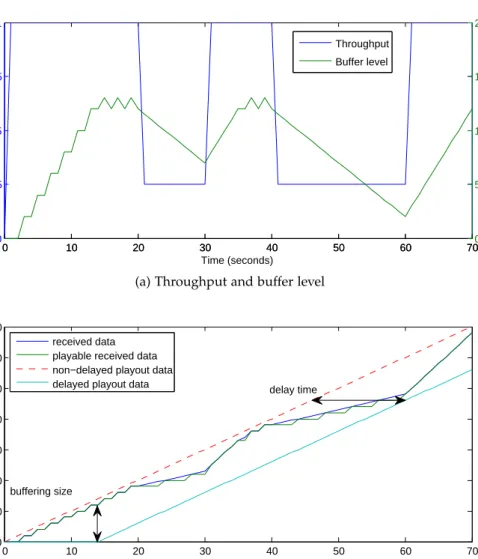
Bd the buffering size, i.e., the amount of video data (in seconds) collected in the buffer before the start of the first video playback.
Bdegmin the minimum buffer level required prior to a network degradation, such that the client can avoid playback stalls during the network degradation.
Bmdmin the minimum buffer level required for the progressive buffer reduction within a time period having multiple degradation events with insufficient degradation intervals.
Bsdmax the maximum of allBdegminin a streaming session.
Bsdimin the average of the minimum buffer levels required for each network degradation inDsdi.
baseRTT the minimum of the round trip time.
C(t) the available network throughput at timet.
C the average network throughput over the entire streaming session.
Ci the average network throughput during the entire reception of segmenti.
Cdeg the average network throughput during a network degradation event.
Cdega the average network throughput during the time period within which the remaining reception of a segment succeeding a network
degradation eventdegis completed.
Cidin the average throughput over then-th insufficient degradation interval.
di the reception duration for segmenti, i.e.,di =tei −tsi.
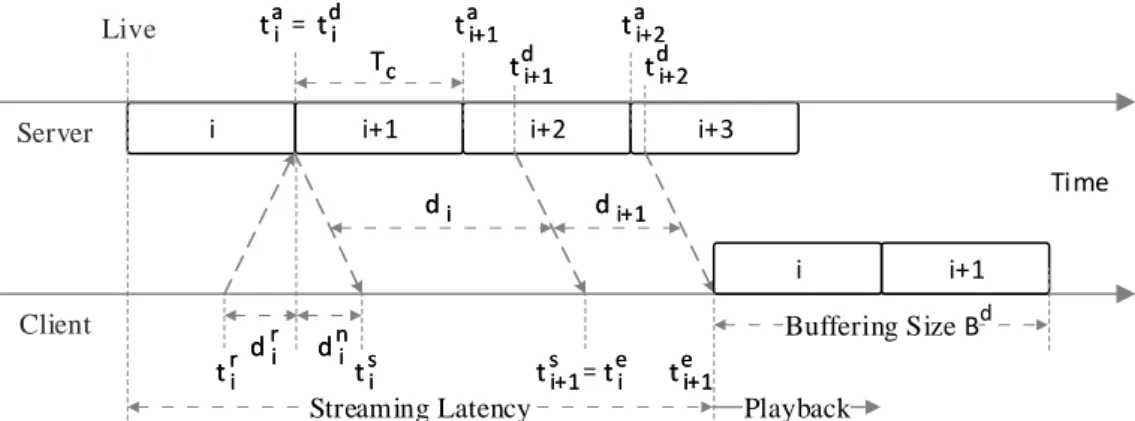
ddi the request-response delay for segmenti, i.e., the time elapsed from the moment the client requests segmentiuntil the client starts the reception of segmenti.
dni the network delay of segmenti.
dri the delivery time of the request to segmenti.
deg an event of network degradation.
Ddeg the duration of a network degradation event, in which the average network throughput over each segment duration is lower than the guaranteed throughput.
Dmindi the shortest interval between two network degradation events within the entire streaming session.
Dnidi the duration of then-th insufficient degradation interval.
I(v) the index of the video segment to which the video packetv
corresponds.
n o tat i o n s xvii
ISD the impairment function of startup delay.
IST the impairment function of playback stalls.
L the streaming latency.
Mi the value of the video quality metric of segmenti.
N the number of segments contained in a video.
Ni the number of consecutive segments preceding segmentithat have the same bitrate as segmenti
NST the number of rebuffering events.
Nidi the number of insufficient degradation intervals in a streaming session.
OPT the optimal solution of bitrate selection.
QoE the Quality-of-Experience function.
r the average video bitrate of a segment.
ri the average video bitrate of segmenti.
R the nominal bitrate of the video (the video quality level).
Ri the nominal video bitrate of segmenti.
S(v) the size of a video packetvin bytes.
SiR the size (inkbit) of segmentiencoded at the nominal video bitrateR.
tai the available time of segmenti, i.e., the time at which segmentiis available at the server and is ready for the delivery.
tid the time at which the server starts to deliver segmenti.
tei the time at which the reception of segmentiends.
tri the request time of segmenti, i.e., the time at which the client issues a request for segmenti.
tsi the time at which the reception of segmentistarts.
T the duration of a video streaming session.
Tc video segment duration in seconds.
Td the delay time of the first video playback.
TS the startup delay
TST the total rebuffering duration, i.e., the total time of all playback stalls events.
w the most recent estimate of the congestion window.
w0 the previous estimate of the congestion window.
α the parameter of the congestion control equation in FAST TCP, which reflects the number of packets queued in the network.
βl the lower threshold level in seconds of the buffer region for not switching the video bitrate.
βmax the maximum client buffer level (i.e., the client buffer size) in seconds. βre f the desired buffer level in seconds.
βu the upper threshold level in seconds of the buffer region for not switching the video bitrate.
γ the smoothing parameter of the congestion control equation in FAST TCP.
∆t the reception delay between two consecutive segments.
∆ti+1 the reception delay between segmenti+1 and segmenti, i.e., the time that elapses from the moment the client finishes receiving segmenti
until the client starts to receive segmenti+1.
∆tri the request-response time of receiving segmenti, i.e., the time that elapses from the moment the client requests the reception of segmenti
until the client starts to receive segmenti.
∆twi+1 the waiting time for which the client waits before the reception of segmenti+1, if a full buffer event occurs during the reception of segmenti.
η the parameter of the congestion control equation to control the aggressiveness in the throughput acquisition.
λ the weighting factor for quality variations in an Quality-of-Experience function.
µ the weighting factor for the startup delay in an Quality-of-Experience function.
ν the weighting factor for rebuffering duration in an Quality-of-Experience function.
Φ(t) the accumulated amount of received data (in seconds of video) in the buffer at timet.
Φ0(t) the accumulated amount of playable received data (in seconds of
video) in the buffer at timet.
Ω(t) the accumulated amount of playout data at timet.
D the set of all network degradation events in a streaming session.
Didi the set of sequential degradation events with Nidi insufficient degradation intervals.
Dsdi the set of network degradation events which are connected with the shortest interval between two events in the entire streaming session.
R the set of available nominal bitrates of the video.
1
I N T R O D U C T I O N
Video has been an integral part of communications and entertainment applications for many years. With the growth and popularity of the Internet, video delivery over best-effort packet-switched networks such as the Internet has become an important research area. To be effective, video needs to be presented to users in high quality and without interruptions. So the term “streaming” is used to refer to the process of delivering video as a continuous stream of audio-visual data. Nowadays, video streaming has become a dominant traffic type in the Internet and its share will constantly increase in the near future. By 2021, Cisco’s Visual Networking Index
[1] estimates that video traffic will globally be 82% of all consumer Internet traffic
and live Internet video will account for 13% of Internet video traffic. According to Sandvine’s data [2], the company found that the combination of streaming audio
and video was responsible for over 71% of all evening traffic on North American fixed networks. By2020, Sandvine predicts an increase to 80%.
1.1 r i s i n g o f i n t e r n e t v i d e o
As a result, the Internet is morphing into a video distribution network for digital entertainment, which competes with traditional television broadcasting for con-sumers’ attention. A new emergent form of television services aims to replicate the traditional television experience offered by cable, terrestrial, and satellite pro-viders. Today, people are watching a wide range of Internet video — from online television or subscription services such as Netflix1
to free video from platforms like YouTube2
. In the U.S., 64% of all Internet households had an online subscrip-tion service from Netflix, Amazon Prime3
, and/or Hulu4
in 2017, and 51% of this
group had more than one of these services [3]. In addition to television-like
ser-vices, applications such as surveillance, Free Viewpoint Television (FTV), telepres-ence, and tele-immersion are leveraging the Internet as the communication platform to an ever increasing extent. People see video virtually every day while scrolling through recent social media such as Facebook5
and WeChat6
. User-generated video — including personal live streaming — introduces even more exciting
possibilit-ies for them. The appetite for video — both on-demand and live — will further increase with innovative technologies such as Ultra-High-Definition (UHD),
Multi-1 Netflix - Watch TV Shows Online, Watch Movies Online.https://www.netflix.com/
2 https://www.youtube.com/ 3 https://www.primevideo.com/
4 Hulu: Stream TV and Movies Live and Online.https://www.hulu.com/
5 https://www.facebook.com/
6 WeChat - Free messaging and calling app.https://www.wechat.com/
View Video (MVV), and Virtual and Augmented Reality (VR and AR) video. VR and AR traffic will increase 20-fold between 2016 and 2021 [1]. Indeed, video is
the future of media on the Web and is competing with scheduled linear television content for consumers’ attention.
1.2 c h a l l e n g e s i n i n t e r n e t v i d e o
The Internet, however, was not designed to stream video. Traditional television providers exclusively use a communication channel such as a radio frequency to broadcast the video content to everyone within reach. For instance, Digital Video Broadcasting (DVB) is such a well-known system distributing video using a variety of approaches including: cable [4], satellite [5], and terrestrial television [6]. In
con-trast, the Internet is a best-effort packet-switched network that does not provide any Quality-of-Service (QoS) guarantees. Also, the network for the data transmission is shared among all the users. With video streaming over the Internet, a packet-wise data stream is transmitted to every single receiver. The Internet is thus a very challenging network for delivering delay-constraint data such as video, since, prior to the start of streaming, the state of the network is unknown and hardly predict-able. In particular, Transmission Control Protocol (TCP), which governs the Internet traffic, is conventionally regarded as inappropriate for video streaming. The reason is that the congestion control and the retransmission mechanism in TCP can lead to undesirable end-to-end delays, which violate the timeliness requirement for video streaming. Overall, video over best-effort packet-switched network faces a number of challenges including: unknown and time-varying throughput, delay, and losses. A study shows that TCP-based streaming requires the available network through-put to be roughly twice as high as the video bitrate and a startup delay in tens of seconds [7]. Worse still, if the throughput is not sufficient, the video playback will
stall due to the buffer running empty — video data is not received in time for its playback. Then, the client needs to re-buffer a sufficient amount of data so as to resume the playback. Furthermore, the demand, the usage, and the connectivity of wireless and mobile networks recently grow significantly with the proliferation of smartphones and tablets. In2012–2017, the increase of mobile data traffic was
recor-ded with nearly 70% per year, primarily due to increased viewing of video content [8]. The rapid growth and the ubiquity of wireless and mobile networks make the
challenges and issues in video streaming even more technically difficult. A mobile user will always experience varying degrees of connectivity, and in some cases the variations can be extreme and long lasting. According to a recent global study [9],
65% of respondents using mobile broadband experience rebuffering problems, 62% experience delayed playback start, and 57% experience low video bitrate problems.
1.3 r i s i n g o f a d a p t i v e s t r e a m i n g
Thus, on one hand, traditional fixed-quality video streaming technologies fail to deliver acceptable Quality-of-Experience (QoE), which is a subjective measure from the user’s perspective of the overall quality of multimedia services [10], e.g., less
playback stalls and better throughput utilization translate to an improved QoE. On the other hand, supporting such an enormous amount of video traffic with an
ap-1.4 c h a l l e n g e s i n a d a p t i v e s t r e a m i n g 3
propriate QoE places a huge burden on the communication network technology, and requires novel solutions in the areas of content distribution, wireless and mo-bile networking, as well as video streaming. So all significant streaming technolo-gies developed since 2008 have been based on Adaptive Bitrate Streaming (ABS).
In ABS, a video stream is divided into small segments, each of which contains a specific duration of video and is encoded with multiple quality levels with respect to video characteristics such as video bitrate and resolution. This enables stream-ing applications to dynamically adjust the characteristics of the streamed video to a varying network state. Thereby, ABS lessens the playback stalls due to buf-fer underflow and improves the utilization of the available network throughput. The most prominent examples of ABS include Apple HTTP Live Streaming (HLS) [11], Microsoft Smooth Streaming (MSS) [12,13], Adobe HTTP Dynamic Streaming
(HDS) [14], and MPEG Dynamic Adaptive Streaming over HTTP (DASH) [15, 16].
In particular, DASH has been adopted as a true standard [17] by the International
Organization for Standardization (ISO) since 2012. With the demotion of
Silver-light7
and Flash8
plug-ins in browsers, HLS and DASH dominate the ABS format landscape. The Media Source Extensions [18] framework enables HLS and DASH
playback via the HTML5[19] video tag. Recently, MPEG (Moving Picture Experts
Group) issued a standard — Common Media Application Format (CMAF [20]) —
which aims to bridge HLS and DASH around a shared segment format. This uni-form uni-format reduces deployment overhead and complexity of Internet-based video distribution. The broadcast industry has also adopted ABS for its need. DVB con-sortium and Advanced Television Systems Committee (ATSC) issued DVB-DASH [21] and ATSC 3.0 [22] specifications, which use DASH for both broadband and
broadcast delivery as well as the Hybrid Broadcast Broadband TV (HbbTV [23]). 1.4 c h a l l e n g e s i n a d a p t i v e s t r e a m i n g
As of today, ABS is the most prevailing and significant technology in video stream-ing, especially over the Internet. A huge number of techniques, algorithms and sys-tems have been centered around this concept which aims to offer users the best pos-sible viewing experience on their networks and local hardware. Nevertheless, the viewing experience is not comparable to traditional broadcast: frequent rebuffering events, high latency of video playback, as well as low and/or heavily varying image quality are the most dominant impairments. Extensive modeling and evaluations of bitrate adaptation have revealed that the state-of-the-art adaptive solutions reach satisfactory performance only under buffering of several tens of seconds [24,25,26].
For live events this implies a high playback latency for video streaming, which is undesirable especially in the context of the services with a low upper bound on the latency. This performance bottleneck is mainly a result of the underlying TCP trans-port layer and the biased bitrate adaptation. Moreover, with the increased adoption rate of broadband Internet access — global broadband adoption above 10Mbpswas 45% in2017, a 29% increase compared with one year prior [8] — and the upcoming 5G rollout — across Europe and China by2020[27,28] — we are seeing that users’
streaming demand for high-quality viewing experiences will be constantly increas-7 https://www.microsoft.com/silverlight/
ing. Likewise, we are seeing the improvement potential of ABS’s performance, since users will be expecting the viewing experience to match their Internet connectivity. Consequently, in contrast to existing work, this thesis focuses on the research of a low-latency streaming service with adaptive solutions that fulfill the requirements of live video broadcast. To this end, we design and develop a novel approach for adaptive streaming that minimizes the required video buffers on clients.
1.5 r e s e a r c h c o n t r i b u t i o n s a n d t h e s i s o u t l i n e
In the following we outline the research problems and the main contributions.
t o wa r d s r e d u c e d l at e n c y i n a d a p t i v e v i d e o s t r e a m i n g
Although ABS has been a very active research area, a lot of research (e.g., [24,25,26, 29,30,31,32]) focuses on the adaptation algorithms, few researchers (e.g., [33]) are
interested in how low the latency can be. To fill this gap, the first goal in this thesis is to determine a reasonable lower bound on the latency for video delivery. Such a low bound is absolutely necessary for the potential improvement of streaming solutions in scenarios with low-latency requirements, such as the streaming of live events and augmented vision, and video conferencing. Moreover, it provides us with baselines to design more efficient streaming systems with respect to the latency.
In Chapter3, our objective is to find out how low a reasonable latency for
stream-ing systems can be, by derivstream-ing the lower bound for the bufferstream-ing size. In particular, we first analyze the latency in ABS and identify the buffering size as the key com-ponent affecting streaming latency; then we develop an analytical model of ABS for buffer size, which can accommodate wide range of streaming scenarios, especially in the context of low latency; last, we derive the theoretical lower bound of the buf-fering size, and introduce an approximation of the minimum bufbuf-fering size. The related publication can be found in [34].
a d a p tat i o n a l g o r i t h m f o r b u f f e r s ta b i l i z at i o n
The allowed latency of streaming systems limits the size of the client buffer in time units (seconds of video). State-of-the-art adaptation algorithms (e.g., [24,25,26,29,30, 31,32]) are not suitable forlow-latencyABS due to a lack of explicit stabilization of
client buffer dynamics. Specifically, an empty client buffer leads to playback stalls (rebuffering); when the client buffer is at its maximum level, a biased feedback of network throughput is induced that results in suboptimal adaptation decisions. Accordingly, existing streaming systems with a small client buffer size suffer from frequent video playback stalls and/or low image quality.
Chapter4tackles the stabilization issue in low-latency ABS by developing a novel
algorithm that effectively supports streaming with a small buffering size. The con-tribution consists of two major lines of work: i.) we present a baseline algorithm for the bitrate adaptation that minimizes the buffer deviation from the desired level despite a buffer as small as a single segment duration, and ii.) further im-prove the algorithm by applying a simple-but-effective modification that reduces
1.5 r e s e a r c h c o n t r i b u t i o n s a n d t h e s i s o u t l i n e 5
the heavy variation of image quality. Our algorithm outperforms the state-of-the-art algorithms with at least 6% higher QoE. The research results of this chapter are covered in the following publications: [35,36,37].
a d va n c e d i m p r ov e m e n t s i n l o w-l at e n c y a d a p t i v e v i d e o s t r e a m i n g
ABS performs video bitrate selection based on streaming client’s local information such as throughput estimate and buffer occupancy. Most adaptation controllers are deployed at the client side. In practice, the accuracy of bitrate adaptation is limited due to feedback delay and unawareness of the dynamics of the underlying transport layer. In addition, the TCP transport layer introduces severe packet delay variation (packet jitter) and unstable throughput due to its loss- and window-based congestion control, as well as error control with retransmission mechanism [7]. As
a result, streaming adaptation is often erroneous and causes client buffer instability such that conventional streaming applications require an extensive buffering on the order of tens of seconds (e.g., [24,25,26,29,30,31,32]).
In Chapter5, we propose a server-side architecture for ABS, which removes
feed-back delay from the control loop of bitrate adaptation and provides a hybrid adapt-ation controller based on throughput and buffer informadapt-ation. Moreover, we deploy the proposed architecture over a new transport-layer protocol in [38] and employ
a modified delay-based congestion control from Fast TCP [39] into the transport
layer. This enables predictable packet jitter, explicit throughput estimates, and a high throughput utilization for ABS. We evaluate the performance of our architec-ture with respect to impairment functions that model user-perceived video quality and compare against the well-known streaming architectures. Through intensive experiments, we demonstrate significant improvements with at least 64% lower impairment of stalls and at least 20% lower impairment of quality variations in ABS with buffering sizes as small as the segment duration. Related publications are [40,41,42,43,37].
2
B A C K G R O U N D
This chapter will briefly go through the prerequisite information on the work presen-ted in this thesis. It starts with an overview of the technology in Internet-based video streaming in Section 2.1. This is followed by the introduction of adaptive
video streaming in Section2.2, including quality switching, playback buffer,
stream-ing behavior, video bitrate, segmentation, standards, and adaptation controller. This chapter ends with the quality assessment of streaming services with respect to qual-ity of experience in Section2.3.
2.1 v i d e o s t r e a m i n g
TV broadcasting (such as cable [4], satellite [5], and terrestrial television [6]) and
In-ternet Protocol television (IPTV) services operate over managed networks for video distribution, which fulfill certain QoS aspects required by these services and sup-port multicast deployment. In contrast, the prevalent streaming technologies are dedicated to delivering the video content over mostly unmanaged networks, i.e., best-effort packet-switched networks such as the Internet. With these streaming technologies, video services such as Dailymotion1
and Youtube, are usually man-aging a unicast connection and deliver video streams to the client by using the standard Hypertext Transfer Protocol (HTTP) which relies on the TCP. Other tech-nologies operate with a proprietary streaming protocol running on top of an exist-ing transport protocol, mostly TCP and occasionally User Datagram Protocol (UDP). One successful example of such a streaming protocol is the protocol suite of Real-Time Transport Protocol (RTP) / Real-Real-Time Control Protocol (RTCP) / Real-Real-Time Streaming Protocol (RTSP) [44, 45], which is usually built upon UDP. It provides
the means to establish and control the streaming session, as well as to monitor the QoS so that streaming applications are able to deal with delay variations (jitters) and packet reordering/losses. TCP is widely used in commercial streaming sys-tems due to the ease of deployment on existing Content Delivery Network (CDN) architecture for web services via HTTP, and the inherent control mechanisms for net-work congestion and packet losses, while UDP-based streaming is typically focused on live services, by providing mechanisms for TCP-friendliness and loss recovery [46,47,48].
Any Internet-based streaming technology, however, faces an inherent challenge. On one hand, the Internet is a so-called best-effort packet-switched network; i.e., it was not designed to provide any QoS guarantees, such as specified throughput bitrate, network delay, and packet loss rate. On the other hand, the entity of
stream-1 Dailymotion: What to Watch.http://www.dailymotion.com/
ing (i.e., video) by nature has strict timing constraint for its playback. Also, due to users’ demand on excellent image quality, video streams are expected to have the highest possible video bitrate and limited packet losses such that visual artifacts are minimized. This conflict of the inherent properties between videos and the Internet leads to a major problem: namely, Internet-based streaming experiences frequent rebuffering events (playback stalls) in the course of video playback. Because when the video data to be played back cannot arrive in time at the client and the data in the buffer is not sufficient to be played back, the client has to pause the playback and wait for sufficient data to be received and stored into the buffer, so as to re-sume the decoding and the playback. Such a process of pausing the playback and buffering the data is termed asrebufferingor playback stall2
.
Considerable research effort has addressed the challenge by developing network-ing architectures [49,50,51, 52,53]. However, none of them has seen wide
deploy-ment yet. One reason lies in the complex impledeploy-mentation of QoS models as well as of the trade-off between resource reservation and over-provisioning. Another way to overcome the problem is to dynamically adapt the video characteristics of the streams to varying network states. This leads to the development of ABS, which will be described in more details in the sequel.
2.2 a d a p t i v e b i t r at e s t r e a m i n g
The general idea of ABS is to allow the bitrate (and consequently the quality) of the video stream to change with respect to currently available resources (on a reason-able timescale). The resource in this context is usually known as network through-put, also known as network bandwidth3
, but other parameters can be taken into account such as screen resolution, battery capacity, and Central Processing Unit (CPU) usage of end devices.
2.2.1 Dynamic Quality Switching
First, a video source is divided into small segments, each of which can be pro-cessed independently from the others. The client sends requests to retrieve certain segments of the video from a server, and then renders the received video segments while the next segments are being downloaded. The Uniform Resource Locators (URLs) of all segments are collected in a manifest file, which describes the temporal and structural relationships between segments. Second, each of these segments only represents a small duration of the whole video, typically 2–10 seconds long. This enables the client to download only the necessary segments and employ trick modes such as fast-forward, rewind, or seek efficiently. So the process of deliver-ing video is more like a continuous stream of audio-visual data, to which the term “streaming” is used to refer. Third, the small segments are encoded at multiple Video Quality Levels (VQLs) with respect to various video characteristics such as
2 Although playback stalls can be due to multiple reasons — such as system/player crash and playback
failure — besides rebuffering, the termplayback stallrefers to the interruption of the playback due to
rebuffering throughout this thesis. It is used interchangeably with the termrebuffering.
3 In this thesis, the termbandwidthwill refer to the bitrate in bits per second (bps) that can be transmitted,
2.2 a d a p t i v e b i t r at e s t r e a m i n g 9 Manifest File Video segments
...
...
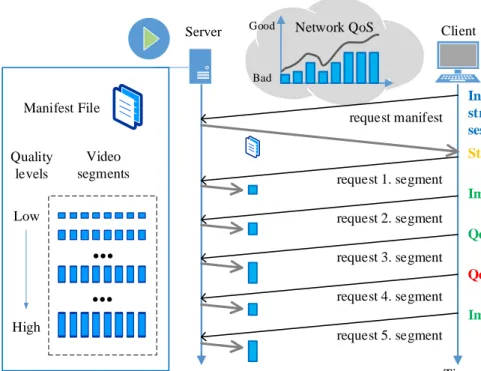
Server request manifest request 1. segment request 2. segment request 3. segment request 4. segment request 5. segment Client Network QoS Good Bad Time Start quickly Initiate a streaming session Improve quality QoS is good QoS drops Improve quality Low High Quality levelsFigure2.1: Illustration of segment requests and bitrate adaptation in adaptive streaming
the resolution, frame rate, and video (coding) format. Typically, the VQLs differ with respect to their nominal video bitrates, i.e., the average number of bits that are processed in a unit of time over the entire video. So, the quality of the video is often characterized by the nominal video bitrate. Given multiple VQLs for each segment, the client may seamlessly switch between different VQLs at each request. Because the segments are completely self-contained, the client can also perform seamless video playback across segments and VQLs. The streaming system strives to select the best segments to be delivered after examining a variety of parameters related to network QoS (e.g., available throughput and network delay), device capabilities (e.g., display resolution and CPU usage), as well as streaming states (e.g., the occu-pancy of the playback buffer and server workload). Therefore, the bitrate adaptation for ABS can be formulated as an optimization problem. Its goal is to provide the highest possible QoE, e.g., maximizing the achievable bitrate while minimizing the likelihood of playback stalls and bitrate switches. Figure 2.1 shows an example of
ABS, which improves the QoE by dynamically adjusting the VQLs according to the network QoS.
2.2.2 Client Playback Buffer
Once video data is received at the client, the playback of the data may start immedi-ately. However, such an immediate playback is infeasible to maintain a continuous playback, because the arrival time of video data is often unable to meet its playback deadline due to packet jitters and the mismatch between the video bitrate and the throughput bitrate of the network. Generally, the client employs a playback buffer (also called client buffer) to store the received data and attempts to keep the buffer occupancy at a safe level, in order to absorb the jitters and the bitrate mismatch.
Buffer occupancy (seconds)
Fi ll rat e Drain rat e
C /r 1
Buffer size (seconds)
i i
Buffer occupancy (seconds)
Fi ll rat e Drain rat e
C /r 1
Buffer size (seconds)
i i
Figure2.2: Illustration of the client playback buffer, tracked in seconds of video. While
every second of video is taken out from the buffer for a continuous playback, a specific amount of video is received and filled into the buffer. The amount can be represented as a ratio between the network throughput and the selected video bitrate, Ci
ri seconds.
The occupancy of the playback buffer is primarily affected by the choice of video bitrate. Since ABS provides multiple individual VQLs with different video bitrates, the client is able to control the buffer occupancy to a certain extent by dynamically selecting an appropriate VQL for each requested segment. Figure2.2illustrates an
example of the playback buffer occupancy with respect to the throughput and the video bitrate. The occupancy (level) of the buffer is typically expressed in seconds of video. Once the client completes the reception of a video segment, the playback buffer is filled with a duration of video equal to the video duration of the segment. For simplicity, we refer to the video duration of the segment as the segment dura-tion, denoted byTc. In the course of the buffering phase, the buffer level constantly increases along the time. Once the buffering finishes, the client starts the playback and enters to the playback phase. In the case of a continuous playback during the playback phase, every second, one second of video is taken from the buffer and displayed to the user, since exact one second of video should be played back every second of real time. At the same time, the client receives Ci
ri seconds of video and
stores it into the buffer, whereri denotes the video bitrate of the selected segment with index i and Ci the average network throughput during the entire reception of segment i. It implies that the buffer is filled at a rate Ci
ri , while the buffer is
drained at a unit rate for a constant playback. For instance, considerri = 2Mbps andCi =10Mbps, then for each second, the buffer occupancy grows by 4 seconds. If the ABS’s client picks a video bitrate that is smaller than the network through-put, the fill rate of the buffer will exceed the drain rate (i.e., Ci
ri > 1) and the buffer
level will rise. If the increase lasts sufficiently long, the buffer level will reach its maximum level that corresponds to the size of the buffer. Generally, the buffer size is measured in a unit of physical memory size, e.g., bytes. In practice, it is expressed in seconds of video, because the buffer level is directly related to seconds of video and bounded to a specific value in seconds of video in the context of video stream-ing — for both live and on-demand. On one hand, in live streamstream-ing, the buffer level (in seconds of video) cannot exceed the value of the streaming latency, because the video content is being generated while being streamed and then the possibility to prefetch content is severely limited. On the other hand, with Video-on-Demand (VoD) services, the complete video content is available for delivery throughout the
2.2 a d a p t i v e b i t r at e s t r e a m i n g 11
streaming session. Consequently, the client may theoretically prefetch the complete rest of the content into its playback buffer while streaming, if the selected video bitrate is sufficiently low compared to the available network throughput. However, even with VoD, the maximum buffer level is generally limited. One reason is the fact that the service providers avoid resource waste, by preventing the client from downloading the content that will not be presented because e.g., the user quits the streaming session or switches to other channels or abandons the prefetched low-quality content if a throughput increase allows the client to request a higher-low-quality level. Therefore, throughout this thesis, we term the buffer size as the maximum buffer level in seconds of video. We define afull bufferorbuffer overflowas the event when the buffer occupancy is at its maximum level.
However, when the fill rate of the buffer is higher than the drain rate, the ABS system probably does not maximize the video bitrate and cannot fully utilize the available network throughput. On the contrary, if the system chooses a video bitrate that is larger than the throughput of the underlying network, the buffer will be filled at a rate smaller than the drain rate (i.e., Ci
ri < 1) and the buffer occupancy
will drop. If this situation persists sufficiently long, the buffer will run empty and the occupancy will be at the zero seconds. We call such an eventempty bufferor buf-fer underflow. If this event occurs during the playback phase, it will incur a so-called rebuffering event. Note that, if rebuffering happens because the network through-put is unable to sustain even the minimum video bitrate, there is nothing an ABS system can do to avoid it, except for buffering sufficient video prior to such an inad-equate throughput. Generally, the service providers should ensure sufficiently good network QoS for their users in order to maintain at least the minimum video bitrate while streaming. In practice, the guarantee however does not hold anytime due to e.g., hardware failures, network congestion, or signal degradation on wireless net-works. We name an event asnetwork degradationin which the available throughput is lower than the minimum video bitrate. Multiple studies (e.g., [54, 55, 56]) show
that the frequency and the duration of the rebuffering have the strongest impact on the QoE. Therefore, a well-designed ABS system should keep the buffer occu-pancy at a high enough level to mitigate the impact of network degradations and should be able to avoid rebuffering events caused by choosing a non-sustainable video bitrate.
2.2.3 ON-OFF Streaming Pattern
While ABS struggles with buffer underflow for preventing playback stalls, it needs to take buffer control at near-maximum buffer levels into account. In case the play-back buffer is at its maximum level, no video data can be received by the client and the streaming enters an OFF period. Once the OFF period is past, the streaming reenters an ON period and the client resumes receiving data. Here, one needs to distinguish between VoD and live streaming. With VoD streaming, in case of a full buffer, the client has to wait for the buffer occupancy to reduce to a level which allows further video data to be stored into the playback buffer. With live streaming, a full buffer implies that the streaming latency is near-zero. The unavailability of segments restricts the continuity of the streaming and also incurs the same effect of a full buffer in VoD streaming. The consumer of live streaming cannot receive video
data until a segment is generated and is available for delivery. Therefore, a repeat-ing alternation between ON and OFF periods happens in both streamrepeat-ing scenarios, as long as the network throughput is higher than the selected video bitrate and this condition lasts sufficiently long. Such a periodic phenomenon is called ON-OFF streaming pattern. Unfortunately, the ON-OFF streaming pattern poses problems on throughput estimation for ABS [57, 58, 59,29, 60]. In general, the client estimates
the available throughput of the underlying network by measuring the transport-layer throughput during every segment reception and computing a moving average of those measurements over time [61]. This moving average is then used to select
the video bitrate for the next segment. Performing throughput estimation under the ON-OFF streaming pattern cause inaccuracies in the estimation.
Akhshabi et al. [57] identify that the ON-OFF streaming pattern can lead to
quality instability and unfairness when multiple streaming clients compete over the same network bottleneck. Depending on the temporal overlap of the ON-OFF periods among competing clients, they may not estimate the available throughput correctly. For instance, suppose that the ON periods of two clients do not over-lap during the reception of a segment. Both clients can perceive the maximum throughput (i.e., the capacity) of the bottleneck and will select a video bitrate that is close to the maximum throughput. If that video bitrate is higher than 50% of the maximum throughput, network congestion will occur while both clients receive a segment with that video bitrate. In this case, the clients will observe that their transport-layer throughput is less than the previous throughput estimate, and then they will switch back to a lower video bitrate. This oscillatory switching behavior can repeat, causing quality instability. Another example is that the ON period of one client spans the ON period of another one. This can take place if one client is receiving a segment with a higher bitrate than the other client. In this situation, the former client will measure a throughput that is more than 50% of the maximum throughput, while the latter one will measure only 50% of the maximum through-put. Suppose that the bitrates currently selected by both clients are appropriate to their throughput estimates, respectively. Then, both clients can converge to a stable but unfair equilibrium in which the client with the higher bitrate keeps selecting the higher bitrate but the client with the lower bitrate stays with the selection of the lower bitrate.
The root cause of the issues studied in [57] mainly lies in the application-layer
behaviors initiated by the ON-OFF streaming pattern. In fact, such application-layer behaviors can disturb the transport-application-layer dynamics, which negatively impacts the application layer reversely. Accordingly, it can form a negative feedback loop. Huanget al.[58] observe that the ON-OFF streaming pattern can interfere with TCP
dynamics, causing TCP to reenter the slow-start process, because the TCP conges-tion window may time out due to the inactivity within an OFF period. As a result, the client will acquire a lower throughput than the available throughput and thus suffer from the underestimation of the available throughput. Even worse, bitrate selection based on such low estimates can trigger a downward spiral effect, leading to a undesirably low video quality [58]. The worse performance is due to the fact
that the underestimation of the throughput is combined with a conservative bitrate selection. A conservative bitrate selection typically picks a video bitrate which is equal to or lower than the throughput estimate. Then, a lower throughput leads the
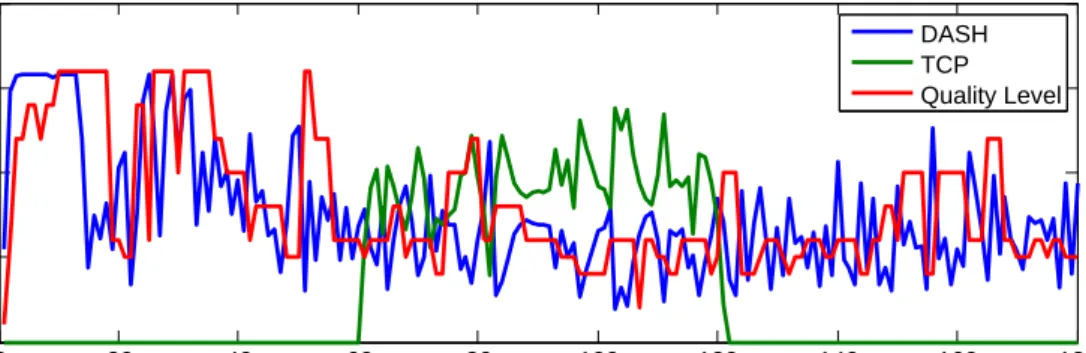
2.2 a d a p t i v e b i t r at e s t r e a m i n g 13 0 20 40 60 80 100 120 140 160 180 0 5 10 15 20 Time (s) Bitrate (Mbps) DASH TCP Quality Level
(a) Throughput and quality level (nominal video bitrate) acquired by DASH and TCP
0 20 40 60 80 100 120 140 160 180 0 0.5 1 1.5 2 Time (s)
Buffer Level (s) Buffer Level
(b) Client buffer dynamics
Figure2.3: Bitrate selection based on average HTTP throughput in DASH with 2s client
buffer size and 2s segment duration. We demonstrate the performance issue of a bitrate algorithm in DASH under the ON-OFF streaming pattern while competing with a greedy TCP background traffic at a network bottleneck with 16Mbpsmaximum throughput.
client to select a lower bitrate. When selecting a lower bitrate, the segment would also be smaller in size (bytes). With a smaller segment size, the client becomes more vulnerable to acquire lower throughput. In the worst case, a vicious cycle is created, which brings the video bitrate down to its lowest value.
Figure2.3visualizes the behavior of a bitrate selection that is purely based on the
measurement of the average throughput at the HTTP/TCP client. It clearly points out the random disturbance of the transport-layer throughput imposed by the ad-aptation decisions at the application layer. These disturbances cause an excessively poor bitrate selection. The observation reveals that the throughput acquired by the streaming client does not match the available throughput any more and is limited by the average bitrate of video segment instead, once the buffer keeps nearly full. The throughput measurement of the upper layer is not aware of the underlying transport dynamics and determines the available throughput based on the acquired throughput. This incurs fluctuating and biased bitrate selection. The effect is partic-ularly visible during the competition with the greedy background traffic. After the background traffic is switched off, the streaming application significantly underu-tilizes the network by just acquiring a small share of the available throughput. The reason is that the throughput measurement at the application layer underestimates the available throughput of the network during the ON-OFF streaming behaviors.
2.2.4 Video Bitrate
As mentioned before, video streams in ABS are encoded at multiple VQLs, which are typically characterized by the nominal video bitrate. The video bitrate is the average rate at which a video is processed, measured in bits per second (bps) or more often in kilobits per second (kbps) and megabits per second (Mbps). The nominal bitrate of the video is the mean video bitrate over the entire video. The quality of the video is determined by various factors such as video resolution (e.g., 480p, 720p, and 1080p), frame rate (i.e., the number of consecutive images called frames that are displayed per second on the screen, i.e., frames-per-second, e.g., 24f ps, 30f ps, and 60f ps.), and video compression technique (also known as video coding technique, e.g., H.262 [62], H.264 [63], and H.265 [64], as well as VP8 [65],
VP9[66], and AV1[67]). In general, a higher video bitrate will accommodate higher
image quality in the video. Even though the image quality will be affected by other factors from above together with the bitrate. For example, at the same video bitrate, video encoded by an advanced codec such as H.264 will look substantially better than an older coder like H.262. Nevertheless, throughout this thesis, we use video bitrate and video quality both interchangeably, and use the nominal video bitrate to represent the VQL of a video (stream).
In ABS, a video stream is segmented into small parts with a specific duration of video. The average (video) bitrate of the segment may vary across the segments with the same VQL (nominal video bitrate), if Variable Bitrate (VBR) encoding is used to generate the video data. VBR encoding is commonly used on modern video coding techniques to produce superior visual quality with a lower nominal bitrate compared to Constant Bitrate (CBR) encoding, even though a video stream contains complex segments e.g., due to a large number of high motion scenes. The primary benefit of VBR encoding is that it allocates a higher bitrate (and therefore more storage space) to the more complex segments of video streams and lower bitrates to less complex segments. Accordingly, VBR encoding produces significantly higher quality at similar nominal bitrate for complex segments than CBR encoding, which maintains the same bitrate for all segments of the video stream.
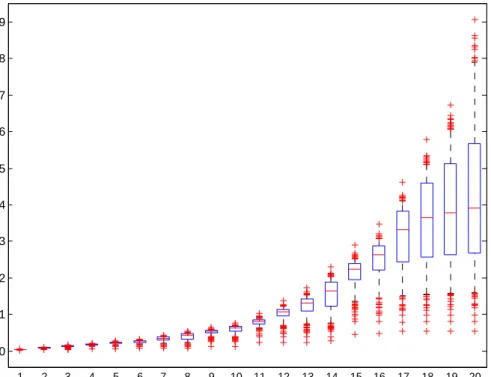
Although VBR encoding provides a consistent quality throughout the video, it also poses challenges during streaming. The average bitrates of video segments may significantly vary around the nominal bitrate and may exceed the available network throughput. For instance, Figure 2.4 shows the variance of the video bitrate for
different quality profiles of the video sequenceBig Buck Bunnyfrom [68], where the
average bitrate of each segment may significantly differ from the nominal bitrate of the segment. In this example, at least 50% segments of each quality profile have an average bitrate of at least 5–45 % higher or lower than the nominal bitrate. The similar effects also happen to other video genres, e.g., sport (Red Bull Playstreets) and movie (Valkaama) from [68]. Therefore, handling such bitrate variations becomes
one influential consideration while designing the ABS system.
2.2.5 Segmentation
Segmentation is essential to support streaming. To achieve the seamless playback and switching of segments, each segment is required to be able to be decoded
2.2 a d a p t i v e b i t r at e s t r e a m i n g 15 0 1 2 3 4 5 6 7 8 9 1 2 3 4 5 6 7 8 9 10 11 12 13 14 15 16 17 18 19 20 Quality Profile ID
Average Bitrate of one segment (Mbps)
Figure2.4: Average bitrate of segments in variable bitrate encoding with various quality
profiles. The red plus marker denotes the outliers of the 5-th and 95-th percent-iles, which are marked with black bars. The blue box contains the bitrate range from the 25-th to the 75-th percentile. The red bar in the center indicates the nominal video bitrate.
independently. Namely, the streaming format of the video must fulfill this require-ment of the completely self-contained segrequire-ment. Modern video encoding employs inter-frame compression: one or more neighboring frames are used to reconstruct a current frame due to the temporal redundancy, only the differences are transmit-ted. Therefore, it is necessary to ensure that there is an Intra-coded frame (I-frame) at the beginning of each segment, such that clients can seamlessly play back the segments and switch levels between different segments. Because I-frames do not reference any other frames or segments, the client can start the decoding of a seg-ment once its reception is completed. Fixed I-frame positions can be achieved by aligning the group-of-picture (GOP) size of the encoding to the number of frames in a segment; e.g., for a video with a frame rate of 24f ps, a segment with two second video duration may have a GOP size of 24 frames or 48 frames. As a con-sequence, shorter segment durations result in a lower compression ratio because I-frames have more bits, and thus the overall video quality is worse than the one of longer segments encoded at the same bitrate. However, short segments allow quick adaptability. Therefore, this trade-off needs to be balanced in content generation for adaptive streaming. There are some research efforts (e.g., [69, 70,71]) to optimize
the segment duration. Typically, the segment duration varies between 2 seconds and 10 seconds.
The SP/SI-frame extension to H.264 [72] introduces two new frame types for
an alternative to I-frame when applications perform functionalities such as stream switching, splicing, and random access. SP-frames utilize motion-compensated