SYSTEMATIC REVIEW
Control groups in recent septic shock
trials: a systematic review
Ville Pettilä
1,2*, Peter Buhl Hjortrup
3, Stephan M. Jakob
1, Erika Wilkman
2, Anders Perner
3,4and Jukka Takala
1© 2016 Springer-Verlag Berlin Heidelberg and ESICM
Abstract
Purpose: The interpretation of septic shock trial data is profoundly affected by patients, control intervention, co-interventions and selected outcome measures. We evaluated the reporting of control groups in recent septic shock trials.
Methods: We searched for original articles presenting randomized clinical trials (RCTs) in adult septic shock patients from 2006 to 2016. We included RCTs focusing on septic shock patients with at least two parallel groups and at least 50 patients in the control group. We selected and evaluated data items regarding patients, control group charac-teristics, and mortality outcomes, and calculated a data completeness score to provide an overall view of quality of reporting.
Results: A total of 24 RCTs were included (mean n= 287 patients and 71 % of eligible patients were randomized). Of the 24 studies, 14 (58 %) presented baseline data on vasopressors and 58 % the proportion of patients with elevated lactate values. Five studies (21 %) provided data to estimate the proportion of septic shock patients fulfilling the Sepsis-3 definition. The mean data completeness score was 19 out of 36 (range 8–32). Of 18 predefined control group characteristics, a mean of 8 (range 2–17) were reported. Only 2 (8 %) trials provided adequate data to confirm that their control group treatment represented usual care.
Conclusions: Recent trials in septic shock provide inadequate data on the control group treatment and hemo-dynamic values. We propose a standardized trial dataset to be created and validated, comprising characteristics of patient population, interventions administered, hemodynamic values achieved, surrogate organ dysfunction, and mortality outcomes, to allow better analysis and interpretation of future trial results.
Keywords: Septic shock, Control group, Randomized, Trial, Reporting, Standardization Background
Septic shock affects millions of people annually (approxi-mately 300–700 per 100,000 adult population per year), and a recent meta-analysis of observational studies
indicated that it leads to death in 46 % of cases [1] in spite of recent progress in diagnosis and treatment.
In addition to the recently revised definition of septic shock [1], future progress requires improved design of randomized controlled trials (RCTs). For correct inter-pretation of the results of RCTs in septic shock, it is crucial to report all recommendations and restrictions stipulated in the protocol and the main co-interven-tions performed in the control group. The most impor-tant issues to be considered are representativeness of the study population, control group treatment, pos-sible misalignment due to titrated treatment in usual care [2], detailed description of the given treatment and *Correspondence: [email protected]; [email protected]
1 Department of Intensive Care Medicine, Inselspital, Bern University
Hospital, University of Bern, Bern, Switzerland
Full author information is available at the end of the article
Take-home message: Recent trials in septic shock provide inadequate data on the treatment given the control group and the hemodynamic values achieved. We propose a standardized trial dataset comprising characteristics of patient population, co-interventions administered, hemodynamic values achieved, surrogate organ dysfunction, and mortality outcomes.
co-interventions, and their agreement with guidelines and with usual care. A deeper understanding of these fac-tors may improve the clinical utility of trial results.
Accordingly, we aimed to evaluate information reported about the control groups in recent septic shock trials [3]. We specifically aimed to evaluate (1) the selection of the patient population, (2) the description of treatments and co-interventions of the control group, especially the hemodynamic treatment and hemodynamic values achieved, (3) the mortality outcome measures, (4) the rep-resentativeness of control groups compared to usual care, and (5) the overall completeness of the data reported. Methods
The search strategy and selection of trials
We searched Pubmed, Scopus, and the Cochrane Central Register of Controlled Trials for original articles present-ing RCTs in adult septic shock patients and published during the last 10 years (from February 10, 2006, to Feb-ruary 10, 2016). The search strategy is presented in the ESM. Due to the evolution of publication requirements and treatment concepts, we considered earlier trials as not representative. Two investigators (V.P. and P.H.) inde-pendently extracted the pre-selected data items from the original papers and supplementary material of these trials. We excluded the study if: (1) it was not a parallel-group randomized trial; (2) it did not include an adult septic shock population (less than 75 % of the patients or not stated); (3) there were fewer than 50 patients in the control group; (4) it was a sub-study or a post hoc analy-sis; or (5) it was not published in the English language. All discrepancies in inclusion and evaluation of the studies between the two assessors were registered and discussed.
We used predefined data items and the PICO approach: patients (P), intervention (I), control (C), and outcome (O), however without assessment of (I), the experimental intervention studied.
Patient (P) populations
We extracted numbers of screened, eligible, all rand-omized, and control group patients. In all trials, patients with all inclusion criteria and no pre-defined exclusion criteria were considered eligible [4–6], regardless of rea-sons for missing informed consent or any logistic issues. We calculated the following ratios: randomized per screened, randomized per eligible, and septic shock per randomized patients. We judged the representativeness of the control populations based on the proportion of included patients per eligible patients. We regarded less than 50 % randomization per eligible patients as unclear representativeness of the study inclusion and exclusion criteria. We evaluated the proportion of patients who at baseline (1) had vasopressor infusion to target a mean
arterial pressure (MAP) of 65 mmHg, (2) had lactate of at least 2 mmol/L, and (3) fulfilled both abovementioned criteria, as well as (4) whether the trial population was representative of a septic shock population according to the Sepsis-3 definition (with >50 % of patients fulfilling the Sepsis-3 definition of septic shock).
Control (C) group characteristics, interventions, and co‑interventions
First, we evaluated (1) whether the trial comprised a group of usual care and/or protocolized care, (2) whether co-interventions were restricted or recommended, and (3) whether the control group was designed to repre-sent usual care. Second, we evaluated inclusion of base-line characteristics, intervention characteristics, focus of infection, pathogens, basic co-morbidities, co-interven-tions (mechanical ventilation, renal replacement therapy, red blood cell transfusions, inotrope use), daily Sequen-tial Organ Failure Assessment (SOFA), and hemody-namic data for the first 24 h after randomization [eight items: MAP, central venous pressure, urine output, lac-tate, norepinephrine (vasopressor) dose and duration, administered fluids, and fluid balance]. Additionally, if data for the entire 24 h were not reported, we used data for the first 6 h, and if not available, we recorded data at baseline. We calculated the number of reported items for hemodynamic data, and described fluid and vasopres-sor therapy. Finally, we assessed whether the achieved and presented hemodynamic values in the study control group were adherent to guidelines. If at least 50 % (4 of 8) of predefined hemodynamic items were reported and no major deviation from usual care could be detected, the study control group was judged as adherent to guidelines.
Outcomes (O)
We included only the most common mortality outcomes (hospital, 28-/30-day, and 90-day mortality) in our evalu-ation of both the control and the intervention groups.
Completeness of the reported data
The data completeness score was calculated based on 33 data items (Table 1) with a maximum of 36 points: 12 for patient population (P1–P12; one point each), 18 for con-trol group (C1–C18; based on 18 items, one point each), and 6 for mortality outcomes (O1–O3; 1 point for report-ing hospital, 2 points for 28-day/30-day, and 3 points for 90-day mortality or longer). Finally, we compared the data completeness scores for the two periods earlier (from 2006 to 2011) and later (from 2012 to 2015), and separately between studies focusing on hemodynamic treatment and the others. We used the Mann–Whit-ney test and considered p < 0.05 as indicating statistical significance.
Results
Selection of trials
The trial selection is presented in Fig. 1. The database searches revealed a total of 542 references, of which 498 were excluded based on the abstract reviews. After review of the full text of the remaining 44, an additional 20 trials
were excluded, 4 of them at the final stage because less than 75 % of patients had septic shock [7–10]. For 14 of the 542 trials (2.6 %) there was initial disagreement regarding the reason for exclusion; this was resolved after discussion in all cases. Thus, in the final analysis we included 24 origi-nal articles presenting primary data from 24 RCTs. These Table 1 Data items and completeness score for randomized controlled trials in adult septic shock (max 36 points per 33 items)
For scoring of the data items, see Table 2 (P1–12), Table 3 (C1–C18), and Table 4 (O1–O3 and the summary score)
Items Data completeness score
Patients (P1–P12) Max 12
P1 Number of screened patients 1
P2 Number of eligible patients 1
P3 Number of randomized patients 1
P4 Proportion (%) of randomized to screened 1
P5 Proportion (%) of randomized to eligible 1
P6 Number of septic shock patients in the control group 1
P7 Total number of patients in the control group 1
P8 Proportion (%) of septic shock patients in the control group 1
P9 Proportion (%) of control group patients with norepinephrine (NE) to target mean arterial pressure
(MAP) of 65 mmHg 1
P10 Proportion (%) of control group patients with blood lactate >2 mmol/L 1 P11 Proportion(%) of control group patients with both NE and lactate >2 mmol/L 1 P12 Studies presenting proportion of patients fulfilling the Sepsis-3 septic shock criteria 1
Control group data (C1–C18) Max 18
Baseline data (C1–C5) C1 Baseline characteristics—adequate 1 C2 Intervention characteristics—adequate 1 C3 Focus of infection 1 C4 Pathogens 1 C5 Comorbidities 1 Co-interventions presented (C6–C10) C6 Mechanical ventilation 1
C7 Renal replacement therapy 1
C8 Red blood cell transfusions 1
C9 Inotropes 1
C10 Daily Sequential Organ Failure Assessment (SOFA) 1
Hemodynamic data for the first 24 h after randomization (C11–C18)
C11 Mean arterial pressure (MAP) 1
C12 Central venous pressure (CVP) 1
C13 Urine output 1
C14 Lactate 1
C15 Norepinephrine (vasopressor) dose 1
C16 Norepinephrine (vasopressor) duration 1
C17 Total amount of administered fluids 1
C18 Fluid balance 1
Outcome data on mortality (O1–O3) Max 6
O1 Hospital 1
O2 28-/30-day 2
O3 90-day 3
trials enrolled patients between 1991 and 2014 (Table 2). Twelve trials were published between 2006 and 2011 [11–
22] and 12 between 2012 and 2015 [4–6, 23–31].
Patient populations
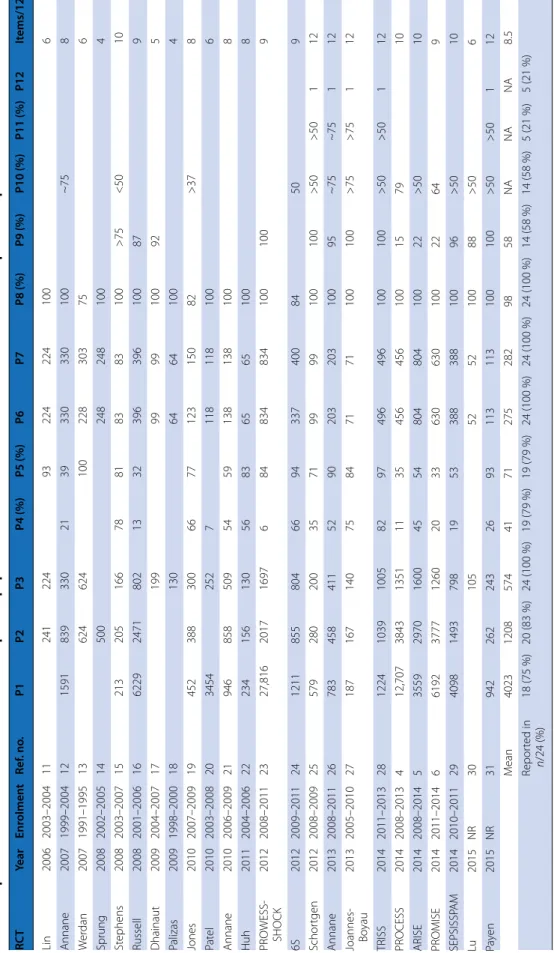
Details on the patient populations are presented in Table 2. The 24 RCTs included had an average of 287 patients (and 71 % of eligible patients). Six studies (25 %) did not follow the CONSORT guidelines to provide number of screened patients and reasons for exclusions [11, 13, 14, 17, 18, 30]. In four (17 %) trials less than 50 % of the eligible patients were randomized [4, 6, 12, 16], with the reported ratio var-ying between 32 and 100 % among all RCTs. Due to exclu-sion of studies with less than 75 % of septic shock patients, the proportion of septic shock patients per included patients was high—98 % on average (range 75–100 %).
Fourteen (58 %) trials presented baseline data on vaso-pressors. In three trials less than 25 % (range 3–22 %) of the patients received vasopressor treatment at randomi-zation [4–6]. The proportion of patients with elevated lac-tate values was mentioned in 14 of 24 (58 %) trials. Five studies (21 %) provided adequate data to estimate the pro-portion of septic shock patients fulfilling the new Sepsis-3 definition (>50 % in all of them) [25–28, 31]. The average number of reported data items was 9 (range 4–12) of 12.
Control group characteristics, interventions, and co‑interventions
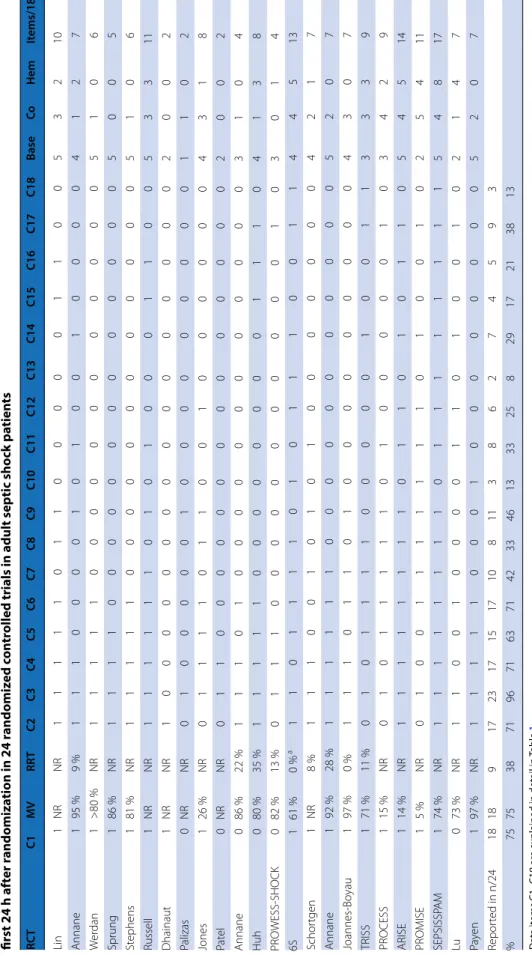
The completeness of baseline characteristics, co-mor-bidities, and co-interventions is presented in Table 3.
Of the 18 predefined control group data items, a mean of 8 (range 2–17) were reported. Focus of infection (in 96 %), microbiological findings in some detail (71 %), and co-morbidities (63 %) were reported in most trials. Of 24 trials, 18 (75 %) reported the proportion of control group patients with mechanical ventilation at baseline (ranging from 5 to 97 %) (Table 3, item MV) and 9 (38 %) reported the proportion having renal replacement ther-apy at baseline (ranging from 0 to 35 %) (Table 3, item RRT). Administration of RBCs, day-1 SOFA score, nor-epinephrine dose and duration, and hemodynamic values achieved during the first 24 h (MAP, CVP, UO, lactate, fluid balance) were reported in up to one-third of the tri-als (range regarding each item 8–33 %). The total amount of fluids administered in the first 24 h was reported in 9 of 24 (38 %) trials. The reported hemodynamic values for the first 24 h are presented as ESM Table 1. If not avail-able, substitute data points are marked.
In all but one trial [21], the control group was designed to include or represent usual care. Six trials included restrictions and four had recommendations for the con-trol group treatment. We judged that half of the trials had a usual care group, and 13/24 had a group with protocol-ized care as their control group (one trial included both groups [4]).
None of the control group protocols or treatment goals clearly contradicted current guidelines. The representa-tiveness of the control populations was judged as unclear in 22 of 24 RCTs, mainly due to missing hemodynamic data, and in one trial due to deviation from the protocol Fig. 1 Flowchart of references
Table 2 Rep or ted da ta it ems r ela ted t o selec tion of pa tien t p opula tion in 24 r andomiz ed c on tr
olled trials in adult septic sho
ck pa tien ts Da ta it ems P1–P12 ar e e xplained in detail in Table 1 RC T Year Enr olmen t Ref . no . P1 P2 P3 P4 (%) P5 (%) P6 P7 P8 (%) P9 (%) P10 (%) P11 (%) P12 It ems/12 Lin 2006 2003–2004 11 241 224 93 224 224 100 6 Annane 2007 1999–2004 12 1591 839 330 21 39 330 330 100 ~75 8 W er dan 2007 1991–1995 13 624 624 100 228 303 75 6 Sprung 2008 2002–2005 14 500 248 248 100 4 St ephens 2008 2003–2007 15 213 205 166 78 81 83 83 100 >75 <50 10 Russell 2008 2001–2006 16 6229 2471 802 13 32 396 396 100 87 9 Dhainaut 2009 2004–2007 17 199 99 99 100 92 5 Palizas 2009 1998–2000 18 130 64 64 100 4 Jones 2010 2007–2009 19 452 388 300 66 77 123 150 82 >37 8 Pat el 2010 2003–2008 20 3454 252 7 118 118 100 6 Annane 2010 2006–2009 21 946 858 509 54 59 138 138 100 8 Huh 2011 2004–2006 22 234 156 130 56 83 65 65 100 8 PR O WESS-SHOCK 2012 2008–2011 23 27,816 2017 1697 6 84 834 834 100 100 9 6S 2012 2009–2011 24 1211 855 804 66 94 337 400 84 50 9 Schor tgen 2012 2008–2009 25 579 280 200 35 71 99 99 100 100 >50 >50 1 12 Annane 2013 2008–2011 26 783 458 411 52 90 203 203 100 95 ~75 ~75 1 12 Joannes- Bo yau 2013 2005–2010 27 187 167 140 75 84 71 71 100 100 >75 >75 1 12 TRISS 2014 2011–2013 28 1224 1039 1005 82 97 496 496 100 100 >50 >50 1 12 PR OCESS 2014 2008–2013 4 12,707 3843 1351 11 35 456 456 100 15 79 10 ARISE 2014 2008–2014 5 3559 2970 1600 45 54 804 804 100 22 >50 10 PR OMISE 2014 2011–2014 6 6192 3777 1260 20 33 630 630 100 22 64 9 SEPSISSP A M 2014 2010–2011 29 4098 1493 798 19 53 388 388 100 96 >50 10 Lu 2015 NR 30 105 52 52 100 88 >50 6 Pa ye n 2015 NR 31 942 262 243 26 93 113 113 100 100 >50 >50 1 12 M ean 4023 1208 574 41 71 275 282 98 58 NA NA NA 8.5 Repor ted in n /24 (%) 18 (75 %) 20 (83 %) 24 (100 %) 19 (79 %) 19 (79 %) 24 (100 %) 24 (100 %) 24 (100 %) 14 (58 %) 14 (58 %) 5 (21 %) 5 (21 %)
Table 3 Rep or ted da ta it ems r egar ding baseline demo gr aphics , in ter ven tion, c omor bidities , inf ec tion, c o-in ter ven tions , and hemo dynamic v alues during the first 24 h af ter r andomiza tion in 24 r andomiz ed c on tr
olled trials in adult septic sho
ck pa tien ts Da ta it ems C1– C18 ar e e xplained in detail in Table 1 MV pr opor tion of pa tien ts with mechanical v en tila tion a t baseline , RRT pr opor tion of pa tien ts with r enal r eplac emen t ther ap y a t baseline . Sub -sc or ing f or C1– C18: Base baseline demog raphics ( C1– C5) − max 5, Co co -in ter ven tions af ter r andomiza tion ( C6– C10) − max 5, Hem hemodynamic da ta it ems f or the first 24 h ( C11– C18) − max 8 a A n e xclusion cr iter ia RC T C1 MV RR T C2 C3 C4 C5 C6 C7 C8 C9 C10 C11 C12 C13 C14 C15 C16 C17 C18 Base Co Hem It ems/18 Lin 1 NR NR 1 1 1 1 1 0 1 1 0 0 0 0 0 1 1 0 0 5 3 2 10 Annane 1 95 % 9 % 1 1 1 0 0 0 0 1 0 1 0 0 1 0 0 0 0 4 1 2 7 W er dan 1 >80 % NR 1 1 1 1 1 0 0 0 0 0 0 0 0 0 0 0 0 5 1 0 6 Sprung 1 86 % NR 1 1 1 1 0 0 0 0 0 0 0 0 0 0 0 0 0 5 0 0 5 St ephens 1 81 % NR 1 1 1 1 1 0 0 0 0 0 0 0 0 0 0 0 0 5 1 0 6 Russell 1 NR NR 1 1 1 1 1 1 0 1 0 1 0 0 0 1 1 0 0 5 3 3 11 Dhainaut 1 NR NR 1 0 0 0 0 0 0 0 0 0 0 0 0 0 0 0 0 2 0 0 2 Palizas 0 NR NR 0 1 0 0 0 0 0 1 0 0 0 0 0 0 0 0 0 1 1 0 2 Jones 1 26 % NR 0 1 1 1 1 0 1 1 0 0 1 0 0 0 0 0 0 4 3 1 8 Pat el 0 NR NR 0 1 1 0 0 0 0 0 0 0 0 0 0 0 0 0 0 2 0 0 2 Annane 0 86 % 22 % 1 1 1 0 1 0 0 0 0 0 0 0 0 0 0 0 0 3 1 0 4 Huh 0 80 % 35 % 1 1 1 1 1 0 0 0 0 0 0 0 0 1 1 1 0 4 1 3 8 PR O WESS-SHOCK 0 82 % 13 % 0 1 1 1 0 0 0 0 0 0 0 0 0 0 0 1 0 3 0 1 4 6S 1 61 % 0 % a 1 1 0 1 1 1 1 0 1 0 1 1 1 0 0 1 1 4 4 5 13 Schor tgen 1 NR 8 % 1 1 1 0 0 1 0 1 0 1 0 0 0 0 0 0 0 4 2 1 7 Annane 1 92 % 28 % 1 1 1 1 1 1 0 0 0 0 0 0 0 0 0 0 0 5 2 0 7 Joannes-Bo yau 1 97 % 0 % 1 1 1 0 1 1 0 1 0 0 0 0 0 0 0 0 0 4 3 0 7 TRISS 1 71 % 11 % 0 1 0 1 1 1 1 0 0 0 0 0 1 0 0 1 1 3 3 3 9 PR OCESS 1 15 % NR 0 1 0 1 1 1 1 1 0 1 0 0 0 0 0 1 0 3 4 2 9 ARISE 1 14 % NR 1 1 1 1 1 1 1 1 0 1 1 0 1 0 1 1 0 5 4 5 14 PR OMISE 1 5 % NR 0 1 0 0 1 1 1 1 1 1 1 0 1 0 0 1 0 2 5 4 11 SEPSISSP A M 1 74 % NR 1 1 1 1 1 1 1 1 0 1 1 1 1 1 1 1 1 5 4 8 17 Lu 0 73 % NR 1 1 0 0 1 0 0 0 0 1 1 0 1 0 0 1 0 2 1 4 7 Pa ye n 1 97 % NR 1 1 1 1 1 0 0 0 1 0 0 0 0 0 0 0 0 5 2 0 7 Repor ted in n/24 18 18 9 17 23 17 15 17 10 8 11 3 8 6 2 7 4 5 9 3 % 75 75 38 71 96 71 63 71 42 33 46 13 33 25 8 29 17 21 38 13
using high norepinephrine with regard to targeted MAP [29]. Thus, 2 of 24 (8 %) trials provided adequate data to confirm that their control group treatment was adherent to recommended usual care.
Control group outcomes
Each of the mortality outcomes was reported in 42–58 % of trials (Table 4). The mean sub-score for mortality outcomes was 3 (range 0–6) of 6. Three studies reported all three mor-tality outcomes [5, 12, 26]. The mean of 28-/30-day mortal-ity was 32 % and ranged 2.5-fold from 16 % [5] to 43 % [20]. The mean (range) of reported 90-day mortality was 39 % (19–51 %) (12 studies). In 4 of 5 studies where >50 % ful-filled the Sepsis -3 criteria for septic shock [32], the reported 90-mortality (mean, range) was 41 % (24–51 %).
Completeness of the reported data
The average total data completeness score was 19 (range 8–32) of 36. The data completeness scores for each trial are presented in Table 4. Studies published between 2012 and 2015 (12 studies) had higher scores than stud-ies published between 2006 and 2011 (12 studstud-ies): mean 24 (range 14–32) versus 15 (range 8–25), p = 0.001. The 10 studies (5 from 2006 to 2011 [11, 12, 16, 19, 20] and 5 from 2012 to 2015) [4–6, 29, 30] focusing on hemody-namic management in septic shock patients did not have higher scores than the studies not focusing on hemo-dynamic treatment: mean 21 (range 10–32) versus 18 (8–27), p = 0.37. Three studies reported at least 75 % (corresponding to 27 items) of the required data [5, 21,
29]. The trials with lower (n = 9) than mean mortality Table 4 Reported mortality outcomes (O1–O3) (control group and experimental group) and total data completeness scores in 24 randomized controlled trials in adult septic shock patients
Data items for reporting (P1–P12, C1–C18, and O1–O3) are explained in detail in Table 1
RCT O1‑Controls
hospital (%)O2‑Controls28/30 day (%)
O3‑Controls
90 days (%) Experimen‑tal Hospital (%) Experimen‑ tal 28/30 day (%) Experimen‑ tal 90 days (%) Patients
(P1–P12) Controls (C1–C18) Outcomes (O1–O3) Total score/36
Lin 6 10 0 16 Annane 49 34 50 52 40 52 8 8 6 22 Werdan 37 39 6 6 2 14 Sprung 41 32 44 34 4 5 3 12 Stephens 25 27 10 6 1 17 Russell 39 50 35 44 9 11 5 25 Dhainaut 32 40 5 2 2 9 Palizas 30 28 4 2 2 8 Jones 23 17 8 8 1 17 Patel 43 50 6 2 2 10 Annane 8 4 0 12 Huh 35 34 42 37 8 8 3 19 PROWESS-SHOCK 24 33 26 34 9 4 5 18 6S 36 43 39 51 9 13 5 27 Schortgen 48 43 12 7 1 20 Annane 44 35 46 45 37 48 12 7 6 25 Joannes-Boyau 51 50 12 7 3 22 TRISS 43 45 12 9 3 24 PROCESS 19 34 21 32 10 9 4 23 ARISE 16 19 15 15 19 10 14 6 30 PROMISE 29 30 9 11 3 23 SEPSISSPAM 34 42 37 44 10 17 5 32 Lu 29 25 6 7 1 14 Payen 20 24 28 34 12 7 5 24 Mean 33 32 39 33 35 40 8.5 7.7 3.1 19.3 Reported in
rates (Table 4) reported a comparable amount of data to that of trials (n = 13) with a higher mortality rates (19.6 vs. 20.1/36). The five trials with >50 % septic shock patients (Table 2, P11, Sepsis-3-definition) had a mean completeness score of 23/36.
In summary, of the 33 items evaluated, 15 were reported in less than 50 % of the trials. Data were frequently miss-ing for relevant comorbidities, co-interventions (renal replacement therapy, red blood cell transfusion, ino-tropes, total fluids, fluid balance), norepinephrine dose for the first 24 h (reported in 17 % of trials) and its dura-tion, basic hemodynamic values achieved for the first 24 h (MAP reported in 33 %, urine output in 8 %, lactate in 29 % of trials) and development of organ dysfunction.
After the first evaluation, there was disagreement on 41 of 794 (5.1 %) registered data items, most frequently regard-ing the method of calculation of eligible patients and the adequacy of reported data for estimating the proportion of patients fulfilling the Sepsis-3 septic shock criteria. All these discrepancies were reconciled in the final evaluation. Discussion
Main findings
In this systematic review comprising recent large RCTs in septic shock, we found that about one-half of the data considered necessary for evaluation of the control group were reported. Only one-fifth of RCTs provided data on baseline vasopressor use and on lactate levels needed to evaluate septic shock presence according to the Sepsis-3 definition. Basic hemodynamic variables for day 1 after randomization were reported in up to one-third of trials. Only 2 of 24 trials provided adequate data to confirm that their control group treatment was adherent to usual care according to the current guidelines.
Patient populations
We assessed the representativeness of the patient popu-lation based on the ratio of randomized per eligible patients. The representativeness of four trials [5, 12, 16,
29] was limited due to less than 50 % of eligible patients being randomized. In addition, three recent large studies [4–6] included septic shock patients, less than one-fifth of whom met the recent definition of septic shock [32]. Thus, most available data from previous RCTs might not be applicable to septic shock patients with the exception of two studies [26, 27] in which more than 75 % had sep-tic shock according to the Sepsis-3 definition published in 2016 after all the RCTs.
Control group characteristics, interventions, and co‑interventions
For assessment of trial results, data on baseline charac-teristics, intervention, infection, and co-interventions are
crucial. More than one-fourth of the trials did not report microbiological findings, co-morbidities, or co-interven-tions (Table 3). Increased transparency regarding admin-istered concomitant interventions would allow improved interpretation of the results of individual trials. Addition-ally, by carefully documenting the treatment given and analyzing the compliance–effect ratio by site, potential impact misattribution may be minimized [33]. None of the assessed trials included a clear risk of misalignment [2]. Less than half of the papers reported inotropes, and one-third reported use of RBCs. Of note, the hemody-namic data for the first 24 h were reported in the minor-ity of studies, with only one study reporting all eight items [29]. We argue that, when septic shock is treated, the variables characterizing septic shock and hemody-namic treatment given should be reported, including duration of vasoactive treatment, both the values and timing of lactate measurements (due to its time-depend-ency), and duration of hyperlactatemia (not reported in any trial; see the ESM Table). In general, we found it surprising that only two trial reports provided adequate data to show their control group adherence to usual care. Thus, the reporting of future trials can improve markedly.
Completeness of the reported data
Unexpectedly, especially the data regarding basic hemo-dynamic variables (such as MAP, central venous pres-sure, urine output, blood lactate) and treatment given over time (such as total fluids, fluid balance achieved, vasopressor dose and duration) were inadequate in most cases. Notably, reporting was not affected by whether vasoactive treatment or hemodynamic management in general was studied. Similarly, the standard mortal-ity outcome measures were reported in only half of the studies. Suggested international standardization of clini-cal outcomes measurement [34] when extended to septic shock trials, as recently suggested for perioperative trials [35], would provide better comparison of future trials’ results.
Limitations and strengths
Our systematic review has some limitations. First, due to the heterogeneity and missing hemodynamic data, a meta-analysis of published data was not possible. Addi-tionally, the registered data of previous trials were inad-equate for post hoc analysis classifications according to the recent septic shock definition. Second, the proposed dataset has not been used or validated previously. Thus, several important aspects may deserve to be added to the dataset. Among these are documentation of adequacy and time to antimicrobial therapy, duration of septic shock before randomization and/or vasopressor therapy, adjunctive immunomodulation treatments administered,
and surrogate and patient-related important outcomes other than mortality. In general, the reporting of the abovementioned additional data was infrequent. Third, the aims of each RCT may have an effect on the decision as to which data are important and should be registered. However, we did not find any differences in the complete-ness of hemodynamic items in RCTs focusing on hemo-dynamics or those with higher mortality rates compared to other RCTs in septic shock patients. Therefore, the demonstrated variation in the registered data in the quite large RCTs analyzed in septic shock patients seems to be determined by factors other than the aims of the RCTs. Finally, the number of RCTs included was limited, and their patient populations, severity of illness, and studied treatments differed. Thus, we did not include analysis of inclusion or exclusion criteria, sample size calculations, randomization process, the effect of treatments or other important items included in the CONSORT checklist for RCTs [36]; instead, we focused on the reporting of data on patients, interventions, and mortality in control groups.
Despite its limitations, we consider this systematic review valuable in describing the variability and potential flaws in reporting data on control groups in large-scale septic shock trials. We are not aware of any previous systematic review with this purpose and patient popula-tion. A previous systematic review in septic patients [37], which included 2 of the 24 RCTs in this review, had a dif-ferent objective, aiming at improving the success rate of future septic shock trials, and focused on the design and methodology of trials.
Future directions
In addition to the Sepsis-3 definition of septic shock, we need more detailed and standardized reporting of RCTs. In this paper, we propose a minimum set of items to be reported as a first step toward standardizing the report-ing, and not as a complete and final dataset. A generally accepted common electronic septic shock dataset for all large-scale RCTs would improve the clinical utility of trial results, and provide better options for individual-patient meta-analysis to combine the data from separate trials more easily. Inclusion of data on time-related values, such as lactate and MAP, interventions, and changes in poten-tial surrogate outcomes, such as daily Sequenpoten-tial Organ Failure Assessment (SOFA), not only in RCTs but also in cohort studies among septic shock patients, would allow use of new statistical time-dependent outcome analyses. We consider that inclusion of septic shock patients (on vasopressors and with elevated lactate) should take place as early as possible, but may not be feasible 24/7, unless an option for deferred consent is available.
Conclusions
In this systematic review including recent large RCTs among septic shock patients, we found that the reported data regarding patient populations, control group char-acteristics, co-interventions, administered hemodynamic treatments, and hemodynamic values achieved, varied considerably and were inadequate in many trials. How-ever, the completeness of reported data has improved during the last decade. Few RCTs have included patients that fulfilled the current septic shock definition, and very few provide adequate data to confirm that the control group treatment represents usual care. Thus, we sug-gest that a standardized dataset will be created, generally agreed upon, and validated, after which it may be used for reporting in future septic shock trials.
Electronic supplementary material
The online version of this article (doi:10.1007/s00134-016-4444-y) contains supplementary material, which is available to authorized users.
Author details
1 Department of Intensive Care Medicine, Inselspital, Bern University Hospital,
University of Bern, Bern, Switzerland. 2 Division of Intensive Care Medicine,
Department of Anesthesiology, Intensive Care and Pain Medicine, University of Helsinki and Helsinki University Hospital, Helsinki, Finland. 3 Department
of Intensive Care, Copenhagen University Hospital, Rigshospitalet, Copen-hagen, Denmark. 4 CRIC, Center of Research for Intensive Care, Copenhagen,
Denmark. Acknowledgments
We would like to thank Information Specialist Tiina M. Heino, MSc from Terkko Library (Helsinki, Finland) for performing the literature searches, and medical editor Jeannie Wurz (Bern, Switzerland) for careful editing of the manuscript. Compliance with ethical standards
Conflicts of interest
The authors declare that they have no conflicts of interest regarding this contribution. AP was the principal investigator of 6S and TRISS trials, PH co-authored the TRISS trial, and VP co-authored TRISS and ARISE trials and con-tributed as an investigator to EXTENDED APC, PROWESS-SHOCK, and 6S trials. Received: 9 May 2016 Accepted: 4 July 2016
Published online: 23 July 2016
References
1. Shankar-Hari M, Phillips GS, Levy ML et al (2016) Developing a new definition and assessing new clinical criteria for septic shock: for the Third International Consensus Definitions for Sepsis and Septic Shock (Sepsis-3). JAMA 315:775–787
2. Deans KJ, Minneci PC, Suffredini AF et al (2007) Randomization in clinical trials of titrated therapies: unintended consequences of using fixed treat-ment protocols. Crit Care Med 35:1509–1516
3. Takala J (2009) Better conduct of clinical trials: the control group in critical care trials. Crit Care Med 37(1 Suppl):S80–S90
4. Investigators PROCESS, Yealy DM, Kellum JA et al (2014) A randomized trial of protocol-based care for early septic shock. N Engl J Med 370:1683–1693
5. ARISE Investigators, ANZICS Clinical Trials Group, Peake S et al (2014) Goal-directed resuscitation for patients with early septic shock. N Engl J Med 371:1496–1506
6. Mouncey PR, Osborn T, Power GS, Trial Investigators PROMISE et al (2015) Trial of early, goal-directed resuscitation for septic shock. N Engl J Med 372:1301–1311
7. Caironi P, Tognoni G, Masson S, Albios Study Investigators et al (2014) Albumin replacement in patients with severe sepsis or septic shock. N Engl J Med 370:1412–1421
8. De Backer D, Biston P, Devriendt J et al (2010) Comparison of dopamine and norepinephrine in the treatment of shock. N Engl J Med 362:779–789 9. Brunkhorst FM, Oppert M, Marx G et al (2012) Effect of empirical
treat-ment with moxifloxacin and meropenem vs. meropenem on sepsis-related organ dysfunction in patients with severe sepsis: a randomized trial. JAMA 307:2390–2399
10. Vincent JL, Marshall JC, Dellinger RP et al (2015) Talactoferrin in severe sepsis: results from the phase II/III Oral tAlactoferrin in Severe sepsIS Trial. Crit Care Med 43:1832–1838
11. Lin SM, Huang CD, Lin HC, Liu CY, Wang CH, Kuo HP (2006) A modified goal-directed protocol improves clinical outcomes in intensive care unit patients with septic shock: a randomized controlled trial. Shock 26:551–557
12. Annane D, Vignon P, Renault A et al (2007) Norepinephrine plus dobu-tamine versus epinephrine alone for management of septic shock: a randomised trial. Lancet 370:676–684
13. Werdan K, Pilz G, Bujdoso O et al (2007) Score-based immunoglobu-lin G therapy of patients with sepsis: the SBITS study. Crit Care Med 35:2693–2701
14. Sprung CL, Annane D, Keh D et al (2008) Hydrocortisone therapy for patients with septic shock. N Engl J Med 358:111–124
15. Stephens DP, Thomas JH, Higgins A et al (2008) Randomized, double-blind, placebo-controlled trial of granulocyte colony-stimulating factor in patients with septic shock. Crit Care Med 36:448–454
16. Russell JA, Walley KR, Singer J et al (2008) Vasopressin versus norepineph-rine infusion in patients with septic shock. N Engl J Med 358:877–887 17. Dhainaut JF, Antonelli M, Wright P et al (2009) Extended drotrecogin alfa
(activated) treatment in patients with prolonged septic shock. Intensive Care Med 35:1187–1195
18. Palizas F, Dubin A, Regueira T et al (2009) Gastric tonometry versus cardiac index as resuscitation goals in septic shock: a multicenter, randomized, controlled trial. Crit Care 13:R44
19. Jones AE, Shapiro NI, Trzeciak S, Arnold RC, Claremont HA, Kline JA (2010) Lactate clearance vs central venous oxygen saturation as goals of early sepsis therapy: a randomized clinical trial. JAMA 303:739–746 20. Patel GP, Grahe JS, Sperry M et al (2010) Efficacy and safety of dopamine
versus norepinephrine in the management of septic shock. Shock 33:375–380
21. Annane D, Cariou A, Maxime V et al (2010) Corticosteroid treatment and intensive insulin therapy for septic shock in adults: a randomized controlled trial. JAMA 303:341–348
22. Huh JW, Choi HS, Lim CM et al (2011) Low-dose hydrocortisone treat-ment for patients with septic shock: a pilot study comparing 3 days with 7 days. Respirology 16:1088–1095
23. Ranieri VM, Thompson BT, Barie BS, PROWESS-SHOCK study group et al (2012) Drotrecogin alfa (activated) in adults with septic shock. N Engl J Med 366:2055–2064
24. Perner A, Haase N, Guttormsen AB, Scandinavian Critical Care Trials Group (2012) Hydroxyethyl starch 130/0.42 versus Ringer’s acetate in severe sepsis. N Engl J Med 367:124–134
25. Schortgen F, Clabault K, Katsahian S et al (2012) Fever control using exter-nal cooling in septic shock: a randomized controlled trial. Am J Respir Crit Care Med 185:1088–1095
26. Annane D, Timsit JF, Megarbane B et al (2013) Recombinant human activated protein C for adults with septic shock: a randomized controlled trial. Am J Respir Crit Care Med 187:1091–1097
27. Joannes-Boyau O, Honore PM, Perez P et al (2013) High-volume versus standard-volume haemofiltration for septic shock patients with acute kidney injury (IVOIRE study): a multicentre randomized controlled trial. Intensive Care Med 39:1535–1546
28. Holst LB, Haase N, Wetterslev J, TRISS trial group, Scandinavian Critical Care Trials Group et al (2014) Lower versus higher hemoglobin threshold for transfusion in septic shock. N Engl J Med 371:1381–1391
29. Asfar P, Meziani F, Hamel JF, Investigators Sepsispam et al (2014) High versus low blood-pressure target in patients with septic shock. N Engl J Med 370:1583–1593
30. Lu NF, Zheng RQ, Lin H, Shao J, Yu JQ, Yang DG (2015) Improved sepsis bundles in the treatment of septic shock: a prospective clinical study. Am J Emerg Med 33:1045–1049
31. Payen DM, Guilhot J, Launey Y et al (2015) Early use of polymyxin B hemoperfusion in patients with septic shock due to peritonitis: a multi-center randomized control trial. Intensive Care Med 41:975–984 32. Singer M, Deutschman CS, Seymour CW et al (2016) The Third
Interna-tional Consensus Definitions for Sepsis and Septic Shock (Sepsis-3). JAMA 315:801–810
33. Kavanagh BP, Nurok M (2015) Standardized intensive care—protocol misalignment and impact misattribution. Am J Respir Crit Care Med 193:17–22
34. Porter ME, Larsson S, Lee TH (2016) Standardizing patient outcomes measurement. N Engl J Med 374:504–506
35. Myles PS, Grocott MP, Boney O, Moonesinghe SR, COMPAC-StEP Group (2016) Standardizing end points in perioperative trials: towards a core and extended outcome set. Br J Anaesth 116:586–589
36. Schulz KF, Altman DG, Moher D, For the CONSORT group (2010) CON-SORT 2010 statement: updated guidelines for reporting parallel group randomized trials. J Clin Epidem 63:834–840
37. Annane D (2009) Improving clinical trials in the critically ill: unique chal-lenge—sepsis. Crit Care Med 37:S117–S128