White Rose Research Online URL for this paper:
http://eprints.whiterose.ac.uk/145908/
Version: Published Version
Article:
Turner, J., Siriwardena, A.N., Coster, J. et al. (21 more authors) (2019) Developing new
ways of measuring the quality and impact of ambulance service care: the PhOEBE
mixed-methods research programme. Programme Grants for Applied Research, 7 (3).
ISSN 2050-4322
https://doi.org/10.3310/pgfar07030
© Queen’s Printer and Controller of HMSO 2019. Reproduced in accordance with the
publisher's self-archiving policy.
[email protected] https://eprints.whiterose.ac.uk/ Reuse
Items deposited in White Rose Research Online are protected by copyright, with all rights reserved unless indicated otherwise. They may be downloaded and/or printed for private study, or other acts as permitted by national copyright laws. The publisher or other rights holders may allow further reproduction and re-use of the full text version. This is indicated by the licence information on the White Rose Research Online record for the item.
Takedown
If you consider content in White Rose Research Online to be in breach of UK law, please notify us by
PROGRAMME GRANTS FOR APPLIED RESEARCH
VOLUME 7 ISSUE 3 APRIL 2019 ISSN 2050-4322
DOI 10.3310/pgfar07030
Developing new ways of measuring the quality and
impact of ambulance service care: the PhOEBE
mixed-methods research programme
Janette Turner, A Niroshan Siriwardena, Joanne Coster, Richard Jacques,
Andy Irving, Annabel Crum, Helen Bell Gorrod, Jon Nicholl, Viet-Hai Phung,
Fiona Togher, Richard Wilson, Alicia O’Cathain, Andrew Booth,
Daniel Bradbury, Steve Goodacre, Anne Spaight, Jane Shewan,
Richard Pilbery, Daniel Fall, Maggie Marsh, Andrea Broadway-Parkinson,
Ronan Lyons, Helen Snooks and Mike Campbell
Developing new ways of measuring the
quality and impact of ambulance service
care: the PhOEBE mixed-methods research
programme
Janette Turner,
1
A Niroshan Siriwardena,
2,3
*
Joanne Coster,
1
Richard Jacques,
1
Andy Irving,
1
Annabel Crum,
1
Helen Bell Gorrod,
1
Jon Nicholl,
1
Viet-Hai Phung,
2
Fiona Togher,
2
Richard Wilson,
1
Alicia O
’
Cathain,
1
Andrew Booth,
1
Daniel Bradbury,
1
Steve Goodacre,
1
Anne Spaight,
3
Jane Shewan,
4
Richard Pilbery,
4
Daniel Fall,
5
Maggie Marsh,
5
Andrea Broadway-Parkinson,
5
Ronan Lyons,
6
Helen Snooks
6
and Mike Campbell
1
1
School of Health and Related Research, University of Sheffield, Sheffield, UK
2Community and Health Research Unit (CaHRU), University of Lincoln, Lincoln, UK
3East Midlands Ambulance Service NHS Trust, Nottingham, UK
4
Yorkshire Ambulance Service NHS Trust, Wakefield, UK
5Patient and public involvement, Sheffield, UK
6
College of Medicine, Swansea University, Swansea, UK
*Corresponding author
Declared competing interests of authors:Anne Spaight reports grants from East Midlands Ambulance Service NHS Trust during the conduct of the study. Steve Goodacre is a member of the Health Technology Assessment (HTA) Clinical Trials Board, HTA Funding Boards Policy Group and HTA IP Methods Group. Helen Snooks is a member of National Institute for Health Research HTA and Efficacy and Mechanism Evaluation Editorial Board.
Published April 2019
DOI: 10.3310/pgfar07030This report should be referenced as follows:
Turner J, Siriwardena AN, Coster J, Jacques R, Irving A, Crum A,et al. Developing new ways of measuring the quality and impact of ambulance service care: the PhOEBE mixed-methods research programme.Programme Grants Appl Res2019;7(3).
Programme Grants for Applied Research
ISSN 2050-4322 (Print) ISSN 2050-4330 (Online)
This journal is a member of and subscribes to the principles of the Committee on Publication Ethics (COPE) (www.publicationethics.org/). Editorial contact: [email protected]
The full PGfAR archive is freely available to view online at www.journalslibrary.nihr.ac.uk/pgfar. Print-on-demand copies can be purchased from the report pages of the NIHR Journals Library website: www.journalslibrary.nihr.ac.uk
Criteria for inclusion in theProgramme Grants for Applied Researchjournal
Reports are published inProgramme Grants for Applied Research(PGfAR) if (1) they have resulted from work for the PGfAR programme, and (2) they are of a sufficiently high scientific quality as assessed by the reviewers and editors.
Programme Grants for Applied Research programme
The Programme Grants for Applied Research (PGfAR) programme, part of the National Institute for Health Research (NIHR), was set up in 2006 to produce independent research findings that will have practical application for the benefit of patients and the NHS in the relatively near future. The Programme is managed by the NIHR Central Commissioning Facility (CCF) with strategic input from the Programme Director. The programme is a national response mode funding scheme that aims to provide evidence to improve health outcomes in England through promotion of health, prevention of ill health, and optimal disease management (including safety and quality), with particular emphasis on conditions causing significant disease burden.
For more information about the PGfAR programme please visit the website: http://www.nihr.ac.uk/funding/programme-grants-for-applied-research.htm
This report
The research reported in this issue of the journal was funded by PGfAR as project number RP-PG-0609-10195. The contractual start date was in June 2011. The final report began editorial review in November 2017 and was accepted for publication in November 2018. As the funder, the PGfAR programme agreed the research questions and study designs in advance with the investigators. The authors have been wholly responsible for all data collection, analysis and interpretation, and for writing up their work. The PGfAR editors and production house have tried to ensure the accuracy of the authors’report and would like to thank the reviewers for their constructive comments on the final report document. However, they do not accept liability for damages or losses arising from material published in this report.
This report presents independent research funded by the National Institute for Health Research (NIHR). The views and opinions expressed by authors in this publication are those of the authors and do not necessarily reflect those of the NHS, the NIHR, CCF, NETSCC, PGfAR or the Department of Health and Social Care. If there are verbatim quotations included in this publication the views and opinions expressed by the interviewees are those of the interviewees and do not necessarily reflect those of the authors, those of the NHS, the NIHR, NETSCC, the PGfAR programme or the Department of Health and Social Care.
© Queen’s Printer and Controller of HMSO 2019. This work was produced by Turneret al.under the terms of a commissioning contract issued by the Secretary of State for Health and Social Care. This issue may be freely reproduced for the purposes of private research and study and extracts (or indeed, the full report) may be included in professional journals provided that suitable acknowledgement is made and the reproduction is not associated with any form of advertising. Applications for commercial reproduction should be addressed to: NIHR Journals Library, National Institute for Health Research, Evaluation, Trials and Studies Coordinating Centre, Alpha House, University of Southampton Science Park, Southampton SO16 7NS, UK.
Published by the NIHR Journals Library (www.journalslibrary.nihr.ac.uk), produced by Prepress Projects Ltd, Perth, Scotland (www.prepress-projects.co.uk).
NIHR Journals Library Editors
Professor John Powell Chair of HTA and EME Editorial Board and Editor-in-Chief of HTA and EME journals. Consultant Clinical Adviser, National Institute for Health and Care Excellence (NICE), UK, and Honorary Professor, University of Manchester, and Senior Clinical Researcher and Associate Professor, Nuffield Department of Primary Care Health Sciences, University of Oxford, UK
Professor Andrée Le May Chair of NIHR Journals Library Editorial Group (HS&DR, PGfAR, PHR journals) and Editor-in-Chief of HS&DR, PGfAR, PHR journals
Professor Matthias Beck Professor of Management, Cork University Business School, Department of Management and Marketing, University College Cork, Ireland
Dr Tessa Crilly Director, Crystal Blue Consulting Ltd, UK
Dr Eugenia Cronin Senior Scientific Advisor, Wessex Institute, UK
Dr Peter Davidson Consultant Advisor, Wessex Institute, University of Southampton, UK Ms Tara Lamont Director, NIHR Dissemination Centre, UK
Dr Catriona McDaid Senior Research Fellow, York Trials Unit, Department of Health Sciences, University of York, UK
Professor William McGuire Professor of Child Health, Hull York Medical School, University of York, UK Professor Geoffrey Meads Professor of Wellbeing Research, University of Winchester, UK
Professor John Norrie Chair in Medical Statistics, University of Edinburgh, UK
Professor James Raftery Professor of Health Technology Assessment, Wessex Institute, Faculty of Medicine, University of Southampton, UK
Dr Rob Riemsma Reviews Manager, Kleijnen Systematic Reviews Ltd, UK
Professor Helen Roberts Professor of Child Health Research, UCL Great Ormond Street Institute of Child Health, UK Professor Jonathan Ross Professor of Sexual Health and HIV, University Hospital Birmingham, UK
Professor Helen Snooks Professor of Health Services Research, Institute of Life Science, College of Medicine, Swansea University, UK
Professor Ken Stein Professor of Public Health, University of Exeter Medical School, UK
Professor Jim Thornton Professor of Obstetrics and Gynaecology, Faculty of Medicine and Health Sciences, University of Nottingham, UK
Professor Martin Underwood Warwick Clinical Trials Unit, Warwick Medical School, University of Warwick, UK Please visit the website for a list of editors: www.journalslibrary.nihr.ac.uk/about/editors
Abstract
Developing new ways of measuring the quality and impact
of ambulance service care: the PhOEBE mixed-methods
research programme
Janette Turner,
1A Niroshan Siriwardena,
2,3* Joanne Coster,
1Richard Jacques,
1Andy Irving,
1Annabel Crum,
1Helen Bell Gorrod,
1Jon Nicholl,
1Viet-Hai Phung,
2Fiona Togher,
2Richard Wilson,
1Alicia O
’
Cathain,
1Andrew Booth,
1Daniel Bradbury,
1Steve Goodacre,
1Anne Spaight,
3Jane Shewan,
4Richard Pilbery,
4Daniel Fall,
5Maggie Marsh,
5Andrea Broadway-Parkinson,
5Ronan Lyons,
6Helen Snooks
6and Mike Campbell
11School of Health and Related Research, University of Sheffield, Sheffield, UK
2Community and Health Research Unit (CaHRU), University of Lincoln, Lincoln, UK
3East Midlands Ambulance Service NHS Trust, Nottingham, UK
4Yorkshire Ambulance Service NHS Trust, Wakefield, UK
5Patient and public involvement, Sheffield, UK
6College of Medicine, Swansea University, Swansea, UK
*Corresponding author [email protected]
Background:Ambulance service quality measures have focused on response times and a small number of emergency conditions, such as cardiac arrest. These quality measures do not reflect the care for the wide range of problems that ambulance services respond to and the Prehospital Outcomes for Evidence Based Evaluation (PhOEBE) programme sought to address this.
Objectives:The aim was to develop new ways of measuring the impact of ambulance service care by reviewing and synthesising literature on prehospital ambulance outcome measures and using consensus methods to identify measures for further development; creating a data set linking routinely collected ambulance service, hospital and mortality data; and using the linked data to explore the development of case-mix adjustment models to assess differences or changes in processes and outcomes resulting from ambulance service care.
Design:A mixed-methods study using a systematic review and synthesis of performance and outcome measures reported in policy and research literature; qualitative interviews with ambulance service users; a three-stage consensus process to identify candidate indicators; the creation of a data set linking ambulance, hospital and mortality data; and statistical modelling of the linked data set to produce novel case-mix adjustment measures of ambulance service quality.
Setting:East Midlands and Yorkshire, England.
Participants:Ambulance services, patients, public, emergency care clinical academics, commissioners and policy-makers between 2011 and 2015.
Interventions:None.
DOI: 10.3310/pgfar07030 PROGRAMME GRANTS FOR APPLIED RESEARCH 2019 VOL. 7 NO. 3
© Queen’s Printer and Controller of HMSO 2019. This work was produced by Turneret al.under the terms of a commissioning contract issued by the Secretary of State for Health and Social Care. This issue may be freely reproduced for the purposes of private research and study and extracts (or indeed, the full report) may be included in professional journals provided that suitable acknowledgement is made and the reproduction is not associated with any form of advertising. Applications for commercial reproduction should be addressed to: NIHR Journals Library, National Institute for Health Research, Evaluation, Trials and Studies Coordinating Centre, Alpha House, University of Southampton Science Park, Southampton SO16 7NS, UK.
Main outcome measures:Ambulance performance and quality measures.
Data sources:Ambulance call-and-dispatch and electronic patient report forms, Hospital Episode Statistics, accident and emergency and inpatient data, and Office for National Statistics mortality data. Results:Seventy-two candidate measures were generated from systematic reviews in four categories: (1) ambulance service operations (n= 14), (2) clinical management of patients (n= 20), (3) impact of care on patients (n= 9) and (4) time measures (n= 29). The most common operations measures were call triage accuracy; clinical management was adherence to care protocols, and for patient outcome it was survival measures. Excluding time measures, nine measures were highly prioritised by participants taking part in the consensus event, including measures relating to pain, patient experience, accuracy of dispatch decisions and patient safety. Twenty experts participated in two Delphi rounds to refine and prioritise measures and 20 measures scored≥8/9 points, which indicated good consensus. Eighteen patient and public representatives
attending a consensus workshop identified six measures as important: time to definitive care, response time, reduction in pain score, calls correctly prioritised to appropriate levels of response, proportion of patients with a specific condition who are treated in accordance with established guidelines, and survival to hospital discharge for treatable emergency conditions. From this we developed six new potential indicators using the linked data set, of which five were constructed using case-mix-adjusted predictive models: (1) mean change in pain score; (2) proportion of serious emergency conditions correctly identified at the time of the 999 call; (3) response time (unadjusted); (4) proportion of decisions to leave a patient at scene that were potentially inappropriate; (5) proportion of patients transported to the emergency department by 999 emergency ambulance who did not require treatment or investigation(s); and (6) proportion of ambulance patients with a serious emergency condition who survive to admission, and to 7 days post admission. Two indicators (pain score and response times) did not need case-mix adjustment. Among the four adjusted indicators, we found that accuracy of call triage was 61%, rate of potentially inappropriate decisions to leave at home was 5–10%, unnecessary transport to hospital was 1.7–19.2% and survival to hospital admission was 89.5–96.4% depending on Clinical Commissioning Group area. We were unable to complete a fourth objective to test the indicators in use because of delays in obtaining data. An economic analysis using indicators (4) and (5) showed that incorrect decisions resulted in higher costs.
Limitations:Creation of a linked data set was complex and time-consuming and data quality was variable. Construction of the indicators was also complex and revealed the effects of other services on outcome, which limits comparisons between services.
Conclusions:We identified and prioritised, through consensus processes, a set of potential ambulance service quality measures that reflected preferences of services and users. Together, these encompass a broad range of domains relevant to the population using the emergency ambulance service. The quality measures can be used to compare ambulance services or regions or measure performance over time if there are improvements in mechanisms for linking data across services.
Future work:The new measures can be used to assess different dimensions of ambulance service delivery but current data challenges prohibit routine use. There are opportunities to improve data linkage processes and to further develop, validate and simplify these measures.
Contents
List of tables xi
List of figures xiii
List of boxes xv
List of abbreviations xvii
Plain English summary xix
Scientific summary xxi
SYNOPSIS 1
Background 1
Aims and objectives 3
Programme design 3
Public involvement 4
Changes from the original proposal 4
Identifying potential measures to assess ambulance service performance and
quality of care 7
Systematic searches and review of related research evidence 7
Review 1: documentary analysis of policy documents 7
Review 2: systematic literature search and synthesis of primary research studies 9
Consensus event 11
Delphi survey 12
Patient and carer views of ambulance service care 14 Final selection of measures for further development 15
Summary 15
Creating a linked data set 19
Introduction 19
Types and sources of information included in the linked data 19
Ambulance information 20
Hospital information 20
National mortality data 20
Study services and planned data collection periods 20
Data permissions 21
Creating the linked data sets 22 Processing the linked data 24
Data complexity 24
Analytical decisions 25
Additional linkages 25
Cases included in the final data set 25
Summary 26
DOI: 10.3310/pgfar07030 PROGRAMME GRANTS FOR APPLIED RESEARCH 2019 VOL. 7 NO. 3
© Queen’s Printer and Controller of HMSO 2019. This work was produced by Turneret al.under the terms of a commissioning contract issued by the Secretary of State for Health and Social Care. This issue may be freely reproduced for the purposes of private research and study and extracts (or indeed, the full report) may be included in professional journals provided that suitable acknowledgement is made and the reproduction is not associated with any form of advertising. Applications for commercial reproduction should be addressed to: NIHR Journals Library, National Institute for Health Research, Evaluation, Trials and Studies Coordinating Centre, Alpha House, University of Southampton Science Park, Southampton SO16 7NS, UK.
Developing case-mix-adjusted performance indicators 29
Introduction 29
Indicator development methods 29
Step 1 29
Step 2 30
Step 3 30
Summary of indicators developed 30 Indicator 1: mean change in pain score 30
What did we find? 30
Indicator 2: proportion of serious emergency conditions correctly identified at the time
of the 999 call 37
What did we find? 37
Indicator 3: response time 37
What did we find? 37
Indicator 4: proportion of decisions to leave a patient at scene (‘hear and treat’and
‘see and treat’), which were potentially inappropriate 38
What did we find? 38
Indicator 5: proportion of patients transported to emergency department by 999 emergency ambulance, but who were discharged to usual place of residence or care of
general practitioner without treatment or investigation(s) that needed hospital facilities 39
What did we find? 39
Indicator 6: proportion of ambulance patients with a serious emergency condition who
survive to admission, and to 7 days post-admission 39
What did we find? 39
Summary of the indicator development 40 Patient safety in prehospital ambulance care: exploratory structured judgement case
record review study 41
Introduction 41
Methods 41
Results 42
Discussion 44
Patient and public involvement 45
Introduction 45
Reference group 45
Co-ordination and activities 46
How useful could the indicators be in the future and what are the costs
associated with different clinical management options? 49
Introduction 49
What is a good performance indicator? 49
Sets of indicators 49
Types of indicator 50
Characteristics of good performance indicators 50
Assessment of measures for the PhOEBE programme 51
Summary 51
Estimating the cost impact of alternative types of ambulance response 53
Introduction 53
Methods 53
Results 54
Discussion and conclusions 55
Summary of programme achievements 55 Challenges and limitations 56 Implications for practice 57 Recommendations for research 59
Conclusions 60
Acknowledgements 61
References 65
Appendix 1Systematic searches and summary of identified measures 71 Appendix 2Assessment criteria for identifying indicator set 79
DOI: 10.3310/pgfar07030 PROGRAMME GRANTS FOR APPLIED RESEARCH 2019 VOL. 7 NO. 3
© Queen’s Printer and Controller of HMSO 2019. This work was produced by Turneret al.under the terms of a commissioning contract issued by the Secretary of State for Health and Social Care. This issue may be freely reproduced for the purposes of private research and study and extracts (or indeed, the full report) may be included in professional journals provided that suitable acknowledgement is made and the reproduction is not associated with any form of advertising. Applications for commercial reproduction should be addressed to: NIHR Journals Library, National Institute for Health Research, Evaluation, Trials and Studies Coordinating Centre, Alpha House, University of Southampton Science Park, Southampton SO16 7NS, UK.
List of tables
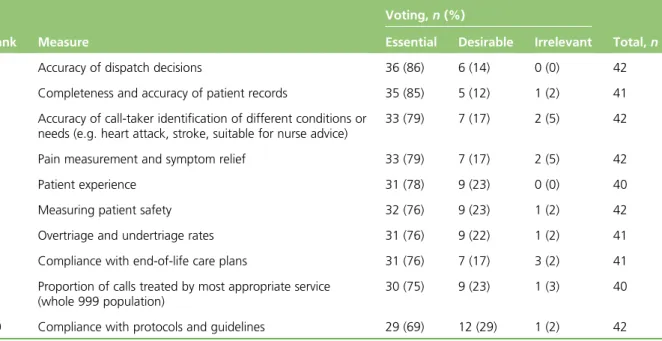
TABLE 1 Example measures identified from systematic evidence review 10 TABLE 2 Top-10 measures by highest percentage voted as essential 13 TABLE 3 The final set of measures that could be developed as potential
performance or quality indicators 17
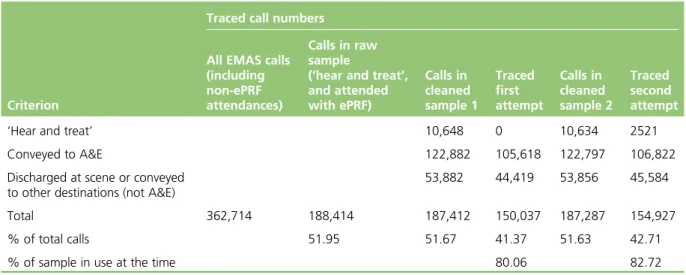
TABLE 4 Traced call numbers as a proportion of total call volume 26
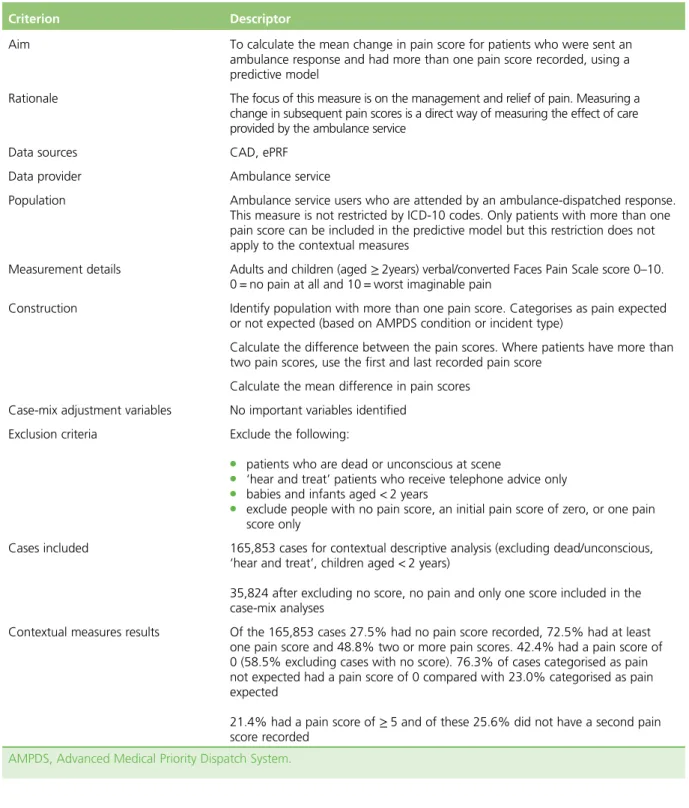
TABLE 5 Criteria for development of indicator 1 31
TABLE 6 Criteria for development of indicator 2 32
TABLE 7 Criteria for development of indicator 3 33
TABLE 8 Criteria for development of indicator 4 33
TABLE 9 Criteria for development of indicator 5 34
TABLE 10 Criteria for development of indicator 6 35 TABLE 11 Summary of case-mix adjustment effects for indicator development 35 TABLE 12 Response time comparisons for urban and rural calls 36 TABLE 13 Summary of cases scored as having strong evidence of avoidability 43 TABLE 14 Assessment of the PhOEBE programme measures 52 TABLE 15 Search strategy for systematic review 1 71 TABLE 16 Database search strategies for systematic review 2 72 TABLE 17 Results of expert panel assessment of all potential measures 83
DOI: 10.3310/pgfar07030 PROGRAMME GRANTS FOR APPLIED RESEARCH 2019 VOL. 7 NO. 3
© Queen’s Printer and Controller of HMSO 2019. This work was produced by Turneret al.under the terms of a commissioning contract issued by the Secretary of State for Health and Social Care. This issue may be freely reproduced for the purposes of private research and study and extracts (or indeed, the full report) may be included in professional journals provided that suitable acknowledgement is made and the reproduction is not associated with any form of advertising. Applications for commercial reproduction should be addressed to: NIHR Journals Library, National Institute for Health Research, Evaluation, Trials and Studies Coordinating Centre, Alpha House, University of Southampton Science Park, Southampton SO16 7NS, UK.
List of figures
FIGURE 1 The PhOEBE programme overview 5
FIGURE 2 Workstream 1 6
FIGURE 3 The Preferred Reporting Items for Systematic Reviews and Meta-Analyses
(PRISMA) flow chart for review 1 8
FIGURE 4 The Preferred Reporting Items for Systematic Reviews and
Meta-Analyses (PRISMA) flow chart for review 2 10
FIGURE 5 Timetable of data permissions and processes for obtaining linked data 22
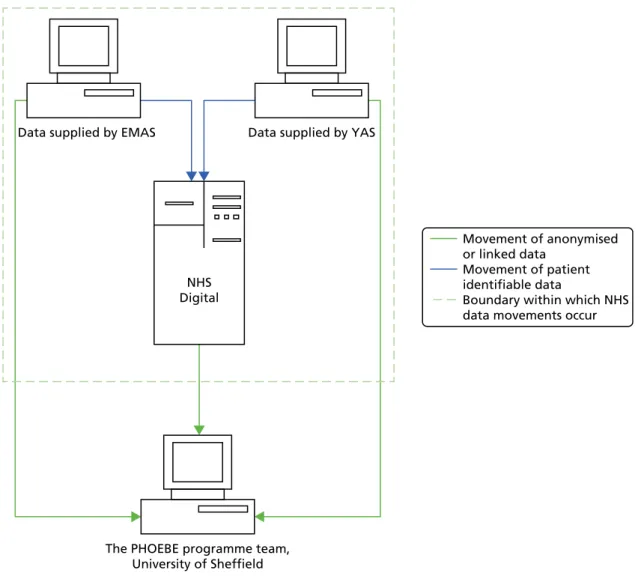
FIGURE 6 Data flow processes 24
FIGURE 7 Numbers of cases traced and included in the linked data set 25
FIGURE 8 Assessment of potential measures 80
DOI: 10.3310/pgfar07030 PROGRAMME GRANTS FOR APPLIED RESEARCH 2019 VOL. 7 NO. 3
© Queen’s Printer and Controller of HMSO 2019. This work was produced by Turneret al.under the terms of a commissioning contract issued by the Secretary of State for Health and Social Care. This issue may be freely reproduced for the purposes of private research and study and extracts (or indeed, the full report) may be included in professional journals provided that suitable acknowledgement is made and the reproduction is not associated with any form of advertising. Applications for commercial reproduction should be addressed to: NIHR Journals Library, National Institute for Health Research, Evaluation, Trials and Studies Coordinating Centre, Alpha House, University of Southampton Science Park, Southampton SO16 7NS, UK.
List of boxes
BOX 1 Emergency conditions used for call accuracy and survival indicators 16
BOX 2 Data sources and case identification 36
BOX 3 Quality of care scale/scores 42
BOX 4 Members of the PhOEBE programme PPI reference group 46 BOX 5 Combined measures from reviews 1 and 2: patient management 74 BOX 6 Combined measures from reviews 1 and 2: patient outcomes 76 BOX 7 Combined measures from reviews 1 and 2: operational measures 77
DOI: 10.3310/pgfar07030 PROGRAMME GRANTS FOR APPLIED RESEARCH 2019 VOL. 7 NO. 3
© Queen’s Printer and Controller of HMSO 2019. This work was produced by Turneret al.under the terms of a commissioning contract issued by the Secretary of State for Health and Social Care. This issue may be freely reproduced for the purposes of private research and study and extracts (or indeed, the full report) may be included in professional journals provided that suitable acknowledgement is made and the reproduction is not associated with any form of advertising. Applications for commercial reproduction should be addressed to: NIHR Journals Library, National Institute for Health Research, Evaluation, Trials and Studies Coordinating Centre, Alpha House, University of Southampton Science Park, Southampton SO16 7NS, UK.
List of abbreviations
A&E accident and emergency
AMPDS Advanced Medical Priority Dispatch System
APC admitted patient care
ARP Ambulance Response Programme CAD computer-aided dispatch
CaHRU Community and Health Research Unit
CCG Clinical Commissioning Group CI confidence interval
CINAHL Cumulative Index to Nursing and Allied Health Literature
ED emergency department
EMAS East Midlands Ambulance Service NHS Trust
EMS Emergency Medical Services
ePRF electronic patient report form EQ-5D EuroQol-5 Dimensions GP general practitioner HES Hospital Episode Statistics ICC intraclass correlation coefficient ICD-10 International Classification of
Diseases, Tenth Edition ID identifier
ONS Office for National Statistics PhOEBE Prehospital Outcomes for Evidence
Based Evaluation
PPI patient and public involvement SJR structured judgement case note
review
YAS Yorkshire Ambulance Service NHS Trust
DOI: 10.3310/pgfar07030 PROGRAMME GRANTS FOR APPLIED RESEARCH 2019 VOL. 7 NO. 3
© Queen’s Printer and Controller of HMSO 2019. This work was produced by Turneret al.under the terms of a commissioning contract issued by the Secretary of State for Health and Social Care. This issue may be freely reproduced for the purposes of private research and study and extracts (or indeed, the full report) may be included in professional journals provided that suitable acknowledgement is made and the reproduction is not associated with any form of advertising. Applications for commercial reproduction should be addressed to: NIHR Journals Library, National Institute for Health Research, Evaluation, Trials and Studies Coordinating Centre, Alpha House, University of Southampton Science Park, Southampton SO16 7NS, UK.
Plain English summary
A
mbulance services are mainly judged on how well they are doing by measuring how quickly they respond, or by measuring the care provided for a few emergency conditions. We wanted to develop new measures that are important to patients, reflect all types of 999 calls and can provide information to improve care.The development of new measures was done in stages. First, the literature on what measures had already been used was reviewed. Patients who had recently used the service were interviewed and it was found that patients valued receiving appropriate advice, treatment, care and reassurance.
A series of events was then held and consultations were had with a wide range of people, including the public, clinicians, service managers, commissioners and policy-makers, to identify a small number of measures for development. A new information record in one ambulance service was also created by combining ambulance, hospital and death records.
Six measures for further development were identified: managing pain; managing the 999 call; response time; decisions about whether or not to leave people at home; decisions about whether or not to take people to hospital; and survival after a serious emergency.
The new patient record was used to find the best way of calculating each measure. It was found that when the impact of ambulance service care is measured on, for example, survival, factors (such as the patient’s age, clinical condition and which hospital they went to) have to be taken into account, as these also have an effect. This is important, because without considering these factors there is a risk of making unfair judgements about ambulance service quality. It was also found that the process of creating the combined patient record was complicated and time-consuming. The set of six measures provides a comprehensive picture of the different aspects of ambulance care but, at present, the difficulties in combining information means that it is not possible to do this routinely.
DOI: 10.3310/pgfar07030 PROGRAMME GRANTS FOR APPLIED RESEARCH 2019 VOL. 7 NO. 3
© Queen’s Printer and Controller of HMSO 2019. This work was produced by Turneret al.under the terms of a commissioning contract issued by the Secretary of State for Health and Social Care. This issue may be freely reproduced for the purposes of private research and study and extracts (or indeed, the full report) may be included in professional journals provided that suitable acknowledgement is made and the reproduction is not associated with any form of advertising. Applications for commercial reproduction should be addressed to: NIHR Journals Library, National Institute for Health Research, Evaluation, Trials and Studies Coordinating Centre, Alpha House, University of Southampton Science Park, Southampton SO16 7NS, UK.
Scientific summary
Background
Measurement of the performance of and quality of care provided by ambulance services has been dominated by response times and indicators for a small number of emergency conditions, such as cardiac arrest, heart attack and stroke. These measurements do not reflect the wide range of conditions that present to ambulance services and the variety of response options that are now available. This is largely because of the lack of previous research on what matters to patients and the absence of data on outcomes after patients are attended by ambulance services. The Prehospital Outcomes for Evidence Based Evaluation (PhOEBE) programme sought to address this.
Aim and objectives
The PhOEBE programme aimed to explore the development of new ways of measuring the impact of prehospital ambulance service care. These new ways of measuring could provide better information about the effectiveness and quality of the different types of care delivered to the range of patients attended by ambulance services to support quality improvement, audit and evaluation of future service changes. The objectives of the programme were to:
1. review, assess and synthesise policy and research literature on prehospital ambulance outcome measures, conduct a qualitative study of ambulance service users’experiences, and use consensus methods to identify measures relevant to NHS patients, providers, practitioners and commissioners that had potential for further development
2. create an information data set that could be used for measuring ambulance service care by linking routinely collected prehospital ambulance data, hospital episode data and mortality data using processes that were acceptable to patients and complied with information legislation to provide information on outcomes
3. use the linked data to develop case-mix adjustment models that measure mortality and non-mortality outcomes for assessing ambulance service quality and detecting change over time
4. explore the practical use of the linked data set and risk adjustment models to measure the effectiveness and quality of ambulance service care and assess how the linked data set and models could be best used to support quality improvement strategies.
Methods
We used a series of linked studies using multiple methods to investigate the aim and objectives. The study was conducted in the East Midlands and Yorkshire regions of England and involved ambulance services, patients who had used ambulance services, patient and public involvement (PPI) groups, emergency care clinical academics, commissioners and policy-makers between 2011 and 2017.
To address objective 1 we undertook two systematic reviews of relevant literature: first, a review of published policy documents that were relevant to actual and aspirational quality and outcomes of prehospital ambulance services and care; and, second, a review systematically synthesising performance and outcome measures reported in the published prehospital research literature. We also conducted a qualitative interview study of a purposive sample of recent ambulance service users to investigate aspects of emergency ambulance service care valued by patients.
DOI: 10.3310/pgfar07030 PROGRAMME GRANTS FOR APPLIED RESEARCH 2019 VOL. 7 NO. 3
© Queen’s Printer and Controller of HMSO 2019. This work was produced by Turneret al.under the terms of a commissioning contract issued by the Secretary of State for Health and Social Care. This issue may be freely reproduced for the purposes of private research and study and extracts (or indeed, the full report) may be included in professional journals provided that suitable acknowledgement is made and the reproduction is not associated with any form of advertising. Applications for commercial reproduction should be addressed to: NIHR Journals Library, National Institute for Health Research, Evaluation, Trials and Studies Coordinating Centre, Alpha House, University of Southampton Science Park, Southampton SO16 7NS, UK.
Using the outputs from the systematic reviews and interviews, we used a three-stage multimethod consensus study comprising multistakeholder consensus event using a modified nominal group technique, modified Delphi study, and patient and public consensus workshop to prioritise and rate potential
measures. An expert panel used the results of the consensus work and further assessed 20 potential measures and identified a small number of candidate indicators for further development.
To address objective 2 we created a data set linking ambulance, hospital and mortality data using
ambulance call-and-dispatch and electronic patient report forms, Hospital Episode Statistics (HES) accident and emergency and inpatient data, and Office for National Statistics mortality data.
To address objectives 3 and 4 we conducted a statistical analysis of the linked data set to explore use of case-mix-adjusted methods for the candidate indicators. Case-mix adjustment was used to explore factors other than ambulance service care that may be influencing processes or outcomes. These included patient characteristics, for example age and the type of condition, and external factors, such as the time of day an incident happens, the location and which hospital provided subsequent care. For each indicator we built a statistical model that allowed us to assess which factors were important in predicting the process or outcome and determine if case-mix adjustment would improve the robustness of the indicator as a measure of performance and quality.
We also used the linked data and the results of two indicators to conduct an economic analysis assessing the costs of different types of ambulance response and the economic consequences of making incorrect decisions about whether to take people to hospital or leave them at home.
Results
Seventy-two candidate measures were generated from systematic reviews in four categories: (1) ambulance service operations (n= 14), (2) clinical management of patients (n= 20), (3) impact of care on patients (n= 9) and (4) time measures (n= 29). Forty-two potential measures (excluding time measures) were presented at the consensus conference and nine measures or principles were highly prioritised by over three-quarters of consensus event participants, including measures relating to pain, patient experience, accuracy of dispatch decisions and patient safety.
Twenty experts participated in two Delphi rounds to refine and prioritise measures; 20 measures scored
≥8/9 points, indicating good consensus, including the proportion of calls correctly prioritised, time to definitive care and pain measures. Eighteen patient and public representatives attending a consensus workshop identified six measures as important including time to definitive care, response time, reduction in pain score, calls correctly prioritised to appropriate levels of response and survival to hospital discharge for treatable emergency conditions.
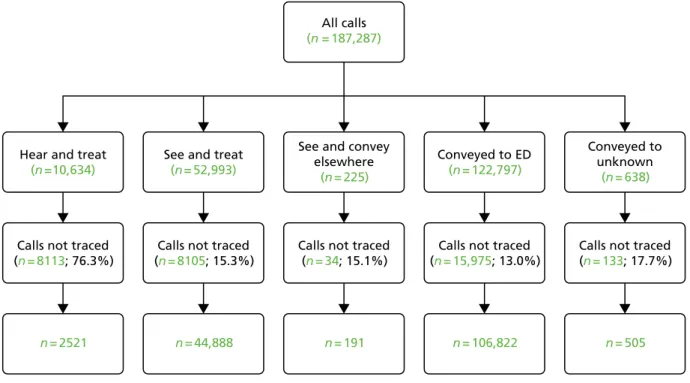
A total of 187,287 cases were retrieved and a linked data set of 154,927 cases was created for the 6-month period of January to June 2013 from one ambulance service. For patients attended by the ambulance service, 85% of records were successfully linked. For cases with no ambulance response (telephone advice only), the linkage rate was poor at 24%.
Using the outputs from the consensus work the expert panel identified six candidate indicators. These were (1) mean change in pain score; (2) proportion of serious emergency conditions correctly identified at the time of the 999 call; (3) response time; (4) proportion of decisions to leave a patient at scene (‘hear and treat’and‘see and treat’) who subsequently re-contact a service or die within 3 days (potentially inappropriate decision); (5) proportion of patients transported to ED by 999 emergency ambulance, but who were discharged to usual place of residence or care of their general practitioner without treatment or investigation(s) that needed hospital facilities (unnecessary transports); and (6) proportion of ambulance patients with a serious emergency condition who survive to admission, and to 7 days post admission.
Response time was not case-mix-adjusted as this is entirely in the control of the ambulance service. Of the other five, only the mean change in pain score was not affected by other factors. For the four case-mix-adjusted indicators, age, deprivation (measured by the Index of Multiple Deprivation) and condition or call reason were important, and sex affected all indicators except survival. Receiving hospital was an important factor in the indicators for unnecessary transports and survival at 7 days post incident. The overall accuracy rate for identifying 16 emergency conditions at the time of the 999 call was 61%, although this varied substantially for individual conditions (10–85%). The rate for potentially inappropriate decisions to not transport a patient to hospital varied from 5 to 10.2 cases per 100 calls across 22 Clinical Commissioning Groups, and unnecessary transports varied from 2.4 to 8 cases per 100 calls. Survival to hospital admission ranged from 90.5 to 97.3 cases per 100 calls and survival at 7 days ranged from 90.5 to 98 cases per 100 calls. This confirms that the proportion of calls to the ambulance service that are truly life-threatening is very small. Indicators not affected by external hospital factors could be used to measure differences between different services or areas as well as monitoring over time. Indicators for which hospital has an effect can be used for within-service comparisons and trends but would not make a fair judgement between services as the outcome is influenced by service factors outside ambulance service control. Early in the programme we identified one other potential indicator–survival rates for patients who call for urgent conditions–but could not reliably identify all of the relevant patient population. Instead, we conducted a retrospective case review of a sample of patients we identified from the linked data as having a low risk of death. We assessed 153 cases of patients who died within 3 days and identified 29 patients who were not taken to hospital at the time of the incident. These 29 cases were reviewed using structured judgement review. Overall, 8 cases out of 29 (27.6%) were judged definitely avoidable, 8 (27.6%)
probably avoidable and 13 (44.8%) slightly or definitely not avoidable.
The economic study analysed 182,566 cases, of which 10,151 (5.6%) were‘hear and treat’so received no ambulance face-to-face response, 51,223 (28.0%) received a‘see and treat’response and 121,192 (66.4%) were taken to hospital. The total mean cost of a‘hear and treat’call was £125,‘see and treat’call was £415 and‘see and convey’call £1745. The main reasons for these cost differences are the differences in inpatient costs. We also compared costs for correct and incorrect decisions using the indicators for potential inappropriate non-conveyance and unnecessary transports to identify calls with correct and incorrect decisions. We found that the mean total cost of an incorrect non-conveyance decision is £313 more than that of a correct conveyance decision. The mean total cost of an incorrect conveyance decision is £237 more than that of a correct non-conveyance decision. There are potential costs savings if decision-making can be improved.
Limitations
A serious limitation to this programme was the delays caused by difficulties in obtaining the linked data. The data linkage component was contracted to the then Health and Social Care Information Centre (HSCIC) (now NHS Digital). NHS Digital holds the central HES data and also provided a trusted data linkage service. We planned to use this service to obtain the first set of linked data by the end of year 2 and a second set in year 3 (2013–14). During 2013 major data security issues arose at NHS Digital and, as a result, there was a major review and restructuring of the organisation. This meant that no data were released for (any) research use for almost 2 years. As a consequence, we did not receive a linked data set until October 2016, which was 4 months after the original expected end date of the programme. These delays meant that we have been unable to conduct the work to further test and validate the indicators set out in objective 4.
The complexities of data management and linkage also proved to be costly and time-consuming. For some groups of patients (e.g. those who do not receive an ambulance response), there is insufficient information held to achieve high levels of matching and data linkage, so this patient group is not well represented in some of the analyses. The construction of the case-mix-adjusted indicators was also complex. Although processes to do this have now been established, we have used data from one ambulance service only.
DOI: 10.3310/pgfar07030 PROGRAMME GRANTS FOR APPLIED RESEARCH 2019 VOL. 7 NO. 3
© Queen’s Printer and Controller of HMSO 2019. This work was produced by Turneret al.under the terms of a commissioning contract issued by the Secretary of State for Health and Social Care. This issue may be freely reproduced for the purposes of private research and study and extracts (or indeed, the full report) may be included in professional journals provided that suitable acknowledgement is made and the reproduction is not associated with any form of advertising. Applications for commercial reproduction should be addressed to: NIHR Journals Library, National Institute for Health Research, Evaluation, Trials and Studies Coordinating Centre, Alpha House, University of Southampton Science Park, Southampton SO16 7NS, UK.
The results showed that the rates measured vary by geographical area and so the indicators would have to be recalibrated for each individual ambulance service. The inability to test the indicators and their usefulness in a‘real-world’setting is also a limitation to further use.
Conclusions
We identified and prioritised, through systematic reviews of the literature followed by a series of formal consensus processes with a wide range of stakeholders, a set of potential ambulance service quality measures that reflect the preferences of both services and users. We also created a comprehensive linked data set providing information for individual calls that extends beyond the prehospital component of care, although this proved to be a complex and time-consuming process. Six candidate indicators were developed using case-mix adjustment and, of these, four were found to need adjustment to make fair comparisons. Hospital was found to have a substantial effect on the process or outcome for two indicators, which means that these are suitable for use only at an individual service or system level. Other indicators could be used to make comparisons between regions or services. The complexities of both creating linked data and constructing the indicators means that, at present, they are of limited value as it would not be possible to measure them routinely. There is a pressing need to improve information systems and data linkage processes if more sophisticated case-mix-adjusted performance and quality measurement is to be implemented. Currently, no national, centralised ambulance service data are collected. Development of an ambulance equivalent to the Emergency Care Dataset that could be linked to this and HES data would produce real benefits for better performance measurement and associated clinical audit. The different studies conducted as part of the PhOEBE programme open up a wide range of potential future research:
l The measures prioritised through the consensus studies should be further developed, validated and examined to investigate their importance, validity, feasibility, relevance and sensitivity to differences in services, service changes and quality improvement efforts in practice.
l New measures, such as patient-related experience measures, should be developed based on our understanding of what is important to patients using ambulance services.
l Future data sets linking ambulance, hospital and mortality data could be used to investigate the effects, safety and costs of different pathways and processes for a variety of clinical conditions and patient outcomes.
Funding
Funding for this study was provided by the Programme Grants for Applied Research programme of the National Institute for Health Research.
SYNOPSIS
Background
The NHS provides emergency care for a diverse population of patients who need medical care for a wide range of conditions and have different levels of urgency. For many patients, the first point of contact with the NHS is when they request help from the ambulance service.
Demand for ambulance services has been steadily increasing for many years. In 1974, ambulance services in England responded to 1.5 million emergency (‘999’) calls per year. By 2016/17 this had increased to > 6 million responses to almost 10 million calls.1In the past, the main purpose of the ambulance service was
to respond to serious emergencies and transport patients to the nearest hospital emergency department (ED). As the number of calls has grown, so has the type of health problems people call 999 for.
Ambulance services now provide care for conditions that range from life-threatening emergencies, such as heart attacks, stroke and serious injury, a wide range of illnesses and problems associated with chronic disease and long-term conditions, to relatively minor illness or injury. In response to these changes, ambulance services have also adapted and developed.
In 2005, the Department of Health and Social Care policy documentTaking Healthcare to the Patient: Transforming NHS Ambulance Services2recognised that patients who call 999 should receive care that not
only is timely but also best meets their clinical needs. Patients with serious medical emergencies and injury still need a fast response, early treatment and good clinical care at the scene, followed by transport to hospital. However, research evidence also showed that, for some patients with less urgent problems, a trip to the ED was not always necessary and their needs could be better met by providing the care at home or in a community service.3
As a result of the 2005 report, and subsequent broader policy initiatives focusing on delivering care closer to home for urgent problems and developing expert centres for specialist care such as stroke units and major trauma centres for emergencies,4there have been a variety of innovations in types of response
provided by the ambulance service. These types of response now fall into three main categories:
1. More detailed clinical telephone assessment of some 999 calls by nurses or paramedics so that patients who do not need an emergency ambulance can be provided with self-care advice or referred to the right service– ‘hear and treat’.
2. Development of paramedic skills including advanced paramedic practitioners so they can treat minor illness and injury at home and, when needed, refer to other services for follow-up care, for example community falls services– ‘see and treat’.
3. Improving prehospital assessment and care pathways so that patients who need specialist care can be taken straight to the best facility (e.g. a stroke or heart attack centre) and other patients taken to the nearest ED– ‘see and convey’.
The changes in the way that ambulance services provide care have contributed to broader efforts to improve emergency and urgent care by developing a more‘joined up’system approach in which ambulance, accident and emergency (A&E), and community services work in partnership to ensure that patients can access and receive care in the right place and at the right time.4
These changes also need to reflect the NHS principles set out in the Next Stage Review,5which are to
provide high-quality services through improving effectiveness, safety and patient experience. If these aims are to be achieved, then the assessment and monitoring of the quality of services and the wider system in
DOI: 10.3310/pgfar07030 PROGRAMME GRANTS FOR APPLIED RESEARCH 2019 VOL. 7 NO. 3
© Queen’s Printer and Controller of HMSO 2019. This work was produced by Turneret al.under the terms of a commissioning contract issued by the Secretary of State for Health and Social Care. This issue may be freely reproduced for the purposes of private research and study and extracts (or indeed, the full report) may be included in professional journals provided that suitable acknowledgement is made and the reproduction is not associated with any form of advertising. Applications for commercial reproduction should be addressed to: NIHR Journals Library, National Institute for Health Research, Evaluation, Trials and Studies Coordinating Centre, Alpha House, University of Southampton Science Park, Southampton SO16 7NS, UK.
which they operate become important tasks.6This means that we need ways of measuring how well
ambulance services are performing, in terms of both the services they are delivering and the impact that these services have on the patients that they care for.
Quality assessment and quality improvement can be achieved only if we can find ways of routinely and consistently measuring these important aspects of patient care so that we can identify where care is good and where it needs to be improved. Measuring performance and quality of care is never easy but is particularly difficult for ambulance services, as they provide care to such a diverse group of patients and those patients will be in their care for a relatively short period of time only.
For many years, the quality of ambulance service care has been mainly assessed by measuring how quickly they respond to 999 calls–response time performance. This is not unique to the UK and has been the predominant performance or quality measure for Emergency Medical Services (EMS) internationally.7Response time has
been used as a proxy measure because of the relationship between speed of response and survival following out-of-hospital cardiac arrest–the faster the response, the more likely a patient is to survive.8However, cardiac
arrest accounts for a very small proportion of 999 calls only, currently 0.6% in England,9and research evidence
shows that, for other calls, the speed of response has little impact on survival or outcomes.10–12Response time
also tells us nothing about what clinical care was given or the impact of that care on patient outcomes so, overall, it is a poor measure of service quality for the vast majority of patients who request an ambulance. The need to develop better ways of measuring ambulance service performance and quality of care, particularly the effect on patient outcomes that are relevant to all people who use the service, not just a few, has been recognised for some time. This need was a key recommendation ofTaking Healthcare to the Patient: Transforming NHS Ambulance Services2and also a high priority in a UK Delphi study assessing
priorities for prehospital care research.13Despite this recognition, a review of outcome measurement in
prehospital care found few research studies investigating this area and found that most published
literature focused on discussion of the need to develop measures rather than any solution to the problem.14
In England, some progress has been made with the introduction of a set of 11 ambulance service quality indicators adopted in 2011.15Having a set of indicators, rather than just a single measure of response time
performance, that had relevance to all calls was a big step forward, as was the inclusion of a small number of clinical indicators designed to measure the care provided for some key conditions like cardiac arrest, stroke and heart attack.16However, the focus remained on processes [what the ambulance service did in
terms of response times, type of service (e.g. how many calls are managed using‘hear and treat’) and providing treatment for a small number of conditions] rather than how care affected patients. It is also fair to say that these indicators or measures have mainly been developed by health professionals and academics so may not include aspects of care that are important to patients.
There has been a major problem holding back the development of better ways of measuring how well ambulance services provide care to the population who call 999 and that was the lack of information available to them about what happens to patients and their outcome once they had left ambulance care. If the only information they have is their own data about how they respond and what they do then, it is not surprising that these are the only things that were measured. These data are also incident rather than patient based, which makes it difficult to monitor related calls for the same patient. However, if ambulance service information about patients could be linked to, for example, hospital information, so that they have a more complete picture of what happens to patients and their outcomes, then a better assessment could be made of the impact of care and the benefits it produced. Creating linked data sets can also potentially add value by creating comprehensive information sources that can be used to provide feedback on outcomes and improve performance and practice, but this was not something that was being done routinely.
This programme was designed to try and resolve these problems by bringing together the two key themes of:
1. developing more meaningful ambulance service performance and quality measures that reflect the key principles of quality, safety and effectiveness of care
2. creating linked data sets that can combine ambulance service, hospital and mortality data to provide the information needed to support better performance and quality measurement.
Even with a linked data set that includes patient outcomes, measuring impact is problematic. Outcomes can be influenced by a whole range of factors in addition to ambulance care received, such as a patient’s age, illness severity or hospital care. One way of overcoming this is to develop performance measures that can take account of these intrinsic and extrinsic factors by using risk or case-mix adjustment models. These have been successfully developed and used for research and audit in settings such as trauma17
and intensive care18and have shown they can make an important difference to improving processes and
outcomes of care.
Aims and objectives
The aim of this programme was to develop new ways of measuring the impact of care provided by
ambulance services. This could support quality improvement by providing information to monitor and audit service performance and assess the impact of change through service evaluation. The programme was called PhOEBE (Prehospital Outcomes for Evidence Based Evaluation).
Its objectives were to:
1. review and synthesise the research literature on prehospital care outcome measures and use consensus methods to identify a small set of measures relevant to the NHS and patients for further development 2. create a data set linking routinely collected prehospital (ambulance service) data, hospital data and
mortality data to provide outcome information
3. use the linked data to develop the measures identified in objective 1 by building case-mix adjustment models that could potentially be used to assess ambulance service performance and detect change over time with repeated measurement
4. explore the practical use of the linked data set and the case-mix adjustment models to measure the effectiveness and quality of ambulance service care and assess how they can be best used to support quality improvement strategies.
Programme design
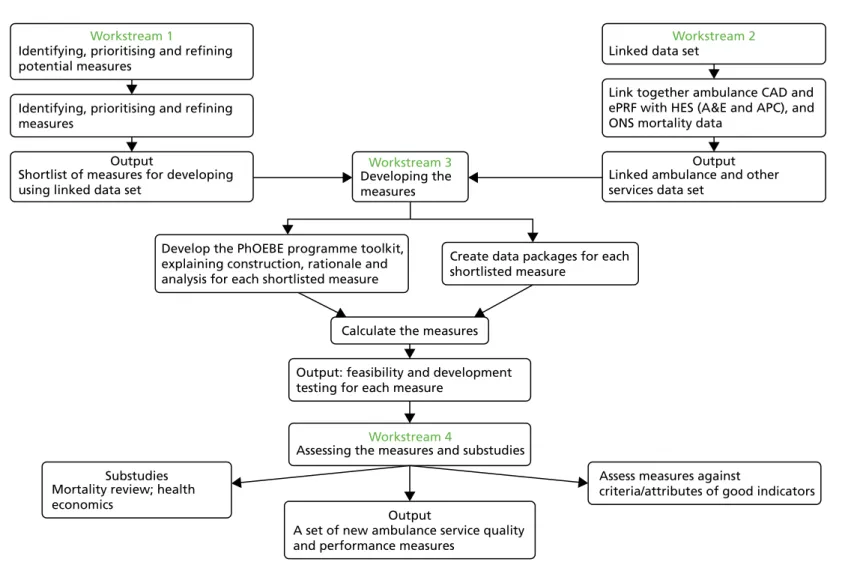
The programme was designed to be conducted in four linked stages or workstreams (Figure 1).
Workstream 1: a review and synthesis of the evidence on ambulance service-related performance and quality measures to produce a list of potential measures. Then use consensus methods to assess and prioritise these measures and to identify a small number that are relevant to different stakeholders, including patients and NHS staff, research academics and patient representatives for further development. Workstream 2: linking ambulance service call information and patient information from the care record completed by ambulance clinicians with routine ED and hospital information [Hospital Episode Statistics (HES)] and national records of patient deaths. This creates a single data set that follows what happens to each patient who makes a 999 call.
DOI: 10.3310/pgfar07030 PROGRAMME GRANTS FOR APPLIED RESEARCH 2019 VOL. 7 NO. 3
© Queen’s Printer and Controller of HMSO 2019. This work was produced by Turneret al.under the terms of a commissioning contract issued by the Secretary of State for Health and Social Care. This issue may be freely reproduced for the purposes of private research and study and extracts (or indeed, the full report) may be included in professional journals provided that suitable acknowledgement is made and the reproduction is not associated with any form of advertising. Applications for commercial reproduction should be addressed to: NIHR Journals Library, National Institute for Health Research, Evaluation, Trials and Studies Coordinating Centre, Alpha House, University of Southampton Science Park, Southampton SO16 7NS, UK.
Workstream 3: explore and develop case-mix-adjusted models for processes and outcomes in patients attended by the ambulance service using the linked data. This allows us to assess whether or not case-mix adjustment is needed to improve the usefulness of process or outcome measures, and their potential as indicators to measure quality and performance between services or within services over time.
Workstream 4: testing the risk adjustment models to assess if they can be used to measure effectiveness and quality. This looks at how they might be used in practice and explores with users (patients and staff) how useful they are and how they might be best implemented in the NHS. In addition, the linked data can be used to estimate the costs of different types of ambulance response.
Figures 1and2provide a summary of the four workstreams and how they are linked together. The programme was overseen and supported by a project management group that included all of the programme collaborators, the research team, representatives from the two ambulance services taking part and a public involvement member. We also had a project steering committee comprising key members of the management group and external advisors representing ambulance services, the College of Paramedics, NHS commissioners and emergency care research. The programme was carried out over the 6-year period of 2011–17.
Public involvement
Public involvement made an important contribution to the PhOEBE programme. At the outset we formed a public involvement reference group of three members who provided substantial support and input to each stage of the programme, both individually and by providing links to other relevant external groups. Our public involvement reference group not only contributed advice but also co-produced some of the programme work and outputs. We describe the patient involvement work in more detail underPatient and public involvementbelow.
Changes from the original proposal
During the course of the programme we encountered a major problem during workstream 2. The data linkage component was contracted to the then Health and Social Care Information Centre (HSCIC) (now NHS Digital). NHS Digital held the central HES data and also provided a trusted data linkage service. We planned to use this service to link the ambulance service, hospital and Office for National Statistics (ONS) mortality data. The plan was to obtain the first set of linked data by the end of year 2 and a second set in year 3 (2013–14).
During 2013, major data security issues arose at NHS Digital and, as a result, there was a major review and restructuring of the organisation. This meant that no data were released for (any) research use for almost 2 years. These issues are described in more detail inCreating a linked data setbut the overall impact was that, because of these external delays, we did not receive a linked data set until October 2016–4 months after the original expected end date of the programme. We were fortunate to obtain a 1-year extension to the programme, which enabled us to complete the workstream 3 work to develop the risk-adjusted measures, albeit within a much reduced time frame.
The delays meant that we were unable to conduct much of the planned work for workstream 4, principally because the second linked data set that we had intended to use to test and validate the measures
developed in workstream 3 arrived too late and we had no time left to complete this. The implications of these delays and the difficulties in obtaining and managing the linked data are discussed in more detail in
Identifying, prioritising and refining potential measures
Identifying, prioritising and refining measures
Shortlist of measures for developing using linked data set
Linked data set
Developing the measures
Develop the PhOEBE programme toolkit, explaining construction, rationale and analysis for each shortlisted measure
Create data packages for each shortlisted measure
Output: feasibility and development testing for each measure
A set of new ambulance service quality and performance measures
Assess measures against
criteria/attributes of good indicators Mortality review; health
economics
Assessing the measures and substudies Calculate the measures
Link together ambulance CAD and ePRF with HES (A&E and APC), and ONS mortality data
Linked ambulance and other services data set
Workstream 2 Workstream 1 Workstream 3 Output Output Workstream 4 Substudies Output
FIGURE 1 The PhOEBE programme overview. APC, admitted patient care; CAD, computer-aided dispatch; ePRF, electronic patient report form; ONS, Office for National Statistics. DOI: 10.3310/pgfar07030 PROGRAMME GRANTS FOR APPLIED RESEARCH 2019 VOL. 7 NO. 3 © Queen ’ s Printer and Controller of HMSO 2019. This work was produced by Turner et al. under the terms of a commissioning contract issued by the Secretary of State for Health and Social Care. This issue may be freely reproduced for the purposes of private research and study and extracts (or indeed, the full report) may be incl uded in professional journals provided that suitable acknowledgement is made and the reproduction is not associated with any form of advertising. Applications for commercial rep roduction should be addressed to: NIHR Journals Library, National Institute for Health Research, Evaluation, Trials and Studies Coordinating Centre, Alpha House, Uni versity of Southampton Science Park, Southampton SO16 7NS, UK. 5
Identifying, prioritising and refining potential measures
Expert group Identifying
measures
Longlist of measures for prioritising through consensus process
Shortlist of measures for developing using linkeddata set Systematic reviews Service user interviews Prioritising and refining measures Consensus event
Delphi study PPI workshop
Workstream 1
Output
Output
Identifying potential measures to assess
ambulance service performance and
quality of care
T
he overall aim of this first workstream (seeFigure 2) was to explore, as broadly as possible, the range of potential measures that might be used to assess ambulance service performance and quality of care and then, through a consensus process, reduce this down to those suitable for further development as risk-adjusted measures. This was achieved using a stepwise process of five different activities:1. Two systematic searches and syntheses of the relevant literature to identify candidate measures. 2. A qualitative study with recent users of the ambulance service to identify which aspects of ambulance
service care were important to patients and carers.
3. A consensus event at which we presented the outputs from steps 1 and 2 to a group of people representing different interests in ambulance service care and asked participants to rate the importance of the potential measures.
4. The highest-scoring measures from the consensus event were then developed into more detailed measures and a Delphi survey and a patient and public involvement (PPI) event were conducted to further rate and prioritise them.
5. A review and assessment of the results from step 4 by the programme steering group to identify the final small set of measures for development in workstream 3.
Systematic searches and review of related research evidence
We conducted two systematic searches to review, assess and synthesise the research literature for existing and potential process and patient outcome measures for prehospital care. These were not conventional systematic reviews in that we were not appraising evidence of the effects of prehospital care. The aim was to identify all measures that had been used to assess the impact, quality and safety of prehospital care as well as potential and as yet untested measures, using systematic searching and evidence synthesis strategies. We conducted two reviews so that we could examine both policy literature and primary research evidence.
Review 1: documentary analysis of policy documents
The first review was designed to identify actual and aspirational quality and performance measures of ambulance and prehospital care. We used a comprehensive search strategy to search four electronic databases: MEDLINE, Scirus, Scopus and Google Scholar (seeAppendix 1, Table 15). We also searched relevant websites such as the Department of Health and Social Care,19National Association of Emergency
Medical Services Physicians20and NHS Confederation.21We supplemented the searches with our own
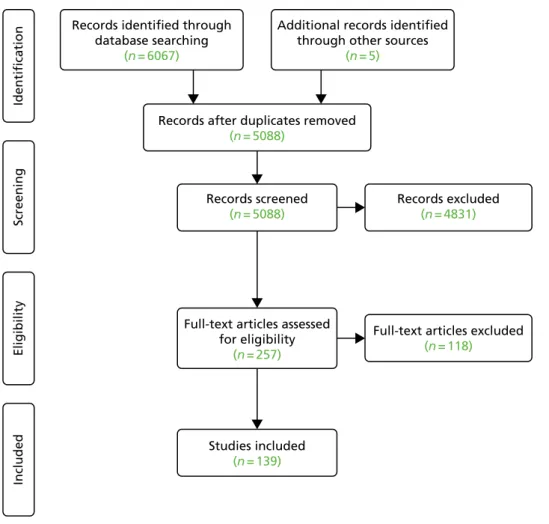
extensive archive from previous related research studies. Any policy documents produced by national, regional or professional organisations or agencies were included, but these were limited to those in the English language published between 2000 and 2011 to ensure relevance. Searches were conducted in August 2011. The results of the searches are given inFigure 3.
References were screened by six members of the research team. We screened 319 potential references, assessed 72 full-text papers and included 36 documents.
Double data extraction of included references was carried out by the same six researchers and the measures identified were classified using established frameworks of health-care quality (structure, process and outcome23and timeliness; efficiency; effectiveness; safety; patient centredness and equity24).
DOI: 10.3310/pgfar07030 PROGRAMME GRANTS FOR APPLIED RESEARCH 2019 VOL. 7 NO. 3
© Queen’s Printer and Controller of HMSO 2019. This work was produced by Turneret al.under the terms of a commissioning contract issued by the Secretary of State for Health and Social Care. This issue may be freely reproduced for the purposes of private research and study and extracts (or indeed, the full report) may be included in professional journals provided that suitable acknowledgement is made and the reproduction is not associated with any form of advertising. Applications for commercial reproduction should be addressed to: NIHR Journals Library, National Institute for Health Research, Evaluation, Trials and Studies Coordinating Centre, Alpha House, University of Southampton Science Park, Southampton SO16 7NS, UK.