A Stream-Comptuting Extension to OpenMP
Antoniu Pop, Albert Cohen
To cite this version:
Antoniu Pop, Albert Cohen. A Stream-Comptuting Extension to OpenMP. International
Con-ference on High Performance and Embedded Architectures and Compilers, Jan 2011, Heraklion,
Greece. 2011.
<inria-00551507>
HAL Id: inria-00551507
https://hal.inria.fr/inria-00551507
Submitted on 27 Nov 2011
HAL
is a multi-disciplinary open access
archive for the deposit and dissemination of
sci-entific research documents, whether they are
pub-lished or not.
The documents may come from
teaching and research institutions in France or
abroad, or from public or private research centers.
L’archive ouverte pluridisciplinaire
HAL
, est
destin´
ee au d´
epˆ
ot et `
a la diffusion de documents
scientifiques de niveau recherche, publi´
es ou non,
´
emanant des ´
etablissements d’enseignement et de
recherche fran¸
cais ou ´
etrangers, des laboratoires
publics ou priv´
es.
A Stream-Computing Extension to OpenMP
Antoniu Pop
Centre de Recherche en Informatique MINES ParisTech, France
[email protected]
Albert Cohen
INRIA Saclay – Île-de-France Orsay, France
[email protected]
ABSTRACT
This paper introduces an extension to OpenMP3.0 enabling stream programming with minimal, incremental additions that seamlessly integrate into the current specification. The stream programming model decomposes programs into tasks and explicits the flow of data among them, thus exposing data, task and pipeline parallelism. It helps the programmers to express concurrency and data local-ity properties, avoiding non-portable low-level code and early opti-mizations. We survey the diverse motivations and constraints con-verging towards the design of our simple yet powerful language extension, and we present experimental results of a prototype im-plementation in a public branch of GCC 4.5.
Categories and Subject Descriptors
D.1.3 [Concurrent Programming]: Parallel programming; D.3.3 [Language Constructs and Features]: Concurrent programming structures
1.
INTRODUCTION
The performance of single-threaded applications is expected to stagnate with new generations of processors. Improving perfor-mance requires changing the code structure to harness complex parallel hardware and memory hierarchies. But this is a nightmare for programmers: translating more processing units into effective performance gains involves a never-ending combination of target-specific optimizations. These manual optimizations involve subtle concurrency concepts and non-deterministic algorithms, as well as complex transformations to enhance memory locality. As optimiz-ing compilers and runtime libraries no longer shield programmers from the complexity of processor architectures, the gap to be filled by programmers increases with every processor generation.
High-level languages are designed to express (in)dependence, communication patterns and locality without reference to any par-ticular hardware, leaving compilers and runtime systems with the responsibility of lowering these abstractions to well-orchestrated threads and memory management. In particular, stream program-ming has recently attracted a lot of attention. It is a widely applica-ble form of parallel programming that guarantees functional
deter-Permission to make digital or hard copies of all or part of this work for personal or classroom use is granted without fee provided that copies are not made or distributed for profit or commercial advantage and that copies bear this notice and the full citation on the first page. To copy otherwise, to republish, to post on servers or to redistribute to lists, requires prior specific permission and/or a fee.
HiPEAC2011 Heraklion, Crete, Greece
Copyright 2011 ACM 978-1-4503-0241-8/11/01 ...$10.00.
minism, a major asset in the productivity race. It is also conducive to making relevant data-flow explicit and to structuring programs in ways that allow simultaneously exploiting pipeline, data and task parallelism. Stream computations also help reduce the severity of the memory wall in two complementary ways: (1) decoupled pro-ducer/consumer pipelines naturally hide memory latency; and (2) they favor local, on-chip communications, bypassing global mem-ory. While many languages have been designed to exploit pipeline parallelism, we believe it is more interesting and sufficient to in-troduce minimal and incremental additions to an existing and well-established language.
This paper introduces an extension to the OpenMP3.0 language [22] to enable stream programming. It requires only minor addi-tions that seamlessly integrate in the current language specification. We detail the motivation of our work and present the extension as well as the experimental results of an early implementation in a public branch of GCC 4.5.
The paper is structured as follows. Section 2 discusses our mo-tivation and related work. Section 3 details the analysis driving the design of our streaming extension. Section 4 presents the extension itself. Section 5 defines the semantics of the new constructs and validates the execution model. Section 6 evaluates our implemen-tation on realistic applications and benchmarks.
2.
MOTIVATION AND RELATED WORK
Many languages and libraries are being developed for the stream-computing model. Some are general purpose programming lan-guages that hide the underlying architecture’s specificities, while others are specifically targeted at accelerator architectures. While a complete survey is outside the scope of this paper, we present a selection of the most related efforts in this field. We also discuss the motivations and constraints that drive our proposal.
Data-parallel execution puts a high pressure on the memory bandwidth of multi-core processors. There is a well known tradeoff between synchronization grain and private memory footprint, as illustrated by performance models for bulk-synchronous data-parallel programs [3]. But there are few answers to the limitations of the off-chip memory bandwidth of modern processors. Pipeline parallelism provides a more scalable alternative to communication through main memory, as the communication buffers can be tailored to sit in the caches, effectively making cores communicate through a shared cache or through the cache coherence protocol. In addition, the choice of developing streaming languages for accelerator hardware [16] is partly due to the prohibitive latency of accessing the main memory.
Furthermore, a stream-programming model naturally exposes data, task and pipeline parallelism through its high-level semantics, avoiding the loss in expressiveness of other parallel-programming
models. A stream computation is divided in pipeline stages, or filters, where the producer-consumer relationships are explicit. Stages can be either sequential, if there is a dependence between successive executions of the stage, or parallel, in which case, the stage can be replicated at will for load balancing and/or exploiting data parallelism. The sequential filters are an issue that is shared with other forms of parallelism as it stems from the presence of state in the filter, or equivalently from a loop-carried dependence. Closely related to pipelining, doacross parallelization [6], can be used in such cases, but it is more restrictive and requires communication of the state between threads.
Because of this problem, there are applications where the use of pipelining is the only efficient solution for parallelization. As an example, the recent study [17] by Pankratius et al. of the paral-lelization of Bzip2 shows that this application is not only hard to parallelize, but more specifically that only pipelining allows it to be efficient and to achieve decent scalability levels. The authors of the study remark that OpenMP is not well suited for paralleliz-ing Bzip2, but this was reversed by implementparalleliz-ing FIFO queues to communicate between tasks, making it one of the best choices. In this paper, we want to show that it is neither necessary to develop a new language for streaming, nor to require developers to write the pipelining code by hand.
The StreamIt language [21] is an explicitly parallel programming language rooted in the Synchronous Data Flow (SDF) model of computation [14]. StreamIt provides three interconnection modes: the Pipeline allows the connection of several tasks in a straight line, the SplitJoin allows for nesting data parallelism by dividing the output of a task in multiple streams, then merging the results in a single output stream, and the FeedbackLoop allows the cre-ation of streams from consumers back to producers. The channels connecting tasks are implemented either as circular buffers, or as message passing for small amounts of control information. Thanks to these static restrictions (periodicity, split-join structure), a sin-gle StreamIt source can be compiled very efficiently on a variety of shared and distributed memory targets [10]. But we believe these expressiveness restrictions are not necessary to achieve excellent performance, assuming the programmer is willing to spend a min-imal effort to balance the computations and tune the number of threads to dedicate to each task manually. This is the pragmatic ap-proach OpenMP has successfully taken for years. In addition, when the compiler discovers that the SDF invariants are satisfied, it may trigger aggressive loop transformations to adapt the task parallelism to the target, matching the performance portability of StreamIt.
The Brook language [4] provides language extensions to C with Single Program Multiple Data (SPMD) operations on streams. Un-like StreamIt, it is control-centric, with control flow operations tak-ing place at synchronization points. Streams are defined as col-lections of data that can be processed in parallel. For example: “float s<100>;” is a stream of 100 independent floats. User defined functions that operate on streams are called kernels. The user defines input and output streams for the kernels that can exe-cute in parallel by reading and writing to separate locations in the stream. Brook kernels are blocking and isolated: the execution of a kernel must complete before the next kernel can execute. This is the same execution model that is available on graphics processing units (GPUs): a task queue contains the sequence of shader programs to be applied on the texture buffers.
Dynamic data-flow principles [23, 7, 1] have regained popular-ity as pragma-based extensions to imperative languages. Based on CellSs [2], StarSs [18] defines a complete set of pragmas to pro-gram distributed-memory and heterogeneous architectures; it sup-ports both data-flow and control-flow programming styles. SMPSs
is one of the StarSs incarnations for shared-memory targets [15]. TFlux follows a similar approach [20], focusing on data flow and targeting the Data-Driven Multithreading (DDM) execution model [13]. StarSs and TFlux are closely related to streaming languages, but they differ from our approach in two fundamental aspects:
• their design and implementation assume a short-lived task exe-cution model, relying on data-driven scheduling of lightweight user-level threads and work stealing; this is excellent for load-balancing, but induces significant overheads for finer grain tasks, as our experiments confirm;
• they are not compatible with OpenMP, but introduce other prag-mas with different semantics; StarSs handles distributed mem-ory and heterogeneous targets, unlike OpenMP, but is not as expressive on shared-memory targets; TFlux is currently re-stricted to nested loops.
Closest to our work is the Streaming Programming Model of the ACOTES project [5]. This model takes its inspiration from the OpenMP3.0 tasks, but is not compatible with OpenMP. It adds de-coupled communication channels and pioneered thepersistent in-terpretation of tasks, among other contributions. Our proposal de-rives from this experimental platform, but it is more expressive, it achieves a complete and incremental integration within OpenMP.
3.
DESIGN GOALS OF THE EXTENSION
Our primary design goal is to enable OpenMP programmers to exploit pipeline parallelism without explicitly handling communi-cation and synchronization, which is both error-prone and time-consuming. We also want to offer highly efficient decoupled pipe-lined executions to programmers with no experience in shared-memory concurrency. To achieve these goals, we propose exten-sions to the OpenMP language, exposing the necessary information for the generation of pipelined parallel code, while ensuring this additional expressiveness does not introduce excessive complexity and does not break the semantics of the current specification.
More specifically, we deem the three objectives of expressive-ness, efficiency and simplicity to be the most important to enable stream programming in OpenMP. In Section 4, we will show how to achieve these goals.
Expressiveness.
The extension aims to provide a way for pro-grammers to expose producer-consumer relationships. The current OpenMP specification lacks the capability to explicit the flow of data, as the existing sharing clauses only allow to distinguish be-tweensharedand privatedata. In order to usetask con-structs in non-embarrassingly parallel problems, manual synchro-nization is required to communicate through shared memory.The convenience of “peek” operations and non-unitary produc-tion and consumpproduc-tion rates is often provided in streaming frame-works. The manual implementation is cumbersome enough to de-serve a simplified mechanism at the language level, which in addi-tion allows the compiler to generate in-place operaaddi-tions in stream buffers, avoiding the explicit state management and the spurious dependences it induces, and avoiding the overhead of copying from streams to local buffers and back.
Productivity.
One of the drawbacks of new stream-programming languages is that they come with a whole new programming environment, which lacks debugging support, interoperability and mature accompanying libraries. To this startup cost, one should often add the cost of target-specific tweaking required by the lower level languages (e.g., hard-wired offloading directives for accelerators). By extending a well-knownparallel-programming language, OpenMP, with incremental, natural and target-independent constructs for streaming, the programmer’s productivity is maximized. We believe a seamless integration with the current OpenMP specification is essential to avoid making the extension an additional burden on current developers. They should not change the way they are used to work with OpenMP for non-streaming applications. The semantics of the extension should therefore be incremental and any new interaction should, as far as possible, follow the existing rules. This practical constraint turns into a research challenge: building compositional data-flow constructs over an existing imperative, shared-memory semantics.
Efficiency.
The execution model of OpenMP3.0 specification tasks is similar to that of coroutines or fibers. A task instance is created whenever the execution flow of a thread encounters a task construct, but the execution of the newly created task is contingent on the cooperative scheduling policy. No ordering of the execution of tasks can be assumed. Such an execution model is well suited for unbalanced loads, but the overhead of creating and scheduling tasks is significantly more expensive than synchronizing persistent tasks.1 Indeed, when the load can be properly balanced, there is a strong case for relying on persistent tasks rather than on data-driven scheduling of short-lived tasks.To sustain this claim, we compare the cost of our optimized syn-chronization algorithm to the cost of scheduling lightweight tasks on a synthetic benchmark, calledexploration, consisting of a sequential producer task generating values and a consumer. In the persistent task version, the producer pushes the values in a stream, by groups ofburstvalues at a time, and the consumer is a sin-gle task reading from that stream and synchronizing with the pro-ducer for every block ofburstvalues. In the Cilk version the pro-ducer spawns a new task to process each block ofburstvalues. Theburstparameter allows to study the parallelization overhead as a function of the synchronization grain. The results, on an In-tel Core2 Quad Q9550 with 4 cores at 2.83GHz, are presented on Figure 1. While the benefits of scheduling lightweight tasks for load-balancing are undeniable, the higher overhead of scheduling requires a significantly higher task granularity to amortize. In order to evaluate the granularity required to break even between persis-tent and short-lived tasks, we compare, on Figure 1, the execution time on theexplorationsynthetic benchmark. On one side we use persistent tasks, while on the other we have a Cilk implementa-tion spawning short-lived user-level tasks [9]. Cilk is run with the
-nproc 4option to generate parallel code, and with the-nproc 1option to specialize the code for sequential execution. The se-quential Cilk version takes almost7sfor the finest synchroniza-tion grain, and5sfor larger ones. The parallel Cilk version with the finest synchronization takes221.4sand the corresponding per-sistent task version takes107.7s. The performance gap widens sig-nificantly for bursts of intermediate size, and approaches5×when the persistent task version reaches its performance plateau. The most important figure, in practice, is that the persistent tasks break even for grain size80×smaller than Cilk. This demonstrates the need for data-flow interactions among long-lived, persistent tasks as an essential abstraction for scalable concurrency.
4.
PROPOSED STREAMING EXTENSION
This section introduces the syntactic constructs we need to meet the design goals outlined in Section 3. We use a C syntax although everything can easily be transposed to Fortran.
1
Except when the target architecture offers some support for very lightweight thread scheduling [13].
1 2 4 8 16 32 64 128 256 1024 2048 4096 8192 16384 32768 65536
1 10 100 1000
Persistent tasks Cilk (--nproc 4) Cilk (--nproc 1)
Burst size E xe cu tio n tim e
Figure 1: Exploration: persistent vs. short-lived tasks.
input/output (list) list ::= list, item | item item ::= stream | stream >> window | stream << window stream ::= var | array[expr] expr ::= var | value input (s >> Rwin[burstR]) s Rwin Wwin peek poke burst burst int s, Rwin[Rhorizon]; int Wwin[Whorizon]; output (s << Wwin[burstW])
Figure 2: Syntax forinputandoutputclauses.
Language extension.
We propose to extend OpenMP3.0 with two additional clauses for task constructs, the inputandoutputclauses presented on Figure 2. Both clauses take a list of items, each of which describes a stream and its behaviour w.r.t. the task to which the clause applies. In the abbreviated item form, stream, the stream can only be accessed one element at a time through the same variable s. In the second form,
stream >> window, the programmer uses the C++ flavoured
<< >>stream operators to connect asliding windowto a stream, gaining access, within the body of the task, tohorizonelements in the stream.
Our programming model is more general thanscalardata-flow: tasks computestreams of valuesand not individual values. To the programmer, streams are plain C variables, transparently expanded into streams by the compiler. An array declaration (in C) defines the sliding window accessible within the task and its size, thehorizon. Connecting a sliding window to a stream in aninputoroutput
clause allows to indicate theburst, which is the number of elements by which the sliding window is shifted after each activation. In Fig-ure 2 the input windowRwinis shifted by two elements, while the output windowWwin is shifted by three elements. Scalar data-flow corresponds tohorizon=burstR(resp.burstW). In the more general case wherehorizon>burstR(resp.burstW), the window elements beyond the burst are accessible to the task; for an output window, the values of these elements will only be committed and made accessible to consumers in subsequent acti-vations. Task activation is driven by the availability, on each input stream, ofallhorizonelements on the input window.
The examples on Figure 3 illustrate the syntax of theinput
andoutputclauses. In the first example on the left, the task reads from the streamx. It reads up tohorizonvalues ofxahead of the current position in the stream, and consumesburstelements at each activation. In the second example on the left, the task reads
from the streamA[0], the first element of the array of streamsA, and connects it to the “window”zfor use within the task. In this degenerate form, the window is a scalar: the task can only access and consume one element at a time. In the third example on the left, the task reads from the stream of arraysAof 3 elements; depend-ing on the task, the same array may interchangeably be used as an array of streams or a stream of arrays. Finally, the last example on the right shows a stream of arrays with parametrichorizonand
burstvalues; all combinations are possible.2 int x, z;
int X[horizon]; int A[3];
#pragma omp task \
input (x » X[burst])
// task code block // horizon > 2
... = ... X[2];
#pragma omp task \
input (A[0] » z)
// task code block
... = ... z ...;
#pragma omp task input (A)
// task code block
... = A[0] + A[1] + A[2];
int y;
int Y[horizon]; int B[horizon][2];
#pragma omp task output (y)
// task code block
y = ...
#pragma omp task \
output(y « B[burst][])
// task code block
for (int i=0; i<burst; ++i) {
B[i][0] = ...; B[i][1] = ...; }
Figure 3: Example ofinputandoutputclauses.
Notice that the array used to access the stream does not need to be allocated. Its syntactic presence is motivated by compatibility reasons and to ensure the code can compile and execute even if the OpenMP annotations are omitted.
Following the semantics of OpenMP3.0, the enclosing context is considered to be an implicit task acting as a source and/or a sink for any streams that do not have other connection options. If a task has a unmatchedinput clause, the stream of data comes from the enclosing context and conversely, if a task has a unmatched
outputclause, the stream of data goes to the enclosing context.
Execution model.
The OpenMP3.0 execution model states that, whenever a thread encounters ataskconstruct, a task instance is generated from the code of the associated structured block. This task may either be scheduled immediately on the same thread or deferred and assigned to any thread in the team.Such a model is well suited for very unbalanced loads, but in most cases the overhead of creating and scheduling the tasks is sig-nificantly higher than synchronizing persistent tasks. This is partic-ularly acute on streaming tasks with regular production/consump-tion rates, operating on large sliding windows of live data.
We propose to make streaming tasks persistent in our OpenMP extension. We emphasize the fact that this change only affects the execution model: the semantics of OpenMP programs is not im-pacted. This choice puts a heavier load on the compiler: it needs to convert the dynamic scheduling of new instances of a task into data-driven synchronization (i.e., based on the availability of data in the input streams). In this new model, all streaming tasks are created at the beginning of the enclosing OpenMP context and they can only execute when sufficient data is present on all input chan-nels. In the particular case where a task has no input channels, but has output channels (thus qualifying it for streaming), an implicit input stream is created to carry the control-flow, thus converted to data-flow.
2The size ofB’s second dimension can be implicit in the clause.
5.
SEMANTICS OF THE EXTENSION
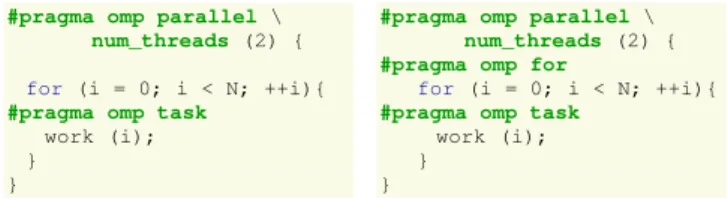
In this section, we elaborate on the semantical interpretation of our proposed extension. The OpenMP specification provides many illustrative examples that help understanding of the semantics and we will also adopt this stance. For instance, because of its execu-tion model, thetaskconstruct is mostly used within the scope of a worksharing construct3. As every thread encountering atask
construct will create a dynamic instance of the task, it is necessary to be able to discriminate the different instances, in a context where tasks can be scheduled anytime, anywhere (barring tied tasks and “if” clauses). For this reason thetaskconstruct will actually be meaningful only in cases where threads are already differentiated, like e.g., within a worksharing construct.
#pragma omp parallel \
num_threads (2) { for (i = 0; i < N; ++i){
#pragma omp task
work (i); }
}
#pragma omp parallel \
num_threads (2) {
#pragma omp for
for (i = 0; i < N; ++i){
#pragma omp task
work (i); }
}
Figure 4: Task instances need to be differentiable. Multi-ple undifferentiated instances (left) and properly differentiated (right).
Figure 4 illustrates this issue. On the left, thetaskconstruct is used directly within theparalleldirective. The duplicate in-stances of the task, one for each of the two threads executing this parallel section, will be impossible to differentiate. By contrast, on the right, the worksharing construct (theomp for) distributes loop iterations onto the available threads and ensures a single in-stance of the task will be activated for each value ofi.
The same semantics will apply to streaming tasks. We do not forbid their use outside of a worksharing construct, but the alterna-tive is to manually differentiate threads, which is seldom portable and often considered a bad coding practice.
Another important point is that, by nature, pipelining requires tasks to be part of a loop structure as filters are applied to a sequence of elements. It is possible to use streaming tasks outside of a loop nest, which then behaves as a loop with a single iteration. This is of little interest overall as it only incurs the overhead of creating streams for single elements.
In the remainder of this paper, we will only discuss the cases where streaming tasks are enclosed by a loop, which itself must be nested within a worksharing construct. However, as these con-structs can be part of a caller function, the callee can possibly only exhibit freestanding tasks, which will sometimes be the case in our examples for brevity.
5.1
Programming model
Though this is by no means an exhaustive list of the possible uses of streaming tasks or of their interaction with other OpenMP con-structs, we will present in the following paragraphs how our exten-sions can provide the necessary building blocks for programming streaming applications.
Pipeline parallelism.
To provide the fundamental basis for pipelining, we use thesingleworksharing construct for build-ing a simple pipeline, as for example on Figure 5.3
OpenMP3.0 defines the following worksharing constructs:loop,
#pragma omp parallel #pragma omp single
for (i = 0; i < N; ++i) {
#pragma omp task output (x) x = ... ;
#pragma omp task input (x) ... = ... x ...; } x=... ...=x 1 1 x
Figure 5: Pipeline using thesingleworksharing construct.
Parallel and sequential filters.
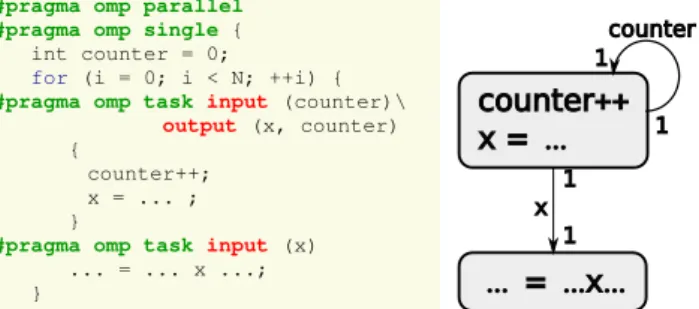
Filters are naturally parallel, as the ordering of the elements in the stream is preserved by the stream library implementation, except in the case where a stream is both input and output to the same filter as in Figure 6. This denotes a loop-carried dependence, or equivalently that the filter has a state that is preserved between executions.#pragma omp parallel #pragma omp single { int counter = 0;
for (i = 0; i < N; ++i) {
#pragma omp task input (counter)\
output (x, counter) {
counter++; x = ... ; }
#pragma omp task input (x) ... = ... x ...; }
x
=
...
1 1 xcounter++
1 1counter... = ...x...
Figure 6: Sequential filter because of a self-loop.
In this case, the first filter must execute sequentially while the second could be data-parallelized. This case often arises when a filter reads or writes to a file as the file descriptor is both read and written at every access to the file. If a task does not properly specify inputs and outputs, the resulting behaviour is unspecified.
Conditional execution.
A task can be nested into a conditional block. The semantics of streaminginputandoutputclauses is defined such that inputs are buffered until the next activation of the task, and outputs are buffered until the next activation of consumer tasks.for (i = 0; i < N; ++i) { if (condition_1 (i)) {
#pragma omp task firstprivate (i) output (x) x = i ;
}
if (condition_2 (i)) {
#pragma omp task firstprivate (i) input (x) y = x + i ;
} }
Figure 7: Streaming tasks nested within arbitrary control-flow.
In the example presented on Figure 7, the values ofxcomputed by the first task are buffered and consumed by the second task when it activates. Streaming clauses allow bypassing the control flow, so that thek−th activation of the second task consumes the value produced by thek−th activation of the first task, irrespectively of the truth values of the conditions.
This highlights the semantic difference between theinputand
firstprivateclauses, as the latter does not have buffering se-mantics and is control flow sensitive. Thefirstprivateclause simply forwards values from the enclosing context to the task in compliance with OpenMP3.0 semantics. As a result, depending
on the conditions predicating both tasks, the second task may not computey=i+ias it is possible thatx6=i.
We motivate this choice of a buffering semantics for streaming clauses as follows.
• It offers maximal expressiveness, unlike a “sampling” seman-tics where in-flight data on input and output clauses would be implicitly discarded. Defining when this data should be dis-carded is also problematic (the task may be nested into arbitrary control flow).
• It eases the compilation: there is no need to sink the conditional expression inside tasks, resulting in undesired if-conversion withspurious task activations when the condition is false. • It is fully in line with the formal basis for data-flow and stream
computing defined by Kahn [12], it matches directly the under-lying execution model of our proposal, and it compatible with OpenMP 3.0.
• But it is also a challenge for static buffer sizing. Programs with diverging queues of in-flight data can be written easily. This is a well known issue, solved with a type system (clock calculus) in data-flow synchronous languages [11], or with periodic restric-tion on the producrestric-tion/consumprestric-tion rates [14]. Because of its expressiveness and modularity, we will consider the type-based approach in further refinements of our streaming extension. The ability to ignore pragmas or to run the code sequentially are currently under study.
The compilation of persistent tasks may require the generation of a control stream which enables the activation of the task only when the control dependences guarding the task are satisfied. This control stream is often made redundant by the presence of other data streams carrying the same control dependences, or otherwise can be stripped of the data buffer and behave as a synchronization device only. This avoids sinking the task’s enclosing control flow inside the persistent process and activating the task when there is no work to be done.
firstprivate
vs.
input. These two clauses are semantically very close. They both represent a privatizing copy-in of a value. Yet as we have discussed above, the semantics differ with regard to the control flow. Streams implicitly carry control flow information as the availability of data in a stream satisfies both data and control de-pendences of the consumer. We promotefirstprivateclauses toinputclauses in streaming tasks as our choice of a persistent-task execution model means the expansion of the clause needs a stream to forward copy-in values to the thread in charge of execut-ing the successive instances of the task. As thefirstprivateclause only has data-dependence semantics, the production of ele-ments for such a stream must be within the same control flow as the task itself to avoid interference with the control stream. The same remark applies toinputclauses that do not have anoutput
counterpart and thus are equivalent tofirstprivateclauses.
Multiple connections.
It is possible to connect multiple filters to the same stream, both as input and as output. The semantics of multiple filters using the same stream as input is to broadcast the data: all the consumers have access to the all data. If multiple filters use the same stream as output, then the values produced by these filters are interleaved in the stream, according to the sequen-tial schedule.Delays.
Among stateful filters,delaysplay a central role. A unit delay prepends an initial value to the stream it takes as input,ef-fectively delaying input values by one activation of the task. De-lays are used to break instantaneous dependence cycles in the SDF model of computation [14]; they take the form of the “pre” op-erator (akin to a synchronous register) in synchronous data-flow languages [11]. Their role is paramount in the modeling of hard-ware circuits and control-dominated embedded systems. Strangely, delays have not met the same success for parallel stream program-ming (yet), as illustrated by their absence from the StreamIt bench-mark suite [21].
Delays can be implemented through tasks producing the desired amount of data before the producer filters start executing. This is illustrated on Figure 8, wherekinitial elements are inserted in the streamxby the first task. Thanks to the multiple output semantics defined in the previous paragraph, this first task implements ak -delay operator. Ifk≥1, this is sufficient to break the instantaneous dependence cycle among the two following tasks. No internal state is required to implement delays, the state is hidden in the stream, by storing the delay values, and outside in the control flow. This guarantees that delays do not waste data-parallelism by inducing spurious serialization due to internal state.
#pragma omp task output (x « A[k]) for (i = 0; i < k; ++i)
A[i] = ...;
for (i = 0; i < N; ++i) {
#pragma omp task input (y) output (x) x = ... y ...;
#pragma omp task input (x) output (y) y = ... x ... ;
}
Figure 8: Introducing delays on streams.
Mixing data and pipeline parallelism.
While the runtime may exploit data parallelism within a pipeline by executing mul-tiple instances of parallel filters (starting with the heaviest ones for load balancing), the programmer can decide to explicit data-parallelism at the pipeline or individual filter level.#pragma omp parallel #pragma omp for shared (A)
for (i = 0; i < N; ++i) {
#pragma omp task output (x) x = ... ;
#pragma omp task input (x) \
shared(A) A[i] = ... x ...; } 1 1 x x = ... A[i]=...x 1 1 x x = ... A[i]=...x A
Figure 9: Parallel replicated pipelines with a worksharing con-struct.
For example the code on Figure 9 creates parallel pipelines of fil-ters by using theloopworksharing construct instead ofsingle. We must note that the correctness of this parallelization depends on the behaviour of the tasks. The user is responsible for ensuring no dependence is violated and for using proper synchronization if required. The programmer could even introduce a second level of data parallelism within a filter, by nesting a parallel loop within a streaming task as illustrated on Figure 10. But if the compiler does not take special provisions for the specialization of nested paral-lelism, it may result in unnecessary overheads.
Dynamic pipelines.
In some cases, like the butterfly stages of an FFT, it is necessary to build a pipeline where the depth isparametric. We can build dynamic pipelines by using classical OpenMP3.0 tasks in addition to the worksharing construct, and us-ing an array of streams to communicate through the pipeline, which we illustrate on Figure 11.
int X[k];
#pragma omp parallel #pragma omp single
for (i = 0; i < N; i+=k) {
#pragma omp task output (x « X[k]) {
#pragma omp parallel for
for (j = 0; j < k; ++j) X[j] = ... ;
}
#pragma omp task input (x) ... = ... x ...; } X[j]=... X[j]=... X ... = x X k 1
Figure 10: Parallel loop worksharing construct within a filter.
int A[K];
#pragma omp parallel #pragma omp single
{
for (i = 0; i < N; ++i) {
#pragma omp task output (A[0] « x) x = ... ;
}
for (j = 0; j < K-1; ++j)
#pragma omp task
for (i = 0; i < N; ++i) {
#pragma omp task input (A[j] » x) \
output (A[j+1] « y) y = ... x ...; } } x=... y=...x... y=...x... A[0]1 1 1 1 A[1] A[K-1]
Figure 11: Dynamic pipeline of filters generated from a loop by using thetaskconstruct.
Hierarchical streaming.
Figure 12 shows how pipelines can be organized hierarchically using nested streaming tasks. The en-closing task can be seen as a wrapper to factor the designation of inputs and outputs.int sub_pipeline (int y) { int a, res;
#pragma omp task input (y) \
output (a) a = ... y ...;
#pragma omp task input (a) \
output (res) res = ... a ...; return res; }
#pragma omp parallel #pragma omp single
for (i = 0; i < N; ++i) {
#pragma omp task output (x) x = sub_pipeline (...) ;
#pragma omp task input (x) ... = ... x ...; } a = ... y ... 1a 1 res = ...a... 1 1 y res ... = ...x... 1 x
Figure 12: Hierarchically structured pipeline. The first stream-ing task on the right serves as a wrapper for the pipeline on the left.
Variable burst sizes.
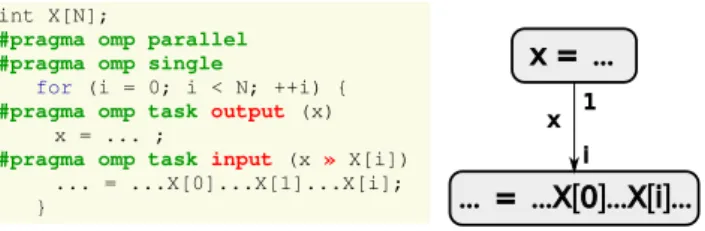
In C99, it is possible to declare arrays whose size is only known when entering a block, which means that our syntax can lead to variable-sized bursts and horizons in streams. Variable horizons make it very problematic to determine the global buffer size for a stream variable, so the programmer should instead provide the maximal horizon across all iterations to make this com-putation possible. We thus disallow the usage of dynamically-sizedarrays as horizons forinputandoutputclauses. This does not result in a loss of generality: bursts can be dynamic, with each instance of a task consuming/producing a different number of ele-ments, as illustrated on Figure 13.
int X[N];
#pragma omp parallel #pragma omp single
for (i = 0; i < N; ++i) {
#pragma omp task output (x) x = ... ;
#pragma omp task input (x » X[i]) ... = ...X[0]...X[1]...X[i]; } x = ... ... = ...X[0]...X[i]... x 1 i
Figure 13: Restricting the horizon size to be a constant does not forbid a task to consume a variable number of elements.
Deadlocks and dependence cycles.
The previous con-structs can induce dependence cycles among tasks, through theinput and output clauses. Delays can be used to break such cycles. Unfortunately, high expressiveness has a cost: with arbitrary control flow enclosing task activations and variable burst rates, detection of instantaneous (i.e., delay-free) dependence cycles is undecidable. We have to accept deadlocks as part of the semantics of the language extension.
At least, we know that if deadlocks occur, they will occur deter-ministically, independently of the number of threads or scheduling policy. This means that traditional test and debugging procedures for sequential programs are still applicable.
Although no complete method to avoid deadlocks can exist, con-servative approaches have been very successful for embedded sys-tem design; they are based on control-flow and burst rate restric-tions [14] (also adopted by StreamIt), or they rely on type systems of synchronous clocks [11]. Integrating some of these principles in the compiler could provide debugging help and support more ag-gressive optimizations; these research directions are left for future work.
5.2
Execution model
Following are a few important considerations on the execution model underlying these language constructs.
Persistent tasks.
To improve performance, we propose to adjust the execution model to make streaming tasks persistent. Instead of having one instance of the task for each point in the iteration space of the enclosing OpenMP context (worksharing construct or any other OpenMP construct), we will have a single instance that will traverse the full iteration space, consuming data on the input streams and producing on the output streams. We emphasize the fact that this modification of the execution model is not a require-ment of the extension we propose. Given the right circumstances, in particular w.r.t. the target architecture support for lightweight scheduling [13], the compiler may still generate code that fits the current execution model for tasks.To prove the validity of this transformation, let us consider the acceptable schedules of the task instances. In the old schedule, no ordering, no exclusion and no thread locality could be assumed. All schedules were therefore acceptable (without explicit locking). In the new execution model, the persistent task traverses the iter-ation space in a statically-defined partial order, thus restricting the possible schedules to a subset of the acceptable schedules. The par-ticular case where a parallel filter is replicated to benefit from data parallelism means that the iteration space has been strip-mined and that the different instances will impose a local order for the
execu-tion. The resulting set of possible schedules is still a subset of the acceptable schedules in the old execution model.
Correctness is of course the burning question at this point. Over-all, the transformation is always possible and correct when the only scheduling constraints are the data-driven ones enforced by
inputandoutputclauses. Obviously, introducing atomic sec-tions within tasks will not interfere with task-level scheduling con-straints. However causality problems may arise when combining our streaming extensions with arbitrary locking mechanisms, if the acquisition of a lock escapes outside task boundaries. In real ap-plications, locking may be legitimate to handle other forms of con-currency unrelated with the parallelization itself (e.g., I/O or user interfaces). Conversion to persistent tasks forces the ordering of successive task instances. Whereas valid schedules may exist for independent, freely schedulable tasks, it is possible that none of them be compatible with the sequential execution of dynamic in-stances of a given task. Without further precautions, conversion to persistent tasks may thus result into deadlocks (of the evil, target-dependent kind). Because of the critical performance advantage of the persistent-task execution model, and because of the importance of compiler optimizations to tune the grain of task and pipeline parallelism [10], we choose to (minimally) constrain the usage of cross-task locking mechanisms. Since OpenMP encourages pro-grammers to make the sequential execution a subset of the legal schedules of the parallel program [22], one may require cross-task locking to be compatible with the serial execution of tasks. When generating persistent tasks, the compiler can safely assume that the original schedule of task instances is deadlock-free. Regarding de-bugging and test, one only has to compile the program for serial execution to make sure it is deadlock-free.
Nesting.
For all nesting purposes, we consider that the nesting of a streaming task within any OpenMP construct behaves in the same way standardtaskconstructs behave. The iteration space taken into account for a streaming task is relative to the nearest enclosing OpenMP construct. However, the visibility of inputand outputclauses and therefore the visibility of the resulting task graph spans across all constructs within the nearest enclosing parallel region.
Data parallelism.
Data parallelism is typically exploited auto-matically at runtime as all tasks that do not partake in a dependence cycle (induced byinput and output clauses) are fully parallel. The programmer is free to mix pipelining with other data-parallel OpenMP constructs: the compiler will generate broadcast, splitter and selector patterns to handle synchronization and stream buffer indexing.Streaming tasks are data-parallel by nature. This comes from the fact that they only read from and write to private memory (includ-ing their stream horizon). Unless the task uses shared memory with explicit synchronization or it is part of an inter-task dependence cy-cle, it will be deemed parallel.
5.3
Example: FFT
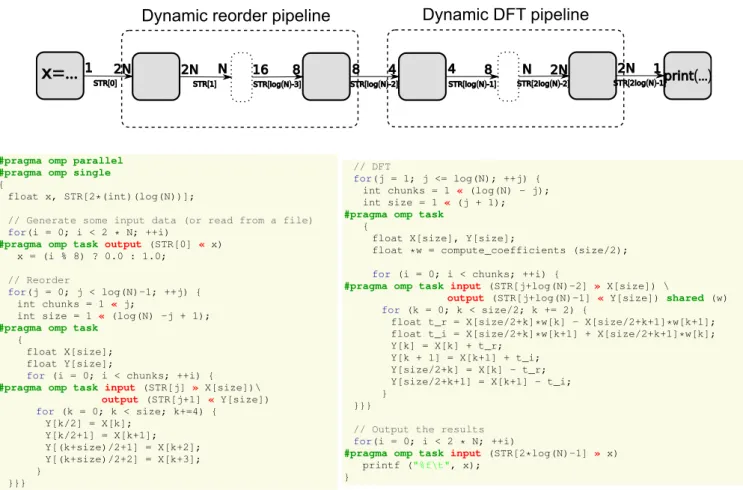
In order to illustrate the programming model this extension en-ables, let us show how this all works together on the implementa-tion of FFT presented on Figure 14. This example was chosen as it illustrates most of the constructs we have introduced so far. The global structure is a linear pipeline of filters using two dynamic pipelines with an array of streams,STR[]. The horizons and rates are constant, but they vary across the different filters in the dynamic pipelines. This accounts for varying degrees of available data par-allelism within the filters, which is a well-known issue for FFT.
x
=...
print(...)Dynamic reorder pipeline
Dynamic DFT pipeline
1 2N 2N N 16 8 8 4 4 8 N 2N 2N 1
STR[0] STR[1] STR[log(N)-3] STR[log(N)-2] STR[log(N)-1] STR[2log(N)-2] STR[2log(N)-1]
#pragma omp parallel #pragma omp single
{
float x, STR[2*(int)(log(N))];
// Generate some input data (or read from a file)
for(i = 0; i < 2 * N; ++i)
#pragma omp task output (STR[0] « x) x = (i % 8) ? 0.0 : 1.0;
// Reorder
for(j = 0; j < log(N)-1; ++j) { int chunks = 1 « j;
int size = 1 « (log(N) -j + 1);
#pragma omp task
{
float X[size]; float Y[size];
for (i = 0; i < chunks; ++i) {
#pragma omp task input (STR[j] » X[size])\
output (STR[j+1] « Y[size]) for (k = 0; k < size; k+=4) { Y[k/2] = X[k]; Y[k/2+1] = X[k+1]; Y[(k+size)/2+1] = X[k+2]; Y[(k+size)/2+2] = X[k+3]; } }}} // DFT for(j = 1; j <= log(N); ++j) { int chunks = 1 « (log(N) - j); int size = 1 « (j + 1);
#pragma omp task
{
float X[size], Y[size];
float *w = compute_coefficients (size/2); for (i = 0; i < chunks; ++i) {
#pragma omp task input (STR[j+log(N)-2] » X[size]) \
output (STR[j+log(N)-1] « Y[size]) shared (w) for (k = 0; k < size/2; k += 2) {
float t_r = X[size/2+k]*w[k] - X[size/2+k+1]*w[k+1]; float t_i = X[size/2+k]*w[k+1] + X[size/2+k+1]*w[k]; Y[k] = X[k] + t_r; Y[k + 1] = X[k+1] + t_i; Y[size/2+k] = X[k] - t_r; Y[size/2+k+1] = X[k+1] - t_i; } }}}
// Output the results
for(i = 0; i < 2 * N; ++i)
#pragma omp task input (STR[2*log(N)-1] » x) printf ("%f\t", x);
}
Figure 14: FFT implementation using dynamic task pipelines and the corresponding task graph.
Reorder stages DFT stages
Figure 15: Data-flow graph for FFT.
For this implementation of the FFT, data-parallelism is available in each stage or vertical slice of the data-flow graph presented on Figure 15. Pipelining allows to relax the synchronization and en-ables wavefront parallelization. We control the granularity by vary-ing the depth of the pipeline, thus changvary-ing the number of times the data is split. The maximal degree of parallelism available varies through the execution, and the optimal achievable speedup (on a PRAM) is in betweenlog2(size)/2and(log2(size) + 1)/2.
6.
IMPLEMENTATION
AND
EXPERI-MENTS
The implementation of this extension is under way in a pub-lic branch of GCC. This early implementation already provides full support for generating (coarse-grain) pipelined code from our OpenMP extension. The current stable state has reached the point
where programs requiring simple pipelines can be compiled with support for constant burst and horizon sizes. The automatic ex-ploitation of mixed pipeline- and data-parallelism as well as vari-able burst rates and dynamic pipelines are still under development. The streaming library takes advantage of the memory hierarchy by aggregating communication in reading/writing windows. The win-dows’ size is a multiple of the size of a L1 cache line, which reduces false sharing and improves performance [19].
We present results on 3 applications: FFTfrom the StreamIt benchmarks [21],FMradiofrom the GNU radio package4and a
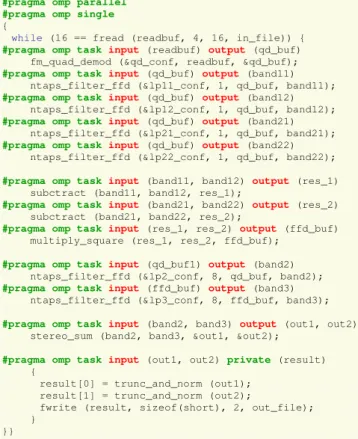
802.11acode from Nokia [8]. These applications are complex enough to illustrate the expressiveness of our extension. The anno-tated kernels ofFFTand ofFMradioare presented on Figures 14 and 16. The main loop of802.11acould not fit in this paper.
At this time, the fully automated stream code generation from extended OpenMP annotations is only possible for FMradio
and 802.11a and it can only exploit pipeline parallelism. It achieves a speedup of3.1×onFMradioand a speedup of2.9× on 802.11a on an Intel Core2 Quad Q9550 with 4 cores at 2.83GHz. Similar results are achieved on the other platforms for the pure (coarse-grain) pipelined version.
To get an idea of what could be achieved once the implementa-tion is complete, we manually parallelized the three applicaimplementa-tions using the low-level stream programming extensions supporting the expansion of OpenMP pragmas. We conducted performance evaluations on a 4-socket AMD quad-core Opteron 8380 (Shang-hai) with 16 cores at2.5GHzand a 4-socket Intel hexa-core Xeon
#pragma omp parallel #pragma omp single
{
while (16 == fread (readbuf, 4, 16, in_file)) {
#pragma omp task input (readbuf) output (qd_buf) fm_quad_demod (&qd_conf, readbuf, &qd_buf);
#pragma omp task input (qd_buf) output(band11) ntaps_filter_ffd (&lp11_conf, 1, qd_buf, band11);
#pragma omp task input (qd_buf) output(band12) ntaps_filter_ffd (&lp12_conf, 1, qd_buf, band12);
#pragma omp task input (qd_buf) output(band21) ntaps_filter_ffd (&lp21_conf, 1, qd_buf, band21);
#pragma omp task input (qd_buf) output(band22) ntaps_filter_ffd (&lp22_conf, 1, qd_buf, band22);
#pragma omp task input (band11, band12) output (res_1) subctract (band11, band12, res_1);
#pragma omp task input (band21, band22) output (res_2) subctract (band21, band22, res_2);
#pragma omp task input (res_1, res_2) output (ffd_buf) multiply_square (res_1, res_2, ffd_buf);
#pragma omp task input (qd_buf1) output (band2) ntaps_filter_ffd (&lp2_conf, 8, qd_buf, band2);
#pragma omp task input (ffd_buf) output (band3) ntaps_filter_ffd (&lp3_conf, 8, ffd_buf, band3);
#pragma omp task input (band2, band3) output (out1, out2) stereo_sum (band2, band3, &out1, &out2);
#pragma omp task input (out1, out2) private (result) {
result[0] = trunc_and_norm (out1); result[1] = trunc_and_norm (out2);
fwrite (result, sizeof(short), 2, out_file); }
}}
Figure 16: Annotated kernel from the GNU radio project.
E7450 (Dunnington), with 24 cores at2.4GHz, both with64GBof memory. These targets are respectively called Opteron and Xeon in the following.
FMradio presents a high amount of data-parallelism and is fairly well-balanced; annotating the code with the extended OpenMP directives requires little effort and provides up to12.6× speedup on Opteron and up to18.8×speedup on Xeon.802.11a
is more unbalanced and complicated to parallelize. A lot of code refactoring is necessary to expose data parallelism as the original version extensively uses global and static variables. After this step, annotating the program is straightforward and the parallelized code achieves up to13×speedup on Opteron and14.9×speedup on Xeon.
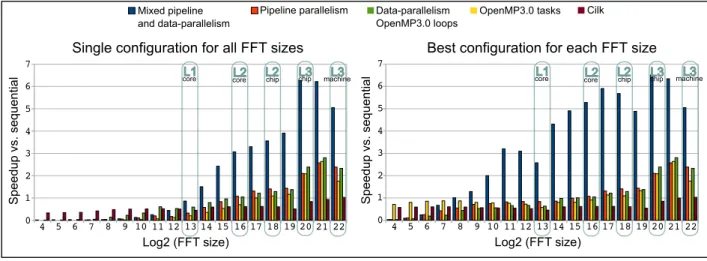
Speedups forFFTare presented on Figures 17 and 18. The base-line is an optimized sequentialFFTimplementation used as a base-line within the StreamIt benchmark suite. Combined pipebase-line- and parallelism achieve the best results, compared to pure data-parallelism or pure pipelining. We report two sets of results for each target: the single configuration results (on the left) correspond to speedups obtained when using the same tuning parameters (num-ber of threads, granularity, etc.) for all the data sizes and for all the code versions; the best configuration results correspond to the op-timal performance achieved with the best configuration for each individual data size point. The size of the machines and the as-sociated cost of inter-processor communication set the break-even point around vectors of 256doubles and more.
These results validate our approach and constitute a strong in-centive to complete the development of this streaming framework in GCC. We are also proposing to include this extension in upcom-ing revisions of the OpenMP specification.
7.
CONCLUSION
We presented an incremental extension to enable stream pro-gramming in OpenMP. Our work is motivated by the quest for in-creased productivity in parallel programming, and by the strong evidence that has been gathered on the importance of pipeline par-allelism for scalability and efficiency. We discussed the design principles necessary to maximize the expressiveness and perfor-mance benefits of our extension, while preserving backward com-patibility. One key choice was to favor an execution model where the tasks are persistent: this choice allows static scheduling and lightweight, lock-free implementations for streaming communica-tions. We demonstrated the expressiveness and performance ad-vantages of our design on real-world applications.
The only down-side of persistent tasks is the lack of native sup-port for load balancing. We plan to complement our implementa-tion with lightweight threading and work-stealing mechanisms to address this limitation. We believe that data-driven scheduling at coarse grain can be combined with persistent tasks and streaming communications at finer grain to offer the best of both worlds in terms of load balancing and synchronization overhead.
Acknowledgments.
This work was supported by the European Commission through the FP7 project TERAFLUX id. 249013.8.
REFERENCES
[1] Arvind, R. S. Nikhil, and K. Pingali. I-structures: Data structures for parallel computing.ACM Trans. on
Programming Languages and Systems, 11(4):598–632, 1989. [2] P. Bellens, J. M. Pérez, R. M. Badia, and J. Labarta. CellSs:
a programming model for the Cell BE architecture. InSC, 2006.
[3] R. H. Bisseling.Parallel Scientific Computation: A
Structured Approach using BSP and MPI. Oxford University Press, Mar. 2004.
[4] The Brook Language.http://graphics.stanford. edu/projects/brookgpu/lang.html.
[5] P. M. Carpenter, D. Ródenas, X. Martorell, A. Ramírez, and E. Ayguadé. A streaming machine description and
programming model. InSAMOS, pages 107–116, 2007. [6] R. Cytron. Doacross: Beyond vectorization for
multiprocessors. InIntl. Conf. on Parallel Processing (ICPP), Saint Charles, IL, 1986.
[7] J. B. Dennis and G. R. Gao. An efficient pipelined dataflow processor architecture. InSupercomputing (SC’88), pages 368–373, 1988.
[8] H. M. et al. ACOTES project: Advanced compiler technologies for embedded streaming.Intl. J. of Parallel Programming, 2010. Special issue on European HiPEAC network of excellence member’s projects.
[9] M. Frigo, C. E. Leiserson, and K. H. Randall. The implementation of the Cilk-5 multithreaded language. In ACM Symp. on Programming Language Design and Implementation (PLDI’98), pages 212–223, Montreal, Quebec, June 1998.
[10] M. Gordon, W. Thies, and S. Amarasinghe. Exploiting coarse-grained task, data, and pipeline parallelism in stream programs. InInternational Conference on Architectural Support for Programming Languages and Operating Systems, San Jose, CA, Oct 2006.
[11] N. Halbwachs, P. Caspi, P. Raymond, and D. Pilaud. The synchronous dataflow programming language Lustre. Proceedings of the IEEE, 79(9):1305–1320, Sept. 1991.
Mixed pipeline
and data-parallelism Pipeline parallelism Cilk Data-parallelism
OpenMP3.0 loops OpenMP3.0 tasks 7
6 5 4 3 2 1 0 Sp ee du p vs. se qu en tia l 4 5 6 7 8 9 10 11 12 13 14 15 16 17 18 19 20 21 22 Log2 (FFT size) L1
core coreL2 L2chip L3chip machineL3
7 6 5 4 3 2 1 0 Sp ee du p vs. se qu en tia l 4 5 6 7 8 9 10 11 12 13 14 15 16 17 18 19 20 21 22 Log2 (FFT size) L1
core coreL2 L2chip chipL3 machineL3
Mixed pipeline
and data-parallelism Pipeline parallelism Data-parallelismOpenMP3.0 loops OpenMP3.0 tasks Cilk
Single configuration for all FFT sizes Best configuration for each FFT size
Figure 17: FFT performance on Opteron.
4 5 6 7 8 9 10 11 12 13 14 15 16 17 18 19 20 21 22 Log2 (FFT size)
L1
core 2 coresL2 L2chipchipL3 6 5 4 3 2 1 0 Sp ee du p vs. se qu en tia l 6 5 4 3 2 1 0 Sp ee du p vs. se qu en tia l 4 5 6 7 8 9 10 11 12 13 14 15 16 17 18 19 20 21 22 Log2 (FFT size) L1
core 2 coresL2 L2chipchipL3
Mixed pipeline
and data-parallelism Pipeline parallelism Data-parallelismOpenMP3.0 loops OpenMP3.0 tasks Cilk
Single configuration for all FFT sizes Best configuration for each FFT size
Figure 18: FFT performance on Xeon.
[12] G. Kahn. The semantics of a simple language for parallel programming. In J. L. Rosenfeld, editor,Information processing, pages 471–475, Stockholm, Sweden, Aug. 1974. North Holland, Amsterdam.
[13] C. Kyriacou, P. Evripidou, and P. Trancoso. Data-driven multithreading using conventional microprocessors.IEEE Trans. on Parallel Distributed Systems, 17(10):1176–1188, 2006.
[14] E. A. Lee and D. G. Messerschmitt. Static scheduling of synchronous data flow programs for digital signal processing.IEEE Trans. Computers, 36(1):24–25, 1987. [15] V. Marjanovic, J. Labarta, E. Ayguadé, and M. Valero.
Effective communication and computation overlap with hybrid MPI/SMPSs. InPPOPP, 2010.
[16] A. Munshi. The OpenCL specification, v. 1.0, revision 29. www.khronos.org/registry/cl/specsopencl-1.0.29.pdf, 2008. [17] V. Pankratius, A. Jannesari, and W. F. Tichy. Parallelizing
bzip2: A case study in multicore software engineering.IEEE Softw., 26(6):70–77, 2009.
[18] J. Planas, R. M. Badia, E. Ayguadé, and J. Labarta. Hierarchical task-based programming with starss.Intl. J. on High Performance Computing Architecture, 23(3):284–299, 2009.
[19] A. Pop, S. Pop, H. Jagasia, J. Sjödin, and P. H. J. Kelly. Improving GNU compiler collection infrastructure for streamization. InProceedings of the 2008 GCC Developers’ Summit, pages 77–86, 2008.
http://www.gccsummit.org/2008. [20] K. Stavrou, M. Nikolaides, D. Pavlou, S. Arandi,
P. Evripidou, and P. Trancoso. Tflux: A portable platform for data-driven multithreading on commodity multicore systems. InIntl. Conf. on Parallel Processing (ICPP’08), pages 25–34, Portland, Oregon, Sept. 2008.
[21] The StreamIt language.
http://www.cag.lcs.mit.edu/streamit/. [22] The OpenMP Architecture Review Board. OpenMP
Application Program Interface.http:
//www.openmp.org/mp-documents/spec30.pdf. [23] I. Watson and J. R. Gurd. A practical data flow computer.