The PCL Theorem.
Transactions cannot be Parallel, Consistent and Live.
Victor Bushkov
EPFL, IC, LPD[email protected]
Dmytro Dziuma
FORTH-ICS[email protected]
Panagiota Fatourou
∗University of Crete & FORTH-ICS
[email protected]
Rachid Guerraoui
EPFL, IC, LPD[email protected]
ABSTRACT
We show that it is impossible to design a transactional mem-ory system which ensuresparallelism, i.e. transactions do not need to synchronize unless they access the same appli-cation objects, while ensuring very littleconsistency, i.e. a consistency condition, calledweak adaptive consistency, in-troduced here and which is weaker than snapshot isolation, processor consistency, and any other consistency condition stronger than them (such as opacity, serializability, causal serializability, etc.), and very littleliveness, i.e. that trans-actions eventually commit if they run solo.
Categories and Subject Descriptors
D.1.3 [Programming Techniques]: Concurrent
Program-ming
Keywords
transactional memory; disjoint-access-parallelism; snapshot isolation; processor consistency; weak adaptive consistency; obstruction-freedom; lower bounds; universal constructions
1.
INTRODUCTION
The paradigm oftransactions[20, 26, 35] is appealing for its simplicity but implementing it efficiently is challenging. Ideally a transactional system should not introduce any con-tention between transactions beyond that inherently due to the actual code of the transactions. In other words, if two transactions access disjoint sets of data items, then none of these transactions should delay the other one, i.e., these transactions should notcontendon any base object. This re-quirement has been calledstrict disjoint-access-parallelism[2, ∗Currently with ´Ecole Polytechnique F´ed´erale de Lausanne (EPFL), Switzerland, as an EcoCloud visiting professor.
Permission to make digital or hard copies of all or part of this work for personal or classroom use is granted without fee provided that copies are not made or distributed for profit or commercial advantage and that copies bear this notice and the full cita-tion on the first page. Copyrights for components of this work owned by others than ACM must be honored. Abstracting with credit is permitted. To copy otherwise, or re-publish, to post on servers or to redistribute to lists, requires prior specific permission and/or a fee. Request permissions from [email protected].
SPAA’14 Prague, Czech Republic
Copyright 2014 ACM 978-1-4503-2821-0/14/06 ...$15.00. http://dx.doi.org/10.1145/2612669.2612690.
22]. Base objects are low-level objects, which typically pro-vide atomicprimitiveslikeread/write,load linked/store con-ditional,compare-and-swap, used to implement transactional systems. Two transactions contendon some base object if both access that object during their executions and one of them performs a non-trivial operation on that object, i.e. an operation which updates its state.
Strict disjoint access parallelism can be ensured by block-ing transactional memory (TM) systems; indeed, TL [14], a lock-based TM algorithm, ensures strict disjoint-access-parallelism and strict serializability [30]. It was shown in [21] that a strictly disjoint-access-parallel TM algorithm cannot ensure both obstruction-freedom (i.e. a weak non-blocking liveness condition) and serializability (i.e. a consistency condition weaker than strict serializability). Specifically,
obstruction-freedom[25] ensures that a transaction is aborted only if step contention is encountered during the course of its execution. Serializability [30] ensures that, in any exe-cution, all committed transactions (and some that have not completed yet) execute like in a legal sequential execution.
In this paper, we study the following question: can we en-sure strict disjoint-access-parallelism and obstruction free-dom if we weaken safety? In other words, is serializability indeed a major factor against strong parallelism? We focus on a new weak consistency condition that we introduce in this paper, called weak adaptive consistency. Weak adap-tive consistency is weaker than (a weak variant of) snap-shot isolation [10] and processor consistency [19]. Thus, it is weaker than serializability, causal serializability and all other consistency conditions that are stronger than processor con-sistency (or snapshot isolation or even the union of both). Our PCL theorem states that even with weak safety and weak liveness, the described task is still impossible: specif-ically, it is not possible to implement a transactional mem-ory system which ensures strict disjoint-access-parallelism (Parallelism), weak adaptive consistency (Consistency), and obstruction-freedom (Liveness).
Weak adaptive consistencyweakens snapshot isolation in two ways: (1) each process is allowed to have its own sequen-tial view and (2) it is possible to partition the transactions of an execution in such a way that each set of transactions in the partition satisfies either snapshot isolation or processor consistency. Snapshot isolation [10] requires that transac-tions should be executed as if every read operation observes a consistent snapshot of the memory that was taken when
the transaction started. To make our result stronger, in our definition of snapshot isolation, we do not require the extra constraint (met in the literature [10, 16, 33] for snapshot isolation) that from two concurrent transactions writing to the same data item, only one can commit, and we do not impose any restriction on the value that areadon some data itemxby a transactionT may return ifT has writtenx be-fore invoking this read. Processor consistency [19, 3] allows each process to have its own sequential view which should respect the process-order of writes, additionally it requires writes to the same data item appear in the same order in all sequential views. Processor consistency is stronger than
PRAM consistency [28, 3], which does not require writes to the same data item to appear in the same order in all se-quential views, but weaker thancausal serializability [32], which requires each sequential view to respect a relation on transactions, calledcausality relation.
The proof of our impossibility result is based on indistin-guishability arguments. The main difficulty comes from the fact that the read operations of a transaction do not have to be serialized at the same point as its write operations. Basically, snapshot isolation and especially weak adaptive consistency allow more executions to be correct and it is much harder to construct an execution which violates it. We end up constructing two legal executions where a trans-action must read the same values for data items. We then prove that in one of these two executions this is not the case. This paper is structured as follows. Section 2 gives an overview of the related work. Section 3 gives a system model and all necessary definitions. Section 4 gives the PCL theo-rem and its proof. Section 5 presents concluding theo-remarks.
2.
RELATED WORK
The notion of disjoint-access-parallelism appears in the literature [2, 8, 15, 22, 27, 31] in many flavors. Disjoint-access-parallelism was first introduced in [27] through the notion of conflicting transactions. Later variants [2, 8, 15] employed the concept of a conflict graph. Aconflict graphis a graph whose nodes represent transactions (or operations) performed in an execution interval α (i.e. the execution interval of those transactions overlap withα) and an edge exists between two nodes if the corresponding transactions (operations) access the same data item inα(i.e theyconflict
inα). In most of these definitions,disjoint-access-parallelism
requires any two transactions to contend on a base object only if there is a path in the conflict graph of the minimal ex-ecution interval that contains the exex-ecution intervals of both transactions such that every two consecutive transactions in the path conflict. In [2, 5, 6, 27], additional constraints are placed on the length of the path in the conflict graph, result-ing in what is known asd-local contention property, whered
is an upper bound on the length of the path. In [27], where disjoint-access-parallelism originally appeared, an additional constraint on the step complexity of each operation was pro-vided in the definition. Stronger versions of disjoint-access-parallelism usually result in more disjoint-access-parallelism and therefore they are highly desirable when designing TM implementa-tions. Weaker versions of disjoint-access-parallelism may re-sult in less parallelism but are easier to implement.
Attiyaet al.[8] proved that no disjoint-access-parallel TM implementation can support wait-free and invisible read-only transactions. Aread-onlytransaction does not perform writes on data items; aninvisibletransaction does not
per-form non-trivial operations on base objects when reading data items. The variant of disjoint-access-parallelism con-sidered in [8] stipulates that processes executing two trans-actions concurrently contend on a base object only if there is a path between the two transactions in the conflict graph. Although our impossibility does not hold for this variant of disjoint-access-parallel, our impossibility result considers a much weaker liveness property and holds even for TM algo-rithms where read-only transactions are visible.
Recent work [12] proved that, if the TM algorithm does not have access to the code of each transaction, a property similar towait-freedom, called local progress, cannot be en-sured by any TM algorithm. In [15], it was proved that wait-freedomcannot be achieved even if this restriction is aban-doned (given that each time a transaction aborts, it restarts its execution), if the TM algorithm ensures strict serializabil-ity and a weak version of disjoint-access-parallelism, called
feeble disjoint-access-parallelism. Thus, one must consider weaker consistency or progress properties as we do here.
Pelermanet al.[31] proved that no disjoint-access-parallel TM algorithm can be strictly serializable and MV-permissive. The impossibility result holds under the assumptions that the TM algorithm does not have access to the code of trans-actions and the code for reading and writing data items ter-minates within a finite number of steps. Pelermanet al.[31] considered the same variant of disjoint-access-parallelism as
in [8]. A TM implementation satisfies MV-permissiveness
if a transaction aborts only if it is a write transaction that conflicts with another write transaction. This impossibility result can be beaten [7] if the stated assumptions do not hold. Our impossibility result holds if the TM ensures just weak snapshot isolation, even if it is MV-permissive.
Several software TM implementations [35, 14, 17, 29, 36, 25] are disjoint-access-parallel: TL[14] ensures strict disjoint-access-parallelism but is blocking since it uses locks; the rest satisfy weaker forms of disjoint-access-parallelism [8]. Among themOSTM[17] is lock-free. The TM in [35] is also
lock-free but it has been designed forstatictransactions that access a pre-determined set of memory locations. Aparently, our impossibility result does not contradict these implemen-tations because all of them, except TL, ensure weaker vari-ants of disjoint-access-parallelism and some of them weaker progress as well. Also, our impossibility result does not con-tradictTLsinceTLuses locks and consequently does not en-sure obstruction-freedom. Linearizable universal construc-tions [23, 24], which ensure some form of disjoint-access-parallelism, are presented in [1, 9, 15, 37]. Barnes [9] im-plementation is lock-free. The universal construction in [15] ensures wait-freedom when applied to objects that have a bound on the number of data items accessed by each opera-tion they support, and lock-freedom in other cases. Disjoint-access-parallel wait-free universal constructions when each operation accesses a fixed number of predetermined mem-ory locations are provided in [2, 37].
Snapshot isolation was originally introduced as an iso-lation level for database transactions [10, 16] to increase throughput for long read-only transactions. In TM comput-ing, snapshot isolation has been studied in [4, 13, 33, 34]. An STM algorithm, calledSI-STM, which ensures snapshot
isolation is presented in [33]. SI-STMemploys a global clock
mechanism and therefore, it is not disjoint-access-parallel. In [13], static analysis techniques are presented to detect, at compile time, consistency anomalies that may arise when
the TM algorithm satisfies snapshot isolation or other safety properties. Snapshot isolation on TM for message-passing systems has been studied in [4].
Our definition of snapshot isolation is weaker than that de-fined for database transactions [10] for the following reasons. First, we do not put any constraint on the value returned by any read that occurs after a write to the same data item in the same transaction. Second, we do not place the ”first committer wins” rule, i.e. we abandon the requirement to abort one out of two concurrent transactions that are writ-ing to the same data item. By introducwrit-ing these constraints, we would make our impossibility result weaker.
3.
PRELIMINARIES
System. We consider an asynchronous system with n
processes which communicate by accessing shared base ob-jects. Abase objectprovides atomic primitivesto access or modify its state. The system may support various types of base objects like read/write registers, CAS, etc. A primitive that does not change the state of an object is calledtrivial
(otherwise it is callednon-trivial).
Transactions.Transactional memory(TM) employs trans-actionsto execute pieces of sequential code in a concurrent environment. Each piece of code contains accesses to pieces of data, calleddata items, that may be accessed by several processes when the code is executed concurrently; so TM should synchronize these accesses. To achieve this, a TM algorithm usually provides a shared representation for each data item by using base objects. A transaction may either
commit, in which case all its updates become visible to other transactions, orabortand then its updates are discarded.
A TM algorithm provides implementations for the rou-tinesx.read(), which returns a value forxif the operation was successful orAT if the transaction has to abort, and
x.write(v), which writes valuevto data itemxand returns
okif the write was successful orATif the transaction has to abort. In addition, a TM algorithm provides implementa-tions for the routinesbeginT, which is called when a trans-action T starts and returns ok, commitT, which is called whenT tries to commit and returns eitherCT (commit) or
AT (abort), and abortT, which aborts T and returns AT. Each time a transaction calls one of these routines we say that itinvokesanoperation; when the execution of the rou-tine completes, aresponseis returned.
Executions and configurations. Aconfiguration is a vector with components comprising the state of each process and the state of each base object. In aninitial configuration, processes and base objects are in initial states. Astepof a process consists of a single primitive on a single base object, the response to that primitive, and zero or more local op-erations that are performed after the access and which may cause the internal state of the process to change; each step is executed atomically. Invocations and responses performed by transactions are considered as steps. Anexecution αis a sequence of steps. An execution islegal starting from a configurationC if the sequence of steps performed by each process follows the algorithm for that process (starting from its state inC) and, for each base object, the responses to the operations performed on the object are in accordance with its specification (and the state of the object at configuration
C). We use α·β to denote the execution α immediately followed by the executionβ and say that α is a prefix of
α·β. An execution is solo if every step is performed by the same process. Two executionsα1 andα2 starting from
configurationsC1andC2, respectively, areindistinguishable
to some processp, if the state ofpis the same inC1andC2,
and the sequence of steps performed byp(and thus also the responsespreceives) are the same during both executions.
Fix an executionαin which a transactionT is executed. TransactionT completesinα, ifαcontainsCTorAT. Trans-action T accesses xin α, if αcontains either x.write() or
x.read(). Theexecution intervalof a completed transaction
T inαis the subsequence of consecutive steps ofαstarting with the first step executed by any of the operations invoked byT and ending with the last such step. Theexecution in-terval of a transactionT that does not complete inαis the suffix of α starting with the first step executed by any of the operations invoked byT. Theactive execution interval
of any transaction (completed or not) T in αis the subse-quence of consecutive steps ofαstarting with the first step executed by any of the operations invoked byT and ending with the last such step. A TM algorithm isobstruction-free
if a transactionT can be aborted only when other processes take steps during the execution interval ofT.
Histories. Ahistory H is a sequence of invocations and responses performed by transactions. Given an executionα, we denote byHαthe sequence of invocations and responses performed by the transactions inα. We denote byH|T the longest subsequence ofHconsisting only of invocations and responses of a transaction T. Transaction T is in history
H if H|T is not empty. History H is well-formed if for every transaction T in H the following holds for H|T: (i)
H|T is a sequence of alternating invocations and responses starting withbeginT·ok, (ii) each read invocation is followed either by a value or by AT, (iii) each write invocation is followed by either anokresponse orAT, (iv) each invocation ofcommitT is followed byCT orAT, (v) each invocation of
abortT is followed by AT, (vi) no invocation follows after
CT or AT. Herein, we consider only well-formed histories. We say thatT commits (aborts) inH ifH|T ends withCT (AT). IfT does not commit or abort inH, then T islive in H. If H|T ends with an invocation ofcommitT, thenT is commit-pending. Transaction T1 precedes transaction T2
in executionα (denotedT1 <α T2), ifT1 is not live inHα and AT1 or CT1 precedesbeginT2 in Hα. IfT1 6<α T2 and
T26<αT1, thenT1 andT2 areconcurrent in α.
A historyH issequential if no two transactions are con-current inH. H is complete if it does not contain any live transactions. Transaction T is legal in a sequential history H, if for every x.read() by T which returns some value v
the following holds: (i) if T executes an x.write() before
x.read(), thenv is the argument of the last suchx.write() invocation in T; otherwise, (ii) if there is an invocation of
x.write() by some committed transaction that precedesT, thenvis the argument of the last suchx.write() inH; oth-erwise (iii)vis the initial value ofx. A complete sequential historyH islegal if each transaction is legal inH.
Disjoint-access-parallelism. For proving the impossi-bility result presented in Section 4, we consider a collection of simple static transactions. Hence, to simplify the defi-nitions in this paragraph, we assume that transactions are static and predefined1
, i.e. we assume that the data items on whichT invokesreadandwrite (in any execution
con-1
Apparently, this assumption makes the impossibility result proved in Section 4 stronger.
taining T) are the same and can be derived by inspecting
T’s code; we call the set of these data items the data set D(T) ofT. Note that the set of data items accessed byT
in a specific execution might be a proper subset ofD(T) if
T is not committed in this execution. For example, consider a transaction T whose code implies that T accesses data itemsxand yand letαbe an execution in which transac-tion T invokesx.read() and gets AT as a response; then,
D(T) ={x, y}butT accesses only data itemxinα. We say that two transactionsT1andT2conflict, ifD(T1)∩ D(T2)6=∅. We say that two executionscontendon a base
objectoif they both contain a primitive operation onoand one of these primitive operations is non-trivial. Denote by
α|T the subsequence ofαconsisting of all steps executed by
T. A TM implementationIisstrict disjoint-access-parallel, if in each executionαofI, and for every two transactions
T1 and T2 executed inα, α|T1 andα|T2 contend on some
base object, only ifT1 andT2 conflict.
Consistency. A read operationx.read() by some trans-actionT isglobal ifT has not invoked x.write() before in-vokingx.read(). LetT be a committed or commit-pending transaction executed by a process pi in a history H. Let
T|readg be the longest subsequence ofH|T consisting only of global read invocations and their corresponding responses andT|write be the longest subsequence ofH|T consisting only of write invocations and their corresponding responses. Letλdenote the empty history. Then we define transactions
TgrandTw (both executed bypi) in the following way: • (1) Tgr = T|readg·commitTgr ·CTgr if T|read6= λ,
andTgr=λotherwise, and
• (2)Tw=T|write·commitTw·CTwifT|write6=λ, and
Tw=λotherwise.
Definition 3.1 (Snapshot isolation). An execution αsatisfiessnapshot isolation, if (i) there exists a setcom(α)
consisting of all committed and some of the commit-pending transactions in α and (ii) it is possible to insert (in α) a global read serialization point∗T ,gr and a write serialization point∗T ,w, for each of transactionsT ∈com(α), so that if σα is the sequence defined by these serialization points, the
following holds:
1. ∗T ,gr precedes∗T ,w inσα,
2. both∗T ,gr and∗T ,w are inserted within the active exe-cution interval ofT,
3. if Hσα is the history we get by replacing each ∗T ,gr
with Tgr and each ∗T ,w with Tw in σα, then Hσα is
legal.
An STM implementationI satisfies snapshot isolation, if each of the executions produced byI satisfies snapshot iso-lation.
Since we require neither consistency for local reads nor aborting two concurrent transactions writing to the same data item, our definition of snapshot isolation is weaker than standard definitions of snapshot isolation for databases [10]. This makes our impossibility result stronger.
To strengthen our impossibility result even more, we prove it for a much weaker consistency property, calledweak adap-tive consistencywhich allows (i) each process to have its own sequential view and (ii) to switch between snapshot isolation and processor consistency (defined below) during the course
of an execution; specifically, the transactions of the execu-tion can be partiexecu-tioned into groups so that either snapshot isolation or processor consistency is ensured for the transac-tions of each group. Processor consistency is a safety prop-erty which allows each process to have its own sequential view but requires that writes to the same data item occur in the same order in each sequential view.
Definition 3.2 (Processor consistency). An execu-tionαis processor consistent if (i) there exists a setcom(α)
consisting of all committed and some of the commit-pending transactions in αand (ii) for each processpi, it is possible
to insert (inα) a serialization point∗T, for each transaction T ∈ com(α), so that ifσi
α is the sequence defined by these
serialization points, the following holds: 1. ∀T1, T2∈com(α):
(a) ifT1 andT2 are executed by the same process and T1 <αT2, then∗T1 precedes∗T2 inσαi,
(b) ifT1 andT2 write to the same data item and∗T1 precedes∗T2 inσ i α, then∀j∈ {1, . . . , n},∗T1 pre-cedes ∗T2 inσ j α, 2. ifHσi
αis the history we get by replacing each∗T inσ i α
withH|T, ifT commits inα, or withH|T·CT, ifT is
commit-pending inα, then every transaction executed bypiis legal inHσi
α.
LetTlandTrbe two transactions in an executionαsuch that either Tl and Tr are the same or the invocation of
beginTl precedes the invocation of beginTr. A consistency
groupG(Tl, Tr) ofαis a set of transactions fromαsuch that: (1)TlandTr belong toG(Tl, Tr), and (2) a transactionTk belongs to G(Tl, Tr) if the invocation of beginTk occurs in
α between the invocation ofbeginTl and the invocation of
beginTr. In other words, a consistency groupG(Tl, Tr) of
α is a set containing the transactions that start their exe-cution between the beginning ofTland the beginning ofTr (inclusive). Anactive execution interval ofG(Tl, Tr) is the longest execution interval of α which includes all steps in
α from the first step ofTl to the last step of any transac-tion fromG(Tl, Tr). A consistency groupG(Tl, Tr)precedes a consistency group G(T′
l, Tr′) in α, if the last step of any transaction fromG(Tl, Tr) precedes the first step ofTl′inα. A consistency partition P(α) of an execution αis a se-quence G(Tl,1, Tr,1), G(Tl,2, Tr,2), . . . G(Tl,n, Tr,n) of consis-tency groups such that:
1. Tl,1 is the transaction which invokes the firstbeginin α and Tr,n is the transaction which invokes the last
begininα,
2. ∀k ∈ {1, . . . , n}, either Tl,k = Tr,k or beginTl,k
pre-cedesbeginTr,k inα,
3. ∀k∈ {1, . . . , n−1},beginTr,kprecedesbeginTl,k+1inα,
and there is no transaction that invokesbeginbetween
beginTr,k andbeginTl,k+1in α.
Definition 3.3 (Weak adaptive consistency). An executionαsatisfiesweak adaptive consistencyif it is possi-ble to do all of the following: (i) choose a consistency parti-tionP(α), (ii) partition all groups inP(α)into two disjoint sets of groups: a setSI(P(α))of snapshot isolation groups
and a set P C(P(α))of processor consistency groups, (iii) choose a setcom(α)consisting of all committed and some of
the commit-pending transactions inα, and (iv) for each pro-cess pi insert (in α) a global read serialization point ∗T ,gr
and a write serialization point ∗T ,w, for each transaction T ∈com(α), so that ifσi
α is the sequence defined by these
serialization points, the following holds: 1. ∗T ,gr precedes∗T ,w inσi
α,
2. ∀T1, T2 ∈ com(α), if T1 and T2 write to the same data item and ∗T1,w precedes ∗T2,w in σ
i
α, then ∀j ∈ {1, . . . , n},∗T1,w precedes∗T2,w inσ
j α,
3. for each group G(Tl,k, Tr,k)∈SI(P(α))the following
holds: ∀Tm∈G(Tl,k, Tr,k)∩com(α), both∗Tm,gr and ∗Tm,w are inserted within the active execution interval
of Tm,
4. for each groupG(Tl,k, Tr,k)∈P C(P(α))the following
holds: ∀Tm ∈G(Tl,k, Tr,k)∩com(α), no other
serial-ization point is inserted between∗Tm,grand∗Tm,wand
both ∗Tm,gr and ∗Tm,w are inserted within the active
execution interval of G(Tl,k, Tr,k),
5. ifHσi
αis the history we get by replacing each∗T ,grwith
Tgr and each∗T ,w withTw inσαi, then every
transac-tion executed bypi is legal inHσi α.
Consider an executionαthat satisfies weak adaptive con-sistency, let σi
α be the sequence of serialization points for process pi. For simplicity, we use the following notation: ∗T ,l1 <i ∗T′,l2, whereT, T
′ ∈ com(α) andl
1, l2 ∈ {gr, w},
to identify that∗T ,l1 precedes∗T′,l2 inσ
i
α. We remark that items 3 and 4 of Definition 3.3 imply that the global read and write serialization points of any transactionT ∈com(α) are placed within the active execution interval of the consis-tency group to whichT belongs.
An STM implementationIsatisfies weak adaptive consis-tency, if each of the executions produced byIsatisfies weak adaptive consistency. Weak adaptive consistency is weaker than processor consistency, and consequently is weaker than causal serializability, serializability, opacity and any other property stronger than processor consistency. This is so be-cause if an executionαsatisfies processor consistency, then there exists a consistency partitionP(α) = G(Tl, Tr) con-sisting only of one processor consistency group such that the active execution interval ofG(Tl, Tr) is exactly α, and therefore, serialization points of transactions fromG(Tl, Tr) can be inserted anywhere inα. Weak adaptive consistency is weaker than snapshot isolation because in the definition of snapshot isolation there is only one sequential view σα, and condition 2 of the above definition trivially holds for the case of a single sequential viewσα. In fact, weak adap-tive consistency is even weaker than the union of snapshot isolation and processor consistency.
4.
THE PCL THEOREM
In this section we show that it is impossible to implement a TM which ensures weak adaptive consistency, obstruction-freedom, and strict disjoint-access-parallelism. The main idea behind the proof is the following. We design two legal executionsα =α1·α2·s1·s2·α7 and α′ = α1·α2·s2· s1·α′7, whereα1 andα2are parts of solo executions of some
transactionsT1 (executed by processp1) andT2 (executed
by processp2), respectively,s1ands2are single steps byT1
andT2, respectively, andα7 andα′7 are solo executions of T7(executed by processp7) until it commits. We prove that
s1ands2 are steps accessing different base objects, soα7 is
indistinguishable fromα′
7 to processp7. We also prove that
there exists a data item inT7’s read set for whichT7reads a
different value inα7 from the value read for the same data
item inα′
7, which is a contradiction.
Theorem 4.1 (The PCL theorem). There is no TM implementation which is strict disjoint-access-parallel and satisfies weak adaptive consistency and obstruction-freedom. Proof. Assume, by contradiction, that there exists an obstruction-free implementation I which is strict disjoint-access-parallel and satisfies weak adaptive consistency.
We use the following notation: we denote by bk, ck, dk data items written by transactionTkand byek,mdata items written by both transactions Tk andTm. Consider the fol-lowing transactions (the initial value of every data item is considered to be 0):
• T1, executed by processp1, which reads data itemsb3
andb7, and writes the value 1 to data itemsa,b1,c1, d1,e1,3,
• T2, executed by processp2, which reads data itemsb5
andb7, and writes the value 2 to data itemsa,b2,c2, d2,e2,5,e2,7,
• T3, executed by processp3, which reads data itemsb1
and b4, and writes the value 1 to data items b3, c3, e1,3,e3,4,
• T4, executed by processp4, which reads data itemsd2
andc3, and writes the value 1 to data itemsb4,e3,4,
• T5, executed by processp5, which reads data itemsb2
and b6, and writes the value 1 to data items b5, c5, e2,5,e5,6,
• T6, executed by processp6, which reads data itemsd1
andc5, and writes the value 1 to data itemsb6,e5,6,
• T7, executed by processp7, which reads data itemsa, c1, and c2, and writes the value 1 to data items b7, e2,7.
Definition of α1 and s1: Let transactionT1 be executed
solo from the initial configurationC0. Becausep1 runs solo
and I is obstruction-free, T1 eventually commits. In the
resulting execution, T1 reads the value 0 for data items b3
and b7 because I satisfies weak adaptive consistency and
there is no transaction that writes to these data items in this execution. Let C′ be the configuration resulting from
the execution of the last step ofT1.
If T3 is executed solo from the initial configuration C0,
then in the resulting execution, T3 reads 0 forb1 (since I
satisfies weak adaptive consistency and no transaction writes tob1 in this execution).
Consider now the execution δ1 where transaction T3 is
executed solo from C′ until it commits. We prove that T
3
reads the value 1 for data item b1 in δ1. Since I satisfies
weak adaptive consistency, there exists a consistency parti-tion P(δ1) which satisfies the conditions of Definition 3.3.
We consider the following cases:
• Assume first thatP(δ1) =G(T1, T3) andSI(P(δ1)) =
{G(T1, T3)}. Since G(T1, T3) is a snapshot isolation
group, then∗T1,w must be placed within the active
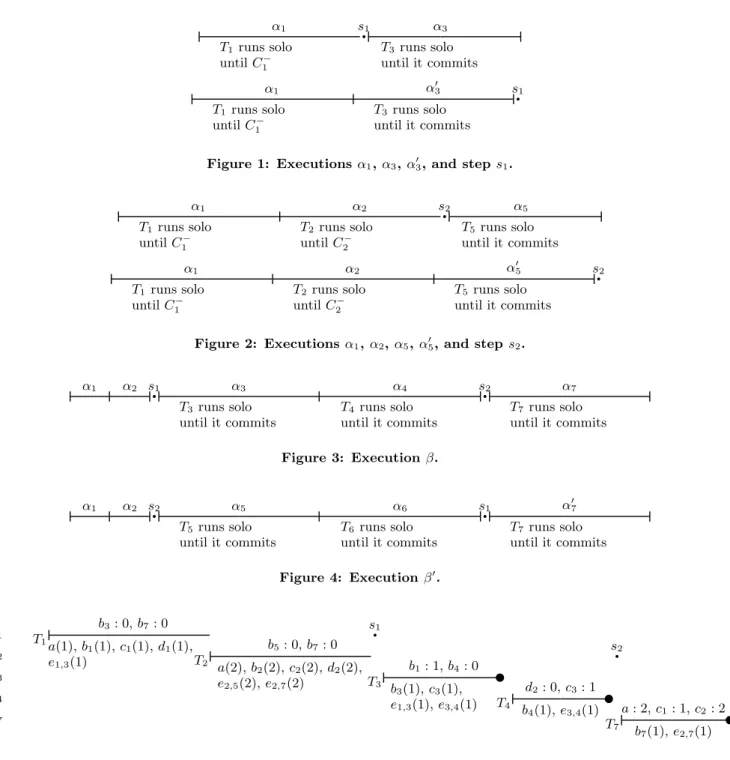
α1 T1 runs solo untilC− 1 s1 α3 T3 runs solo until it commits α1 T1runs solo untilC− 1 α′ 3 T3 runs solo until it commits s1
Figure 1: Executionsα1,α3, α′3, and step s1.
α1 T1 runs solo untilC− 1 α2 T2runs solo untilC− 2 s2 α5 T5 runs solo until it commits α1 T1 runs solo untilC− 1 α2 T2 runs solo untilC− 2 α′ 5 T5 runs solo until it commits s2
Figure 2: Executionsα1, α2, α5, α′5, and steps2.
α1 α2 s1 α3 T3 runs solo until it commits α4 T4 runs solo until it commits s2 α7 T7 runs solo until it commits Figure 3: Executionβ. α1 α2 s2 α5 T5 runs solo until it commits α6 T6 runs solo until it commits s1 α′7 T7 runs solo until it commits Figure 4: Executionβ′. p1 p2 p3 p4 p7 T1 b3: 0,b7: 0 a(1), b1(1),c1(1),d1(1), e1,3(1) T2 b5: 0,b7: 0 a(2),b2(2), c2(2),d2(2), e2,5(2),e2,7(2) s1 T3 b1: 1,b4: 0 b3(1),c3(1), e1,3(1),e3,4(1) T4 d2: 0,c3: 1 b4(1),e3,4(1) s2 T7 a: 2,c1: 1,c2: 2 b7(1),e2,7(1) Figure 5: Values read by transactions in executionβ. Wherex:vdenotes a read fromxwhich returns value v, x(v) denotes a write toxwhich writes value v, and•denotes a commit event.
p1 p2 p3 p4 p7 T1 b3: 0,b7: 0 a(1), b1(1),c1(1),d1(1), e1,3(1) T2 b5: 0,b7: 0 a(2),b2(2), c2(2),d2(2), e2,5(2),e2,7(2) s2 T5 b2: 2,b6: 0 b5(1),c5(1), e2,5(1),e5,6(1) T6 d1: 0,c5: 1 b6(1),e5,6(1) s1 T7 a: 1,c1: 1,c2: 2 b7(1),e2,7(1) Figure 6: Values read by transactions in execution β′.
the active execution interval ofT3 2
. SinceT1<δ1 T3,
then∗T1,w <3 ∗T3,gr. It follows thatT3 must observe
the update performed on data itemb1byT1, and
con-sequentlyT3 must read 1 forb1.
• Assume that P(δ1) = G(T1, T3) and P C(P(δ1)) =
{G(T1, T3)}. Because T1 reads 0 for b3 in δ1, it
fol-lows that∗T1,gr <1∗T3,w. SinceG(T1, T3) is a
proces-sor consistency group, no serialization point is inserted between∗T1,gr and∗T1,w. Thus,∗T1,w <1 ∗T3,w.
Be-causeT1andT3write to the same data iteme1,3, it
fol-lows that∗T1,w <3 ∗T3,w. Since no serialization point
is inserted between ∗T3,gr and ∗T3,w, it follows that
∗T1,w<3∗T3,gr, soT3 must read 1 forb1.
• Assume now that P(δ1) = G(T1, T1), G(T3, T3).
Be-cause T1 <δ1 T3, it follows that G(T1, T1) precedes
G(T3, T3) in δ1. Since∗T1,w should be placed within
the execution interval of G(T1, T1) and ∗T3,gr should be placed within the execution interval of G(T3, T3),
∗T1,w<3∗T3,gr. Hence,T3 must read 1 forb1.
Since in the solo execution of T3 fromC0,T3 reads 0 for b1, whereas in the solo execution ofT3 fromC′,T3 reads 1
for b1, it follows that there exists some step s1 in the solo
execution ofT1fromC0, resulting in a configurationC1, such
that: (I) ifα′
3 is the solo execution ofT3 from configuration C−
1 (whereC1−is the configuration just befores1), then, in α′
3,T3 reads 0 forb1; and (II) ifα3 is the solo execution of T3 from configurationC1, then inα3,T3 reads 1 for b1. (If
there are more than one steps with this property, lets1 be
the first of them.)
Denote byα1the solo execution ofT1fromC0untilC1−is
reached (Figure 1). Note thatT3 reads 0 forb4 inα3 since
there is no transaction inα1·s1·α3 which writes tob4. Claim 1: TransactionT1 invokescommitT1 inα1. Proof: Assume, by contradiction, thatT1 does not invoke commitT1inα1. We argue that the executionα1·s1·α3does
not satisfy weak adaptive consistency. This is so because, by definition ofs1,T3reads 1 forb1in this execution butT1
is not yet commit-pending and therefore we cannot assign a write serialization point toT1 in this execution.
Claim 2:Steps1applies a non-trivial operationopon some base objecto1 for which the following holds: T3 reads o1 in α3 andα′3.
Proof: Ifopis a trivial operation ono1orT3does not read o1 inα3 (or inα3′), thenα3 andα′3 are indistinguishable to p3. This is a contradiction, since by the definition ofs1,T3
reads a different value forb1in these two executions. Definition of α2 and s2: Using a similar reasoning as
above, we can show that in an execution whereT2is executed
solo fromC−
1 until it commits, there is a steps2, resulting
in a configurationC2, such that:
1. ifα′
5is the solo execution ofT5from configurationC2−,
whereC−
2 is the configuration just before the execution
ofs2, thenT5reads 0 forb2 inα′5;
2. ifα5 is the solo execution ofT5from configurationC2,
thenT5 reads 2 forb2 and 0 forb6 inα5,
3. if α2 is the solo execution ofT2 fromC1− untilC−2 is
reached (Figure 2), thenT2 invokescommitT2 inα2, 2
For simplicity, throughout the proof, we use the term exe-cution intervalinstead ofactive execution interval, whenever it is clear from the context.
4. T2 reads the value 0 for data itemsb5 andb7 inα2,
5. s2 applies a non-trivial operation on some base object o2which is read inα5 andα′5.
Claim 3: o16=o2
Proof: Assume thato1 =o2. Consider an executionα1· α2·s′1·γ3, wheres′1 is a single step byp1 and γ3 is a solo
execution of T3 by p3 until T3 commits. We argue that s′
1=s1andγ3is indistinguishable fromα3top3. Obviously,
sinces′
1 is the step thatp1 is poised to perform afterα1,s1
ands′
1access the same base object, namely objecto1. Thus,
ifs1 ands′1 are different, they differ in their response.
Since T3 and T2 do not conflict, strict
disjoint-access-parallelism implies thatα2 does not contain any non-trivial
operation on base objects read inγ3. Thus, the prefix ofα3
until the point thato1 is first accessed is also a prefix ofγ3.
Therefore,T3 readso1 inγ3(as it does inα3).
Becauseγ3 readso1, andT3 andT2 do not conflict, strict
disjoint-access-parallelism implies thatα2 does not contain
a non-trivial operation ono1=o2. It follows thats1 =s′1.
This and the fact thatT3andT2do not conflict imply thatγ3
is indistinguishable fromα3top3. So, executionα1·α2·s1·α3
is legal.
Sincep2 is poised to execute a step which applies a
non-trivial operation ono2=o1afterα1·α2·s1·α3ando1is read
inα3, it follows that in executionα1·α2·s1·α3·s′2, where s′
2 is a single step byp2, strict disjoint-access-parallelism is
violated. This is a contradiction. Thus,o16=o2.
Consider executions α = α1 ·α2·s1·s2 ·α7 and α′ = α1·α2·s2·s1·α′7, whereα7 andα′7 are solo executions of T7 until T7 commits. Since stepss1 ands2 access different
base objects,α7 is indistinguishable fromα′7 to processp7.
Consider an executionα1·α2·s1·α3·α4·s
′′
2, where α4
is the solo execution ofT4 until it commits. We first argue
thats′′2 =s2.
Recall thatα1·α2·s1·α3 is legal, soα1·α2·s1·α3·α4
is legal. Notice thats′′
2, likes2, accesses base objecto2. It
remains to argue that the response ofs′′
2 is the same as that
ofs2. Recall thatα3does not contain a non-trivial operation
ono2. It remains to argue that the same is true forα4.
Consider the executionδ2=α1·α2·s1·α3·α4·α′5. Recall
that α′
5 is the solo execution of T5 from configuration C2−.
SinceT5does not conflict withT1,T3, andT4, strict
disjoint-access-parallelism implies thatα1·α2·s1·α3·α4·α′5is legal.
Sinceα′
5 reads o2 and T5 does not conflict with T4, strict
disjoint-access-parallelism implies thatα4 does not contain
a non-trivial operation ono2. It follows thats′′2 =s2.
Letβ=α1·α2·s1·α3·α4·s2·α7(see Figure 3). We first
argue thatβis legal. This is so becauseT7does not conflict
neither withT3 nor withT4, soα7 does not access any base
object modified inα3 orα4.
We now argue thatT7 reads 2 for data items a and c2,
and 1 for data itemc1in α7.
Claim 4: T7 reads the value2for data itemsaandc2, and the value1for data itemc1 inα7.
Proof: We first prove that transaction T4 reads 0 for d2 in α4. Recall that δ2 = α1 ·α2 ·s1·α3·α4·α′5 is legal.
Since I satisfies weak adaptive consistency, there exists a consistency partitionP(δ2) and a setcom(δ2) of committed
and commit-pending transactions fromδ2 which satisfy the
Assume, by contradiction, thatT2 ∈com(δ2). We consider
the following cases.
• Assume first that P(δ2) includes G(Ti, T5) for some i ∈ {3,4,5}. Since the execution intervals of T2 and T1 precede the execution intervals of T3, T4, andT5,
and the execution intervals of T3,T4, and T5 do not
overlap inδ2, it follows that the execution interval of
the consistency group containingT2 inP(δ2) precedes
the execution interval of G(Ti, T5). Thus, ∗T2,w <5
∗T5,gr. This contradicts the fact thatT5reads 0 forb2
inα′
5.
• Assume that P(δ2) includes G(Ti, T5) for some i ∈
{1,2}andG(Ti, T5)∈SI(P(δ2)). SinceG(Ti, T5) is a
snapshot isolation group and the execution interval of
T2precedes the execution interval ofT5inδ2, it follows
that∗T2,w<5∗T5,gr. This contradicts the fact thatT5
reads 0 forb2 inα′5.
• Assume that P(δ2) includes G(Ti, T5) for some i ∈
{1,2}andG(Ti, T5)∈P C(P(δ2)). BecauseT2 reads 0
for b5 in α2, it follows that∗T2,gr <2 ∗T5,w. Since no point is inserted between ∗T2,gr and ∗T2,w, it follows
that ∗T2,w <2 ∗T5,w. BecauseT2 andT5 write to the
same data item e2,5, it follows that ∗T2,w <5 ∗T5,w. Since no point is inserted between∗T5,grand∗T5,w, it
follows that∗T2,w<5∗T5,gr. This contradicts the fact
thatT5 reads 0 forb2 inα′5.
Hence,T2 ∈/com(δ2), and consequentlyT4 reads 0 ford2
inα4.
We next argue that T4 reads 1 for c3 in α4. Since δ3 = α1 ·α2·s1·α3·α4 is legal and I satisfies weak adaptive
consistency, there exists a consistency partitionP(δ3) and a
setcom(δ3) of committed and commit-pending transactions
fromδ3 which satisfy the conditions of Definition 3.3. We
consider the following cases:
• Assume first thatP(δ3) includesG(T4, T4). Since the
execution interval of any consistency group contain-ing transaction T3 precedes the execution interval of G(T4, T4), it follows that∗T3,w <4∗T4,gr.
• Assume now that P(δ3) includes G(Ti, T4) for some i ∈ {1,2,3} and that G(Ti, T4) ∈ SI(P(δ3)). Since T3<δ3 T4, it follows that∗T3,w<4∗T4,gr.
• Assume now that P(δ3) includes G(Ti, T4) for some i ∈ {1,2,3} and that G(Ti, T4) ∈ P C(P(δ3)). Since T3 reads 0 forb4inα3, it follows that∗T3,gr<3∗T4,w. Since no point is inserted between∗T3,grand∗T3,w, it
follows that∗T3,w<3∗T4,w. BecauseT3 and T4 write
to the same data item e3,4, it follows that∗T3,w <4
∗T4,w. Since no point is inserted between ∗T4,gr and
∗T4,w, it follows that∗T3,w<4∗T4,gr.
We conclude that (in all cases)∗T3,w<4∗T4,gr. Thus,T4
reads 1 forc3inα4.
We now prove that T7 reads 2 forc2 in α7. Notice that α1 ·α2 ·s1·s2·α5 is legal. This is so because s1 and s2
are steps on different base objects andT5 does not conflict
with T1, so it does not access o1 in α5. We argue that δ4=α1·α2·s1·s2·α5·α7is also legal. This is so because α1·α2·s1·s2·α5 andα1·α2·s1·s2·α7 are legal andT7
does not conflict withT5.
SinceI satisfies weak adaptive consistency, there exists a consistency partitionP(δ4) and a setcom(δ4) of committed
and commit-pending transactions fromδ4 which satisfy the
conditions of Definition 3.3. SinceT5 reads 2 forb2 inα5, it
follows thatT2∈com(δ4) and∗T2,w <5 ∗T5,gr. We consider
the following cases.
• Assume first that P(δ4) includes G(Ti, T7) for some i∈ {5,7}. Since the execution intervals ofT1 and T2
do not overlap with the execution intervals ofT5 and T7 in δ4, it follows that the execution interval of the
consistency group of P(δ4) that contains transaction T2precedes the execution interval ofG(Ti, T7).
There-fore, ∗T2,w <7 ∗T7,gr, and consequentlyT7 must read
2 forc2 inα7.
• Assume now that P(δ4) includes G(Ti, T7), for some i∈ {1,2}and thatG(Ti, T7)∈ SI(P(δ4)). Since the
execution interval ofT2 precedes the execution
inter-val ofT7 andT2, T7 ∈G(Ti, T7), which is a snapshot
isolation group, it follows that∗T2,w<7∗T7,gr. Thus,
T7 must read 2 forc2 inα7.
• Assume now that P(δ4) includes G(Ti, T7), for some i∈ {1,2}and that G(Ti, T7) ∈ P C(P(δ4)). Because T2reads 0 forb7 inα2, it follows that∗T2,gr <2∗T7,w. Since no point is inserted between∗T2,gr and∗T2,w, it
follows that∗T2,w <2 ∗T7,w. BecauseT2 andT7 write
to the same data item e2,7, it follows that∗T2,w <7
∗T7,w. Since no point is inserted between∗T7,gr and
∗T7,w, it follows that∗T2,w <7 ∗T7,gr. Thus, T7 must
read 2 forc2 inα7.
Since T3 reads 1 for b1 in β, it follows that ∗T1,w <3
∗T3,gr <3∗T3,w. BecauseT1 andT3 write to the same data
iteme1,3, it follows that∗T1,w <4 ∗T3,w. SinceT4 reads 0
ford2 and 1 forc3, it follows that∗T3,w<4∗T4,gr <4∗T2,w. Thus, ∗T1,w <4 ∗T2,w. Because T1 and T2 write to the
same data item a, it follows that ∗T1,w <7 ∗T2,w. Since
T7 reads 2 for c2, it follows that ∗T2,w <7 ∗T7,gr. Thus, ∗T1,w <7 ∗T2,w <7 ∗T7,gr, and consequently, it follows that
T7 reads 2 foraand 1 forc1 inα7 (see Figure 5).
Consider now executionα1·α2·s2·α5·α6·s′′1, whereα6
is the solo execution ofT6 until it commits. We first argue
thats′′1 =s1.
Recall thatα1·α2·s2·α5 is legal, soα1·α2·s2·α5·α6
is legal. Notice thats′′
1, likes1, accesses base objecto1. It
remains to argue that the response ofs′′
1 is the same as that
ofs1. Recall thatα5does not contain a non-trivial operation
ono1. It remains to argue that the same is true forα6.
Consider an executionδ5=α1·α2·s2·α5·α6·α′3. SinceT3
does not conflict withT2,T5, andT6, strict
disjoint-access-parallelism implies thatα1·α2·s2·α5·α6·α′3is legal. Recall
thatα′
3 readso1. SinceT3 does not conflict withT6, strict
disjoint-access-parallelism implies thatα6 does not contain
a non-trivial operation ono1. It follows thats′′1 =s1.
Letβ′ =α
1·α2·s2·α5·α6·s1·α′7 (see Figure 4). We
first argue thatβ′ is legal. This is so because T
7 does not
conflict neither withT5 nor withT6, so α′7 does not access
any base object modified inα5 orα6. Claim 5: T7 reads1forainα′7.
Proof: We first prove that transaction T6 reads 0 for d1 in α6. Recall that δ5 = α1 ·α2 ·s2·α5·α6·α′3 is legal.
Since I satisfies weak adaptive consistency, there exists a consistency partitionP(δ5) and a setcom(δ5) of committed
and commit-pending transactions fromδ5 which satisfy the
Assume, by contradiction, thatT1 ∈com(δ5). We consider
the following cases.
• Assume first thatP(δ5) includesG(Ti, T3) for somei∈
{2,3,5,6}. Since the execution interval ofT1 precedes
the execution intervals of T2, T3,T6 and T5, and the
executions intervals of T2,T3,T6 andT5 do not
over-lap in δ5, it follows that the execution interval of the
consistency group containing T1 precedes the
execu-tion interval ofG(Ti, T3) inδ5. Thus,∗T1,w<3∗T3,gr. This contradicts the fact thatT3 reads 0 forb1 inα′3.
• Assume now thatP(δ5) =G(T1, T3) and that it holds
that SI(P(δ5)) = {G(T1, T3)}. Since the execution
interval of T1 precedes the execution interval of T3 in δ5, it follows that ∗T1,w <3 ∗T3,gr. This contradicts the fact thatT3 reads 0 forb1 inα′3.
• Assume now thatP(δ5) =G(T1, T3) and that it holds
that P C(P(δ5)) = {G(T1, T3)}. Because T1 reads 0
for b3 in α1, it follows that∗T1,gr <1 ∗T3,w. Since no point is inserted between ∗T1,gr and ∗T1,w, it follows
that ∗T1,w <1 ∗T3,w. BecauseT1 andT3 write to the
same data item e1,3, it follows that ∗T1,w <3 ∗T3,w. Since no point is inserted between∗T3,grand∗T3,w, it
follows that∗T1,w<3∗T3,gr. This contradicts the fact
thatT3 reads 0 forb1 inα′3.
Hence,T1 ∈/com(δ5), and consequentlyT6 reads 0 ford1
inα6.
We next argue that T6 reads 1for c5 in α6. Since δ6 = α1 ·α2·s2·α5·α6 is legal and I satisfies weak adaptive
consistency, there exists a consistency partitionP(δ6) and a
setcom(δ6) of committed and commit-pending transactions
fromδ6 which satisfy the conditions of Definition 3.3. We
consider the following cases:
• Assume first thatP(δ6) includesG(T6, T6). Since the
execution interval of any consistency group containing transaction T5 must precede the execution interval of G(T6, T6), it follows that∗T5,w <6∗T6,gr.
• Assume now that P(δ6) includes G(Ti, T6) for some i ∈ {1,2,5} and that G(Ti, T6) ∈ SI(P(δ6)). Since T5<δ6 T6, it follows that∗T5,w<6∗T6,gr.
• Assume now that P(δ6) includes G(Ti, T6) for some i ∈ {1,2,5} and that G(Ti, T6) ∈ P C(P(δ6)). Since T5 reads 0 forb6inα5, it follows that∗T5,gr<5∗T6,w. Since no point is inserted between∗T5,grand∗T5,w, it
follows that∗T5,w<5 ∗T6,w. BecauseT5 and T6 write
to the same data item e5,6, it follows that∗T5,w <6
∗T6,w. Since no point is inserted between ∗T6,gr and
∗T6,w, it follows that∗T5,w<6∗T6,gr.
We conclude that (in all cases)∗T5,w<6∗T6,gr. Thus,T6
reads 1 forc5inα6.
Becauseα′
7 andα7 are indistinguishable top7, it follows
thatT7reads the same values inα′7 andα7. SinceT5 reads
2 for b2 in β′, it follows that ∗T2,w <5 ∗T5,gr <5 ∗T5,w. BecauseT2andT5write to the same data iteme2,5, it follows
that∗T2,w<6∗T5,w. SinceT6 reads 0 ford1 and 1 forc5, it
follows that∗T5,w<6∗T6,gr<6∗T1,w. Thus,∗T2,w<6∗T1,w.
BecauseT1 andT2write to the same data itema, it follows
that∗T2,w <7∗T1,w. SinceT7 reads 1 forc1, it follows that
∗T1,w <7 ∗T7,gr. Thus, ∗T2,w <7 ∗T1,w <7 ∗T7,gr in β
′,
and consequently, it follows thatT7 reads 1 fora inβ′ (see
Figure 6) and inα′
7.
Claim 4 states that T7 reads 2 for data item a in α7,
and Claim 5 states thatT7 reads 1 for data item a in α′7.
Sinceα7 is indistinguishable fromα′7 to processp7 this is a
contradiction.
5.
DISCUSSION
We proved the PCL theorem: in transactional systems it is impossible to ensure strict disjoint-access-parallelism (Parallelism), weak adaptive consistency (Consistency), and obstruction-freedom (Liveness). To circumvent the impos-sibility result it is sufficient to weaken just one of the three requirements. Weakening obstruction-freedom to a blocking liveness property makes it possible to ensure strict disjoint-access-parallelism and strong consistency (e.g. strict serial-izability) by using locks; these are the properties ensured by TL [14]. Likewise, weakening consistency makes it possible to ensure strict disjoint-access-parallelism and strong live-ness. For example, allowing writes to the same data item to be viewed differently, as in PRAM consistency [28], makes it possible to trivially ensure strict disjoint-access-parallelism and wait-freedom, the strongest liveness property, without any synchronization between processes. In [11], we design a simple variant of DSTM [25], which satisfies snapshot isola-tion, obstruction-freedom, and the following weakening of strict disjoint-access-parallelism: two write operations on different data items contend on the same base object only if there is a chain of transactions starting with the transaction that performs one of these write operations and ending with the transaction that performs the other, such that every two consecutive transactions in the chainconflict. The PCL the-orem shows that the distance between strict disjoint-access-parallelism and its non-strict forms draws a sharp line in the design of transactional systems.
Our theorem might at first glance look close to the CAP theorem [18] which states that it is impossible to ensure con-sistency, availability, andpartition in a distributed system and weakening at least one of these requirements circum-vents the impossibility result. In fact, they are different re-sults. While consistency can be viewed as a safety property, and availability can be viewed as a liveness property, parti-tion is not analogous to disjoint-access-parallelism. Specif-ically, partition tolerance ensures that the system tolerates arbitrary network partitions. Disjoint-access-parallelism on the other hand, does not ensure tolerance against failures but imposes that logical components of a system (transac-tions or opera(transac-tions) do not contend at low level (i.e. on base objects) if they do not conflict at high level (i.e. do not access the same data items).
Our definition of snapshot isolation is incomparable to strict serializability [30] and opacity [22]. This is because strict serializability and opacity are defined in terms of ex-ecution intervals whereas our definition of snapshot isola-tion is based onactiveexecution intervals. The same holds for previous definitions of snapshot isolation, both in the database world [10], and in TM computing [4, 33]. We can easily remedy this problem by defining snapshot isolation in terms of execution intervals. Indeed, we did so in [11] and we were able to prove [11] that no TM implementation satisfies that version of snapshot isolation, obstruction-freedom, and strict disjoint-access-parallel. This impossibility result [11] also holds if a primitive accesses up tokbase objects in one atomic step.
6.
ACKNOWLEDGEMENTS
This work has been supported by the European Commis-sion under the 7th Framework Program through the Trans-Form (FP7-MC-ITN-238639) project and by the ARISTEIA Action of the Operational Programme Education and Life-long Learning which is co-funded by the European Social Fund (ESF) and National Resources through the GreenVM project.
7.
REFERENCES
[1] Y. Afek, D. Dauber, and D. Touitou. Wait-free made fast. InProceedings of ACM STOC ’95.
[2] Y. Afek, M. Merritt, G. Taubenfeld, and D. Touitou. Disentangling multi-object operations (extended abstract). InProceedings of ACM PODC ’97. [3] M. Ahamad, R. A. Bazzi, R. John, P. Kohli, and
G. Neiger. The power of processor consistency. In
Proceedings of ACM SPAA ’93.
[4] M. S. Ardekani, P. Sutra, and M. Shapiro. The impossibility of ensuring snapshot isolation in genuine replicated stms. InWTTM’11.
[5] H. Attiya and E. Dagan. Universal operations: unary versus binary. InProceedings of ACM PODC ’96. [6] H. Attiya and E. Hillel. Built-in coloring for
highly-concurrent doubly-linked lists. InProceedings of ACM DISC’06.
[7] H. Attiya and E. Hillel. Single-version stms can be multi-version permissive. InProceedings of ICDCN’11. Springer-Verlag.
[8] H. Attiya, E. Hillel, and A. Milani. Inherent
limitations on disjoint-access parallel implementations of transactional memory. InProceedings of ACM SPAA ’09.
[9] G. Barnes. A method for implementing lock-free shared-data structures. InProceedings of ACM SPAA ’93.
[10] H. Berenson, P. Bernstein, J. Gray, J. Melton, E. O’Neil, and P. O’Neil. A critique of ansi sql isolation levels.ACM SIGMOD Rec., 24(2):1–10, 1995. [11] V. Bushkov, D. Dziuma, P. Fatourou, and
R. Guerraoui. Snapshot isolation does not scale either. Technical Report TR-437, FORTH-ICS, 2013.
[12] V. Bushkov, R. Guerraoui, and M. Kapa lka. On the liveness of transactional memory. InProceedings of ACM PODC ’12.
[13] R. J. Dias, J. Seco, and J. M. Louren¸co. Snapshot isolation anomalies detection in software transactional memory. InProceedings of InForum 2010.
[14] D. Dice and N. Shavit. What really makes transactions
faster? InProceedings of ACM TRANSACT’06.
[15] F. Ellen, P. Fatourou, E. Kosmas, A. Milani, and C. Travers. Universal constructions that ensure disjoint-access parallelism and wait-freedom. In
Proceedings of ACM PODC ’12.
[16] A. Fekete, D. Liarokapis, E. O’Neil, P. O’Neil, and D. Shasha. Making snapshot isolation serializable.
ACM Trans. Database Syst., 30(2), 2005.
[17] K. Fraser and T. Harris. Concurrent programming without locks.ACM Trans. Comput. Syst., 25(2), 2007.
[18] S. Gilbert and N. Lynch. Brewer’s conjecture and the feasibility of consistent, available, partition-tolerant web services. ACM SIGACT News, 33(2), 2002. [19] J. R. Goodman. Cache consistency and sequential
consistency. Technical report, Technical Report 61, IEEE Scalable Coherent Interface Working Group, 1989.
[20] J. Gray. A transaction model. InProceedings of ICALP ’80. Springer-Verlag.
[21] R. Guerraoui and M. Kapalka. On obstruction-free transactions. InProceedings of ACM SPAA ’08. [22] R. Guerraoui and M. Kapalka. On the correctness of
transactional memory. InProceedings of ACM PPoPP
’08.
[23] M. Herlihy. A methodology for implementing highly concurrent data structures.ACM SIGPLAN Not., 25(3), 1990.
[24] M. Herlihy. Wait-free synchronization.ACM Trans. Program. Lang. Syst., 13(1), 1991.
[25] M. Herlihy, V. Luchangco, M. Moir, and W. N. Scherer, III. Software transactional memory for dynamic-sized data structures. InProceedings of ACM PODC’03.
[26] M. Herlihy and J. E. B. Moss. Transactional memory: Architectural support for lock-free data structures.
SIGARCH Comput. Archit. News, 21(2), 1993. [27] A. Israeli and L. Rappoport. Disjoint-access-parallel
implementations of strong shared memory primitives. InProceedings of ACM PODC ’94.
[28] R. J. Lipton and J. S. Sandberg. Pram: A scalable shared memory. Technical Report CS-TR-180-88, Princeton University, 1988.
[29] V. J. Marathe, W. N. Scherer, and M. L. Scott. Adaptive software transactional memory. In
Proceedings of DISC’05. Springer-Verlag.
[30] C. H. Papadimitriou. The serializability of concurrent database updates.J. ACM, 26(4), 1979.
[31] D. Perelman, R. Fan, and I. Keidar. On maintaining multiple versions in stm. InProceedings of ACM PODC ’10.
[32] M. Raynal, G. Thia-Kime, and M. Ahamad. From serializable to causal transactions for collaborative applications. InProceedings of EUROMICRO ’97. [33] T. Riegel, C. Fetzer, and P. Felber. Snapshot isolation
for software transactional memory. InProceedings of ACM TRANSACT’06.
[34] M. Saeida Ardekani, P. Sutra, M. Shapiro, and N. Pregui¸ca. On the scalability of snapshot isolation. InEuro-Par Parallel Processing. Springer Berlin Heidelberg, 2013.
[35] N. Shavit and D. Touitou. Software transactional
memory. InProceedings of ACM PODC ’95.
[36] F. Tabba, M. Moir, J. R. Goodman, A. W. Hay, and C. Wang. Nztm: nonblocking zero-indirection
transactional memory. InProceedings of ACM SPAA
’09.
[37] J. Turek, D. Shasha, and S. Prakash. Locking without blocking: making lock based concurrent data structure
algorithms nonblocking. InProceedings of ACM PODS