The European Union’s IPA Multi – beneficiary Programme
school professional
toolkit
entrepreneurial learning
School Professional Toolkit
Quantitative Section of the Study of Strategic Piloting in Western Balkans and Turkey
published by
South East European Centre for Entrepreneurial Learning Selska 217/IV, 10000 Zagreb, Croatia
for the publisher Sandra Rončević Sonja Šegvić
©South East European Centre for Entrepreneurial Learning, 2013. All rights reserved.
authors
Ivana Batarelo Kokić Efka Heder Maja Ljubić reviewers Radmil Polenakovik, PhD Bahrija Umihanić, PhD ISBN 978-953-56732-3-1
Copies of this book are available at the SEECEL website at www.seecel.hr
Printed in Zagreb, Croatia 2013
Printed by Magnus Gubernator d.o.o. (Četiri Boje Group) Design & Layout by Jelenko Hercog
A CIP catalogue record for this book is available from the National and University Library in Zagreb under 837632
list of figures
4
list of tables
5
list of abbreviations
6
abstract
6
1. introduction
8
2. design and methods -
quantitative section of
the study of
strategic piloting
10
2.1. Research questions -
quantitative section of the study 12 2.2. Research Design -
quantitative section of the study
of strategic piloting 14
2.2.1. Experimental method 14
2.2.2. Focus on curriculum 14
2.2.3. Competence-based approach
focus on learning outcomes 15
2.3. Target population and recruitment 16 2.4. Data collection instruments
and procedures 19
2.4.1. Factorial analysis of the
entrepreneurship-related learning
outcomes scale 10
2.4.2. Relationships between variables and
the Revised Bloom’s Taxonomy 21
3. results of the study of
strategic piloting
23
3.1. Results for teachers and school
management staff 25
3.1.1. Entrepreneurship competence in
different curricular areas 25
3.1.2. Entrepreneurship competence at
different schools 33
3.1.3. Entrepreneurship competence in
different countries 37
3.2. Study of strategic piloting impact
on the school management staff 42
4. conclusions and
recommendations 43
4.1. Conclusions 44
4.2. Recommendations 45
5. annexes
47
5.1. Annex 1: ISCED 2 school professional
questionnaire 48 5.2. Annex 2. Tables with ANOVA results 54 5.3. Annex 3: School codes, names and
curricular areas 60
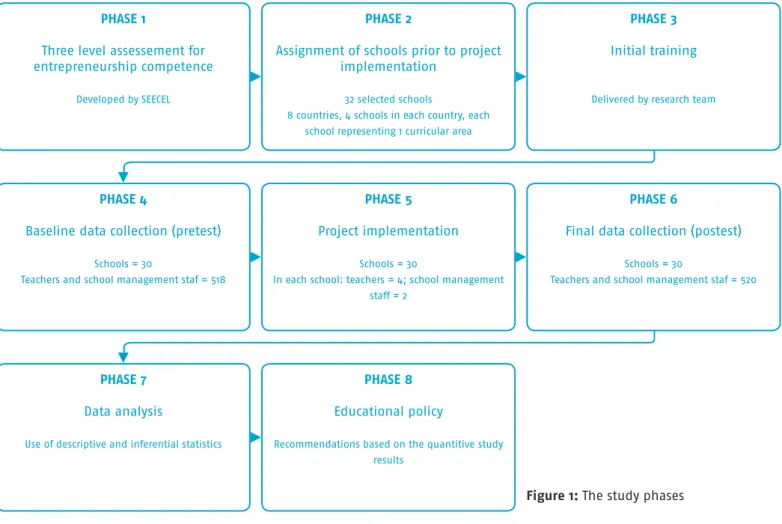
Figure 1: The study phases ...16
Figure 2: Questionnaires included in data analysis by curricular area ...17
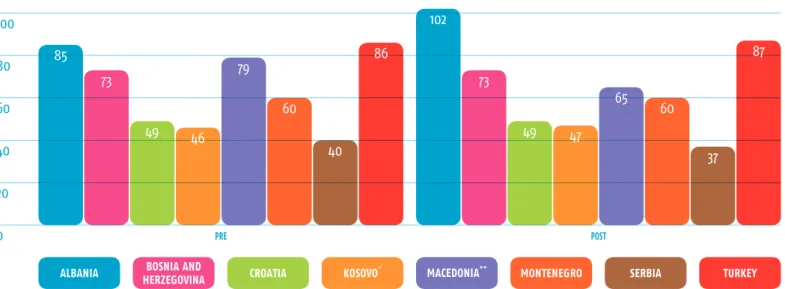
Figure 3: Questionnaires included in data analysis by country ...18
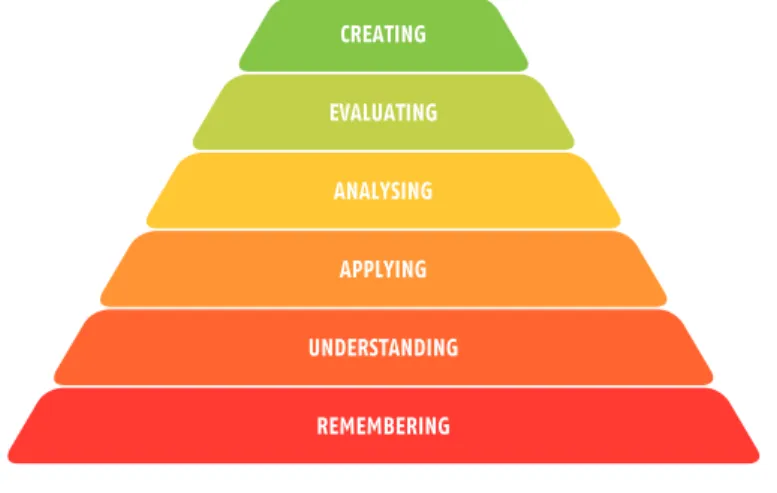
Figure 4: Revised Bloom’s Taxonomy – cognitive domain ...21
Figure 5: Bloom’s Taxonomy - affective domain ...21
Figure 6: Curriculum-related results in the cognitive domain (levels of remembering and understanding) ...26
Figure 7: Curriculum-related results on the cognitive domain (higher levels of learning) outcomes scale ...26
Figure 8: Curriculum-related results on the cognitive domain (higher levels of learning) outcomes subscale - the school professionals’ role in EE .. 27
Figure 9: Curriculum-related results on the affective domain outcomes scale ...27
Figure 10: Business start-up - Language Curriculum ...29
Figure 11: Business start-up - Social Science Curriculum ... 30
Figure 12: Business start-up - Science Curriculum ... 31
Figure 13: Business start-up - Arts, Technical & Physical Education Curriculum ...32
Figure 14: School-related results in the cognitive domain (level of remembering and understanding) ...33
Figure 15: School-related results on the cognitive domain (higher levels of learning) outcomes scale ...34
Figure 16: School-related results on the cognitive domain (higher levels of learning) outcomes subscale - the school professionals’ role in EE ...35
Figure 17: School-related results on the affective domain outcomes scale ... 36
Figure 18: Country-related results in the cognitive domain (level of remembering and understanding) ...37
Figure 19: Country-related results on the cognitive domain (higher levels of learning) outcomes scale ... 38
Figure 20: Country-related results on the cognitive domain (higher levels of learning) outcomes subscale - the school professionals’ role in EE ... 39
Figure 21: Country-related results on the affective domain outcomes scale... 40
Figure 22: Study impact on the school management staff ...42
list of tables
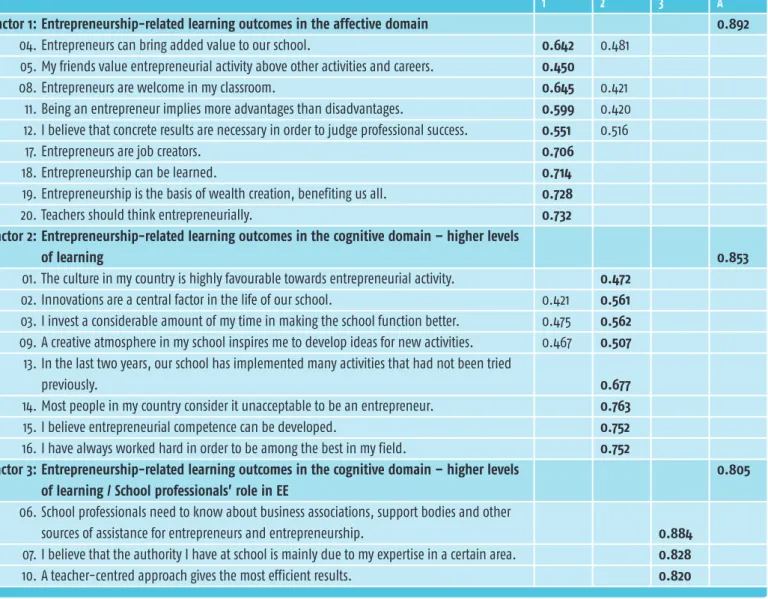
Table 1: Factorial structure of entrepreneurship-related learning outcomes scale: factorial weights and Cronbach alpha coefficient ... 20
Table 2: Explanation of entrepreneurship-related learning outcomes scale variables ...22
Table 3: Curricular areas – cognitive domain (level of remembering and understanding) ... 54
Table 4: Curricular areas – cognitive domain (higher levels of learning) ... 54
Table 5: Curricular areas – cognitive domain (higher levels of learning) outcomes subscale - the school professionals’ role in EE ... 55
Table 6: Curricular areas – affective domain ... 55
Table 7: School level – Cognitive domain (level of remembering and understanding) ... 55
Table 8: School level – Cognitive domain (higher levels of learning) ... 56
Table 9: School level – Cognitive domain (higher levels of learning) outcomes subscale - the school professionals’ role in EE ... 56
Table 10: School level – Affective domain ... 56
Table 11: Countries – Cognitive domain (level of remembering and understanding) ...57
Table 12: Countries – Cognitive domain (higher levels of learning) ...57
Table 13: Countries – Cognitive domain (higher levels of learning) outcomes subscale - the school professionals’ role in EE ... 58
Table 14: Countries – Affective domain ... 58
Table 15: School management staff – complete data ... 59
Table 16: School management staff – significant changes in curricular areas and countries ... 59
list of abbreviations
CoP – Community of Practice EL – Entrepreneurial Learning EC – European Commission EU – European Union
ISCED – International Standard Classification of Education
IPA – Instrument for Pre-Accession Assistance LLL – Lifelong Learning
LLEL – Lifelong Entrepreneurial Learning LO – Learning Outcome
OMC – Open Method of Coordination SBA – Small Business Act for Europe
SEE – South East Europe
SEECEL – South East European Centre for Entrepreneurial Learning TT – Teacher Training
The preparation of a robust and comprehensive entrepreneurial infrastructure is essential for the development of entrepreneurship in any society. Teachers and schools have been recognized as key agents in the entrepreneurial infrastructural chain which leads from entrepreneurial schools towards an entrepreneurially literate society. In 2010, SEE-CEL began structured cooperation of eight EU pre-accession countries for the development of a com-mon Entrepreneurial Learning: a Key Competence Approach (ELKCA) instrument.
This publication presents the results of the stra-tegic piloting of the ELKCA instrument in 31 schools in eight countries during the school year 2011/2012. The primary goal of the strategic pilot was to im-plement the instrument in real-life cases in a vast variety of institutions, national curricula, teacher training programmes, etc. The expected outcome of the strategic pilot was a set of documents that each school had to submit and give their report on the implementation of the instrument as well as their recommendations for steps forward – together these documents would give a clear review of the instru-ment and its applicability. One of the key docuinstru-ments
in this set was the school professional questionnaire distributed prior and post piloting, and which would measure the achievement of school professionals in acquiring entrepreneurial competences through ba-sic (5-7 hours) and advanced training (25-30 hours). The results in regards to the internal consistency of the entrepreneurship-related learning outcomes are promising and indicate a high validity of the school professionals’ questionnaire. The factorial analysis resulted in scales in affective and cognitive learn-ing domain. In addition, the quantitative section of the study addressed the question on entrepre-neurial learning activities impact on the teachers’ and school management staff’s entrepreneurship-related learning outcomes in eight pre-accession countries in South East Europe and Turkey. The analysis focused on changes that occurred in school professionals’ learning on the school, curricular and national level. Results obtained with this exhaustive research and the implemented practical solution can serve as an example on how entrepreneurial com-petences can be taught effectively across borders, in various national curricula, and serve as the founda-tion for future planning.
Developing the lifelong entrepreneurial learning system (LLEL) and an entrepreneurial culture is con-sidered as a key strategic policy of many countries. LLEL is highlighted in many policy documents, and both educational professionals and policy makers are becoming aware of the importance of an en-trepreneurial culture and a lifelong enen-trepreneurial learning system to support the growth of an entre-preneurial culture.
One of the most important steps in the devel-opment of entrepreneurship in any society is the preparation of an entrepreneurial infrastructure, in which the creation of entrepreneurial culture is one of the most important aspects.
Current evidence suggests that „teachers and schools are key agents“1 in the entrepreneurial in-frastructural chain which leads from entrepreneurial schools towards an entrepreneurially literate soci-ety. Building on these ideas, in 2010, SEECEL began a structured cooperation of eight EU pre-accession countries for the development of a common Entre-preneurial Learning: a Key Competence Approach (ELKCA) instrument. This instrument was strategically piloted at 31 schools in eight countries during the school year 2011/2012. This bottom-up piloting ap-proach was aimed at the implementation of
SEECEL-1 European Commission (2012). Guidebook Series: Building Entrepreneurial Mindsets and Skills in the EU. Brussels: European Commission, p. 13
defined learning outcomes, in-service teacher train-ing and school management traintrain-ing, as well as the development of entrepreneurial schools.
This publication puts forward the analysis of the developed measurement instrument “Entrepreneur-ial School Professional Toolkit”. The instrument aims to evaluate the acquired competences through pi-loted teacher and school management training pro-grammes as well as practical entrepreneurial com-petence acquisition on classroom and school level. The development and successful implementation of this instrument would not have been possible with-out the active participation of teachers and school managers, and we would therefore like to thank all members of the SEECEL Network of Entrepreneurial Schools who participated on a regular basis. Their support, dedication and efforts have been the key pillars upon which the results of this publication have been built on.
Results obtained with this exhaustive research and the implemented practical solution can serve as an example on how entrepreneurial competences can be taught effectively across borders, in various national curricula, but also as the foundation for future planning. We hope that the measurement instrument will enter into wider usage and that all schools will be able to use it on an everyday basis and profit from the experience of this pilot phase.
The quantitative section of the larger study of stra-tegic piloting, implemented by SEECEL in cooperation with national partners, focused on the school as unit of change to test the impact of the entrepre-neurial learning SEECEL ELKCA instrument on teachers and school management entrepreneurship-related learning outcomes developed by SEECEL. The quan-titative section of the study addressed one primary impact question, as well as four exploratory ques-tions. The questions are presented below and fol-lowed by the overall research design, sampling and recruitment methods, data collection procedures, and data analysis methods. The questions are for-mulated with the focus on learning outcomes; fur-thermore, the exploratory questions are formulated with respect to the revised Bloom’s Taxonomy2.
2 Anderson, L.W., & Krathwohl (Eds.). (2001). A Taxonomy for
Learning, Teaching, and Assessing: A Revision of Bloom’s Taxonomy of Educational Objectives. New York: Longman.
The primary impact question addressed by the quan-titative section of the study of strategic piloting was:
• What impact does the entrepreneurial learning project have on the teachers’ and school man-agement staff’s entrepreneurship-related learn-ing outcomes in eight pre-accession countries in SouthEast Europe?
Four exploratory questions were also addressed: 1. Does the study have a significant impact on the teachers’ and school management staff’s entre-preneurship-related learning outcomes in four curricular areas (language, social science, sci-ence, arts, technical and physical education)?
• Does the study have a significant impact on the teachers’ and school management staff’s entre-preneurship-related learning outcomes in the cognitive domain, on the level of remembering, in four curricular areas?
• Does the study have a significant impact on the teachers’ and school management staff’s
entre-preneurship-related learning outcomes in the cognitive domain, on the higher levels of learn-ing, in four curricular areas?
• Does the study have a significant impact on the teachers’ and school management staff’s entre-preneurship-related learning outcomes in the affective domain, in four curricular areas? 2. Does the study have a significant impact on
the teachers’ and school management staff’s entrepreneurship-related learning outcomes at different schools?
• Does the study have a significant impact on the teachers’ and school management staff’s entre-preneurship-related learning outcomes in the cognitive domain, on the level of remembering, at different schools?
• Does the study have a significant impact on the teachers’ and school management staff’s entre-preneurship-related learning outcomes in the cognitive domain, on the higher levels of learn-ing, at different schools?
2.1.
• Does the study have a significant impact on the teachers’ and school management staff’s entre-preneurship-related learning outcomes in the affective domain, at different schools?
Does the study have a significant impact on the teachers’ and school management staff’s entre-preneurship-related learning outcomes, in eight countries (Albania, Bosnia and Herzegovina, Croatia, Kosovo*, Macedonia**, Montenegro, Serbia, Turkey)?
• Does the study have a significant impact on the teachers’ and school management staff’s entre-preneurship-related learning outcomes in the cognitive domain, on the level of remembering, in eight countries?
• Does the study have a significant impact on the
teachers’ and school management staff’s entre-preneurship-related learning outcomes in the cognitive domain, on the higher levels of learn-ing, in eight countries?
• Does study have a significant impact on the teachers’ and school management staff’s entre-preneurship-related learning outcomes in the affective domain, in eight countries?
3. Does the study have a significant impact on the school management staff’s entrepreneurship-related learning outcomes, on the level of cur-ricular area and country?
* This designation is without prejudice to positions on status, and is in line with UNSCR 1244 and the ICJ Opinion on the Kosovo Declaration of independence
2.2.1.
Experimental method
The quantitative section of the study of strate-gic piloting is based on a quasi–experiment, the experimental method in which units are not as-signed to conditions randomly3. Outcome measures were taken on two occasions: before and after the strategic piloting. The unit of assignment was the school, whereas the primary unit of analysis were ISCED 2 school teachers and the school management staff. The outcome measure was the ISCED 2 school professional questionnaire (see Annex 1: ISCED 2 school professional questionnaire) which consisted of demographic questions (country, institution, par-ticipants gender, age, subject area, curriculum area,
3 Shadish, W. R. Cook, T. D., & Campbell, D. T. (2002). Experi-mental and quasi-experiExperi-mental designs for generalized causal inference. Boston: Houghton Mifflin Company. pp. 12.
type of employment, length of work experience), 20 Likert scale questions (5 levels) related to the entre-preneurship and an entrepreneurial knowledge test with 8 questions.
2.2.2.
Focus on curriculum
Due to the fact that eight countries involved in the research have different educational systems and dif-ferent ISCED 2 education curricula, the schools were clustered around the curricular area. In accordance with the comparative education theory4, the primary focus of this research was a comparison on the cur-ricular level. The secondary focus of this research
4 Bray, M. et al. (Eds.) (2007). Comparative Education Re-search: Approaches and Methods. Hong Kong & Dordrecht, Netherlands: Springer.
2.2.
research design - quantitative section of the study of
strategic piloting
was a comparison on country level, followed by the comparison on the level of the educational institu-tion. While the analysis of the study data on three levels was conducted for the entire sample (teachers and school management staff), the separate infer-ential analysis on the curricular and country levels were conducted for the school management staff subsample.
2.2.3.
Competence-based approach - focus on
learning outcomes
The primary consideration that influenced this study is a promotion of entrepreneurship as a key com-petence in early education (ISCED 2). According to the European Framework for Key Competencies for Lifelong learning, competence consists of knowl-edge, skills and attitudes5. In addition, Kozlinska6 summarizes, the European Competences Framework has fundamental grounds in the Bloom’s Taxonomy of Educational Objectives consisting of the three do-mains of learning: cognitive (knowledge, compre-hension and critical thinking), affective (concerning
5 European Communities (2007). The Key Competences for Lifelong Learning – A European Framework. Luxembourg: Office for Official Publications of the European Communities.
6 Kozlinska, I. (2012). Fundamental view of the outcomes of
entrepreneurship education. Tartu: University of Tartu.
attitudes, emotions and feelings) and psycho-motor (focusing on skills). Hence, in determining the teachers’ and school management staff’s entrepre-neurship competence, the researchers used a ques-tionnaire that consisted of three parts, two of which were measuring entrepreneurship-related learning outcomes. While the first part of the questionnaire focused on demographics, the questions in the sec-ond part of the questionnaire accounted for the par-ticipants’ entrepreneurship-related attitudes, which could be linked to the affective domain and higher levels of learning in the cognitive domain, according to the revised Bloom’s Taxonomy7. The questions in the third part of the questionnaire focused solely on the entrepreneurial knowledge (cognitive domain – the level of remembering and understanding).
7 Anderson, L.W., & Krathwohl (Eds.). (2001). A Taxonomy for
Learning, Teaching, and Assessing: A Revision of Bloom’s Taxonomy of Educational Objectives. New York: Longman.
2.3.
target population and recruitment
Figure 1: The study phases
PHASE 1
Three level assessement for entrepreneurship competence
Developed by SEECEL
PHASE 4
Baseline data collection (pretest)
Schools = 30
Teachers and school management staf = 518
PHASE 7
Data analysis
Use of descriptive and inferential statistics
PHASE 2
Assignment of schools prior to project implementation
32 selected schools
8 countries, 4 schools in each country, each school representing 1 curricular area
PHASE 5
Project implementation
Schools = 30
In each school: teachers = 4; school management staff = 2
PHASE 8
Educational policy
Recommendations based on the quantitive study results
PHASE 3
Initial training
Delivered by research team
PHASE 6
Final data collection (postest)
Schools = 30
Figure 1 depicts eight phases of the quantitative sec-tion of the study in the centre of this report. The first phase of the study concerns the development of a three-level assessment for entrepreneurship as key competence at ISCED 2 by the South East European Centre for Entrepreneurial Learning (SEECEL). The levels include measuring the progress of any given school in becoming an entrepreneurial school using 10 indicators, the assessment of teachers and school managers through a questionnaire and the assess-ment of defined learning outcomes on ISCED 2 level based on Bloom’s Taxonomy. Learning outcomes were implemented across the curriculum in existing subjects.8
The second phase deals with the assignment of schools prior to project implementation. As shown in Figure 2 and Figure 3, the participating schools were selected according to country and curricular area. The population of interest were ISCED 2 school teach-ers and school management staff in eight countries in South East Europe (Albania, Bosnia and Herzego-vina, Croatia, Kosovo*, Macedonia**, Montenegro, Serbia and Turkey). Each of four schools from a single country is associated with one of the four curricular areas (language curriculum, social science
curricu-8 European Commission (2012). Commission Staff Working Document. Assessment of Key Competences in initial educa-tion and training: Policy Guidance. Strasbourg: European Commission.
lum, science curriculum, arts, technical & physical education curriculum).
Figure 2: Questionnaires included in data analysis by curricular
area 180 160 140 120 100 80 60 40 20 0 pre post arts, physical & technical science social science language 94 167 118 139 111 101 143 165
Phase 3: represents initial training delivered by the SEECEL research team. The initial training was delivered prior to the baseline data collection to teachers and other non-teaching staff.
Phases 4 to 6: represent baseline testing, project implementation and final testing. The results of the quantitative part of the study should be observed in relation to the initial differences among the ways in which initial training was delivered and the project was implemented.
Phase 7: In the quantitative data analysis, descrip-tive and inferential statistics methods were used. The study results were presented in the form of a table and
graphically. The results in the table include descrip-tive data (mean, standard deviation and number of participants) and measures of significance9.
Phase 8: Report with educational policy recommen-dations for the further development of ISCED2 school professional questionnaire, training for school teach-ers and other school staff and project implementation.
9 The variance homogeneity hypothesis was discarded given the Levene results. Both Welch and Brown-Forsythe correc-tions were run and they show the same results. The table shows the results for the Welch test.
120 100 80 60 40 20 0 pre post bosnia and
herzegovina croatia kosovo* montenegro serbia turkey
albania macedonia** 85 102 73 73 49 46 49 47 79 65 60 60 40 37 86 87
2.4.
data collection instruments and procedures
A variety of data collection instruments were used throughout the course of the study to address the research questions. The quantities data analysis focused solely on the main impact research ques-tion and the implementaques-tion quesques-tions. The instru-ment used in this quantitative section of the study consisted of three parts: (1) general demographic information on participants; (2) scale determining the participants’ opinion on the 20 question related to the entrepreneurship-related learning outcomes; and (3) test of entrepreneurship-related knowledge consisting of 10 questions. The same instrument was used for pre- and post-testing.
2.4.1.
Factorial analysis of the
entrepreneurship-related learning outcomes scale
The second section of the questionnaire consisted of 20 questions that could be linked to the variety of entrepreneurship-related learning outcomes. The
factorial analyses load three factors (Table 1); the loaded factors resemble theaffective and psychomo-tor/skill-based domains of learning. The extracted scale with the entrepreneurship-related learning outcomes in the affective domain consists of 9 vari-ables. Cronbach’s alpha is 0.892, which indicates a high level of internal consistency for the affective domain scale with this specific sample. The second extracted one is the scale with the entrepreneurship-related learning outcomes in the cognitive domain for higher levels of learning, which consists of 8 vari-ables with a Cronbach’s alpha score of 0.853. This re-sult indicates a high level of internal consistency for the cognitive domain scale for higher levels of learn-ing, with this specific sample. The third extracted one is the entrepreneurship-related learning outcomes on the cognitive domain subscale for higher levels of learning, focusing on the school professionals’ role in entrepreneurship education and consists of 3 vari-ables with a Cronbach’s alpha score of 0.805, which indicates a high level of internal consistency for the cognitive domain subscale with this specific sample.
Table 1: Factorial structure of entrepreneurship-related learning outcomes scale: factorial weights and Cronbach alpha coefficient
1 2 3 a
Factor 1: Entrepreneurship-related learning outcomes in the affective domain 04. Entrepreneurs can bring added value to our school.
05. My friends value entrepreneurial activity above other activities and careers. 08. Entrepreneurs are welcome in my classroom.
11. Being an entrepreneur implies more advantages than disadvantages.
12. I believe that concrete results are necessary in order to judge professional success. 17. Entrepreneurs are job creators.
18. Entrepreneurship can be learned.
19. Entrepreneurship is the basis of wealth creation, benefiting us all. 20. Teachers should think entrepreneurially.
Factor 2: Entrepreneurship-related learning outcomes in the cognitive domain – higher levels of learning
01. The culture in my country is highly favourable towards entrepreneurial activity. 02. Innovations are a central factor in the life of our school.
03. I invest a considerable amount of my time in making the school function better. 09. A creative atmosphere in my school inspires me to develop ideas for new activities.
13. In the last two years, our school has implemented many activities that had not been tried previously.
14. Most people in my country consider it unacceptable to be an entrepreneur. 15. I believe entrepreneurial competence can be developed.
16. I have always worked hard in order to be among the best in my field.
Factor 3: Entrepreneurship-related learning outcomes in the cognitive domain – higher levels of learning / School professionals’ role in EE
06. School professionals need to know about business associations, support bodies and other sources of assistance for entrepreneurs and entrepreneurship.
07. I believe that the authority I have at school is mainly due to my expertise in a certain area. 10. A teacher-centred approach gives the most efficient results.
0.642 0.450 0.645 0.599 0.551 0.706 0.714 0.728 0.732 0.421 0.475 0.467 0.481 0.421 0.420 0.516 0.472 0.561 0.562 0.507 0.677 0.763 0.752 0.752 0.884 0.828 0.820 0.892 0.853 0.805
2.4.2.
Relationships between variables and the
Revised Bloom’s Taxonomy
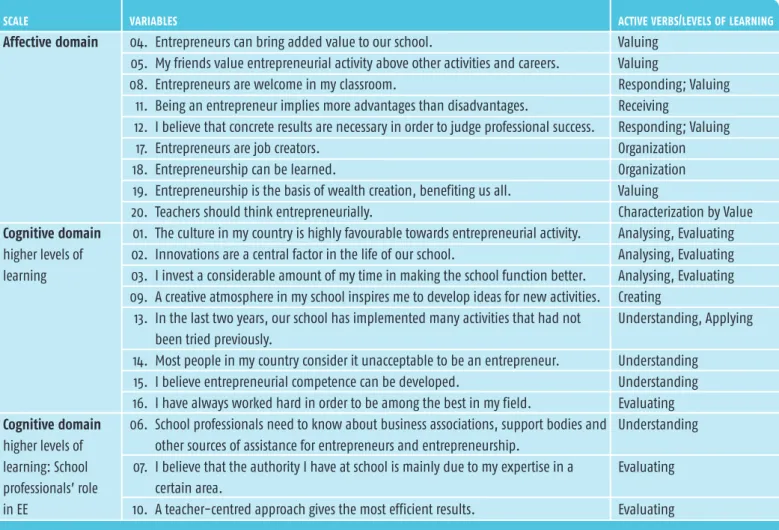
The extracted factors could be further explained by us based on the Bloom’s Taxonomy action verbs for the cognitive (Figure 4) and affective (Figure 5) do-mains. The description of the tested learning out-comes is given in Table 2.
The third part of the questionnaire, knowledge test, focused solely on the levels of remembering and understanding. In the second part of the question-naire, the most commonly tested learning outcomes
Figure 4: Revised Bloom’s Taxonomy – cognitive domain10
10 Anderson, L.W., & Krathwohl (Eds.). (2001). A Taxonomy for
Learning, Teaching, and Assessing: A Revision of Bloom’s Taxonomy of Educational Objectives. New York: Longman.
in the cognitive domain are on the level of evaluat-ing and analysevaluat-ing, followed by understandevaluat-ing, ap-plying and creating. Anderson11 emphasizes that for novices, the skill-based learning outcomes should be translated into cognitive learning outcomes. These findings are important for the further devel-opment of the questionnaire, where questions that belong to the cognitive domain and are covering higher levels of learning could be translated into the learning outcomes that belong to the psychomotor/ skill-based domain. Furthermore, having a list of the measurable learning outcomes should facilitate further efforts in the project implementation.
Figure 5: Bloom’s Taxonomy - affective domain12
11 Anderson, J. R. (1982). Acquisition of cognitive skill. Psycho-logical Review, 89, 369-406.
12 Krathwohl, D.R., Bloom, B.S. and Masia, B. B. (1964).
Tax-onomy of educational objectives, Book II. Affective domain.
New York, NY. David McKay Company, Inc. characterizing by value or value concept organizing and conceptualizing
valuing creating evaluating analysing applying understanding remembering responding receiving
The most commonly tested learning outcomes in the affective domain are on the level of valuing, fol-lowed by responding, receiving, organization and characterization by value. This finding, suggesting
the presence of a variety of levels of learning in the affective domain, provides an additional confirma-tion of the entrepreneurship-related learning out-comes scale for the affective domain.
Table 2: Explanation of entrepreneurship-related learning outcomes scale variables
variables
scale active verbs/levels of learning
Affective domain Cognitive domain higher levels of learning Cognitive domain higher levels of learning: School professionals’ role in EE Valuing Valuing Responding; Valuing Receiving Responding; Valuing Organization Organization Valuing Characterization by Value Analysing, Evaluating Analysing, Evaluating Analysing, Evaluating Creating Understanding, Applying Understanding Understanding Evaluating Understanding Evaluating Evaluating 04. Entrepreneurs can bring added value to our school.
05. My friends value entrepreneurial activity above other activities and careers. 08. Entrepreneurs are welcome in my classroom.
11. Being an entrepreneur implies more advantages than disadvantages.
12. I believe that concrete results are necessary in order to judge professional success. 17. Entrepreneurs are job creators.
18. Entrepreneurship can be learned.
19. Entrepreneurship is the basis of wealth creation, benefiting us all. 20. Teachers should think entrepreneurially.
01. The culture in my country is highly favourable towards entrepreneurial activity. 02. Innovations are a central factor in the life of our school.
03. I invest a considerable amount of my time in making the school function better. 09. A creative atmosphere in my school inspires me to develop ideas for new activities. 13. In the last two years, our school has implemented many activities that had not
been tried previously.
14. Most people in my country consider it unacceptable to be an entrepreneur. 15. I believe entrepreneurial competence can be developed.
16. I have always worked hard in order to be among the best in my field.
06. School professionals need to know about business associations, support bodies and other sources of assistance for entrepreneurs and entrepreneurship.
07. I believe that the authority I have at school is mainly due to my expertise in a certain area.
This chapter presents the results of analyses per-formed to answer the primary research question: What impact does the study have on the teachers’ and school management staff’s entrepreneurship competence in eight countries in South East Eu-rope? The first section presents the results on the difference of the teachers’ and school manage-ment staff’s entrepreneurship competence related learning outcomes between four curricular areas (language curriculum; social science curriculum; science curriculum; arts, technical and physical education curriculum). The second section pre-sents the results of the question on a difference
of the teachers’ and school management staff’s entrepreneurship competence related learning outcomes among the participating countries (Al-bania, Bosnia and Herzegovina, Croatia, Kosovo*, Macedonia**, Montenegro, Serbia, Turkey). The third section presents the results of the question on the difference of the teachers’ and school man-agement staff’s entrepreneurship competence re-lated learning outcomes between schools. Finally, the fourth section focuses on the study impact on the school management staff’s entrepreneurship-related learning outcomes, on the level of curricu-lar area and country.
3.1.1.
Entrepreneurship competence in different
curricular areas
When researching entrepreneurship competence in different curricular areas, it is necessary to under-stand the common ways in which entrepreneur-ship education is implemented across the ISCED 2 education curriculum in the participating countries. The European Commission13 reports on efforts to establish the mainstream of the entrepreneurship key competence in the curriculum in Albania, Croa-tia and Kosovo*. According to the Eurydice analysis of the EU countries (plus Norway and Turkey) lower secondary education curriculum, entrepreneurship education was primarily implemented through the social sciences curriculum (including economics, business studies and careers education), and the sciences curriculum (maths, sciences, technology, ICT). In Latvia and Sweden, entrepreneurship
edu-13 European Commission (2011). Entrepreneurship Education:
Enabling Teachers as a Critical Success Factor. Brussels:
European Commission.
cation was a compulsory part of the arts and music curriculum. The Eurydice analysis did not consider the language curriculum for the analysis of the inte-gration of entrepreneurship education.14
In relation to the data gathered in the quanti-tative section of this study, the robust analysis of one-way ANOVA may give guidance on the relation between curricular area and certain domains of en-trepreneurship competence (cognitive and affective domain). Changes of the pre-and post-test for each question in four different curricular areas were test-ed separately. This way, it is possible to determine the relation of the particular curricular area and changes in learning outcomes for specific learning types (cognitive and affective learning type).
14 Eurydice (2012). Entrepreneurship Education at Schools in Europe: National Strategies, Curricula and Learning Out-comes. Brussels: Eurydice.
3.1.
Figure 6: Curriculum-related results in the cognitive domain
(levels of remembering and understanding)
6 5 4 3 2 1 0 35 30 25 20 15 10 5 0 language language socialscience socialscience science science arts, technical&
physical
arts, technical& physical pre
4,14
pre 31
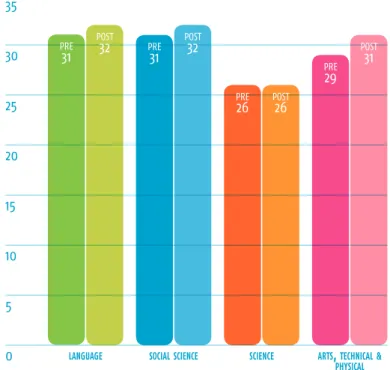
school management staff’s entrepreneurship-relat-ed learning outcomes in the cognitive domain, on the level of remembering and understanding, differ between four curricular areas. Significant positive changes occurred in two curricular areas (language and science curriculum). Further research should provide data on reasons because of which significant positive changes in the study participants’ knowl-edge did not occur in the social science curricular area and the arts, technical & physical education curricular area.
As visible from Figure 6, significant positive changes in the participants’ cognitive domain (levels of re-membering and understanding) on the p<0.05 level occurred for the language curriculum [F(1, 202)=11.864, p=0.001] and the science curriculum [F(1, 207)=6.305, p=0.013]. Significant negative changes of the participants’ knowledge occurred at schools belonging to the social science curricular area [F(1, 330)=4.226, p=0.041] (Annex 2, Table 3). Accord-ing to the statistical data, it is possible to conclude that the impact of the study on the teachers’ and
Figure 7: Curriculum-related results on the cognitive domain
(higher levels of learning) outcomes scale
post 4,78 post 32 pre 4,58 pre 31 pre 4,25 pre 26 pre 4,92 pre 29 post 4,22 post 32 post 4,76 post 26 post 5,09 post 31
The changes in the cognitive domain (higher levels of learning) scale are visible in Figure 7. A significant positive change among the study participants (An-nex 2, Table 4) on the p<0.05 level occurred for the social science curriculum [F(1, 321)=4.934, p=0.027] and the arts, technical and physical education curricu lum [F(1, 253)=7.115, p=0.008]. The presented data indicates that the study had a significant posi-tive impact on the development of higher levels of learning in the cognitive domain for participants in the social science curricular area and the art, tech-nical and physical education curricular area.
Significant negative changes on the participants’ cognitive domain (higher levels of learning) out-comes subscale focusing on the school profession-als’ role in EE (Annex 2, Table 5) on the p<0.05 level occurred for the language curriculum [F(1, 129)=24.325, p=0.000], the social science curriculum [F(1, 231)=10.601, p=0.001] and the arts, technical and physical education curriculum [F(1, 191)= 24.525, p=0.000]. The study findings related to the subscale focusing on the school professionals’ role in entre-preneurship education (additional cognitive domain scale for higher levels of learning), differ from find-ings for the main scale. It is apparent that this study had a negative impact on the participants’ recogni-tion of the school professionals’ role in the imple-mentation of entrepreneurship education (Figure 8).
14 12 10 8 6 4 2 0 40 35 30 25 20 15 10 5 0
language socialscience science arts, technical& language socialscience science
physical arts, physicaltechnical&
pre 12 pre 35 post 8 post 38 pre 12 pre 36 pre 8 pre 32 pre 11 pre 37 post 11 post 37 post 8 post 33 post 9 post 38
Figure 8: Curriculum-related results on the cognitive domain
(higher levels of learning) outcomes subscale - the school pro-fessionals’ role in EE
Figure 9: Curriculum-related results on the affective domain
As visible from Figure 9, positive changes occurred among participants in each curricular area. A sig-nificant positive change on the participants’ affective domain EE outcomes scale (Annex 2, Table 6) on the p<0.05 level occurred for the language curriculum [F(1, 157)=11.266, p=0.001], the social science curricu-lum [F(1, 330)=5.061, p=0.025], and the arts, physical and technical curriculum [F(1, 278)=8.408, p=0.004]. It is possible to conclude that this project had an overall positive impact on the entrepreneurship-related learning outcomes in the affective domain.
When analysing the statistically significant data, it is visible that this study had the largest impact on participants from the schools focusing on the social science curriculum. The improvements are
visible both in the cognitive domain (higher levels
of learning) and the affective domain for the so-cial science curricula. These results are not surpris-ing knowsurpris-ing that social sciences are traditionally viewed as curricular area that contributes to the theory and practice of entrepreneurship.15 Still, it would be necessary to further explore the reasons because of which this study had a negative impact on the cognitive domain (level of remembering and understanding) for the participants from the social sciences curricular area.
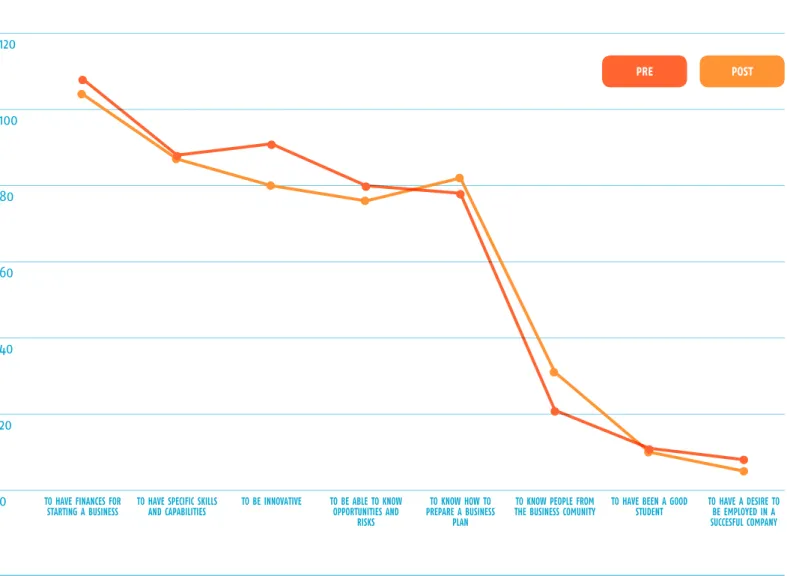
In addition to the set of questions analysed by robust one-way ANOVA measures, the study partici-pants also answered a multiple-answer question on the prerequisites needed for starting a new business. The participants’ answers are presented graphically, separately for each of the four curricular areas.
15 Swedberg, R. (2000). The social science view of entrepre-neurship: Introduction and practical applications. In R. Swedberg (ed.), Entrepreneurship: The social science view. Oxford University Press.
Figure 10: Business start-up - Language Curriculum 80 70 60 50 40 30 20 10 0 tohaveadesireto beemployedina succesfulcompany tohavebeenagood
student toknowpeoplefrom
thebusinesscomunity toknowhowto prepareabusiness plan tobeabletoknow opportunitiesand risks tobeinnovative
tohavespecificskills andcapabilities tohavefinancesfor
startingabusiness
As visible from Figure 10, teachers and school man-agement staff focusing on the language curriculum changed their opinion in relation to the recognition of the importance of all listed skills needed for a new business start-up. They changed their opinion in relation to issues of financing, innovativeness, and business planning.
post pre
Figure 11: Business start-up - Social Science Curriculum 90 80 70 60 50 40 30 20 10 0 tohaveadesireto beemployedina succesfulcompany tohavebeenagood
student toknowpeoplefrom
thebusinesscomunity toknowhowto prepareabusiness plan tobeabletoknow opportunitiesand risks tobeinnovative
tohavespecificskills andcapabilities tohavefinancesfor
startingabusiness
As visible from Figure 11, the study participants fo-cusing on the social science curriculum had only a slight change in opinion on the importance of skills needed for a new business start-up. The largest change occurred in relation to the recognition of the importance of innovativeness.
post pre
120 100 80 60 40 20 0 tohaveadesireto beemployedina succesfulcompany tohavebeenagood
student toknowpeoplefrom
thebusinesscomunity toknowhowto prepareabusiness plan tobeabletoknow opportunitiesand risks tobeinnovative
tohavespecificskills andcapabilities tohavefinancesfor
startingabusiness
Figure 12: Business start-up - Science Curriculum As visible from Figure 12, participants form the
sci-ence curriculum had thea largest change from pre-to post-test in relation pre-to the recognition of the importance of finances for starting a business. The participants’ opinion in relation to other issues changed minimally.
post pre
Figure 13: Business start-up - Arts, Technical & Physical Educa-tion Curriculum 100 90 80 70 60 50 40 30 20 10 0 tohaveadesireto beemployedina succesfulcompany tohavebeenagood
student toknowpeoplefrom
thebusinesscomunity toknowhowto prepareabusiness plan tobeabletoknow opportunitiesand risks tobeinnovative
tohavespecificskills andcapabilities tohavefinancesfor
startingabusiness
As visible from Figure 13, the study participants fo-cusing on the arts, technical and physical educa-tion curriculum had a slight change in opinion on the importance of skills needed for a new business start-up.
post pre
3.1.2
Entrepreneurship competence at different
schools
The two-way analysis of variance (ANOVA) was con-ducted to test the hypothesis that there would be one or more mean differences between schools and teacher and school management staff responses on pre- and post-questionnaire questions dealing with the cognitive and affective learning domain. The significant results are presented. The names of schools are marked by abbreviations, while the ab-breviation explanations are listed in Annex 3.
The statistical analysis results (Annex 2, Table 7) pre-sented in Figure 14 indicate a significant increase on the p<0.05 level which occurred on the cognitive domain scale for the schools which focused on the social science curriculum (KSSC school [F(1, 36)=10.687, p=0.002]; the MNSA [F(1, 29)=178.42, p=0.000 ]; the RSSC school[F(1, 33)=7.388, p=0.010]); on the science curriculum (BHSB school [F(1, 27)= 20.785, p=0.000]; MNSD [F(1, 35)=11.713, p=0.002 ]); on the arts, physical & technical education curriculum (BHSC school [F(1, 38)=9.941, p=0.003]) and the language curriculum (HRSC school [F(1, 37)=224.307, p=0.000]). The results for the cognitive domain (levels of remembering and understanding) indicate that on the school level changes most commonly occurred at schools focus-ing on the social science curriculum.
Figure 14: School-related results in the cognitive domain (level
of remembering and understanding)
7 6 5 4 3 2 1 0 bhsb pre 4,11 post 6 bhsc pre 5,8 post 6,45 hrsc pre 6,4 post 2,85 kssc pre 4,2 post 2,84 mnsa pre 5,6 post 2,15 mnsd pre 5,2 post 6,05 rssc pre 4,88 post 5,85
[F(1, 29)= 75.348, p=0.000]); on the arts, physical & technical education curriculum (ALSA school [F(1, 49)=99.981, p=0.000]; KSSA school [F(1, 12)= 49.091, p=0.000]); and onthe science curriculum (MKSA school [F(1, 20)= 155.27, p=0.000]; MNSD school [F(1, 37)= 13.032, p=0.001]). The results for the cognitive domain (higher levels of learning) indicate that on the school level for changes most commonly occurred at schools focusing on the social science curriculum.
Figure 15: School-related results on the cognitive domain
(higher levels of learning) outcomes scale
45 40 35 30 25 20 15 10 5 0 alsa pre 26,3 post 33,7 alsb pre 37,22 post 33,75 kssa pre 17,14 post 12,86 mksa pre 31,15 post 18,43 mksb pre 30,75 post 33,42 mnsa pre 32,56 post 39,75 mnsd pre 29,25 post 32,37
The statistical analysis results (Annex 2, Table 8) presented in Figure 15 indicate a significant increase on the p<0.05 level which occurred on the cognitive domain (higher levels of learning) outcomes scale for the schools which focused on the social science curriculum (ALSB school [F(1, 35)=15.996, p=0.000]; MKSB school [F(1, 36)=6.517, p=0.015]; MNSA school
Figure 16: School-related results on the cognitive domain
(higher levels of learning) outcomes subscale - the school pro-fessionals’ role in EE
HRSC school [F(1, 37)=4.626, p=0,038]; TRSD school [F(1, 34)=7.952, p=0.008]; on the social science cur-riculum (KSSC school [F(1, 35)= 5.018, p=0.032]), and the science curriculum (MKSA school [F(1, 24)=16.74, p=0.000]). The cognitive domain (higher levels of learning) subscale provides information on the schools at which significant changes occurred in relation to the recognition of school professionals in entrepreneurship education. The results indicate that most commonly significant changes occurred at schools focusing on the language curriculum.
16 14 12 10 8 6 4 2 0 bhsd pre 10,47 post 12,25 hrsc pre 11,8 post 10,7 kssc pre 10,68 post 12,2 mksa pre 11,9 post 13,71 trsd pre 10,1 post 11,85
As visible from Figure 16, the statistical analysis re-sults (Annex 2, Table 9) indicate a significant increase on the p<0.05 level which occurred on the cognitive domain (higher levels of learning) outcomes sub-scale focusing on the school professionals’ role in EE for the schools which focused on the language curriculum (BHSD school [F(1, 29)=9.135, p=0.005];
Figure 17: School-related results on the affective domain
out-comes scale
14.087, p=0.003]), on the science curriculum (BHSB [F(1, 31)=6.963, p=0.013]; TRSB school [F(1, 35)=9.390, p=0.004]); on the language curriculum (HRSC school [F(1, 35)= 5.882, p=0.021]; TRSD school [F(1, 27)=9.778, p=0.004]); and the social science curriculum (MKSB school [F(1, 36)=8.872, p=0.005]; MNSA school [F(1, 25)=30.002, p=0.000]). The presented results indi-cate that on the school level for the affective domain, changes most commonly occurred at schools focusing on the arts physical & technical education curriculum. As visible from Figure 17, the statistical analysis results
(Annex 2, Table 10) indicate a significant increase on the p<0.05 level which occurred on the affective do-main outcomes scale for the schools which focused on the arts, physical & technical education cur-riculum (ALSA school [F(1, 52)=151.17, p=0.000]; BHSC
school [F(1, 32)=5.653, p=0.024]; the KSSA [F(1, 12)=
50 45 40 35 30 25 20 15 10 5 0 alsa pre 31,63 post 40,74 bhsb pre 33,67 post 37,62 bhsc pre 35,3 post 39 hrsc pre 32,55 post 34,75 kssa pre 43 post 40,43 mksb pre 34,2 post 37,68 mnsa pre 38,72 post 43,5 trsb pre 35,5 post 38,65 trsd pre 27,9 post 34,5
3.1.3.
Entrepreneurship competence in different
countries
The changes in entrepreneurship competence in dif-ferent countries should be observed with caution re-lated to the initial entrepreneurship training that was delivered to the study participants in each of the par-ticipating countries. The difference in length of the training, content of the training and trainers could be linked to the changes in the pre- and post-testing.
As visible from Figure 18, the statistical analysis results (Annex 2, Table 11) indicate that the signifi-cant increase in entrepreneurial knowledge on the p<0.05 level occurred in Bosnia and Herzegovina [F(1, 144)=11.529, p=0.001], Croatia [F(1, 73)=27.846, p=0.000], Kosovo* [F(1, 91)= 5.408, p=0.022], and Montenegro [F(1, 99)= 12.864, p=0.001].
Figure 18: Country-related results in the cognitive domain
(level of remembering and understanding)
7 6 5 4 3 2 1 0 albania pre 3,58 post 3,78 bosniaand herzegovina pre 4,86 post 5,59 croatia pre 4,67 post 6,16 kosovo* pre 2,96 post 3,53 macedonia** pre 4,56 post 4,86 montenegro pre 5,38 post 4,35 serbia pre 5,38 post 5,24 turkey pre 4,86 post 4,63
40 35 30 25 20 15 10 5 0 albania pre 32,82 post 34,68 bosniaand herzegovina pre 29,63 post 31,44 croatia pre 29,94 post 29,45 kosovo* pre 15,15 15,09post macedonia** pre 32,14 post 31,58 montenegro pre 31,18 post 34,82 serbia pre 29,82 post 30,49 turkey pre 28,09 post 28,92
Figure 19: Country-related results on the cognitive domain
(higher levels of learning) outcomes scale
As visible from Table 12 (Annex 2) and Figure 19, the significant changes on the cognitive domain (higher levels of learning) outcomes scale on the p<0.05 level occurred in Albania [F(1, 124)=9.19, p=0.003], Bosnia and Herzegovina [F(1, 143)=8.77, p=0.004] and Montenegro [F(1, 82)=10.65, p=0.002].
14 12 10 8 6 4 2 0 albania pre 9,07 post 0 bosniaand herzegovina pre 11,29 11,42post croatia pre 11,63 post 11,2 kosovo* pre 7,82 post 8,23 macedonia** pre 12,24 post 13,28 montenegro pre 12,35 post 12,82 serbia pre 11,75 post 11,38 turkey pre 10,81 post 11,05
Figure 20: Country-related results on the cognitive domain
(higher levels of learning) outcomes subscale - the school pro-fessionals’ role in EE
Figure 20 depicts differences in country related results on the cognitive domain (higher levels of learning) outcomes subscale, focusing on the school professionals’ role in entrepreneurship education. As visible from Table 13 (Annex 2), the significant changes on the cognitive domain (higher levels of learning) outcomes subscale focusing on the school professionals’ role in EE did not occur.
Figure 21: Country-related results on the affective domain
outcomes scale
As visible from Table 14 (Annex 2) and Figure 21, the significant changes on the affective domain out-comes scale on the p<0.05 level occurred in Albania [F(1, 123)=18.04, p=0.000] and Bosnia and Herzego-vina [F(1, 137)=16.07, p=0.000]. 45 40 35 30 25 20 15 10 5 0 albania pre 38,89 post 40,77 bosniaand herzegovina pre 35,05 post 38,14 croatia pre 35,16 post 36,16 kosovo* pre 23,39 post 25,11 macedonia** pre 36,71 post 37,94 montenegro pre 37,65 post 39,57 serbia pre 35,65 35,86post turkey pre 33,81 post 35,8
The quantitative data analysis results indicate that this study had the best impact on the participants in Bosnia and Herzegovina and Montenegro where sig-nificant positive changes occurred on different levels in the cognitive domain. Furthermore, the results for Bosnia and Herzegovina indicate a significant positive change in the affective domain, while the results for Albania indicate positive changes in the cognitive domain (higher levels of learning) and the affective domain. The additional qualitative data from the countries, in which significant changes occurred in different domains or in different levels of the same domain, should be used in the fur-ther project planning. The changes in the learning outcomes for each of the analysed tests and scales should be observed in relation to the intensive pre-testing training for the participants. Furthermore, the findings for the countries, in which significant changes did not occur, should be observed in rela-tion to the country educarela-tional policy and current state of entrepreneurship education implementa-tion. For example, the results for Turkey should be
observed in relation to the initiatives to implement entrepreneurship education in the general educa-tion (ISCED 1-3), 2011/12 that are part of a broader national strategy for lifelong learning. Nevertheless, approaches to entrepreneurship education in pri-mary education (ISCED 1), according to central steer-ing documents, for 2011/12 in Turkey are not explicitly mentioned in the steering documents (official docu-ments containing curricula, guidelines, obligations and/or recommendations). Also, the learning out-comes for entrepreneurship education in Turkey are defined only on ISCED3 level16.
16 Eurydice (2012). Entrepreneurship Education at School in Eu-rope: National Strategies, Curricula and Learning Outcomes. Brussels: Eurydice.
Separate statistical analyses were conducted to determine the significance of the study impact on the school management staff’s entrepreneurship-related learning outcomes. In addition to overall statistical changes for the entire sample, the se-lected statistical measures were tested in relation to the curricular area and country.
Figure 22: Study impact on the school management staff
3.2.
study of strategic piloting impact on the school
management staff
The results are presented in Figure 22, and suggest that positive changes among the school manage-ment staff did occur, but were insignificant for each of the tested domains (Annex 2, Table 15). Additional analysis of the study impact on the entrepreneurship-related learning outcomes for different curricular areas and different countries revealed predominantly insignificant changes for the school management staff. The signifi-cant changes occurred only in the cognitive do-main (level of remembering and understanding) among the school management staff working at schools focusing on the language curriculum [F(1, 9)=12.039, p=0.007] and the science curriculum [F(1, 13)=4.706, p=0.049]. In addition, significant changes in the same domain occurred only among the school management staff in Croatia [F(1, 8)=6.136, p=0.040] (Annex 2,Table 16).
Predominantly insignificant changes for the school management staff indicate the need for changes in the project implementation, related to the role of the school management staff.
40 35 30 25 20 15 10 5
0 cognitivedomaini cognitivedomainii cognitivedomainiii affectivedomain
pre 4,93 5,47post pre 29,79 pre 10,98 pre 35,33 post 30,73 post 11,11 post 36,8
The quantitative data analysis indicated that on the curricular level , the significant positive changes in the cognitive domain, on the level of remembering and understanding occurred among participants at schools focusing on the language curriculum and the science curriculum. In addition, the significant changes on the higher level of learning in the cogni-tive domain occurred for participants in the social science curricular area and the art, technical and physical education curricular area. Nevertheless, the study findings indicate that a negative impact on the participants’ recognition of the school profession-als’ role in the implementation of entrepreneurship education. In relation to different curricular areas, this study had the largest impact on participants from the schools focusing on the social science cur-riculum. The improvements are visible both in the
cognitive domain (higher levels of learning) and the affective domain for the social science curricula. Nevertheless, there is a need for further exploration of reasons due to which this study had a negative impact in the cognitive domain (level of
remember-ing and understandremember-ing) for the participants from the social sciences curricular area.
The results of the separate analyses on the level of schools for the different levels of the cognitive domain indicate that the changes most commonly occurred at schools focusing on the social science curriculum. The results differ for the cognitive do-main (higher levels of learning) subscale focusing on the recognition of the school professionals’ role in entrepreneurship education. The results indicate that most commonly significant changes occurred at schools focusing on the language curriculum. Also, the presented results indicate that on the school level for the affective domain changes most commonly occurred at schools focusing on the arts physical & technical education curriculum.
The analysis on the level of countries indicate that this study had the best impact on the participants in Bosnia and Herzegovina and Montenegro where sig-nificant positive changes occurred on different levels of the cognitive domain. Furthermore, the results for Bosnia and Herzegovina indicate significant positive change in the affective domain, while results for Albania indicate positive changes in the cognitive (higher levels of learning) and the affective domain.
According to the study results, positive changes in entrepreneurship-related learning outcomes among the school management staff did occur, but were insignificant for each of the tested domains. Signifi-cant changes occurred only for the cognitive domain, on the level of remembering and understanding, for the school management staff at schools focusing on the language curriculum and the science curriculum.
4.1.
Promising results in regards to the internal con-sistency of the entrepreneurship-related learn-ing outcomes scale indicate a high validity of the questionnaire. The factorial analysis was conducted on the large number of participants from different educational systems. The factorial analysis resulted in scales in two learning domains (affective and cognitive). The questions from the scale that should be linked to the higher levels of learning in the cog-nitive domain could be used in order to formulate learning outcomes for the skill-based domain. The quantitative analysis of the study data indicates the importance of initial training in delivery of this and similar projects focusing on the development of
entrepreneurship competence among teachers and other school staff. The additional qualitative data from the countries, in which significant changes occurred in different domains or in different levels of the same domain, should be used in the further project planning. Furthermore, the findings for the countries, in which significant changes did not occur, should be observed in relation to the country edu-cational policy and current state of entrepreneurship education implementation. Also, the predominantly insignificant changes for the school management staff indicate the need for changes in the project implementation, related to the role of the school management staff.
4.2.
5.
literature
• Anderson, J. R. (1982). Acquisition of cognitive skill. Psychological Review, 89, 369-406.
• Anderson, L.W., & Krathwohl (Eds.). (2001). A Taxonomy for Learning, Teaching, and Assessing: A Revision of Bloom’s Taxonomy of Educational Objectives. New York: Longman.
• Bray, M. et al. (Eds.) (2007). Comparative Educa-tion Research: Approaches and Methods. Hong Kong & Dordrecht, Netherlands: Springer.
• European Commission (2012). Commission Staff Working Document. Assessment of Key Compe-tences in initial education and training: Policy Guidance. Strasbourg: European Commission. • European Commission (2012). Guidebook Series:
Building Entrepreneurial Mindsets and Skills in the EU. Brussels: European Commission.
• European Commission (2011). Entrepreneurship Education: Enabling Teachers as a Critical Success Factor. Brussels: European Commission.
• European Communities (2007). The Key Com-petences for Lifelong Learning – A European
Framework. Luxembourg: Office for Official Pub-lications of the European Communities.
• Eurydice (2012). Entrepreneurship Education at School in Europe: National Strategies, Curricula and Learning Outcomes. Brussels: Eurydice. • Kozlinska, I. (2012). Fundamental view of the
outcomes of entrepreneurship education. Tartu: University of Tartu.
• Krathwohl, D.R., Bloom, B.S. and Masia, B. B. (1964).Taxonomy of educational objectives, Book II. Affective domain. New York, NY. David McKay Company, Inc.
• Shadish, W. R. Cook, T. D., & Campbell, D. T. (2002). Experimental and quasi-experimental designs for generalized causal inference. Bos-ton: Houghton Mifflin Company.
• Swedberg, R. (2000). The social science view of entrepreneurship: Introduction and practical ap-plications. In R. Swedberg (ed.), Entrepreneur-ship: The social science view. Oxford University Press.
Country
(please fill)
Name of the School
(please fill) Gender (please circle) Age (please fill) I am:
(please circle and fill)
Work experience
(please circle)
SCHOOL PROFESSIONALS QUESTIONNAIRE
1. Teacher
1.1. ...(Curriculum area) 1.2. ...(Subject)
2. School management staff
1. Male 1. Female 1. up to 5 years 2. from 6 to 10 3. from 10 to 15 4. from 16 to 20 5. from 21 to 25 6. 26 up
6.1.
The culture in my country is highly favourable towards entrepreneurial activity.
Innovations are a central factor in the life of our school.
I invest a considerable amount of my time towards making the school function better. Entrepreneurs can bring added
value to our school.
My friends value entrepreneurial activity above other activities and careers.
School professionals need to know about business associations, support bodies and other sources of assistance for entrepreneurs and entrepreneurship. I believe that the authority I have in the school is due
mainly to my expertise in a certain area. Entrepreneurs are welcome
in my classroom.
A creative atmosphere in my school inspires me to develop ideas for new activities.
A teacher centred approach gives the most efficient results.
Being an entrepreneur implies more advantages than disadvantages.
I believe that concrete results are necessary in order to judge professional success.
In the last two years, our school has implemented many activities that had not been tried previously. Most people in my country consider it
unacceptable to be an entrepreneur. I believe entrepreneurial competence can be developed.
I have always worked hard in order to be among the best in my field.
Entrepreneurs are job creators. Entrepreneurship can be learned.
Entrepreneurship is the basis of wealth creation, benefiting us all.
Teachers should think entrepreneurially.
SCHOOL PROFESSIONALS AND ENTREPRENEURSHIP
please circle three (3) of the statements accordance to your opinion
in the following questions please circle only one (1) of the answers
In order to start a new business the entrepreneur needs:
Productivity is:
We pay taxes:
• To have finances for starting a business
• To have specific skills and capabilities
• To be innovative
• To be able to know opportunities and risks
• To know how to prepare a business plan
• To know people from the business community
• To have been a good student
• To have a desire to be employed in a successful company
1. To earn more money
2. To produce a certain number of products in a given period of time
3. To achieve a goal in any case
1. So that public servants have something to do 2. To satisfy the need for public good
in the following questions please circle only one (1) of the answers
The most limited resource is:
A public good is:
For Valentine’s day, the price of the flowers increases because: 1. Gold 2. Solar energy 3. Air 4. Time 5. Water 1. Street lightning 2. City parks 3. Education 4. Public transportation 5. Army
1. Florist have decided to do so
2. Greenpeace is fighting against flower destruction 3. There are fewer flowers in winter
4. The demand has increased 5. They are cheaper than jewellery