econ
stor
Der Open-Access-Publikationsserver der ZBW – Leibniz-Informationszentrum Wirtschaft The Open Access Publication Server of the ZBW – Leibniz Information Centre for Economics
Nutzungsbedingungen:
Die ZBW räumt Ihnen als Nutzerin/Nutzer das unentgeltliche, räumlich unbeschränkte und zeitlich auf die Dauer des Schutzrechts beschränkte einfache Recht ein, das ausgewählte Werk im Rahmen der unter
→ http://www.econstor.eu/dspace/Nutzungsbedingungen nachzulesenden vollständigen Nutzungsbedingungen zu vervielfältigen, mit denen die Nutzerin/der Nutzer sich durch die erste Nutzung einverstanden erklärt.
Terms of use:
The ZBW grants you, the user, the non-exclusive right to use the selected work free of charge, territorially unrestricted and within the time limit of the term of the property rights according to the terms specified at
→ http://www.econstor.eu/dspace/Nutzungsbedingungen By the first use of the selected work the user agrees and declares to comply with these terms of use.
zbw
Leibniz-Informationszentrum Wirtschaft Leibniz Information Centre for Economics Lux, ThomasWorking Paper
The multi-fractal model of asset returns : its
estimation via GMM and its use for volatility
forecasting
Economics working paper / Christian-Albrechts-Universität Kiel, Department of Economics, No. 2003,13
Provided in cooperation with:
Institut für Weltwirtschaft (IfW)
Suggested citation: Lux, Thomas (2003) : The multi-fractal model of asset returns : its estimation via GMM and its use for volatility forecasting, Economics working paper / Christian-Albrechts-Universität Kiel, Department of Economics, No. 2003,13, In: Institut für Volkswirtschaftslehre, Kiel (Ed.), urn:nbn:de:101:1-200911022352 , http:// hdl.handle.net/10419/3031
Economics Working Paper
No 2003-13
The Multi-Fractal Model of Asset Returns: Its
Estimation via GMM and Its Use for Volatility
Forecasting
Its Estimation via GMM and Its Use for Volatility Forecasting
Thomas Lux*
Abstract: Multi-fractal processes have been proposed as a new formalism for modeling the time series of returns in finance. The major attraction of these processes is their ability to generate various degrees of long memory in different powers of returns - a feature that has been found to characterize virtually all financial prices. Furthermore, elementary variants of multi-fractal models are very parsimonious formalizations as they are essentially one-parameter families of stochastic processes. The aim of this paper is to provide the characteristics of a causal multi-fractal model (replacing the earlier combinatorial approaches discussed in the literature), to estimate the parameters of this model and to use these estimates in forecasting financial volatility. We use the auto-covariances of log increments of the multi-fractal process in order to estimate its parameters consistently via GMM (Generalized Method of Moment). Simulations show that this approach leads to essentially unbiased estimates, which also have much smaller root mean squared errors than those obtained from the traditional ‘scaling’ approach. Our empirical estimates are used in out-of-sample forecasting of volatility for a number of important financial assets. Comparing the multi-fractal forecasts with those derived from GARCH and FIGARCH models yields results in favor of the new model: multi-fractal forecasts dominate all other forecasts in one out of four cases considered, while in the remaining cases they are head to head with one or more of their competitors.
Keywords: multi-fractality, financial volatility, forecasting JEL classification: C20, G12
* Earlier versions of this paper have been presented at the International Conference on Long-Range Dependent Stochastic Processes and their Applications, Indian Institute of Science, Bangalore, 7 – 12 January 2002, the International Conference on Economics and Physics, Denpasar, 28 - 31 August, 2002, the Second ISM/SEKONDAI Economics Meeting, Institute of Statistical Mathematics, Tokyo, 11 November 2002 and the Second Symposium on Financial Fluctuations at Nihon Keizai Nikkei Corp., Tokyo, 12 – 14 November 2002. The author is indebted to many colleagues and participants of these events for their helpful comments. Particular thanks go to two JBES referees and editor-in-charge Alastair Hall for their most useful comments and suggestions, and to Hwa-Taek Lee and Simone Alfarano for their able research assistance. The present version of this paper has been completed during a sabbatical stay at International Christian University Tokyo whose great hospitality is gratefully acknowledged. The author also gratefully appreciates financial support by the Landeszentralbank Schleswig-Holstein and the Japan Society for the Promotion of Science.
February 2003 Address of author:
Department of Economics, University of Kiel, Olshausenstr. 40, 24118 Kiel, Germany [email protected]
1. Introduction
While so-called uni-fractal or self-similar processes, such as fractional Brownian motion, have been known for quite some time in empirical finance, more general multi-fractal processes have been considered only very recently. After some earlier attempts at recovering traces of multi-fractal behavior (Vassilicos, Demos and Tata, 1993, Ghasghaie, S. et al., 1996) this topic has also been taken up in a couple of recent papers. Among these contributions, Schmitt, Schertzer and Lovejoy (1999) and Vandewalle and Ausloos (1998a, b) concentrate on statistical analyses suggesting the multi-fractal nature of various financial records. Mandelbrot, Fisher and Calvet (1997), Mandelbrot (1999) and Calvet and Fisher (2002a) proceed one step further by proposing a compound stochastic process as a generating mechanism of stock returns and exchange rate changes in which a multi-fractal cascade plays the role of a time transformation. The message of these papers is unequivocal in indicating that the data under consideration consistently exhibit features that have been found to characterize multi-fractality in other environments (e.g. statistical analyses of turbulence1). However, the methods employed by these authors differ quite fundamentally from the usual techniques used to estimate and evaluate time series models in economics. Although a comparison of simulated multi-fractal processes with empirical data (Fisher, Calvet and Mandelbrot, 1997; Mandelbrot, 1999) suggests that they are, in fact, able to reproduce to a large extent the empirical characteristics of financial returns, no assessment of goodness-of-fit is provided in these early papers. A comparison of the performance of multi-fractals with, for example, GARCH processes as a candidate alternative, was particularly hampered by the fact, that ‘time series’ of this first vintage of multi-fractal processes have been generated by algorithms that are of a combinatorial nature rather than by truly iterative mechanisms.
The purpose of this paper is to go one (modest) step towards such an assessment of the empirical performance of multi-fractal cascade models. Following similar approaches by Breymann et al. (2000) and Calvet and Fisher (2001,2002b), we first set up a causal counterpart of one variant of the combinatorial multi-fractal model analyzed by Calvet and Fisher (2002a). The iterative nature of this process allows simulations of arbitrary length. We show that this process preserves the scaling laws of moments characterizing its combinatorial predecessor, so that we can also apply the ‘scaling estimator’ of Calvet and Fisher for estimating the parameters of the causal process. As an alternative, potentially more efficient framework for parameter estimation we consider Generalized Method of Moments (GMM) estimation. We discuss under what circumstances GMM might be applicable to this new class of long-memory models. For a certain selection of moment conditions, we explore the finite-sample properties of the GMM estimators via Monte Carlo simulations. As it turns out, the root mean-squared error (RMSE) from this procedure is much smaller than that of the
1 The similarities in the time series characteristics of financial data and data from turbulent flows has
stimulated a discussion about potential similarities in the underlying data generating mechanisms among physicists, cf. Vassilicos, 1995; Gashghaie et al., 1996, and Mantegna and Stanley, 1996.
standard heuristic estimation method. Furthermore, the decrease of RMSE under increasing sample size nicely exhibits T1/2 consistency for all parameter choices and sets of moment conditions we have explored. When increasing the number of moment conditions, we find a continuous improvement in terms of mean squared errors of parameter estimates albeit with decreasing marginal returns from additional moment conditions. As concerns the distribution of the statistic used in Hansen’s related test of overidentifying restrictions, we found almost no variation with sample size, parameter values and number of moment conditions. Unfortunately, the distribution of p-values seems to have too much mass on the extreme left-hand side even for relatively large samples up to 1000 observations, and, therefore, too often rejects the underlying model.
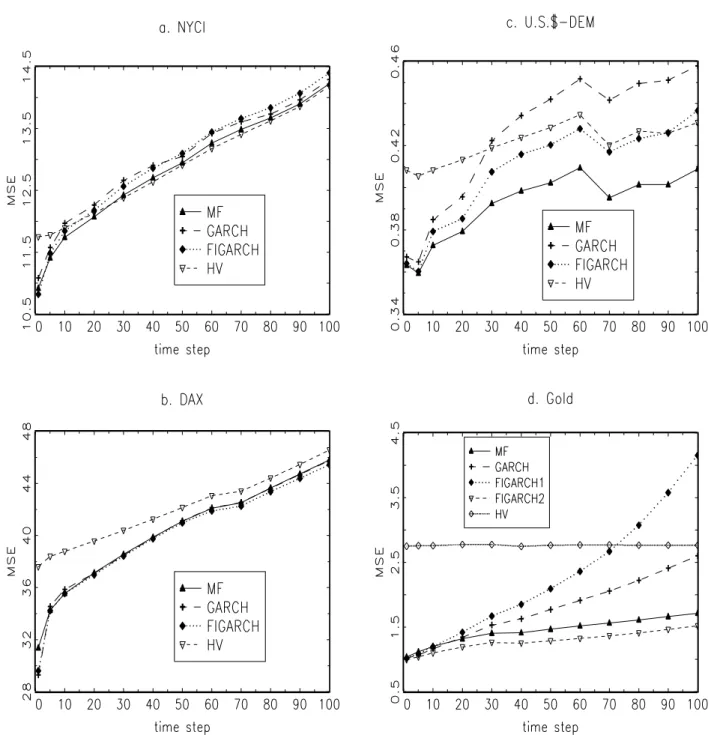
Equipped with these results, we estimate the parameters of the causal multi-fractal process for daily variations of various financial data: two stock market indices (the German DAX and the New York Stock Exchange Composite Index), an exchange rate (Deutsche Mark/U.S.$), and the daily price of gold from the London Precious Metal Exchange. Since the multi-fractal model allows to capture the long-term dependence of volatility and the scaling of various moments, one might also expect that it can be used as a tool for forecasting the time development of volatility over short and medium time horizons. The use of the multi-fractal (MF) model to this end is, however, hampered by the lack of identification of the individual volatility components (this unsolved task is known as the inverse multi-fractal problem in physics). Nevertheless, even without being able to identify the ruling individual components of the volatility dynamics, we can devise a best linear predictor using the aggregate information available in our time series. To this end, we construct best linear forecasts for future volatility within time horizons ranging from 1 day to 100 days. For comparison, we compute similar forecasts based on historical volatility (HV), GARCH and FIGARCH models. Overall, the performance of the MF model compares quite well to that of its competitors. It beats all other forecasts for the U.S.$-DEM exchange rate, while in forecasting the volatility of the gold price, it comes in second in a very narrow race with one specification of the FIGARCH model. Furthermore, while the gain in MSEs is probably negligible for small forecasting horizons in these cases, the gap between the multi-fractal (or the multi-fractal and the FIGARCH model) and alternative methods also widens with increasing time horizon and becomes quite sizable for larger forecasting horizons. For the two stock indices, results from HV, GARCH, FIGARCH and the multi-fractal model are almost indistinguishable, which might be explained by the tremendous increase of volatility in our out-of-sample period 1997/98.
Our aims of constructing iterative multi-fractal cascades and developing rigorous estimation methods are shared by three other recent entries in the literature. Breymann et al. (2000) have developed a model very similar to the present one and explore some of its scaling characteristics. Another closely related version of a causal multi-fractal model is studied in Calvet and Fisher (2001, 2002b). In contrast to the present entry, they assume that the multipliers are drawn from a Binomial distribution which allows maximum likelihood estimation based on the Hamilton filter for
Markov-switching processes. Most interestingly, they have also been the first to investigate the performance of a multi-fractal model in forecasting volatility. However, for the one-day forecasting horizons considered in their paper, they were unable of finding an advantage of MF against standard GARCH models. We will point to the similarities and differences between our approach and results and theirs repeatedly over the course of the presentation.
The paper proceeds as follows: sec. 2 introduces both the original combinatorial multi-fractal model with Lognormal multipliers as well as its causal counterpart used in the present study. Sec. 3 presents the scaling estimator introduced by Calvet and Fisher (2002a) while sec. 4 develops our alternative GMM estimator and provides a comparative Monte Carlo study of the performance of both estimators. Sec. 5 deals with some problems of empirical implementation of the GMM approach and reports the results of estimating the multi-fractal model for four different financial time series. Sec. 6 continues with the forecasting competition between the MF model and three alternative approaches. Sec. 7 concludes. The Appendix contains derivations of various analytical moments of the multi-fractal process used in both GMM estimation and forecasting as well as details on our GARCH and FIGARCH estimates used in sec. 6.
2. The Multi-Fractal Model: Combinatorial and Causal Versions
The multi-fractal model put forward in Mandelbrot, Calvet and Fisher (1997) and Calvet and Fisher (2002a) postulates that returns { x(t) } follow a compound process:
(1) x(t) = BH[θ(t)].
In this notation, BH[ ] is a fractional Brownian motion with index H, and θ(t) is the distribution
function of a multi-fractal measure which plays the role of a time-deformation. Both component processes are assumed to be independent of each other. With a time-homogeneous Brownian process BH, the multi-fractal measure θ(t) is responsible for changes in the scale of the fluctuations
which generate heteroskedasticity of the overall dynamics. In contrast to the GARCH and stochastic volatility models and their descendants, the above cascade model is scale-free and, therefore, one and the same specification can be applied to data of different sampling frequencies. This feature is highlighted by Calvet and Fisher in their analysis of both high-frequency and daily returns of the Deutschmark/U.S.$ exchange rate.
In our application, we simplify the general compound model by setting H = 0.5. This means we restrict the price process assuming that (in transformed time) the logs of prices follow a (Wiener) Brownian motion instead of fractal Brownian motion with arbitrary H. The reason is that empirical evidence in favor of H ≠ 0.5 is weak: statistical tests can usually not reject the null hypothesis H =
0.5 for raw returns (cf. Lo, 1991; Goetzman, 1991; Mills, 1993),2 while absolute and squared returns have values of H significantly exceeding 0.5. Hence, the picture from the literature (as well as from a preliminary analysis of our time series) is that long-term dependence (which shows up in an estimate H > 0.5) is confined to various powers of returns, but is almost absent in the raw data. In order to model long-term dependence in the powers, we do not need to assume a fractional Brownian motion of returns. This feature of the data can be accounted for by the introduction of the multi-fractal time-transformation alone.
Inspired by the multi-fractal models for turbulent flows in physics several models of multiplicative cascades have been applied for modeling the time-transformation θ(t). Mandelbrot, Calvet and Fisher focus on the so-called Binomial and Log-normal cascades, while Schmitt, Schertzer and Lovejoy (1999) estimate the parameters of the Log-Levy model for a number of foreign exchange rates. To get a basic idea of this approach, it is useful to first have a look at one of the simplest cases, the Binomial model.
In their original form, multi-fractal cascades are operations performed on probability measures. 3 The ‘cascade’ starts with assigning uniform probability to the interval [0,1]. In the first step, this interval is split up into two subintervals of equal length, which receive a fraction m0 and 1 - m0,
respectively, of the total probability mass. In the next step, each subinterval is again split up into two subintervals, which again receive fractions m0 and 1 - m0 of the probability mass of their
‘mother’ intervals. In principle, this procedure is, then, repeated ad infinitum.
It is easy to envisage more or less complicated variants of this general procedure: first, the probabilities could be assigned in a systematic fashion (e.g. always assigning probability m0 to the
left hand descendant and 1 - m0 to the right-hand descendant of a mother interval). Alternatively,
this assignment could be made randomly. Going beyond the Binomial model, one could think of more than two subintervals to be generated in each step (which leads to multinomial cascades) or of generating random numbers for m0 in each iteration instead of using the same constant value
throughout the formation of the cascade. The Log-normal and Log-Levy models mentioned above are examples of the latter type of multi-fractal measures.
In the resulting final stage of the creation of a combinatorial cascade process consisting of, say, k such operations, the remaining subintervals all have size 2-k and do possess mass identical to the product of their k multipliers chosen at different levels of the cascade:
2 It is also well-known that the R/S and other estimation methods are positively biased around H = 0.5 which
may explain some (seemingly significant) findings of H in excess of one half in the earlier literature (cf. North and Halliwell, 1994).
3 Tel (1988), Falconer (1990) and Evertz and Mandelbrot (1992) are recommendable introductory sources to
(2)
∏
= = θ k 1 i ) i ( j j m ,with j a partition of the unit interval, i.e. j is an index of subintervals with constant mass: } 2 ,..., 2 , 1 j ], 2 j , 2 ) 1 j [( : {θj =θ − ⋅ −k ⋅ −k = k .
Depending on the type of process, the m(ji)may represent independent draws from a Binomial, Lognormal or any other distribution one considers useful in this context. The defining characteristic of these measures is their non-linear scaling of moments, i.e.
(3) E[θqj]=
( )
2−k τ(q)+1with τ(q) a non-linear function of q. Various scaling functions for different underlying distributions of the multipliers can be found in Calvet, Fisher and Mandelbrot (1997). Defining
1 H q ) q ( = ⋅ q−
τ , we can highlight the key difference between uni-fractal and multi-fractal processes: for the former Hq is a constant and, hence, τ(q) is linear in q. For multi-fractal processes,
on the contrary, the nonlinear shape of τ(q) implies non-constant Hq. It is this feature which makes
the later formalism an attractive model of financial returns. In fact, variability of H over various powers has been found to be a pervasive feature of financial data. The first systematic inquiry into the behavior of various measures of long-term dependence with varying powers q has been contributed by Ding, Engle and Granger (1993) and their findings have been confirmed in a number of other studies recently (Lux, 1996; Mills, 1997). The consensus now is that this feature appears in virtually all financial prices (Anderson and Bollerslev, 1997; Lobato and Savin, 1998). It is noteworthy that, although the above authors did not refer to multi-fractality in their papers, they did already point to empirical regularities of the type depicted in eq. (3) that are consistent with the multi-fractal model. Their basic message is, therefore, very similar to that of the recent contributions by Fisher, Calvet and Mandelbrot (1997), Schmitt, Schertzer and Lovejoy (1999), and Calvet and Fisher (2001, 2002a, b). The progress made by the later papers is, however, to go beyond a description of stylized facts and to propose a new class of models that genuinely allows to capture these facts.
The approach proposed by Calvet and Fisher (2002a) consists in interpreting the order of the subsets of a multi-fractal measure within the interval [0, 1] as an ordering along the time axis so that
j
θ can be used as a transformation of homogenous clock-time or, in an equivalent interpretation, as the local volatility of the process governing stock price changes. It is immediately obvious that one important limitation of this approach is the finite support of the resulting compound process. Although one imposes a temporal order on the subintervals, the whole ‘time path’ is still obtained
(or simulated) in one act which leaves no room for predicting the likely future development after the end of the current cascade. Furthermore, with an underlying cascade extending over k steps, we have exactly 2k different subintervals at our disposal and, therefore, could lodge only time series which are no longer than that. It is not clear how one should proceed when reaching the end point T = 2k, since starting with a new cascade, for example, would amount to a structural break at T without any dependence between the parts of the time series before and after that point.4 This underscores the need for an iterative framework instead of the traditional combinatorial approach.
Expanding on a recent proposal by Breymann et al. (2000) and a similar approach found in Calvet and Fisher (2001, 2002b), we replace the non-causal construction outlined above by an iterative mechanism that preserves its essential features. This approach conserves the hierarchical nature of the volatility process but allows for stochastic changes of its individual components over time. The volatility components, m(ti) at time t (chronological time t now replacing the ordering j within the unit interval), are, then, replaced over time by new multipliers with certain probabilities. To replicate the structure of a binary cascade, the probability of replacement would have to be:
(4) Prob (new m(ti)) = 2-(k-i) .
This implies that the last multiplier would be replaced with probability Prob (new m(k)) = 1 at each time step, while the first, i = 1, would be replaced with probability Prob(new m ) = 2(1) -(k-1). Keeping in line with the spirit of the original non-causal model, replacement of an element m(tp) would also have the consequence of replacement of all subordinated multipliers p+1, p+2, …, k at t. This is in contrast to the approach of Calvet and Fisher (2002b) who assume independent replacement operations at all levels of the cascade.
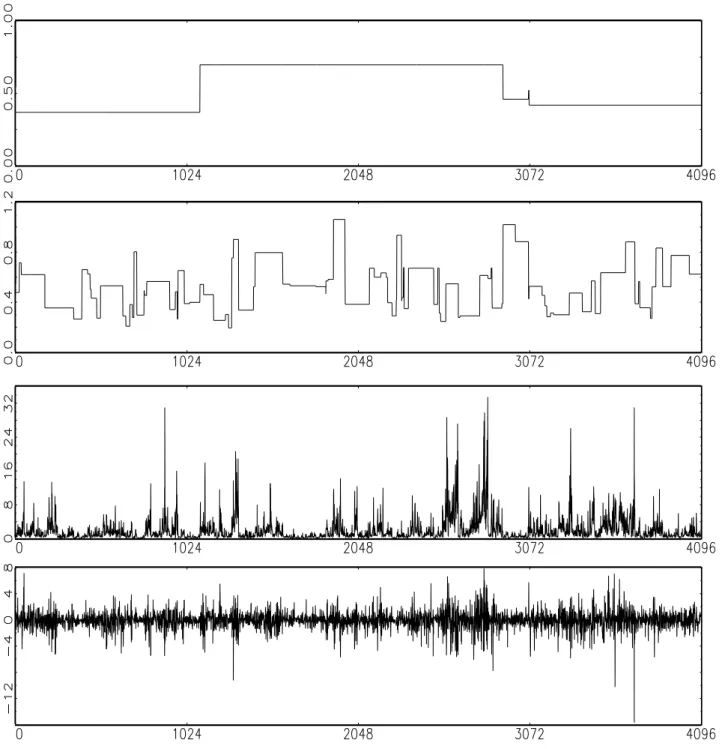
The construction of our iterative cascade process is illustrated in Fig. 1. The first and second panel exhibit the developments of the multipliers of levels 2 and 6. The basic difference with respect to the combinatorial models is that their renewal occurs in irregular intervals determined as random events. For example, in a simulation of the same length the second level multiplier would have exactly four different realizations of exactly equal duration in the framework of Calvet and Fisher (2002a), while here it has 5 realizations of very different duration. The third panel shows the overall volatility process resulting from the superimposition of all active multipliers, while the bottom panel exhibits the dynamics of returns as a compound process with an incremental Wiener
4 Muzy et al. (2001) construct an iterative ‘multi-fractal random walk’ assuming a finite depth of its
underlying volatility cascade and extract the number of valid multipliers, k, from the ‘zero-crossing’ of the auto-correlation function of absolute returns. However, under ‘true’ long-memory, autocorrelations should remain positive over all lags. In any case, even if there were a finite correlation length, the ‘zero-crossing’ might be hard to identify due to the noisiness of the autocorrelation function at long lags.
Brownian motion sampled at unit time intervals. This illustration is, in fact, similar to Fig. 1 in Calvet and Fisher (2001) although the model presented there is based on a continuous-time Poisson process governing the replacement of multipliers. In its discretized version, the later is equivalent to the process studied here.
Insert Fig. 1 about here
As a consequence of our construction, on average 2k-1 adjacent time steps share the same multiplier at level 1, 2k-2 the same multiplier at level 2 etc. Note that in the non-causal binary cascade model, there are (with a process consisting of k iterations) exactly 2k-1 adjacent subintervals with the same multiplier at level 1, 2k-2 subintervals with the same multiplier at level 2 etc. The iterative process, therefore, preserves the average duration of hierarchical components but allows for stochastic fluctuations in their realized durations. Like in the standard model, many choices for the selection of the m(ti) are possible. For the sake of comparability, a particularly well-known model is chosen here, the Lognormal model. This means that when a new multiplier is needed at any level, it will be determined via a random draw from a Log-Normal distribution:
(5) m(ti) ~LN
(
−λln(2),s2ln(2)2)
,where the normalization of the parameters of the Lognormal distribution via multiplication by ln(2) stems form consideration of binary intervals in the combinatorial process. To facilitate comparison with earlier literature, we keep this convention in our causal setting.
Note, that in (5), the scale parameter, s2, of the Lognormal distribution must be determined from the restriction5 E[M] = 0.5, which in the combinatorial model is necessary to preserve average mass of the interval [0, 1] during the evolution of the cascade, and, therefore, prevents nonstationarity of the multi-fractal cascade dynamics (explosion to infinity or collapse to zero upon addition of further volatility components). With this restriction, we can substitute s2 =2(λ−1)/ln(2)and the Lognormal volatility process therefore, boils down to a one-parameter model which is fully defined by the parameter λ.
To see the similarity to the model analyzed in Mandelbrot, Calvet and Fisher (1997) and Calvet and Fisher (2002a), we compute the unconditional moments of the resulting process. Let us denote by µt the causal multi-fractal process:
(6)
∏
= = µ k 1 i ) i ( t t mwith replacement rule (4). Its q-th moment is given by: (7)
(
)
( )
= = µq] E mt(1)m(t2)...m(tk) q E m(ti) k⋅q [ E tsince all the m(ti) are independent. For the Log-normal model, this leads to: (8) E[ q] exp
(
k(
q ln(2) q2( 1)ln(2))
)
t = − λ + λ−
µ
which can be transformed into: (9) E[ q]
( )
2 k (q) 1 t + τ − = µ with: τ(q)=qλ−q2(λ−1)−1.Since τ(q) is the celebrated scaling function of the Log-Normal model for turbulence first proposed in Mandelbrot (1974), the behavior of unconditional moments is identical to that of the traditional combinatorial model. Since the unconditional moments of the resulting volatility model are not affected by our randomization of replacement times, we can apply the traditional ‘scaling estimator’ built upon this relationship to estimate the parameters of the causal model (cf. Calvet and Fisher, 2002a). However, we will see that this estimator has relatively large bias and root mean squared error in finite samples and is dominated by a GMM estimator to be introduced in section 4 below.
Using the iterative version of the multi-fractal model instead of its combinatorial predecessor in the process (1), and confining attention to unit time intervals, the resulting dynamics can also be seen as a particular version of a stochastic volatility model. Rescaling the volatility dynamics in a way to preserve a mean value equal to 1 of the cascade, we can write returns over unit time intervals as the product of local volatility and Normally distributed increments:
(10) k t 1 i ) i ( t k t 2 m u x =
∏
⋅σ⋅ = ,in which the factor 2k compensates for the mean value equal to 0.5 of the k multipliers, ut is a
standard Normal random variate ut ~ N(0,1), and σ is the standard deviation of the incremental
3. Estimation of the Multi-Fractal Parameters: The Scaling Approach
In the physics literature, multi-fractal behavior is usually identified via analysis of the so-called partition function S t q( , )∆ of a time series. Denoting by p(t) the logarithm of the asset price at time t, it summarizes the behavior of moments q of increments (returns) computed over various time horizons ∆t: (11) S t q( , )∆ = int[ / ]{ (p t t) p t( ) } t T t q + − =
¦
∆ ∆ 1 ∼∆
t
τ(q)In the pertinent literature, the parameters of multi-fractal cascades are usually not estimated directly from the scaling function τ(q), but rather from its Legendre transformation:
(12) f(α) =
q
q q
arg min[ α τ− ( )].
The resulting function f(α) can be interpreted as the distribution of so-called local Hölder exponents α (which as a continuum of local scaling factors replaces the unique Hurst exponent of uni-fractal processes such as fractional Brownian motion). In the case of the Log-normal model, both the τ(q) and f(α) functions depend on one parameter, the location parameter λ of the Lognormal distribution LN
(
−λln(2),2(λ−1)ln(2))
from which the volatility components are drawn. The pertinent fractal spectrum is given by (cf Calvet and Fisher, 2001a):(13) fµ(α) = 1 − − − ( ) ( ) α λ λ 2 4 1 .
In estimating the multi-fractal spectrum of returns time series, we note that under the assumption of Brownian motion of price changes in transformed time the spectrum of the compound process x(t) = BH[θ(t)] is related to the spectrum of the multi-fractal time-transformation µ(t) in the
following way (cf. Mandelbrot, Calvet and Fisher, 1997): (14) fx(α) = fµ(αH) = fµ(α/2).
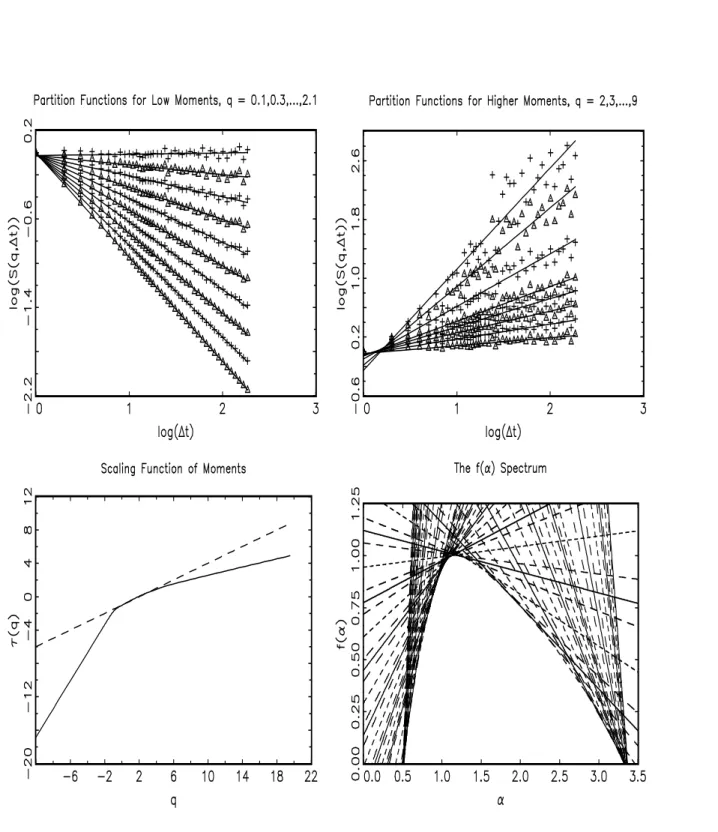
Fig. 2 illustrates the traditional method of estimating the key parameter λ of the multi-fractal model. One starts with the empirical partition functions S t q( , )∆ which are, then, used to estimate the scaling function τ(q) from regressions in log co-ordinates. The upper panel of Fig. 2 shows a selection of partition functions for some low (left-hand side) and higher moments (right-hand side)
for the German stock market index DAX.6 As can be observed, the empirical behavior is very close to the presumed linear shape for moments of small order, while the fluctuations around the regression line become more pronounced for higher powers. This is, however, to be expected as the influence of chance fluctuations is magnified with higher powers q. The resulting scaling function for moments in the range [-10, 20] is exhibited in the lower left panel of Fig. 2,7 For comparison, the broken line shows the behavior expected with Wiener Brownian motion, i.e. scaling according to q/2 - 1. There is a clear deviation from pure Brownian motion. The qualitative picture is the same found by Mandelbrot et al. as well as Schmitt, Schertzer and Lovejoy. Finally, the last step consists in computing the multi-fractal f(α) spectrum. The lower right-hand panel of Fig. 2 is a visualization of the Legendre transformation. The spectrum is obtained by drawing lines of slope q and intercept -τ(q) for various q. If the underlying data indeed exhibits multi-fractal properties, these lines would turn out to constitute the envelop of the distribution f(α). As can be seen, a convex envelope emerges from our scaling functions. It seems worthwhile to emphasize that this outcome is shared by all other studies available hitherto, which may suggest that such a shape of the spectrum is a robust feature of financial data.
Insert Fig. 2 about here
For fitting the empirical spectrum by its theoretical counterpart, the inverted parabolic shape of the Lognormal cascade (13), we have to keep in mind, that the cascade model is used for the volatility or time deformation µ(t) and that the returns themselves result from the compound process B.5[µ(t)].
We, therefore, have to take into account the shift in the spectrum as detailed in eq. (14). In order to arrive at parameter estimates for λ, the common approach pursued in physical applications is to compute the best fit to (14) for the empirical spectrum using a least square criterion. To this end, we restrict our attention to the positively sloped, left-hand part of the spectrum. The reason is, that the right-hand arm is computed from partition functions with negative powers and is, therefore, strongly affected by chance fluctuations due to the Brownian process. In fact, performing experiments with synthetic data from multi-fractal processes, we find that the location of the downward sloping part is strongly biased and, even with a symmetrical theoretical spectrum, often shows the same skewness as our empirical spectra. As a consequence, a fit based on the left-hand arm alone seems preferable.8 Empirical results from this procedure are exhibited below in Table 4.
6 Plots from the other three time series are almost identical.
7 Negative moments are only shown for illustration, but are discarded in the ensuing statistical analyses. 8It may be added that fits with both arms gave inferior results throughout and sometimes even led to
violations of the restrictions of the underlying model. Note also that a bias towards skewness on the right implies also that our empirical f(α) shape does not necessarily speak against the symmetric shape implied by the Log-normal model.
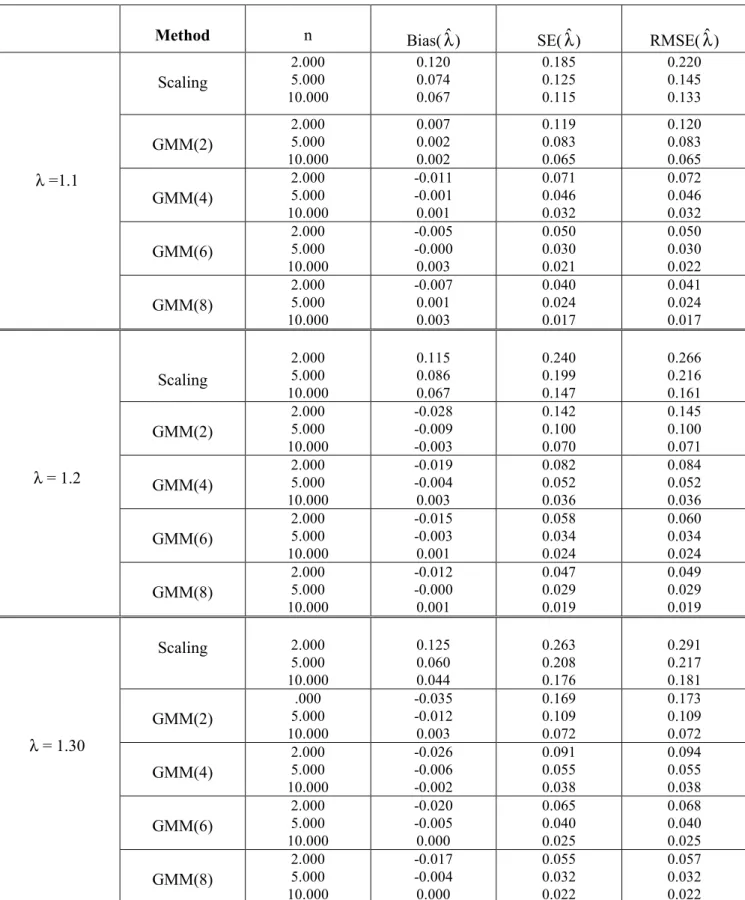
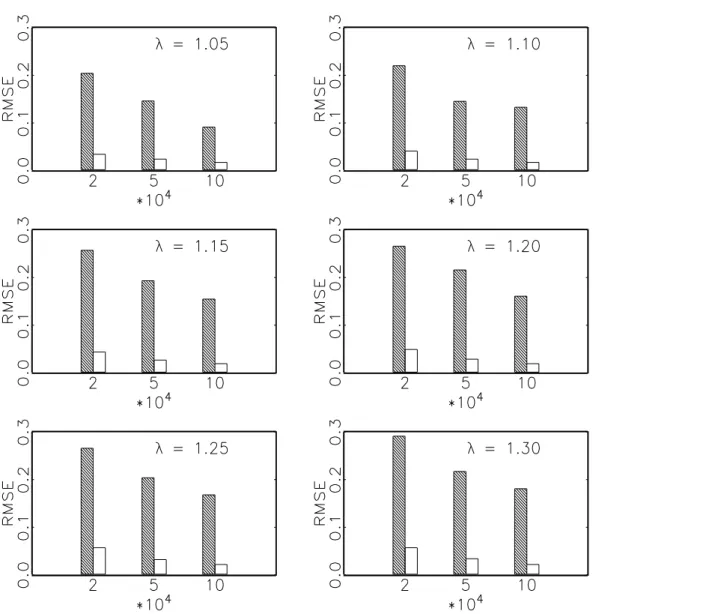
The physics literature notes biases and other problems of the scaling method (cf. Ouillon and Sornette, 1996; and Veneziano et al., 1995), but to our knowledge, no systematic inquiry into the reliability and performance of the resulting estimates is available. In order to arrive at an assessment of the quality of the estimates and, in particular, to be able to compare it with that of the upcoming GMM estimates, we performed Monte Carlo experiments with simulated data. For these experiments, the set-up was as follows: 1,000 replications were run for six values of λ ( running from 1.05 to 1.30 in increments of 0.05) and sample sizes T equal to 2,000, 5,000 and 10,000. Each data set has been obtained as a random subsample from a longer simulation run with 105 iterations and underlying k = 15. A visual comparison with the upcoming results for the GMM estimator is provided in Fig. 3. Detailed results are shown in Table 1. Because of the similarity of our results from different parameter values, we only provide data for three entries of λ: 1.1, 1.2, and 1.3. As can be seen, for all parameter values, the estimates of λ are positively biased, while the reduction of the RMSE is often much slower than T-1/2 (the more so, the higher the true parameter λ).
Insert Table 1 and 2 about here
4. GMM Estimation of Multi-Fractal Models
Unfortunately, no results on the consistency and asymptotic distribution of the f(α) estimates seem to be available in the relevant literature. This approach also does not provide us with estimates of the standard deviation σ of the incremental Brownian motion nor of the number of steps k to be used in the cascade. The later omission is somewhat natural since the underlying physical models assume an infinite progression of the cascade which is also the reason for their initially scale free approach.
Besides that, the τ(q) and f(α) fits also require judgmental selection of the number and location of steps used for the scaling estimates of the moments and the non-linear least-square fit of the spectrum. However, in principle, the fitting of the spectrum amounts to matching the moments of the theoretical process. This may lead to the question whether one could not resort to the methodology introduced under the heading of Generalized Methods of Moments by Hansen (1982). The advantage of this later approach consists in the availability of results on the asymptotic distribution of the estimates as well as the possibility of testing well specified null hypotheses. We will discuss shortly, under what conditions we are allowed to apply GMM for the estimation of the multi-fractal model.
In the GMM approach, the vector of parameter estimates of a model, say ϕ, is obtained as (15) ϕˆT =argminfT(ϕ)'ATfT(ϕ),
Ω ∈ ϕ
where Ω is the parameter space, fT(ϕ) is the vector of differences between sample moments and
analytical moments, and AT is a positive definite and possibly random weighting matrix. Under
‘suitable regularity conditions’, detailed, for example in Harris and Mátyás (1999), ϕˆT is consistent and asymptotically Normal with
(16) T1/2(ϕˆT−ϕ0)~N(0,Ξ), with covariance matrix Ξ=(FT'V−T1FT)−1
and ϕ0 the true parameter vector, VˆT−1=TvarfT(ϕˆT) the covariance matrix of the moment
conditions, ' ) ( f ) ( FT T ϕ ∂ ϕ ∂ =
ϕ the matrix of first derivatives of the moment functions, and V and T T
F the constant limiting matrices to which VˆT and FT converge. Knowledge about this asymptotic
distribution can be used to construct a test of the null hypothesis that the model is the true data-generating process. With the number of moment conditions (say q) exceeding the number of model parameters (say p), we can test the model using Hansen’s statistic: JT =T⋅fT(ϕˆ)'AˆTfT(ϕˆ),which under the null hypothesis can be shown to converge to a χ2 distribution with q-p degrees of
freedom.
Now turn to the question of applicability of the GMM procedure. For models incorporating long-term dependence, applicability of the ‘usual regularity conditions’ of GMM and other estimators is often questionable or simply not known. In fact, to the best of our knowledge, no rigorous proof of applicability of GMM to stochastic volatility models (even without the long-memory feature) has been provided in the literature so far.9 To see what kind of difficulties one encounters in the present framework, consider the following sets of conditions for consistency and asymptotic Normality of GMM estimators (cf. Harris and Mátyás, 1999). First, weakconsistency can be shown to hold if: (i)
)] ( f [
E T ϕ exists for all ϕ and is finite, (ii) there exists a ϕ0 such that E[fT(ϕ)] = 0 if and only if ϕ =
ϕ0, (iii) the difference between average sample and population moments uniformly converges to
zero in probability (i.e., fT(ϕ) satisfies a weak law of large numbers), and (iv) the sequence of
(random) weighting matrices converges in probability to a constant matrix A . For T strong consistency, the assumed convergence in probability in (iii) and (iv) would have to be replaced by convergence almost surely. Furthermore, asymptotic Normality requires the following additional or sharper conditions: (v) fT(ϕ) needs to be continuously differentiable, (vi) the matrix of first
derivatives )FT(ϕ should converge to a constant matrix F for T ϕ →ϕ0, and (vii) fT(ϕ) now needs
to satisfy a central limit theorem (cf. Harris and Mátyás, 1999).
Immediate problems may arise with (vii) and (iv): first, given the genuine long-memory features of the process under consideration, the moment functions will probably not satisfy a central limit law. In fact, whether or not a central limit law holds depends on the degree of dependence (cf. Beran, 1994, c. 3). Unfortunately, the estimated parameters for the long-term dependence in, for example, absolute returns usually fall into the range of non-applicability of these central limit laws. If that is true, the usual estimators for the covariance matrix VT do also not fall into the classes for which
consistency is guaranteed and will possibly not converge to a constant limiting matrix. One may circumvent this problem by resorting to other choices of the weighting matrix, e.g. a constant matrix, in order to guarantee consistency. However, abandoning the usual weighting according to the precision of the individual entry in the vector of moment conditions would greatly reduce the intuitive appeal of GMM.
A possible way out of this dilemma is provided by differencing the data. As shown in the technical Appendix, log differences of either the multi-fractal process itself or the compound process for (absolute) returns yield a stationary stochastic process which definitely has no long memory. As is shown in the Appendix, this process, in fact, only has non-zero autocovariances at the first lag. For our GMM estimation approach, we, therefore, select moments of the transformed process:10
(17) ξt,T =lnxt −lnxt−T .
From (10), this transformation amounts to:
(18) ⋅ σ ⋅ ∏ − ⋅ σ ⋅ ∏ = ξ − = − = t T k 1 i ) i ( T t k t k 1 i ) i ( t k T , t ln 2 m u ln 2 m u =
(
)
t t T k 1 i ) i ( T t ) i ( t lnu lnu 5 . 0 − = − − + ε − ε∑
, with ε(ti) =ln(m(ti))With all the entries on the right-hand side stemming from random Normal variates drawn at times t and t-T, it is almost obvious that this is a particularly harmless process which should be unproblematic in terms of the regularity conditions of GMM. One drawback (similar to the f(α) methodology) is that this transformation only allows to estimate the parameter λ of the Lognormal
10 In an earlier version of the paper, moments of raw differences instead of log differences have been used
for GMM estimation. However, closer inspection showed that this transformation did still preserve the long-memory property of the multi-fractal model. Similar moment conditions have also been used for SMS (simulated method of moment) estimation in Calvet and Fisher (2002b).
distribution while the standard deviation from the Normally distributed increments drops out when computing log differences, and the depth of the cascade, k, as a discrete parameter is not amenable to GMM estimation anyway. Nevertheless, as shown in our simulation, this approach provides a tremendous reduction of bias and root mean squared error so that it seems worthwhile to pursue this avenue. In practical applications, the standard deviation of the time series can be used as an estimate of σ. As concerns the number of multipliers, k, we will try to extract a rough estimate from a chain of GMM estimates for λ as detailed below.
Our choice of moment conditions tries to exploit the scaling properties of the multi-fractal processes. Like the original scaling estimator, our alternative GMM estimator, therefore, uses information over various time horizons, albeit for the log differenced process instead of the original one. In particular, we select covariances of the powers of ξt,T, i.e., moments of the following type:
(19) M(T,q)=E[ξqt+T,T⋅ξqt,T] for different T and q = 1,2.
Analytical expressions for all the relevant moments are to be found in the Technical Appendix. In order to assess the quality of the GMM estimates, we performed a chain of Monte Carlo simulations using lags T = 1,5,10, and 20. We started with a set of two moment equations, M(T=1,q=1) and M(T=1,q=2), i.e. autocovariances of the absolute and squared values of log differences computed over one lag. In order to see the influence of the number of moment conditions, we have subsequently enlarged the set of moments by including M(T=5,q=1) and M(T=5,q=2) when using four moments, M(T=10,q=1) and M(T=10,q=2) when using six moments, and finally, M(T=20,q=1) and M(T=20,q=2) when using eight moments.
Now turn to the results of our Monte Carlo simulations. The design of our experiments is as follows: we have again chosen three sample sizes: T = 2,000, 5,000, and 10,000 in all cases. Each sample is again generated as a randomly drawn subsample from a longer simulation with k = 15 (with a length of 105 observations). As with the f(α) Monte Carlo experiments, the parameter λ was allowed to vary from 1.05 to 1.30 using increments of size 0.05. Again, we only show the cases λ = 1.2, 1.2, and 1.3 in Table 2 since behavior of the other cases is almost identical. Note that increasing the parameter λ amounts to generating more pronounced bursts of volatility. As is routinely done in the literature, we computed the optimal weighting matrix from the covariance matrix for which we applied the Newey-West autocorrelation and heteroskedasticity consistent estimator (which should be a consistent estimator for the covariance matrix of the moments of the transformed process). Furthermore, we used the iterative GMM in which a new weighting matrix is computed and the whole estimation process repeated until one gets convergence of both the estimates and the weighting matrix (cf. Hansen, Heaton and Yaron, 1996).
As it turned out, results were almost identical over parameter values in terms of biases and root mean-squared errors. At most, one recovers a very slight tendency towards increasing RMSEs with higher λ. Furthermore, we found a continuous reduction of both the bias and the mean-squared error when increasing the number of moment conditions, albeit with a decreasing rate of return in terms of relative improvement per added moment. Hence, at least from our chosen set of up to eight moments, there seems to be no reason for restricting the number of moment conditions to be used in GMM estimation. This is in contrast to the results on GMM estimation of the stochastic volatility model, for which it has been shown by Andersen and Sørensen (1996) that using too many moment conditions leads to deterioration of the results.11
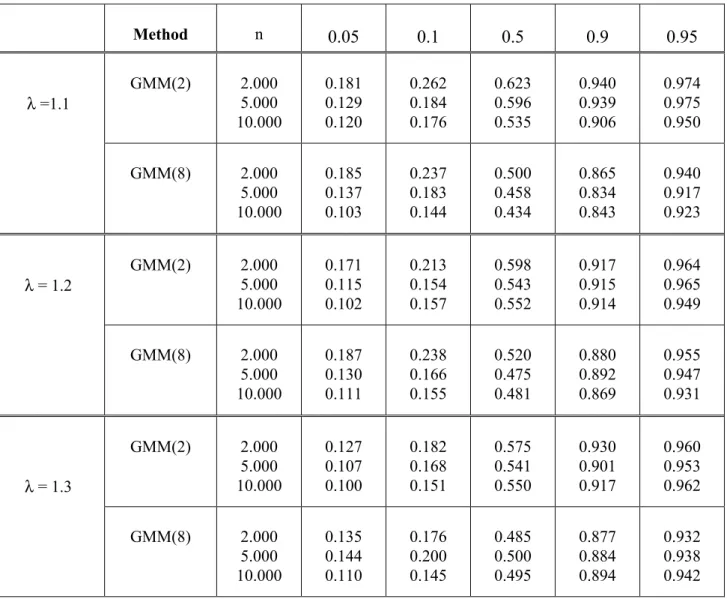
Unfortunately, the results with respect to the p-values of Hansen’s test of overidentifying restrictions were rather disappointing (cf. Table 3). In particular, over all sampling horizons, parameter values, and moment conditions, a pronounced skewness on the left-hand side of the distributions of p-values was found. Closer inspection of the histograms, in fact, reveals, that the largest deviation from the expected Chi-square distribution always occurs in the leftmost ten or so percent of the data, while the remainder of the distribution is rather well-behaved. It, therefore, seems that with respect to Hansen’s test, asymptotic theory does not provide a good guidance for samples as large as 10,000 data points. One of the reasons for this poor behavior might be the influence of the borderline solution λ = 1 at which the iterative GMM typically stops and fails to reinject the parameter estimates into the sensible region λ > 1
Insert Fig. 3 about here.
In summary, our Monte Carlo experiments suggest the following conclusions:
(i) GMM by far outperforms the f(α) methodology in all cases. First, while the f(α) estimates have a large bias for all parameter values and sample sizes, the GMM estimates are essentially unbiased even with small sample size and few moments to match. Second, the RMSE of GMM estimates is also always smaller than that of the f(α) estimates at all sample sizes. When using only two moments, the RMSE can already be reduced by about 30 to 50 percent with GMM compared to that of the scaling estimator. When using more than two moment conditions, the ratio of the RMSEs becomes even higher. In the case of eight
11 Results of our earlier analysis of moments of raw differences were different in many respects: (i) similar
to the f(α) estimates, the former GMM estimates of λ had large biases which were increasing in the underlying true parameter value, (ii) there was definitely no indication of T1/2 consistency, (iii) RMSEs
were smaller (larger) than the present ones for small (large) λ, (iv) best results were found with only few moment conditions with results deteriorating with an increase of the number of moments (similar to the findings of Andersen and Sørensen for stochastic volatility models)
moments, the RMSE of the GMM estimates is only of the order of 10 percent or less of that of the scaling estimator. It is worth emphasizing that this occurs despite the use of even more information in the f(α) approach since the later estimate is based on a much higher number of scaling laws for various powers q. Note also that GMM with eight conditions is still by far faster than the scaling approach.
(ii) The decrease in RMSE with sample size for the Binomial model is in good overall harmony with T1/2 consistency: proceeding from 10,000 to 5,000 and further to 2,000 observations, the root mean-squared error, in fact, increases roughly with factors of about 2 and 2 , respectively. Reduction of the (generally much larger) RMSEs from f(.5 α) often occurs more slowly (particularly so for high values of the parameter λ).
(iii) Turning to the distribution of p-values, we found that in all our scenarios, the GMM estimators suffer from skewness on the left-hand side (i.e., too many rejections of the null hypothesis). However, in contrast to the findings of Andersen and Sørensen (1996) for stochastic volatility models, there seems to be no trade-off between the preferred number of moments for RMSE (small) and specification tests (somewhat larger) in our setting.
(iv) It also seems worth noting that in contrast to the case of stochastic volatility models, problems of non-convergence of the estimates were altogether absent in the present setting. On the contrary, it could be observed that the iterative GMM procedure very reliably converged to the same set of estimates with different choices of initial conditions. For extreme initial conditions, the number of iterations sometimes became relatively large (> 10) before the process eventually found its way to the apparent global minimum.
5. Parameter Estimation and Forecasting of Volatility
Equipped with these encouraging findings we proceed to empirical applications. Our empirical analysis uses data from four different financial markets: the New York Stock Exchange Composite Index, the German share price index DAX, the U.S. $-Deutsche Mark exchange rate and the price of gold. The stock market series were obtained from the New York and Frankfurt Stock Exchanges, the exchange rate and precious metal series were obtained from the financial database at the University of Bonn. Our sample covers twenty years starting on 1 January 1979 and ending on 31 December 1998. For in-sample estimates we use the years 1979 to 1996 and leave the two remaining years for out-of-sample forecasts of volatility. This gives a number of in-sample observations of about 4,400 and 500 out-of-sample entries (with slight variations of the numbers between markets depending on the number of active days).
Following the results of the Monte Carlo simulations, we attempt to estimate the parameter λ from the largest set of eight moment conditions after demeaning the data and filtering out linear
dependence. In estimating the multi-fractal model with empirical data, the question of appropriate selection of the depth of the cascade, i.e. the number k of multipliers, emerges. Of course, one would like to have some data-driven selection of k. Since multi-fractal processes with varying k can be viewed as nested alternatives, the following procedure seems a natural choice: estimate λ with varying k and record the value of Hansen’s statistic JT =T⋅fT(ϕˆ)'AˆTfT(ϕˆ). From this chain of estimates, choose the one with the minimum JT which apparently seems to provide the best fit of the
underlying moments. Unfortunately, Monte Carlo simulations indicate that this algorithm would not work properly. We tried this method with ‘true’ k’s ranging from 4 to 14, a data size of T = 5000, and 500 replications for each k. ‘Estimation’ was done in each trial with k ranging from 1 to 20. Unfortunately, the JT minimizing choice showed no correlation at all with the ‘true’ parameter k but
was strongly attracted towards the extreme ends of the admissible spectrum. In all cases considered we found a concentration at small values (k ≤ 3, accounting for about sixty percent of all experiments independent of true k) and at k = 20 (about twenty percent). Another chain of Monte Carlo experiments was carried out with different ‘true’ k’s (k = 1,2,3,5,10,15,20) and ‘assumed’ k’s used in estimating λ (the same values were used for the hypothesized number of multipliers). Combining all ‘true’ and ‘assumed’ k’s we found that the J test has very limited power against these closely related alternatives for sample size like those used in our empirical application.
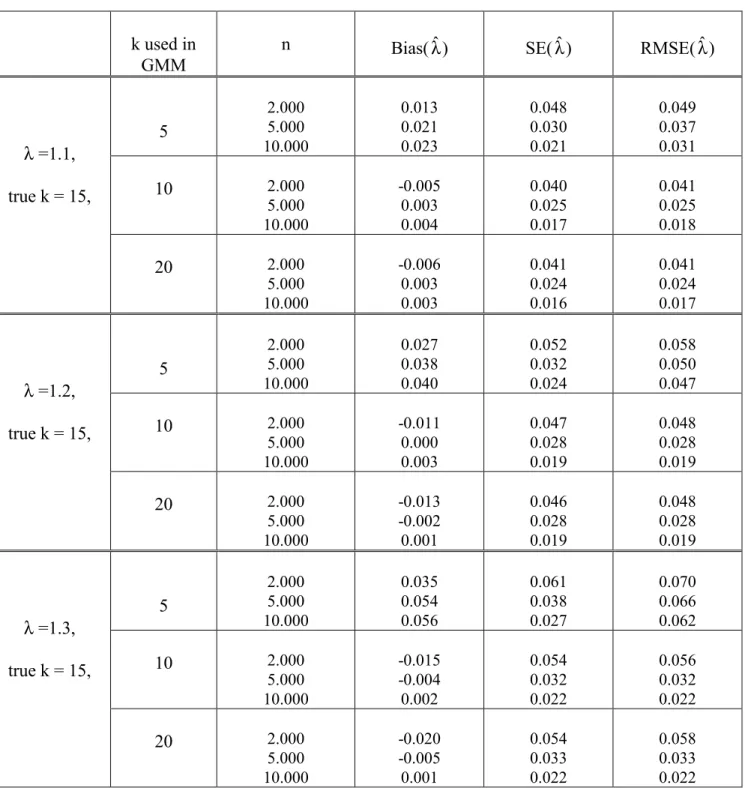
Since we found no indication of revelation of the true k with this approach, we resorted to heuristically choosing k from a chain of GMM estimates (again ranging from k = 1 to 20) as the value from which onward the estimated λ practically remains constant. In fact, we typically found large variations of λ when initially increasing the number of cascade steps starting at k = 1, but after a number of steps, the outcome of the estimation did remain practically unchanged with addition of cascade branches. This could be taken as an indication of the number of relevant steps the algorithm could find in the data, and so we have chosen to select k as that value at which the estimated λ did not change by more than 0.001 compared to its value at k-1. Of course, one could imagine that the underlying process has a much larger number of volatility branches, but due to the limited size of the available time series, most of the higher multipliers are constant so that their influence remains invisible. However, in such a situation, it would probably be useful to only rely on the number of multipliers whose influence can be detected in the data when, for example, trying to forecast volatility. Luckily, misspecification of the model in the sense e of using the wrong number of cascade steps, seems to be relatively harmless within a rather large range of choices for k. This can be seen in another Monte Carlo experiment whose results are shown in Table 3. Similarly like in Tables 1 and 2, the underlying data are generated from a model with ‘true’ k = 15, but now λ has been estimated under the assumptions of k = 5, 10, and 20. As can be seen, the misspecifications k = 10 and k = 20 do almost no harm to the resulting estimates we have generated. Ironically, the misspecified model with k = 20 even comes out marginally better with λ = 1.1 and 1.2 than the true model. For the very different k = 5, the RMSE with eight moment conditions is in the range of what
one gets from the true model with two or four moments. However, both the bias and mean squared error are still much smaller than those of the scaling method.12
Insert Table 3 about here
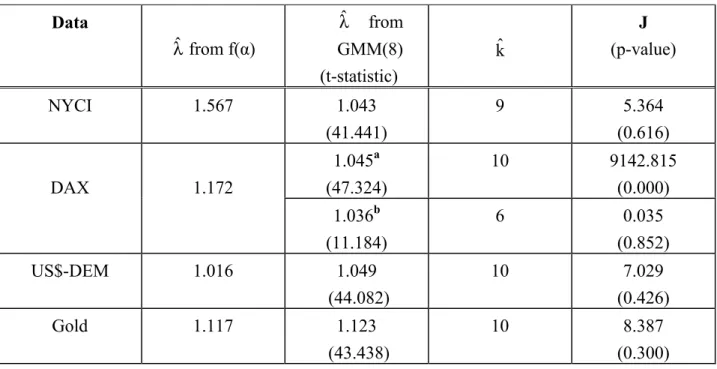
These results seem encouraging enough to proceed with empirical estimation whose results are given in Table 4 together with the estimates produced from the f(α) estimator.
With the scaling estimator, results show quite some variation ranging from a very low value of 1.02 for the U.S. $-DEM exchange rate to the high 1.57 obtained for the NYSE index. Admittedly, our estimates are obtained by mechanical implementation of the scaling estimator based on (11) to (14) with a fixed number of moments and time steps used. In physical applications, typically much emphasis is laid on checking the visual appearance of the scaling behavior. However, while the visual appearance as illustrated in Fig. 1 seems in harmony with what one expects, different set-ups, in fact, sometimes lead to wide variations of the results. Comparison with the estimates obtained by Calvet and Fisher (1997) for the Lognormal model with the DM/U.S.$ exchange rate shows quite big a gap between our λ = 1.016 and their estimate of 1.09 for the case H = 0.5. The sources of this remarkable differences could only be recovered by a re-investigation of their data set. However, the large root mean-squared errors that we get in our Monte Carlo simulations for the estimates of the multipliers from the f(α) method may provide a partial explanation of the differences.
With the GMM approach, a certain difficulty was encountered with the German stock index DAX for which at all k, the iterative GMM with eight moment conditions converged to an estimate of λˆ = 1. We conjecture that this is one of the cases where the GMM fails to reinject the estimate into the sensible parameter region after it had hit the lower boundary. In order to be able to report an estimate different form the degenerate and useless λˆ = 1 for this case as well13, we used two
different approaches: first, we reduced the number of moment conditions until we eventually obtained convergence to some λˆ > 1 with only two moment conditions left, second, we also report results obtained with a weighting matrix equal to the identity matrix (since this is not really a GMM estimation, the reported objective function is relatively large in the later case).
Comparing the numerical estimates obtained from the scaling and GMM estimator, we find that they differ more for the stock indices, but are relatively similar for the exchange rate and the price of
12 Interestingly, for this grossly misspecified model, RMSE also declines much slower than T1/2, while for k
= 10 and k = 20, T1/2 consistency is nicely preserved. Note that we also checked for the influence of the
choice of k (and pertinent estimate of λ) in our forecasting exercise reported below. Results paralleled those exhibited in Fig. 3 in that practically no differences in MSEs were obtained for alternative k’s in the vicinity of the original choice
13 Note that according to eq. (10), λ = 1 effectively implies that returns are drawn from a standard Normal
gold. Remarkably, Hansen’s test is not able to reject the multi-fractal model as the underlying data generating process for any of our time series (except for the case of the identity matrix as the ‘weighting’ matrix used for the DAX) at any conventional level of significance! This good fit is the more remarkable as we have seen that the test of overidentifying restrictions produces a large number of false rejections of the null in Monte Carlo simulations. It shows that the MF model provides a reasonable fit of the chosen moment conditions. It is interesting to note, that Lux (2001) was also unable to reject the MF model in tests of the Kolmogorov-Smirnov type for identity of the hypothesized unconditional distribution from the combinatorial MF model and the empirical distribution, for the same underlying time series. Comparing the results with those obtained from the standard GARCH(1,1) model and a GARCH model with Student-t innovations, he also found the MF model to dominate in terms of the Kolmogorov-Smirnov distance.
Insert Table 4 about here
6. Forecasting Volatility: A Competition between MF, GARCH, FIGARCH and Historical Volatility
According to the above results, the multi-fractal model appears capable of producing good fits to both the unconditional distribution and the conditional moments of empirical data.14 However, estimating the parameters of a new model alone does not proof that it might be a useful addition to the existing tool-box of empirical finance. Since the main motivation of the multi-fractal model is to capture the supposed hierarchical structure of the volatility dynamics, one of its contributions should be an improved ability to forecast financial volatility. In order to see how our estimates perform on this task, we have carried out a competition between forecasts of volatility derived from the Lognormal multi-fractal model with a number of well-known alternatives. Given that one of the virtues of the multi-fractal model is incorporation of long memory in various powers of returns, we found that we should test its forecasting performance over relatively long time horizons. Like many forecasting competitions, we start with 1 day and 5 day forecasts, but then proceed via 10 day increments to forecasts up to 100 periods ahead.
The competitors of our multi-fractal forecasts are (1) the naïve forecasts formed on the base of historical volatility, (2) forecasts computed from the standard GARCH(1,1) model and (3) forecasts derived from the FIGARCH(1,d,1) model first proposed by Baillie et al. (1996). Inclusion of the later seems sensible since it also has built-in long memory of volatility and, therefore, should be the
14 Of course, it remains to be shown whether estimates produced from different sets of moments are in
main rival of the new multi-fractal model. While the derivation of efficient forecasts from GARCH and FIGARCH models is well-known, it is not clear how to construct efficient predictors from the new multi-fractal model. In principle, one would like to identify the ruling multipliers within the observable realizations of the process (in fact, identification of the multipliers within the last available entry of the time series would be sufficient), and from this knowledge, could probably compute most efficient forecasts on the base of expected future replacements of individual volatility components. Unfortunately, this identification problem (known as the inverse multi-fractal problem in physics) is still unsolved for the combinatorial models. Of course, our approach also provides no solution to this problem for the more complicated causal structures analyzed here. What one can do, however, is deriving forecasts based on best linear predictors for the multi-fractal model. The later only need analytical solutions for the autocovariances of x2t which are provided in the Technical Appendix.
With this information, forecasts of future volatility can be computed following the standard approach for best linear forecasts outlined, for example, in Brockwell and Davis (1991, c.3). Assuming that the data under scrutinity follow a stationary process { Xt } with mean zero, h-step
forecasts are obtained as:
(19) n n 1 i (nh) n 1 i ) h ( h n X Xˆ ni ⋅ =φ ⋅X φ = + − = +
∑
with the vector of weights φn(h) =(φn1,φn2,...,φnn)' being any solution of Γnφ(nh) =γ(nh), ))' 1 h n ( ),..., 1 h ( ), h ( ( ) h ( n = γ γ + γ + −
γ being the autocovariances for the data generating process of Xt
at lags h and beyond, and Γn =[γ(i−j)],ij=1,...,nthe pertinent variance-covariance matrix. It is well known, that this is the best linear estimator under the criterion of minimization of mean squared error. It is also known that for long-memory processes, one should use as much information as available, i.e., the vector Xn should contain all past realizations of the process under study. In our
application, the realizations Xt are given by:
(20) Xt =x2t −E[xt2]=x2t −σˆ2
with σˆ the standard deviation of the time series which as an elementary estimate for the standard deviation of the incremental process enters besides our above estimates of λ and k. Note that the HV predictor can be interpreted as a special case of (19) and (20) which emerges if weights of all past observations are identical equal to zero and, hence, one assumes absence of temporal dependency in the volatility dynamics. The computational burden of these predictors is immensely reduced by using the generalized Levinson-Durbin algorithm developed in Brockwell and Dahlhaus (2002, particularly their algorithm 6).
GARCH and FIGARCH estimates are obtained on the base of (quasi-) maximum likelihood estimates of the parameters of the following standard fomalizations:
(21) xt =µ+ρ⋅xt−1+htεt with εt∼ N(0, 1)
and
(22) ht =ω+α1x2t−1+β1ht−1, ω > 0, α1, ß1 ≥ 0 or
(23) ht =ω+β1ht−1+(1−β1L−(1−ϕ1L)(1−L)d)ε2t
for the GARCH(1,1) and FIGARCH(1,d,1) specification of the volatility dynamics, respectively. In GARCH and FIGARCH estimation, we have also demeaned the raw data and removed linear dependence (through eq. 21) as we did when developing the MF and HV forecasts.
With respect to the FIGARCH model, we should note that the underlying concept and implementation has been extensively discussed in recent literature (cf. Chung, 2002; Zumbach, 2002). Despite certain recently emphasized ambiguities of their parameterization, we stick to the original framework of Baillie et al. in our empirical implementation. With respect to the infinite number of lags incorporated in the fractional difference we followed most of the available literature by using a truncation lag of 1000 past observations in both estimation and forecasting (together with 1000 presample values set equal to the variance of the in-sample observations). Alternatively, we also tried estimation and forecasting using all available past data (again with 1000 presample observations), but results were practically identical.
Before considering the results of our competition in detail, a short review of available empirical evidence on the forecasting performance of long-memory processes is in order. To our great surprise, despite the immense literature on volatility forecasting (surveyed recently by Poon and Granger, 2003), entries comparing the forecasts from FIGARCH and more traditional GARCH models are extremely scarce and those available do not yield a clear indication for the long-memory variant to provide an advantage in this respect. Basically, only two papers with a direct comparison of FIGARCH and GARCH seem to be available at present: Vilasuso (2002) and Zumbach (2002), both considering forecasting of volatility in foreign exchange markets. While Vilasuso uses daily data of five currencies against the U.S. dollar, Zumbach’s data base consists of intra-daily variations of the Swiss Franc against the U.S. dollar. The later finds, that the original FIGARCH model as well as a variety of closely related specifications of long-memory models have a higher log-likelihood
than the basic GARCH(1,1) model, but provide only very modest gains in forecasting daily volatility on the order of 1 to 2 percent of MSE. Vilasuso, on the other hand, does not report figures for model selection criteria, but notes relatively large reductions of both mean squared error and mean absolute errors for all currencies over forecasting horizons of 1,5, and 10 days. The advantage of FIGARCH versus GARCH (as well as EGARCH) reported in this paper increases with forecasting horizon with the difference ranging between 8 and 37 percent at the 10 day horizon. To date, this study appears to be the only entry in the literature reporting a clear advantage of the FIGARCH model over simpler specifications (however, we were unable to replicate his results for the U.S. Dollar-DEM exchange rate). Another interesting comparison in our context is that by Calvet and Fisher (2002b) between GARCH, Markov-Switching GARCH and one variant of a causal multi-fractal model They find, that their Binomial model mostly dominates GARCH and MS-GARCH in terms of AIC and BIC model selection criteria (data are again daily returns of four currencies against the U.S. dollar). However, when it comes to forecasting at daily horizons, it mostly does marginally worse than GARCH(1,1).
Under the light of the above review of similar literature, our ensuing results should be of interest under a variety of aspects: first, what evidence exists concerning the case of GARCH versus FIGARCH (or, more generally, short-memory vs. long-memory models), is limited to foreign exchange markets so that the analysis of stock and precious metal markets would give us some clue on whether the above results are typical or not. Second, evidence concerning the performance of multi-fractal models versus GARCH is confined to the recent entry by Calvet and Fisher (2002b), while it is non-existing for the MF versus FIGARCH case. The later, should, however, be particularly interesting since both models share the long-memory property observed in empirical data. Third, we also do have only comparative evidence on forecasting competitions for relatively small horizons (mostly one day comparisons). However, from their very construction, long-memory models should be able to play out their advantages more clearly over longer time horizons. To see whether they have any use, it would, therefore, be of relevance to compare their forecasting performance for long horizons with that of short-memory (GARCH) or no-memory (HV) approaches.
With this background, turn to the results of our comparison. GARCH and FIGARCH estimates are given in Table A1 in the Appendix. We see that AIC and BIC selection criteria prefer FIGARCH for both stock indices as well as the price of gold, while for the exchange rate, GARCH seems more appropriate. A particularly interesting case, is, however, that of gold. For this time series, we actually could find two maxima of the FIGARCH log-likelihood: one global maximum at a corner solution with d = 0.999 (i.e. practically identical to an EGARCH specification) which