Towards a mood sensitive
integrated development
environment to enhance the
performance of programmers
A thesis submitted for the degree of Doctor of Philosophy
Iftikhar Ahmed Khan
School of Computing, Information Systems and
Mathematics
Brunel University
December 2008
Abstract
The aim of the research was to analyze the possibility of developing an Integrated Development Environment (IDE) that could improve a programmer‘s performance by considering their current mood. Various experiments were conducted to study this idea. However, the impact of moods on programmer performance was initially examined in the literature. Based on this, a Cognitive Programming Task Model (CPTM) was developed showing that various cognitive functions and programming activities are interrelated. A second model derived from the literature, the Cognitive Mood Model (CMM), suggested that moods are also interrelated with various cognitive functions. Combining these two models indirectly suggests a relation between moods and programming tasks, which was presented as the Mood Programming Model (MPM).
As direct empirical support was lacking for this relation, two experiments were conducted to study the effect mood could have on performance in a debug task. Validated mood-inducing movie clips were used to induce specific moods along two-mood dimensions: valence and arousal. The first study was conducted online. The results showed that arousal is a significant factor when considering programmer performance whereas valence was found to have no significant effect. The second study was a continuation study to validate the findings from the first study within lab conditions. The results were not able to confirm the findings of the first experiment. The reasons for these findings were explained accordingly.
As mood was found to have an effect on a programmer‘s coding and debugging performance, this factor might be considered when developing a support system. The next step in the research was therefore to consider mood measuring in a non-interruptive way. The next two experiments were based around the hypothesis that ―moods can be measured from the keyboard and mouse interaction of the computer user‖. In the first experiment an application was installed on participants‘ computers to record their key presses and mouse clicks in a log file. Their self reported moods in intervals of 20 minutes were also stored in the same file over an average period of eight days. Correlations between participants‘ self reported moods and their keyboard and mouse use revealed that it might be possible to measure moods of the some of the participants. The second experiment took place in the lab, where participants were asked to perform programming like tasks while listening to
mood inducing background music. Their moods were measured with a Galvanic Skin Response (GSR) meter whereas key presses and mouse clicks again were recorded in log files. The correlations between GSR measurements and keyboard and mouse interaction validated the findings of the experiment in the field that it might be possible to measure the mood of some users from their computer use. Analyzing participants‘ personality traits showed dutifulness and self discipline as indicators that a person‘s mood correlates with his/her interaction behaviour.
Considering that mood has an effect on programmer performance and that it might be possible to measure mood in a non-intrusive manner, the last question to focus on was whether a computer-generated intervention could change a programmer‘s mood and consequently improve their performance. In the final experiment programmers had to dry run algorithms for 16 minutes with the expectation that a level of boredom would set in. After this the video clip instructed them to participate in some physical exercises. Participants continued tracing algorithms for 8 minutes after the intervention. Results showed that the mood change after the intervention coincided with a programmers improved ability to provide the correct output of the algorithms.
Together these findings lay the foundation for developing an IDE that can measure the programmer mood in a non-intrusive way and make effective interventions to improve programmer performance.
Declaration
The following publications have been produced, directly and indirectly, from the research undertaken in this investigation.
Khan, I.A., Brinkman, W-P. and Hierons, R. M. (2006). Programmer's mood and their performance, 13th European Conference on Cognitive Ergonomics, September 20-22, 2006, ETH Zurich, Switzerland, pp. 123-124.
Khan, I.A., Brinkman, W-P. and Hierons, R.M. (2007). Moods and Programmers Performance, 22nd Psychology of programming Conference, July 02-06, 2007, Joensuu, Finland, pp. 3-16.
Khan, I.A., Brinkman, W-P. and Hierons, R.M. (2007). Mood Independent Programming, 14th European Conference on Cognitive Ergonomics, August 02-06, 2007, London, UK, pp. 269-272.
Khan, I.A., Brinkman, W-P., and Hierons, R.M. (2008). Toward a Mood Measuring Instrument from Interaction Behaviour, 23rd Conference on Psychology of Programming, 10-12 September 2008. Lancaster University, UK; pp. 155-169. Khan, I.A., Brinkman, W-P., and Hierons, R.M. (2008). Measuring Personality from
the Use of Keyboard and Mouse, 15th European Conference on Cognitive Ergonomics, 16-19 September 2008, Maderia, Portugal. Article No. 38.
Acknowledgements
First of all I am thankful to the God, who provided me the patience and passion to get this work done. I will also like to thank my parents and their continuous support all over the years.
Henry Adams said, ―A teacher affects eternity; he can never tell where his\her influence stops‖. Very same is true about Dr. Willem-Paul Brinkman. He was always available to correct me, guide me and to encourage me. He always taught me the tips and tricks to do research and helped toward my way to seek the scientific knowledge. He therefore will always influence me and his teachings will always guide me in my professional career.
If a reader is able to understand whatever is written in this thesis, than credit goes to Professor Robert Mark Hierons. Whenever he read a draft of the thesis he mentioned hundreds of mistakes and thus kept this thesis improving.
I will also like to thank my friends and other participants who helped me a lot by participating and motivating me in the course of my research.
Last and most important of all, I will like to thank the Higher Education Commission of Pakistan and the University of Engineering and Technology Peshawar for providing me a chance and funding to keep this research going.
Table of Contents
Abstract ... i
Declaration ...iii
Acknowledgements ... iv
Table of Contents ... v
List of Figures ...viii
List of Tables ... x
List of Tables ... x
Chapter 1: Introduction ... 1
1.1 Overview ... 1
1.2 The Software Industry ... 1
1.3 Programming, Mood and Emotion ... 2
1.4 Research Objectives ... 3
1.5 Research Approach and Overview of Thesis ... 4
Chapter 2: Hypotheses of the study ... 6
2.1 Introduction ... 6
2.2 Moods and Emotions ... 8
2.3 One-Dimensional Versus Multi-Dimensional Mood Model ... 9
2.4 Moods and Programmers‘ Performance ... 11
2.5 Measuring Moods from Behaviour ... 18
2.6 IDE to Improve Performance in Context of Moods ... 21
2.7. Conclusions ... 26
Chapter 3: Impact of Moods on Programmers‘ Performance ... 27
3.1 Introduction ... 27
3.2 Experimental Material ... 28
3.2.1 Validating the Debugging Test ... 28
3.2.2 Validating the Movie Clips ... 29
3.3 Experiment 1 ... 32
3.3.1 Participants ... 33
3.3.2 Procedure and Experimental Design ... 33
3.3.3 Results ... 36
3.3.4 Effect of Debugging Tasks on Mood Ratings ... 38
3.4 Experiment 2 ... 39
3.4.1 Experimental Design ... 39
3.4.2 Material and Procedure ... 40
3.4.3 Participants ... 41
3.4.4 Results ... 42
3.5 Discussions, Limitations and Future Research ... 43
Chapter 4: Mood Measurement by the use of Keyboard and Mouse ... 47
4.1 Introduction ... 47
4.2 Literature Review ... 48
4.3 Experiment ... 49
4.3.1 Experimental Material and Design ... 49
4.3.1 Log File Recoding ... 52
4.3.2 Participants ... 52
4.3.3 The Experiment Setup ... 53
4.4 Results ... 54
4.4.1 Preparation of Data ... 54
4.4.3 Regression Analysis ... 57
4.4.4 Conservative Analysis ... 58
4.4.5 Logistic Regression ... 59
4.5 Conclusions, Limitations and Future Research ... 61
Chapter 5: Measuring Mood by the use of Keyboard and Mouse: Galvanic Skin Response Scenario ... 64
5.1 Introduction ... 64
5.2 Literature Review ... 65
5.3 Experimental Material and Design ... 66
5.3.1 Galvanic Skin Response Meter ... 67
5.3.2 GSR Recording and Keyboard Mouse Interaction Logging Application ... 68 5.3.3 Mood Induction ... 68 5.3.4 Participants ... 69 5.3.5 Experimental Setup ... 69 5.4 Results ... 71 5.4.1 Data Preparation ... 71 5.4.2 Analysis ... 72 5.4.3 Conservative Analysis ... 74 5.4.4 Logistic Regression ... 75
5.5 A Comparison of Mood Measurement Methods ... 77
5.6 Conclusions, Limitations and Future Research ... 79
Chapter 6: The Impact of a Computer-Support Intervention on the Programmers‘ Performance ... 82
6.1 Introduction ... 82
6.2 Background ... 82
6.3 Experimental Material and Design ... 84
6.3.1 Algorithms ... 84
6.3.2 Intervention Exercise Video ... 86
6.4 Participants ... 86 6.5 Experimental Setup ... 87 6.6 Procedure ... 88 6.7 Results ... 90 6.7.1 Data Preparation ... 90 6.7.2 Analysis ... 92
6.8 Conclusions, Limitations and Future Research ... 93
Chapter 7: Conclusions, Limitations and Future Research ... 95
7.1 Overview ... 95
7.2 Recapitulation ... 95
7.3 Conclusion from Hypotheses Testing ... 96
7.3.1 H1: Moods have an Impact on Programmers‘ Performance ... 96
7.3.2 H2: Moods can be measured From a Computer User‘s Interaction with Keyboard and Mouse ... 97
7.3.3 H3: A Development Environment with an Intervention or Suggestion System Could Help to Improve Programmer‘s Performance ... 98
7.3.4 Overall Experimental Hypothesis ... 98
7.4 Envisioned Mood Sensitive Component to Enhance Performance ... 101
Figure 7.1: Flow diagram of envisioned component ... 102
7.5 IDE a Step Ahead ... 103
7.7 Future Work ... 104 7.8 Contributions ... 106 7.8.1 Theoretical Contributions ... 106 7.8.2 Practical Contributions ... 107 7.9 Final Remarks ... 107 References ... 109
Appendix I: Debugging Questions ... 122
Appendix II: Algorithms ... 126
Appendix III: Consent form used in the experiments ... 136
Task 1: Story - The Hare and Tortoise (Aesop Stories, 2007) ... 142
List of Figures
Figure 2.1: Valence-Arousal model with some examples of some specific moods or .. 11
Figure 2.2: A two-dimensional CPTM (Cognitive Programming Task Model). ... 15
Figure 2.3: A Cognitive Mood Model (CMM), showing moods (valence, arousal) impact on cognitive tasks (CTs). ... 17
Figure 2.4: A Mood Programming Model (MPM) based on models in Figure 2.2 and Figure 2.3 showing moods might have an impact on Programming Tasks. The relations are represented by ticks in the respective cell. ... 18
Figure 2.5: IDE cognitive support model, including some examples of support tools that support specific cognitive element of the programming task ... 23
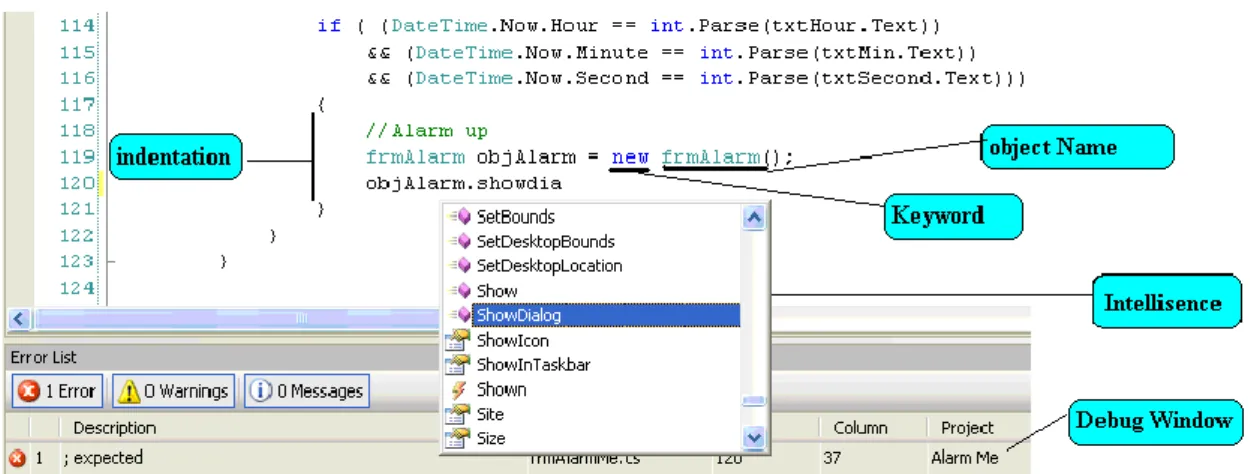
Figure 2.6: An example of cognitive support provided by IDEs in various programming tasks. This is a screen shot of Visual Studio express edition editor. ... 24
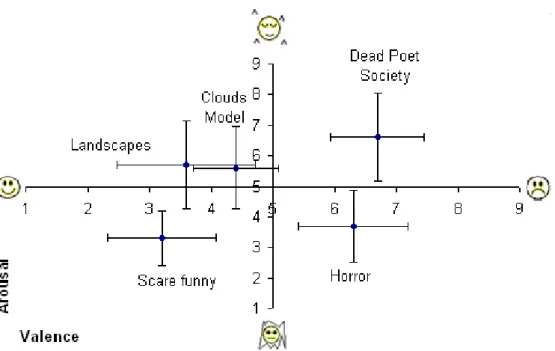
Figure 3.1: Average mood ratings and their 95% confidence interval of the 4 selected mood inducing video clip and the mood neutral video clip (Clouds Model). ... 32
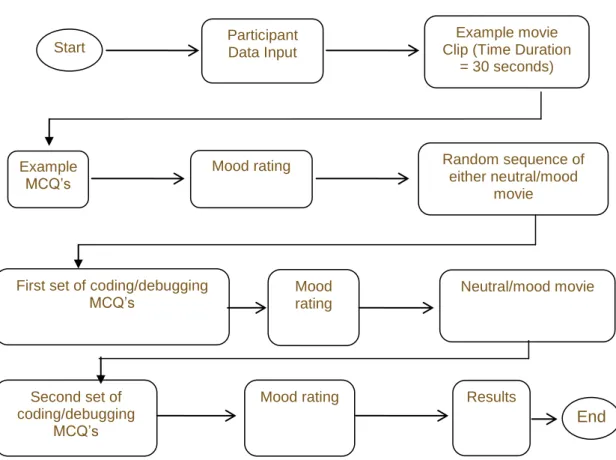
Figure 3.2: Online experiment flow sequence ... 34
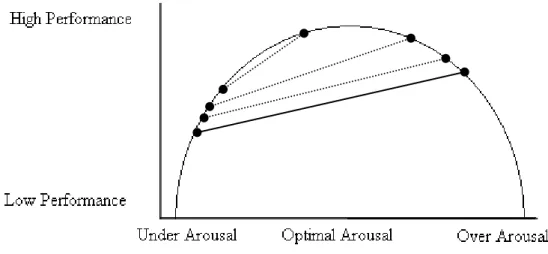
Figure 3.3: Arousal Performance relationship in terms of Inverted-U shaped hypothesis including the potential places of experimental conditions (left side represents low arousal while the right side represents high arousal) ... 44
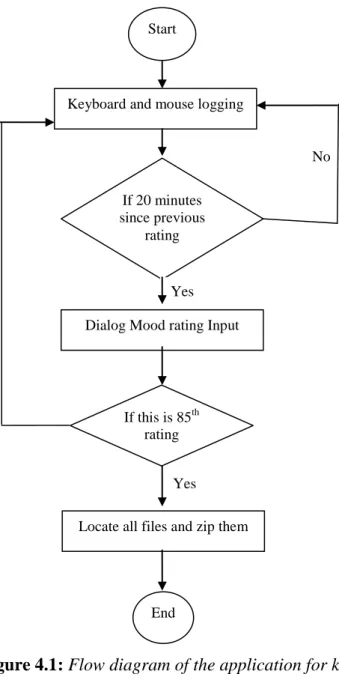
Figure 4.1: Flow diagram of the application for keyboard/mouse logging ... 50
Figure 4.2: Mood rating dialog with SAM (Self Assessment Manikin) scale... 51
Figure 4.3: Application menu and its further option... 52
Figure 4.4: An example of log file ... 53
Figure 4.4: Window for taking events to analyze correlations between events and valence/arousal ... 54
Figure 4.5: Valence Histogram ... 62
Figure 4.6: Arousal Histogram ... 62
Figure 5.1: The GSR Meter and it electrodes attaching position with hand as used in the experiment ... 67
Figure 5.2: Relative Galvanic Skin Response (GSRrelative = GSRneutral – GSRlow/high) in low (LA) and high (HA) arousal conditions. Upper line represents music from the literature whereas line near the bottom represents music brought by person. ... 73
Figure 6.1: A screen shot of the training application ... 88
Figure 6.3: Screen shot of the marking application showing three windows and place to input marks. ... 91 Figure 6.4: Utility to provide possible correct flow & output from the initializing values provided by participant in the algorithm trace table. ... 91 Figure 6.5: Correct output performance standardized by difficulty level ... 93 Figure AIII.1: Self Assessment Manikin for self reporting of moods. Row one is used to report valence (pleasantness) ranging from happy figure to sad figure, whereas row 2 is used to report arousal ranging from excited figure representing high arousal to sleep\calm figure representing low arousal ... 136 Figure AIII.2: Information and Consent form for Experiment 1A. (Web Study: H1:-
Moods affect programmers‟ coding\debugging performance) ... 137 Figure AIII.3. Information and consent form for experiment 1B. (Lab Study: H1:- Moods affect programmers‟ coding\debugging performance ... 138 Figure AIII.4: Information and consent form for experiment 2 (H2:- Programmers‟ mood can be measured from interaction behaviour with keyboard and mouse) ... 139 Figure AIII.6: Information and consent form for experiment 3 (H3:- An intervention
List of Tables
Table 3.1: Criteria for the selection of questions for the debugging tests ... 29 Table 3.2: The number of participants that complete the test (NC), the number (ND) and percentage (PD) of dropouts after being allocation to experimental conditions ... 36 Table 3.3: Preset format of Movie Sequence, each row indicating one complete test with a participant. ... 41 Table 3.4: Results multivariate and univariate analysis on arousal ... 42 Table 3.5: Results multivariate and univariate analysis on valence ... 43 Table 4.1: Correlations between behavioural interaction variables and participants‘ valence rating with six minutes data around a valence rating. ... 56 Table 4.2: Correlations between behavioural interaction variables and participants‟ arousal rating with six minutes data around an arousal rating ... 56 Table 4.3: Correlations between behavioural interaction variables and participants‟ valence rating with ten minutes data around a valence rating. ... 56 Table 4.4: Correlations between behavioural interaction variables with participants‟
arousal rating with ten minutes data around an arousal rating. ... 57 Table 4.5: Regression model for prediction valence with that of behavioural variables in six minutes window obtained by the use of keyboard and mouse. ... 57 Table 4.6:Regression model for prediction arousal with that of behavioural variables in six minutes window obtained by the use of keyboard and mouse. ... 57 Table 4.7:Regression model for prediction valence with that of behavioural variables in ten minutes window obtained by the use of keyboard and mouse. ... 58 Table 4.8: Behavioural variables with significant correlations at 0.006 level with valence and arousal. ... 59 Table 4.9: Summary of logistic regression analysis for variables predicting
participants that might show correlations in valence; Have correlation (n = 11) and No correlations (n = 9). ... 60 Table 4.10: Predictor variables showing possibility of predicting participants who might show correlations or no correlations with use of keyboard and mouse and their valence level. ... 60 Table 4.11: Summary of logistic regression analysis for variables predicting
participants that might show correlations in arousal; Have correlations (n=8) and No correlations (n=12). ... 61
Table 4.12: Predictor variables showing possibility of predicting participants who might show correlations or no correlations with use of keyboard and mouse and their arousal level. ... 61 Table 5.1: The four session/music sequencing permutation participants were allocated to. ... 70 Table 5.2: Correlations of different behavioural variables with participants GSR responses ... 74 Table 5.3: Behavioural variables with significant correlations with GSR
measurements at 0.006 level. ... 75 Table 5.4: Summary of logistic regression analysis for variables predicting
participants that might show correlations; Have correlation (n = 7) and No
correlations (n = 8) ... 76 Table 5.5: Predictor Variables showing possibility of predicting participants who might show correlations or no correlations with use of keyboard and mouse and their valence level ... 76
Chapter 1: Introduction
1.1 Overview
This chapter provides an introduction into the work presented in this thesis, describes the motivations behind the research and introduces the research questions. The chapter starts by discussing the motivation behind the research and then discusses research questions. The subsequent section explains the approach taken to investigate these research questions by presenting an overview of the thesis.
1.2 The Software Industry
The software industry is growing and globalizing very rapidly. More than ten years ago it already had an annual growth rate of 10-15% (Barr and Tessler, 1996). The software industry‘s key inputs are highly motivated, creative and enthusiastic individuals starting from high-level managers to analysts, software engineers, programmers, testers etc. About 236,000 people were working in the US software industry in 2005 and millions of others are working in this industry all over the world. The software industry‘s output depends on the skills and performance of Information Technology (IT) workers. Software development related skills might also be vital into many other industries (Barr and Tessler, 1996).
As software development involves various phases and each phase requires different cognitive skills, various people are involved in these phases because of specific skills. The task of converting analysis and design specifications into implement-able software is mainly the work of programmers. Programmers like everyone else make errors and may introduce errors into software applications. About 27% of system failures in various different companies are due to software defects according to a survey conducted by Gartner Dataquest (Rocco and Igou, 2001). There are various factors that contribute to software defects and researchers have various solutions, like better project management and more user involvement but psychological, social and organizational issues are often not addressed by these solutions (Smith and Keil, 2003). Errors seem inherent to human work, and they occur even in the most favourable conditions (Ko and Myers, 2003). For example, psychological issues like attention deficits can cause a decrease in work performance (Coetzer and Rixhmond, 2007), as lapses in attention are a known cause of accidents,
loss of time, efficiency deterrence, and personal productivity (Cheyne et al., 2006). If someone is not able to focus or is absent minded then this might lead to various errors (Reason, 1984). Similarly if programmers are less focused or are absent minded then this might lead to various errors in software while developing it. In other words to produce good error free software, being attentive seems to be important.
1.3 Programming, Mood and Emotion
Software development involves different cognitive and human aspects. Human performance and the quality of the resultant work are affected by different conditions and circumstances (Shneiderman, 1978). One of these factors is the mood and emotion of humans. For example, Norman (2004, p. 7) states that ―Someone who is relaxed, happy, in a pleasant mood, is more creative …‖. In other words, people in the software industry when in a less pleasant mood might be unable to consider software problems from different angles and therefore be less able to find a viable solution. Therefore moods seem to be related to the quality of software and also to the performance of humans. Various psychological studies such as Tice et el., (2001), Chang & Wilson (2004), Lowther & Lane (2006) and Lane et al. (2005) suggest that moods and emotions have an effect on human performance. Moods are known to have an impact on reasoning which is an important cognitive element of most programming tasks (Jones, 2003). As the literature suggests moods as a factor that affects cognitive processes, it seems likely that programmers‘ performance is also affected by their mood, and potentially explaining lapses in their attention.
There are various psychological reasons for attention diversion. Larson et al. (1997) used the Cognitive Failure Questionnaire (CFQ) to study the relationship between mishaps and driving accidents and found a link between high CFQ scores and accidents, which were the result of distractibility, poor selective attention and mental error. This and several other studies (Cheyne et al., 2006; Danaher, 1980) show that cognitive aspects affect attention and the human focus. Research into cognition traditionally deals with concepts such as reasoning, perception, intelligence, learning, and various other properties that describe numerous capabilities of the human mind. Moods, emotions and feelings are also considered to be cognitive by psychologists like Schmitt (1969) and Izard et al. (1984). Relaxation, happiness and moods such as pleasantness can increase someone‘s creativity (Norman, 2004). In other words, this suggests that programmers in a less pleasant mood might be less able
to view software problems from various viewpoints and therefore less able to come up with alternatives.
Throughout our daily life we experience a series of different moods. We feel saddened by the death of a friend, whilst feel joyful and happy on the birth of a child or at a wedding. Similarly, in almost every task from flying a plane to performing an operation or programming a real time system, one would expect to feel a wide range of positive and negative feelings (Martin, 2001). These feelings and moods may disrupt our daily tasks. These disruptions along with interference in energy, sleep, and thinking are common, painful, and too often fatal (Jamison, 2003). It has been found that moods affect various different activities of people like creativity (Russ and Kaugars, 2001; Kaufman, 2003), memory tasks (Lewis and Critchley, 2003), reasoning (Chang and Wilson, 2004), behaviour (Kirchsteiger, Rigotti and Rustichini, 2006), cognitive processing (Rusting, 1998), information processing (Armitage, Conner and Norman, 1999), learning (Weiss, 2000; Ingleton, 1999), decision making (Gardner and Hill, 1990; Kirchsteiger, Rigotti and Rustichini, 2006), and performance (Chang and Wilson, 2004; Lowther and Lane, 2006; Lane et al, 2005).
1.4 Research Objectives
Computers are not mere tools to solve complex problems nowadays. Research is being conducted on the affective aspects of computers, so that they can communicate in a more human-like way with humans. Expectations are that this could help computer to be more helpful as well as more trustworthy than computers without this capability. Furthermore, a machine that could understand the mood of the user might be able to behave accordingly to relieve and help users to increase their performance. A substantial amount of work by Picard (1995) and her affective computing group and various other researchers are already striving for this goal. The motivation of the research presented in this thesis should be seen in this tradition. The work presented in this thesis, however, focuses specifically on a specific user group, i.e. software programmers.
Equipping the software development environment with the ability to measure the programmer‘s mood would allow this environment to detect conditions that might deteriorate the performance of the programmer. One step further would be that the supporting environment acts on this and provides programmers with suitable suggestions to alter their mood in order to improve their performance. With this vision
in mind, the work presented here lays the foundation for the design and development of such a support system. It focuses on three questions: (1) whether moods affect the programmer performance, (2) whether mood can be measured in a non-interruptive and un-obstructive manner, and (3) whether computer-generated intervention can help programmers to change their mood and improve their performance. The overall research question can therefore be formulated as: Could a computer support system measure the programmer‟s moods in a non-interruptive and un-obstructive manner and generate effective interventions to alter the programmer‟s mood in order to improve their performance?
1.5 Research Approach and Overview of Thesis
The research approach is a mixture of analytical reasoning, literature review, empirical experimentation and applying software engineering principles to develop software that supports the experiments or analyse the obtained data. The organisation of this thesis follows the research conducted. The research started with examining the literature and led to three models that could explain a possible relation between the programming task and programmer mood. Chapter 2 describes these analytical models which help to formulate the 3 hypotheses that were examined in the remaining part of thesis. These hypotheses were:
H1: Moods have an impact on programmers‘ performance.
H2: Mood can be measured from the computer user‘s interaction with keyboard and mouse.
H3: A development environment with an intervention or suggestion system could help to improve programmers‘ performance.
These three hypotheses support the overall hypothesis of this thesis, which is:
H4: An integrated development environment could measure the programmer‘s moods in a non-interruptive and un-obstructive manner and generate effective interventions to alter the programmer‘s mood in order to improve his\her performance.
The first empirical research work of the thesis is presented in Chapter 3. Two experiments are discussed that were conducted to test the first hypothesis. Once it was established that mood could affect programmer performance, work focussed on measuring mood in a non-interruptive and un-obstructive manner. After examining existing mood measures, two explorative empirical experiments were conducted to
examine whether keyboard and mouse interaction data correlated with data obtained from existing mood measures. Chapter 4 presents a field experiment in which interaction data was collected from a group of computer users over a period of eight days. Besides recording their behaviour, these users were asked to report their mood every 20 minutes. Chapter 5 presents an experiment conducted in the laboratory, where variation in mood was increased by using mood inducing background music while participants work on a series of programming tasks. Besides recording their keyboard and mouse interaction, the participant‘s mood was recorded by measuring their galvanic skin resistance, which is a psycho-physiological mood measure. The results of both experiments supported the second hypothesis.
The third hypothesis was also examined in a laboratory experiment as is discussed in Chapter 6. The results of this experiment suggest that a computer intervention in the form of a physical exercise film can help to change the mood of programmers as well as their performance when dry running a series of algorithms.
Chapter 7 reflects on the outcomes of the research and conclusions that can be drawn from it. The chapter presents the blueprint for an envisioned mood sensitive integrated development environment that can enhance the performance of programmers. Limitations of research and ideas of possible future research are also discussed in this chapter.
Chapter 2: Hypotheses of the study
2.1 Introduction
Chapter 1 explained the motivation of the project and set out the general research questions, this chapter establishes the theoretical foundation of the research. It puts forward three hypotheses that are empirically examined in the remaining chapters of this thesis. Together these hypotheses suggest that programmers can be supported in their work by using a computer-based development environment that can detect their mood and generate effective interventions to alter the programmers‘ mood and improve their performance.
The first hypothesis forms the basis of the research by suggesting that
programmers' mood can affect their programming performance. It legitimizes potential research on a development environment that considers the programmers' mood. Limited direct research exists to support this hypothesis. Therefore support will be established by looking at previous work that has explored the relation between human task performance and mood in general and especially with programmers‘ activities. An indirect relation will be formed between moods and programmers‘ programming task performances to support the hypothesis. This indirect relation will be in the form of models, which are based on literature that suggests a relation between programming tasks and cognition as well as moods and cognition. The first section of this chapter therefore is devoted to examining the relation between moods and programming performance in the context of the tasks performed by programmers. Although this study mainly focuses on moods and their impact on programming performance, the concept of emotion is often interchangeably used for the concept of moods. Therefore the chapter will briefly discuss moods and emotions and how they differ and relate to each other. Literature suggests moods are either one dimensional or multidimensional. As this study used a two-dimensional model of mood the next section is devoted to two-dimensional mood models. The position is taken that the two-dimensional mood model is a suitable model to be used in this study. Following on from the discussion on moods, emotions and their dimensions, the rest of the chapter is organized into three parts. The first part reviews the effect of moods on people's performance and one of the positions taken in the study that moods have an effect on programmers' performance. Mood might affect people in their
performance of different activities and here the relationship between their activities, performance and moods in general and the debugging activities of the programmers' in specific will be examined.
Measuring the mood of a programmer is a key element in this research. To be practically acceptable for programmers, a measurement instrument should be non-intrusive, and non-interruptive of their work. Traditional measuring instruments such as questionnaire, psychological or psycho-physiological measures (special gloves, special caps and helmets, special jackets, attached wires and instruments) seem inappropriate therefore. On the other hand various studies suggest a relationship between people‘s behaviours and their moods. A potential alternative therefore, is to study the programmers' interaction with computer applications and Integrated Development Environment (IDE) to determine their moods. This leads to the second hypothesis that states: Moods can be measured from the computer user‟s interaction
with keyboard and mouse. The rationale behind this hypothesis is based on mood measurement using interaction behaviour and will be presented in the third section of this chapter.
As indicated before measuring mood is an aim of this research but this measurement should be non-intrusive and non-interruptive. In the second part of the chapter different methods used to measure moods will be reviewed. This review will be made in terms of interaction of a programmer with computer applications in general and IDE in specific. Advantages and disadvantages of these methods will be analyzed when used in the practical environment. There will be a discussion on the possibility of measuring computer users' and programmers' mood from their keyboard key patterns and mouse movements.
An Integrated Development Environment is computer software that traditionally aids computer programmers in software development. The last part of this chapter will look into different ways a programming environment can serve programmers. Programming environments (IDE) are aiding programmers to avoid mistakes in syntax as well as various logical errors. In other words, these IDE's are aiding programmers to improve their work. These programming environments might also help programmers to improve their performance by using knowledge about programmers' mood and then devising different suggestions such as ‗take some rest' or ‗coffee' or do some exercise etc. This forms the third hypothesis: A development
environment with an intervention or suggestion system could help to improve programmers‟ performance.
In the following sub-sections there will be a discussion on moods and emotions followed by a discussion on one-dimensional versus multidimensional mood models used for measuring moods and emotions.
2.2 Moods and Emotions
Kleinginna and Kleinginna (1981) in a review on definitions of emotions explained difficulties in defining emotions but agreed on most of the Plutchik's definitions. Pluctchik (1980) explained emotions in 10 postulates of which some are (p.80): "1. Emotions are aroused by external stimuli. 2. Emotional expression is typically directed toward the particular stimulus in the environment by which it has been aroused. 3. Emotions may be, but are not necessarily or usually, activated by a physiological state. 4. There are no 'natural' objects in the environment toward which emotional expression is directed. 5. An emotional state is induced after an object is seen or evaluated, and not before".
Various resent studies still (Gendolla, 2000; Cowie et al., 2001; Izard, 2007) used Plutchicks‘ definition of emotions. Parkinson et al., (1996) considered moods and emotions as affective states. He defined moods as (p.4) ―Affects which refer to mental states involving evaluative feelings, in other words psychological conditions when the person feels good or bad, and either likes or dislikes, what is happening‖.
Moods are affective states that last a little longer and are weaker states of uncertain origin, whereas emotions last for a short time are more intense, and have a clear object or cause (Fridja, 1993). Moods may last from a few minutes to days whereas emotions come and go in minutes and sometimes even in seconds (Ekman, 2003). Most psychologists consider mood and emotion as the same entity. For example, Dow (1992) considers mood as a type of emotion. Most studies also use the terms mood and emotions interchangeably without distinguishing between them (for example Kirchsteiger, Rigotti and Rustichini, 2006; Kaufmann and Vosburg, 1997). According to Ekman (2003) mood is a continuous emotional state, whereby moods differ from emotions based on the time they are retained and on the variations in the intensity.
Further, given an emotion, it is often possible to identify the events that caused it, however, the event responsible for causing a mood is rarely known. Moods can just
happen, for instance; one can wake up in the morning with some particular mood. Zimmermann et al. (2003) stated that moods might result in preconceived emotions as people may not be aware of their moods until attention is drawn toward them. Shorter events as with emotions cannot be easily distinguished from other short events. For example, while watching TV a user could get distracted by the telephone and at the same time is amazed at what he sees on the screen. Both events can cause emotions and so it is difficult to know the exact cause of emotion (Zimmermann et al, 2002).
In conclusion moods and emotions are considered as the same with few differences in their time and intensity. People are aware of events that caused emotions but usually they are not certain of the events that caused their moods. Both moods and emotions have impacts on several aspects of the people‘s lives (see section 2.2). Moods last longer so they might affect aspects related to programming continually but with less intensity. This research focuses mainly on the impact of moods rather than emotions because of the several reasons i.e: Most of the time people are not aware of the events that caused their mood, and they might have less control to overcome these situations e.g. blue feelings (Fiedler, 2001). On the other hand, an event that caused emotion is known to them and so they might have more control in overcoming bad emotions like anger. The basic aim of this research is to design affect aware Integrated Development Environment (IDE) that can aid programmers to improve their performance. Therefore an IDE considering emotion could be too interruptive, as emotions live shortly with more intensity and therefore could become annoying. As moods last longer, their measurement and response from the environment over the mentioned period could prove to be more useful.
2.3 One-Dimensional Versus Multi-Dimensional Mood Model The degree of happiness or sadness is often labeled with the term valence
whereas a subjective state of feeling activated or deactivated is often refer to with
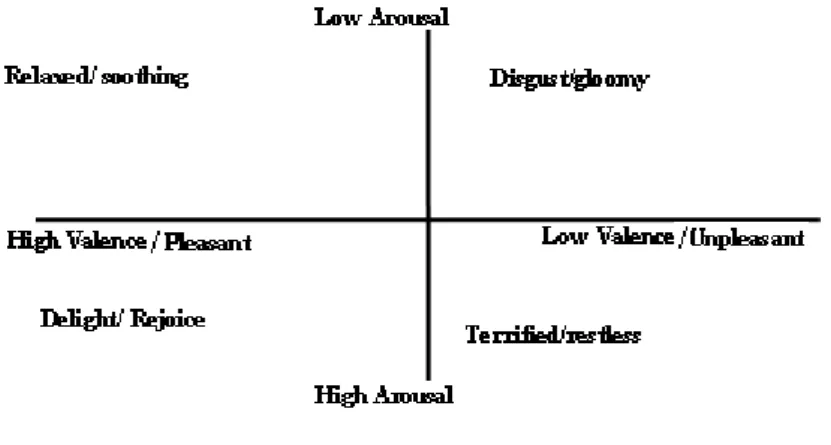
arousal (Sanchez et al., 2005). The representations of valence and arousal on orthogonal X- and Y-axes form a two-dimensional model of mood as proposed by Lang (1995). Figure 2.1 explains some affective states and their correspondence to some valence-arousal combinations. For example, the ―Rejoice‖ could be a pleasant and high arousal state while ―gloomy‖ could be an unpleasant and low arousal state. Similarly, ―terrified‖ could be an unpleasant but high arousal state whereas ―soothing‖ could be a pleasant but low arousal state (Sanchez et al., 2005).
Some researchers believe moods to be one-dimensional and trace it back to Charles Darwin's theories (Darwin, 1965). There are various other researchers who consider moods as multidimensional such as Dienstbier (1984). Russell (1980) suggested a spatial model to represent affective states and indicated that affective states fall in a circle with the following angling order (p. 1161): ―pleasure (0°), excitement (45°), arousal (90°), distress (135°), displeasure (180°), depression (225°), sleepiness (270°), and relaxation (315°)‖. A detailed discussion about one-dimensional versus multione-dimensional moods is provided by Remington and Fabrigar (1995). The use of two-dimensional models to examine a mood is gaining greater acceptance (Thayer, Newman and McClain, 1994). Various researchers consider mood as, at least, a two-dimensional construct, with an evaluation dimension (valence or pleasure) and an arousal dimension. For example, Almagor and Ben-Porath (1989) divided mood into two dimensions: an arousal or activation dimension and a hedonic tone or pleasantness dimension. Others like Morris (1995) prefer adding a third dimension to express the dominance (controlled, uncontrolled). This study used only a two-dimensional model, with the two dimensions valence and arousal as these two dimensions are primary and are used in most emotional judgments (Bradley and Lang, 1994).
Researchers with a nominal view of moods and emotions, whereby emotions are described in basic states, believe that general arousal may have some minor affect on intensity or duration of emotion. On the other hand, researchers who consider moods and emotions as multidimensional believe that emotional experience is formed by the combination of arousal underlying this experience and certain cognitive assessment of the meaning of the arousal (Dienstbier, 1984). Moods and emotions in multidimensional view are often measured using self-reports. According to Lang (1980) self-reports are more reliable applying a multidimensional view of measuring moods than a single-dimensional view. This study will mainly use self-reported measures with multidimensional approach (valence, arousal) because of the following reasons: 1) Most of the research used multidimensional emotions rather than the basic emotions or one dimension of emotions (Picard, 1997), 2) Self-reports are more reliable with multidimensions than with the one dimension categories such as anger, fear etc (Lang, 1980).
Figure 2.1: Valence-Arousal model with some examples of some specific moods or emotions
For self reported measurement of valence and arousal on the two dimensional model SAM (Self Assessment Manikin) devised by Lang (1980) is used in this study. Figure 2.1 shows use of this scale along X-axis and Y-axis. The Horizontal X - axis scale starts from 1 (High valence) to 9 (Low valence). Similarly the Vertical Y-axis scale starts from 1 (High Arousal) to 9 (Low Arousal).
2.4 Moods and Programmers’ Performance
The basic objective of this section is to establish indirect support for the first hypothesis of the study that states that ―Moods have an impact on programmers‘ performance‖. This support will be provided with the help of relevant literature as well as by developing models indicating indirect support for the hypothesis. The proposed models will be developed using relevant research in cognitive sciences, on programming tasks and moods. The purpose of these models is to explain the relation between cognition and programming tasks, the relation between moods and cognition, and thus indirectly the relation between moods and programming tasks.
The section will start with emphasising the importance of moods in daily life. This will be followed by a discussion on moods and their impact on programming, cognitive tasks as well as on programmers‘ performance. As moods are considered to affect cognition and as programming involves various cognitive processes, the next part will discuss the psychology of programming and the impact of different cognitive elements on programming tasks. The impact of cognitive elements will be extended to debugging and program comprehension in the next part that will be followed by the formulation of a programming, cognition mood model.
Moods and emotions are important to understand the world and their absence can cause distress and disaster. For example, Damasio (1995) found that people who lose emotional ability often take disastrous decisions as they do not feel happy or sad about events. Moods also aid to understand circumstances as well as they can alert us to dangers. For instance, an emotion like ‗fear‘ enables someone to realize the critical situation, which in turn conveys one‘s emotional and physical state to the others. Moods can also help us to overcome problems and to gain advantage of useful situations. Disorders in mood are common, painful and could prove to be fatal (Jamison, 2004). Moods are also known to affect thinking, narrow down alternatives and make it difficult to control things and therefore might affect performance indirectly while someone is at work (Ekman, 2003). Tice et al., (2001) argued that people under emotional stress may give priority to feel better and in the process may ignore long range goals and thus in turn cause decrease in performance.
Research shows that moods affect performance but a question of importance becomes what could be the reason for mood? In daily life there are various causes that could explain someone‘s mood. For example, an individual is likely to feel sad on someone's death and is likely to feel happy on marriage or birthday. Similarly, flying a plane, performing an operation, playing finals and presenting are some of the tasks in which people could expect a wide range of positive and negative feelings (Martin, 2001). Similarly, overwork or boring work may lead to under arousal and an interesting and exciting task can result in over arousal. People in sad mood try to repair their bad moods. There is a threat to performance in the tasks if people are in bad moods or seek to repair bad moods (Erber and Erber, 2001).
According to Yerkes-Dodson's (1908) Inverted U Hypothesis an increase in arousal cause an increase in performance until a certain level beyond which arousal increase cause degradation of performance. Various other studies like Chang & Wilson (2004), Lowther & Lane (2006) and Lane et al. (2005) also found that moods have significant impact on performance. Moods also affect activities like creativity (Russ and Kaugars, 2001; Kaufmann, 2003), memory tasks (Lewis, Critchely, 2003), reasoning (Chang and Wilson, 2004), behaviour (Kirchsteiger, Rigotti, et al, 2005), cognitive processing (Rusting, 1998), information processing (Armitage, Conner and Norman, 1999), learning (Weiss, 2000; Ingleton, 1999) and decision making (Gardner and Hill, 2004).
Research suggests that moods affect reasoning, which is an important cognitive process for programming (Jones, 2003). Jones argued that programming tasks alone are not sufficient for a valid computer program without reasoning. Impact of moods on reasoning is also evident in other studies (Blagrove and Akehurst, 2001; Zarinpoush, Cooper and Moylan, 2000). Furthermore various researchers like Damasio (1995) found emotions/moods and reasoning to be quite interrelated. Therefore, an impact of moods on reasoning might directly or indirectly have an effect on a programmer's performance.
As moods might have an impact on programmers‘ performance, there is a need to view mood as an important human factor affecting performance. Traditionally, software psychology focuses on human factors such as ease of use, simplicity in learning, improved reliability, reduced error frequency and enhanced user satisfaction (Rugaber and Tisdale, 1994). The personality of a programmer can also be factor. Iron (1982) stated that by considering personality in cognitive operations of programming, it can be easier to understand cognitive abilities and their utilization to improve the performance of programming tasks. Programming or coding is only one of several tasks in the software development process which also includes: designing, debugging and testing etc. Work has also been done towards understanding the cognition behind the programming task. Examples include Shneiderman and Mayer‘s (1979) work. They proposed a model of programmers‘ behaviour to explain basic programming tasks in terms of cognition. These tasks include:
1) Composition: writing a program
2) Comprehension: understanding a given problem 3) Debugging: finding errors in a given program
4) Modification: altering a given program to fit a new task 5) Learning: acquiring new programming skills and knowledge
Debugging as mention above is a task that focuses on finding and correcting errors in a program. Debugging is a difficult task and requires large part of a programmer‘s effort (Brooks, 1975). It is a complex but important activity and is a combined process of testing and code correction (Shaochun and Rajlich, 2004). Debugging has received some attention from software psychology (Rugaber and Tisdale, 1994) but there is still a lack of research in the scope of cognitive abilities and debugging performance. Therefore the main focus of this study will be on debugging. Shaochun and Rajlich (2004) identified three levels of knowledge for a
programmer and these are helpful in understanding effective debugging. They are: program knowledge, domain knowledge and specific bug knowledge. Debugging therefore requires skills to utilize this stored knowledge from memory on all the three levels which in some sense can also be said for program comprehension.
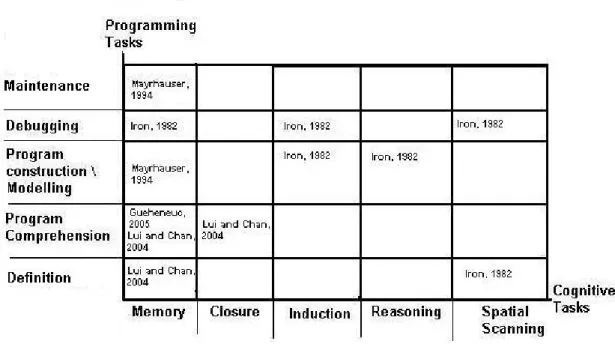
Similar to the three levels of knowledge required for debugging, Shneiderman (1980) also divided program comprehension into three levels, i.e. low level comprehension of the function of each line of code, mid level comprehension of the structure of the algorithm & data and high level comprehension of overall program function. He organized these three levels into the form of a model. According to Shneiderman, programmers store the multilevel knowledge in their long-term memory and extract and use this knowledge to convert program code into some internal semantic form. In addition to memory, other well established cognitive factors are also known to have relationship with different programming variables. For example, Iron (1982) found that induction and syllogistic reasoning are strongly related with program composition and its production. He also found that spatial scanning and debugging are interrelated.
Similarly Lui and Chan (2004) proposed a Cognitive Programming Model (CPM) based on the studies of psychology of programming and cognitive models for learning. The purpose of the model is to describe how problems in natural language are transformed into symbolic executable programs by programmers. CPM work on six key areas: 1) Definition, 2) Representation, 3) Model, 4) Schema 5) Algorithm and 6) Code. Lui and Chan (2004) found that repeated tasks (repeating a similar task several times) initiate cognitive processes of learning and memorization which in turn cause reduction in development time. They found that in the start of the repeated tasks programmers applied different reasoning and logic but after learning and memorization, produced similar solutions in terms of program logic. Xu (2005) worked toward creating program comprehension model based on Bloom‘s (1956) six learning levels. He considered cognitive activities absorption, denial, reorganization and expulsion at six learning levels of Bloom taxonomy.
The above literature suggests that various cognitive abilities are of importance for different programming tasks. For example Shneiderman (1980) related program comprehension with memorization. Iron (1982) found relation between induction and syllogistic reasoning. He also found a strong relationship of induction with program composition and its production. Next, Iron also found that spatial scanning and
debugging are interrelated. Similarly Lui and Chan (2004) related learning and memorization with efficient task processing as well as a mean for the production of various solutions in repeated tasks. Therefore the Programming Tasks (PTs) which literature suggests that are related with Cognitive Tasks (CTs) can be mapped with each other in a two-dimensional model as illustrated below in Figure 2.2.
Figure 2.2: A two-dimensional CPTM (Cognitive Programming Task Model). Some cells show examples from the literature that address the specific cross-section of programming task and cognitive element. Note: this table does not present an exhaustive overview of the literature, instead it just provide some examples from the literature for some PT-CT cells.
The programming tasks as well as cognitive elements used in the model above were based on the literature like Mayrhauser (1994), Lui & Chan (2004), Iron (1982) and Gueheneuc 2005. This CPTM (Cognitive Programming Task Model) model represents only a few of the important programming tasks as well as some of the cognitive tasks derived from the literature indicated earlier in this paragraph. The programming tasks used in the model (Figure 2.2) along the y-axis are parts of the normal software development life cycle as discussed by Pressman (2005). The programming tasks include:
1. Definition; Elementary term required to perceive problems.
2. Program Comprehension/Program Understanding; Ability to read and to understand a computer program to plan, design and implement modifications in it.
3. Program Construction / Modelling; A stepwise transformation of real world 4. relations into computer language coding
5. Debugging: An activity of finding and correcting errors within a computer program
6. Maintenance; Modification of the software product to correct faults and to improve performance of the software product.
Cognitive tasks used in the model include:
1. Memory; An organism‘s ability to store, retain and subsequently retrieve
information.
2. Closure; The ability to ‗hold in mind‘ a particular percept (configuration)
and find it embedded in distracting material
3. Induction; A Process in software development in which developers deal with elementary terms that are required to perceive problems
4. Reasoning; cognitive process of looking for reasons for beliefs, conclusions, actions or feelings
5. Spatial Scanning; The ability to quickly survey a complex field to find a particular combination representing a pathway through the field
Paragraphs above relate programming tasks and cognitive elements. Literature discussed earlier in this section also suggests that various moods (valence and arousal) have impact on cognitive abilities. For example with respect of human memory MacWhinney et al. (1992) as well as Lewis & Critchely (2003) found that moods dimensions valence and arousal are related to better memory performance. Mujica-Parodi et al. (2004) found that arousal had a significant impact on cognitive performance. Similarly Chang and Wilson (2004) found that valence and arousal affect reasoning capabilities. Zheng (2008) argued with the help of literature that valence and arousal are related to implicit and explicit memory. Similarly Delplangue et al. (2006) found that emotional content of the stimulus may modulate the reorientation of attention and the subsequent updating process in a specific way. Therefore, it can be argued on the bases of literature that moods (valence, Arousal) and cognitive tasks (CTs) are related and can be mapped to each other in a two-dimensional model as illustrated in Figure 2.3. This two-two-dimensional model suggests the possibility of mapping moods (valence, Arousal) with cognitive tasks, which could help to classify existing literature and direct future research.
Figure 2.3: A Cognitive Mood Model (CMM), showing moods (valence, arousal) impact on cognitive tasks (CTs). Note: * indicates that a specific study does not focus
exclusively on only valence or only arousal, but on mood in general.
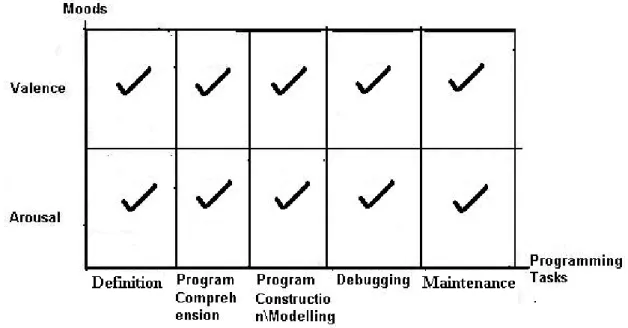
Considering the relation of cognitive elements with programming tasks as illustrated in (Figure 2.2) and that of moods with cognitive tasks from the literature (Figure 2.3) it can be argued that moods are related with programming tasks. Thus another two dimensional model with one axis representing moods (valence, arousal) and other axis representing programming tasks can be formulated to form the model represented in Figure 2.4. This MPM Mood Programming Model) model supports the first hypothesis H1 by indicating a relation between moods and programming tasks. Mood dimension is further divided into valence and arousal. The symbol in the cell represents the impact of one dimension on the other dimension, formulated as an indirect relationship from the two earlier models. For example Lewis and Critchley (2003) presented a case to show that valence (positive or negative) has an effect on memory. Similarly Shneiderman (1980) found that memory plays a vital role in programming tasks like definition (D), program comprehension & understanding (PC), program construction & modelling (PM) and debugging (DG). As valence effect memory and memory effect programming tasks (D, PC, PM, DG), there might be an indirect relation between programming tasks (D, PC, PM, DG) and valence. Thus a symbol in the respective cell shows indirect relationship between the two dimensions. The CPTM model presented earlier also shows that all cognitive tasks mentioned here (induction, closure, memory, induction and reasoning) are related with debugging,
thus indicating impact of moods on debugging. This formed an additional reason to consider debugging as main focus for this study.
Figure 2.4: A Mood Programming Model (MPM) based on models in Figure 2.2 and Figure 2.3 showing moods might have an impact on Programming Tasks. The
relations are represented by ticks in the respective cell.
In conclusion, earlier sections established that moods might have an impact on various cognitive abilities. Furthermore cognitive abilities play an important part in programming skills and in programming performance. Therefore the literature provides indirect support for a relationship between mood as a factor affecting various cognitive abilities and thus programming tasks and programmers‘ performance. This leads to refined formulation of the first hypothesis for this research that states that ―Programmers' moods affect their debug performance in respect of finding and correcting problems”.
2.5 Measuring Moods from Behaviour
In the previous section it was established with the help of the literature that moods might have an impact on programmers‘ programming tasks and hence on their performance. However, in order to help programmers to improve their performance, there is a need to measure their mood. The objective of this section is to consider the possibility of measuring programmers‘ and computer users‘ mood from their use of a keyboard and a mouse.
As use of keyboard and mouse is a specific kind of behaviour, this section commences with the possibility of measuring moods from programmers‘ and
computer users‘ behaviour. Therefore, in the second part of this section the effect of moods on general behaviour will be discussed, followed by the discussion on the effects moods have on computer related behaviour in the third part. The fourth part will be a discussion on different ways to report moods and to measure moods along with their advantages and disadvantages. What could be used in order to have non-interruptive and non obtrusive measurement of moods in a computer related environment? This concern will be discussed in the last part of this section. In addition, the second hypothesis of the study will also be devised in the last part.
Mood might have an effect on behaviour and there are various studies to support this idea. For example, Armitage, Conner and Norman (1999) showed that positive moods promote risky decision making and heuristic strategies. Similarly, they found that people in negative moods focus more on specific outcomes and other attributes associated with behaviour when making a decision. Bohner et al. (1992) showed that people were uninfluenced by the content as well as context information when in a good mood but used both types of information while in a bad mood. Dow (1992) argued that moods are diffusely related to behaviour.
As reports in the literature show that different moods/emotions might be a reasons for various behaviours, this research is particularly interested in measuring moods based on the behaviour. A considerable amount of research has focused on computer systems that can recognize user's emotions and can adapt them accordingly in order to improve social presence (Nasoz et. al, 2003). There are also continuing attempts to measure moods from behaviour.
There are various methods devised for measuring moods/emotion from behaviour including both self-reporting and detections and measurements by the use of software. Methods like SAM (Self Assessment Manikin) and EPI (Emotion Profile Index) are for manual measurement of moods and are widely used in different researches that require measuring moods and emotions of the subjects. These measurements are also called self-reporting measurements (Swindells, 2006; Poels, 2006).
Poels (2006) divided reporting measurement scales into verbal self-reporting scales, visual self-self-reporting scales and moment-to-moment ratings. Some commonly used examples of verbal self-report scales are Plutchik's emotion profile index (EPI) and Izzard's differential emotion scale. Visual self-report scales include SAM (Self Assessment manikin), PrEMO (Product Emotion Measurement
Instrument). Moment to moment ratings includes warmth monitor which is shown to provide reliable measure of warmth.
Verbal mood measuring methods have various advantages such as being simple and easy to quickly investigate large scale emotional responses. Similarly, these methods also have various limitations such as scales containing a large list of emotion adjectives that might be cumbersome and a cause of fatigue in respondents (Poels, 2006). However, these moods/emotions measuring methods might not be suitable for measuring moods/emotions of the programmers due to their distracting nature and requirement to rate moods constantly (Zimmerman et al., 2003).
Visual reporting or autonomic measures include various techniques like facial expressions, skin conductance and heart rate (Nasoz, 2003; Backs, 2000). Measurements of facial expressions might not be suitable for measuring moods of programmers at work because they rely on the visible facial expression. Measuring moods from facial expression is not always a good choice because affective states are internal and involve cognitive thoughts as well as physical changes (Picard, 1997). Internal cognitive thoughts may not always impact facial expressions.
Physiological measures such as skin conductance, heart rate measurement etc require equipment to be attached to different body parts and this may cause disturbance to a programmers working in a professional environment. (Fahrenberg and Wientjes, 2000; Zimmermann et al., 2003). The mentoring of keyboard and mouse use might reduce these overheads as these are the most basic input devices used by computer users. Computer users are familiar with these devices and there are no risks of external device disruptions such as the loss of concentration due to attached equipment and devices. The use of keyboard and mouse is also cheap as they are available with almost every computer (Zimmerman et al., 2003).
Keyboard and mouse have already been used in various studies such as in personality (Mikkelsen et al., 2007) and usability (Coutaz et al., 1995) domains. For instance Meunier (1996) found that personality and gender had a significant effect on keyboard control. However there is limited literature on the possibility of measurement of moods by the user‘s use of keyboard and mouse. There are some examples where researchers strived for this, like Mahr et al. (2005) used mouse motions to detect emotions with some significant correlations in his thesis. Another example is Zimmerman et al. (2003) who designed experiments to store keyboard keystrokes and mouse movements in log files and later intended to find correlations of
these events with affective state. Zimmerman (2003) results might not be published yet but the study described in this thesis was set up to conduct the empirical examination on the possibility of mood measurement from computer users‘ keyboard and mouse usage.
Although there is some research, which utilized keyboard and mouse as indicated above, the direct use of keyboard and mouse as a mood measurement instrument was simply not found. However research suggests that keyboard and mouse behaviour is influenced by social factors and work environments (Peres et al., 2004). This might lead us to the second hypothesis of the study that indicates that ―Moods can be measured from the computer user‟s interaction with keyboard and mouse”.
2.6 IDE to Improve Performance in Context of Moods
Previous sections looked at the impact moods may have on a programmer coding and debugging performance as well as how programmer and computer user mood can be measured from their interaction with a keyboard and a mouse without interrupting them. Implementing a mood-measuring tool, however, requires a software environment. As almost every programmer uses some kind of Integrated Development Environment (IDE) for software development, an IDE could be a suitable platform for such mood-measuring instrument.
This section will discuss programming environments, also called IDEs, and their role towards assisting programmers in their programming tasks. The first part of this section of this chapter explains programming as complex cognitive tasks and therefore needs to divide them into subtasks as well as to provide tools for each task in order to reduce its complexity. The second part looks at IDEs and some of the tools embedded in IDEs and ways in which they help programmers will be explained by looking at the underlying cognitive functions they support. The third part will discuss the possibility of an affect recognizing tool embedded in an IDE and how it can implement an intervention system to aid programmers. The last part of the section will talk about different interventions that can be used to change moods of people. The position will be taken that these interventions can be implemented in an IDE and thus can serve to improve performance of programmers.
Programming is a complex cognitive activity with limited time to complete the tasks (Yildiz, 2007). Therefore, it is suitable to divide programming tasks into various
subtasks as well as to introduce helper modules to aid programmers. Such a tool which holds different helper tools together at one place is called an Integrated Development Environment (IDE). An IDE improve performance by targeting various problems programmers may face during development. Pane and Myers (2000) identified that programmers face difficulties in memorizing because of increasing vocabulary of computer languages as well huge syntax requirements. They also identified that mental plans of the programmers are not appropriately mapped into programming languages. Therefore Pane and Myers identified that there is a need for tools that can make relevant information available and accessible as well as provide support transforming mental plans into a specific computer language. As memorizing, expressing and representing mental plans are cognitive function, there is a need for cognition support tools.
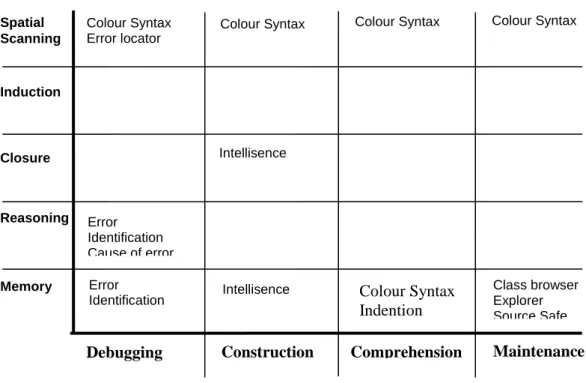
As explained earlier with the help of Figure 2.2 programming tasks and cognitive elements are directly related. There is some research conducted toward developing software that could provide cognitive support. For example Green and Petre (1996) studied the possibility of designing a development environment that should be able to adapt according to mental representations. They laid a basis for development of such environments by developing a framework they called cognitive dimensions framework.
CTAT (Cognitive Tutor Authoring Tools) is software used to author intelligent tutor behaviour. This tool is now being used in research related with development, learning, and complex problem solving. For example Aleven et al. (2006) used CTAT in preliminary small-scale controlled experiments involving basic cognitive tutor development tasks. Some of the modern IDEs are also providing tools for cognitive support in order to help a programmer to increase their productivity. For example Koedinger & Aleven (2004) found preliminary evidence that CTAT software substantially reduce the time needed to build and test cognitive models and tutors. Support tools provided by IDEs could be mapped onto two dimensions representing programming tasks on horizontal axis and cognitive element on vertical axis. The conjunction of programming tasks and cognitive element form a cell displaying the relevant tool present in the IDE to support programmer in their work. This model is illustrated in the Figure 2.5.