Sequential Recommender Systems: Challenges, Progress and Prospects
∗Shoujin Wang
1, Liang Hu
2,3, Yan Wang
1, Longbing Cao
2, Quan Z. Sheng
1and
Mehmet Orgun
1 1Department of Computing, Macquarie University
2
Advanced Analytics Institute, University of Technology Sydney
3University of Shanghai for Science and Technology
{
shoujin.wang, yan.wang
}
@mq.edu.au, [email protected],
[email protected],
{
michael.sheng, mehmet.orgun
}
@mq.edu.au
Abstract
The emerging topic of sequential recommender systems (SRSs) has attracted increasing attention in recent years. Different from the conventional recommender systems (RSs) including collabora-tive filtering and content-based filtering, SRSs try to understand and model the sequential user behav-iors, the interactions between users and items, and the evolution of users’ preferences and item popu-larity over time. SRSs involve the above aspects for more precise characterization of user contexts, in-tent and goals, and item consumption trend, leading to more accurate, customized and dynamic recom-mendations. In this paper, we provide a systematic review on SRSs. We first present the characteris-tics of SRSs, and then summarize and categorize the key challenges in this research area, followed by the corresponding research progress consisting of the most recent and representative developments on this topic. Finally, we discuss the important re-search directions in this vibrant area.
1
Introduction
Sequential recommender systems (SRSs) suggest items which may be of interest to a user by mainly modelling the sequential dependencies over the user-item interactions (e.g., view or purchase items on an online shopping platform) in a sequence. The traditional recommender systems (RSs), including the content-based and collaborative filtering RSs, model the user-item interactions in a static way and can only capture the users’ general preferences. In contrast, SRSs treat the user-item interactions as a dynamic sequence and take the sequential dependencies into account to capture the current and recent preference of a user for more accurate recommen-dation [Chen et al., 2018]. In order to enhance the under-standing of SRSs, next we present the motivation and formal-ization of SRSs.
Motivation: Why Sequential Recommender Systems?
The user-item interactions are essentially sequentially depen-dent. In the real world, users’ shopping behaviours usually
∗
A comprehensive survy on session-based recommender systems can be found: https://arxiv.org/abs/1902.04864.
Tina Jimmy
Figure 1: Two examples of SRSs: (1) After Jimmy has booked a flight, a hotel and rented a car, what will be his next action? (2) After Tina has bought an iPhone, an iWatch and a pair of AirPods, what would she buy next?
happen successively in a sequence, rather than in an isolated manner. Taking the shopping events of Jimmy depicted in Figure 1 as an example, before Jimmy started holiday, he booked a flight and a hotel and rented a car successively, and his next action may be visiting a tourist attraction via self-driving. In such a case, the hotel may be close to the desti-nation airport of the flight and the location for picking up the rented car may be not far away from the hotel. In this sce-nario, each of Jimmy’s next actions depends on the prior ones and thus all the four consumption actions are sequentially de-pendent. Likewise, we can see the sequential dependencies in Tina’s case. Such kind of sequential dependencies com-monly exist in transaction data but cannot be well captured by the conventional content-based RSs or collaborative filter-ing RSs [Kanget al., 2018], which essentially motivates the development of SRSs.
Both the users’ preference and items’ popularity are dy-namic rather than static over time. In fact, a user’s prefer-ence and taste may change over time. For instance, many young people who used to be iPhone fans now have switched to become fans of the phones manufactured by Huawei or Samsung and the popularity of iPhone has been dropping in recent years. Such dynamics are of great significance for pre-cisely profiling a user or an item for more accurate recom-mendations and they can only be captured by SRSs.
User-item interactions usually happen under a certain se-quential context. Different contexts usually lead to different users’ interactions with items, which is, however, often ig-nored by traditional RSs like collaborative filtering. In trast, an SRS takes the prior sequential interactions as a con-text to predict which items would be interacted in the near future. As a result, it is much easier to diversify the
rec-ommendation results by avoiding repeatedly recommending those items identical or similar to those already chosen.
Formalization: What are Sequential Recommender Systems?
Generally, an SRS takes a sequence of user-item interactions as the input and tries to predict the subsequent user-item in-teractions that may happen in the near future through mod-elling the complex sequential dependencies embedded in the sequence of user-item interactions. More specifically, given a sequence of user-item interactions, a recommendation list consisting of top ranked candidate items are generated by maximizing a utility function value (e.g., the likelihood):
R=arg max f(S) (1)
wheref is a utility function to output a ranking score for the candidate items, and it could be of various forms, like a condi-tional probability [Wanget al., 2018], or an interaction score [Huanget al., 2018]. S = {i1, i2, ..., i|S|}is a sequence of
user-item interactions where each interactionij =< u, a, v >
is a triple consisting of a useru, the user’s actiona, and the corresponding itemv. In some cases, users and items are as-sociated with some meta data (e.g., the demographics or the features), while the actions may have different types (e.g., click, add to the cart, purchase) and happen under various contexts (e.g., the time, location, weather). The outputRis a list of items ordered by the ranking score.
Different from the general sequence modelling in which the sequence structure is much simpler since a sequence is often composed of atomic elements (e.g., real values, genes), the learning task in SRSs is much more challenging because of the more complex sequence structure (e.g., each element is a triple). This motivates us to systematically analyze the chal-lenges in SRSs and summarize the corresponding progress.
Contributions. The main contributions of this work are sum-marized below:
• We systematically analyze a number of key challenges caused by different data characteristics in SRSs and cat-egorize them from a data driven perspective, which pro-vides a new view to deeply understand the characteris-tics of SRSs.
• We summarize the current research progress in SRSs by systematically categorizing the state-of-the-art works from a technical perspective.
• We share and discuss some prospects of SRSs for the reference of the community.
2
Data Characteristics and Challenges
Due to the diversity and complexity of the customers’ ping behaviours, item characteristics and the specific shop-ping contexts in the real world, the generated user-item in-teraction data often has different characteristics. Different data characteristics essentially bring different challenges for SRSs, which require different solutions, as presented in Table 1. In the following five subsections, we specifically discuss five key challenges respectively in SRSs caused by different data characteristics. In each subsection, we first introduce the particular data characteristics and then illustrate the cor-responding challenges.
2.1
Handling Long User-Item Interaction
Sequences
A long user-item interaction sequence consists of a relatively large number of user-item interactions. As a result, it has a much higher chance to have more complex and compre-hensive dependencies over the multiple interactions inside it, which makes the sequential recommendations much more challenging. Specifically, two most critical challenges in long user-item interaction sequences arelearning higher-order se-quential dependenciesandlearning long-term sequential de-pendencies, which will be presented respectively below.
Learning higher-order sequential dependencies. Hig her-order sequential dependencies commonly exist in the user-item interaction sequences, especially in long ones. Com-pared to the lower-order sequential dependencies, which are relatively simple and can be easily modeled by Markov chain models [Garcinet al., 2013] or factorization machines [Ren-dleet al., 2010; Hidasi and Tikk, 2016], higher-order sequen-tial dependencies are much more complex and harder to be captured because of their complicated multi-level cascading dependencies crossing multiple user-item interactions. So far, there have been mainly two basic approaches reported that can address this challenge in SRSs to some extent: higher-order Markov-chain models [He and McAuley, 2016] and recurrent neural networks (RNN)[Hidasi et al., 2016a], as shown in Table 1. However, each approach has its own limi-tations, for example, the historical states that can be involved in a higher-order Markov-chain model are quite limited as the number of the model parameters to be estimated grows exponentially with the order, while the overly strong order assumption employed in RNN limits the application of RNN in sequences with a flexible order. The technical progress achieved in both approaches will be presented in Sections 3.1 and 3.3 respectively in more details.
Learning long-term sequential dependencies. Long-term sequential dependencies refer to the dependencies between interactions that are far from each other in a sequence. For instance, given a shopping sequenceS1={a rose, eggs, bread, a bottle of milk, a vase}, which consists of a basket of items that are purchased successively by a user Janet. Obviously, the vase and the rose are highly dependent even though they are far from each other. Such cases are not uncommon in the real world as users’ behaviours are usually highly uncertain and thus they may put any items into the cart. To address such a critical issue, Long Short Term Memory (LSTM)-based [Wu et al., 2017] and Gated Recurrent Unit (GRU)-based [Hidasiet al., 2016a] RNN have been applied in SRSs to capture the long-term dependencies among the user-item interactions in a sequence. However, it is easy for RNN mod-els to generate false dependencies by overly assuming any adjacent items in a sequence are highly dependent. In the above example of Janet’s shopping sequence, an RNN usu-ally modelsS1by assuming the milk and vase are dependent due to the close distance between them, but actually they are not. Some other efforts have been made to solve this issue by utilizing the advantage of mixture models to combine multi-ple sub-models with different temporal ranges to capture both short- and long-term dependencies in a unified model [Tanget
Data characteristics Challenges Existing solutions
Long user-item interac-tion sequences
Learning higher-order se-quential dependencies
Higher-order Markov chain [He and McAuley, 2016], RNN [Hidasiet al., 2016a]
Learning long-term sequen-tial dependencies
LSTM- [Wu et al., 2017] and GRU-based [Hidasiet al., 2016a] RNN, mixture models [Tanget al., 2019]
User-item interaction sequences with a flexible order
Learning collective sequen-tial dependencies under the assumption of flexible order
CNN [Tang and Wang, 2018; Yuanet al., 2019]
User-item interaction sequences with noise
Learning sequential depen-dencies attentively and dis-craminatively
Attention models [Wang et al., 2018], memory networks [Chenet al., 2018]
User-item interaction sequences with hetero-geneous relations
Learning heterogeneous re-lations discriminatively and integrating them effectively
Mixture models [Kanget al., 2018; Tanget al., 2019; Wang et al., 2019]
User-item interac-tion sequences with hierarchical structures
Learning hierarchical de-pendencies
Feature-enriched RNN [Hidasiet al., 2016b], hierarchical embedding [Wang et al., 2015], hierarchical RNN [Quad-ranaet al., 2017], hierarchical attention [Yinget al., 2018]
Table 1: A summary of challenges driven by data characteristics in SRSs
al., 2019]. Overall, the works that are able to tackle this chal-lenge are quite limited and more investigations are required to bridge this gap. The technical progress achieved in RNN and mixture models will be presented in Section 3.3.
2.2
Handling User-Item Interaction Sequences
with a Flexible Order
In the real world, some user-item interaction sequences are strictly ordered while others may not be, namely, not all adja-cent interactions are sequentially dependent in a sequence. For instance, in a shopping sequence S2 = {milk, butter, flour}, it does not matter whether to buy milk or butter first, but the purchase of both items leads to a higher probability of buying flour next; namely, there is no strict order between milk and butter, but flour sequentially depends on the union of them. Therefore, for a sequence with a flexible order, it is much better to capture thecollective sequential dependencies, rather than the point-wise ones as the former is fuzzy and does not assume a strict order over user-item interactions. As a re-sult,how to capture collective sequential dependencies under an assumption of flexible orderbecomes the key challenge in handling sequences with a flexible order in SRSs.
Although common and important, reported studies in SRSs have not paid much attention to this issue yet. Exist-ing SRSs built on Markov-chains, factorization machines or RNN can only handle the point-wise dependencies but are not good at modelling and capturing collective dependen-cies. Only quite few works like [Tang and Wang, 2018; Yuanet al., 2019] have attempted to address such a challenge by employing the strength of convulotional neural networks (CNN) to model the local and global dependencies between different areas in an “image”, i.e., the embedding matrix of a sequence of interactions. The technical progress achieved in CNN-based SRSs will be presented in Section 3.3.
2.3
Handling User-Item Interaction Sequences
with Noise
Due to the uncertainty of user shopping behaviours, most of the user-item interaction sequences are not clean, meaning
that they may contain some noisy and irrelevant interactions that generate interference for the next interaction prediction. In practice, in a user-item interaction sequence, some histor-ical interactions are strongly relevant to the next interaction, while others may be weakly relevant or even irrelevant. For example, in another shopping sequenceS3={bacon, a rose, eggs, bread}, the item “rose” may be a noisy item as it is quite different from others and has no correlation to them. The next item may be a bottle of milk with a high probability and it only sequentially depends on bacon, eggs and bread while has nothing to to with the rose. Therefore, another key challenge in SRSs isto learn sequential dependencies attentively and discriminativelyover user-item interaction se-quences with noise.
Quite a few works have attempted to solve such a typical is-sue by employing the attention models [Wanget al., 2018] or memory networks [Chenet al., 2018] to selectively retain and utilize information from those interactions that are truly rele-vant to the next interaction prediction. The technical progress achieved in these solutions will be presented in Section 3.3.
2.4
Handling User-Item Interaction Sequences
with Heterogeneous Relations
Heterogeneous relations refer to different types of relations which deliver different kinds of information and should be modelled differently in SRSs. For instance, in a user-item interaction sequence, except for the widespread occurrence-based sequential dependencies over user-item interactions, there are also similarity-based relations between the inter-acted items in terms of their features. Furthermore, even though both are sequential dependencies, long-term sequen-tial dependencies are quite different from short-term ones and they cannot be modelled in the same way. Therefore, another key challenge in SRSs is how to effectively capture these heterogeneous relations embedded in the user-item in-teraction sequences respectively and to make them work col-laboratively for the sequential recommendations when han-dling user-item interaction sequences associated with hetero-geneous relations.
There are quite limited works reported in the literature to solve this challenge in SRSs. Mixture models [Kanget al., 2018; Tanget al., 2019; Wanget al., 2019] are the only so-lution to address such challenge so far. A mixture model integrates different types of relations modelled by different sub-models to collaboratively generate sequential recommen-dations. The specific technical progress will be presented in Section 3.3.
2.5
Handling User-Item Interaction Sequences
with Hierarchical Structures
Generally, there are mainly two kinds of hierarchical struc-tures that may be associated with a user-item interaction se-quence: (1) the hierarchical structure between meta data and user-item interactions. To be specific, the users’ demo-graphics can determine the users’ preferences in some de-gree and can further affect their interactions with the items. Similarly, the features of items often have some effects on whether they will be liked and interacted by users [Hidasiet al., 2016b]; and (2)the hierarchical structure between sub-sequences and user-item interactions. More specifically, in some SRSs, one user-item interaction sequence includes mul-tiple sub-sequences (also called sessions). In such a case, in addition to the prior interactions within the current sub-sequence, the historical sub-sequences may also influence the next user-item interaction to be predicted in the current sub-sequence [Yinget al., 2018]. Therefore, one more key chal-lenge in SRSs ishow to incorporate the hierarchical depen-dencies embedded in these two kinds of hierarchical struc-tures into sequential dependency learning to generate more accurate sequential recommendations.
Although quite a few works have attempted to address this challenge from certain aspects, some other aspects have been less studied. On the one hand, to take the influences of items’ features on the user-item interactions into account, a series of feature-enriched neural models including [Hidasi et al., 2016b] have been proposed for SRSs. In comparison, the in-fluences of users’ demographics have been rarely considered in existing SRSs and more efforts should be devoted into this direction. On the other hand, some hierarchical models in-cluding hierarchical embedding models [Wanget al., 2015], hierarchical RNN [Quadranaet al., 2017] and hierarchical at-tention networks [Yinget al., 2018] have been devised to in-corporate the historical sub-sequences into sequential depen-dency learning to build more powerful SRSs. Particularly, the technical progress achieved to address this challenge will be presented in Sections 3.2 and 3.3.
3
Research Progress
To provide an overview of the technical progress in SRSs and to give more technical details of the solutions to the afore-mentioned challenges, we summarize and briefly discuss the research progress in SRSs from a technical perspective in this section. Particularly, we first present a categorization of all the approaches for SRSs from the technical perspective and then briefly highlight the recent progress in each category.
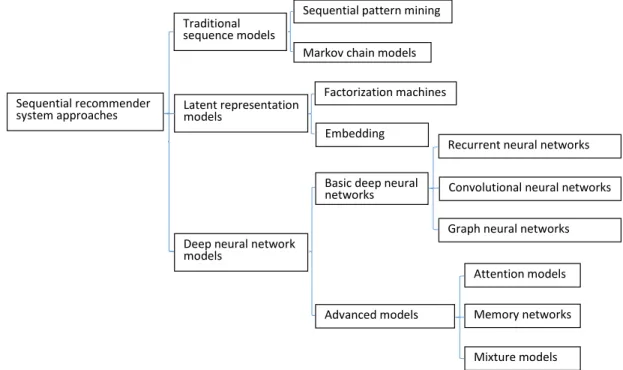
The categorization of SRS approaches is presented in Fig-ure 2. We observe that the various approaches for SRSs are
first categorized into 11 atomic classes ( e.g., the sequential pattern mining, factorization machine, and recurrent neural networks) from the technical perspective. All these atomic classes are then further categorized into three taxonomies, including traditional sequence models, latent representation models, and deep neural network models. Generally speak-ing, these three taxonomies change from simple to complex and are reported successively. Next we summarize the re-search progress in each of the three taxonomies.
3.1
Traditional Sequence Models for SRSs
Traditional sequence models including sequential pattern mining and Markov chain models are intuitive solutions to SRSs by taking advantage of their natural strength in mod-elling sequential dependencies among the user-item interac-tions in a sequence.
Sequential pattern mining. Sequential pattern-based RSs first mine frequent patterns on sequence data and then uti-lize the mined patterns to guide the subsequent recommenda-tions. Although simple and straightforward, sequential pat-tern mining usually generates a large number of redundant patterns, which increases unnecessary cost w.r.t. time and space. Another obvious shortcoming is that it often loses those infrequent patterns and items due to the frequency con-straint, which limits the recommendation results to those pop-ular items. Therefore, quite few works have been reported in this class, except a representative one [Yapet al., 2012].
Markov chain models. Markov chain-based RSs adopt Markov chain models to model the transitions over user-item interactions in a sequence, for the prediction of the next in-teraction. According to the specific technique used, Markov chain-based RSs are divided intobasic Markov Chain-based approachesandlatent Markov embedding-based approaches. The former one directly calculates the transition probability based on the explicit observations [Garcinet al., 2013], while the latter first embeds the Markov chains into an Euclidean space and then calculates the transition probabilities between interactions based on their Euclidean distance [Fenget al., 2015]. The shortcomings of Markov chain-based RSs are ob-vious, namely, on the one hand, they can only capture the short-term dependencies while ignoring long-term ones due to the Markov property which assumes that the current in-teraction depends on one or several most recent inin-teractions only; on the other hand, they can only capture the point-wise dependencies while ignoring the collective dependencies over user-item interactions. Consequently, they are less and less employed in SRSs in recent years.
3.2
Latent Representation Models for SRSs
Latent representation models first learn a latent representation of each user or item, and then predict the subsequent user-item interactions by utilizing the learned representations. As a result, more implicit and complex dependencies are cap-tured in a latent space, which greatly benefits the recommen-dations. Next, we introduce two representative models falling into this taxonomy.
Factorization machines.Factorization machine-based SRSs usually utilize the matrix factorization or tensor factorization
Sequential recommender system approaches Traditional sequence models Latent representation models
Deep neural network models
Sequential pattern mining Markov chain models
Factorization machines Embedding
Basic deep neural networks
Advanced models
Recurrent neural networks Convolutional neural networks Graph neural networks
Attention models Memory networks
Mixture models
Figure 2: A categorization of SRS approaches from the technical perspective
to factorize the observed user-item interactions into latent fac-tors of users and items for recommendations [Rendleet al., 2010; Hidasi and Tikk, 2016]. Different from collaborative filtering (CF), the matrix or tensor to be factorized is com-posed of interactions rather than the ratings in CF. Such a model is easily affected by the sparsity of the observed data and thus cannot achieve ideal recommendations.
Embedding. Embedding-based SRSs learn a latent repre-sentations for each user and item for the subsequent rec-ommendations by encoding all the user-item interactions in a sequence into a latent space. Specifically, some works take the learned latent representations as the input of a net-work to further calculate an interaction score between users and items, or successive users’ actions [Wanget al., 2015; 2018], while other works directly utilize them to calculate a metric like the Euclidean distance as the interaction score [He et al., 2018]. This model has shown great potential in recent years due to its simplicity, efficiency and efficacy.
3.3
Deep Neural Network Models for SRSs
Deep neural networks have natural strength to model and cap-ture the comprehensive relations over different entities (e.g., users, items, interactions) in a sequence, and thus they nearly dominate SRSs in the past few years. The latest progress achieved in SRSs also belongs to this taxonomy. Generally, this taxonomy can be divided into two sub classes: SRSs built on basic deep neural networks and SRSs built on deep neural networks with some advanced models incorporated.
Basic Deep Neural Networks
The most commonly used deep neural networks for SRSs are recurrent neural networks (RNN) due to their natural strength in sequence modelling, but they also have defects. Recently,
convolutional neural networks (CNN) and graph neural net-works (GNN) have also been applied in SRSs to make up the defects of RNN. Next, we introduce the SRSs built on top of these three deep neural networks respectively.
RNN-based SRSs. Given a sequence of historical user-item interactions, an RNN-based SRS tries to predict the next pos-sible interaction by modelling the sequential dependencies over the given interactions. Except for the basic RNN, long-short-term-memory (LSTM)- [Wuet al., 2017] and gated re-current unit (GRU)-based [Hidasiet al., 2016a] RNN have also been developed to capture the long-term dependencies in a sequence. Recent years have witnessed the prosperity of RNN-based SRSs and they dominate the research on the deep learning-based SRSs or even the whole SRSs. Besides the basic RNN structure, some variants are proposed to capture more complex dependencies in a sequence, like hierarchical RNN [Quadranaet al., 2017]. However, RNN is not flaw-less for SRSs, with the shortcomings in two aspects: (1) it is easy to generate fake dependencies due to the overly strong assumption that any adjacent interactions in a sequence must be dependent, which may not be the cases in the real world because there are usually irrelevant or noisy interactions in-side a sequence; and (2) it is likely to capture the point-wise dependencies only while ignoring the collective dependencies (e.g., several interactions collaboratively affect the next one).
CNN-based SRSs. Different from RNN, given a sequence of user-item interactions, a CNN first puts all the embeddings of these interactions into a matrix, and then treats such a ma-trix as an “image” in the time and latent spaces. Finally, a CNN learns sequential patterns as local features of the image using convolutional filters for the subsequent recommenda-tions. Since a CNN does not have strong order assumptions over the interactions in a sequence, and they learn patterns
between the areas in an “image” rather than over interactions, therefore, CNN-based SRSs can make up the aforementioned drawbacks of RNN-based SRSs to some degree. However, CNN-based SRSs cannot effectively capture long-term de-pendencies due to the limited sizes of the filters used in CNN, which limits their applications. The typical works include [Tang and Wang, 2018; Yuanet al., 2019].
GNN-based SRSs. Recently, with the fast development of GNN, GNN-based SRSs have been devised to leverage GNN to model and capture the complex transitions over user-item interactions in a sequence. Typically a directed graph is first built on the sequence data by taking each interaction as a node in the graph while each sequence is mapped to a path. Then, the embeddings of users or items are learned on the graph to embed more complex relations over the whole graph [Wuet al., 2019]. Such an approach makes full use of the advan-tage of GNN to capture the complex relations in structured relation datasets. GNN-based SRSs have shown a great po-tential to provide explainable recommendations by revealing the complex relations between the recommended items and the corresponding sequential context. Such kind of SRSs are still in their early stages.
Advanced Models
To address the limitations of SRSs built on basic neural net-work structures, some advanced models are usually combined together with a certain kind of basic deep neural networks (e.g., RNN, CNN) to build more powerful SRSs which are able to address particular challenges. Next, we introduce three advanced models that are commonly used in SRSs.
Attention models. Attention models are commonly em-ployed in SRSs to emphasize those really relevant and im-portant interactions in a sequence while downplaying those ones irrelevant to the next interaction. They are widely incor-porated into shallow networks [Wanget al., 2018] and RNN [Yinget al., 2018] to handle interaction sequences with noise.
Memory networks. Memory networks are introduced into SRSs to capture the dependencies between any historical user-item interaction and the next one directly by incorpo-rating an external memory matrix. Such matrix enables it possible to store and update the historical interactions in a sequence more explicitly and dynamically to improve the ex-pressiveness of the model and reduce the interference of those irrelevant interactions [Chenet al., 2018]. Furthermore, some works incorporate a key-value memory network to store and update the corresponding knowledge base information of the interacted items in a sequence to learn the attribute level pref-erence for the enhancement of recommendations [Huang et al., 2018]. Generally, memory networks have shown their potential in SRSs, but are not sufficiently studied yet.
Mixture models.A mixture model-based SRS combines dif-ferent models that excel at capturing difdif-ferent kinds of de-pendencies to enhance the capability of the whole model in capturing various dependencies for better recommendations. A typical example is [Tanget al., 2019], which combines dif-ferent kinds of encoders that are suitable for short- and long-term dependencies respectively to learn a more precise se-quence representation for the subsequent recommendations and has demonstrated to be quite effective. However, such
models are in their early stages.
4
Open Research Directions
Recent years, particularly the recent three years, have wit-nessed the fast development of sequential recommender sys-tems, along with the prosperity of deep learning, especially that of the recurrent neural networks. While categorizing and summarizing the research practices in this filed, we have iden-tified further open research directions discussed below.
Context-aware sequential recommender systems.The cur-rent context in which a user or an item is could greatly in-fluence the user’s choice on the item, which should be con-sidered when conducting recommendations. This is even more necessary in SRSs as the context may change over time. However, most existing SRSs ignore such significant aspect. Therefore, context-aware SRSs would be an important direc-tion for future work.
Social-aware sequential recommender systems.Users live in a society and are connected with various people both online and offline. Others’ behaviors or opinions often affect the users’ choices greatly. Therefore, the social influence needs to be taken into account in SRSs, which is usually ignored in the existing works.
Interactive sequential recommender systems. Most of shopping behaviours in the real-world are continuous rather than isolated events. In other words, there are actually se-quential interactions between a user and the shopping plat-form (e.g., Amazon). However, the existing SRSs often ne-glect such interactions and only generate recommendations for one action at a single time step. How to incorporate the user-seller interactions and thus generate multi-time step rec-ommendations is a promising research direction.
Cross-domain sequential recommender systems. In the real world, items purchased by a user during a certain time period are often from multi-domains rather than one domain. Essentially, there are some sequential dependencies between items from different domains, such as the purchase of a car insurance after the purchase of a car. Such cross-domain se-quential dependencies are ignored in most SRSs. Therefore, cross-domain SRS is another promising research direction to generate more accurate recommendations by leveraging in-formation from other domains and more diverse recommen-dations from different domains.
5
Conclusions
Recommender systems (RS) is one of the most direct and practical applications of artificial intelligence in our daily lives. Sequential recommender systems (SRSs) have been at the core of the RS field in the past three to five years as they provide more intelligent and favorable recommendations to satisfy our daily requirements. It is our hope that this sum-mary provides an overview of the challenges and the recent progress as well as some future directions in SRSs to the RS research community.
Acknowledgements
This work was partially supported by Australian Research Council Discovery Project DP180102378.
References
[Chenet al., 2018] Xu Chen, Hongteng Xu, Yongfeng Zhang, and et al. Sequential recommendation with user memory networks. In Proceedings of the 11th ACM In-ternational Conference on Web Search and Data Mining, pages 108–116, 2018.
[Fenget al., 2015] Shanshan Feng, Xutao Li, Yifeng Zeng, Gao Cong, and Yeow Meng Chee. Personalized ranking metric embedding for next new poi recommendation. In Proceedings of the 24th International Joint Conference on Artificial Intelligence, pages 2069–2075, 2015.
[Garcinet al., 2013] Florent Garcin, Christos Dimitrakakis, and Boi Faltings. Personalized news recommendation with context trees. InProceedings of the 7th ACM Conference on Recommender Systems, pages 105–112, 2013.
[He and McAuley, 2016] Ruining He and Julian McAuley. Fusing similarity models with markov chains for sparse sequential recommendation. In Proceedings of the 16th IEEE International Conference on Data Mining, pages 191–200, 2016.
[Heet al., 2018] Ruining He, Wang-Cheng Kang, and Julian McAuley. Translation-based recommendation: A scalable method for modeling sequential behavior. InProceedings of the 27th International Joint Conference on Artificial In-telligence, pages 5264–5268, 2018.
[Hidasi and Tikk, 2016] Bal´azs Hidasi and Domonkos Tikk. General factorization framework for context-aware rec-ommendations. Data Mining and Knowledge Discovery, 30(2):342–371, 2016.
[Hidasiet al., 2016a] Bal´azs Hidasi, Alexandros Karat-zoglou, and et al. Session-based recommendations with recurrent neural networks. InProceedings of the 4th Inter-national Conference on Learning Representations, pages 1–10, 2016.
[Hidasiet al., 2016b] Bal´azs Hidasi, Massimo Quadrana, Alexandros Karatzoglou, and Domonkos Tikk. Paral-lel recurrent neural network architectures for feature-rich session-based recommendations. In Proceedings of the 10th ACM Conference on Recommender Systems, pages 241–248, 2016.
[Huanget al., 2018] Jin Huang, Wayne Xin Zhao, Hongjian Dou, Ji-Rong Wen, and Edward Y Chang. Improv-ing sequential recommendation with knowledge-enhanced memory networks. InProceedings of the 41st ACM SIGIR Conference on Research & Development in Information Retrieval, pages 505–514, 2018.
[Kanget al., 2018] Wang-Cheng Kang, Mengting Wan, and Julian McAuley. Recommendation through mixtures of heterogeneous item relationships. In Proceedings of the 27th ACM International Conference on Information and Knowledge Management, pages 1143–1152, 2018. [Quadranaet al., 2017] Massimo Quadrana, Alexandros
Karatzoglou, and et al. Personalizing session-based recommendations with hierarchical recurrent neural networks. InProceedings of the 11th ACM Conference on Recommender Systems, pages 130–137, 2017.
[Rendleet al., 2010] Steffen Rendle, Christoph Freuden-thaler, and Lars Schmidt-Thieme. Factorizing person-alized markov chains for next-basket recommendation. In Proceedings of the 19th International Conference on World Wide Web, pages 811–820, 2010.
[Tang and Wang, 2018] Jiaxi Tang and Ke Wang. Person-alized top-n sequential recommendation via convolutional sequence embedding. InProceedings of the 11th ACM In-ternational Conference on Web Search and Data Mining, pages 565–573, 2018.
[Tanget al., 2019] Jiaxi Tang, Francois Belletti, Sagar Jain, Minmin Chen, Alex Beutel, and et al. Towards neural mixture recommender for long range dependent user se-quences. InProceedings of the 28th International Confer-ence on World Wide Web, pages 811–820, 2019.
[Wanget al., 2015] Pengfei Wang, Jiafeng Guo, Yanyan Lan, Jun Xu, Shengxian Wan, and Xueqi Cheng. Learning hierarchical representation model for next basket recom-mendation. InProceedings of the 38th ACM SIGIR Con-ference on Research and Development in Information Re-trieval, pages 403–412, 2015.
[Wanget al., 2018] Shoujin Wang, Liang Hu, Longbing Cao, Xiaoshui Huang, Defu Lian, and Wei Liu. Attention-based transactional context embedding for next-item rec-ommendation. InProceedings of the 32nd AAAI Confer-ence on Artificial IntelligConfer-ence, pages 2532–2539, 2018. [Wanget al., 2019] Shoujin Wang, Liang Hu, Yang Wang,
and et al. Modeling multi-purpose sessions for next-item recommendations via mixture-channel purpose rout-ing networks. In Proceedings of the 28th International Joint Conference on Artificial Intelligence, pages 1–7, 2019.
[Wuet al., 2017] Chao-Yuan Wu, Amr Ahmed, Alex Beu-tel, Alexander J Smola, and How Jing. Recurrent recom-mender networks. In Proceedings of the 10th ACM In-ternational Conference on Web Search and Data Mining, pages 495–503, 2017.
[Wuet al., 2019] Shu Wu, Yuyuan Tang, and et al. Session-based recommendation with graph neural networks. In Proceedings of the 33rd AAAI Conference on Artificial In-telligence, pages 1–9, 2019.
[Yapet al., 2012] Ghim-Eng Yap, Xiao-Li Li, and Philip Yu. Effective next-items recommendation via personalized se-quential pattern mining. In Database Systems for Ad-vanced Applications, pages 48–64, 2012.
[Yinget al., 2018] Haochao Ying, Fuzhen Zhuang, Fuzheng Zhang, Yanchi Liu, Guandong Xu, and Xing Xie. Sequen-tial recommender system based on hierarchical attention networks. InProceedings of the 27th International Joint Conference on Artificial Intelligence, 2018.
[Yuanet al., 2019] Fajie Yuan, Alexandros Karatzoglou, Ioannis Arapakis, Joemon M Jose, and Xiangnan He. A simple convolutional generative network for next item rec-ommendation. InProceedings of the 12th ACM Interna-tional Conference on Web Search and Data Mining, pages 582–590, 2019.

![Table 1: A summary of challenges driven by data characteristics in SRSs al., 2019]. Overall, the works that are able to tackle this](https://thumb-us.123doks.com/thumbv2/123dok_us/10194318.2922247/3.918.105.821.78.362/table-summary-challenges-driven-characteristics-srss-overall-tackle.webp)