R E S E A R C H
Open Access
Energy-efficient multi-cell resource
allocation in cognitive radio-enabled 5G
systems
Hengwei Lv, Pandong Li, Qinmengying Yan and Haijian Zhang
*Abstract
In this paper, we propose an energy-efficient resource allocation (RA) algorithm in cognitive radio-enabled 5th generation (5G) systems, where the scenario including one primary system and multiple secondary cells is considered. Because of the high spectrum leakage of traditional orthogonal frequency division multiplexing (OFDM), alternative modulation schemes regarded as the potential air interfaces in 5G are analyzed, e.g., filter bank-based multi-carrier (FBMC), generalized frequency division multiplexing (GFDM), and universal filtered multi-carrier (UFMC). Our objective is to maximize the whole energy efficiency of secondary system defined by the ratio of the capacity to the total power consumption subject to some practical constraints. The general formulation leads to a non-convex mixed-integer nonlinear programming problem with fractional structure, which is challenging to solve due to its intractability and significant complexity. Therefore, we resort to an alternate optimization framework to optimize the variables of subcarrier assignment and power allocation, where successive convex approximation (SCA) is employed so that the general formulation is finally transformed into a solvable convex problem. Numerical results validate the effectiveness of the proposed RA algorithm, and the comparison with some existing RA algorithms is conducted. In addition, the performance of using different 5G candidate waveforms in the energy-efficient RA algorithm is also presented and discussed.
Keywords: 5G, Cognitive radio, Modulation schemes, Energy efficiency, Resource allocation
1 Introduction
With the explosive growth of various communication ser-vices, more and more mobile terminals or users are seek-ing for accessseek-ing the communication networks. However, the current 4th generation (4G) communication technolo-gies cannot meet the increasing communication demand, which greatly drives the development of the 5th genera-tion (5G) communicagenera-tion technologies [1–3]. It has been expected that 5G not only should satisfy the great com-munication needs but the efficient utilization of scarce spectral resource should be also ensured. On the one hand, the current policy of the exclusive spectrum alloca-tion cannot maintain the supply of addialloca-tional spectrum to accommodate more mobile users, support higher capacity and lower latency requirements, and provide ubiquitous
*Correspondence:[email protected]
Signal Processing Laboratory, School of Electronic Information, Wuhan University, Bayi Road, Wuhan 430072, People’s Republic of China
connectivity of the Internet of Things. On the other hand, the inadequate spectrum resource is not efficiently uti-lized, and a large portion of the spectrum is idle without being accessed by licensed systems [4,5].
As a result, the concept of cognitive radio (CR) is put forward to solve the problem of 5G spectrum scarcity and improve the spectral efficiency by allowing secondary users (SUs) to occupy the idle spectrum [6, 7]. The CR-enabled 5G systems provide the possibility that SUs can autonomously access the most meritorious spectrum and gain higher network capacity [8]. Currently, how to effi-ciently allocate spectrum resource to SUs becomes one of the key research topics in 5G. Existing resource allo-cation (RA) works aim at either maximizing the system capacity or minimizing the energy consumption. The large number of users and diverse services in 5G signify the huge system consumption; thus, maximizing the energy efficiency plays a critical role of performance assessment in future communications [9–11]. This paper takes the
system consumption into account, and focuses on the energy-efficient multi-cell RA algorithm in CR-enabled 5G systems.
1.1 Related work
In the literature, plenty of existent works pay atten-tions to the RA problem by assuming one primary cell and a single secondary cell. The authors in [12] uti-lized the spectrum holes in primary user (PU) bands as well as active PU bands to propose a low complex-ity suboptimal solution for orthogonal frequency division multiplexing (OFDM) and filter bank-based multi-carrier (FBMC) systems. Spectrum sensing and resource alloca-tion were jointly considered in [13], and the water filling algorithm is modified for the optimization problem. In [14], the authors proposed an algorithm to maximize the system capacity through exploiting the problem struc-ture to speed up the convergence. The authors in [15] investigated the effective capacity maximization problem under statistical delay guarantee by the Lagrangian dual decomposition method. An energy consumption issue with channel uncertainty was studied in [16], and a fast algorithm is derived to settle the quasi-convex problem. In [17], the resource allocation problem was solved by the Hungarian algorithm and the gradient projection method. However, it is noteworthy that the above RA algorithms may be not suitable for handling more complicated situa-tions where multiple secondary cells are involved, which is the practical scenario in future ultra-dense 5G networks.
It is quite difficult to solve the CR RA problem of multi-cell due to the complicated system structure and the existence of co-channel interference between dif-ferent cells. To make this problem tractable, some RA algorithms have been developed. A distributed algorithm containing two loops [18] was designed for the weighted sum-rate maximization problem with multi-cell uplink-downlink throughput. An interference-limited method was presented in [19], where the co-channel interference is assumed to be constant and then transformed into a constraint. In [20, 21], the non-cooperative game the-ory was adopted to solve the problem of multi-cell, and Nash equilibrium is guaranteed. However, less efforts have been devoted to the research of the energy-efficient multi-cell resource allocation. An iterative subchannel allocation
and power allocation algorithm was proposed in [22]
for joint optimization of energy and spectral efficiency. In [23], a distributed resource allocation scheme-based game theory, taking user fairness and priority into con-sideration, was proposed to solve the energy-efficient RA problem. The problem of power control jointly con-sidering energy efficiency and delay was solved in [24] by non-cooperative game. The energy-efficient downlink resource allocation in heterogeneous networks was inves-tigated in [25], where a non-concave nonlinear objective
function and nonlinear constraints are incorporated. Frac-tional programming and branch-and-bound method are utilized to obtain the solution. The authors in [26] consid-ered an equivalent non-fractional form of the formulated problem and proposed an iterative algorithm to optimize the objective. Nevertheless, the aforementioned litera-tures did not investigate the impact of spectral leakage of different 5G waveforms on energy efficiency.
1.2 Contributions
In this paper, we propose an energy-efficient RA algo-rithm for the scenario including one primary cell and multiple secondary cells. We try to maximize the energy efficiency of all the secondary cells subject to some prac-tical constraints. Although the constructed expression belongs to a mixed-integer nonlinear programming with high computation complexity, it can be well solved by the proposed RA algorithm. Compared to the existing works, the contributions of the proposed RA algorithm are as follows:
• A practical energy-efficient multi-cell RA problem in CR-enabled 5G systems is formulated. In practice, the interference between the primary system and the secondary cells actually exists due to the spectral leakage; thus, the interference vectors in [27–30] are employed in the proposed RA formulation. To the best of our knowledge, there are few works which consider the quantified interference vectors to formulate the objective function and its
corresponding constraints in 5G resource allocation problem.
• The general formulation is a mixed-integer nonlinear programming problem, and we propose an efficient RA algorithm to transform the intractable
non-convex problem into a convex one. Specifically, the variables of subcarrier assignment and power allocation are alternately optimized. Once given the subcarrier assignment, a novel transformation is utilized to eliminate the fractional structure and successive convex approximation (SCA) is adopted to solve the power allocation. Moreover, the convergent property can be ensured. The proposed RA algorithm is compared with some existing algorithms, and the simulation results show the advantages of the proposed algorithm.
significant spectral leakage of OFDM will induce severe adjacent channel interference. In 5G networks, more flexible 5G waveforms [32] are required to overcome the upcoming challenges, e.g., FBMC [33–35], generalized frequency division multiplexing (GFDM) [36], and universal filtered multi-carrier (UFMC) [37]. Most of the existing RA algorithms only take either OFDM [14–16] or OFDM/FBMC [12,20,38] into account, and it still needs to make a thorough inquiry of the specific influence about different waveforms. In our RA algorithm, all of the above 5G waveforms are compared by evaluating the effect of waveforms on energy efficiency, and the results can provide a reference base for designing and selecting the physical waveform in 5G systems.
The remainder of this paper is organized as follows. In Section2, the system model is illustrated and the opti-mization problem is formulated. Section3describes the optimization frame of the proposed resource allocation
algorithm. The complexity of the proposed algorithm is analyzed in Section 4. The simulation results are pre-sented in Section 5. Finally, we conclude the paper in Section6.
2 System model and problem formulation
2.1 System model
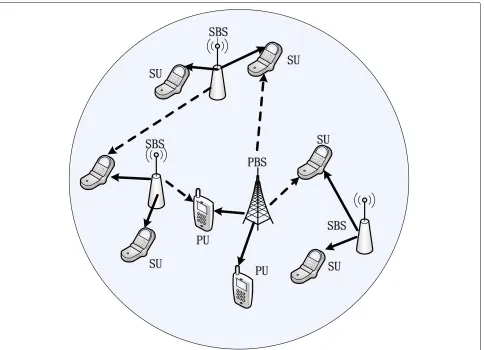
In the context of CR-enabled 5G systems, we assume a system scenario where a primary system and multiple sec-ondary cells coexist, as illustrated in Fig.1. The primary system is located in the center of the whole system, and it is comprised of a primary base station (PBS) and PUs. While the secondary CR system consists of multiple sec-ondary cells, the secsec-ondary cells are uniformly distributed around the primary system. Let N = {1, 2, ...,n, ...,N}
denote the set of secondary cells, and in thenthcell, there
is a secondary base station (SBS) servingMSUs denoted byMn= {1n, 2n, ...,mn, ...,Mn}.
Given the above system model, we make some assump-tions as below:
• Considering the downlink transmission, each user receives signals from their own base station
respectively, and the signals from other base stations are regarded as interference, i.e., each user is only attached to one cell [38].
• Assuming that SUs are randomly located around their own SBS, all base stations serve as accessing points to their corresponding users, and single antenna is equipped for the transmitter and receiver [20]. • It is practical to assume that the primary system and
all the secondary cells are asynchronized; thus, the interference due to spectral leakage exists between primary and secondary systems [27].
• All the secondary cells are synchronized, and the spectrum sensing is assumed to be achieved by a public sensing node. The sensing results are transmitted to the SBSs by a common control channel, i.e., all secondary cells share the same sensing results.
• Since the secondary cells and primary cell are subordinate to two different systems, generally, their cross-gains are unaccessible. But for simplicity and providing an interference protection to primary cell, we only estimate the channel gains from secondary system to primary cell.
After receiving the sensing results, the SBS allocates the available frequency resource to its attached SUs. The sketch map of possible sensing results is depicted in Fig.2. The whole frequency band is divided into some subcarri-ers, where the set of available and occupied subcarriers is denoted asF= {1,. . .,f,. . .,F}andL= {1,. . .,l,. . .,L}, respectively. The index difference between thefthavailable
subcarrier and thelthunavailable subcarrier isπ(f,l) =
F(f)−L(l). Denote the power on thefthavailable
subcar-rier accessed by themthSU of thenthcell aspnf, and the
channel gain from thenthSBS to themthSU is denoted as
gnmnf . Therefore, the corresponding signal to interference
plus noise ratio (SINR) is expressed as:
nf m =
pnfgnf
nm σ2+I
ps+Iss
, (1)
where σ2 means additive white Gaussian noise power,
Ips denotes the interference from primary system which
is induced by the asynchronization transmission, andIss
denotes co-channel interference between secondary cells. The power variablepnf is gathered into the matrixPwith sizeN×F.
According to the aforementioned assumptions, the asynchronous interference only exists between the pri-mary and secondary systems. In order to compute the interferenceIps, we resort to the interference vector model
for quantifying the asynchronization transmission inter-ference between primary and secondary systems. The interference vectors of different candidate waveforms in
5G are shown in Table 1, where the value of the cases
of perfect synchronization (PS), OFDM, and FBMC is
cited from [27] while the value of the cases of UFMC
and GFDM is cited from [30]. Supposing that a single
complex symbol is transmitted with unit power and unit channel gain in a subcarrier, each element of one interfer-ence vector corresponds to the quantity of the out of band radiation, i.e.,V means the spilled power from the inter-ferer subcarrier with unit power and unit channel gain to the victim subcarrier. And the quantities of interfer-ence less than 10−3are all ignored. It is noted in Table1
that each subcarrier will introduce interference to its eight adjacent subcarriers for OFDM (if the spectral distance is larger than 8, the interference will be less than 10−3and ignored), and the first adjacent subcarrier suffers from the severest interference with amount of 8.94E−2. For the
Table 1Interference vector table of different candidate waveforms in 5G
case of FBMC, it can be seen that the number of sub-carriers interfered due to spectral leakage is 1. Intuitively, FBMC can achieve better interference protection to pri-mary system due to its slight spectral leakage compared to OFDM. The analogous conclusion can be drawn for the cases of UFMC and GFDM.
Consequently, the interferences of Ips and Iss can be
respectively defined as follows:
Ips=
wherePpl denotes the power on thelthsubcarrier occupied
by PU,hnmfps denotes the channel gain from PBS to themth
SU of thenthcell on thefthavailable subcarrier, andgn
f
nm
denotes the channel gain from thenthSBS to themthSU
of thenthcell on thefthavailable subcarrier.
2.2 Problem formulation
According to Shannon capacity formula, the sum capacity of all SUs is formulated as:
N
whereθfnmdenotes the indicator of subcarrier assignment, i.e.,θfnm=1 means thefthavailable subcarrier is allocated
to themthSU of thenthcell, otherwiseθfnm=0. Defineθθθ
as the set ofθfnm. As discussed earlier, the system objective of this paper is to improve the energy efficiency; therefore, we aim to maximize the ratio of the sum capacity to the sum power consumption as below:
N
where the first termPdpin the denominator denotes the
dynamic power consumption, e.g., power radiation of cir-cuit blocks in radio frequency chain, while the second
termPspis the static power employed for cooling system
and power supply, andξin the last term means the inverse of power amplifier efficiency [39,40].
In wireless communication networks, the optimization problem of resource allocation generally involves some constraints. Some practical constraints considered in this work are listed as follows:
F
The constraint (6a) is the sum power budget of each secondary cell, where the sum power of all available sub-carriers in each cell should be no more than Pth. The
constraint (6b) limits the power level on each subcar-rier, which should not exceed Psub. The last two
con-straints (6c) and (6d) indicate that each subcarrier must be accessed at most one user at a given time.
As a CR-enabled 5G system, the constraint keeping the interference from secondary cells to primary system must be considered. Denotehnfsp as the real channel gain from
thenthSBS to PU on thefthavailable subcarrier. According
to the last item in the assumptions,hnfsp is unknown and
needs to be estimated.
The works in [41, 42] give a real propagation model of the channel, which decomposeshnfsp into Lnfsp for large
scale fading and Snfsp for small scale fading respectively,
i.e.,hnfsp = LnfspSnfsp. TheLnfsp is only decided by shadowing
and distance between the communicating parties. TheSnfsp
can be described as the product of two conjugate circu-lar symmetric complex Gaussian variables with zero mean and unit variance. Thus Sspnf has a Gamma distribution
with unit shape parameter and unit scale parameter, i.e.,
Sspnf ∼(1, 1).
By introducing a channel estimated marginSmar, we can
the case ifhnfspis larger thanhnfsp as the outage. The outage
probability can be represented as:
Pout=Pro
The cumulative distribution function ofSnfsp is the
reg-ularized Gamma function, and Eq. (7) can be further
formulated as:
1−Pout= γ (
1, 1+Smar)
(1) , (8)
whereγ (·)is the lower incomplete Gamma function. For a given outage probabilityPout, we have:
Smar=loge
Through the prescribedPout, the estimated channel gain hnfsp can be obtained. The critical interference constraint
can be formulated as:
F
f=1
pnfhnfspVπ(f,l)≤Ithl , ∀n,l, (10)
where Ithl in (10) is the interference threshold and
pre-scribed by the guarantee coefficient β of PU capacity,
which is defined as:
log2
wheregppl is the channel gain from PBS to the PU occupy-ing thelthunavailable subcarrier. The larger the value ofβ
is, the lower the interference threshold is.
Based on the abovementioned analysis, we express the optimization problem asQ1:
max
3 Optimization method via alternate way
It is noted that Q1in (12) is a mixed-integer nonlinear programming problem, which is quite difficult to solve. Firstly, the integer indicator variableθfnm equals to 1 or 0, and the real variablepnf is involved. Both discrete and continuous variables will give rise to high complexity. Secondly, the ratio of a non-convex function to a linear function in (5) is also a non-convex structure. Finally, the co-channel interference might also induce the non-convex property. In this section, an efficient optimization scheme based on alternate optimization and SCA is proposed to
transformQ1into a solvable problem, and for a clear illus-tration, it is summarized in Algorithm 1, which includes the procedures of subcarrier assignment and power allo-cation. In the following, these two parts will be described in details.
Algorithm 1Proposed algorithm based on alternate opti-mization and SCA
Initialization: Set t1 = 0, initialize Pt1 with a feasible power,1;
7: Approximate the constraints (15d) and (15e)
according to (16) and (20);
3.1 Heuristic subcarrier assignment
In order to solve the optimization problem Q1, the
subcarrier assignment indicator θfnm should be firstly excluded from the objective function and constraints. Because the problemQ1will generateMNFpossible sub-carrier allocation schemes, which is prohibitively expen-sive especially in a high-dimensional system. To avoid the unbearable complexity, a heuristic subcarrier assignment is employed by means of an alternate manner.
For a given power allocation, the problemQ1is equiva-lent to maximizing the total system capacity subject to the constraints (6c) and (6d). Generally, it is not sufficient to assign subcarriers to one user with the best channel gain. In this context, the co-channel interference and the power on subcarriers are not taken into account. To realize the maximal capacity of communication networks, subcar-riers can be allocated by employing the maximal SINR criterion [43]. In our work, we assume an initial feasi-ble power distribution is given1, and then the subcarrier assignment proceeds on the basis of the maximal SINR criterion.
θnm
After accomplishing subcarrier allocation (i.e., the inte-ger variable is excluded), and the residual problem inQ1
is reformulated asQ2:
max
Once the solution of Q2 is obtained, the subcarrier
assignment will be executed until convergence. The pro-cedures of this alternate optimization are summarized in line 2∼12 of Algorithm 1.
The convergence property can be derived with the fol-lowing idea. For a given power allocationPt1, the maximal SINR criteria maximize the objective within the feasible subcarrier assignmentθθθt1+1. And for a fixedθθθt1, Pt1 is the optimal solution of maximizing the objective within the feasible power distribution. In other words, the arbi-trary optimization ofθθθ andPwill improve the objective during the alternate process. Therefore, Algorithm 1 is convergent.
3.2 Power optimization
3.2.1 An equivalent transformation
It is observed that the objective function in Q2 has
a ratio structure consisting of a non-convex function and a linear function, which is known as a fractional programming problem. Generally, the routine method [25, 26,38] of solving such problem is to transform the objective function into a parametric subtracted form. It needs to update the parameter of the ratio iteratively according to the Dinkelbach algorithm reported in [44] or bisection method [45].
While in this paper, we do not invoke the Dinkelbach procedure to make the subtracted transformation and iteratively update the ratio. Inspired by [39], we solve the problem with the ratio structure by means of a novel equivalent transformation which can directly acquire the optimal value of the ratio. Let us introduce some auxiliary variablesx,y, andη. Define the following problemQ3:
In Q3, ηis applied to approximate the original ratio, andxandyare used to approximate the denominator and numerator of the objective function inQ2 respectively. ForQ3, we have the following theorem.
Theorem:Q3is an equivalent substitute of Q2.
Proof: The equivalency can be proved by
contradic-tion. Assuming that at the optimal point(x∗,y∗,η∗,P∗), the inequality constraints of (14d), (14e), and (14f) do not hold; therefore, there must exist a point (x◦,y◦,η◦,P◦)
which improves the optimal value, i.e.,η◦> η∗. And this contradicts the initial assumption. Thus, we can conclude that the inequality constraints of (14d), (14e), and (14f) must be active at the optimality, i.e., all of (14d), (14e), and (14f) must be equality constraints, and it indicates that
Q2can be substituted byQ3. In the subsequent subsec-tion, we mainly concentrate on how to solve the power allocation problemQ3.
3.2.2 Power allocation based on SCA
On the basis of theorem, we can find the solution ofQ3
instead of solvingQ2with fractional structure. However, it is clear that solvingQ3directly is still troublesome due to the non-convexity of constraints (15d) and (15e). The constraint (15d) has a relatively simpler structure than (15e), so we firstly show how to deal with (15d).
Note that the left side of (15d) is a quadratic over linear function which is convex ifx ≥ 0. For a given approxi-mated point Pt2,xt2,yt2
, the following inequality holds true: (15d). The constraint (15d) can be represented as:
Ω (x,y)≥η, (17)
As for (15e) inQ3, the case is more complicated than
approximates the capacity which is a concave function of
y, and the other two terms originate from the formula of capacity. The expression (18) leads to a non-convex feasi-ble area; thus, the critical situation lies in how to construct a convex set from (18) on the given approximated point
Pt2,xt2,yt2
.
Based on the fact that the value of arithmetic mean is greater than or equal to the value of geometric mean, the following inequality holds true:
a1b1+a2b2+ · · · +aibi≥ba11ba22. . .baii, (19) mean approximation can be utilized to approximateφ(P)
if takingφ(P)as the left part of (19). The corresponding approximated inequality (20) is shown at the top of this page, and the right part of (20) is defined asφ(P)which is
On the surface, the manipulation of (20) expresses the linear function of power variableφ(P)with a multiplica-tive function of power variableφ(P). But essentially, the manipulation constructs a convex set from a non-convex
set on the approximated point Pt2,xt2,yt2
. As a con-sequence, the original constraint (15e) inQ3is approxi-mately written as:
By introducing a logarithmic manipulation P =
expP
and bringing it into (21), then the final opti-mization problem after approximation is formulated asQ4:
For the above problem inQ4, we have the following two propositions.
Proposition 1 Q4is a convex optimization problem.
Proof Firstly, the sum of exponential functions is
con-vex, so the constraints (22a) ∼ (22c) and (22f) are all convex sets. The constraint (22d) is a linear constraint
which is also convex. Lastly,
N
is a linear function ofP, and it has been proved that the log-sum-exp function is convex [46], so we can find that the left side of (22e) inQ4is the sum of linear functions and two concave functions, which implies (22e) is also a convex set. Therefore, the convexity of the constraint sets is verified, i.e.,Q4is a convex problem.
constraints only corresponds to initial approximate point
Pt2,xt2,yt2
. In order to produce an improvement point compared to Pt2,xt2,yt2
, herein, the SCA in [48,49] for constraints is employed. Once we obtain the solution of
Q4, it will take the place of the previous approximated point according to (16) and (20), and the iteration proce-dure goes on until convergence. The iterative proceproce-dure is summarized in line 4∼10 of Algorithm 1.
Proposition 2Each iteration of SCA makes an improve-ment compared to the previous iteration and the iteration procedure is convergent.
ProofIt is assumed that the optimal solution obtained
at the iteration t2 is
P∗t2,y∗t2,x∗t2, which is also feasible and satisfies the constraints of Q3 for the next approxi-mation. This mainly results from the fact that the approx-imated parts of the constraints (22d) and (22e) are less than the original corresponding parts of constraints (15d) and (15e). It indicates that the iteration sequences of the objective are non-decreasing. In addition, the con-straints are bounded. Therefore, the process of successive convex approximation finally converges, which proves Proposition 2.
Moreover, in order to make the iterative sequences stop at or converge to Karush-Kuhn-Tucker (KKT) point, the following conditions are needed for the successive convex approximation [⎧ 48]:
⎨
It can be verified that the approximation of (16) and (20) satisfies the above three conditions. In (23), the first condition guarantees the approximation is tightening the constraints of (15d) and (15e), and the solution of approxi-mated problem is also a feasible point for the next approx-imation; the second condition ensures the improvement of the objective during each iteration; the last condition ensures the satisfaction of the KKT conditions after a series of iteration approximation.
4 Complexity analysis
In this section, the computational complexity of the pro-posed algorithm is analyzed. The optimization toolbox CVX is applied to solveQ4via the interior point method (IPM), which dominates the main complexity of the whole algorithm. In IPM, by contaminating the objective and inequality constraints, a logarithmic barrier function is constructed and optimized along a central path through Newton method. With self-concordance for this func-tion, the number of Newton steps is proportional to the square root of the number of inequality constraints, and the complexity of each Newton increases cubically with the number of inequality constraints [46,50].
The analogous means of [50] can be adopted to
transform the constraints with log-sum-exp into a set of equivalent constraints with self-concordance. The
total number of equivalent constraints is 6FN + N +
2FLN + L + 2FN2. Therefore, the whole complexity
after eliminating the multi-plicative factors and non-dominant terms, whereT1and T2are the numbers of alternate optimization and
succes-sive convex approximation, respectively.
5 Simulation results and discussions
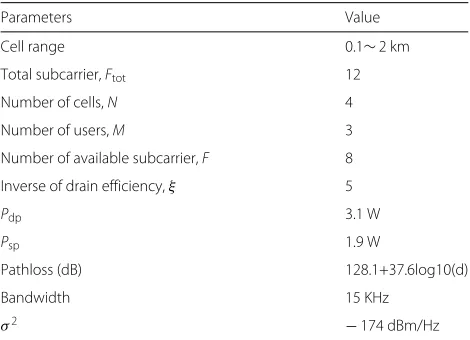
In this section, numerical results of the proposed RA algo-rithm by Monte Carlo are conducted and compared with two algorithms [19,23]. Moreover, the impacts of different 5G waveforms and system dimensions are also simulated and analyzed. To be more specific, the simulation results are divided into three parts: The first part presents the efficiency including the convergence and the performance comparison between the proposed algorithm and the two existing algorithms in [19, 23]; the second part exhibits the performance of four potential 5G waveforms in terms of different parameter settings; and the last part evaluates the impact of different system dimensions on the energy efficiency. The simulation parameters are presented in Table2, and the ones which are changed will be declared.
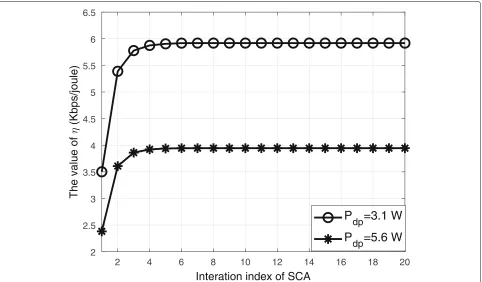
Considering the CR-enabled 5G system shown in Fig.1, where the PBS lies in the center of the primary system, the PUs are randomly located around the PBS within the cell range. We firstly investigate the efficiency of the proposed algorithm. The convergence of alternate optimization and SCA is shown in Figs.3and 4. According to the conver-gence behavior in Fig.3, we can find that the alternate optimization of subcarrier assignment and power alloca-tion converges after several operaalloca-tions. It is interesting to note that no matter what initial power allocation is given for the subcarrier assignment, the results converge to the same solution even if an infeasible power allocation
Table 2Simulation parameters
Parameters Value
Cell range 0.1∼2 km
Total subcarrier,Ftot 12
Number of cells,N 4
Number of users,M 3
Number of available subcarrier,F 8
Inverse of drain efficiency,ξ 5
Pdp 3.1 W
Psp 1.9 W
Pathloss (dB) 128.1+37.6log10(d)
Bandwidth 15 KHz
1 2 3 4 5 6 7 8 9 10
Interation index of alternate optmization
0 1 2 3 4 5 6 7
The energy efficiency (Kbps/joule)
equal feasible power initialization
random feasible power initialization
infeasible power initialization
Fig. 3The convergence of alternate optimization. Convergence behavior of alternate optimization with different initial power allocation
2 4 6 8 10 12 14 16 18 20
Interation index of SCA
2 2.5 3 3.5 4 4.5 5 5.5 6 6.5
The value of
(Kbps/joule)
P
dp=3.1 W
P
dp=5.6 W
is initialized. This is because it can introduce a feasible power allocation for the subcarrier assignment induced by the infeasible initial power allocation. Figure4exhibits the convergence of SCA given the subcarrier assignment. The procedure of successive convex approximation of updat-ingηconverges within 10 iterations. Thus, the practical applicability of SCA can be verified.
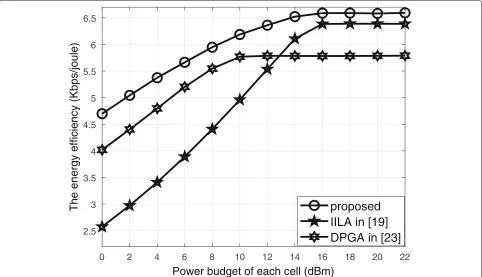
Besides, in order to illustrate the superiority, the pro-posed algorithm is compared with two algorithms, i.e., IILA in [19] and DPGA in [23], as shown in Fig. 5. For the sake of fairness, all algorithms are compared on the basis of energy efficiency. Here, we only consider the case of FBMC in Table1. The capacity guarantee coefficientβ associated with the level of interference threshold is set to 0.8. As the sum power budget augments, it is seen that all of the curves in Fig.5firstly increase and then slowly approach a constant. It can be explained that the numera-tor in (8) has a logarithmic structure with power variable, while the power consumption in the denominator is linear. The value of energy efficiency initially increases because the incremental portion of capacity plays the dominant role relative to the increment of power consumption, and the energy efficiency finally remains constant because the opposite situation follows. Therefore, a turning point must exist in line with the point firstly approaching the constant. For the proposed algorithm, the turning point is achieved at 16 dBm.
In Fig. 5, we also observe that the proposed
algo-rithm achieves higher energy efficiency in both cases of either low-power budget or high-power budget. With the same power consumption, the proposed algorithm has the largest capacity, i.e., our algorithm needs the least con-sumption to achieve the same capacity. The reason is that a linear pricing factor is required to impose the penalty for the DPGA in [23], which is avoided in the proposed algorithm. For IILA in [19], the co-channel interference is assumed to be constant, while the proposed algorithm makes an improvement for the co-channel interference by using the successive convex approximation.
In the second parts of the experiments, the impacts of the proposed algorithm with different system parameters on energy efficiency by using various 5G waveforms are presented. The first three figures are obtained under ideal channel gain, and the last one is obtained under estimated channel gain.
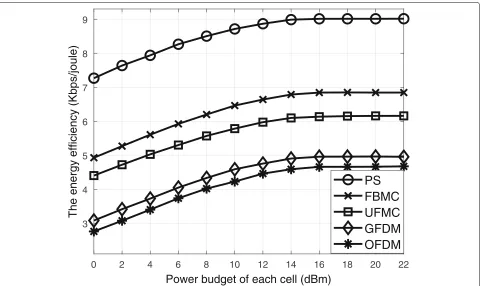
Figure 6 shows the relation between the energy
effi-ciency of waveforms with power budget of each cell. It is seen that all curves have the same tendency and almost the same turning point. The difference among these wave-forms is that these wavewave-forms have different levels of spectral leakage. The case of PS provides a theoretic upper bound and is viewed as the benchmark because the spec-tral leakage is not involved. Note that FBMC achieves the highest energy efficiency and is the closest to the case
0 2 4 6 8 10 12 14 16 18 20 22
Power budget of each cell (dBm)
2.5 3 3.5 4 4.5 5 5.5 6 6.5
The energy efficiency (Kbps/joule)
proposed
IILA in [19]
DPGA in [23]
0 2 4 6 8 10 12 14 16 18 20 22
Power budget of each cell (dBm)
3 4 5 6 7 8 9
The energy efficiency (Kbps/joule)
PS
FBMC
UFMC
GFDM
OFDM
Fig. 6Energy efficiency versus power budget. The performance of the proposed algorithm using various modulation schemes versus different sum power budgets
of PS, while OFDM has the worst performance among all the waveforms due to its significant spectral leakage. Although the first element of GFDM in Table1is less than that of FBMC, the remaining elements of GFDM are larger than those of FBMC, which explains the worse perfor-mance of GFDM than FBMC. At last, FBMC and UFMC have similar performance due to their similar interference vectors. As a conclusion, the less the spectral leakage is, the higher energy efficiency can be achieved.
Figure7displays the relation between the energy effi-ciency of waveforms with power limits on each subcarrier. The power budget of each cell is set to 16 dBm. The energy efficiency firstly increases and then maintains a constant when the power limit increases from 1 to 10 mW. In Fig.7, we can see that the most appropriate power limit of sub-carrier is about 6 mW, where the value of energy efficiency firstly approaches the maximum. The reason is that the large power limit of subcarriers enlarges the capacity until the energy efficiency achieves the maximum, and sub-sequently, the other constraints restrict the growing of capacity.
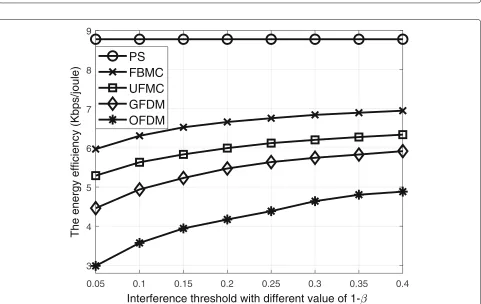
We also investigate the impacts of different waveforms under different interference thresholds, as shown in Fig.8, where the maximal power consumption of each cell and power limit of each subcarrier are 16 dBm and 5 mW, respectively. Except for the PS case (interference to PU
does not exist), all other curves increase as the value of 1−βaugments. If a large interference threshold from sec-ondary cells to PUs is permitted, the SBS will transmit more power to its corresponding SUs. This explains the rise of the curves in Fig.8when the interference threshold increases. In addition, the same conclusion as in Fig.6is made, i.e., FBMC has the highest energy efficiency under the same interference threshold.
The impact of estimated channel gain is depicted in Fig. 9. Since the case of PS does not introduce inter-ference due to spectral leakage, the constraint (10) loses efficacy, which induces the horizontal curve of PS (like the case in Fig. 8). As the outage probability increases uniformly, the estimated margin decreases rapidly firstly and then decreases slowly. It implies that the transmis-sion power can enlarge rapidly first which induces sig-nificant co-channel interference and power consumption, thus the energy efficiency declines, and subsequently, the transmission power increases slowly, the co-channel inter-ference and power consumption strengthen slowly too, which results in the rising tendency of energy efficiency.
1 2 3 4 5 6 7 8 9 10
Power limit of each subcarrier (mW)
3 4 5 6 7 8 9
The energy efficiency (Kbps/joule)
PS
FBMC
UFMC
GFDM
OFDM
Fig. 7Energy efficiency versus power limits. The performance of the proposed algorithm using various modulation schemes versus different power limits on subcarriers
0.05 0.1 0.15 0.2 0.25 0.3 0.35 0.4
Interference threshold with different value of
1-34 5 6 7 8 9
The energy efficiency (Kbps/joule)
PS
FBMC
UFMC
GFDM
OFDM
0.05 0.1 0.15 0.2 0.25 0.3 0.35 0.4 0.45 0.5
Outage probability
2 3 4 5 6 7 8 9
The energy efficiency (Kbps/joule)
PS
FBMC
UFMC
GFDM
OFDM
Fig. 9Energy efficiency versus outage probability. The performance of the proposed algorithm using various modulation schemes versus different outage probability
5 4
3 2
number of cells
5 5.5 6 6.5 7 7.5 8 8.5
The energy efficiency (Kbps/joule)
P
th=16 dBm
P
th=6 dBm
2 3 4 5 6
number of SUs
4 4.5 5 5.5 6 6.5 7 7.5 8 8.5 9
The energy efficiency (Kbps/joule)
P
th
=16 dBm
P
th=6 dBm
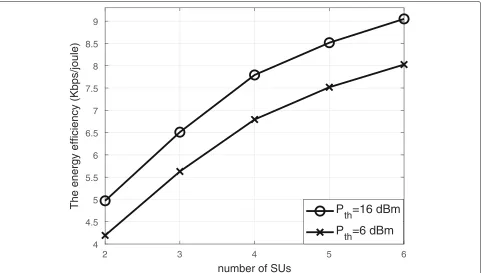
Fig. 11Energy efficiency versus number of SUs. The performance of the proposed algorithm with different number of SUs per cell
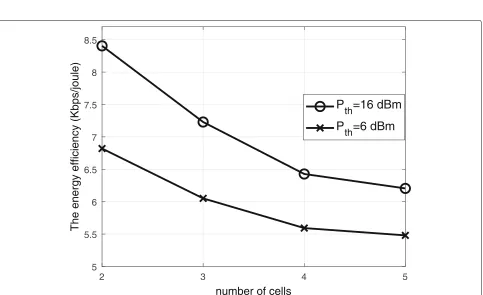
selected as the waveform. In Fig.10, the number of SUs is fixed to 3, and the number of secondary cells is set to 2, 3, 4, and 5. Observe that the number of cells has a negative effect on the system performance, i.e., an energy-efficient system should pay attention to the number of cells. Because a large-cell structure will inevitably gener-ate significant co-channel interference among cells and result in the capacity degradation for each cell, although the whole system capacity increases. From the perspec-tive of spectral efficiency, the more the number of cells is, the higher the capacity is. When the energy efficiency is concerned, the increasing number of cells will cause lower energy efficiency. Consequently, we need to make a trade-off between energy efficiency and spectral efficiency if the future 5G system considers a large number of cognitive cells.
In Fig.11, the number of cells is fixed to 3, and the num-ber of SUs is set to 2, 3, 4, 5, and 6. According to Fig.11, it can be found that the number of the SUs will bring higher energy efficiency. This results from the fact that the increasing number of the SUs enlarges the system capac-ity when the system power budget remains constant, i.e., the ratio of capacity to consumption is increased. There-fore, more SUs benefit the energy efficiency performance. However, we also can forecast that under the conditions of given number of subcarriers, more SUs means less access-ing opportunity and worse quality of service (QoS). The
trade-off of the system energy efficiency and the QoS of SUs also need to be considered.
6 Conclusions
This paper proposes an energy-efficient resource allo-cation algorithm aiming at solving the awkward non-convex problem involving multiple cells with multiple SUs per cell. The heuristic subcarrier assignment and convex approximation are adopted to sequentially transform the non-convex form into a convex one. Numerical results validate the superiority of the proposed algorithm for achieving higher energy efficiency compared with some existing algorithms. Furthermore, the impacts of poten-tial modulation schemes in 5G on energy efficiency are also investigated, and we reach the conclusion that the waveform with less spectral leakage is more suitable for energy-efficient 5G systems.
Endnote
1Generally, it makes no difference whether the initial
power is feasible or not, which will be demonstrated by the subsequent simulation.
Acknowledgements
Funding
National Natural Science Foundation of China with Grant Number 61501335 and Hubei Provincial Natural Science Foundation of China (No. 2018CFB225).
Availability of data and materials Not applicable.
Authors’ contributions
HL and PL conceived and designed the study. HZ performed the experiments. HL wrote the paper. PL, HZ, and QY reviewed and edited the manuscript. All authors read and approved the manuscript.
Ethics approval and consent to participate Not applicable.
Consent for publication Not applicable.
Competing interests
The authors declare that they have no competing interests.
Publisher’s Note
Springer Nature remains neutral with regard to jurisdictional claims in published maps and institutional affiliations.
Received: 31 May 2018 Accepted: 20 December 2018
References
1. Q. Wu, G. Y. Li, W. Chen, D. W. K. Ng, R. Schober, An overview of sustainable green 5G networks. IWirel. EEE. Commun.24(4), 72–80 (2017) 2. S. Zhang, Q. Wu, S. Xu, G. Y. Li, Fundamental green tradeoffs: progresses,
challenges, and impacts on 5G networks. ICommun, EEE, Surv. Tutor. 19(1), 33–56 (2017)
3. M. Agiwal, A. Roy, N. Saxena, Next generation 5G wireless networks: a comprehensive survey. ICommun. EEE. Surv. Tutor.18(3), 1617–1655 (2016)
4. R. H. Tehrani, S. Vahid, D. Triantafyllopoulou, H. Lee, K. Moessner, Licensed spectrum sharing schemes for mobile operators: a survey and outlook. ICommun. EEE. Surv. Tutor.18(4), 2591–2623 (2016)
5. P. Kolodzy, Spectrum policy task force report. Federal Commun. Comm. Washington DC Rep. Docket ET.40(4), 147–158 (2002)
6. H. Mu, T. Hu,Cognitive radio and the new spectrum paradigm for 5G. (M. A. Matin, ed.) (Springer, Singapore, 2017), pp. 265–286
7. X. Hong, J. Wang, C. X. Wang, J. Shi, Cognitive radio in 5G: a perspective on energy-spectral efficiency trade-off. ICommun. EEE Mag.52(7), 46–53 (2014)
8. L. Zhang, M. Xiao, G. Wu, M. Alam, Y. C. Liang, S. Li, A survey of advanced techniques for spectrum sharing in 5G networks. ICommun. EEE Mag. 24(5), 44–51 (2017)
9. A. Georgakopoulos, A. Margaris, K. Tsagkaris, P. Demestichas, Resource sharing in 5G contexts: achieving sustainability with energy and resource efficiency. IVeh EEE Technol. Mag.11(1), 40–49 (2016)
10. Y. Huang, M. Liu, Y. Liu, Energy-efficient SWIPT in IoT distributed antenna systems. IEEE J. Internet Things.5(4), 2646–56 (2018)
11. J. Yan, Y. Liu, A dynamic SWIPT approach for cooperative cognitive radio networks. ITrans EEE Veh. Technol.66(12), 11122–11136 (2017) 12. M. Shaat, F. Bader, Computationally efficient power allocation algorithm
in multicarrier-based cognitive radio networks: OFDM and FBMC systems. EURASIP J. Adv. Signal Process.2010(1), 1–13 (2010)
13. S. Dikmese, S. Srinivasan, M. Shaat, F. Bader, M. Renfors, Spectrum sensing and resource allocation for multicarrier cognitive radio systems under interference and power constraints. EURASIP J. Adv. Signal Process. 2014(1), 1–12 (2014)
14. S. Wang, Z. H. Zhou, M. Ge, C. Wang, Resource allocation for heterogeneous cognitive radio networks with imperfect spectrum sensing. IEEE J. Sel. Areas Commun.31(3), 464–475 (2013)
15. T. Abrão, S. Yang, L. D. H. Sampaio, P. J. E. Jeszensky, L. Hanzo, Achieving maximum effective capacity in OFDMA networks operating under statistical delay guarantee. IAccess, EEE,.5, 14333–14346 (2017)
16. S. Wang, W. Shi, C. Wang, Energy-efficient resource management in OFDM-based cognitive radio networks under channel uncertainty. ITrans EEE Commun.63(9), 3092–3102 (2015)
17. H. Zhang, D. L. Ruyet, D. Roviras, Y. Medjahdi, H. Sun, Spectral efficiency comparison of OFDM/FBMC for uplink cognitive radio networks. EURASIP J. Adv. Signal Process.2010(1), 1–14 (2010)
18. Z. Hu, Y. Zhu, J. Xu, J. Wang, Y. Yang, Distributed weighted sum-rate maximization with multi-cell uplink-downlink throughput duality. EURASIP J. Adv. Signal Process.2015(1), 31–46 (2015)
19. H. Zhang, C. Jiang, X. Mao, H. H. Chen, Interference-limited resource optimization in cognitive femtocells with fairness and imperfect spectrum sensing. ITrans EEE Veh. Technol.65(3), 1761–1771 (2016) 20. H. Zhang, D. L. Ruyet, D. Roviras, H. Sun, Noncooperative multicell
resource allocation of FBMC-based cognitive radio systems. ITrans EEE Veh. Technol.61(2), 799–811 (2012)
21. H. Lv, P. Li, H. Zhang, Y. Qian, in2016 IEEE 13th International Conference on Signal Processing (ICSP). Resource allocation in FBMC-based two-cell cognitive radio systems with estimated CSI, (2016), pp. 1301–1306 22. W. Jing, Z. Lu, X. Wen, Z. Hu, S. Yang, Flexible resource allocation for joint
optimization of energy and spectral efficiency in OFDMA multi-cell networks. ICommun EEE Lett.19(3), 451–454 (2015)
23. S. Bu, F. R. Yu, in2014 IGlobal, EEE, Communications Conference. Distributed energy-efficient resource allocation with fairness in wireless multicell OFDMA networks, (2014), pp. 4708–4713
24. A. Zappone, L. Sanguinetti, M. Debbah, Energy-delay efficient power control in wireless networks. ITrans. EEE. Commun.66(1), 418–431 (2018) 25. K. Yang, S. Martin, D. Quadri, J. Wu, G. Feng, Energy-efficient downlink
resource allocation in heterogeneous OFDMA networks. ITrans. EEE. Veh. Technol.66(6), 5086–5098 (2017)
26. Z. Tong, B. Li, Y. Hui, Energy efficiency maximisation in downlink multi-cell networks via coordinated resource allocation. Commun. IET,.9(1), 42–54 (2015)
27. Y. Medjahdi, M. Terré, D. L. Ruyet, D. Roviras, J. A. Nossek, L. Baltar, in2009 IEEE 10th Workshop on Signal Processing Advances in Wireless
Communications. Inter-cell interference analysis for OFDM/FBMC systems, (2009), pp. 598–602
28. Y. Medjahdi, M. Terré, D. L. Ruyet, D. Roviras, A. Dziri, Performance analysis in the downlink of asynchronous OFDM/FBMC based multi-cellular networks. ITrans. EEE. Wirel. Commun.10(8), 2630–2639 (2011) 29. Y. Medjahdi, M. Terré, D. Le Ruyet, D. Roviras, Interference tables: a useful
model for interference analysis in asynchronous multicarrier transmission. EURASIP J. Adv. Signal Process.2014(1), 1–17 (2014)
30. H. Zhang, H. Lv, P. Li, inTowards 5G wireless networks - a physical layer perspective, ed. by H. K. Bizaki. Spectral efficiency analysis of filter bank multi-carrier (FBMC) based 5G networks with estimated channel state information (CSI) (InTech, Rijeka, 2016)
31. Y. Liu, X. Chen, Z. Zhong, B. Ai, D. Miao, Z. Zhao, J. Sun, Y. Teng, H. Guan, Waveform design for 5G networks: analysis and comparison. IAccess. EEE. 5, 19282–19292 (2017)
32. Y. Cai, Z. Qin, F. Cui, G. Y. Li, J. A. McCann, Modulation and multiple access for 5G networks. ICommun. EEE. Surv. Tutor.PP(99), 1–1 (2017) 33. C. Kim, Y. H. Yun, K. Kim, J. Y. Seol, Introduction to QAM-FBMC: from
waveform optimization to system design. ICommun. EEE, Mag.54(11), 66–73 (2016)
34. J. Z. Jiang, B. W. K. Ling, S. Ouyang, Efficient design of prototype filter for large scale filter bank-based multicarrier systems. Signal IET Proc.11(5), 521–526 (2017)
35. Y. Medjahdi, S. Traverso, R. Gerzaguet, H. Shaïek, R. Zayani, D. Demmer, R. Zakaria, J. B. Doré, M. B. Mabrouk, D. L. Ruyet, Y. Louët, D. Roviras, On the road to 5G: comparative study of physical layer in mtc context. IAccess EEE.5, 26556–26581 (2017)
36. B. Lim, Y. C. Ko, SIR analysis of OFDM and GFDM waveforms with timing offset, CFO, and phase noise. ITrans. EEE. Wirel. Commun.16(10), 6979–6990 (2017)
37. L. Zhang, P. Xiao, A. Quddus, Cyclic prefix-based universal filtered multicarrier system and performance analysis. ISignal. EEE. Process. Lett. 23(9), 1197–1201 (2016)
39. K. G. Nguyen, L. N. Tran, O. Tervo, Q. D. Vu, M. Juntti, Achieving energy efficiency fairness in multicell MISO downlink. ICommun. EEE. Lett.19(8), 1426–1429 (2015)
40. K. G. Nguyen, Q. D. Vu, M. Juntti, L. N. Tran, Distributed solutions for energy efficiency fairness in multicell MISO downlink. ITrans. EEE. Wirel. Commun.16(9), 6232–6247 (2017)
41. J. Wang, W. Feng, Y. Chen, S. Zhou, Energy efficient power allocation for multicell distributed antenna systems. ICommun. EEE. Lett.20(1), 177–180 (2016)
42. W. Feng, Y. Chen, N. Ge, J. Lu, Optimal energy-efficient power allocation for distributed antenna systems with imperfect CSI. ITrans. EEE. Veh. Technol.65(9), 7759–7763 (2016)
43. C. Zhong, C. Li, L. Yang, Z. He, in2008 International Conference on Neural Networks and Signal Processing. Dynamic resource allocation for the downlink of multi-cell systems with full spectral reuse, (2008), pp. 173–177 44. W. Dinkelbach, On nonlinear fractional programming. Manag. Sci.13(7),
492–498 (2011)
45. Y. Chen, Z. Zheng, Y. Li, Y. Li, Energy-efficient resource allocation in multiuser OFDM systems with proportional rate constraints. Electron. Lett. 51(20), 1611–1613 (2015)
46. S. Boyd, L. Vandenberghe,Convex optimization. (Cambridge University Press, Cambridge, 2004)
47. M. Grant, S. Boyd,CVX: Matlab Software for disciplined convex programming, version 2.1, (2014).http://cvxr.com/cvx
48. M. Chiang, C. W. Tan, D. P. Palomar, D. O’neill, D. Julian, Power control by geometric programming. ITrans. EEE. Wirel. Commun.6(7), 2640–2651 (2007)
49. A. Zappone, L. Sanguinetti, G. Bacci, E. Jorswieck, M. Debbah,
Energy-efficient power control: a look at 5G wireless technologies. ITrans. EEE. Signal Process.64(7), 1668–1683 (2016)