ADDRESSING EDUCATIONAL NEEDS OF TEACHERS IN THE
EU FOR INCLUSIVE EDUCATION IN A CONTEXT OF DIVERSITY
INNO4DIV PROJECT
VOLUME 3 — Part 1: Assessment guidelines for teacher education
and training practices on intercultural and democratic competence
development
Victoria Tenreiro Rodríguez UCV, Marcela Jabbaz Churba UV, Carmen
Carmona Rodríguez UV, Assumpta Aneas Álvarez UB, Tamar Shuali
Trachtenberg UCV, Marta Simó Sánchez UB, Barry van Driel IAIE
A U T H O R S —Clara Centeno, EC JRC
E D I T O R —This publication is a Technical report by the Joint Research Centre (JRC), the European Commission’s science and knowledge service. It aims to provide evidence-based scientific support to the European policymaking process. The scientific output expressed does not imply a policy position of the European Commission. Neither the European Commission nor any person acting on behalf of the Commission is responsible for the use that might be made of this publication. For information on the methodology and quality underlying the data used in this publication for which the source is neither Eurostat nor other Commission services, users should contact the referenced source. The designations employed and the presentation of material on the maps do not imply the expression of any opinion whatsoever on the part of the European Union concerning the legal status of any country, territory, city or area or of its authorities, or concerning the delimitation of its frontiers or boundaries.
Contact information Name: Clara Centeno
Email: [email protected] EU Science Hub
https://ec.europa.eu/jrc JRC122828
PDF ISBN 978-92-76-26816-1 doi:10.2760/811156
Luxembourg, Publications Office of the European Union, 2020 © European Union, 2020
The reuse policy of the European Commission is implemented by the Commission Decision 2011/833/EU of 12 December 2011 on the reuse of Commission documents (OJ L 330, 14.12.2011, p. 39). Except otherwise noted, the reuse of this document is authorised under the Creative Commons Attribution 4.0 International (CC BY 4.0) licence (https://creativecommons.org/licenses/by/4.0/). This means that reuse is allowed provided appropriate credit is given and any changes are indicated. For any use or reproduction of photos or other material that is not owned by the EU, permission must be sought directly from the copyright holders.
All content © European Union, 2020 unless otherwise specified. Cover image ©annett_seidler.
How to cite this report: Tenreiro, V., Jabbaz, M., Carmona, C., Aneas, A., Shuali, T., Simó. M., van Driel, B., Addressing educational needs of Teachers in the EU for inclusive education in a context of diversity - Volume 3. Part 1: Assessment guidelines for teacher education and training practices on intercultural and democratic competence development, Centeno C., ed., Publications Office of the European Union, Luxembourg, 2020, ISBN 978-92-76-26816-1, doi:10.2760/811156, JRC122828.
1
Contents
Foreword ... 3 Acknowledgements ... 4 Abstract ... 5 Introduction ... 61. Sources for the identification and selection of cases... 7
2. Criteria for case assessment: identification and selection ... 8
2.1 Sources of generic selection criteria ... 8
2.2 Generic selection criteria ... 9
2.3 Sources of specific criteria per KEC ... 12
2.4 Specific criteria per KEC ... 13
2.5 Inclusion and exclusion criteria for KEC 1 ... 13
2.6 Inclusion and exclusion criteria for KEC 2 ... 14
2.7 Inclusion and exclusion criteria for KEC 3 ... 16
2.8 Inclusion and exclusion criteria for KEC 4 ... 19
2.9 Inclusion and exclusion criteria for KEC 5 ... 20
2.10Inclusion and exclusion criteria for KEC 6 ... 22
2.11Inclusion and exclusion criteria for KEC 7 ... 24
2.12Inclusion and exclusion criteria for KEC 8 ... 26
2.13Inclusion and exclusion criteria for KEC 9 ... 27
3. Steps in the assessment process: case selection. ... 30
3.1 Protocol for identification, assessment and selection of cases ... 30
3.2 Case identification, assessment and selection process ... 31
4. References ... 33
5. Annexes ... 40
5.1 Annex 1. Potential outcomes of effective development of teachers’ IDC ... 40
5.2 Annex 2. Assessment tools to capture effectiveness within each KEC ... 41
5.3 Annex 3. Data Extraction Template for collecting cases ... 43
5.4 Annex 4. KECs, barriers and outcomes ... 46
5.5 Annex 5. Geographical Scope ... 51
5.6 Annex 6. Identification of cases per KEC ... 54
5.7 Annex 7. Case assessment according to Specific Criteria (example for KEC 1) ... 55
5.8 Annex 8. Case assessment according to Generic Criteria... 56
5.9 Annex 9. Case assessment: final comments for decision-making ... 59
5.10Annex 10. Specific Criteria per KEC... 60
5.11Annex 11. Instructions for the experts ... 67
List of abbreviations and definitions ... 69
List of figures ... 70
3
Foreword
In a context of increasing populism, xenophobia and radicalisation, shared values and social cohesion in our diverse societies are questioned. The JRC transversal project "Values and identity in a multicultural society" aims at improving our understanding of the European values and identities in order to reinforce them through the better design and implementation of all EU policies.
Based on its experience, the JRC.B.4 Human Capital and Employment Unit is contributing to the advancement of the knowledge needed to design policies and support action in the promotion of EU values in the field of Education.
In particular, in the field of teachers´ intercultural competence, in spite of policy impetus, research shows that teachers struggle to address the increasing diversity in classrooms. This is due, among others, to the lack of competences to deal with it. The acquisition of Intercultural Competence (IC), which could be defined as “the ability to mobilise and deploy relevant attitudes, skills, knowledge and values in order to interact effectively and appropriately in different intercultural situations”, is a crucial need for teachers to deal with diversity and to be successful in their teaching.
In this context, in 2019 the JRC launched the project Educational needs of Teachers in the EU for inclusive education in a context of diversity (INNO4DIV), with the aim to support polices in the field of IC of teachers, through the analysis of literature and innovative good practices which have successfully addressed the existing barriers for teacher´s IC development.
The execution of the project has been contracted to Universidad Católica de Valencia San Vicente Mártir, under contract number 938137-2019ES, and includes the following activities that will produce related reports:
1. Working definition of teachers´ IC, and implications for teacher´s educators
2. Systematic literature review of key enabling components of teachers’ IC development and associated barriers
3. Selection and analysis of 20-30 innovative good practices of teachers’ IC development 4. Cross-case analysis, identification of innovation models and policy recommendations. The present report is the first part (of three) resulting from the project activity 3.
This research responds to the "European Council recommendation of 22 May 2018 on promoting common values, inclusive education, and the European dimension of teaching (2018/C 195/01)", which invites Member States to promote active citizenship to foster tolerant and democratic attitudes and social, citizenship and intercultural competences, and enable educational staff to promote common values through initial and continued education. It also responds to the European Commission’s intention to develop and regularly review practical reference tools and guidance documents for policymakers and practitioners and support research and stakeholder engagement to meet knowledge needs.
The research outcomes will thus aim at advancing research in the field of teachers´ IC and at supporting the implementation of this Council recommendation across EU Member States.
Finally, given the EU policy developments at the time of the publication of this report, the research will also support the implementation of the communication “A union of equality: EU anti-racism Action Plan 2020-2025, COM(2020) 565 final”, which emphasises that “Teachers must be trained to work with all children and be sensitive to the needs of pupils from different backgrounds, including on issues relating to racial discrimination”, among the different actions suggested on Education, under its “2.2. Beyond EU legislation - doing more to tackle racism in everyday life” Chapter.
Ioannis Maghiros
4
Acknowledgements
In a broad sense, this report is the result of the ongoing dialogue with different specialists that have offered their expertise to organize and even interpret the different concepts involved.
While it has been necessary to select and adapt the criteria for assessing good practices to the field of education, it has been even more important to redefine them to focus on teacher education as the main objective of the research. In this regard, the contributions of Dr. Darla Deardorff and Dr. Christine Sleeter have been crucial.
In addition, the conflicts of interpretation that have arisen have been addressed by appealing to the wide experience provided by Dr. Martyn Barret and Dr. Zvi Bekerman. Being part of a dialogue with them has been a great opportunity for learning and exchange.
The authors wish to acknowledge the valuable contributions of Dr. Rosa Currás, Dr. Empar Guerrero, Dr. Iris Serrat, Dr. Ana Casino, Dr. María Jiménez, Ms. Celia Martínez, Mr. Pablo Martínez, Mr. Julian Bell, Mrs. Simran Vazirani and Ms. Darllyn Muñoz. They have made possible an exhaustive review of the bibliographic sources to define the specific criteria for each KEC. The authors also wish to thank EC JRC Dr. Jonatan Castaño for his peer review.
Finally, this work would not have been possible without the comprehensive reading of Dr. Christine Leitner and the scientific and communicative rigour that has been guaranteed by the constant review of Ms. Marija Atanaskova, who has been a fundamental support for the successful completion of the report.
5
Abstract
In spite of policy impetus, research shows that teachers struggle to address the increasing diversity in classrooms, among others, due to the lack of competences to deal with it. The acquisition of Intercultural Competence (IC), which could be defined as “the ability to mobilise and deploy relevant attitudes, skills, knowledge and values in order to interact effectively and appropriately in different intercultural situations”, is a crucial need for teachers to deal with diversity and to be successful in their teaching. In this context, in 2019 the JRC launched the INNO4DIV project with the aim to support polices in the field of IC of teachers, through the analysis of literature and innovative good practices which have successfully addressed the existing barriers for teacher´s IC development.
In this context, it was necessary to select and assess innovative practices for overcoming barriers in the development of intercultural and democratic competences (IDC) of teachers.
Given the wealth and variety of educational practices, and in order to preserve the scientific rigour of the assessment process, this report provides the rationale and description of the criteria used, developed in accordance with the conceptual framework of the project, Volume 1. Teachers’ Intercultural Competence:
Working definition and implications for teacher education (Shuali et al., 2020), and with the results of the Volume 2. Literature review on the key enabling components of teachers’ intercultural and democratic competence development and their associated barriers (Simó et al., 2020). As per the project design, the set of
cases selected needed to cover all the identified key Enabling Components (KEC).
Following a brief explanation of the sources used for the selection of cases (Section 2), the report focuses on establishing the selection criteria across all KEC for the case assessment, which are divided into generic and specific criteria (Section 3). The generic criteria apply to all the cases. Instead, the specific criteria relate to the scope of each specific Key Enabling Component (KEC) and are the most direct reference to the particular features of the cases. Finally, the document contains an elaborated protocol for case assessment that will lead to the final list of selected cases.
6
Introduction
As established in the Technical Specifications (TS), which set the basis for the project, and, bearing in mind the perspective developed in the Conceptual Framework (Shuali et al., 2020), the proposal of selection criteria for the case assessment is the cornerstone of WP3, which aims at identifying innovative practices overcoming barriers1 in the development of IC2.
The purpose of this deliverable is the description of the selection criteria for the assessment and establishing the process for case selection. Following a brief explanation of the sources used for the selection of cases (Section 2), the deliverable focuses on establishing the selection criteria across all Key Enabling Components (KEC) for the assessment, which are divided into generic and specific criteria (Section 3). The generic criteria apply to all the cases. Instead, the specific criteria relate to the subject matter of each specific Key Enabling Component (KEC) and are the most direct reference to the particular features of the cases. Finally, the document contains an elaborated protocol for case assessment that will lead to the final list of selected cases.
This deliverable is founded on the Conceptual Framework (Shuali et al., 2020) and the literature review (Simó et al., 2020) which offer a comprehensive perspective of the KECs for the development of Intercultural and Democratic Competence (IDC), potential barriers and expected outcomes. As can be seen in Section 3, the KEC”s barriers and outcomes have been crucial to prioritise and establish the specific criteria, developed through inclusion and exclusion criteria per KEC.
The generic and specific selection criteria provide reliable evidence for the case assessment and lead to an informed judgement to select innovative good practices for the research. The subsequent in-depth analysis of each case will be carried out based on the foundations provided by this report.
1 The indicators of overcoming that barriers within each KEC are developed in Section 3.4.
2 As indicated in the Conceptual Framework (Shuali et al. 2020), the project researchers consider the definition of Intercultural Democratic
Competences (IDC) to be more relevant to the project objectives. This definition establishes the inherent interaction and affinity between IC and CDC, while at the same time shifting the terminology towards a more balanced perspective regarding the relevance of the different dimensions. In this document, from now on IDC will be used to refer to IC and CDC.
7
1.
Sources for the identification and selection of cases
Locating a variety of relevant cases in order to create a pool of practices that qualify for inclusion, the following sources were used:
● A general announcement and a call for cases at the International Association of Intercultural Education (IAIE) Conference (Amsterdam, 13–15 November 2019). Also, personal conversations with experts.
● The PPMI project (2017) on Initial Teacher Education (ITE) and teacher preparation for diversity. The project identified more than 40 high quality initiatives through an in-depth literature review of academic databases (including the British Educational Index, ERIC, ProQuest in English, French and German, yet the large majority were not processed further).
● A key part of the methodology included the identification of innovative and exceptional practices on the part of eminent scholars in the field: Martyn Barrett (Democratic Competences), Milton Bennett (Intercultural Competences), Paul Gorski (Teacher Education for Social Justice), Robert Jackson (Religious and Interfaith Education), Felisa Tibbitts (Human Rights Education), and Ellen Rose Kambel (Multilingual and Bilingual Education). They were asked to identify practices they are familiar with and which they considered innovative, inspirational, that address diversity, and could be considered effective in their view. The case owners/designers of these practices were personally contacted by email.
● Email conversations with case owners/designers as identified by the eminent scholars mentioned above have led to a snowball method. Several of the case owners referred other worthwhile practices to the project team.
● The database of Erasmus+ projects has been an important source for projects relating to teacher education and diversity (past five years): https://ec.europa.eu/programmes/erasmus-plus/projects_en
● The Intercultural Education journal contains an extensive amount of research on issues related to intercultural education, approximately 45 articles a year. It also contains a section entitled ‘Examples of Best Practice’ which includes many teacher training initiatives. All issues since 2012 were examined for relevant information/cases.
● The Education and Training (ET) 2020 Working Group (WG) on Promoting Common Values and Inclusive Education compiled a Compendium of Inspiring Practices. Although the practices selected for this Compendium mostly served as an exclusion filter (practices already contained in the Compendium woud be disqualified), during each WG meeting in Brussels and during the Peer-Learning Activities (PLA’s), additional ‘best’ practices were identified as they were included in the PLA’s Background Papers or mentioned by the WG participants (mostly representatives from Member States, but also NGOs).
8
2.
Criteria for case assessment: identification and selection
The case identification and selection process has been developed through different assessment levels that will lead to identifying the best educational practices, presented in a final list of cases, in the next project step. The macro-level evaluation questions will lead to the assessment of the practices in line with the final objective of the research. The meso-level evaluative questions address the practices according to the generic selection criteria (Section 3.2). Finally, the micro-level assessment will be carried out based on some indicators that correspond to the inclusion and exclusion criteria per KEC (Section 3.4).
The following macro-level evaluation questions have been taken into account in the process of case identification and selection:
1. What kind of innovative practices of IDC training in teachers’ continuous professional development and initial teacher training can be found in the EU Member States?
2. Which innovative practices within culturally diverse contexts have overcome known obstacles and barriers3 for teacher training in IDC? Which innovative elements can be identified?
3. Which policies, pedagogies, strategies, tools or approaches could address the barriers identified for each KEC?
The meso- and micro-level questions and/or indicators have been associated to the generic and specific criteria, as indicated in the following sections.
2.1 Sources of generic selection criteria
The generic selection criteria allow to determine the merit, worth or significance of the practice (OECD/DAC, 2019). Each criterion is a different lens or perspective through which the practice was viewed, but together, they provide a more comprehensive picture of the potential case.
In addition, the generic selection criteria play a normative role (OECD/DAC, 2019). Together, they describe the desired attributes of the cases: all practices should be innovative, show evidence of effectiveness, be relevant, be transferable and replicable, show sustainability and scalability. They have been established based on:
a) Requirements of the Technical Specifications (TS)
The TS emphasise the importance of innovative practices for this study. In Sections 2 and 4, innovation is used to distinguish the practices as follows:
● regarding aim and objectives: “An objective of the research will be gathering an inventory of examples illustrating innovative practices that have emerged to overcome the barriers teachers find in acquiring and teaching IDC” (p. 3); and
● with respect to the Work Packages and Tasks: “Based on the systematic literature review and the selection criteria, a total of 20-30 cases of good practices with innovative approaches (2–4 per key [enabling] component of IDC) will be proposed and agreed with the JRC” (p. 9).
Additionally, the TS pay specific attention to effective pedagogical approaches. The TS require an analysis illustrating how effectively and innovatively the barriers for teachers’ IC development are addressed in the selected cases (p. 9).
Furthermore, the following criteria are established as essential: geographical scope, cultural context diversity, effectiveness, replicability, and scalability aspects (p. 6).
b) ET 2020 Working Group
The ET 2020 Working Group (WG) on Promoting Common Values and Inclusive Education had relaunched work on the online compendium of inspiring practices to add 40 new examples in 2020. By aligning the INNO4DIV selection criteria to the criteria defined by EU MS in this WG, the research leaves open the possibility to incorporate the cases selected in the WG’s database. As a result, it was agreed to include transferability and sustainability as criteria for the case selection.
9 c) Specific literature
The generic criteria have followed the definitions in Better criteria for better evaluation (OECD/DAC, 2019), adapted to the research goals, from a perspective that primarily refers to the CoE Reference Framework of Competences for Democratic Culture (2018, Vol. 1), the Recommendation on Promoting common values,
inclusive education, and the European dimension of teaching (Council, 2018), and the OECD TALIS Teaching in focus brief, No. 25. How education systems respond to cultural diversity in schools: New measures in TALIS 2018 (2019a). The Glossary of Key Terms in Evaluation and Results Based Management (OECD, 2010) was
used to ensure consistency on the understanding of the main concepts.
Given the relevance of innovation and effectiveness for the project, the following reports have been identified as key reference documents for the definition of the criteria: Innovating Professional Development in
Compulsory Education (Vuorikari, R., 2019) and the OECD/TALIS report Teaching in Focus brief, No. 26. How teachers and schools innovate: New measures in TALIS 2018 (2019d). With respect to effectiveness,
Darling-Hammond, Hyler, and Gardner (2017), among others, provided interesting information to establish the generic criteria. Additionally, some publications suggested by experts have been analysed, in particular, Methodological
Briefs from the UNICEF Office of Research (Peersman, 2014a and 2014b; Rogers, 2014). 2.2 Generic selection criteria
In addition to the sources mentioned above, and, as indicated in the text below, specific articles have been used to define each criterion, leading to the establishment of a final list of generic criteria to assess and identify the best cases for analysis. Each criterion is presented through a meso-level evaluation question, a definition adapted to the INNO4DIV project, and the data/information needed to assess the case as follows:
1. Innovativeness: Does the case address the challenge of teaching IDC to teachers through a new approach
in comparison with previous practices, in general or within the case context?
Namely, the case should represent a new approach in comparison with previous practices (Vuorikari, 2019) regarding IDC training for teachers. In essence, the practice may be innovative in terms of policies, pedagogical conceptions, methodologies or tools that address the challenge of teaching IDC to teachers.
The decision on the innovative or creative quality of a learning experience takes into account the context, e.g., the use of ICT may be more prevalent when there are sufficient resources available; however, in other contexts, teachers may face a lack of support and material (OECD, 2019d). Based on this, the cases selected can be innovative in response to local or global needs and conditions, depending on the case (OECD/Eurostat, 2018). In order to assess innovativeness, it is necessary to gather information about previous and current practices related to IDC training within each KEC. Similarly, it is necessary to be aware of the case context; each case should include data on the circumstantial conditions which determine the innovative character of the practice and examine the implications in detail.
For the specific cases of Initial Teacher Education (ITE) (KEC 3) and Continuous Professional Development (CPD) (KEC 4), and based on the innovation criteria provided by Vuorikari (2019), assessing innovativeness requires information about:
- a new learning resource or product of IDC teaching provided by third party actors (e.g., non-profit associations, social and civic partners, and even by individuals);
- a new delivery method of development of IDC for teachers or organizational innovations (e.g., multimodal practices, theory delivered online with on-site experimentation in school, collaborative models, teacher networks, teacher cooperation, extracurricular activities focused on democracy and interculturality, peer coaching between teachers, student counselling and mentoring); or
- a new pedagogical model or conception of how teachers’ professional development in IDC is usually provided or understood.
There are cases that can be innovative in various dimensions, e.g. the practice of cultural consultants that can be considered as a new learning resource and as a new process (Merryfield, 2003).
In any case, innovation involves being experimental, disruptive, creative, and/or involving element of risk (Serdyukov, 2017), as a response from teachers to demands of reinventing and shaping their approaches to teaching in the twenty-first-century context. All cases are identified and selected according to practices that
10
deviate from the traditional lecture model and seek to develop high-level skills, such as critical thinking and creativity (OECD, 2019d).
2. Effectiveness: Does the case achieve its objectives/goals about IDC training for teachers?
According to OECD/DAC (2019) effectiveness is the extent to which the expected objectives and results are achieved, which in the case of INNO4DIV refers to the development of IDC for teachers. In addition, the practice is being or has been tested and/or professionally evaluated and/or shown to be effective (e.g., outputs/outcomes have been accomplished; or other forms of recognition).
To assess effectiveness, it was necessary to identify the objectives or intended results of the case, to collect information about the extent to which the objectives of the intervention were achieved, and the major factors influencing the achievement or non-achievement of the objectives (Peersman, 2014a).
Additionally, and based on the triangulation of three relevant sources for the project (the descriptors of the competence for democratic culture from CoE, 2018, Vol. 2; the description of an interculturally competent teacher developed in the Conceptual Framework (Shuali et al., 2020); and the model of Ildikò Lázár about what makes an interculturally competent individual (2012), a list of potential external outcomes4 has been developed
(see Annex 1: Potential outcomes about effective development of teachers’ IDC). They served as general indicators of the effective development of the different components of IDC and supported the experts and researchers in the assessment process (developed in Section 4).
Scientific articles related to the case can be very useful in that they provide evidence-based information. In cases where there is not enough evidence of effectiveness, a list of techniques has been provided on how to gather more information regarding each KEC (see Annex 2).
3. Positive impact: What positive difference does the case make about IDC training for teachers within the
context?
In general, the impact shows how an intervention makes a difference in a positive or negative way (Chianca, 2008) within a determined context and for the different stakeholders involved. However, for the purpose of the INNO4DIV research - the identification of good practices (TS, p. 3) of IDC training- the priority is the positive impact for pre-service and in-service teachers5 and for the educational institution of teacher training. Based on
that, the selected cases should show positive differences in the development of teachers’ IDC.
Beyond the immediate and expected results, in a broader scope than those already captured by the effectiveness criterion, positive impact seeks to capture the indirect or unintended, secondary and potential consequences of the intervention (OECD/DAC, 2019).
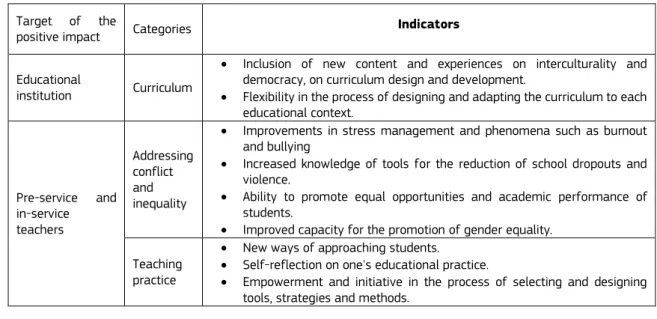
There are some dimensions and indicators that have been taken into account in order to maximise the possibilities of capturing the positive effects that cases have had in the development of teachers’ IDC:
Table 1. Impact indicators Target of the
positive impact Categories Indicators
Educational
institution Curriculum
Inclusion of new content and experiences on interculturality and democracy, on curriculum design and development.
Flexibility in the process of designing and adapting the curriculum to each educational context. Pre-service and in-service teachers Addressing conflict and inequality
Improvements in stress management and phenomena such as burnout and bullying
Increased knowledge of tools for the reduction of school dropouts and violence.
Ability to promote equal opportunities and academic performance of students.
Improved capacity for the promotion of gender equality. Teaching
practice
New ways of approaching students. Self-reflection on one's educational practice.
Empowerment and initiative in the process of selecting and designing tools, strategies and methods.
4 Effective and appropriate behaviour and communication in intercultural situations (Deardorff, 2011)
11
School community
Empowerment to promote the development of a sense of community within the context.
Teacher educators
Record, write or design tools on the recording of teachers' own teaching experiences as a source of long-term knowledge.
Greater articulation to make the problems visible in the institution. Source: Prepared by the authors
As in the effectiveness criterion, scientific articles can provide evidence-based information about impact. However, there are cases where there is not enough evidence of impact, therefore a list of techniques has been provided on how to gather more information about it, within the different KECs (see Annex 2).
4. Relevance: Does the case address the demands and requirements of pre-service and in-service teachers
related to the development of IDC?
The objectives and design of the case are consistent with teachers’ requirements about the development of IDC (OECD/DAC, 2019) according to the context. This means that the case focuses on the development of “the ability to mobilise and deploy relevant values, attitudes, skills, knowledge and/or understanding in order to respond appropriately and effectively to the demands, challenges and opportunities that are presented by democratic and intercultural situations” (CoE, 2016, 10).
The approach for the development of intercultural competence can be considered holistically or by components, according to the CoE competence model (2018, Vol.1). In this way, it is possible for a case to focus on the development of IDC as a whole, or at least on one of its components: knowledge and critical understanding, values, attitudes and/or skills. This may vary according to the demands of the teachers, depending on the context.
Assessment of relevance requires information on the objectives and design of the initiative, and its correspondence with the demands for IDC development of teachers within the context.
5. Transferability: Is the case transferable or generalisable to other contexts with the same or similar
outcomes?
Transferability is the extent to which the same or similar outcomes are obtained if the practice (policy, training, etc.) is repeated in other contexts or settings, with other participants6 (trainers, student teachers, etc.) (Brown,
2005 and 2015). In the case of the INNO4DIV project the term “contexts” refers to different educational levels of teacher training (ITE, CPD accredited by national education bodies) and/or different settings (professional development delivered from non-traditional training providers, and/or national, regional, and local different settings).
Transferability involves demonstrating the applicability of the results of a practice to other contexts (Brown, 2005). For that purpose, a detailed description of the context and conditions where the practice is undertaken is required, including the actors' interpretations and other social and/or cultural information (Davis, 1995). Additionally, it is important to know if the practice has already been transferred; if applicable, it is required to obtain evidence of the development of the same policies and/or educational methods beyond the specific context or situations where it has been originally undertaken.
Finally, it is important to note that “…transferability is the responsibility of the person seeking to apply the results of the study to a new context” (Marshall and Rossman, 1989, 145). In this regard, it is a matter of judgement that needs to be developed by the experts’ assessment as part of the decision-making stage of the case selection process (Section 4).
6. Replicability: Can the same or similar outcomes of the case be obtained in the same context and under the
same conditions, with different participants?
Replicability is the extent to which the same or similar outcomes would be obtained if the practice (e.g.: teacher training) were to be repeated in the same context and under the same conditions, with different participants (trainers, student teachers, etc.). This refers to whether the outcomes of the training can be replicated, repeated or reproduced, enhancing the validity and reliability of the practice.
6 For the development of the transferability and replicability concepts, contributions from Christine Sleeter, Martyn Barret and Zvi Bekerman
12
For the assessment of replicability, the case should provide access to sufficient information in order to reproduce the educational practice (method, training) obtaining same or similar results (Brown, 2005). In this way, the same author recommends a clear and complete report “…in the style of a recipe…” describing the design, participants, methods, tools, procedures and evaluations. Additionally, it is important to know if the same design and implementation process has already been tested in successive groups under the same conditions, and the same results have been obtained.
7. Sustainability: Can the benefits of the case be continued over the medium and long term?
According to OECD/DAC (2019) sustainability refers to the extent to which the net benefits of an intervention continue, or are likely to continue. Adapting the definition to the scope of the INNO4DIV project, the selected cases are likely to continue over time after their first implementation, or have already been continued. “It is difficult to provide a reliable assessment of sustainability while activities are still underway, or immediately afterwards” (Ministry of Foreign Affairs of Denmark, 2006). In such cases the sustainability assessment is based on projections of future developments based on available knowledge about the case and the capacity of involved parties to deal with changing contexts.
Useful data for assessing sustainability addresses the extent to which teachers’ IDC has been successfully developed (effectiveness), the positive impacts and whether the teacher community values the benefits sufficiently to allocate resources to them (Ministry of Foreign Affairs of Denmark, 2006).
8. Scalability: Can the case be applied to a larger scale or be extended?
The case has the capacity to maintain high quality despite an increasing or a large number of learners (Kasch et al., 2017).
The scalability assessment requires information about internal and external factors. According to the objective of the project, the time available for its implementation and the sources of information available in each case the following factors are selected (Vaughan-Lee et al., 2018):
a) External factors: political will, support and/or buy-in for the initiative from local/national authorities; a supportive policy environment (e.g. leadership/someone who champions the initiative; local/multi-stakeholder partnerships engaged with the process.
b) Internal factors: the case addresses IDC as a perceived need of teachers; it is flexible and simple, or has the potential to be simplified; the case has identifiable leadership or other easily accessible sources to the information required to develop it in a larger scale; the process has an adequate budget and is affordable; scaling entity and/or key stakeholders have a shared vision of the initiative; and, the initiative is linked to incentives (monetary or non-monetary).
9. Geographical scope and cultural context diversity are given specific consideration as follows:
In order to focus on the most innovative educational practices and ensure representation of different EU countries, geographical scope is only considered as an element of judgement in the decision-making stage, as can be seen in Section 4.
Similarly, another consideration for the selection of cases is a comprehensive approach towards cultural diversity (see INNO4DIV, 2020). Therefore specific inclusion and exclusion criteria have been proposed for each KEC, addressing multiple dimensions of cultural diversity by covering a set of culturally diverse contexts.
2.3 Sources of specific criteria per KEC
The specific criteria are defined as indicators or qualitative factors that provide simple and reliable means (OECD, 2010) to identify the overcoming of the barriers per KEC. In the context of the INNO4DIV project, they act as a reference of the main actions or activities that experts are going to look at to assess the case, but under no circumstances pretend to be exhaustive; each case needs to be considered in its uniqueness.
The specific criteria per KEC have been established through the following sources:
1. The analysis outlined in the TS regarding the barriers that affect the development of teachers’ IC (p. 5) have been collected and interpreted in two ways (see Tables 2 to 9). First, as obstacles or challenges to be overcome. Second, these challenges or barriers have made it possible to establish some of the outcomes that the cases should aim at. The outcomes are positive expressions of the barriers and
13
express their overcoming, serving as guidelines to determine the attributes of the cases according to each KEC and its inclusion criteria. In short, according to the TS, both the barriers and the outcomes have served as references to define the specific criteria.
2. Literature review: A detailed analysis of a wide range of selected texts indicated in the literature review (Simó et al., 2020) has been used as a reference for determining the inclusion criteria to select the cases. In addition to those already mentioned in the TS, the literature makes explicit references to cases that should be excluded, as indicated below.
3. Final table of KECs, barriers and outcomes(see Annex 4): given the wide range of criteria found through the literature review, the final table is crucial for prioritising the most relevant criteria per KEC. It aims to focus on overcoming the barriers and achieving the expected outcomes. The cases that fulfil all the inclusion and exclusion criteria within each KEC represent practices with a great value for the INNO4DIV objectives.
2.4 Specific criteria per KEC
Tables 2–10 show each KEC, its associated barriers and the expected outcomes. The main ideas leading to the definition of inclusion and exclusion criteria per KEC are detailed below.
2.5 Inclusion and exclusion criteria for KEC 1 Table 2. KEC1 barriers and outcomes
KEY ENABLING COMPONENTS
(KEC) BARRIERS
OUTCOMES7
(based on overcoming barriers) KEC1:
Common understanding of knowledge, skills, and attitudes related to IDC.
Different understanding of IDC or missing IDC-related concepts in education.
Different theoretical approaches towards education and cultural diversity (Allan, 2011).
Knowledge and understanding that serve as common background to the development of frameworks, vocabulary and concepts (Deardorff, 2011) regarding IDC training for teachers.
Knowledge that provides a reference for the development of curricula, programmes, methods, etc. (authors’ own elaboration). Teacher can articulate ideas that go beyond stereotypes and common prejudices (Deardorff, 2011).
The inclusion and exclusion criteria aim at identifying cases that provide a clear conceptual framework for teaching IDC for teachers in order to accomplish common understanding between educational agents and ITE providers (PPMI, 2017).
The inclusion criteria are based on the principles of human rights, democracy and the rule of law provided by the conceptual framework of the CoE (2018, Vol. 1) and the common values of respect for human dignity, freedom, democracy, equality, the rule of law and respect for human rights, from the Recommendation (Council, 2018). The cases selected should depart from knowledge and critical understanding, values, attitudes and skills as reflected in the CoE competence model (2018, Vol. 1).
The cases should address cultural diversity as an asset to society in terms of:
a. diverse cultural affiliations, cultural variability and diversity, and pluralism of perspectives, views and practices that ought to be positively regarded, appreciated and cherished; and
b. shared principles, that led to assume that cultural diversity always ought to be valued unless it undermines the human rights and freedoms of others. The consideration of both perspectives is a way to address the potential tension between valuing human rights and valuing cultural diversity (CoE, 2018, Vo. 1).
14
The notion of culture and identity should be addressed from a complex and dynamic perspective, taking into account their fluctuations. These fluctuations are the consequence of personal changes or a response to external conditions or interactions within the context and with other members of social groups (CoE, 2018, Vol. 1). The case should also take into account complexity in the sense of being open to understanding the needs and problems of particular societies and groups within them (Allan, 2011).
In addition, there are studies that show how students with higher levels of civic knowledge tend to be the students expressing more tolerant attitudes (Council, 2018). In this vein, and in order to select cases that overcome the lack of IDC-related concepts, the practices should provide knowledge (Deardorff, 2011) of the following concepts in the discourse of teacher training: active citizens, lifelong learning, identity, beliefs, culture, intercultural, intercultural situations, intercultural dialogue and critical thinking (CoE, 2018, Vol. 1), inclusion (PPMI, 2017), social cohesion (Barrett, 2012; Council, 2018) and digital citizenship (CoE, 2017), precisely in order to select cases that overcome the lack of IDC-related concepts.
The cases should consider the role of education as a key agent for social change to promote open, tolerant and diverse societies (CoE, 2018, Vol. 1). Likewise, the cases should contemplate the political, economic, and cultural context of education as part of the learning process aimed to develop the intercultural competence of teachers (Merryfield, 2000). In this sense, it has been important to have a comprehensive idea of education as a “lifelong process that enables people to make independent choices for their own lives […] All teachers and teacher educators, regardless of which subject they might be teaching, contribute to this educational goal” (CoE, Vol. 3, 2018). Based on this, the cases should include the understanding of IDC for all teachers, regardless of the subject they teach.
In summary, the selected cases within KEC 1 should respond to the question: What do we want our teachers to understand, to be and to do, regarding democracy, diversity and intercultural competence? This is an ethical standpoint to consider the competences required by teachers (Allan, 2011).
Cases that identify cultural diversity only in terms of migrants, gender, or special needs should be excluded; the project attempts to emphasise the ethnic, religious, linguistic, and individual and collective narratives as part of the history of each person as a whole (CoE, 2018, Vol. 1; Barrett, 2018).
Cases that don’t take into consideration the social and political implications of school education and focus purely on academic achievements (Hagan and McGlynn, 2004) should therefore be excluded.
Based on the goal of improving the quality of education for all students in their uniqueness, a “one-size-fits-all”8 approach has been excluded (OECD, 2019a). In the same way, cases that support cultural relativist
approaches that do not recognise human dignity as universal value and explain IDC only as a skill or in terms of specific behaviour are excluded (CoE, 2018, Vol. 1). KEC 1, and all subsequent KECs exclude cases based on a deficit model perspective which focuses on students’ weaknesses (PPMI, 2017).
2.6 Inclusion and exclusion criteria for KEC 2 Table 3. KEC2 barriers and outcomes
KEY ENABLING COMPONENTS
(KEC) BARRIERS
OUTCOMES
(based on overcoming barriers) KEC 2:
Supporting educational policies.
Lack of policy attention to teaching common values.
Inadequate educational policies and legal frameworks (Allan, 2011).
Lack of policies for including citizenship education in initial teacher training (Council, 2018).
The promotion of standards (Darling-Hammond et al., 2017) about IDC professional development.
Flexible funding and continuing education units for learning opportunities that include sustained engagement in collaboration, mentoring and coaching (Darling-Hammond et al., 2017).
Engage ITE and CPD providers in research and innovation about IDC (CoE, 2018, Vol. 3).
8 According to the OECD “There is a growing awareness that one-size-fits-all approaches to school knowledge and organisation are
ill-adapted both to individuals’ needs and to the knowledge society at large. To move beyond uniform, mass provision can be described as ‘personalisation’ of education and of public services more widely” (2006, p.9).
15
Better use and cost-effectiveness of IDC teaching efforts (authors’ own elaboration). Increased outreach and dissemination of IDC training (authors’ own elaboration).
The inclusion and exclusion criteria aim at identifying cases of policy design and implementation that prioritise teacher training on democratic and intercultural competences (CoE, 2018, Vol. 1). The educational policies that include IDC can offer strong support for ITE providers, schools and teachers (Park and Tan, 2016).
The principles of human rights, democracy and the rule of law provided by the CoE’s RFCDC (2018, Vol. 1) and the common values of respect for human dignity, freedom, democracy, equality, the rule of law and respect for human rights, from the Recommendation (Council, 2018) are crucial in the acquisition of IDC. Policy designed for the development of IDC should include the recognition and promotion of the principles and values mentioned above (Veugelers et al., 2017). Additionally, the policies should be inclusive in terms of recognition of cultural diversity; they should include the representation of the history and contributions of the diverse groups that live in the country and/or in Europe, through establishing national policy standards (Sleeter, 2015; Hagan and McGlynn, 2004). Similarly, and according to the conceptual framework of the INNO4DIV project (Shuali et al., 2020), the policy should explicitly identify a cluster of competences that teachers (pre-service and in-service) should develop, according to the four components of the CoE competence model, as shown in Figure 1:
Figure 1. The 20 Competences of the CoE’s RFCDC
Source: “Reference Framework of Competences for Democratic Culture” Vol. 1, p. 38. Council of Europe, 2018.
Cases that include the adoption of standards of professional development (Darling Hammond et al., 2017) that integrate IDC at the foundations should be noted. They are a way to overcome the main barriers of KEC 2, through strengthening common pedagogical concepts about IDC, implementation strategies and/or shared values between different countries, contexts and/or cultures.
On the one hand, the case should address the identification and assessment of teachers’ needs related to IDC, to avoid that the definition of professional development is disconnected from the practice (Darling-Hammond
16
et al. 2017). On the other hand, the case should take into account existing national strategies and regulations regarding the organization of courses and study programmes of IDC training (CoE, 2018, Vol. 3).
The case should include some implementation measures, to provide strong support for teachers’ IDC development in educational institutions, according to the context (Van Driel et al., 2016). For example, such measures could include the following:
● prepare an action plan to implement training of IDC with teacher education institutions and schools, including material and human resources (CoE, 2018, Vol. 3);
● assign funding for continuing education, provide technology-facilitated opportunities for professional learning and coaching in schools, and identify experts of IDC as mentors and coaches to support teacher’s learning (Darling-Hammond et al., 2017);
● include training and support for teachers and teacher educators from ITE and CPD providers (CoE, 2018, Vol. 3); and
● recruit and retain more diverse student teachers in student cohorts, in order to encourage diversity in the education workforce (Cushner and Mahon, 2009; Van Driel et al, 2016).
In order to provide feasible information for policy makers, the case should include an assessment of the outcomes through the creation of systems for tracking professional development by state education agencies, ITE and/or CPD providers (Darling-Hammond et al., 2017). Likewise, more horizontal coordination in which schools work together with other schools of local municipalities, a wider community and NGOs are also necessary to guarantee the implementation and evaluation of education policies on teaching IDC (Veugelers, 2017).
The integration of IDC in the purpose and function of ITE and CPD providers is considered an inclusion criterion, as a way to engage them in research and innovation projects (CoE, 2018, Vol. 3). In addition, the educational policy should encourage the cooperation between education institutions within the country and several European countries (CoE, 2018, Vol. 3).
Innovative policies should include explicit strategies for providing teacher training that covers emerging areas and topics (contextual demands), such as the use of ICT in the classroom to help student build cross-curricular skills, fostering the sense of preparedness with respect to competence development and technology (OECD, 2019d). This is very important in the specific case of IDC that involve cross-curricular clusters of competences (CoE, 2018, Vol. 1).
A deficit-based understanding of diversity is an exclusion criterion that permeates all KECs. The deficit-approach perceives diversity as a ‘disparity’; ‘heterogeneity’ is perceived as a burden to be dealt with, associated with different outcomes and hence, differential treatment (PPMI, 2017). Additionally, a case will be excluded if it displays an undue burden (excessive working hours, unattainable resources, etc.) on teachers, communities, students, and other stakeholders (Sleeter, 2017). As in the previous KECs, a “one-size-fits-all” approach (OECD, 2019a) is another exclusion criterion, avoiding lack of attention to the specific demands of the context, especially regarding cultural diversity. Finally, policies are excluded when they promote an educational approach focusing on purely academic issues (Hagan and McGlynn, 2004).
2.7 Inclusion and exclusion criteria for KEC 3 Table 4. KEC 3 barriers and outcomes
KEY ENABLING COMPONENTS
(KEC) BARRIERS
OUTCOMES9
(based on overcoming barriers) KEC 3:
Effective initial teacher education (ITE)10 curricula, including mandatory
Insufficient emphasis on IDC learning in ITE. Educators may feel more ready to negotiate ways for interacting with students and to realign their values with their practice, by getting to know themselves as individuals
9 Given the similarities found between the outcomes of KEC 3 and KEC 4, the outcomes have been merged in the KEC description table.
This applies to the outcomes of KEC 6 and KEC 7 as well.
10 According to the educational legislation of each country, the qualification of future teachers corresponds to grade level or master degree
(COE, 2018, VOL. 3). The degree has not been a condition for determining whether the case belongs to KEC 3 or KEC 4; the decision is made depending on the context.
17
IDC and related assessment methods, naming specific learning objectives and competences and how to foster them with appropriate tools, methods, and teaching approaches in classroom education and extracurricular activities.
Unclear instructions on how to integrate IDC learning in teachers’ education which may lead to counter-effective education practices. IDC seen as transversal competence in the usual frameworks for teacher education, underlining its importance, but also diluting its emphasis.
Competences for diversity rarely include specific learning outcomes in terms of knowledge, attitudes and skills, creating limitations in the way those are reflected in ITE curricula.
Teacher trainers are rarely prepared to teach ITE curricula for diversity and there is no systematic approach for preparing them to teach about diversity.
Insufficient quality assurance systems linked to the framework of competences and learning outcomes for teachers and students. Sense of discomfort in dealing with diversity in the classroom (Hagan and Mc Glynn, 2004).
Lack of confidence of pre-service teachers in their knowledge of cultural differences and their abilities to address students’ individual needs (Cushner and Mahon, 2009).
and teachers, raising their awareness of their professional and personal identities and purpose as teachers and human beings. Ease of dealing with cultural diversity in the classroom (Hagan and Mc Glynn, 2004). Pre-service and in-service teachers show effective and appropriate behaviour and communication (outcomes detailed in Annex 1).
Reduction of stress levels at school (Palomera et al., 2008, as cited in Palmer and van Wyk, 2013).
The inclusion and exclusion criteria mainly indicate educational practices that show a systematic approach for teaching IDC in ITE curricula, in order to identify cases that explicitly embrace democracy and interculturality as part of the goals and challenges of teacher training.
As a starting point, the case should include IDC in compulsory courses of pre-service training programmes, with a clear definition and expected outcomes, to know what to teach and what to evaluate (Deardorff, 2011). In addition to the inclusion of IDC, the case should show the implementation process of the training and communicate it: spreading information of good practices, encouraging teacher educators or faculty members to carry out pilot projects of IDC training within the institution or with schools, and integrating content related to the context in study programmes or courses (CoE, 2018, Vol. 3).
According to the CoE, teaching IDC should embrace the development of a cluster of competences that pre-service teachers should gain as outcomes (see Annex 1) according to the four components of the competence model (values, attitudes, skills, and knowledge and critical understanding) (2018, Vol. 1 and 2). However, the use of the model should focus on the promotion of responsiveness to the changing nature of the society in which the student teachers will work (Van Driel et al., 2016). Based on that, the case should include the development of continuous reflection and adaptation to the context, rather than a pre-established group of actions which ignores the shape or form diversity takes (Allan, 2011). However, cases should provide student teachers with teaching materials, aids and new teaching methods, as well as engage them in research and innovation projects (CoE, 2018, Vol. 3). This combination is a way to equip future teachers with strategies and resources, while promoting openness to context.
The communicative level is one of the main aspects for understanding what IDC teaching involves sometimes identified as intercultural dialogue (CoE, 2018, Vol. 1), interaction (Deardorff, 2011) or just communication (Allan, 2011). For that reason, teacher training practices should include the development of strategies for finding ways of creating opportunities and removing barriers to dialogue and participation (Allan, 2011), in order to create meaningful interactions between all student teachers.
The cases should integrate IDC as a transversal dimension of teacher training, providing both the technical and the substantial side of the process (CoE, 2018, Vol. 3):
It is not only to train teachers to be able to make effective use of the CDC Framework in schools and other educational institutions (the “technical” side), but also to equip them with a set of competences
18
necessary for living together as democratic citizens in diverse societies (the “substantial” side) (CoE, 2018, Vol. 3, 77).
In this way, besides the personal development of student teachers’ IDC, the potential case should prepare them to design their own IDC teaching strategies. Instead of a general didactic approach, effective teacher training should focus on a discipline-specific approach (Darling-Hammond et al. 2017).
As part of the teacher training, the cases should lead student teachers to a critical review of social justice issues (Sleeter, 2015; Merryfield, 2000), personal assumptions or preconceptions (Huber, 2012), and their own pedagogical and didactical approaches, as a way to becoming self-aware (Gallavan and Webster-Smith, 2009; Clarke-Habibi, 2019). Similarly, the ITE cases should include self-reflection of differences in student teachers’ perceptions of culturally determined patterns of thinking, communication and behaviour, as crucial aspects in determining the future relationship between culturally diverse teachers and students (Cushner and Mahon, 2009). The personal commitment of school leaders and other members of school management teams to an ethos of diversity is critical in developing IDC (Van Driel et al., 2016).
In order to recognise the importance of teachers’ attitudes, experiences that promote teachers’ self-efficacy have been included (OECD, 2019a) as a way of empowering them to cope with the challenges of multicultural classrooms. The case should integrate activities within which the student teachers can articulate anxieties and questions, rather than rehearse tolerance as a dogma, without critical thinking (Allan, 2011). As part of the same criterion, the case could provide activities to engage them in their own dialogues and professional deliberations, e.g.: to reason freely about ethical problems, to think critically and reflectively, solve problems, etc. This seems to be an effective approach to develop the professional autonomy required for future innovation (Jimenez, 2007).
The cases should take into account different sources of experiential learning for teacher training, both within and outside the educational institution (ITE provider), in contact with NGOs (Vuorikari, 2019) and other informal and non-formal education environments (CoE, 2018, Vol. 1) developing rich extra-curricular activities in the form of service-learning, community work or excursions (Veugelers et al., 2017). Besides, the CoE suggest cooperative programmes for student teachers, as summer schools, youth camps and various workshops or action research projects shared with in-service teachers (2018, Vol. 3, 86). The cases should offer opportunities for student teachers to do internships in multicultural contexts (Siarova and Tudjman, 2018), or to have intercultural exchanges (Deardorff, 2011) both, in physical and/or digital format (e.g. the experience of cross-cultural experiential learning online, described by Merryfield, 2003). However, the promotion of this type of activities is not as important as the inclusion of critical reflection about the intercultural experience itself (Deardorff, 2011), before and after experiencing it (Cushner, 2017; European Commission/EACEN Eurydice, 2015, as cited in Siarova and Tudjman, 2018).
The promotion of cultural diversity in cohorts of student teachers (Sleeter, 2007 and 2015; Cushner and Mahon, 2009) is another criterion to identify cases that provide first-hand experience or experiential knowledge of other cultures that improve the development of IDC (Huber, 2012; Cushner and Mahon, 2009) and reflect diversity within the student body (OECD TALIS, 2018).
The cases should respond to this question: How well prepared are student teachers for this global world in which we live and work? (Deardorff, 2011) For that purpose, the case should focus on evaluating the level of intercultural sensitivity of student teachers, through different methods, such as Intercultural Development Inventory (IDI), among others (Cushner and Mahon, 2009) providing reliable evidence of learning during the course and at the end of the course (Acquah, E. and Hattunen, T., 2018). Specifically, the cases should show a process-focused evaluation of the outcomes that allow registering the differences along the process (Deardorff, 2011).
To evaluate IDC can be understood as evaluating interaction with those from different backgrounds (Deardorff, 2011). As a result, the assessment should focus on the development of competences for intercultural dialogue (CoE, 2018, Vol. 3).
Moreover, the assessment methods should evaluate reflection capacity, critical thinking and/or the development of strategies to teach them. It is as important for student teachers to have the experience of new ways of thinking as to learn how to teach them (Palmer and van Wyk, 2007). As a result, student teachers are engaged both as learners and as future teachers (Darling-Hammond et al., 2017).
Teacher training should provide pre-service teachers with assessment methods that can be adjusted to changing contexts and educational settings (CoE, 2018, Vol. 3). In contrast with the process of teaching that involves a holistic approach of the competence learning, the case could include assessment methods focusing
19
on separate components of IDC (Deardorff, 2006), evaluated at various moments of the learning process as opposed to one point in time.
Based on the importance of attitudes for IDC development, and being aware of the complexity of evaluating them, it is interesting for the project to include cases that provide assessment methods that include both, the evaluation of attitudes and high-level thinking skills (Deardorff, 2011). In general, the cases should include both direct assessment methods (learning contracts, e-portfolios, journaling, blogging and reflection papers and/or performance) and indirect assessment methods (surveys, inventories, interviews or focus groups). In addition, it is extremely important for the case to provide opportunities for continuous self-reflection and self-evaluation (CoE, 2018, Vol. 3).
Innovation focus within ITE is ensured according to the Vuorikari model (2019) already explained in Section 3.2. Based on it, the cases should incorporate the development of new resources or products, delivery methods (collaborative models, teacher networks, teacher cooperation, peer coaching between teachers, student counselling and mentoring) and/or pedagogical conceptions, with respect to previous practices in general or within the context. Among others, it is expected that IDC teacher training includes the use of digital media as resource or delivery method, considering the ability to learn, collaborate and solve problems in digital information environments (Caena, 2019). This is the case of multimodal practices, theory delivered online with on-site experimentation in school, video pedagogy, digital citizenship (CoE, 2017), etc. Besides ‘development’, ITE providers should include the ‘promotion’ of innovation on IDC and related issues among their faculty members or teacher educators, and as a way to adapt the Vuorikari model to the specific field of pre-service teacher training.
The exclusion criteria focus on cases that ignore IDC as part of the foundations of teacher training (Cushner and Mahon, 2009). In parallel, teacher training experiences that lack a progressive implementation plan are excluded (Sleeter, 2017). As already mentioned, there are some exclusion criteria that apply for several KECs, such as: cases that identify cultural diversity only in terms of migrants, gender, or special needs; a deficit-based understanding of diversity; and, the “one-size-fits-all” approach.
2.8 Inclusion and exclusion criteria for KEC 4 Table 5. KEC4 barriers and outcomes
KEY ENABLING COMPONENTS
(KEC) BARRIERS
OUTCOMES
(based on overcoming barriers) KEC 4:
Availability of high-quality IDC courses for teachers’ continuing professional development (CPD).
Insufficient emphasis on IDC learning in teacher in-service training as part of their CPD: Insufficient resources, ineffective methods (need to move from “learning by doing” to “integral evidence based”), lack of offer of quality training based on experiential learning.
Push teachers “towards the management of, rather than engagement with, difference” (Allan, 2011, p.132).
Reluctance to address controversial social cultural and political issues in schools (Hagan and Mc Glynn, 2004).
Same as KEC 3 above (as indicated in Annex 4: KECs, barriers and outcomes)
According to the objective of the research, the inclusion and exclusion criteria are intended to select the best cases that provide IDC training for in-service teachers.
The inclusion criteria are basically the same as in KEC 3, adapted to the case of in-service teachers, as demonstrated in the table of Specific Criteria (see Annex 10). However, it has been important to distinguish the specific needs between pre-service and in-service teachers (CoE, 2018, Vol. 3). For this reason, here below, some considerations and additional criteria have been developed.
The case should contemplate the awareness of the transformation of monocultural teachers to become intercultural teachers (Hagan and Mac Glynn, 2004). In this regard, the potential cases should display structured professional learning that results in changes in teacher practices (Darling-Hammond et al., 2017).