Kingdom of Saudi Arabia
King Saud University
College of Engineering
Electrical Engineering Department
Program Bulletin
Page | 2
A Message from Chairman
gives me pleasure to welcome you to the Website of the Department
of Electrical Engineering. The Department has 53 members of
academic staff, 45 technical and supporting staff, 700 undergraduate
students, and 85 graduate students. We offer two undergraduate
programs: Electrical Power & Machines Engineering, and Electronics &
Communication Engineering, which attract top students from high schools in the Kingdom. For
graduate studies, the department offers three programs in five areas of specialization.
The Department has recently put a great effort to update academic programs and teaching facilities
as well. A new M.Sc. program, based on course work only, has been introduced to cater for the
needs of a wide class of graduate students. Several improvements in the undergraduate programs
include: professional communications course and laboratory, an improved graduation project,
courses in selected topics of current interest such as mobile communications, computer networks
and information security are presently offered. Smart class rooms and meeting rooms, R&D
laboratories, such as the Erickson lab, major laboratory software and hardware upgrading, such as
the electrical power and the high voltage labs, are steps to upgrade the department facilities.
The main objective of such changes is to:
Improve teaching methods, to be at the forefront of current thoughts in Engineering
Education.
Improve the learning skills of students to become independent learners and effective users
of existing facilities such as the library, laboratory equipment, and computers.
Establish a quality assurance system to insure the above objectives will be met in the near
future.
The department has maintained close working relations with public and private sectors of
engineering including the Saudi Telecommunication Company, Erickson, Saudi Electrical
Company, and many others. Among such efforts is offering short courses, collaborate research
projects, and consultation work. Presently, the department is establishing the "Saudi Society of
Electrical Engineering” and the “Saudi Society of Communication Engineering”, with the target of
joining efforts of all electrical and communication engineers in the Kingdom to upgrade the
profession and promote joint research and development efforts and technology transfer in the area
of Electrical Engineering, Information Technology, and Telecommunications, with relevance to
the needs of the Kingdom.
Dr. Abdulhameed M. Al-Sanie
Chairman of electrical Engineering Department
It
Page | 3
Table of Contents
Contents
Table of Contents ______________________________________________________________ 3
INTRODUCTION______________________________________________________________ 4
DEPARTMENT VISION AND MISSION __________________________________________ 4
Vision _____________________________________________________________________________ 4
Mission ____________________________________________________________________________ 4
Values ____________________________________________________________________________ 4
EDUCATIONAL PROGRAMS ___________________________________________________ 5
Bachelor of Science Program in Electrical Engineering _______________________________ 5
Program Objectives _________________________________________________________________ 5
Program Learning Outcomes _________________________________________________________ 6
The Academic Plan __________________________________________________________________ 6
Master of Science Program in Electrical Engineering ________________________________ 12
Degree Requirements for M. Sc. (Non-Thesis Option) Program: ___________________________ 17
PhD. Program in Electrical Engineering __________________________________________ 22
FACULTY ___________________________________________________________________ 24
LABORATORIES _____________________________________________________________ 29
DEPARTMENT COMMITTEES & UNITS ________________________________________ 32
ADMISSION REQUIREMENTS & REGULATIONS FOR THE B.Sc. PROGRAMS ______ 32
Admission of Students who have finished the Preparatory-Year of Science Colleges. __________ 32
Student and Course Transfer ________________________________________________________ 32
Students Allocation to College Departments ____________________________________________ 33
Practical Training__________________________________________________________________ 33
CONTACT INFORMATION ____________________________________________________ 34
APPENDIX – A: BS Course Description __________________________________________ 35
APPENDIX – B: MS Course Description __________________________________________ 48
A selected research topic will be conducted. ________________________________________ 52
APPENDIX – C: PhD Course Description _________________________________________ 53
APPENDIX – D: Laboratories ___________________________________________________ 57
Page | 4
INTRODUCTION
The Department of Electrical Engineering has been in the forefront of the educational development process
at King Saud University till date. Ever since its inception, the department has effectively contributed to the
rapid development of the educational system in the Kingdom by striving to offer graduates who are
qualified to play a vital role in all development plans of the country and hold key positions in all
governmental and private sectors. As is understood by its faculty and staff members, the main objective of
the Electrical Engineering Department is to educate highly specialized and qualified electrical engineers in
different fields of electrical engineering who are capable of enhancing the rapid industrial, economical and
social development taking place in Saudi Arabia. Accordingly, the Department educates and prepares
engineers on electrical power and the responsibilities associated in electrical power engineering stations,
substations and high voltage transmission networks. The Electrical Engineering Department also teaches
students the issues pertaining to the design, development and analysis of different types of electrical
generators and motors in addition to their operation, maintenance and control through extensive knowledge
of power electronics. In addition, the Department qualifies electrical communication engineers capable of
designing, developing, operating and maintaining networks including antenna systems, satellite, microwave
and digital communications, in addition to signal processing. On the other hand, the Department also
teaches electronics in order to design, and maintain the electronic circuits and systems used in the fields of
communication, automatic control and computers along with other systems of civilian or military nature.
Moreover, the Department prepares system engineers who are trained in the design and management of
control systems using computers to operate and maintain various processes and fulfill other applications.
The Department is fully equipped with advanced facilities and high-quality laboratories that cover all
aspects of electrical engineering. These facilities are subjected to a continuous upgrades and improvements
in order to keep pace with the latest technology requirements. The diverse areas of specialty associated with
electrical engineering provide the graduates with very good job opportunities both in the governmental and
in the private sectors throughout the Kingdom.
DEPARTMENT VISION AND MISSION
Vision
The vision of the Electrical Engineering Program is to contribute to improving the society by promoting the
electrical engineering profession through providing qualified engineers who can perform and manage; learn
and accumulate experience; respond to changes; create and contribute to knowledge; and provide
innovative products and services.
Mission
The mission of the Electrical Engineering Program is to attain excellence in quality of electrical engineering
education; provide the society with highly qualified electrical engineers to meet the industry challenges
during the 21st century; and serve the society through involvement in knowledge sharing outreach and
professional activities that include innovative research and developing new technologies.
Values
The Department of Electrical Engineering operates according to the spirit of the following four values:
1.
To manage with quality and efficiency and to emphasize cooperation, ethical values, and trust.
2.
To treat individuals with dignity and respect and to value diversity.
3.
To support distinction and to encourage creativity.
Page | 5
EDUCATIONAL PROGRAMS
The department offers a carefully designed undergraduate program with a Major in Electrical
Engineering (EE). It has the following four specialized areas:
1.
Electronics,
2.
Communication Systems,
3.
Electrical Power Engineering,
4.
Automation and Intelligent Systems.
The Department also offers Master’s programs (Non-thesis and thesis options) in the following
areas of specialization:
1-
Electronics
2-
Communications
3-
Electrical Power
4-
Control Systems and Computers
Ph. D. programs in the following specializations are also offered by the Department:
1.Electronics.
2.Electromagnetic Waves and Communication.
3.Electrical Machines and Power Electronics.
4.Electrical Power and High Voltage Systems.
Degrees awarded by the department
Bachelor of Science in Electrical Engineering.
Master of Science in Electrical Engineering (Non-thesis and thesis options).
PhD in Electrical Engineering
Bachelor of Science Program in Electrical Engineering
Program Objectives
The following objectives have been set:
1-
Provide well-tailored and progressive sequence of subjects in which emphasis is placed on sound
fundamentals of engineering principles.
2-
Emphasize on the application of science and mathematics in the core courses.
3-
Utilize modern teaching software tools and laboratory equipment in engineering analysis and
design.
4-
Emphasize on reasoning and application of knowledge in problem solving and self-reliance.
5-
Apply engineering concepts & principles in multi-disciplinary surroundings, projects and
teamwork.
6-
Promote the effective oral and written communications skills through reports and projects.
7-
Emphasize on professional, cultural, ethical and community responsibilities through trainings.
8-
Keep students aware of the contemporary and global issues by continuously providing them with
current information.
Page | 6
Level 1 Course
Code Course Title Hr. MATH 140 Introduction to Mathematics 2(2-1-0) ENGL 140 English Language (1) 8(20-0-0) Health 150 Health & Fitness 1(1-1-0) CI 140 Learning, Thinking and Research Skills 3(3-1-0) ENT 101 Entrepreneurship 1(1-1-0) 15
Level 2 Course
Code Course Title Hr. MATH 150 Differential Calculus 3(3-1-0) ENGL 150 English Language (2) 8(20-0-0) IT 140 Computer Skills 3(0-0-6) SCS 140 Communication Skills 2(2-1-0)
16
9-
Keep students aware of safety issues related to different engineering topics and the impact of it on
the environment.
10-
Emphasize on importance of life-long learning.
11-
Empower and foster an environment to encourage the department research.
12-
Select qualified faculty members who are up-to-date with industrial and community issues, and
who are active in conducting consultations, participating in seminars, conferences and short
courses.
Program Learning Outcomes
LABEL
Program Learning Outcomes
A
An ability to apply knowledge of mathematics, science, and engineering
B
Ability to design and conduct experiments, as well as to analyse and
interpret data
C
Ability to design a system, component, or process to meet desired needs
within realistic constraints such as economic, environmental, social,
political, ethical, health and safety, manufacturability, and sustainability
D
Ability to function on multidisciplinary teams
E
Ability to identify, formulate, and solve engineering problems
F
Understanding of professional and ethical responsibility
G
Ability to communicate effectively
H
Understand the impact of engineering solutions in a global,
environmental, economic, and societal context
I
Recognize of the need for, and an ability to engage in life-long learning
J
Knowledge of contemporary issues
K
Ability to use the techniques, skills, and modern engineering tools
necessary for Engineering practice.
The Academic Plan
This program was carefully designed to provide more opportunities and less restriction by allowing students
to have breadth of knowledge in important areas of modern electrical engineering and at the same time
ensure that the graduates have sufficient depth to begin professional work with confidence in at least one of
the disciplines. The B.S. program is a four-year (eight-semesters) program, preceded by a two-semester
preparatory year.
Preparatory Year
The preparatory year aims at enhancing the skills of the student through intense English courses and
courses that improve their communication and computer skills. The table below illustrates the modules
studied during the preparatory year.
Preparatory Year requirement is given in Table 1 below:Page | 7
Course Requirements
After successfully passing the preparatory year and to complete the graduation requirements for a B.S. in
Electrical Engineering, the students are required to successfully pass a total of 132 credit hours (Table 2).
The program is divided into:
12 credit hours of University requirements (Table 3).
51 credit hours of College requirements (Table 4) of which 38 credit hours are compulsory courses
for all departments (Table 4A) and 13 credit hours of complementary courses (Table 4B).
69 credit hours of departmental requirements (Table 5) of which 42 credit hours are core courses
(Table 5A), 4 credit hours of graduation project (Table 5B) and 23 credit hours of elective courses
(Table 5C).
The 23 cr. hr. elective courses are divided into two groups: Depth courses (17 cr. hr.) that are to be
selected from one of the specialized areas offered by the department and Breadth courses (6 cr. hr.)
that are to be selected from two areas other than the student’s area of specialization (Tables 6A to
6D inclusive).
Senior Capstone Design Project Requirements
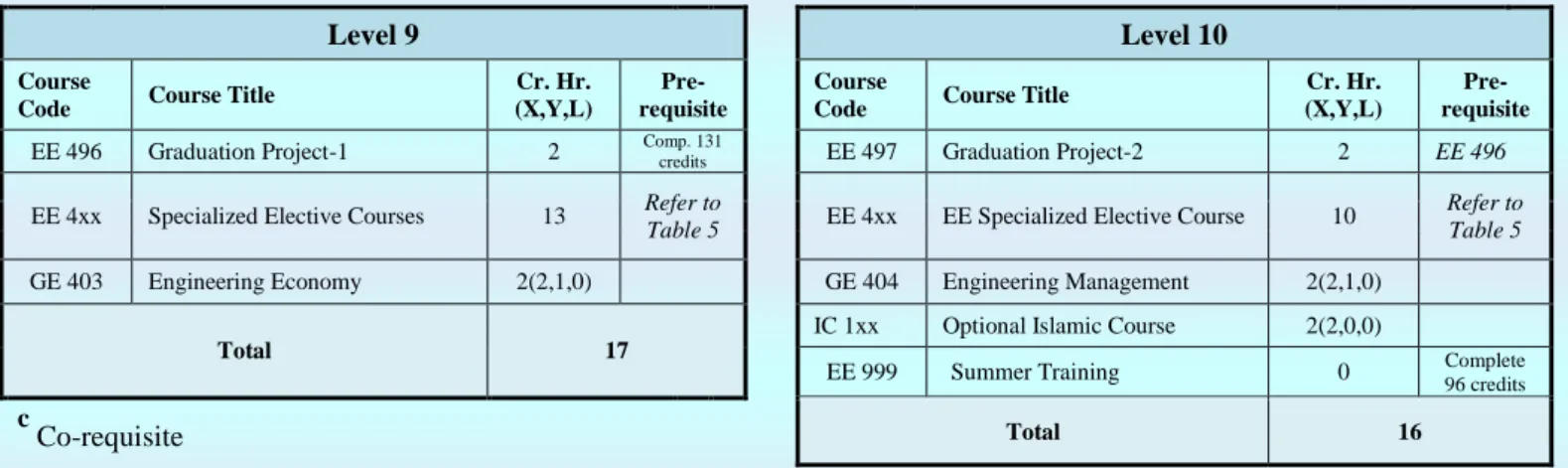
The design project is divided into two parts (2 credit hours each). The student is eligible to register for
Senior Design Project -1 if he completes successfully at least 100 credit hours excluding preparatory year.
Senior Design Project -2 can be taken during the first and second semesters only (not during summer
semester).
Summer Training Requirements
Prior to graduation, after completion of at least 65 Cr. Hr. after preparatory year, each Electrical
Engineering major must complete an approved Engineering Summer Training Program. Summer training
extends over a period of 10 weeks excluding weekends and official holidays, and must be undertaken in
companies or establishments accepted by the college. The student’s performance is evaluated by the
training company and by both the Department and College coordinators.
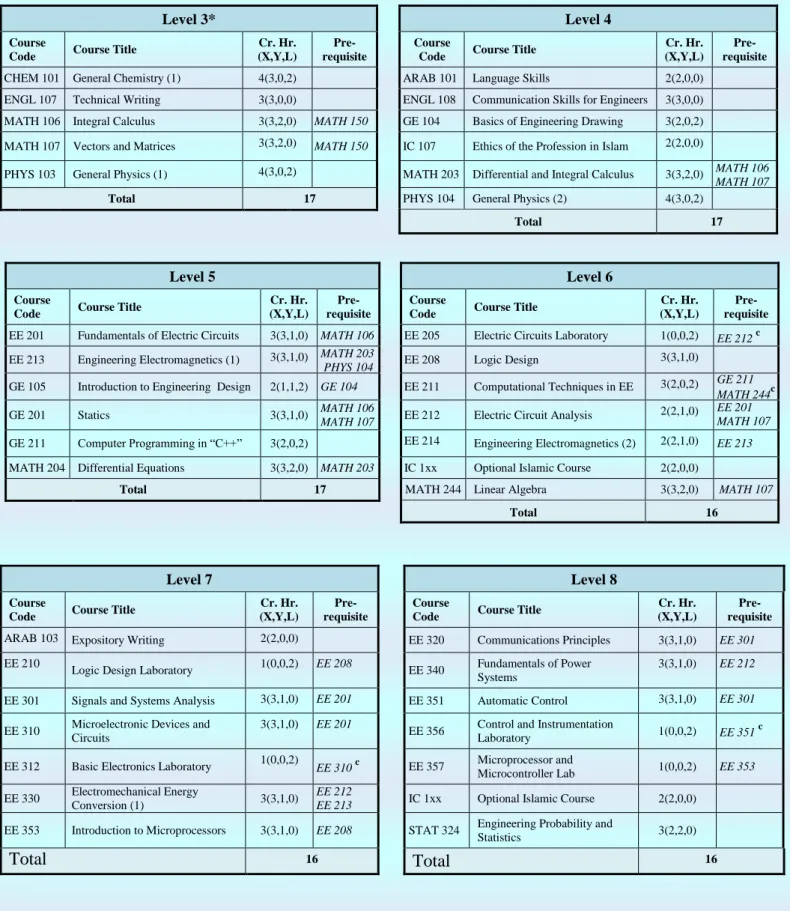
A typical plan of study for a B. S. in Electrical Engineering is presented in Table 7.
Table 2 SUMMARY OF B.S. DEGREE REQUIREMENTS IN ELECTRICAL ENGINEERING Requirements Cr. Hr. Description
University 12 Islamic (8) and Arabic (4) Studies
College 51 Compulsory (41), Complementary (10)
Department 69 Core (42), Projects (4) and Electives (23)
Total 132
Table 3 U
NIVERSITYR
EQUIREMENTSCourse Code Course Title Cr. Hr.
IC 101 Introduction to Islamic Culture 2(2,0,0)
IC 102 Islam and Society 2(2,0,0)
IC 103 The Islamic Economic System 2(2,0,0)
IC 104 Fundamentals of the Islamic Political System 2(2,0,0)
ARAB 101 Language Skills 2(2,0,0)
ARAB 103 Arabic Basic Writing 2(2,0,0)
Page | 8
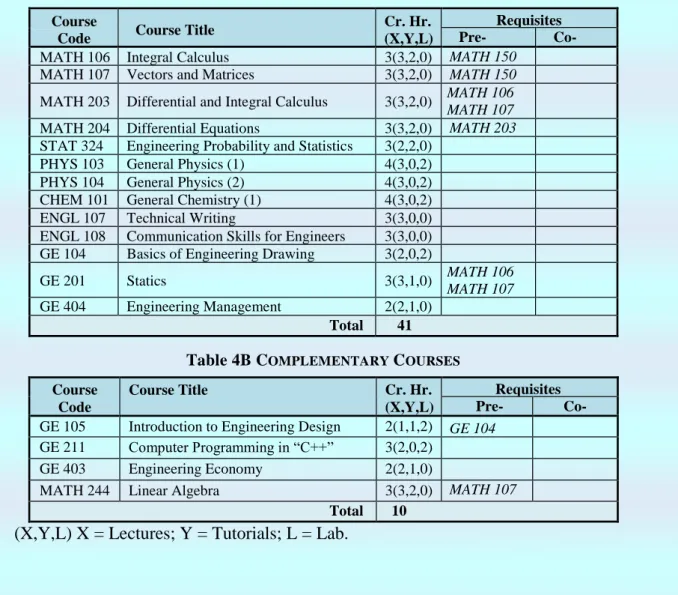
Table 4 C
OLLEGER
EQUIREMENTSTable 4A C
OMPULSORYC
OURSESCourse
Code Course Title
Cr. Hr. (X,Y,L)
Requisites Pre- Co-
MATH 106 Integral Calculus 3(3,2,0) MATH 150
MATH 107 Vectors and Matrices 3(3,2,0) MATH 150
MATH 203 Differential and Integral Calculus 3(3,2,0) MATH 106
MATH 107
MATH 204 Differential Equations 3(3,2,0) MATH 203
STAT 324 Engineering Probability and Statistics 3(2,2,0)
PHYS 103 General Physics (1) 4(3,0,2)
PHYS 104 General Physics (2) 4(3,0,2)
CHEM 101 General Chemistry (1) 4(3,0,2)
ENGL 107 Technical Writing 3(3,0,0)
ENGL 108 Communication Skills for Engineers 3(3,0,0)
GE 104 Basics of Engineering Drawing 3(2,0,2)
GE 201 Statics 3(3,1,0) MATH 106
MATH 107
GE 404 Engineering Management 2(2,1,0)
Total 41
Table 4B C
OMPLEMENTARYC
OURSESCourse Code Course Title Cr. Hr. (X,Y,L) Requisites Pre- Co-
GE 105 Introduction to Engineering Design 2(1,1,2) GE 104
GE 211 Computer Programming in “C++” 3(2,0,2)
GE 403 Engineering Economy 2(2,1,0)
MATH 244 Linear Algebra 3(3,2,0) MATH 107
Total 10
(X,Y,L) X = Lectures; Y = Tutorials; L = Lab.
Table 5: E
LECTRICALE
NGINEERINGR
EQUIREMENTSTable 5A: C
OREC
OURSESCourse
Code Course Title
Cr. Hr. (X,Y,L)
Requisites Pre- Co-
EE 201 Fundamentals of Electric Circuits 3(3,1,0) MATH 106
EE 205 Electric Circuits Laboratory 1(0,0,2) EE 212
EE 208 Logic Design 3(3,1,0)
EE 210 Logic Design Laboratory 1(0,0,2) EE 208
EE 211
Computational Techniques in Electrical
Eng.
3(2,0,2) GE 211 MATH 244
EE 212 Electric Circuit Analysis 2(2,1,0) EE 201
MATH 107
EE 213 Engineering Electromagnetics (1) 3(3,1,0) MATH 203
PHYS 104
EE 214 Engineering Electromagnetics (2) 2(2,1,0) EE 213
EE 301 Signals and Systems Analysis 3(3,1,0) EE 212
EE 310 Microelectronic Devices and Circuits 3(3,1,0) EE 201
EE 312 Basic Electronics Laboratory 1(0,0,2) EE 310
EE 320 Communications Principles 3(3,1,0) EE 301
EE 330 Electromechanical Energy Conversion (1) 3(3,1,0) EE 212
EE 213
EE 340 Fundamentals of Power Systems 3(3,1,0) EE 212
Page | 9
EE 353 Introduction to Microprocessors 3(3,1,0) EE 208
EE 356 Control and Instrumentation Laboratory 1(0,0,2) EE 351
EE 357 Microprocessor and Microcontroller Laboratory 1(0,0,2) EE 353
Total 42
(X,Y,L) X = Lectures; Y = Tutorials; L = Lab.
Table 5B: S
ENIORD
ESIGNP
ROJECTSCourse
Code Course Title Cr. Hr.
Requisites Pre- Co-
EE 496 Graduation Project -1 2 Complete
131 credits
EE 497 Graduation Project -2 2 EE 496
Total 4
Table 5C: E
LECTIVEC
OURSESEach student is required to take 17 cr. hr. from ONE of the four Specialized Areas (Depth) in addition to 6 cr. hr. from TWO other areas (Breadth)
Elective Module Cr. Hr.
Specialized Area Elective Module (Depth) 17
Other Areas Elective Courses (Breadth) 6
Total 23
Table 6: E
LECTIVEC
OURSES OFS
PECIALIZEDA
REASEach student is required to take 17 cr. hr. from ONE of the four Specialized Areas (Depth) in addition to 6 cr. hr. from TWO other areas (Breadth)
Table 6A: E
LECTRONICSCourse
Code Course Title
Cr. Hr. (X,Y,L)
Requisites Pre- Co-
EE 401 Introduction to Electronic Circuits 3(3,1,0) EE 310
EE 402 Electronic Circuits Laboratory 1(0,0,2) EE 401
EE 403 Semiconductor Devices 3(3,1,0) EE 310
EE 404 Solar Cells and Photovoltaic Systems 3(3,1,0) EE 310
EE 405 VLSI Circuit Design 3(3,1,0) EE 310
EE 406 VLSI Design Laboratory 1(0,0,2) EE405
EE 407 Electronic Communication Circuits 3(3,1,0) EE 401
EE 408 VLSI Technology and Fabrication 3(3,1,0) EE 310
EE 409 Electronic Instrumentation 3(3,1,0) EE 401
EE 410 Optoelectronic Devices and Systems 3(3,1,0) EE 310
EE 412 Low Power VLSI Design 3(3,1,0) EE 405
EE 415 Principles of Nanoelectronics 3(3,1,0) EE 403
EE 419 Introduction to Electronic Warfare 3(3,1,0) EE 401
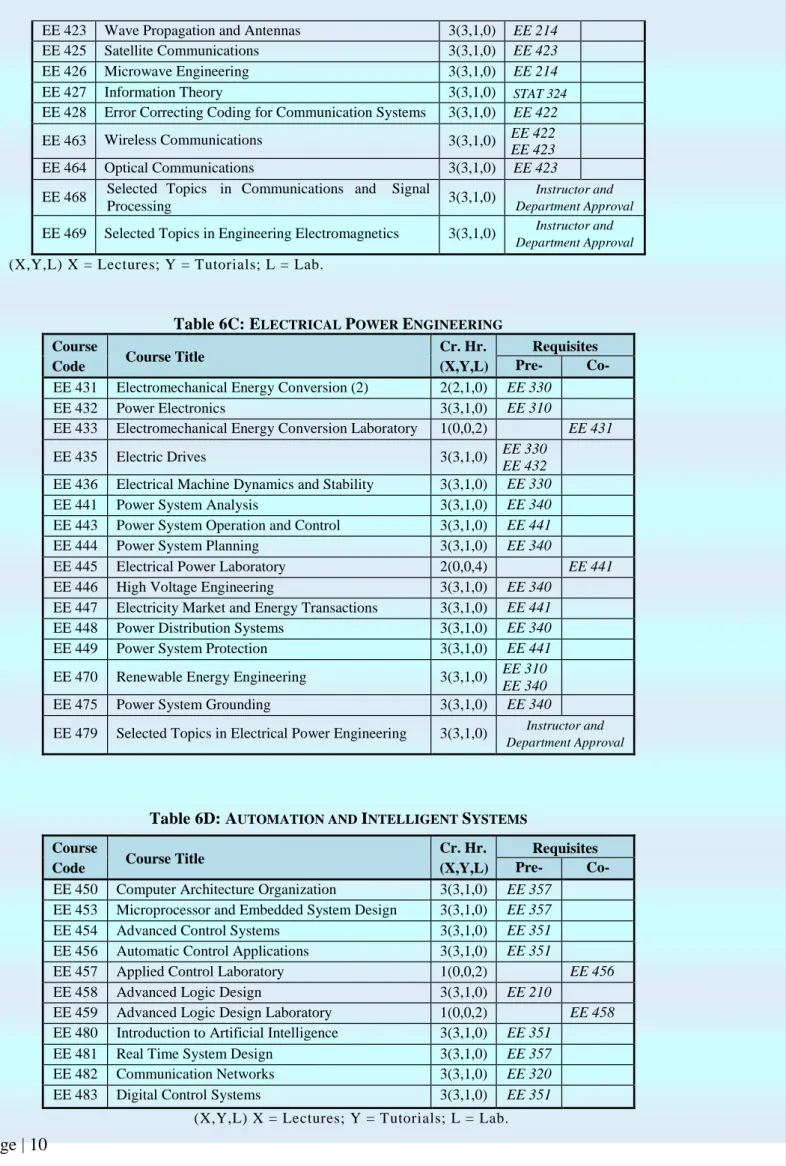
Table 6B: C
OMMUNICATIONS
YSTEMSCourse
Code Course Title
Cr. Hr. (X,Y,L)
Requisites Pre- Co-
EE 420 Digital Signal Processing 3(3,1,0) EE 301
EE 421 Communications Laboratory 2(0,0,4) EE 214
EE 320
Page | 10
EE 423 Wave Propagation and Antennas 3(3,1,0) EE 214
EE 425 Satellite Communications 3(3,1,0) EE 423
EE 426 Microwave Engineering 3(3,1,0) EE 214
EE 427 Information Theory 3(3,1,0) STAT 324
EE 428 Error Correcting Coding for Communication Systems 3(3,1,0) EE 422
EE 463 Wireless Communications 3(3,1,0) EE 422
EE 423
EE 464 Optical Communications 3(3,1,0) EE 423
EE 468 Selected Topics in Communications and Signal
Processing 3(3,1,0)
Instructor and Department Approval
EE 469 Selected Topics in Engineering Electromagnetics 3(3,1,0) Instructor and
Department Approval
(X,Y,L) X = Lectures; Y = Tutorials; L = Lab.
Table 6C: E
LECTRICALP
OWERE
NGINEERINGCourse
Code Course Title
Cr. Hr. (X,Y,L)
Requisites Pre- Co-
EE 431 Electromechanical Energy Conversion (2) 2(2,1,0) EE 330
EE 432 Power Electronics 3(3,1,0) EE 310
EE 433 Electromechanical Energy Conversion Laboratory 1(0,0,2) EE 431
EE 435 Electric Drives 3(3,1,0) EE 330
EE 432
EE 436 Electrical Machine Dynamics and Stability 3(3,1,0) EE 330
EE 441 Power System Analysis 3(3,1,0) EE 340
EE 443 Power System Operation and Control 3(3,1,0) EE 441
EE 444 Power System Planning 3(3,1,0) EE 340
EE 445 Electrical Power Laboratory 2(0,0,4) EE 441
EE 446 High Voltage Engineering 3(3,1,0) EE 340
EE 447 Electricity Market and Energy Transactions 3(3,1,0) EE 441
EE 448 Power Distribution Systems 3(3,1,0) EE 340
EE 449 Power System Protection 3(3,1,0) EE 441
EE 470 Renewable Energy Engineering 3(3,1,0) EE 310
EE 340
EE 475 Power System Grounding 3(3,1,0) EE 340
EE 479 Selected Topics in Electrical Power Engineering 3(3,1,0) Instructor and
Department Approval
Table 6D: A
UTOMATION ANDI
NTELLIGENTS
YSTEMSCourse
Code Course Title
Cr. Hr. (X,Y,L)
Requisites Pre- Co-
EE 450 Computer Architecture Organization 3(3,1,0) EE 357
EE 453 Microprocessor and Embedded System Design 3(3,1,0) EE 357
EE 454 Advanced Control Systems 3(3,1,0) EE 351
EE 456 Automatic Control Applications 3(3,1,0) EE 351
EE 457 Applied Control Laboratory 1(0,0,2) EE 456
EE 458 Advanced Logic Design 3(3,1,0) EE 210
EE 459 Advanced Logic Design Laboratory 1(0,0,2) EE 458
EE 480 Introduction to Artificial Intelligence 3(3,1,0) EE 351
EE 481 Real Time System Design 3(3,1,0) EE 357
EE 482 Communication Networks 3(3,1,0) EE 320
EE 483 Digital Control Systems 3(3,1,0) EE 351
Page | 11
Table 7: R
ECOMMENDEDS
EMESTERS
CHEDULE- E
LECTRICALE
NGINEERINGP
ROGRAM*
Level 5 Level 6
Course
Code Course Title
Cr. Hr. (X,Y,L)
Pre-requisite
Course
Code Course Title
Cr. Hr. (X,Y,L)
Pre-requisite
EE 201 Fundamentals of Electric Circuits 3(3,1,0) MATH 106 EE 205 Electric Circuits Laboratory 1(0,0,2) EE 212 c EE 213 Engineering Electromagnetics (1) 3(3,1,0) MATH 203
PHYS 104 EE 208 Logic Design 3(3,1,0)
GE 105 Introduction to Engineering Design 2(1,1,2) GE 104 EE 211 Computational Techniques in EE 3(2,0,2) GE 211
MATH 244c
GE 201 Statics 3(3,1,0) MATH 106 MATH 107 EE 212 Electric Circuit Analysis 2(2,1,0) EE 201 MATH 107 GE 211 Computer Programming in “C++” 3(2,0,2) EE 214 Engineering Electromagnetics (2) 2(2,1,0) EE 213
MATH 204 Differential Equations 3(3,2,0) MATH 203 IC 1xx Optional Islamic Course 2(2,0,0)
Total 17 MATH 244 Linear Algebra 3(3,2,0) MATH 107
Total 16
Level 7 Level 8
Course
Code Course Title
Cr. Hr. (X,Y,L)
Pre-requisite
Course
Code Course Title
Cr. Hr. (X,Y,L)
Pre-requisite
ARAB 103 Expository Writing 2(2,0,0) EE 320 Communications Principles 3(3,1,0) EE 301
EE 210
Logic Design Laboratory 1(0,0,2) EE 208 EE 340 Fundamentals of Power Systems
3(3,1,0) EE 212
EE 301 Signals and Systems Analysis 3(3,1,0) EE 201 EE 351 Automatic Control 3(3,1,0) EE 301
EE 310 Microelectronic Devices and Circuits
3(3,1,0) EE 201
EE 356 Control and Instrumentation
Laboratory 1(0,0,2) EE 351 c
EE 312 Basic Electronics Laboratory 1(0,0,2) EE 310 c EE 357 Microprocessor and
Microcontroller Lab 1(0,0,2) EE 353 EE 330 Electromechanical Energy
Conversion (1) 3(3,1,0)
EE 212
EE 213 IC 1xx Optional Islamic Course 2(2,0,0)
EE 353 Introduction to Microprocessors 3(3,1,0) EE 208 STAT 324 Engineering Probability and
Statistics 3(2,2,0)
Total
16Total
16Level 3* Level 4
Course
Code Course Title
Cr. Hr. (X,Y,L)
Pre-requisite
Course
Code Course Title
Cr. Hr. (X,Y,L)
Pre-requisite
CHEM 101 General Chemistry (1) 4(3,0,2) ARAB 101 Language Skills 2(2,0,0) ENGL 107 Technical Writing 3(3,0,0) ENGL 108 Communication Skills for Engineers 3(3,0,0) MATH 106 Integral Calculus 3(3,2,0) MATH 150 GE 104 Basics of Engineering Drawing 3(2,0,2) MATH 107 Vectors and Matrices 3(3,2,0) MATH 150 IC 107 Ethics of the Profession in Islam 2(2,0,0)
PHYS 103 General Physics (1) 4(3,0,2) MATH 203 Differential and Integral Calculus 3(3,2,0) MATH 106
MATH 107
Total 17 PHYS 104 General Physics (2) 4(3,0,2)
Page | 12
Level 9 Level 10
Course
Code Course Title
Cr. Hr. (X,Y,L)
Pre-requisite
Course
Code Course Title
Cr. Hr. (X,Y,L)
Pre-requisite
EE 496 Graduation Project-1 2 Comp. 131 credits EE 497 Graduation Project-2 2 EE 496
EE 4xx Specialized Elective Courses 13 Refer to
Table 5 EE 4xx EE Specialized Elective Course 10
Refer to Table 5
GE 403 Engineering Economy 2(2,1,0) GE 404 Engineering Management 2(2,1,0)
Total 17
IC 1xx Optional Islamic Course 2(2,0,0)
EE 999 Summer Training 0 Complete 96 credits c
Co-requisite Total 16
(X,Y,L) X = Lectures; Y = Tutorials; L = Lab.
Master of Science Program in Electrical Engineering
The Electrical Engineering Department offers graduate programs leading to the degree of Master of Science
in Electrical Engineering. The program has been designed to reflect the modern trends and developments in
the Electrical Engineering curricula. The program is available with the following options in several
specializations:
- Thesis Option.
- Non-Thesis Option.
Aims of the Master Program:
-
Offering specialized courses for electrical engineers.
- Development of production and service sectors in the Kingdom.
- Combining the university with industrial and technical sectors into common research programs.
-
Promoting scientific and applied researches particularly that are related to development
requirements of the kingdom.
Requirements for MSc (
Thesis Option
) Degree Program:
1.
Completing 24 credit hours of course work from the approved graduate courses as follows:
- 9 credit hours of common courses.
-
15 credit hours of specialized electrical engineering courses following the Departmental
regulations.
2. The student must successfully complete and defend a thesis on a selected research topic in the area of
specialization.
Common Courses
Course Code Course Title
Credit hours
GE 501
EE 502
Math 505
Computer Simulation of Engineering Systems
Modelling of Stochastic Engineering Systems
Numerical Linear Algebra
3 (3,0)
3 (3,0)
3 (3,0)
Page | 13
1-
Electronics
Level
Course
Code
Course Title
Credit
hours
I
GE 501
EE 503
Math 505
Computer Simulation of Engineering Systems
Advanced Digital Circuit Design
Numerical Linear Algebra
3
3
3
II
EE 502
EE 504
Modelling of Stochastic Engineering Systems
Electronic Devices
3
3
III
EE ---
EE ---
EE ---
Course selected by the department from List 1-A*
Course selected by the department from List 1-A*
Course selected by the department from List 1-A or List 1-B *
List 1-A
EE 506 Advanced Analysis of Electronic Circuits
EE 507 VLSI Design
EE 508 Optoelectronics
EE 509 Embedded Systems
EE 510 Data Communication Integrated Circuits
EE 512 Applications of Integrated Circuits
EE 515 Microwave Electronics
EE 516 Selected Topics in Electronics
EE 517 VLSI Fabrication Technology
EE 519 System on Chip
List 1-B
EE 524 Communication Networks
EE 526 Optical Communications
EE 528 Digital Communications
EE 550 Internet Technologies and E-Services
EE 552 Advanced Microprocessors and their Applications
EE 553 Computer Organization and Architecture
EE 575 Mobile Communications
3
3
3
EE 600
Thesis
-
*
This course is selected by the department according to its capabilities and
circumstances.
Page | 14
2- Communications
Level
Course
Code
Course Title
Credit
hours
I
GE 501
EE 521
Math 505
Computer Simulation of Engineering Systems
Electromagnetic Fields
Numerical Linear Algebra
3
3
3
II
EE 502
EE 528
Modelling of Stochastic Engineering Systems
Digital Communications
3
3
III
EE ---
EE ---
EE ---
Course selected by the department from List 2-A*
Course selected by the department from List 2-A*
Course selected by the department from List 2-A or List 2-B *
List 2-A
EE 524 Communication Networks
EE 526 Optical Communications
EE 571 Digital Image Processing
EE 572 Satellite Communications
EE 573 Information Theory
EE 574
Error Correcting Coding for Communication Systems
EE 575 Mobile Communications
EE 576 Selected Topics in Communications and Signal
Processing
EE 577 Selected Topics in Electromagnetic waves and
Microwave Engineering
List 2-B
EE 508 Optoelectronics
EE 510 Data Communication Integrated Circuits
EE 515 Microwave Electronics
EE 550 Internet Technologies and E-Services
EE 551 Computer Controlled Systems
EE 559 Intelligent Control Systems
EE 585 Power System Operation and Control
3
3
3
EE 600
Thesis
-
*
This course is selected by the department according to its capabilities and
circumstances.
Page | 15
3- Electrical Machines and Power Electronics
Level
Course
Code
Course Title
Credit
hours
I
GE 501
EE 532
Math 505
Computer Simulation of Engineering systems
The Generalized Theory of Electrical Machines
Numerical Linear algebra
3
3
3
II
EE 502
EE 534
Modelling of Stochastic Engineering Systems
Power Semiconductor Converters
3
3
III
EE ---
EE ---
EE ---
Course selected by the department from List 3-A*
Course selected by the department from List 3-A*
Course selected by the department from List 3-A or List 3-B *
List 3-A
EE 530 Design of Electrical Machines
EE 531 Advanced Theory of Electrical Machines
EE 533 Electrical Machine Dynamics
EE 535 Selected Topics in Electrical Machines
EE 536 Electrical Machines for Special Purposes
EE 537 Selected Topics in Power Electronics
List 3-B
EE 548 Power System Protection
EE 552 Advanced Microprocessors and their Applications
3
3
3
EE 600
Thesis
-
*
This course is selected by the department according to its capabilities and
circumstances.
Page | 16
4- Electrical Power
Level
Course
Code
Course Title
Credit
hours
I
GE 501
EE 585
Math 505
Computer Simulation of Engineering systems
Power System Operation and Control
Numerical Linear algebra
3
3
3
II
EE 502
EE 546
Modelling of Stochastic Engineering Systems
High Voltage Test Techniques
3
3
III
EE ---
EE ---
EE ---
Course selected by the department from List 4-A*
Course selected by the department from List 4-A*
Course selected by the department from List 4-A or List 4-B *
List 4-A
EE 544 Reliability Evaluation and Power System Planning
EE 547 Selected Topics in Power Systems
EE 548 Power System Protection
EE 549 Power System Dynamics
EE 581 High Voltage Transmission Systems
EE 582 Power System Transients
EE 583 Distribution System Engineering
List 4-B
EE 509 Embedded Systems
EE 524 Communication Networks
EE 533 Electrical Machine Dynamics
EE 534 Power Semiconductor Converters
EE 552 Advanced Microprocessors and their Applications
EE 559 Intelligent Control Systems
EE 560 Advanced Control Techniques
3
3
3
EE 600
Thesis
-
*
This course is selected by the department according to its capabilities and
circumstances.
Page | 17
5- Control Systems and Computers
Level
Course
Code
Course Title
Credit
hours
I
GE 501
EE 551
Math 505
Computer Simulation of Engineering systems
Computer Controlled Systems
Numerical Linear algebra
3
3
3
II
EE 502
EE 552
Modelling of Stochastic Engineering Systems
Advanced Microprocessors and their Applications
3
3
III
EE ---
EE ---
EE ---
Course selected by the department from List 5-A*
Course selected by the department from List 5-A*
Course selected by the department from List 5-A or List 5-B *
List 5-A
EE 550 Internet Technologies and E-Services
EE 553 Computer Organization and Architecture
EE 554 Performance Evaluations of Computing Systems
EE 557 Linear Systems
EE 559 Intelligent Control Systems
EE 560 Advanced Control Techniques
EE 561 Selected Topics in Computers
EE 562 Selected Topics in Control
List 5-B
EE 509 Embedded Systems
EE 524 Communication Networks
EE 536 Electrical Machines for Special Purposes
EE 571 Digital Image Processing
EE 573 Information Theory
3
3
3
EE 600
Thesis
-
*
This course is selected by the department according to its capabilities and
circumstances.
COURSE DESCRIPTION: Please see Appendix B
Degree Requirements for M. Sc. (Non-Thesis Option) Program:
1. Completing 36 credit hours of course work from the approved graduate courses as follows:
- 9 credit hours of common courses.
-
27 credit hours of specialized electrical engineering courses following the Departmental
regulations.
2. The student must successfully complete a research project, which comprises two parts (EE598
& EE599), each having 3 credit hours. Each part is graded pass/fail.
Common Courses
Course Code Course Title
Credit hours
GE 501
EE 502
Math 505
Computer Simulation of Engineering Systems
Modelling of Stochastic Engineering Systems
Numerical Linear Algebra
3 (3,0)
3 (3,0)
3 (3,0)
Page | 18
1-
Electronics (Non-Thesis)
Level
Course
Code
Course Title
Credit
hours
I
GE 501
EE 503
Math 505
Computer Simulation of Engineering Systems
Advanced Digital Circuit Design
Numerical Linear Algebra
3
3
3
II
EE 502
EE 504
EE 506
Modelling of Stochastic Engineering Systems
Electronic Devices
Advanced Analysis of Electronic Circuits
3
3
3
III
EE 507
EE ---
EE ---
VLSI Design
Course selected by the department from List 1-A*
Course selected by the department from List 1-A*
3
3
3
IV
EE 598
EE ---
EE ---
Research Project (1)
Course selected by the department from List 1-A*
Course selected by the department from List 1-A or List 1-B *
3
3
3
V
EE 599
EE ---
Research Project (2)
Course selected by the department from List 1-A or List 1-B *
List 1-A
EE 508 Optoelectronics
EE 509 Embedded Systems
EE 510 Data Communication ICs
EE 512 Applications of Integrated Circuits
EE 515 Microwave Electronics
EE 516 Selected Topics in Electronics
EE 517 VLSI Fabrication Technology
EE 519 System on Chip
List 1-B
EE 524 Communication Networks
EE 526 Optical Communications
EE 528 Digital Communications
EE 550 Internet Technologies and E-Services
EE 552 Advanced Microprocessors and their Applications
EE 553 Computer Organization and Architecture
EE 575 Mobile Communications
3
3
*
This course is selected by the department according to its capabilities and
circumstances.
Page | 19
2- Communications (Non-Thesis)
Level
Course
Code
Course Title
Credit
hours
I
GE 501
EE 521
Math 505
Computer Simulation of Engineering Systems
Electromagnetic Fields
Numerical Linear Algebra
3
3
3
II
EE 502
EE 528
EE 571
Modelling of Stochastic Engineering Systems
Digital Communications
Digital Image Processing
3
3
3
III
EE 524
EE ---
EE ---
Communication Networks
Course selected by the department from List 2-A*
Course selected by the department from List 2-A*
3
3
3
IV
EE 598
EE ---
EE ---
Research Project (1)
Course selected by the department from List 2-A*
Course selected by the department from List 2-A or List 2-B *
3
3
3
V
EE 599
EE ---
Research Project (2)
Course selected by the department from List 2-A or List 2-B *
List 2-A
EE 526 Optical Communications
EE 572 Satellite Communications
EE 573 Information Theory
EE 574 Error Correcting Coding for Communication
Systems
EE 575 Mobile Communications
EE 576 Selected Topics in Communications and Signal
Processing
EE 577 Selected Topics in Electromagnetic waves and
Microwave Engineering
List 2-B
EE 508 Optoelectronics
EE 510 Data Communication ICs
EE 515 Microwave Electronics
EE 550 Internet Technologies and E-Services
EE 551 Computer Controlled Systems
EE 559 Intelligent Control Systems
EE 585 Power System Operation and Control
3
3
*
This course is selected by the department according to its capabilities and
circumstances.
Page | 20
3- Electrical Power (Non-Thesis)
Level
Course
Code
Course Title
Credit
hours
I
GE 501
EE 585
Math 505
Computer Simulation of Engineering Systems
Power System Operation and Control
Numerical Linear Algebra
3
3
3
II
EE 502
EE 534
EE 546
Modelling of Stochastic Engineering Systems
Power Semiconductor Converters
High Voltage Test Techniques
3
3
3
III
EE 544
EE ---
EE ---
Reliability Evaluation and Power System Planning
Course selected by the department from List 3-A*
Course selected by the department from List 3-A*
3
3
3
IV
EE 598
EE ---
EE ---
Research Project (1)
Course selected by the department from List 3-A*
Course selected by the department from List 3-A or List 3-B *
3
3
3
V
EE 599
EE ---
Research Project (2)
Course selected by the department from List 3-A or List 3-B *
List 3-A
EE 531 Advanced Theory of Electrical Machines
EE 533 Electrical Machine Dynamics
EE 536 Electrical Machines for Special Purposes
EE 547 Selected Topics in Power Systems
EE 548 Power System Protection
EE 549 Power System Dynamics
EE 581 High Voltage Transmission Systems
EE 582 Power System Transients
EE 583 Distribution System Engineering
List 3-B
EE 509 Embedded Systems
EE 524 Communication Networks
EE 551 Computer Controlled Systems
EE 552 Advanced Microprocessors and their Applications
EE 559 Intelligent Control Systems
EE 560 Advanced Control Techniques
3
3
*
This course is selected by the department according to its capabilities and
circumstances.
Page | 21
4- Control Systems and Computers (Non-Thesis)
Level
Course
Code
Course Title
Credit
hours
I
GE 501
EE 551
Math 505
Computer Simulation of Engineering Systems
Computer Controlled Systems
Numerical Linear Algebra
3
3
3
II
EE 502
EE 552
EE 553
Modelling of Stochastic Engineering Systems
Advanced Microprocessors and their Applications
Computer Organization and Architecture
3
3
3
EE 557
EE ---
EE ---
Linear Systems
Course selected by the department from List 4-A*
Course selected by the department from List 4-A*
3
3
3
IV
EE 598
EE ---
EE ---
Research Project (1)
Course selected by the department from List 4-A*
Course selected by the department from List 4-A or List 4-B *
3
3
3
V
EE 599
EE ---
Research Project (2)
Course selected by the department from List 4-A or List 4-B *
List 4-A
EE 550 Internet Technologies and E-Services
EE 554 Performance Evaluations of Computing Systems
EE 559 Intelligent Control Systems
EE 560 Advanced Control Techniques
EE 561 Selected Topics in Computers
EE 562 Selected Topics in Control
List 4-B
EE 509 Embedded Systems
EE 524 Communication Networks
EE 536 Electrical Machines for Special Purposes
EE 571 Digital Image Processing
EE 573 Information Theory
3
3
*
This course is selected by the department according to its capabilities and
circumstances.
Page | 22
PhD. Program in Electrical Engineering
Electrical Engineering is a fast changing profession and there are rapid advances in research and
development of different specialization of electro technology. To cope with such advancements, some
electrical engineers usually need a much higher level of education and training. The Ph.D. program was
initiated in the Electrical Engineering Department in 1412H (1991G). This program responds to the needs
of national research and development centers for highly qualified specialists in electrical engineering
capable of effective contributions to complex scientific and technical projects.
A good deal of the scientific thesis work of graduate students deals with advanced research, development
and application problems in various fields of electrical engineering. The Department has directed its
research abilities so as to benefit from the rapid advances in all fields in electrical engineering to match the
needs and requirements of the development plans of the Kingdom of Saudi Arabia.
Degree Requirements
1.
Completing 18 credit hours of course work from the approved Post Graduate (Ph.D.) Courses.
2.
Passing the Ph.D. qualifying comprehensive exam.
3.
Satisfactory completion of the Ph.D. thesis. The student can register in the Ph.D. thesis only
after he passes the qualifying comprehensive examination. He also has to meet residency
requirements.
The available PhD courses, in different specializations, are given below.
Electronics
EE 610 Semiconductor Characterization Techniques
EE 611 Semiconductor Device Modelling
EE 612 Design and Technology of Solar Cells
EE 613 Design and Application of Photovoltaic Systems
EE 614 MOS Devices for Advanced VLSI
EE 615 Analysis and Design of VLSI Circuits
EE 616 VLSI Layout and Processing
EE 617 Layout Design of Bipolar Integrated Circuits
EE 618 VLSI for Fast Processing Systems
EE 619 Advanced Topics in Electronics
Communications
EE 620 Signal Detection and Estimation
EE 621 Channel Coding Theorem
EE 622 Advanced Digital Communications
EE 623 Digital Signal Processing
EE 624 Antenna Theory and Design
EE 625 Propagation of Electromagnetic Waves
EE 626 Secure Communication Systems
EE 627 Advanced Network Planning and Tele-traffic Engineering
EE 628 Radar Systems
EE 629 Advanced Topics in Communications
Page | 23
Electrical Machines and Power Electronics
EE 630 Advanced Theory of Electro-Mechanical Energy Conversion
EE 631 Computer Aided Analysis of Electrical Machines
EE 632 Special Types of Electrical Machinery
EE 633 Computational Methods in Electromagnetics
EE 634 New Concepts in Electric Machine Design
EE 635 Voltage and Frequency Converter Systems
EE 636 Special Drives and Reactive Power Control
EE 637 Advanced Topics in Drives & Power Electronics
EE638 Linear Electric Machines
Electrical Power
EE 640 Large Scale System Analysis
EE 641 Stability of Large Power Systems
EE 642 Power System Operation and Security
EE 643 Optimal Power System Planning
EE 644 Reliability Evaluation of Power System
EE 645 Electromagnetic Transients in Power System
EE 646 Advanced Power System Protection
EE 647 High Voltage Insulation
EE 648 Corona and Field Effects of High Voltage Systems
EE 649 Advances in Power System
Control Systems and Computers
EE 650 Artificial Intelligence in Engineering
EE 651 Parallel Processing and Programming
EE 652 Computer Network Protocols
EE 653 Computer Vision and Image Processing
EE 654 Microprocessor Based Instrumentation & Control
EE 655 Digital Control Systems
EE 656 Non-linear Control Systems
EE 657 Stochastic Control Systems
EE 658 Adaptive and Learning Control Systems
EE 659 Advanced Topics in Computer & Control
Seminar Courses and Thesis
EE 661 Seminar (1)
EE 662 Seminar (2)
EE 663 Seminar (3)
Page | 24
FACULTY
The Electrical Engineering Department currently has 51 faculty members holding Ph.D. in
different electrical engineering disciplines. Out of these, there are 18 Professors, 18 Associate
Professors and 15 Assistant Professors. In addition, the department has 5 Lecturers and 12
Teaching Assistants. In addition there are many Technicians, Research Assistants, and Engineers
working in the different labs.
Chairman
Dr.
Abdulhameed M. Al-Sanie
Associate Professor
Professors
No. Name Major Area University E-mail
1 Adnan S. Nouh Systems Engineering,
Signal Processing, Digital System, Pattern
Recognition
Carnegie Mellon University, USA, 1973
2 Nazar Hussain Malik High Voltage
Components and Systems, Electrical Power Systems, Electrical Insulation
University of Windsor, Canada, 1979
3 Abdulrahman I. Alolah Electrical Machines,
Power Electronics
University of Bradford, UK, 1986
4 Abdullah M. Shaalan
Power System Planning. University of Manchester,
UK, 1984.
5 Abdurahman A. Al-Arainy Power Engineering, High
Voltage Insulation and Testing, EM Interference, Insulation Coordination
University of Toronto, Canada, 1982
6 Mohammed Al Turaigi Electronic Circuits,
Parallel Processing.
Syracuse University, USA, 1983
7 Saad M. Alghuwainem Power System
Engineering Power System Protection, Renewable Energy Systems.
University of Michigan, Ann Arbor, USA, 1986.
8 Khaled E. Addoweesh Power Electronics and
Electrical Drives, Microprocessor Applications, AC Choppers, Dynamic Modeling of AC Machines University of Bradford, UK, 1986 [email protected]
9 Shuja Ahmed Abbasi Microelectronics, VLSI
Technology and Design.
University of
Southampton, UK, 1980
10 Abdulaziz S. Alruwais Communication
Networks, Electronic Warfare, Radar and Laser Systems.
Ohio State University, USA, 1982.
11 Abdulrahman M. Alamoud Microelectronics and
Photovoltaics.
University of West Virginia, USA, 1984.
12 Khalid Al-Mashouq Modern Communication
Systems
University of Sothern California, USA, 1991.
13 Saleh A. ALshebeili Statistical Signal
Processing.
University of Toronto, Canada, 1992.
14 Adel Abdennour Artificial Intelligence,
Control Systems, Image
Penn State University, USA, 1996.
Page | 25
Processing, System Simulations.
15 Abdullah M. Alsuwailem Microprocessor-based
System Design, Programmable Digital System Design.
Bradford University, UK, 1986.
16 Abdel Fattah Sheta Microwave Engineering,
Microstrip Antennas for Wireless Applications, MIC and MMIC Components
University de Bretagne Occidental, Brest, France, 1996.
17 Majeed A. Alkanhal Modern Communication
and Wireless Systems, Electromagnetic Scattering, Propagation and Radar Cross-Sections, Antenna Engineering, Electronic Warfare.
Syracuse University, USA, 1994.
18 Ibrahim Elshafiey EM Computational
Modeling, Biomedical Imaging,
Data Fusion, Nondestructive Evaluation.
Iowa State University, USA, 1994.
Associate Professors
No. Name Major Area University E-mail
1
Abdulhameed A. Al-Ohaly Power System Stability. University of Missouri,
USA, 1983.
2
Fahd A. Alturki
Control and Computer Engineering, Intelligent Control, Fuzzy Logic, Neural Networks.
University of Sheffield, UK, 1993.
3
Nacer Amara Debbar
Physics, Processing and Characterization of Semiconductor Devices.
University of Michigan, Ann Arbor, USA, 1989.
4
Abdulhameed M. Al-Sanie
Communication Systems, Space Time Coding, Block Coded Modulation.
Syracuse University, USA, 1992.
5
Hamad S. Alhokail Electronics Circuits
Design.
Colorado State University, USA, 1995.
6
Abdlmohsen Alheraish Communication
Networks.
Strathclyde University, UK, 2000.
7 Ridha A. Djemal Integrated System Design,
Image and video Encryption and Watermarking, Formal Verification, for System Architecture.
University of Grenoble, France, 1996
8 Bandar A. Al-Mashary Analysis of
Semiconductor Waveguide Structures,
University of Pittsburgh, USA, 1996.
9 Mohammad A. Al-Eshaikh Error control coding,
Nuclear reactor design.
Strathclyde University, UK, 1993.
10 Yasin Khan High Voltage Engineering
and Power Systems,
Kyushu University, Japan, 2004
11 Habib Fathallah Communication Networks Laval University, Canada [email protected]
Page | 26
Canada
13 Zuhair Hejazi Microwave Engineering Bradford University, UK [email protected]
14 Essam Al-Ammar Power Systems,
Electromagnetic Transients.
Arizona State University, USA, 2007.
15 Mamdooh Saud Alsaud Design and Operation of
Distribution System, Power System Reliability and Security Assessment, Application of ANN in Power System Design.
McMaster University, Canada, 2007.
16 Hany Hasanian Power machines Ain-Shams University,
Egypt
17 Ehab Awad Optoelectronic systems University of Maryland
College Park, USA, 2003
18 Yahya Alharthi Radio Resource
Management
University of Minnesota, USA
19 Ahmad Fauzi bin Abas Optical Communications University of Paderborn,
German
Assistant Professors
1 Mohammed S. Al-Numay Control of None
Minimum Phase Systems, Modeling and Simulation of Digital Systems, Discrete-Time Analysis of PWM Systems, Digital Control of PWM Systems Georgia Institute of Technology, USA, 1997 [email protected]
2 Saeed A. Aldosari Signal Processing,
Communication Systems,
Carnegie Mellon University, USA, 2005
3 Yasir A. Al-Turki Sensor Networks. Strathclyde University,
UK, 2007
4 Mubashir Alam Digital signal processing Georgia Institute of
Technology
5 Basil A Sadhan Computer Networks Carnegie Mellon
University, USA
6 Sami Alhumaidi Radar Systems Florida Institute of
Technology, USA
7 Essam Altubaishi Mobile Communications University of Waterloo,
Canada
8 Sohaib Majzoub VLSI Design University of British
Colombia
9 Usama Khalid Power systems Aswan University [email protected]
10 Hamsakutty Vettikalladi Communication Cochin University [email protected]
11 Abu Syed Mahajumi Electronics Lancaster University,
Lancaster, UK
12 Irfan Ahmad Control Systems University of Grenoble,
France
13 Thamir Alrashidi Communication [email protected]
14 Won Ku Control University of Leeds, UK [email protected]
Lecturers
No. Name
Major Area
University
1 Ahmed Asalom Power electronics King Saud University,
KSA
Page | 27
2 Khalid Al-Fayyadh Electronics Queen’ University, Canada [email protected]
3 Turki A-Madhu Electronics King Saud University,
KSA
4 Saleh AlSenaidi Power electronics Saskatchewan University,
Canada
5 AhmedTelba Communication University of Bradford, UK [email protected]
Teaching Assistants
No. Name
Major Area
University
1 Ghazi Mohammed Ishag Electronics Menofia University,
Menofia, Egypt
2 Amin A. A. Assar Electrical Power &
Machine
Menofia University, Menofia, Egypt
3 Mohammed Jaafar Mohammed Electric Circuits Khartoum
University
4 Mohammed Ahmed Abuheene Electric Circuits [email protected]
5 Mohammed A. Al-Rumaih Electrical
Engineering:Systems
University of Michigan, Ann Arbor
6 Omar Saad Aldayel Communications Wireless Systems
Royal Institute of Technology (KTH), Sweden
7 Ali H. Al-Enezi Electric Circuits King Saud
University
8 Ali Mohammed A. Al-Bishi Communication and
Electronics
University of Waterloo, Canada
9 Yazeed AbdulAziz Al-Shadokhi Communication King Saud
University
10 Abdullah Khaled Alrushud Communication University of
Dayton, USA
11 Anas Abdullah Al-Hussayen Electric Circuits King Saud
University
12 Abdulaziz Ali Alqahtani Electric Circuits King Saud
University
Lab Engineers
Responsible of all Electrical Engineering Laboratories:
Mr. Abdulaziz Al-Shehri
Lab Responsible Lab Name Responsible Email
Mr. Ali Ahmed Ali Aseeri Electrical Circuits Laboratory [email protected]
Eng. Osama Abdulkareem Kayed Electrical Communications Laboratory [email protected]
Eng. Omar Mohammad Al Assaif Electronics Laboratory -
Eng. Nissar Rasool Wani High Voltage Laboratory [email protected]
Mr. Mohammad A. Al-Hamidi High Voltage Laboratory -
Eng. Hayder A. Al-Ghalban Digital Logic Laboratory [email protected]
Eng. Umar A. Bawah Electromech. Energy Conversion Laboratory [email protected]
Mr. Sulaiman Al-Hudaib Electromech. Energy Conversion Laboratory -
Eng. Abulrahman Al-horaish Electrical Measurement Laboratory -
Page | 28
Engineering Labs