Calhoun: The NPS Institutional Archive
Theses and Dissertations Thesis Collection
2005-03
Command and control of Special Operations Forces
missions in the US Northern Command Area of Responsibility
McGregor, Otis W., III
Monterey, California. Naval Postgraduate School
NAVAL
POSTGRADUATE
SCHOOL
MONTEREY, CALIFORNIA
THESIS
COMMAND AND CONTROL OF SPECIAL
OPERATIONS FORCES MISSIONS IN THE US
NORTHERN COMMAND AREA OF
RESPONSIBILITY
by
Otis W. McGregor III March 2005
Thesis Advisor: Christopher Bellavita
Second Reader: Robert Simeral
REPORT DOCUMENTATION PAGE Form Approved OMB No. 0704-0188
Public reporting burden for this collection of information is estimated to average 1 hour per response, including the time for reviewing instruction, searching existing data sources, gathering and maintaining the data needed, and completing and reviewing the collection of information. Send comments regarding this burden estimate or any other aspect of this collection of information, including suggestions for reducing this burden, to Washington headquarters Services, Directorate for Information Operations and Reports, 1215 Jefferson Davis Highway, Suite 1204, Arlington, VA 22202-4302, and to the Office of Management and Budget, Paperwork Reduction Project (0704-0188) Washington DC 20503.
1. AGENCY USE ONLY 2. REPORT DATE
March 2005 3. REPORT TYPE AND DATES COVEREDMaster’s Thesis
4. TITLE AND SUBTITLE:
Command and Control of Special Operations Forces Missions in the US Northern Command Area of Responsibility
6. AUTHOR Lieutenant Colonel Otis W. McGregor III
5. FUNDING NUMBERS
7. PERFORMING ORGANIZATION NAME AND ADDRESS
Naval Postgraduate School Monterey, CA 93943-5000
8. PERFORMING
ORGANIZATION REPORT
NUMBER
9. SPONSORING /MONITORING AGENCY NAME AND ADDRESS
N/A
10. SPONSORING/MONITORING AGENCY REPORT NUMBER
11. SUPPLEMENTARY NOTES The views expressed in this thesis are those of the author and do not reflect the official
policy or position of the Department of Defense or the U.S. Government.
12a. DISTRIBUTION / AVAILABILITY STATEMENT
Approved for public release; distribution is unlimited 12b. DISTRIBUTION CODE
13. ABSTRACT (maximum 200 words)
The need for a well thought out, planned, and rehearsed command and control organization to conduct special operations in the US Northern Command Area of Responsibility is vital to success in defending the Homeland. Currently, USNORTHCOM does not have an apportioned or assigned command and control structure for the conduct of special operations. This thesis analyzes three courses of action to fulfill this requirement: use the current USNORTHCOM battle staff command structure including the integration of the Standing Joint Force Headquarters-North; rely on the newly formed US Special Operations Command’s Joint Task Force Structures; and establish a Theater Special Operations Command North assigned to USNORTHCOM. Through the conduct of analysis and research this thesis recommends that The Joint Staff direct the reorganization required to establish a Theater Special Operations Command North to exercise command and control of special operations forces conducting operations in the USNORTHCOM AOR.
15. NUMBER OF
PAGES
111
14. SUBJECT TERMS Special Operations Forces (SOF), Homeland Security (HLS), Homeland
Defense (HLD), US Northern Command (USNORTHCOM), Command and Control (C2), Joint Task Force (JTF), Joint Special Operations Task Force (JSOTF), Threat to Homeland, Posse Comitatus
16. PRICE CODE 17. SECURITY CLASSIFICATION OF REPORT Unclassified 18. SECURITY CLASSIFICATION OF THIS PAGE Unclassified 19. SECURITY CLASSIFICATION OF ABSTRACT Unclassified 20. LIMITATION OF ABSTRACT UL
NSN 7540-01-280-5500 Standard Form 298 (Rev. 2-89)
Prescribed by ANSI Std. 239-18
THIS PAGE INTENTIONALLY LEFT BLANK
iii
Approved for public release; distribution is unlimited
COMMAND AND CONTROL OF SPECIAL OPERATIONS FORCES MISSIONS IN THE US NORTHERN COMMAND AREA OF RESPONSIBILITY
Otis W. McGregor III
Lieutenant Colonel, United States Army B.S., Texas A&M University, 1987
Submitted in partial fulfillment of the requirements for the degree of
MASTER OF ARTS IN SECURITY STUDIES (HOMELAND SECURITY AND DEFENSE)
from the
NAVAL POSTGRADUATE SCHOOL March 2005
Author: Otis W. McGregor III
Approved by: Christopher Bellavita
Thesis Advisor
Robert Simeral
Second Reader/ CAPT (Ret)
Douglas Porch
THIS PAGE INTENTIONALLY LEFT BLANK
ABSTRACT
The need for a well thought out, planned, and rehearsed command and control organization to conduct special operations in the US Northern Command Area of Responsibility is vital to success in defending the Homeland. Currently, USNORTHCOM does not have an apportioned or assigned command and control structure for the conduct of special operations. This thesis analyzes three courses of action to fulfill this requirement: use the current USNORTHCOM battle staff command structure including the integration of the Standing Joint Force Headquarters-North; rely on the newly formed US Special Operations Command’s Joint Task Force Structures; and establish a Theater Special Operations Command North assigned to USNORTHCOM. Through the conduct of analysis and research this thesis recommends that The Joint Staff direct the reorganization required to establish a Theater Special Operations Command North to exercise command and control of special operations forces conducting operations in the USNORTHCOM AOR.
THIS PAGE INTENTIONALLY LEFT BLANK
TABLE OF CONTENTS
I. INTRODUCTION...1
A. HOMELAND DEFENSE VIGNETTE ...2
B. IDENTIFYING THE PROBLEM...3
C. BACKGROUND ...7
1. Desert One ...7
2. Holloway Commission ...9
3. Goldwater-Nichols Defense Act ...10
4. USSOCOM Organization...12
D. SPECIAL OPERATIONS MISSIONS ...14
E. US NORTHERN COMMAND MISSIONS AND RESPONSIBILITIES ...17
F. THESIS CONSTRUCT...20
II. LITERATURE REVIEW AND METHODOLOGY...23
A. RESEARCH QUESTION ...23
B. DISCUSSION ...24
1. The Theory and Doctrine of Special Operations ...25
2. The Theory and Doctrine of Homeland Security...26
3. America's Historical Experience with Special Operations and Homeland Security...27
4. The Spectrum of Threats USNORTHCOM Can Expect to Face..29
5. The Strategic and Political Environment in Which USNORTHCOM Operates ...31
C. METHODOLOGY ...33
1. Eliminated Courses of Action ...33
2. Missions in the USNORTHCOM AOR...35
3. Attribute Definitions...35
a. Responsiveness ...35
b. Continuity of C2...36
c. Knowledge of the AOR...36
d. Manpower Cost ...37
e. SOF Ability to Operate and Integrate with Interagency ...37
4. Conduct of Analysis of Courses of Action ...38
III. ANALYSIS ...39
A. INTRODUCTION...39
B. THREATS TO THE HOMELAND ...40
C. MISSIONS...43
1. Homeland Security and Homeland Defense ...43
2. USNORTHCOM Missions ...46
3. USNORTHCOM Special Operations Missions...49
D. COURSE OF ACTION DESCRIPTION AND ANALYSIS...52
1. USNORTHCOM Adaptive Joint Force Headquarters ...52 vii
2. USNORTHCOM Adaptive Joint Force Headquarters
Comparison to Attributes...56
a. Responsiveness ...56
b. Continuity of C2...57
c. Knowledge of the AOR...57
d. Manpower Cost ...58
e SOF Ability to Operate and Integrate with Interagency ...58
3. Theater Special Operations Command North ...58
4. Theater Special Operations Command North Comparison to Attributes...60
a. Responsiveness ...60
b. Continuity of C2...60
c. Knowledge of the AOR...61
d. Manpower Cost ...62
e. SOF Ability to Operate and Integrate with Interagency ...62
5. USSOCOM Provided Joint Task Force...63
6. Comparison of USSOCOM Joint Task Force to Attributes ...65
a. Responsiveness ...65
b. Continuity of C2...66
c. Knowledge of the AOR...66
d. Manpower Cost ...67
e. SOF Ability to Operate and Integrate with Interagency ...67
E. SUMMARY ...67
IV. FINDINGS ...69
A. INTRODUCTION...69
B. ATTRIBUTE COMPARISON ...69
1. Responsiveness ...69
2. Responsiveness Rank Order ...71
3. Continuity of C2...71
4. Continuity of C2 Rank Order...72
5. Knowledge of the AOR...72
6. Knowledge of the AOR Rank Order...73
7. Manpower Cost ...73
8. Manpower Cost Rank Order ...74
9. SOF Ability to Operate and Integrate with Interagency ...74
10. SOF Ability to Operate and Integrate with Interagency Rank Order...75
C. COURSE OF ACTION COMPARISON MATRIX...75
D. SUMMARY ...75
V. CONCLUSION ...77
A. INTRODUCTION...77
B. VIGNETTE CONCLUSION ...78
C. RESEARCH QUESTION REVISITED ...78
D. POSSIBLE ALTERNATIVE SOLUTIONS ...80
viii E. FURTHER STUDIES REQUIRED OR RECOMMENDED ...81
F. EFFECT ON WAR ON TERROR...81
G. CONCLUSION ...82
BIBLIOGRAPHY ...85
INITIAL DISTRIBUTION LIST ...91
THIS PAGE INTENTIONALLY LEFT BLANK
LIST OF FIGURES
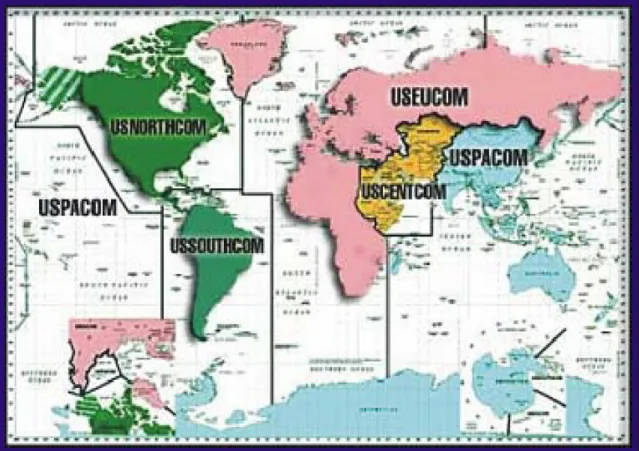
Figure 1. US Combatant Commands’ Areas of Responsibility ...18
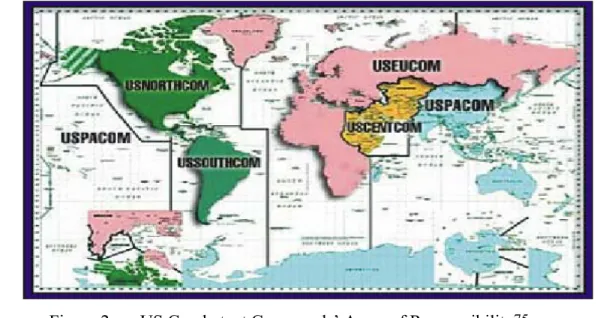
Figure 2. US Combatant Commands’ Areas of Responsibility ...46
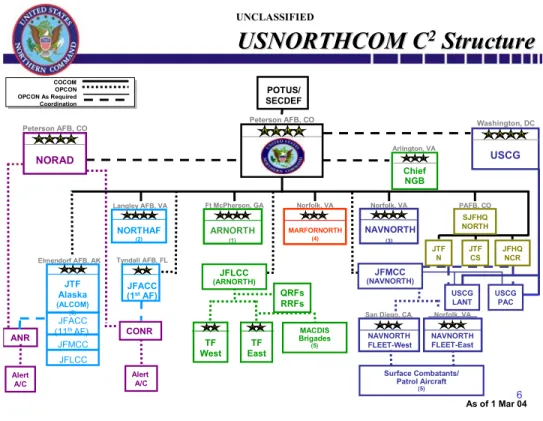
Figure 3. USNORTHCOM Organization and Command Relationships ...48
Figure 4. USNORTHCOM Adaptive Joint Force Headquarters...53
Figure 5. Standing Joint Force Headquarters-North ...55
Figure 6. Theater-Level Special Operations Forces Command and Control ...59
Figure 7. USSOCOM Deployable Joint Task Force ...64
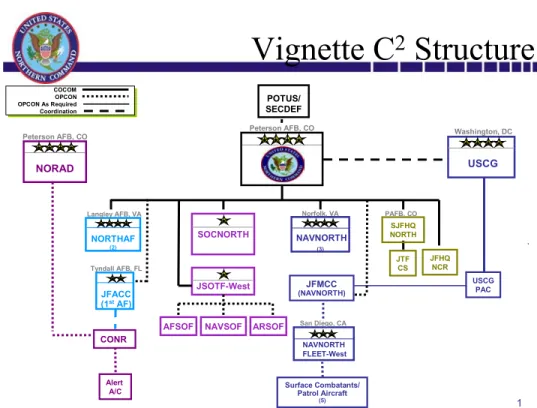
Figure 8. Vignette C2 Structure for a Maritime Special Operation Mission ...78
THIS PAGE INTENTIONALLY LEFT BLANK
LIST OF TABLES
Table 1. Course of Action Comparison Matrix...75
THIS PAGE INTENTIONALLY LEFT BLANK
ACRONYM DEFINITIONS
AFSOC Air Force Special Operations Command AJFHQ Adaptive Joint Force Headquarters AOR Area of Operation
C2 Command and Control
CA Civil Affairs
CAO Civil Affairs Operations CEB Commander’s Executive Board CIFG Combined Intelligence Fusion Group CM Consequence Management
COA Course of Action COCOM Combatant Command COG Current Operations Group CONPLAN Concept Plan
CP Counter-proliferation
CT Counterterrorism
CTJTF Counter-Terrorism Joint Task Force
DA Direct Action
DEA Drug Enforcement Agency DPG Defense Planning Guidance DHS Department of Homeland Security DOD Department of Defense
DOJ Department of Justice DWC Domestic Warning Center
EAP Emergency Action Plan
FID Foreign Internal Defense FTO Foreign Terrorist Organizations GBMD Ground Based Missile Defense
GCC Geographic Combatant Commander or Command GEN General (US Army abbreviation)
HLD Homeland Defense
HLS Homeland Security
HRT Hostage Rescue Team
ISP Integrated Survey Plan
IO Information Operations
IOC Initially Operational Capable JCET Joint Combined Exchange Training JFCOM Joint Forces Command
JFMCC Joint Forces Maritime Component Command
JFSOCC Joint Force Special Operations Component Command JISG Joint Information Superiority Group
JMD Joint Manning Document JPG Joint Planning Group
JSOTF Joint Special Operations Task Force JTF Joint Task Force
JTF-N Joint Task Force-North formerly known as JTF-6
LFA Lead Federal Agency
LNO Liaison Officer
MACA Military Assistance to Civil Authorities also known as Defense Support to Civil Authorities (DSCA)
MACSOG-V Military Assistance Command Special Operations Group-Vietnam
MFP Major Force Program
MG Major General
NEO Non-Combatant Evacuation Operations NSSE National Special Security Event
NORAD North American Aerospace Defense OEF Operation Enduring Freedom OIF Operation Iraqi Freedom
ONE Operation NOBLE EAGLE
OPG Operations Planning Group OPT Operations Planning Team PSYOP Psychological Operations
SecDef Secretary of Defense
SJFHQ-N Standing Joint Force Headquarters-North SMEs Subject Matter Experts
SO Special Operations
SOC-K Special Operations Command-Korea SOCSOUTH Special Operations Command South SOD Special Operations Division
SOF Special Operations Forces
SOLIC Special Operations and Low Intensity Conflict
SR Special Reconnaissance
SWAT Special Tactics and Weapons Teams TACON Tactical Control
TDA Table of Distribution Allowances TSC Theater Security Cooperation TSOC Theater Special Operations Command
UCP Unified Command Plan
USAF US Air Force
USA US Army
USASOC US Army Special Operations Command
USCG US Coast Guard
USN US Navy
USNORTHCOM US Northern Command
USSOCOM US Special Operations Command WMD Weapons of Mass Destruction
WOT War on Terror
ACKNOWLEDGMENTS
I would to thank my wife, Suzanne and our children, Ciarra, Braden, and Camden for allowing me to take the time to complete this thesis. I also appreciate the time that was afforded me by the USNORTHCOM J3 and the USNORTHCOM Special Operations Division to complete this endeavor.
THIS PAGE INTENTIONALLY LEFT BLANK
I. INTRODUCTION
Special Operations Forces are a critical component of United States Northern Command’s mission. However, unless significant changes are made to the manner in which US Northern Command is structured, the capabilities of Special Operations Forces may not be used to their full potential when they are most needed. This paper argues that US Northern Command should reorganize to provide better control of Special Operations missions in the US Northern Command Area of Responsibility.
US Northern Command was established as a Geographic Combatant Commander in October 2002 with the dual mission of defending the United States from aggression and providing support to civil authorities in times of crisis and disaster. In order to defend the Homeland in the most effective manner, the primary focus is on defeating attacks of aggression prior to terrorist attacks being realized in the United States. The only means of successfully defeating these attacks prior to their import into the homeland is to win the “away game.” The most adept force to conduct counter-terrorism operations of this nature are United States Special Operations Forces (SOF). Command and control of SOF requires an in-depth knowledge of the capabilities and weaknesses of these forces which can only be affected by a structure of command with this knowledge, a Special Operations-capable command. US Northern Command, in its current configuration, lacks a Special Operations Command capability. In order for US Northern Command to have the highest probability of success in the execution of Special Operations, it is imperative that a Special Operations capable command be established to provide the Commander, US Northern Command the option to control Special Operations in the US Northern Command area of responsibility (AOR).
This paper will explore the most probable courses of action available for the Commander, US Northern Command to command and control Special Operations in the US Northern Command AOR.
Currently (2005), US Northern Command (USNORTHCOM) does not have a command element with the organic capability to command and control SOF assigned or apportioned to the command. USNORTHCOM has commanders and staffs capable of
executing command and control in a conventional operation, but the capability to command and control Special Operations (SO) does not currently exist in the USNORTHCOM span of control. In order for USNORTHCOM to realize this capability, changes in the training and organization of the current USNORTHCOM battle staff configuration must be made. The most efficient and effective means of command and control of a SO mission is through the establishment of a Joint Special Operations Task Force (JSOTF) to control the operation and report directly to Commander, USNORTHCOM.1 To establish this JSOTF in a timely manner and for the commander
of the JSOTF to understand the requirements and uniqueness of USNORTHCOM, USNORTHCOM requires an organic Theater Special Operations Command (TSOC). To create an environment where the probability of success is highest for the execution of the mission Joint Publication 3-05 states that Special Operations Forces should command and control SO. A clear and concise chain of command and control of SOF in the execution of SO is critical. The established command and control must be responsive and conducted by a Special Operations command and control element.2
A. HOMELAND DEFENSE VIGNETTE
In order to illustrate the significance of the requirement for USNORTHCOM to develop and maintain a capability to command and control Special Operations, the following vignette is provided:
Department of Homeland Security has elevated the threat level to “Orange,” due to intelligence received that Al Qaeda has planned an attack against the West Coast of the United States. Additional information is leading to indications that the attack may be conducted using a nuclear device.
An emergency distress signal has just been received from the captain of a Princess Lines Cruise Ship which is due to dock in Los Angles the day after tomorrow. The message claims that the ship is being taken over by terrorist and passengers are being systematically killed. Further attempts by the US Coast Guard to hail the ship have resulted in no response.
1 JSOTF is a joint task force which is composed of special operations forces from more than one service. This task force is formed to carry out a specific special operation or in support of a larger campaign. Joint Pub 1-02, 12 April 2003, p. 288.
2 US Department of Defense. Joint Publication 3-05, Joint Doctrine for Special Operations, 17 December 2003.
The President of the United States declares this to be a matter of Homeland Defense which designates the Department of Defense as the lead federal agency to confront the crisis. The Secretary of Defense directs that US Northern Command be the supported command for executing the mission to deal with the situation.
US Northern Command (USNORTHCOM) designates the Joint Forces Maritime Component Command (JFMCC) as the supported commander to conduct operations. The Commander, JFMCC assesses the situation and submits his estimate of the situation to USNORTHCOM. The Commander, JFMCC identifies that his forces do not possess the capability to handle a hostage situation (nor do his forces possess the capability to address a possible nuclear device) like the one that has developed off the coast of Los Angles. He requests the capability to conduct a hostage rescue of the passengers and crew aboard the cruise ship. Commander, USNORTHCOM approves the request and submits it to the Joint Staff for approval and tasking to US Special Operations Command (USSOCOM). The request is approved by The Joint Staff and USSOCOM issues orders to the Naval Special Warfare Group to deploy forces to the area in support of USNORTHCOM.
USNORTHCOM continues to monitor the situation and provide information and intelligence to the forces that are enroute to the crisis site. The USNORTHCOM Commander must designate a command element for this Special Operations Force (SOF).
What organization in the USNORTHCOM has the understanding and capability to command a Special Operation of this nature?
B. IDENTIFYING THE PROBLEM
What is the most effective means for USNORTHCOM to execute the command and control of SO in the USNORTHCOM Area of Responsibility (AOR)? Currently, USNORTHCOM does not have an organic or apportioned3 command capability to fulfill
this requirement. Three options exist for Commander USNORTHCOM: 1) crisis Special Operations in the USNORTHCOM AOR will be commanded by the Secretary of Defense and non-crisis SO will be commanded by USNORTHCOM Adaptive Joint Force Headquarters (AJFHQ); 2) establish a Theater Special Operations Command as a sub-unified command organic to USNORTHCOM; or 3) USSOCOM will provide a JTF to execute missions both crisis and non-crisis SO to support Commander, USNORTHCOM.
3 US Department of Defense Joint Publication 1-02 describes apportionment as being allocated for planning for an operation or contingency.
Analysis of these three options, or courses of action, will help to provide the Commander, USNORTHCOM with the best possible solution to the prosecution of SO within the USNORTHCOM AOR.
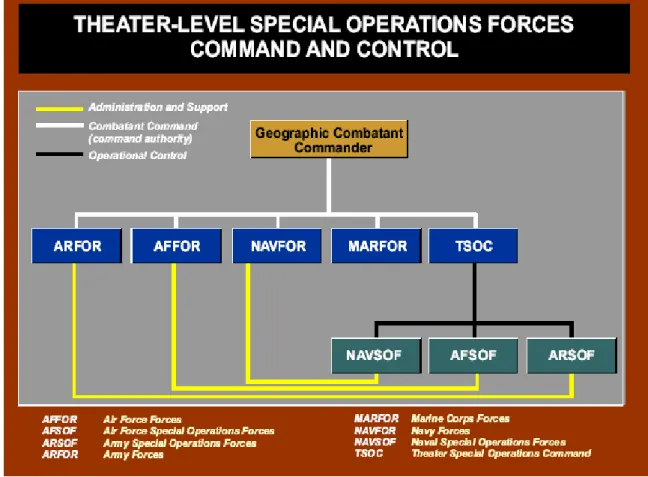
The most effective and efficient means for USNORTHCOM to command and control SO being executed in the USNORTHCOM AOR is through an organic TSOC. This TSOC can act as the base element of a JSOTF established to command and control an operation or as the Joint Force Special Operations Component Command (JFSOCC). TSOCs are established to integrate SOF into the Commander’s plans and contingency operations. The TSOC Commander is responsible for development of plans and conduct of joint SO in the Geographic Combatant Command’s (GCC) AOR. A TSOC also provides the GCC the core element for the establishment of a JSOTF organized to direct SO missions.4
An organization that is habitually associated with the day-to-day operation of USNORTHCOM, such as a TSOC, has a higher understanding of the intricacies of the situation and requires less of a build-up preparation prior to execution of SO missions in the USNORTHCOM AOR. The time required to “ramp up” an organization external to the daily life of USNORTHCOM can be critical. Time is one of the most valuable assets and should be managed and coveted during a crisis situation. If the JSOTF is formed and deployed from another organization, such as USSOCOM, this does not afford the Commander, USNORTHCOM the most efficient means of executing the mission.
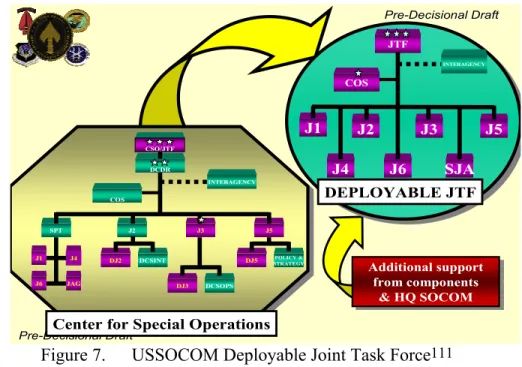
The creation of a JSOTF deployed from USSOCOM in support of a USNORTHCOM SO would provide the Commander, USNORTHCOM with the SO expertise required to execute a SO mission. However, this force is not apportioned to USNORTHCOM. The time required to develop situational awareness of the common operating picture of USNORTHCOM and the AOR can become a severe drain on the availability of the time to execute the operation.
If the previous two options do not exist or are not implemented, USNORTHCOM will command and control SO missions in the AOR through the AJFHQ. This
4 US Department of Defense. USSOCOM, Theater Special Operations Commands (TSOCs), available at USSOCOM classified website, http://intel.socom.smil.mil/sojic/mcs/theater_socs/theater_socs.htm, accessed March 2004.
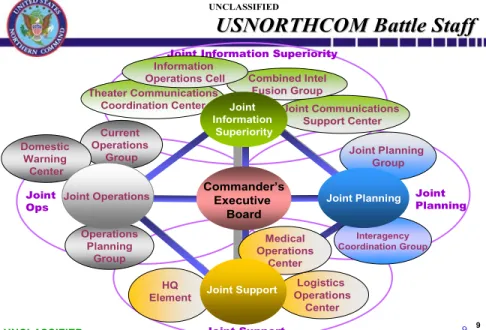
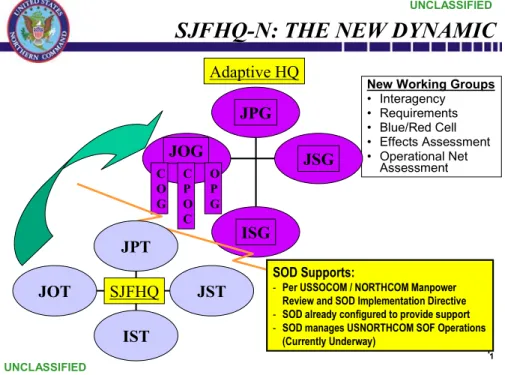
organization consists of representatives from each of the USNORTHCOM directorates, operations, intelligence, logistics, etc., in each of its groups. There are currently six components of the Battle Staff which are established at the direction of the Commander. They are the Commander’s Executive Board (CEB), Domestic Warning Center (DWC), Current Operations Group (COG), Operations Planning Group (OPG), Joint Planning Group (JPG) and Combined Intelligence Fusion Group (CIFG).5 A further explanation
and description of these Groups will be discussed later in the paper.
Returning to the vignette, Special Operations Forces are the only element in the US arsenal of capabilities that possess the training and experience to execute a hostage rescue at sea. They are also the only element that has the capability to handle an improvised nuclear device. Addressing one more complication to the scenario discussed above, US SOF are the only element that can conduct this operation at sea while the ship is underway and the enemy forces on the ship are likely to attempt to repel the attacking rescuers. Several elements within the US vast array of capabilities maintain and train to a capability to handle hostage situations to include many local police forces. These elements, while extremely capable for what they are trained and equipped to execute, cannot execute and handle a mission of this complexity and magnitude. The US Coast Guard (USCG) possesses the capability to board a ship and search it. USCG boarding teams can also handle an unruly ship’s crew but, they are not trained and equipped to handle a ship’s crew who will fight back and do all they can to prevent the boarding of the would-be rescuers.
Joint Publication 3-05, Doctrine for Joint Special Operations, describes Special Operations as, “special operations conducted in hostile, denied, or politically sensitive areas to achieve military, diplomatic, informational and/or economic objectives employing military capabilities for which there is no broad conventional force requirement.” The difference between SO and conventional operations is measured by the degree of physical and political risk, operational techniques required, how they are employed, the independence from friendly support, operational intelligence, or
5 US Department of Defense. LTC Ross Brown, USNORTHCOM J33. “USNORTHCOM Battle Staff and Crisis Action Process,” briefing, Mar 2004.
indigenous assistance contained within the operation.6 A rescue mission of this
magnitude can only be categorized as an SO and only executed by SO-capable forces, SOF.
US SOF are specially trained and equipped to handle just such a mission. Not only are they the best trained and equipped force in the world to execute a hostage rescue, they are the only force in the US arsenal which can execute the mission with the highest probability of success, especially at sea. SOF are a unique force in the total US arsenal, not just the military. Roger Pezzelle describes the Special Operator as unique and states that not every good infantryman can become a good Special Operator. The psychological aspect of Special Operators is what makes SOF different. Existing and operating for extended periods of time in a denied area with indigenous forces and little or no support from the US military requires a unique psychological makeup. Missions that are on the edge of human endurance and capability are the norm for Special Operators.7
The importance of the establishment of a separate Special Operations capable command is emphasized by Edward Luttwak, Senior Fellow, Center for Strategic and International Studies, Georgetown University, in his discussions of former Chief, Special Operations Division, J3 (Operations), The Joint Staff, Colonel Roger Pezzelle’s book, “Military Capabilities and Special Operations in the 1980s.” Luttwak states, “When bureaucratic and engineering oriented military establishments (conventional force staffs) attempt commando operations, it is always ‘unlucky.’ These organizations spend precious time establishing feasibility studies and planning committees. Time that established commando units aware of capability and weakness are inherently aware of.”8
In a scenario such as the one described in the vignette the force of choice would most likely be SOF because the President and Secretary of Defense want to have the highest probability of success in the execution of this sort of operation and in preventing
6 US Department of Defense. Joint Publication 3-05, Doctrine for Joint Special Operations, 17 December 2003, I-1.
7 Roger M. Pezzelle. “Military Capabilities and Special Operations in the 1980s.” edited by Frank Burnett, B. Hugh Tovar, Richard Shultz. Special Operations in the US Strategy. National Defense University Press, 1984, 148.
8 Edward N. Luttwak. Discussion of “Military Capabilities and Special Operations in the 1980s” by Roger Pezelle, edited by Frank Burnett, B. Hugh Trevor, and Richard Shultz. Special Operations in US Strategy. National Defense University Press, 1984, 155.
the terrorists from being able to be successful in their mission to kill Americans. The National Security Council and the President, after declaring the situation an HLD situation could choose to have the conventional Navy engage the ship with conventional munitions either sinking or disabling the ship. But what of the hostages and the implications of sacrificing hundreds of innocent lives unnecessarily. SOF’s unique ability to conduct surgical strikes, minimizing the chance of collateral damage, are the only force of choice for this type of mission.
C. BACKGROUND 1. Desert One
During November 1979, radical Muslims overthrew the moderate government of Iran, which had replaced the regime of the Shah in January, 1979. Shortly after the coup, a group of Iranian University students attacked the US Embassy in Tehran, capturing 66 Americans and holding them hostage in the Embassy. A few days prior to the takeover of the Embassy by the Iranian terrorists, a secret counter-terrorism organization, code named Delta Force, had just completed an exercise and was deemed “operationally ready”. The US Government immediately identified the unit as a possible solution to the hostage situation, if it could not be resolved diplomatically. In April 1980, five months after the hostages had been taken, President Jimmy Carter directed a rescue attempt of the US hostages being held by terrorists in the US Embassy in Tehran, Iran.9
Each component of the operation-ground, air and sea-planned and rehearsed their portions separately. This lack of cross-service coordination was later identified as one of the major reasons the operation was unsuccessful. A key element of the operation was to establish a remote landing strip in the desert. This landing strip was essential to the success of the operation because the range of the helicopters used did not allow them to fly the entire mission without refueling. The name of the rendezvous and refueling site was Desert One. The site was critical, not only for the refueling that the helicopters required, but because this was where all the components of the operation would assemble for the mission. The organizations established for the mission were a sampling of the US Military’s elite forces. Delta Force, the ground assault element, belonged to the Army.
9 Charles G. Cogan. “Desert One and Its Disorders.” The Journal of Military History 63, issue 1, (January 2003), 201.
The EC-130 aircraft belonged to the Air Force and were responsible for refueling and transporting Delta Force. The Navy provided the helicopters while the marines provided the pilots. The Navy was concerned about the lack experience its pilots had flying long distances over land. To complicate this issue, the helicopters the Marines flew normally were an older model than what the Navy would provide.10
Before the operation could begin, complications leading to the eventual calling off of the mission began to mount. The operation began with two less aircraft than required. About 200 miles after launch from the Nimitz, one of the 53s had a hydraulic warning indicator light illuminate, and the pilot aborted his mission. Later, during transit through a dust storm, another 53 encountered problems with its navigational system and aborted. Six of the eight 53s arrived at Desert One and the window of opportunity for execution was closing. COL Beckwith, the Delta Force Commander, pressed to continue the mission. As the Delta Force troops were loading the aircraft, another hydraulic indicator warning light illuminated on another 53. Col Edward Sieffert, USAF, the air component commander, deemed the situation too dangerous due to the lack helicopters. The request to call off the mission was made and passed to the President. The President approved the request and evacuation of Desert One began.
However, the 53s still required refueling prior to departure from Desert One. As one of them was being refueled, its rotor struck an EC-130, which ignited the fuel and caused an explosion. Eight of the would-be rescuers were killed and the helicopter was destroyed. The dead and the helicopters were left behind at Desert One. Operation EAGLE CLAW, or. as it became known in the common vernacular, Desert One, was a failure.11
The problems with interoperability did not begin at Desert One. An air of competiveness between the services had developed over the preceding decade. The parochialism which had developed since the end of the Vietnam War between the conventional and unconventional forces had created an atmosphere of mistrust and
10 Charles G. Cogan. “Desert One and Its Disorders.” The Journal of Military History. Lexington: January 2003, 201.
11 Charles G. Cogan. “Desert One and Its Disorders.” The Journal of Military History. Lexington: January 2003, 201.
misunderstanding of unconventional forces and operations by conventional force officers. In addition to this environment in the services, Washington had created a hesitant and unsure decision making environment. Washington was not comfortable with the rescue operation and this less than total commitment transferred to the planners and the commanders of the operation.12 A command environment which lacked confidence in
the success of the operation brewed failure and the search for excuses to quit around every corner.
Desert One was a watershed event for the US Military. The lack of cross service coordination had caused a critical failure in the mission. The mission failure and subsequent accident highlighted a major split in the way the military had been planning and conducting operations. There were minimal joint operations being conducted by the military, and Desert One demonstrated the problems that the lack of cross-service coordination and interoperability can cause. The failure, especially in the world of Special Operations, was the impetus for of the Joint Military requirement and identified the need to create a command that would ensure inter service operability and readiness for Special Operations.
2. Holloway Commission
Following the aborted mission at Desert One and the loss of life, Congress directed an investigation into the mission and what caused the failure. This investigation became known as the Holloway Commission, named after the Chairman, Admiral J. L. Holloway, III, USN (Ret). The investigation was called the Special Operations Review Group, and they published their findings in Rescue Mission Report and presented the report to Congress. The investigation found that although adequate planning existed, it did not include additional helicopters nor account for bad weather in the plan. The report also determined that preparation was adequate but lacked a full mission profile rehearsal.13 If the rehearsal had been conducted it is likely the weak links in the chain of
12 Charles G. Cogan. “Desert One and Its Disorders.” The Journal of Military History. Lexington: January 2003, 201.
13 A full mission profile rehearsal is a training exercise in which all the elements that will execute the mission, rehearse the entire operation from beginning to end with all the equipment to be used and in the environment and setting in which the mission will be executed. This type of rehearsal is normally completed immediately prior to mission execution and allows all the forces to “iron out” the last minute details of the operation prior to its execution.
command would have been identified. The report specifically states that command and control above the Joint Task Force (JTF) or the “upper echelons” was excellent. However, at the JTF and below, the chain of command was not as clear and became especially muddled on the issue of who was really in charge. The relationships were tenuous and were easily influenced, creating misunderstanding about who could make the mission decision to continue or abort the mission. The conclusion of the report led to the commission’s recommendation that a “Counter-Terrorism Joint Task Force (CTJTF) be established as a field agency of the Joint Chiefs of Staff with permanently assigned personnel and certain assigned forces.”14 The CTJTF became the first permanently
manned and funded Joint Special Operations Unit.
One of the first steps toward effecting the change recommended by the Holloway Commission was the Defense Guidance of 1981. This guidance was the first mention of SOF as a force, and it directed each of the services to develop a Special Operations capability.15 With the mission failure at Desert One and the resulting findings of the
Holloway Commission, Congress became involved in the development and preparation of the military to fight. This involvement would create significant changes in the US Military and the Department of Defense forcing the military to become jointly interoperable and increasing the power and oversight of civilian authority over the Department of Defense. Desert One and the findings of the Holloway Commission were the impetus for Congress to mandate a change in the way the military fights and trains to fight. This forced change was finally implemented in 1986 with the Goldwater-Nichols Act.
3. Goldwater-Nichols Defense Act
The intent of the Goldwater-Nichols Department of Defense Reorganization Act of 1986 was:
1) reorganize the Department of Defense and strengthen civilian authority in the Department;
14 Admiral J. L. Holloway, III, USN (Ret), “Rescue Mission Report.” Statement made by Holloway to US Congress in August 1980.
15 John O. Marsh, Jr. text of speech. “Special Operations in US Strategy.” Edited by Frank Burnett, B. Hugh Tovar, Richard Shultz, National Defense University Press, 1984, 18.
2) improve the military advice provided to the President, the National Security Council, and the Secretary of Defense;
3) place clear responsibility on the commanders of the unified and specified combatant commanders for the accomplishment of the missions assigned to those commands;
4) ensure that the authority of the commanders of the unified and specified combatant commands is fully commensurate with the responsibility of those commanders for the accomplishment of missions assigned to their commands;
5) increase attention to the formulation of strategy and to contingency planning;
6) provide for more efficient use of defense resources; 7) improve joint officer management policies; and
8) otherwise enhance the effectiveness of military operations and improve the management and administration of the Department of Defense.16
These changes to the Department of Defense forced the US Military to become more “joint” or, as some like to call it, more purple. Each component of the military Army, Navy, Marines and Air Force were required to fill positions on The Joint Staff and the Staffs of the Geographic Combatant Commanders17 and Specified Command
Commanders. These positions were no longer a detriment to an officer’s career. The positions became a requirement for an officer from any service to become a General Officer. The forced integration of personnel on staffs helped to mitigate the parochialism between the services by creating a better informed group of officers who understood the capabilities and shortcomings of the other services. This development of knowledge helped to create more efficient use of the forces. Not only did the act change how personnel were employed, it forced the military to become more compatible. Gone would be the days of the Navy fighter not being able to talk to the Air Force tanker or an Army Division not able to talk to a Marine Battalion. When buying or improving
16 United States. Goldwater-Nichols Department of Defense Reorganization Act of 1986. 99th
Congress, available at http://www.ndu.edu/library/goldnich/99433pt2.pdf accessed June 2004.
17 These Commanders were referred to as Commanders in Chief (CINC) when the Goldwater-Nichols Act was implemented.
existing equipment, the military was now required to ensure that this equipment was compatible with other services’ equipment. If the equipment being purchased did not meet the compatibility requirements it risked not being funded by Congress.
Almost immediately after the Goldwater-Nichols Defense Reform Act was passed, Senators Nunn and Cohen submitted an amendment to the act in 1987 which called for the establishment of a separate specified command for all US SOF. This change to the military would be even more difficult to establish than the Goldwater-Nichols Act. Mr. Lunger, in an interview conducted by USSOCOM Historian, John Partin stated, “The service chiefs opposed a strong SOF organization because having made war a life long study and having fought to get to the top, they were loathe to admit that their careers and weapons systems were irrelevant to the real world.”18 This
command would be responsible for the training and manning of all SOF throughout the US Military. Following 9/11, the command was given the additional responsibility to plan and prepare for and when directed conduct, counter-terrorism operations in support of the War on Terror. The law which established USSOCOM states that all SOF in the United States, active and reserve, are assigned to USSOCOM unless otherwise directed by the Secretary of Defense.19
4. USSOCOM Organization
The creation of a separate command for the care, training, and development of Special Operations in the US military was a key event for SOF. In the past, SOF had been on its own buried in the services as just another branch. USSOCOM provides SOF a voice at the table that did not exist previously. As an example of how dire conditions had been for SOF throughout its history, Sam Sarkesian, Professor of Political Science, Loyola University, points out that during the Korean War, several attempts were made to employ SOF with little or no impact on the operations in which they were employed. According to one individual, who participated in these efforts, “as the organization grew larger and more conventional, the effectiveness of its operations decreased accordingly.” Sarkesian also explained that an organization established to conduct low intensity
18 John Partin. USSOCOM, Memorandum for Record, Interviews on the Origins of USSOCOM, Washington, DC, 6-14 July 1988 (27 July 1988).
19 US Department of Defense. “United States Special Operations Command History, 15th
conflicts (guerilla warfare is a SO mission in this context) cannot be formed ad-hoc because of the training, preparation, and operational implementation required to conduct this type of operation. 20 In contrast to SO attempted during the Korean War, Pezzelle
explains that the lessons learned from Military Assistance Command Special Operations Group-Vietnam (MACSOG-V) serve as an early example of how SO planning and execution should be conducted for future SO Commands. The tactics, techniques and procedures developed and used are an excellent source for how to conduct SO in a modern war. MACSOG-V also serves as an example of problems that can occur with lack of coordination and integration of mutually supporting assets.21 Another example of
how important mission support and focus had become was operation URGENT FURY. This operation was conducted to rescue medical students from the island of Grenada in the Caribbean. Analysis of this operation will not be covered in this paper. However, there are some lessons learned that apply to situations that influenced the creation of USSOCOM.
In operation URGENT FURY, SOF were not commanded by SOF for the invasion. During his testimony to Congress, MG (Ret) Richard Scholtes, Commander of the JSOTF for Grenada, explained that the conventional commanders’ misuse of SOF during the operation was the key reason for the high casualties suffered by SOF during this operation.22 According to GEN Brian Brown, on several occasions during URGENT
FURY, SOF was not properly supported or was misused and improperly employed due to a lack of knowledge of how to employ SOF by the conventional JTF commanders. One example he points out that the Rangers were inserted during daylight. The Rangers continuously train to conduct operations at night. The potential operational advantage gained through countless hours of night training was not realized by the conventional JTF Commander. GEN Brown also said the JSOTF with a lack of authority to command and
20 Sam C. Sarkesian. “Organizational Strategy and Low Intensity Conflict.” Special Operations in US Strategy, edited by Frank Burnett, B. Hugh Tovar, Richard Shultz. National Defense University Press, 1984, 265-266.
21 Roger M. Pezzelle. “Military Capabilities and Special Operations in the 1980s.” Special Operations in US Strategy, edited by Frank Burnett, B. Hugh Tovvar, Richard Shultz. National Defense University Press, 1984, 141-142.
22 US Department of Defense. “United States Special Operations Command History, 15th
control SOF during the operation severely hurt SOF employment. Because of this lack of a SOF command and control, the parochialism between the services was manifested in battle when the Commander of the US Marine Forces refused to fly the Rangers with Marine helicopters during the operation.23
The creation of a separate four-star command to provide for the funding, training and preparedness of SOF has helped to mitigate the problems discussed above. USSOCOM has also become an advocate for SOF commanding SOF. As noted above, several operations have either met with failure or higher casualty rates because a clear understanding of SO capabilities did not exist in the chain of command responsible for the operation. A common understanding and knowledge of the capabilities, both strengths and weaknesses, of SOF is critical to the success of a SO mission. Simple things which are common knowledge throughout the SOF community, such as Rangers fighting at night, are not common knowledge throughout the military. Secretary of the Army John O. Marsh stated that emphasis must be placed on “flexibility, on imaginative planning, and on decisive execution. Conventional and Special Operations Commanders must both understand the capabilities and limitations of both types of forces.”24
D. SPECIAL OPERATIONS MISSIONS
SOF, while a highly capable force, have a finite mission set and a select group of parameters that must be met in order to employ SOF in these missions. It is imperative for Commanders to understand these missions and differences between SOF and conventional forces. This familiarity of SOF characteristics and capabilities ensures missions selected are commensurate with their capabilities. In executing these missions, SOF can gain access to denied areas, rapidly deploy to a crisis area, or be used as a means of establishing a diplomatic relationship with foreign governments. SOF accomplishes these missions while executing its core tasks or as a supporting or primary task for the assigned mission. SOF are equipped and organized to conduct nine core tasks: direct action, special reconnaissance, foreign internal defense, unconventional warfare,
23 Harry S. Brown. “The Command and Control of Special Operations Forces.” Naval Post Graduate School, Monterey, CA, December 1996, 40, 47.
24 John O. Marsh. Text of speech, Special Operations in US Strategy. edited by Frank Burnett, B. Hugh Tovvar, Richard Shultz National Defense University Press, 1984, 23.
counterterrorism, psychological operations (PSYOP), civil affairs (CA) operations, counter-proliferation of weapons of mass destruction (WMD) and information operations (IO).25
A direct action (DA) is a short duration offensive action executed in a hostile, denied or politically sensitive environment. DA requires the employment of specially trained forces with the capability to seize, destroy, capture, exploit, or recover assigned targets. A DA mission is differentiated from conventional missions by the level of risk to the force and the strategic impact the outcome of the mission may have. DA missions include raids, ambushes, and direct assaults. These DA specific missions can be accomplished using stand-off attacks such as information operations (IO) or via air, maritime, or ground-based platforms.
Special reconnaissance (SR) includes reconnaissance and surveillance missions conducted in environments described in DA. SR is executed to collect and/or verify information of strategic or operational importance.
Foreign internal defense (FID) is conducted to train a host nation’s military force to defeat an insurgent threat, lawlessness or subversion. FID can be conducted beginning at the very basic levels of establishing a military from nothing, to conducting training in a highly complicated and risky mission such as hostage rescue.
Unconventional Warfare (UW) involves all aspects of the SO mission set. UW is the umbrella of operations which SOF were originally created to execute. The UW main effort is Guerrilla Warfare. UW operations are normally conducted over extended periods of time in a non-permissive environment in which the political sensitivities of the operation have strategic implications. The political environment of the host nation is unfriendly to the US and its interests; however, UW cannot be conducted without the support of the indigenous population of the host nation. This support is critical to the success of UW operations, as was demonstrated by SO conducted in Afghanistan during Operation ENDURING FREEDOM. SOF deployed, organized, trained and equipped indigenous forces to defeat the controlling Taliban government.
25 US Department of Defense. Joint Publication 3-05, Doctrine for Joint Special Operations, 17 December 03, viii.
Counterterrorism (CT) operations are offensive in nature and conducted to prevent, deter, pre-empt and respond to terrorism. The role of SOF is to execute these missions as a supporting task to DOD’s overall combating terrorism operations. These operations range from intelligence gathering to offensive actions against terrorists or their supporting efforts as a pre-emptive action to prevent the terrorists from attacking.
Counter-proliferation (CP) of WMD describes operations taken to prevent the spread of WMD, through seizure, destruction, render safe, capture or recovery of WMD. The main effort of CP is to prevent the development of the capability to produce and deliver WMD technology by organizations and rogue nations.
Civil Affairs (CA) operations (CAO) are conducted to provide the host nation with the ability to establish and maintain its own infrastructure. These tasks range from establishing the basic needs of the population such as utilities to providing training in civil governmental authority. The key objective of CAO is to maintain control of the population by “winning the hearts and minds.”
Psychological Operations (PSYOP) are conducted to influence the enemy to do the will of the United States without firing a shot. PSYOP can be conducted over a variety of media to include actions or mis-actions of a force to convince the enemy of a capability or strength and ability that may or may not exist. This influence is conducted to change the behavior of the enemy forces and to gain an advantage for the friendly force commander.
Information Operations (IO) are operations conducted to influence the enemy’s will to fight. These operations include PSYOP, CAO, computer network operations, electronic warfare, physical attack, operational security and military deception. The intent of IO is to synchronize all these actions into a single theme that supports the commander’s overall objectives. IO can be described as an economy of force across the spectrum of the battle space.26
26 Department of Defense. Joint Publication 3-05, Doctrine for Joint Special Operations, 17 December 2003, II-4 – II-8.
E. US NORTHERN COMMAND MISSIONS AND RESPONSIBILITIES Following the attacks of September 11, 2001, significant changes were directed in US Government to counter and prevent the chances for another terrorist attack. One of the most significant changes the Department of Defense made was the establishment of a Combatant Command whose geographic responsibilities include the US.
USNORTHCOM was established as fully operational capable on 11 September 2003, with the responsibility to protect and defend the homeland. USNORTHCOM’s mission states that the Command is responsible for preventing, detecting, deterring, and defending the homeland from attacks. USNORTHCOM’s website states:
The command's mission is homeland defense and civil support, specifically:
Conduct operations to deter, prevent, and defeat threats and aggression aimed at the United States, its territories, and interests within the assigned area of responsibility; and
As directed by the President or Secretary of Defense, provide military assistance to civil authorities including consequence management operations.
U.S. Northern Command plans, organizes, and executes homeland defense and civil support missions, but has few permanently assigned forces. The command will be assigned forces whenever necessary to execute missions as ordered by the President.27
27 Department of Defense. United States Northern Command website,
Figure 1. US Combatant Commands’ Areas of Responsibility 28
The figure above illustrates the geographic responsibility that each of the GCCs possesses. The Unified Command Plan 2002 established USNORTHCOM and delineated its area of responsibility. This directive created the first-ever Combatant Command responsibility for the United States. Prior to this, military assistance to civil authorities (MACA) was handled by the Services, primarily the Army. As illustrated above, USNORTHCOM’s AOR encompasses more than the domestic regions of the US. USNORTHCOM also has responsibility for Mexico, Canada, portions of the Caribbean, and a shared responsibility for Alaska with US Pacific Command.29 The first
Commander of USNORTHCOM was Air Force General Ralph E. Eberhart.
28 Department of Defense. Joint Publication 3-26, Joint Doctrine for Homeland Security, Final Coordination, 26 March 2004, II-2.
29 “The Creation of the United States Northern Command: Potential Constitutional, Legal, and Policy Issues Raised by a Unified Command for the Domestic United States”,
As a GCC with all the responsibilities of maintaining regional engagement with other nations within the AOR, defending the homeland, and providing assistance to federal authorities in time of need, USNORTHCOM has a uniquely expanded mission to fulfill.
To match USNORTHCOM’s unique mission, SOF in support of USNORTHCOM is just as unique. The USNORTHCOM J3 (Operations) Special Operations Division (SOD) has identified five primary SO missions that are conducted in support of USNORTHCOM’s mission. They are: direct action, special reconnaissance, combating terrorism, counter-proliferation and unconventional warfare. The current mission of the USNORTHCOM J3 SOD is
USNORTHCOM J32 SOD develops strategies and programs for the integration of Joint SOF capabilities; manages and monitors SOF operations, in support of USNORTHCOM programs and initiatives.30
These missions while not all-encompassing of the SOF core missions as designated by USSOCOM, cover the primary spectrum required for SO in the USNORTHCOM AOR.
SOF in support of USNORTHCOM is also the lead element for USNORTHCOM’s theater security cooperation program. This program involves building relationships between the US Military and that of nations within the USNORTHCOM AOR, primarily Mexico and Canada. These relationships help to foster an air of trust and exchange of capability and training. They also create the ability for mutual support in time of crisis. Areas where this may become a necessary exchange would be the ability of the Canadian Forces to respond more quickly to a situation in an area such as Juneau, AK or the US providing WMD response to either Mexico or Canada.
The importance of the establishment of joint forces and operations, the creation of a separate Special Operations Command and USNORTHCOM, and missions of SOF in general and specifically in support of USNORTHCOM are key points to understand prior to moving to an analysis of command of SOF in the USNORTHCOM AOR. The
30 Department of Defense. United States Northern Command, Operations Directorate, Special Operations Division mission briefing, 8 June 2004, 3.
command and control of SOF conducting operations in the USNORTHCOM AOR remains an unanswered question. European, Pacific, Central, and Southern Command all maintain an organic TSOC assigned to the command through the Unified Command Plan (UCP). These TSOCs provide the Commander with a SOF-capable command and control element. TSOCs maintain the ability to rapidly deploy and establish a JSOTF to conduct SO in support the Geographic Combatant Commander. Even Joint Forces Command, whose mission is joint experimentation and training, maintains a Special Operations Command.
F. THESIS CONSTRUCT
Before moving further into the analysis of the problem, some assumptions have to be made in order to scale and scope the problem. This paper will not debate the value of SOF commanding SOF, which has been established in Joint Publication doctrine. This will, however, be a determining factor when comparing courses of action for the conclusion. Also, DOD recently analyzed the value of combining USNORTHCOM with USSOUTHCOM possibly creating America’s Command (AMERICOM). The outcome of this analysis and any decisions made by the Secretary of Defense to merge or not merge the two commands do not affect the analysis. However, any changes that are made will be discussed for further analysis as part of the conclusion. Another key factor is USSOCOM is presently developing plans to establish deployable JTFs as part of USSOCOM to support the War on Terror. These JTFs will be discussed further during course of action analysis. Equipment availability and costs for any of the courses action will not be considered. The assumption is that equipment is always available with the organization’s priority and budget. Personnel to man the organization will be considered.
That the Commander, USNORTHCOM requires the capability to command and control SO is not disputed. What will be analyzed further in this paper is the frequency that a SO command would be utilized, and when such a command is required, what is the best means to provide the Commander with the neccessary capability. A key finding will be whether an organic TSOC would provide the Commander, USNORTHCOM with the most effective means of executing Special Operations within the USNORTHCOM area of responsibility (AOR). Further research and analysis will explore three courses of action to address C2 of SOF in the USNORTHCOM AOR:
1) Continue to use the USNORTHCOM adaptive joint headquarters as the primary means of providing command and control of SOF in the USNORTHCOM AOR.
2) Establish an organic TSOC in support of USNORTHCOM.
3) Apportion a JTF from USSOCOM with habitual association for training and operations with USNORTHCOM.
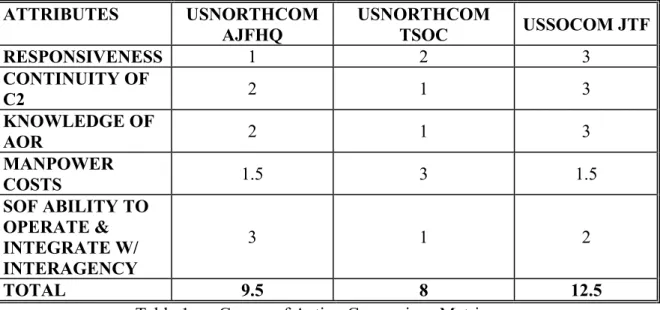
Analysis of these courses of action will be based on such as: responsiveness of the command to a crisis situation; continuity of C2; knowledge of the AOR; knowledge and understanding of the unique aspects and sensitivities for military operations conducted in the AOR; SOF ability to operate and integrate operations with various agencies; (the ‘interagency’) and the manpower cost to establish a new organization. Each of these attributes will be defined later in the paper along with a means of quantifying each attribute. If an attribute is difficult to quantify, professional judgment and an objective recommended scoring for each course of action will be established. Thorough analysis of the COAs against these attributes will help to illustrate which of the three COAs will provide the most feasible and effective C2 structure for USNORTHCOM controlling SOF in the AOR.
Each of the COAs will be defined and evaluated individually against each of the defined attributes. After each COA is evaluated individually a comparison of the courses COAs will be presented with a conclusion on the recommended COA to best fulfill the needs of controlling SOF in the USNORTHCOM AOR.
II. LITERATURE
REVIEW AND METHODOLOGY
A. RESEARCH QUESTION
The United States Military has a longstanding tradition of warfare overseas. Its role in domestic operations has been limited, mainly in the area of support for natural disasters. However, with 9/11 and the increased threat of future terrorist activity on US soil, there has been a marked increase in the collaboration and coordination between state and local law enforcement officials and the Department of Defense (DOD). DOD’s response to the threat to Homeland Security, with the objective of supporting and collaborating with state and local agencies, was the establishment of the new combatant command, USNORTHCOM. How the Interagency works together and performs with a command and control structure remains to be seen. However - the key issue is command and control (C2). Nowhere is the issue of command and control more critical than it is within Special Operations Forces (SOF) and their C2 relationship with USNORTHCOM. SOF are a unique resource for USNORTHCOM, and they can be applied to both deter and respond to acts of terrorism. With the role of “military protection of the United States territory, domestic populations, and critical defense infrastructure against external threats and aggressions,” SOF are uniquely trained and equipped to respond. But how effective will they be if their C2 is not an established, trained and rehearsed organization with the resident expertise to make time-critical decisions? Lessons learned from the failed hostage rescue attempt during President Carter’s administration have left lasting concerns over how best to manage a complex C2 structure. There are conflicting opinions regarding allowing SOF to operate under the current structure of USNORTHCOM with a C2 structure that may or may not be conducive to mission success. While USNORTHCOM has now positioned itself to fully incorporate the unique skills and talents of this community into the command structure, there are still some unanswered questions as to how that should be accomplished, given the preferred method of a “self contained” command and control, distinct and necessary, for a fully functioning Special Operations Force.
B. DISCUSSION
The research for this thesis explored the various SOF C2 arrangements and determined the strengths and weaknesses of each and when each would be appropriate. In conducting the research, the identification of the attributes required for evaluating which SOF C2 structure was a best fit for USNORTHCOM was essential for the establishment of the validity and strength of the recommendation. The attributes selected to conduct these analyses and comparisons were derived from discussion with experts in the field of US SOF operations and organizations. Additionally, some of the attributes are commonly used in the conduct of the military decision making process when comparing courses of action in order to determine which course of action will lead to the desired outcome of the commander.
The methodology of this literature review involved researching academic and doctrinal bodies of work obtained primarily from two general sources:
(1) Doctrinal - SOF-specific periodicals published by the service components of USSOCOM and the US Joint Forces Command, which is responsible for the training and doctrine of joint forces.
(2) Academic - SOF specific periodicals written by SOF-qualified personnel and members of military academia.
On the subject of SOF operations and C2 organizations, specifically - the two categories were mutually, since the academics is based on the doctrine and vice versa. The studies and journal papers are based on doctrine established within military academia. These studies and papers help to present a better understanding of existing doctrine, and establish a forum for changes and improvements to the doctrine. While preparing for this thesis, the difference between these two categories did not present itself as a significant factor affecting the findings of the research.
The review of the literature evolved into the following categories: the theory and doctrine of Special Operations; the theory and doctrine of Homeland Security; America’s historical experience with Special Operations and Homeland Security; the spectrum of threats USNORTHCOM can expect to face; and the strategic and political environment in which USNORTHCOM operates.
1. The Theory and Doctrine of Special Operations
Several Joint Publications have been developed over the last ten years focusing on the training, development and employment of SO in support of joint operations and as unilateral SO. The primary theme of the joint doctrine for Special Operations is twofold: SOF should command SOF in both crises and daily operations conducted in support of the US national strategic objectives; and SOF are highly specialized units which must be employed properly. The proper employment of SOF drives joint doctrine to the conclusion of SOF commanding SOF and the importance of the establishment of a SOF chain of command to oversee SO missions. Joint Publication series “3” covers joint operations, which includes SO, ranging from the basics of SOF employment and makeup to the tactics, techniques and procedures of SOF core missions, e.g., Foreign Internal Defense (FID) and Unconventional Warfare (UW).
The base document for Joint SO, Joint Publication 3-05, Joint Doctrine for Special Operations, establishes the approved doctrinal procedures for Special Operations. This publication is the basis for how to employ SOF unilaterally or in support of a larger campaign or operation. JP 3-05 discusses the nine core missions of SOF outlined earlier. Command and Control of SOF is discussed in depth. This section describes the organizations that are established in the military to provide C2 of SOF in both peacetime and combat operations. It also covers the basics of a TSOC, its responsibilities, and how to employ the TSOC in support of GCC missions.31
In his thesis, “The Command and Control of Special Operations Forces,” Harry Brown, presents some insight into the importance of SOF commanding SOF in operations. He cites examples from Operation URGENT FURY in which the lack of understanding of the limitations and capabilities of SOF likely contributed to a higher casualty rate for the SOF units in the operation. Also, the lack of a centralized support structure for SOF during the operation limited the capabilities of SOF and contributed to SOF units attempting to rely on other forces for support. Brown’s thesis relates the importance of SOF to the ultimate success of a mission.32
31 US Department of Defense. Joint Publication 3-05, Doctrine for Joint Special Operations. 17 December 2003.
32 Harry Brown. “The Command and Control of Special Operations Forces.” Naval Post Graduate School, Monterey, CA, December 1996.