Calhoun: The NPS Institutional Archive
Theses and Dissertations Thesis Collection
2007-12
An analysis of Special Operations
Command-South's distributive command and control concept
O'Hara, Patrick M.
Monterey California. Naval Postgraduate School http://hdl.handle.net/10945/3078
NAVAL
POSTGRADUATE
SCHOOL
MONTEREY, CALIFORNIA
THESIS
Approved for public release; distribution is unlimited AN ANALYSIS OF SPECIAL OPERATIONS COMMAND –
SOUTH’S DISTRIBUTIVE COMMAND AND CONTROL CONCEPT by Christian M. Averett Louis A. Cervantes Patrick M. O’Hara December 2007
Thesis Advisor: David C. Tucker
i
REPORT DOCUMENTATION PAGE Form Approved OMB No. 0704-0188 Public reporting burden for this collection of information is estimated to average 1 hour per response, including the time for reviewing instruction, searching existing data sources, gathering and maintaining the data needed, and completing and reviewing the collection of information. Send comments regarding this burden estimate or any other aspect of this collection of information, including suggestions for reducing this burden, to Washington headquarters Services, Directorate for Information Operations and Reports, 1215 Jefferson Davis Highway, Suite 1204, Arlington, VA 22202-4302, and to the Office of Management and Budget, Paperwork Reduction Project (0704-0188) Washington DC 20503.
1. AGENCY USE ONLY (Leave blank) 2. REPORT DATE December 2007
3. REPORT TYPE AND DATES COVERED
Master’s Thesis
4. TITLE AND SUBTITLE An Analysis of Special Operations Command – South’s Distributive Command and Control Concept
6. AUTHOR(S) Christian M. Averett, MAJ, USAF; Louis A. Cervantes, LT, USN; Patrick M. O’Hara, MAJ, USA
5. FUNDING NUMBERS
7. PERFORMING ORGANIZATION NAME(S) AND ADDRESS(ES)
Naval Postgraduate School Monterey, CA 93943-5000
8. PERFORMING ORGANIZATION REPORT NUMBER
9. SPONSORING /MONITORING AGENCY NAME(S) AND ADDRESS(ES)
N/A
10. SPONSORING/MONITORING AGENCY REPORT NUMBER
11. SUPPLEMENTARY NOTES The views expressed in this thesis are those of the author and do not reflect the official policy or position of the Department of Defense or the U.S. Government.
12a. DISTRIBUTION / AVAILABILITY STATEMENT Approved for public release; distribution is unlimited
12b. DISTRIBUTION CODE 13. ABSTRACT (maximum 200 words)
Since national, regional, or continental borders do not hinder transnational terrorist organizations, a Theater Special Operations Command is forced to conduct operations across a wide range of political and social environments. Special Operations Command-South (SOCSOUTH), the theater special operations component of the United States Southern Command, has determined that each sub-region within its area of responsibility has particular nuances that require separate and distinct command elements. Due to this determination, SOCSOUTH has decided to revise its approach to the command and control (C2) of all special operations forces operating throughout Central and South America. SOCSOUTH calls this new C2 approach “Distributive C2.”
The purpose of this thesis is to conduct a thorough analysis of the SOCSOUTH Distributive C2 concept and propose recommendations for improvement of its effectiveness and efficiency. Using multiple theories of organizational design and recommendations based on personal observations and interviews, this thesis will propose a long term command and control structure for SOCSOUTH. The authors hope to provide SOCSOUTH and other theater special operations commands with a C2 structure that will allow them to better coordinate and prosecute their war on terror mission across multiple sub-regions and ensure proper integration into a larger global counter-terrorism strategic plan.
15. NUMBER OF PAGES
103
14. SUBJECT TERMS Special Operations, Command and Control, C2, Distributive C2, South America, Andean Ridge, Caribbean and Central America, Southern Cone, Tri-Border Area, SOCSOUTH, SOUTHCOM, USSOCOM
16. PRICE CODE 17. SECURITY CLASSIFICATION OF REPORT Unclassified 18. SECURITY CLASSIFICATION OF THIS PAGE Unclassified 19. SECURITY CLASSIFICATION OF ABSTRACT Unclassified 20. LIMITATION OF ABSTRACT UU NSN 7540-01-280-5500 Standard Form 298 (Rev. 2-89) Prescribed by ANSI Std. 239-18
ii
iii
Approved for public release; distribution is unlimited
AN ANALYSIS OF SPECIAL OPERATIONS COMMAND – SOUTH’S DISTRIBUTIVE COMMAND AND CONTROL CONCEPT
Christian M. Averett Major, United States Air Force B.A., Virginia Military Institute, 1995 M.S., Embry-Riddle Aeronautical University, 2001
Louis A. Cervantes Lieutenant, United States Navy B.S., Norfolk State University, 2001
Patrick M. O’Hara Major, United States Army B.S., Auburn University, 1990
M.B.A, University of Alabama at Birmingham, 1991 Submitted in partial fulfillment of the
requirements for the degree of
MASTER OF SCIENCE IN DEFENSE ANALYSIS
from the
NAVAL POSTGRADUATE SCHOOL December 2007
Author: Christian M. Averett
Louis A. Cervantes
Patrick M. O’Hara
Approved by: David C. Tucker
Thesis Advisor
Robert O’Connell
Second Reader/Co-Advisor
Gordon McCormick
iv
v
ABSTRACT
Since national, regional, or continental borders do not hinder transnational terrorist organizations, a Theater Special Operations Command is forced to conduct operations across a wide range of political and social environments. Special Operations Command-South (SOCSOUTH), the theater special operations component of the United States Southern Command, has determined that each sub-region within its area of responsibility has particular nuances that require separate and distinct command elements. Due to this determination, SOCSOUTH has decided to revise its approach to the command and control (C2) of all special operations forces operating throughout Central and South America. SOCSOUTH calls this new C2 approach “Distributive C2.”
The purpose of this thesis is to conduct a thorough analysis of the SOCSOUTH Distributive C2 concept and propose recommendations for improvement of its effectiveness and efficiency. Using multiple theories of organizational design and recommendations based on personal observations and interviews, this thesis will propose a long term command and control structure for SOCSOUTH. The authors hope to provide SOCSOUTH and other theater special operations commands with a C2 structure that will allow them to better coordinate and prosecute their war on terror mission across multiple sub-regions and ensure proper integration into a larger global counter-terrorism strategic plan.
vi
vii
TABLE OF CONTENTS
I. INTRODUCTION...1 A. PURPOSE...5 B. RELEVANCE ...6 C. METHODOLOGY ...7II. THE TERRORISM THREAT ASSESSMENT FOR SOCSOUTH ...9
A. INTRODUCTION...9
B. THE SOUTHERN CONE ...10
C. THE ANDEAN RIDGE...12
D. THE CARIBBEAN AND CENTRAL AMERICA ...13
E. CONCLUSION ...14
III. SOCSOUTH’S DISTRIBUTIVE COMMAND AND CONTROL CONCEPT ...17
A. INTRODUCTION...17
B. BRIGADIER GENERAL CLEVELAND’S C2 POLYGON...18
C. THE SOCSOUTH RWOT STRATEGY ...20
D. ANALYSIS OF THE PREVIOUS SOCSOUTH C2 STRUCTURE...23
E. DISTRIBUTIVE C2 DEFINED ...25
F. DISTRIBUTIVE C2 AT SOCSOUTH HEADQUARTERS ...26
G. DISTRIBUTIVE C2 BY SUB-REGION...28
1. The Andean Ridge...28
2. The Southern Cone ...30
3. The Caribbean and Central America ...32
H. REVIEW OF THE NEW OVERALL SOCSOUTH DISTRIBUTIVE C2 STRUCTURE ...34
I. CONCLUSION ...36
IV. SOCSOUTH C2 NODE IN THE ANDEAN RIDGE...39
A. INTRODUCTION...39
B. SOCSOUTH’S INITIAL STEPS FOR ITS ANDEAN RIDGE C2 NODE ...40
1. Manning Levels ...40
2. Permanent Party Status for Node Leadership ...41
3. Assigning a Contracting Officer to the Node ...41
4. Additional Workspace ...42
5. Air Assets ...42
6. Integration into the Embassy Country Team...43
7. Impact to Subordinate Units...44
C. CONCLUSION ...44
V. SOCSOUTH C2 NODE IN THE SOUTHERN CONE ...47
A. INTRODUCTION...47
B. SOCSOUTH’S INITIAL STEPS FOR ITS SOUTHERN CONE C2 NODE ...49
viii
1. Selection of Node Leadership...50
2. Interagency Education and Awareness...51
3. Speed, Flexibility, Integration, and Innovation...52
C. CONCLUSION ...54
VI. A DISCUSSION OF COMMAND AND CONTROL AND ORGANIZATIONAL DESIGN ...57
A. INTRODUCTION...57
B. BACKGROUND ...57
C. MILITARY COMMAND AND CONTROL...57
D. BREAKING DOWN THE BOUNDARIES WITHIN THE HIERARCHY...62
E. CONCLUSION ...64
VII. RECOMMENDATIONS AND PROPOSED MODEL ...65
A. INTRODUCTION...65
B. ANALYSIS OF THE SOCSOUTH DISTRIBUTIVE C2 CONCEPT...66
C. RECOMMENDATIONS...67
1. Mission Essential...68
a. Strategic Communications Plan...68
b. SOF Liaison Officers in each Embassy ...69
2. Mission Enhancing...69
a. Permanent Party Assignments for Node Leadership...69
b. Balance the Proper Rank with the Proper Personality ...70
c. Interagency Training for SOCSOUTH Personnel ...70
d. Warranted Contracting Officer Assigned to Each Node...71
D. PROPOSED DISTRIBUTIVE C2 MODEL...71
E. CONCLUSION ...74
VIII. CONCLUSION ...75
A. OBSTACLES TO IMPLEMENTATION...76
1. Obstacles Inside the Department of Defense ...76
2. Obstacles Outside the Department of Defense ...77
B. IMPLICATIONS FOR USSOCOM AND OTHER TSOCS ...78
C. FINAL REMARKS...79
LIST OF REFERENCES ...81
INITIAL DISTRIBUTION LIST ...87
ix
LIST OF FIGURES
Figure 1. SOUTHCOM Organization ...5
Figure 2. Cocaine Flows to the United States in 2003 ...13
Figure 3. Current USSOCOM Approach to GWOT C2 ...19
Figure 4. BG Cleveland’s Approach to GWOT C2 ...20
Figure 5. SOCSOUTH Layered Defense Strategy...21
Figure 6. SOCSOUTH Overall C2 Structure – Current...24
Figure 7. The Old J3 Directorate Task Organization ...26
Figure 8. The New J3 Directorate Task Organization...27
Figure 9. The Andean Ridge SOC Forward Concept...30
Figure 10. The Southern Cone SOC Forward Concept...32
Figure 11. The CCA C2 Cell Concept ...34
Figure 12. The SOCSOUTH Distributive C2 Concept ...36
x
xi
LIST OF ABBREVIATIONS AND ACRONYMS
ACI Andean Counter-drug Initiative
AI Area of Interest
AO Area of Operations
AOR Area of Responsibility
AR Andean Ridge
ASD/SOLIC Assistant Secretary of Defense for Special Operations and Low Intensity Conflict
BG Brigadier General
C2 Command and Control
CA Civil Affairs
CAFTA-DR Central America-Dominican Republic-United States Free Trade Agreement
CCA Caribbean and Central America
CIA Central Intelligence Agency
COA Course of Action
COM Chief of Mission
CSO Center for Special Operations
DA Direct Action
DAO Defense Attaché Office
DEA Drug Enforcement Agency
DNI Director of National Intelligence
DoD Department of Defense
DoJ Department of Justice
DoS Department of State
ELN El Ejército de Liberación Nacional (English translation: National Liberation Army)
FARC Fuerzas Armadas Revolucionarias de Colombia (English translation: Revolutionary Armed Forces of Colombia) FBI Federal Bureau of Investigation
FID Foreign Internal Defense
GCC Geographic Combatant Command
GWOT Global War on Terror
HARB Homestead Air Reserve Base
HVT High Value Target
J2 Joint Intelligence Directorate J3 Joint Operations Directorate J4 Joint Logistics Directorate
J6 Joint Communications Directorate JIACG Joint Interagency Coordination Group JIATF-S Joint Inter-agency Task Force South JOD Joint Operations Division
xii
JTF Joint Task Force
LNO Liaison Officer
LOO Lines of Operations
MAFB MacDill Air Force Base
MILGRP Military Group
MOA Memorandum of Agreement
NGO Non-Government Agency
OBM Organizational Behavior Model
OEF OPERATION Enduring Freedom
OIF OPERATION Iraqi Freedom
OJT On-the-Job Training
OPE Operational Preparation of the Environment
PN Partner Nation
POLAD Political Advisor
POM Program Objective Memorandum
PSYOPS Psychological Operations
REB Regional Engagement Branch
RSO Regional Security Officer
RWOT Regional War on Terror
SAO Security Assistance Organization
SC Southern Cone
SITREP Situation Report
SO Special Operations
SOCFWD Special Operations Command Forward SOCSOUTH Special Operations Command-South SOF Special Operations Force
SOF LNO Special Operations Force Liaison Officer
TBA Tri-border Area
TSOC Theater Special Operations Command USAFRICOM United States African Command USCENTCOM United States Central Command USEUCOM United States European Command USPACOM United Stated Pacific Command
USSOCOM United States Special Operations Command USSOUTHCOM United States Southern Command
UW Unconventional Warfare
VBSS Visit, Board, Search, Seize
VTC Video Tele-Conference
xiii
ACKNOWLEDGMENTS
First, we would like to thank our families for their unparalleled support and encouragement throughout this endeavor. We are also indebted to our thesis advisor, Dr. David Tucker, for his insight and guidance. Dr. Tucker’s expertise was invaluable in shaping our thoughts into a coherent written product.
We are also thankful for the support and access given to us by Brigadier General Charles Cleveland, the commanding general of the Special Operations Command-South (SOCSOUTH), his operations officer, Colonel Gregory Wilson, and the rest of the SOCSOUTH headquarters staff.
We also want to thank our peers — whether they are Soldiers, Sailors, Airmen, or Marines — and the faculty and staff of the Department of Defense Analysis at the Naval Postgraduate School. You provided a challenging academic environment that compelled us to work not just harder but smarter.
Our most sincere gratitude goes out the men and women serving throughout all branches of our armed forces. Your courage, dedication, and selfless service are truly inspirational.
xiv
I. INTRODUCTION
The United States and our partners continue to pursue a significantly degraded but still dangerous al-Qaeda network. Yet the enemy we face today in the War on Terror is not the same enemy we faced on September 11. Our effective counterterrorist efforts, in part, have forced the terrorists to evolve and modify their ways of doing business. Our understanding of the enemy has evolved as well. Today, the principal terrorist enemy confronting the United States is a transnational movement of extremist organizations, networks, and individuals — and their state and non-state supporters — which have in common that they exploit Islam and use terrorism for ideological ends.1
National Strategy for Combating Terrorism, September 2006
After the terrorist attacks of September 11, 2001, President George Bush addressed a joint session of Congress and the American people and declared a war against international terrorism. President Bush stated that “our war on terror begins with al Qaeda, but...will not end until every terrorist group of global reach has been found, stopped and defeated.”2 The Department of Defense (DoD), specifically the United States Special Operations Command (USSOCOM), was then charged with planning, resourcing, and executing the Global War on Terror (GWOT).
The current USSOCOM approach for the GWOT is to synchronize “global operations against terrorist networks in coordination with other Combatant Commands, US Government agencies, and international partners through collaboration and the employment of national-level systems to maximize these combined effects.”3 To
facilitate this approach, the DoD has vastly increased the size of the USSOCOM staff and integrated personnel from other U. S. Government (USG) departments and agencies.
1 The White House, The National Strategy for Combating Terrorism, Washington, DC: Government
Printing Office, 2006: 5.
2 President George Bush, Address before a joint session of the U.S. Congress on September 20, 2001,
“U.S. Response to the Terrorist Attacks of September 11,”
http://www.whitehouse.gov/news/releases/2001/09/ 20010920-8.html (accessed August 24, 2007).
3 The United States Special Operations Command, United States Special Operations Command 2007 Posture Statement, MacDill Air Force Base, FL, 2007: 3.
Additionally, USSOCOM transformed its organizational structure by establishing the Center for Special Operations (CSO) and the Joint Interagency Coordination Group (JIACG). The CSO now exercises command and control of GWOT operations from its location at MacDill Air Force Base, Florida.4
Despite the substantial growth of both the USSOCOM headquarters staff and special operations units5, the theater special operations commands (TSOCs) themselves have experienced virtually no manning increases. This fact seems at odds with the approach favored by Michael Vickers, the current Assistant Secretary of Defense for Special Operations and Low Intensity Conflict (ASD SO/LIC).6
Operations in the GWOT primarily occur at the country and sub-region level. Strategy is most effectively made at these levels, as well as at the global level. Our system of high command across departments and agencies is focused on the regional level, which is of reduced importance in both GWOT strategy and operations. In short, our interagency command structure is not well aligned with the geographic realities of the GWOT. GWOT operational areas should be established at the country and sub-region level. Sub-regional task forces are needed to conduct integrated area surveillance and cross-border operations. DoD senior counterterrorism presence is in need of significant elevation at the Country Team level, particularly in countries with which the US is not at war. Standing Interagency Task Forces commanded by either a military officer or CIA officer, as operational circumstances dictate, should be established as the execution arm for the designated operational areas.7
Given Mr. Vickers’ rationale, the TSOC staffs, rather than USSOCOM’s, should be enjoying manpower growth. Because they are regionally focused, these TSOCs have the potential for a greater working relationship with the U.S. Embassy country teams. These country teams are typically comprised of senior representatives from the State
4 General Bryan D. Brown, Commander, United States Special Operations Command, “US Special
Operations Command: Meeting the Challenges of the 21st Century,” Joint Forces Quarterly 40 (2006): 39.
5 General Bryan D. Brown, Commander, United States Special Operations Command, Statement
before the House Armed Services Committee’s Subcommittee on Terrorism, Unconventional Threats and Capabilities on January 31, 2007, “Current Manning, Equipping, and Readiness Challenges Facing Special Operations Forces,” Congressional Record Daily Digest, 110th Congress, D135.
6 The White House, “Personnel Announcement,”
http://www.whitehouse.gov/news/releases/2007/04/20070404-4.html (accessed April 19, 2007).
7 Michael Vickers, Testimony before the House Committee on Armed Services’ Subcommittee on
Terrorism, Unconventional Threats, and Capabilities on March 15, 2006, “Implementing GWOT Strategy: Overcoming Interagency Problems,” Congressional Record, 109th Congress, 2d session, Vol. 152, no. 33..
Department, Central Intelligence Agency, and the Defense Department’s Security Assistance Organization and Attaches. These teams form a valuable mechanism for ensuring interagency collaboration and coordination at the operational level. Typically however, Department of Defense representation to an embassy’s country team is limited to personnel grounded in the doctrine of general purpose forces who possess a limited understanding of special operations capabilities. Excepting the Marine Security Detachments, there are two “basic components of DoD’s ‘overseas presence’ in U.S. embassies: security assistance offices or SAOs (overseen by the Defense Security Cooperation Agency, defense attaché offices (overseen by Defense Intelligence Agency).”8
As former Deputy Assistant Secretary of Defense for Strategy, Andrew Hoehn noted, “SAO personnel serve under the direction and supervision of the Chief of the U.S. Diplomatic Mission (COM). The regional combatant commanders command the SAOs in all matters that are not functions of the COM.”9
Depending on the particular embassy, the security assistance offices (SAOs) may operate under different names. Nonetheless, “[a]n SAO is a DoD organization, regardless of actual title, located overseas with assigned responsibilities for carrying out the security assistance management functions.”10 These six primary responsibilities include:
1. Foreign Military Sales Case Management 2. Training Management
3. Program Monitoring
4. Evaluation of Partner Nation military capabilities and requirements
8 Andrew Hoehn, U.S. Deputy Assistant Secretary of Defense (Strategy), Testimony before the
Committee on Government Reform Subcommittee on National Security, Veterans Affairs, and International Relations on May 1, 2002, http://www.DOD.mil/DODgc/olc/docs/test02-05-01hoePN.rtf
(accessed August 22, 2007).
9 Andrew Hoehn, Testimony, May 1, 2002.
10 U.S. Department of Defense, Directive 5132.12, Consolidations and Reductions of U.S. Defense Attaché Offices (DAOs) and Security Assistance Organizations (SAOs), by Donald Atwood, U.S. Deputy Secretary of Defense, Washington, DC: Government Printing Office, 1991,
5. Rationalization, Standardization, Interoperability 6. International Armaments Cooperative Program11
The Defense Attaché Office (DAO) is typically the other standard component of an Embassy’s military workforce. The DAO is part of “a multi-mission intelligence and diplomatic organization that operates in 134 locations, managing and supporting a variety of Department of Defense and USG missions.”12
Specifically, the various DAOs are given the following core tasks in accordance with DoD Directive C-5105.32:
1. Obtain and report political-military information
2. Diplomatically represent the Secretary of Defense, Joint Chiefs of Staff, and the Military Services
3. Serve as primary political-advisor to the Chief of Mission.13
As illustrated above, both the DAO and SAO deal with more conventional military mission sets. Naturally both are focused entirely on the country in which they are residing. Regional issues are typically managed by the Geographic Combatant Commander.
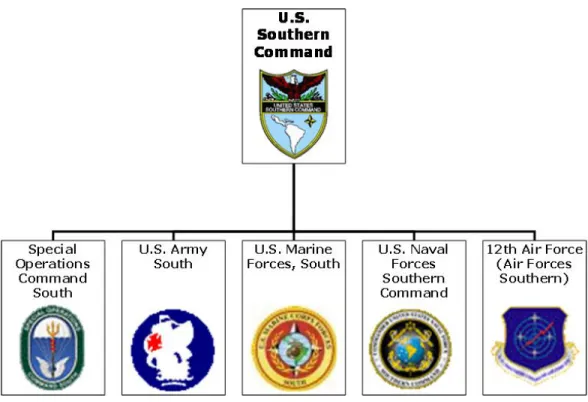
Through its execution of the regional war on terror plan, the Special Operations Command-South (SOCSOUTH), a component of the United States Southern Command (USSOUTHCOM) and USSOCOM, has acknowledged particular cultural, geographic, and/or political nuances within its area of responsibility (AOR). For instance, certain countries may be exceedingly sensitive to U.S. military presence within their borders while some may welcome as large a DoD presence as the U.S. government is willing to commit. Additionally, being culturally and politically attuned to regional intricacies enables the U.S. military to tailor operations for each specific country or sub-region.
11 Defense Security Cooperation Agency, “Security Assistance Organization (SAO) and
Responsibilities,” PowerPoint Presentation, April 2007,
http://www.disam.dsca.mil/Research/Presentations/4%20SAOResp.ppt (accessed August 22, 2007).
12 Andrew Hoehn, Testimony, May 1, 2002. 13 Andrew Hoehn, Testimony, May 1, 2002.
As a result, SOCSOUTH has divided its AOR into three major sub-regions. Consequently, SOCSOUTH has revised its approach to the command and control (C2) of all special operations forces (SOF) operating throughout Central and South America. The intent of this new C2 approach, called “Distributive C2,” is to facilitate rapid decision making, promote interagency coordination, and navigate the particular political environments within the SOUTHCOM AOR.14
Figure 1. SOUTHCOM Organization
A. PURPOSE
The purpose of this thesis is to conduct a thorough analysis of the SOCSOUTH Distributive C2 concept and propose recommendations for improvement of its effectiveness and efficiency. Using multiple theories of organizational design and recommendations based on personal observations and interviews, this thesis will propose a long term command and control structure for SOCSOUTH. The authors hope to provide SOCSOUTH and other theater special operations commands with a C2 structure
14 Captain Paul Brister, “Information Paper on SOCSOUTH Distributive Command and Control,”
that will allow them to better coordinate and prosecute its war on terror mission across multiple sub-regions and ensure proper integration into a larger global counter-terrorism strategic plan.
This thesis will determine if the SOCSOUTH Distributive C2 concept does improve its ability to prosecute its Regional War on Terror (RWOT). In this regard, this thesis will seek to answer the following questions:
• Does this new C2 concept improve SOCSOUTH’s speed in conducting RWOT operations?
• Does this new C2 concept improve SOCSOUTH’s flexibility to adapt as its terrorist opponent changes its methods and force structure?
• Does this new C2 concept improve SOCSOUTH’s integration into the interagency and the plans of higher commands?
• Does this new C2 concept improve SOCSOUTH’s ability to foster and achieve innovation in its approach to the RWOT?
B. RELEVANCE
According to the National Strategy for Combating Terrorism, “Today, the principal terrorist enemy confronting the United States is a transnational movement of extremist organizations, networks, and individuals.”15 Since this terrorist enemy is not thwarted by national, regional, or continental borders, a TSOC such as SOCSOUTH is forced to conduct operations across a wide range of political and social environments. Prior to 9/11 much of the U.S. military, TSOCs included, was focused on conventional warfare involving nation-states. The advent of the GWOT necessitated a doctrinal shift for the U.S. military. The new terrorist enemy transcends national boundaries, maintains no formal standing army, and is devoid of any centers of gravity which might be struck. Simple tools such as the internet prove a remarkable enabler for these terrorist organizations to plan and operate at a speed and precision that their forbearers of the
1980s did not enjoy.16 As a result, the U.S. military was forced into a paradigm shift regarding how best to combat the threat of the transnational terrorist.
SOCSOUTH’s logical question was how to organize a regionally focused special operations component command element to address this new threat. “Much like the Goldwater-Nichols Act accomplished for our Armed Forces two decades ago, we should assess what new or revised authorities are needed to enhance interagency coordination, and build a more joint and integrated process.”17
C. METHODOLOGY
Following the introduction, the second chapter of this thesis provides an overview of the terrorism threat assessment for the entire SOUTHCOM AOR. Each sub-region – the Andean Ridge (AR), the Southern Cone (SC), and the Caribbean and Central America (CCA) – is assessed for both its common and its region-specific characteristics.
The third thesis chapter is dedicated to a thorough explanation of SOCSOUTH’s Distributive C2 concept. This section examines the vision of SOCSOUTH’s commander, Brigadier General Charles Cleveland, who initiated this alternate approach. SOCSOUTH’s RWOT strategy is also reviewed followed by a description of its current C2 structure. Additionally, chapter three provides a comprehensive examination of SOCSOUTH’s Distributive C2 concept by defining and listing relevant characteristics. This section also describes organizational changes resulting from SOCSOUTH C2 structure, both at its headquarters and its forward operating locations. This chapter concludes with a review of just what the new Distributive C2 concept entails once fully implemented.
Chapters IV and V each focus on two of SOCSOUTH’s three new C2 nodes. Both of these chapters provide a general background on the command situation for that particular sub-region. The majority of each chapter discusses proposed recommendations
16 Gabriel Weimann, Terror on the Internet (Washington, DC: United States Institute of Peace Press,
2006).
17 General Peter Pace, Chairman of the Joint Chiefs of Staff, Testimony before the 110th
Congress, Senate Armed Services Committee on February 6, 2007, “Posture Statement of General Peter Pace, Chairman of the Joint Chiefs of Staff,” Congressional Record Daily Digest, 110th Congress, D141.
derived from personal observations, as well as individual interviews. The intent of these recommendations is to provide constructive improvements to SOCSOUTH’s Distributive C2 concept. The third C2 node, which encompasses the Caribbean and Central America, is not examined since it is still in the conceptual phase and SOCSOUTH has yet to begin any implementation.
Chapter VI introduces several military definitions of command and control and provides a discussion of organizational design principles that are relevant to Distributive C2. These definitions and principles are utilized to analyze SOCSOUTH’s Distributive C2 Concept.
The seventh chapter focuses on identifying overarching strengths and weaknesses with SOCSOUTH’s Distributive C2 concept. This chapter summarizes previous recommendations for improvement common to each sub-region. Once the analysis of the SOCSOUTH Distributive C2 concept is complete, this thesis will propose its own long-term Distributive C2 concept, based on SOCSOUTH’s original plan and the recommendations proposed by this thesis. The goal is to further improve SOCSOUTH’s coordination with subordinate elements which in turn will enable greater success for its RWOT missions. Consequently, SOCSOUTH’s effort should enable full integration into the larger USSOCOM plan for defeating global terror networks.
II. THE
TERRORISM
THREAT
ASSESSMENT FOR SOCSOUTH
If he attacks Iran, in two minutes Bush is dead…We are Muslims. I am Hezbollah. We are Muslims, and we will defend our countries at any time they are attacked.18
Mustafa Khalil Meri, Young Arab Muslin from Paraguay, quoted in interview on MSNBC
A. INTRODUCTION
Historically, the U.S. response to economic, political, and military issues in Latin America and the Caribbean has varied greatly, but has generally focused on partnerships. America’s regional foreign policy has ranged anywhere from Franklin D. Roosevelt’s
Good Neighbor Policy to John F. Kennedy’s Alliance for Progress. The Bush Administration’s grand strategy for the SOUTHCOM AO is termed Partnership for the Americas.19 The current policy views most issues through the national security lens of the global war on terrorism (GWOT).
Partnership for the Americas not only emphasizes partnering with nations but also between multiple U.S. agencies and non-government organizations (NGOs) operating throughout the region. United States Southern Command’s Strategy 201620 is a ten-year endeavor broken down into five phases. USSOUTHCOM recognizes that there is little potential for major combat operations between two or more nations in Latin America and the Caribbean. Furthermore, Strategy 2016 recognizes that all elements of
18 Pablo Gato and Robert Windrem, “Hezbollah Builds a Western Base: From Inside South America’s
Tri-Border Area, Iran-linked Militia Targets U.S.,” NBC News, May 9, 2007,
http://www.msnbc.msn.com/id/17874369 (accessed September 21, 2007).
19 U.S. Southern Command, United States Southern Command Strategy 2016. Miami, FL, March
2007. http://www.southcom.mil/AppsSC/pages/ ourMission.php (accessed September 19, 2007).
American power must now collectively focus on how the U.S. can help mitigate the crime, corruption, poverty, and terrorism problems that challenge “security, stability, and prosperity” in the region.21
General policy statements do not completely define U.S. strategy for Latin America and the Caribbean because broad policies and strategies do not address the myriad of local issues at the country level and below. American relations with individual nations in the region vary dramatically from the highest levels of cooperation on trade agreements and security issues on one extreme to an absence of diplomatic relations and trade embargos on the other. This was a driving factor behind SOCSOUTH partitioning its area of responsibility into three major sub-regions. These sub-regions include the Southern Cone, which includes the troublesome Tri-Border area (TBA) of Paraguay, Brazil, and Argentina, the Andean Ridge of northern South America, and the Caribbean and Central America (CCA). Each of these sub-regions possesses unique problems that require multi-disciplined approaches from SOCSOUTH.
B. THE SOUTHERN CONE
Within the Southern Cone, USSOUTHCOM has identified internal government corruption at all levels and the growing presence of Islamic extremists in the largely ungoverned TBA as the greatest threats to U.S. national security. According to a recent report to Congress,
The TBA has long been used for arms and drug trafficking, contraband smuggling, document, and currency fraud, money laundering, and the manufacture and movement of pirated goods. The terrorism report maintains that the United States remains concerned that Hezbollah and Hamas are raising funds among the sizable Muslim communities in the region but stated that there was no corroborated information that these or other Islamic extremist groups had an operational presence in the area. Allegations have linked Hezbollah to two bombings in Argentina: the
1992 bombing of the Israeli Embassy in Buenos Aires that killed 30 people and the 1994 bombing of the Argentine-Israeli Mutual Association in Buenos Aires that killed 85 people.22
In addition, a recent investigation by NBC news supports claims of an extensive smuggling network operated by Hezbollah in this area. This joint Telemundo/NBC investigation discovered that “the operation funnels large sums of money to militia leaders in the Middle East and finances training camps, propaganda operations and bomb attacks in South America.”23 The report also details how these individuals carry Latin American passports, speak Spanish, and generally pass themselves off as Hispanic. This fact has major implications when coupled with the current U.S. immigration reform debate. If undocumented migrant workers can illegally enter the United States seemingly with ease, then logically the same holds true for terrorists.
At this time Hezbollah is designated by the U.S. State Department as a terrorist organization. Clearly Hezbollah is taking advantage of the ungoverned space and the lucrative drug and human smuggling trade networks that extend through to the Andean Ridge, Central America, and the Caribbean. This terrorist organization is already known to have a presence in the United States.24 Prior to 9/11, Hezbollah was responsible for more American deaths than Al Qaeda. While one operation in the United States was derailed by law enforcement,25 given Hezbollah’s tenacity it is likely that they are continuing to operate from within America’s borders.
To help combat terrorist operations the governments of Paraguay, Argentina, Brazil, and the United States, have committed to regional cooperation through the “3+1” mechanism on security in the Tri-Border Area. In December 2006, delegations from these nations met and established a comprehensive strategy for containing terrorism and
22 Congressional Research Service, Latin America: Terrorism Issues, by Mark P. Sullivan
(Washington, DC: Government Printing Office, January 22, 2007).
23 Gato and Windrem, “Hezbollah Builds a Western Base.”
24 Daniel Pipes, “Hezbollah in America: An Alarming Network,” The National Review Online (August
28, 2000), http://www.danielpipes.org/ article/349 (accessed September 25, 2007).
25 David Asman, “Hezbollah Inside America: FOX News Tells All in Documentary,” Fox News, 18
January 2007, http://www.foxnews.com/ printer_friendly_story/0,3566,244002,00.html (accessed September 25, 2007).
other illegal activities in the TBA.26 Unfortunately, it is too early to ascertain whether the 3+1 group’s effort will bear any fruit.
C. THE ANDEAN RIDGE
The highly profitable cocaine trade prominent in the Andean Ridge is one of the main enterprises fueling smuggling networks in the TBA. The illegal Andean drug industry has deeply penetrated the global markets and is currently helping to sustain violent guerrilla groups such as Las Fuerzas Armadas Revolucionarias de Colombia (FARC) (Revolutionary Armed Forces of Colombia) and El Ejército de Liberación Nacional (ELN) (National Liberation Army). Both FARC and ELN have been designated terrorist organizations by the U.S. State Department. Although they have lost some momentum recently, both groups continue to pose a threat to the Colombian government and American forces stationed there.
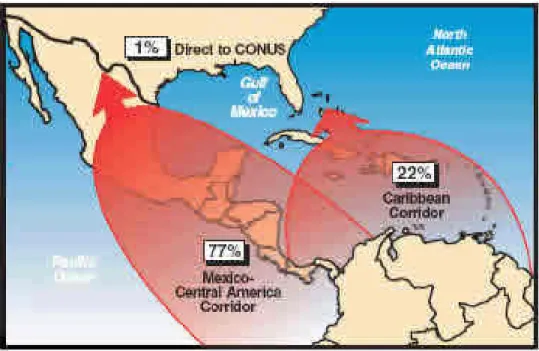
Due to an enduring relationship with Colombia, however, the United States is able to collaborate on issues of major concern to both. The Andean Counterdrug Initiative (ACI) is the primary U.S. program that supports Plan Colombia and is largely focused on combating drug trafficking and spurring economic development in the region. According to recent reporting, 90% of all cocaine that reaches the United States originates or passes through Colombia.27 The cocaine produced in the Andean Ridge moves through two main corridors in the CCA, the Mexico-Central American corridor and the Caribbean corridor (see Figure 2).
26 U.S. Department of State, Communiqué of the 3+1 group on Tri-border Area Security, Prepared by
the Counterterrorism Office, http://www.state.gov/s/ct/rls/other/39706.htm (accessed June 8, 2007).
27 Congressional Research Service, “Andean Counterdrug Initiative (ACI) and Related Funding
Programs: FY2005 Assistance,” by Connie Veillette (Washington, DC: Government Printing Office, May 10, 2005).
Figure 2. Cocaine Flows to the United States in 200328
D. THE CARIBBEAN AND CENTRAL AMERICA
While the Southern Cone, Andean Ridge, and CCA each have distinct security concerns, these issues are all interrelated. Stability in the Andean Ridge directly translates into interdiction worries for the CCA. In order for drug cartels to move their product into the U.S., drug dealers use the extensive smuggling networks that spread throughout Central America and the Caribbean. The CCA is host to thousands of points of origin from which illegal drugs and human cargo are transported into the United States. Revenue generated from the drug trade can potentially flow back to Islamic extremists operating from within the Southern Cone’s TBA and help finance terrorist operations throughout the western hemisphere. In addition, the CCA is host to a growing gang problem that spans Mexico and the United States.
To help combat these threats USSOUTHCOM has a semi-permanent joint task force (JTF Bravo) at Soto Cano Air Base, Honduras in order to provide security assistance to partner nations in Central America.
28 U.S. Department of Justice, National Drug Threat Assessment 2005 Summary Report, Prepared by
the National Drug Intelligence Center, February 2005, http://www.usdoj.gov/ndic/pubs11/ 13846/cocaine.htm (accessed June 8, 2007).
While not directly related to drug interdiction, the United States has several mostly economic collateral missions which affect relations in the CCA. For example, the U.S. has a trade embargo with Cuba that dates back to 1961. However, Cuba recently discovered large quantities of oil within its territory. A 2006 report by the U.S. Geological Survey confirmed that, “the North Cuba Basin held a substantial quantity of oil — 4.6 billion to 9.3 billion barrels of crude and 9.8 trillion to 21.8 trillion cubic feet of natural gas.”29 This recent discovery could have a far-reaching impact on the U.S. position towards Cuba given that other countries such as China, India, Norway, Spain, Canada, Venezuela, and Brazil have already shown interest in this new find.
An example of a more cooperative economic enterprise is the Central America-Dominican Republic-United States Free Trade Agreement (CAFTA-DR). Thus far membership has been extended to Costa Rica, the Dominican Republic, El Salvador, Guatemala, Honduras, and Nicaragua. This trade agreement is the second largest U.S. export market in Latin America behind a similar one with Mexico.30 The countries affected by CAFTA-DR are some of the poorest in the region. In order for this endeavor to succeed the U.S. must focus on poverty reduction through a host of civil programs throughout the region.
E. CONCLUSION
In conclusion, there are several programs favorable to the United States in Latin America and the Caribbean. These are focused on economic development, regional security and stability, crime and corruption issues, and trade negotiations. However, when crafting strategies at the country level and below, a certain degree of ambiguity arises between the U.S. Departments of State and Defense as to which is the lead agency.31 This difficulty comes to light when both departments have concurrent presence
29 Todd Lewan, “Cuban Discovery Could Pour Oil on Troubled Waters,” Associated Press, July 30,
2006, http://www.signonsandiego.com/ uniontrib/20060730/news1n30oil.html (accessed April 28, 2007).
30 Free Trade Agreement, “U.S. CAFTA-DR Free Trade Agreement, How can U.S. Companies
Benefit,” U.S. Government Export Portal, http://www.export.gov/fta/CAFTA/index.asp?dName=CAFTA
(accessed April 29, 2007).
31 Robert B. Oakley and Michael Casey, Jr., “The Country Team: Restructuring America’s First Line
and conflicting programs or operations in a particular sub-region or country. Conflict resolution usually results from internal bureaucratic compromises.
National policy should place more emphasis on the sub-regional rather than the regional level. A shift in focus from big to small could have a positive impact where the real policy decisions are implemented. Success requires the unified efforts of numerous American entities employed in the region through carefully coordinated campaigns developed at each country team.
III. SOCSOUTH’S DISTRIBUTIVE COMMAND AND CONTROL
CONCEPT
The Romans said, and I quote, “If you would have peace, you must be prepared for war.” And while we pray for peace, we can never forget that organization, no less than a bayonet or an aircraft carrier, is a weapon of war. We owe it to our soldiers, our sailors, our airmen, and our marines to ensure that this weapon is lean enough, flexible enough, and tough enough to help them win, if God forbid, that even becomes necessary.32
Congressman Bill Nichols, Hearings for the Goldwater-Nichols Act, 1986.
A. INTRODUCTION
Recently, SOCSOUTH proposed, “the need to establish a flat, networked command and control architecture that incorporates multiple, tailored C2 nodes spread throughout South America.”33 To describe this C2 arrangement they have coined the term “distributive C2.” SOCSOUTH has determined that their current organizational structure is inadequate to respond effectively to emerging problems throughout the region based on taskings from USSOUTHCOM.
The term commonly used to describe their approach prior to distributive C2 is “swarmballing.”34 The premise behind “swarmball” is elementary: when a crisis arises whatever staff personnel are least busy are thrown at the problem. While expedient, the downside to this ad hoc method is that typically these individuals have little expertise with the country in question.
Distributive C2 transcends much of the traditionally accepted command and control concepts published in joint military doctrine. It also illustrates an important cultural transformation by some senior military leaders with regards to how the U.S.
32 Congressman Bill Nichols, Opening statement for the House Armed Services Committee on
February 19, 1986, “Reorganization of the Department of Defense,” Congressional Record, 99th Congress, 2d session, no. 99-53.
33 Captain Paul Brister, “Information Paper.”
34 Based on several interviews conducted at SOCSOUTH Headquarters, Homestead Air Reserve Base,
military integrates with other government agencies and partner nation colleagues towards a unified strategy for the SOUTHCOM AOR.
This chapter analyses SOCSOUTH’s distributive C2 concept. It begins with the vision of Brigadier General (BG) Charles Cleveland, SOCSOUTH’s commanding general, who initiated this concept. Additionally, this chapter reviews SOCSOUTH’s RWOT strategy followed by a description of the organization’s current C2 structure. This section then transitions to a detailed explanation of all facets of the SOCSOUTH distributive C2 concept. This chapter concludes with a review of the resulting organizational structure stemming from SOCSOUTH’s command and control endeavors.
B. BRIGADIER GENERAL CLEVELAND’S C2 POLYGON
After the terrorist attacks of 9/11, USSOCOM was tasked by the Secretary of Defense to plan and execute the global war on terror. As previously discussed, USSOCOM’s response in part, was to dramatically increase the size of its headquarters staff. Additionally, in May 2003 USSOCOM created the Center for Special Operations (CSO), to oversee this new role as a supported combatant command.35 The CSO “combines the intelligence (J2), operations (J3), and planning (J5) functions... [and serves] both as a force providing element and a GWOT warfighting cell.”36 At the CSO, liaison officers (LNOs) from multiple government agencies facilitate interagency coordination for counterterror efforts.
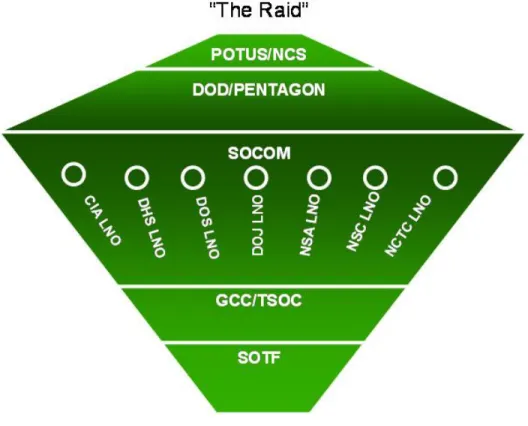
The CSO, however, does not have C2 of the majority of the SOF forces executing the GWOT. Most SOF are controlled by Theater Special Operations Commands (TSOC) that are components within each of DoD’s geographic combatant commands (GCCs). BG Cleveland labels this approach to the GWOT C2 as “The Raid” because this is how most direct action missions, such as raids, are conducted (See Figure 3).37
35 U.S. Special Operations Command, “Center for Special Operations (J2/J3/J5) (SCSO),” Special Operations Reference Manual, Hurlbert Field, FL: Joint Special Operations University Press, June 2005: Chapter 2-5.
36 U.S. Special Operations Command, “Center for Special Operations,” Chapter 2-5.
37 Brigadier General Charles Cleveland (Commander, Special Operations Command South), interview
Top-down directives, large higher headquarters, executive level interagency coordination are indicative of the Raid approach.
Figure 3. Current USSOCOM Approach to GWOT C238
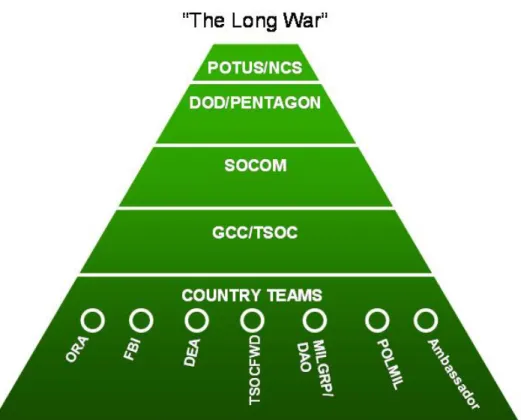
SOCSOUTH’s commanding general, however, has a different view of how headquarters should be staffed to lead the GWOT. BG Cleveland’s method, entitled “The Long War,” is a bottom-up structure with the majority of all interagency coordination occurring at the lowest level possible.39 In addition, his vision projects his staff officers forward into theater, a bold step towards decentralized execution. As discussed in the thesis introduction, each sub-region within Cleveland’s AO has unique cultural and political characteristics that keep a top-down, centralized plan from being as effective as possible. SOCSOUTH offers a smaller, more agile focus centered on U.S. Embassy country teams (See Figure 4). This is something that a larger, more cumbersome headquarters such as USSOCOM is unable to achieve.
38 Brigadier General Charles Cleveland, note given to authors, SOCSOUTH Headquarters, Homestead
Air Reserve Base, FL, May 7, 2007.
Figure 4. BG Cleveland’s Approach to GWOT C240
C. THE SOCSOUTH RWOT STRATEGY
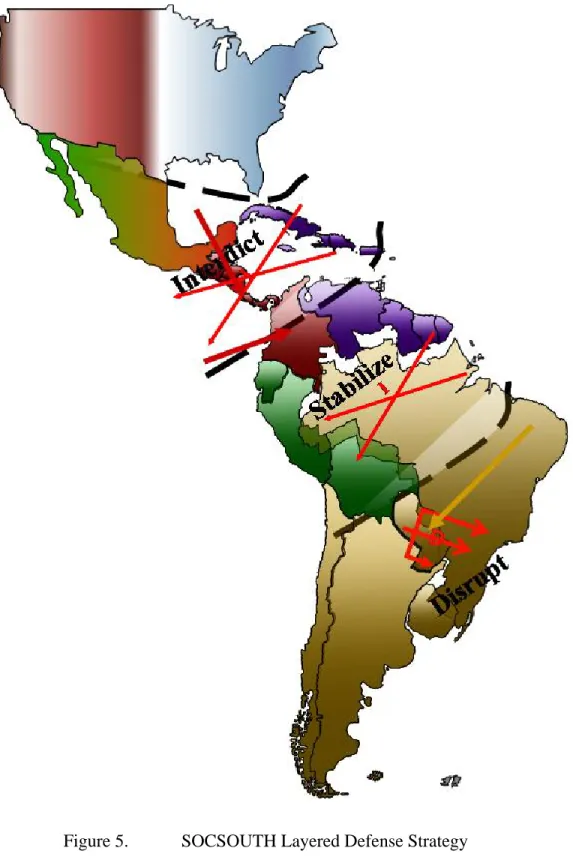
SOCSOUTH has deemed its overall strategy in its regional war on terror to be a “layered defense of the homeland”41 with the homeland being the United States (see Figure 5). According to SOUTHCOM’s Theater Security Cooperation Plan42 and
Command Strategy 201643, the three layers of this strategy are: disruption in the Southern Cone sub-region, stabilization in the Andean Ridge, and interdiction in the Caribbean and Central America.
40 BG Cleveland, note given to authors.
41 Special Operations Command-South Joint Operations Division, “Special Operations SOUTH
Distributive Command and Control COA Development,” PowerPoint Presentation, Homestead Air Reserve Base, FL, 2007.
42 U.S. Southern Command, Theater Security Cooperation Plan, Miami, FL, June 2007,
http://www.southcom.mil/AppsSC/pages/theaterSecurity.php (accessed September 19, 2007).
Figure 5. SOCSOUTH Layered Defense Strategy
The purpose of SOCSOUTH’s efforts in the Southern Cone (SC) is to disrupt transnational terrorist activities. The SC sub-region includes the South American countries of Brazil, Argentina, Chile, Uruguay, and Paraguay. Special operations forces
in this area integrate their operations with other USG and partner nation government activities. These same SOF forces also serve as advisors in regional shaping operations.44
In the Andean Ridge (AR), SOCSOUTH is focused on maintaining or increasing the stability of existing governments within the sub-region through a sustained SOF presence, as well as the targeting of high value narco-terrorist leaders. The AR is comprised of the nations of Venezuela, Colombia, Ecuador, Peru, and Bolivia. Here SOF forces provide coordination, counterterror planning assistance, intelligence support, operational preparation of the environment (OPE), and inter-agency liaison to many of these Andean governments. In addition, Joint and Combined Exchange Training (JCETs) are used to build relationships and maintain partner nation capacity.45
To accomplish its drug interdiction role in the Caribbean and Central American (CCA) zone, SOCSOUTH has two focused efforts. In Central America, SOF is used to increase US and partner capabilities by providing training at regional training centers, leveraging existing partner facilities, and funding new equipment and additional training. SOF also advises partner nation counterterror units and ensures they are capable of acting on behalf of internal security interests. In the Caribbean, interdiction is accomplished through the integrated efforts of the Joint Interagency Task Force-South’s (JIATF-S) counter-drug operations. These SOF elements provide full-time vessel support as well as maritime visit, board, search, and seize capabilities.46
Since disruption, stability, and interdiction operations all require different military assets, SOCSOUTH recognizes that these three distinct missions may also require different command and control arrangements. As a result, SOCSOUTH has eschewed a traditional military “one size fits all” approach with its Distributive C2 concept.
44 SOCSOUTH JOD, “SOCSOUTH Distributive C2 COA Development.” 45 SOCSOUTH JOD, “SOCSOUTH Distributive C2 COA Development.” 46 SOCSOUTH JOD, “SOCSOUTH Distributive C2 COA Development.”
D. ANALYSIS OF THE PREVIOUS SOCSOUTH C2 STRUCTURE
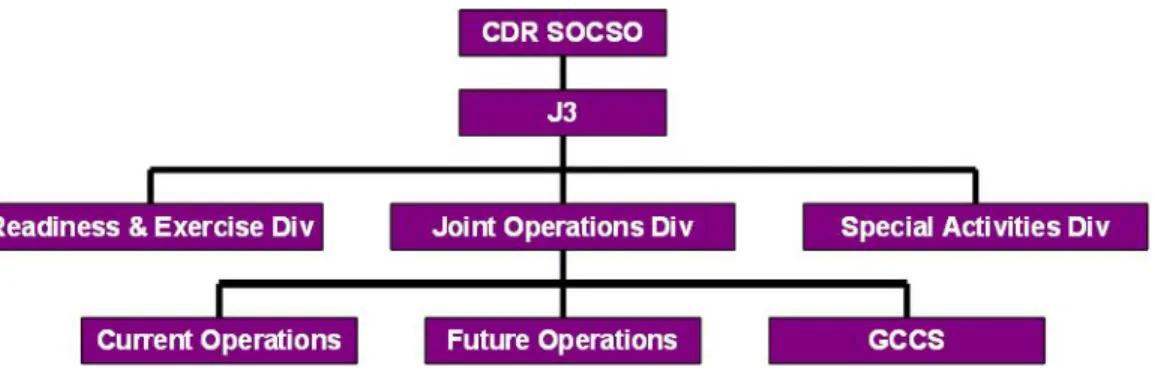
Before initiating its Distributive C2 concept, SOCSOUTH followed traditional doctrinal methods with regards to structuring command and control. The SOCSOUTH headquarters staff was organized along standard functional lines, as is typical of most US military staffs. Each staff function, be it command, administration, intelligence, operations, logistics, communications, etc., had its own joint directorate.
SOCSOUTH’s operations directorate, or J3, was divided into three divisions: the Readiness and Exercise Division, the Joint Operations Division (JOD), and the Special Activities Division. All matters related to current and future operations were managed from within the JOD.47
The JOD was, and still is, the center of gravity for the execution of the SOCSOUTH commander’s strategy and the C2 of all SOF operating with its AO.48 Previously the JOD was further task divided along functional lines – current operations, future operations, air operations, etc. – but in each case staffed only with enough personnel to focus on priority tasks. This led staff officers in the JOD to become Jacks-of-all-trades but masters of none. The end result was the aforementioned “swarmballing”.
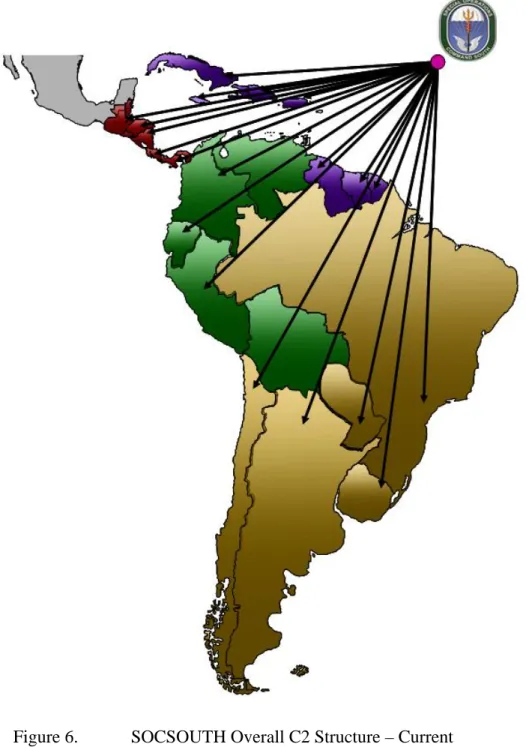
From its headquarters near Miami, FL, SOCSOUTH primarily oversaw the activities of its subordinate elements operating in theater. Each individual SOF element reported up to SOCSOUTH HQ for additional guidance, authority, and support that it could not obtain locally. SOCSOUTH did however previously deploy two small forward C2 elements into theater briefly (See Figure 6). Nonetheless, these elements were focused on specific missions inside single countries rather than being regionally focused. Consequently these forward C2 elements did not oversee the activities of other SOF elements operating within its area of interest outside its particular country.49
47 Special Operations Command-South Joint Operations Division, “Special Operations SOUTH
Distributive Command and Control Joint Operations Division Reorganization,” PowerPoint Presentation, Homestead Air Reserve Base, FL, 2007.
48 SOCSOUTH JOD, “SOCSOUTH Distributive C2 JOD Reorganization.” 49 SOCSOUTH JOD, “SOCSOUTH Distributive C2 JOD Reorganization.”
Figure 6. SOCSOUTH Overall C2 Structure – Current
The JOD’s ability to provide sub-regional situational awareness to the SOCSOUTH commander was limited due to its being a functionally oriented organization, manned only for priority tasks, consisting of multiple subordinate elements reporting to a single location. For example, prior to implementing its Distributive C2 concept, SOCSOUTH’s JOD Chief would post the various daily situation reports (SITREPs) from its subordinate units deployed into theater. However, since none of the
JOD personnel were permanently assigned to monitor a particular country or sub-region, they had no sense of ownership and waited to be assigned a particular operation or crisis—swarmball ensued. This hampered the commanding general’s ability to execute his RWOT.50 As detailed in subsequent sections of this thesis, the new Distributive C2 concept amends this by assigning each JOD member to a specific sub-region, thereby giving that individual a stake in the same.
E. DISTRIBUTIVE C2 DEFINED
In early 2006, SOCSOUTH personnel sought to determine what exactly “distributive C2” meant to their operations. Staff officers concluded their definition to be “a flat, networked command and control architecture that incorporates multiple, tailored C2 nodes, facilitates rapid decision making, interagency coordination and proper resourcing of special operations forces operating over vast geographic areas in support of the RWOT.”51
Within SOCSOUTH’s definition, distributive C2 has the following characteristics:52
• Capable of conducting interagency coordination at regional and country team levels
• Able to interface at the strategic, operational, and tactical levels.
• Emphasizes the local solution with commanders at forward locations with sufficient [command] authorities and resources to conduct operations.
• Have a small [logistics] footprint and the ability to operate with low visibility. • Maximizes reach back to SOCSOUTH headquarters.
• Networked both vertically and horizontally to maximize intelligence sharing. • Requires a regional focus.
50 SOCSOUTH JOD, “SOCSOUTH Distributive C2 JOD Reorganization.” 51 SOCSOUTH JOD, “SOCSOUTH Distributive C2 COA Development.” 52 SOCSOUTH JOD, “SOCSOUTH Distributive C2 COA Development.”
• Conduct operations over long durations (traditional joint task force C2 configurations are not conducive to this).
F. DISTRIBUTIVE C2 AT SOCSOUTH HEADQUARTERS
The implementation plan for the overall distributive C2 concept consists of two parts. The first aspect reorganizes the JOD from a functionally focused task organization to a regionally centered one. Previously, the various JOD sub-elements focused on functional issues such as air, maritime, or ground operations, to name a few (see Figure 7).
Figure 7. The Old J3 Directorate Task Organization
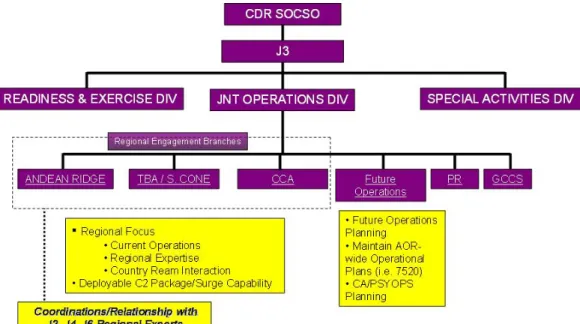
The nucleus of the new construct, however, is the creation of three Regional Engagement Branches (REBs), one for each sub-region. In addition to the three REBs, the JOD will also maintain a future operations cell, a personnel recovery cell, and a GCC support cell. The future operations cell will continue to conduct all near- and long-term planning, maintain all AOR-wide operational plans, and accomplish planning for civil affairs (CA) and psychological operations (PSYOPS) (See Figure 8).53
Figure 8. The New J3 Directorate Task Organization
The regional focus of each REB allows it to track current operations, gain regional expertise, and integrate into the country teams located within its sub-region. The REB can also serve as a deployable C2 package to surge into its sub-region to supplement existing SOCSOUTH command elements already in place. The REBs will also have the following capabilities:54
• Detailed tracking of current operations.
• Development and/or approval of operational concepts.
• Reception of mission in-briefs and out-briefs of deployed SOF in their sub-region.
• Coordination and scheduling of airlift assets.
• Coordination of SOF operations with other SOUTHCOM forces [in theater]. • Building and maintaining relationships with embassy country teams.
• Conduct and coordinate in-country assessments and VIP visits.
54 Special Operations Command-South Joint Operations Division, “Configuring the TSOC to CS the
• Providing support to SOCSOUTH intelligence assets.
• Coordinating and building relationships with regional experts located in the other [functional] sections of the SOCSOUTH staff.
G. DISTRIBUTIVE C2 BY SUB-REGION
The second aspect for implementing SOCSOUTH’s Distributive C2 concept is centered on establishing forward deployed command and control nodes. These C2 nodes, or SOC Forwards (SOCFWDs), coordinate directly with each REB and oversee all SOF operations within its sub-region. To reiterate, one node, is dedicated to the Andean Ridge, one to the Southern Cone, and two smaller C2 cells to the Caribbean and Central America (one in each area). The SOCFWDs in the Andean Ridge and the Southern Cone are in the early stages of implementation, while the C2 cells in the CCA are still in the conceptual phase. For purposes of operational security, the location of these SOCFWDs may not be disclosed.
Each SOCFWD/C2 node is empowered with certain command authorities to streamline the execution of special operations. Specifically, the node synchronizes all missions with strategic objectives as determined by the commanding general. In addition to the ability to authorize and C2 operations, each C2 node will have the ability to provide some logistical support to its assigned SOF elements. Also, the SOCFWDs will have small intelligence and administrative capabilities and the authority to coordinate with the appropriate US Embassy or partner nation agencies for additional support needs. Lastly, each C2 element will possess the capability to send and receive communications through a variety of mediums twenty-four hours a day, seven days a week.55
1. The Andean Ridge
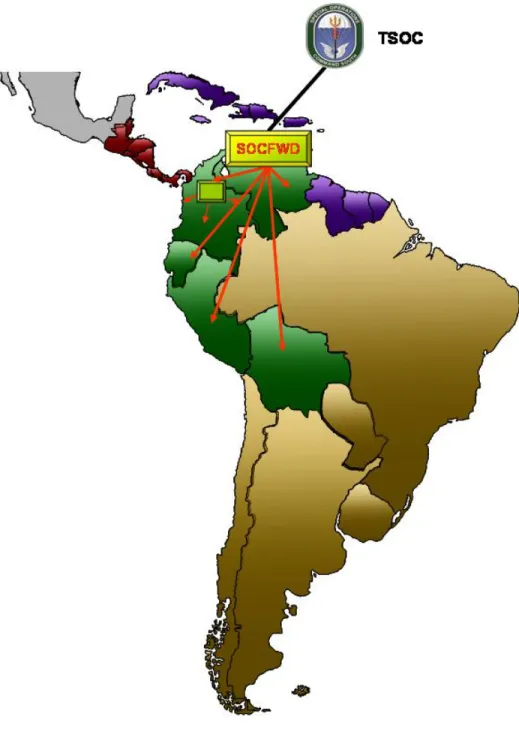
The first sub-region allocated a SOCFWD C2 node was the Andean Ridge. Currently, the AR node is dedicated to personnel recovery and high value target “snatch and grab” operations. However, at a time to be determined by SOCSOUTH’s
55 SOCSOUTH personnel, interview by authors, SOCSOUTH Headquarters, Homestead Air Reserve
Base, FL, on May 7, 2007. Based on operational security reasons, all interviews were conducted in confidentiality with the names of interviewees being withheld.
Commanding General, this node will transition operations to include the full scope of the Distributive C2 concept. Consequently, the AR C2 node will encompass all SOF elements operating within its sub-region. Additionally, the Andean Ridge SOCFWD will begin coordinating and synchronizing SOF operations with relevant US Embassy country team members, non-government organizations (NGOs), and PN agencies.56
When fully operational, the AR C2 node will have operational control of all SOF operating within its sub-region. This SOCFWD will be the focal point between the SOCSOUTH headquarters at Homestead Air Reserve Base (HARB) and SOF operating within the sub-region (see Figure 9). It will also maintain regional situational awareness, make assessments on partner nation capabilities, and support intelligence operations.57
Currently, this C2 node resides inside the US embassy compound of one of the countries in its sub-region. For force protection issues only, SOCFWD is under the tactical control of the Security Assistance Organization operating in that US Embassy and has a memorandum of agreement (MOA) with it for some minor administrative and logistical support.
56 SOCSOUTH JOD, “SOCSOUTH Distributive C2 COA Development.” 57 SOCSOUTH JOD, “SOCSOUTH Distributive C2 JOD Reorganization.”
Figure 9. The Andean Ridge SOC Forward Concept
2. The Southern Cone
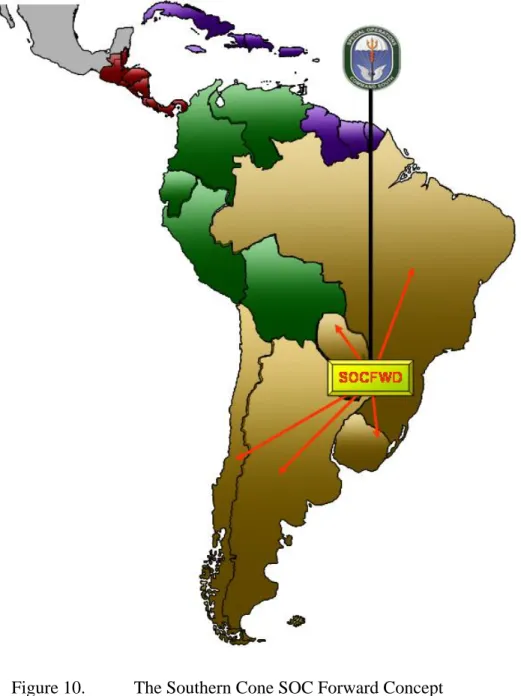
The second of these SOCFWD C2 nodes was established in the Southern Cone. This element’s operations are currently focused on the Tri-Border Area of Brazil, Paraguay, and Argentina. Once fully operational, this SOCFWD node will be
responsible for the command and control of all SOF operating with the Southern Cone sub-region. As with its Andean counterpart, this SOCFWD will also be responsible for the coordination and synchronization of all SO within its AOR.
When fully operational as a SOCFWD, this C2 node will also have operational control for all SOF operating within the SC. It will also be responsible for ensuring that all unconventional warfare shaping operations are nested and synchronized within the RWOT plan, maintaining regional situational awareness, and developing operational counters to Tri-Border threats (see Figure 10).58
As with its Andean Ridge counterpart, this C2 node also resides inside the US embassy compound of the one of the countries in its specific sub-region. A virtually identical agreement exists between the SOCFWD and the applicable Security Assistance Organization with regards to force protection and other levels of minor support.
Figure 10. The Southern Cone SOC Forward Concept
3. The Caribbean and Central America
While still in the conceptual phase, the SOCFWD structure for the Caribbean and Central American (CCA) area is unique. Within this sub-region there will be two smaller C2 cells reporting to the CCA REB at SOCSOUTH headquarters. One of these CCA C2 cells will operate inside the Caribbean while the other will be located on the mainland in Central America. Once moved from the conceptual to the operational phase, the task of these two C2 cells will be the same, namely the command and control of all SOF
operating within its AOR. Each will also be responsible for synchronizing and coordinating all special operations within it sub-region.59
The reason for having these two small C2 cells, as opposed to one larger SOCFWD, is the CCA’s two distinct operating environments. While both support the overall task of drug interdiction, in Central America this objective is accomplished through the use of ground forces, while in the Caribbean this is achieved with maritime elements. Hence the two separate C2 cells.
Despite their smaller size, these C2 cells will still possess many of the same responsibilities and capabilities of the larger SOCFWDs. Each cell will have operational control of all SOF in its AOR, will maintain regional situational awareness, and develop operational concepts for interdiction operations (see Figure 11).60
Similar to the other two C2 nodes, SOCSOUTH intends for each of these C2 cells to also reside within a US Embassy compound in a country within its AO. As with the two SOCFWDs, these two CCA C2 cells will be under the tactical control of the applicable U.S. Embassy’s Security Assistance Organization only with regards to force protection issues. Additionally, these cells will also maintain MOAs for minor administrative support.61
59 SOCSOUTH JOD, “SOCSOUTH Distributive C2 JOD Reorganization.” 60 SOCSOUTH JOD, “SOCSOUTH Distributive C2 JOD Reorganization.” 61 SOCSOUTH JOD, “SOCSOUTH Distributive C2 JOD Reorganization.”
Figure 11. The CCA C2 Cell Concept
H. REVIEW OF THE NEW OVERALL SOCSOUTH DISTRIBUTIVE C2
STRUCTURE
The overall Distributive C2 concept is an effort to acquire regional expertise, develop regional as opposed to task focus, and improve the speed at which tactical operations are planned, resourced, and authorized. As discussed previously, due to
cultural and political sensitivities, SOCSOUTH believes a regional orientation to be superior to a task organized one. As a result, the new C2 arrangements are the same or very similar but they allow different approaches to develop in each sub-region.
Additionally, rather than a multitude of SOF elements reporting up to the JOD for action, support, and assistance, this Distributive C2 concept attempts to push assets away from SOCSOUTH headquarters and into the actual theater of operations.
The chain of command and support now moves from the individual SOF element operating in a particular country to its sub-region’s SOCFWD/C2 cell. The SOCFWD then reports to SOCSOUTH through their respective REB. As many issues as possible will be resolved at the C2 node level. This chain works in reverse for issues generated from the top-down (see Figure 12).
Figure 12. The SOCSOUTH Distributive C2 Concept
I. CONCLUSION
The purpose of this chapter was to explain the SOCSOUTH Distributive C2 concept. This chapter began with Brigadier General Cleveland’s vision of what the C2 structure for the GWOT should be centered on. This vision was the catalyst for his Distributive C2 concept. After BG Cleveland’s vision, the SOCSOUTH strategy for its RWOT was reviewed, followed by a description of the current SOCSOUTH C2 structure. This chapter then provided SOCSOUTH’s refined definition of Distributive C2 and its
characteristics. Then the chapter detailed the task, purpose, and responsibilities for each of the two parts of this new concept: the establishment of REBs within the JOD and the creation of SOWFWDs/C2 nodes within each sub-region. This chapter concluded with a review of the end state for SOCSOUTH’s fully operational C2 structure.