Title
A galloping quadruped model using left-right asymmetry in
touchdown angles.
Author(s)
Tanase, Masayasu; Ambe, Yuichi; Aoi, Shinya; Matsuno,
Fumitoshi
Citation
Journal of biomechanics (2015), 48(12): 3383-3389
Issue Date
2015-09-18
URL
http://hdl.handle.net/2433/202761
Right
© 2015. This manuscript version is made available under the
CC-BY-NC-ND 4.0 license
http://creativecommons.org/licenses/by-nc-nd/4.0/; The
full-text file will be made open to the public on 18 September 2016
in accordance with publisher's 'Terms and Conditions for
Self-Archiving'.; この論文は出版社版でありません。引用の際
には出版社版をご確認ご利用ください。This is not the
published version. Please cite only the published version.
Type
Journal Article
A galloping quadruped model using left–right
asymmetry in touchdown angles
Masayasu Tanasea, Yuichi Ambea, Shinya Aoib,c,∗, Fumitoshi Matsunoa
aDept. of Mechanical Engineering and Science, Graduate School of Engineering, Kyoto
University, Kyoto Daigaku-Katsura, Nishikyo-ku, Kyoto 615-8540, Japan
bDept. of Aeronautics and Astronautics, Graduate School of Engineering, Kyoto University,
Kyoto Daigaku-Katsura, Nishikyo-ku, Kyoto 615-8540, Japan
cJST, CREST, 5 Sanbancho, Chiyoda-ku, Tokyo 102-0075, Japan
Abstract
Among quadrupedal gaits, the galloping gait has specific characteristics in terms of locomotor behavior. In particular, it shows a left–right asymmetry in gait parameters such as touchdown angle and the relative phase of limb movements. In addition, asymmetric gait parameters show a characteristic dependence on locomotion speed. There are two types of galloping gaits in quadruped ani-mals: the transverse gallop, often observed in horses; and the rotary gallop, often observed in dogs and cheetahs. These two gaits have different footfall se-quences. Although these specific characteristics in quadrupedal galloping gaits have been observed and described in detail, the underlying mechanisms remain unclear. In this paper, we use a simple physical model with a rigid body and four massless springs and incorporate the left–right asymmetry of touchdown angles. Our simulation results show that our model produces stable galloping gaits for certain combinations of model parameters and explains these specific characteristics observed in the quadrupedal galloping gait. The results are then evaluated in comparison with the measured data of quadruped animals and the gait mechanisms are clarified from the viewpoint of dynamics, such as the roles of the left–right touchdown angle difference in the generation of galloping gaits and energy transfer during one gait cycle to produce two different galloping
∗Corresponding author
gaits.
Keywords: Galloping gait, Quadruped, Model, Touchdown angle, Left–right
asymmetry, Center of mass movement, Energy transfer
1. Introduction 1
Quadruped animals use various gaits depending on the locomotion speed.
2
They use a walking gait in the lowest range of locomotion speed, and this
3
changes to a trotting gait as the locomotion speed increases. In the highest range
4
of locomotion speed, they use a galloping gait. These gaits are characterized by
5
footfall sequence [32]. During gaits used at slow speeds, such as a walking gait,
6
at least one limb is in contact with the ground, that is, in the stance phase. In
7
contrast, gaits used at higher speeds, such as a galloping gait, have a flight phase
8
during which all four limbs are in the air, that is, in the swing phase. These
9
gaits have been investigated from mechanical, energetic, kinematic, and kinetic
10
viewpoints to clarify the underlying mechanism for the use of such different gaits
11
depending on the locomotion speed [1, 13, 22, 23, 24, 31].
12
Among these quadrupedal gaits, the galloping gait has characteristic
prop-13
erties. Differing from the walking and trotting gaits, the galloping gait is
asym-14
metric [1, 22, 23]. More specifically, the relative phase of the movements between
15
the left and right limbs is away from the antiphase, unlike the walking and
trot-16
ting gaits, as shown in Fig. 1A. In addition, as the locomotion speed increases,
17
the relative phase decreases and approaches the in-phase as in a bounding gait,
18
which is not generally used by large, cursorial quadrupeds [26]. There are two
19
types of galloping gaits in quadruped animals, the transverse gallop and the
20
rotary gallop, and the two gaits have different footfall sequences (Fig. 1B) [22].
21
The transverse gallop is the preferred gait of horses, and the foot contacts take
22
place in the order of a hindlimb, the contralateral hindlimb, the ipsilateral
fore-23
limb, and the contralateral forelimb. The rotary gallop is the preferred gait of
24
dogs and cheetahs, and the foot contacts occur in the sequence of a hindlimb, the
0 0.2 0.4 0.6 0.8 0.1 0.3 1 3 10 30
Relative phase [rad]
Froude number Dog Sheep Camel Indian Rhinoceros White Rhinoceros Ferret Rat Jird Coypu Gallop Walk, Trot π π π π π
A
0 20 40 60 80 100 Gait cycle [%] 0 20 40 60 80 100 Gait cycle [%] TH (Left Hind) TF (Left Fore) LF (Right Fore) LH (Right Hind)Transverse Gallop Rotary Gallop
B
TH (Left Hind) TF (Right Fore) LF (Left Fore) LH (Right Hind)
Figure 1: Characteristics of the quadrupedal galloping gait. A: relative phase between left and right forelimbs of quadrupeds depending on locomotion speed (Froude number), modified from [1]. Although it remains almost antiphase in the walking and trotting gaits, it is away from the antiphase and approaches the in-phase in the galloping gait as the locomotion speed increases. B: footfall diagrams of the transverse gallop of horses and the rotary gallop of dogs and cheetahs, modified from [22]. The transverse gallop has a single flight phase after the liftoff of the forelimbs, while the rotary gallop has two flight phases after the liftoff of the hindlimbs and forelimbs. TH: trailing hindlimb, TF: trailing forelimb, LH: leading hindlimb, and LF: leading forelimb.
contralateral hindlimb, the contralateral forelimb, and the ipsilateral forelimb.
26
Both gallops have a flight phase after the liftoff of the forelimbs. In contrast, the
27
fast rotary gallop of dogs and cheetahs has another flight phase after the liftoff
28
of the hindlimbs, unlike the transverse gallop of horses [5, 23] (some species
29
show a rotary gallop with just one flight phase at low speeds [25]). Although
30
these specific characteristics in quadrupedal galloping gaits and the dependence
31
on the locomotion speed and species have been observed and described in
de-32
tail [1, 5, 22, 23], the underlying dynamic mechanisms remain unclear.
33
Locomotion in humans and animals involves moving the center of mass
34
(COM) of the whole body using the limbs. The essential contribution of a
limb in locomotion dynamics can be represented by a spring. To explain the
36
locomotion mechanisms from a dynamic viewpoint, spring-loaded inverted
pen-37
dulum models have been used [6, 7, 8, 9, 11, 16, 29, 30, 36]. In particular,
38
for human running, the dependence of stability on touchdown angles has been
39
clarified [17, 19, 38]. A simple model having mass and two springs has been
40
used to explain the characteristic difference between human walking and
run-41
ning, which appears in the vertical ground reaction forces: a double-peaked
42
shape in human walking, and a single-peaked shape in human running [18]. For
43
quadrupedal locomotion, a rigid body with two springy legs has shown the
sta-44
bility characteristics of a bounding gait [10, 35]. The difference in the energy
45
levels between the trotting, bounding, and galloping gaits also has been
exam-46
ined [33]. Although simple physical models with leg springs have been used
47
for the quadrupedal galloping gait [21, 26, 28, 33, 40], they do not explain the
48
above-mentioned specific characteristics. In this paper, we use a simple
physi-49
cal model with a rigid body and four massless springs. The simulation results
50
show that our model produces stable galloping gaits for certain combinations of
51
model parameters, and explains these specific characteristics in the quadrupedal
52
galloping gait. The results are then evaluated in comparison with quadruped
53
animals and the gait mechanisms are discussed from the viewpoint of dynamics.
54
2. Materials and Methods 55
2.1. Physical model 56
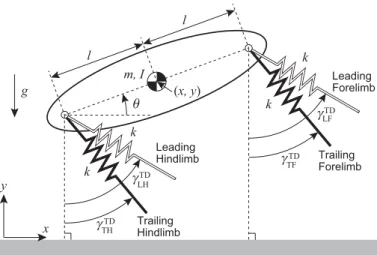
In this paper we use a physical model, which consists of a rigid body and
57
four massless springs in two dimensions (Fig. 2), as used in [33]. xand y are,
58
respectively, the horizontal and vertical positions of the COM of the body, and
59
θis the pitch angle. mandIare, respectively, the mass and moment of inertia
60
around the COM.lis the distance between the COM and the root of the spring.
61
g is the gravitational acceleration. +xis the locomotion direction. The front
62
two springs and the rear two springs represent the forelimbs and hindlimbs,
63
respectively. The spring constant isk. In the forelimbs, the anterior limb during
x y m, I l TF k k k k l θ (x, y) Leading Forelimb Trailing Forelimb γ LF γ LH γ TH γ Leading Hindlimb Trailing Hindlimb g TD TD TD TD
Figure 2: Physical model of galloping consisting of a rigid body and four massless springs in two dimensions.
the swing phase is the leading forelimb (LF) and the posterior limb is the trailing
65
forelimb (TF). Similarly, the anterior and posterior hindlimbs during the swing
66
phase are the leading hindlimb (LH) and trailing hindlimb (TH), respectively.
67
During the swing phase, the spring length remains the neutral lengthl0and
68
the angle relative to the vertical line keeps the specific valueγiTD (i=LF, TF,
69
LH, TH), which corresponds to the touchdown angle (γLFTD≥γTFTD,γTDLH ≥γTHTD).
70
We assumed γLFTD+γTFTD ≥ 0 and γLHTD+γTHTD ≥ 0 so that the trailing limbs
71
contact the ground earlier than the leading limbs, as observed in quadruped
72
animals. When a spring tip reaches the ground, it is constrained on the ground
73
and behaves as a frictionless pin joint. When the spring length returns to the
74
neutral length after the compression, the tip leaves the ground. Because the
75
touchdown and liftoff occur at the neutral length, this physical system is energy
76
conservative.
77
2.2. Governing equations 78
In our model, the four limbs have no influence on body dynamics during the
79
swing phase. In contrast, during the stance phase, they work as springs and
influence body dynamics through their compression. The motion of our model
81
is governed by the equations of motion ofx,y, andθ, which are given by
82 mx¨ = i=LF,TF,LH,TH −fisinγi my¨ = i=LF,TF,LH,TH ficosγi−mg Iθ¨ = i=LF,TF filcos(γi−θ)− i=LH,TH filcos(γi−θ) (1) where 83 fi = ⎧ ⎨ ⎩ −k(li−l0) stance phase 0 swing phase
li and γi (i =LF, TF, LH, TH) are the spring length and the angle relative
84
to the vertical line, respectively, which are determined by x, y, θ, l, and the
85
touchdown position (li=l0 andγi=γiTDduring the swing phase).
86
By using m, l0, and l0/g as the characteristic mass, length, and time
87
scale of our model, the state variables and parameters become dimensionless as
88
x∗ =x/l0, y∗ =y/l0, ˙()∗ = ˙()l0/g, I∗ =I/(ml02), k∗ =kl0/(mg),l∗ =l/l0,
89
andli∗=li/l0, which yields the dimensionless equations of (1) by
90 ¨ x∗ = i=LF,TF,LH,TH −fi∗sinγi ¨ y∗ = i=LF,TF,LH,TH fi∗cosγi−1 I∗θ¨∗ = i=LF,TF fi∗l∗cos(γi−θ)− i=LH,TH fi∗l∗cos(γi−θ) (2) where 91 fi∗ = ⎧ ⎨ ⎩ −k∗(li∗−1) stance phase 0 swing phase
2.3. Generation of galloping gait using the left–right asymmetry of touchdown 92
angles 93
An important function of limbs in locomotion dynamics is to produce
trans-94
lational and rotational forces for the whole body through interaction with the
A
B
Figure 3: Different touchdown angles of (A) trailing and (B) leading hindlimbs in the horse galloping gait.
ground. Such forces are generated through the movements of the limb tip
rel-96
ative to the limb root (length and orientation). During a steady gait, the limb
97
tip produces a periodic trajectory relative to the body. When the relative phase
98
between the left and right limb movements is antiphase, as in walking and
trot-99
ting gaits, the left and right limbs move alternately relative to the body and
100
the periodic trajectories are almost identical between the left and right limbs.
101
When the relative phase is in-phase, as in a bounding gait, the left and right
102
limbs move simultaneously and the periodic trajectories are also almost
identi-103
cal between the left and right limbs. In contrast, during a galloping gait, the
104
relative phase is not in-phase or antiphase as shown in Fig. 1Aand the periodic
105
trajectories differ between the left and right limbs, which leads to the difference
106
in touchdown positions relative to the body as shown in Fig. 3 [21]. That is,
107
the touchdown angles are different between the left and right limbs.
108
In our model, when we use identical touchdown angles between the left
109
and right limbs (γLFTD =γTFTD, γLHTD=γTHTD), foot contact occurs simultaneously
110
between the left and right limbs, which produces a bounding gait and a zero
111
relative phase between the left and right limbs. In contrast, different touchdown
112
angles (γLFTD = γTFTD, γLHTD = γTHTD) induce different foot contact timings and
113
positions between the left and right limbs and yield a galloping gait. In addition,
114
an increase in the touchdown angle difference indicates an increase in the relative
phase between the left and right limbs.
116
2.4. Search of periodic solutions and stability analysis 117
We define the Poincar´e section when ˙y∗= 0 and when all four limbs are in the
118
swing phase (the model is in the flight phase). We find a periodic solution, which
119
corresponds to a gait, by searching for a fixed point in the Poincar´e section,
120
where we neglect x∗ because the horizontal position monotonically increases
121
during locomotion. In addition, we assume that all four limbs have to experience
122
the stance phase at least once before the intersection with the Poincar´e section so
123
that the solution explains a gait. When we setz∗= [y∗θx˙∗θ˙∗]T, the Poincar´e
124
mapP is written as
125
zn∗+1=P(zn∗, u∗) (3)
wherezn∗ is the value ofz∗at thenth intersection with the Poincar´e section and
126
u∗ is the parameter set. When we denote ˆz∗for the fixed point on the Poincar´e
127
section, we obtain ˆz∗=P(ˆz∗, u∗).
128
In this paper, because the left–right touchdown angle differences are not
129
so different between the forelimbs and hindlimbs during galloping gaits [21],
130
we find gaits in which the differences in the left and right touchdown angles
131
are identical between the forelimbs and hindlimbs (γLFTD−γTFTD=γLHTD−γTHTD).
132
In this condition, we can write the touchdown angles using the difference δ 133
(≥0) byγLFTD= ¯γFTD+δ/2,γTFTD= ¯γFTD−δ/2, γLHTD = ¯γHTD+δ/2, and γTHTD =
134
¯
γTDH −δ/2 (¯γFTD,γ¯HTD ≥ 0), and the parameter set of this model is given by
135
u∗ = [I∗k∗l∗¯γFTDγ¯HTDδ]T. We used the following four constraints: ˆy∗ =y∗0,
136
ˆ
θ=θ0,ˆ˙θ∗= ˙θ0∗, and F r=F r0, where F r is the Froude number defined by
137 F r= 1 τ∗ τ∗ 0 x˙ ∗dt∗ 2 (4) and τ∗ is a dimensionless one gait cycle [1]. We determined I∗ = 0.1 and
138
l∗= 0.6 based on the physical parameters of such quadruped animals as horses,
139
dogs, cheetahs, and goats [15, 20, 25, 39], and usedy0∗ = 0.94 andθ0 = 0.018.
140
To clarify the dynamic characteristics of galloping gait of our model, we used
various values fork∗, ˙θ∗0, andF r0and searched ˆ˙x∗, ¯γFTD, ¯γHTD, andδthat satisfy
142
ˆ
z∗=P(ˆz∗, u∗), where we used thefsolvefunction of MATLAB.
143
When we found periodic gaits, we investigated the local stability from the
144
eigenvalues of the linearized Poincar´e map around the fixed points. Because
145
our model is energy conservative, the gait is asymptotically stable when all
146
the eigenvalues except for one eigenvalue of 1 are inside the unit circle (these
147
magnitudes are less than 1).
148
3. Results 149
We obtained various periodic gaits depending on F r0, k∗, and ˙θ0∗.
Fig-150
ures 4A and B show the angle difference δ for F r0 and k∗ for the obtained
151
gaits with ˙θ∗0 = 0.92 and 1.65, respectively. The gray regions show unstable
152
gaits and the white regions show stable gaits. The obtained gaits have different
153
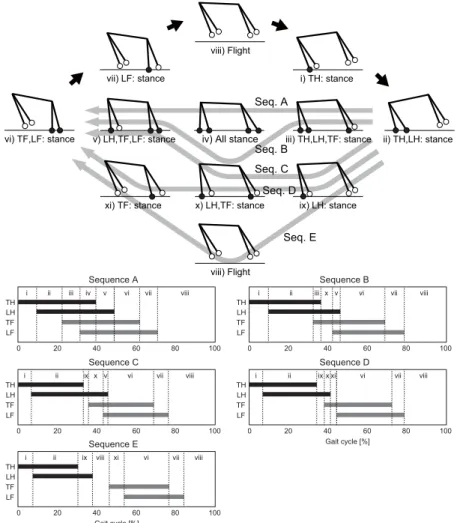
sequences of the stance status (Sequences A–E), depending on the parameters,
154
as shown in Fig. 5. The obtained gaits in Fig. 4Ahave Sequences A–E, whereas
155
those in Fig. 4B have only Sequence E. Sequences B and E correspond to the
156
transverse and rotary gallops, respectively, in Fig. 1B. In both Figs. 4A and
157
B, as the locomotion speed increases, δ decreases and approaches 0 (but, did
158
not reach 0). At slow speeds (small Froude number), the obtained gaits are
159
unstable, and when the locomotion speed increases, the gaits become stable.
160
The dimensionless spring stiffness was estimated as 7 [14] or 12 [27] for horses,
161
11 [14] for dogs, and 16 [14] for goats. The left–right touchdown angle difference
162
during galloping gaits was observed around 5 to 15◦ [21]. The Froude number
163
of various quadruped animals is shown in Fig. 1Aand about 3 during the
trans-164
verse gallop of goats [14], and is seen to be greater than 50 during the rotary
165
galloping of cheetahs [5]. Our simulation results are comparable with biological
166
data.
167
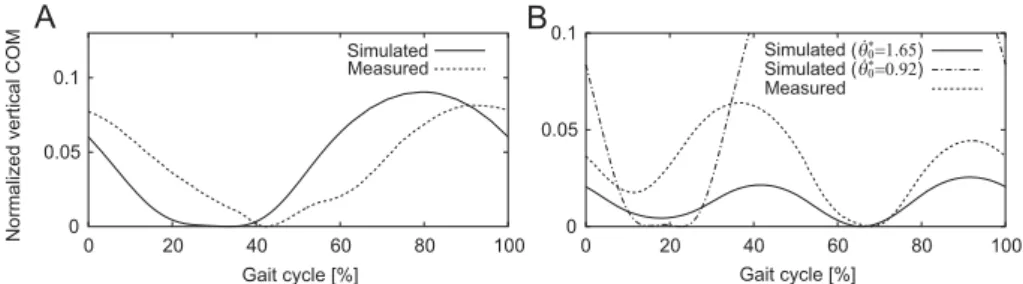
To evaluate the biological relevance of the obtained gaits, we compared the
168
vertical COM movement of our simulation results with data measured during
169
quadrupedal galloping gaits. In Fig. 6A, we used ˙θ∗0 = 0.92, F r0 = 14.4,
0 10 20 30 40 50 4.5 5 5.5 1 2 3 4 5 6 7 8 Froude number Fr0 Spring stiffness k∗ Angle difference [ ° ] A Seq. A Seq. B Seq. C Seq. D Seq. E 0 20 40 60 80 6 6.5 7 0 2 4 6 8 10 12 14 16 18 Froude number Fr0 Spring stiffness k∗ B Seq. E δ
Figure 4: Touchdown angle differenceδof obtained gaits for Froude numberF r0and spring stiffnessk∗ with (A) ˙θ0∗= 0.92 and (B) ˙θ∗0 = 1.65. Gray regions show unstable gaits, and white regions show stable gaits. Ahas five gaits (Sequences (Seqs.) A–E) depending onF r0 andk∗, whileB has one gait (Sequence E). Sequences A–E have different sequences of the stance condition, as shown in Fig. 5. The open dot (inA) and the black dots (inAandB) are the parameter sets used in Fig. 6 to compare vertical COM movement with the measured data for transverse and rotary gallops, respectively.
and k∗ = 5.1 (open dot in Fig. 4A) and compared the simulation result with
171
data measured during a transverse gallop by a horse (the Froude number is
172
around 18) [34]. The simulation result shows a single sinusoidal curve, and the
173
magnitude is similar to that of the measured data. The dimensionless spring
174
stiffness of a horse transverse gallop was estimated by 12 [27], and the simulation
175
result is fairly consistent with the measured data. In Fig. 6B, we used ˙θ0∗= 0.92,
176
F r0= 42.1, andk∗= 5.5 (black dot in Fig. 4A) and ˙θ∗0= 1.65,F r0= 25.7, and
177
k∗= 7.0 (black dot in Fig. 4B) and compared these simulation results with data
178
measured during a rotary gallop by a dog (the Froude number is about 20) [4].
179
The dimensionless spring stiffness of dogs was estimated by 11 [14]. When
180
˙
θ∗0 = 0.92, the simulation result is very different in shape and magnitude from
181
the measured data. In contrast, for ˙θ∗0= 1.65, although the magnitude is slightly
182
lower than the measured data, the simulation result shows a double sinusoidal
183
curve and has a similar shape to the measured data. This simulation result is
184
consistent with the measured data. See supplementary movies in Appendix A
185
for simulated locomotor behaviors.
TF LF TF LF TF LF TF LF TF LF viii) Flight i) TH: stance ii) TH,LH: stance iv) All stance iii) TH,LH,TF: stance
v) LH,TF,LF: stance vi) TF,LF: stance vii) LF: stance ix) LH: stance x) LH,TF: stance xi) TF: stance viii) Flight 0 20 40 60 80 100 TH LH Sequence A 0 20 40 60 80 100 TH LH Sequence B 0 20 40 60 80 100 TH LH Sequence C 0 20 40 60 80 100 Gait cycle [%] TH LH Sequence D 0 20 40 60 80 100 Gait cycle [%] TH LH Sequence E Seq. A Seq. B Seq. C Seq. E Seq. D v x ix iv vi vii viii iii ii
i i ii iiix v vi vii viii
xi x vi vii viii ii i v vi vii viii ii i xi
viii vi vii viii ix
ii i
ix
Figure 5: Schematic sequences of stance condition of obtained gaits: Sequences (Seqs.) A–E. TH: trailing hindlimb, TF: trailing forelimb, LH: leading hindlimb, and LF: leading forelimb.
To clarify the dynamical difference between the obtained transverse and
187
rotary gallops, we investigated the energy transfer during one gait cycle.
Fig-188
ures 7AandBshow the ratio of four components of the conservative mechanical
189
energy (the gravitational energy (zero at the bottom of the vertical COM
move-190
ment), forelimb and hindlimb spring energies, and kinetic energy) for ˙θ0∗= 0.92,
191
F r0 = 14.4, and k∗ = 5.1 (transverse gallop), and ˙θ∗0 = 1.65, F r0 = 25.7, and
192
k∗= 7.0 (rotary gallop), respectively. In the transverse gallop, the gravitational
193
and kinetic energies move to the hindlimb spring energy during the first half
Normalized vertical COM
A
Gait cycle [%]B
0 20 40 60 80 100 Simulated Measured Gait cycle [%] 0 20 40 60 80 100 Simulated (θ.0∗=1.65) Simulated (θ.0∗=0.92) Measured 0 0.05 0.1 0 0.05 0.1Figure 6: Comparison of vertical COM movement between the simulation results and measured data for one gait cycle between touchdowns of trailing hindlimbs during quadrupedal galloping gaits. A: transverse gallop using ˙θ0∗= 0.92, F r0 = 14.4, andk∗= 5.1. Measured data are based on [34] from a horse. B: rotary gallop using ˙θ∗0 = 0.92,F r0= 42.1, andk∗= 5.5 and
˙
θ∗
0= 1.65,F r0= 25.7, andk∗= 7.0. Measured data are based on [4] from a dog.
of the hindlimb stance phase. The energy transitions into the kinetic energy
195
during the last half of the stance phase, and then changes to the forelimb spring
196
energy due to the touchdown of the forelimbs. Finally, it moves back to the
197
gravitational and kinetic energies. In the rotary gallop, the gravitational and
198
kinetic energies transition into the hindlimb spring energy during the first half
199
of the hindlimb stance phase, similarly to the transverse gallop. However, the
200
energy returns to the gravitational and kinetic energies during the last half of
201
the stance phase unlike the transverse gallop. The similar energy transfer occurs
202
in the forelimb stance phase. Although the rotary gallop has the energy transfer
203
to the gravitational energy between the hindlimb and forelimb stance phases,
204
the transverse gallop does not have such an energy transfer. This difference
205
produces two types of galloping gaits; the transverse gallop with a single flight
206
phase and the rotary gallop with two flight phases.
207
4. Discussion 208
In this paper, we produced galloping gaits using a simple model with a rigid
209
body and four massless springs, and showed that the model can explain specific
210
characteristics in a quadrupedal galloping gait, such as dependence of left–right
0 20 40 60 80 100 Ratio [%] Gait cycle [%] A B 98 99 100 0 20 40 60 80 100 Gait cycle [%] Kinetic Hindlimb Forelimb spring spring Gravitational 93 94 95 96 97 98 99 100 Hindlimb Forelimb spring spring Kinetic Gravitational
Figure 7: Energy transfer during one gait cycle for (A) transverse gallop using ˙θ∗0 = 0.92,
F r0= 14.4, andk∗= 5.1 and (B) rotary gallop using ˙θ0∗= 1.65,F r0= 25.7, andk∗= 7.0.
asymmetry in gait parameters on the locomotion speed, from the viewpoint of
212
dynamics.
213
4.1. Asymmetric gait parameters 214
In quadrupedal galloping gaits, the relative phase between the left and right
215
limbs is away from the antiphase, irrespective of species, as shown in Fig. 1A[1].
216
In addition, the relative phase decreases and approaches in-phase as the
loco-217
motion speed increases; however, it does not reach complete in-phase. These
218
characteristics reflect the left–right asymmetry in touchdown angles, as shown
219
in Fig. 3 [21]. We focused on this asymmetry to produce the galloping gait of
220
our model. As the locomotion speed increased, the left–right touchdown
an-221
gle difference decreased and approached 0 (but did not reach 0), as shown in
222
Fig. 4. This means that the relative phase difference decreased and approached
223
in-phase. This trend is consistent with the observations in quadrupedal
gallop-224
ing gaits. Furthermore, the fact that there is no solution for the zero left–right
225
touchdown angle difference means that this asymmetry in touchdown angles
226
allows the model to produce periodic solutions for gaits, which may suggest an
227
important role of left–right asymmetry in touchdown angles in the locomotion
228
dynamics of galloping gaits.
4.2. Transverse and rotary gallops 230
There are basically two types of galloping gaits (transverse and rotary
gal-231
lops) in quadruped animals, and they have different footfall sequences as shown
232
in Fig. 1B. The transverse gallop observed often in horses has a single flight
233
phase after the liftoff of the forelimbs. In contrast, the fast rotary gallop
ob-234
served often in dogs and cheetahs has another flight phase after the liftoff of
235
the hindlimbs in addition to the flight phase after the liftoff of the forelimbs.
236
Our simulation results showed that our model produced various galloping gaits
237
depending on the parameters, which had different sequences of the stance
condi-238
tion (Sequences A–E), as shown in Fig. 5. As locomotion speed and spring
stiff-239
ness increased, the sequence of the stance condition changed from Sequence A
240
to E. Sequences B and E corresponded to the transverse and rotary gallops,
241
respectively (because we cannot determine left and right limbs due to the
two-242
dimensional nature of our model, we decided these gaits from the number of
243
flight phases). However, even when the sequences of the stance condition were
244
identical, the locomotor behavior of the obtained gaits, such as the vertical COM
245
movement, differed depending on the parameters, as shown in Fig. 6. Depending
246
on the model parameters, both the sequences of stance condition and locomotor
247
behavior of the obtained gaits were comparable to those in quadruped animals,
248
which was evaluated by comparing our simulation results with measured data of
249
quadruped animals. Although quadruped animals use these two different gaits
250
depending on the locomotion speed and species, our simple model can explain
251
these different gaits using only a few parameters.
252
The transverse gallop has a small relative phase between the forelimbs and
253
hindlimbs, while the rotary gallop has a large relative phase, as shown in Fig. 1B.
254
In our simulation results, different parameters produced different relative phase
255
between the forelimbs and hindlimbs, as shown in Fig. 5, which changed the
256
number of flight phases and induced different galloping gaits. While the relative
257
phase between the left and right limbs depends on the left–right touchdown angle
258
differenceδ, our modeling has no constraint on the relative phase between the
259
forelimbs and hindlimbs, which were only determined through gait dynamics
with parameters. The dynamic mechanism that creates two different gaits was
261
ascertained from the energy transfer during one gait cycle in Fig. 7. It has
262
been suggested that horse transverse galloping and human skipping gaits have a
263
similarity in the energy transfer between the leading and trailing limbs [30]. We
264
also intend to investigate the mechanism by improving our model in the future.
265
4.3. Gait stability 266
Gait stability is an important factor in dynamic locomotion, as investigated
267
in humans [17, 19, 38] and quadrupeds [2, 3, 10, 12, 35, 37]. Our simulation
268
results showed that the galloping gait of our model was stable depending on the
269
Froude number (Fig. 4). That is, our model had self-stability for a particular
270
locomotion speed. More specifically, our model generated stable galloping gaits
271
only at fast locomotion speeds (F r0 >5), which is consistent with the
obser-272
vation in quadrupedal galloping gaits as shown in Fig. 1A[1]. At slow speeds,
273
the obtained galloping gaits became unstable. This limitation of gait stability
274
due to the decrease in locomotion speed suggests a change of the gait to an
275
alternative gait, such as a trotting gait, to improve gait stability.
276
4.4. Limitation of our model and future work 277
In this study, we used a very simplified physical model for quadrupedal
gal-278
loping gaits. For example, the galloping quadruped animal was modeled by
279
a single rigid body and four massless springs, and symmetric assumptions
be-280
tween the forelimbs and hindlimbs were used in the model parameters, such
281
as the left–right touchdown angle difference δ and dimensionless spring
stiff-282
nessk∗. Such simplifications resulted in quantitative differences in locomotion
283
parameters from actual animals. However, it is clear that our model showed
284
similar trends in the asymmetric gait parameters for the locomotion speed
285
and in the generation of two different galloping gaits, which are
characteris-286
tic for quadrupedal galloping gaits, as was confirmed by the comparisons with
287
quadruped animals. This suggests that our simple model is capable of capturing
288
the essential aspects needed to generate the galloping gait in quadruped animals
from the viewpoint of dynamics. To further clarify the underlying mechanisms
290
in quadrupedal galloping gaits, we intend to develop a more sophisticated and
291
plausible model by incorporating important dynamical factors, such as
mus-292
cle actuators, frictional dissipation, and neuromechanical interactions, in future
293
studies.
294
Appendix A. Supplementary materials 295
We prepared two supplementary movies on the transverse and rotary gallops
296
obtained in our simulation:
297
1. Transverse gallop using ˙θ∗0= 0.92,F r0= 14.4, andk∗= 5.1.
298
2. Rotary gallop using ˙θ∗0= 1.65,F r0= 25.7, andk∗= 7.0.
299
Acknowledgment 300
This paper was supported in part by JST, CREST.
301
Conflict of interest statement 302
The authors have no conflict of interests.
303
References 304
[1] Alexander, R.McN., and Jayes, A.S., 1983.A dynamic similarity hypothesis 305
for the gaits of quadrupedal mammals, J. Zool., Lond., 201:135–152.
306
[2] Aoi, S., Yamashita, T., and Tsuchiya, K., 2011.Hysteresis in the gait transi-307
tion of a quadruped investigated using simple body mechanical and oscillator 308
network models, Phys. Rev. E, 83(6):061909.
309
[3] Aoi, S., Katayama, D., Fujiki, S., Tomita, N., Funato, T., Yamashita, T.,
310
Senda, K., and Tsuchiya, K., 2013.A stability-based mechanism for hystere-311
sis in the walk–trot transition in quadruped locomotion, J. R. Soc. Interface,
312
10(81):20120908.
[4] Bertram, J.E.A. and Gutmann, A., 2009. Motions of the running horse 314
and cheetah revisited: fundamental mechanics of the transverse and rotary 315
gallop, J. R. Soc. Interface, 6:549–559.
316
[5] Biancardi, C.M. and Minetti, A.E., 2012. Biomechanical determinants of 317
transverse and rotary gallop in cursorial mammals, J. Exp. Biol., 215:4144–
318
4156.
319
[6] Blickhan, R., 1989. The spring–mass model for running and hopping, J.
320
Biomech., 22:1217–1227.
321
[7] Bullimore, S.R. and Burn, J.F., 2006. Dynamically similar locomotion in 322
horses, J. Exp. Biol., 209:455-465.
323
[8] Bullimore, S.R. and Burn, J.F., 2006.Consequences of forward translation 324
of the point of force application for the mechanics of running, J. Theor.
325
Biol., 238:211-219.
326
[9] Bullimore, S.R. and Burn, J.F., 2007. Ability of the planar spring-mass 327
model to predict mechanical parameters in running humans, J. Theor. Biol.,
328
248:686-695.
329
[10] Cao, Q. and Poulakakis, I., 2013.Quadrupedal bounding with a segmented 330
flexible torso: passive stability and feedback control, Bioinspir. Biomim.,
331
8:046007.
332
[11] Cavagna, G.A., Heglund, N.C., and Taylor, C.R., 1977. Mechanical work 333
in terrestrial locomotion: two basic mechanisms for minimizing energy ex-334
penditure, Am. J. Physiol., 233(5):R243–R261.
335
[12] Diedrich, F.J. and Warren Jr., W.H., 1998.Why change gaits? Dynamics of 336
the walk-run transition, J. Exp. Psychol. Hum. Percept. Perform., 21:183–
337
202.
338
[13] Farley, C.T. and Taylor, C.R., 1991.A mechanical trigger for the trot-gallop 339
transition in horses, Science, 253:306–308.
[14] Farley, C.T., Glasheen, J., and McMahon, T.A., 1993. Running springs: 341
Speed and animal size, J. Exp. Biol., 185:71–86.
342
[15] Fischer, M.S., Lilje, K.E., Laustr¨oer, J., and Andikfar, A., 2011. Dogs in
343
motion,Dortmund: VDH-Service GmbH.
344
[16] Full, R.J. and Koditschek, D.E., 1999. Templates and anchors: neurome-345
chanical hypotheses of legged locomotion on land, J. Exp. Biol., 202:3325–
346
3332.
347
[17] Geyer, H., Seyfarth, A., and Blickhan, R., 2005.Spring-mass running: sim-348
ple approximate solution and application to gait stability, J. Theor. Biol.,
349
232:315–328.
350
[18] Geyer H., Seyfarth, A., and Blickhan, R., 2006. Compliant leg behaviour 351
explains basic dynamics of walking and running, Proc. R. Soc. B, 273:2861–
352
2867.
353
[19] Ghigliazza, R.M., Altendorfer, R., Holmes, P., and Koditschek, D., 2003.A 354
simply stabilized running model, SIAM J. Appl. Dyn. Syst., 2(2):187–218.
355
[20] Grossi, B. and Canals, M., 2010.Comparison of the morphology of the limbs 356
of juvenile and adult horses (Equus caballus) and their implications on the 357
locomotor biomechanics, J. Exp. Zool., 313A:292–300.
358
[21] Herr, H.M. and McMahon, T.A., 2001. A galloping horse model, Int. J.
359
Robot. Res., 20(1):26–37.
360
[22] Hildebrand, M., 1977. Analysis of asymmetrical gaits, J. Mammal.,
361
58(2):131–156.
362
[23] Hildebrand, M., 1989. The quadrupedal gaits of vertebrates, BioScience,
363
39(11):766–775.
364
[24] Hoyt, D.F. and Taylor, C.R., 1981.Gait and the energetics of locomotion 365
in horses, Nature, 292:239–240.
[25] Hudson, P.E., Corr, S.A., and Wilson, A.M., 2012. High speed galloping 367
in the cheetah (Acinonyx jubatus) and the racing greyhound (Canis famil-368
iaris): spatio-temporal and kinetic characteristics, J. Exp. Biol., 215:2425–
369
2434.
370
[26] Marhefka, D.W., Orin, D.E., Schmiedeler, J.P., and Waldron, K.J., 2003.
371
Intelligent control of quadruped gallops, IEEE/ASME Trans. Mechatron.,
372
8(4):446–456.
373
[27] McGuigan, M.P. and Wilson, A.M., 2003. The effect of gait and digital 374
flexor muscle activation on limb compliance in the forelimb of the horse 375
Equus caballus, J. Exp. Biol., 206:1325–1336.
376
[28] McMahon, T.A., 1985.The role of compliance in mammalian running gaits,
377
J. Exp. Biol., 115:263–282.
378
[29] McMahon, T.A. and Cheng, G.C., 1990.The mechanics of running: how 379
does stiffness couple with speed?, J. Biomech., 23(Suppl. 1):65–78.
380
[30] Minetti, A.E., 1998.The biomechanics of skipping gaits: a third locomotion 381
paradigm?, Proc. R. Soc. Lond. B, 265:1227–1235.
382
[31] Minetti, A.E., Ardigo, L.P., Reinach, E., and Saibene, F., 1999.The rela-383
tionship between mechanical work and energy expenditure of locomotion in 384
horses, J. Exp. Biol., 202:2329–2338.
385
[32] Muybridge, E., 1957. Animals in motion,New York: Dover Publications.
386
[33] Nanua, P. and Waldron, K., 1995.Energy comparison between trot, bound, 387
and gallop using a simple model, ASME J. Biomech. Eng., 117:466–473.
388
[34] Pfau, T., Witte, T.H., and Wilson, A.M., 2006.Centre of mass movement 389
and mechanical energy fluctuation during gallop locomotion in the Thor-390
oughbred racehorse, J. Exp. Biol., 209:3742–3757.
[35] Poulakakis, I., Papadopoulos, E., and Buehler, M., 2006. On the stability 392
of the passive dynamics of quadrupedal running with a bounding gait, Int.
393
J. Robot. Res., 25(7):669–687.
394
[36] Raibert, M.H., 1986. Legged robots that balance,Cambridge: MIT Press.
395
[37] Sch¨oner, G., Jiang, W.Y., and Kelso, J.A.S., 1990. A synergetic theory of 396
quadrupedal gaits and gait transitions, J. Theor. Biol., 142:359–391.
397
[38] Seyfarth, A., Geyer, H., G¨unther, M., and Blickhan, R., 2002.A movement 398
criterion for running, J. Biomech., 35:649–655.
399
[39] Taylor, C.R., Shkolnik, A., Dmi’el, R., Baharav, D., and Borut, A., 1974.
400
Running in cheetahs, gazelles, and goats: energy cost and limb conjguration,
401
Am. J. Physiol., 227(4):848–850.
402
[40] Waldron, K., Estremera, J., Csonka, P., and Singh, S., 2009. Analyz-403
ing bounding and galloping using simple models, ASME J. Mech. Rob.,
404
1(1):011002.
![Figure 1: Characteristics of the quadrupedal galloping gait. A: relative phase between left and right forelimbs of quadrupeds depending on locomotion speed (Froude number), modified from [1]](https://thumb-us.123doks.com/thumbv2/123dok_us/9513110.2827093/4.892.204.713.189.483/characteristics-quadrupedal-galloping-forelimbs-quadrupeds-depending-locomotion-modified.webp)