Double Weighted Weibull Distribution Properties and Application
Aamir Saghir, Muhammad Saleem
Department of Mathematics, Mirpur University of Science and Technology
(MUST), Mirpur AJK.
This paper offering a new weighted distribution known as the Double Weighted Weibull Distribution (DWWD). The statistical properties of the (DWWD) are derived and discussed, including the mean, variance, coefficient of variation, moments, mode, reliability function, hazard function and the reverse hazard function. Also the parameters of this distribution are estimated by the maximum likelihood estimation method. The plots of survival function, hazard function and reverse hazard function of (DWWD) are also presented. The worth of the distribution has been demonstrated by applying it to real life data.
Keywords:Weighted distribution, Double Weighted distribution, Weibull distribution, Reliability estimation.
1. Introduction
In the literature the Weibull distribution attract the most of the researchers due to its wide range applications. Different generalization of the Weibull distribution are available in the literature as Merovci and Elbatal (2015) developed the Weibull-Rayleigh distribution and demonstrated its application using lifetime data. Almalki and Yuan (2013) presented the new modified Weibull distribution by combining the Weibull and the modified Weibull distribution in a serial system.Pal M. et. All (1993) introduce the Exponentiated Weibull distribution. Al-Saleh and Agarwal (2006) proposed another extended version of the Weibull distribution. Xie and Lai (1996) developed the additive Weibull distribution withbathtub shaped hazard function obtained as the sum of two hazard functions. Teimouri and Gupta (2013) studied the three-parameter Weibull distribution.Nasiru (2015) introduced another weighted Weibull distribution from azzalini’s family. Gokarna et al. (2011) presented the transmuted Weibull distribution and discussed its various properties. For another generalizations of Weibull distribution see (PalakornSeenoi et al. (2014), Jing (2010), and Kishore and Tanusree(2011)).The pdf and cdf of the Weibull distribution are given as:
f(x; λ) = λxλ−1e−xλ
x ≥ 0, λ > 0 (1)
F(x; λ) = 1 − e−xλ
λ > 0 (2)
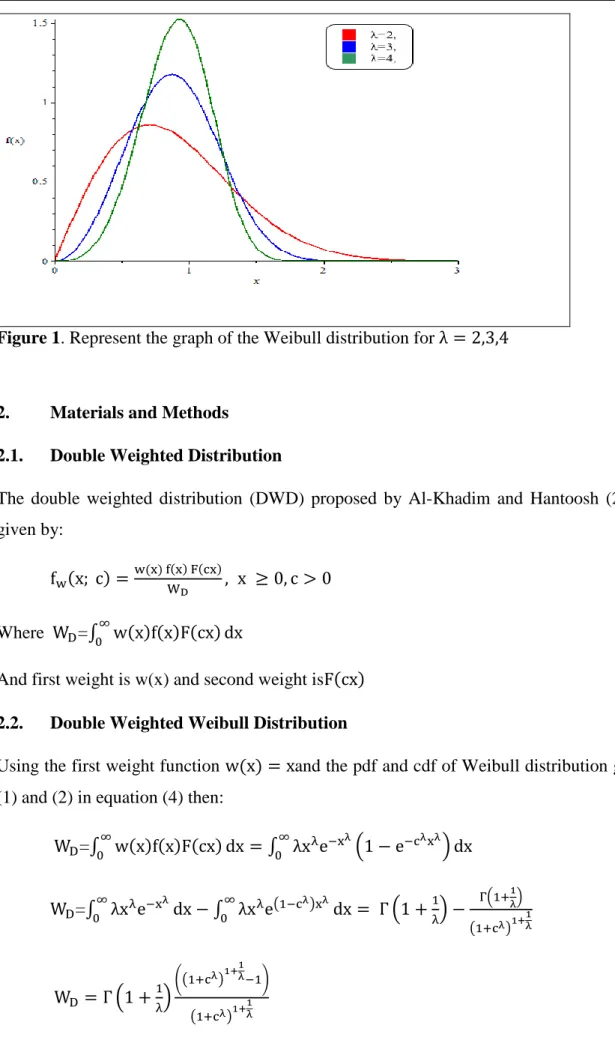
The plot of thepdf of the Weibull distribution aregiven in figure 1 given below.
Now we are giving another generalization of the Weibull distribution known as double weighted Weibull distributionDWWD. The double weighted distribution and length-biased distributions are the types of weighted distribution proposed by Fisher (1934) and Rao (1965). The weighted distribution has useful application in medicine, ecology and reliability etc. There is a lot of literature on the weighted distribution as Das K.K and Roy, T.D. (2011) introduced the Applicability of length biased weighted generalized Rayleigh distribution,NareeratNanuwong and WinaiBodhisuwan (2014) hosted the length-biased Beta-Pareto (LBBP) distribution and compared with Beta-Beta-Pareto (BP) and Length-Biased Beta-Pareto (LBP) distributions.. For further important results of weighted distribution you can see also Oluyede and George (2002), Ghitany and Al-Mutairi (2008), Ahmed et al. (2013),Oluyede and Pararai (2012), Oluyede and Terbeche (2007).
The Concept of double weighted distribution first time introduced by Al-Khadim and Hantoosh (2013), apply it on the exponential distribution and derive the statistical properties
for the double weighted exponential distribution.Rishwan(2013) introduce the
Characterization and Estimation of Double Weighted Rayleigh Distribution.Al-khadim and Hantoosh (2014) proposed the double weighted inverse Weibull distribution and deliberate its statistical properties of inverse Weibull distribution. All these studies agreed that the double weighted distribution has very efficient and effectual role in the modelling of weighted distributions. The definition of double weighted distribution introduced by Al-khadim and Hantoosh given in next section.
Figure 1. Represent the graph of the Weibull distribution for λ = 2,3,4
2. Materials and Methods
2.1. Double Weighted Distribution
The double weighted distribution (DWD) proposed by Al-Khadim and Hantoosh (2013) is given by:
fw(x; c) =w(x) f(x) F(cx)W
D , x ≥ 0, c > 0 (3)
Where WD=∫ w(x)f(x)F(cx)0∞ dx (4)
And first weight is w(x) and second weight isF(cx)
2.2. Double Weighted Weibull Distribution
Using the first weight function w(x) = xand the pdf and cdf of Weibull distribution given in (1) and (2) in equation (4) then:
WD=∫ w(x)f(x)F(cx)0∞ dx = ∫ λx0∞ λe−xλ(1 − e−cλxλ)dx WD=∫ λx0∞ λe−xλdx − ∫ λx0∞ λe(1−cλ)xλdx = Γ (1 +1λ) − Γ(1+ 1 λ) (1+cλ)1+1λ WD = Γ (1 +1λ) ((1+cλ)1+1λ−1) (1+cλ)1+1λ (5)
Using (1) (2) and (5) in (3) and considering w(x) = x then pdf of the double weighted exponential distribution is given by:
fw(x; c, λ) =
λ(1+cλ)1+1λxλe−xλ(1−e−cλxλ)
Γ(1+λ1)((1+cλ)1+λ1−1) x ≥ 0, c > 0 λ > 0 (6)
(a) (b)
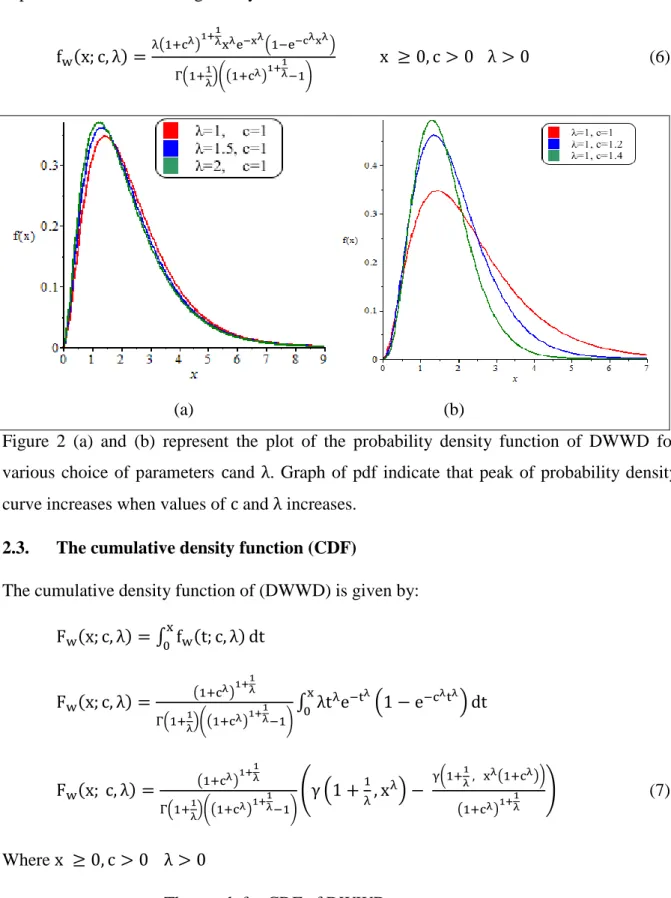
Figure 2 (a) and (b) represent the plot of the probability density function of DWWD for various choice of parameters cand λ. Graph of pdf indicate that peak of probability density curve increases when values of c and λ increases.
2.3. The cumulative density function (CDF)
The cumulative density function of (DWWD) is given by:
Fw(x; c, λ) = ∫ f0x w(t; c, λ)dt Fw(x; c, λ) = (1+cλ) 1+1λ Γ(1+λ1)((1+cλ)1+λ1−1)∫ λt λe−tλ(1 − e−cλtλ) x 0 dt Fw(x; c, λ) = (1+c λ)1+1λ Γ(1+λ1)((1+cλ)1+1λ−1)(γ (1 + 1 λ, x λ) − γ(1+ 1 λ , xλ(1+cλ)) (1+cλ)1+1λ ) (7) Where x ≥ 0, c > 0 λ > 0
(a) (b)
Figure3 (a) and (b) represent the plot of the cumulative density function of DWWD for various choice of parameters cand λ.
3. Transformed double weighted Weibull distribution
Put xλ = θyλθ > 0 in (6) then transformed pdf is given by:
dx dy= θ 1 λ Since fw(y; c, λ, θ) = fw(x; c, λ)dxdy fw(y; c, λ, θ) = λ(1+cλ) 1+1λ
θ1+1λyλe−θyλ(1−e−θcλyλ)
Γ(1+1λ)((1+cλ)1+λ1−1)
y ≥ 0, c > 0 λ > 0(8)
4. Sub modals derived from DWWD
1) Put λ = 1 in (8) then:
fw(y; c, θ) =(1+c)Γ(2)((1+c)2θ2e−θy(1−e2−1)−θcy)=(1+c)2θ2e−θy(1−e−θcy)
((1+c)2−1) x ≥ 0, c > 0 λ > 0(9)
Which is double weighted exponential distribution (DWED) proposed by Al-Khadim and Hantoosh (2013)
2) Put λ = 2 and θ =2α12 in (8) then resulting pdf is given by:
fw(y; c, α) = √2π
(1+c2)32y2e−2α2y2(1−e−c2y22α2)
α3((1+cλ)32−1)
x ≥ 0, c > 0 λ > 0 (10)
5. Reliability analysis 5.1. Reliability function R(x)
The reliability function or survival function of DWWD is given as:
Rw(x; c, λ) = 1 − Fw(x; c, λ) Rw(x; c, λ) = 1 − (1+c λ)1+1λ Γ(1+1λ)((1+cλ)1+1λ−1) (γ (1 +1λ, xλ) − γ(1+ 1 λ , xλ(1+cλ)) (1+cλ)1+λ1 ) (11) Where x ≥ 0, c > 0 λ > 0 (a) (b)
Figure4 (a) and (b) represent the plot of the survival function of DWWD for various choice of parameters cand λ.
5.2. Hazard Function H(x)
The Hazard function or survival function of DWWD is given as:
Hw(x; c, λ) = fw(x; c,λ) Rw(x; c,λ) Hw(x; c, λ) = λ(1+cλ) 1+1λ xλe−xλ(1−e−cλxλ) Γ(1+1λ)((1+cλ)1+λ1−1)−(1+cλ)1+1λ(γ(1+1 λ,xλ)− γ(1+1λ , xλ(1+cλ)) (1+cλ)1+ 1 λ ) (12) Where x ≥ 0, c > 0 λ > 0
(a) (b)
Figure5 (a) and (b) represent the plot of the Hazard function of DWWD for various choice of parameters cand λ.
5.3. Reverse Hazard function 𝛗(𝐱)
The reverse hazard function or survival function of DWWD is given as:
φw(x; c, λ) = fw(x; c,λ) Fw(x; c,λ) φw(x; c, λ) = λ(1+cλ) 1+1λ xλe−xλ(1−e−cλxλ)) (1+cλ)1+1λ(γ(1+1 λ,xλ)− γ(1+1λ , xλ(1+cλ)) (1+cλ)1+ 1 λ ) (13) Where x ≥ 0, c > 0 λ > 0 (a) (b)
Figure6 (a) and (b) represent the plot of the reverse Hazard function of DWWD for various choice of parameters cand λ.
6. Asymptotic behaviours
The Asymptotic behaviours of the DWWD can be explained by studying function given in (6) defined over the positive real line [0, ∞) and the behaviour of its derivative as follows:The limits of the pdf given in (6) is given by:
lim x→0fw(x; c, λ) = limx→0 λ(1 + cλ)1+1λxλe−xλ(1 − e−cλxλ) Γ (1 +1λ) ((1 + cλ)1+1λ− 1) = 0 lim x→∞fw(x; c, λ) = limx→∞ λ(1 + cλ)1+1λxλe−xλ(1 − e−cλxλ) Γ (1 +1λ) ((1 + cλ)1+1λ− 1) = 0 Sincelim x→0x λ = 0 ,lim x→∞e −xλ= 0 and lim x→∞(1 − e −cλxλ) = 1
From these limits, we conclude that pdf of DWWD has one mode say x0 as given by: The pdf of the DWWD is given by
fw(x; c, λ) = λ(1+cλ)
1+1λ
xλe−xλ(1−e−cλxλ)
Γ(1+λ1)((1+cλ)1+λ1−1)
x ≥ 0, c > 0 λ > 0
Taking logarithm of the pdf of DWWD
logfw(x; c, λ) = logλ + (1 + 1
λ) log(1 + cλ) + λlogx − xλ+ log (1 − e−c
λxλ ) − log (Γ (1 +1λ)) − log ((1 + cλ)1+1λ− 1) ∂ ∂xlogfw(x; c, λ) = λ x− λx λ−1+λcλxλ−1e−cλxλ 1−e−cλxλ (14)
The mode of the DWRD is obtained by solving the following non-linear equation with respect to x.
λ
x− λxλ−1+
λcλxλ−1e−cλxλ
The mode of Double Weighted Weibull Distribution (DWWD)can be calculated by solving above nonlinear equation.
7. Order Statistics
The order statistics have great importance in life testing and reliability analysis. Let
𝑋1,𝑋2,𝑋3,……….,𝑋𝑛 be random variables and its ordered values is denoted as
𝑋1,𝑋2,𝑋3,……….,𝑋𝑛. The pdf of order statistics is obtained using the below function
𝑓𝑠:𝑛,(𝑥) =(s−1)!(n−s)!𝑛! 𝑓(𝑥)[𝐹(𝑥)]𝑠−1[1 − 𝐹(𝑥)]𝑛−𝑠 (16)
To obtain the smallest value in random sample of size n put 𝑠 = 1in (16) then the pdf of smallest order statistics is given by
𝑓1:𝑛,(𝑥) = 𝑛𝑓(𝑥)[1 − 𝐹(𝑥)]𝑛−1 For the DWWD 𝑓1:𝑛,(𝑥) = 𝑛 λ(1+cλ)1+1λxλe−xλ(1−e−cλxλ) Γ(1+1λ)((1+cλ)1+1λ−1) [1 − (1+cλ)1+1λ Γ(1+1λ)((1+cλ)1+1λ−1) (γ (1 +1λ, xλ) − γ(1+ 1 λ , xλ(1+cλ)) (1+cλ)1+1λ )] 𝑛−1 (17) Where x ≥ 0, c > 0 λ > 0
To obtain the largest value in random sample of size n put 𝑠 =n in 16 then the pdf of order statistics is given by 𝑓𝑛:𝑛,(𝑥) = 𝑛𝑓(𝑥)[𝐹(𝑥)]𝑛−1 For the DWWD 𝑓𝑛:𝑛,(𝑥) = 𝑛 λ(1+cλ)1+1λxλe−xλ(1−e−cλxλ) Γ(1+1λ)((1+cλ)1+1λ−1) [ (1+cλ)1+1λ Γ(1+1λ)((1+cλ)1+1λ−1) (γ (1 +1λ, xλ) − γ(1+ 1 λ , xλ(1+cλ)) (1+cλ)1+1λ )] 𝑛−1 (18) Where x ≥ 0, c > 0 λ > 0 8. Moment of DWWD
The kth Moment of DWWD can be calculated as:
E(xk) = (1+cλ)1+ 1 λ Γ(1+1λ)((1+cλ)1+1λ−1)∫ λx k+λe−xλ (1 − e−cλxλ ) ∞ 0 dx k = 1,2,3, … …
E(xk) = (1+cλ)1+ 1 λ Γ(1+1λ)((1+cλ)1+1λ−1)(∫ λx k+λe−xλ ∞ 0 dx − ∫ λxk+λe(1+c λ)xλ dx ∞ 0 ) E(xk) = (1+cλ)1+ 1 λ Γ(1+1λ)((1+cλ)1+1λ−1) (Γ (1 +k+1λ ) − Γ(1+ k+1 λ ) (1+cλ)1+k+1λ ) E(xk) = (1+cλ) 1+1λ Γ(1+k+1λ ) Γ(1+1λ)((1+cλ)1+1λ−1)( (1+cλ)1+k+1λ −1 (1+cλ)1+k+1λ ) E(xk) = Γ(1+k+1λ ) Γ(1+1λ)((1+cλ)1+1λ−1) ((1+cλ) 1+k+1λ −1 (1+cλ)kλ ) E(xk) = Γ(1+ k+1 λ ) Γ(1+1λ)((1+cλ)1+1λ−1) ((1 + cλ)1+1λ− 1 (1+cλ)kλ ) Let ∈= (1 + cλ)1+ 1 λ and ∈ k= (1 + cλ) k λ k = 1,2,3, … … E(xk) = Γ(1+ k+1 λ ) Γ(1+1λ)(∈−1)(∈ − 1 ∈k) (19) 8.1. Mean μ = Γ(1+ 2 λ) Γ(1+1λ)(∈−1)(∈ − 1 ∈1) (20) Where ∈1= (1 + cλ) 1 λand ∈= (1 + cλ)1+ 1 λ 8.2. The variance σ2 = Γ(1+ 3 λ) Γ(1+1λ)(∈−1)(∈ − 1 ∈2) − ( Γ(1+2λ) Γ(1+1λ)(∈−1)(∈ − 1 ∈1)) 2 (21) Where ∈1= (1 + cλ) 1 λ, ∈ 2= (1 + cλ) 2 λ and ∈= (1 + cλ)1+ 1 λ
8.3. The standard deviation σ = ( Γ(1+ 3 λ) Γ(1+1λ)(∈−1)(∈ − 1 ∈2) − ( Γ(1+2λ) Γ(1+1λ)(∈−1)(∈ − 1 ∈1)) 2 ) 1 2 (22)
8.4. The coefficient of variance
C. V = ( Γ(1+ 3 λ) Γ(1+λ)1(∈−1)(∈− 1 ∈2)−( Γ(1+2λ) Γ(1+1λ)(∈−1)(∈− 1 ∈1)) 2 ) 1 2 Γ(1+2λ) Γ(1+1λ)(∈−1)(∈− 1 ∈1) (23)
Table1represent the values of mean, mod, variance, STD and C.V for different value of parameters are given below as
C Λ Mean Variance STD C.V 1 1 2.3333 2.0571 1.4343 0.6147 2 1.3092 0.1517 0.3895 0.2975 3 1.1481 0.0743 0.2726 0.2374 2 1 2.1667 1.9721 1.4043 0.6481 2 1.1897 0.2025 0.4500 0.3782 3 1.0405 0.0858 0.2929 0.2815 3 1 2.1000 1.9650 1.4018 0.6675 2 1.1536 0.2133 0.4618 0.4003 3 1.0189 0.0935 0.3058 0.3001 4 1 2.0667 1.9688 1.4031 0.6789 2 1.1408 0.2190 0.4680 0.4102 3 1.0138 0.0969 0.3113 0.3071
From table 1 represent thevalues of mean, variance, standard deviation and coefficient of variance for various choices of parameters.
9. Estimation of reliability
Suppose that X and Y are random variables independently distributed such that X
𝑅 = 𝑃(𝑌 < 𝑋) = ∫ 𝑓1(𝑥)𝐹2(𝑥) ∞ 0 𝑑𝑥 = ∫ 𝑓(𝑥)𝐹(𝑥) ∞ 0 𝑑𝑥 𝑅 = 𝑃(𝑌 < 𝑋) = ∫ 𝑓(𝑥)𝐹(𝑥) ∞ 0 𝑑𝑥 𝑅 = λ(1 + c λ)2+λ2 (Γ (1 +1λ))2((1 + cλ)1+1λ − 1)2 ∫ xλe−xλ (1 − e−cλxλ ) (γ (1 +1 λ, xλ) ∞ 0 − γ (1 + 1 λ , x λ(1 + cλ)) (1 + cλ)1+1λ ) 𝑑𝑥 Let 𝛼 = λ(1+c λ)2+2λ (Γ(1+1λ))2((1+cλ)1+1λ−1) 2 then 𝑅 = 𝛼 ∫ xλe−xλ(1 − e−cλxλ) (γ (1 +1 λ, xλ) − γ (1 +1λ , xλ(1 + cλ)) (1 + cλ)1+1λ ) ∞ 0 𝑑𝑥 𝑅 = 𝛼 ∫ xλe−xλ γ (1 +1 λ, xλ) 𝑑𝑥 − ∞ 0 𝛼 ∫ xλe−xλγ (1 + 1 λ , xλ(1 + cλ)) (1 + cλ)1+1λ 𝑑𝑥 ∞ 0 − 𝛼 ∫ xλe−(1+cλ)xλγ (1 +1 λ, xλ) 𝑑𝑥 ∞ 0 + 𝛼 ∫ xλe−(1+cλ)xλγ (1 + 1 λ , x λ(1 + cλ)) (1 + cλ)1+1λ 𝑑𝑥 ∞ 0 𝑅 = 𝛼 (𝐼1− 1 (1+cλ)1+1λ 𝐼2− 𝐼3+ 1 (1+cλ)1+λ1 𝐼4) (24) Where 𝐼1 = ∫ x0∞ λe−xλγ (1 +1λ, xλ) 𝑑𝑥, 𝐼2 = ∫ xλe−xλ γ(1+λ1 , xλ(1+cλ)) (1+cλ)1+1λ 𝑑𝑥 ∞ 0 , 𝐼3 = ∫ xλe−(1+cλ)xλ γ (1 +1λ, xλ) 𝑑𝑥 ∞ 0 and𝐼4 = ∫ xλe−(1+c λ)xλγ(1+1λ , xλ(1+cλ)) (1+cλ)1+1λ 𝑑𝑥 ∞ 0 𝐼1 = ∫ xλe−x λ γ (1 +1 λ, xλ) 𝑑𝑥 ∞ = ∑ Γ (1 + 1 λ) 1 ∞ (1 2) 2 λ+𝑘+2 Γ (2 λ+ 𝑘)
𝐼2 = ∫ xλe−xλ γ (1 +1λ , xλ(1 + cλ)) (1 + cλ)1+1λ 𝑑𝑥 ∞ 0 = ∑(1 + c λ)2λ+𝑘+1Γ (1 +1 λ) λΓ (1λ+ 𝑘 + 2) ∞ 𝑘=0 ( 1 2 + cλ) 2 λ+𝑘+2 Γ (2 λ+ 𝑘) 𝐼3 = ∫ xλe−(1+cλ)xλ γ (1 +1 λ, xλ) 𝑑𝑥 ∞ 0 = ∑ Γ (1 + 1 λ) Γ ( 2 λ+ 𝑘) λΓ (1λ+ 𝑘 + 2) (2 + cλ)2λ+𝑘+2 ∞ 𝑘=0 𝐼4 = ∫ xλe−(1+cλ)xλγ (1 + 1 λ , xλ(1 + cλ)) (1 + cλ)1+1λ 𝑑𝑥 ∞ 0 = ∑ Γ (1 + 1 λ) Γ ( 2 λ+ 𝑘) λΓ (1λ+ 𝑘 + 2) (1 + cλ)λ1+1(2 2 λ+𝑘+2) ∞ 𝑘=0
Using values of 𝐼1, 𝐼2, 𝐼3 𝑎𝑛𝑑 𝐼4 in equation(24)
𝑅 = 𝛼 (∑ Γ (1 + 1 λ) Γ (1λ+ 𝑘 + 2) ∞ 𝑘=0 (1 2) 2 λ+𝑘+2 Γ (2 λ+ 𝑘) − 1 (1 + cλ)1+1λ∑ (1 + cλ)2λ+𝑘+1Γ (1 +1 λ) Γ (1λ+ 𝑘 + 2) ∞ 𝑘=0 ( 1 2 + cλ) 2 λ+𝑘+2 Γ (2 λ+ 𝑘) − ∑ Γ (1 + 1 λ) Γ ( 2 λ+ 𝑘) λΓ (1λ+ 𝑘 + 2) (2 + cλ)2λ+𝑘+2 ∞ 𝑘=0 + 1 (1 + cλ)1+1λ ∑ Γ (1 + 1 λ) Γ ( 2 λ+ 𝑘) λΓ (1λ+ 𝑘 + 2) (1 + cλ)1λ+1(2 2 λ+𝑘+2) ∞ 𝑘=0 ) 𝑅 = 𝛼 ∑ Γ (1 + 1 λ) Γ (1λ+ 𝑘 + 2) ∞ 𝑘=0 ((1 2) 2 λ+𝑘+2 Γ (2 λ+ 𝑘) − (1 + cλ) k+1λ ( 1 2 + cλ) 2 λ+𝑘+2 Γ (2 λ+ 𝑘) − Γ ( 2 λ+ 𝑘) (2 + cλ)2λ+𝑘+2 + Γ ( 2 λ+ 𝑘) (1 + cλ)2λ+2(2 2 λ+𝑘+2) )
𝑅 = ∑ (1+cλ)2+ 2 λ Γ(1+1λ)((1+cλ)1+1λ−1) 2 Γ(1λ+𝑘+2) ∞ 𝑘=0 ((12) 2 λ+𝑘+2 Γ (2λ+ 𝑘) − (1 + cλ)k+1λ( 1 2+cλ) 2 λ+𝑘+2 Γ (2λ+ 𝑘) − Γ( 2 λ+𝑘) (2+cλ)2λ+𝑘+2 + Γ( 2 λ+𝑘) (1+cλ)2λ+2(22λ+𝑘+2) ) (25) 10 Estimation of Parameter
In this section, we obtain the maximum likelihood estimate (MLE) and method of moment estimator (MME) for the parameters λ and c of the (DWWD).
10.1 Method of moments
From method of moment we have:
E(xk) =1
n∑ xi
k k = 1,2 n
i=1
For k = 1 E(x) = ∑ni=1xni= X̅
Γ(1+k+1λ ) Γ(1+1λ)(∈−1)(∈ − 1 ∈1) = X̅ (26) For k = 2E(x2) =1 n∑ xi 2 n i=1 Γ(1+k+1λ ) Γ(1+1λ)(∈−1)(∈ − 1 ∈2) = 1 n∑ xi 2 n i=1 (27) Where ∈1= (1 + cλ) 1 λ, ∈ 2= (1 + cλ) 2 λ and ∈= (1 + cλ)1+ 1 λ
Solving the equation (21) and (22) using numerical method we get the ĉ and λ̂ as estimate of c and λ.
10.2 Maximum Likelihood Estimators
Maximum Likelihood Estimator is most effective and efficient methods for estimation of parameters. The pdf of the DWWD is given by:
fw(x; c, λ) = λ(1+cλ)
1+1λ
xλe−xλ(1−e−cλxλ)
Γ(1+λ1)((1+cλ)1+λ1−1)
x ≥ 0, c > 0
Let 1 + cλ = α then above pdf can be written as:
fw(x; α, λ) =
λ(α)1+1λxλe−xλ(1−e−(α−1)xλ)
Γ(1+1λ)((α)1+1λ−1) x ≥ 0, α > 0 (28)
Let x1 , x2 , … , xn) be the random sample of double weighted Weibull distribution then log-likelihood function of above pdf is given as:
L(x; c, λ) = nlogλ + n (1 +1
λ) log(α) + λlogx − xλ+ log (1 − e−(α−1)x
λ
) − n log (Γ (1 +1
λ)) − nlog ((α)
1+λ1− 1)
Differentiating w.r.t x; to λ and α we get:
∂
∂λ(L(x; α, λ)) = n λ−
n
λ2log α + logx − xλlogx +
(α−1) log(x)xλe−(α−1)xλ 1−e−(α−1)xλ +λn2psi (1 +1λ) +n(α)1+ 1 λlog (α) λ2((α)1+1λ−1) (29) ∂ ∂λ(L(x; α, λ)) = n α(1 + 1 λ) + xλe−(α−1)xλ 1−e−(α−1)xλ− n(1+1λ)(α)1λ ((α)1+λ1−1) (30)
Equating above equation to zero we get
n λ−
n
λ2log α + logx − xλlogx +
(α−1) log(x)xλe−(α−1)xλ 1−e−(α−1)xλ + n λ2psi (1 + 1 λ) + n(α)1+1λlog(α) λ2((α)1+1λ−1) = 0(31) n α(1 + 1 λ) + xλe−(α−1)xλ 1−e−(α−1)xλ− n(1+λ1)(α)1λ ((α)1+1λ−1)= 0 (32)
To estimate λ and α we have to solve (25) and (26) using numerical technique methods because it is not possible to solve analytically (25) and (26). We use newton Raphson method to (see Adi (1966)) to obtain the solution of nonlinear equations given above.
11 Application
In this section, we are considering the lifetime data of 20 electronic components given by Nasiru (2015))to demonstrate the application of the double weighted Weibull distribution. The data set is given by:
0.03 0.22 0.73 1.25 1.52 1.80 2.38 2.87 3.14 4.72
0.12 0.35 0.79 1.41 1.79 1.94 2.40 2.99 3.17 5.09
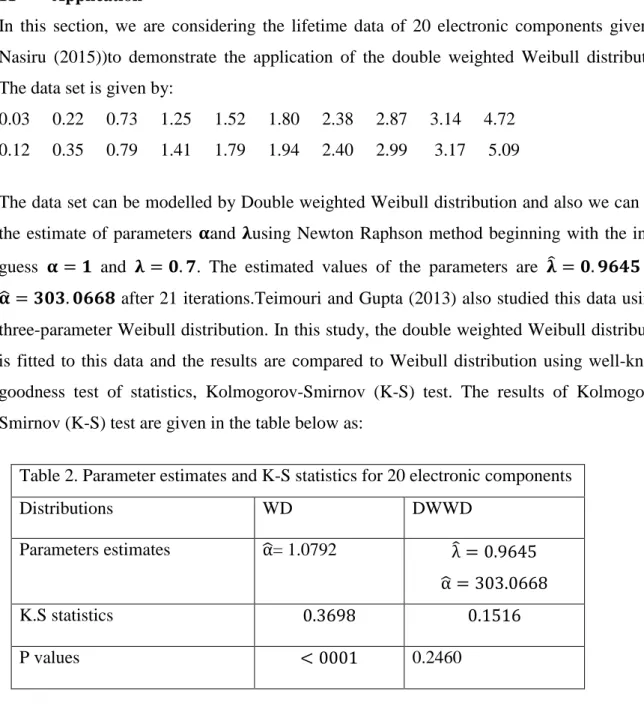
The data set can be modelled by Double weighted Weibull distribution and also we can find the estimate of parameters 𝛂and 𝛌using Newton Raphson method beginning with the initial guess 𝛂 = 𝟏 and 𝛌 = 𝟎. 𝟕. The estimated values of the parameters are 𝛌̂ = 𝟎. 𝟗𝟔𝟒𝟓 and
𝛂̂ = 𝟑𝟎𝟑. 𝟎𝟔𝟔𝟖 after 21 iterations.Teimouri and Gupta (2013) also studied this data using a three-parameter Weibull distribution. In this study, the double weighted Weibull distribution is fitted to this data and the results are compared to Weibull distribution using well-known goodness test of statistics, Smirnov (K-S) test. The results of Kolmogorov-Smirnov (K-S) test are given in the table below as:
Table 2. Parameter estimates and K-S statistics for 20 electronic components
Distributions WD DWWD
Parameters estimates α̂= 1.0792 λ̂ = 0.9645
α̂ = 303.0668
K.S statistics 0.3698 0.1516
P values < 0001 0.2460
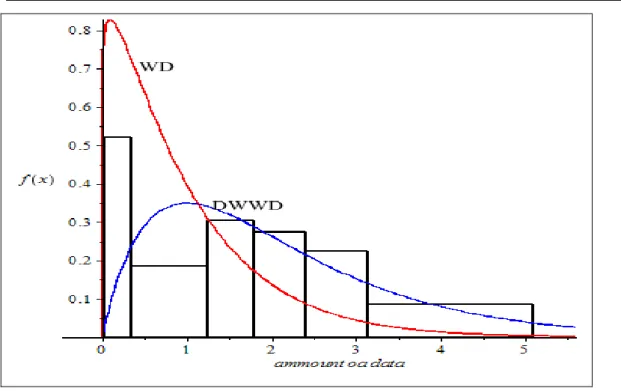
From above table the DWWD has greater p value as compared to the WD which claims that DWWD gives better fit the 20 electronic components data set from WD. Only the K-S test is not satisfactory statistical indication for supporting that the data set do not closely fitted by the WD. My second judgement based on graphical test as shown in figure7 which represent that the densities of the theoretical distributions WD and DWWD plotted over the empirical histogram of 20 electronic components data. Figure3 indicate that DWWD is more fitted to these data as compared to WD.
Figure 3. The plot b/w theoritical distributions and emperical histogram for data of 20 electronic components
12 Conclusion
This paper develops a new double weighted distribution known as double weighted Weibull distribution DWWD. The statistical properties mean, variance, coefficient of variance and standard deviations are also determined of DWWD. The data set validate the fitting of the proposed distribution DWWDas compared to WD using a well-known Kolmogrov-Smirnov test. The results of the K-S statistics indicate that the DWWD is suitable as compared to WD.Our proposed distribution DWWD is more general modal because existing double weighted distributions (Double weighted Religh distribution and double weighted exponential distribution) are special cases to our proposed distribution DWWD (See section 4).
References
Ahmed, A., Mir, K. A.,Rashi, J. A. (2013). On new method of estimation of parameters of size-biased generalized gamma distribution and its structural properties. IOSR J. Math. 5: 34-40.
Al-khadim, K. A.,Hantoosh, A. F.(2013). Double Weighted distribution and double weighted exponential distribution. Mathematical theory and Modling, Vol.3:124-134.
Al-khadim, K. A.,Hantoosh, A. F. (2014). Double Weighted Inverse Weibull distribution, Malaysia Handbook on the Emerging Trends in Scientific Research, ISBN: 978-969-9347-16-0.
Almalki, S. J., Yuan, J. (2013). The new modified Weibull distribution.Reliability Engineering and System Safety.111: 164-170.
Al-Saleh, J. A.,Agarwal, S. K. (2006). Extended Weibull type distribution and finite mixture of distributions.Statistical Methodology, 3:224-233.
Ben-Israel A (1966). Newton-Raphson Method for the Solution of Systems of equations Equations.Journal of Mathematical analysis and applications. 15: 243-252
Das, K. K.,Roy, T. D. (2011) Applicability of length biased weighted generalized Rayleig distribution.Advances in Applied Science Research. 2:320-327.
FisherR A (1934).The effect of methods of ascertainment upon the estimation of frequencies.The Annals of Eugenics. 6:13-25.
Gokarna, A. R., Chris, T. P. (2011). Transmuted Weibull Distribution: A Generalization of
the Weibull Probability Distribution.European journal of pure and applied
mathematics. 4: 89-102.
Ghitany, M. E., Al-Mutairi, D. K. (2008). Size-biased Poisson-Lindley distribution and its application.International Journal of Statistics 2008, vol. LXVI, n. 3, pp. 299-311. JING, X. K. (2010). Weighted Inverse Weibull and Beta-Inverse Weibull distribution, 2009
Mathematics Subject Classification.62N05, 62B10.
Kishore, K., Das, K. K.,Tanusree, D. R. (2011). Applicability of Length Biased Weighted Generalized Rayleigh Distribution, Advances in Applied Science Research, 2 (4): 320-327.
Merovci, F.,Elbatal, I. (2015).Weibull Religh distribution theory and applications.J. Applied Mathematics and inpormation science, 4: 2127-2137.
Nanuwong, N., Bodhisuwan, W. (2014). The length-biased beta-pareto distribution and its structural properties with application.Journal of Mathematics and Statistics,
Nasiru, S. (2015). Another weighted Weibull distribution from azzalini’s family. European scientific journal. 11: 134-144.
Oluyede, B. O., George, E. O. (2000). On Stochastic Inequalities and Comparisons of Reliability Measures for Weighted Distributions.Mathematical problems in Engineering.8:1-13.
Oluyede, B. O.,Terbeche, M. (2007). On Energy and Expected Uncertainty Measures in Weighted Distributions. International Mathematical Forum. 2: 947-956.
Pal, M., Ali, M. M., Woo J. (2006). Exponentiated Weibull distribution.Statistica, 66: 139-147.
Rao, C. R. (1965) On discrete distribution arising out of methods of ascertainment, in Classical and Contagious Discrete Distribution, G.P. Patil, ed., Pergamon Press and Statistical Publishing Society, Calcutta, pp.320-332.
Rishwan, N. I. (2013).Double Weighted Rayleigh Distribution Properties and Estimation. International Journal of Scientific & Engineering Research. Vol. 4, Issue 12, ISSN 2229-5518.
Seenoi, P., Supapakorn, T.,Winai, B. (2014). The length-biased Exponentiated inverted Weibull distribution. International Journal of Pure and Applied Mathematics.
92: 191-206.
Teimouri, M., Gupta, K. A. (2013). On three-parameter Weibull distribution shape parameter estimation. Journal of Data Science.11: 403-414.
Xie, M.,Lai, C. D. (1996). Reliability analysis using an additive Weibull model with bathtub shaped failure rate function. Reliability Engineering andSystem Safety.52(1): 87-93.