105
SkillBot: Towards Automatic Skill Development via User Demonstration
Yilin Shen, Avik Ray, Hongxia Jin, Sandeep Nama
Samsung Research America, Mountain View, CA, USA
{yilin.shen,avik.r,hongxia.jin,s.nama}@samsung.com
Abstract
We present SkillBot that takes the first step to enable end users to teach new skills in personal assistants (PA). Unlike existing PA products that need software developers to build new skills via IDE tools, an end user can use SkillBot to build new skills just by naturally demonstrating the task on device
screen. SkillBot automatically develops a
natural language understanding (NLU) engine and implements the action without the need
of coding. On both benchmark and
in-house datasets, we validate the competitive performance of SkillBot automatically built NLU. We also observe that it only takes a few minutes for an end user to build a new skill using SkillBot.
1 Introduction
Artificially intelligent voice-enabled personal assistants (PA) have been emerging in our daily life, such as Alexa, Google Assistant, Siri, Bixby,
etc. Existing off-the-shelf personal assistants
serve different domains, in which each domain has a large number of capabilities, calledskills. A skill refers to the understanding of various utterances about one intent/task and the execution of this intent/task.
Existing industrial PA products completely rely on software developers to build new skills
by manually developing NLU engine and
implementing action fulfillment. On one hand,
while recent work CRUISE (Shen et al., 2018a)
and SliQA-I (Shen et al., 2019) have introduced
automatic training utterance and question
generation approaches with lightweight human workload, they still require the involvement of software developers for NLU development through IDE tools. Another line of research is to
personalize NLU engine in existing skills (Azaria
et al.,2016;Ray et al.,2018;Shen et al.,2018b;
Wang et al., 2018a), yet they cannot support building new skills. On the other hand, developers need to write a significant amount of code in order to fulfill a sequence of operations to carry out the task (DialogFlow,2018;Alexa,2018).
However, in practice, it is infeasible for software developers to pre-build all possible
skills that satisfy all users’ needs. First,
the pre-collected training corpus usually cannot exhaustively cover all possible varieties of utterances. Second, due to the heavy workload on fulfillment implementation, many actions are not implemented to be supported in PA. Thus, it is critically desirable to design an easy to use
system that can facilitate end users to quickly
build high quality new skills. Unlike existing IDE for skill development, such system needs to be more friendly and natural to ordinary end users without any complex interfaces.
In this paper, we take the first step to
present SkillBot that enables end users to
initialize building PA skills. An ordinary user,
without either natural language expertise or software development background, only needs to demonstrate the task on his daily device screen. SkillBot, without a complex IDE interface, automatically learns the action by tracking user operations and develops the NLU engine by automatically generating training utterances based
on pre-built skills. Since users intend to
use spoken language to interact with PA, we
follow most industrial products (DialogFlow,
2018; Alexa, 2018) to use spoken language understanding (SLU) as our NLU engine, which understands user query by detecting its intent (skill) and extracting semantic slots (slot filling) (Liu and Lane,2016;Kim et al.,2017;Wang et al.,
select search box
input search content
input location click to search User: “Find a five star hotel near San Jose”
Agent: “Please teach me”
[User Selection of Each Input Description]
Input description:
Review rating Review numbers Amenities
Input description:
Location name Distance type Amenities
(a) Learning via Demonstration: When PA asks for teaching, the user operates step by step accordingly in Yelp app. For each user input, SkillBot prompts to ask user to select the most relevant description of this input.
User: “Find a hotel with good rating”
Agent:
“What is the location name? ”
User:
“San Francisco”
[image:2.595.309.523.64.222.2] [image:2.595.75.291.64.195.2](b) Automatic Execution: After parsing the utterance using NLU, PA executes the learned action step by step. When finding a missing input, PA prompts for user input.
Figure 1: SkillBot Running Example: Learning and executing new skill ”find hotel” in Yelp
from any user, we show the competitive NLU performance of SkillBot built skills in later experiments. More importantly, in most cases it only takes a user several minutes to build a new skill using SkillBot. As such, SkillBot leverages the existing skills to help end users automatically and quickly build high quality skills to meet their personal needs.
2 SkillBot System Overview
2.1 Our Settings
To satisfy user personalized needs in PA, SkillBot aims to enable end users to build their own
(long-tail) skillsonly by demonstration on screen. That
said, an end user onlynaturallyuses their device
as usual to build a new skill. In this first work, we assume that there exist a set of pre-built popular (head) skills in the ecosystem and these skills contain both annotated training utterances and a
text description for each slot. In addition, we
[image:2.595.73.290.246.360.2]target on teaching and executing actions on the same mobile apps.
Figure 1 shows a running example in which
Action Execution
bytecode
Utterance
Utterance Generation
Action/Skill
Database Prebuilt Skills Task Complete
update
existing skill
Auto Action Fulfillment Auto NLU Development
Natural Language Understanding
new skill
Action Learning via
User Demonstration Slot Identification
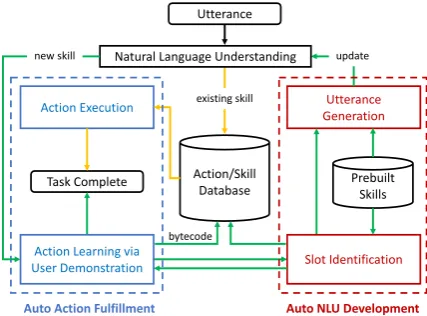
Figure 2: SkillBot Architecture & Workflow: When learning via demonstration (green arrows), automatic action fulfillment (runs as a system service on each user’s device) first tracks and captures system level event sequence based on user operations. It outputs a bytecode file with learned event sequence for this skill and saves in database for future execution. After each user input operation, automatic NLU development identifies the list of possible slot descriptions for user to select and then generates more training utterances by leveraging existing training utterances in pre-built skills. At last, the NLU engine is updated using all generated utterances. When executing an existing skill (orange arrows), based on the parsed skill from NLU, the corresponding bytecode is retrieved to automatically execute all saved steps.
SkillBot helps an end user to build the new “find hotel” skill in Yelp. For an end user, he uses PA as usual via voice utterances. SkillBot prompts the user to teach when PA cannot understand and execute the user utterance correctly. As in
Figure 1a, all the end user needs to do is to demonstrate on screen step by step how he wants PA to execute. After each user input, SkillBot identifies possible slot descriptions and asks user
to select the most relevant one. SkillBot then
automatically builds the new skill and outputs a well-trained NLU engine and an action executable
file. A user could teach a new skill multiple
times where each skill is considered to have the same on-screen operation sequence. Next time, in
Figure 1b, PA can correctly understand this user’s different expressions of this intent and execute the right action.
2.2 System Design
Recall that our target is to facilitate the end users who have neither natural language expertise nor software development knowledge. Thus, SkillBot is designed to support these two automation respectively. Specifically, SkillBot consists of two
“@slot2”: [ “San Jose”,
“options”: [“New York”, “LA”, …]
]
Screen UI Elements Extractor
Event Extractor
Event Sequence
Action Learning via Demonstration
Slot Ensemble Zero-shot
Slot Tagging Prebuilt Skills
Utterance Segment Combination
Slot Identification Training Data Generation
User Utterance bytecode
Event Filtering
Generated Utterances User Selection
@location
User Demonstration
[image:3.595.77.525.61.173.2]App Screen
Figure 3: New Skill Learning in SkillBot
and automatic NLU development. In addition, SkillBot also has an action/skill database to save the mapping between learned actions and
corresponding skills. Figure 2 shows SkillBot
architecture and work flow. Since we use the off-the-shelf NLU models in this paper, auto NLU development focuses on generating annotated training utterances.
3 Learning via Demonstration
3.1 Action Learning
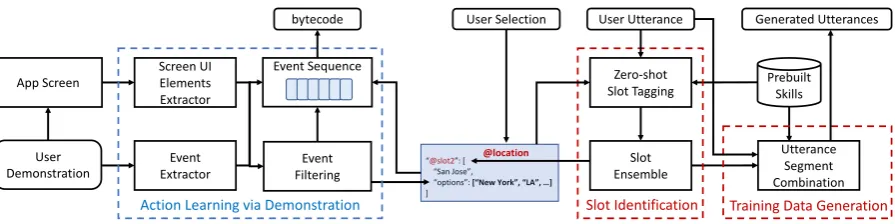
Action learning module has two main threads, as
shown in the left part of Figure 3. Following
user demonstration, at each screen, screen UI element extractor collects all UI elements in the format of a DOM tree on the current screen that the user is operating. In the meanwhile, event extractor collects all events from user operates in this screen.
Since there are typically a lot of system services running on device, the extracted events usually include many irrelevant ones that is not from user demonstrated actions, such as ‘windows change’, ‘window state change’, ’system or other app notifications’, etc. In order to filter the irrelevant events, we first prune all events out of the current front end app based on their event package name. To further ensure some unexpected events within app (e.g., location permission request in Yelp app), we allow user to teach again at any point when user sees any unusual popups or notifications. At last, a bytecode is outputted including the event sequence in which each event contains its UI element information and the required slot value
input based on the identified slot in Section3.2.1.
3.2 Automatic NLU Development
The key idea of training utterance generation is to identify the slots in the user utterance and then use them to generate more training utterances based on
the training utterances in existing pre-built skills.
3.2.1 Slot Identification
This module is invoked after each user input during demonstration. As shown in the middle
part (blue) of Figure 3, after user inputs “San
Jose” in the example of Figure 1a, it receives the
user utterance and the optional values (e.g., “New York”, “LA”, etc.) extracted from dropdown list of the user input box (Yelp location textbox) during action learning.
Taking the above input, we first construct the set of natural language utterances by replacing the input values with other optional values. For each utterance, zero-shot slot tagging module extracts its semantic slots based on each slot
description using the zero-shot model in (Bapna
et al., 2017) trained on pre-built skills. Slot ensemble module performs a joint slot detection across all constructed utterances by combining the likelihood scores of each slot. The descriptions of identified top ranked slots are sent to the user to select the most relevant one.
3.2.2 Utterance Generation
In this first work, we assume that each training utterance in pre-built skills has been decomposed into segments by human expert or our proposed
CRUISE approach (Shen et al., 2018a). Each
segment contains a slot tag (two examples are
shown in the right side of Figure 4). We only
use the subset of segments associated with the aforementioned identified slots.
We generate the utterance by combining identified segments into long utterances by concatenating them together (middle part in
Figure 4). To do so, we first use the off-the-shelf Stanford parser to identify the verb and main object in user utterance. In the sample utterance of Figure 1, “find” and “hotel” are marked as
User utterance verb Find a @rating five star
object hotel @location near San Jose
Generated utterance verb Find a @location nearby object hotel @rating with high rating
“get direction” utterance verb Go to @location nearby
object gas station
“find hotel” skill
“find restaurant” utterance verb I would like a object restaurant @rating with high rating
Yelp domain Map domain
[image:4.595.73.291.64.144.2]* Each box stands for one utterance * Each row is a segment in this utterance
Figure 4: Utterance Generation Example
the arrows show in Figure 4, we next generate
the permutations of segments before and after the object based on their places in original utterances with non-overlapping slots.
4 Automatic Execution
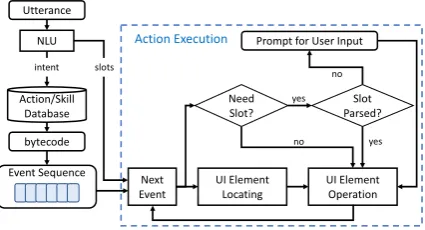
Figure 5shows the flow of automatic execution
of a skill. NLU first parses the utterance and
outputs its intent and slots. The intent class
is used to query the action/skill database to retrieve the bytecode of the corresponding action. SkillBot executes the events one by one following
the sequence. For each event, the execution
consists of the following two threads: One thread determines if this event requires a slot input based on the saved meta data during learning. If so, we extract on the slot results parsed by NLU. If this information is missing in utterance or NLU fails to parse, we prompt the follow-up question to ask user. The other thread first locates the UI element based on its saved coordinates. It then inputs slot values and simulates the user operation by using gesture control based on the element coordinates (e.g., MotionEvent in Android devices).
5 Experiments
In this section, we focus on evaluating SkillBot built NLU engine given that auto action learning and execution are restricted to the same app.
We test on both benchmark and in-house
datasets/domains: (1) ATIS (4978 training, 893
test) with 17 intent labels and 79 slot labels
(Hemphill et al., 1990); (2) In-house Yelp (1968
training, 911 test) with 5 intents and 10 slots.
To evaluate both datasets which are not generated by CRUISE, we segment each utterance using dependency parser and slot annotations (each segment ends with a slot). The noisy segments
are further removed by human experts. In the
experiment, we assume that user always select the correct slot description after each input to ensure the correct slot identification. We use the
Event Sequence Action/Skill
Database Utterance
bytecode intent
Need Slot?
Next Event slots
UI Element
Locating UI Element Operation Slot Parsed?
no yes Prompt for User Input NLU Action Execution
no
yes
Figure 5: Automatic Skill Execution in SkillBot
benchmark BiRNN based joint NLU model (Liu
and Lane,2016).
In each dataset (withkintents), for each intent
I,we assume the user teaches this intentI given
the remainingk−1intents as pre-built skills. Let
TI be the subset of training data w.r.t. intent I,
andTc
I be utterances w.r.t. the remaining k−1
intents. Our baseline NLU engine is trained on this training setTc
I of remainingk−1intents. Next,
we randomly sample5user utterances (assuming
a user teaches the new intent 5 times) from set
TI,and use our utterance generation algorithm to
auto generate datasetAIfor intentI.Our SkillBot
built NLU (called SkillBot NLU) is trained on
the combined training data Tc
I ∪ AI. Both the
NLU engines are tested on the original test dataset (having allkintents).
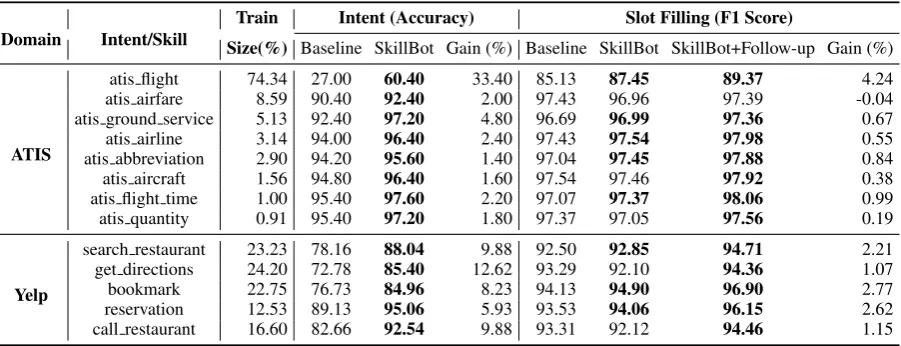
Table 1 presents the results. For ATIS, we
show the results for top 8intents, which contain
at least0.9%of the overall training utterances (the third column displays this fraction). SkillBot NLU achieves a large gain in intent accuracy over the baseline in both datasets. Moreover, we observe that the accuracy gain is also roughly correlated to the fraction of all test utterances in each intent. This indicates that the SkillBot NLU can correctly learn most of the test utterances in the newly added intent. SkillBot NLU also improves the slot filling F1 score in most intents. In cases when SkillBot NLU completely misses a slot, it can directly ask a follow-up question to allow user provide the
slot value before action fulfillment. Therefore,
SkillBot with follow-up user clarification further improves the F1 score and obtains performance gain in last column.
6 Discussion & Future Work
[image:4.595.311.524.65.180.2]Table 1: SkillBot NLU Experimental Results
Domain Intent/Skill
Train Intent (Accuracy) Slot Filling (F1 Score)
Size(%) Baseline SkillBot Gain (%) Baseline SkillBot SkillBot+Follow-up Gain (%)
ATIS
atis flight 74.34 27.00 60.40 33.40 85.13 87.45 89.37 4.24
atis airfare 8.59 90.40 92.40 2.00 97.43 96.96 97.39 -0.04
atis ground service 5.13 92.40 97.20 4.80 96.69 96.99 97.36 0.67
atis airline 3.14 94.00 96.40 2.40 97.43 97.54 97.98 0.55
atis abbreviation 2.90 94.20 95.60 1.40 97.04 97.45 97.88 0.84
atis aircraft 1.56 94.80 96.40 1.60 97.54 97.46 97.92 0.38
atis flight time 1.00 95.40 97.60 2.20 97.07 97.37 98.06 0.99
atis quantity 0.91 95.40 97.20 1.80 97.37 97.05 97.56 0.19
Yelp
search restaurant 23.23 78.16 88.04 9.88 92.50 92.85 94.71 2.21
get directions 24.20 72.78 85.40 12.62 93.29 92.10 94.36 1.07
bookmark 22.75 76.73 84.96 8.23 94.13 94.90 96.90 2.77
reservation 12.53 89.13 95.06 5.93 93.53 94.06 96.15 2.62
call restaurant 16.60 82.66 92.54 9.88 93.31 92.12 94.46 1.15
future work, we will evaluate SkillBot in more real and larger-scale scenarios: allow end users to teach more naturally with less clarification by improving the accuracy of slot identification; support building a brand new domain by enabling slot identification to map more varieties of slots in other domains; incorporate with other non-CRUISE pre-built skills without pre-segmented
utterances; enhance the robustness of action
learning to tackle the dynamics in mobile device system; expand cross app action teaching in which we will design machine learning algorithms for event filtering and UI semantic mapping.
Acknowledgments
The authors would like to thank Abhishek Patel and Xiangyu Zeng for useful discussion and their help of demo implementation and video shooting.
References
Amazon Alexa. 2018. https://developer.
amazon.com/docs/custom-skills/ handle-requests-sent-by-alexa. html.
Amos Azaria, Jayant Krishnamurthy, and Tom M
Mitchell. 2016. Instructable intelligent personal
agent. InAAAI, pages 2681–2689.
Ankur Bapna, Gokhan T¨ur, Dilek Hakkani-T¨ur, and
Larry Heck. 2017. Towards zero-shot frame
semantic parsing for domain scaling. InInterspeech,
pages 2476–2480.
DialogFlow. 2018. https://dialogflow.com/.
Charles T Hemphill, John J Godfrey, George R Doddington, et al. 1990. The atis spoken language
systems pilot corpus. InProceedings of the DARPA
speech and natural language workshop, pages 96– 101.
Young-Bum Kim, Sungjin Lee, and Karl Stratos. 2017. ONENET: joint domain, intent, slot prediction for
spoken language understanding. In ASRU, pages
547–553.
Bing Liu and Ian Lane. 2016. Attention-based
recurrent neural network models for joint
intent detection and slot filling. arXiv preprint
arXiv:1609.01454.
Avik Ray, Yilin Shen, and Hongxia Jin. 2018. Learning out-of-vocabulary words in intelligent personal
agents. InIJCAI, pages 4309–4315.
Yilin Shen, Avik Ray, Abhishek Patel, and Hongxia Jin. 2018a. CRUISE: cold-start new skill development
via iterative utterance generation. In ACL, System
Demonstrations, pages 105–110.
Yilin Shen, Yu Wang, Abhishek Patel, and Hongxia Jin. 2019. Sliqa-i: Towards cold-start development of end-to-end spoken language interface for question
answering. InICASSP.
Yilin Shen, Xiangyu Zeng, Yu Wang, and Hongxia Jin. 2018b. User information augmented semantic frame parsing using progressive neural networks. In
Interspeech, pages 3464–3468.
Yu Wang, Abhishek Patel, Yilin Shen, and Hongxia
Jin. 2018a. A deep reinforcement learning
based multimodal coaching model (dcm) for slot
filling in spoken language understanding(slu). In
Interspeech, pages 3444–3448.
Yu Wang, Yilin Shen, and Hongxia Jin. 2018b. A bi-model based RNN semantic frame parsing bi-model for
intent detection and slot filling. In NAACL-HLT,