The Electron Microscopy Outreach Program: A Web-Based Resource
for Research and Education
Gina E. Sosinsky,*,† Timothy S. Baker,‡ Galen Hand,* and Mark H. Ellisman*,†
*Department of Neurosciences, and †San Diego Supercomputer Center, University of California, San Diego, 9500 Gilman Drive, La Jolla, California 92093-0608; and ‡Department of Biological Sciences, Lilly Hall of Life Sciences, Purdue University,
West Lafayette, Indiana 47907-1392
Received October 30, 1998, and in revised form December 22, 1998
We have developed a centralized World Wide Web (WWW)-based environment that serves as a resource of software tools and expertise for biological elec-tron microscopy. A major focus is molecular elecelec-tron microscopy, but the site also includes information and links on structural biology at all levels of resolu-tion. This site serves to help integrate or link struc-tural biology techniques in accordance with user needs. The WWW site, called the Electron Micros-copy (EM) Outreach Program (URL: http://em-outreach.sdsc.edu), provides scientists with compu-tational and educational tools for their research and edification. In particular, we have set up a centralized resource containing course notes, references, and links to image analysis and three-dimensional reconstruc-tion software for investigators wanting to learn about EM techniques either within or outside of their fields of expertise. r1999 Academic Press
INTRODUCTION
Approaches for exploration of biological structures with modern three-dimensional microscopy tech-niques are expanding rapidly. These technological advances impact not only the imaging of structures, but also the computational reconstruction methods for calculating three-dimensional structures. At one level of resolution, the computational techniques used to investigate the three-dimensional structure of macromolecular complexes, organelles, or cells include crystallographic reconstruction, helical recon-struction, icosahedral reconrecon-struction, single-particle reconstruction, electron tomography, and serial sec-tion reconstrucsec-tion. At lower levels of resolusec-tion, a combination of computational and light microscopy techniques (including deconvolution methods in com-bination with wide-field, multiphoton, or confocal microscopy) provides information on the cellular organization of specifically targeted molecules. Three-dimensional electron microscopic (EM) techniques have been particularly useful for determining
struc-tures that are too small for light microscopy or too large for NMR or X-ray techniques or in cases where crystals are not available or possess only limited order.
Advances in microscopes and associated computa-tional capabilities have been substantial over the past few years and have occurred in all aspects of 3D reconstruction, including (1) image acquisition, (2) image processing and analysis, (3) 3D visualization and presentation, and (4) image or three-dimen-sional structure interpretation (cf. Carragher and Smith, 1996, Journal of Structural Biology issue on Software for Microscopy, for a more complete treatise on software available for molecular and macromolecular micros-copy). These approaches are being communicated and shared with other structural biologists. Each structural biological technique provides unique or complementary structural information. Merging of data from different structural disciplines has provided new information at different levels of molecular or cellular organization (see the review by Baker and Johnson, 1996, for a more extensive list of references to combining EM and x-ray structures; Stewart et al., 1997; Hoh et al., 1993; Yip et al., 1998; Hanein et al., 1998, Wriggers et al., 1998, 1999, and other papers in this issue). There are exciting new technologies for sharing microscopes, data, and analysis via the World Wide Web (WWW) (Ellisman et al., 1998; Hadida-Hassan, 1998, 1999; Wolf et al., 1998; Henri et al., 1997; Kisseberth et al., 1998; Zaluzec, 1998. Here we introduce the Electron Microscopy (EM) Outreach Pro-gram, a Web-based resource integrated for both research and education in electron microscopy. Thus, the site provides basic and advanced information on electron microscopic computational techniques, ac-cess to software tools for computation and visualiza-tion, and access to computational resources avail-able through the San Diego Supercomputer Center.
THE ELECTRON MICROSCOPY OUTREACH PROGRAM: RATIONALE AND IMPLEMENTATION
The EM Outreach Program is a joint project of the National Center for Microscopy and Imaging Re-246
1047-8477/99 $30.00
Copyrightr1999 by Academic Press
search (NCMIR, an NIH National Research Re-source), the San Diego Supercomputer Center (SDSC), the National Partnership for Advanced Com-putational Infrastructure (NPACI), and the National Biomedical Computational Resource (NBCR, an NIH National Research Resource). The EM Outreach Web site is accessible through the research Web page of the SDSC, where it is listed with other NPACI biological thrust areas such as crystallography, mo-lecular biology, ecology, and neurosciences. Under the National Science Foundation funded NPACI, SDSC supports a partnership involving research groups at 46 institutions throughout the United States focused on developing and disseminating advanced methods for computation, in many scien-tific areas, including structural biology. Integrating the EM Outreach Program with NPACI research provides maximum exposure to scientists from other disciplines accessing the general tools at SDSC. Our goal is to produce and promote a centralized resource through NCMIR and NPACI/SDSC. This is espe-cially important is light of the recent award of the Protein Data Bank, the depository of high-resolution protein structures, to a consortium of three institu-tions, of which SDSC is one (Rutgers and the Na-tional Institutes of Standards are the two others; see Editorial, 1998, in Nature Structural Biology).
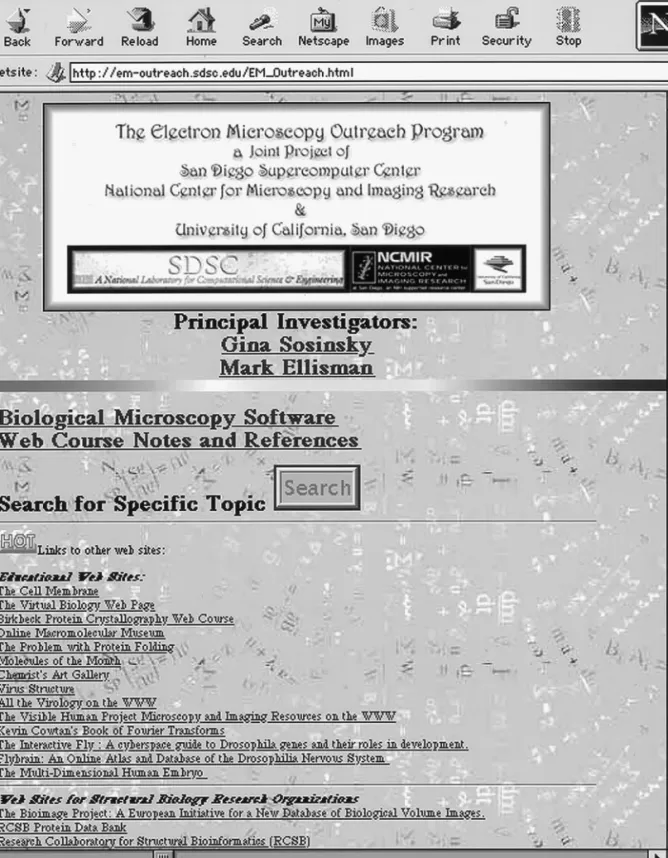
Figure 1 shows the main menu page for the EM Outreach Program. We have included links to data-base resources such as the multidimensional image data base (BioImage Project, Marabini et al., 1996), the Protein Data Bank (PDB), the Human Brain Project, sequence data bases, or other Web-based resource sites. The Outreach Page also contains links to professional organizations, educational Web sites, and other research resources whose focus is either electron microscopy or structural biology.
The EM Outreach Program is divided into two sections: (1) a resource for educational tools and (2) a resource for software tools. The Web site contains a search engine that acts as a glossary for the HTML documents as well as up- and down-links within each section. The site is open to the general public. (1) Resource for Education Tools
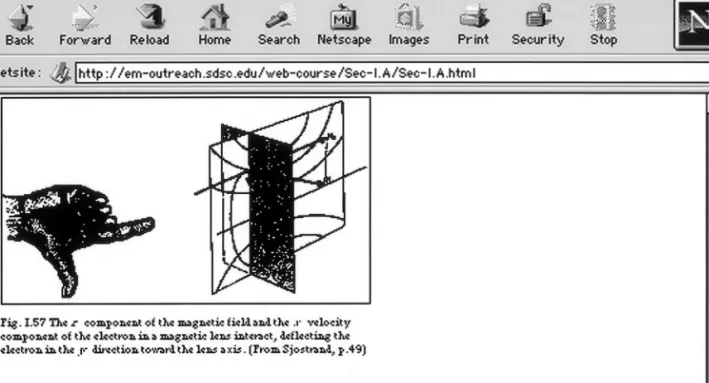
The EM Outreach Program Home Page Web URL contains a link to an EM Web Course. This is a comprehensive ‘‘Web textbook’’ about transmission electron microscopy written in the HTML language. Our original source materials were lecture notes from a course taught by one of us (T.S.B.) for more than 10 years. The notes are extensive and contain tables and figures obtained from published materials (see Fig. 2 for an example). The course is divided into three sections: ‘‘The Microscope’’ (optics and physical principles of transmission electron microscopy;
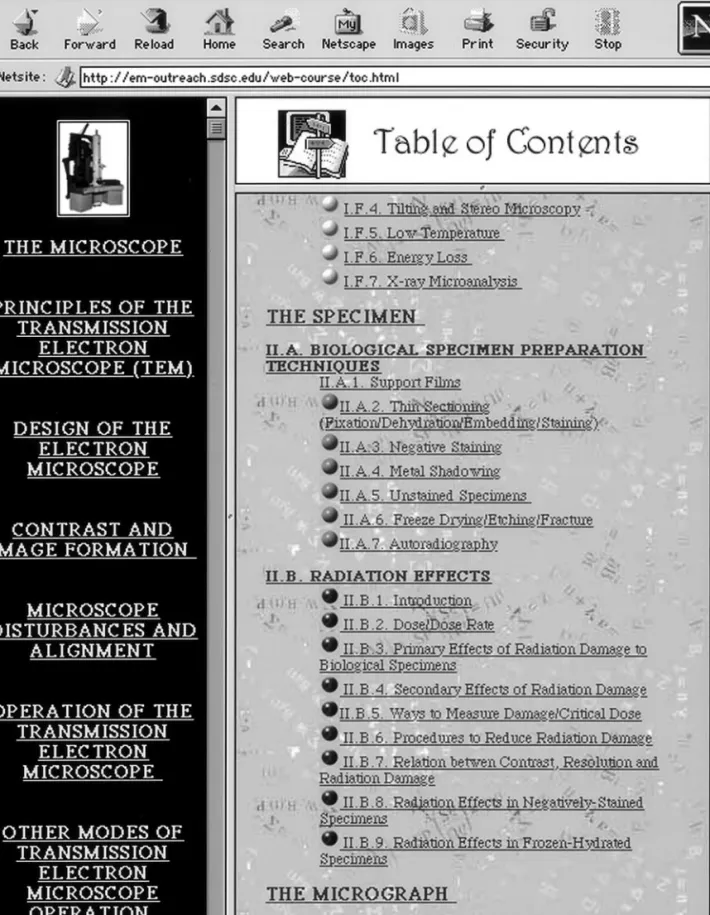
com-parisons to light microscopy), ‘‘The Specimen’’ (meth-ods of biological specimen preparation for transmis-sion electron microscopy, e.g., negative staining, frozen-hydrated preparation, freeze-fracture, thin-section preparation), and ‘‘The Image’’ (methods of image analysis and three-dimensional reconstruc-tion). These Web pages are accessible through a central table of contents and contain links to other appropriate sections and references (Fig. 3).
(2) Resource for Software Tools
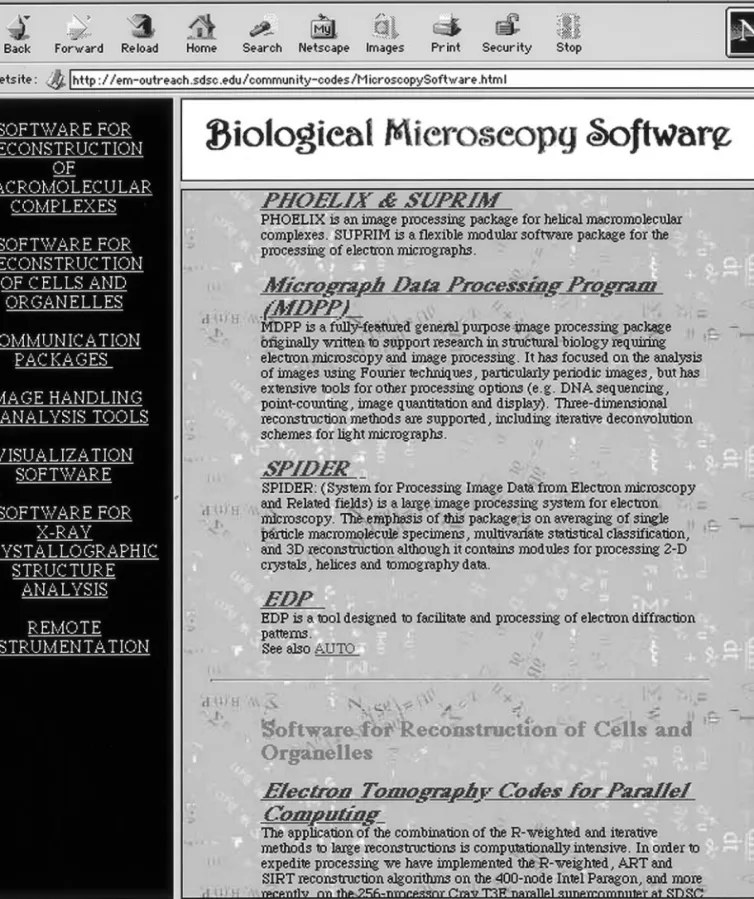
The EM Outreach Program also contains Web documents with links to software tools listed on a page entitled Biological Microscopy Software (Fig. 4). A user can use the EM Outreach Program Home Page Web URL to search for software tools that would be applicable to his/her research. A user can utilize this software in two ways, depending on the particular program and their local computer re-sources. If the desired programs require particular resources, such as a parallel computing environment for electron tomographic reconstruction, the user can run such software on computers at the SDSC facility. In this instance, the user will find a general-ized description of the programs and a URL on how to use the SDSC facility and a transparent interface to this utility. If the desired program runs on ‘‘ordi-nary’’ computers, the user can download software directly to a local computer such as a Silicon Graph-ics Inc., Sun, or Digital Equipment workstation or a personal computer. With this option, the user ac-cesses descriptions of the programs and their func-tions and the URL needed to download the software. In particular, we are currently targeting software that permits data from complementary techniques to be merged and analyzed (e.g., EM and x-ray or EM and light microscopy). In addition to locating exist-ing software that the authors will allow us to distrib-ute, we will take advantage of all appropriate soft-ware advances made by NPACI, SDSC, or NCMIR and distribute these via links in the EM Outreach software Web page. At present, links to SDSC compu-tational resources are the only links listed. We welcome any additional listings on the EM Outreach Program for Web sites that provide access to other national or international computational resources related to biological microscopy. Of the software listed on the Biological Microscopy Software Page, only the Parallel Tomography programs are cur-rently available on the high-performance parallel processing supercomputers at SDSC (and else-where). Researchers interested in using these re-sources should contact Mark Ellisman at NCMIR ([email protected], or one of the other contacts noted on the NCMIR Web Pages, http://www-ncmir.ucsd.edu).
247 EM OUTREACH PROGRAM FOR RESEARCH/EDUCATION VIA THE WWW
FIG. 1. Main menu of Web page to EM Outreach Program. This page contains an overview of the project with links to the Web Course and to microscopy software. Also included on this page are links to other structural biology organizations, databases, educational sites, research resources, and a search engine for finding topics within the Web pages. A user can also access the search engine through the table of contents page of the Web course. Note: The figures presented in this paper are in black and white; however, the Web pages contain color figures and text.
FIG. 2. Sample page of course contents. The page shown here is from the section entitled ‘‘I.A. Principles of the Transmission Electron Microscope (TEM).’’
249 EM OUTREACH PROGRAM FOR RESEARCH/EDUCATION VIA THE WWW
FIG. 4. Biological microscopy software Web page. This page contains short descriptions and links to software sites. The software is categorized by application.
251 EM OUTREACH PROGRAM FOR RESEARCH/EDUCATION VIA THE WWW
ACCESSIBILITY, DISTRIBUTION, AND INCORPORATION OF NEW RESEARCH TOOLS
The EM Outreach Program has been accessible through the World Wide Web at its public address, http://em-outreach.sdsc.edu, since January 1998. It is available to anyone with an Internet browser such as Netscape Navigator or Microsoft Explorer. Re-quests for posting links to software materials and other Web sites as well as any questions about the project can be made by e-mail to Gina Sosinsky at [email protected]. Any suggestions or comments that would expand the scope of this project, such as user group postings, are encouraged and appreci-ated.
FUTURE PLANS
We are developing tutorials, documentation, and sample data to aid investigators in understanding and utilizing these software programs. Some of the software tools listed already have good documenta-tion as part of their current release. Copyright permissions for images for ‘‘version 1’’ of the Web course will be obtained within a reasonable time frame (e.g., publication of this issue) or will be replaced by similar figures without copyright restric-tions. A second edition of the Web course will incorpo-rate animations and advanced Web technology. Ex-amples of advanced Web technology include interactive graphics, the use of JAVA applets for specific applications, and virtual reality modeling language (VRML). VRML is a standard language for describing interactive 3-D objects and virtual worlds for transmission across the Internet. VRML adds the next level of interaction after HTML providing struc-tured graphics, three-dimensional representations, and animations. See http://www.sdsc.edu/vrml for further details and examples. The improved Web course will include exercises and animations that go along with the textual material and links to biblio-graphic databases. We will include links in the image analysis section about appropriate software and where to access these packages or programs. We will also solicit sections from leading researchers on other types of biological microscopic techniques, e.g., immunocytochemistry, confocal microscopy, and scan-ning probe microscopies (SPM/AFM), which will expand the information already present in the course. The EM Outreach Program project was initiated with funds from the National Science Foundation as part of the Computa-tional Biology support for the San Diego Supercomputer Center. The continuation and further development of this project are part of the directive of the NCMIR (http://www-ncmir.ucsd.edu) and are supported by NIH Grant RR04050 to Mark H. Ellisman. Development and maintenance of this Web site and related infrastructure are provided by NIH Grant RR08605 (NBCR, http://www.sdsc.edu/NBCR) and NSF Grant ASC 97-5249 (NPACI, http://www.npaci.edu). T.S.B. was supported by NIH Grant
GM33050. G.E.S. was supported by NSF Grant MCB-9728338. We thank Dr. Maryann Martone and Steve Young for comments on the manuscript; Adam Lathers for help with the search engine and formatting of some of the Web documents; and Millicent Sturgeon for help in organizing the Web-based course notes. We dedicate this paper to Dr. Steve Young.
REFERENCES
Baker, T. S., and Johnson, J. E. (1996) Low resolution meets high: Towards a resolution continuum from cells to atoms, Curr. Opin. Struct. Biol. 6, 585–594.
Carragher, B., and Smith, P. R., Eds. (1996) Special Issue: Advances in computational image processing for microscopy, J. Struct. Biol. 116.
Editorial (1998) The ‘‘new’’ PDB, Nat. Struct. Biol. 5, 925–926. Ellisman, H., Hadida, M., Greer, D., Wong, M., Lindsey, S., Peltier,
S., and Young, S. J. (1998) Telemicroscopy: Development of a collaboratory for microscopic digital anatomy, Microsc. Micro-anal. 4(2), 12–13.
Hadida-Hassan, M. (1998) An Architecture for Video-Guided Remote Operation of Instruments over the World Wide Web, Master’s Thesis, University of California, San Diego.
Hadida-Hassan, M., Young, S. J., Peltier, S. T., Wong, M., Lamont, S., and Ellisman, M. H. Web-based telemicroscopy, J. Struct. Biol. 125, 235–245.
Hanein, D., Volkmann, N., Goldsmith, S., Michon, A.-M., Lehman, W., Craig, R., DeRosier, D., Almo, S., and Matsudaira, P. (1998) An atomic model of fimbrin binding to F-actin and its implica-tions for filament crosslinking and regulation, Nat. Struct. Biol.
5, 787–792.
Henri, C. J., Rubin, R. K., Cox, R. D., and Bret, P. M. (1997) Design and implementation of World Wide Web-based tools for image management in computed tomography, magnetic resonance imaging, and ultrasonography, J. Digital Imaging 10(Suppl. 1): 77–79.
Hoh, J., Sosinsky, G. E., Revel, J.-P., and Hansma, P. K. (1993) Structure of the extracellular surface of the gap junction by atomic force microscopy, Biophys. J. 65, 149–163.
Kisseberth, N., Whittaker, M., Weber, D., Potter, C. S., and Carragher, B. (1997) emScope: A tool kit for control and automation of a remote electron microscope, J. Struct. Biol. 120, 309–319.
Marabini, R., Vaguerizo, C., Ferna´ndez, J. J., Carazo, J. M., Engel, A., and Frank, J. (1996) Proposal for a new distributed database of macromolecular and subcellular structures from different areas of microscopy, J. Struct. Biol. 116, 161–166.
Stewart, P. L., Chiu, C. Y., Huang, S., Muir, T., Zhao, Y., Chait, B., Mathias, P., and Nemerow, G. R. (1997) Cryo-EM visualization of an exposed RGD epitope on adenovirus that escapes antibody neutralization, EMBO J. 16, 1189–1198.
Wriggers, W., Milligan, R. A., Schulten, K., and McCammon, J. A. (1998) Self-organizing neural networks bridge the biomolecular resolution gap, J. Mol. Biol. 284, 1247–1254.
Wriggers, W., Milligan, R. A., and McCammon, J. A. (1999) Situs: A package for docking crystal structures into low-resolution maps from electron microscopy, J. Struct. Biol. 125, in press. Wolf, G., Petersen, D., Dietel, M., and Petersen, I. (1998)
Telemi-croscopy via the internet, Nature 391, 613–614.
Yip, C. M., Brader, M. L., DeFelippis, M. R., and Ward, M. D. (1998) Atomic force microscopy of crystalline insulins: The influence of sequence variation on crystallization and interfa-cial structure, Biophys. J. 74, 2199–2209.
Zaluzec, N. J. (1998) Tele-presence microscopy: A progress report, Microsc. Microanal. 4(2), 18–19.