Wikipedia
Master Thesis
presented by Bernhard Sch¨afer
submitted to the
Research Group Data and Web Science Prof. Dr. Christian Bizer
University Mannheim
Contents
1 Introduction 1
1.1 Motivation . . . 1
1.2 Problem Description . . . 2
2 Related Work 4 2.1 The Entity Linking Process . . . 5
2.2 Entity Linking Data Sources . . . 6
2.2.1 Wikipedia . . . 7 2.2.2 DBpedia . . . 9 2.3 Phrase Spotting . . . 11 2.3.1 Link Probability . . . 11 2.3.2 NLP-informed Spotting . . . 12 2.4 Candidate Selection . . . 13 2.5 Disambiguation . . . 14 2.5.1 Features . . . 14 2.5.2 Systems . . . 18 3 Methods 22 3.1 Graph Construction . . . 22
3.1.1 Selecting DBpedia Datasets . . . 23
3.1.2 Triple Filtering . . . 24
3.2 Graph Traversal . . . 30
3.3 Candidate Pruning . . . 32
3.4 Semantic Relation Weighting . . . 35
3.4.1 Information Content . . . 37
3.4.2 Joint Information Content . . . 37
3.4.3 Combined Information Content . . . 38
3.4.4 Information Content and Pointwise Mutual Information . . 38
3.5 Graph Connectivity Measures . . . 40
3.5.1 Local Measures . . . 40
3.6 Federated Entity Linking . . . 45
3.6.1 Enhanced Graph-based Disambiguation . . . 46
3.6.2 System Combination . . . 46
3.6.3 Feature Combination . . . 49
4 Evaluation 51 4.1 Metrics . . . 52
4.2 Datasets . . . 54
4.3 Baseline Linkers . . . 56
4.4 DBpedia Graph Linker . . . 58
4.4.1 Error Analysis . . . 58
4.4.2 Performance . . . 62
4.5 DBpedia Spotlight Linker . . . 67
4.5.1 Error Analysis . . . 67
4.5.2 Performance . . . 68
4.6 Federated Linker . . . 69
4.6.1 Enhanced Graph-based Disambiguation . . . 69
4.6.2 System Combination . . . 70
4.6.3 Feature Combination . . . 72
4.7 Findings . . . 72
4.7.1 DBpedia Graph Linker . . . 72
4.7.2 Baseline Linkers . . . 73 4.7.3 Federated Linkers . . . 73 5 Conclusion 74 5.1 Overview . . . 74 5.2 Future Work . . . 75 A Implementation Details 80 A.1 Graph Database . . . 80
List of Figures
2.1 Entity Linking Process-Features-Data-Sources Relationships . . . 5 2.2 Entity Linking Process . . . 6 2.3 Strawberry Pie Wikipedia Article Markdown . . . 7 3.1 Sentence Subgraph for Undirected Traversal with Depth Two . . . 33 4.1 Berlin Popular Entity Bias Example . . . 60 4.2 Unrelated Domain Surface Forms Example . . . 61
List of Tables
2.1 Link Probability Counts for Napoleon Sentence . . . 12
2.2 State of the Art Entity Linking Systems . . . 19
3.1 Included DBpedia Datasets . . . 24
3.2 Excluded DBpedia Datasets . . . 25
3.3 Top-20 Occurring Categories . . . 26
3.4 Regular Expressions for filtering Wikipedia Categories . . . 27
3.5 Top-20 Mapping-based Types by Frequency . . . 29
3.6 Subgraph comparison for sample sentence . . . 31
3.7 Top-3 candidates for sample sentence surface forms . . . 32
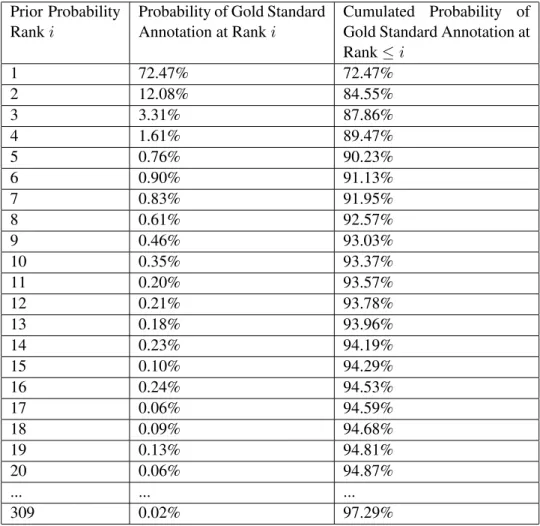
3.8 Candidate Prior Probability Distribution AIDA/CO-NLL . . . 35
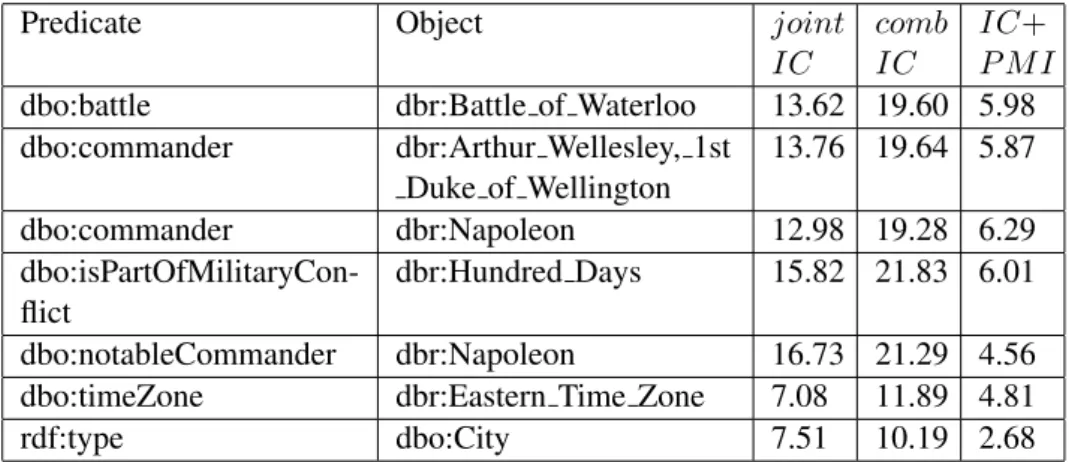
3.9 Napoleon sentence weighting schemes . . . 36
3.10 Napoleon sentence predicate metrics . . . 37
3.11 Napoleon sentence object metrics . . . 38
3.12 Napoleon sentence combined frequencies . . . 39
3.13 Local measures for the vertices from Table 3.7 . . . 41
3.14 Spotlight top-4 log-scaled feature probabilities . . . 50
4.1 Evaluation Dataset Statistics . . . 55
4.2 BaselineP(s|e)Sa2W Accuracy . . . 57
4.3 BaselineP(s|e)D2W Accuracy . . . 57
4.4 AGDISTIS D2W Accuracy . . . 58
4.5 DBpedia Graph Linker D2W Accuracy . . . 63
4.6 DBpedia Graph Linker Sa2W Accuracy . . . 63
4.7 Graph Construction D2W Accuracy AIDA/CO-NLL . . . 64
4.8 Graph Traversal D2W Accuracy AIDA/CO-NLL . . . 65
4.9 Candidate Pruning D2W Accuracy AIDA/CO-NLL . . . 65
4.10 Semantic Relation Weighting D2W Accuracy AIDA/CO-NLL . . 66
4.11 Graph Connectivity Measure D2W Accuracy AIDA/CO-NLL . . 66
4.12 DBpedia Spotlight Analysis Error Distribution . . . 68
4.13 DBpedia Spotlight D2W Accuracy . . . 69
4.14 DBpedia Spotlight Sa2W Accuracy . . . 69 4.15 Enhanced DBpedia Graph Linker D2W Accuracy AIDA/CO-NLL 70
4.16 System Combination Linker D2W Accuracy . . . 71 4.17 Feature Combination Linker D2W Accuracy . . . 72 4.18 Evaluation Linkers D2W Accuracy AIDA/CO-NLL . . . 72
Introduction
1.1
Motivation
Unlike for human beings, for a computer it is very challenging to tell which sense a word in a sentence refers to. This can be illustrated by the following sentence:
Napoleon was defeated at Waterloo by Wellington.
Due to existing knowledge, a human immediately knows that in this context, Wa-terloorefers to the battle which took place in Belgium, and not the city in Canada. Likewise,Napoleonrefers to Napoleon Bonaparte, and not one of his descendants with the same name. In the same manner,Wellingtondoes not refer to the city in New Zealand, but to Arthur Wellesley, 1st Duke of Wellington, the commander of the allied army in the battle of waterloo.
The task in which a computer tries to derive the senses of words is called word-sense disambiguation (WSD), an open problem in natural language process-ing (NLP). With the increasprocess-ing popularity of Wikipedia in the 2000s decade, the task of named entity linking (NEL) emerged, with the goal of linking words or phrases in text (surface forms) to their respective entities in a knowledge base. In case Wikipedia is used as the knowledge base, the surface forms are linked to their matching Wikipedia article. The task of linking entities to Wikipedia is also called Wikification [29].
The most successful approaches to entity linking, to date, are based on su-pervised learning methods [9]. Hereby, the article texts in Wikipedia and their containing interlinks, along with the anchor texts, are commonly used as training data. The first publication on supervised entity linking to Wikipedia was published in 2007 by [29]. At the time of writing, all state of the art performing entity linking systems still depend to a large extent on the features explored in the publication from 2007.
For a big step forward to the accuracy of a human linker, it is essential to also investigate on other approaches to entity linking. Here, the attention could be more directed towards knowledge-based approaches, since they are closest to
mimicking the approach of a human linker. This circumstance is an advantage of knowledge-based approaches, since a human being has an accuracy close to 100%. For example, a human might exploit the fact that Napoleon Bonaparte was the commander of the french troops in the Battle of Waterloo to reason that the surface form Napoleon refers to Napoleon Bonaparte in the previous example. This exploited fact can also be found in the infobox of theBattle of WaterlooWikipedia article1, and thus, it could be used by a computer in a similar fashion.
Earlier attempts to exploiting a knowledge source for disambiguation mostly focussed on the task of WSD and used WordNet as a knowledge base (cf. [32]). However, there are only a few attempts at exploiting Wikipedia for knowledge-based entity linking (cf. [41]). This might be due to the fact that in contrast to sources such as WordNet, the Wikipedia infobox statements are not structured and contain errors, which makes their usage tedious. Fortunately, in more recent years community efforts such as DBpedia have been founded, which extract structured information from Wikipedia and make this information available on the Web [2, 3]. To this end, the community created an automated extraction framework that creates structured datasets in the form of RDF triples, which can essentially be interpreted as a giant graph.
The mentioned facts lead to the conclusion that entity linking could substan-tially benefit from further research on exploiting DBpedia for graph-based entity linking to Wikipedia.
1.2
Problem Description
The present thesis addresses two main research problems. The first topic is cen-tered around exploring DBpedia for novel approaches to graph-based entity linking to Wikipedia. To set graph-based linking into context with the bigger picture of entity linking, the second aspect is concerned with incorporating the graph-based methods into state of the art supervised approaches, with the aim of combining the strenghts of both.
The work on graph-based linking is broken down into four main phases. To enable graph-based entity linking based on DBpedia, at first a graph suited for dis-ambiguation is constructed from the DBpedia datasets. This involves determining the appropriate datasets and figuring out which data from DBpedia is irrelevant for linking (e.g. image-related triples), and thus should be excluded from the graph representation. After the DBpedia graph has been constructed, methods are devel-oped to traverse the graph efficiently. This involves various steps such as figuring out if the graph should be interpreted as directed or undirected, and the deter-mination of an appropriate traversal depth limit. To further improve the expres-siveness of connections in the graph, another aspect is the weighting of semantic relations to emphasize especially relevant predicates or predicate-object combina-tions. Thereby, different measures from existing research are evaluated (cf. [36]).
1
To link the surface forms in text to their entity references, there are numerous graph-based connectivity measures. Therefore, different graph-based algorithms for entity linking are evaluated. For the similar task of word-sense disambiguation (WSD), different local and global graph algorithms have been already proposed by [32]. Accordingly, the present work looks at these very same algorithms, as well as extends this line of work to other algorithms, attempting to mitigate the drawbacks exposed from the evaluation of these algorithms.
For forming a federated linker that combines the graph-based with state of the art supervised techniques, DBpedia Spotlight is used as the supervised system. To assess the strengths and drawbacks of both linkers, an error analysis based on a random sample of documents is conducted for both. Based on the results, different methods for combining both linkers are developed and evaluated, with the goal of exploiting the synergies between both to enhance the state of the art statistical approach.
The remainder of this work is organized as follows: The next chapter discusses the state of the art in entity linking (Chapter 2). Next, the methodology of the present work is discussed, focussing on the various aspects in constructing the graph-based linker and how to integrate this linker with state of the art supervised methods (Chapter 3). This is followed by an extensive evaluation (Chapter 4). The evaluation serves not only to compare the performance of graph-based and other state of the art approaches, but also to use actual data to justify the numerous design decisions involved in constructing the graph-based linker. Finally, some conclusions are drawn from this work (Chapter 5).
Related Work
The goal of this chapter is to outline the research that has happened in entity linking to Wikipedia and discuss how the graph-based approach of the present work fits in. Since the first papers on entity linking to Wikipedia have been published in 2007 (cf. [10, 29]), the topic has gained a lot of attention from the research community. The majority of works on entity linking propose and evaluate full entity linking systems. Among others, these systems can be characterized along two dimensions: • Entity Linking Process: The steps that the entity linker performs to transform
a raw document input to a document with annotations to Wikipedia.
• Entity Linking Features: The methods used within each step of the process. The features used within each step of the process can be best categorized and distinguished by their underlyingdata sources. Hereby, the vast majority of systems solely rely on features which are directly or indirectly drawn from Wikipedia.
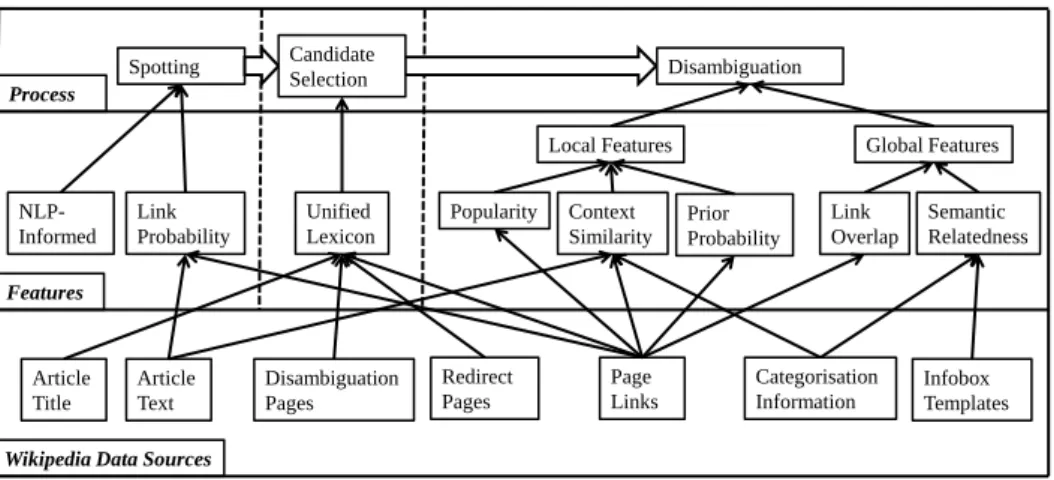
Figure 2.1 summarizes the detected relationships between the entity linking process,features andWikipedia data sources that have been drawn from the sur-veyed related work.
The remainder of the chapter is structured as follows: The next section ad-dresses the entity linking process from a high-level perspective (Section 2.1). This is followed by a discussion of the different data sources that aid throughout the entire process (Section 2.2). Overall, this section provides a foundation for the rest of the chapter, since all features in each step of the linking process are based on a subset of these sources. The elaboration of the data sources is followed by dedi-cated sections for each step within the linking process. Thus, a discussion about techniques spotting (Section 2.3) is followed by a dedicated section for candidate selection (Section 2.4). Next, the disambiguation phase is discussed (Section 2.5). Since the focus of the present thesis is placed on the disambiguation step, this section is discussed in a detailed manner, including a comparison of all features used within entity linking systems and an analysis of which and how each of those features is utilized within state of the art these systems.
Spotting Unified Lexicon Disambiguation Popularity Link Overlap Prior Probability Context
Similarity Semantic Relatedness Link
Probability
NLP-Informed
Article
Title Article Text
Page
Links Infobox Templates Categorisation Information Redirect Pages Disambiguation Pages
Local Features Global Features
Wikipedia Data Sources Features
Process
Candidate Selection
Figure 2.1: Entity Linking Process-Features-Data-Sources Relationships
2.1
The Entity Linking Process
The entire entity linking process can be split up in multiple steps. The first works on entity linking distinguished between two steps,detectionandlink disambiguation [29].
The first step, which is commonly referred to as spotting (cf. [28]), detec-tion(cf. [31]) orkeyword extraction(cf. [29]), involves identifying the terms and phrases from which the links should be made. Throughout research, these terms or phrases are calledspots,mentions, orsurface forms. The techniques for spotting are further elaborated in a dedicated section (2.3).
The link disambiguation phase is concerned with finding the correct Wikipedia article that should be linked to a keyword or phrase. Follow-up works have fur-ther split up this step into the two phasescandidate selection anddisambiguation [28]. The candidate selection step is concerned with generating potential entity candidates in the form of Wikipedia articles for each prior identified surface form. The next step, commonly referred to asdisambiguation(cf. [31, 28]) orcandidate ranking(cf. [8]), deals with finding the best matching candidate entity for each surface form. Hereby, candidate ranking is a generalisation of the disambiguation process, since disambiguation merely returns the candidate with the highest score, whereas ranking produces an ordered list of candidates, optionally enriched with confidence scores.
More recent work also identified a subsequent step to deal with NIL surface forms [8, 11]. This step is based on the assumptions that not all surface forms have corresponding articles in Wikipedia. Thus, if a surface form has no matching article, it should be mapped to a NIL entity. Since the most commonly used datasets for evaluating entity linkers, discussed in Chapter 4, do not contain annotations to NIL entities, this step does not play a major role in this work.
Spotting
Candidate Selection
Disambiguation
Napoleon was defeated at Waterloo by Wellington.
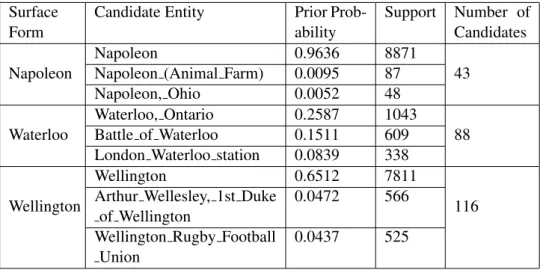
Napoleon, Napoleon_(Animal_Farm), Napoleon,_Ohio, ... Waterloo,_Ontario, Battle_of_Waterloo, London_Waterloo_station, ... Wellington, Arthur_Wellesley,_1st_Duke_of_Wellington, Wellington_Rugby_Football_Union, ... Napoleon (0) Napoleon (0.9) Napoleon,_Ohio (0.02) Napoleon_(Animal_Farm) (0.01) ... Battle_of_Waterloo (0.7) Waterloo,_Ontario (0.1) London_Waterloo_station (0.1) ... Arthur_Wellesley,_1st_Duke_of_Wellington (0.7) Wellington (0.1) Wellington_Rugby_Football_Union (0.1) ... Input Text Wellington (38) Waterloo (26)
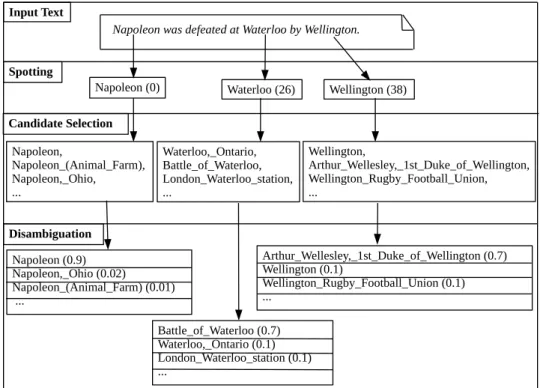
Figure 2.2: Entity Linking Process
by [28]. An overview of this process, along with an exemplary sentence, is shown in Figure 2.2. In the illustrated spotting phase, the numbers in parenthesis depict the character offset of the surface form in the overall document. This illustrates that there can be multiple surface forms with equal character strings, which can only be distinguished by their offset within the document.
2.2
Entity Linking Data Sources
The majority of data sources used within state of the art entity linking systems are directly or indirectly based on Wikipedia. The indirect usage happens through third-party projects such as DBpedia, a community effort to make the information of Wikipedia available in a structured manner. Since the graph-based approach of the present thesis is also focussed on DBpedia, this chapter is structured as follows: In the next section, the different data sources contained within Wikipedia are outlined (Section 2.2.1). This is followed by a dedicated section which covers the DBpedia project (Section 2.2.2).
Figure 2.3: Strawberry Pie Wikipedia Article Markdown
2.2.1 Wikipedia
There are multiple data sources contained within Wikipedia, which are individually discussed in the remainder of this section. While doing so, the Wikipedia article of Strawberry Pie1is used as an example to illustrate the different sources.
Article Text
The most straightforward data source from Wikipedia to use is the text of the Wikipedia articles. Since the articles contain an explanation of its main subject and relationship to related concepts, the words contained in the article indicate a certain relatedness to the article. This data source has been utilized by the first works in entity linking to Wikipedia [6, 10].
There are various context-based local features which leverage the article text; they are further explained in Section 2.5.1.
Page Links
The most prominent data source for entity linking to Wikipedia are the page links contained within the Wikipedia articles.
The Wikipedia articles are written inwiki markup2, a markup language which is translated to HTML. As part of the language specification, references to other Wikipedia concepts can be made through double square brackets. Optionally, these references contain a vertical bar. In this case, the text left of the bar denotes the Wikipedia concept whereas the text on the right is the anchor text of the link. As illustrated in Figure 2.3, an exemplary anchor contained in the Strawberry Pie ar-ticle is [[Garden strawberry|strawberries]]. Since the Wikipedia
1
http://en.wikipedia.org/wiki/Strawberry pie 2
page articles are freely accessible3, these double square brackets can be easily ex-ploited to identify interlinking Wikipedia concepts. Through third-party projects such as DBpedia, these page links are also conveniently accessible in a structured and semantic format4.
The page links and anchor texts within Wikipedia are used as basis in the spot-ting and candidate selection step, and also for many local and global features in Section 2.5.1.
Infobox Templates
Infoboxes in Wikipedia contain core facts about an article5. They are displayed as panels that appear on the top right of the default view of many Wikipedia articles, or at the start for the mobile version.
Wikipedia uses a hierarchy of infobox templates that can be used for articles, where each template contains a set of properties for the respective domain. In theStrawberry Pie example the templateInfobox prepared food6 is used, which contains properties such asMain ingredient(s)andVariations.
Overall, the infobox templates are utilized as global features within entity link-ing, commonly through the usage of third-party projects such as DBpedia [2] and YAGO [39], which generate structured data from these infoboxes.
Categorisation Information
In Wikipedia, articles also contain a set of categories. These categories are roughly organized as a tree with the exceptions of several cycles.
The Strawberry pie example lists the following categories: Sweet pies, Ger-man cuisine,Pie stubs. Hereby, theSweet Piescategory is a subcategory ofPies, which has the supercategoriesFoods,Baked Goods, andDessert.
This category information is exploited as local and global disambiguation fea-tures.
Non-article pages
In addition to pages for Wikipedia articles and categories, there are other pages in Wikipedia, for example dedicated to redirects, disambiguations, lists, or images.
The redirect and disambiguation pages are useful for entity linking, especially regarding candidate selection (cf. Section 2.4). Therefore, they are shortly de-scribed in the following:
• Redirect pages: The Wikipedia articles commonly have a set of redirect pagesthat link to them. These redirect pages use synonyms or alternative
3http://en.wikipedia.org/wiki/Wikipedia:Database download 4http://wiki.dbpedia.org/Downloads39#wikipedia-pagelinks 5
http://en.wikipedia.org/wiki/Infobox#Wikipedia 6
surface forms, including common misspellings and acronyms. For example, the entityMichael Jordanhas more than 20 different redirect pages, ranging from the full name depictionMichael Jeffrey Jordan to nicknames such as His Airness.
• Disambiguation pages: These pages exist throughout Wikipedia for ambigu-ous surface forms. They contain a list of references to entities that are typi-cally mentioned using this surface form.
2.2.2 DBpedia
DBpedia is a community effort to extract structured information from Wikipedia and to make this information available on the Web [2, 3]. To this end, the commu-nity created an automated extraction framework that creates structured datasets in the form of RDF triples, based on the data sources mentioned in Section 2.2. Each RDF triple consists of a subject, a predicate, and an object. Thereby, the subjects and predicates are IRIs, whereas the object is either an IRI or a literal. The notion of IRI (International Resource Identifier) is a generalization of URI (Uniform Re-source Identifier), allowing non-ASCII characters to be used in the IRI character string [24]. Throughout this work, the URI prefixes commonly used within the Linked Data community are applied7.
The DBpedia dataset has several advantages compared to the raw data from Wikipedia for the entity linking task. Besides the more convenient access to the underlying Wikipedia data sources, it also provides a higher data quality. The higher quality is due to the fact that the extraction framework embeds multiple steps commonly found in data mining applications, such as duplicate removal in the form of mapping redundant infobox properties to the same DBpedia property. Therefore, the present work is focussed on using DBpedia for entity linking to Wikipedia.
The entire DBpedia is split up into different datasets, which can be downloaded in different format such as N-Triples8. Since the goal of the present thesis is the creation of a graph based on DBpedia suitable for entity linking, in the following the datasets that are created as part of the extraction are discussed. Thereby, the datasets are grouped according to their Wikipedia data sources explained in Section 2.2.
Article Text There are various datasets containing elements of the article text, such as the titles9and short abstracts10.
Page Links The page links, extracted from the internal links between Wikipedia articles, are also accessible as dataset in DBpedia11.
7 http://prefix.cc/ 8http://wiki.dbpedia.org/Downloads39 9http://wiki.dbpedia.org/Downloads39#titles 10 http://wiki.dbpedia.org/Downloads39#short-abstracts 11 http://wiki.dbpedia.org/Downloads39#wikipedia-pagelinks
Infobox Templates The datasets extracted from the infobox templates represent the key facts about an entity. There are two types of information that are extracted from the templates, the type of template that is used for the article and the properties that are used within the template.
The name of the template itself is used to map the overall article towards an ontology type. The resultingmapping-based typesdataset, also referred to asinstance-types, containsrdf:typestatements about DBpedia entities12. Hereby, the entities are linked to ontology classes, which are part of the overall DBpedia ontology13. DBpedia maintains a set of manual mappings between the templates in the template hierarchy and the appropriate on-tology class. The onon-tology classes are arranged in a tree and range from broad classes such asdbo:Placeanddbo:Personto fine-grained classes such asdbo:Guitarist14. For interlinking the ontology with other Linked Open Data datasets, the datasets also contain mappings to other respective classes, such asfoaf:Person15. As an example, in the current version of DBpedia, dbr:Michael Jordanis mapped as dbo:BasketballPlayer. Consequently, he is also mapped towards all classes from this class up to the root class, which makes him andbo:Athlete,dbo:Person,dbo:Agent, andowl#Thing.
The properties of the infobox templates are extracted into various infobox datasets. These infobox datasets deal to a different extent with the incon-sistencies and errors in infobox templates. The raw infobox properties16 dataset, which is in the/property/namespace, maps almost all infobox prop-erties to their matching DBpedia property. Thus, this dataset has a high cov-erage but is less clean and more error prone. On the opposite, the mapping-based propertiesdataset17, which is in the/ontology/namespace, has a much higher quality, since different Wikipedia infobox properties that correspond to the same concept, are mapped towards one relation in the ontology. For the entitydbr:Michael Jordan, an exemplary mapping-based triple is:
dbr:Michael Jordan dbo:birthPlace dbr:Brooklyn.
Additional to the mentioned infobox derived datasets, there are domain-specific datasets such asperson data18orhomepages19.
Categorisation Information DBpedia also contains datasets regarding the
12 http://wiki.dbpedia.org/Downloads39#mapping-based-types 13 http://wiki.dbpedia.org/Ontology39 14http://mappings.dbpedia.org/server/ontology/classes/ 15http://xmlns.com/foaf/0.1/Person 16 http://wiki.dbpedia.org/Downloads39#raw-infobox-properties 17 http://wiki.dbpedia.org/Downloads39#mapping-based-properties 18 http://wiki.dbpedia.org/Downloads39#persondata 19http://wiki.dbpedia.org/Downloads39#homepages
Wikipedia category system. Overall, DBpedia lists 995,91120different cate-gories in their newest release 3.9 at the time of writing. The category URIs all share the prefix http://dbpedia.org/resource/Category:, which is com-monly abbreviated ascategory:. The category information is split up into three different datasets, thearticle categories21, the skos categories22, and thecategory labels23. The article category dataset contains category state-ments about articles, using http://purl.org/dc/terms/subject as triple pred-icate. The skos category dataset contains the category hierarchy repre-sented as statements with categories as subject and object. For the en-tity dbr:Michael Jordan, DBpedia lists 38 categories, ranging from cat-egory:Basketball players from New York to very broad categories such as category:Living people.
2.3
Phrase Spotting
Phrase spotting involves identifying the terms and phrases from which the links should be made [31]. Throughout research, these terms or phrases are calledspots, mentions, orsurface forms. There are two categories of spotting techniques which can be distinguished based on their data sources: spotting based onLink probabil-ity, which utilizes Wikipedia article texts and page links as a data source, and NLP-informedspotting, which uses the characteristics of tokens and phrases or pre-built language-dependent models. The remainder of this chapter discusses both cate-gories in dedicated sections. Since DBpedia Spotlight makes extensive usage of both categories, their interplay as used in this system is discussed throughout the sections.
2.3.1 Link Probability
Throughout literature, the most common approach to spotting is calledlink prob-abilityorannotation probabilitydetection. This approach has first been proposed by Mihalcea and Csomai in 2007 using the termkeyphraseness[29]. Formally, the link probability of a phrase is defined as the number of Wikipedia articles that use it as an anchor, divided by the number of articles that mention it at all. Therefore, is is solely based on the article text (cf. Section 2.2.1) and page links (cf. Section 2.2.1) data sources. The detection approach works by gathering all n-grams for a doc-ument and retaining those surface forms whose link probability exceeds a certain threshold. When link probability is used as the only spotting method, overlapping surface form candidates can then be resolved based on the higher probability value.
20
Unique categories in the Category (Labels) dataset (http://wiki.dbpedia.org/Downloads39# categories-labels) 21 http://wiki.dbpedia.org/Downloads39#articles-categories 22 http://wiki.dbpedia.org/Downloads39#categories-skos 23http://wiki.dbpedia.org/Downloads39#categories-labels
Spot Annotation Count Total Count Link Probability
Napoleon 9,206 18,330 50.22%
Waterloo 4,301 7,541 57.03%
Wellington 11,994 19,278 62.22%
Table 2.1: Link Probability Counts for Napoleon Sentence
For the following sentence, the respective annotation and total counts, generated by DBpedia Spotlight, are listed in Table 2.1:
Napoleon was defeated at Waterloo by Wellington.
Apart from the spotsNapoleon, Waterloo, and Wellington, there are no n-grams within these sentences that have been used within an anchor in a Wikipedia article. Therefore, there are no further potential spots.
The link probability measure is unreliable for marginal cases where the to-tal occurrence count is very low, since it only considers the relative frequency of phrases within anchor texts. Therefore, most entity linkers define a minimum total occurrence frequency thresholdtoccfor a phrase to be considered, such astocc= 5
as used by [29].
2.3.2 NLP-informed Spotting
To improve the accuracy of thelink probabilitymethod, follow-up works experi-mented with incorporating natural language processing (NLP) informed methods. There are various methods based on NLP features.
A simple method for identifying further noun phrases is to determine capital-ized token sequencessuch as ”President Barack Obama” [11]. Another approach to improve spotting precision is to filter out phrases with common words based on a predefined set of stopwords, to avoid linking plain English words [27].
Apart from these relatively simple techniques, more advanced NLP techniques such aspart-of-speech (POS) tagging, phrase chunking, or named entity recog-nition (NER), can be applied [23]. These techniques require a prebuilt language-dependent model which has been trained on a large text corpora. Moreover, the tok-enization of the input text is a prerequisite for these techniques to function properly. POS taggingmarks tokens with their corresponding word type based on the token itself and the context of the token. There is an established set of word types com-monly used throughout research, ranging from plural nouns (NNS) and adverbs (RB) to sentence closers. Aphrase chunkeruses these POS-tagged sentences to separate and segment a sentence into phrases such as noun, verb, and prepositional phrases. The phrase chunks that DBpedia Spotlight considers relevant for spotting are Noun Phrase chunks (NP), Prepositional Phrase chunks (PP) and Multi Word Units (MWUs) [11]. Apart from phrase chunking,named entity recognition (NER) is another NLP technique used for spotting. NER identifies and classifies phrases to types such asPeople,Location, orOrganization[27].
Overall, DBpedia Spotlight combines link probability, capitalized token se-quences detection, common phrase filtering, phrase chunking and named entity recognition in a two-step spotting process. In the first step, each of the mentioned methods generates a set of surface form candidates, forming a global set union of candidates. In the second step, the best candidates are selected from this set union. To this end, overlaps in the candidates are resolved based on which method generated them. Hereby, the more fine-grained and scientific approaches, such as NER, are preferred to methods such as plain capitalized token sequences detection. As the last step of the spotting process, the candidates whose link probability falls below a constant threshold value are dropped [11].
For the mentioned NLP tasks that require a pre-built model, DBpedia Spotlight relies on the open-source projectApache OpenNLP24[11].
2.4
Candidate Selection
Candidate generation is concerned with constructing a set of candidate entities for each spotted surface form. At the time of writing, most state-of-the-art systems rely on the approach proposed by the Cucerzan in 2007 [10]. Cucerzan uses four sources to extract possible surface forms for entities [10]:
Article title The article title is the most obvious surface form for an entity. For ambiguous surface forms, the article title contains a trailing appositive, either within parenthesis (e.g.Napoleon (Animal Farm)) or followed by a comma (e.g. Napoleon, Ohio). These appositives are eliminated from the surface form representation.
Redirect pages The labels of the redirect pages, which have been discussed in Section 2.2.1, are all utilized as surface forms.
Disambiguation Pages The labels of the disambiguation pages (cf. Section 2.2.1) are also considered as surface forms for each listed entity. Thereby, the disambiguation suffix is stripped (e.g.Michael Jordan (disambiguation)→ Michael Jordan).
Page Links As illustrated in Section 2.2.1, the anchor texts of the page links rep-resent a rich set of surface forms for an entity.
Overall, the surface forms collected from these data sources can be seen as a community created set of commonly used labels, and thus, they have a low error rate. Based on the generated lexicon, which maps an entity to a set of surface forms, a reverse lookup can be created to map each surface form to a set of candidate entities.
DBpedia Spotlight follows the approach of Cucerzan (2007) by utilizing the respective datasets in DBpedia corresponding to the mentioned four data sources [28].
24
2.5
Disambiguation
The disambiguation phase, briefly described in Section 2.1, is concerned with de-termining the correct entity for each surface form, given a set of candidate entities. There is a variety of features used for disambiguation within research. There-fore, the next section discusses all features used within state-of-the-art entity link-ing to Wikipedia systems (Section 2.5.1). Since, apart from the features them-selves, the feature combination techniques are also crucial to the disambiguation accuracy, this section is followed by a discussion of selected state-of-the-art sys-tems (Section 2.5.2).
2.5.1 Features
Based on the data sources drawn from Wikipedia (cf. Section 2.2), researchers have proposed various features that aid in linking the correct entity to a surface form. Throughout this section, it is distinguished between local and global features for entity linking, as proposed by [34]. Therefore the remainder of the section dis-cusses all local features that have been utilized in state-of-the-art systems, followed by a discussion of the respective global features.
Local Features
Local approaches to disambiguation link each surface form to an entity, indepen-dent from the assignment of other surface forms to entities. There are three differ-ent categories of local features commonly used:context similarity,prior probabil-ity, andpopularity. Each feature is described in the following:
• Context Similarity: The context similarity describes the similarity between a candidate entity in a document and its surrounding words. There are many ways on how to construct a context similarity feature, which can be based on the article text (cf. Section 2.2.1), the page links (cf. Section 2.2.1) or the categorisation information (cf. Section 2.2.1) data sources.
Context similarity was already incorporated within early works on named entity disambiguation in 2006 [6]. In their work, the authors experiment with two different approaches. The first approach is based on a context-article cosine similarity, which compares the words within the sized win-dow of the query document context and the article text. The latter approach uses a support vector machine (SVM) based on a taxonomy kernel using the Wikipedia categories. Further improvements to these approaches were achieved by [10].
In one of the first works targeted at entity linking, Mihalcea & Csomai’s (2007) best performing approach extracts different features from the phrase and its surrounding context [29]. To model feature vectors, the authors distinguish, among others, between a local context window of three words
around the ambiguous word and a global context. The global context is im-plemented through surface form-specific keywords, which are determined as a list of at most five words occurring at least three times in the contexts of a surface form. All feature vectors are then combined through a Naive Bayes classifier [29].
Later approaches to disambiguation also incorporate the context of page links to the bag-of-words representation for a context. To this end, Mendes et al. (2011) preprocessed Wikipedia articles and extracted the paragraph of each page link in Wikipedia [28]. Based on the article text, the page link paragraphs and the anchor texts, the authors generated a weighted bag-of-words representation for each entity.
Also in 2011, Ratinov et al. (2011) further experimented with different weighting schemes for the article and context [34].
Overall, the different approaches used within research indicate that there is a large set of options for modeling a context-based similarity between surface forms and entity candidates.
• Prior Probability: The prior probability, which is also known as common-ness of an entity, is the most prominent feature in entity linking. This feature has been introduced in 2008 [25]. Formally, the prior probabilityP(s|e)of an entityegiven a surface formsis estimated as the fraction of timeseis the target page fors. This single feature is a quite reliable indicator of the correct disambiguation, and is therefore often used for baseline comparison. The importance of this feature is also reflected by the fact that it is contained within all state of the art entity linking systems discussed in Section 2.5.2. An example regarding prior probability is discussed in the subsequent Meth-ods chapter, in Table 3.7.
• PopularityA global popularity feature of entities can also be exploited for disambiguation. To this end, Daiber et al. (2013) count the number of inlinks for each article in Wikipedia and normalize by the total number of links in Wikipedia [11]. Throughout research, this feature is not utilized frequently, since it does not perform as good as the previously discussed prior probabil-ity feature, which takes into account the surface form itself.
Global Features
In contrast to local features, global features try to find an assignment of entities for a set of surface forms that maximizes the coherence among them. Through-out literature, global features are therefore often referred to asentity coherenceor relatedness.
Ideally, global approaches to disambiguation define acoherence functionthat finds the best assignment of entities to surface forms within all combinations of
possible assignments. Since this global optimization problem is NP-hard, the common approach is the definition of a pairwise entity relatedness function and a heuristic that finds a satisfactory solution over a disambiguation context [34].
Theheuristic functionis commonly integrated with other local features into an overall disambiguation algorithm. Therefore, in the present work the heuristics are discussed in the same section that describes the overall disambiguation algorithms used by the state-of-the-art systems (cf. Section 2.5.2).
The notion of adisambiguation context has first been defined by [10] as the “union of disambiguation candidates for all the named entity mentions in the input document”. However, follow-up approaches have reduced this context, since in large documents surface forms outside of the current paragraph are often unrelated and thus considered noise. Overall, there is no consensus of what the optimal disambiguation context looks like, since this also depends on the applied heuristic function. For instance, [31] use all unambiguous surface forms as context, whereas [12] use a window of five surface forms prior to and after the surface form in question.
Throughout research, there are two different categories of Wikipedia data sources that are exploited to estimate the pairwise relatedness between entities:
1. Wikipedia page links: This category is commonly referred to aslink overlap, since it uses the overlap in the set of articles that link to each entity.
2. Wikipedia infobox and category information: The utilization of the infobox and category information results in a relatedness on a more semantic level; therefore, the latter category is depicted as thesemantic relatedness.
The remainder of the section discusses both of these categories individually. • Link Overlap: Link overlap has been proposed as the first global feature
by Milne & Witten in 2008 [30]. It is estimated as the overlap between the inlinking articles of two entities. Milne & Witten (2008) use the Nor-malized Google Distance (NGD)for estimating the relatedness between two Wikipedia articles. Follow-up works also experimented with using in- and outlinks, and with using other measures such asPointwise Mutual Informa-tion (PMI)[34].
In the majority of the literature, the link overlap feature is referred to as relat-edness(cf. [31, 34]) orentity-entity coherence(cf. [17]). Since other global features also estimate entity-entity coherence or relatedness, throughout this work the termlink overlapis used to distinguish it from other global features. The first works on entity linking to Wikipedia all followed the approach of balancing thecommonness(i.e. prior probability) of an entity with its relat-edness to the surrounding context [31]. The techniques on how to combine these features are further addressed in Section 2.5.2.
• Semantic Relatedness: The semantic relatedness between entities can be esti-mated by exploiting the infobox (cf. Section 2.2.1) and category information (cf. Section 2.2.1) in Wikipedia.
Throughout this work, the term semantic relatedness is used to refer to techniques that estimate the relatedness between entities using the men-tioned data sources. This differs from the terminology in other works, where semantic relatedness is used when referring to link overlap (cf. [30]) or context-based similarity (cf. [15]). Moreover, there are works that use the termsemantic similarityto refer to what the present work addresses as se-mantic relatedness(cf. [37]).
Most works regarding semantic relatedness between Wikipedia concepts are not directly targeted at entity linking or word-sense disambiguation, but merely to estimate entity-entity relatedness. Strube & Ponzetto (2006) were the first to compute measures of semantic relatedness using Wikipedia [38]. For their approach - WikiRelate - they ported and modified techniques they had successfully applied on WordNet to Wikipedia, using the Wikipedia cat-egory structure. Their best performing approach uses a path-length mea-sure adapted from [21]. A path-length meamea-sure has also been exploited by Schuhmacher & Ponzetto (2014) for the task of entity linking to Wikipedia [36]. Thereby, the authors determine the cheapest path between two enti-ties, where the edges in the graph are weighted based on various information gain measures. Unlike most entity linking systems, that are targeted at nat-ural text, the authors use their system for linking subject-predicate-object triples, obtained from an information extraction system.
The LINDEN linker, proposed by [37], uses a semantic similarity feature that is also based on information gain. However, unlike [36], the authors estimate the relatedness based on a YAGO ontology tree distance measure. Thereby, for a pair of entities, the tree distance of their most similarksuper classes are determined, where the path distance is determined by weighting the edges based on information gain.
Targeted at entity linking, the Illinois Wikifier 2.0 exploits direct connections between the candidates of the surface forms using statements from DBpedia [8]. This can be seen as connections in the DBpedia graph with a path length equal to one. They apply this feature on a very small disambiguation context of two surface forms that share a linguistic relation.
The graph-based linking approach of the present thesis also fits into the cat-egory of semantic relatedness. Unlike the path-length measure approach, most disambiguation algorithms in the graph-based scenario are based on finding all paths within a maximum length to express the relatedness between two entities. This technique has been frequently used in the context of word-sense disambiguation, where typically the knowledge base is not based on Wikipedia, but rather on a lexicon with a linguistic focus, such as WordNet
[32]. However, for the task of entity linking, to the author’s best knowledge AGDISTIS is the only system that exploits this methodology [41].
The usage of semantic relatedness in state of the art systems is further dis-cussed in Section 2.5.2.
2.5.2 Systems
This section discusses selected state of the art systems in entity linking to Wikipedia. The basis for the contemplated systems are the ones benchmarked in Cornolti et al. [9]. Addressing the changes that occurred since this publication, the new versions of DBpedia Spotlight (cf. [11]) and Illinois Wikifier (cf. [8]) have been added. Furthermore, the recently introduced systems AGDISTIS (cf. [41]) is also considered, since it uses an approach similar to the one in the present work.
Overall, the focus is placed on the features the systems use for disambiguation; thus, the system descriptions contain references to the features described in the previous section. A summary of the considered systems, along with the features they use, is given in Table 2.2. Hereby, except for the popularity and prior prob-ability features, a short description is given on how each feature is used. For the mentioned two features the description is omitted since they are always applied in a straightforward manner.
The remainder discusses each considered entity linking system in a dedicated section.
DBpedia Spotlight
There are two major revisions of DBpedia Spotlight. The first major revision, which was mostly developed in 2011, solely relied on a context similarity feature (cf. Section 2.5.1) [28]. To this end, the authors built a vector space model (VSM) using Apache Lucene25. For comparing the context vectors, the authors developed a slight variation of the popular TF-IDF weighting scheme, by using an inverse candidate frequency (ICF) which weights the words in the context vector based on their overall frequency.
The second revision of DBpedia Spotlight uses agenerative probabilistic model for disambiguation [11]. This model has been adapted from [16], with the central idea of combining the local featurespopularity,prior probabilityandcontext simi-larityin one statistical model. For the context score, the authors rely on a smoothed unigram language model, which uses the product of the maximum likelihood prob-abilities of all tokens in the context window.
Illinois Wikifier
The Illinois Wikifier has two different versions, one that has been published in 2011 (cf. [34]), and an improvement based on relational inference in 2013 (cf. [8]).
25
Feature Type Local Global Feature Name Popu- larity Prior prob-ability Conte xt score Link Ov erlap Semantic Similarity A GDISTIS × × × × X HITS on DBpedia Graph AID A × X X keyphrase-based similarity X greedy iterati v e algorithm using NGD on inlinks × DBpedia Spotlight (2011) × × X TF-ICF v ector space model × × DBpedia Spotlight (2013) X X X smoothed unigram language model × × Illinois Wikifier (2011) × X X multiple weighted TF-IDF features X average/ max. PMI/ NGD on in-/ outlinks × Illinois Wikifier (2013) × X X see Illinois W ikifer (2011) X see Illinois W ikifer (2011) X relation inlink and DB-pedia predicate o v erlap T A GME × X × X voting scheme using av er -age NGD on inlinks × T able 2.2: State of the Art Entity Linking Systems
In their first work from 2011, the authors experimented, aside from the com-mon local featurespopularityandprior probability, with four different local con-text similarityand nine different globallink overlapfeatures. The context similar-ity features are different variants of weighted and unweighted cosine similarities between the document text, the entity article text and the entity context. For the global features, the authors use different variants of in- and outlink overlap, thereby measuring the Pointwise Mutual Information (PMI) and Normalized Google Dis-tance (NGD)[33]. The linking algorithm, named Global Wikification (GLOW), combines all these features using a Support Vector Machine (SVM), where the co-efficientswi are learned using training data from Wikipedia. The GLOW system
works in a two-stage process, where at first arankerobtains the bestnon-null dis-ambiguation for each mention in the document, and then alinkerdecides whether the mention should be linked to Wikipedia, or whether instead switching the top-ranked disambiguation tonullimproves the global objective function [34].
In their follow-up work from 2013, the authors switched to an Integer Linear Programming (ILP) algorithm and incorporated linguistic features based on de-tecting relational inference [8]. The rules and patterns for extracting relations are proposed by the authors in a prior work [7]. In this work, the authors describe how to detect four different relational structures in text: premodifier,possessive, preposition, andformulaic. Besides the four mentioned relations, the current Wik-ifier version also detectsappositionandco-referencerelations within the text. The overall idea is that if such a relation can be detected, it is clear that the related sur-face forms should be disambiguated together, since they are closely connected. For such united disambiguations, the linker tries to find all direct connections between the candidates of the surface forms in consideration, using statements from DBpe-dia and direct page links. Since statements in DBpeDBpe-dia have a semantic meaning, the authors favour these explicit predicates by assigning them a higher weight than interconnections through page links.
AIDA
The AIDA linker uses a weighted linear combination of local and global features as their overall objective function [17]. As local features, the author exploit theprior probabilityandcontext similaritybetween surface forms and entities, whereas the link overlapis applied as global feature. The authors also experiment with seman-tic relatednessfeatures in the form of a syntax-based similarity. To this end, the overlap in YAGO types of the entities are compared. However, due to unsatis-factory results, this feature is not used in their best performing algorithm. Since the combination of all possible entity assignments is combinationally explosive, the AIDA system casts the entire optimization problem in a mention-entity graph. In this graph, the mention-entity and entity-entity edge weights are precomputed [42]. During the disambiguation phase, the greedy algorithm iteratively removes the worst candidate in the subgraph, until a final assignment is found.
TAGME
The TAGME linker, introduced in 2010, uses a voting scheme algorithm based on prior probabilityandlink overlap[13]. During the voting phase, each surface form assigns a combined score to each candidate entity of the other surface forms. For the ranking of of entity candidates, eventually a heuristic is adopted that selects the best link for each surface form, thereby dropping candidates whose prior proba-bility missed a dedicated threshold. TAGME has been designed to deal with short texts; however, the evaluation by Cornolti et al. suggests that it also performs well on longer texts [9].
AGDISTIS
AGDISTIS is the only linker surveyed in this work which also uses DBpedia graph traversal for disambiguation [41]. AGDISTIS is targeted at named entity recog-nition (NER); therefore, only candidates with anrdf:type matching a person, an organization, or a place, are considered. This leads to the followingrdf:type re-strictions:
• Person:dbpedia-owl:Person,foaf:Person
• Organization: dbpedia-owl:Organization, dbpedia-owl:WrittenWork (e.g. Journals)
• Place:dbpedia-owl:Place,yago:YagoGeoEntity
In thecandidate selection phase (cf. Section 2.4), AGDISTIS only considers candidates with a surface form-label trigram similarity above a certain thresholdσ. Here,σ = 0.81has been found as the best threshold during evaluation. As entity label, therdfs:labelproperties of the entities are utilized. This trigram similarity-based candidate pruning effectively removes a significant subset of the possible candidate entity set, and makes the linking of challenging cases, for exampleHis Airness→dbr:Michael Jordan, impossible.
For disambiguation, AGDISTIS applies a two step process. In the first step, a subgraph of the overall DBpedia graph is created by exploring the neighbor enti-ties of all entity candidates up to a limited depth. After an experimentation phase the authors conclude that a maximum exploration depth of two results in the high-est accuracy. In the second step, theHyperlink-Induced Topic Search (HITS)link analysis algorithm is run on the subgraph created in the prior step. The candidates are then ranked based on their HITS score, and subsequently, the highest ranked candidate is returned.
Methods
The methodology chapter is broken down into six sections. At first, methods are developed to construct and navigate the DBpedia dataset as a graph efficiently (Sec-tion 3.1). The following graph traversal sec(Sec-tion discusses how the subgraph for a given set of mentions and candidates is constructed (Section 3.2). Experiments in graph traversal revealed that it is necessary to restrict the set of candidate entities for a surface form. Thus, the traversal section is followed by a section dedicated to pruning the candidate set (Section 3.3). This is followed by a discussion of se-mantic relation weighting approaches (Section 3.4). To produce a disambiguation score for each candidate entity based on the subgraph, various graph-based con-nectivity measures are discussed in Section 3.5. Last, the methods for combining the graph-based linker with a traditional supervised linker are elaborated (Section 3.6).
3.1
Graph Construction
For constructing a navigable graph based on DBpedia, it is necessary to determine the subset of the overall DBpedia dataset that is relevant for entity linking. This step is crucial, since as much noise as possible needs to be eliminated, while still retaining all connections that are helpful for disambiguation.
For example, disambiguation pages are considered harmful for disambiguation, since they connect entities that might be otherwise unrelated. On an exemplary basis, the disambiguation page for the name Michael Jordan1, lists, besides the famous basketball player, unrelated entities such as an Irish politician2.
In the present work, the relevant DBpedia subset is determined based on a two level approach. On the macro level, completely irrelevant datasets are identified, which are excluded from the graph representation. On the micro level, irrelevant triples from the generally accepted datasets are filtered out. In the next two sections both levels are addressed individually.
1http://en.wikipedia.org/wiki/Michael Jordan (disambiguation) 2http://en.wikipedia.org/wiki/Michael Jordan (Irish politician)
3.1.1 Selecting DBpedia Datasets
The entire DBpedia dataset is split up into multiple, individually accessible, datasets3. These datasets are formed into groups such as ”Infobox Data” or ”Clas-sification”4. The different datasets are discussed in the following, including a jus-tification for each dataset whether or not it is relevant for entity linking. Hereby, the datasets are grouped according to their Wikipedia data sources, as explained in Section 2.2.1:
• Article Text: Since only semantic connections between entities are consid-ered relevant, the article text is excluded.
• Page Links: The page links could be exploited for graph-based entity linking to Wikipedia; however, the focus of the present work is to exploit the seman-tic interrelations between entities. Thus, this data source is not utilized. • Infobox Templates: The datasets extracted from the infobox templates are the
most interesting ones for graph-based entity linking, since they represent the key facts about an entity. Therefore, the following datasets are used, which have already been described in Section 2.2.2:instance types,mapping-based properties, andpersondata.
• Categorisation Information: Generally, the category information can be con-sidered as a helpful knowledge source in aiding the disambiguation task. Therefore, all datasets related to categories are considered: article cate-gories, skos categories, and topical concepts. Hereby, the article cate-gories dataset contains the actual statements about the catecate-gories of a re-source. The skos categories dataset contains the interconnections among the categories. Moreover, the topical concepts contain, if applicable, the resource that matches each category, such as category:Programming and dbr:Programming.
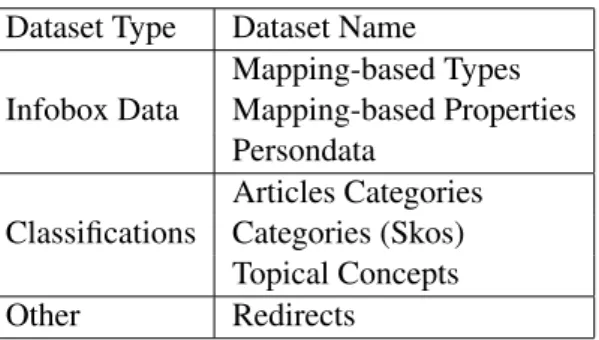
Overall, the first step in determining relevant DBpedia datasets yields the set of valid datasets illustrated in Table 3.1. Theredirectsdataset is also included to maintain compatibility with DBpedia Spotlight, since the candidate entities that Spotlight produces are often redirects to actual entities.
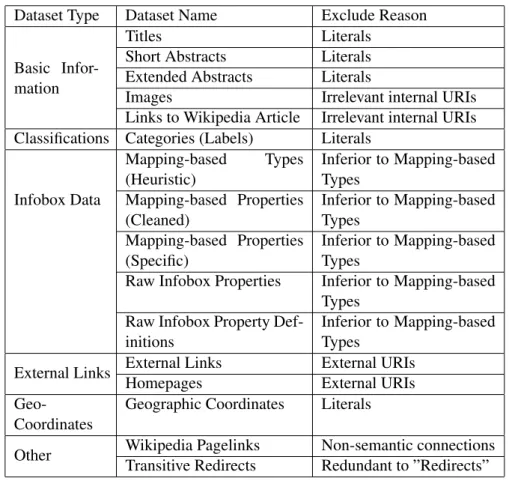
The remaining excluded datasets are shown in Table 3.2. There are different reasons for exclusion: Literalsmeans that all triples within the respective dataset contain literal objects, and thus, do not interconnect entities. Internal irrelevant URIsrefers to the fact that the objects in the datasets are URIs in the DBpedia namespace; however, these URIs do not correspond to Wikipedia articles.External URIsdepicts that the dataset is made up of triples with URI objects that are not in the DBpedia namespace; thus, they do no represent direct connections between entities.
3
http://wiki.dbpedia.org/Downloads 4
Dataset Type Dataset Name Infobox Data Mapping-based Types Mapping-based Properties Persondata Classifications Articles Categories Categories (Skos) Topical Concepts Other Redirects
Table 3.1: Included DBpedia Datasets
3.1.2 Triple Filtering
In the included datasets from the previous section, there are still many triples that are irrelevant for linking. Thus, during graph construction, it is necessary to in-spect each individual RDF triple on an automated basis and determine whether it is relevant or not.
In this work, the applied methods for filtering out irrelevant triples in DBpedia are based on existing approaches from academia. For traversing DBpedia for topic labeling, [18] propose a blacklist of irrelevant URIs. This blacklist focusses on irrelevant categories; therefore, the authors created the list by navigating the higher levels of the category hierarchy rooted at the nodecategory:Contents. As a result, the researchers define three categories of triples that are irrelevant [18]:
• Wikipedia administrative categories: This category consists of Wikipedia categories that solely exist for administration purposes, e.g. Cate-gory:Pages containing deleted templates.
• Etymology categories: The articles belonging to etymology and its subcat-egories are devoted to a discussion of terminology, usually terminology re-lated to a specific topic5, e.g.Category:Clothing terminology.
• Generic LOD concepts: Common concepts in the LOD cloud are con-sidered irrelevant. In this category, [18] define five URIs: owl:Thing, owl:Class, skos:core#Concept, http://www.opengis.net/gml/ Feature, and http://dbpedia.org/class/yago/Concept105835747.
Overall, [18] define 852 blacklisted categories, arguing that these nodes create a range of shortcuts between concepts that do not reflect interesting relationships.
[36] further extended this blacklist for their approach of representing docu-ments in a DBpedia graph. Since the entire DBpedia dataset has already been cut down to a smaller subset in the previous section, most filters of their work are not needed, since the respective URIs do not occur in any of the selected datasets. Overall, the only relevant filters are targeted at Wikipedia templates. These are
Dataset Type Dataset Name Exclude Reason
Basic Infor-mation
Titles Literals
Short Abstracts Literals Extended Abstracts Literals
Images Irrelevant internal URIs
Links to Wikipedia Article Irrelevant internal URIs Classifications Categories (Labels) Literals
Infobox Data Mapping-based Types (Heuristic) Inferior to Mapping-based Types Mapping-based Properties (Cleaned) Inferior to Mapping-based Types Mapping-based Properties (Specific) Inferior to Mapping-based Types
Raw Infobox Properties Inferior to Mapping-based Types
Raw Infobox Property Def-initions
Inferior to Mapping-based Types
External Links External Links External URIs
Homepages External URIs
Geo-Coordinates
Geographic Coordinates Literals
Other Wikipedia Pagelinks Non-semantic connections Transitive Redirects Redundant to ”Redirects”
Table 3.2: Excluded DBpedia Datasets
URIs starting withhttp://dbpedia.org/resource/Template:, which only occur in the redirectdataset as part of all selected datasets. Of the more than six million triples in the redirect dataset, there are 92,941 matching template triples. Although both blacklists are not targeted explicitly at the entity linking task, they still form a suit-able basis for the domain of the present work.
After having identified appropriate datasets in the previous section and clean-ing the datasets from irrelevant triples such as administrative categories through blacklist filtering, the next step is concerned with analyzing which statements are helpful indicators and which are hindering disambiguation. Therefore, additional filters in the form of blacklists and regular expressions are defined, with the goal of removing connections in the graph that are not helpful for disambiguating enti-ties. This task has been separated according to the three types of included datasets: properties,ontology, andcategory. In the following, a detailed analysis about each of those types, along with the resulting additional filters, is given.
Category Frequency Cumulative Percentage
Category:Living people 612308 3.69%
Category:Year of birth missing (living people) 47398 3.97% Category:English-language films 26198 4.13%
Category:American films 18630 4.24%
Category:Main Belt asteroids 17739 4.35%
Category:The Football League players 15471 4.44%
Category:Year of death missing 15236 4.54%
Category:Year of birth missing 14451 4.62%
Category:Black-and-white films 14261 4.71%
Category:English footballers 14253 4.79%
Category:Association football midfielders 14011 4.88%
Category:1985 births 11876 4.95%
Category:Association football defenders 11804 5.02%
Category:Year of birth unknown 11779 5.09%
Category:1984 births 11668 5.16%
Category:Association football forwards 11643 5.23%
Category:1983 births 11605 5.30%
Category:1986 births 11592 5.37%
Category:1982 births 11558 5.44%
Category:1981 births 11400 5.51%
Category:Articles created via the Article Wizard 11346 5.58% Table 3.3: Top-20 Occurring Categories
Categorisation
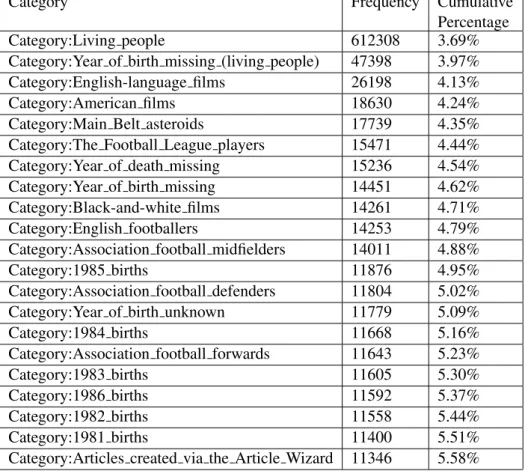
After removing administrative and ethimology related categories in the previous section, there are still very common categories such as Category:Living people. Although these categories are no obvious noise, they are not helpful in entity link-ing, since they directly connect otherwise unrelated entities. Therefore, as a first step the distribution of categories needs to be analyzed.
The top 20 utilized categories are shown in Table 3.3. The distribu-tion shows that, besides the frequently used category Living People, there are many other categories that are not helpful in disambiguation, such as Cate-gory:1985 births. Moreover, there are still administrative categories that have not been captured by the blacklists imported from other work, such as Cate-gory:Articles created via the Article Wizard. Therefore, a set of regular sions was defined to further filter out irrelevant categories. These regular expres-sions, along with the number of affected categories and exemplary targeted cate-gories, are shown in Table 3.4. All of these regular expressions are applied to the resource suffix following Category: in a case-insensitive manner. Due to space
Regular Expression Affected Categories
Top-3 Matched Categories by Frequency
Category Name Frequency
ˆ\d+.*$ 103221
1985 births 11876
1984 births 11668
1983 births 11605
ˆ.*\d+$ 34618
Astronomical objects discovered in 1998 1762 Astronomical objects discovered in 1999 1535 Animals described in 1758 1495
ˆlist.* 4991
Lists of asteroids by number 804 Lists of American television series episodes 764 Lists of drama television series episodes 676
ˆ.*stub.* 919
People educated at Stubbington House School 107 Writing system stub articles needing reassessment 90 Inorganic compound stubs 77
ˆ.*articles.* 736
Articles created via the Article Wizard 11346 Article Feedback 5 Additional Articles 712 Law articles needing an infobox 493
ˆ.*wiki.* 190
WikiProject Artemis Fowl 102 Wikipedias by language 97 MediaWiki websites 93
ˆ.*redirect.* 164
Unprintworthy redirects 9394 Redirects from songs 4008 Redirects from alternative names 1576
ˆ.*pages.* 100
Place name disambiguation pages 1415 Township name disambiguation pages 1008 Human name disambiguation pages 737
ˆ.*disambiguation.* 74
Place name disambiguation pages 1415 Township name disambiguation pages 1008 Human name disambiguation pages 737
ˆ.*portal.*
38 Web portals 132
Sports and games current events portals 103
Science portal 22
ˆ.*categories.* 20
Grammy Award categories 114 Motorsport categories in Australia 42 Monoidal categories 32
ˆ.*infoboxes.* 17
Supreme Court of Canada case articles without infoboxes 88 Canadian articles needing infoboxes 31 United States Supreme Court case articles without infoboxes 6
ˆ.*templates.* 13
Musician templates 4 WikiProject United States Public Policy templates 2 Wikipedia Education Program templates 2
ˆ.*navigational_boxes.* 12
Telugu film director navigational boxes 4 Tamil film director navigational boxes 2 Nevada county navigational boxes 2
Table 3.4: Regular Expressions for filtering Wikipedia Categories
constraints, theCategory: prefix has been omitted. Besides these regular expres-sions, the category Living peoplewas also blacklisted since it is too widespread and provides little additional value in disambiguation.
Due to all established filters discussed in this section, of the 753,525 categories that occur at least once, 608,412 (80.74%) are included. Of the 16,599,811 to-tal article categorisation triples, applying the mentioned filters yields 12,772,300 (76.94%) valid. Moreover, 66,698 (45.87%) out of 145,398 topical concept triples are allowed. Among the interconnections between the categories, which are con-tained in the skos concepts dataset, 1,566,904 (39.05%) out of 4,012,746 triples are included into the graph. Overall, this results in 14,405,902 categorisation related triples in the concluding DBpedia graph.
Properties
Overall, there are 1373 unique properties in the English Wikipedia as captured in the DBpedia 3.9 version6. [41] performed some initial experiments to determine the influence of single properties on the linking accuracy. As methodology, the authors removed single properties from the knowledge base and then investigated the delta of the overall accuracy. Due to the limited scope of the thesis, finding a good estimator for the properties influence on disambiguation is not possible. Therefore, rather generic estimators based on occurrence frequency are applied, as described in Section 3.4.
Of the overall 25,910,643 mapping-based property triples, 13,096,087 (50.54%) are imported into the final DBpedia graph. The high number of rejects is due to the fact that 12,060,592 (46.55%) triples contain literal objects, which do not in-terconnect entities. The remaining 2.91% rejects are due to the filters applied from mentioned prior works.
Ontology
At the time of writing, the current DBpedia version 3.9 has 529 different ontology classes7. As mentioned in the dedicated section on DBpedia (cf. Section 2.2.2), the ontology classes are organized as a tree, withowl:Thing as root class8. The first level below the root class are generic classes such asowl:Place,owl:Person, owl:Work,owl:Species, andowl:Organisation. These generic classes provide little value to disambiguation.
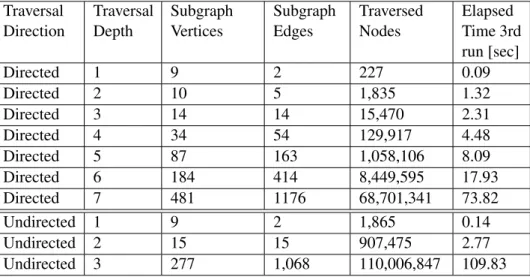
To decrease the influence of those widespread classes, it would be possible to introduce weighted edges to degrade common Linked Open Data (LOD) concepts such as high-level ontology classes. However, this results in a computationally explosive graph traversal. Even if the graph is only explored with a maximum depth of two, when using undirected traversal and following ardf:type owl:Thing link, in the next step all vertices within the entire graph would be traversed, since each vertex is mapped to the root ontology class. Therefore, it is essential to filter out common LOD concepts that do not help in entity linking.
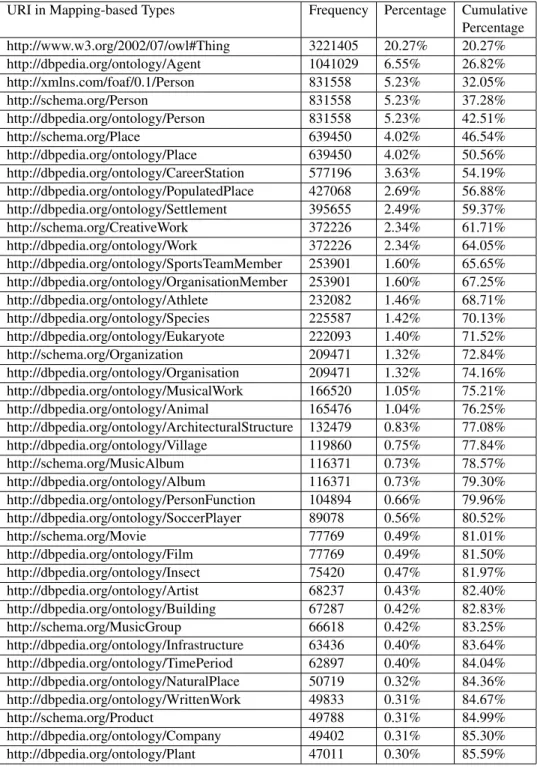
Overall, there are 15,894,066 triples in the mapping-based types dataset. As a first step, the occurrence frequency of the different ontology classes needs to be analyzed.
The 20 classes with the highest occurrence frequency are displayed in Table 3.5. As expected, the distribution shows that the root ontology class owl#Thing has by far the highest occurrence frequency. This is followed by other high level ontology classes such asowl:Agent, owl:Person, orowl:Place. There are many ontology classes without the common prefixhttp://dbpedia.org/ontology/, such as foaf:Person. In these cases, a corresponding class with the DBpedia prefix can be
6 http://wiki.dbpedia.org/Datasets39/DatasetStatistics 7 http://wiki.dbpedia.org/Ontology39 8 http://mappings.dbpedia.org/server/ontology/classes
URI in Mapping-based Types Frequency Percentage Cumulative Percentage http://www.w3.org/2002/07/owl#Thing 3221405 20.27% 20.27% http://dbpedia.org/ontology/Agent 1041029 6.55% 26.82% http://xmlns.com/foaf/0.1/Person 831558 5.23% 32.05% http://schema.org/Person 831558 5.23% 37.28% http://dbpedia.org/ontology/Person 831558 5.23% 42.51% http://schema.org/Place 639450 4.02% 46.54% http://dbpedia.org/ontology/Place 639450 4.02% 50.56% http://dbpedia.org/ontology/CareerStation 577196 3.63% 54.19% http://dbpedia.org/ontology/PopulatedPlace 427068 2.69% 56.88% http://dbpedia.org/ontology/Settlement 395655 2.49% 59.37% http://schema.org/CreativeWork 372226 2.34% 61.71% http://dbpedia.org/ontology/Work 372226 2.34% 64.05% http://dbpedia.org/ontology/SportsTeamMember 253901 1.60% 65.65% http://dbpedia.org/ontology/OrganisationMember 253901 1.60% 67.25% http://dbpedia.org/ontology/Athlete 232082 1.46% 68.71% http://dbpedia.org/ontology/Species 225587 1.42% 70.13% http://dbpedia.org/ontology/Eukaryote 222093 1.40% 71.52% http://schema.org/Organization 209471 1.32% 72.84% http://dbpedia.org/ontology/Organisation 209471 1.32% 74.16% http://dbpedia.org/ontology/MusicalWork 166520 1.05% 75.21% http://dbpedia.org/ontology/Animal 165476 1.04% 76.25% http://dbpedia.org/ontology/ArchitecturalStructure 132479 0.83% 77.08% http://dbpedia.org/ontology/Village 119860 0.75% 77.84% http://schema.org/MusicAlbum 116371 0.73% 78.57% http://dbpedia.org/ontology/Album 116371 0.73% 79.30% http://dbpedia.org/ontology/PersonFunction 104894 0.66% 79.96% http://dbpedia.org/ontology/SoccerPlayer 89078 0.56% 80.52% http://schema.org/Movie 77769 0.49% 81.01% http://dbpedia.org/ontology/Film 77769 0.49% 81.50% http://dbpedia.org/ontology/Insect 75420 0.47% 81.97% http://dbpedia.org/ontology/Artist 68237 0.43% 82.40% http://dbpedia.org/ontology/Building 67287 0.42% 82.83% http://schema.org/MusicGroup 66618 0.42% 83.25% http://dbpedia.org/ontology/Infrastructure 63436 0.40% 83.64% http://dbpedia.org/ontology/TimePeriod 62897 0.40% 84.04% http://dbpedia.org/ontology/NaturalPlace 50719 0.32% 84.36% http://dbpedia.org/ontology/WrittenWork 49833 0.31% 84.67% http://schema.org/Product 49788 0.31% 84.99% http://dbpedia.org/ontology/Company 49402 0.31% 85.30% http://dbpedia.org/ontology/Plant 47011 0.30% 85.59%