Ex-post evaluation of
network-wide Dynamic
Traffic Management
Proposal for a theory-based evaluation
methodology
Suerd Polderdijk
March 2009
Ministerie van Verkeer en Waterstaat
opq
Ex-post evaluation of
network-wide
Dynamic Traffic
Management
Proposal for a theory-based evaluation methodology
Suerd Polderdijk March 27, 2009
MSc Thesis Transport, Infrastructure and Logistics Delft University of Technology
. . .
Colophon
Published by: ITS Edulab, Delft
ITS Edulab is a cooperation between the Rijkswaterstaat centre for Transport and Navigation and the Delft University of Technology
Information: Henk Taale
Email: [email protected]
Author: Suerd Polderdijk
Delft University of Technology
Master Transport, Infrastructure and Logistics
Graduation committee:
Prof. Dr. Ir. Serge P. Hoogendoorn Committee chairman,
Delft University of Technology
Faculty of Civil Engineering and Geosciences Dr. Ir. John H. Baggen
Delft University of Technology
Faculty of Technology, Policy and Management Dr. Ir. Sascha Hoogendoorn-Lanser
Rijkswaterstaat, Centre for Transport and Navigation Dr. Ir. Henk Taale
Rijkswaterstaat, Centre for Transport and Navigation Ir. Feiko van der Veen
DHV B.V., Environment and Transportation Dr. Ir. Andreas Hegyi / Dr. Ir. Francesco Viti Delft University of Technology
Faculty of Civil Engineering and Geosciences
Date: March 27, 2009
Summary
. . . Dynamic Traffic Management (DTM) is a means to increase road infrastructure efficiency. This increase is achieved by matching infrastructure demand and supply, in time as well as over networks. Decision-making about DTM in the Netherlands is hampered by a lack of knowledge of impacts, costs and benefits of network-wide DTM. A suitable evaluation methodology is required to gain this knowledge. The current evaluation methodology of Rijkswaterstaat is documented in the “Guideline for model and evaluation studies of utilisation measures1” and the “Guideline for ex-post evaluation of utilisation
measures on the main road network2”. This methodology is developed
for evaluation of local DTM measures and may no longer be suitable to evaluate network-wide DTM. Rijkswaterstaat will therefore design a new evaluation guideline within the “National evaluation program3”.
The objective of this thesis is to identify strengths, weaknesses, opportunities and threats of the current ex-post evaluation methodology for DTM of Rijkswaterstaat and to propose a new evaluation methodology
A SWOT analysis is used to identify strengths, weaknesses, opportunities and threats of the current evaluation methodology. Trends are towards network-wide and coordinated use of DTM. Due to these trends identified weaknesses of the current evaluation
methodology will become more apparent in the future.
The extent in which three existing alternative evaluation methodologies (CONVERGE methodology, Finnish ITS evaluation methodology and Canadian Finnish ITS evaluation methodology) provide improvements for the identified weaknesses is studied. It is concluded that
improvements are offered to an extent, but weaknesses remain in the studied alternative methodologies.
In this report a new methodology for DTM evaluation is therefore proposed. This methodology uses a theory-based approach. Current DTM evaluation approaches focus on expected final impacts of DTM measures. The concept of theory-based evaluation is that every DTM design is based on theory and this project theory should be the basis of evaluation. Therefore evaluation should not just focus on expected final impacts of DTM, but also on assumptions that explain how these expected final impacts are achieved.
1 In Dutch: “Leidraad model- en evaluatiestudies benuttingsmaatregelen” 2 In Dutch: “Richtlijn voor de ex-post evaluatie van benuttingsmaatregelen op het
hoofdwegennet”
3 In Dutch: “Landelijk evaluatieprogramma”
. . .
“Logic models” can be used to make project theory explicit. Logic models are diagrams that describe how DTM measures are expected to achieve their expected impacts. The proposed evaluation methodology offers a step-by-step approach to develop logic models for DTM projects. Based on these logic models, relevant evaluation questions are formulated in a structured manner. The formulated evaluation
questions and logic models are then used to select appropriate
evaluation methods, indicators and experimentation set-ups. Disturbing external influences on evaluation are explicitly taken into account in these selections.
Logic models include assumptions about the (technical) functioning of DTM measures, road user behaviour and impacts. Therefore the proposed evaluation methodology links various evaluation types common in DTM evaluation to each other, such as technical, user-response and impact evaluation.
Using a case study and a SWOT analysis, strengths, weaknesses, opportunities and threats of the proposed evaluation methodology are identified. The case study of the “Field Test Traffic Management Amsterdam4” shows that the methodology can be applied to a real-life,
network-wide DTM project.
It is concluded that the proposed evaluation methodology is better suited to cope with current trends in DTM than the current evaluation methodology. The proposed evaluation methodology:
• Is flexible to take any impact of DTM into account;
• Integrates various evaluation types and project phases into one evaluation;
• Explicitly evaluates assumptions about the functioning of DTM measures and road user response to them; and
• Reduces the likelihood that measured impacts not caused by DTM measures are attributed to them.
If properly applied, it is expected that the proposed evaluation methodology results in evaluations that are more useful, convincing and reliable than using the current evaluation methodology. However, further work to expand the methodology and test it in practice remains to be done.
It is recommended to use the proposed evaluation methodology as a basis for the new evaluation guideline for DTM projects of
Rijkswaterstaat. The development of logic models should be integrated into the DTM design process, for example by integrating it into the “Sustainable traffic management5” process. Not only DTM evaluation,
but also DTM design will benefit from this.
4 In Dutch: “Praktijkproef Verkeersmanagement Amsterdam” 5 In Dutch: “GebiedsGericht Benutten (GGB)”
Samenvatting
. . . Dynamisch Verkeersmanagement (DVM) is een middel om de
benutting van het verkeerswegennet te verhogen. Deze verhoging van de benutting wordt bereikt door verkeersvraag en -aanbod op elkaar af te stemmen, zowel in tijd als over het netwerk.
Besluitvorming over DVM in Nederland wordt belemmerd door een gebrek aan kennis van de effecten, kosten en baten van netwerkbreed DVM. Een geschikte evaluatiemethodiek is benodigd om deze kennis te verkrijgen. De huidige evaluatiemethodiek van Rijkswaterstaat is vastgelegd in de “Leidraad model- en evaluatiestudies
benuttingsmaatregelen en “Richtlijn voor de ex-post evaluatie van benuttingsmaatregelen op het hoofdwegennet” Deze
evaluatiemethodiek is ontwikkeld voor de evaluatie van lokale DVM maatregelen en is mogelijk niet langer geschikt om netwerkbreed DVM te evalueren. Binnen het “Landelijk Evaluatieprogramma” zal
Rijkswaterstaat dan ook een nieuwe evaluatieleidraad ontwikkelen. Doel van deze scriptie is het identificeren van sterke en zwakke punten, kansen en bedreigingen van de huidige methodiek voor ex-post
evaluatie van DVM projecten van Rijkswaterstaat en het voorstellen van een nieuwe met methodiek.
Met behulp van een SWOT analyse zijn sterke en zwakke punten, kansen en bedreigingen van de huidige evaluatiemethodiek geïdentificeerd. De trends in DVM zijn in de richting van de
netwerkbrede en gecoördineerde inzet van DVM maatregelen. Door deze trends zullen de geïdentificeerde zwakke punten van de huidige evaluatiemethodiek in de toekomst duidelijker zichtbaar worden. De mate waarin drie alternatieve evaluatiemethodieken (CONVERGE methodiek, Finse ITS evaluatiemethodiek en Canadese ITS
evaluatiemethodiek) verbeteringen bieden voor de geïdentificeerde zwakke punten is onderzocht. Hoewel verbeteringen worden aangeboden, blijven zwakke punten aanwezig in de bestudeerde alternatieve methodieken.
In dit rapport wordt dan ook een nieuwe evaluatiemethodiek voor DVM projecten voorgesteld. Deze methodiek gebruikt een theorie-gebaseerde benadering. Huidige evaluatiemethodieken richten zichten zich met name op verwachte (eind-)effecten van DVM maatregelen. Theorie-gebaseerde evaluatie stelt dat elk ontwerp van een DVM project gebaseerd is op een theorie en dat deze projecttheorie de basis van evaluatie zou moeten zijn. Evaluatie zou zich daarom niet alleen op verwachte (eind-)effecten van DVM moeten richten, maar ook op de aannames die uitleggen hoe deze verwachte effecten bereikt worden.
. . .
Een “logisch model” kan gebruikt worden om deze projecttheorie expliciet te maken. Een logisch model is een diagram dat beschrijft hoe de DVM maatregelen naar verwachting de gewenste (eind-)effecten zullen creëren. De voorgestelde evaluatiemethodiek biedt een stapsgewijze aanpak om een logisch model voor een DVM project te ontwikkelen. Aan de hand van dit logisch model worden vervolgens gestructureerd evaluatievragen geformuleerd. Op basis van deze vragen en het logisch model worden geschikte evaluatiemethoden, indicatoren en experimentele opzet gekozen. Verstorende externe invloeden op de evaluatie worden expliciet in deze keuzes
meegenomen.
Een logisch model bevat aannames over het (technische) functioneren van DVM maatregelen, gedrag van weggebruikers en resulterende (eind-)effecten. De voorgestelde methodiek verbindt daarom op een logische wijze de verschillende evaluatietypen die gangbaar zijn binnen DVM met elkaar, zoals technische evaluatie, gebruikersevaluatie en effectevaluatie.
Met behulp van een casusstudie en een SWOT analyse zijn de sterke en zwakke punten, kansen en bedreigingen van de voorgestelde
evaluatiemethodiek geïdentificeerd. De casusstudie van de
“PraktijkProef Amsterdam” toont aan dat de methodiek toegepast kan worden op een bestaand, netwerkbreed DVM project.
Geconcludeerd wordt dat de voorgestelde evaluatiemethodiek beter aansluit bij de huidige trends in DVM dan de huidige
evaluatiemethodiek van Rijkswaterstaat. De voorgestelde evaluatiemethodiek:
• Is algemeen toepasbaar om elk effect van DVM te evalueren;
• Integreert de verschillende evaluatietypen en projectfasen in één evaluatieaanpak;
• Evalueert expliciet de aannames over technisch functioneren en het gedrag van weggebruikers; en
• Vermindert de kans dat gemeten effecten die niet zijn veroorzaakt door de DVM maatregelen toch aan deze maatregelen worden toegeschreven.
Verder onderzoek is benodigd om de methodiek verder te ontwikkelen en in de praktijk te testen. De voorgestelde evaluatiemethodiek zal naar verwachting resulteren in een evaluatie die nuttiger, overtuigender en betrouwbaarder is dan met behulp van de huidige evaluatiemethodiek. Het wordt Rijskwaterstaat dan ook aanbevolen de voorgestelde evaluatiemethodiek te gebruiken als basis voor de nieuwe
evaluatieleidraad voor DVM projecten. Verder is het aan te bevelen de ontwikkeling van logische modellen te integreren in het ontwerpproces, bijvoorbeeld door het te integreren in het “Gebieds Gericht Benutten” (GGB) proces. Niet alleen de evaluatie van DVM projecten, maar ook het ontwerp van DVM maatregelen heeft hierbij baat.
Voorwoord
. . .
“Our engineers have done some testing and evaluation, and overall we concluded this was an interesting option to discover information.”
David L. Tennenhouse, Senior Research Scientist, M.I.T. Dit rapport is geschreven in het kader van mijn afstudeeronderzoek voor de master Transport, Infrastructure and Logistics aan de TU Delft. Dit afstudeerwerk heb ik mogen doen in het “ITS Edulab”, een
samenwerkingsverband tussen de TU Delft en de Dienst Verkeer en Scheepvaart van Rijkswaterstaat. Bij dezen mijn dank voor de collega’s bij het Edulab, de projectteams van “FileProof A10” en de
“PraktijkProef Amsterdam” en de afdeling Verkeersmanagement Wegennet voor de gezelligheid, adviezen en uiteraard potjes tafelvoetbal.
Uiteraard een hartelijk dankwoord voor mijn afstudeercommissie. Andreas, Feiko, Francesco, Henk, John, Sascha en Serge, ik heb met elk van jullie met veel plezier samengewerkt. Bedankt voor jullie scherpe tips, prettige begeleiding, enthousiasme en gezelligheid!
Manus en Wout, het waren jullie tips en ideeën die me de gekozen richting in hebben gestuurd. Onze twee afspraken hebben daarmee een belangrijke bijdrage aan het resultaat geleverd, dankjewel!
Last but zeker not least, Merel, dankjewel voor het doorlezen en dat je bereid was al mijn saaie afstudeerverhalen aan te horen...
List of English – Dutch translations
. . .
Before and after study Voor- en nameting of nul- en éénmeting
Centre for Transport and Navigation
Dienst Verkeer en Scheepvaart
Control strategy Regelstrategie
Dynamic Traffic Management Dynamisch Verkeersmanagement Field Test Traffic Management
Amsterdam
Praktijkproef
Verkeersmanagement Amsterdam Guideline for model and
evaluation studies of utilisation measures
Leidraad model- en evaluatiestudies benuttingsmaatregelen Guideline for ex-post evaluation
of utilisation measures on the main road network
Richtlijn voor de ex-post evaluatie van benuttingsmaatregelen op het hoofdwegennet
Improving traffic flow on the A10 ring road
Verbeteren doorstroming Ring A10
Main road network Hoofdwegennet
National evaluation program Landelijk evaluatieprogramma Network Vision North-Holland Netwerkvisie Noord-Holland Policy Note on Mobility Nota Mobiliteit
Rijkswaterstaat Traffic Centre the Netherlands
Rijkswaterstaat Verkeerscentrum Nederland
Secondary road network Onderliggend wegennet ShoulderDRIP BermDRIP
Sustainable Traffic Management Gebieds Gericht Benutten Utilisation Benutting
Table
of
contents
. . .
SUMMARY ... II SAMENVATTING ... IV VOORWOORD ... VI LIST OF ENGLISH – DUTCH TRANSLATIONS ... VII TABLE OF CONTENTS ... VIII
1. INTRODUCTION ... 1
1.1 INTRODUCTION TO DYNAMIC TRAFFIC MANAGEMENT ... 1
1.2 PROBLEM DEFINITION ... 1
1.3 RESEARCH OBJECTIVE AND RESEARCH QUESTIONS ... 4
1.4 RESEARCH SCOPE ... 4
1.5 RESEARCH RELEVANCE ... 5
1.6 RESEARCH APPROACH ... 6
1.7 READING GUIDE ... 7
2. SWOT-ANALYSIS CURRENT EVALUATION METHODOLOGY ... 9
2.1 INTRODUCTION ... 9
2.2 OBJECTIVE OF EX-POST EVALUATION ... 10
2.3 CURRENT EVALUATION METHODOLOGY ... 12
2.4 EXPLORATIVE CASE STUDY CURRENT EVALUATION METHODOLOGY .. 16
2.5 STRENGTHS OF CURRENT EVALUATION METHODOLOGY ... 19
2.6 WEAKNESSES OF CURRENT EVALUATION METHODOLOGY ... 20
2.7 OPPORTUNITIES FOR CURRENT EVALUATION METHODOLOGY ... 24
2.8 THREATS TO CURRENT EVALUATION METHODOLOGY ... 24
2.9 CONCLUSIONS ... 27
3. POTENTIAL IMPROVEMENTS EVALUATION METHODOLOGY . 29 3.1 INTRODUCTION ... 29
3.2 IMPROVEMENTS IN EXISTING EVALUATION METHODOLOGIES ... 30
3.3 ALTERNATIVE EXPERIMENTAL DESIGNS ... 37
3.4 STATISTICAL AND MODELLING TOOLS ... 39
3.5 THEORY-BASED EVALUATION ... 40
3.6 CONCLUSIONS ... 47
4. PROPOSED EVALUATION METHODOLOGY ... 49
4.1 INTRODUCTION ... 49
4.2 LOGIC MODELS FOR DYNAMIC TRAFFIC MANAGEMENT PROJECTS ... 50
4.3 INTRODUCTION TO PROPOSED EVALUATION METHODOLOGY ... 51
4.4 CREATING LOGIC MODELS ... 53
4.5 CREATING EVALUATION APPROACHES WITH LOGIC MODELS ... 62
4.6 REFLECTION ON PROPOSED EVALUATION METHODOLOGY ... 68
5. CASE STUDY PROPOSED EVALUATION METHODOLOGY ... 73
5.1 INTRODUCTION ... 73
5.2 INTRODUCTION TO THE CASE ... 73
5.3 DEVELOPING THE LOGIC MODEL ... 75
5.4 DEVELOPING AN EVALUATION APPROACH ... 81
5.5 REFLECTION ON CASE STUDY ... 86
5.6 CONCLUSIONS ... 89
6. SWOT-ANALYSIS PROPOSED EVALUATION METHODOLOGY . 91 6.1 INTRODUCTION ... 91
6.2 STRENGTHS OF PROPOSED EVALUATION METHODOLOGY ... 91
6.3 WEAKNESSES OF PROPOSED EVALUATION METHODOLOGY ... 93
6.4 OPPORTUNITIES FOR PROPOSED EVALUATION METHODOLOGY ... 94
6.5 THREATS TO PROPOSED EVALUATION METHODOLOGY ... 97
6.6 CONCLUSIONS ... 98
7. CONCLUSIONS AND RECOMMENDATIONS ... 99
7.1 INTRODUCTION ... 99
7.2 MAIN RESEARCH FINDINGS ... 100
7.3 CONCLUSIONS ... 103
7.4 RECOMMENDATIONS ... 105
BIBLIOGRAPHY ... 109
APPENDIX A : SOCIO-ECONOMIC EVALUATION OF DTM PROJECTS ... 115
APPENDIX B : LOGIC MODEL OF EXAMPLE DTM PROJECT .... 121
APPENDIX C : LOGIC MODEL OF EXAMPLE DTM PROJECT WITH EXTERNAL INFLUENCES ... 123
APPENDIX D : LOGIC MODEL OF “FIELD TEST TRAFFIC MANAGEMENT” ... 125
APPENDIX E : LOGIC MODEL OF “FIELD TEST TRAFFIC MANAGEMENT” WITH EXTERNAL INFLUENCES ... 127
1.
Introduction
. . .
1.1
Introduction to Dynamic Traffic Management
Utilisation6 concerns synchronising infrastructure demand and supply,
both in time and over the network. This synchronisation is done in such a way that network performance is optimised using existing physical infrastructure.
Measures to increase utilisation of existing road infrastructure are receiving increasing attention in the Netherlands. Construction of new roads and the introduction of road pricing are postponed. This has led to an increase of attention for utilisation. The Ministry of Transport, Public Works and Water Management has underlined this trend, by incorporating “utilisation” as one of the pillars of Dutch national transportation policy. This policy is documented in the “Policy note on Mobility7” (Ministry of Transport, Public Works and Water
Management, 2006).
An instrument to increase road infrastructure utilisation is Dynamic Traffic Management (DTM). The “dynamic” aspect concerns coupling current (or predicted) traffic conditions to measures being taken. These measures for example consist of ramp metering and Dynamic Route Information Panels (DRIPs).
1.2
Problem definition
From local to network-wide DTM
Dynamic Traffic Management is currently mainly implemented locally in an isolated and reactive manner (Hoogendoorn and Van Zuylen, 2008). DTM measures are applied to relieve a local bottleneck, individual DTM measures are not coupled and thus do not cooperate and DTM
measures react to current traffic conditions.
DTM may not be exploited to its full potential with this approach. Local DTM may solve problems locally, but creates new problems at other locations. Ramp metering may for example improve traffic flow on the main road network but also shift queues to urban roads. Reactive DTM may aim to reroute traffic via alternative routes, only to cause new congestion on these alternative routes. Uncoordinated DTM could create situations where one DTM measure is worsening a problem another DTM measure is trying to solve.
6 In Dutch: “Benutten” 7 In Dutch: “Nota Mobiliteit”
DTM may be exploited to its full potential using a network-wide, anticipative and coordinated approach. By using a network-wide approach to DTM design, remaining capacity available in networks can be utilised. Traffic can be controlled in such a way that for example important links in networks remain free of congestion or a bottleneck of air quality is relieved. This however requires cooperation between DTM measures; a form of coupling between DTM measures is often a necessity. Operating DTM in an anticipative manner could prevent bottlenecks from occurring, instead of relieving them. Experience with network-wide DTM is currently being acquired in the Netherlands and a large scale field test of network-wide DTM is planned for 2010 in and around Amsterdam, see Schwarz, Van Schie, and Verroen (2007).
Need for insight into costs and benefits of network-wide DTM
Despite the expected benefits, decision-making around network-wide DTM is hampered by a lack of knowledge about impacts of network-wide DTM. Knowledge about impacts on traffic flow of local DTM measures in regular conditions has been acquired, at least to an extent (see for example Rijkswaterstaat, 2008b). However, impacts of DTM measures in non-regular conditions (incidents, severe weather conditions, events) are mostly unknown, as are impacts of DTM on emissions, noise hindrance and traffic safety (Ministry of Transport, Public Works and Water Management, 2008). Knowledge about impacts of network-wide DTM is mainly limited to model predictions and theoretical estimates (Ministry of Transport, Public Works and Water Management, 2008).
Besides gaining insight into impacts of network-wide DTM, the decision-making process may benefit from a framework to interpret its costs and benefits (Rijkswaterstaat, 2008a). Costs and benefits of network-wide DTM are largely unknown. Insight into (societal) costs and benefits of network-wide DTM might speed up the decision making process, leading to an implementation of DTM that is more geared towards demands of society and allows expenditures for DTM to be justified.
Current evaluation guidelines are not intended for network-wide DTM
By starting the “national evaluation program8”, the Dutch Centre for
Transport and Navigation intends to increase its knowledge of costs and benefits of DTM. The goal of the “national evaluation program” is to “allow better and well-considered choices regarding the
implementation of traffic management to be made” (Rijkswaterstaat, 2008a). The program aims to achieve this goal by supervising
evaluation of DTM projects, standardizing evaluations when possible and gathering knowledge gained in these evaluations.
To be able to achieve the goals of this program, a suitable guideline for evaluating network-wide DTM projects is required. Based on
experiences gained with evaluating local DTM projects, the “Guideline for model and evaluation studies of utilisation measures9” has been
composed as the standard for evaluating DTM measures (both ex-ante and ex-post). Next to this the “Guideline for ex-post evaluation of utilisation measures on the main road network10” (Rijkswaterstaat
Traffic Centre the Netherlands, 2008) has been written. This guideline is meant to perform a “quick ex-post evaluation” of DTM measures focussed on improving traffic flow. From now on “the current
evaluation methodology” will be used to refer to these two documents. In this methodology focus is on impacts of local DTM measures on traffic flow, on the main road network, in regular conditions. The following remarks can therefore be made about this methodology:
• The guidelines focus on impacts on traffic flow. How to determine impacts on for example road user behaviour, traffic safety, noise hindrance and emissions is not explicitly documented. The evaluator is referred to other documents.
• The methodology is meant for impact evaluation alone and do not include other evaluation types. The guidelines for example do not provide a framework for interpreting costs and benefits of DTM.
• The methodology is focused on impacts of local DTM on the main
road network and does not offer guidance to determine impacts of
network-wide DTM, on both the main and secondary road network. The Centre for Transport and Navigation of Rijkswaterstaat has noted these possible shortcomings of the current evaluation methodology. Revision of the current evaluation guidelines is therefore incorporated as objective of the “National evaluation program”.
Summarizing, the problem definition is formulated as follows:
A suitable evaluation guideline is required to gain insight into impacts of network-wide Dynamic Traffic Management (DTM) and to support decision-making around DTM. DTM can have impacts on for example traffic flow, travel time reliability, road user behaviour, noise hindrance, emissions and traffic safety. The current evaluation methodology of Rijkswaterstaat is however focused on evaluation of impacts of local
DTM measures on traffic flow and may no longer be suitable to evaluate network-wide DTM projects.
9 In Dutch: “Leidraad model- en evaluatiestudies benuttingsmaatregelen” 10 In Dutch: “Richtlijn voor de ex-post evaluatie van benuttingsmaatregelen op het
hoofdwegennet” . . .
1.3
Research objective and research questions
Based on the problem definition the following research objective is formulated:
The objective of this research is to identify strengths, weaknesses, opportunities and threats of the current ex-post evaluation methodology for DTM of Rijkswaterstaat and to propose a new evaluation methodology
To be able to meet the research objective, the following research questions are answered in this report:
• What are strengths, weaknesses, opportunities and threats of the current evaluation methodology?
• To what extent do alternative evaluation methodologies offer an improvement for the identified weaknesses?
• What potential improvement offered in evaluation-related literature for the remaining weaknesses is most promising?
• How can this most promising improvement be incorporated into a proposal for a new evaluation methodology?
• Is it possible to apply the proposed evaluation methodology to a real-life, network-wide DTM project?
• What are strengths, weaknesses, opportunities and threats of the proposed evaluation methodology?
Answering these research questions leads to the answer of the central research question of this report:
How do strengths, weaknesses, opportunities and threats of the proposed evaluation methodology relate to those of the current evaluation methodology of Rijkswaterstaat?
The remainder of this introduction explains how these research questions are answered and what this research yields. A delineation of the research scope is presented in Section 1.4. Section 1.5 explains what scientific and practical relevance the resulting research has. The research approach is explained in Section 1.6. Finally an overview of the structure of the remainder of the report is presented in the reading guide of Section 1.7.
1.4
Research scope
Within the research questions the research scope is already defined to an extent. In this section the research scope will be delineated further.
• Strengths, weaknesses, opportunities and threats (SWOTs) of evaluation methodologies are not identified in readability (textual quality) or practicality (quality of the report structure) of evaluation guidelines.
• Research focus is on ex-post evaluation of DTM measures. The proposed evaluation methodology can however also be applied to ex-ante evaluation.
. . .
Research objective
. . .
• Research focus is on roadside DTM measures and not on in-car or cooperative roadside/in-car systems. Research focus is thus on Intelligent Transportation Systems (ITS) for infrastructure and not on the following ITS clusters (Panou and Bekiaris, 2004):
o ITS for private vehicles; o ITS for public transport; o ITS for commercial vehicles;
o Cooperative infrastructure/in-vehicle systems.
The research may however also provide insights for these ITS clusters.
• Focus of the methodology proposed in this report is on evaluation of DTM measures in regular situations. The methodology is however suitable for the evaluation non-regular situations as well.
• The proposed evaluation methodology will not yet include socio-economic evaluation. Further research is required to incorporate socio-economic evaluation into the proposed evaluation
methodology. To this end Appendix A includes a discussion of methods for socio-economic evaluation of DTM projects.
• Data collection, data selection, data analysis and feedback of evaluation results are outside the scope of the methodology proposed in this report. Further research is required to incorporate these steps into the proposed evaluation methodology.
1.5
Research relevance
Achieving the objective of this research within the defined scope has both scientific and practical relevance, which is explained below.
Scientific relevance
This research:
• Provides insight into shortcomings of current DTM evaluation methodologies;
• Identifies and analyses potential solutions for these shortcomings;
• Introduces the theory-based evaluation approach to the field of DTM evaluation;
• Proposes a new evaluation methodology based on the theory-based evaluation approach.
Practical relevance
This research:
• Produces an overview of SWOTs of the current evaluation
methodology. Based on these SWOTs recommendations are made for Rijkswaterstaat on when (not) to apply this methodology;
• Proposes an evaluation methodology that can be used as the basis of a new evaluation guideline for Rijkswaterstaat which is able to cope with current trends in DTM;
• Proposes an evaluation methodology and case study which provide a starting point for the “Field Test Amsterdam”, an important project for the future of DTM in the Netherlands;
• Proposes an evaluation methodology that stimulates cooperation between decision-makers, project designers and evaluators;
• Proposes an evaluation methodology that may:
o Increase insight into costs and benefits of DTM; o Assist the decision-making process around DTM; o Increase public support for DTM;
o Increase the effectiveness of DTM measures.
1.6
Research approach
This section describes how the research questions defined in Section 1.3 are answered and how the scientific and practical relevance defined in Section 1.5 is achieved.
The research starts with a SWOT analysis of the current evaluation methodology of Rijkswaterstaat. Advantages of SWOT analysis over a listing of advantages and disadvantages are that it:
• Makes a distinction between attributes of the methodology under analysis (strengths and weaknesses) and attributes of its
environment (opportunities and threats). This helps to identify possible sources of improvement.
• Requires a clear definition of the objective of ex-post evaluation. This helps to focus the identification of SWOTs.
An explorative case study, review of evaluation guidelines and literature on (DTM) evaluation are used to identify SWOTs.
Alternative evaluation methodologies are then studied to determine the extent in which they provide improvements over the current evaluation methodology of Rijkswaterstaat. Focus is on identifying improvements for weaknesses of the current evaluation methodology. A review of evaluation guidelines is used to identify these improvements.
The research then focuses at weaknesses not (sufficiently) improved in alternative evaluation methodologies. Literature on evaluation is used to identify and describe potential improvements for these remaining weaknesses. The “most promising” improvement is then selected by checking three criteria. This improvement is used in the proposal for a new evaluation methodology.
The proposed evaluation methodology uses a theory-based evaluation approach. A “logic model”, a graphical representation of project theory, is chosen as the basis of the methodology. Literature on logic models and theory-based evaluation is used to design a step-by-step approach to design logic models and develop evaluation plans based on these logic models.
A SWOT analysis of the proposed evaluation methodology is then performed. A case study is used to determine whether it is possible to apply the proposed evaluation methodology to a real-life project. The case study and literature on theory-based evaluation and logic models are used to complete the SWOT analysis.
Finally the central research question is answered by comparing results of the SWOT analyses of the current and proposed evaluation
methodologies.
1.7
Reading guide
The contents of this report follow the structure of the research approach described in Section 1.6. This section describes the report structure and contents of each chapter. First an overview of the report structure is given, followed by a description of contents of each chapter.
Research overview
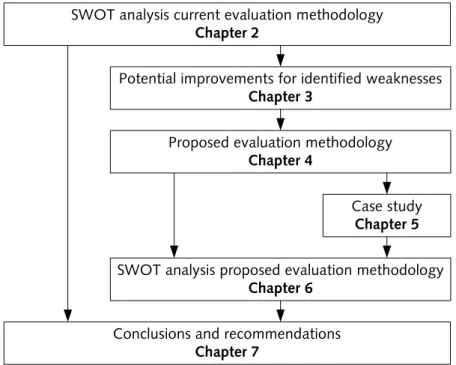
Figure 1.1 graphically summarises the report structure.
SWOT analysis current evaluation methodology
Chapter 2
Potential improvements for identified weaknesses
Chapter 3
Proposed evaluation methodology
Chapter 4
Case study
Chapter 5
SWOT analysis proposed evaluation methodology
Chapter 6
Conclusions and recommendations
Chapter 7
Chapter 2
In Chapter 2 a SWOT Analysis of the current evaluation methodology is performed. The chapter starts with defining the objective of ex-post evaluation in Section 2.2. Next, a description of the characteristics of the current evaluation methodology is given in Section 2.3. To give an indication of SWOTs, an explorative case study of the (attempted) application of this methodology to a network-wide DTM project is presented in Section 2.4. The case used is the ex-post evaluation of the project “Improving traffic flow on the A10 ring road11“, part of the
“FileProof” program. A comparison of characteristics of the methodology with literature on (DTM) evaluation is then made to further clarify strengths and weaknesses of the methodology in Sections 2.5 and 2.6. Finally, trends in DTM are described to identify
opportunities and threats in Sections 2.7 and 2.8.
11 In Dutch: “Verbeteren doorstroming ring A10”
. . .
Chapter 3
In Chapter 3 potential improvements for the identified weaknesses of the current evaluation methodology of Rijkswaterstaat are identified. First the extent to which three alternative evaluation methodologies offer improvements for these weaknesses is researched in Section 3.2. The remainder of the chapter will focus on the weaknesses not improved in these three studied evaluation methodologies.
For these remaining weaknesses three potential improvements are explored. First of all, three alternative experimental designs are discussed in Section 3.3. Secondly, statistical and modelling tools are described in Section 3.4. Finally, the theory-based evaluation approach is introduced in Section 3.5. The chapter ends with a selection of potential improvements that are used in the proposed methodology in Chapter 4.
Chapter 4
A new evaluation methodology, using a theory-based approach, is proposed in Chapter 4. The chapter starts with defining the scope of the proposal. Next, the logic model, the “core” of the methodology, is discussed in Section 4.2. Finally, a step-by-step approach is proposed to create a logic models for DTM projects and create evaluation plans based on these logic models in Sections 4.4 and 0. The approach is clarified with an example.
Chapter 5
The proposed evaluation methodology is applied to a real-life, network-wide DTM project in Chapter 5. The case used is the “Field Test Traffic Management Amsterdam12”, a network-wide and coordinated
application of DTM due to start in 2010. An introduction to this case is given in Section 5.2. The logic model for part of this project is
developed in Section 5.3. This logic model is used for an evaluation approach in Section 5.4.
Chapter 6
In Chapter 6 a SWOT analysis of the proposed evaluation methodology is performed. The objective of ex-post evaluation defined in Chapter 2 will be used for this SWOT analysis again, allowing a fair comparison to be made between the current and proposed methodology in Chapter 7, the final Conclusions and Recommendations of this report. Strengths and weaknesses are described in Sections 6.2 and 6.3, opportunities and threats in Sections 6.4 and 6.5.
2.
SWOT-analysis current evaluation methodology
. . .
2.1
Introduction
In this chapter, a SWOT-analysis is performed for the current evaluation methodology of Rijkswaterstaat. This chapter’s central question is:
What are strengths, weaknesses, opportunities and threats of the current evaluation methodology?
This Chapter results in:
• Strengths of the current evaluation methodology that are helpful to achieve the objective of ex-post evaluation;
• Weaknesses of the current evaluation methodology that are harmful to achieve the objective of ex-post evaluation;
• Opportunities for the current evaluation methodology that are helpful to achieve the objective of ex-post evaluation;
• Threats to the current evaluation methodology that are harmful to achieve the objective of ex-post evaluation;
See Table 2.1.
Helpful
to achieve the objective of ex-post evaluation
Harmful
to achieve the objective of ex-post evaluation Interna l or igi n (attributes of the methodology)
S W
Externa l or ig in (attributes of the environment)O T
. . .Research question of Chapter 2
. . .
Table 2.1: SWOT analysis
Overview of the four aspects of a SWOT analysis. Based on (Wikimedia Foundation Inc., 2008)
The objective of ex-post evaluation is defined in Section 2.2. Next, characteristics of the object under SWOT-analysis, the current evaluation methodology, are described in Section 2.3. An explorative case study of the application of the current evaluation methodology to a network-wide DTM project is performed in Section 2.4. The
explorative case study illustrates difficulties of ex-post evaluation of a network-wide DTM project to the reader and helps to identify SWOTs of the current evaluation methodology. The explorative case is the ex-post evaluation of the network-wide DTM project “Improving traffic flow on the A10 ring road13“, part of the “FileProof” program.
Finally, SWOTs of the current evaluation methodology are described in more detail using literature on (DTM) evaluation. Three sources were used to identify SWOTs:
• Literature on DTM evaluation and evaluation in general;
• Difficulties encountered by the evaluation team of the explorative case study;
• A review of evaluation guidelines.
The chapter concludes with an overview of SWOTs of the current evaluation methodology. The next chapter describes potential improvements offered in literature for the identified weaknesses.
2.2
Objective of ex-post evaluation
To be able to state the objective of ex-post evaluation, which is needed to perform SWOT-analysis, the role that ex-post evaluation plays in policy-making needs to be known. In science of public administration, the process of agenda setting, policy design and implementation is often shown as a cyclic process: the policy cycle. An example of a basic representation of the policy cycle is shown in Figure 2.1.
13 In Dutch: “Verbeteren doorstroming ring A10”
. . .
Figure 2.1: Policy cycle
Basic representation of the policy cycle. The equivalent four policy phases used by Rijkswaterstaat are included between brackets.
Sources: (Palumbo, 1987), adapted, (Rijkswaterstaat Dienst Verkeer en Scheepvaart, 2008) Problem definition or agenda-setting (“Act”) Policy Formulation (“Plan”) Policy Implementation (“Do”) Policy Evaluation (“Check”)
Evaluation plays a role in each of these four phases of the policy cycle (Palumbo, 1987):
• In the agenda setting and problem definition phase, the objectives of evaluation are to determine or forecast size and geographical distribution of problems, to determine or forecast needs of stakeholders, and to identify target groups or areas.
• In the policy formulation phase, evaluation serves to identify alternative means to achieve policy objectives and to determine effectiveness of alternatives. Furthermore evaluation must assess the acceptance of alternatives by public and stakeholders. An evaluation in this phase and the previous phase is referred to as ex-ante
evaluation.
• In the policy implementation phase, evaluation checks whether policy is implemented properly, i.e. in line with policy design. An evaluation in the implementation phase is called ex-durante or intermediate evaluation, within Rijkswaterstaat also referred to as monitoring.
• In the policy evaluation phase evaluation is referred to as ex-post evaluation, the evaluation type studied in this research.
An ex-post evaluation is thus necessary to “close” the policy cycle by connecting the policy implementation phase to the problem definition and agenda-setting phase. According to the “Guideline for model and evaluation studies of utilisation measures14” the objective of evaluation
is “to support decision making in the future” (Rijkswaterstaat Adviesdienst Verkeer en Vervoer, 2002). Since it is hard to perform a SWOT-analysis using this broad definition, a more specific objective of ex-post evaluation is formulated for this research. The objective of ex-post evaluation, used to perform SWOT-analyses in this research, is:
Assessing the functioning and impacts of DTM measures and providing information on the use and allocation of public resources or the
efficiency of DTM measures.
Ex-post evaluation thus includes a learning aspect and an
accountability aspect. Learning deals with how and when DTM
measures work and how future DTM measures can be improved. Traffic engineers will generally be most interested in this aspect.
Accountability deals with the extent in which benefits of DTM
measures outweigh costs and whether such DTM measures should be considered again in the future. Decision-makers will generally be most interested in this aspect. Due to restrictions on evaluation resources, a trade-off usually has to be made between these two aspects.
14 In Dutch: “Leidraad model- en evaluatiestudies benuttingsmaatregelen”
. . .
Objective of ex-post evaluation of DTM projects
Adapted from (Giorgi and Tandon, 2002)
2.3
Current evaluation methodology
The object under SWOT-analysis is described in this section. This object is the current ex-post evaluation methodology for DTM projects of Rijkswaterstaat.
The current evaluation methodology aims at determining impacts of measures to increase road infrastructure utilisation, such as DTM measures. Focus is on determining direct, traffic related impacts of individual measures, in regular conditions, on the main road network. The current evaluation methodology for DTM projects is documented in two guidelines. These guidelines are the “Guideline for model and evaluation studies of utilisation measures” and the “Guideline for ex-post evaluation of utilisation measures on the main road network15”.
From now on “Guideline for model and evaluation studies” and “Guideline for ex-post evaluation” will be used to refer to these documents.
This section starts with a description of these guidelines, followed by a description of the approach used to determine impacts of DTM
measures.
Evaluation guidelines
The “Guideline for model and evaluation studies” (Rijkswaterstaat Adviesdienst Verkeer en Vervoer, 2002) is an aid for model studies (ex-ante evaluation) and evaluation studies (ex-post evaluation). It is not meant as a prescriptive guideline, but provides a frame of reference and suggestions for evaluators.
In this guideline both ex-ante and ex-post evaluation is considered supportive to the “Sustainable traffic management16” process.
“Sustainable traffic management” is a procedure in which various road authorities (and other relevant stakeholders) work together on the basis of equality to design integral and sustainable traffic management solutions” (Rijkswaterstaat, 2002).
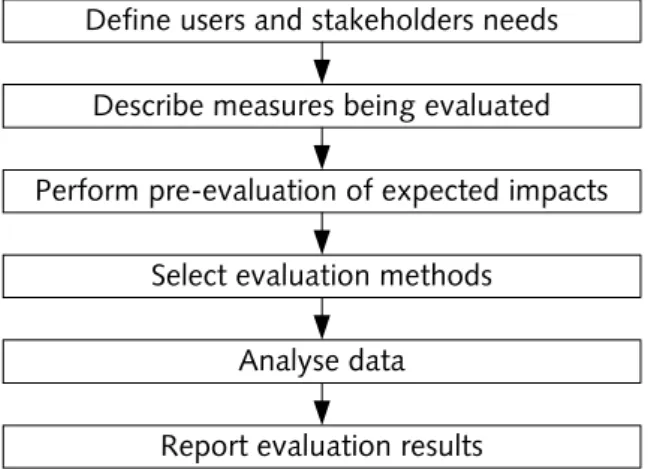
The “Guideline for model and evaluation studies” describes a step-by-step approach to ex-post evaluation. This step-by-step-by-step-by-step approach is illustrated in Figure 2.2.
15 In Dutch: “Richtlijn voor de ex-post evaluatie van benuttingsmaatregelen op het
hoofdwegennet”
Compose evaluation plan Define evaluation objectives Define evaluation questions Determine experimental design
Perform data collection Perform data selection and analysis
Write evaluation report
How to perform these steps is not explicitly prescribed in the
“Guideline for model and evaluation studies”. Instead, considerations and suggestions are given to evaluators at each step.
More prescriptive is the “Guideline for ex-post evaluation”
(Rijkswaterstaat Traffic Centre the Netherlands, 2008). This guideline is focused on ex-post evaluation of traffic management measures aimed at improving traffic flow on the main road network. It is meant to perform a “quick evaluation” to estimate impacts of (groups of) DTM measures. To this end, it gives a detailed prescription for:
• Experimental design;
• Data collection;
• Data selection and analysis.
The evaluation approach to determine impacts of DTM described as “most common” in the “Guideline for model and evaluation studies” and explicitly prescribed in the “Guideline for ex-post evaluation” is described below.
Evaluation approach
To determine impacts of DTM measures, the current evaluation
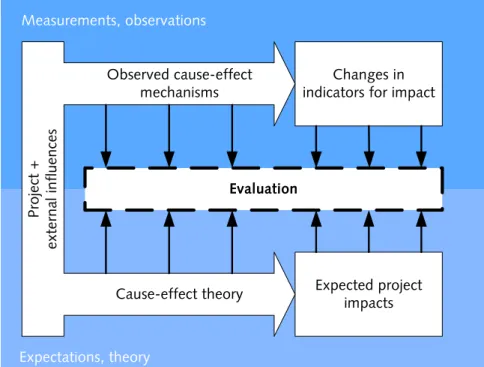
methodology determines changes of indicators for expected impacts of DTM measures. This is required since impacts of DTM measures on for example “accessibility” cannot be determined without a clear definition of this impact. Based on this definition, indicators for these impacts should be chosen. Measured changes in these indicators after realisation of DTM measures are an indication for impacts of DTM measures on “accessibility”. See Figure 2.3 for an illustration.
. . . .
Figure 2.2: Steps in ex-post evaluation in “Guideline for model and evaluation studies”
Changes in indicators for impact
Measurements, observations Expected project impacts Expectations, theory Proj ect + external influences Evaluation
To determine these changes in indicators, the current evaluation methodology uses an experimental design called “before and after study17”. This approach starts with determining values of indicators
before DTM measures are implemented, in other words before the intervention in the traffic system is made. This is called before study. Next, after implementing the intervention, values of the same indicators are determined again. This is called after study. Based on differences in values of indicators between before study and after study, impacts of DTM measures can be estimated. When possible, statistical significance of impacts should be determined.
However, besides DTM measures, various external influences affect both actual impacts of DTM measures and value of indicators of these impacts. This is also included in Figure 2.3. Examples of these external influences are road works, incidents, weather conditions and spatial and economic developments. In the current evaluation methodology these external influences are referred to as “disturbing variables18”.
17 In Dutch: “voor- en nameting” of “nul- en éénmeting”. The “Guideline for model and
evaluation studies” does not explicitly prescribe a before and after study, but describes it as “most common”.
18 In Dutch: “verstorende variabelen”
. . . .
Figure 2.3: Current evaluation approach
In the current evaluation methodology a process called “matching”19 is
used to deal with these external influences. Impacts of external influences are removed from measurements as much as possible. To this end, measurements in which external influences have large impacts are removed from the dataset. This should result in datasets of before and after measurements in which impacts of (remaining) external influences is equal.
After removing measurements on which external influences had large impacts, a check is made whether the remaining impacts of external influences is comparable in before and after datasets. This is done by determining the number of vehicle kilometres travelled or traffic volume in networks, and checking whether they are comparable in before and after study.
Besides this “matching” approach the “Guideline for model and evaluation studies” mentions two possibilities for dealing with external influences:
• Measuring impacts of known external influences and reducing determined changes of indicators by these impacts. These measurements can also be done in a “control area” where DTM measures do not have impacts. Impacts of external influences can also be estimated based on previously gained knowledge.
• Alternating evaluation, in which DTM measures are switched on and off at random days. Impacts of external influences on before and after study can then be assumed equal.
Table 2.2 summarises the characteristics of the two evaluation guidelines of Rijkswaterstaat.
Guideline for model and evaluation studies
Guideline for ex-post evaluation
. . . Evaluation focus Ex-ante and ex-post impact
evaluation
Ex-post impact evaluation Considered impact
groups of DTM
Focus on traffic flow. Safety, noise, emissions, user-acceptance mentioned but not explicitly described
Traffic flow
Experimental design to determine impacts
Various designs described. Before and after study “most common”.
Before and after study
Approach to dealing with external influences
Various approaches described.
Matching “most common”.
Matching
19 The “Guideline for model and evaluation studies” describes “matching” as “most common”.
The “Guideline for ex-post evaluation” prescribes matching. . . .
Table 2.2 Overview of characteristics of studied evaluation methodologies
2.4
Explorative case study current evaluation
methodology
In this section an attempt to apply the evaluation methodology, which was described above, to a network-wide DTM project is studied. This explorative case study will illustrate SWOTs of the current evaluation methodology, which will be researched in more detail in the next section. The case studied is the ex-post evaluation of project
“Improving traffic flow on the A10 ring road20“, part of the “FileProof”
program. From now on “FileProof A10” will be used to refer to this project. Innovative about this project is a network-wide approach to DTM design and coordination between DTM measures.
After an introduction of the project, its ex-post evaluation will be described. The section will conclude with an overview of problems encountered by the evaluation team while creating the evaluation plan based on the current evaluation methodology. This overview will help to find SWOTs of the current evaluation methodology in evaluation-related literature.
Introduction to the explorative case
The objective of “FileProof A10” is to design and implement a broadly supported set of DTM measures, as part of the “Network vision North-Holland21”, which improves traffic flow of the Ring Road of Amsterdam
(A10) by control of traffic flows (Rijskwaterstaat, Directie Noord Holland, 2007). In the “Network vision North-Holland” (Gemeente Amsterdam, Provincie Noord-Holland, Rijkswaterstaat, Stadsregio Amsterdam and Regionaal Orgaan Amsterdam, Not dated)
Rijkswaterstaat, the Province of North-Holland, the Urban Region of Amsterdam and the Municipality of Amsterdam have comitted themselves to administrative and operational cooperation to increase accessibility of the region. An important part of this vision is to “keep the traffic on the Ring A10 flowing”, as this will prevent spillback of congestion towards connecting motorways and urban roads. This network vision requires a prioritisation of the regional road network to be made. Traffic on roads with a high priority need to keep flowing, possibly using roads with a lower priority as a buffer for congestion. This should lead to “graceful degradation” of the road network in peak conditions, where low priority roads become congested first, and the highest priority road, Ring A10, remains flowing for as long as possible. The prioritisation made for the road network around Amsterdam can be seen in Figure 2.4.
20 In Dutch: “Verbeteren doorstroming ring A10” 21 In Dutch: “Netwerkvisie Noord-Holland”
To be able to keep traffic on the Ring A10 flowing as much as possible, a control philosophy was designed in “FileProof A10”. This philosophy comprises the following control strategies22, approaches to alleviate the
most important sources23 of congestion on the A10:
• Rerouting of traffic “on a distance of the ring road”. This can be done by rerouting traffic via other motorways such as the A9;
• Rerouting of traffic via non-congested sections of the A10 ring road;
• Optimising traffic flow on the A10 by small infrastructure and road design changes;
• Improving outflow of traffic from the A10 to urban roads;
• Improving outflow of traffic from the A10 to other motorways;
• When necessary controlling inflow of traffic onto the A10 from the four main axes in Amsterdam;
• When necessary controlling inflow of traffic onto the A10 from other urban roads;
• When necessary controlling inflow of traffic onto the A10 from other motorways.
To implement these four control strategies, a set of Dynamic Traffic Management measures was designed for both the main road network and the secondary road network. This set of DTM measures consists of:
• Installation of Dynamic Route Information Panels (DRIPs) to provide (route) information for road users;
• Infrastructure adaptations such as lengthening of merging and exit lanes;
• Expansion of monitoring installations, such as installing cameras on urban roads to measure travel times at important urban access routes and queue detection systems at on-ramps.
• Installation of ramp metering installations.
These DTM measures are implemented in phases, over a time-span of approximately a year. At the time of writing it is expected that the final component, the control software, will be operational in the final months of 2009.
22 In Dutch: “regelstrategieën” 23 In Dutch: “kiemen”
. . .
Figure 2.4: Prioritisation of the road network around Amsterdam
According to the network vision North-Holland. Blue roads (A10 ring road) are priority 1, black roads priority 2, green roads priority 3. Source: (Gemeente Amsterdam et al, Not dated)
A10
Besides a network-wide approach to DTM design, another innovative aspect is coordinated DTM control. The control software will allow ramp metering installations to be coordinated with urban traffic signals and other ramp metering installations.
Difficulties during the design of an evaluation plan
The ex-post evaluation of “FileProof” A10 is divided into three parts: collection of traffic data, an impact evaluation and a (road)
user-acceptance evaluation. The case study focuses on the impact evaluation, since the current evaluation methodology is focused at impact
evaluation. The objectives of the impact evaluation are determining impacts of DTM measures on:
• Vehicle delay hours24;
• Travel times for (different classes of) road users;
• Travel time reliability.
These impacts should be determined for both the main road network and the secondary road network. In addition, a comparison is made between costs and benefits of the project by attaching a monetary value to the reduction of vehicle delay hours.
The impact evaluation is tendered to an external consultant. According to tender documents the ex-post impact evaluation should be carried out based on the current evaluation methodology (using the “Guideline for model and evaluation studies”).
However, the consultant’s evaluation team encountered difficulties when designing an evaluation plan based on the current evaluation methodology. The network-wide scale of “FileProof A10” and the phased implementation of DTM measures caused these difficulties. These difficulties will be described below.
The evaluation team expected it to be very difficult to determine (statistically significant) impacts at a network-wide level based on a single before and after study. The evaluation team identified several reasons for this:
• A result of the phased implementation is that after implementing all DTM measures, experience road users have with DTM measures varies per measure. Road users have had several months to
understand some DTM measures and have adapted their behaviour accordingly, whilst road users are not yet familiar with other measures that were installed later.
• Due to the long implementation period of DTM measures and the large scale of the study area the number and impacts of external influences increase. External influences include road works, events, the credit crunch and fuel price fluctuations. These increases of the number and impacts of disturbing influences have two effects. First of all, “removing” disturbing influences from the dataset will lead to a small dataset. Secondly, the likelihood that unknown external influences are influencing measured impacts increases. The likelihood that impacts caused by external influences are inadvertently attributed to DTM measures also increases.
• Due to the long implementation period, some external influences have lasting impacts on measured changes of indicators. Their impacts cannot be removed by removing measurements from the dataset.
• Expected impacts of DTM measures are small compared to impacts of external influences.
• Mobility management, economic growth, changes in fuel prices and possibly DTM measures themselves influence traffic volume during the time it takes to implement all measures. Origin-Destination patterns may have shifted. Checking whether all external influences have sufficiently been removed by comparing traffic volume in before and after study may not be feasible.
Another encountered difficulty is that measuring no or only minor impacts at a network-wide scale does not necessarily mean that no impacts are achieved (both positive and negative) at local scales. Local authorities are particularly interested in local impacts. Although the current evaluation methodology is focussed at determining these local impacts, it does not provide guidelines to distinguish between the various scales of impacts.
A potential solution for the two issues described above is to divide the network into sub-networks and determine impacts of DTM measures per sub-network. Per sub-network a different dataset can be selected for before and after study. Next, impacts per sub network can be summed-up to gain network-wide impacts. However, because datasets of before and after study are different for each sub-network, this may come down to “comparing apples and oranges”.
2.5
Strengths of current evaluation methodology
The explorative case study illustrated several weaknesses of the current evaluation methodology. In Section 2.6 these weaknesses are defined in detail. Besides weaknesses the current evaluation methodology off course also has strengths. This section starts with a summary of these strengths, followed by explanation.
Strengths of the current evaluation methodology, that are helpful to achieve the defined objective of ex-post evaluation, are that it:
• Is based on a straightforward and intuitive approach;
• Is applicable to determine impacts on traffic flow of various projects without much adaptation;
• Has been applied frequently; experience is gained with applying the methodology;
• Connects evaluation to the policy cycle. These strengths are explained below.
Straightforward and intuitive
The methodology used for impact evaluation is based on a before and after study, which according to Haight (2002) and Wholey, Hatry and Newcomer (1994) is a straightforward and intuitive approach. The approach measures indicators before and after implementation of DTM measures. Impacts of DTM measures are derived from resulting
differences. This approach appeals to intuition. Before and after study is explicitly prescribed in the “Guideline for ex-post evaluation” and mentioned as “most common” in the “Guideline for model and evaluation studies”.
Applicable to various projects without much adaptation
The methodology is applicable to determine impacts on traffic flow of various projects without much adaptation. The methodology can be applied irrespective of DTM design. The methodology does not place strong demands on project planning and monitoring. The only demand on realisation of DTM projects is that before study has to be done before actual realisation of DTM measures.
Experience gained
Experience has been gained with the methodology within Rijkswaterstaat and consultants. The approach has been used to evaluate many (local) DTM projects over the past two decades (see Rijkswaterstaat Adviesdiens Verkeer en Vervoer, 2002).
Evaluation connected to policy cycle
The “Guideline for model and evaluation studies” offers an aid for both ex-ante and ex-post evaluation of DTM projects. The role each
evaluation type has in the policy cycle is explicitly defined, by defining the role of evaluation in the “Sustainable traffic management” process. This may increase usefulness of evaluation results
2.6
Weaknesses of current evaluation methodology
The explorative case study in Section 2.4 has shown that the current evaluation methodology has several weaknesses, which became apparent due to the network-wide scale of “FileProof A10” and the phased implementation of DTM measures. In this section these
weaknesses will be described in more detail. The next section describes trends in DTM, identifying opportunities and threats to achieve the objective of ex-post evaluation.
Weaknesses of the current evaluation methodology that are harmful to achieve the defined objective of ex-post evaluation are that it:
• Does not analyse the functioning of DTM measures and road user response to them (technical and user-response evaluation);
• Does not provide information on the use and allocation of public resources (socio-economic evaluation);
• Does not focus on all relevant DTM impacts;
• Focuses on before and after study to determine DTM impacts. This experimental design is weak at proving causality between DTM measures and measured changes of indicators.
These weaknesses are explained below.
Does not include technical and user-response evaluation
The current evaluation methodology does not explicitly evaluate the the functioning of (individual) DTM measures. In Section 2.2 the objective of ex-post evaluation was defined as: “Assessing the functioning and impacts of DTM measures and providing information on the use and allocation of public resources or the efficiency of DTM measures”. The current evaluation methodology meets only part of this objective. The methodology assesses “impacts of DTM measures”, but does not explicitly assess their “the functioning”. According to Hall, Miller and Khatak (1996) this problem is inherent to the before and after study experimental design: it does not provide insights into the functioning of (individual) DTM measures. The methodology does not show which DTM measures work and which do not, when they work and why.
For DTM measures it is not sufficient to assess whether their technical functioning is according to design specifications. Success of DTM measures also depends on (unpredictable) road user responses to DTM measures (Newman-Askins, Ferreira and Bunker, 2003). These user-responses should also be assessed. Two evaluation types are thus missing in the current evaluation methodology: technical evaluation and user-response evaluation.
Does not include socio-economic evaluation
The current evaluation methodology does not “provide information on the use and allocation of public resources or the efficiency of DTM measures”. A socio-economic evaluation is required to meet this part of the objective of ex-post evaluation.
Socio-economic evaluation is strongly related to impact evaluation. It uses impacts and evidence of causal attribution of impact evaluation as input. On the other hand, socio-economic evaluation demands which impacts should be measured in impact evaluation. Figure 2.5 shows this relationship.
An ex-post socio-economic evaluation is required to show to what extent impacts generated by DTM projects compensate for invested public resources. On the one hand it allows “better” choices to be made about future allocations of public resources. On the other hand a socio-economic evaluation is essential to show that chosen DTM measures were superior over available alternatives and expenditures were thus justified (Moore and Pozdena, 2004). Information socio-economic evaluation provides may improve future decision-making about DTM.
Does not focus on all relevant DTM impacts
A third weakness of the current evaluation methodology is that it does not focus on all relevant DTM impacts. In order to perform socio-economic evaluation, all impacts of DTM measures need to be determined. Three reasons can be given why the current evaluation methodology does not focus on all relevant DTM impacts.
First of all the, current evaluation methodology is focused at impacts of DTM in regular conditions. However, next to impacts in regular
conditions, it is also relevant to research impacts of DTM in non-regular conditions (Ministry of Transport, Public Works and Water
Management, 2008).
Secondly, the methodology focuses at impacts of DTM on traffic flow, and not for example on road user behaviour, traffic safety or emissions. The “Guideline for model and evaluation studies” includes these impact types as relevant impact types of DTM, but does not explicitly describe how to determine these impacts.
. . .
Figure 2.5: Relationship between decision-makers, socio-economic evaluation and impact evaluation
Impact evaluation Socio- economic evaluation Decision- makers Measured impacts and causal attribution to DTM Demands on impacts to be measured Objectives and boundary conditions
Judgment about the use and allocation of public resources or the efficiency of
Thirdly the methodology is focused at direct impacts of DTM. A
complicating factor in DTM evaluation is that DTM impacts evolve over various timescales (Ministry of Transport, Public Works and Water Management, 2008). Direct impacts of DTM measures are for example an improvement of traffic flow and a reduction of congestion. These direct impacts also lead to indirect impacts, since road users adapt to new situations. These indirect impacts consist of changes of destination, route, departure time and mode choices of road users. A new
equilibrium is formed. On the long run this new situation may even affect spatial-economic development. In the new equilibrium congestion in networks can be at the same level as before
implementation of DTM measures. However, more trips were made possible, which have an economic value.
This third reason can be overcome by selecting appropriate indicators for impacts of DTM measures. The “Guideline for model and evaluation studies” does not explicitly mention this issue in the selection of
indicators. The “Guideline for ex-post evaluation” does recommend several indicators, all of which are focused on direct impacts of DTM measures.
Weak at proving causality between DTM measures and measured changes of indicators
The current evaluation methodology is strictly an impact evaluation, which should provide two insights (BandA Group, not dated). Firstly, an ex-post impact evaluation shows the extent in which objectives have been achieved. Secondly, an ex-post impact evaluation tries to explain why impacts have been achieved, including the extent in which results can be causally attributed to DTM measures. Causal attribution refers to the problem of how and how safely one may infer that DTM measures are responsible for measured changes in indicators.
It is hard to prove causal attribution of measured changes in indicators to DTM measures using a before and after study experimental design (Haight, 2002; Hall et al, 1996; Rossi, Lipsey, and Freeman, 2004; Wholey et al, 1994). Therefore sole reliance on a before and after study is often not justified. Haight (2002) describes it as follows: “A principal difficulty is that the traffic system after the intervention is usually different from the system before the intervention, besides impacts of the measures being evaluated. It is usually difficult, if often impossible, to separate the various influences on evaluation outcomes.” The
current evaluation methodology mostly relies on before and after study, so the possibility that a measured change in indicators is wrongly attributed to DTM measures is present.