Mingxian Zhong
Submitted in partial fulllment of the requirements for the degree
of Doctor of Philosophy
in the Graduate School of Arts and Sciences
COLUMBIA UNIVERSITY
2018Some Problems in Graph Theory and Scheduling
Mingxian Zhong
In this dissertation, we present three results related to combinatorial algorithms in graph theory and scheduling, both of which are important subjects in the area of discrete mathematics and theoretical computer science. In graph theory, a graph is a set of vertices and edges, where each edge is a pair of vertices. A coloring of a graph is a function that assigns each vertex a color such that no two adjacent vertices share the same color. The rst two results are related to coloring graphs belonging to specic classes. In scheduling problems, we are interested in how to eciently schedule a set of jobs on machines. The last result is related to a scheduling problem in an environment where there is uncertainty on the number of machines.
The rst result of this thesis is a polynomial time algorithm that determines if an input graph containing no induced seven-vertex path is3-colorable. This armatively answers a question posed
by Randerath, Schiermeyer and Tewes in 2002. Our algorithm also solves the list-coloring version of the3-coloring problem, where every vertex is assigned a list of colors that is a subset of{1,2,3}, and gives an explicit coloring if one exists. This is joint work with Flavia Bonomo, Maria Chundnovsky, Peter Maceli, Oliver Schaudt, and Maya Stein.
A graph is H-free if it has no induced subgraph isomorphic to H. In the second part of this
thesis, we characterize all graphs H for which there are only nitely many minimal
non-three-colorable H-free graphs. This solves a problem posed by Golovach et al. We also characterize all
graphsH for which there are only nitely manyH-free minimal obstructions for list 3-colorability.
This is joint work with Maria Chudnovsky, Jan Goedgebeur and Oliver Schaudt.
The last result of this thesis deals with a scheduling problem addressing the uncertainty regarding the machines. We study a scheduling environment in which jobs rst need to be grouped into some sets before the number of machines is known, and then the sets need to be scheduled on machines without being separated. In order to evaluate algorithms in such an environment, we introduce the
not subject to the restriction that the sets cannot be separated. Under such environment, we give a (53 +)-robust algorithm for scheduling on parallel machines to minimize makespan, and show
a lower bound of 4
3. For the special case when the jobs are innitesimal, we give a 1.233-robust
List of Figures iii
List of Tables iv
1 Introduction 1
1.1 Coloring Graphs with Forbidden Induced Subgraphs . . . 1
1.2 Obstruction to Coloring and List-Coloring . . . 4
1.3 Scheduling with Uncertainty . . . 5
1.4 Outline . . . 7
2 Denitions 8 2.1 Basic Graph Denitions . . . 8
2.2 Updating Lists . . . 10
3 Three-coloring graphs without induced paths on seven vertices 12 3.1 Introduction and Preliminaries . . . 12
3.2 Proof of the Main Theorem . . . 15
3.2.1 Proof of Lemma 3.2.1 . . . 24
4 Obstructions for three-coloring and list three-coloring H-free graphs 32 4.1 Introduction . . . 32
4.1.1 Structure of this Chapter . . . 33
4.2 Obstructions with lists of size at most two . . . 34
4.3.2 Reducing obstructions . . . 44
4.3.3 Proof of Lemma 4.3.2 . . . 46
4.4 2P3-free 4-vertex critical graphs . . . 67
4.4.1 Proof of Lemma 4.4.1 . . . 67
4.4.2 Proof of Lemma 4.4.2 . . . 69
4.5 P4+kP1-free minimal list-obstructions . . . 75
4.6 Necessity . . . 78
4.6.1 Proof of Lemma 4.6.1 . . . 78
4.6.2 Proof of Lemma 4.6.2 . . . 80
4.7 Proof of Theorem 4.1.2 and Theorem 4.1.3 . . . 81
5 Scheduling When You Don't Know the Number of Machines 83 5.1 Introduction . . . 83
5.1.1 Overview of this chapter and a Lower Bound . . . 85
5.2 Scheduling innitesimal jobs . . . 86
5.2.1 Minimizing the Maximum Dierence . . . 91
5.3 Scheduling discrete jobs . . . 94
5.3.1 Partitioning . . . 95
5.3.2 Packing and Scheduling . . . 100
4.1 A circular drawing of G5 . . . 79
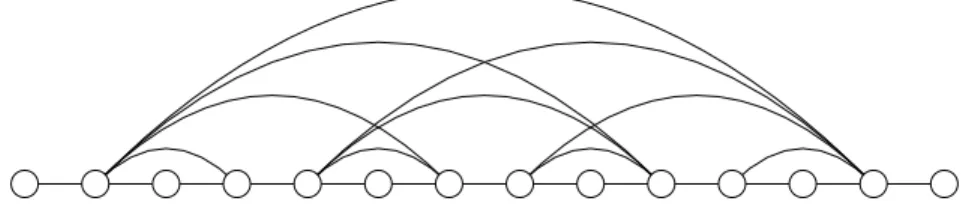
4.2 A drawing of H5. The verticesv1 to v14 are shown from left to right. . . 81
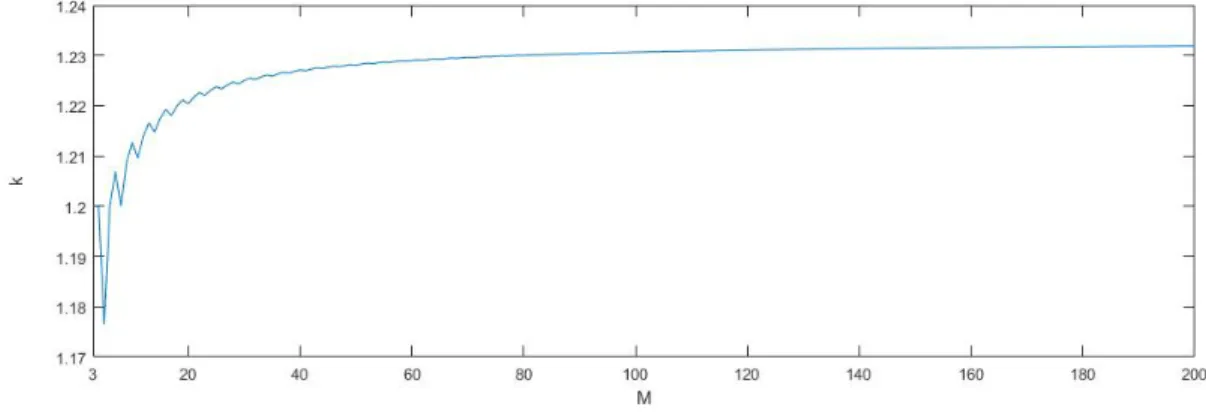
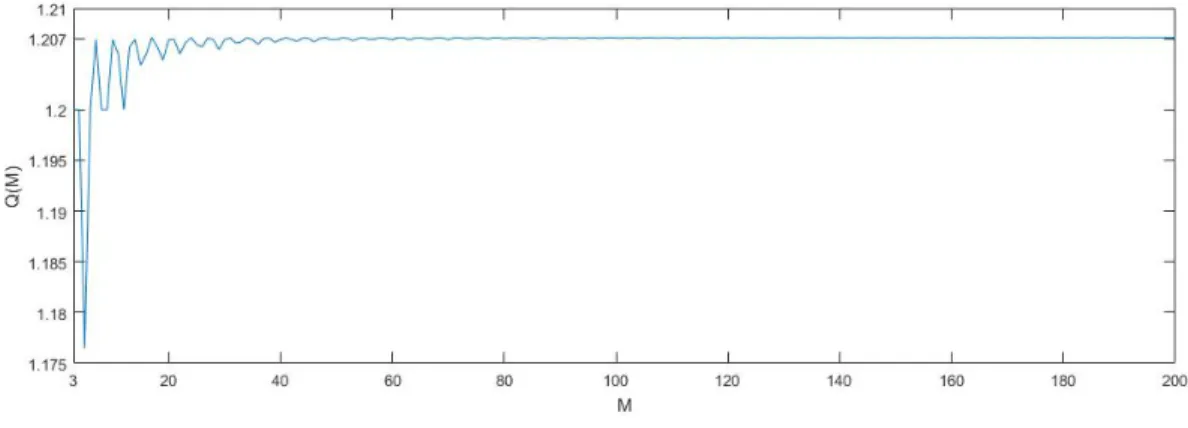
5.1 kas a function of M. . . 87
1.1 Table of known complexities of the k-coloring problem inPt-free graphs. . . 3
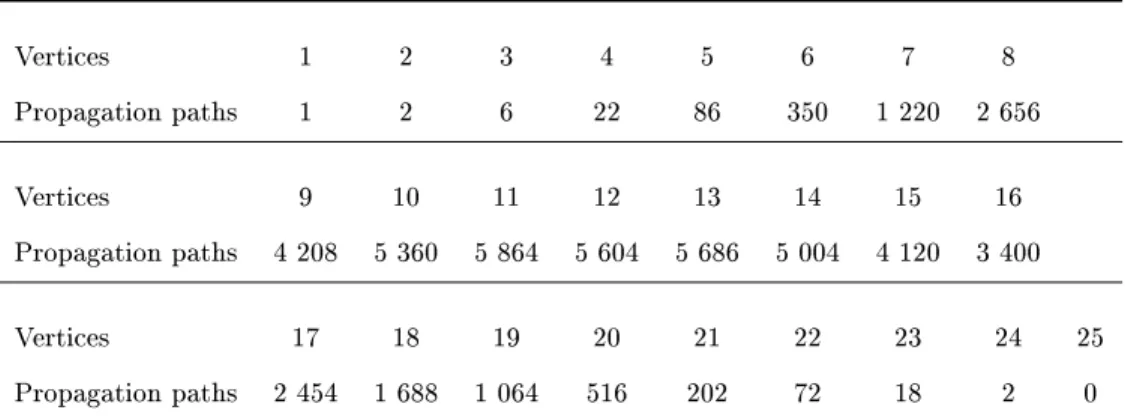
4.1 Counts of all P6-free propagation paths with lists of size 2 meeting condition (4.1)
Firstly, I would like to express my deepest gratitude to my advisers, Maria Chudnovsky and Cliord Stein. Back in the days when I was in my master's program, Maria's class inspired my interest in graph theory, and the experience of working together with her was one of the most important reasons that I decided to apply for Ph.D. programs. During my Ph.D. program, both Maria and Cli continually provided every bit of assistance I needed for my study and research. Under their guidance, I learned how to conduct a research and how to write the results as formal papers. They encouraged me to pursue an academic career after graduation and they are exactly the kind of professor I wanted to be. I am also very thankful for their support of my traveling to conferences around the world. It was truly a blessing to have both of them as my advisors.
Besides the advisors, I would also like to thank other coauthors I have been working with during my graduate study: Flavia Bonomo, Jan Goedgebeur, Shenwei Huang, Peter Maceli, Oliver Schaudt, Paul Seymour, Sophie Spirkl, Juraj Stacho and Maya Stein. I learned a lot from them and it's my great pleasure to write joint papers with them.
I would like to thank everyone in the IEOR department. All sta members here have always been helpful, patient and kind. It was my great opportunity to be able to learn from such knowledgeable faculty here. I am very thankful to Fei, Zhipeng, Ni, Yanan and Xinshang: It was a great memory of studying together with them in preparation for the qualifying exam, which is also probably the last qualifying exam in the department (or at least for a while).
Lastly and most importantly, I would like to thank my parents, Zhihua Zhong and Xiaoyan Wang, for their unconditional love, care and support all over the years. My mother had wished to attend my Ph.D. graduation ceremony, but unfortunately this wish can never become true as she passed away three years ago. I hereby dedicate this thesis to her.
Chapter 1
Introduction
In this dissertation, we present three results related to combinatorial algorithms in graph theory and scheduling, both of which are important subjects in the area of discrete mathematics and theoretical computer science. The rst two results are related to coloring graphs belonging to specic classes and the last result is related to a scheduling problem addressing the environment where there is uncertainty on the number of machines. We will explain those results, and discuss some of the motivations and background in this section.
1.1 Coloring Graphs with Forbidden Induced Subgraphs
In graph theory, a graphGis a set of vertices and edges, where each edge is a pair of vertices. Graphs
can be used to model many types of real-world systems, such as transportations, social networks and software design. However, many fundamental graph theory problems, such as the maximum independent set problem, the Hamiltonian path problem and the graph coloring problem, on a general graph are NP-complete, which means that in general it is hard to nd ecient algorithms to solve those problems. So people are interested in solving those problems eciently for graphs with some structural properties. The problem here we are specically interested in is coloring graphs with forbidden induced subgraphs.
A k-coloring of a graph G = (V, E) is a function f : V → {1, . . . , k} such that f(v) 6= f(w)
whenevervw ∈E. The coloring problem, whose input is a graphGand a natural numberk, consists
NP-complete problems [36] (unless k= 2; then the problem is solvable in linear time). Stockmeyer [57]
proved that the problem remains NP-complete even ifk≥3 is xed, and Maray and Preissmann
proved that it remains NP-complete for triangle-free graphs [41].
List variations of the vertex coloring problem can be found in the literature. For a survey on this kind of related problems, see [58]. In the list-coloring problem, every vertexv comes equipped with
a list of permitted colors L(v), and we require the coloring to respect these lists, i.e., f(v)∈ L(v)
for every v inV. For a positive integer k, the k-list-coloring problem is a particular case in which
|L(v)| ≤kfor each v in V, but the union of the lists can be an arbitrary set. If the size of the list
assigned to each vertex is at most two (i.e.,2-list-coloring), the instance can be solved inO(|V|+|E|)
time [16; 19; 59], by reducing the problem to a 2-SAT instance, which Aspvall, Plass and Tarjan [5] showed can be solved in linear time (in the number of variables and clauses). The list k-coloring
problem is a particular case of k-list-coloring, in which the lists associated to each vertex are a
subset of{1, . . . , k}. Since list k-coloring generalizesk-coloring, it is NP-complete as well.
Let H and G be graphs. We say that H is an induced subgraph of G if V(H) ⊆ V(G), and u, v ∈V(H) are adjacent in H if and only if u, v are adjacent in G. we say that G contains H if
some induced subgraph ofGis isomorphic toH. If Gdoes not containH, we say thatGisH-free.
Because of the notorious hardness of k-coloring, eorts were made to understand the problem on
restricted graph classes. Some of the most prominent such classes are the classes of H-free graphs.
Kami«ski and Lozin [35] and independently Král, Kratochvíl, Tuza, and Woeginger [37] proved that for any xedk, g ≥3, thek-coloring problem is NP-complete for the class of graphs containing no
cycle of length less than g. As a consequence, if the graph H contains a cycle, then k-coloring is
NP-complete fork≥3 for the class ofH-free graphs.
The claw is the complete bipartite graph K1,3. A theorem of Holyer [30] together with an
extension due to Leven and Galil [39] imply that if a graph H contains a claw, then for every xed k≥3, thek-coloring problem is NP-complete for the class of H-free graphs.
Combined, these two results only leave open the complexity of the k-coloring problem for the
class of H-free graphs where H is a xed acyclic claw-free graph, i.e., a disjoint union of paths.
There is a nice recent survey by Hell and Huang on the complexity of coloring graphs without paths and cycles of certain lengths [27] and another nice survey by Golovach et al. [22]. We denote a path and a cycle ontvertices by Pt and Ct, respectively.
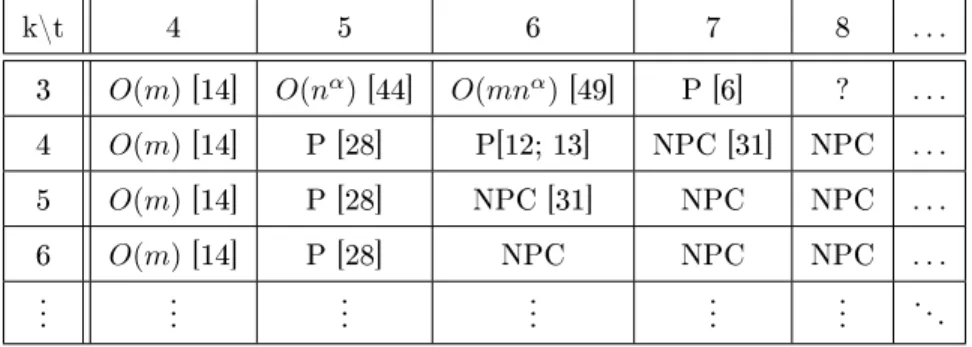
k\t 4 5 6 7 8 . . . 3 O(m)[14] O(nα)[44] O(mnα)[49] P [6] ? . . . 4 O(m)[14] P [28] P[12; 13] NPC [31] NPC . . . 5 O(m)[14] P [28] NPC [31] NPC NPC . . . 6 O(m)[14] P [28] NPC NPC NPC . . . ... ... ... ... ... ... ...
Table 1.1: Table of known complexities of thek-coloring problem inPt-free graphs.
The strongest known results related to our work are due to Huang [31], who proved that 4-coloring is NP-complete forP7-free graphs, and that 5-coloring is NP-complete for P6-free graphs.
On the positive side, Hoàng, Kami«ski, Lozin, Sawada, and Shu [28] have shown that k-coloring
can be solved in polynomial time on P5-free graphs for any xed k. Recently, in a joint work with
Chudnovsky and Spirkl [12; 13], we proved that 4-coloring is polynomial-time solvable forP6-free
graphs, which settles the last remaining open case of the complexity ofk-coloring Pt-free graphs for any xed k≥4. On the other hand, fork= 3 it is not known whether there exists atsuch that
3-coloring is NP-complete forPt-free graphs. Randerath and Schiermeyer [49] gave a polynomial time algorithm for 3-coloring P6-free graphs. Later, Golovach et al. [23] showed that the list 3-coloring
problem can be solved eciently forP6-free graphs. Some of these results are summarized in Table
1.1. Here `?' stands for open problems.
In Chapter3of this thesis, we show that the 3-coloring problem forP7-free graphs is
polynomial-time solvable, answering positively a question rst posed in 2002 by Randerath et al. [49; 50]. This is joint work with Flavia Bonomo, Maria Chundnovsky, Peter Maceli, Oliver Schaudt, and Maya Stein, and rst appeared in [6]. Our algorithm even works for the list 3-coloring problem. This is not trivial: there are cases where k-coloring and list k-coloring have dierent complexities (unless
P = NP). For instance, in the class ofP6-free graphs, 4-coloring can be solved in polynomial time [12;
1.2 Obstruction to Coloring and List-Coloring
We say that a graph isk-chromatic if it is k-colorable but not (k−1)-colorable. A graph is called k-critical if it isk-chromatic, but every proper subgraph is(k−1)-colorable. The characterization of
critical graphs is a notorious problem in the theory of graph coloring. Since it is NP-hard to decide whether a given graph admits ak-coloring fork≥3, there is little hope of giving a characterization
of the (k+ 1)-critical graphs that is useful for algorithmic purposes. The picture changes if one
restricts the structure of the graphs under consideration. Bruce et al. [7] proved that there are exactly six 4-critical P5-free graphs. By using the characterization of 4-critical P5-free graphs,
Maray and Morel [40] gave a linear time certifying algorithm of the problem of3-coloring P5-free
graphs. On the other hand, Hoàng et al. [29] constructed an innite family of k-critical P5-free
graphs fork≥5.
In a joint work with Chudnovsky, Goedgebeur and Schaudt [10], we proved that there are exactly 244-criticalP6-free graphs [10]. Moreover, together with counterexamples constructed, we were able
to give a dichotomy theorem of the problem: for a connected H, there are nitely many 4-critical H-free graphs if and only if H is a subgraph of P6. This solves a problem posed by Golovach et
al. [24] and answers a question asked by Seymour [53]. Also, it implies the existence of a certifying algorithm of this problem.
In Chapter 4 of this thesis, we extend the above dichotomy theorem by removing the requirement thatHis connected. Specically, we proved that there are only nitely manyH-free 4-vertex-critical
graphs if and only ifHis an induced subgraph ofP6,2P3, orP4+kP1 for somek∈N. The tools we
used in [10] were tailored specically for the P6-free case and do not generalize well, while our new
approach is signicantly more powerful. The idea is to transfer the problem to the more general list setting and solve it there. However, this generality comes at a certain cost: we can only give a very rough upper bound on the maximum number of vertices anH-free 4-vertex-critical graph can
have, while in [10] we were able to give a picture of all critical graphs.
The second main result in this chapter is the analog of the above theorem in the list setting. To state it, we need the following concepts. Let L be a mapping that maps each vertex of G to a
subset of {1, . . . , k}. We say that the pair (G, L) is colorable if there is a k-coloring c of G with c(v) ∈ L(v) for each v ∈V(G). As we are considering the obstructions to list 3-coloring, we call
but for all induced proper subgraphsAofGthe pair A, L|V(A)
is colorable. We proved that there are only nitely many H-free minimal list-obstructions if and only if H is an induced subgraph of P6 or P4+kP1 for some k∈N. This is joint work with Maria Chudnovsky, Jan Goedgebeur and Oliver Schaudt, and it rst appeared in [11].
1.3 Scheduling with Uncertainty
For many problems, one does not know the entire input accurately and completely in advance. There are dierent ways of addressing such uncertainty, e.g. via online algorithms (assuming the input arrives over time), dynamic algorithms (assuming the input changes over time), stochastic optimization (assuming the input includes random variables) or robust optimization (assuming that there is bounded uncertainty in the data). Another way of addressing uncertainty is to require one solution that is good against all possible values of the uncertain parameters. Examples of work in this direction include the universal traveling salesman problem (one tour that is good no matter which subset of points arrive) [46], robust matchings (one matching is chosen and then evaluated by its top k edges, where k is unknown) [26; 42], a knapsack of unknown capacity(one
policy of packing that is good irrespective of the actual capacity) [15] and 2-stage scheduling (some decisions must be made before the actual scenario is known) [9; 54]. In scheduling problems, there are many ways to model uncertainty in the jobs, including online algorithms [1; 2], in which the set of jobs is not known in advance, stochastic scheduling [45], in which the jobs are modeled as random variables, and work on schedules that are good against multiple objective functions [4; 43; 51]. But there is much less work studying the possibility of uncertainty in the machines, and the work we are aware of studies uncertainty in speed or reliability (breakdowns) [3; 17].
Motivated by the need to understand how to make scheduling decisions without knowing how many machines we will have, we consider a dierent notion of uncertainty a scenario in which you don't know how many machines you are going to have, but you still have to commit (partially) to a schedule by making signicant decisions about partitioning the jobs before knowing the number of machines.
This type of decision arises in a variety of settings. For example, many scheduling problems are fundamentally about packing items onto machines and there are many examples of problems
that concern packing items where there are multiple levels of commitment to be made with partial information. For example, in a warehouse, a large order may need to be placed into multiple boxes, without knowing exactly how many trucks there will be to ship the items. You therefore want to be able to pack the items well, given the various possible number of trucks. Another example involves problems in modern data centers. In data centers, there are some systems which require you to group work together into bundles without knowing exactly how many machines will be available. For example, in a map-reduce type computation, the mapping function naturally breaks the data into some number of groups g. However, there are some unknown numbers of available
machinesm, and you typically have to design your mapping function, choosing ag and associated
grouping, without knowing m. You may know a range of possible values for m, or it may vary
widely depending on the availability of machines at the time you run the map-reduce computation (and the availability is typically not under your control). As more and more computing moves to the cloud, that is, moves to large shared data centers, we anticipate that this problem of grouping work without knowing the number of machines will become more widespread.
In Chapter 5 of this thesis, we consider one of the simplest scheduling problems minimizing
makespan on identical parallel machines. We choose this problem partly as a proof of concept for our two-stage model. We consider the following specic model. We are given a set of n jobs, J,
with a known processing times p(j) for each job j, and a number M, which is an upper bound on
the number of machines we might have. An algorithm must commit, before knowing how many machines there are, to grouping the jobs into M bags, where each job is assigned to exactly one
of the bags. We call this step the packing step. Only after completing the packing step do we learn the number of machines m. We now need to compute a schedule, with the restriction that
we must keep the bags together, that is, we will assign one or more bags to each machine. We call this step the scheduling step. As in other robust problems, we want to do well against all possible numbers of machines. We therefore evaluate our schedule by the ratio of the makespan of our schedule, ALG(m, M), to the makespan of a schedule that knew m in advance, optm, taking
the worst case over all possible values ofm. If an algorithm always provides a ratio of at most α,
where α = max 1≤m≤M
ALG(m,M)
optm , we call it α-robust. (We may also consider scenarios in which there
are dierent upper and lower bounds on the range of m; the denition of robustness extends in the
The main result of Chapter 5 is an algorithm for minimizing makespan on parallel machines.
which is (53 +)-robust; and we show a lower bound of 4/3 on the robustness of any algorithm
for minimizing makespan on parallel machines. This is joint work with Cliord Stein, and rst appeared in the proceedings of SODA [56].
1.4 Outline
In this section, we give a brief outline of this thesis.
• In Chapter 2, we give some graph theory denitions that will appear later in this thesis. • In Chapter 3, we give a polynomial time algorithm that determines if an input graph
con-taining no induced seven-vertex path is 3-colorable. This is joint work with Flavia Bonomo,
Maria Chundnovsky, Peter Maceli, Oliver Schaudt, and Maya Stein, and rst appeared in Combinatorica [6].
• In Chapter 4, we characterize all graphs H for which there are only nitely many minimal
non-three-colorable H-free graphs and all graphs H for which there are only nitely many H-free minimal obstructions for list 3-colorability. This is joint work with Maria Chudnovsky,
Jan Goedgebeur and Oliver Schaudt, and it rst appeared in [11].
• In Chapter 5, we give a(53+)-robust algorithm for scheduling with uncertainty on the number
of machines. This is joint work with Cliord Stein, and rst appeared in the proceedings of SODA [56].
Chapter 2
Denitions
In this chapter, we present several denitions in graph theory which will appear throughout this thesis. All graphs in this thesis are nite and simple.
2.1 Basic Graph Denitions
For a graphG, we useV(G)to denote its vertex set andE(G)to denote its edge set. Foru, v∈V(G),
we say thatuandvare adjacent if{u, v} ∈E(G), and non-adjacent otherwise. A clique in a graph
is a set of vertices such that every pair of the vertices are adjacent, and a stable set is a set of vertices all pairwise non-adjacent. The neighborhood of a vertex v∈V(G)is the set of all vertices adjacent
to v, and is denoted byNG(v), or simply N(v) when there is no danger of confusion. Let X be a subset ofV(G). We denote byG[X], orG|X the subgraph of Ginduced by X, that is, the subgraph
of G with vertex set X such that u, v∈X are adjacent in G[X]if and only if {u, v} ∈ E(G). We
denote byG\X the graphG[V(G)\X]. IfX={v} for somev∈V(G), we writeG\v instead of G\ {v}. Let H be a graph. IfG|X is isomorphic toH, then we say thatX is anH in G. IfGhas
no induced subgraph isomorphic to H, then we say thatGisH-free. For a familyF of graphs, we say that GisF-free if GisF-free for every F ∈ F. We write G1+. . .+Gk for the disjoint union of graphsG1, . . . , Gk. For a vertex setS, we useN(S) to denote( S
v∈S
N(v))\S.
For all t, let Pt denote the path on t vertices, which is the graph with vertex set {p1, . . . , pt} such that pi is adjacent to pj if and only if|i−j|= 1. LetCt denote the cycle ont vertices, which is the graph with vertex set {p1, . . . , pt} such thatpi is adjacent topj if and only if |i−j|= 1 or
t−1. By convention, when explicitly describing a path or a cycle, we always list the vertices in
order. LetG be a graph. WhenG|{p1, . . . , pn}is the path Pn, we say thatp1-. . .-pn is a Pn in G. Similarly, when G|{c1, c2, . . . , cn} is the cycleCn, we say that c1-c2-. . .-cn-c1 is aCn in G.
LetAandB be disjoint subsets ofV(G). For a vertexb∈V(G)\A, we say thatbis complete to A ifbis adjacent to every vertex ofA, and thatb is anticomplete to Aif bis non-adjacent to every
vertex ofA. If every vertex ofA is complete toB, we sayAis complete to B, and if every vertex of Ais anticomplete toB, we say thatA is anticomplete toB. Ifb∈V(G)\Ais neither complete nor
anticomplete toA, we say thatb is mixed on A. The complement Gof Gis the graph with vertex
set V(G) such that two vertices are adjacent in G if and only if they are non-adjacent inG. If G
is connected we say that G is anticonnected. For X ⊆ V(G), we say that X is connected if G|X
is connected, and that X is anticonnected if G|X is anticonnected. A component ofX ⊆V(G) is
a maximal connected subset of X, and an anticomponent of X is a maximal anticonnected subset
of X. We write component of G to mean a component of V(G). A subset D of V(G) is called a
dominating set if every vertex inV(G)\D is adjacent to at least one vertex inD; in this case we
also say thatG|D is a dominating subgraph ofG.
A k-coloring of a graph G is a mapping c : V(G) → {1, . . . , k} such that if x, y ∈ V(G) are
adjacent, then c(x) 6=c(y). If a k-coloring exists for a graph G, we say that Gis k-colorable. We
say that a graph is k-chromatic if it is k-colorable but not (k−1)-colorable. A graph is called k-critical if it is k-chromatic, but every proper subgraph is (k−1)-colorable. A graph is called k-vertex-critical if it is k-chromatic, but every proper induced subgraph is (k−1)-colorable. A
graph is calledH-free,k-vertex-critical if it isH-free,k-chromatic, but every properH-free induced
subgraph is (k−1)-colorable. A list systemLof a graph Gis a mapping which assigns each vertex v∈V(G)a nite subset ofN, denoted byL(v). A subsystem of a list systemLofGis a list system
L0 of Gsuch thatL0(v)⊆L(v) for allv ∈V(G). We say a list systemL of the graphG has order k if L(v) ⊆ {1, . . . , k} for all v ∈V(G). In this article, we will only consider list systems of order 3. Notationally, we write (G, L) to represent a graphG and a list systemLof G. We say thatc, a
coloring ofG, is an L-coloring ofG, or a coloring of (G, L) provided c(v)∈L(v) for all v∈V(G).
We say that(G, L) is colorable, if there exists a coloring of(G, L). A partial coloring of (G, L) is a
mapping c :U → N such that c(u) ∈L(u) for allu ∈U, where U is a subset of V(G). Note that
Let G be a graph and let L be a list system of order 3 for G. We say that (G, L) is a
list-obstruction if(G, L)is not colorable. As stated earlier, we call(G, L) a minimal list-obstruction if,
in addition, (G\x, L) is colorable for every vertexx∈G.
Let(G, L)be a list-obstruction. We say a vertex v∈V(G) is critical ifG\v isL-colorable and
non-critical otherwise. If we repeatedly delete non-critical vertices of Gto obtain a new graph, G0
say, such that(G0, L)is a minimal list obstruction, we say that(G0, L)is a minimal list obstruction
induced by(G, L).
Let u, vbe two vertices of a list-obstruction (G, L). We say that u dominates v if L(u)⊆L(v)
and N(v)⊆N(u). It is easy to see that if there are such vertices u and v inG, then(G, L) is not
a minimal list-obstruction. We frequently use this observation without further reference.
2.2 Updating Lists
LetG be a graph and letL be a list system for G. Letv, w∈V(G) be adjacent, and assume that
|L(w)|= 1. To update the list of v from w means to delete fromL(v) the unique element ofL(w).
If the size of the list of v is reduced to one, we sometimes say that v is colored, and refer to the
unique element in the list of v as the color of v. Throughout the thesis, we make use of distinct
updating procedures to reduce the sizes of the lists, and we dene them below.
If P =v1-. . . -vk is a path and |L(v1)| = 1, then to update from v1 along P means to update v2 from v1 if possible, then to update v3 from v2 if possible, and so on. When vk is updated from
vk−1, we stop the updating.
Let X⊆V(G) such that|L(x)| ≤1 for allx∈X. For a subset A⊆V(G)\X, we say that we
update the lists of the vertices inAwith respect to Xif we update eacha∈Afrom eachx∈X. We
say that we update the lists with respect toX if A=V(G)\X. LetX0=X and L0=L. Fori≥1
deneXi and Li as follows. Li is the list system obtained fromLi−1 by updating with respect to Xi−1. Moreover,Xi =Xi−1∪ {v ∈V(G)\Xi−1 :|Li(v)| ≤1 and |Li−1(v)|>1}. We say that Li is obtained from L by updating with respect to X i times. If X ={w} we say thatLi is obtained by updating with respect to w i times. If for some i, Wi = Wi−1 and Li = Li−1, we say that Li was obtained from L by updating exhaustively with respect to X (or w). For simplicity, ifX is an
We also adopt the following convention. If for some i, if two vertices of Xi−1 with the same list
are adjacent, or Li(v) = ∅ for some v, we set Li(v) = ∅ for every v ∈V(G)\Xi. Observe that in this case (G|Xi, Li) is not colorable, and so we have preserved at least one minimal list obstruction induced by(G, L).
Chapter 3
Three-coloring graphs without induced
paths on seven vertices
3.1 Introduction and Preliminaries
Graph coloring is one of the fundamental problems in graph theory and also one of the most famous NP-complete problems. So we are interested in the complexity of coloring graph without certain induced subgraphs. It is known thatk-coloringH-free graphs is NP-complete unlessH is a disjoint
union of paths [30; 35; 37; 39]. In this chapter, we prove the following main theorem, showing that
3-coloring and list 3-coloring problem for P7-free graphs are polynomial-time solvable, which is one
of the remaining cases of k-coloring Pt-free graphs (see Chapter 2 for formal denitions).
3.1.1. One can decide whether a givenP7-free graphGhas a list3-coloring, and nd such a coloring
(if it exists) in polynomial time. The running time of the proposed algorithm isO(|V(G)|21(|V(G)|+
|E(G)|)).
The algorithm given by Theorem 3.1.1 is based on the following ideas. First we apply some preprocessing techniques and compute a small 2-dominating set (i.e., a set such that every vertex has distance at most two to some vertex of the set). Then we use a controlled enumeration based on a structural analysis of the considered graphs, in order to reduce the problem to a polynomial number of instances of list 3-coloring in which the size of the list of each vertex is at most two. These instances, in turn, can be reduced to an instance of 2-SAT, which can be solved in linear
time in the number of variables and clauses [5], several authors [16; 19; 59] independently proved the following.
3.1.2. If a list system L of a graph G is such that |L(v)| ≤ 2 for all v ∈V(G), then a coloring of (G, L), or a determination that none exists, can be obtained in O(|V(G)|+|E(G)|) time.
LetGbe a graph. A subsetS ofV(G)is called monochromatic with respect to a given coloring c of Gif c(u) =c(v) for all u, v∈S. Let L be a list system of G, and Z a set of subsets of V(G).
We say that (G, L, Z) is colorable if there is a coloring c of (G, L) such that S is monochromatic
with respect to cfor all S∈Z.
A triple(G0, L0, Z0) is a restriction of (G, L, Z) if
(a) G0 is an induced subgraph of G,
(b) the list systemL0 is a subsystem ofLrestricted to the set V(G0), and
(c) Z0 is a set of subsets of V(G0) such that if S∈Z thenS∩V(G0)⊆S0 for some S0 ∈Z0.
Let Rbe a set of restrictions of(G, L, Z). We say thatRis colorable if at least one element of R is colorable. If L is a set of list systems of G, we write(G,L, Z) to mean the set of restrictions (G, L0, Z) whereL0 ∈ L.
Note that if two sets S and S0 are monochromatic and have a non-empty intersection, then S∪S0 is monochromatic, too. Thus, for each triple(G, L, Z)there is an equivalent triple(G, L, Z0)
such thatZ0 contains only mutually disjoint sets. During our algorithm, we compute the set family Z such that the sets are mutually disjoint. Under this assumption, the proof of Lemma 3.1.2 can
be easily modied to obtain the following generalization [55].
3.1.3. If a list system L of a graph G is such that |L(v)| ≤2 for all v ∈V(G), and Z is a set of
mutually disjoint subsets ofV(G), then a coloring of(G, L, Z), or a determination that none exists,
can be obtained in O(|V(G)|+|E(G)|) time.
Proof. By traversing once each set inZ, create a vectorr that maps each vertexv with a
represen-tative r(v) on its set (the same representative for all the vertices in one set). Dener(v) = v if v
L(r(v)) =L(r(v))∩L(v). If at some point L(r(v)) =∅, return that no coloring exists. These steps can be performed in O(|V(G)|) time.
If none of the lists L(r(v)) is empty, compute the 2-SAT formula that expresses the coloring
problem of(G, L, Z), similarly as for(G, L)in Lemma 3.1.2. Namely, dene for each vertexv∈V(G)
and each color j ∈ L(r(v)) the variablexr(v)j to model that vertex v gets color j. Notice that if
v and w are in the same set of Z, then r(v) =r(w), thus the sets of Z will be monochromatic in
every coloring derived from a solution of the formula.
If L(r(v)) = {j}, add (xr(v)j) as a clause, and if L(r(v)) = {j, k}, add (xr(v)j ∨xr(v)k) as a clause. This ensures every vertex gets a color. Finally, for each edge vw ∈ E(G) and each color j ∈L(r(v))∩L(r(w)), add the clause (¬xr(v)j ∨ ¬xr(w)j). This ensures two adjacent vertices get dierent colors. Notice also that two adjacent vertices in the same set ofZwill produce an unfeasible
formula, as desired.
The formula can be constructed inO(|V(G)|+|E(G)|)time and hasO(|V(G)|+|E(G)|)variables
and clauses. Since the algorithm that solves 2-SAT is linear in the number of variables and clauses [5], we are done.
We write N(S) for the set of vertices of V(G)\S with a neighbor in S. For disjoint sets of
verticesS, T ofV(G), letNT(S) =N(S)∩T. IfS ={s}we just writeNT(s). For a vertex setS, let
S =S∪N(S). IfS =V(G), we say thatS is dominating G, or is a dominating set. Moreover, ifS
is dominating and the subgraph induced byS is connected, then we callS a connected dominating
set. If S dominates G, we callS 2-dominating.
For a graphGwith a list systemL, call a (nonempty) 2-dominating setS ⊆V(G)which induces
a connected subgraph a seed of(G, L), if|L(v)|= 1for eachv∈Sand|L(v)|= 2for eachv∈N(S).
Note that we do not require the list systemL to be updated.
Observe that for any seed S, and for any two non-adjacent vertices v, w∈N(S) the following
holds.
There is an inducedvw path of at least 3 vertices whose inner vertices all lie inS. (3.1)
The next result is essential to our proof.
3.1.4 (Camby and Schaudt [8]). For all t≥3, any connected Pt-free graph has a connected domi-nating set whose induced subgraph is either Pt−2-free, or isomorphic to Pt−2.
We use the following easy corollary of Theorem 3.1.4 in order to prove the existence of a small seed inP7-free graphs that may be 3-colorable.
3.1.5. Every connectedP7-free graphGhas either a connected 2-dominating set of size at most3or
a complete subgraph of 4 vertices. The set or the subgraph can be found in O(|V(G)|3|E(G)|) time.
Proof. We prove the rst statement by applying Theorem 3.1.4 to the graph in question, sayG. Let S be the connected dominating set ofG whose induced subgraph, sayH, is either aP5 or P5-free.
If H is a P5, the three non-leaf vertices of H form a connected 2-dominating set of G, as desired.
Otherwise, another application of Theorem 3.1.4 shows thatH has a connected dominating set S0
whose induced subgraph is either a P3 orP3-free. If|S0| ≤3,S0 is a connected 2-dominating set of G of at most three vertices. Otherwise, as a connectedP3-free graph is complete, |S0| ≥ 4 implies
thatG contains a complete subgraph on4vertices.
Now we turn to the second statement. It suces to run through all triples T of vertices
(O(|V(G)|3) triples), and check if there is a common neighbor v of T such thatT ∪ {v} induces a
complete subgraph (O(|E(G)|) possible verticesv). If not, we check whetherT induces a connected
subgraph and all vertices of the graph are within distance 2 fromT. We can test the second property
by using two steps of a breadth-rst-search (that has time complexity O(|E(G)|)).
This corollary will help us to reduce in the next section the original instance to a polynomial number of simpler instances. In each of these, the vertices having lists of size 1 or 2 satisfy some structural properties and the vertices having lists of size 3 form a stable set. We will in turn solve these special instances in Section 3.2.1 by reducing them to a polynomial number of instances to which we can apply Lemma 3.1.3.
3.2 Proof of the Main Theorem
LetG be a graph andv be a vertex ofG. Observe rst that if G[N(v)] is not bipartite, then Gis
not3-colorable. Observe also that ifG[N(v)]is a connected bipartite graph with bipartitionU, W,
then in every3-coloring of Geach of the setsU and W is monochromatic.
Let (G, L) be a list 3-coloring instance, such that for everyv∈V(G),G[N(v)]is bipartite. We
If there is a vertex v with |L(v)| = 3 such that G[N(v)] is connected, proceed as follows. Let U, W be a bipartition ofG[N(v)]. We construct the graph G0 we obtain from Gby deleting v and
replacing the neighborhood of v with an edge uw, where NG0(u)∩V(G) = NG(U)∩V(G0), and
NG0(w)∩V(G) =NG(W)∩V(G0). In the case thatW is empty, say, we can assume U ={u}, and we just dene G0 = G− {v}. The list ofu is the intersection of all lists of vertices from U, and
similar forw and W. Clearly,G admits a coloring forL if and only ifG0 admits a coloring for the
new list system.
We iterate the above procedure untilG[N(v)]is disconnected for each vertex vwith|L(v)|= 3.
The term neighborhood reduction refers to the whole process until it stops.
The following claim says that this reduction preserves the property of beingPt-free, fort≥3. (1) If G is a Pt-free graph (t ≥ 3), then the graph obtained from the neighborhood reduction is
Pt-free.
Proof. It suces to consider one reduction step. Let us say we contracted the neighborhood of the vertexv inG, and obtained the graph G0. It remains to show thatG0 is stillPt-free.
To see this, suppose Q is an inducedPt inG0. SinceGis Pt-free, it follows thatV(Q)∩ {u, w} is non-empty. Note that if Q contains both u and w, then u, w are consecutive on Q. So (in any
case) we can write Q as Q1−Q2−Q3, where V(Q2) ⊆ {u, w} and Q1, Q3 avoid {u, w}. We can
assume thatQ1, Q3 are not empty, as otherwise it is easy to substituteQ2 with one or two vertices
inU ∪W, and thus nd an inducedPt inG, a contradiction.
Observe that Q1, Q3 each have exactly one vertex q1, q3 in N(V(Q2)). If |V(Q2)|= 1, we may
assume both these vertices lie in N(U), and we can substitute Q2 = u with either a common
neighbor ofq1, q3, or with a path u1−v−u2 withu1 ∈U ∩N(q1) andu2∈U∩N(q3). This gives
an inducedPtinG, a contradiction.
So assume|V(Q2)|= 2, and without loss of generalityQ2 =u−w,q1 is adjacent touandq3 to w. Thenq1is anticomplete toW and has a neighboru1inU, andq3 is anticomplete toU and has a
neighbor w1 inW. We can thus replaceQ2 with the pathu1−w1 if they are adjacent, or with the
pathu1−v−w1 if they are not. This gives an inducedPtinG, yielding the nal contradiction. LetG∗ be a connectedP7-free graph with a list systemL∗. We preprocess rst the instance by
the following presentation and discussion of our algorithm, after that preprocessing, we do not take the input list systemL∗ into account. Instead, we consider the list systemL1 withL1(v) ={1,2,3} for each vertex v. We intersect the current lists withL∗ at the very end of the rst phase of the
algorithm only.
Here is an overview over the steps taken in the algorithm.
(a) Assert that for every vertex v of G∗, G∗[N(v)] is bipartite. Otherwise, we can report that G∗
is not3-colorable.
(b) Reduce the instance so that the neighborhood of every vertexvwith|L∗(v)|= 3is disconnected.
LetGbe the graph obtained. By Claim 1,G isP7-free.
(c) Apply Corollary 3.1.5 toGand obtain a connected 2-dominating setS1of size at most3. (Notice
that as we have asserted that every vertex has a bipartite neighborhood, G cannot contain a
complete subgraph of size 4).
(d) For each feasible coloring ofS1 do the following to(G, L1).
(1) Update the lists of all remaining vertices to get a list systemL2 and a larger seedS2. The
setS2 is the largest connected superset ofS1 containing only vertices with lists of size 1.
(2) By guessing a partial coloring of the graph, obtain an equivalent set of list systems L3. (3) After another iteration, obtain a rened equivalent set of list systemsL4.
(4) For each list system L ∈ L4, intersect L with the input list system L∗ and obtain a list
systemL0.
(5) Update, and apply Lemma 3.2.1 to check for colorability.
We now describe the individual steps in more detail. The rst step as well as the neighborhood reduction can be performed inO(|V(G∗)|(|V(G∗)|+|E(G∗)|))time. The complexity associated to
Corollary 3.1.5 isO(|V(G)|3|E(G)|)time. As we report that the graph is not 3-colorable otherwise,
we may assume that G[N(v)] is bipartite for every vertex v of G, and that we have obtained a
2-dominating connected setS1 ofGof size at most3. For technical reasons, if S1 is a singleton, we
3-colorings of S1, and check for each whether it extends to a coloring of G which respects the list
systemL∗. This is clearly enough for deciding whether (G, L∗)is colorable.
So from now on, assume the coloring on S1 is xed and that for every other vertex v of Gwe
have L1(v) ={1,2,3}. We update the lists of all vertices inG. Note that updating can be done in O(|V(G)|+|E(G)|)time, because each edge vwneeds to be checked at most once (either updating v from w or updatingw from v). After updating to list system L2, consider the largest connected
setS2 of vertices with lists of size 1 that containsS1. We claim thatS2is a seed for(G, L2). Indeed,
since S1 dominates G, so does S2. Also, all vertices in N(S2) must have lists of size 2, since they
are adjacent, but do not belong toS2. SoS2 is a seed.
In the case that two adjacent vertices of S2 have the same entry on their list, we abort the
algorithm for that sub-instance and report that the current3-coloring of S1 does not lead to a valid 3-coloring of G.
(2) For every vertexv in N(S2) there is an induced path on at least 3 vertices contained inS2∪ {v} havingv as an endpoint.
Proof. This holds sinceS2 is connected, |S2| ≥ |S1| ≥2, andv is not adjacent to two vertices ofS2
that have dierent entries on their lists (because |L2(v)|= 2 after updating).
Now, in two steps j= 3,4, we will rene the set of subsystems ofL1 we are looking at, starting
withL2 ={L2}. At each step we replace the setLj−1 of list systems from the previous step with a
setLj. More precisely, each elementL ofLj is a subsystem of some elementP red(L) of Lj−1. We
will argue below why it is sucient to check colorability for the new set of list systems. For each of the list systems L inLj, we will dene a seed S
L and a setTL⊆N(SL). We start with SL2 = S2 and TL2 being the set of vertices x ∈ N(SL2) for which there does not exist an induced path x−y−z with |L2(y)|= 3 and z /∈SL2. We will ensure for each list system L that
SL⊇SP red(L)andTL⊇TP red(L). Furthermore, the seedsSLand the setsTLwill have the following properties:
(A) for allx∈N(SL)\TL, there is an induced pathx−y−zwith|L(y)|= 3 and z /∈SL, and for nox∈TL is there such a path; and
Let us now get into the details of the procedure. Successively, for j= 3,4, we consider for each L∈ Lj−1 a set of subsystems ofL obtained by partitioning the possible colorings of induced paths x−y−z withx∈N(SL)\TL,|L(y)|= 3and z /∈SL into a polynomial number of cases. The set Lj will be the union of all the sets of subsystems corresponding to listsL in Lj−1. The idea is to
make the seed grow, and after these two steps, obtain a set of list systems we can deal with, and such that the graph admits a coloring for the original list system if and only if it admits a coloring for one of the list systems in the set.
For each i∈ {1,2,3}, let Pi be the set of pathsx−y−z withx∈N(SL)\TL,|L(y)|= 3and
z /∈SL, and such thati /∈L(x). We will order the paths ofPi non-increasingly by|N(x)\(N(y)∪
N(z)∪SL)|, i.e., the number of vertices w(if any) such thatw−x−y−z is an induced path and
w6∈SL.
We can compute and sort the paths ofPi inO(|V(G)|4) time. Moreover, this order of the paths
induces an order on the setYi of verticesy that are midpoints of pathsx−y−zinPi. The vertices inYi are ordered by their rst appearance as midpoints of the ordered paths in Pi. Let ni =|Yi|, and Yi ={yi,1, . . . , yi,ni}.
For each i∈ {1,2,3}, we consider the following cases. (a) All vertices inYi are colored i.
(b) There is a k, 1 ≤ k ≤ ni, such that the rst k−1 vertices of Yi are colored i, and the rst pathx−yi,k−z inPi is colored such that the color ofyi,k is dierent fromi, the color of every vertex inW =N(x)\(N(yi,k)∪N(z)∪SL)is i, and the color of z isiif W is empty.
(c) There is a k, 1 ≤ k ≤ ni, such that the rst k−1 vertices of Yi are colored i, and the rst pathx−yi,k−z inPi is colored such that the color of yi,k is dierent fromi, the color ofz is dierent from iif W =N(x)\(N(yi,k)∪N(z)∪SL) is empty, and if W is nonempty, there is a vertex wof W that gets a color dierent from i.
In order to do that, we consider all choices of functions f : {1,2,3} → {a, b, c}. For each of these choices, we generate a setLf of subsystems ofL, andLj will be the union of all setsLf. For xedf the rst step to obtainLf consists of deningLi,f fori= 1,2,3in the following way.
If f(i) = a, set L(y) =ˆ {i} for every y ∈ Yi and L(v) =ˆ L(v) for every v ∈ V(G)\Yi. Set Li,f ={Lˆ}.
If f(i)6=a, for each k∈ {1, . . . , ni}, let x andz be such thatx−yi,k −z is the rst path in Pi havingyi,k as midpoint, and let W =N(x)\(N(yi,k)∪N(z)∪SL).
If f(i) = b, consider all subsystems Lˆ of L which only dier from L on W ∪ {yi,1, . . . , yi,k, z}, and satisfy L(yˆ i,k) = {i0} for somei0 =6 i,L(v) =ˆ {i} for all v∈ W ∪ {y
i,1, . . . , yi,k−1}, |L(z)ˆ |= 1,
and L(z) =ˆ {i}if W is empty. Update these list systems Lˆ from yi,k except onTL and letLi,f be
the set of all list systems found in this way, for every choice ofk. Note that, in each list system, the
updated list ofx has size 1, and that the number of list systems generated this way is O(|V(G)|).
If f(i) = c, if W is nonempty, for each w ∈ W consider all subsystems Lˆ of L which only
dier fromL on{yi,1, . . . , yi,k, z, w}, and satisfy L(v) =ˆ {i}for allv∈ {yi,1, . . . , yi,k−1},|L(yˆ i,k)|= |L(z)ˆ |= |L(w)ˆ |= 1, L(yˆ i,k) 6= {i}, and L(w)ˆ 6= {i}. If W is empty, consider all subsystems Lˆ of
L which only dier from L on {yi,1, . . . , yi,k, z}, and satisfy L(v) =ˆ {i} for v ∈ {yi,1, . . . , yi,k−1},
|L(yˆ i,k)|=|L(z)ˆ |= 1,L(yˆ i,k)=6 {i}, and L(z)ˆ 6={i}. Update these list systemsLˆ fromyi,k except onTL and letLi,f be the set of all list systems found in this way, for every choice ofk and ofw(if such a wexists). Note that again, in each list system, the updated list ofxhas size1, and that the
number of list systems generated this way is O(|V(G)|2).
Finally, for each triple (L1, L2, L3)∈ L1,f× L2,f× L3,f consider the list systemL˜ obtained from
intersecting the lists of L1, L2, L3, taking intersections at each vertex. Update the list system L˜
from any vertex inSL, except onTL. Let Lf be the set of all list systems L˜ thus generated. Observe that |Lf|=O(|V(G)|6), since |L
i,f|=O(|V(G)|2) for i= 1,2,3.
For eachL0 ∈ Lf, letSL0 be a maximal connected set of vertices with list size 1 that containsSL. ThenSL0 is a seed.
Note that for each L0 ∈ Lf, all vertices v in TL satisfy |L0(v)| = 2, since they were never updated. Let TL0 be the union of TL with all vertices x ∈N(SL0) which are not the starting point of an induced path x−y−zwith|L0(y)|= 3 andz /∈SL0.
Clearly,TL0 ⊆N(SL0). Property (A) holds because of the way we denedTL0, and because there are no new paths of the type described in (A) that start at vertices in TL, as seeds grow and lists shrink. Property (B) holds because SL was a seed satisfying Properties (A) and (B), and when dening list systems in Lf by the cases (a), (b), and (c), we have reduced the size of some vertex
lists from 3 to 1, never to 2; then we only updated from vertices in SL except on TL, thus every vertex that got a list of size 1 by updating is connected to SL by a path all whose vertices have current lists of size one, and is now in SL0 and, consequently, every vertex that got a list of size 2 by updating is inN(SL0).
(3) There is a coloring of Gfor the list system L2 if and only ifGhas a coloring for at least one of
the list systems in L4.
Proof. Indeed, observe that when obtaining Lj from Lj−1, we consider for eachL ∈ Lj−1 and for
each i∈ {1,2,3} the possibility that all induced3-vertex-paths that start inN(SL) and then leave
SL have their second vertex colored i(when f(i) =a). We also consider the possibility that there is such a path whose second vertex is colored with a dierent color (when f(i) =bor f(i) =c). In
that case, we consider separately the possible colorings of a fourth vertexw, if such a wexists.
Note that|Lj+1|=O(|Lj| · |V(G)|6)for eachj= 2,3. Since|L2|= 1, the number of list systems
inL4 isO(|V(G)|12).
Next we prove that during the above described process, the union of our seed with the set TL actually grows.
(4) For eachL∈ Lj, we have N(S
P red(L))⊂SL∪TL.
Proof. Let L0 = P red(L) and let f be the function used to produce L from L0. In order to see
Claim 4, suppose there is a vertex x0 ∈ N(SL0)\(SL∪TL). As x0 ∈/ SL and SL ⊇ SL0, we know thatx0 ∈N(SL). Furthermore, sincex0 ∈/TL, there is an induced pathx0−y0−z0 with|L(y0)|= 3 and z0 ∈/ SL. In particular, z0 ∈/ SL0 and since lists only shrink, |L0(y0)|= 3. So f(i) 6=a, where i is such that i /∈L(x0) =L0(x0). Thus f(i)∈ {b, c}, and so there is an induced path x−y−z with x ∈ N(SL0), y, z /∈ N(SL0), L(x) 6= {i}, L(y) 6= {i}, and |L(x)| = |L(y)|= |L(z)| = 1, and thus
x, y, z∈SL. Sincey0, z0 6∈SL, it follows that there are no edges between{y0, z0}and{x, y, z}. Also, since x0 ∈N(SL), there are no edges from x0 to verticesv ∈ {x, y, z} with L(v) (L(x0). In other
words, the only possible edge between {x, y, z} and {x0, y0, z0} is x0z, and if this edge is present,
we have that L(z) = {i}. On the other hand, by (3.1), there is a path Q of at least 3 vertices
connecting x and x0 whose interior lies in SL0 (in particular, the interior of Q is anticomplete to {y0, z0, y, z}). So, since GisP7-free, the edgex0zhas to be present and thus we have L(z) ={i}.
Now, assume there is an extension of x−y−zto an induced pathw−x−y−z withw6∈SL0. Then, as the sequence w−x−y−z−x0 −y0−z0 is not an induced P7, there is an edge from w
to one ofx0, y0, z0. Observe if |L(w)|= 1, then w∈ SL and neitherwy0 norwz0 is an edge. Hence either|L(w)| ≥2, orL(w) ={i}, and in the latter case the only edge from w to {x0, y0, z0} is wx0.
As this happens for all possible choices of w, we see that f(i)6=c, and thusf(i) =b. This means
that for all possible w,w is adjacent tox0. But now, observe that
N(x)\(N(y)∪N(z)∪SL0)(N(x0)\(N(y0)∪N(z0)∪SL0),
since zis in the right hand side set, but not in the left hand side set. This is a contradiction to the
choice of the path x−y−z for the denition ofL fromL0 and f.
We conclude that there is no extension ofx−y−zto an induced path w−x−y−z. But then,
the fact thatL(z) ={i}implies that again,f(i)6=c, and thus, f(i) =b. The existence of the edge x0zgives a contradiction to the choice of the path x−y−z for the denition of Lfrom L0 and f.
This proves Claim 4.
Next, we prove that two steps of performing the above procedure suce to take care of all paths on three vertices that start in the boundary of the current seed, and then leave the seed.
(5) For eachL∈ L4, we have N(S
L)⊂TL. Proof. Suppose there are L∈ L4 and x ∈N(S
L) such that x /∈ TL. Then by (A) there is a path
x−y−z with|L(y)|= 3and z /∈SL. Clearlyy and z are anticomplete to SL. Let L0 =P red(L) and L00 = P red(L0). Choose an induced path P from x to N(SL00) with all vertices but x in SL, say it ends inx00∈N(SL00). By Claim 4, N(SL00)⊆SL0∪TL0. On the other hand, as TL0∩SL=∅,
x00 ∈SL0. In particular, x6=x00.
Letx1 be the neighbor ofx inP. Sincex6∈SL∪TL, by Claim 4,x1∈SL\SL0. As the subpath ofP from x1 to x00 goes fromSL\SL0 to SL0, it contains a vertex x0 inN(SL0). The vertexx0 may bex1, butx0 is dierent from x00 because x00 ∈SL0. Asx0 is in the subpath fromx1 to x00,x0 6=x. Summing up, x, x0 and x00 are three distinct vertices, and so P together with the path x−y−z
and the path provided by Claim 2 forx00 gives a path on at least7vertices, a contradiction.
By Claim 3, (G, L2) is colorable if and only if (G, L) is colorable for some L ∈ L4. For each L∈ L4 our aim is to check whether there is a coloring of (G, L). This we will do, after some more
discussion, with the help of Lemma 3.2.1 below. So from now on, letL∈ L4 be xed. LetX be the
set of all vertices inV(G)\SL with lists of size1, and setY =V(G)\(SL∪X). By construction, |L(y)|= 3 for eachy ∈Y.
By Claim 5, no vertex of N(SL) is the starting point of an induced path x−y−z with y∈Y and z ∈ X∪Y. In other words, for each y ∈ Y, all edges between N(y)∩SL and N(y)\SL are present.
Now we intersectLwith the given input list systemL∗, and then update. LetL0be the resulting
list system. We may assume that|L0(v)| ≥1for all v∈V(G), otherwise we may safely report that (G, L0) is not colorable, and thus L does not lead to a feasible coloring of (G, L∗). Let Y0 be the
set of verticesy of Y such that|L0(y)|= 3. We noticed that for each y∈Y, all the edges between N(y)∩SL and N(y)\SL are present. SinceY0 is a subset of the vertices v such that |L∗(v)|= 3 and we have applied the neighborhood reduction at the beginning of the algorithm and the graph did not change, fory ∈Y0 one of the sets N(y)∩SL or N(y)\SL must be empty. Since SL⊇S2
is a dominating set, we conclude that N(y)\SL=∅, and thus
N(y)⊆SLfor each y∈Y0. (3.2) Consider the setS0 of all vertices that are connected toSLby a (possibly trivial) path containing only vertices with lists L0 of size 1. Note that S0 is a seed. In particular, SL⊆S0 and by (3.2), we have N(y)⊆S0 for every y∈Y0. That is,Y0 is a stable set anticomplete to V(G)\(S0∪Y0).
We are now in a situation where the following lemma applies, solving the remaining problem.
3.2.1. Let G be a connected P7-free graph with a list system L. Let S be a seed of G such that if v ∈ S and w ∈ N(S) are adjacent, then they do not share list entries. Assume that the set X of
vertices having lists of size 3 is stable and anticomplete to V(G)\(S∪X). Assume also that no
vertex in X has a connected neighborhood. Then we can decide whether G has a coloring for L in O(|V(G)|9(|V(G)|+|E(G)|)) time.
The next subsection is devoted to the proof of Lemma 3.2.1. Since we have |L4|=O(|V(G)|12)
many lists to consider, and need to apply Lemma 3.2.1 to each of these, the total running time of the whole algorithm amounts to O(|V(G)|21(|V(G)|+|E(G)|)).
3.2.1 Proof of Lemma 3.2.1
LetG,L,S and X be as in the statement of Lemma 3.2.1.
In this proof we make extensive use of the concept of monochromatic set constraints as dened in Section 3.1. Note that(G, L)is colorable if and only if the triple (G, L,∅) is colorable. Our aim
is to dene a setRof restrictions of(G, L,∅) with the property that in any element ofRthere are no vertices with list of size 3, and (G, L,∅) is colorable if and only if Ris colorable. Moreover, R has polynomial size and is computable in polynomial time.
If X = ∅, we simply let R = {(G, L,∅)}. Otherwise, for all i = 1,2,3, let Di be the set of vertices v∈N(S) withL(v) ={1,2,3} \ {i}, and forx∈X, letNi(x) =N(x)∩Di, for i= 1,2,3. Observe that, under the hypothesis of Lemma 3.2.1, for every d∈Di and for every s∈S∩N(d), we haveL(s) ={i}. By the same hypothesis, no vertex ofX has neighbors in S.
If N(x)⊆Di for somex ∈X and some i∈ {1,2,3}, then setting L(x) ={i} does not change the colorability of (G, L,∅), so we may assume that for every x ∈ X at least two of the sets N1(x), N2(x), N3(x) are non-empty. Let X1 be the set of vertices x ∈ X for which N2(x) is not
complete to N3(x); for every x ∈X1 x two vertices n2(x) ∈N2(x) and n3(x) ∈ N3(x) such that n2(x)is non-adjacent to n3(x). Dene similarlyX2 andn1(x), n3(x)for every x∈X2, andX3 and n1(x), n2(x)for everyx∈X3. Since no vertex ofXhas a connected neighborhood andXis a stable
set and anticomplete toV(G)\(S∪X), it follows that X=X1∪X2∪X3.
Before we state the coloring algorithm, we need some auxiliary statements. For a path P with
endsu, v letP∗ =V(P)\ {u, v} denote the interior vertices ofP.
(1) Leti, j ∈ {1,2,3},i=6 j, and let ui, vi∈Di anduj, vj ∈Dj, such that {ui, vi, uj, vj}is a stable set. Then there exists an induced path P with endsa, b∈ {ui, vi, uj, vj} such that
(a) {a, b} 6={ui, uj} and{a, b} 6={vi, vj},
(b) P∗ is contained in S and, in particular, |L(v)|= 1 for every v∈P∗, and
(c) P∗ is anticomplete to{ui, vi, uj, vj} \ {a, b}.
Proof. Note that each of ui, uj, vi, vj has a neighbor in S, and G[S] is connected. Let P be an induced path with P∗ ⊆ S that connects ui with vi. If P is not as desired, at least one of uj, vj has a neighbor onP. Letp be the neighbor of uj or vj on P that is closest to vi; by symmetry we may assume p is a neighbor of uj. Note that p is not adjacent toui, vi ∈ Di, because p is already
adjacent to uj ∈Dj. Hence, ifuj −p−P −vi is not as desired, then vj must have a neighbor on
p−P −vi. Among all such neighbors, letp0 be the one that is closest to p (possibly p0 =p). As before,p0 is not adjacent to any ofui, vi∈Di, and thus, uj−p−P−p0−vj is the desired path. (2) Let {i, j, k} = {1,2,3}. Let x, y ∈ Xi, let nj ∈ Nj(x) and nk ∈ Nk(x) such that nj is non-adjacent to nk. Then there is an edge between {x, nj, nk} and {y, nj(y), nk(y)}.
Proof. Assume there is no such edge. Then in particular, vertices nj, nj(y), nk, nk(y) are distinct, and we can apply Claim 1 to obtain a path P with P∗ ⊆ S that connects two vertices from
{nj, nj(y), nk, nk(y)} in way that P∗, together with nj −x−nk and nj(y)−y−nk(y), forms an induced path of length at least 7, a contradiction.
Next we distinguish between several types of colorings of G, and show how to reduce the list
sizes assuming that a coloring of a certain type exists. For this, let {i, j, k} ={1,2,3}. We call a coloringc of a restriction(G0, L0, Z0) of(G, L, Z)
(A) a type A coloring with respect to iif there exists an induced path nj−x−nk−z−mj with
x, z∈Xi,nj ∈Nj(x),mj ∈Nj(z), andnk∈Nk(x)∩Nk(z) such thatc(nj) =i,c(x) =j and
c(z) =k(this impliesc(nk) =c(mj) =i), or the same with the roles ofj and kreversed; (B) a type B coloring with respect to i if it is not a type A coloring with respect to i, and there
exists an induced pathx−nk−z−mj withx, z ∈Xi∩V(G0),mj ∈Nj(z),nk∈Nk(x)∩Nk(z) such thatc(x) =jand c(z) =k(this impliesc(nk) =c(mj) =i), or the same with the roles of
j andk reversed;
(C) a type C coloring with respect to i if it is not a type A or type B coloring, and there exist z∈Xi∩V(G0),mj ∈Nj(z) andnk∈Nk(z) such thatc(mj) =c(nk) =i.
We will show in Claim 3 how to rene the instances to test if a graph admits a type A coloring with respect to a color i; in Claim 4 how to rene the instances to test if a graph admits a type
B coloring with respect to i under the assumption that it does not admit a type A coloring with
respect toi; in Claim 5 how to rene the instances to test if a graph admits a type C coloring with
respect toiunder the assumption that it does not admit a type A or type B coloring with respect to i; nally, in Claim 6 we show how to rene the instances to test if a graph admits a coloring under
the assumption that it does not admit a type A, or type B, or type C coloring with respect to i.
After the claims, we describe how to combine them in order to obtain the desired list of restrictions of the original instance.
(3) Let (G0, L0, Z0) be a restriction of (G, L, Z). There exists a set Li of O(|V(G)|3) subsystems of
L0 such that
(a) |L00(v)| ≤2 for every L00∈ Li andv∈Xi∩V(G0), and
(b) (G0, L0, Z0) admits a type A coloring with respect to iif and only if (G0,Li, Z0) is colorable.
Moreover,Li can be constructed in O(|V(G)|4) time.
Proof. For every x, z ∈ Xi∩V(G0) and nj ∈ Nj(x) for which there are nk ∈ Nk(x)∩Nk(z) and
mj ∈Nj(z)such thatnj−x−nk−z−mjis an induced path, we construct a list systemL00 =Lx,z,nj
depending onx, z, nj; for the same case with triplesx, z ∈Xi∩V(G0),nk ∈Nk(x), and the roles of
jandkreversed, we construct in an analogous way a list systemL00 =L0x,z,n
k depending onx, z, nk.
The setLi will be the set of all list systems L00 obtained in this way. So the number of list systems inLi isO(|V(G)|3).
Forx, z, nj as above (we will assume the rst case in the denition, the other case is analogous), we dene L00 by setting L00(x) = {j}, L00(z) = {k}, L00(nj) = {i}, and leaving L00(v) = L0(v) for all v ∈ V(G0)\ {x, z, nj}. Update Nj(z) from z, and Nk(x) from x. Let nk and mj be such that nk ∈Nk(x)∩Nk(z), mj ∈Nj(z), and nj−x−nk−z−mj is an induced path. Note that after updating, L00(nk) = L00(mj) = {i}. Now, for each vertex v ∈ Dj ∪Dk that has a neighbor
v0∈ {x, z, nj, nk, mj}, updatevfrom each such neighbor v0. Next, for every vertexy∈Xi∩V(G0), if nj(y) or nk(y) now has list size 1, then update y from both nj(y) and nk(y), and also updatey frommj, nj and nk in the case that y is adjacent to any of them. Call the obtained list systemL00 (slightly abusing notation). By the way we updated, it only takes O(|V(G)|) time to compute this
list system. The total time for constructing all list systems forLi thus amounts toO(|V(G)|4).
In order to see Claim 3 (a), we need to show that |L00(y)| ≤ 2 for all y ∈ Xi ∩V(G0). For contradiction, suppose |L00(y)| = 3 for some y ∈ Xi∩V(G0). By Claim 2, there must be edges between {x, nj, nk} and {y, nj(y), nk(y)}, and also between {z, mj, nk} and {y, nj(y), nk(y)}. By the way we updatedL00, the only possibly edges between these sets are those connectingnj(y)with
x, andnk(y)withz. Consequently, nj(y)x andnk(y)zare both edges, and so mj−z−nk(y)−y−
For Claim 3 (b), rst note that by construction, if (G0,Li, Z0) is colorable then (G0, L0, Z0) has a type A coloring with respect toi. On the other hand, ifcis a type A coloring of(G0, L0, Z0)with
respect to i, then there is an induced path nj−x−nk−z−mj with x, z ∈ Xi, nj, mj ∈ Nj(x), and nk ∈ Nk(x) such that c(nj) = c(mj) = c(nk) =i, c(x) = j, and c(z) = k (or the same with the roles of j and k reversed). Since updating does not change the set of possible colorings for a
list, c is a coloring for the list L00 = Lx,z,nj (respectively, L
00 = L
x,z,nk). So Li is as required for
Claim 3 (b).
(4) Let (G0, L0, Z0) be a restriction of (G, L, Z) that does not admit a type A coloring. There exists
a setLi of O(|V(G)|2) subsystems of L0 such that
(a) |L00(v)| ≤2 for every L00∈ Li andv∈Xi∩V(G0), and
(b) (G0, L0, Z0) admits a type B coloring with respect toi if and only if(G0,Li, Z0) is colorable. Moreover,Li can be constructed in O(|V(G)|3) time.
Proof. For everyx, z ∈Xi∩V(G0) for which there existnk ∈Nk(x)∩Nk(z) andmj ∈Nj(z) such thatx−nk−z−mj is an induced path, we construct a list system L00=Lx,z, depending onx and
z. For the case with the roles ofjandkreversed, we construct analogously a list systemL00=L0x,z.
The setLi will be the set of all list systems L00 obtained in this way. So the number of list systems inLi isO(|V(G)|2).
Given a pair of vertices x, z in Xi∩V(G0) satisfying the hypothesis, let nk and mj such that
nk∈Nk(x)∩Nk(z),mj ∈Nj(z), and x−nk−z−mj is an induced path. Let M be the set of all
n∈Nj(x) for whichn−x−nk−z−mj is an induced path.
Dene L00 by setting L00(x) = {j},L00(z) = {k}, L00(nk) = L00(mj) ={i}, and L00(n) ={k} for alln∈M, and leavingL00(v) =L0(v)for allv∈V(G0)\({x, z, nk, mj} ∪M). Now, for each vertex
v∈Dj∪Dkthat has a neighborv0in{x, z, mj, nk}, updatev from each such neighborv0. Next, for every vertex y ∈Xi∩V(G0), ifnj(y) or nk(y) now has list size 1, then update y from bothnj(y) andnk(y), and also updatey frommj andnk in the case thatyis adjacent to either of them. Call the obtained list systemL00. Note that by the way we updated, it takesO(|V(G)|) time to compute
this list system. The total time for constructing all list systems forLi thus amounts toO(|V(G)|3).
In order to see Claim 4 (a), we need to show that |L00(y)| ≤ 2 for all y ∈ Xi ∩V(G0). For contradiction, suppose |L00(y)| = 3 for some y ∈ Xi ∩V(G0). Then nj(y) 6∈ M ∪ {mj} and
nk(y)6=nk. By Claim 2, it follows that nk(y) is adjacent toz, and by the way we updatedL00, the only other possible edge between {x, nk, z, mj} and {y, nj(y), nk(y)} would be xnj(y). However, sincenj(y)6∈M, we deduce thatnj(y)is non-adjacent tox. Letsbe a neighbor ofnj(y) inS with
L(s) ={j}. Then sis anticomplete to{nk, x, y, z, nk(y)}. Sox−nk−z−nk(y)−y−nj(y)−sis a P7, a contradiction.
For Claim 4 (b), note that by construction, if (G0,Li, Z0) is colorable then (G0, L0, Z0) has a
type B coloring with respect to i. On the other hand, if c is a type B coloring of (G0, L0, Z0) with
respect to i, then there is an induced path x−nk −z −mj with x, z ∈ Xi, mj ∈ Nj(x), and
nk ∈ Nk(x)∩Nk(z) such that c(mj) = c(nk) = i, c(x) = j, and c(z) = k (or the same with the roles of j and k reversed). Sincecis not a type A coloring, it follows that c(v) =k for all v inM.
Since updating does not change the set of possible colorings for a list,cis a coloring for L00=Lx,z. So Li is as required for Claim 4 (b).
(5) Let (G0, L0, Z0) be a restriction of (G, L, Z) that does not admit a type A or type B coloring.
There exists a setLi of O(|V(G)|2) subsystems of L0 such that
(a) |L00(v)| ≤2 for every L00∈ Li and v∈Xi∩V(G0), and
(b) (G0, L0, Z0) admits a type C coloring with respect toi if and only if(G0,Li, Z0) is colorable.
Moreover,Li can be constructed in O(|V(G)|4) time.
Proof. For every z ∈ Xi∩V(G0) having non-adjacent neighborsmj ∈ Nj(z) and nk ∈ Nk(z), we construct two families of list systems, one for each of the possible colorsj, kofzin a type C coloring, z,mj,nk are as in the denition of a type C coloring. We only describe how to obtain the family of list systems L00 withL00(z) = {k}; the denition of the family of list systems L00 withL00(z) ={j} is analogous, with the roles of j andk reversed.
Let Nz be the set of vertices nk in Nk(z) having a non-neighbor in Nj(z). For each such vertex nk, let W =Wz,nk be the set of all w∈Xi∩V(G
0) such that there exists an induced path
w−nk−z−mj with mj ∈Nj(z). We will order the vertices of Nz non-increasingly by |W|. We can compute and sort the vertices of Nz inO(|V(G)|3) time.
For each nk ∈Nz, deneL00=Lz,nk by settingL
00(z) =L00(w) ={k} for all w∈W,L00(n
k) = {i},L00(n0k) ={j} for everyn0k∈Nz having an index lower than the index of nk inNz, and leaving