Compositional Approaches for Representing
Relations Between Words: A Comparative Study
Huda Hakami Danushka Bollegala
[email protected], [email protected] Department of Computer Science,
The University of Liverpool, L69 3BX, UK September 5, 2017
Abstract
Identifying the relations that exist between words (or entities) is important for various natural language processing tasks such as, re-lational search, noun-modifier classification and analogy detection. A popular approach to represent the relations between a pair of words is to extract the patterns in which the words co-occur with from a cor-pus, and assign each word-pair a vector of pattern frequencies. Despite the simplicity of this approach, it suffers from data sparseness, infor-mation scalability and linguistic creativity as the model is unable to handle previously unseen word pairs in a corpus. In contrast, a compo-sitional approach for representing relations between words overcomes these issues by using the attributes of each individual word to indirectly compose a representation for the common relations that hold between the two words. This study aims to compare different operations for creating relation representations from word-level representations. We investigate the performance of the compositional methods by measur-ing the relational similarities usmeasur-ing several benchmark datasets for word analogy. Moreover, we evaluate the different relation representations in a knowledge base completion task.
1
Introduction
Different kinds of semantic relations exist between words such as synonymy, antonymy, meronymy, hypernymy, etc. Identifying the semantic relations between words (or entities) is important for various Natural Language Pro-cessing (NLP) tasks such as knowledge base completion [Socher et al., 2013],
relational information retrieval [Duc et al., 2010] and analogical reasoning [Turney and Littman, 2005]. To answer analogical questions of the form “a
is to b as c is to d ”, the relationship between the two words in each pair (a, b) and (c, d) must be identified and compared. For example, (lion, cat) is relationally analogous to (ostrich, bird) because alion is a largecat as an
ostrich is a largebird. In relational information retrieval, given the querya is to b as c is to? we would like to retrieve entities that have a semantic relationship withcsimilar to that betweenaand b. For example, given the relational search query Bill Gates is to Microsoft as Steve Jobs is to?, a relational search engine [Duc et al., 2011] is expected to return the result
Apple Inc.
A popular approach for representing the relations that exist between pairs of words is to extract the lexical patterns in which the pairs of words co-occur in some context [Turney and Littman, 2005, Turney, 2006, Bollegala et al., 2008]. In a text corpus, relationships between words are categorised by the patterns in which they co-occur, for instance “a is ab” or “b such as
a ” patterns indicate thata is a hyponym ofb. Following the Vector Space Model (VSM) [Turney and Pantel, 2010], each pair of words is represented using a vector of pattern frequencies where the elements correspond to the number of times the two words in a given pair co-occur with a particular pattern. This representation allows us to measure the relational similarity between two given pairs of words by the cosine of the angle between the corresponding pattern-frequency vectors. We call this approach theholistic
approach, because the pairs of words are treated as a whole rather than indi-vidually. This method achieved human-level performance for measuring re-lational similarity on Scholastic Aptitude Test multiple-choice word analogy questions. The average score reported for the US college applicants is 57.0%, whereas Latent Relational Analysis (LRA), a state-of-the-art algorithm for measuring relational similarity using the holistic approach, obtained a score of 56.1% [Turney, 2006, 2005].
Despite the holistic method achieving human-level performance, espe-cially for relational similarity prediction tasks, a major drawback of the holistic approach is the data sparseness. Most of the elements in pair-pattern vector space have zero occurrences, because most related words co-occur only with a small fraction of the extracted patterns. Moreover, not every related word pair co-occur even in a large corpus. Therefore the relations that exist between words that co-occur rarely cannot be adequately repre-sented. Another limitation of this approach is its scalability, as we must consider co-occurrences between patterns and all pairs of words. The num-ber of all pair-wise combinations between words grows quadratically with
the number of words in the vocabulary. Therefore, it is computationally costly, especially if the vocabulary size is very large (>106) and new words are continuously proposed because for each new word, we must pair it with existing words in the vocabulary. Furthermore, a continuously increasing set of patterns is required in order to cover the relations that exist between the two words in each of those word-pairs.
To overcome the above mentioned issues in the holistic approach, an alternative method that does not rely on pair-pattern co-occurrences is re-quired. Such alternative methods must be able to represent the semantic relations that exist between all possible pairings of words, requiring only semantic representations for the constituent words. In this paper, we call such approaches for representing the relationship between words as compo-sitional approaches, because the way in which the relation representation is composed using the semantic representations of the constituent words. Different approaches have been proposed in the NLP community for repre-senting the meaning of individual words based on thedistributional hypothe-sis [Harris, 1985], which states that the meaning of a word can be predicted by the words that co-occur with it in different contexts. Counting-based approaches [Baroni et al., 2014] represent the meaning of a word by a poten-tially high-dimensional sparse vector, where each dimension corresponds to a particular word that co-occurs with the word under consideration in some context. The values of the dimensions are computed using some word asso-ciation measure such as the pointwise mutual information or log-likelihood ratio [Turney et al., 2010].
Prediction-based approaches have also been used for representing the meanings of words using vectors [Mikolov et al., 2013a, Pennington et al., 2014]. Instead of counting the co-occurrences of a target word in its con-text, Neural Network Language Model (NNLM) [Bengio et al., 2003] uses distributional information in a corpus to maximise the probability of predict-ing the target word from the surroundpredict-ing context. This procedure embeds the words into a low-dimensional latent dense vector space model. Mikolov et al. [2013c] show that the learnt word embeddings using recurrent neural network language model [Mikolov et al., 2010] captures linguistic regulari-ties by simply applying vector offset and addition operators. They evaluate the accuracy of the learnt word representation by applying them to solve word analogy questions of the form “a is to b as c is to d ”, where d is unknown and it is typically selected from a subset of words from the vocab-ulary such that vb−va+vc ≈ vd (we denote the vector representing the
worda asva). Arguably, one of the most popular examples is the following:
In compositional approaches, the meaning of longer lexical units such as phrases or sentences are composed by applying some operators on the semantic representations for individual words. The principle of composi-tionality states that the meaning of the hole is a function of the meaning of the parts [Frege, 1892]. Over the years, researchers in compositional seman-tics have applied different compositional approaches to extend the meaning of individual words to larger linguistic units [Mitchell and Lapata, 2010, Baroni and Zamparelli, 2010, Guevara, 2010]. However, the problem of rep-resenting the meaning of a sentence differs from our problem, reprep-resenting the relation between two words, in several important ways. First, a sen-tence would often contain more than two words, whereas we consider word pairs that always contain exactly two words. Second, a good sentence rep-resentation must encode the meaning of the sentence in its entirety, ideally capturing the meanings of salient content words in the sentence. On the other hand, in relation representation, we are not interested in the mean-ings of individual words, but the relationship between the two words in a word pair. For example, given the word pair (ostrich,bird), the semantics associated with ostrich or bird is not of interest to us. We would like to represent the relation is-a-large that holds between the two words in this example. It is true that most of the compositional operators that have been proposed in prior work on sentence representations such as vector addition or element-wise multiplication could be used to create relation representa-tions for word pairs, but there is no guarantee that the exact same operators that have found to be effective for sentence representation will be accurate for relation representation. As we see later in our experiments, vector offset, which does not scale up to sentences turns out to be a better operator for relation representation.
In this paper, we explore several compositional approaches for creating representations for the relations between words. In brief, we need a function that takes two vector representations for each word in a given word-pair to generate a vector for the relation that exists between those words. Our contributions in this work can be summarised as follows:
• An empirical comparison of the unsupervised compositional operators (offset, concatenation, addition and element-wise multiplication) to represent relations between words.
• Investigate the performance of those operators on relational similarity and a relational classification tasks using five different word-analogy benchmark datasets.
• Evaluate such operators on a knowledge base completion task.
• Understand to what extent the performance of those methods change across different word representation methods including counting-based and predicting-based approaches.
• Systematically examine how the performance of different composi-tional operators are affected by the dimensionality of the word em-beddings.
Our study shows that the offset operator for relational compositionality outperforms other compositional operators on word-analogy datasets. For knowledge base completion, element-wise multiplication shows its ability to capture relations between entity embeddings for a given knowledge graph.
2
Related work
Representing the meaning of individual words has received a wide attention in NLP. Different representation methods have been proposed using the distributional semantics of the words in a corpus to obtain a vector space model of semantics where each word is represented in term of its surrounding lexical contexts. The distributional hypothesis is summarised by Firth [1957] as follows “You shall know a word by the company it keeps”, which means that the words that appear in similar contexts share similar meanings. The traditionalcount-based word representations count the co-occurrences of a word with its neighbouring words in a specific window size. In practice however this method generates high dimensional and sparse vectors [Baroni and Lenci, 2010, Turney et al., 2010].
Recently, instead of counting the occurrences between words and con-texts, machine learning techniques have been applied in NLP to directly learn dense words vectors bypredicting the occurrence of a word in a given context. For example, skip-gram and continuous bag-of-words models learn vectors that maximise the likelihood of co-occurrence contexts in a corpus [Mikolov et al., 2013a]. The word representations learnt via prediction-based methods are often referred to as words embeddings because the words are represented (embedded) using vectors in some lower-dimensional space. In addition to the fact that the learnt semantic space represents semantically similar words close to each other, Mikolov et al. [2013c] report that word embeddings capture relational information between words by simple linear offset between words vectors. In their study, they propose an analogical rea-soning task to evaluate word embeddings. To answer analogical questions
of the form “a is tobasc is to ? ”, they subtract the embedding of wordb
froma and then add the embedding ofc. Next, a word in the entire vocab-ulary set that is the most similar to the generated vector is selected as the answer. They refer to this method for solving analogy as3CosAdd. Follow-ing this work, alternative methods have been proposed and compared with 3CosAdd for analogical reasoning [Levy et al., 2014, Linzen, 2016, Drozd et al., 2016]. These prior studies focus on proposing methods for solving word analogy problems given word embeddings but do not consider com-posing representations for the relations that exist between two words in a word-pair.
Vylomova et al. [2015] conduct a study to evaluate how well the off-set method encodes relational information between pairs of words. They test the generalisation of the offset method across different types of rela-tions by evaluating the relational vectors generated by the offset method in an unsupervised (clustering) task and a supervised (classification) task. They conclude that information about syntactic and semantic relations are implicitly embedded in the offset vectors, especially under supervised learn-ing. However, they find that the offset method does not capture semantic relations to the same level of accuracy as it captures the syntactic relations. Many compositional operators have been proposed for the purpose of representing sentences [Baroni and Zamparelli, 2010, Mitchell and Lapata, 2008]. For example, Mitchell and Lapata [2008] introduce additive and mul-tiplicative models for sentence representations, whereas Nickel et al. [2016] proposed circular correlation for relational composition. However, to the best of our knowledge, there exist no work that compares different compo-sitional operators for the purpose of relation representation. To this end, our study aims to systematically evaluate how well the contribution of word embeddings to represent relations between words by comparing different compositional operators under unsupervised settings.
3
Relation Composition
3.1 Compositional operators
Our goal in this paper is to compare different compositional operators for the purpose of composing representations for the relation between two words, given the word embeddings for those two words. In this work, we assume that pre-trained word embeddings are given to us, and our task is to use those word embeddings to compose relation representations. Specifically, given a word-pair (a, b), consisting of two unigrams a and b, represented
respectively by their embeddings va,vb ∈ Rn, we propose and evaluate
different compositional operators/functions that return a vector vr given
by (1) that represents the relationship betweenaand b.
vr=f(va,vb) (1)
In this paper, we limit our study to non-parametric functionsf. Parametric functions that require labelled data for computing the optimal values of the parameters for generating relation representations are beyond the scope of this paper.
We use the following operators to construct a vector for a given pair of words:
PairDiff: Pair Difference operator has been used by Mikolov et al. [2013c] for detecting syntactic and semantic analogies using the offset method. For example, given a pair of words (a, b), they argue that (vb −va)
produces a vector that captures the relation that exits between the two wordsa and b. Under the PairDiff operator, a resultant relation representation vector has the same dimensionality as the input vectors. The PairDiff operator is defined as follows:
vr= (vb−va) (2)
PairDiff captures the information related to a semantic relation by the direction of the resultant vector. Similar relations have shown to produce parallel vectors in prior work on word embedding learn-ing [Pennlearn-ington et al., 2014]. Such geometric regularities are useful for NLP tasks such as solving word analogies [Mikolov et al., 2013c]. Concat.: The linear concatenation of two n-dimensional vectors va =
(a1, . . . , an)> and vb = (b1, b2, . . . , bn)> produces a 2n-dimensional
vectorvr given by,
vr = (a1, a2, . . . , an, b1, b2, . . . , bn)>.
vr can then be used as a proxy for the relationship between a and
b. Vector concatenation retains the information that exist in both input vectors in the resulting composed vector. In particular, vec-tor concatenation has been found to be effective for combining multi-ple source embeddings to a single meta embedding [Yin and Sch¨utze, 2016]. However, one disadvantage of concatenation is that it increases the dimensionality of the relation representation compared to that in the input word embeddings.
Mult: We apply element-wise multiplication between va and vb such that
theith dimension ofvr has the value of multiplying theithdimensions
of the input vectors. Applying element-wise multiplication generates a vector in which the dimensions common to both words receive non-zero values. Multoperator is defined as follows:
vr= (vavb)
vri =vaivbi
(3) Element-wise multiplication has the effect of selecting dimensions that are common to the embeddings of both words for representing the rela-tionship between those words. Prior work on compositional semantics have shown that element-wise multiplication to be an effective method for composing representations for larger lexical units such as phrases or sentences from elementary lexical units such as words [Mitchell and Lapata, 2008]. However, element-wise multiplication has an undesir-able effect when the embeddings contain negative values. For example, two negative-valued dimensions can generate a positive-valued dimen-sion in the relational representation. If the relations are directional (asymmetric), then such changes of sign can incorrectly indicate op-posite/reversed relations between words. For example, Baroni and Zamparelli [2010] report that word embeddings created via singular value decomposition performs poorly when composing phrase repre-sentations because of this sign-flipping issue. As we see later in Sec-tion 5,Multalso suffers from data sparseness because if at least one of the corresponding dimensions in two word embeddings is zero (or nu-merically close to zero), then the resultant dimension in the composed relational vector becomes zero. Our experimental results suggest that more than negativity, sparseness is problematic for theMultoperator. However, to the best of our knowledge, the accuracy of element-wise multiplication has not been evaluated so far in the task of relation representation.
Add: We apply element-wise addition betweenva andvb such that theith
dimension ofvr has the value of adding theithdimensions of the input
vectors, given as follows:
vr = (va+vb)
vri =vai+vbi
(4) Element-wise multiplication and addition have been evaluated in com-positional semantics for composing phrase-level or sentence-level
representa-tions from word-level representarepresenta-tions [Mitchell and Lapata, 2009, 2008]. In the context of relations, a relationship might materialise between two entities because they share many attributes in common. For example, two people might become friends in social media because they discover they have many common interests. Consequently, element-wise addition and multiplication emphasise such common attributes by adding their values together when composing the corresponding relation representation. In this work, we hy-pothesise that some relations are formed between entities because they have common attributes. By pairwise addition or multiplication of the attributes of two given words, we are emphasising these common attributes in their relational representation.
Element-wise operators between word vectors assume that the dimen-sions of the word representation space are linearly independent. Alterna-tively, we can consider that the dimensions are cross-correlated and use cross-dimensional operators (i.e. operators that considerith and jth dimen-sions for i=j as well as i6=j) instead of element-wise operators to create relation representations. For this purpose, given a word representation ma-trixW∈Rm×nofm words andndimensions, we create a correlation matrix C∈Rn×n in which theCij element is thePearson correlation coefficient of W:,iand W:,j, (i.e., theith and thejth dimensions for all of the represented
words). In our preliminary experiments, for the pre-trained word embed-dings we use as inputs, we found that the correlation coefficients betweeni, j(6=i) dimensions are close to zero, which indicates that the dimensions are indeed uncorrelated. Consequently, for the prediction-based word embed-dings we used in this comparative study, we did not obtain any significant improvement in performance by using cross-dimensional operators. There-fore, in the remainder of the paper, we do not consider cross-dimensional operators.
3.2 Input Word Embeddings
We consider three widely used prediction-based word embedding meth-ods namely, Continuous Bag-of Words (CBOW), Skip-gram (SG)1[Mikolov et al., 2013a] and Global Vector Prediction (GloVe)2 [Pennington et al., 2014]. CBOW and SG models the task of learning word embeddings as predicting words that co-occur in a local contextual window. The latent dimensions in the embeddings can be seen as representing various semantic concepts that are useful for representing the meanings of words. However,
1
https://code.google.com/archive/p/word2vec/
unlike in counting-based word embeddings, in prediction-based word embed-dings the dimensions are not explicitly associated with a particular word or a class of words. In brief, CBOW learn word embeddings by maximising the probability of predicting a target word from the surrounding context words, whereas SG aims to predict surrounding context words given a tar-get word in some context. On the other hand, GloVe learning method con-siders global co-occurrences over the entire corpus. Specifically, GloVe first builds a co-occurrence matrix between words, and then learns embeddings for the words such that using the inner-product between the corresponding embeddings we can approximate the logarithm of the co-occurrence counts between the words.
For consistency of the comparison, we train all word embedding learning methods on the same ukWaC corpus3 which is a web-derived corpus of En-glish consisting of ca. 2 billion words [Ferraresi et al., 2008]. We lowercase all the text and tokenise using NLTK4. We use the publicly available imple-mentations by the original authors of CBOW, SG, and GloVe for training the word embeddings using the recommended parameters settings. Specifi-cally, the context window is set to 5 words before and after the target word, and words with frequency less than 6 in the corpus are ignored, resulting in a vocabulary containing 1,371,950 unique words. The negative sampling rate in SG is set to 5 words for each co-occurrence. Our vocabulary is restricted to the words that appeared more that 6 times in the corpus, resulting in a vocabulary which includes 1,371,950 unique words. Using each of the word embedding learning methods, we learn 300 dimensional word embeddings.
In addition to prediction-based word embeddings described above (i.e. CBOW, SG, and GloVe), we evaluate counting-based word representations for relation representation. This method assigns each word with a high-dimensional vector that captures the contexts in which it occurs. We first construct unigram counts from the ukWaC corpus. The co-occurrences be-tween low-frequency words are rare and result in a sparse co-occurrence matrix. To avoid this issue, we consider the most-frequent 50,000 words in the corpus as our vocabulary, and consider co-occurrences between only those words. We found that a vocabulary of 50,000 frequent words to be sufficient for covering all the benchmark datasets used in the evaluations. Moreover, truncating the co-occurrence matrix to the top frequent contexts makes the dimensionality reduction methods computationally inexpensive. Then the word-word co-occurrence statistics are computed from the corpus
3
http://wacky.sslmit.unibo.it/doku.php?id=corpora
4
using windows of size 5 tokens on each side of the target word. We weight the co-occurrences by the inverse of the distance between the two words measured by the number of tokens that appear between the two words. Af-terwards, Positive Pointwise Mutual Information (PPMI) is computed from the co-occurrence matrixW∈Rm×n as follows:
PPMI(x, y) = max 0,log p(x, y) p(x)p(y) , (5)
wherep(x, y) is the joint probability that the two wordsxandyco-occurring in a given context, whereasp(x) is the marginal probability. We then apply Singular Value Decomposition (SVD) to the PPMI matrix, which factorises W as, W = USV>, where S is the singular values of W. We truncate S keeping only the top 300 singular values to reduce the dimensionality and thus increase the density of words representation. This count-based statistical method for word representations is widely applied in NLP to produce semantic representations for words and documents [Clark, 2015, Turney et al., 2010].
As an alternative dimensionality reduction method, we use Nonnega-tive Matrix Factorisation (NMF) in our experiments [Lee and Seung, 2001]. Given a matrix W ∈ Rm×n, NMF computes the factorisation W = GH,
whereG∈Rm×d, and H∈
Rd×n, and G≥0,H≥0 (i.e. G andHcontain
non-negative elements). By setting d <min(n, m), we can obtain lower d -dimensional embeddings for the rows and columns ofW, given respectively by the rows and columns in G and H. Unlike, SVD, the embeddings cre-ated using NMF are non-negative. By using non-negative embeddings in our evaluations, we can test the behaviour of the different relation composition operators under nonnegativity constraints.
4
Evaluation methods
Prior work that proposed compositional operators such as Mult, Add etc. evaluate their effectiveness on semantic composition tasks. For example, Mitchell and Lapata [2008, 2010] used a crowd sourced dataset of phrase similarity. First, a phrase is represented by applying a particular compo-sitional operator on the constituent word representations. Next, the simi-larity between two phrases is computed using some simisimi-larity measure such as the cosine similarity between the corresponding phrase representations. Finally, the computed similarity scores are compared against human similar-ity ratings using some correlation measure such as the Spearman or Pearson
correlation coefficients. If a particular compositional operator produces a higher agreement with human similarity ratings then it is considered su-perior. However, our task in this paper is to measure similarity between relations and not phrases (or sentences). Therefore, this evaluation proto-col is not directly relevant to us. Instead, we use word analogy detection (Section 4.1) and knowledge base completion (Section 4.3) tasks, which are more dependent on better relation representations.
4.1 Relational similarity prediction
Given two word pairs (a, b) and (c, d), the task is to measure the similarity between the semantic relations that exist between the two words in each pair. This type of similarity is often referred to as relational similarity in prior work [Turney, 2006]. The task is to measure the degree of relational similarity between two given word-pairs (a, b) and (c, d). We need a method that assigns a high degree of relational similarity if the first pair stands in the same relation as another pair. Two benchmark datasets have been used frequently in prior work for evaluating relational similarity measures are SAT [Turney et al., 2003] dataset and SemEval 2012-Task25 [Jurgens et al., 2012] dataset. Next, we briefly describe the protocol for evaluating relational similarity measures using those datasets.
The Scholastic Aptitude Test (SAT) word analogy dataset contains 374 multiple choice questions in which each question contains a word-pair as the stem, and the examinees are required to select the most analogous word-pair from a list of 4 or 5 candidate answer word-word-pairs. An example is shown in Table 1. We generate relation embeddings for the question and its choice word-pairs using a compositional operator. Next, the cosine similarity (Equation 6) between the relation representationxof the question word-pair (a, b) and the relation representation y of each of the candidate word-pairs (c, d) is computed to select the candidate with the highest similarity score as the correct answer. Cosine similarity between two vectors is defined as follows:
sim(x,y) = cos(θ) = x >y
||x|| ||y|| (6)
The recorded accuracy is the ratio of the number of questions that are an-swered correctly to the total number of the questions in the dataset. Because there are five candidate answers out of which only one is correct, random guessing would give a 20% accuracy.
5
Stem: ostrich:bird Choices: (a) lion:cat
(b) goose:flock (c) ewe:sheep (d) cub:bear (e) primate:monkey Solution: (a) lion:cat
Table 1: An example question from the SAT dataset. In this question, the common relation between the stem (ostrich, bird) and the correct answer (lion, cat) is is-a-large.
Main Category Description Subcategories Prototypical pairs
PART-WHOLE One word names a part of the Object:Component car:engin, face:nose entity named by the other word Mass:Portion water:drop, time:moment
Collection:Member forest:tree, anthology:poem CLASS-INCLUSION One word names a class that includes Taxonomic flower:tulip, poem:sonnet
the entity named by the other word Functional weapon:knife, ornament:brooch
Class Individual river:Nile, city:Berlin CAUSE-PURPOSE One word represents the cause, purpose or goal Cause:Effect enigma:puzzlement, joke:laughter
of entity named by the other word, or the purpose Case:Compensatory Action hunger:eat, fatigue:sleep or goal of using the entity named by the other wod Enabling Agent:Object match:candle, gasoline:car
Table 2: Example of taxonomy of the semantic relations in SemEval dataset
SemEval 2012 Task-2 covers 10 categories of semantic relations, each with a number of subcategories. In total the dataset has 79 subcategories. Each subcategory (relation) has approximately 41 word pairs and three to four prototypical examples. Example word-pairs from the SemEval dataset are illustrated in Table 2. The task here is to assign a score to each word-pair, which indicates the average of the relational similarity between the given word-pair and prototypical word-pairs in a subcategory.
An alternative approach for measuring the accuracy of a relation embed-ding method is to apply the relation embedembed-ding to complete word analogies. measuring relational similarity could be evaluated in terms of completing an analogya:b::c:?. In other words, we must find the fourth (missing) word dfrom a fixed vocabulary such that the relational similarity between (a, b) and (c, d) is maximised. Equation 7 uses thePairDiffoperator for represent-ing the relation between two words, and use cosine similarity to measure the relational similarity between the two word-pairs. Likewise, we can use the other compositional operators Add and Multto first create a relational embedding and then use cosine similarity to measure relational similarity.
For the analogy completion task we use two datasets: MSR [Mikolov et al., 2013c], and Google analogy [Mikolov et al., 2013b] datasets. MSR dataset contains 8,000 proportional analogies covering 10 different syntactic
relations, whereas the Google contains 19,544 analogical word-pairs covering 9 syntactic and 4 semantic relation types, corresponding to 10,675 syntactic and 8,869 semantic analogies. We restrict the search space for the missing word to the words that appear in a large set of vocabulary consists of 13,609 words in ukWaC, excluding the three words for each question.
d∗= arg max
d∈V (cos(vb−va,vd−vc)) (7) 4.2 Relation classification
In relation classification, the problem is to classify a given pair of words (w1, w2) to a specific relation r in a predefined set of relations R
accord-ing to the relation that exists between w1 and w2 . We use the DiffVecs
dataset proposed by Vylomova et al. [2015] that consists of 12,458 triples
hw1, w2, ri, where word w1 and w2 are connected by a relation r. The
rela-tion set R includes 15 relation types comprising lexical semantic relations, morphosyntactic paradigm relations and morphosemantic relations.6
We use the different compositional operators discussed in Section 3.1 to represent each word-pair by a relational embedding. We then perform 1-nearest neighbour (1-NN) classification in this relational embedding space to classify the test word-pairs into the relation types. If the nearest neighbour has the same relation label as the target word-pair, then we consider it to be a correct classification. The classification accuracy is computed as follows:
Accuracy = correct matches
total number of pairs (8)
We experimented using both unnormalised word embeddings as well as `2 normalised word embeddings. We found that`2 normalised word
embed-dings perform better than the unnormalised version in most configurations. Consequently, we report results obtained only with the`2 normalised word
embeddings in the remainder of the paper. 4.3 Knowledge base completion
Knowledge graphs such as WordNet and FreeBase that link entities accord-ing to numerous relation types that hold between entities are important resources for numerous NLP tasks such as question answering, entity and relation extraction. Automatic knowledge base completion attempts to over-come the incompleteness of such knowledge bases by predicting missing re-lations in a knowledge base. For instance, given a first entity (also known as
the head entityh) and a relation typer, we need to predict a second entity (also known as the tail entityt) such thath and tare related by r.
To evaluate the unsupervised compositional operators for the knowledge base completion task, we apply the following procedure. First, we require pre-trained entity embeddings as the input to a compositional operator. Translating embeddings (TransE) model is one of the popular methods for learning entity representations from a given knowledge graph [Bordes et al., 2013]. In TransE, if (h, r, t) holds, then the entity embeddings are learnt such that: h+r ≈ t. We consider two knowledge bases frequently used in prior work on knowledge base completion [Bordes et al., 2013]. Namely, WordNet (WN18) and FreeBase (FB15k). The datasets and the source code that generates entity embeddings are publicly available [Lin et al., 2015]7.
To evaluate the accuracy of a relation composition operator f, we first create a representationri for each relation typerusing the entity pairs(h, t)
in the training data by applying f to the embeddings of the two entitiesh and tas follows: r= 1 |R| X (h,r,t)∈R f(h, t) (9)
Here,Ris the set of pairs of entities that are related by ri.
Next, for each test triple (h0, r0, t0), we rank the candidate tail entities t0 according to the cosine similarity between each of the relation embedding
r0 of the relationr0 computed using (9), and the result of applyingf to the entity embeddings h0 and t0. The cosine similarity score we used to rank candidate tail entities is given by,
cos(r, f(h0, t0)). (10)
We rank all tail entities in all test entity pairs according to (10) and select the top-ranked entity as the correct completion. This process is repeatedly applied for predicting the head entities for each test triple as well.
If the correct tail (or head) entity (according to the original test tu-ple) can be accurately predicted using the relation embeddings created by applying a particular compositional operator, then we can conclude that op-erator to be accurately capturing the relational information. Following prior work on knowledge base completion, we use two measures for evaluating the predicted tail (or head) entities: Mean Rank and Hits@10. Mean rank is the average rank assigned to the correct tail (or head) entity in the ranked listed of candidate entities according to (10). A lower mean rank is better
7
because the correct candidate is ranked at the top by the compositional op-erator under evaluation. Hits@10 is the proportion of correct entities that have been ranked among the top 10 candidates. It is noteworthy that our purpose here is not to propose state-of-the-art knowledge base completion methods. We are using knowledge base completion simply as an evaluation task to compare different compositional operators, whereas the prior works in knowledge base completion learn entity and relation embeddings that can accurately predict the missing relations in a knowledge base.
5
Experimental results
5.1 Performance of Relational Similarity Task
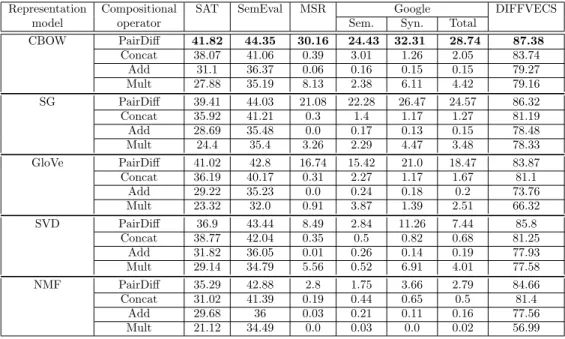
In Table 3, we compare the four compositional operators (PairDiff, Con-cat, Add and Mult) described in Section 3.1 for the four different word representation models as described in Section 3.2. We observe that PairDiff achieves the best results compared with other operators for all the evaluated datasets and all the word representation methods. PairDiff is significantly better than Add or Mult for all embeddings (both prediction- and counting-based) in MSR, Google and DiffVec datasets according to Clopper-Pearson confidence intervals (p< 0.05). SAT is the smallest dataset among all, so we were unable to see any significant differences on SAT.
Analogy completion in Google and MSR datasets are considered as an open vocabulary task because to answer a question of the form “a is tobasc
is to ?”, we must consider all the words in the corpus as candidates, which is an open vocabulary, not limited to the words that appear in the benchmark datasets as in SAT or SemEval datasets. Therefore, applying PairDiff to each pair (a, b) and (c, d) will retrieve candidatesd that have relations with
c similar to the relation betweena and b, but not necessary similar to the word c. For instance, the top 3 ranked candidates for a question “man is towoman as king is to ?” are women, pregnant and maternity. We notice that the top ranked candidates indicate feminine entities. This explains the performance of PairDiff on MSR and Google datasets, which is lower compared with other datasets. Similar observations have been made by Levy et al. [2014]. Moreover, the open vocabulary task (Google and MSR) is harder than the closed vocabulary task (SAT, SemEval and DiffVecs) as the number of incorrect candidates is much larger in the open vocabulary setting. This means that the probability of accidentally retrieving a noisy negative candidate as the correct answer is higher than in the closed vocabulary task.
Representation Compositional SAT SemEval MSR Google DIFFVECS
model operator Sem. Syn. Total
CBOW PairDiff 41.82 44.35 30.16 24.43 32.31 28.74 87.38 Concat 38.07 41.06 0.39 3.01 1.26 2.05 83.74 Add 31.1 36.37 0.06 0.16 0.15 0.15 79.27 Mult 27.88 35.19 8.13 2.38 6.11 4.42 79.16 SG PairDiff 39.41 44.03 21.08 22.28 26.47 24.57 86.32 Concat 35.92 41.21 0.3 1.4 1.17 1.27 81.19 Add 28.69 35.48 0.0 0.17 0.13 0.15 78.48 Mult 24.4 35.4 3.26 2.29 4.47 3.48 78.33 GloVe PairDiff 41.02 42.8 16.74 15.42 21.0 18.47 83.87 Concat 36.19 40.17 0.31 2.27 1.17 1.67 81.1 Add 29.22 35.23 0.0 0.24 0.18 0.2 73.76 Mult 23.32 32.0 0.91 3.87 1.39 2.51 66.32 SVD PairDiff 36.9 43.44 8.49 2.84 11.26 7.44 85.8 Concat 38.77 42.04 0.35 0.5 0.82 0.68 81.25 Add 31.82 36.05 0.01 0.26 0.14 0.19 77.93 Mult 29.14 34.79 5.56 0.52 6.91 4.01 77.58 NMF PairDiff 35.29 42.88 2.8 1.75 3.66 2.79 84.66 Concat 31.02 41.39 0.19 0.44 0.65 0.5 81.4 Add 29.68 36 0.03 0.21 0.11 0.16 77.56 Mult 21.12 34.49 0.0 0.03 0.0 0.02 56.99
Table 3: Accuracy of the compositional operators for relational similarity prediction and relational classification (last right column).
Mult is performing slightly worse with NMF compared to other embed-dings. Recall that NMF produces non-negative embeddings and Mult is performing an elementwise multiplication operation on the two input word embeddings to create the embeddings for their relation. If the negativity was the only issue with Mult operator as previously suggested by [Baroni and Zamparelli, 2010], then Mult should have performed better with NMF. We hypothesise the issue here is sparsity in the relation representations. To test our hypothesis empirically we conduct the following experiment.
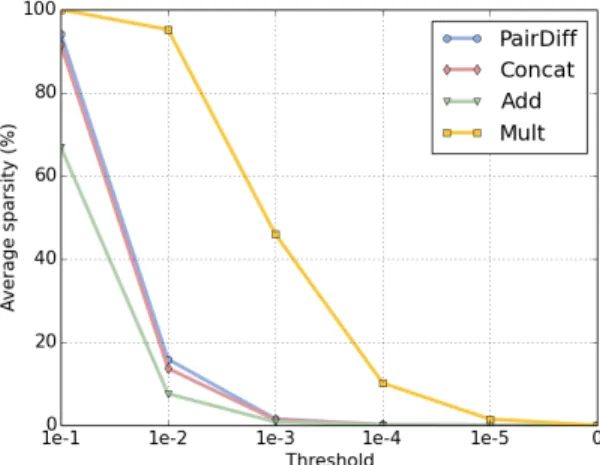
First, we randomly select 140 word-pairs from the Google dataset and apply different compositional operators to create relation embeddings for each word-pair using 300 dimensional CBOW word embeddings as the input. Next, we measure the average sparsity of the set of relational embeddings created by each operator. We define sparsity at a particular cut-off level for addimensional vector as the percentage of elements with absolute value less than or equal toout of d. Formally, sparsity is given by (11).
sparsity = 1 d d X i=1 I[|xi|≤] (11)
Here,I is the indicator function which returns 1 if the expression evaluated is true, or 0 otherwise. Our definition of sparsity is a generalisation of the `0 norm that counts the number of non-zero elements in a vector. However,
in practice, exact zeros will be rare and we need a more sensitive measure of sparsity, such as the one given in (11). Average sparsity is computed by dividing the sum of sparsity values given by (11) for the set of word-pairs by the number of word-pairs in the set (i.e. 140).
Figure 1 shows the average sparsity values for different operators under differentlevels. Figure 1 shows that Mult operator generates sparse vectors for relations compared to other operators under all values. Considering that Mult is performing a conjunction over the two input word embeddings, even if at least one embedding has a nearly zero dimension, after elementwise multiplication we are likely to be left with nearly zero dimensions in the relation embedding. Such sparse representations become problematic when measuring cosine similarity between relation embeddings, which leads to poor performances in word analogy tasks.
Figure 1: The average sparsity of relation embeddings for different operators using CBOW embeddings with 300 dimensions for some selected pairs of words.
5.2 Effect of Dimensionality
The dimensionality of the relational embeddings produced by the composi-tional operators presented in Section 3.1 depends on the dimensionality of the input word embeddings. For example, Mult, Add, and PairDiff
oper-ators produce relational embeddings with the same dimensionality as the input word embeddings, whereas the Concat operator produce relational embeddings twice the dimensionality of the input word embedding. A nat-ural questions therefore is that how does the performance of the relational embeddings vary with the dimensionality of the input word embedding. To study the relationship between the dimensionality of the input word em-bedding and the composed relational emem-bedding we conduct the following experiment.
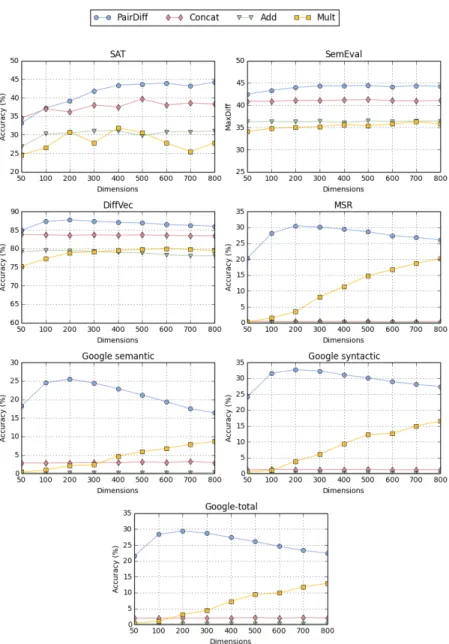
We first train word embeddings of different dimensionalities using the ukWaC corpus. We keep all the other parameters of the word embedding learning method fixed except for the dimensionality of the word embed-dings learnt. Because CBOW turned out be the single best word embedding learning method according to the results in Table 3, we use CBOW as the preffered word embedding learning method in this analysis. Figure 2 shows the performance of the different compositional operators on the benchmark datasets using CBOW input word embeddings with dimensionalities in the range 50-800.
As seen from Figure 2, PairDiff outperforms all other operators across all dimensionalities. The best results on SemEval and DiffVecs datasets are reported by PairDiff with 200 dimensions. Performance saturates when the dimensionality is increased beyond this point. On the other hand, SAT shows different trend. On SAT, the performance of PairDiff continuously increases with the dimensionality of the input word embeddings. On the other hand, in MSR and Google datasets we see a different trend where the performance of PairDiff decreases while that of Mult increases with the dimensionality of the input word embedding.
To understand the above-described trends first note that the dimensions in word embeddings are providing almost complementary information re-lated to the semantics of a word.8 Adding more dimensions to the word embedding can be seen as a way of representing richer semantic informa-tion. However, increasing the dimensionality also increases the number of parameters that we must learn. Prediction-based word embedding learning methods first randomly initialise all the parameters and then update them such that the co-occurrences between words can be accurately predicted in a given context window. However, the training dataset, which in our case is the ukWaC corpus, is fixed. Therefore, we will have more parameters than we could reliably estimate using the data we have, resulting in some
8
As described in Section 3.1, Pearson correlation coefficients between different dimen-sions in word embeddings are small, showing that different dimendimen-sions are uncorrelated.
Figure 2: The effect of the dimensionality of the CBOW word embeddings for compositional relation representations.
overfitted noisy dimensions as we increase the dimensionality of the word embeddings learnt.
One hypothesis for explaining the seemingly contradictory behaviour with PairDiff and Mult operators is as follows. When we increase the
dimen-sionality of the input word embeddings, there will be some noisy dimensions in the input word embeddings. PairDiff operators amplifies the noise in the sense that the resultant offset vector will retain noisy high dimensions that appear in both word embeddings. On the other hand, Mult operator can be seen as a low-pass filter where we shutdown dimensions that have small (or zero) valued dimensions in at least one of the two embeddings via the element-wise multiplication of corresponding dimensions. Therefore, Mult will be robust against the noise that exist in the higher dimensions of the word embeddings than the PairDiff operator.
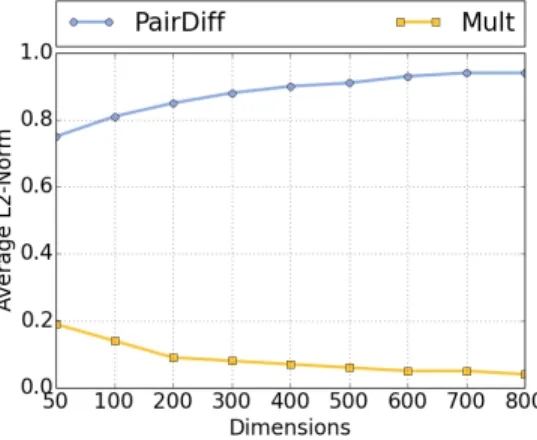
To empirically test this hypothesis we compute the`2 norm of (va−vb)
and (vavb) for word embeddings of different dimensionalities and compute
the average over 140 randomly selected word-pairs. As shown in Figure 3, the norm of PairDiff relation embedding is increasing with dimensionality, whereas norm of the relation embedding generated by Mult decreases. This proves our hypothesis that Mult is filers out the noise in high dimensional word embeddings better than PairDiff.
Figure 3: Average`2norm of relational vectors generated using PairDiff and
Mult operators.
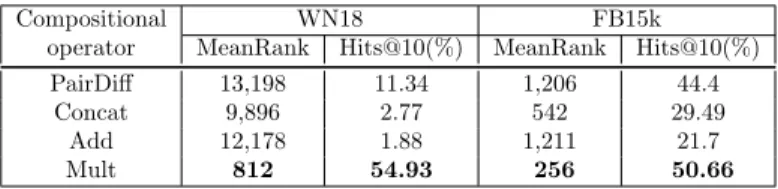
5.3 Performance on Knowledge Base Completion Task Table 4 displays the performance on the compositional operators for the knowledge base completion task on the two knowledge graphs WN18 and FB15k, where low mean rank and high Hits@10 indicates better perfor-mance. As can be seen from the Table, Mult operator yields the lowest mean rank and the highest Hits@10 accuracy among other operators for the both knowledge bases.
Given that PairDiff was the best operator for relational similarity tasks, it is surprising that Mult operator outperforms PairDiff in both WN18 and FB15k datasets. Recall that knowledge base completion is the task where given that (h, t) pair is related by a relation r (as provided in the train set) we need to assess how likely that (h0, t0) is related byr. In our evalua-tion process, this task is answered by measuring the inner-product between f(h, t) and f(h0,t0), where f is a compositional function that represents the relationship between h and t. In the case of Mult operator, we have: similarity-score = (ht)>(h0t0), this indicates that if a dimension is not common across all four entities it does not contribute to the overall similar-ity score. This can be seen as a strict way of estimating relational similarsimilar-ity between train and test pairs because a particular dimension must be on in all four words involved in an analogy.
On the other hand, PairDiff operator scores test entity pairs by (h−
t)>(h0 −t0). Here, (h0, t0) is an entity pair in the test dataset with the target relation r, and we are interested in finding, for example, candidate tail entities t0 that has r with a given head entity h0. This score can be further expanded as (h−t)>h0−(h−t)>t0. The first term is fixed given the training dataset and the head entity, and the rank of the tail entity is determined purely based on (h−t)>t0, where the head entityh0 does not participate in. This is problematic because entities t0 that are similar to t and dissimilar to h will be simply ranked at the top irrespective of the relationt0 has withh0. Indeed in Table 4 we see that mean rank for PairDiff is significantly higher compared to that of Mult. This suggests that many irrelevant tail (or head) entities are ranked ahead of the correct entity for each test tuple. On the other hand, in relational similarity task, the two pairs between which we must measure similarity are fixed and this issue is not
If a relation is asymmetric such as hypernym and hyponym as in WN18, addition model will be insensitive to the directionality of such relations com-pared to PairDiff which explains the better performance of PairDiff over Add.
5.4 Evaluating the Asymmetry of the PairDiff Operator Relations between words can be categorised as either being symmetric or
asymmetric. If two words a and b are related by a symmetric relation r, thenbis also related toawith the same relationr. Examples of symmetric
Compositional WN18 FB15k
operator MeanRank Hits@10(%) MeanRank Hits@10(%)
PairDiff 13,198 11.34 1,206 44.4
Concat 9,896 2.77 542 29.49
Add 12,178 1.88 1,211 21.7
Mult 812 54.93 256 50.66
Table 4: Accuracy of the compositional operators for knowledge base com-pletion task.
relations include synonyms and antonyms. On the other hand, ifais related to b by an asymmetric relation, then b might not be necessarily related to a with the same relation r. Examples of asymmetric relations include hypernyms and meronyms. As discussed in Section 5.1, PairDiff operator outperforms Add and Mult operators. Unlike Mult and Add, which are commutative operators, PairDiff is a non-commutative operator. Therefore, PairDiff should be able to detect the direction of a relation.
To test the ability of PairDiff to detect the direction of a relation, we set up the following experiment. Using a set of word-pairs where there is a common directional relation r between the two words in each word pair as training data, we use PairDiff to represent the relationship between two words in a word-pair, given the word embeddings for those two words. Next, we swap the two words in each word-pair and apply the same procedure to create relation embeddings for the reversed relationr0in each word-pair. We model the task of predicting whether a given word-pair contains the original relationror its reversed versionr0as a binary classification task. Specifically, we train a binary support vector machine with a linear kernel with the cost parameter set to 1 using held-out data. If the trained binary classifier can correctly predict the direction of a relation in a word-pair, then we can conclude that the relation embedding for that word-pair accurately captures the information about the direction of the relation that exists between the two words in the word-pair. We can repeat this experiment with symmetric as well as asymmetric relation typesr and compare the performances of the trained classifiers to understand how well the directionality in asymmetric relations is preserved in the PairDiff embeddings.
For the asymmetric relation types we use all relation types in the DIFFVECS
because this dataset contains only asymmetric relation types. For symmet-ric relation types we use two popular symmetsymmet-ric semantic relations namely, synonymy9 and antonymy10. We report five-fold cross-validation accuracies
9
http://saifmohammad.com/WebDocs/LC-data/syns.txt
10
with each relation type in Figure 4. If the classifier reports a high classifi-cation accuracy for asymmetric relations than symmetric relations, then it indicates that the relation embedding can encode the directional informa-tion in a relainforma-tion. From Figure 4 we see that, overall, the accuracies for the two symmetric relation types is lower than that for the asymmetric relation types. This result indicates that PairDiff can correctly detect the direction in the asymmetric relation types.
Figure 4: The accuracy of SVM classifier.
6
Discussion and conclusion
This work evaluated the contribution of word embeddings for representing relations between pairs of words. Specifically, we considered several compo-sitional operators such as PairDiff, Mult, Add, and Concat for creating a representation (embedding) for the relation that exist between two words, given their word embeddings as the input. We used different pre-trained word embeddings and evaluated the performance of the operators on two tasks: relational similarity measurement and knowledge base completion. We observed that PairDiff to be the best operator for relational similarity measurement task, whereas Mult operator to be the best for knowledge base completion task. We then studied the effect of dimensionality on the
per-formance of these two operators and showed that the sparsity of the input embeddings is affecting the Mult operator, and not the negativity of the in-put word embedding dimensions as speculated in prior work. Our analysis in this paper was limited to unsupervised operators in the sense that there are no parameters in the operators that can be (or must be) learnt from training data. This raises the question whether we can learn better compo-sitional operators from labelled data to further improve the performance of the compositional approaches for relation representation, which we plan to explore in our future work.
References
Marco Baroni and Alessandro Lenci. Distributional memory: A general framework for corpus-based semantics. Computational Linguistics, 36(4): 673–721, 2010.
Marco Baroni and Roberto Zamparelli. Nouns are vectors, adjectives are matrices: Representing adjective-noun constructions in semantic space. In EMNLP’10, pages 1183 – 1193, 2010.
Marco Baroni, Georgiana Dinu, and Germ´an Kruszewski. Don’t count, pre-dict! a systematic comparison of context-counting vs. context-predicting semantic vectors. In Proceedings of the 52nd Annual Meeting of the As-sociation for Computational Linguistics (Volume 1: Long Papers), pages 238–247, Baltimore, Maryland, June 2014. Association for Computational Linguistics.
Yoshua Bengio, R´ejean Ducharme, Pascal Vincent, and Christian Jauvin. A neural probabilistic language model.journal of machine learning research, 3(Feb):1137–1155, 2003.
Danushka Bollegala, Yutaka Matsuo, and Mitsuru Ishizuka. Www sits the sat: Measuring relational similarity on the web. InECAI, pages 333–337, 2008.
Antoine Bordes, Nicolas Usunier, Alberto Garcia-Duran, Jason Weston, and Oksana Yakhnenko. Translating embeddings for modeling multi-relational data. In Advances in neural information processing systems, pages 2787– 2795, 2013.
Stephen Clark. Vector space models of lexical meaning. Handbook of Con-temporary Semantic Theory, The, pages 493–522, 2015.
Aleksandr Drozd, Anna Gladkova, and Satoshi Matsuoka. Word embed-dings, analogies, and machine learning: Beyond king-man+ woman= queen. In Proceedings of COLING 2016, the 26th International Confer-ence on Computational Linguistics: Technical Papers, pages 3519 – 3530, 2016.
Nguyen Tuan Duc, Danushka Bollegala, and Mitsuru Ishizuka. Using re-lational similarity between word pairs for latent rere-lational search on the web. In IEEE/WIC/ACM International Conference on Web Intelligence and Intelligent Agent Technology, pages 196 – 199, 2010.
Nguyen Tuan Duc, Danushka Bollegala, and Mitsuru Ishizuka. Cross-language latent relational search: Mapping knowledge across Cross-languages. In Proceedings of the Twenty-Fifth AAAI Conference on Artificial Intel-ligence, pages 1237 – 1242, 2011.
Adriano Ferraresi, Eros Zanchetta, Marco Baroni, and Silvia Bernardini. Introducing and evaluating ukwac, a very large web-derived corpus of english. In Proceedings of the 4th Web as Corpus Workshop (WAC-4) Can we beat Google, pages 47–54, 2008.
John R Firth. A synopsis of linguistic theory, 1930-1955. 1957.
Gottlob Frege. ¨Uber sinn und bedeutung. Zeitschrift f¨ur Philosophie und philosophische Kritik, 100:25 – 50, 1892.
Emiliano Guevara. A regression model of adjective-noun compositionality in distributional semantics. InACL’10 Workshop on Geometrical Models of Natural Language Semantics, pages 33 – 37, 2010.
Z. Harris. Distributional structure. The Philosophy of Linguistics, pages 26 – 27, 1985.
David A Jurgens, Peter D Turney, Saif M Mohammad, and Keith J Holyoak. Semeval-2012 task 2: Measuring degrees of relational similarity. In Pro-ceedings of the First Joint Conference on Lexical and Computational Semantics-Volume 1: Proceedings of the main conference and the shared task, and Volume 2: Proceedings of the Sixth International Workshop on Semantic Evaluation, pages 356–364, 2012.
Daniel D Lee and H Sebastian Seung. Algorithms for non-negative matrix factorization. InAdvances in neural information processing systems, pages 556–562, 2001.
Omer Levy, Yoav Goldberg, and Israel Ramat-Gan. Linguistic regularities in sparse and explicit word representations. In CoNLL, pages 171–180, 2014.
Yankai Lin, Zhiyuan Liu, Maosong Sun, Yang Liu, and Xuan Zhu. Learning entity and relation embeddings for knowledge graph completion. InAAAI, pages 2181–2187, 2015.
Tal Linzen. Issues in evaluating semantic spaces using word analogies.arXiv preprint arXiv:1606.07736, 2016.
Tomas Mikolov, Martin Karafi´at, Lukas Burget, Jan Cernock`y, and San-jeev Khudanpur. Recurrent neural network based language model. In
Interspeech, volume 2, page 3, 2010.
Tomas Mikolov, Kai Chen, and Jeffrey Dean. Efficient estimation of word representation in vector space. InProceedings of International Conference on Learning Representations, 2013a.
Tomas Mikolov, Ilya Sutskever, Kai Chen, Gregory S. Corrado, and Jef-frey Dean. Distributed representations of words and phrases and their compositionality. In NIPS, pages 3111 – 3119, 2013b.
Tomas Mikolov, Wen-tau Yih, and Geoffrey Zweig. Linguistic regularities in continuous space word representations. In HLT-NAACL, volume 13, pages 746–751, 2013c.
Jeff Mitchell and Mirella Lapata. Vector-based models of semantic compo-sition. InACL-HLT’08, pages 236 – 244, 2008.
Jeff Mitchell and Mirella Lapata. Language models based on semantic com-position. In Proceedings of the 2009 Conference on Empirical Methods in Natural Language Processing, pages 430–439, Singapore, 2009.
Jeff Mitchell and Mirella Lapata. Composition in distributional models of semantics. Cognitive Science, 34(8):1388 – 1429, November 2010.
Maximilian Nickel, Lorenzo Rosasco, and Tomaso Poggio. Holographic em-beddings of knowledge graphs. InProc. of AAAI, 2016.
Jeffery Pennington, Richard Socher, and Christopher D. Manning. Glove: global vectors for word representation. InProceedings of Empirical Meth-ods in Natural Language Processing (EMNLP), pages 1532–1543, 2014.
Richard Socher, Danqi Chen, Christopher D Manning, and Andrew Ng. Reasoning with neural tensor networks for knowledge base completion. In Advances in Neural Information Processing Systems, pages 926–934, 2013.
Peter Turney, Michael L Littman, Jeffrey Bigham, and Victor Shnayder. Combining independent modules to solve multiple-choice synonym and analogy problems. InProceedings of the Recent Advances in Natural Lan-guage Processing, pages 482 – 489, 2003.
Peter D Turney. Measuring semantic similarity by latent relational analysis.
arXiv preprint cs/0508053, 2005.
Peter D Turney. Similarity of semantic relations.Computational Linguistics, 32(3):379–416, 2006.
Peter D Turney and Michael L Littman. Corpus-based learning of analogies and semantic relations. Machine Learning, 60(1-3):251–278, 2005.
Peter D. Turney and Patrick Pantel. From frequency to meaning: Vector space models of semantics. Journal of Aritificial Intelligence Research, 37:141 – 188, 2010.
Peter D Turney, Patrick Pantel, et al. From frequency to meaning: Vector space models of semantics. Journal of artificial intelligence research, 37 (1):141–188, 2010.
Ekaterina Vylomova, Laura Rimmel, Trevor Cohn, and Timothy Bald-win. Take and took, gaggle and goose, book and read: Evaluating the utility of vector differences for lexical relation learning. arXiv preprint arXiv:1509.01692, 2015.
Wenpeng Yin and Hinrich Sch¨utze. Learning meta-embeddings by using ensembles of embedding sets. InProc. of ACL, pages 1351–1360, 2016.