1 M.E. (Student), Electronics and Telecommunication Engineering Department SSCET, CSVTU,
Bhilai, IndiaE-mail: [email protected]
2 Associate Professor Electronics and Instrumentation Engineering Department SSCET, CSVTU,
Bhilai, IndiaE-mail: [email protected]
GPS-GSM Based Tracking System
Abid Khan1 and Ravi Mishra2ABSTRACT
This proposed work is an attempt to design a tracking unit that uses the global positioning system to determine the precise location of a object, person or other asset to which it is attached and using GSM modem this information can be transmit to remote user. It can provide tele-monitoring system for inter-cities transportation vehicles such as taxis and buses. This system contains single-board embedded system that is equipped with GPS and GSM modems along with ARM processor that is installed in the vehicle. During object motion, its location can be reported by SMS message. A software package is developed to read, process, analyze and store the incoming SMS messages. The use of GSM and GPS technologies allows the system to track object and provides the most up-to-date information about ongoing trips. If a password like SMS is sent by the owner, it automatically stops the vehicle or we can use it for different other work, it can provide real time control. This system finds its application in real time traffic surveillance. It could be used as a valuable tool for real time traveler. The current system can be able to provide monitoring process from anywhere. The purpose of this system is to design and integrate a new system which is integrated with GPS- GSM to provide following feature: a) Location information, b) Real time tracking using SMS, c) track bus driver activity d) Communication is instantaneous therefore we can receive running report quickly. It is completely integrated so that once it is implemented in all vehicles, then it is easy to track vehicles any time.
Keywords: Embedded ARM, GPS, GSM, NMEA Protocol. 1. INTRODUCTION
Proposed design is cost-effective, reliable and has the function of accurate tracking. When large object or vehicles were spread out over ground, the owner corporations often found it difficult to keep track of what was happening. They required some type of system to determine where each object was at any given time and for how long it travelled. Also the need of tracking in consumer’s vehicle use to prevent any kind of theft because police can use tracking reports to locate stolen vehicle. GSM and GPS based tracking system will provide effective, real time vehicle location, and reporting. A GPS- GSM based tracking system will inform where your vehicle is and where it has been, how long it has been. The system uses geographic position and time information from the Global Positioning Satellites. The system has an “On-Board
Module” which resides in the vehicle to be tracked. The On-Board module consists of GPS receiver, a GSM modem and ARM processor. It can provide tele-monitoring and management system for inter-cities transportation vehicles such as taxis and buses.[2] This system contains single-board embedded system that is equipped with GPS and GSM modems along with microcontroller that is installed in the vehicle. During vehicle motion, its real-time parameters such as location are reported by SMS message. The system takes advantage of wireless technology in providing powerful management transportation engine. The use of GSM and GPS technologies allows the system to track vehicle and provides the most up-to-date information about ongoing trips. This system finds its application in real time traffic surveillance. It could be used as a valuable tool for real time traveler information, congestion monitoring, and system evaluation. [4] An intelligent, automated vehicle tracking system can resolve following problems such as, late arrivals to scheduled, improper use of company time and resources, unsafe driving habits, assigned routes, inefficient dispatching, and passenger’s dissatisfaction. This can lead to better traffic flow modeling and a better understanding of driver behavior. This project includes various features like Ingenuity, Simplicity of design and Easy implementation. It is completely integrated so that once it is implemented in all vehicles, then it is easy to track vehicle any time. [7]
2. HARDWARE DESIGN
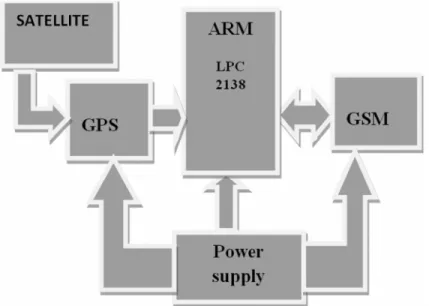
Hardware framework for tracking system is shown in Fig 1. System contains high Performance ARM controller, a GPS, and GSM modem and overall system reside into a vehicle. A tracking system will provide effective real time vehicle location reporting. Tracking system will inform where your vehicle is and where it has been, how longer it has been there .
The basic function of in vehicle unite is to acquire, Monitor and transmit the position latitude, longitude, speed, time to management center either at fixed interval or on demand. Microcontroller unit form the heart of IVU, which acquires and process the position data from the GPS module. The GPS receiver of vehicle terminal receives and resolves the navigation message broadcasted by GPS position satellites, computes the longitude and latitude of vehicle coordinates, transforms it into the GSM message form by GSM communication controller, and sends the message to monitoring center via the GSM network.
GSM HARDWARE
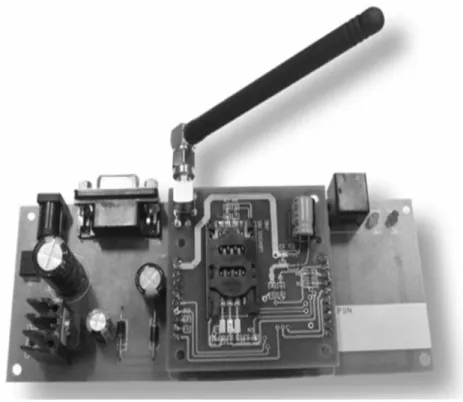
The core of data communication about this system lies in Wireless communication control terminals that uses GSM Modules to transfer long-distance data extensively and reliably. It Support instructions of AT commands. SIM300 can be integrated with a wide range of applications. SIM300 is a Tri-band GSM/GPRS engine that works on frequencies EGSM 900 MHz, DCS 1800 MHz and PCS1900 MHz SIM300 provides GPRS multi-slot class 10 capabilities and support the GPRS coding schemes CS-1, CS-2, CS-3 and CS-4. With a tiny configuration of 40mm × 33mm × 2.85 mm, SIM300 can fit almost all the space requirement in our application. Therefore, the MCU can connect with GSM Modules very expediently through serial interfaces the GSM modules need extensively on the market mainly are standard GSM modules.GSM modem as shown in Fig. 2.
GPS RECEIVER
The hardware interfaces for GPS units are designed to meet NMEA requirements. The GPS receiver provides data in NMEA 0183format with a 1Hz update rate. Generally message received by GPS is in NMEA [National Marine Electronics Association] message format and NMEA protocol which is most commonly used is NMEA0183 protocol. GPS sentences beginning with the following specifications: $GPGGA, $GPGSA, $GPGSV, $GPRMC, and $GPVTG. And sentences also begins with $GPMSS, $GPZDA as shown in Table 1.
Table 1
Formats of NMEA Messages
Sentence ID Description
$GPGGA GPS Fix Date
$ GPGSA GPS Dilution of Precision and active satellites
$GPGSV GPS Satellite in view
$GPRMC Recommended minimum specific GPS/Transit data
$GPVTG Track made good and ground speed
$GPMSS Beacon Receiver status
$GPZDA UTC Date/Time and Local time Zone Offse
A common NMEA Sentence used for location is:
$GPRMC,161229.487,A,3723.2475,N,12158.3416,W,0.13,309.62,120598, ,*10 GPRMC,021709.000,A,3717.6077,N,12658.6237,E,2.14,17.03,280907,,,A GPRMC,021710.000,A,3717.6102,N,12658.6233,E,2.31,9.15,280907,,,A $GPGGA,002153.000,3342.6618,N,11751.3858,W,1,10,1.2,27.0,M,-34.2,M,,0000*5E $GPGLL, 3723.2475, N, 12158.3416, W, 161229.487, A, A*41 $GPGSA,A,3,07,02,26,27,09,04,15,,,,,,1.8,1.0,1.5*33 Figure 3: GPS Receiver
MICROCONTROLLER • A smaller computer
• On-chip RAM, ROM, I/O ports.
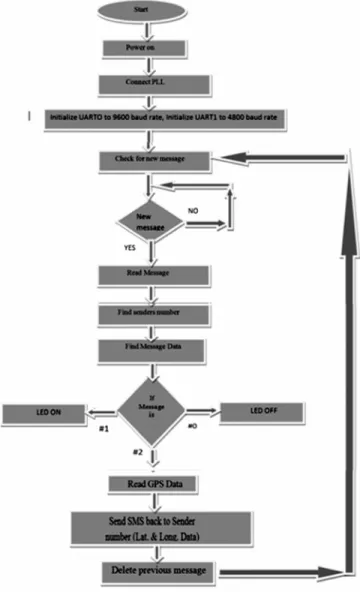
Example ARM perfectly fits many uses, from automotive industries and controlling home appliances to industrial, instruments, remote sensors, electrical door locks and safety devices. It is also ideal for smart cards as well as for battery supplied devices of its low consumption EEPROM memory makes it easier to apply microcontrollers to devices where permanent storage of various parameters needed. Low cost, low consumption, easy handling and flexibility make ARM applicable. Flow chart for overall system as shown in Figure 4.
Algorithm
Step 1. Start of process. Step 2. First is power on. Step 3. Initialize System PLL.
Step 4. Initialize UART0 at 9600 and UART1 at 4800 baud rate.
Step 5. Check for new message. Yes then go to step 7 else wait for new message. Step 6. Start reading the message
Step 7. First read sender number.
Step 8. And read data in message .If message contain #0 then LED OFF and if #1 then LED ON and if #2 go to step 9.
Step 9. Start reading GPS message.
Step 10. Send longitude and latitude information to sender back.
Step 11. After sending message delete previous message and go to step no. 6 again for repeating process.
3. RESULT AND DISCUSSION
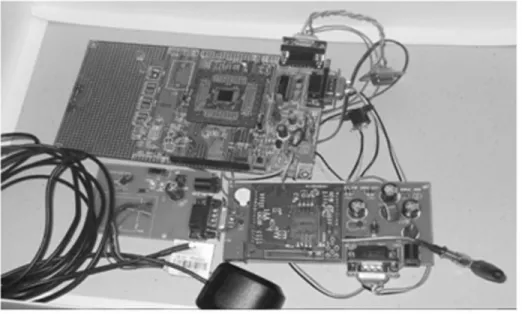
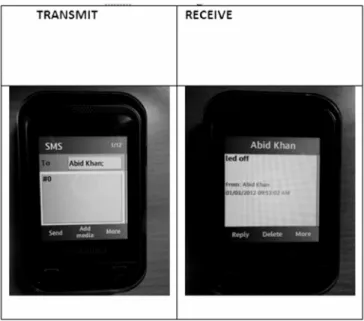
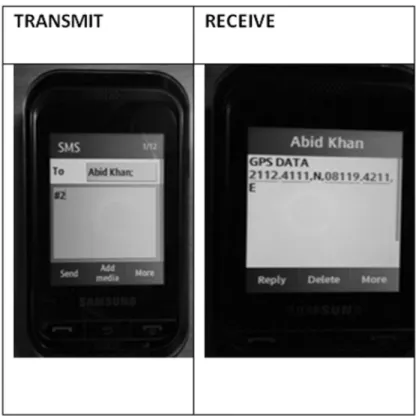
Complete system as shown in Figure 5 contains complete connection of 32-bit ARM processor along with GSM and GPS system. The positions are displayed in requesting cell phone display. With this system it becomes easy for the users to keep track of their objects. If the object resides in any location positional data in terms of latitude and longitude can easily be traced out also we can control our vehicle by password like #0 and #1 as shown in Figure 6 and 7.
The message sending and receiving by cell-phone are shown in Figure 6, Figure 7 and Figure 8.
1. If SMS Contain #0 Messsage then Cellphone Receive “Led off” Message.
Figure 6: LED OFF Message Received by Cellphone
2. If SMS Contain #1 Message then Cellphone Receive “Led on” Message.
Figure 7: LED ON Message Received by Cellphone
Figure 8: Location Message Received by Cellphone
4. CONCLUSIONS
Tracking system is becoming increasingly important in large cities and it is more secured than other systems. It is completely integrated so that once it is implemented in all vehicles, then it is possible to track anytime from anywhere. It has Real-time capability, emerges in order to strengthen the relations among people, vehicle and road by putting modern information technologies together and able to forms a real-time accurate, effective comprehensive transportation system. This system has many advantages such as large capability, wide areas range, low operation costs, effective, Strong expandability and Easy to use in vehicle traffic administration. Upgrading this setup is very easy which makes it open to future a requirement which also makes it more efficient.
ACKNOWLEDGEMENT
I owe a debt of gratitude to Prof. Ravi Mishra (Sr. Assistant Prof., Department of Electronics & Electrical Engineering, SSCET, Bhilai, CG) for providing his timely advice, constructive criticism and excellent supervision.
REFERENCES
[1] Elia Nadira Sabudin, Siti Zarina Mohd Muji, Mohd. Helmy Abd Wahab, Ayob Johari, Norazman Bin Ghani, “GSM-based Notification Speed Detection for Monitoring Purposes”,IEEE, Department of Computer Engineering, University Tun Hussein Onn Malaysia in 2008.
[2] M. AL-Rousan, A. R. AI-Ali and K. Darwish “GSM-Based Mobile Tele-Monitoring and Management System for Inter-Cities Public Transportations”,International Conference on Industrial Technology (ICIT), Computer Engineering Dept., American University of Sharjah, UAE in 2004, pp. 859-862.
[3] Stephen Teang Soo Thong, Chua Tien Han and Tharek Abdul Rahman, “Intelligent Fleet Management System with Concurrent GPS & GSM Real-Time Positioning Technology”, IEEE, Wireless Communication Centre (WCC), Universiti Teknologi Malaysia (UTM), Malaysia in 2007.
[4] Hui Hu, Lian Fang, “Design and Implementation of Vehicle Monitoring System Based on GPS/GSM/GIS”Third International Symposium on Intelligent Information Technology Application, School of Information Engineering, East China Jiao Tong University, Nanchang, Jiangxi, China in 2009. pp. 278-279.
[5] Thuong Le-Tien, Vu Phung-The “Routing and Tracking System for Mobile Vehicles in Large Area”,
Fifth IEEE International Symposium on Electronic Design, Test & Applications Dept. of Electrical Electronics Engineering, HCM University of Technology, Vietnam in 2010.
[6] Umar Farooq, Tanveer ul Haq, Muhammad Amar, Muhammad Usman Asad, Asim Iqbal “GPS-GSM Integration for Enhancing Public Transportation Management Services” Second International Conference on Computer Engineering and Applications, Department of Electrical Engineering University of the Punjab Lahore-54590, in 2010.
[7] T. Shyam Ramanath, A. Sudharsan, U. Pelix Udhayaraj, “Drunken Driving and Rash Driving Prevention System”,International Conference on Mechanical and Electrical Technology (ICMET 2010), Sri Sai Ram Engineering College, Chennai, India in 2010, pp. 603.
[8] Muruganandham, P.R. Mukesh, “Real Time Web Based Vehicle Tracking Using GPS”,World Academy of Science, Engineering and Technology in 2010.