Progress Report
J A N U A R Y – D E C E M B E R
2014
Sharing
Knowledge.
Sharing Hope.
CIBMTR® (Center for International Blood and Marrow Transplant Research®) is a research collaboration between the National Marrow Donor Program®/Be The Match® and Medical College of Wisconsin
Progress
Report
January – December
2014
Milwaukee Campus
Medical College of Wisconsin
9200 W Wisconsin Ave, Suite C5500
Milwaukee, WI 53226 USA
(414) 805-0700
Minneapolis Campus
National Marrow Donor Program
3001 Broadway St NE, Suite 100
Minneapolis, MN 55413-1753 USA
(612) 884-8600
Center for International Blood and Marrow Transplant Research
Progress Report: January – December 2014
TABLE OF CONTENTS
1.0 OVERVIEW OF THE CIBMTR ... 1
1.1 Value of the CIBMTR as a Resource ... 1
1.2 Goals ... 2
1.3 Research Strategy ... 2
1.4 Organizational and Research Program Structure ... 3
1.5 Committee Structure ... 3
1.5.1 Assembly ... 3
1.5.2 Advisory Committee ... 5
1.5.3 Nominating Committee ... 6
1.5.4 Scientific Working Committees ... 6
1.5.5 Steering Committees ... 8
1.6 Training ... 8
1.6.1 Internal Training Initiatives ... 8
1.6.2 External Training Initiatives ... 10
1.6.3 Staff Continuing Education ... 11
2.0 RESOURCE DEVELOPMENT PLAN ACCOMPLISHMENTS ... 12
2.1 Quality and Scope of the Research Database ... 12
2.1.1 Stem Cell Therapeutic Outcomes Database (SCTOD) ... 12
2.1.2 Research Data Life Cycle ... 13
2.1.3 FormsNet ... 14
2.1.4 Research Database ... 16
2.1.5 Data Quality ... 17
2.1.6 Transplant Center Visits ... 19
2.1.7 Data and Information for Statistical Center Operations (DISCO) ... 19
2.1.8 Human Subjects / HIPAA Compliance ... 19
2.1.9 Information Security and Data Privacy ... 19
2.2 Technology Solutions for Sharing Data ... 20
2.2.1 Data Sharing Initiative ... 20
2.2.2 Applications for Sharing Data ... 20
3.0 SCIENTIFIC RESOURCE UTILIZATION PLAN ACCOMPLISHMENTS ... 23
3.1 Processes for Proposed Studies ... 23
3.2 Moving a Study Proposal to Publication ... 24
3.3 Support of Clinical Trials ... 24
3.3.1 BMT CTN ... 25
CIBMTR Progress Report 2014 TABLE OF CONTENTS
3.4 Long Term Follow-Up of Patients in Clinical Trials ... 26
3.5 Use of Immunologic Data from the Research Sample Repository ... 31
3.6 Observational Studies ... 32
3.6.1 Non-Transplant Therapy Research Initiatives ... 33
3.7 Biostatistical Approaches ... 34
3.8 Health Services Research in HCT ... 35
4.0 DISSEMINATION OF RESULTS ... 37
4.1 BMT Tandem Meetings ... 37
4.2 Presentations ... 37
4.3 Standard Reports ... 37
4.3.1 Report of Survival Statistics for BMT ... 37
4.3.2 Transplant Data by US Center Report ... 38
4.3.3 Annual Report on Transplant Center Survival Rates ... 38
4.3.4 Summary Slides ... 38
4.3.5 Summary of Accomplishments ... 38
4.3.6 Study Summaries for Patients ... 38
4.3.7 Newsletters ... 39
5.0 RESOURCE SHARING ... 40
5.1 Publications ... 40
5.2 Websites ... 40
5.2.1 CIBMTR Public Internet Presence ... 40
5.2.2 NMDP / Be The Match Internet Presence ... 41
5.2.3 HRSA Blood Cell Transplant Website ... 42
5.3 Data Resources ... 42
5.3.1 Research Database ... 42
5.3.2 Research Repository ... 46
6.0 FUTURE PLANS ... 47
7.0 IMPACT OF THE CIBMTR ... 49
8.0 WORKING COMMITTEE STUDIES ... 52
8.1 Acute Leukemia Working Committee ... 52
8.2 Autoimmune Diseases and Cellular Therapies Working Committee ... 61
8.3 Chronic Leukemia Working Committee ... 64
8.4 Donor Health and Safety Working Committee ... 70
8.5 Graft Sources and Manipulation Working Committee... 76
8.6 Graft-vs-Host Disease Working Committee ... 83
8.7 Health Services and International Issues Working Committee ... 89
8.8 Immunobiology Working Committee ... 97
8.9 Infection and Immune Reconstitution Working Committee ... 118
TABLE OF CONTENTS CIBMTR Progress Report 2014
8.11 Lymphoma Working Committee ... 131
8.12 Pediatric Cancer Working Committee ... 137
8.13 Plasma Cell Disorders and Adult Solid Tumors Working Committee ... 140
8.14 Primary Immune Deficiencies, Inborn Errors of Metabolism, and Non-Malignant Marrow Disorders Working Committee ... 150
8.15 Regimen-Related Toxicity and Supportive Care Working Committee ... 157
APPENDIX A: CIBMTR 2014 FACTS ... 166
APPENDIX B1: US CENTERS ... 167
APPENDIX B2: INTERNATIONAL CENTERS ... 177
APPENDIX C1: ORGANIZATIONAL STRUCTURE – MILWAUKEE CAMPUS ... 185
APPENDIX C2: ORGANIZATIONAL STRUCTURE – MINNEAPOLIS CAMPUS ... 186
APPENDIX C3: COORDINATING CENTER PERSONNEL ... 187
APPENDIX D1: ADVISORY COMMITTEE MEMBERSHIP ... 195
APPENDIX D2: EXECUTIVE COMMITTEE MEMBERSHIP ... 197
APPENDIX D3: CONSUMER ADVOCACY COMMITTEE MEMBERSHIP ... 199
APPENDIX D4: NOMINATING COMMITTEE MEMBERSHIP ... 200
APPENDIX D5: SCIENTIFIC WORKING COMMITTEE LEADERSHIP ... 201
APPENDIX D6: IMMUNOBIOLOGY STEERING COMMITTEE MEMBERSHIP ... 206
APPENDIX D7: CLINICAL TRIALS ADVISORY COMMITTEE MEMBERSHIP ... 207
APPENDIX E: STAFF CONTINUING EDUCATION ... 208
APPENDIX F: FORMS SUBMISSION PROCESS ... 211
APPENDIX G: HUMAN SUBJECTS / HIPAA COMPLIANCE ... 212
APPENDIX H: PUBLICATIONS IN 2014 ... 214
APPENDIX I: PRESENTATIONS IN 2014 ... 234
APPENDIX J: STUDY DEVELOPMENT CYCLE ... 238
APPENDIX K1: BMT CTN CLINICAL TRIALS ... 240
APPENDIX K2: RCI BMT CLINICAL TRIALS ... 244
CIBMTR Progress Report 2014 1.0 OVERVIEW OF THE CIBMTR
1.0 OVERVIEW OF THE CIBMTR
The CIBMTR® (Center for International Blood and Marrow Transplant Research®) collaborates with
the global scientific community to advance hematopoietic cell transplantation (HCT) and cellular therapy research worldwide. The CIBMTR is a research collaboration between the National Marrow Donor Program (NMDP) ®/Be The Match® and the Medical College of Wisconsin (MCW) that
facilitates critical observational and interventional research, which has led to increased survival and enriched quality of life for thousands of patients.
These research activities are made possible by the participation of a large network of transplant centers and the expertise of the CIBMTR Coordinating Center. Support for this program is provided by the National Institutes of Health (NIH) grants # 5U24CA076518 and # 5U10HL069294, Health Resources and Services Administration (HRSA) contract # HHSH250201200016C, and other
supplementary sources. This funding has resulted in the successful completion of hundreds of studies that positively impact clinical practice.
The CIBMTR is now in its tenth year of a robust, collaborative, and outcomes-focused research endeavor. The Coordinating Center spans two campuses and is committed to supporting the highest level of clinical research. This Progress Report covers the period from January 1 through December 31, 2014. Unless otherwise noted, all reported data are effective through December 1, 2014.
1.1 VALUE OF THE CIBMTR AS A RESOURCE
HCT is a sophisticated, resource-intensive therapy that is increasingly used to treat malignant and non-malignant diseases. HCT may use cells from healthy donors (alloHCT) or from patients
themselves (autoHCT). Assessing HCT outcomes is challenging. Individual indications for HCT are uncommon, sources for grafts are diverse, the early HCT period is characterized by multiple
competing risks, and technologies evolve rapidly. There is need for long-term follow-up of recipients since some HCT effects, e.g., therapy-related cancers, occur many years after treatment.
The CIBMTR maintains a large outcomes registry focused on HCT donors and recipients. Its network includes approximately 350 transplant centers across the globe, including almost all US centers, which share data on HCT outcomes; its database has information for more than 390,000 HCT recipients. The CIBMTR also provides statistical support for analyses of those data, making it an invaluable resource for assessing use and effectiveness of HCT. The CIBMTR originated in 1972 as the International Bone Marrow Transplant Registry (IBMTR). In 2004, the IBMTR program joined with the NMDP / Be The Match’s research program (established in 1987) to form the CIBMTR. Consequently, the program has well-established processes for collecting, sharing, and analyzing data resulting from 40 years of collaboration with investigators in the field. The productivity of the resource stems from this successful collaboration. Our goal as a resource is to facilitate research by sharing data as well as statistical and scientific expertise with clinical and basic scientists to allow them to better address important scientific and clinical issues. These investigators bring a broad range of expertise to the CIBMTR studies thus allowing our state of the art resource to be used to support research in many domains.
Outcomes registries like the CIBMTR’s facilitate understanding of treatment outcomes by addressing questions not amenable to randomized trials or single-center series. These include descriptions of use and results in various disease states and patient groups, determining prognostic factors, defining
1.0 OVERVIEW OF THE CIBMTR CIBMTR Progress Report 2014
inter-center variability in diagnosis, practice and outcome, evaluating long-term outcomes, and developing new analytic approaches. Outcomes registries can also be an asset in planning clinical trials by identifying the most promising questions (hypothesis generation), by providing realistic estimates of baseline outcome rates and of availability of patients under varying eligibility criteria, and by allowing simulation of statistical designs. Additionally, repositories of biologic samples linked to registry data, as is available through the CIBMTR, can facilitate unanticipated new areas of
investigation as science advances. The value of outcomes registries in assessing treatment effects is not restricted to HCT and is increasingly recognized in many areas of medicine. While this type of endeavor is not inherently innovative, the CIBMTR incorporates innovative components in its operations and analytic strategies. The CIBMTR’s unique Resource of data and expertise in statistics, immunobiology, bioinformatics, and clinical HCT along with our collaboration with many
investigators in diverse fields have led to successful completion of hundreds of studies with important impacts on clinical practice.
1.2 GOALS
Resource Development: The CIBMTR seeks to provide the biomedical community a high-quality clinical database and state-of-the-art statistical support to address important issues in HCT and related fields through continued enhancement of data collection and management technology and procedures, expansion of the Resource to include patient-reported outcomes, gathering and dissemination of data necessary for health services research and data on some non-HCT patients, development and application of novel statistical techniques, and collaboration with national and international networks in HCT and related fields. Additionally, the CIBMTR makes available a repository of paired donor / recipient specimens linked to clinical data.
Resource Utilization: The CIBMTR is committed to increasing use of the data, statistical, and
biospecimen resources maintained by the CIBMTR; to supporting studies with important clinical and policy implications; and to enhancing Working and Advisory Committee and Coordinating Center processes to prioritize and complete these studies.
1.3 RESEARCH STRATEGY
Resource Development Plan (Section 2):
1. Optimize and enhance the quality and scope of the database.
2. Provide state of the art technology solutions and develop collaborative agreements to share data for research.
Scientific Resource Utilization Plan (Section 3):
1. Enhance processes for review, prioritization, and implementation of proposed studies. 2. Optimize the timeline for moving a study proposal to publication.
3. Utilize data from observational studies to support decisions regarding design of prospective clinical trials and/or amendments of such trials.
4. Assist in long term follow-up of patients participating in clinical trials.
5. Link outcomes data to immunologic data available from the NMDP / Be The Match sample repository.
6. Provide novel observational studies in malignant and non-malignant blood and other disorders, including use of genetically engineered cellular products.
CIBMTR Progress Report 2014 1.0 OVERVIEW OF THE CIBMTR
8. Facilitate health services research in HCT.
1.4 ORGANIZATIONAL AND RESEARCH PROGRAM STRUCTURE
The CIBMTR represents a large network of approximately 350 participating transplant centers (Appendices B1 and B2) that submit transplant-related data for patients. Centers submit data at two levels: a Transplant Essential Data (TED) level, which captures basic data, and a Comprehensive Report Form (CRF) level, which captures more detail. The CIBMTR Coordinating Center, staffed by approximately 185 employees (Appendices C1-C3), provides data acquisition, management, and statistical support for analyses of these data.
The Chief Scientific Director is responsible for all administrative and scientific operations. The Associate and Senior Scientific Directors assist in overseeing operational aspects of the CIBMTR Coordinating Center. The CIBMTR committees (Section 1.5) provide input and advice to the
leadership team, ensuring the continued support of both the needs and priorities of its scientific and medical communities.
As identified in Figure 1.1, CIBMTR research involves five major programs:
• Clinical Outcomes Research;
• Immunobiology Research;
• Health Services Research;
• Statistical Methodology Research;
• Clinical Trials Support;
o Blood and Marrow Transplant Clinical Trials Network (BMT CTN);
o Resource for Clinical Investigations in Blood and Marrow Transplantation (RCI BMT).
1.5 COMMITTEE STRUCTURE
The CIBMTR committee structure ensures that research within each of the program areas is
conducted responsibly and efficiently. The Joint Affiliation Committee provides executive oversight. The Advisory (Section 1.5.2), Executive (Section 1.5.2.1), and Nominating (Section 1.5.3) Committees manage administrative issues, including policy making and organizational development. The
Consumer Advocacy Committee (Section 1.5.2.2) provides patients’ perspectives to all aspects of CIBMTR activities. The Scientific Working Committees (Section 1.5.4) manage clinical outcomes research activities and statistical analyses. The Immunobiology Steering Committee (Section 1.5.5) and Clinical Trials Advisory Committee (Section 1.5.5) provide scientific oversight for the
Immunobiology Working Committee and RCI BMT (Section 3.3.2), respectively.
1.5.1 Assembly
The CIBMTR Assembly is the organization’s voting membership. A representative from each CIBMTR center that submits CRF-level data serves on the Assembly, which elects members of the CIBMTR Advisory Committee, Nominating Committee, and Clinical Trials Advisory Committee. The Assembly meets annually during the BMT Tandem Meetings and is regularly updated on CIBMTR activities through periodic e-newsletters (Section 4.3.7).
1.0 OVERVIEW OF THE CIBMTR CIBMTR Progress Report 2014
Figure 1.1. Organizational Structure for Scientific Oversight
Joint Affiliation Committee Executive Director
J. Chell, MD National Marrow Donor
Program Transplant Centers CIBMTR Assembly Advisory Committee Executive Committee Medical College of Wisconsin Senior Research Advisor
D. Weisdorf, MD
Senior Scientific Director for Research M. Eapen, MBBS, MS Senior Scientific Director for SCTOD
D. Rizzo, MD, MS Associate Scientific Director for
CIBMTR Minneapolis D. Confer, MD
Advisory role
Chief Scientific Director M. Horowitz, MD, MS Scientific Working Committees
Steering Committees Consumer Advocacy Committee Chief Statistical Director M.J. Zhang, PhD (Interim) Statistical Methodology Research Program M.J. Zhang, PhD (Interim) Clinical Outcomes Research Program M. Eapen, MBBS, MS Health Services Research Program Linda Burns, MD Immunobiology Research Program S. Lee, MD, MPH Clinical Trials Support Program M. Pasquini, MD, MS TBD Blood and Marrow Transplant
Clinical Trials Network (BMT CTN) M. Pasquini, MD, MS
Resource for Clinical Investigations in Blood and Marrow Transplantation
(RCI BMT) TBD
CIBMTR Progress Report 2014 1.0 OVERVIEW OF CIBMTR
1.5.2 Advisory Committee
The Advisory Committee (Appendix D1) provides oversight for CIBMTR policies and scientific agenda and also partners with the Working Committees to prioritize scientific studies. Members are elected to three-year terms by the CIBMTR Assembly and must be from qualifying CRF centers. The Advisory Committee also includes appointed representatives from donor centers (1), collection centers (1), the patient community (2), the business community (1), the bioethics field (1), and cord blood banks (1) as well as ex-officio members from the National Cancer Institute (NCI); National Heart, Lung, and Blood Institute (NHLBI); National Institute of Allergy and Infectious Disease (NIAID); HRSA (4); and the CIBMTR Coordinating Center (7).
The Advisory Committee holds an in person meeting annually at the BMT Tandem Meetings. Additionally, the Committee meets quarterly and additionally, as needed, by teleconference. All Advisory, Executive, and Nominating Committee terms begin on March 1.
1.5.2.1 Executive Committee
The CIBMTR Executive Committee (Appendix D2), a subcommittee of the Advisory Committee, ensures that the organization carries out its mission and adheres to CIBMTR policies and procedures; it also provides advice and counsel to the CIBMTR Coordinating Center between meetings of the Advisory Committee. Members include the Advisory Committee Chair, Chair-Elect or Immediate Past Chair, four Vice-Chairs (each representing a geographic region), appointed members of the Advisory Committee, and senior Coordinating Center staff members who also serve on the Advisory Committee. The Executive Committee meets four times annually by teleconference and is responsible for:
• Providing scientific and policy advice to the Chief Scientific Director and Coordinating Center;
• Reviewing audit results and making recommendations for improvement;
• Appointing a CIBMTR Co-Chair and additional CIBMTR representatives to the BMT Tandem Meetings Scientific Organizing Committee for the annual BMT Tandem Meetings.
1.5.2.2 Consumer Advocacy Committee
The Consumer Advocacy Committee (Appendix D3) was created in 2005 as a subcommittee of the Advisory Committee to communicate CIBMTR research results and data to the non-medical
community and to provide patient and donor perspectives during the development of the CIBMTR research agenda. Many members have personal experience as a donor, recipient, or family member of a recipient.
Co-Chairs serve on both the Advisory Committee and the Clinical Trials Advisory Committee (Section 1.5.5), and members also participate in Working Committees. The nine members meet in person at the annual BMT Tandem Meetings and by periodic conference calls.
The Consumer Advocacy Committee oversees the translation of published research articles into lay summaries. Committee members determine which research articles are most meaningful to patients and family members, and the lay summary is created collaboratively with the CIBMTR’s Medical Writer, the first author of the research article, committee members, and members of the NMDP / Be The Match Patient Services Writing Team. In 2014, 3 summaries were added to the CIBMTR Patient Resources webpage at www.cibmtr.org, bringing the total number of available summaries to 25.
1.0 OVERVIEW OF THE CIBMTR CIBMTR Progress Report 2014
1.5.3 Nominating Committee
The Nominating Committee (Appendix D4) consists of five members elected by the CIBMTR Assembly and meets by teleconference(s) each fall. Following an annual call for nominations, the Nominating Committee prepares a slate of candidates for open positions on the Advisory,
Nominating, and Clinical Trials Advisory Committees. Elections are held annually by confidential electronic ballot.
The Nominating Committee also makes recommendations to the Advisory Committee for open Working Committee Chair and other leadership appointments, seeking recommendations from the CIBMTR Assembly, Advisory Committee, and incumbent Working Committee Chairs.
1.5.4 Scientific Working Committees
To ensure broad input into the research process and efficient use of resources, the CIBMTR facilitates 15 Working Committees focused on specific research areas:
• Acute Leukemia;
• Autoimmune Diseases and Cellular Therapies;
• Chronic Leukemia;
• Donor Health and Safety;
• Graft Sources and Manipulation;
• Graft-versus-Host Disease;
• Health Services and International Issues;
• Immunobiology;
• Infection and Immune Reconstitution;
• Late Effects and Quality of Life;
• Lymphoma;
• Pediatric Cancer;
• Plasma Cell Disorders and Adult Solid Tumors;
• Primary Immune Deficiencies, Inborn Errors of Metabolism, and Other Non-Malignant Marrow Disorders;
• Regimen-Related Toxicity and Supportive Care.
Total Working Committee membership exceeds 1,700 researchers. While most of these individuals are HCT clinicians, statisticians and basic scientists also participate. PhD statistical faculty and Master’s-level statisticians from the CIBMTR Coordinating Center provide their unique expertise in data analysis. Basic scientists investigating human leukocyte antigen (HLA), immunogenetics,
pharmacogenetics, stem cell biology, and other areas related to HCT provide essential expertise in their respective research areas. The Working Committee structure encourages a collaborative but rigorous methodological approach to all CIBMTR activities, including:
• Designing and conducting relevant studies that use CIBMTR data, statistical resources, networks, and/or centers;
CIBMTR Progress Report 2014 1.0 OVERVIEW OF CIBMTR • Setting priorities for clinical outcomes studies that use the CIBMTR Research Database,
including evaluating study proposals to ensure they are relevant to their subject area and will produce meaningful results;
• Assessing and revising CIBMTR data collection forms as needed;
• Planning and conducting workshops at CIBMTR meetings.
Working Committee membership is open to any researcher willing to take an active role in developing and conducting studies that use CIBMTR data and/or resources. Each Working Committee is staffed by at least one MS-level Statistician, a PhD Statistical Director, and an MD Scientific Director from the CIBMTR Coordinating Center. Each also typically has three to four Co-Chairs who are appointed by the Advisory Committee to non-renewable five-year terms. Working Committee Co-Chair appointments are made each fall, with terms commencing at the close of the BMT Tandem Meetings each year. Terms are staggered to facilitate succession and maintain continuity. Individuals may serve as Co-Chair more than once but not consecutively for the same committee. Co-Chairs participate in the nomination process for replacement positions and give special consideration to promising junior investigators, thus promoting ongoing leadership for the work of the CIBMTR. A list of Working Committee leadership can be found in Appendix D5. Working Committee Co-Chairs provide subject matter expertise in autologous and allogeneic transplantation as well as understanding of CIBMTR organization and procedures. They must be members of CIBMTR centers that submit CRFs and that are compliant with Continuous Process Improvement (CPI) standards for data submission (Section 2.1.3.1), unless an exception is granted by the Advisory Committee. Co-Chairs are occasionally selected from outside these guidelines for their specific scientific expertise, for example, a scientist who directs a histocompatibility laboratory, apheresis center, or donor registry, who is committed to the CIBMTR and to the field of HCT.
Co-Chairs monitor and facilitate the progress of studies in their Working Committee’s portfolio. They communicate with Principal Investigators to address barriers and/or delays and participate in weekly CIBMTR Coordinating Center study critiques when studies in their portfolios are being discussed. In addition to chairing annual Working Committee meetings, Co-Chairs meet by teleconference every four to eight weeks with their committee’s Scientific Director and biostatisticians to review the progress of study proposals and ongoing studies. Co-Chairs lead the annual Working Committee meeting and, using input from that meeting, prioritize studies for the following year.
In August 2014, the CIBMTR Nominating Committee submitted recommendations, which the Advisory Committee approved, for 12 open Working Committee Co-Chair positions. New Working Committee Co-Chairs will assume their roles in March 2015 after conclusion of the annual BMT Tandem Meetings.
The CIBMTR Advisory Committee encourages each Working Committee to develop clinically relevant and meaningful studies. To that end, Working Committees review proposals for CIBMTR clinical outcomes studies. Proposals are formally solicited each fall but may be submitted at any time throughout the year. Proposals are reviewed by the Coordinating Center and then discussed in-depth at the appropriate Working Committee meeting at the annual BMT Tandem Meetings. The Chief Scientific Director, in consultation with the Chief Statistical Director and the Associate Statistical Director, allocates statistical resources to each Working Committee. Working Committee Chairs establish a work plan for the ensuring year that is consistent with available resources. See Section 8
1.0 OVERVIEW OF THE CIBMTR CIBMTR Progress Report 2014
for a list of current Working Committee studies. An abbreviated listing, updated biannually, can also be found on the www.cibmtr.org website.
1.5.5 Steering Committees
Two CIBMTR Steering Committees, the Immunobiology Steering Committee (Appendix D6) and the Clinical Trials Advisory Committee (Appendix D7), provide an additional level of oversight for the use of certain resources.
The NMDP / Be The Match Histocompatibility Advisory Group also serves as the CIBMTR Immunobiology Steering Committee, which consists of appointed members and liaisons from the CIBMTR, NMDP / Be The Match, American Society for Histocompatibility and Immunogenetics, NMDP / Be The Match Cord Blood Advisory Group, HRSA, and C.W. Bill Young Marrow Donor Recruitment and Research Program. This committee reviews and approves the use of donor-recipient specimens from the NMDP / Be The Match Research Repository in CIBMTR studies and meets in person twice annually, in summer and at the annual BMT Tandem Meetings.
The Clinical Trials Advisory Committee assists in the review, approval, and oversight of proposals and protocols for Phase I and Phase II clinical trials submitted to the RCI BMT (Section 3.3.2). Its 10 members represent transplant physicians, non-physicians with experience in patient and donor issues, consultants, and representatives from the CIBMTR and RCI BMT. The committee meets in-person during the BMT Tandem Meetings and by teleconference as needed.
1.6 TRAINING
The CIBMTR is committed to staff training and development for both Coordinating Center staff and participating transplant center professionals. A formal training program was established in 2012, and a Training and Development Specialist was recruited at that time. In 2014, the CIBMTR established a Training Steering Committee with the vision to “Deliver educational / training resources that enhance the quality of CIBMTR research.” One goal of the committee is to better integrate operational training across all functional areas and provide enhanced training opportunities that are appropriate for both internal and external audiences. New and continuing training initiatives offered in 2014 are described in this section.
1.6.1 Internal Training Initiatives
• All-staff Meetings. The CIBMTR holds quarterly staff meetings to share information between the two campuses and provide updates on ongoing operational projects, new key initiatives, and organizational objectives and measures. Staff accomplishments are also highlighted.
• Data Operations Staff Annual Meeting. Held in September 2014, this meeting incorporated training on good clinical practices, customer service, and business modeling.
• Immunobiology Research Lunch and Learn Sessions. The Immunobiology Research team, in collaboration with the Bioinformatics team, prepared and delivered several training sessions to internal CIBMTR and NMDP / Be The Match staff throughout the past year. Training topics included the role of transposons in killer-cell immunoglobulin-like receptors (KIR)
recombination, a summary of population genetic talks from the American Society of Human Genetics annual meeting, and staff presentations providing overviews of their projects.
CIBMTR Progress Report 2014 1.0 OVERVIEW OF CIBMTR • Information Technology (IT) Sessions. IT provided monthly trainings to staff on project
management, business requirements, and leadership as well as opportunities to attend lunch and learns with topics such as data warehousing, business intelligence, and business
modeling. IT has purchased licenses to encourage regular individual training as well, with access to two types of online training libraries that include a broad range of technical and management skill training.
• Statistical Training. The CIBMTR maintains a formal training program for master (MS)-level statisticians to ensure uniform procedures in the coordination of Working Committee and research study implementation. A comprehensive educational manual is provided to each statistician for their personal reference, and a code library is maintained on both campuses. The educational manual is updated periodically and used primarily as a resource tool for the MS-level statisticians while in training and thereafter. As part of the MS-statistician continuing education training program, statisticians attend annual CIBMTR data management meetings, the annual BMT Tandem Meetings, and short courses on statistical techniques that can be applied to the field of HCT. To increase the MS-level statistician’s awareness of organizational and research changes, tools available, onboarding and ongoing training updates, the MS-level statistician’s training manual is continually enhanced to support better communication and knowledge. Training program initiatives for 2014-2015 include:
o Statistical workshop led by Senior Biostatisticians, PhD Statisticians, and HCT
physicians;
o Bi-weekly Senior Biostatistician meetings with junior staff to provide mentoring and
answer questions;
o Monthly Senior Biostatistician meetings to discuss future projects;
o MS-level Statisticians meetings to discuss updates on Working Committee
management, study issues, SAS codes, policies and procedures, data, and other issues as needed.
Finally, to assess the MS-level statistician’s project management skills, a survey is planned to measure their current understanding and skills. Results of this survey as well as specific project management materials will be incorporated in the MS-level statistician’s training manual.
• Biostatistics Graduate Student. In 2014, one third-year doctoral student in the biostatistics program at MCW worked on CIBMTR projects. His training is focused on a sound theoretical understanding of statistical principles, research in the development of applied methodology, and collaborative research with biomedical scientists and clinicians. The student works closely with PhD-level biostatistical faculty members, particularly the CIBMTR Interim Chief
Statistical Director, as well as physician faculty members. He meets regularly with his primary mentor, with whom he created an individual development plan.
• Medical Students. In 2014, the CIBMTR hosted three medical students during the academic year as well as two in a summer research program that allows first-year medical students the opportunity to explore a career in biomedical research and academic medicine and gain research tools applicable to clinical practice.
1.0 OVERVIEW OF THE CIBMTR CIBMTR Progress Report 2014 • HCT Clinical Research Fellowship. In 2014, one physician participated in the HCT Clinical
Research Fellowship, which provides participants with coursework, data for research projects, and clinical experience as well as mentoring and an individual development plan. The fellow’s plan was developed with his primary mentor, the CIBMTR Senior Scientific Director for Research, who is a member of the fellow’s mentoring committee along with another physician faculty member and a PhD-level statistical faculty member. The fellow meets weekly with his primary mentor to discuss coursework as well as research progress and obstacles and to ensure the individual development plan is guiding the fellow’s training and providing him with the necessary experience to achieve his career goals.
1.6.2 External Training Initiatives
• BMT Tandem Meetings. With 2,950 attendees, the 2014 BMT Tandem Meetings included 5 plenary sessions, 11 concurrent sessions, 102 oral abstracts, 2 poster sessions, 4 corporate-supported symposia, and 3 product theaters. Continuing Medical Education (CME) and Continuing Education credits were issued through MCW to US physicians and allied health professionals. In addition to the extensive scientific agenda, many educational opportunities focused on young investigators and other allied health professionals:
o Clinical Research Professionals / Data Management Conference. With almost 200
attendees, this conference provided forms training, which increases the accuracy with which CIBMTR forms are completed.
o BMT CTN Coordinators and Investigators Meetings. With approximately 100 and
300 attendees, respectively, these meetings focused on data collection; the biology of diseases and the immune system; and processes, such as protocol activation, as well as specific clinical trials.
o IT Forum. With almost 100 attendees, this forum discussed various aspects of the
CIBMTR Data Life Cycle, including data collection through FormsNet, AGNIS, and data sharing through the Data Back to Center (DBtC) application and information requests. The Forum provides a unique opportunity to obtain input from the BMT community regarding future initiatives in data collection and data sharing.
o BMT Center Administrators Conference. With approximately 165 attendees, this
conference focused on payor strategies, performance improvement, data quality, caregiver challenges, and other management and leadership issues.
o BMT Pharmacists Conference. With almost 200 attendees, this conference presented
the latest research and best practices with a focus on specific diseases and populations.
o Transplant Nursing Conference. With almost 500 attendees, this conference presented
the latest research as well as disease-specific information and case studies.
o BMT Clinical Education Conference. This conference is designed for Nurse
Practitioners, Physician Assistants, Fellows, and Junior Faculty. With more than 300 attendees, the conference focused not only on the biology of diseases and clinical treatments but also quality improvement and patient interaction.
• Data Matters Training Newsletter. This data management-focused newsletter is published monthly via email and contains updates on projects, announces training opportunities and manual updates, and provides answers to frequently asked questions. Newsletter content is developed as a collaborative effort among several internal departments.
CIBMTR Progress Report 2014 1.0 OVERVIEW OF CIBMTR • E-Learning Modules for Network Data Professionals. E-Learning Modules were first
released in October 2013. At this time, a total of 10 modules have been completed. These include an introduction to the e-learning module, an overview of the revision process for recipient forms, modules on HLA, lymphoma, and plasma cell disorders, and a training module on FormsNet3 for donor centers. The next E-learning modules will focus on the essential form series for new data managers, including CRID (2804), Recipient Module FormsNet3 Application, Data Back to Center Overview, Pre-TED (F2400), Baseline (F2000), Infusion (F2006), and IDM (F2004) forms.
• Learning Management System (LMS). Implemented in 2014, LMS is the infrastructure that securely registers courses, houses instructional content for online access, and tracks progress towards meeting organizational goals by individual and by center. Courses located in the LMS include HLA [Introduction to HLA, Basic Biology of HLA, Advanced Biology of HLA and HLA Reporting (Form 2005)], Essential Form Series (Form 2400 Pre-TED module), and Disease Specific Series (including Plasma Cell Disorders and Lymphoma). Use of the individual
account registration was promoted through the Data Matters Training Newsletter and Clinical Research Coordinators (CRCs).
• Data Management Manual. The manual provides information detailing the forms completion process, SCTOD reporting requirements, data management protocols, and the consent process as well as instruction manuals for the Pre-TED (2400), Post-TED (2450), CRF forms (2100, 2200, 2300), and some disease forms. In 2014, one new manual section was published on the
CIBMTR website, and an additional 11 manual sections have been written and will be published as soon as review is completed.
• Center Reference Guide. The Center Reference Guide includes information about participation in CIBMTR research, center membership, data submission, data manager
education, mentor program, and the forms submission process as well as many useful tips and links.
• Clinical Research / Outcomes Educational Track at the NMDP / Be The Match Council Meeting. The CIBMTR Immunobiology Research team maintains responsibility for this educational opportunity. The 2014 program included the following workshops:
o Globalization of HCT;
o Weighing the risks and benefits of HCT for sickle cell disease; o New cellular therapy approaches: CARS and BIKES;
o Out of the freezer: CIBMTR research using Research Repository samples; o Treating disease relapse after alloHCT;
o Umbilical cord blood expansion: an alternative to HCT.
1.6.3 Staff Continuing Education
During 2014, 93% of staff members at both the Milwaukee and Minneapolis campuses attended various training programs in operations, CME, leadership development, and change management. See Appendix E for a list of specific training and professional development activities.
2.0 RESOURCE DEVELOPMENT PLAN ACCOMPLISHMENTS CIBMTR Progress Report 2014
2.0 RESOURCE DEVELOPMENT PLAN ACCOMPLISHMENTS
2.1 QUALITY AND SCOPE OF THE RESEARCH DATABASE
Committed to optimizing and enhancing the quality and scope of the Research Database, the CIBMTR collects data for approximately 20,500 new transplant recipients annually as well as a continually increasing volume of follow-up data on previously reported recipients and donors. Figure 2.1 shows cumulative accession of transplants since 1970 when the IBMTR began collecting these data.
2.1.1 Stem Cell Therapeutic Outcomes Database (SCTOD)
The CIBMTR administers the SCTOD for the HRSA-sponsored C.W. Bill Young Cell Transplantation Program, established by the Stem Cell Therapeutic and Research Act of 2005. Continued support for the SCTOD is provided through the Stem Cell Therapeutic and Research Reauthorization Act of 2010. The program has several goals:
• Collecting, analyzing and reporting outcomes data for all allogeneic transplants and other therapeutic uses of blood stem cells;
• Publicizing information about HCT to patients, families, health care professionals, and the public;
• Defining better processes for identifying unrelated matched marrow donors, peripheral blood stem cell (PBSC) donors, and cord blood units through one electronic system;
CIBMTR Progress Report 2014 2.0 RESOURCE DEVELOPMENT PLAN ACCOMPLISHMENTS • Increasing availability of unrelated adult volunteer donors and cord blood units;
• Expanding research to improve patient outcomes.
Annually, the CIBMTR publishes HCT volumes and demographic data by transplant center and provides public access to this information available on the Program website
(http://bloodcell.transplant.hrsa.gov).
As part of the contract to operate the SCTOD, the CIBMTR is required each year to perform a center-specific survival analysis comparing the one-year survival rates among US centers. The report
contains transplants from both related and unrelated donors. The most recent report was finalized in November 2014 and contains information on all first allogeneic transplants performed in US centers from January 1, 2010, through December 31, 2012.
The CIBMTR has conducted four Center Outcomes Forums to engage relevant stakeholders in the center specific outcomes reporting process. The most recent meeting was held in June 2014.
The Cellular Therapies for Regenerative Medicine (CTRM) data repository is also an SCTOD activity that tracks alternate uses of stem cells. The SCTOD contract mandates data collection on uses of cells found in bone marrow, peripheral blood, and umbilical cord blood for alternative therapeutic applications including regenerative medicine. The CTRM repository captures uses of cells for the treatment of diseases without the intention of replacing the recipient’s hematopoietic function. These therapies include, but are not limited to, treatment of infectious, cardiovascular, rheumatologic, neurologic, musculoskeletal, and endocrinologic diseases with the intent to improve organ function. The CIBMTR anticipates that the expansion of cellular therapy field with use of not only
hematopoietic derived cells, but also cells from other tissues, will only increase and is expanding the capability and flexibility of data collection in this area.
Two working groups provide oversight specific to SCTOD:
• Cord Blood Data Working Group. This group reviews and makes content suggestions for the cord blood outcomes reports which, utilizing CIBMTR data, help banks meet regulatory requirements and understand product quality.
• HRSA Blood Cell Transplant Website Working Group. This group reviews and makes content suggestions for the C.W. Bill Young Cell Transplantation website
(http://bloodcell.transplant.hrsa.gov). The CIBMTR provides the HCT data for this website.
2.1.2 Research Data Life Cycle
The Research Data Life Cycle (Figure 2.2) describes the track that data make as they are transformed from data to information and knowledge from the point of capture to its ultimate use in reporting and analysis. Activities along the Research Data Life Cycle are grouped in three general areas: Data
Collection; Extraction, Transformation, and Load; and Data Sharing.
The process begins at data collection when transplant centers enter the data in one of the applications we offer to enable electronic data capture. Most centers will enter data in FormsNet, a web application now in its third generation. Centers that have implemented local or third party systems can also capture and submit data electronically using AGNIS (A Growable Network Information System) service. An overriding goal of these solutions is to ease data capture burden on the centers.
2.0 RESOURCE DEVELOPMENT PLAN ACCOMPLISHMENTS CIBMTR Progress Report 2014
Figure 2.2. Research Data Life Cycle
Abbreviations: AGNIS = A Growable Network Information System, CDW = CIBMTR Data Warehouse, CRID = CIBMTR Recipient Identification Number, CRF = Comprehensive Report Form, FN = FormsNet, RDB = Research Database
The CIBMTR collects data at two levels: TED and CRF. The TED data set is an internationally accepted standard data set that contains a limited number of key variables and is required for all consecutive transplant recipients. The CRF captures additional patient, disease, and treatment-related data. TED-level data, with some additional details of donor and graft characteristics, comprise the obligatory data to be submitted to the SCTOD by US transplant centers.
Following data collection, data are pulled four times per month from FormsNet to an Oracle staging environment that starts an Extraction, Transformation, and Load (ETL) program. During ETL, data are rigorously validated for consistency, completeness, and uniqueness using custom logic and standardized and encoded for optimal statistical analysis. ETL culminates in the loading of validated data to the Research Database.
Data Sharing completes the cycle, providing data for analysis that have been collected and curated to generate research value. These data are extracted from the Research Database in periodic retrievals to serve a range of research and stakeholder needs. The data retrievals provide the basis for research study data files, reports, and externally-requested datasets. TED-level data are also directly available to centers through use of the DBtC application (Section 2.2.2.2).
2.1.3 FormsNet
FormsNet is the CIBMTR’s web-based application for electronic submission of transplant outcomes data. The application was updated in 2014 to provide key enhancements supporting operational efficiencies. Monthly form maintenance releases began in January 2014 to update key form
CIBMTR Progress Report 2014 2.0 RESOURCE DEVELOPMENT PLAN ACCOMPLISHMENTS
validations, which save time as well as improve user experience and accuracy for CIBMTR staff and FormsNet users. Additional improvements to FormsNet in 2014 include:
• Upgrades. The Donor module was upgraded to the FormsNet3 platform to provide autopopulation, improved navigation / validation, and overall improved user experience.
• Enhancements. Recipient, Donor, Clinical Trials, Audit, Forms Definition Manager, and Monitoring applications were enhanced to provide improved support and operational efficiencies.
• Auditing support. Enhancements were made to the applications for auditing FormsNet data against source documents at centers.
• Monitoring support. The Monitoring application was enhanced to provide monitoring support for an additional clinical trial.
2.1.3.1 Continuous Process Improvement
Robust data collection is critical to the success of the CIBMTR. The CPI program ensures timeliness and completeness of data forms submissions (Appendix F). Transplant centers receive CPI reports three times per year (January, May, and September), listing the number of follow-up forms that were due in the previous trimester and the number and percentage of each submitted within the trimester. A form is not officially submitted until all errors are resolved and all applicable information is
submitted and approved.
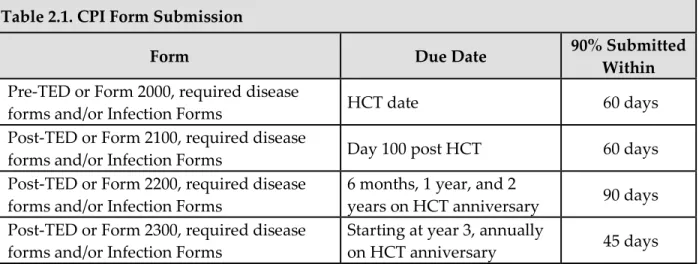
To be compliant, centers must submit at least 90% of forms due for the trimester, for all unrelated donor transplants and for related donor transplants that have occurred since December 3, 2007 (Table 2.1). As of September 1, 2014, 95% of US transplant centers were in compliance. The few remaining non-compliant centers enter a forms-due remediation procedure. If a center does not have current Institutional Review Board (IRB) approval information on file with the CIBMTR, it will not pass CPI even if the forms submission requirements are met.
In addition to the CPI recipient forms program, there are CPI regulations for donor forms. The Donor Data Management Team oversees submission of these forms from NMDP / Be The Match donor, collection, and apheresis centers. Donor CPI reports are generated four times per year (January, April, July, and October). To be compliant, centers must submit 100% of the forms required for that CPI period.
Table 2.1. CPI Form Submission
Form Due Date 90% Submitted Within
Pre-TED or Form 2000, required disease
forms and/or Infection Forms HCT date 60 days Post-TED or Form 2100, required disease
forms and/or Infection Forms Day 100 post HCT 60 days Post-TED or Form 2200, required disease
forms and/or Infection Forms 6 months, 1 year, and 2 years on HCT anniversary 90 days Post-TED or Form 2300, required disease
2.0 RESOURCE DEVELOPMENT PLAN ACCOMPLISHMENTS CIBMTR Progress Report 2014
2.1.4 Research Database
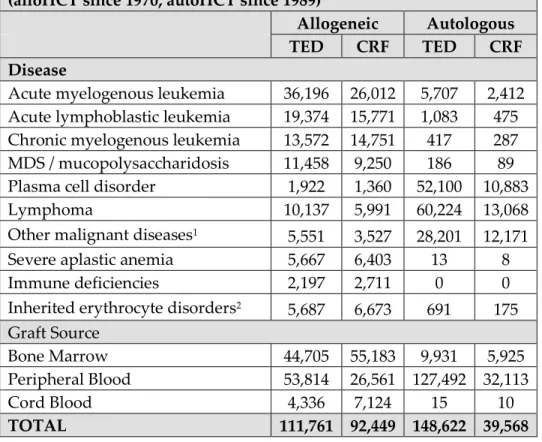
Once collected in FormsNet, submitted data goes through computerized completeness and quality checks before being added to the CIBMTR Research Database. The latter now contains information on more than 390,000 transplant recipients going back to transplants performed in 1968. The distribution of patients in the database is displayed in Table 2.2 Mandatory submission of outcomes data for alloHCTs in the US ensures we capture almost all US transplants.
Table 2.2. Distribution of Patients in the CIBMTR Research Database (alloHCT since 1970, autoHCT since 1989)
Allogeneic Autologous TED CRF TED CRF Disease
Acute myelogenous leukemia 36,196 26,012 5,707 2,412 Acute lymphoblastic leukemia 19,374 15,771 1,083 475 Chronic myelogenous leukemia 13,572 14,751 417 287 MDS / mucopolysaccharidosis 11,458 9,250 186 89 Plasma cell disorder 1,922 1,360 52,100 10,883 Lymphoma 10,137 5,991 60,224 13,068 Other malignant diseases1 5,551 3,527 28,201 12,171
Severe aplastic anemia 5,667 6,403 13 8 Immune deficiencies 2,197 2,711 0 0 Inherited erythrocyte disorders2 5,687 6,673 691 175
Graft Source
Bone Marrow 44,705 55,183 9,931 5,925 Peripheral Blood 53,814 26,561 127,492 32,113 Cord Blood 4,336 7,124 15 10
TOTAL 111,761 92,449 148,622 39,568
1. Includes other leukemias (n=8,629) and solid tumors (n=40,821).
2. Includes inherited erythrocyte disorders (n=8,078), inborn errors of metabolism (n=2,348), histiocytic disorders (n=1,321), autoimmune disease (n=606), and other non-malignant diseases (n=873).
In July 2014, the CIBMTR completed integration of Part I Forms Revision updates to the Research Database, including changes to pre-TED, baseline, product, and pre- and post-transplant disease forms for five major diseases that went live in FormsNet in October 2013. The scope of this effort encompassed the integration of 211 forms pages and more than 2,875 FormsNet field changes in the Research Database, ETL program, and SAS data retrievals that support CIBMTR research.
• SAS Retrieval. CIBMTR biostatisticians perform most analyses using third-party SAS software applications for clinical data analysis and reporting. To simplify study datasets, the CIBMTR creates SAS datasets of the most commonly analyzed data fields and the most commonly used computed variables. The data are extracted from the Research Database and formatted to be SAS-compatible. Four different datasets are created eight times per year, as shown in Table 2.3.
CIBMTR Progress Report 2014 2.0 RESOURCE DEVELOPMENT PLAN ACCOMPLISHMENTS
Table 2.3. Study Datasets
Dataset Description Number of Variables Number of Cases
TED All patients and transplants, regardless of reporting track 1,743 446,303 Research:
Allogeneic Patients on CRF track who had an allogeneic transplant and a follow-up form was submitted 15,984 105,713 Research:
Autologous Patients on CRF track who had an autologous transplant and a follow-up form was submitted 11,676 42,690 Study Patients accrued to specified studies (generally prospective studies – e.g. KGF, RCI BMT trials) 16,208 14,535
2.1.5 Data Quality
2.1.5.1 Verification and Validation
When data are entered into FormsNet, a series of entry level validation checks takes place to ensure the data are valid. This process flags certain errors at the time of entry and allows the CIBMTR to contact the center data manager so errors can be corrected immediately while source documents are readily available. If a data field does not pass the FormsNet validation checks identified below, an error comment is generated, and the data manager is navigated to an error review page to review, resolve, or override the unresolved errors. Lastly, an error report is generated that lists any
unresolved errors as well as errors that have been overridden. FormsNet validation checks include:
• Mandatory field validation. Certain fields on the forms must be completed for all recipients (e.g., primary questions that lead into secondary questions). Other fields must be completed depending on how a primary question is answered (e.g., ‘yes’ to ‘developed acute graft vs host disease (GVHD)’ makes all acute GVHD questions mandatory). The validation process checks that all mandatory fields are completed.
• Range validation. The validation process checks all laboratory values, drug doses, heights, and weights against established upper and lower limits. Additionally, the validation process ensures dates fall within an appropriate time frame.
• Cross form consistency. For certain data fields, the validation process checks for consistency between data reported on the current form and related data reported on a previous form. For example, on all forms, the contact date is validated against the HCT date.
• Within form consistency. The validation process also checks each form for consistency between related data reported on the same form. For example, all dates are validated against the ‘date of last contact’ or ‘date of actual contact’.
• Core field validations. The validation process checks against certain core data fields. For example, some questions are optional for international centers and required for domestic centers, so based on the location of the transplant center, a question may be optional or required.
Data extracted from FormsNet and loaded to the Research Database each month undergoes even more comprehensive validation and verification via an Extraction, Transformation & Load (ETL) process. These data are then more rigorously validated for consistency, completeness, and uniqueness
2.0 RESOURCE DEVELOPMENT PLAN ACCOMPLISHMENTS CIBMTR Progress Report 2014
using business rules created in custom logic for the categories provided below. Finally, the CIBMTR Data Quality Team reviews ETL errors and works with transplant centers to correct data.
• Fields that cannot be null. Business rules conduct structural validations to ensure data is complete and to limit the level of missing values in the data that may compromise its research utility.
• Cross form consistency. Additional rules are applied to ensure consistency across forms for a given patient on unique identifiers, key dates, and key values. This ensures the patient is uniquely defined across the database and there is no double counting.
• Longitudinal consistency. Several data specific rules are applied to ensure data is associated with the correct transplant records, especially for patients who receive multiple lines of therapy.
• Logical relationships. These rules ensure that logical dependencies between data are
enforced. A simple example is that the date of transplants must occur after the patient's date of birth.
Rules across these categories were updated and tested as part of the recent Forms Revision. Currently, the rate of form rejection is less than 2%, which is attributed to recent enhancements in transplant center education as well as to validations built in at the point of entry into FormsNet.
2.1.5.2 On-Site Data Audit Program
On-going data audits are performed at all CIBMTR participating transplant centers as part of the CIBMTR’s overall data quality assurance program. The audit compares data in source documents maintained at the transplant center with data contained in the CIBMTR Research Database. Currently, six Clinical Research Associates perform the on-site transplant center audits, spending three to four days at each center reviewing original source documents. The overall audit process is as follows:
• Audit cycle. Each domestic and international center that has submitted data for at least 20 HCTs is audited once within the 4-year audit cycle.
• Recipient selection and eligibility requirements. If a center has performed more than 20 HCTs during the audit period, recipient records are randomly selected for audit.
• Forms and data fields. All TED and CRF data are subject to data audit, and essential critical data fields are audited for each recipient.
• Methodology. Auditors compare the data submitted to the CIBMTR Research Database with the data in the source documents. Errors are reviewed with the data coordinator. CIBMTR auditors make all data corrections to the database, and the transplant center is provided with a record of all changes made to the TED forms and/or CRFs.
• Audit analysis, reports, and corrective action. Transplant centers receive a detailed audit report evaluating the results of their audit. Centers are required to submit a Corrective Action Plan following the audit in response to a critical field error rate above 3%, any systemic errors, consent issues requiring correction, or outstanding missing documentation issues.
In calendar year 2014, 51 centers were scheduled for audit (47 domestic, 4 international). As of December 1, 2014, 40 centers have been notified of their final audit results, including requested corrective action follow-up. Of those centers that have been sent reports, 80% passed with fewer than 3% critical field errors. Of the eight centers that did not pass the audit, four have completed all
CIBMTR Progress Report 2014 2.0 RESOURCE DEVELOPMENT PLAN ACCOMPLISHMENTS
required corrective action; the remaining four centers are in the process of completing requested corrective action.
2.1.6 Transplant Center Visits
The CIBMTR continued a program of transplant center visits in 2014 with the goal of understanding user needs, providing better data sharing solutions related to consolidation of data from disparate data sources, reducing time, and improving access to and delivery of data. Fifteen visits were conducted in 2014; the business needs gathered during these site visits will be incorporated into future enhancements to data sharing capabilities.
2.1.7 Data and Information for Statistical Center Operations (DISCO)
DISCO is the enterprise contact management system, deployed in Salesforce.com application
software, and used by the CIBMTR to maintain key operational information, as follows: organization and contact information for transplant centers; Executive, Advisory, and Working committee
administration; and membership data. Throughout 2014, DISCO was enhanced to more effectively track and manage the process flow of data related to Committee administration as well as Working Committee studies, from proposal to publication. By the end of 2014, the system will have completed its seventh release, furthering its ease of use and capabilities as a single point of access to
administrative information and management reports.
2.1.8 Human Subjects / HIPAA Compliance
The CIBMTR is committed to the ethical conduct of research. All Coordinating Center personnel maintain Collaborative IRB Training Initiative certification. The NMDP / Be The Match IRB, which is fully accredited by the Association for the Accreditation of Human Research Protection Programs, reviews all human subject research conducted by the CIBMTR, and the CIBMTR maintains
compliance with the Health Insurance Portability and Accountability Act (HIPAA) Privacy Rule. CIBMTR rules requiring the registration of all consecutive HCT recipients ensure the inclusion of women, minorities, and children. For additional information, see Appendix G.
2.1.9 Information Security and Data Privacy
The SCTOD federal contract requires appropriate risk management in the form of minimum security controls, policies, and standards. The CIBMTR’s data systems are maintained in accordance with the Federal Information Systems Management Act of 2002, with information security guidance provided by the National Institute of Standards and Technology (http://www.nist.gov). In accordance with National Institute of Standards and Technology Special Publication 800-18
(http://csrc.nist.gov/publications/PubsSPs.html), and supervised by HRSA’s Office of Information Technology, the CIBMTR maintains a System Security Plan to address information security by implementing measures including management, operational, and technical controls.
Since December 2008, the CIBMTR holds an Authority to Operate from the Chief Information Officer of HRSA. The certification was renewed in December 2011, and annual security audits were
performed in 2012, 2013, and 2014 to ensure compliance. The NMDP / Be The Match also holds an Authority to Operate from HRSA; ensuring similar standards of information security are applied to all CIBMTR and NMDP / Be The Match systems, including the FormsNet data collection system.
2.0 RESOURCE DEVELOPMENT PLAN ACCOMPLISHMENTS CIBMTR Progress Report 2014
These controls maintained by the CIBMTR and NMDP / Be The Match represent robust information security risk management beyond those outlined by HIPAA.
2.2 TECHNOLOGY SOLUTIONS FOR SHARING DATA
It is key to the mission of the CIBMTR to provide state of the art technology solutions and develop collaborative agreements to share data for research. The CIBMTR leverages its federal funding to support a broad array of research programs in a cost-effective manner through its expert staff of physicians, statisticians, immunologists, and clinical research and IT professionals. The organization has become a respected leader in HCT research by providing a unique resource of information and expertise to the medical and scientific communities. CIBMTR studies have changed clinical practice and helped to improve survival and quality of life for patients undergoing or being considered for this complex procedure.
The CIBMTR Data Sharing Initiative focuses on improvements to provide fast, easy, and flexible access to data. In 2014, the CIBMTR supported the research of 44 principal investigators by providing datasets from the Research Database.
2.2.1 Data Sharing Initiative
Thousands of hours of voluntary efforts from physicians and scientists spent using data from the CIBMTR Research Database to address important issues in HCT and other cancer treatments validate the need for this unique resource. The inclusive nature of the CIBMTR and its data access policies make these research data available to many through facilitation of studies in each of the research programs, standard CIBMTR reports, summary slides, and datasets. This year, the CIBMTR reviewed and updated its policies for clarity regarding expectations as well as obligations of users of CIBMTR data.
In 2014, the CIBMTR formalized its commitment to data sharing by creating a program to coordinate activities and effort to provide quality research data, information, and knowledge to meet the diverse needs of its stakeholders. The CIBMTR launched and completed a Data Sharing Assessment to evaluate the CIBMTR's current IT resources and capabilities for data sharing, document the business needs and data uses of our stakeholders, and develop a roadmap for the future that leverages
CIBMTR strengths as well as industry best practices. The Data Sharing Roadmap provides an evolutionary approach to create a unified Data Warehouse that leverages the existing work and design of the CIBMTR Data Warehouse as a foundation and is further expanded with the domain intelligence that already exists in the Research Database.
2.2.2 Applications for Sharing Data
2.2.2.1 A Growable Network Information System (AGNIS)
To assist transplant centers in collecting data for internal research, patient care requirements, and reporting purposes, the CIBMTR and NMDP / Be The Match BioInformatics created AGNIS. AGNIS supports secure data sharing across diverse database systems. It is an open-source web service developed with tools from the NCI caBIG® effort and other well-established projects, such as the Globus Toolkit. AGNIS software, distributed under a public license at www.agnis.net, is available to any interested center.
CIBMTR Progress Report 2014 2.0 RESOURCE DEVELOPMENT PLAN ACCOMPLISHMENTS
AGNIS allows participating centers to collect and share data with the CIBMTR as well as others who link to AGNIS. Data are entered once and then distributed and synchronized among databases. Data elements transmitted via AGNIS are curated using the metadata repository operated by the NCI Center for Biomedical Informatics and Information Technology, known as the Cancer Data Standards Registry and Repository (caDSR). This repository is compliant with government standards for
electronic data transmission.
In the caDSR, common data elements for FormsNet database fields are compiled into Form Builder reports, which convert CIBMTR format into caDSR format and which centers use to submit data automatically to FormsNet via AGNIS. To date, common data elements have been created for more than 14,235 FormsNet database fields. This represents those database fields associated with 99% of the forms submitted via FormsNet. In addition, 28 Form Builder reports have been released in the caDSR. An additional 49 Form Builder reports have been created and are pending quality assurance testing and release in AGNIS. Between January 1 and December 1, 2014, a total of 18,109 forms were submitted through AGNIS.
2.2.2.2 Data Back to Center (DBtC)
The DBtC application provides users the ability to download CIBMTR TED level data variables. The data has been validated and processed in the CIBMTR Research Database and can be downloaded in a comma-separated value format. These data are reviewed and refreshed quarterly. A data dictionary is provided for each field and value in the datasets. Legacy IBMTR data is available for download as far back as 1964, and some legacy NMDP / Be The Match data is available as far back as 1987. These data can be downloaded by authorized users of a transplant center in a comma-separated value format. Between January 1 and December 1, 2014, 951 unique, non-CIBMTR visitors viewed 2,332 DBtC pages and downloaded data 486 times.
• In June 2013, DBtC access was extended to two cooperative registry groups (Asia-Pacific Blood and Marrow Transplant Group & Canadian Blood and Marrow Transplant Group) to obtain data submitted to the CIBMTR by their transplant center members. Access to a transplant center’s data is only provided in cases in which the transplant center has signed a data transmission / sharing agreement form with their respective registry. In 2014, the CIBMTR continued discussion with other international registries to put in place formal agreements to use CIBMTR data as their primary data source.
• In July 2014, DBtC underwent major enhancement to include all pre-TED and post-TED form version 4 changes introduced in FormsNet3 during the Forms Revision release in October 2013.
2.2.2.3 Center Volumes Portal
The Center Volumes Portal allows centers to preview; correct, if necessary; and approve center volume data published annually to the HRSA Blood Cell Transplant website
(http://bloodcell.transplant.hrsa.gov). Under contract to HRSA as part of the C.W. Bill Young
Transplantation Program, the CIBMTR provides information regarding transplants performed at US transplant centers.
The CIBMTR uses its portal site to give centers access to display and download the previous five years (2009-2013) of volume data as well as the current year under review (2013). For 2013, 59 of 215
2.0 RESOURCE DEVELOPMENT PLAN ACCOMPLISHMENTS CIBMTR Progress Report 2014
centers have submitted approval to publish their center volume data. The review of the Center
Volumes Portal will be ongoing through December 2014, and we anticipate the number of centers that agree to have their data published will increase significantly. During 2014, there were 5,081 pages viewed by 707 unique, external visitors to the portal site, and, of those, 1,668 pageviews were of the Center Volumes Portal.
2.2.2.4 Patient One-Year Survival Calculator – Allogeneic Transplants
In July 2014, the CIBMTR launched the Patient One-Year Survival Calculator for Allogeneic Transplants by deploying the calculator to the portal site for access by medical directors. This
calculator represents the first of several online application tools planned by the CIBMTR that leverage data submitted by centers to support decision-making and research. The intent of this online survival calculator is to provide centers with a tool to predict one year survival for individual allogeneic HCT recipients. Data taken from the CIBMTR Center-Specific Survival Report for 2013 is used to calculate the “expected” probability of one-year survival for individual recipients of first allogeneic HCT in the US. Patient, disease, and transplant characteristics of allogeneic HCT recipients at US HCT centers between 2009 and 2011 are used to generate these estimates. The calculator will be updated annually to reflect new information contained in future center outcomes analyses.
2.2.2.5 BRIDG
BRIDG (Biomedical Research Integrated Domain Group) is a collaborative effort engaging stakeholders from four organizations: Clinical Data Interchange Standards Consortium; HL7
Regulated Clinical Research Information Management Work Group; NCI, including the caBIG project; and FDA. The goal of the BRIDG group is a common view of data exchange. The BRIDG model balances the concerns of the larger health care community while being specific enough to apply to a particular subject area, such as HCT. Common data elements for certain standard CIBMTR forms have been extracted and associated to one of three contexts: recipient, donor, or stem cell product. Future expansion of the BRIDG model will add HCT content as the basis for a physical database model. This physical model will help remove barriers that transplant centers experience in electronic transfer of HCT data to the SCTOD by providing a foundation upon which to develop their own in-house data systems and eventual development of electronic medical record integration engines to submit data to the CIBMTR Research Database.