Properties
Arild C Rustan,
University of Oslo, Oslo, NorwayChristian A Drevon,
University of Oslo, Oslo, NorwayFatty acids play a key role in metabolism: as a metabolic fuel, as a necessary component of all membranes, and as a gene regulator. In addition, fatty acids have a number of industrial uses.
Introduction
Fatty acids, both free and as part of complex lipids, play a number of key roles in metabolism – major metabolic fuel (storage and transport of energy), as essential components of all membranes, and as gene regulators (Table 1). In ad-dition, dietary lipids provide polyunsaturated fatty acids (PUFAs) that are precursors of powerful locally acting metabolites, i.e. the eicosanoids. As part of complex lipids, fatty acids are also important for thermal and electrical insulation, and for mechanical protection. Moreover, free fatty acids and their salts may function as detergents and soaps owing to their amphipathic properties and the for-mation of micelles.
Overview of Fatty Acid Structure
Fatty acids are carbon chains with a methyl group at one end of the molecule (designated omega,o) and a carboxyl group at the other end (Figure 1). The carbon atom next to the carboxyl group is called the a carbon, and the
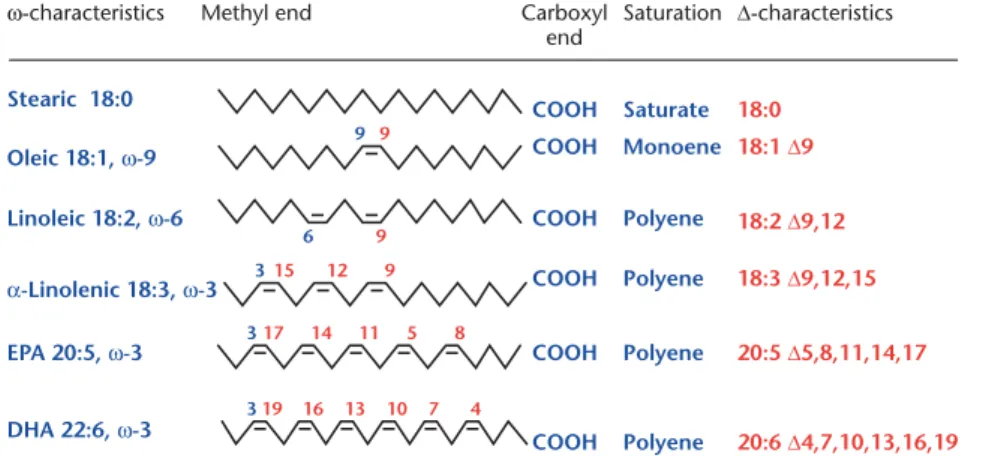
subsequent one thebcarbon. The letternis also often used instead of the Greekoto indicate the position of the double bond closest to the methyl end. The systematic nomencla-ture for fatty acids may also indicate the location of double bonds with reference to the carboxyl group (D).Figure 2 outlines the structures of different types of naturally occurring fatty acids.
Saturated fatty acids
Saturated fatty acids are ‘filled’ (saturated) with hydrogen. Most saturated fatty acids are straight hydrocarbon chains with an even number of carbon atoms. The most common fatty acids contain 12–22 carbon atoms.
Unsaturated fatty acids
Monounsaturated fatty acids have one carbon–carbon double bond, which can occur in different positions. The most common monoenes have a chain length of 16–22 and a double bond with thecisconfiguration. This means that the hydrogen atoms on either side of the double bond are oriented in the same direction.Transisomers may be pro-duced during industrial processing (hydrogenation) of un-saturated oils and in the gastrointestinal tract of ruminants. The presence of a double bond causes restric-tion in the mobility of the acyl chain at that point. Thecis
configuration gives a kink in the molecular shape andcis
fatty acids are thermodynamically less stable than thetrans
forms. Thecisfatty acids have lower melting points than thetransfatty acids or their saturated counterparts.
In polyunsaturated fatty acids (PUFAs) the first double bond may be found between the third and the fourth car-bon atom from theo carbon; these are calledo-3 fatty acids. If the first double bond is between the sixth and seventh carbon atom, then they are calledo-6 fatty acids. The double bonds in PUFAs are separated from each other by a methylene grouping.
Article Contents
. Introduction
. Overview of Fatty Acid Structure . Major Fatty Acids
. Metabolism of Fatty Acids . Properties of Fatty Acids
. Requirements for and Uses of Fatty Acids in Human Nutrition
. Uses of Fatty Acids in the Pharmaceutical/Personal Hygiene Industries
doi: 10.1038/npg.els.0003894
CH – (CH )3 2 n CH – CH – COOH
ω β 2 α 2
Figure 1 Nomenclature for fatty acids. Fatty acids may be named according to systematic or trivial nomenclature. One systematic way to describe fatty acids is related to the methyl (o) end. This is used to describe the position of double bonds from the end of the fatty acid. The letternis also often used to describe theoposition of double bonds.
Table 1 Functions of fatty acids Energy – high per gram (37 kJ g21
fat)
Transportable form of energy – blood lipids (e.g. triacyl-glycerol in lipoproteins)
Storage of energy, e.g. in adipose tissue and skeletal muscle Component of cell membranes (phospholipids)
Insulation – thermal, electrical and mechanical Signals – eicosanoids, gene regulation (transcription)
PUFAs, which are produced only by plants and phyto-plankton, are essential to all higher organisms, including mammals and fish.o-3 ando-6 fatty acids cannot be in-terconverted, and both are essential nutrients. PUFAs are further metabolized in the body by the addition of carbon atoms and by desaturation (extraction of hydrogen). Mammals have desaturases that are capable of removing hydrogens only from carbon atoms between an existing double bond and the carboxyl group (Figure 3).b-oxidation of fatty acids may take place in either mitochondria or peroxisomes.
Major Fatty Acids
Fatty acids represent 30–35% of total energy intake in many industrial countries and the most important dietary sources of fatty acids are vegetable oils, dairy products, meat products, grain and fatty fish or fish oils.
The most common saturated fatty acid in animals, plants and microorganisms is palmitic acid (16:0). Stearic acid (18:0) is a major fatty acid in animals and some fungi, and a minor component in most plants. Myristic acid (14:0) has a widespread occurrence, occasionally as a major com-ponent. Shorter-chain saturated acids with 8–10 carbon atoms are found in milk and coconut triacylglycerols.
Oleic acid (18:1 o-9) is the most common monoenoic fatty acid in plants and animals. It is also found in micro-organisms. Palmitoleic acid (16:1o-7) also occurs widely in animals, plants and microorganisms, and is a major com-ponent in some seed oils.
Linoleic acid (18:2o-6) is a major fatty acid in plant lipids. In animals it is derived mainly from dietary plant oils. Arachidonic acid (20:4o-6) is a major component of
membrane phospholipids throughout the animal king-dom, but very little is found in the diet.a-Linolenic acid (18:3o-3) is found in higher plants (soyabean oil and rape seed oils) and algae. Eicosapentaenoic acid (EPA; 20:5o-3) and docosahexaenoic acid (DHA; 22:6o-3) are major fatty acids of marine algae, fatty fish and fish oils; for example, DHA is found in high concentrations, especially in phospholipids in the brain, retina and testes.
Metabolism of Fatty Acids
An adult consumes approximately 85 g of fat daily, most of it as triacylglycerols. During digestion, free fatty acids Stearic 18:0 ω-characteristics Oleic 18:1, ω-9 Linoleic 18:2, ω-6 α-Linolenic 18:3, ω-3 EPA 20:5, ω-3 DHA 22:6, ω-3
Methyl end Carboxyl Saturation end 9 9 9 6 9 12 15 3 17 3 14 11 5 8 19 3 16 13 10 7 4 ∆-characteristics COOH COOH COOH COOH COOH COOH Polyene Saturate Monoene Polyene Polyene Polyene 18:0 18:1 ∆9 18:2 ∆9,12 18:3 ∆9,12,15 20:5 ∆5,8,11,14,17 20:6 ∆4,7,10,13,16,19
Figure 2 Structure of different unbranched fatty acids with a methyl end and a carboxyl (acidic) end. Stearic acid is a trivial name for a saturated fatty acid with 18 carbon atoms and no double bonds (18:0). Oleic acid has 18 carbon atoms and one double bond in theo-9 position (18:1o-9), whereas eicosapentaenoic acid (EPA), with multiple double bonds, is represented as 20:5o-3. This numerical scheme is the systematic nomenclature most commonly used. It is also possible to describe fatty acids systematically in relation to the acidic end of the fatty acids; symbolizedD(Greek delta) and numbered 1. All unsaturated fatty acids are shown withcisconfiguration of the double bonds. DHA, docosahexaenoic acid.
Linoleic 18:2 α-Linolenic 18:3
∆6-desaturase
γ-Linolenic 18:3 Octadecatetraenoic 18:4 elongase
Dihomo-γ-linolenic 20:3 Eicosatetraenoic 20:4 ∆5-desaturase Arachidonic 20:4 Eicosapentaenoic 20:5 elongase Adrenic 22:4 Docosapentaenoic 22:5 elongase Tetracosatetraenoic 24:4 Tetracosapentaenoic 24:5 ∆6-desaturase Tetracosapentaenoic 24:5 Tetracosahexaenoic 24:6 β-oxidation Docosapentaenoic 22:5 Docosahexaenoic 22:6 ω-3 Fatty acids
ω-6 Fatty acids Enzymes
Figure 3 Synthesis ofo-3 ando-6 polyunsaturated fatty acids (PUFAs). There are two families of essential fatty acids that are metabolized in the body as shown in this figure. Retroconversion, e.g. DHA!EPA also takes place.
(FFA) and monoacylglycerols are released and absorbed in the small intestine. In the intestinal mucosa cells, FFA are re-esterified to triacylglycerols, which are transported via lymphatic vessels to the circulation as part of chylo-microns. In the circulation, fatty acids are transported bound to albumin or as part of lipoproteins.
FFA are taken up into cells mainly by protein trans-porters in the plasma membrane and are transported in-tracellularly via fatty acid-binding proteins (FABP) (Figure 4). FFA are then activated (acyl-CoA) before they are shuttled via acyl-CoA-binding protein (ACBP) to mi-tochondria or peroxisomes forb-oxidation (and formation of energy as ATP and heat) or to endoplasmic reticulum for esterification to different classes of lipid. Acyl-CoA or cer-tain FFA may bind to transcription factors that regulate gene expression or may be converted to signal molecules (eicosanoids). Glucose may be transformed to fatty acids (lipogenesis) if there is a surplus of glucose/energy in the cells.
Properties of Fatty Acids
Physical properties
Fatty acids are poorly soluble in water in their undissoci-ated (acidic) form, whereas they are relatively hydrophilic
as potassium or sodium salts. Thus, the actual water sol-ubility, particularly of longer-chain acids, is often very difficult to determine since it is markedly influenced by pH, and also because fatty acids have a tendency to associate, leading to the formation of monolayers or micelles. The formation of micelles in aqueous solutions of lipids is as-sociated with very rapid changes in physical properties over a limited range of concentration. The point of change is known as the critical micellar concentration (CMC), and exemplifies the tendency of lipids to associate rather than remain as single molecules. The CMC is not a fixed value but represents a small concentration range that is markedly affected by the presence of other ions and by temperature. Fatty acids are easily extracted with nonpolar solvents from solutions or suspensions by lowering the pH to form the uncharged carboxyl group. In contrast, raising the pH increases water solubility through the formation of alkali metal salts, which are familiar as soaps. Soaps have im-portant properties as association colloids and are surface-active agents.
The influence of a fatty acid’s structure on its melting point is such that branched chains andcisdouble bonds will lower the melting point compared with that of equiv-alent saturated chains. In addition, the melting point of a fatty acid depends on whether the chain is even- or odd-numbered; the latter have higher melting points.
Saturated fatty acids are very stable, whereas unsatu-rated acids are susceptible to oxidation: the more double
ATP formation and heat dissipation
Glucose Glucose FFA Acyl-CoA ACBP Peroxisome FABP Albumin Mitochondrion Esterification Lipogenesis Activation Oxidation Transporter FFA Phospholipids Cholesteryl esters Triglycerides • Gene interaction • Eicosanoids • Modulation of enzymes/proteins • Elongation/desaturation
Figure 4 Metabolism of fatty acids. Free fatty acids (FFA) are taken up into cells mainly by protein carriers in the plasma membrane and transported intracellularly via fatty acid-binding proteins (FABP). FFA are activated (acyl-CoA) before they can be shuttled via acyl-CoA binding protein (ACBP) to mitochondria or peroxisomes forb-oxidation (formation of energy as ATP and heat), or to endoplasmic reticulum for esterification to different lipid classes. Acyl-CoA or certain FFA may bind to transcription factors that regulate gene expression or may be converted to signalling molecules (eicosanoids). Glucose may be transformed to fatty acids if there is a surplus of glucose/energy in the cells.
bonds, the greater the susceptibility. Thus, unsaturated fatty acids should be handled under an atmosphere of inert gas and kept away from oxidants and compounds giving rise to formation of free radicals. Antioxidants may be very important in the prevention of potentially harmful attacks on acyl chainsin vivo(see later).
Mechanisms of action
The different mechanisms by which fatty acids can influ-ence biological systems are outlined inFigure 5.
Eicosanoids
Eikosameans ‘twenty’ in Greek, and denotes the number of carbon atoms in the PUFAs that act as precursors of eicosanoids (Figure 6). These signalling molecules are called leukotrienes, prostaglandins, thromboxanes, prostacycl-ins, lipoxins and hydroperoxy fatty acids. Eicosanoids are important for several cellular functions such as platelet aggregability (ability to clump and fuse), chemotaxis (movement of blood cells) and cell growth. Eicosanoids are rapidly produced and degraded in cells where they ex-ecute their effects. Different cell types produce various types of eicosanoids with different biological effects. For example, platelets mostly make thromboxanes, whereas endothelial cells mainly produce prostacyclins. Eicosa-noids from theo-3 PUFAs are usually less potent than eicosanoids derived from theo-6 fatty acids (Figure 7).
Substrate specificity
Fatty acids have different abilities to interact with enzymes or receptors, depending on their structure. For example, EPA is a poorer substrate than all other fatty acids for esterification to cholesterol and diacylglycerol. Someo-3 fatty acids are preferred substrates for certain desaturases. The preferential incorporation ofo-3 fatty acids into some phospholipids occurs becauseo-3 fatty acids are preferred substrates for the enzymes responsible for phospholipid synthesis. These examples of altered substrate specificity of o-3 PUFA for certain enzymes illustrate why EPA and DHA are mostly found in certain phospholipids.
Membrane fluidity
When large amounts of vhery long-chaino-3 fatty acids are ingested, there is a high incorporation of EPA and Eicosanoids Substrate specificity Lipid peroxidation Membrane flexibility Acylation of proteins Transcription factors CH3 COOH CH3 COOH
Red blood cells more flexible cell
Fatty acid Membrane Protein mRNA Protein Nucleus Fatty acid Nuclear receptor Platelets White blood cell Chemotactic agent ω-3 ω-3 DNA
Figure 5 Mechanisms of action for fatty acids. Thromboxanes formed in blood platelets promote aggregation (clumping) of blood platelets. Leukotrienes in white blood cells act as chemotactic agents (attracting other white blood cells). SeeFigure 7.
Arachidonic acid (or EPA) in phospholipid/diacylglycerol
Arachidonic acid (EPA)
Cyclic endoperoxides Leukotriene LTA4 (LTA5)
5-Lipoxygenase (5-LOX) 12-Lipoxygenase (12-LOX) 12-OH-acids Cyclooxygenases (COX) Prostacyclin PGI2 (PGI3) Different enzymes Thromboxane TXA2 (TXA3) Prostaglandin PGE2 (PGE3) LTC4 (LTC5) LTD4 (LTD5) LTE4 (LTE5) LTB4 (LTB5)
DHA into membrane phospholipids. An increased amount ofo-3 PUFA may change the physical characteristics of the membranes. Altered fluidity may lead to changes of membrane protein functions. The very large amount of DHA in phosphatidylethanolamine and phosphatidylser-ine in certain areas of the retinal rod outer segments is probably crucial for the function of membrane phospho-lipids in light transduction, because these phospho-lipids are located close to the rhodopsin molecules. It has been shown that the flexibility of membranes from blood cells is increased in animals fed fish oil, and this might be important for the microcirculation. Increased incorporation of very long-chain o-3 PUFAs into plasma lipoproteins changes the physical properties of low-density lipoproteins (LDL), lowering the melting point of core cholesteryl esters.
Lipid peroxidation
Lipid peroxidation products may act as biological signals. One of the major concerns with intake of PUFAs has been their high degree of unsaturation, and therefore the pos-sibility that they might facilitate peroxidation of LDL. Peroxidized LDL might be endocytosed by macrophages and initiate development of atherosclerosis. Oxidatively modified LDL has been found in atherosclerotic lesions, and LDL rich in oleic acid was found to be more resistant to oxidative modification than LDL enriched with o-6 fatty acids in rabbits. Although some of the published data are conflicting, several well-performed studies indicate small or no harmful effects ofo-3 fatty acids. It should be recalled from the results of epidemiological studies that the dietary intake of saturated fatty acids,transfatty acids and cholesterol is strongly correlated with development of cor-onary heart disease, whereas intake of PUFAs is related to reduced incidence of coronary heart disease. Several stud-ies suggest that it is important that the proper amount of antioxidants is included in the diet with the PUFA to de-crease the risk of lipid peroxidation.
Acylation of proteins
Some proteins are acylated with stearic (18:0), palmitic (16:0) or myristic (14:0) acids. This acylation of proteins is important for anchoring certain proteins in membranes or for folding of the proteins, and is crucial for the function of these proteins. Although the saturated fatty acids are most commonly covalently linked to proteins, PUFA may also acylate proteins.
Gene interactions
Fatty acids or their derivatives (acyl-CoA or eicosanoids) may interact with nuclear receptor proteins that bind to certain regulatory regions of DNA and thereby alter tran-scription of these genes (Figure 5). The combined fatty acid– receptor complex may function as a transcription factor. The first example of this was the peroxisome proliferator-activated receptor (PPAR). Natural fatty acids are weak activators of PPAR, and this may be explained by the rapid oxidation of fatty acids. If fatty acids are blocked from being oxidized, they may be more potent stimulators of PPAR than natural fatty acids. Fatty acids may also in-fluence expression of several glycolytic and lipogenic genes independently of PPAR. It has been demonstrated that one eicosanoid derived from arachidonic acid, prostaglandin J2
(PGJ2), binds to PPARg, which is an important
transcrip-tion factor found in adipose tissue. PUFA may also influ-ence proliferation of white blood cells, together with the cells’ tendency to die by programmed cell death (apoptosis) or necrosis. Thus, fatty acids may be important for regu-lation of gene transcription and thereby regulate metab-olism, cell proliferation and cell death.
Biological effects
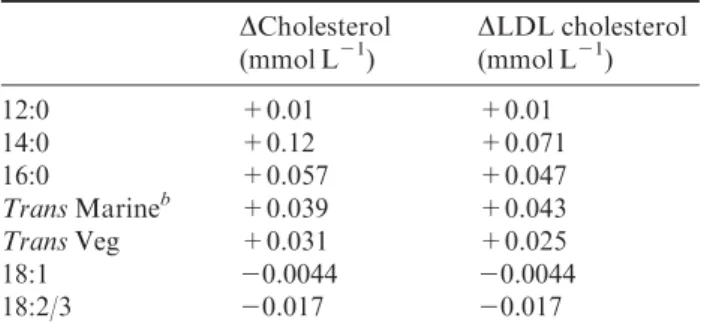
Replacement of saturated fat with monounsaturated and polyunsaturated fat (especiallyo-6 PUFA) decreases the plasma concentration of total and LDL cholesterol (Table 2). The mechanism for these effects may be increased uptake of LDL particles from the circulation by the liver.
Fatty acid AA EPA AA EPA AA EPA
Enzyme Cyclooxygenase Lipoxygenase
Cell type Eicosanoids
Platelets Endothelial cells Leucocytes TXA2 TXA3 PGI2 PGI3 LTB4 LTB5
Aggregation +++ + Antiaggregation +++ +++ Vasoconstriction +++ Vasodilatation +++ +++ Biological effect Chemotaxis +++ +
Figure 7 Biological effects of eicosanoids derived from arachidonic acid (AA; 20:4o-6) or eicosapentaenoic acid (EPA; 20:5o-3). TX, thromboxane; PG, prostaglandin, LT, leukotriene.
Table 2 Effect of fatty acids on plasma and LDL cholesterola DCholesterol (mmol L21) DLDL cholesterol (mmol L21) 12:0 +0.01 +0.01 14:0 +0.12 +0.071 16:0 +0.057 +0.047 TransMarineb +0.039 +0.043 TransVeg +0.031 +0.025 18:1 20.0044 20.0044 18:2/3 20.017 20.017 a Mulleret al.(2001). b
TransMarine,transfatty acids of marine origin;transVeg,trans fatty acids of vegetable origin.
Dietary marineo-3 fatty acids (EPA and DHA) decrease plasma triacylglycerol levels by reducing production and enhancing clearance of triacylglycerol-rich lipoproteins. In addition to effects on plasma lipids, dietary fatty acids can influence metabolic, immunological and cardiovascular events in numerous ways (Table 3). For instance, saturated fat may negatively affect several factors related to cardi-ovascular diseases and atherosclerosis, whereas very long-chaino-3 PUFAs may exert several beneficial effects on the cardiovascular system. Briefly,o-3 PUFAs decrease platelet and leucocyte reactivity, inhibit lymphocyte pro-liferation, and slightly decrease blood pressure. o-3 PUFAs may also beneficially influence vessel wall charac-teristics and blood rheology, prevent ventricular arrhyth-mias and improve insulin sensitivity.o-6 PUFAs (mainly linoleic acid, 18:2o-6) also have many beneficial effects with respect to cardiovascular diseases (Table 3).
The essentialo-3 ando-6 fatty acids are important for fetal growth and development, in particular for the central nervous system, affecting visual acuity as well as cognitive function. Lack of essential fatty acids also promotes skin inflammations and delays wound healing.
EPA and DHA have consistently been shown to inhibit proliferation of certain cancer cell linesin vitroand to
re-duce progression of these tumours in animal experiments. However, it is still unclear whether human cancer devel-opment is beneficially influenced by fatty acids.
Requirements for and Uses of Fatty
Acids in Human Nutrition
Although data on the required intake of essential fatty ac-ids are relatively few, the adequate intakes of linoleic acid (18:2o-6) anda-linolenic acid (18:3o-3) should be 2% and 1% of total energy, respectively. Present evidence suggests that 0.2–0.3% of the energy should be derived from pre-formed very long-chaino-3 PUFAs (EPA and DHA) to avoid signs or symptoms of deficiency. This corresponds to approximately 0.5 g of these o-3 fatty acids per day. It should be stressed that this is the minimum intake to avoid clinical symptoms of deficiency (Table 4). It has been sug-gested that the ratio between o-3 and o-6 fatty acids should be 1:4 as compared to 1:10 in modern dietary habits, but the experimental basis for this suggestion is rather weak.
Table 3 Influence of dietary fatty acids on metabolic, immunological and cardiovascular eventsa
Event Negative influence Positive influence
Coronary artery disease Saturates o-3 PUFA and monoenes
Stroke Saturates ?
Blood pressure Saturates o-3 PUFA
Insulin resistance/diabetes Saturates o-3 PUFA
Blood clotting and fibrinolysis ? o-3 PUFA (?) ando-6 PUFA (?)
Function of platelets ? o-3 PUFA ando-6 PUFA (?)
Hyperlipidaemia Saturates o-3 PUFA,o-6 PUFA and monoenes
Oxidation of LDL o-6 PUFA (?) Monoenes
Atherogenesis (leucocyte reactivity, immunological functions)
Saturates and monoenes (?) o-3 PUFA ando-6 PUFA
Endothelial dysfunction ? o-3 PUFA (?)
Cardiac arrhythmias Saturates o-3 PUFA ando-6 PUFA
Inflammation (rheumatoid arthritis) o-3 PUFA
a
o-3 PUFAs, very long-chaino-3 fatty acids (EPA and DHA);o-6, mainly linoleic acid (18:2,o-6); monoenes, oleic acid (cis18:1,o-9); saturated fatty acids, mainly myristic and palmitic acid (14:0 and 16:0).
Table 4 Recommended intake of essential PUFAa
Intake as % of energy Intake (mg day21)
o-3 o-6 o-3 o-6
Minimum 0.2–0.3 1–3 400–600 2400–7200
Optimum 1–2 3–5 2400–4800 7200–12 000
a
The numbers are based on data from patients with essential fatty acid deficiency and on estimation of required and optimal intake in healthy, normal individuals with energy intake of 9.2 MJ day21.
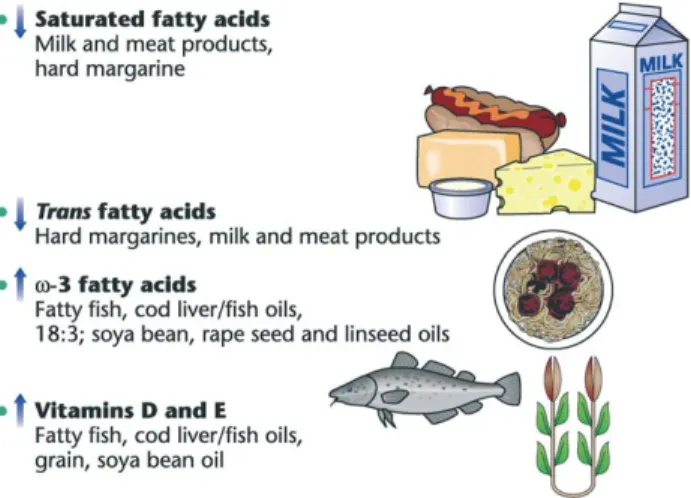
From many epidemiological and experimental studies there is relatively strong evidence that there are significant beneficial effects of additional intake of PUFA in general and very long-chaino-3 fatty acids (EPA and DHA) in particular. It is possible that the beneficial effects may be obtained at intakes as low as one or two fish meals weekly, but many of the measurable effects on risk factors are ob-served at intakes of 1–2 g day21 of very long-chaino-3 PUFA. If 1–2 g day21of EPA and DHA is consumed in combination with proper amounts of fruits and vegetables, and limited amounts of saturated and trans fatty acids, most people will benefit with better health for a longer time (Figure 8).
Uses of Fatty Acids in the
Pharmaceutical/Personal Hygiene
Industries
Fatty acids are widely used as inactive ingredients (excipi-ents) in drug preparations, and the use of lipid formula-tions as the carriers for active substances is growing rapidly. The largest amount of lipids used in pharmaceu-ticals is in the production of fat emulsions, mainly for clinical nutrition but also as drug vehicles. Another lipid formulation is the liposome, which is a lipid carrier particle for other active ingredients. In addition, there has been an increase in the use of lipids as formulation ingredients
owing to their functional effects (fatty acids have several biological effects) and their biocompatible nature. For in-stance, very long-chaino-3 PUFA may be used as a drug to reduce plasma triacylglycerol concentration and to reduce inflammation among patients with rheumatoid arthritis.
Moreover, fatty acids themselves or as part of complex lipids, are frequently used in cosmetics such as soaps, fat emulsions and liposomes.
References
Muller H, Kirkhus B and Pedersen JI (2001) Serum cholesterol predictive equations with special emphasis ontransand saturated fatty acids. An analysis from designed controlled studies.Lipids36: 783–791.
Further Reading
Das UN, Ramos EJ and Meguid MM (2003) Metabolic alterations dur-ing inflammation and its modulation by central actions of omega-3 fatty acids.Current Opinion in Clinical Nutrition and Metabolic Care6: 413–419.
Drevon CA, Nenseter MS, Brude IRet al.(1995) Omega-3 fatty acids – nutritional aspects.Canadian Journal of Cardiology11(supplement G): 47–54.
Duttaroy AK and Spener F (eds) (2003)Cellular Proteins and Their Fatty
Acids in Health and Disease. Weinheim: Wiley–VCH.
Gurr MI and Harwood JL (1991) Fatty acid structure and metabolism. In: Gurr MI and Harwood JL (eds)Lipid Biochemistry, An Introduc-tion. London: Chapman and Hall.
Harris WS, Park Y and Isley WL (2003) Cardiovascular disease and long-chain omega-3 fatty acids.Current Opinion in Lipidology14: 9– 14.
Helland I, Smith L, Saarem K, Saugstad OD and Drevon CA (2003) Maternal supplementation with very long-chainn-3 fatty acids during pregnancy and lactation augments children’s IQ at 4 years of age.
Pediatrics111: E39–E44.
Kris-Etherton PM, Harris WS and Appel LJ (2003) Nutrition Commit-tee. Fish consumption, fish oil, omega-3 fatty acids, and cardiovas-cular disease.Arteriosclerosis Thrombosis and Vascular Biology23: e20–30.
Nenseter MS and Drevon CA (1996) Dietary polyunsaturates and per-oxidation of low-density lipoproteins.Current Opinion in Lipidology7: 8–13.
Storlien L, Hulbert AJ and Else PL (1998) Polyunsaturated fatty acids, membrane function and metabolic diseases such as diabetes and
obes-ity.Current Opinion in Clinical Nutrition and Metabolic Care1: 559–
563.
Terry PD, Rohan TE and Wolk A (2003) Intakes of fish and marine fatty acids and the risks of cancers of the breast and prostate and of other hormone-related cancers: a review of the epidemiologic evidence.
American Journal of Clinical Nutrition77: 532–543.