Semiparametric efficiency
bound for models of
sequential moment
restrictions containing
unknown functions
Chunrong Ai
Xiaohong Chen
The Institute for Fiscal Studies
Department of Economics, UCL
Semiparametric E¢ ciency Bound for Models of Sequential
Moment Restrictions Containing Unknown Functions
Chunrong Ai
yXiaohong Chen
zFirst draft: September 2004, Revised version: September 2009
Abstract
This paper computes the semiparametric e¢ ciency bound for …nite dimensional parame-ters identi…ed by models of sequential moment restrictions containing unknown functions. Our results extend those of Chamberlain (1992b) and Ai and Chen (2003) for semiparametric con-ditional moment restriction models with identical information sets to the case of nested infor-mation sets, and those of Chamberlain (1992a) and Brown and Newey (1998) for models of sequential moment restrictions without unknown functions to cases with unknown functions of possibly endogenous variables. Our bound results are applicable to semiparametric panel data models and semiparametric two stage plug-in problems. As an example, we compute the e¢ ciency bound for a weighted average derivative of a nonparametric instrumental variables (IV) regression, and …nd that the simple plug-in estimator is not e¢ cient. Finally, we present
Chen is grateful to Lars Peter Hansen for numerous insightful comments about e¢ ciency of GMM and related models and methods. We are grateful to Jim Powell for his encouragement upon hearing the …rst presentation in 2005. We thank Demian Pouzo for the Monte Carlo study, and Jinyong Hahn, Alex Torgovitsky, the guest coeditor, three anonymous referees for suggestions that improve the exposition. We also thank D. Andrews, D. Bhattacharya, R. Blundell, J. Horowitz, W. Newey, E. Tamer, and participants of 2005 World Congress Econometric Society Meetings, 2007 LSE Conference in honor of Peter Robinson, 2007 CIRANO and CIREQ econometric conference on GMM in Montreal, econometric workshops at various universities for helpful comments. Ai’s research is supported by 2003 summer grant from the Warrington Business School at University of Florida and Project 211 Phase III and Shanghai Leading Academic Discipline Project (Number: B803) at Shanghai University of Finance and Economics, China. Chen’s research is supported by the National Science Foundation grants SES-0318091 and SES-0631613. All errors are the responsibility of the authors.
yDepartment of Economics, University of Florida, Gainesville, FL 32611, USA, and Shanghai University of Finance
and Economics, China. Email: [email protected]‡.edu.
zCorresponding author. Xiaohong Chen, Cowles Foundation for Research in Economics, Yale University, Box
an optimally weighted, orthogonalized, sieve minimum distance estimator that achieves the semiparametric e¢ ciency bound.
JEL Classi…cation: C14; C22
Keywords: Sequential moment models; Semiparametric e¢ ciency bounds; Optimally weighted orthogonalized sieve minimum distance; Nonparametric IV regression; Weighted average deriv-atives; Partially linear quantile IV
1
Introduction
Since the publication of Hansen’s (1982) seminal work on the Generalized Method of Moments (GMM), moment restriction models have become a popular and useful framework for analyzing eco-nomic data. See Hansen (2007) for an excellent review of the original GMM, its numerous extensions and a wide range of applications.
Motivated by an ever expanding variety of applications, one important branch of extensions fo-cuses on semiparametric e¢ ciency bounds and e¢ cient estimation of more general moment restriction models.1 In this paper, we contribute to this line of research by characterizing the semiparametric
e¢ ciency bound for …nite dimensional parameters ( o) that are identi…ed by models of sequential
moment restrictions containing unknown functions:
E[ t(Z; o; ho( ))jX(t)] = 0 for t = 1; :::; T almost surely, (1)
where Z = (Y0; X0)0 denotes a multivariate random variable with support Z and X X(T), and
t(z; ; h( )) denotes a d t 1 vector of residual functions whose functional forms are known up to
the unknown true parameter values ( o; ho), with ho( ) = (ho1( ); :::; hoq( )) as the q 1 vector of
real-valued measurable functions that may depend on endogenous variables Y and other unknown parameters. E[jX(t)]denotes the conditional expectation under the true (but unknown) conditional
distribution function FZjX(t) for t = 1; :::; T. The sigma-…eld generated by the conditioning variable 1See, for example, Hansen (1985, 1993), Hansen, Heaton and Ogaki (1988), Chamberlain (1987, 1992a, 1992b),
Newey (1993, 2004), Hahn (1997), Carrasco and Florens (2000), Ai and Chen (2003), Chernozhukov and Hong (2003), Donald, Imbens and Newey (2003), Kitamura, Tripathi and Ahn (2004), Newey and Smith (2004), Antoine, Bonnal and Renault (2007),to name only a few.
X(t), X(t) , satis…es a nesting structure2
f1g X(1) X(2) X(T) .
When X(1) is the constant 1, the conditional expectation E[ 1(Z; ; h( ))jX(1)] is simply the uncon-ditional expectation E[ 1(Z; ; h( ))]. Thus model (1) includes unconditional moment restrictions as a special case.
Model (1) includes many existing econometric models. First, it includes semiparametric and nonparametric panel data models where the information set expands over time. Second, it nests widely used semiparametric models that are estimated via two-stage plug-in procedures. For example, with T = 2; = ( 01; 02)0, X(1) = 1 and X =X(2), model (1) becomes the following semiparametric “plug-in” problem:
E[ 1(Z; o1; o2; ho( ))] = 0with dim( 1) = dim( 1); (2)
E[ 2(Z; o2; ho( ))jX(2)] = 0; (3)
where the unknown parameter o2 and the unknown function ho( ) can be estimated using the
con-ditional moment restriction (3), and can then be plugged into the unconcon-ditional moment restriction (2) to compute the parameter o1. An example of the plug-in problem is the estimation of a weighted
average derivative of a possibly nonlinear nonparametric instrumental variables (IV) model:
o =E[W(Y2)rho(Y2)]; E[ 2(Z;ho(Y2))jX(2)] = 0;
where W()is a known positive weight function andrho()denotes the …rst derivative ofho. Leading
examples of the functional forms of 2(Z;h(Y2))include 2(Z;h(Y2)) =Y1 h(Y2) for nonparametric
mean IV regression and 2(Z;h(Y2)) = 1fY1 h(Y2)g 0:5 for nonparametric median IV
regres-sion. Note that our model (1) allows for more general plug-in problems where the unconditional moment restrictionE[ 1(Z; o1; o2; ho( ))] = 0is overidenti…ed for o1 (ordim( 1)>dim( 1)). Many
semiparametric program evaluation models, semiparametric missing data models, choice-based sam-pling problems, some recent nonclassical measurement error models and some semiparametric control function models could also …t into framework (1).
2This sequential restriction on the sigma-…elds allows us to gather all moment restrictions using the same set of
WhenT = 1 and X(1) =X, model (1) becomes the semiparametric conditional moment
restric-tion model with the same condirestric-tioning informarestric-tion set: E[ (Z; o; ho( ))jX] = 0.3 For this model,
Chamberlain (1992b), Ai and Chen (2003) and Chen and Pouzo (2009) characterized the semipara-metric e¢ ciency bound of o; and Ai and Chen (2003), Otsu (2008) and Chen and Pouzo (2009)
considered e¢ cient estimation of o. However, these e¢ ciency bound and e¢ cient estimation results
do not cover semiparametric models with sequential information sets like (1).
Without unknown functions ho( ), model (1) becomes the one studied by Chamberlain (1992a),
Hahn (1997) and Brown and Newey (1998). In particular, under the assumption that o is identi…ed
by the model E[ t(Z; o)jX(t)] = 0, t = 1; :::; T; where f1g X(1) X(T) ,
Chamberlain (1992a) established the semiparametric e¢ ciency bound and Hahn (1997) obtained an e¢ cient estimator of o. Brown and Newey (1998) studied the semiparametric e¢ ciency bound and
suggested some e¢ cient estimators of parameters that are de…ned as unconditional expectations; one of their models is o1 =E[g(Z; o2)]; E[ 2(Z; o2)jX(2)] = 0 with known functional forms of g and 2.
In this paper we extend their results to the general model (1) that contains unknown functions ho( )
which may depend on endogenous variables.
Ai and Chen (2007) studied consistent estimation of ( o; ho) identi…ed by the general model (1)
with T 2, and established the root-n asymptotic normality of their estimator of o. But, to the
best of our knowledge, there is no published work on the semiparametric e¢ ciency bound or e¢ cient estimation of o for model (1), not even for the important special case of the semiparametric
plug-in problem (2)-(3) when ho( )is an unknown function of endogenous variables. There are e¢ ciency
results for various special cases of the model (1) when the unknown functionho( )does not depend on
endogenous variables. For example, Newey and Stoker (1993) computed the semiparametric e¢ ciency bound and presented an e¢ cient estimator for the weighted average derivative when the unknown
ho( ) is a measurable function of conditioning variables (say X(2) in terms of our notation) only.
Our plug-in problem (2)-(3) extends their setup to allow for ho( ) to be a function of endogenous
variables. Since many economic structural models satisfy the sequential moment restrictions (1) with
ho( ) being an unknown function ofY, our extension is a useful one.
A key step in our calculation of the semiparametric e¢ ciency bound for the general model (1) is to sequentially orthogonalize the residual functions t(Z; o; ho( )) for t= 1; :::; T. The semiparametric
e¢ ciency bound is then obtained by optimally weighting the orthogonalized residual functions. When
3See Newey and Powell (2003), Chernozhukov, Imbens and Newey (2007), and Chen and Pouzo (2008a) for
specialized to the models considered by Chamberlain (1987, 1992a, b), Brown and Newey (1998), Ai and Chen (2003) and Chen and Pouzo (2009), our semiparametric e¢ ciency bound coincides with the bounds derived by these authors for their respective models. Although the e¢ ciency bounds do not have explicit closed form expressions for general conditional moment models involving several unknown functions with di¤erent arguments, these bounds can be computed analytically for many speci…c sequential moment models containing only one unknown function. Our characterization of the e¢ ciency bound is useful in evaluating and comparing di¤erent estimators for the general model (1). It also sheds lights on how to construct new estimators that attain the e¢ ciency bound for o.
Speci…cally, it clearly suggests that any e¢ cient estimation procedure has to account for both the correlation between the residual functions t(Z; o; ho( )) as well as their conditional
heteroskedas-ticity. For model (1) with nonsingular e¢ ciency bound for o, we provide an optimally weighted,
orthogonalized, sieve minimum distance (SMD) estimator that is root-n asymptotically e¢ cient for
o.
When applied to the semiparametric plug-in problem (2)-(3), our e¢ ciency bound result reveals that one just needs to use the conditional moment model E[ 2(Z; o2; ho( ))jX(2)] = 0 alone to
construct an e¢ cient estimator of o2. However, any e¢ cient estimator of o1 has to account for the
correlation between the two residuals 1(Z; o1; o2; ho( )) and 2(Z; o2; ho( )) conditional on X(2).
In particular, whenever E[ 1(Z; o1; o2; ho( )) 2(Z; o2; ho( ))jX(2)]6= 0, any simple plug-in estimator b1, de…ned as a solution to 1n
n P
i=1 1
(Zi;b1;b2;bh( )) = 0, is not e¢ cient for o1, regardless of how one
computes the …rst stage estimator(b2;bh( )). For example, to estimate the weighted average derivative
o1 =E[W(Y2)rho(Y2)]of a NPIV regressionE[Y1 ho(Y2)jX(2)] = 0, Ai and Chen (2007) presented
a simple plug-in estimatorb1 = 1n
n P i=1
W(Y2i)rbh(Y2i)wherebh( )is a SMD estimator ofho, and derived
the root-n asymptotic normality of this estimatorb1. To compute a simple plug-in estimator of o1,
instead of using their SMD estimator of ho, one could use other existing NPIV estimators, such as
the estimators of Hall and Horowitz (2005), Darolles, Florens and Renault (2002), Blundell, Chen and Kristensen (2007). Unfortunately, since E[W(Y2)rho(Y2)fY1 ho(Y2)gjX(2)]6= 0, none of these
simple plug-in estimators attain the semiparametric e¢ ciency bound for o1.
The rest of the paper is organized as follows: Section 2 …rst computes the semiparametric e¢ ciency bound for o in the general model (1), and then applies the bound result to the plug-in problem
(2)-(3). Section 3 applies the e¢ ciency bound result to several non-trivial examples, including estimating the weighted average derivative of ho(Y2) in the NPIV regression E[Y1 ho(Y2)jX(2)] = 0 or in the
…rst discusses semiparametric e¢ cient estimation of o for the general model (1) and then presents a
small Monte Carlo study to compare the ine¢ cient simple plug-in estimator versus several e¢ cient estimators of the average derivative of a NPIV regression. Section 5 concludes with suggestions of other e¢ cient estimation procedures. All proofs are contained in the appendix.
2
Semiparametric E¢ ciency Bound
We begin by computing the semiparametric e¢ ciency bound of o. Our calculation of the bound
closely follows the approach of Stein (1956), Newey (1990), Chamberlain (1992a, b) and others (see the appendix for details). We …rst sequentially orthogonalize the original sets of residual functions
t(Z; o; ho( )) for t= 1; :::; T. This procedure is called forward …ltering by Hayashi and Sims (1983)
in their study of linear time series rational expectation models, and has been used in Hansen, Heaton and Ogaki (1988), Chamberlain (1992a) and others in time series and panel data models without an unknown functionho( ). In the following we denote Rd as an open, …nite-dimensional parameter
space with o2 . Let(H;jj jjH)denote an in…nite-dimensional metric space withH=H1 Hq
and ho = (ho1; :::; hoq)2 H, where ho1,..., hoq are real-valued measurable functions. Let A = H
and o = ( 0o; ho)2 A. For any = ( 0; h)2 A, we de…ne
"T(Z; ) T(Z; ); "s(Z; ) s(Z; ) T X t=s+1 s;t(X(t))"t(Z; ) for s=T 1; :::;1; where s;t(X(t)) E[ s(Z; o)"t(Z; o)0jX(t)]f ot(X(t))g 1 for s < t and ot(X(t)) E["t(Z; o)"t(Z; o)0jX(t)]:
For any = ( 0; h)2 A, we denote
ms(X(s); ) Ef"s(Z; )jX(s)g for s= 1; :::; T:
We note that by construction
and
E["s(Z; o)"t(Z; o)0jX(t)] = 0 for any s < t:
This implies that
Ef"s(Z; o)"t(Z; o)v(X(s))q(X(t))g= 0 for any s6=t and any measurable functions v and q.
Also, "s(Z; ) = s(Z; ) (or s;t(X(t)) = 0 for all s < t) if s(Z; o) is measurable with respect to
the sigma …eld generated by X(s+1). Throughout the paper we assume the following conditions hold:
Assumption 1: (i) The datafZi = (Yi0; Xi0)0gni=1 is a random sample from an unknown distribution
of Z onZ; (ii) o = ( 0o; ho)2 A satis…es model (1).
Let f ( ) = ( ( ); h( )) : 0 1g A be an arbitrarily smooth path in satisfying (0) = o,
(1) = , dd( )j =0 = o, and dhd( )j =0 =h ho h. Assumption 2: For t= 1; :::; T, dmt(X(t); ( ))
d j =0 is well-de…ned and has …nite second moment.
Fort = 1; :::; T denote dmt(X(t); o) d [ o] = dEf"t(Z; ( ))jX(t)g d j =0 = dmt(X(t); o) d 0 ( o) + dmt(X(t); o) dh [h ho] where dmt(X(t); o) d = dEf"t(Z; ; ho)jX(t)g d j = o, dmt(X(t); o) dh [h ho] = dEf"t(Z; o; h( ))jX(t)g d j =0:
Assumption 3: For all t = 1; :::; T, (i) ot(X(t)) is non-singular with probability one and (ii)
E h dmt(X(t); o) d0 i0 ot(X(t)) 1 h dmt(X(t); o) d 0 i <1. For any h2 H, de…ne a pseudo-metric jjh hojj as
jjh hojj2 T X t=1 E fdmt(X (t); o) dh [h ho]g 0 ot(X(t)) 1f dmt(X(t); o) dh [h ho]g : (4)
x. For each component j (of ), j = 1; :::; d , let roj 2 W denote one solution to inf rj2W T X t=1 E ( f ot(X(t))g 1 2 dmt(X (t); o) d j dmt(X(t); o) dh [r j] 2 e ) ; (5)
which solves: for all rj 2 W,
T X t=1 E ( dmt(X(t); o) d j dmt(X(t); o) dh [r j o] 0 ot(X(t)) 1 dmt(X(t); o) dh [r j] ) = 0 (6) Let ro (r1o; :::; rdo ) 2 Qd j=1W, and dmt(X(t); o) dh [ro] ( dmt(X(t); o) dh [r 1 o]; :::; dmt(X(t); o) dh [r d o ]) be a d t
d matrix valued measurable function ofX(t). Denote
Jo T X t=1 E ( f ot(X(t))g 1 2 dmt(X (t); o) d 0 dmt(X(t); o) dh [ro] 2 e ) :
Without further assumptions, the minimization problem (5) (or its normal equation (6)) may have several solutions in W. Nevertheless, the minimized criterion value is unique. Therefore Jo is
always well-de…ned and unique. As shown in the appendix, Jo is actually the semiparametric Fisher
information bound for o.
Theorem 2.1 Let Assumptions 1-3 and Assumption A in the appendix hold. (1) If Jo is singular,
then o can not be estimated at pn rate. (2) If Jo is non-singular, then the semiparametric e¢ cient
variance bound for o in model (1) is = (Jo) 1.
It is worth noting that Theorem 2.1 remains valid even if t(Z; ) is not pathwise di¤erentiable
but mt(X(t); ) is pathwise di¤erentiable in o. Thus our e¢ ciency bound result applies to some
nonsmooth problems such as a semi/nonparametric quantile regression with or without endogeneity.
Remark 2.1. (1). When specializing Theorem 2.1 to the case without unknown ho()in model (1):
E[ t(Z; o)jX(t)] = 0 for t= 1; :::; T,
the semiparametric e¢ cient variance bound for o becomes = (Jo) 1, where
Jo = T X t=1 E ( dmt(X(t); o) d 0 0 ot(X(t)) 1 dmt(X(t); o) d 0 ) ;
which is the bound obtained in Chamberlain (1992a). If we further restrict the result to the original conditional moment restriction model: E[ 1(Z; o)jX] = 0 (i.e., the case of T = 1 and X(T) = X),
the semiparametric e¢ cient variance bound for o becomes
E dm1(X; o) d 0 0 o1(X) 1 dm1(X; o) d 0 1 with m1(X; ) = Ef 1(Z; )jXg;
which is the bound derived in Chamberlain (1987). For the unconditional moment restriction model (i.e., T = 1 and X1 = 1): E[ 1(Z; o)] = 0, the semiparametric e¢ cient variance bound for o
becomes E dm1( o) d 0 0 1 o1 dm1( o) d 0 1 with m1( ) =Ef 1(Z; )g,
which is the bound obtained in Hansen (1982) (specialized to i.i.d. data).
(2). When specializing Theorem 2.1 to the case of T = 1 and X(T) =X in model (1): E[ 1(Z; o; ho())jX] = 0;
the semiparametric e¢ cient variance bound for o becomes = (Jo) 1, where
Jo =E dm1(X; o) d 0 dm1(X; o) dh [ro] 0 o1(X) 1 dm1(X; o) d 0 dm1(X; o) dh [ro]
with m1(X; ) =E[ 1(Z; ; h())jX] and o1(X) = V arf 1(Z; o; ho())jXg. This recovers the
semi-parametric e¢ ciency bound obtained by Chamberlain (1992b) and Ai and Chen (2003) for pathwise di¤erentiable 1(Z; ; h()) in o, and by Chen and Pouzo (2009) for possible non-pathwise
di¤eren-tiable 1(Z; ; h()) in o.
2.1
Plug-in problem
We now apply Theorem 2.1 to the plug-in problem. We shall replace Assumption 1 by
Assumption 1s: (i) Assumption 1(i) holds; (ii) o = ( 0o; ho( ))satis…es model (2)-(3) and
dEf 1(Z; o)g
d1
has full rank d 1 dim( 1).
We …rst present the semiparametric e¢ ciency bound of o2 for model (2)-(3). Recall that for this
compo-nent j2 (of 2), j = 1; :::; d 2, let w
j
o2 2 W denote one solution to inf wj2W E ( f o2(X(2))g 1 2 dm2(X (2); o) d j2 dm2(X(2); o) dh [w j] 2 e ) ; (7)
which solves for all wj 2 W:
E ( dm2(X(2); o) d j2 dm2(X(2); o) dh [w j o2] 0 o2(X(2)) 1 dm2(X(2); o) dh [w j] ) = 0: Let wo2 (w1o2; :::; w d2 o2 )2 Qd 2 j=1W, and dm2(X(2); o) dh [wo2] ( dm2(X(2); o) dh [w 1 o2]; :::; dm2(X(2); o) dh [w d2 o2 ]) be
a d 2 d 2 matrix valued measurable function of X(2). Denote
Jo 2 E ( f o2(X(2))g 1 2 dm2(X (2); o) d 02 dm2(X(2); o) dh [wo2] 2 e ) :
As shown in the appendix, Jo 2 is the semiparametric Fisher information bound for o2 in model
(2)-(3).
Theorem 2.2 Let Assumptions 1s, 2, 3 and assumption A in the appendix hold. (1) If Jo 2 is
singu-lar, then o2 can not be estimated at pn rate. (2) If Jo 2 is non-singular, then the semiparametric
e¢ cient variance bound for o2 in model (2)-(3) is 2 = (Jo 2) 1.
The next result provides the e¢ ciency bound of o1. Recall that for model (2)-(3), "1(Z; ) = 1(Z; ) 1;2(X(2)) 2(Z; ) where 1;2(X(2)) = E[ 1(Z; o) 2(Z; o)0jX(2)]f o2(X(2))g 1. When X(1) = 1we denotem 1( ) =E["1(Z; )],dmd1( o) = dEf"1(dZ; ;ho)gj = o, dm1( o) dh [h ho] = dEf"1(Z; o;h( ))g d j =0
and o1 = E["1(Z; o)"1(Z; o)0]. For each component k1 (of 1), k = 1; :::; d 1, let r
k o1 2 W denote one solution to inf rk2W E ( f o1g 1 2 dm1( o) d k1 dm1( o) dh [r k] 2 e + f o2(X(2))g 1 2dm2(X (2); o) dh [r k] 2 e ) : (8) Let ro 1 (r 1 o1; :::; r d 1 o1 ) 2 Qd1 k=1W, and dm1( o) dh [ro 1] ( dm1( o) dh [r 1 o1]; :::; dm1( o) dh [r d1 o1 ]) be a d 1
d 1 matrix of constants. Denote E[S 1S 0 1] E ( f o1g 1 2 dm1( o) d 01 dm1( o) dh [ro 1] 2 e + f o2(X(2))g 1 2dm2(X (2); o) dh [ro 1] 2 e ) : Similarly we de…ne Jo 1 inf (b;w)2Qd1 j=1(R d 2 W) E 8 > < > : f o1g 1 2 h dm1( o) d 01 dm1( o) d02 b dm1( o) dh [w] i 2 e + f o2(X(2))g 1 2 h dm2(X(2); o) d02 b+ dm2(X(2); o) dh [w] i 2 e 9 > = > ;:
Theorem 2.3 Let Assumptions 1s, 2, 3 and Assumption A in the appendix hold. (1) If Jo 1 is
singular, then o1 can not be estimated at pn rate. (2) If Jo 1 is non-singular, then the
semipara-metric e¢ cient variance bound for o1 in model (2)-(3) is 1 = (Jo 1)
1. (3) If both J
o 1 and Jo 2
are non-singular, then another expression for the semiparametric e¢ cient variance bound for o1 in
model (2)-(3) is 1 = E[S 1S 0 1] 1 +a 2a 0, with a = dm1( o) d 01 1 dm1( o) d 02 dm1( o) dh [wo2] (9) where wo2 (w1o2; :::; w d2 o2 )2 Qd2 j=1W solves (7).
Remark 2.2: When applying Theorems 2.2 and 2.3 to the special case
o1 =E[g(Z; o2)]; E[ 2(Z; o2)jX(2)] = 0;
where the functional forms of g() and 2() are known up to an unknown o2, we obtain
2 = E ( dE[ 2(Z; o2)jX(2)] d 02 0 o2(X(2)) 1 dE[ 2(Z; o2)jX(2)] d 02 )! 1 ; and "1(Z; ) =g(Z; 2) E[g(Z; o2) 2(Z; o2)0jX(2)]f o2(X(2))g 1 2(Z; 2) 1; 1 =E["1(Z; o)"1(Z; o) 0] +dEf"1(Z; o)g d 02 2 dEf"1(Z; o)g0 d 2 :
in Brown and Newey (1998).
3
Examples
For the general model (1) involving several unknown functions hoj( ); j = 1; :::; q with di¤erent
arguments, our e¢ ciency bound is characterized in a variational form,4 however it can be solved explicitly for many examples of model (1) involving only one unknown function (q = 1). In this section we present several such examples.
Example 3.1: Weighted average derivatives in a partially linear IV regression:
o1 =E[W(X1)frsho(X1)g]; E[Y1 Y20 o2 ho(X1)jX(2)] = 0; X1 X(2);
where X(1) = 1, W(X
1) is a known scalar positive weight function, and Y1 is a scalar. For this
example, we have"2(Z; ) = 2(Z; ) =Y1 Y2 20 h(X1), o2(X(2)) =E[fY1 Y20 o2 ho(X1)g2jX(2)], m2(X(2); ) = E[Y1 Y2 20 jX(2)] h(X1), dm2(X (2); o) d02 = E[Y 0 2jX(2)] and dm2(X(2); o) dh [r] = r(X1). Denote wo2(X1) = E[ o2(X(2)) 1jX1] 1 E f o2(X(2)) 1E[Y20jX(2)]gjX1 :
We impose the following condition:
Condition 3.1: (i) 0< o2(X(2)) =E[fY1 Y20 o2 ho(X1)g2jX(2)]<1, 0< E[ o2(X(2)) 1jX1]< 1; (ii)E E[Y2jX(2)]f o2(X(2))g 1E[Y20jX(2)] <1,E wo2(X1)0f o2(X(2))g 1wo2(X1) <1; (iii) E[Y2jX(2)]is not a measurable function of X1.
Under Condition 3.1(i)(ii)(iii), the semiparametric Fisher information bound for o2, as given by Jo 2 = inf w E n E[Y20jX(2)] +w(X1) 0 f o2(X(2))g 1 E[Y20jX (2) ] +w(X1) o ;
is nonsingular, and has a unique minimizerwo2(X1). Applying Theorem 2.2, we immediately obtain:
Proposition 3.1 (1) Under Condition 3.1(i)(ii)(iii), Jo 2 is non-singular, and the semiparametric
4This is not a defect associated with our method of deriving e¢ ciency bounds, but is due to the complexity of
the model involving multiple unknown functions of di¤erent (and possibly endogenous) arguments. Even for the special case of the conditional moment model of common conditioning set: E[ (Z; o; ho1(X1); :::; hoq(Xq))jX] = 0
with pointwise smooth ()and fX1; :::; Xqg fXg, Chamberlain (1992b) points out that, when q >1, the bound in
e¢ cient variance bound for o2 of Example 3.1 model is: 2 = (Jo 2) 1 = E f o2(X(2))g 1 2 h E[Y20jX(2)] E[ o2(X(2)) 1jX1] 1 E f o2(X(2)) 1E[Y20jX (2)] gjX1 i 2 e 1 :
Next since 1(Z; ) = W(X1)rsh(X1) 1 andX1 X(2), we haveEf 1(Z; o) 2(Z; o)jX(2)g=
0. Thus 1;2(X(2)) = 0, "1(Z; ) = 1(Z; ), o1 = V arfW(X1)rsho(X1) o1g, m1( ) = E[W(X1)rsh(X1) 1], dmd1(0 o) 1 = I 1, dm1( o) d 02 = 0 and dm1( o) dh [wo2] =E[W(X1)r s wo2(X1)]. Hence a =E[W(X1)rswo2(X1)].
Suppose that X1 has a probability density f1(X1) such that W(x1)f1(x1) goes to zero smoothly
at the boundary of the support of X1. Denote ls(X1) r
s[W(X
1)f1(X1)]
f1(X1) . We impose the following
condition:
Condition 3.1: (iv)[W(x1)f1(x1)]iss times continuously di¤erentiable and is zero on the boundary
of the support ofX1; (v) o1 =V ar(fW(X1)rsho(X1) o1g)andE[ls(X1)ls(X1)0(E[ o2(X(2)) 1jX1]) 1]
are …nite, positive de…nite; (vi) E[W(X1)rswo2(X1)] = ( 1)sEfls(X1)wo2(X1)g exists.
We next compute one solutionro 1 (r 1 o1; :::; r d1 o1 ) to E[S 1S 10] = inf r [I 1 +EfW(X1)r sr(X 1)g]0 o11[I 1 +EfW(X1)r sr(X 1)g] +E r(X1)0 o2(X(2)) 1r(X1) = [I 1 +EfW(X1)rsro 1(X1)g] 0 1 o1:
Applying integration-by-parts, EfW(X1)rsr(X1)g= ( 1)sEfls(X1)r(X1)g. Then by calculus
vari-ation, any solution ro 1 should satisfy [I 1 + ( 1)sEfls(X1)ro 1(X1)g] 0 1 o1Ef( 1) sl s(X1)r(X1)g= E[ro 1(X1) 0 o2(X(2)) 1r(X1)]
for all square measurable functions r(X1) such that all the expectations in the above equation are
de…ned. This implies that ro 1(X1) solves [I 1 + ( 1)sEfls(X1)ro 1(X1)g] 0 1 o1( 1) sl s(X1) +ro 1(X1) 0E[ o2(X(2)) 1jX1] = 0; and thus fE[S 1S 10]g 1 = o1+E[ls(X1)ls(X1)0(E[ o2(X(2)) 1jX1]) 1]:
Applying Theorem 2.3, we immediately obtain:
Proposition 3.1 (2) Under Condition 3.1(i)(ii)(iii)(iv)(v), Jo 1 is non-singular, and the
semipara-metric e¢ cient variance bound for o1 of Example 3.1 model is:
1 =fE[S 1S
0
1]g
1+E[W(X
1)rswo2(X1)] 2E[W(X1)rswo2(X1)]0:
Remark 3.1: When we specialize Example 3.1 to the case
o1 =E[W(X1)rsho(X1)]; E[Y1 ho(X1)jX1] = 0;
we have X(2) =X1, and the semiparametric e¢ cient variance bound of o1 becomes
1 =fE[S 1S
0
1]g 1 =
o1+E[ls(X1)ls(X1)0 o2(X1)];
which coincides with the e¢ cient variance bound of the weighted average …rst-derivative (s = 1) parameter in Newey and Stoker (1993, p.1205, equation (3.8)).
Example 3.2: Weighted average derivatives in a partially linear quantile IV regression:
o1 =E[W(X1)frsho(X1)g]; E[1fY1 Y20 o2+ho(X1)gjX(2)] = 2(0;1); X1 X(2):
For this example, we have "2(Z; ) = 2(Z; ) = 1fY1 Y2 20 +h(X1)g , o2(X(2)) = (1 )
and m2(X(2); ) =E[FY1jY2;X(2)(Y 0 2 2+h(X1))jX(2)]. DenoteU =Y1 Y20 o2 ho(X1)and wo2(X1) = EfE[fUjY2;X(2)(0)Y0 2jX(2)]E[fUjY2;X(2)(0)jX (2)] jX1g Ef(E[fUjY2;X(2)(0)jX(2)])2jX1g :
We impose the following condition:
Condition 3.2: (i) E E[fUjY 2;X(2)(0)Y2jX (2)]E[f UjY2;X(2)(0)Y 0 2jX(2)] <1, Efwo2(X1)0wo2(X1)g < 1; (ii) if E[fUjY2;X(2)(0)[Y20 wo2(X1)]jX(2)] a= 0 a.s. then a= 0:
Then Jo 2 = inf w E E[fUjY2;X(2)(0)[Y 0 2 w(X1)]jX(2)]0E[fUjY2;X(2)(0)[Y 0 2 w(X1)]jX(2)] [ (1 )] 1;
that the e¢ cient variance bound for o2 is 2 = (Jo 2) 1
.
Condition 3.2: (iii)[W(x1)f1(x1)] iss times continuously di¤erentiable and is zero on the
bound-ary of the support of X1; (iv) E[W(X1)rswo2(X1)] = ( 1)sEfls(X1)wo2(X1)g exists; (v) o1 = V ar(fW(X1)rsho(X1) o1g)andE[ls(X1)ls(X1)0(E[fE[fUjY2;X(2)(0)jX
(2)]
g2jX1]) 1]are …nite,
pos-itive de…nite. Under Condition 3.2, E[S 1S 10] = inf r [I 1 +EfW(X1)rsr(X1)g]0 o11[I 1 +EfW(X1)r sr(X 1)g] +[ (1 )] 1E r(X 1)0fE[fUjY2;X(2)(0)jX (2)] g2r(X 1) ! = [I 1 +EfW(X1)r sr o 1(X1)g] 0 1 o1:
is nonsingular, and has a unique minimizer ro 1(X1). Applying Theorem 2.3, the e¢ cient variance
bound for o1 is 1 =fE[S 1S 0 1]g 1+E[W(X 1)rswo2(X1)] 2E[W(X1)r sw o2(X1)]0; where now fE[S 1S 10]g 1 = o1+ (1 )E[ls(X1)ls(X1)0(E[fE[fUjY2;X(2)(0)jX (2)] g2jX1]) 1]:
Example 3.3: Weighted average derivatives of a nonparametric IV regression
o =EfW(Y2)rsho(Y2)g; EfY1 ho(Y2)jXg= 0;
where Y1,Y2 andX are scalars,X(1) = 1,X(2) =X, andW(Y2) is a known positive weight function.
For this example, we have "2(Z; ) = 2(Z; ) = Y1 h(Y2) and m2(X(2); ) = E[Y1 h(Y2)jX].
Also, 1(Z; ) = W(Y2)rsh(Y2) , 1;2(X) = E[W(Y2)rsho(Y2)fY1 ho(Y2)gjX]f o2(X)g 1 and m1( ) =E[fW(Y2)rsh(Y2) g 1;2(X)fY1 h(Y2)g].
Letf(X; Y2)denote the joint density of(X; Y2), andf2(Y2)denote the marginal density ofY2. Let K be the conditional expectation operator of Y2 givenX (i.e.,Kh E[h(Y2)jX] for any measurable
functionh withEf[h(Y2)]2g<1), and K be the adjoint ofK (i.e.,K g E[g(X)jY2]for any
mea-surable function g with Ef[g(X)]2g<1). DenotekhkY
2 p Efh(Y2)g2 and ls(Y2) r s[W(Y 2)f2(Y2)] f2(Y2) .
We impose the following condition:
Condition 3.3: (i)[W(Y2)f2(Y2)]iss times continuously di¤erentiable and is zero on the boundary
of the support of Y2; (ii)Kh E[h(Y2)jX] = 0 impliesh 0;
(iii) 0 < o1 = V ar(fW(Y2)rsho(Y2) og 1;2(X)fY1 ho(Y2)g) < 1; (iv) 0 < o2(X) = Ef[Y1 ho(Y2)]2jXg<1; (v)E f[K o21K] 1=2[( 1)sls+K 1;2](Y2)g2 <1. Then: Jo = inf r2W E ( [1 +EfW(Y2)rsr(Y2) + 1;2(X)r(Y2)g] 2 f o1g 1 +ffE[r(Y2)jX]g2 o21(X)g ) = [1 +Ef[( 1)sls+ 1;2(X)]ro(Y2)g]f o1g 1;
Condition 3.3(iv)(v) can be replaced by the following su¢ cient assumptions:
Condition 3.3s: (i)K is compact with a singular-value systemf j; qj(Y2); pj(X)g1j=1 (i.e.,1 = 1
j j+1 &0, K Kqj = 2jqj and KK pj = 2jpj for allj 1); (ii) o2(X) = o2 a positive …nite
constant; (iii) Ef[ 1;2(X)]2g<1, 1 X j=1 Efls(Y2)qj(Y2)g j 2 <1.
Applying Theorem 2.1 (the veri…cation is very similar to that of example 2.2 in Ai and Chen (2007); hence we omit it), we obtain:
Proposition 3.3Under Condition 3.3, the semiparametric e¢ cient variance bound for oof Example
3.3 model is: = (Jo) 1, with
Jo= f o1g 1 1 + [K o21K] 1=2f[( 1)sl s+K 1;2]g 2 Y2 1 o1 >0:
Under Condition 3.3(i)(ii)(iii) and condition 3.3s, we have:
= o1+ o2 1 X j=1 ( 1)sEfls(Y2)qj(Y2)g j +Ef 1;2(X)pj(X)g 2 <1:
Remark 3.2: Notice that under condition 3.3(v), solutions ro(Y2) are not unique, but the Fisher
information bound Jo is unique and non-singular. If we strengthen condition 3.3(v) to condition
3.3(v)’:
then we obtain a unique solution ro(Y2): ro(Y2) = [K o21K] 1[( 1)sl s+K 1;2](Y2) o11 1 + [K o21K] 1=2f[( 1)sl s+K 1;2]g 2 Y2 1 o1 :
Remark 3.3: Condition 3.3(v) or Condition 3.3s(iii) imposes smoothness restrictions on ls(Y2)
relative to the smoothness of the operator K K. If Condition 3.3(v) is not satis…ed, or under conditional homoskedastic error (i.e., Condition 3.3s(ii)), if Condition 3.3s(iii) is not satis…ed, then
Vo will be singular, and o can not be estimated at the pn rate. Ai and Chen (2007) discuss
Condition 3.3s(iii), and point out that Condition 3.3s(iii) can still be satis…ed even when the singular values j of the conditional expectation operator K decay to zero exponentially fast. For example, consider the special case of o =E[rho(Y2)] and assume that the conditional density of Y2 given X
is normal. For this case ls(Y2) = rflogf2(Y2)g and j exp( j), Condition 3.3s(iii) is satis…ed.
Remark 3.4: When we specialize this example 3.3 to the case of no endogeneity (i.e.,Y2 =X):
o =E[W(Y2)rsho(Y2)]; E[Y1 ho(Y2)jY2] = 0;
we have 1;2(X) = 0 and K =K = identity, and the semiparametrically e¢ cient variance bound
of o becomes
=V ar(fW(X)rsho(X) og) +E[ls(X)ls(X)0 o2(X)]:
4
Optimally Weighted Orthogonalized SMD Estimation
Our e¢ ciency bound characterization for model (1) suggests that any e¢ cient estimator has to account for both the correlation between the residual functions t(Z; o; ho( )) as well as their
condi-tional heteroskedasticity. In this section we propose an optimally weighted SMD procedure that is based on orthogonalized moment conditions. This procedure automatically leads to semiparametric e¢ ciency regardless of whether or not the e¢ ciency bound can be solved for analytically. We discuss alternative e¢ cient procedures in the concluding section.
Let = ( 0; h)2 A= H. Recall that o = ( 0o; ho)2 A is the unique solution to
inf 2 H T X t=1 E mt(X(t); )0 ot(X(t)) 1mt(X(t); ) ; (10)
where mt(X(t); ) Ef"t(Z; )jX(t)g, ot(X(t)) E["t(Z; o)"t(Z; o)0jX(t)], and "t(Z; ), t =
1; :::; T are the sequentially orthogonalized residual functions that were introduced in section 2. Then, the optimally weighted orthogonalized SMD estimator en = (e
0
n;ehn) 2 Hk(n) is the solution to
the following minimization problem:
(e0n;ehn) = arg min 2 Hk(n) T X t=1 1 n n X i=1 b mt(X (t) i ; )0fbot(X (t) i )g 1 b mt(X (t) i ; ); (11)
where fHk(n) :k(n) = 1;2; :::g is a sequence of approximation spaces (sieves) whose union becomes
dense in the in…nite dimensional parameter space H as k(n) ! 1, and mbt(X(t); ), bot(X(t)) are
consistent nonparametric estimators of mt(X(t); ), ot(X(t)) respectively. Note that the sample
criterion function (11) corrects both the unknown correlation among the original sets of residual functions t(Z; ; h( )) fort = 1; :::; T, and the unknown heteroskedasticity.
In most applications, the sieve spacesHk(n)are compact sets of series approximations truncated to
a …nite number of terms. Familiar series approximations include splines, power series, Fourier series, Hermite polynomials, wavelets; see, e.g., Chen (2007) for a review. The orthogonalized conditional means mt(X(t); ) and the conditional variances ot(X(t)) can be consistently estimated by many
nonparametric regression methods such as kernel, local linear regression and series least squares (LS) regression. See, e.g., Andrews (1991), Newey (1997), Ai and Chen (2003) and Chen and Pouzo (2008b) for series LS regression estimators of mbt(X(t); ) and bot(X(t)).
Suppose that the semiparametric e¢ ciency bound for o is nonsingular. Then, by proofs very
similar to those in Ai and Chen (2003) for smooth t() and those in Chen and Pouzo (2009) for
nonsmooth t(), we can establish that pn(en o) ) N(0; ), where is the e¢ cient variance
bound derived in Theorem 2.1. If the semiparametric e¢ ciency bound for o is singular, then en
converges to o at a slower than root-n rate. See Chen and Pouzo (2008b) for details.
4.1
E¢ cient estimation for the Plug-in problem
For the semiparametric plug-in problem (2)-(3), the optimally weighted orthogonalized SMD estima-tor (e0n;ehn) given in (11) becomes the solution to:
min 2 Hk(n) 8 < : b 1 2 o1 1 n n X i=1 b"1(Zi; 1; 2; h) 2 e + 1 n n X i=1 bo2(Xi(2)) 1 2Eb[ 2(Z; 2; h)jXi(2)] 2 e 9 = ;; (12)
which achieves the e¢ ciency bound for 0o = ( 0o1; 0o2)0 in the model (2)-(3).
According to Theorems 2.2 and 2.3, when o1 is exactly identi…ed by unconditional moment (2),
the joint e¢ cient estimator(e0n;ehn)given in (12) is numerically equivalent to the following two stage
e¢ cient estimator:
First stage, estimate o2 e¢ ciently by applying the optimally weighted SMD procedure to the
original conditional moment restriction model (3):
(e02n;ehn) = arg min ( 0 2;h)2 2 Hk(n) n X i=1 b E[ 2(Z; 2; h)jX (2) i ]0fbo2(X (2) i )g 1Eb[ 2(Z; 2; h)jX (2) i ]; (13)
whereEb[ 2(Z; 2; h)jX(2)]andbo2(X(2))are consistent nonparametric estimators ofE[ 2(Z; 2; h)jX(2)]
and o2(X(2)) respectively. By the results of Ai and Chen (2003) for smooth 2()and of Chen and
Pouzo (2009) for nonsmooth 2(), one immediately obtains pn(e2n o2) ) N(0; 2) hence the
semiparametric e¢ ciency ofe2n.
Second stage, estimate o1 e¢ ciently by plugging the …rst stage optimally weighted SMD
es-timator (e02n;ehn) into a consistently estimated, orthogonalized residual function "1(Z; 1; 2; h) 1(Z; 1; 2; h) 1;2(X(2)) 2(Z; 2; h): e1n solves 1 n n X i=1 b"1(Zi; 1;e2n;ehn) = 0; (14) where b"1(Z; 1; 2; h) 1(Z; 1; 2; h) b1;2(X(2)) 2(Z; 2; h);
and b1;2(X(2)) is some consistent nonparametric estimator of
1;2(X(2)) E[ 1(Z; o1; o2; ho) 2(Z; o2; ho)0jX(2)]f o2(X(2))g 1:
For example, b1;2(X(2)) could be
b1;2(X(2)) = Eb[ 1(Z;b1n;e2n;ehn) 2(Z;e2n;ehn)0jX(2)] bo2(X(2)) 1
;
where bo2(X(2)) is a consistent nonparametric estimator of o2(X(2)), b1n is a consistent estimator
of o1 (say a solution to n1
Pn
i=1 1(Zi; 1;e2n;ehn) = 0) andEb[ 1(Z;b1n;e2n;ehn) 2(Z;e2n;ehn)0jX(2)]is
estimator: b E[ 1(Z;b1n;e2n;ehn) 2(Z;e2n;ehn)0jX(2)] = pk2;n 2 (X (2))0(P0 2P2) 1 n X i=1 pk2;n 2 (X (2) i ) 1(Zi;b1n;e2n;ehn) 2(Zi;e2n;ehn)0; where pk2;n 2 (X(2)) = (p2;1(X(2)); : : : ; p2;k2;n(X
(2)))0 is a series basis that can approximate any square
integrable function of X(2) well as k
2;n ! 1. Instead of using bo2(X(2)) to compute b1;2(X(2)) one
could use the following consistent series LS estimator of o2(X(2)):
eo2(X(2)) = p k2;n 2 (X (2))0(P0 2P2) 1 n X i=1 pk2;n 2 (X (2) i ) 2(Zi;e2n;ehn) 2(Zi;e2n;ehn)0:
The semiparametric e¢ ciency ofe1n andpn(e1n o1)) N(0; 1)can be established using proofs
similar to those of Ai and Chen (2007) for smooth () and of Chen and Pouzo (2009) for nonsmooth
().
Remark 4.1: Theorems 2.2 and 2.3 suggest many alternative asymptotically e¢ cient estimators of
o1. In fact, one can use any e¢ cient criterion based on the conditional moment restriction model
(3) to construct an asymptotically e¢ cient estimator(e02n;ehn)in the …rst stage. Then, in the second
stage one can estimate o1 e¢ ciently by plugging (e
0
2n;ehn) into the sample moment based on any
consistently estimated orthogonalized residual function"1(Z; 1; 2; h). For example, a simple e¢ cient
estimator ee1n of o1 can be computed as
ee1n solves 1 n n X i=1 e"1(Zi; 1;e2n;ehn) = 0; (15) where e"1(Zi; 1; 2; h) 1(Zi; 1; 2; h) e1;2(X (2) i ; 1) 2(Zi; 2; h);
and e1;2(X(2); 1) is some consistent nonparametric estimator of
For example, e1;2(X(2); 1) could be
e1;2(X(2); 1) =Eb[ 1(Z; 1;e2n;ehn) 2(Z;e2n;ehn)0jX(2)] eo2(X(2)) 1
;
while Eb[ 1(Z; 1;e2n;ehn) 2(Z;e2n;ehn)0jX(2)] and eo2(X(2)) could be series LS, kernel, or local linear
regression estimators of E[ 1(Z; 1; o2; ho) 2(Z; o2; ho)0jX(2)] and o2(X(2)) respectively.
4.2
Example: weighted average derivative of a NPIV model
For Example 3.3 E[Y1 ho(Y2)jX] = 0 (the NPIV model), it is known that the nonparametric
estimation of ho is a di¢ cult ill-posed inverse problem; see, e.g., Newey and Powell (2003) and
Carrasco, Florens and Renault (2007) for a detailed review. Let bhn be any consistent estimator of
ho in the NPIV model, such as the estimators of Hall and Horowitz (2005), Darolles, Florens and
Renault (2002) or Blundell, Chen and Kristensen (2007). An ine¢ cient simple plug-in estimator of
o =E[W(Y2)rsh(Y2)] is: bn = 1 n n X i=1 W(Y2i)rsbhn(Y2i):
Ai and Chen (2007) obtained root-nasymptotic normality of the ine¢ cient simple plug-in estimator
bn when bhn is the original SMD estimator proposed in Newey and Powell (2003) and Ai and Chen
(2003): bhn= min h2Hk(n) 1 n n X i=1 b E[Y1 h(Y2)jXi] 2 ; (16) with b E[Y1 h(Y2)jXi] =p k2;n 2 (Xi)0(P20P2) 1 n X j=1 pk2;n 2 (Xj)fY1j h(Y2j)g;
where the conditional mean functionm2(X; h) =E[Y1 h(Y2)jX]is approximated by the series basis
functions pk2;n
2 (X) = (p2;1(X); : : : ; p2;k2;n(X))0. The sieve space Hk(n) is a …nite dimensional linear
space generated by some spline basis functions qkh;n(Y
2) = (q1(Y2); : : : ; qkh;n(Y2))0, with k2;n kh;n.
The identity weighted SMD estimator bhn is a simple two stage least squares estimator of regressing
Y1i onqkh;n(Y2i) with p k2;n
2 (Xi) as instruments.
We present two semiparametric e¢ cient estimators of o=EfW(Y2)rsho(Y2)g. Both estimators
an “e¢ cient” …rst stage NPIV estimator: e hn = min h2Hk(n) 1 n n X i=1 b E[Y1 h(Y2)jXi] 2 bo2(Xi) 1 ; (17) bo2(Xi) =p k2;n 2 (Xi)0(P20P2) 1 n X i=1 pk2;n 2 (Xi)fY1i hbn(Y2i)g2:
E¢ cient estimator 1: en solves (14), that is, en= 1 n n X i=1 W(Y2i)rshen(Y2i) b1;2(Xi)fY1i ehn(Y2i)g ; (18) with b1;2(Xi) =pk22n(Xi)0(P20P2) 1 n X i=1 pk2n 2 (Xi)[W(Y2i)rsbhn(Y2i) bn]fY1i bhn(Y2i)g bo2(Xi) 1 :
E¢ cient estimator 2: een solves (15), that is,
1 n n X i=1 W(Y2i)rshen(Y2i) e12(Xi; )fY1i ehn(Y2i)g = 0; (19) with e12(Xi; ) =p k2;n 2 (Xi)0(P20P2) 1 n X i=1 pk2;n 2 (Xi)[W(Y2i)rsehn(Y2i) ]fY1i ehn(Y2i)g eo2(Xi) 1 ; eo2(Xi) =p k2;n 2 (Xi)0(P20P2) 1 n X i=1 pk2;n 2 (Xi)fY1i hen(Y2i)g2:
4.2.1 A Small Monte Carlo Study
We assess the …nite sample performance of our estimators in a small simulation study. The pa-rameter of interest is o = E[rho(Y2)], and the model from which we simulate a random sample f(Y1i; Y2i; Xi)0gni=1 is given by Y1i =ho(Y2i) + p 2Ui; Ui = p !E[ho(Y2)jXi] ho(Y2i) +p1 !p "i; (20)
where o = p
V ar(E[ho(Y2)jX] ho(Y2))and" 1+exp1f "=ag with achosen such thatV ar(") = 1.
Following Blundell, Chen and Kristensen (2007), we generate our Monte Carlo (MC) experiment from the 1995 British Family Expenditure Survey (FES) data set using the subsample of families with no children. In particular, Y2 is log-total expenditure (the endogenous regressor), Xe is
log-gross earnings and X = (Xe) is the instrument. We simulate (Y2i;Xei) jointly from a bivariate
Gaussian density f, with …rst and second moments estimated from the FES data set. Denote
Br(x) = (r11)!Prj=0( 1)j
r j
!
(maxfx j;0g)r 1 as the B-spline of order r 1. We set the true function ho(y2) = B6(y2 c) wherecis the highest integer less than the minimum value of the Y2 series in the FES data set. We then draw "i independently from " 1+exp1f "=ag, and generate
Ui and then Y1i according to model (20). We consider two cases: a “mid-endogeneity” case where
p
1 ! = 0:5, and a “high-endogeneity” case where p1 ! = 0:001. We let = 0:1 for the “mid-endogeneity” case, and for the “high-endogeneity” case we choose in such a way that the unconditional variance of U remains the same as for the “mid-endogeneity” case.
In this simulation study, we consider three di¤erent sample sizes: n = 250; 500; 1500. For each sample size we compute 4 di¤erent estimators: (a) bn = n1
n X
i=1
rbhn(Y2i), the ine¢ cient simple
plug-in estimator; (b)ebn= 1n n X
i=1
rbhn(Y2i) b1;2(Xi)fY1i bhn(Y2i)g , a modi…ed plug-in estimator
based on bh; (c)een given in (19), an e¢ cient estimator based on eh; (d)e s
n is an iterative solution to
(12), similar to continuously updated optimally weighted SMD. This estimator is computationally costly; hence is only computed for n = 250. To compute the two ine¢ cient estimators bn and ebn
we used the SMD estimator bh given in (16), where Eb[Y1 h(Y2)jXi] is a series LS estimator (say
cosine polynomials basis with 10 coe¢ cients) forE[Y1 h(Y2)jXi], andHk(n) is a …fth-order B-spline
basis (1; B5( 2); B5( 3); B5( 4)). The MC results reported below actually correspond to
the SMD estimator bh of Blundell, Chen and Kristensen (2007), which includes the L2 norm of the second derivative of h as a smoothness penalty with a small tuning parameter n = 0:075. To
compute the e¢ cient estimator een given in (19) we used the SMD estimatoreh given in (17), where bo2(Xi) is a Gaussian kernel (with bandwidth n 1=5) estimator of o2(X), with bh as the initial
consistent estimator of ho. To compute estimators (b), (c) and (d), we also need to compute a
consistent estimate of the correlation correction term 1;2(X). We used a series LS estimator with
polynomial splines of order 2and 2equally spaced knots to estimate 1;2(X).
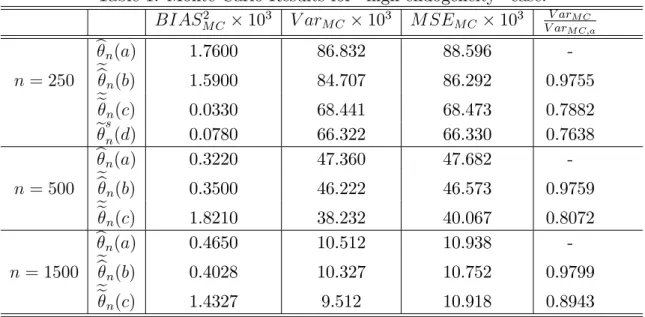
the results for the di¤erent estimators of o for the “high-endogeneity” (
p
1 ! = 0:001) case and the “mid-endogeneity” (p1 ! = 0:5) case respectively. In each table, the MC Bias is computed against the sample mean of the derivative of the true function. EM C stands for the mean of the MC
sample, V arM C and M SEM C are de…ned analogously. In the last column, V arM C=V arM C;a is the
ratio of the MC variance of each estimator, (b), (c) and (d), over the simple plug-in estimator (a). Table 1: Monte Carlo Results for “high-endogeneity” case.
BIAS2 M C 103 V arM C 103 M SEM C 103 V arV arM C M C;a bn(a) 1.7600 86.832 88.596 -n = 250 ebn(b) 1.5900 84.707 86.292 0.9755 een(c) 0.0330 68.441 68.473 0.7882 esn(d) 0.0780 66.322 66.330 0.7638 bn(a) 0.3220 47.360 47.682 -n = 500 ebn(b) 0.3500 46.222 46.573 0.9759 een(c) 1.8210 38.232 40.067 0.8072 bn(a) 0.4650 10.512 10.938 -n= 1500 ebn(b) 0.4028 10.327 10.752 0.9799 een(c) 1.4327 9.512 10.918 0.8943
A brief summary of MC results: First, the MC variances of all the estimators (a), (b), (c)
and (d) decrease approximately linearly as the sample size increases. The QQ plots, which are not reported here for length considerations, indicate that all the four estimators are root-nasymptotically normal. Second, the e¢ cient estimators, (c) and (d), have lower MC variances than the ine¢ cient simple plug-in estimator (a). Third, the MC variance gap between the estimators (or the …nite sample e¢ ciency gain) is bigger for the “high-endogeneity”case.5 Lastly, the variance gap decreases
as the sample size n increases. All of these …ndings are consistent with our theoretical results.
5The particular magnitude of the …nite sample e¢ ciency gain directly depends on the value of (the exogenous
noise level). In MC studies that are not reported here, we discover that smaller values lead to smaller biases and smaller variances in the e¢ cient estimators; hence bigger MC variance gaps.
Table 2: Monte Carlo Results for “mid-endogeneity” case. BIAS2 M C 103 V arM C 103 M SEM C 103 V arV arM C M C;a bn(a) 0.3420 79.246 79.590 -n = 250 ebn(b) 0.2751 77.164 77.433 0.9716 een(c) 0.1810 70.005 70.186 0.8717 esn(d) 0.3110 67.700 68.011 0.8530 bn(a) 0.2010 37.503 37.704 -n = 500 ebn(b) 0.1860 36.951 37.137 0.9853 een(c) 0.2200 33.794 33.974 0.9064 bn(a) 0.0200 9.2042 9.2244 -n= 1500 ebn(b) 0.0201 9.1928 9.2132 0.9987 een(c) 0.1062 8.6932 8.7996 0.9444
5
Conclusion
In this paper we computed the semiparametric e¢ ciency bound for …nite dimensional parameters of sequential moment restriction models (1) containing unknown functions that may depend on endogenous variables. The results extend those of Chamberlain (1992b), Ai and Chen (2003) and Chen and Pouzo (2009) to the case of semi/nonparametric conditional moment restriction with nested information sets. The results also extend those of Chamberlain (1992a), and Brown and Newey (1998) to the case of sequential moment restrictions involving unknown functions. Our characterization of the e¢ ciency bound is useful in evaluating and comparing several competing estimators that are typically proposed for a particular semiparametric econometric model. Although we can only characterize the e¢ ciency bounds for conditional moment models involving several unknown functions when they depend on di¤erent arguments, these bounds can be computed analytically for many speci…c models containing only one unknown function. In terms of semiparametric e¢ ciency bound calculation, our approach carries over to allow for T to increase to in…nity. However, any e¢ cient estimation method would face the “curse-of-dimensionality” when T is very large.
We present an optimally weighted, orthogonalized SMD estimation procedure for ( o; ho)
identi-…ed by the sequential moment restriction model (1). When the semiparametric e¢ ciency bound for
o is non-singular, we note that this estimator is root-n asymptotically normal and e¢ cient for o.
There are many alternative procedures that can also achieve the semiparametric e¢ ciency bound for o in model (1). For instance, one could extend the constrained sieve MLE approach of Gallant
and Tauchen (1989), Gallant, Hansen and Tauchen (1990) and Ai (2007) to estimate o e¢ ciently.
Notice that ( o; ho) in model (1) is the unique solution to
E[ t(Z; o; ho( )) p kt;n t (X (t))] = 0 fort = 1; :::; T, (21) where pkt;n t (X(t)) = (pt;1(X(t)); : : : ; pt;kt;n(X
(t)))0 is a series of basis functions that can approximate
any square integrable function of X(t) arbitrarily well as k
t;n ! 1. One could also estimate o in
(21) by extending the GMM with increasing number of unconditional moments of Hahn (1997), or the continuum GMM of Carrasco and Florens (2000), or the empirical likelihood with increasing number of unconditional moments of Donald, Imbens and Newey (2003). We shall investigate these alternative e¢ cient procedures in another paper.
References
[1] Ai, C. (2007): “A Nonparametric Maximum Likelihood Estimation of Conditional Moment Restrictions Models”, International Economic Review, 48(4), 1093 - 1118.
[2] Ai, C. and X. Chen (2003): “E¢ cient Estimation of Conditional Moment Restrictions Models Containing Unknown Functions,”Econometrica,71, 1795-1843.
[3] Ai, C. and X. Chen (2007): “Estimation of Possibly Misspeci…ed Semiparametric Conditional Moment Restriction Models With Di¤erent Conditioning Variables,”Journal of Econometrics, 141, 5-43.
[4] Andrews, D. (1991) “Asymptotic Normality of Series Estimators for Nonparametric and Semi-parametric Regression Models”, Econometrica,59, 307-345.
[5] Antoine, B., H. Bonnal and E. Renault (2007) “On the E¢ cient Use of the Informational Content of Estimating Equations: Implied Probabilities and Euclidean Empirical Likelihood”, Journal of Econometrics, 138, 461-487.
[6] Begun, J., W. Hall, W. Huang, and J. Wellner (1983): “Information and Asymptotic E¢ ciency in Parametric-Nonparametric Models,” Annals of Statistics, 11, 432–452.
[7] Bickel, P. J., C. A. J. Klaassen, Y. Ritov, and J. A. Wellner (1993): E¢ cient and Adaptive Inference in Semiparametric Models. Johns Hopkins University Press, Baltimore.
[8] Blundell, R., X. Chen and D. Kristensen (2007): “Semi-nonparametric IV Estimation of Shape-Invariant Engel Curves,”Econometrica, 75, 1613-1670.
[9] Brown, B. and W. Newey (1998): “E¢ cient Semiparametric Estimation of Expectations,”
Econometrica, 66, 453-464.
[10] Carrasco, M. and J. P. Florens. 2000. Generalization of GMM to a Continuum of Moment Conditions. Econometric Theory 20:797-834.
[11] Carrasco, M., J. P. Florens and E. Renault 2007. Linear Inverse Problems in Structural metrics Estimation Based on Spectral Decomposition and Regularization. Handbook of Econo-metrics, Vol. 6B, eds. J.J. Heckman and E.E. Leamer. North-Holland, Amsterdam.
[12] Chamberlain, G. 1987. Asymptotic E¤ciency in Estimation with Conditional Moment Restric-tions. Journal of Econometrics 34:305-334.
[13] Chamberlain, G. (1992a) “Comment: sequential moment restrictions in panel data,”Journal of Business and Economic Statistics 10, 20-26.
[14] Chamberlain, G. (1992b) “E¢ ciency Bounds for Semiparametric Regression,”Econometrica, 60, 567-596.
[15] Chen, X., 2007. Large Sample Sieve Estimation of Semi-Nonparametric Models, Chp. 76 in Handbook of Econometrics, Vol. 6B, eds. J.J. Heckman and E.E. Leamer. North-Holland, Am-sterdam.
[16] Chen, X. and D. Pouzo (2009): “E¢ cient Estimation of Semiparametric Conditional Moment Models with Possibly Nonsmooth Residuals,”Journal of Econometrics 152, 46-60.
[17] Chen, X. and D. Pouzo, 2008a. Estimation of Nonparametric Conditional Moment Models with Possibly Nonsmooth Moments. Cowles Foundation Discussion Paper 1650.
[18] Chen, X. and D. Pouzo, 2008b. E¢ cient Estimation of Nonparametric Quantile IV Weighted Average Derivative. Mimeo, Yale University and New York University.
[19] Chernozhukov, V. and H. Hong. 2003. An MCMC Approach to Classical Estimation. Journal of Econometrics 115:293-346.
[20] Chernozhukov, V., G. Imbens, and W. Newey. 2007. Instrumental Variable Estimation of Non-separable Models. Journal of Econometrics 139, 4-14.
[21] Darolles, S., J.-P. Florens and E. Renault (2002): “Nonparametric Instrumental Regression,” mimeo, GREMAQ, University of Toulouse.
[22] Donald, S., G. Imbens and W. Newey (2003): “Empirical Likelihood Estimation and Consistent Tests with Conditional Moment Restrictions,”Journal of Econometrics, 117, 55–93.
[23] Gallant, A. R., L. P. Hansen, and G. Tauchen (1990): “Using Conditional Moments of As-set Payo¤s to infer the Volatility of Intertemporal Marginal Rates of Subsitution,” Journal of Econometrics, 45(2), 141–179.
[24] Gallant, A. R., and G. Tauchen (1989): “Seminonparametric Estimation of Conditionally Con-strained Heterogeneous Processes: Asset Pricing Applications,”Econometrica, 57(5), 1091–1120. [25] Hahn, J. (1997) “E¢ cient estimation of panel data models with sequential moment restrictions,”
Journal of Econometrics 79, 1-21.
[26] Hall, P. and J. Horowitz (2005): “Nonparametric Methods for Inference in the Presence of Instrumental Variables,” Ann of Statistics, 33, 2904-2929.
[27] Hansen, L.P. (1982): “Large Sample Properties of Generalized Method of Moments Estimators,”
Econometrica, 50, 1029-1054.
[28] Hansen, L.P. (1985): “A method for calculating bounds on the asymptotic covariance matrices of generalized method of moments estimators,”Journal of Econometrics, 30, 203-238.
[29] Hansen, L.P. (1993): “Semiparametric e¢ ciency bounds for linear time-series models,”in Mod-els, Methods, and Applications of Econometrics: Essays in Honor of A. R. Bergstrom, edited by PCB Phillips, Cambridge, MA: Blackwell.
[30] Hansen, L.P. (2007). Generalized Method of Moments, entry for the New Palgrave Dictionary of Economics, 2nd edition: edited by S. Durlauf and L. Blume. New York: Elsevier.
[31] Hansen, L.P., J. Heaton, and M. Ogaki (1988): “E¢ ciency Bounds Implied by Multiperiod Conditional Moment Restrictions,” Journal of the American Statistical Association, 83, 863– 871.
[32] Hayashi, F., and C. Sims, 1983: “Nearly e¢ cient estimation of time series models with prede-termined, but not exogenous, instruments. Econometrica, 51, 783–798.
[33] Kitamura, Y., G. Tripathi and H. Ahn (2004) “Empirical Likelihood-based Inference in Condi-tional Moment Restriction Models”,Econometrica, 72, 1667-1714.
[34] Newey, W. 1990. “Semiparametric E¢ ciency Bounds,”Journal of Applied Econometrics, 5, 99-135.
[35] Newey, W. 1993. E¢ cient Estimation of Models with Conditional Moment Restrictions. In Hand-book of Statistics, vol. 11, edited by G. S. Maddala, C. R. Rao, and H. D. Vinod. Amsterdam: North Holland.
[36] Newey, W., 1997. Convergence rates and asymptotic normality for series estimators. Journal of Econometrics, 79, 147-168.
[37] Newey, W., 2004. E¢ cient Semiparametric Estimation via Moment Restrictions,Econometrica,
72, 1877-1897.
[38] Newey, W. and J. Powell (2003) “Instrumental Variable Estimation of Nonparametric Models”,
Econometrica,71, 1565-1578.
[39] Newey, W. and R. Smith (2004) “Higher Order Properties of GMM and Generalized Empirical Likelihood Estimators”,Econometrica, 72, 219-256.
[40] Newey, W. and T. Stoker, 1993, E¢ ciency of Weighted Average Derivative Estimators and Index Models, Econometrica, 61, 1199-1223.
[41] Otsu, T. (2007) “Sieve Conditional Empirical Likelihood Estimation of Semiparametric Models”, forthcoming inEconometric Theory.
[42] Stein, C. (1956): “E¢ cient Nonparametric Testing and Estimation,”in Proceedings of the Third Berkeley Symposium in Mathematical Statistics and Probability, vol. 1, pp. 187–196, Berkeley University of California Press.
Mathematical Appendix
We follow the approach of Stein (1956), Begun, Huang and Wellner (1983), Bickel, et al. (1993), Newey (1990), Chamberlain (1992a, b), and van der Vaart (1991) on semiparametric e¢ ciency bound calculation. Recall the following notation for any 2 A:
"T(Z; ) T(Z; ); "s(Z; ) s(Z; ) T X t=s+1 s;t(X(t))"t(Z; )for s=T 1; :::;1; s;t(X(t)) E[ s(Z; o)"t(Z; o)0jX(t)]f ot(X(t))g 1fors < tand ot(X(t)) E["t(Z; o)"t(Z; o)0jX(t)].
Also, recall that
Ef"s(Z; o)"t(Z; o)v(X(s))q(X(t))g= 0 (22)
holds for any s 6= t and for any measurable functions v and q. Finally we denote mt(X(t); )
E["t(Z; )jX(t)] for t= 1; :::; T.
Denote dz = dim(Z). Let po( ) be the true probability density of Z = (Y0; X0)0 with respect to
a sigma-…nite measure on Z Rdz that satis…es model (1), which is equivalent to the following
model:
E["t(Z; o)jX(t)] = 0 for t= 1; :::; T and o 2 A; (23)
whereE denotes expectation taken with respect to the true density functionpo(z). LetEpdenote
ex-pectation taken with respect to arbitrary density functionp(z). For arbitrary 2 A, the conditional moment restrictions
Ep["t(Z; ; h)jX(t)] = 0 for t= 1; :::; T (24)
do not uniquely determine p(z). For any 2 A, let F denote all probability density functions that satisfy (24):
F = p( ) :
Z
z2Z
p(z)d (z) = 1; p( ) 0; Ep["t(Z; ; h)jX(t)] = 0 fort = 1; :::; T :
For any p( ) 2 F , we can always write p(z) f(zj ; g) with po(z) f(zj o; go), where p is of a
known functional form up to unknown parameters and g, with g being an unknown measurable function of z (see Ai (2007) for an example). g(z)can be viewed as the remainder of the probability density function p(z) f(zj ; g) that is not determined by (24), and is unrestricted except for satisfying f(j ; g) 2 F and f(j o; go) 2 F o. Let G denote a class of real valued measurable
functions of Z satisfying (i) for each 2 A,ff(zj ; g) :g 2 Gg=F ; (ii) there is a go in the interior
of G such that po(z) f(zj o; go).
The following condition shall be imposed throughout the paper.
Assumption A: Let f( ( ); g( )) : 2 [0;1]g denote a family of parametric speci…cations in the parameter space A G satisfying: (1) f(j ( ); g( )) 2 F ( ); f(Zj (0); g(0)) = f(Zj o; go)
po(Z) holds with probability one; ! p
f(j ( ); g( )) is mean-square di¤erentiable. (2) For all
j = 1; :::; T, with probability one, "j(Z; ( )) is continuous at ( ) in a small neighborhood of
= 0, dE["j(Z; ( ))jX(j)]
d j =0 and
dE["j(Z; o;h( ))jX(j)]
d j =0 exist and have …nite second moments, and
E[j"j(Z; o)j2jX(j)]is bounded.
Proof. (Theorem 2.1) Let f( ( ); g( )) : 2 [0;1]g be any parametric path in A G satisfying
assumption A. Denote the log-likelihood function (of one observation) of a parametric submodel by
`(z; ( ); g( )) = logf(zj ( ); g( )). Under assumption A, we can write the pathwise derivative of
`(z; ( ); g( )) at( o; go)as r`(z; o; go) = lim !0 `(z; ( ); g( )) `(z; o; go) = ` (z; o; go) d ( ) d j =0+`h(z; o; go) dh( ) d j =0+`g(z; o; go) dg( ) d j =0 = ` (z; o; go) +`h(z; o; go) [ h] +`g(z; o; go) g;
where the second and the third term on the right-hand side denote the pathwise derivative with respect to h and g respectively. To simplify notation we denote ` (z) ` (z; o; go), `h(z)[ h]
`h(z; o; go)[
dh( )
d j =0]and`g(z) g(z) `g(z; o; go)
dg( )
d j =0. Notice that anyp(z) = f(zj ( ); g( )) 2
F ( ) satis…es restrictions (24). By di¤erentiating both sides of (24), we obtain: dE["j(Z; o)jX(j)] d +E["j(Z; o)` (Z)jX (j)] = 0 for j = 1; :::; T; (25) dE["j(Z; o; h( ))jX(j)] d j =0+E["j(Z; o)`h(Z) [ h]jX (j)] = 0 for j = 1; :::; T; (26) E["j(Z; o)`g(Z) g(Z)jX(j)] = 0 for j = 1; :::; T: (27) Denote Th = ah( ) =`h( )[ h] :E[ah(Z)] = 0; E[fah(Z)g2]<1; h2 H fhog; (26) holds :
Tg = ag( ) = `g( ) g( ) :E[ag(Z)] = 0; E[fag(Z)g2]<1; (27) holds :
Let Th and Tg respectively denote the closed linear completions of Th and Tg under the mean
squared norm kv( )k22 = Efv(Z)2g. Then Th and Tg are the tangent spaces for the nonparametric
parameters h and g respectively. Denote T = Th +Tg. Let Proj(jT) denote the population least
square projection of onto the space T. The semiparametric e¢ cient score of o is given by S
` (Z) proj(` (Z)jT) (see, e.g., Bickel et al. 1993). Denote Jo E[S S 0] as the semiparametric
Fisher information bound. IfJo is non-singular, then the semiparametric e¢ cient variance bound for
o is (Jo) 1 (E[S S 0])
1
.
To compute the least squares projections, note that, for each component k (of ), k = 1; :::; d , the projection proj(` k(Z)jT)solves the following minimization problem:
E ` k(Z) proj(` k(Z)jT) 2 E ` k(Z) ah(Z) ag(Z) 2 = min ah2Th;ag2Tg E [` k(Z) ah(Z) ag(Z)]2 = min ah2Th min ag2Tg E [` k(Z) ah(Z) ag(Z)]2 = min ah2Th n E ` k(Z) ah(Z) proj(` k(Z) ah(Z)jTg) 2 o ;
where ah 2Th; ag proj(` k(Z) ah(Z)jTg)2Tg denote a pair of solutions.
For anyah =`h( )[ h]2Th (with h2 H fhog), to compute a solution proj(` k(Z) ah(Z)jTg)
to the problem mina
g2Tg E[` k(Z) ah(Z) ag(Z)]
2
, we write the Lagrangian expression as
E ( [` k(Z) ah(Z) ag(Z)]2+ 2 T X j=1 j(X(j))0"j(Z; o)ag(Z) ) ; (28)
where j(X(j)) is the Lagrangian multiplier for the constraint (27). Applying calculus of variation,
any solution ag to the unconstrained minimization problem (28) should satisfy the following …rst
order condition: ` k(Z) ah(Z) ag(Z) = T X j=1 j(X(j))0"j(Z; o); (29) E["j(Z; o) ag(Z)jX(j)] = 0 for j = 1;2; :::; T:
de…nition of "j(Z; o); j = 1;2; :::; T and relation (22), it is straightforward to show that t(X(t))0 = dmt(X(t); o) d k dmt(X(t); o) dh [ h] 0 ot(X(t)) 1; t= 1;2; :::; T solves (29). Hence ag(Z) =` k(Z) ah(Z) T X t=1 t(X(t))0"t(Z; o)
solves the unconstrained minimization problem (28). Moreover, becauseEf[` k(Z)]2g<1,Ef[ah(Z)]2g<
1, En t(X(t))0"t(Z; o)
2
e o
<1, we have Ef[ag(Z)]2g<1 and ag 2Tg. Thus
proj(` k(Z) ah(Z)jTg) =ag(Z) =` k(Z) ah(Z)
T X
t=1
t(X(t))0"t(Z; o):
That is, for any ah =`h( )[ h]2Th (with h2 H fhog), we have:
` k(Z) ah(Z) proj(` k(Z) ah(Z)jTg) (30) = T X t=1 dmt(X(t); o) d k dmt(X(t); o) dh [ h] 0 ot(X(t)) 1"t(Z; o):
Recall that the space W is the closed linear completion of H fhog under the pseudo-normjj jj
k hk2 E " T X t=1 dmt(X(t); o) dh [ h] 0 ot(X(t)) 1 dmt(X(t); o) dh [ h] # <1:
For any direction h 2 H fhogwithah =`h( )[ h]2Th, given assumptions 2, 3 and A and relation
(30), we havek hk2 <1hence this direction hbelongs toW. Conversely, for any eh2 H fhog
with eh 2
<1 (so that eh2 W), de…ne
eah(z) = T X t=1 dmt(X(t); o) dh [ eh] 0 ot(X(t)) 1"t(z; o):
It is obvious thatE[eah(Z)] = 0. By de…nition ofWand eh2 Wwe haveE[feah(Z)g2] = eh
2 <1.
Also relation (22) implies that
dmj(X(j); o)
dh [ eh] +E[eah(Z)"j(Z; o)
0jX(j)] = 0 for j = 1; :::; T;
thus eah( )2Th.
By de…nitions ofTh,Th andah(), there exists a sequencefwh;j 2 H fhog; j = 1;2; :::gsuch that
ah;j( ) =`h( ) [wh;j]2Th converges toah( )2Thunder the mean-squared norm. Since the projection
is a bounded linear functional, ag;j(Z) proj(` k(Z) ah;j(Z)jTg)converges toag(Z)2Tg under the
mean-squared norm. By de…nition of W, such a sequence fwh;j 2 H fhog; j = 1;2; :::g belongs to
W. By relation (30), we have: 1 > E ` k(Z) ah;j(Z) proj(` k(Z) ah;j(Z)jTg) 2 = E " T X t=1 f ot(X(t))g 1 2 dmt(X (t); o) d k dmt(X(t); o) dh [wh;j] 2 e # E " T X t=1 f ot(X(t))g 1 2 dmt(X (t); o) d k dmt(X(t); o) dh [r k o] 2 e # ; (31)
where the last inequality is due to the fact that rk
o is a solution to inf w2W E " T X t=1 f ot(X(t))g 1 2 dmt(X (t); o) d k dmt(X(t); o) dh [w] 2 e # :
Taking limit as j ! 1in both sides of inequality (31), we obtain:
E ` k(Z) ah(Z) ag(Z) 2 E " T X t=1 f ot(X(t))g 1 2 dmt(X (t); o) d k dmt(X(t); o) dh [r k o] 2 e # : (32) On the other hand, by de…nitions of W and rk
o, there exists a subsequence fweh;j 2 H fhog; j =
1;2; :::g in W such that 1> E " T X t=1 f ot(X(t))g 1 2 dmt(X (t); o) d k dmt(X(t); o) dh [weh;j] 2 e #
converges to E " T X t=1 f ot(X(t))g 1 2 dmt(X (t); o) d k dmt(X(t); o) dh [r k o] 2 e # asj ! 1: Let e ah;j(z) = T X t=1 dmt(X(t); o) dh [weh;j] 0 ot(X(t)) 1"t(z; o):
Then eah;j( )2Th and hence eag;j(z) proj(` k(Z) eah;j(Z)jTg)2Tg, we have
E " T X t=1 f ot(X(t))g 1 2 dmt(X (t); o) d k dmt(X(t); o) dh [weh;j] 2 e # = E ` k(Z) eah;j(Z) proj(` k(Z) eah;j(Z)jTg) 2 E ` k(Z) ah(Z) ag(Z) 2 : (33) Taking limit (as j ! 1), and combining with the previous inequality (32), we obtain
E ` k(Z) proj(` k(Z)jT) 2 E ` k(Z) ah(Z) ag(Z) 2 = E " T X t=1 f ot(X(t))g 1 2 dmt(X (t); o) d k dmt(X(t); o) dh [r k o] 2 e # : Denotero = (ro1; :::; rod ) and dmt(X(t); o) dh [ro] = dmt(X(t); o) dh [r 1 o]; dmt(X(t); o) dh [r 2 o]; :::; dmt(X(t); o) dh [r d o ] :
Then, an e¢ cient score S for o is
S ` (Z) proj(` (Z)jT) = T X t=1 dmt(X(t); o) d 0 dmt(X(t); o) dh [ro] 0 ot(X(t)) 1"t(Z; o):
The semiparametric Fisher information bound for o isJo E[S S 0], and ifJo is non-singular, then
the semiparametric e¢ cient variance bound for o is (Jo) 1 (E[S S 0]) 1.
When we partition into( 01; 02)0 withd
i = dim( i)and d =d 1+d 2 for i= 1;2, we let ro 1 (ro1; :::; rd1 o )2Q d1 j=1W,ro 2 (r d1+1 o ; :::; rod )2 Qd2 j=1W, dm1(X; o) dh [ro 1] ( dm1(X; o) dh [r 1 o]; :::; dm1(X; o) dh [r d1 o ])