Nitrated
Polycyclic
Aromatic
Hydrocarbons: A
Risk Assessment for the Urban Citizen
by Lennart
MoIIer,1
Ingemar
Lax,2
and Lennart
C.
Eriksson3
Nitrated polycyclic aromatic hydrocarbons (nitro-PAHs) are formed during incomplete combustion. Sources include emissions fromvehicles (mainly diesel vehicles), heating, smoking, certain types of food processing, andincomplete combustion ingeneral. Nitro-PAHs are direct-acting mutagens, and a number of them have been shown tobecarcinogens. 2-Nitrofluorene (NF) represents a model substance for the nitro-PAHs. An attempthas been made tocalculate the humancancerriskdue to exposure to nitro-PAHs bytwodifferent models. In the first model, genotoxic lesions were transferred to units of Gray(y-irradiation),and inthesecond model a mega study (24,000animals) on the carcinogenicity of one metabolite of NF was used to elucidate the risk. Gamma-irradiationof the rat liver gave rise to preneoplastic foci in a dose-dependent manner. which was statisticallysignificant.TheGray-equivalentsofchemically (NF) induced foci werecalculated,and from the human nitro-PAH exposure,expressed in Sievert, a human risk estimate was calculated. In the second model,
an extrapolation from laboratory animals to man was performed because tumor data on 2-acety-laminofluorene (AAF), a major metabolite of NF, were available in the literature. The tumor dose-response dataonAAF waslinearfor tested lifetime doses. Theresults of both models agreed, witharisk range of0.15-49
x 10-ion human cancer risk for an urban citizen.
Introduction
Incomplete combustion is
amajor
problem
in terms
of
pollution. Examples include emissions from
energypro-duction,
industrial
processes,vehicles,
and
smoking.
The
biological effects
of
incomplete combustion
canbe divided
into effects
onhuman
health
or onthe ecosystem. Both
effects
canbe acute
orlong
term.
The
different
biological
responses canbe
related
to
each other because the
samesubstance
in
the
emissions
cangive rise
to
several
reac-tions
in
the
organism
orthe
ecosystem.
One such
example
is the
groupof
nitrated polycyclic aromatic hydrocarbons
(nitro-PAHs). For the formation of nitro-PAHs, incomplete
combusted
organic material (PAH)
and
oxidized
nitrogen
(NO,)
arenecessary.A
low
pH (SO2,
NOx)
catalyzes the
reaction.
NOX
is
oneimportant combustion product
responsible for acidification of the environment,
acute
health effects
(1),
aswell
asformation of
nitro-PAHs
(2),
which
arestrong
genotoxic agents
in
mammalian systems
(3-7). Because the formation of nitro-PAHs is catalyzed by
'Center
for Nutrition andToxicology, KarolinskaInstitute, Novum ResearchPark, S-141 57, Huddinge, Stockholm,Sweden.2Department ofHospital Physics, Karolinska Hospital, Box 60500,
S-10401, Stockholm,Sweden.
3DepartmentofPathology,KarolinskaInstitute, Huddinge University Hospital, S-141 86, Huddinge, Stockholm,Sweden.
Address reprint requests to L. M6ller, Center for Nutrition and
Toxicology,KarolinskaInstitute,Novum ResearchPark,S-14157,
Hud-dinge, Stockholm,Sweden.
a
low
pH,
the reaction
product,
NOR,
catalyzes
its
own
reaction
with PAHs
in
the formation of nitro-PAHs.
Nitro-PAHs are
found
in
emissions
from
diesel- (8) and
gasoline-powered (9) vehicles,
in
the exhaust
from
kero-sene
heaters (10),
in
urban
air
(11-14),
in
river
sediments
(15), and in certain
food products
(16,17).
Nitro-PAHs
can
be formed
during combustion
or as a
result
of
photochemi-cal reactions of
PAHs
(18)
or
amino-PAHs
(19). Nitro-PAH
formation has also
been
reported
to occur
in
the
water
phase with
nitrite as a
donor of the
nitro group
(20,21).
Nitro-PAHs
are a
group
of
at
least
200
different
sub-stances.
Many of them
are
mutagens
(22-25),
and
the
most
potent
bacterial
mutagens
known
today,
the
dinitropy-renes, are
found
in
this
group
(26).
A
number of the
nitro-PAHs are
also carcinogenic
in
laboratory
animals (27,28).
2-Nitrofluorene (NF)
is one
of the
more common
nitro-PAHs, found
in
the environment (29-33) with
1-nitro-pyrene
(NP).
NF
has
been
suggested
to
be a
model
sub-stance
for nitro-PAHs
in
the
gas
and
particle phase,
whereas
NP is
regarded
to
be
a
model substance
for
nitro-PAHs
in
the particle phase (34).
NF
is a mutagen
(25)
as
well
as a
carcinogen
(28)
in
laboratory animals.
NF was
elucidated
by the International
Agency for Research
on
Cancer
(IARC),
and the
conclusion
was
that there
is
"sufficient evidence"
for
the
carcinogenicity
in
experimental animals.
Concerning the evaluation for
human health the statement was that NF is
a
"possible
carcinogen
to
humans"
(35).
The
evaluation
for
diesel
exhaust
'ON
0
FIGURE 1.Thechemicalstructureof 2-nitrofluorene.
NF has been studied in detail in
ourlaboratory from
ananalytical point of view
(36), and with regard
to
metabo-lism
(37-39), lung effects (40,41), and genotoxic effects
(42-44). A review of NF's
prevalence and biological effects has
also
been
published (45). The chemical
structure
of NF is
shown
in
Figure 1.
Results and Discussion
For
the
groupof
nitro-PAHs, epidemiology
orstudies
onspecially selected
groups are more orless
impossible
to
perform because nitro-PAHs constitute only part of the
products of incomplete combustion. It is extremely hard
to
define
agroupof
people that is exposed
to
nitro-PAHs and
acontrol
groupthat is
exactly the
samefrom all
aspects
except that
it is not
exposed to nitro-PAHs. Nitro-PAHs
always
occurwith other carcinogens
(combustion
prod-ucts), and therefore another
approach
must
be
used
to
elucidate the
genotoxic risk.
2-Nitrofluorene,
aPotent
Genotoxic Model
Compound
for Nitro-PAHs
2-Nitrofluorene
(NF) and 1-nitropyrene (NP) have been
selected
asmodel
compounds for the
groupof
nitro-PAHs.
The basic structures, fluorene and
pyrene, are commonin
emissions
from
incomplete combustion.
Because
nitrogen
oxides
arealso
present during combustion, the reaction
products NF and NP
are commonin
environmental
analy-ses(8-17).
NP
occursin
the
particle phase, whereas
NF
is
found with
a50/50 distribution
in
the
particle and
semi-volatile
phase (34).
In
ourstudies, NF
wasselected
asthe model
compound.
NF
is
adirect-acting mutagen
in
bacterial test systems
and is
often
used
asapositive control
in
genotoxic
assays.In
Table 1,
asummaryof
someof
the
existing data
onthe
genotoxicity
of NF is
shown.
Table
1.Asummaryof thebiologicaleffects of 2-nitrofluorene.Assay Effecta Reference
Sister chromatidexchange + (3,5)
Initiator + (44)
Promoter + (44)
Carcinogenicity + (27,56)
Formationof DNA adducts + (69)
Micronuclei assays - (6,70-72)
Bacterial mutagenicity(Salmonella) + (74-76) Bacterialmutagenicity(E. coli) + (77) Mutagenicity,mouselymphoma assay + (3,73,78)
a(
+)
Positiveeffect; (-)noeffect.Although
NF is a
chemically
stable
molecule,
it is
exten-sively
metabolized
in
the
organism.
After oral
administra-tion
of NF, the major
part
of the dose
is
excreted within
48
hr
(37,39).
After
4
hr,
approximately
2%
of the dose has
been
metabolized by the intestinal microflora, absorbed,
and
metabolized (several steps)
in
the liver,
distributed
in
the
circulation, filtered by the kidneys, and excreted
in
urine.
The excretion
of metabolites
is
accompanied
by
excretion of
mutagenicity.
Typically,
direct-acting
muta-genicity
(-S9) dominates
over
mutagenicity
in
the
pres-cence
of
S9, both
in
urine
and feces (37,39).
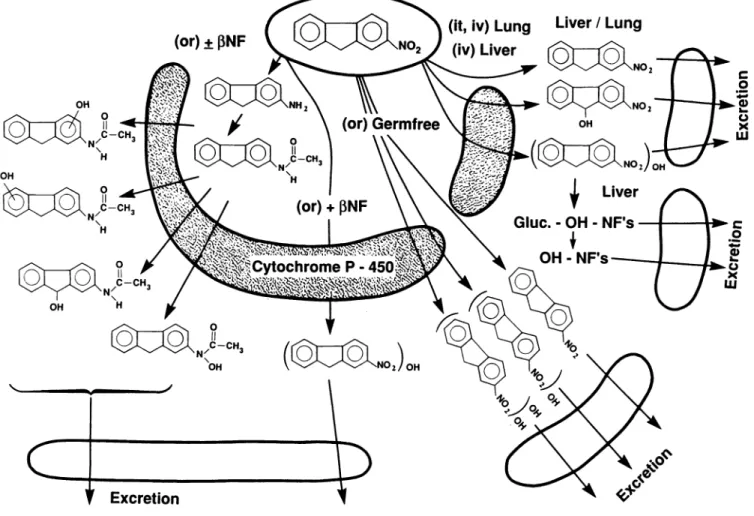
The
in vivo formation
(37)
of
the potent carcinogen
2-acetylaminofluorene [AAF
(46)] is
indicated. After
an
oral dose of
NF to rats, NF is
reduced
to
2-aminofluorene
(AF) by the intestinal microflora,
acetylated
to
AAF,
and
further
hydroxylated
in
the liver,
resulting
in
OH-AAF
compounds,
which can
be
excreted
as
such or in
conjugated
form. This
metabolic
route
is
quantitatively the
most
important.
AAF has
been
a
model compound
for
chemical
carcinogenesis since the Wilson's early
finding of
its
car-cinogenic
potential
in 1941
(47).
AAF
has been
used
in
a
number of bioassays and has been characterized from
many
different points of
view
(48).
AAF is not
found
in
the
environment, and
occupational
exposure can
only
occur
when
AAF is
used
in
research.
It is
thus of
concern
when
an
environmental
pollutant (NF) commonly found
in
diesel
exhaust
(9,49-51)
has the capacity
to
be
metabolized
to
this
potent
carcinogen in
vivo. Other nitro-PAHs have
been shown
to
form
acetylated metabolites,
although
the
biological significance
of these metabolites
is
not
known
(52,53).
After oral administration
of NF,
an
alternative
meta-bolic
route
results
in
the formation
of
OH-NFs.
This is
seen
after induction of the
cytochrome
P450 system
in
vivo.
It is
also seen in
isolated, perfused lung and liver
as
well
as
in
germ-free animals (37-39). OH-AAFs
are
con-sidered to
be
detoxification products (54) and
have
a
low
mutagenic
potency
(55).
OH-NFs,
on
the other
hand,
are
more
mutagenic
than
NF
itself
(39).
So far,
nothing
is
known
about the carcinogenic
potential
of
OH-NFs, but
it
cannot
be
excluded that
they
are
carcinogenic.
They
may,
for
example, be involved
in
the
tumor
formation
seen
in
the
forestomach after oral dosing
of NF. No
forestomach
tumors
are seen
after administration of
AF or
AAF.
OH-NFs may also
play
a
role in the
formation of subcutaneous
tumors
after skin
application
of NF
(28,56). The
metabo-lism
of
NF is
shown in
Figure
2.
Are
Animal Data Relevant to
Humans?
One
can
always
argue
whether data
on
animal
metabo-lism
are
relevant
to
humans, but
in
the case
of
nitro-PAHs,
there are
a
number of
factors
indicating
that animal
studies
are
relevant
to
the human situation:
a) Reduction
of nitro-PAHs
to
amino-PAHs
can
be
performed
by
anaer-obic fecal
bacterial
suspensions
from humans
as
well
as
from
rats
(57-59).
b)
Human
liver
S9
bioactivates AF
and
AAF
to
mutagens
(60). c)
Human
hepatoma
cell lines
can
(or)
±iNF
(it, iv) Lung
Liver /
Lung
(iv) Liver
lll~~~ __Iw ~NO2 c ._ x wU OH C-CH3 H0~
~
0o
[i X ~~C-CH3 N OH H 02 OHFIGURE 2. Thepathwaysforthe metabolismof2-nitrofluorene.
perform nitroreduction
aswell
asring hydroxylation of
NP
(61). d) Liver microsomal metabolism of AAF is similar
in rats
and humans
(62). e) Human lymphocytes
metabo-lize
AAF to
ring- and N-OH derivatives of AAF (63). J)
AAF
metabolism is similar
in
cultures of
epithelial cells
from human and
rat
bladder
(64). g) It has been shown that
the
carcinogen
AAF
given orally
to
humans results
in
the
same
urinary metabolites
asin
the
rat
(65).
Risk
Calculations
Using AAF
In
the
AAF
model, combined data have been used from
the metabolic
pathways (NF metabolized
to AAF
in
vivo)
and
amega-study (66) performed
on24,000
animals to
elucidate the
carcinogenic potential
of AAF at
low
lifetime
dosing. The
tumor
data
onthe liver have been used for
the
extrapolation
to
man.The
dose-response
curvefor tumor
formation in
the
animal
study after lifetime dosing
waslinear.
In
the calculations
(67), the animal data have been
extrapolated
to
man.The
positive
and
negative
comments
that
could be made
regarding this model
arefound
in
Table
2.
With
anestimated human
lifetime dose
rangefor
anurban citizen, as discussed
by Moller
et
al.
(73), the human
cancer
risk is
p(x)
=
1.1
-
49
x 10-
6. Weaknesses
and
strengths
of the AAF model
are
discussed in
Table
2.
ITable2.Weaknesses andstrengths of the 2-acetylaminofluorene(AAF) model. Weaknesses
Dataextrapolated from animalsto man.
Apartof the human dose of 2-nitrofluorene(NF) mightundergo ring-hydroxylation instead of reduction andacetylation.However; much more potent mutagens(carcinogens?)areformedviathatroute. Strengths
Many animalsinthecancerstudy (24,000). Knownmetabolism for the modelcompound(NF). Lowlifetime doses ofAAFgivesrise to tumors.
The dose-responsecurve was linear for livertumors onwhich the calculationswereperformed.
The metabolisminlaboratory animals andmanisprobably similar. TheAAFmodelis anin vivo model.
AAFisconsideredahumancarcinogen.
Enzymes necessary for the metabolicpathwaysarefoundin man.
L....O*
The
y-model
is
totally different
from
the AAF
model in
that known human risk data
on
y-irradiation
is
the
basis
for the risk calculation. The genotoxic effects
in
the
rat
liver after exposure to NF occur as preneoplastic lesions
(44).
The
same
genotoxic lesions
can
be formed
after
exposure to
-y-irradiation of the
rat
livers (67). The dose
of
y-irradiation
was exact in terms
of dose maxima, exposed
area,
standard deviation
of the dose,
etc.,
because
y-irradiation
apparatus
for human cancer treatment was
used (67).
In
this
way
the
genotoxic
lesions
caused by
NF
could be converted
to
y-irradiation
equivalents
(Gy).
The
total
human
dose of nitro-PAHs could then be expressed
in
radiation
units,
which made it possible to use human risk
data
on
carcinogenesis after
y-irradiation exposure
to
large populations (68). With the same estimated life dose of
nitro-PAHs
as
used in the AAF
model, the human
cancer
risk for
an
urban
citizen is
p(x)
=
0.30
-
39
x
10-6.
Weaknesses and
strengths of
the
-y-model
are
discussed
in
Table
3.
Human Dose
of Nitro-PAHs
The
basis for
the risk
calculations
is
the human
lifetime
dose of
nitro-PAHs. Based
on
literature
data,
an
estimated
lifetime dose
range
has been
calculated, which
is
discussed
in
detail
in
M6ller
et
al.
(67).
The combined
risk range is
0.15-49
x
10-6.
In
the dose calculations,
food has been
considered
to
be
zero in terms
of
nitro-PAH
dose, although
this
is not
the
case;
food
can
even
be the
predominate
source
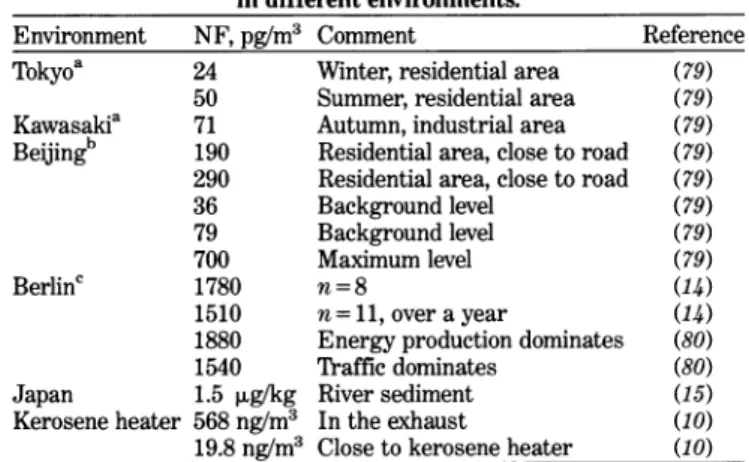
of nitro-PAHs (16,17). Cities like
Berlin and Beijing
represent
the
upper
risk
range,
and
cities
like
Tokyo
and
Kawasaki represent
the lower
risk range.
High traffic
intensity,
a
lot
of
diesel vehicles, and coal
as
source
of
energy
lead
to
doses that pose a
high
risk.
Some
comments
on
the
dose
are
shown in
Table
4.
In
Tables
5
and 6, NF
analyses
in
urban
air
and
particle
extracts are
shown.
In
Table
7
the
factors
that
could
increase or
decrease
the
calculated
risk for nitro-PAHs are
discussed.
Although
no
definite
risk limit
has
been
set, a
risk of 1 x
10-6
is in
general
is
considered
to
be
the limit
for
an
unacceptable
risk. That risk
limit could
be exeeded
by
a
factor of
up
to
50
times in
the
case
of nitro-PAHs.
Table3.Weaknesses andstrengthsof theymodel. Weaknesses
Are foci generated from chemicals and y-irradiation in the same
manner?
Recent human risk data on y-irradiation indicate that the risk is underestimated.
Strengths
Well-known risk dataonhumansafter exposureto-y-irradiationexists. Conversion ofgenotoxic lesionstoradiation-equivalents.
They-modelis an in vivo model.
Weaknesses
Are the literature data on nitro-PAH levels representative?
Sampling temperatures are notgiven (might influence distribution gas/particle phase).
Limited information available on the food levels ofnitro-PAHs. Could beamajorsourceof nitro-PAHs.
Canplants (for food consumption) along roads absorb and metabolize nitro-PAHs?
What is therelationship between oral and inhaled dose?
Are the potent direct-acting mutagens, the OH-NFs, also carcinogens? Strengths
Alarge number of analyses on urban air.
2-Nitrofluorene seemstobe agood model for nitro-PAHs intermsof dose.
Anequal distribution ofnitro-PAHsinthe urban environment dueto a
verylarge number of sources.
Abbreviations: nitro-PAHs, nitrated polycyclic aromatic hydrocar-bons;OH-NF,
Table5.Quantitation of 2-nitrofluorene (NF) in different environments.
Environment NF,pg/m3 Comment Reference
Tokyoa 24 Winter,residential area (79)
50 Summer, residentialarea (79)
Kawasakia 71 Autumn, industrialarea (79)
Beijingb 190 Residential area, close to road (79) 290 Residential area,close to road (79)
36 Background level (79)
79 Background level (79)
700 Maximumlevel (79)
Berlinc 1780 n=8 (14)
1510 n=11,over ayear (14)
1880 Energy production dominates (80)
1540 Traffic dominates (80)
Japan 1.5 ,ug/kg River sediment (15)
Kerosene heater 568ng/m3 Inthe exhaust (10)
19.8ng/m3 Closetokerosene heater (10)
aBig
cities, relatively few vehicles, catalytic cleaning devices,main traffic flowbyunderground,and cities locatedonthecoast.bBig
city, veryfew vehicles, diesel vehicles, nocatalyticcleaning of vehicle emissions, and extensiveheating/cooking with coal.'Big
city, manyvehicles, typical western-type city, although former EastBerlin has coalas afuel for heating, which might influence the air quality in former West Berlin where the analyses have beenperformed.Table6.Quantitative dataon2-nitrofluorene(NF) invehicle emissions.
Source NFLevel Reference
Dieselexhaust, bus 0.13-1.5 ,ug/km (50)
HDD,100%load, moderate speed 0.63 ,ug/g (soot) (49)
HDD,75%load, highspeed 8.8 ,g/g (49)
Diesel muffler 52.2 ,ug/g (9)
SRM1650a 15 ,ug/g (49)
HDD, idle 84 ,ug/g (51)
HDD, zero-load, highspeed 62 ,ug/g (51)
HDD,full-load, highspeed 1.9 Rg/g (51)
LDD, gasphase 90 ,ug/mile (34)
LDD,particlephase 97 ,ug/mile (34)
Gasolinemuffler 0.16 ,ug/g (9)
Abbreviations:HDDandLDD,heavyandlightdutydiesels,
respec-tively.
aThe National Bureau of Standards Reference Diesel Particulate,
Table 7. Summary of factors that can increase or decrease the risk of nitro-PAHs.
Increaserisk
Synergism with other airpollutants occurring in vehicle emissions, urbanair, or incigarette smoke(nitro-PAHs always occur together with PAHs).
Nitro-PAH emmissionfrom kerosene heaters (10).
Certain combustions may generate more nitro-PAHs than vehicles [airplanes andships (51,74)].
Cigarette smokemight beanunknown sourcefor nitro-PAHs. Water-phase reactions(PAH + nitrite) could be an additional source
fornitro-PAHs (20,21).
Cooking could be apredominate source of nitro-PAHs if the Japanese data on chicken aregenerallyapplicable (17).
Nitro-PAHs can act as tumor promoters (44) and/or affect tumor progression.
Exposure to nitro-PAHs could lead to an increased risk of miscar-riages and malformed offspring because metabolites of 2-nitro-fluorene (NF) can cause malformation in laboratory animals (82). Certain other substances can functionasco-carcinogens with
nitro-PAHs: one example isbenzo(a)pyrene (BaP) (83).
Comparedtoothernitro-PAHs, NF, which was the base for calcula-tions, hasalowbacterialmutagenicity.
Contamination ofthe environment of nitro-PAHs might beanaddition tothe lifetime dose (15).
If particles are very small (<1.5,um), they contain more nitro-PAHs
(84).
Certain risk behaviors (being achild and breathing closerto the sourcesof emissions forinstance)are notincluded.
Certain risk situations are not included (indoor exposure of diesel exhaust in garages,mines,ferries, etc.).
Certainoccupational risk behavior isnotincluded such as cutaneous exposureofsoot(workshops,chimneysweeps,etc.).
Metabolism ofother nitro-PAHs might be more important than NF in termsofgenotoxicity.
Metabolism without intestinal microflora(oxidative pathway) leads to the formation ofmore genotoxic metabolites than 2-acetyl-aminofluorene(AAF) (37-39).
Local sourcesinthe countryside could give rise torelativelyhigh levels of nitro-PAHs(diesel tractors, for instance).
The risk calculationsperformed on the victims from Hiroshima and Nagasaki, which is the basis for the rad equivalent calculation, can be underestimated (81).
If nitro-PAHs reacts with cell components other than DNA, it is possible that other toxic reactions mightoccur(i.e., reactions with proteins).
Decrease risk
Measured levels ofNFinBerlinmight not be representative of cities in general(ithasbeen assumed in the calculation that urban levelscan
beaslowas10%ofthe Berlinconcentration, which isone reasonfor the width of the riskrange).
If NF is not a good model for nitro-PAHs in generalin terms of
biologicaleffects.
The increased use of catalytic cleaning devices, although this is not the
casefor diesel vehicles for themoment(whichissofar the main knownsourcefornitro-PAHs).
Ifanimalmodels are not relevanttohuman risk.
Metabolism of other nitro-PAHs is less important than NFintermsof genotoxic risk.
Ifmetabolism of NF via the oxidative pathway leads to less genotoxic metabolites than AAF.
If-y-generatedfoci are different fromchemically induced foci. Ifantagonism between NF and otherxenobioticsreduce the promotive
response.
REFERENCES
1.Lindvall, T. Health effects of nitrogen dioxide andoxidants.Scand. J. WorkEnviron. Health.11:10-28(1985).
2.Tokiwa, H., Nakagawa, R., Morita,K,andOhnishi, Y. Mutagenicity of nitro derivatives induced by exposure of aromatic compounds to nitrogendioxide. Mutat. Res. 85: 195-205 (1981).
3.McCoy, E. Role ofmetabolism on the mutagenicity of nitroarenes. In: BiochemicalBasisof Chemical Carcinogenesis (H. Greim, M. Jung, M. Kramer, H.Marquardt, and F. Oesch, Eds.), Raven Press, New York, 1984, p.57.
4.Danford, N., Wilcox,P., and Parry, J. M. The clastogenic activity of dinitro-pyrenes ina ratliver epithelial cell line. Mutat. Res. 105: 349-355 (1982).
5.Nachtman, J.P,andWolff, S.Activity of nitro-polynuclear aromatic hydrocarbons in the sister chromatid exchange assay with and
with-outmetabolic activation. Environ. Mutagen.4: 1-5(1982).
6.Neal,S. B., and Probst, G. S. Chemically-induced sister chromatid exchangeinvivoinbonemarrowof Chinesehamsters,anevaluation of 24 compounds. Mutat. Res. 113: 33-43 (1983).
7.ITeker, J. D., and Ong, T. Induction of sister chromatid exchanges and chromosome aberrations in humanperipherallymphocytes by 2,4,7-rinitro9-fluorenone. Mutat. Res. 138: 181-184 (1984).
8.Hartong, A.,Kraft, J., Schulze, J., Kiess, H., and Lies, K.-H. The identification of nitrated polycyclic aromatichydrocarbons in diesel particulateextractsandtheirpotential formationasartifactsduring
particulate collection.Chromatographia19:269-273(1984).
9.Handa, T.,Yamauchi, T., Ohnishi, M., Hisematsu, Y, and Ishii, T. Detection andaverage content levelsof carcinogenic and mutagenic compounds from the particulates on diesel and gasoline engine mufflers. Environ. Int. 9: 335-341 (1983).
10.Tokiwa, H.,Nakagawa, R., andHorikowa, K.Mutagenic/carcinogenic agents inindoorpollutants: thedinitropyrenesgeneratedby kerosene heaters and fuel gas and liquified petroleum gas burners. Mutat. Res. 157:39-47 (1985).
11.Ramdahl, T.,Becher,G,and Bj6rseth, A. Nitrated polycyclic aromatic hydrocarbons in urban air particles. Environ. Sci. Technol. 16:
861-865(1982).
12.Gorse, R.A,Riley, T. L., Ferris, F.C., Pero, A. M., andSkewes,L. M. 1-Nitropyrene concentration andbacterial mutagenicity in on-road vehicle emissions. Environ.Sci. Technol.27:198-202(1983). 13.Tokiwa,H, Kitamori, S.,Nakagawa, R., andOhnishi, Y. Mutagens in
airborne particulate pollutants and nitro derivatives produced by
exposureof aromaticcompoundstogaseouspollutants.Environ.Sci. Res. 27: 555-567(1983).
14.Moriske, H.-J. Polareverbindungen imstadtaerosol. VDI
Fortschrit-tberichte,Reike15, No. 42,VDI-Verlag,Dusseldorf,1986.
15.Sato, T,Kato,K, Ose,Y,Nagase,H.,and Ishikawa, T. Nitroarenes in Suimon river sediment. Mutat. Res. 157: 135-143(1985).
16.Ohnishi, Y., Kinouchi, T., Manabe, Y., Tsushi, H., Otsuka, H., Tokiwa, H., andOtofujii,T. Nitrocompounds in environmental mixtures and foods. In: Short-TermBioassaysintheAnalysisofComplex Environ-mentalMixtures, IV(M. D. Waters,Ed), Plenum Press, New York, 1985, pp. 195-204.
17.Kinouchi,T.,Hideshi,T.,andOhnishi, Y. Detection of 1-nitropyrene in Yakatori (grilled chicken). Mutat. Res.171:105-113(1986). 18.Ibkiwa,H,Nakagawa, R., Morita, K, andOhnishi,Y.Mutagenicity of
nitro derivatives induced by exposure of aromatic compounds to
nitrogendioxide. Mutat. Res.85: 195-205(1986).
19.Okinaka, R. T., Nichols, J. W., Whaley, T. W., and Strniste, G. F. Phototransformation of2-aminofluorene into N-oxidized mutagens.
Carcinogenesis5:1741-1743(1984).
20.Ohe, T. Mutagenicity of photochemical reaction products of polycyclic aromatichydrocarbons with nitrite. Sci. Total Environ.39: 161-175
(1984).
21.Suzuki,J,Hagino, T., andSuzuki,S. Formation of1-nitropyreneby
photolysis of pyreneinwatercontaining nitrite ion.Chemosphere 16: 859-864(1987).
22.Rosenkranz, H.S., and Mermelstein, R. M. The genotoxicity, metabo-lism and carcinogenicity of nitrated polycyclic hydrocarbons. J. Environ.Sci. Health2:221-272(1985).
23.Tokiwa, H,Nakagawa,R,andOhnishi,Y. Mutagenic assay of
aro-matic nitrocompounds with Salmonella typhimurium. Mutat. Res. 91: 321-325(1981).
24.Pitts, J. N., Jr., Harger, W., Lokensgaard, D. M., Fitz, D. R.,Scorziell, G.M,andMejia, V.Diurnal variations in themutagenicityofairborne particulate organicmatter inCalifornia's southcoastairbasin. Mutat. Res. 104: 35-41 (1982).
26.Pederson,T.C., andSiak, J.-S.The roleof nitroaromaticcompoundsin
the direct acting mutagenicity of diesel particleextracts. J. Appl.
Toxicol. 1: 54-60 (1981).
27.El-Bayoumy, K., Hecht, S., and Hoffman, D. Comparative tumor initiating activity on mouse skin of6-nitrobenzo(a)pyrene,
6-nitro-chrysene, 3-nitroperylene, 1-nitropyrene and their hydrocarbons. Cancer Lett. 16:333-337(1982).
28.Miller, J. A., Sandin, R. B., Miller, E. C., and Rush, H. P. The
carcinogenicity ofcompoundsrelatedto2-acetylaminofluorene.
Can-cerRes. 15: 188-199 (1955).
29.Schuetzle, D., Riley,T. L., Prater, T. J., Harvey, T. M., and Hunt, D. F.
Analysis of nitratedpolycyclic aromatichydrocarbonsindiesel
par-ticulate. Anal.Chem.54:265-271 (1982).
30.Henderson,T.R., Royer,R. E.,Clark, C.R., Harvey,T.M.,andHunt,
D. F.MS/MS analysis of dieselemissionsand fuels treatedwithN02. J.Appl. Toxicol. 2: 231-237 (1982).
31.Schuetzle,D.Sampling of vehicleemissionsfor chemicalanalysis and
biological testing.Environ.HealthPerspect.47: 65-80(1983). 32. Xu, X., Nachtman, J., Rappaport, S., and Wei, E. Identification of
2-nitrofluoreneindiesel exhaustparticulates. J.Appl. Toxicol.1: 196-198(1981).
33.Nishioka, M.G.,Peterson,B.,andLewtas,J. Comparisonof
nitro-aromatic content and direct-acting mutagenicity ofpassenger car
engine emissions. In:Mobile Source Emissions Including Polycyclic Organic Species (D. Rondial, Ed.),D. Riedel Publishing Company, Dordrecht, Germany,1983, p. 197.
34.Schuetzle, D., and Frazier, J. A.Factorsinfluencing the emission of
vaporand particulate phase components from diesel engines. In: Carcinogenic and Mutagenic Effects of Diesel Engine Exhaust (N. Ishinishi, A.Koizumi, R.0. McClellan, andW.Stober, Eds.), Elsevier, Amsterdam,1986, pp. 41-64.
35.IARC. Diesel and Gasoline Engine Exhausts andSome Nitroarenes. Monograph46,International Agencyfor ResearchonCancer,Lyon, 1989.
36.Moller, L., and Gustafsson, J.-A. Liquid chromatographicmass
spec-trometric analysis of 2-nitrofluorene and its derivatives. Biomed. Mass.Spectrom.13: 681-688(1986).
37.M6ller, L., Rafter,J.,andGustafsson,
J.-A.
Metabolism of the carcino-genicairpollutant 2-nitrofluoreneintherat.Carcinogenesis8: 637-645(1987).38.M6ller, L., Tornquist, S., Beije, B., Rafter, J., Toftg'ard, R., and Gustafsson,
J.-A.
Metabolism of the carcinogenic air pollutant 2-nitrofluoreneinthe isolatedratlung and liver. Carcinogenesis8: 1847-1852(1987).39.M6ller, L., Corrie, M., Midtvedt, T., Rafter, J., and Gustafsson, J.-A. The role of theintestinal microflorainthe formation ofmutagenic metabolites from the carcinogenicairpollutant 2-nitrofluorene. Car-cinogenesis9:823-830(1988).
40.T6rnquist, S., M6ller, L., Gabrielsson, J., Gustafsson,
J.-A.,
and Toftg'ard, R. 2-Nitrofluorene metabolism in the rat lung. Phar-macokinetic and metabolic effects of3-naphthoflavone
treatment.Carcinogenesis11: 1249-1254(1990).
41.Tornquist,S., Sundin, M.,M6ller, L., Gustafsson,
J.-A.,
andToftgard, R.Agedependent expression of cytochrome P-450b and metabolism of the potent carcinogen 2-nitrofluorenein therat lung. Carcino-genesis9:2209-2214(1988).42.Beije,B., andMoller,L.Unscheduled DNAsynthesisintheliver and mutagenic activityintheurineofratsexposedto2-nitrofluorene or
2-acetylaminofluorene.Environ.Mutagen.8: 10(1986).
43.Beije, B.andM6ller, L. Correlation between induction of unscheduled
DNAsynthesisinthe liverand excretion ofmutagenic metabolitesin
theurineofratsexposedtothecarcinogenicairpollutant
2-nitro-fluorene.Carcinogenesis9:1465-1470(1988).
44.M6ller, L., Torndal, U.-B., Gustafsson,
J.-A.,
andEriksson,L.C. Theairpollutant 2-nitrofluoreneasinitiatorandpromotor inalivermodel for studiesonchemical carcinogenesis.Carcinogenesis 10:435-440
(1989).
45.Beije, B., and M6ller, L. 2-Nitrofluorene and related compounds.
Prevalence andbiological effects. Mutat. Res.196: 177-209(1988).
46.Rosenkranz,H.S., and Mermelstein,R. Mutagenicity and
genotox-activityof 2-acetylaminofluorene. Cancer Res.1:595-608 (1941). 48.Thorgeirsson,S. S., Weisburger, E. K., King, C.M.,andScribner,J. D.
Carcinogenic and mutagenic N-substituted aryl compounds. NCI Monograph,No. 58,NationalCancerInstitute,Bethesda,MD, 1979, pp. 1-251,.
49.Campbell, R. M., and Lee, M. L. Capillary columngas
chromato-graphic determination of nitro polycyclic aromatic compounds in
particulateextracts.Anal. Chem.56: 1026-1030 (1984).
50.Bertilsson, T., andEgebaick, K.-E. Emissions from diesel vehicles. SwedishEPAReport,SNVPM1739,Stockholm,1984, p. 19. 51.Schuetzle, D., andPerez, J. M. Factorsinfluencing the emissions of
nitrated-polynucleararomatichydrocarbons (nitro-PAH)from diesel engines.J.AirPollut.Control Assoc.33: 751-755(1983).
52.Bond, J. A., Medinsky, M. A., and Dutcher, J. S.Metabolismof 1-[14C]-nitropyrene inisolatedperfusedratlivers.Toxicol.Appl. Pharmacol.
75:531-538 (1984).
53.Kinouchi, T., Morotomi, M., Mutai, M., Fifer, E. K.,Beland,F.A., and Ohnishi,Y. Metabolism of 1-nitropyrene ingerm-free and
conven-tionalrats.Jpn. J.CancerRes. 77: 356-369 (1986).
54.Weisburger, E. K.N-substituted arylcompoundsincarcinogenesis and mutagenesis.NCI Monograph, No.58, National Cancer Institute, Bethesda, MD,1979, p. 1.
55.McCann, J., Choi, E., Yamasaki, E., and Ames, B. Detection of carcinogensasmutagens inthesalmonella/microsometest:assayof
300chemicals. Proc. Natl. Acad.Sci. U.S.A.72:5135-5139(1975).
56.Morris, H. P., Dubnik, C. S., and Johnson, J. M. Studies of the carcinogenicaction intheratof 2-nitro,2-amino,2-acetylamino, and 2-diacetylaminofluorene after ingestion and after painting. J. Natl. CancerInst. 10: 1201-1213(1950).
57.Cerniglia, C. E., Howard, P. C., Fu, P. P., andFranklin,W.Metabolism ofnitropolycyclic aromatic hydrocarbons by human intestinal
micro-flora. Biochem.Biophys. Res. Commun. 123: 262-270(1984).
58.Howard, P. C., Beland,F.A., and Carniglia, C.E.Reduction of the carcinogen 1-nitropyreneto1-aminopyrenebyratintestinal bacteria. Carcinogenesis4:985-990(1983).
59.ElBayoumi,K.,Sharma,C.,Louis, Y.M., Reddy,B.,and Hecht,S. S. Therole of intestinal microflorainthemetabolic reduction of 1-nitro-pyrene to1-aminopyrene in conventional and germfreeratsand in
humans.CancerLett. 19: 311-316(1983).
60.Harries, G. C., Boobis, A. R., Coller, N., and Davies, D.S. Interin-dividual differences inthe activationoftwo hepatic carcinogens to mutagensbyhuman liver. HumanToxicol.5: 21-26(1986). 61.Eddy, E. P., Howard, P C., McCoy, G. D., and Rosenkranz, H. S.
Mutagenicity, unscheduled DNA synthesis, and metabolism of
1-nitropyrene inthe human hepatoma cell line HepG2. Cancer Res.
47:3163-3168(1987).
62.Boobis, A. R., Brodie, M. J., McManus, M. E., Staiano, N.,
Thor-geirsson, S.S., and Davies,D.S.Metabolism and mutagenicactivation
of2-acetylaminofluorene by human liver and lung. Adv. Exp. Med. Biol.136: 1193-1201(1981).
63.McManus,M.E.,Trainor,K.J.,Morley,A.A., Burgess, W., Stupans, I., andBirkett,D. J. Metabolism of2-acetylaminofluorene incultured humanlymphocytes. Chem. Pathol. Pharmacol.55:409-418 (1987). 64.Moore, B. P, Hicks, R. M., Knowles, M. A., and Redgraves, S. Metabolism and binding of benzo[a]pyrene and 2-acetylamino-fluoreneby short-term organ cultures of human and rat bladder. CancerRes. 42: 642-648(1982).
65.Weisburger, J. H., Grantham, P. H.,vanHorn,E.,Steigbigel,N.H., Rall,D.P,andWeisburger,E. K.Activation anddetoxificationof
N-2-fluoreneylacetamidein man.Cancer Res.24:475-479(1964).
66.Littlefield, N.A., Farmer, J. H., Gaylor, D.W., andSheldon, W. G. Effects of dose andtime in along-term, low-dosecarcinogenicstudy. J.Environ.Pathol. Toxicol.3:17-34 (1979).
67.M6ller,J.,Rafter, J.,T6rnquist,S., Eriksson, L., Beije, B.,Toftgard, R., Midtvedt,T.,Corrie, M., andGustafsson,
J.-A.
Invivometabolismandgenotoxic effects ofthe airpollutant and marker for nitro-PAHs,
2-nitrofluorene.Environ.Sci. Res.40:39-59(1990).
68.ICRP. RecommendationsoftheInternational Commissionon
Radi-ological Protection, PublicationNo.26, Vol. 1,No. 3.PergamonPress, Oxford, 1977.
69.Massaro, M.,McCartney,M.,Rosenkranz,E.J.,Anders, M., McCoy,
E., Mermelstein, R.,and Rosenkranz, H.S. Evidence that nitroarene metabolites form mutagenic adducts with DNA-adenine aswell as
withDNA-guanine. Mutat. Res.122: 243-249(1983).
70.Suzuki, Y. Studiesondevelopment of the sensitive micronucleustest. Part 2. The in vitromethodusingculturedbone marrowcells. Tokyo
Jikeikai Med. J. 100: 707-719 (1985).
71.Sakitani,T.andSuzuki,Y. Part 2.Mutagenicactivities of air
pollu-tantsobservedby micronucleustest.Tokyo Jikeikai Med. J.101: 259-266(1986).
72.Ohe, T. Studies on comparativedecompositionrateby liver
homoge-nate an onmicronucleus test ofnitratedpolycyclicaromatic hydrocar-bons. Bull. Environ.Contam. Toxicol.34: 715-721(1985).
73.M6ller,L., Lax, I.,Torndal,V-B.,andErikson, L. C. Riskassessment
ofnitrated polycyclic aromatic hydrocarbons. RiskAnalysis,in press. 74.Rosenkranz, H.S., McCoy, E. C., Frierson, M., and Klopman, G. The
role of DNA sequence and structure of the electrophile on the
mutagenicity. Environ. Mutagen.7: 645-653(1985).
75.Andrews, L. S., Pohl, L. R., Hinson, J. A., and Gilette, J. R. Muta-genesis of 2-nitrofluorene (NF), 2-nitrosofluorene (NOF) and 2-hydroxylaminofluorene (NHOHF) for Salmonella TA100and TA 200FR.Toxicol.Appl. Pharmacol.48:A48 (1979).
76.Banerjee,T.S., Bhaumik, G., Yu,C.-L., Swaminathan, B., Giri, A. K., Srivastava, S., and Bhattacharjee, S. B. Evaluation of the genotoxicity of lacdye. Food Chem. Toxicol.22: 677-679(1984).
77.Doudney,C.O.,Franke, M. A., andRinaldi, C. N. The DNA damage
activity (DDA) assay and its application to river water and diesel exhausts. Environ. Int. 5: 293-297 (1981).
78.Wangenheim, J., andBolcsfoldi, G. Mouse lymphomaTK +/- assay of 30 compounds. Environ. Mutagen. 8: 90 (1986).
79. Iida, Y., Daishima,S., Furuya, K., Kikuchi, T., Matsushita, H., Tanabe, K., Wu, J., Wan, A.-P., and Huang, Y.-C. Japan-China cooperative study: present stateof air pollutioninBeijing.Sekeij; Asian Pacific Studies 111-129(1987).
80. Moriske, H. J., Block, I.,and Ruiden, H. Zur Mutagenen Wirksamkeit Polarer Organischer Verbindungen in Luftsauben eines mit Hausbrand und eines mit Kfz-Verkehr Belasteten Messtandortes. In: Scritten Reihe Verein Wasser-Boden-Lufthygiene67.GustavFischer Verlag, Stuttgart, 1986, p.235.
81.Robert, L. Atomic bomb doses reassessed. Science 238: 1649-1651
(1987).
82.Faustman-Watts, E. M., Greenaway, J.C., Namkung, M. J., Fantel, A. G., and Juchau, M. R. Teratogenicity in vitro of two deacetylated metabolites of N-hydroxy-2-acetylaminofluorene. Toxicol. Appl. Phar-macol. 76: 161-171(1984).
83.Moon, R. C., Rao, K.V. N., and Detrisac, C. J. Potential
carcino-genicity of 1-nitropyrene. In: The Fifth Health Effects Institute Annual Conference, Health Effects Institute, Colorado Springs, CO, 1988, p. 15.
84.Moriske, H.-J.,Block, I., Schleibinger, H., and Rilden, H. Polar neutral organic compoundsinurbanaerosols. Zbl. Bakt. Hyg.181: 240-271