www.infoDev.org
USING TECHNOLOGY
TO TRAIN TEACHERS
USING TECHNOLOGY TO TRAIN TEACHERS
Information for Development Program
www.infoDev.org
ICT and Education Series
USING TECHNOLOGY TO TRAIN TEACHERS
Appropriate Uses of ICT for Teacher Professional Development in Developing Countries This handbook is intended to help decision makers in developing-country governments and donor agencies in their efforts to utilize information and communication technology (ICT) to improve and expand teacher professional development (TPD) activities.
The handbook helps decision makers improve their abilities to:
• Understand the complex relationships between ICT use, professional learning, the change process, and types of TPD and classroom implementation, to aid the development of requests for proposals (RFPs) that address these issues
• Recognize best practices and essential supports in the use of ICT for TPD in order to evaluate proposals of national, regional, and local scale
• Propose types of TPD and ICT implementations that can achieve specifi c objectives in relation to educational improvement
• Identify cost considerations, potential partnerships, evaluation requirements and other factors essential to the planning of effective ICT-enabled TPD
• Communicate effectively with researchers, representatives of NGOs, policymakers, donor-agency personnel, and others about the roles played by TPD and ICT in educational reform The handbook draws experiences and lessons learned from over 50 programs and initiatives in 25 developing countries.
Appropriate Uses of ICT for
Teacher Professional Development
in Developing Countries
USING TECHNOLOGY
TO TRAIN TEACHERS
Appropriate Uses of ICT for
Teacher Professional Development
in Developing Countries
www.infoDev.org
AN infoDev PUBLICATION PREPARED BY
Edmond Gaible
The Natoma Group
Mary Burns
Center for Online Professional Education at the Education Development Center
ICT AND EDUCATION SERIES SERIES EDITOR: Michael Trucano
Information for Development Program
TPD handbook final 2-26-07.indd Sec2:i
To cite this publication:
Gaible, Edmond and Mary Burns. 2005. Using Technology to Train Teachers: Appropriate Uses of ICT for Teacher Professional Development in Developing Countries. Washington, DC: infoDev / World Bank. Available at: http://www.infodev.org/en/Publication.13.html
©2005
The International Bank for Reconstruction and Development/ The World Bank
1818 H Street, N.W. Washington, D.C. 20433 U.S.A.
All rights reserved
Manufactured in the United States of America
The fi ndings, interpretations and conclusions expressed herein are entirely those of the author(s) and do not necessarily refl ect
the view of infoDev, the Donors of infoDev, the International Bank for Reconstruction and Development/The World Bank and
its affi liated organizations, the Board of Executive Directors of the World Bank or the governments they represent. The World Bank cannot guarantee the accuracy of the data included in this work. The boundaries, colors, denominations, and other information shown on any map in this work do not imply on the part of the World Bank any judgement of the legal status of any territory or the endorsement or acceptance of such boundaries.
The material in this publication is copyrighted. Copying or transmitting portions of this work may be a violation of applicable law. The World Bank encourages dissemination of its work and normally will promptly grant permission for use. For permission to copy or reprint any part of this work, please contact [email protected].
TPD handbook final 2-26-07.indd Sec2:ii
Table of Contents . iii
Acknowledgements
,
References
and
Contributors
vi
Preface
ICT and EFA: Why Should We Care?
xi
Section 1
Overview
1
Literature Review, Case Studies and the Delphi Process
2
Th
ree approaches to ICTs and TPD
2
How to Use Th
is Handbook
2
Section 2
ICTs for Teacher Professional Development at a Glance
7
Computers and the Internet in TPD at a Glance
8
Radio in TPD at a Glance
9
Television in TPD at a Glance
10
Video Recording in TPD at a Glance
11
Online Distance Learning in TPD at a Glance
12
Section 3
Models and Best Practices in Teacher
Professional
Development
15
Guiding
Questions
15
Summary
15
Understanding Professional Development
16
Building Teachers’ Computer Skills
17
Professional Development Models
19
Standardized
TPD
19
Site-based
TPD
21
TABLE OF CONTENTS
TPD handbook final 2-26-07.indd Sec2:iii
Using Technology to Train Teachers iv
Self-directed
TPD
23
Web
Resources
24
Section 4
Technologies for Teacher Professional Development—
Computers and the Internet
27
Guiding
Questions
27
Summary
27
Potential Uses and Benefi ts
28
Computers and the Internet in Teacher Training Colleges
29
Computers and the Internet in schools
31
Computers and the Internet in Regional Teacher Centers
33
Cost
Considerations
34
Strategic Planning for Computer Support of TPD
35
Web Resources
39
Section 5
Technologies for Teacher Professional Development—Radio 41
Guiding
questions
41
Summary
41
Interactive Radio Instruction
42
Web
Resources
45
Section 6
Technologies for Teacher Professional Development—
Television 49
Guiding
questions
49
Summary
49
Television
for
TPD
50
Web
Resource
52
Section 7
Technologies for Teacher Professional Development— Video
Recording and Playback
55
Guiding
Questions
55
Summary
55
Video recording and playback for TPD
56
Web
Resource
58
TPD handbook final 2-26-07.indd Sec2:iv
Table of Contents . v
Section 8
Online Distance Learning for Teacher Professional
Development 61
Guiding
Questions
61
Summary
61
Modes of Online TPD
61
Self-directed
Online
TPD
62
Online
TPD
Courses
63
Online
TPD
Communities
64
Development vs. Recurrent Costs for Online TPD
65
Web
Resources
66
Section 9
Implementing ICT-supported Teacher Professional
Development 69
Guiding
Questions
69
Summary
69
Teacher
Incentives
70
Supporting TPD in Schools
70
Infrastructural Support for TPD
73
Web
Resources
73
Section 10
Eff ective Partnerships for ICT-supported Teacher Professional
Development 77
Guiding
Questions
77
Summary
77
Partnerships to Increase Program Strength
78
Cooperation within Government
78
Private-sector
Partnerships
79
Partnerships with Civil-society Organizations
80
Partnerships with Schools
81
Section 11
Evaluation of ICT-supported Teacher Professional
Development 85
Guiding
questions
85
Summary
85
TPD handbook final 2-26-07.indd Sec2:v
Using Technology to Train Teachers vi
Key Concepts in Project Evaluation
85
Evaluation as Part of a TPD Plan
86
Creating and Conducting Evaluations
87
Key Steps in Evaluating Projects
87
Additional
Suggestions
88
Web
Resources
88
Postscript
Making ICT Projects Work
91
Annex
Using ICT to Train Teachers: Implementation Briefs
93
Glossary
117
References
123
TPD handbook final 2-26-07.indd Sec2:vi
Acknowledgements, References and Contributors . vii
ACKNOWLEDGEMENTS
Th anks to William Wright, Robert Spielvogel, Rebecca Rhodes, Helen Boyle, Th elma Khelgati, Norma Evans and Glenn Kleiman of Education Development Center for their assistance, insight, guidance and feedback in making this handbook a reality; to Alejandra Bonifaz, of Education Development Center for her support during the conceptualization, implementation, and analysis of the Delphi Process; and to Stephanie Foerster and Kanjit Hailu of Education Development Center for sharing information about the SIEEQ project. Special thanks to educators, teachers and students in Namibia and Guinea for generously sharing their time, their classrooms and their insights for the case studies, most especially to Tamsin Bowra of the Initiative for Namibian Educational Technology (iNET) and to Katiadou Bah-Diallo of the National Institute for Pedagogical Research and Action for their logistical support and energy. Special thanks as well to Claudia L’Amoreaux for editorial support.
PROJECTS APPEARING IN THIS HANDBOOK
Reference is made to the following projects, with their countries and key technologies appearing in paren-theses: Active Learning with Technology (United States, Mexico, Nigeria); Applying Technology to Restructuring Learning (United States, Computers); Basic Education Project (Turkey, Computers); Basic Education Support 2 (Namibia, Computers); Confl ict-prevention Project (Rwanda, Computers); Connect-ED Project (Uganda, Computers); DEEP (South Africa, Handheld computers); Discovery Channel Global Education Foundation (Namibia, Video); Discovery Schools Project (Namibia, Video); Educational Inclusion for Disabled Students, Save the Children (Lesotho, Video); EFA Curriculum Project (Uganda, Nicaragua); Enlaces (Chile, Computers); G.S. Soeurs de la assomptión (Computers, Rwanda); EdTech Leaders Online (United States, Computers); Fundamental Quality and Equity Levels (IRI, Guinea); Initiative for Namibian Educational Technology (Namibia, Computers); Intel Teach to the Future (South Africa, Turkey, Computers); Kids on the Block, SchoolNet (Namibia, Computers); LearnLink (Namibia, Computers); New Schools Program (Egypt, Computers); Mental Arithmetic: Th e Numbers Family (Honduras, Radio); Nota 10 (Brazil, Television); Programa de Informática Educativa (Costa Rica, Computers); Relief International— Schools Online (Tajikistan, Computers); Salto para o Futuro (Brazil, Television); SIEEQ Project (Congo, Video); Uganda VSAT Rural Connectivity Project (Uganda, Computers); Telesecundaria (Mexico, Television); WIDE World (Namibia, Computers); World Links (22 countries, Computers).
THE AUTHORS
Edmond Gaible, PhD, is principal in Th e Natoma Group, a consulting company providing design, manage-ment, and evaluation of projects using ICT for education and development. He has contributed curriculum development, training design, software development, and other services to projects in Bhutan, Brazil, the Gambia, India, Kazakhstan, Turkey, Uganda, Zimbabwe and other countries. Mr. Gaible has worked with
ACKNOWLEDGEMENTS, REFERENCES
AND CONTRIBUTORS
TPD handbook final 2-26-07.indd Sec2:vii
Using Technology to Train Teachers viii
development agencies, including the World Bank, UNDP, UNESCO, UNICEF, corporate clients including Microsoft, Apple Computer and others, NGOs such as Jiva Institute and SchoolNet Uganda, and grassroots organizations including the Zenzelele Women’s Goatkeeping and Development Club. He is on the board of directors of the Jhai Foundation.
Mary Burns is a senior technology specialist and professional development provider at Education
Development Center. She designs, delivers and evaluates online and face-to-face professional development programs that utilize ICT to improve teacher quality, particularly in developing countries and in low-resource environments in the United States. Ms. Burns taught for several years in the U.S., Jamaica and Mexico; has conducted research and technical assistance in East Africa, Brazil, Pakistan and the Caribbean; and through such organizations as the US Regional Educational Laboratories, WorldLinks, Relief
International/Schools Online, and the Instituto Tecnológico de Estudios Superiores de Monterrey (México), has created and strengthened Teacher Professional Development (TPD) programs involving ICT use in Asia, Africa and Latin America. She has developed ICT for TPD planning and curricula for teachers, NGOs, school districts and ministries of education in the United States, Mexico, Jordan, Azerbaijan and Tajikistan, and has written numerous articles and monographs on eff ective professional development using ICTs.
DELPHI PROCESS CONTRIBUTORS
Special thanks to the education researchers and professionals who contributed signifi cant time and thought to the Delphi Process on ICT-supported Teacher Professional Development. Th eir infl uence extends throughout the handbook.
Stephen Anzalone
Director, Center for Multichannel Learning Education Development Center
Washington DC, USA Margaret Chia-Watt, PhD
Director, Educational Development Nanyang Polytechnic
Singapore
Katherine McMillan Culp, PhD Senior Project Director
Center for Children and Technology Education Development Center New York, USA
K. Victoria Dimock, PhD Program Manager
Southwest Educational Development Lab Austin, USA
Judi Harris, PhD Professor and Pavey
Family Chair in Educational Technology School of Education
College of William & Mary Williamsburg, USA
Robert Hawkins
Senior Education Specialist World Bank Institute Pretoria, South Africa John Henly, M.Ed. President
Collaborative Frameworks Inc. British Columbia, Canada Shirley M. Hord, PhD Scholar Emerita
Southwest Educational Development Lab College of Education
University of Texas at Austin Austin, USA
Robert B. Kozma, PhD
Emeritus Director and Principal Scientist Center for Technology in Learning SRI International
Menlo Park, USA M. K. Senthil Kumar
Member, Technology Initiatives Azim Premji Foundation Bangalore, India
TPD handbook final 2-26-07.indd Sec2:viii
Acknowledgements, References and Contributors . ix
Daniel Light, PhD Senior Research Associate
Center for Children and Technology Education Development Center New York, USA
Cher Ping Lim Associate Professor
Learning Sciences and Technologies
Center for Research in Pedagogy and Practice National Institute of Education
Singapore Earl Mardle Principal KeyNet Consultancy Sydney, Australia Fred Mednick President/Founder Teachers Without Borders Mercer Island, Washington USA Alexis Menten
International Education Consultant (Central Asia and Middle East) New York, USA
Sean Nicholson
Microsoft Education Middle East and Africa London, England
Cesar Nunes, PhD Senior Researcher School of the Future University of São Paulo São Paulo, Brazil Chris O’Neal
Educational Leadership Consultant University of Virginia
Charlottesburg, USA Heba Ramzy Regional Citizenship
and Community Aff airs Manager Microsoft, Middle East & Africa Istanbul, Turkey
Margaret Riel, PhD Senior Researcher
Center for Technology in Learning
SRI International Visiting Professor Pepperdine University Menlo Park, USA
Bernadette Robinson, PhD Professor
Centre for Comparative Education Research University of Nottingham Nottingham, England Steven Rudolph Education Director Jiva Institute Faridabad, India Semra Seifu
Senior Program Manager – Africa and Europe World Links Washington DC, USA Michelle Selinger, PhD Education Strategist Corporate Responsibility Cisco Systems, UK J Shankar
Head of Technology Initiatives Azim Premji Foundation Bangalore, India Robert Spielvogel Chief Technology Offi cer Education Development Center Newton, USA
Chris A. Spohr
Social Sector Economist
Asian Development Bank Resident Mission People’s Republic of China
Kathryn Stewart Teacher
Campion College Kingston, Jamaica Ronald Th orpe
Vice President and Director of Education Channel Th irteen Television/WNET New York, USA
TPD handbook final 2-26-07.indd Sec2:ix
Using Technology to Train Teachers x
Bernie Trilling, Senior Director Oracle Education Foundation Redwood Shores, USA Basia Urban
Director, ICT in Education Programs (Middle East and Central Asia) Relief International Schools Online Ramallah, West Bank
Adriana M. Vilela
Senior Advisor for Education and Youth World Links
Washington DC, USA
Cédric Wachholz
Chief, ICT in Education Unit UNESCO Asia and Pacifi c Regional Bureau for Education Bangkok, Th ailand
Keith Yocam
Education Consultant San Francisco, USA
TPD handbook final 2-26-07.indd Sec2:x
Preface: ICT and EFA: Why Should We Care? . xi
PREFACE
ICT AND EFA: WHY
SHOULD
WE CARE?
DANIEL A. WAGNER
As the attention of the international donor community focuses more sharply on the achievement of the Millennium Development Goals, especially those related to Education for All (EFA), the credibility of those involved in the information and communication technology (ICT) community is increasingly treated with suspicion by many educators. Th is development should not be surprising, given the checkered results of many ICT-related investments in educational reform over the past decade, and the understandable but regrettable tendency to substitute “photo opportunities” for rigorous attention to impact and costs. Th e power of ICTs as enablers of change—for good, as well as for bad—is undeniable. However, the use of ICTs in education in many developing countries, especially the “poorest of the poor,” is associated with high cost and potential failure. Why should we devote our energies and eff orts to investigating such uses?
Th e answer is simply put: We need to train massive numbers of teachers if EFA goals are to be met. Contrary to the overheated rhetoric and promises of some in the ICT community, ICTs are not the answer to problems affl icting the education sector in developing countries … but they can help. Indeed, how can so many teachers be reached without the aid of ICT?
When asked about the role of ICTs in the EFA process, the consensus at most development agencies seems to be: there is no role. We need to build classrooms, build schools, they say, and equip them with books and blackboards and latrines (and many other things). Fair enough, there is no disagreement here. But it is also clear that these steps will not be suffi cient.
Back in 1996, UNESCO labeled the situation of teachers around the world a “silent emergency.” A decade on, things have not improved much. As eff orts to achieve universal completion of six years of high-quality primary education have added tens of millions of new students to the school rolls, eff orts to recruit and train new teachers have not kept pace (nor have eff orts to upgrade the skills of current teachers who have received inadequate preparation). Few would argue that the student:teacher ratios in excess of 80:1, found in some African countries, are conducive to delivering high-quality education, and indeed, data show that, as school enrolments quickly increase, educational quality appears to be nose-diving in many places.
Countries struggling to meet EFA targets do not need ICTs, of course. Th ey need to better train and support their teachers, move them into the classroom quickly, and support and re-train them regularly to upgrade skills and content mastery. Th is challenge is compounded by the fact that the greatest needs are often in remote areas far from existing training facilities. It is diffi cult to see how such challenges can be met without extending the breadth and depth of pre-service and in-service teacher professional development by using ICT. In the ICT world, current discussions emphasize serving the “next billion” (which will most likely be the emerging middle classes of China, India, Brazil and elsewhere). Given the pressing challenges related to Education for All, the focus on the “next billion” should not obscure the potential utility and relevance of extending ICTs to the “last billion” as well.
Despite current skepticism in donor agencies, policymakers and parents in many developing countries are making increasing demands for the use of ICTs in education. Th is demand can be harnessed to support
TPD handbook final 2-26-07.indd Sec2:xi
Using Technology to Train Teachers xii
EFA-related teacher training initiatives. It is important that any potential deployment of ICTs be evaluated in terms of meeting specifi c educational challenges, and not as an end goal in itself. Computers, TV, the Internet and especially older (and currently unfashionable) technologies with proven track records of cost-eff ective deployment, such as interactive radio, can help to meet the challenges associated with training and supporting the large numbers of teachers necessary required for achieving EFA targets.
TPD handbook final 2-26-07.indd Sec2:xii
TPD handbook final 2-26-07.indd Sec2:xiii
TPD handbook final 2-26-07.indd Sec2:xiv
Section 1. Overview . 1
SECTION 1
OVERVIEW
Information and Communications Technologies (ICTs) will not make a bad teacher professional develop-ment program better. Th e use of technology can, in fact, make TPD programs worse. When refurbished computers cannot run required software applications, or poor telephone lines don’t support Internet connections, teachers and students waste time, grow frustrated, and abandon new practices to return to familiar ones. When an educational television program demonstrates new teaching methods without showing how they can work in one-teacher schools, teachers in those schools watch the program but tune out the message.
Th at said, ICTs have had tremendous impact on TPD in countries around the world. Successful projects, in combination with decades of education research on student learning, teacher development, and school change, have generated a body of relevant knowledge and best practices. Success can be achieved—but only by untangling the complex set of critical factors, and by leveraging previous successes to minimize risk and strengthen project designs.
Th is handbook is intended to help decision makers in developing-country governments and donor agencies in their eff orts to combine ICT and TPD. To the extent possible in a brief work, the handbook combines a global perspective—including information about best practices and successful projects—with attention to the challenges faced by education policymakers, teachers, and students in Less Developed Countries (LDCs) and countries attempting to meet the goals of Education for All (EFA).
Th is handbook will help decision makers improve their abilities to:
Understand the complex relationships between ICT use, professional learning, types of TPD and classroom implementation so as to aid the development of requests for proposals (RFPs)
Recognize best practices and essential supports in the use of ICTs for TPD in order to evaluate proposals of national, regional, and local scale
Propose ways of using ICTs to support TPD that can achieve specifi c objectives in relation to educa-tional improvement
Identify cost considerations, potential partnerships, evaluation requirements and other factors essential to the planning of eff ective ICT-enabled TPD
Communicate eff ectively with researchers, representatives of NGOs, policymakers, donor-agency personnel, and others about the roles played by TPD and ICT in educational reform
To make eff ective decisions in regard to TPD, policymakers must be aware of relevant issues; know the characteristics of eff ective professional development; and understand how ICT can support those character-istics. In LDCs, policymakers must also understand the potential benefi ts and challenges of ICT-supported TPD in the context of schools that lack adequate classrooms, textbooks, and electricity, and in which teachers face fundamental challenges. When a teacher lacks mastery of the language of instruction, how can ICT help? If a teacher’s development of new skills competes with or undermines her role as a mother, or a farmer, how can TPD be eff ective?
■ ■ ■ ■ ■
TPD handbook final 2-26-07.indd Sec1:1
Using Technology to Train Teachers 2
LITERATURE REVIEW, CASE STUDIES AND
THE DELPHI PROCESS
Th e development of this handbook has drawn on several rich sources of information:
Th e fi rst source of information is an extensive literature review of such topics as TPD and the use of ICT for TPD programs in developing and developed nations, and eff ective uses of ICT for school improvement. Th ese resources are assembled in the References section of this handbook.
Th e second source is fi eld-based case-study research specifi cally focused on the uses of ICT in relation to TPD, conducted in Guinea and Namibia. Th e focus in Namibia is on comprehensive eff orts to integrate computers and the Internet, while the focus in Guinea is on development of educational radio programs for primary students and teachers.
Additional information is based on the authors’ own expertise in the areas of international development, education, ICT planning and evaluation, TPD, and curriculum development; and their experience as teachers and trainers using ICT, within such developing country contexts as Uganda, Rwanda, Mexico, Tajikistan, and other countries.
Finally, the handbook draws on the experiences of 26 internationally renowned experts in TPD, ICTs, and development education, who participated in a Delphi process1 through which they assessed the current state
of ICT use in relation to TPD and developed a rough consensus as to future challenges and opportunities. Th ese Delphi participants off ered responses to questions, critiqued statements of other Delphi participants, and ranked various predictions regarding program design, implementation, and technologies.
THREE APPROACHES TO ICTS AND TPD
Th e combination of ICTs and TPD has given rise to a wide range of approaches—from radio programming that “walks” teachers through lessons alongside their students, to the use of computer-aided instruction to improve teachers’ math skills, to teachers videotaping each other in action in their classrooms.
Th e many uses of technology in relation to TPD can be grouped in three categories:
A delivery system providing teachers with information to improve pedagogy and content mastery
A focus of study that develops teachers’ abilities to use specifi c tools, such as computers
A catalyst for new forms of teaching and learning, such as inquiry-based learning, collaborative learning, and other forms of learner-centered pedagogy
Th is handbook presents information about these approaches with the expectation that decision makers will choose “points of entry” appropriate to the capacities, resources, and weaknesses of their school systems. Concrete examples from LDCs and other developing countries, along with research-derived best practices, are presented with the hope that policymakers will choose goals that ensure that the transformation of learning in the poorest schools will become a source of opportunity for the children in their countries.
HOW TO USE THIS HANDBOOK
Using Technology to Train Teachers is a reference tool and guide for decision makers with existing ICT-supported projects in education and for those decision makers who are planning new projects.
■ ■ ■
1 For additional information about the history and characteristics of the Delphi process, refer to The Delphi Method: Techniques and applications, edited by Harold Linstone and Murray Turoff (2002, New Jersey Institute of Technology, http://www.is.njit.edu/pubs/delphibook), originally published in 1975.
TPD handbook final 2-26-07.indd Sec1:2
Section 1. Overview . 3
Th e handbook includes the following sections:
Section 1: Overview
Goals and objectives of the handbook; overview of sections; key points in the use of ICTs for TPD; schematic of ICT for TPD planning process; best practices in TPD
Section 2: ICTs for Teacher Professional Development at a Glance
Roles of ICT in TPD and education; strengths, limitations, and cost considerations for key technologies used to support TPD
Section 3: Models and Best Practices in Teacher Professional Development
Major models of TPD—standardized, site-based, and self-directed
Section 4: Technologies for Teacher Professional Development—Computers and the Internet
Strengths, limitations, and costs; profi les of successful programs; planning for large-scale implementa-tions
Section 5: Technologies for Teacher Professional Development—Radio
Strengths, limitations and costs; profi les of successful programs
Section 6: Technologies for Teacher Professional Development—Television
Strengths, limitations and costs; profi les of projects in Mexico and Brazil
Section 7: Technologies for Teacher Professional Development
—Video Recording and Playback
Strengths, limitations and costs of using audio and video recording tools in schools; ideas for implemen-tation
Section 8: Online Distance Learning for Teacher Professional Development
Strengths, limitations, and costs; online learning vs. face-to-face learning; profi les of successful programs
Section 9: Implementing ICT-supported Teacher Professional Development
Supporting TPD and ICT use in schools, including teacher scheduling, incentives and school leadership
Section 10: Eff ective Partnerships for ICT-supported Teacher Professional Development
Ways in which governmental, civil-society, and private-sector organizations can ensure the success of TPD projects
Section 11: Evaluation of ICT-supported Teacher Professional Development
Essential terms and concepts in monitoring and evaluation; checklist for evaluation planning
Postscript: Making ICT Projects Work
Eight guidelines to increase the likelihood of success for all ICT projects in education
Glossary
Readers should adopt diff erent approaches to the information in this handbook based on whether their goals are to improve existing projects or to plan new ones.
To improve existing ICT projects in education:
Read Section 3: Models and Best Practices in TPD to learn how to improve TPD initiatives and how to use TPD to strengthen educational outcomes.
Refer to the sections addressing tools that are used in your project (radio, television, video, computers and the Internet, online TPD).
Read Section 9: Implementing ICT-supported TPD, Section 10: Eff ective Partnerships for ICT-supported TPD, and Section 11: Evaluation of ICT-supported TPD to identify ways to increase support for your TPD project.
To plan new ICT-supported TPD Projects:
Review the tables and other information in Section 2: ICTs for TPD at a Glance to determine which technologies are likely to off er eff ective support.
Read Section 3: Models andBest Practices in TPD to determine the TPD methods that are most appropri-ate for your needs, objectives, and educational context
Refer to Section 9: Implementing ICT-supported TPD, Section 10: Eff ective Partnerships for ICT-supported TPD, and Section 11: Evaluation of ICT-supported TPD at appropriate points in your planning process.
■ ■ ■ ■ ■ ■ ■ ■ ■ ■ ■ ■ ■ ■ ■ ■ ■ ■ ■
TPD handbook final 2-26-07.indd Sec1:3
Using Technology to Train Teachers 4
Note that the tables in Section 2: ICTs for TPD at a Glance are reproduced at the end of the sections addressing specifi c technologies. For example, the table on radio in Section 2 also appears at the send of
Section 5: Technologies for Teacher Professional Development—Radio.
Section Features
As appropriate, sections include the following aids to reading, planning, and decision-making:
Guiding Questions to be considered throughout your reading.
Section Summaries identifying key points
Questions for Further Discussion that address planning and policy issues raised during profi les of specifi c projects.
Consider Using [Specifi c Technology] to Support TPD When…
Suggested pre-conditions for deployment, including TPD objectives, infrastructure, teachers’ capacities, and other criteria.
Web Resources are provided where possible, to help policymakers obtain additional information on the topic discussed
Implementation Briefs
A set of practical detailed information are presented in a series of Implementation Briefs to help practitio-ners successfully implement ICT-embedded teacher professional development programs
Basic, Intermediate and Advanced Teaching Skills
Th roughout this handbook, discussion of appropriate TPD models and supporting technologies distin-guishes between teachers with basic, intermediate, and advanced skills as educators.
Teachers with basic skills are able to:
Speak, read, write, and teach with fl uency in the national language Perform basic arithmetic
Teach basic language and arithmetic skills using traditional lectures and testing Teachers with intermediate skills have basic skills, and are also able to:
Understand and teach their subject matter at a basic level in the national language Plan their courses to meet national or local standards
Understand the basics of how children learn
Adopt teaching methods appropriate to their students’ abilities and learning styles Teachers with advanced skills have intermediate skills, and are also able to:
Teach their subject matter with ease and make relevant connections to other subjects and to daily life Develop course outlines, lectures, and instructional materials
Identify resources to update their knowledge of the subjects they teach Build on students’ prior knowledge and experience
Teach students how to analyze and solve problems Teach their subject using multiple tools and resources
Understand and use a variety of instructional strategies, including traditional lectures, project-based learning, inquiry-based learning, and collaborative activities
Use ongoing assessment to identify and address student weaknesses
■ ■ ■ ■ ■ ■ ■ ■ ■ ■ ■ ■ ■ ■ ■ ■ ■ ■ ■ ■ ■
TPD handbook final 2-26-07.indd Sec1:4
Section 1. Overview . 5
TPD program goals must be based in part on teachers’ needs and capacities. Choosing models and technolo-gies for TPD must also refl ect these conditions. Refer to these guidelines as necessary to categorize the skill levels of specifi c groups of teachers.
TPD handbook final 2-26-07.indd Sec1:5
TPD handbook final 2-26-07.indd Sec1:6
Section 2. ICTs for Teacher Professional Development at a Glance . 7
SECTION 2
ICTs FOR TEACHER PROFESSIONAL
DEVELOPMENT AT A GLANCE
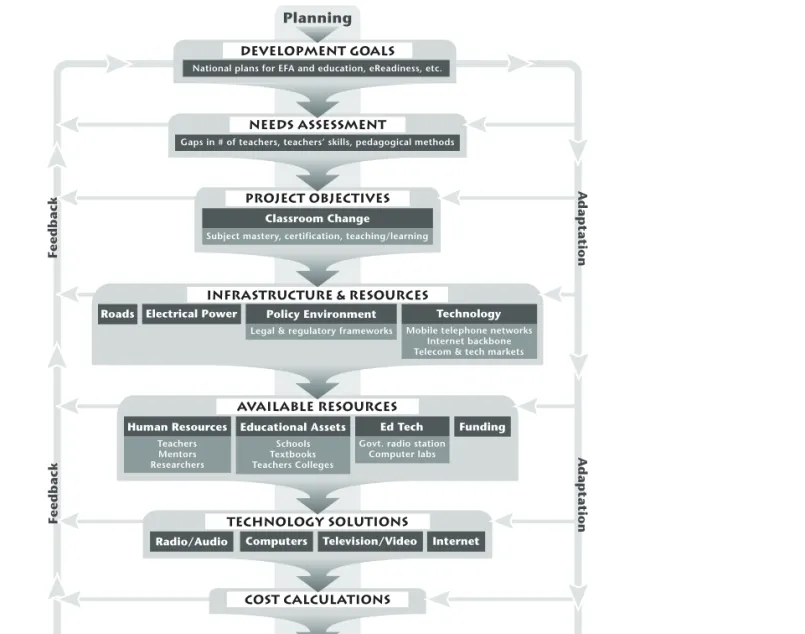
Tables in this section off er overviews of the education-related characteristics of key technologies used to support TPD. Use the tables to compare tools in relation to program objectives. Refer to Figure 1 below for an overview of a planning process to be used in conjunction with this handbook.
FIGURE 1: PLANNING PROCESS FOR ICT-SUPPORTED TPD
COMPUTERS AND THE INTERNET IN TPD AT A GLANCE
MONITORING & EVALUATION COST CALCULATIONS
Radio/Audio Computers Television/Video Internet TECHNOLOGY SOLUTIONS Educational Assets Schools Textbooks Teachers Colleges Ed Tech
Govt. radio station Computer labs Funding Human Resources Teachers Mentors Researchers AVAILABLE RESOURCES INFRASTRUCTURE & RESOURCES Roads Electrical Power Policy Environment
Legal & regulatory frameworks
Technology
Mobile telephone networks Internet backbone Telecom & tech markets
PROJECT OBJECTIVES Classroom Change
Subject mastery, certification, teaching/learning
NEEDS ASSESSMENT
Gaps in # of teachers, teachers’ skills, pedagogical methods
DEVELOPMENT GOALS
National plans for EFA and education, eReadiness, etc.
A daptation A daptation Feedback Feedback Planning
TPD handbook final 2-26-07.indd Sec1:7
Using Technology to Train Teachers 8
COMPUTERS AND THE INTERNET IN TPD A
T A GLANCE
Roles in TPD & education
Strengths Limitations Cost profi le Other considerations •
Flexible and power
ful—can be used to
develop materials, access resources, and communicate
•
Multiple media and platfor
ms combine
text, audio, video, animation, and interactivity
•
Centralized and decentralized com- munication suppor
ts dissemination of
resources and essential feedback from schools
•
May enable lear
ner-centered and
ac-tive-lear
ning pedagogies
•
Enable communication with exper
ts—in-cluding TPD mentors, master teachers, and help desks
•
Improve subject master
y through
Computer-Assisted Instruction (CAI), simulations, and other tools
•
Provide suppor
t for
collaboration—indi-viduals, pairs, and groups of teachers or students can use computers to col- laborate online and face-to-face
•
Suppor
t assessment and
recordkeep-ing—accredited ODL courses, electronic por
tfolios, etc.
•
Potential for revision and new versions suppor
ts refl
ection, self-assessment, and
other lear
ning-related activities
•
Complex tools require both time and TPD to be ef
fective
•
Hardware, software, and operat- ing-systems are fragile—subject to damage by users, viruses, fl
uctuating
electrical power
, etc.
•
Hardware and software lose value and utility as they age—corporate and institutional users plan on 3 years of ser
vice
•
Highly dependent on infrastruc- ture—electrical, telecommunications, road (for repairs), and human (for maintenance and management)
•
Without suppor
t from leadership
and system-wide commitment to new modes of teaching and lear
ning,
impact is limited
•
Provide productivity tools to write repor
ts, make presentations,
commu-nicate, design animations, build W
eb
sites, etc.
•
Provide access to guided TPD resources and collaborative environments, and enable the creation of online communi- ties of practice
•
Enable acquisition of basic computer skills Inter
net Computer Driver’
s License
(ICDL), design skills (e.g., W
eb pages),
programming, and hardware mainte- nance and repair
•
Provide tools (e.g., spreadsheets, databases) that promote higher-order thinking
• V
ariable
production
costs—new software tools (e.g., Flash, Director
, etc.)
drive down production costs of digital content
• V
ariable
content-distribution
costs are contingent on Inter
net connectivity and
resource for
mat
• Signifi
cant
installation,
maintenance, and repair costs
•
Total Cost of Ownership (TCO) model mandates periodic upgrades
•
May contribute to overall e-Readi- ness
•
Advances in wireless, VSA
T,
and
other communications tools may increase Inter
net access
•
Advances in hardware design may increase ruggedness and decrease power requirements
•
Mobile devices (handheld comput- ers, phones) have potential to change TPD-focused communica- tions and access to resources
•
Focus on tools may distract from curriculum-centered lear
ning
(continued on next page)
TPD handbook final 2-26-07.indd Sec1:8
Section 2. ICTs for Teacher Professional Development at a Glance . 9
RADIO AND THE INTERNET IN TPD A
T A GLANCE
•
Can lead to improvements in basic skills
•
Proven curricula in basic math, language ar
ts, health, Early Childhood
Care and Development (ECCD)
•
May be implemented with or without textbooks and other resources
•
Potential to reach large student popula- tions
•
Lack of literacy skills not a barrier
•
Addresses equity and access issues (gender
, ethnic, rural)
•
Can combine hands-on development of teacher skills with student lear
ning
•
Audio lear
ning may suppor
t
visualiza-tion and concept-building by lear
ners
•
Enables instructional continuity across grades and subjects
•
Radio production skills are widespread
•
Durable, sur
vives extreme environments
and long-ter
m use with minimal care
•
Moderate infrastructure requirements
•
Low technical-suppor
t requirements
•
Value of content may degrade over time—long-running programs must evolve with schools and education systems
•
Broadcast air
waves are subject to
political and economic events
•
Tendency to reinforce rote lear
ning
models— interactivity is limited, attention to needs of individual lear
n-ers is limited
•
Fixed broadcast schedule
•
Linear
, one-size-fi
ts-all approach
•
Risk of student and teacher dis- satisfaction —including boredom, es- pecially when lessons are broadcast daily
•
Hardware-replacement programs are necessar
y: Radios and batteries may
be stolen or borrowed
•
Addresses shor
tages of trained teachers
•
Basic-skills instruction—math, health, language-of-instruction (English, French, etc.)
•
Promotes teacher development, primar- ily via demonstration, guided and hands-on classroom management, and building subject knowledge
•
High to moderate content- development costs
•
Star
t-up includes cost of
radios, cassette players, tapes, batteries, materials development, and training
•
Per-student recurrent costs of large-scale programs are ver
y low
•
Funding may combine con- tributions from ministries of communication, broadcast authorities, private radio networks, parents’ groups, and others
•
Low recurrent cost has not ensured sustainability
•
Advance research and for
mative
evaluation are essential for success
•
Impact is increased by teacher development, printed materials, school site visits and other means
•
May incorporate songs, use of real-world objectives (e.g., pebbles or beans as math ma- nipulatives), in-class experiments, pair- and group-work and other active-lear
ning elements
•
Limited quantitative evidence of impact on teacher development
•
Can be used in combination with other technologies, such as video or “pod-casting”—teachers may adopt radio-delivered classroom practices when they see examples on video
Roles in TPD & education
Strengths Limitations Cost profi le Other considerations
TPD handbook final 2-26-07.indd Sec1:9
Using Technology to Train Teachers 10
TELEVISION IN TPD A
T A GLANCE
• Is both powerful (moving images, audio,
etc.) and familiar
•
Can be used to “bring” viewers to the site of events and phenomena
•
Helps teachers implement new tech- niques ef
fectively by obser
ving
demon-strations of classroom management and other teaching practices
•
Has the potential to reach large popula- tions of students and teachers
•
Addresses equity and access issues—al- though access requires electrical power
•
Suppor
ts instructional continuity across
grades and subjects
•
As a visual medium, does not guide teacher through scripted, hands-on classroom activities—unlike radio, television promotes “watch and lear
n,” not “do and lear
n”
•
Involves high development costs which may limit testing, review
,
and revision before programming is launched
•
Value of content may degrade over time—costs of revisions and new programming are high; visual im- ages “show their age”
•
Broadcasts are subject to exter
nal
political and economic disruptions
•
Television production requires sophis- ticated skills and facilities
•
Costs of production and air
time may
infl
uence programming to reach
audiences outside of schools
•
Fixed broadcast schedule—can be augmented by taping
•
Limited by access to electrical power
•
Hardware costs for reception (televi- sion, satellite dish, cabling) and power generation may be too high for poor communities and schools
•
Addresses shor
tages of trained teachers
•
Is a primar
y means of delivering content
and concepts to students across the curriculum
•
Used in development of teacher skills and knowledge
•
Provides views of real classroom prac- tices and lear
ning activities
•
Provides teachers with lear
ning
resources that show distant places, graphical representations of concepts, historical events, etc.
•
High production costs—of- ten US$1,000 per minute
• Commercial
broadcast
rates are ver
y high
•
Local installation includes cost of television, satellite dish (in rural locations)
•
Per-student recurrent costs of large-scale programs are low—but low recurrent costs have not ensured sustainability
•
Funding may combine con- tributions from ministries of communication, broadcast authorities, commercial broadcasters, and others
•
Lack of interactivity can be addressed through a range of af- fordable technologies—fax, email, telephone “call-in” for
mats
•
Impact is increased by teacher development, printed materials, school site visits and other means
•
Limited quantitative evidence of impact on teacher development
(continued on next page)
Roles in TPD & education
Strengths Limitations Cost profi le Other considerations
TPD handbook final 2-26-07.indd Sec1:10
Section 2. ICTs for Teacher Professional Development at a Glance . 11
VIDEO RECORDING IN TPD A
T A GLANCE
•
Teachers benefi
t from seeing other
teachers in action
•
Teachers benefi
t from seeing themselves
in action
•
Video recordings can be used and re- used according to teachers’ schedules
•
Playback controls (rewind, freeze-frame, etc.) enable close analysis of specifi
c
events
•
Video production tools can be used locally—in schools, by ministries, etc.
•
Broadcast quality video is power
ful
(moving images, audio, etc.) and familiar
•
Ef
fective lear
ning resource for teachers
and students—can “bring” viewers to events and phenomena to suppor
t
concept building, retention, etc.
•
Value of content may degrade over time—costs of revisions and new programming are high; visual im- ages “show their age”
•
Video produced by foreign institu- tions may be inef
fective—teachers
may not identify with experiences shown outside recognizable contexts
•
Poor roads, lack of rural electrical power and other challenges to distribution in LDCs may reinforce differences in education access
•
Demonstrates new modes of teaching and lear
ning through views of real
classroom activities (Lesotho video package)
•
Video recording of classes shows teach- ers their own interactions, habits, and progress toward ef
fective teaching
• V
ariable
production
costs—professional quality is high cost; local (in-school) production can be low cost
•
Initial cost of hardware per school is moderate
•
Hardware costs are falling—including digital video cameras, storage media (DVDs, hard drives), and players
•
Distribution of video content to schools may entail low or moderate cost
•
Potential reuse lowers recur- rent costs of large-scale programs
• Professional-quality
resources may be available at low cost from universities or foundations
•
Advances in digital video may increase the value of video for TPD in LDCs—digital video cameras, por
table DVD players
•
New
, power
ful mobile phones can
shoot low-resolution video clips
•
Compression software (e.g., MPEG4, etc.) makes shor
t videos
available via CD-ROM and the Inter
net
•
Easy-to-use editing tools enable moderate-quality video production by ministries, universities, and schools
Roles in TPD & education
Strengths Limitations Cost profi le Other considerations
TPD handbook final 2-26-07.indd Sec1:11
Using Technology to Train Teachers 12
ONLINE DIST
ANCE LEARNING IN TPD A
T A GLANCE
•Anytime, anyplace—wherever connec- tion is available
•
Teachers can interact with exper
t
teach-ers and othteach-ers
•
W
ritten communication (email,
discus-sion) can prompt more refl
ective and considered par ticipation • Suppor ts a range of lear ning styles •
Potential to reach large populations of teachers
•
Dependent on regular access to computers and the Inter
net
•
Teachers must have computer
,
language and literacy
, and teaching
skills to par
ticipate ef
fectively
•
Many self-paced online courses lack high-quality or interactive con- tent—online materials merely replace print materials
•
Inter
net content may be over
whelm-ing—too much and too many choices
•
Online mentoring may be less ef
fec-tive than face-to-face
•
Multimedia and interactive course materials require high bandwidth and power
ful hardware
•
Ef
fect of online TPD on classroom
practice is unclear
•
Provides structured and unstructured TPD to teachers
•
Provides teachers access to lear
ning
resources for use with students
•
Peer mentoring and teacher communi- ties suppor
t TPD initiatives
•
Accredited TPD courses help teachers upgrade qualifi
cations
•
Low costs when teachers access free TPD sites and content (e.g., iEARN, CENSE)
•
High costs when courses have fees (WIDE W
orld)
•
Moderate content develop- ment costs (online courses, por
tals, and communities)
•
Moderate operating costs for facilitated courses, por
tals, and communities
•
In some countries, may best be used to build capacity among master teachers, mentors, and teacher-college faculty
Roles in TPD & education
Strengths Limitations Cost profi le Other considerations
TPD handbook final 2-26-07.indd Sec1:12
TPD handbook final 2-26-07.indd Sec1:13
TPD handbook final 2-26-07.indd Sec1:14
Section 3. Models and Best Practices in Teacher Professional Development . 15
SECTION 3
MODELS AND BEST PRACTICES
IN TEACHER PROFESSIONAL
DEVELOPMENT
GUIDING QUESTIONS
What are the needs of teachers in our country, and how will teacher professional development (TPD) address these needs?
Which of the three models of TPD are most appropriate to the needs of our teachers? Which models are currently being used in our schools?
How can ICTs improve and extend current or projected TPD eff orts?
SUMMARY
To be eff ective and successful, teacher professional development must be of high quality and relevant
to teachers’ needs. No amount of ICT can compensate for TPD that lacks these characteristics.
TPD is the tool by which policymakers convey broad visions, disseminate critical information, and provide guidance to teachers. Eff ective TPD begins with an understanding of teachers’ needs and their work environments—schools and classrooms. TPD then combines a range of techniques to promote learning; provides teachers with the support they need; engages school leadership; and makes use of evaluation to increase its impact. Essential techniques include mentoring, teamwork, observation, refl ection and assess-ment. TPD programs should engage teachers as learners—typically involving the process of “modeling.”2
When computers are involved, TPD programs must address not only teachers’ technical skills, but also their concerns about logistics, about how to use computers with students, and about risks to their status in the classroom. Successful computer-supported or computer-focused TPD provides teachers with hands-on opportunities to build technical skills and work in teams while engaging them in activities that have substantial bearing on their classroom practices or on other aspects of the school workplace.
TPD can be divided into three broad categories:
Standardized TPD
Th e most centralized approach, best used to disseminate information and skills among large teacher populations ■ ■ ■ ■ ■
IN THIS SECTION
Understanding Professional Development Professional Development vs. Training Making TPD Effective
Building Teachers’ Computers Skills Successful Approaches to Computers in TPD What is Technology Integration?
Learner-centered TPD
Professional Development Models The Cascade Model
Strengthening the Cascade Approach in Tajikistan Addressing Women in TPD Site-based TPD Self-directed TPD Web Resources ■ ■ ■ ■ ■ ■ ■ ■ ■ ■ ■ ■ ■ ■
2 Modeling is an instructional method in which teachers experience the kinds of learning that they are expected to implement in the classroom. Design of TPD might, for example, have teachers working in pairs or teams to help build their understanding of collaborative learning.
TPD handbook final 2-26-07.indd Sec1:15
Using Technology to Train Teachers 16
Site-based TPD
Intensive learning by groups of teachers in a school or region, promoting profound and long-term changes in instructional methods
Self-directed TPD
Independent learning, sometimes initiated at the learner’s discretion, using available re-sources that may include computers and the Internet
Standardized TPD includes the Cascade model, frequently used in TPD programs that involve ICTs. In the Cascade model, one or two “cham-pion” teachers at a school might attend centralized
workshops to build computers skills or learn about integrating computers into teaching and learning. When they return to their schools, these champion teachers provide TPD to their colleagues that also builds computer use and integration skills.
Diff erent approaches to TPD can complement each other, and can be implemented in a variety of forms, enabling TPD programs to grow to reach large numbers of teachers while supporting teachers in their eff orts to improve student learning. However, site-based TPD, since it addresses locally based needs and refl ects local conditions, should be the cornerstone of teacher development across the education system.
UNDERSTANDING PROFESSIONAL DEVELOPMENT
Teachers need a wide variety of ongoing opportunities to improve their skills. TPD (also known as “in service” or “teacher education”) is the instruction provided to teachers to promote their development in a certain area (e.g., technology, reading instruction, subject mastery, etc.). TPD is the tool by which policy-makers’ visions for change are disseminated and conveyed to teachers. Th ough the recipient of TPD is the teacher, the ultimate intended benefi ciary is the student. Consequently, professional development is often the most critical component of any ICT project.
Professional Development vs. Training
Professional development is much more than training, though technology training may be one part of TPD. Professional development—including the ongoing workshops, follow-up, study, refl ections, observations and assessment that comprise TPD—accommodates teachers as learners, recognizes the long-term nature of learning, and utilizes methods that are likely to lead teachers to improve their practice as professionals. Professional development takes many forms, such as: when teachers plan activities together; when a master teacher observes a young teacher and provides feedback; and when a team of teachers observes a video lesson and refl ects on and discusses the lesson. Th ese methods of TPD are all more eff ective models of teacher learning than simple training.
Making TPD Effective
Eff ective TPD addresses the core areas of teaching—content, curriculum, assessment and instruction. Regardless of whether ICTs are involved, all TPD projects should:
Address teacher and student needs via approaches that are appropriate for conditions in schools
Be long-term, ongoing, sequenced, and cumulative, providing teachers opportunities to gain new knowledge and skills, refl ect on changes in their teaching practice, and increase their abilities over time
■ ■ ■ ■
CHARACTERISTICS OF
EFFECTIVE TPD
Highly applied, practice-oriented, participatory, and iterative: TPD is often a process of step-by-step familiarization/mastery via “learning by struggling”, and TPD initiatives are too often designed to be “one-size-fi ts-all”, uni-modal (i.e., lecture-based), and overly theoretical, such that teachers never obtain a work-ing knowledge or practice new content/techniques. Chris Spohr
Social Sector Economist, Asian Development Bank Resident Mission in the People’s Republic of China
TPD handbook final 2-26-07.indd Sec1:16
Section 3. Models and Best Practices in Teacher Professional Development . 17 Focus on student learning outcomes in ways that enable teachers to use their new knowledge and skills
Model learner-centered instruction so that teachers experience and refl ect on the learning activities that they will lead
Use formative and summative evaluation for program improvement
BUILDING TEACHERS’ COMPUTER SKILLS
Many computer-supported TPD projects focus on technical concerns, to the exclusion of all others. Underlying these projects is the assumption that learning how to use computers equals knowing how to teach
with computers.
Some degree of technical knowledge is necessary—basic keyboard and mouse skills, familiarity with the operating system and with basic software applications. However, computers are not designed to be used as instructional tools and most teachers need suggestions on how to use them with students. Without those suggestions—and without sensitivity to the array of teachers’ concerns—improving teachers’ computer skills is not likely to lead to students’ use of computers as tools for learning.
Computers raise many concerns among teachers, including:
Technical concerns (“How do I use the computer?”)
Functional concerns (“What can computers help me do?”)
Logistical concerns (“How can I use so few computers with so many students?”)
Aff ective concerns (“Will these computers replace me as a teacher? Will my students lose respect if they think the computer knows more than me?”)
Organizational concerns (“How do I organize my classroom to support the use of computers? How can they be used as part of what I already do in the
classroom?”)
Conceptual concerns (“How can I learn from and with computers?”)
Instructional concerns (“How can computers help my students learn in diff erent ways? How can they support the curriculum? How can they support my teaching? How should I teach using computers?”)
Evaluation concerns (“How do I assess student learning in computer-based projects? How does this new way of learning fi t with national exams?”)
Successful Approaches to Computers in TPD
To increase the likelihood of successful TPD when computers are being introduced, the TPD should be:
Timely
Teachers should learn to use computers at the point in a project when they will have access to them, not before and not after
Job-related
All TPD, including computer-enabled TPD, should connect to teachers’ responsibilities, to their skills and knowledge, or to desired classroom learning outcomes
Welcoming
Many adults have anxiety about learning, or about computers; initial sessions should aim to build “computer comfort,” not high-level skills
Hands-on
Teachers should be asked to learn by doing, not to learn by listening
■ ■ ■ ■ ■ ■ ■ ■ ■ ■ ■ ■ ■ ■ ■
CHARACTERISTICS OF
EFFECTIVE TPD
Any proposal that starts out by “teaching people to use comput-ers” is a dead end. What can it do for me now? How can it reduce my costs for doing things that I do already? How does that free up resources for other activities? How does this technol-ogy enable those activities?
Earl Mardle
Principal, KeyNet Consultancy Sydney, Australia
TPD handbook final 2-26-07.indd Sec1:17
Using Technology to Train Teachers 18
Technically appropriate
Teachers should learn using hardware, systems, and applications that are the same as those they will use in schools
TPD should also be appropriate to the conditions in teachers’ schools. If teachers will be using ten comput-ers with 60 students (or one computer with 60 students), TPD sessions should refl ect this reality.
Th ese strategies—far more than technology training in a computer lab—will result in greater teacher use of technology at the school level. Even when they feel minimally profi cient with ICTs, teachers will use computers if they feel some degree of comfort and confi dence, when they know how computers can improve what they do, and when they have access to functioning equipment and support.
At the point that computers are introduced into schools, head teachers should also receive TPD that builds their confi dence and skills. Head teachers should feel comfortable with their understanding of what teachers are being asked to do, how students can use computers to enhance their learning, and how they too can use computers to accomplish meaningful tasks.
Head teachers should also understand that computers are not inherently valuable. Th eir worth derives from their contribution to the attainment of measurable educational goals..
Learner-centered TPD
Whether it is intended to bring teachers to basic, intermediate or advanced levels of skill—and whether ICTs are used or not—TPD should be learner-centered, enabling teachers to experience the types of instruc-tion that they are asked to provide to their students. Activities model instrucinstruc-tional approaches that teachers can apply in their own settings, and may range from facilitated discussions to working in small groups to project-based instruction.
Within learner-centered TPD, the voices and actions of teachers themselves, not of the TPD provider, should be the focus, and teachers should engage interactively and collaboratively in activities that refl ect their curricula. Like their students, teachers learn by doing—by collaborating with peers, refl ecting, planning classroom activities—not by sitting and listening to a facilitator or following along in directed technology instruction.
■
WHAT IS TECHNOLOGY INTEGRATION?
“Technology integration” refers to the use of computers and the Internet to support teaching and learning across the curriculum. Integrated use of technology may involve students working with computer productivity tools to complete science projects or searching the Internet to fi nd poetry—but it is always tied directly to student mastery of their school subjects.
Properly implemented, technology integration is the best means of building computer skills: Research in South African and Egyptian schools indicates that students learn computer skills better when computers are used to address their own interests rather than in formal skills train-ing.
Technology integration is not: A separate subject, a stand-alone project, a focus of study in and of itself.
Example: Students in a Computer Studies course use a word-processing program to create a newsletter. The purpose of the activity is to build skills using the software. Students’ use of the computer is separate from their study of school subjects. They are learning about computers.
Technology integration is: Using computers on a regular basis, for a purpose connected to math, science, social studies or language arts. Computer use becomes a means of learning, and learning takes place through computer use.
Example: During social studies, a teacher presents students with a task—to research and communicate to the village council fi ve strategies for keeping local water bodies clean. Students use the computer as needed to do research (perhaps with Encarta, a CD-based encyclope-dia) and to prepare fi nal reports. They are learning with computers.
TPD handbook final 2-26-07.indd Sec1:18