Western Washington University Western Washington University
Western CEDAR Western CEDAR
Salish Sea Ecosystem Conference 2018 Salish Sea Ecosystem Conference (Seattle, Wash.)
Apr 6th, 1:45 PM - 2:00 PM
Providing modeling tools on extreme events of climate change to Providing modeling tools on extreme events of climate change to Puget Sound managers
Puget Sound managers
Andrea Copping
Pacific Northwest National Lab., United States, [email protected]
Zhaoqing Yang
Pacific Northwest National Lab., United States, [email protected]
Ian Miller
Washington Sea Grant, United States, [email protected]
Jude K. Apple
Padilla Bay NERR, United States, [email protected]
Guillaume Mauger
Univ. of Washington, United States, [email protected]
See next page for additional authors
Follow this and additional works at: https://cedar.wwu.edu/ssec
Part of the Fresh Water Studies Commons, Marine Biology Commons, Natural Resources and Conservation Commons, and the Terrestrial and Aquatic Ecology Commons
Copping, Andrea; Yang, Zhaoqing; Miller, Ian; Apple, Jude K.; Mauger, Guillaume; Voisin, Nathalie; Fullerton, Aimee; Sun, Ning; and Freeman, Mikaela, "Providing modeling tools on extreme events of climate change to Puget Sound managers" (2018). Salish Sea Ecosystem Conference. 560.
https://cedar.wwu.edu/ssec/2018ssec/allsessions/560
This Event is brought to you for free and open access by the Conferences and Events at Western CEDAR. It has been accepted for inclusion in Salish Sea Ecosystem Conference by an authorized administrator of Western CEDAR. For more information, please contact [email protected].
Speaker Speaker
Andrea Copping, Zhaoqing Yang, Ian Miller, Jude K. Apple, Guillaume Mauger, Nathalie Voisin, Aimee Fullerton, Ning Sun, and Mikaela Freeman
Providing Resource Managers with Modeling
Tools on Extreme Events of Climate Change
Salish Sea Ecosystem Conference Seattle, WA
April 6, 2018
Andrea Copping
Zhaoqing Yang, Mikaela Freeman, Nathalie Voisin, Ning Sun – Pacific Northwest National Laboratory Aimee Fullerton – NOAA Fisheries
Guillaume Mauger, Ian Miller – University of Washington
Jude Apple – Padilla Bay National Estuarine Research Reserve
Extreme Events under Climate Change
Extreme events may be more important drivers of change than long term climate change averages, particularly for resources like fish, water supplies
2
Objective:
Provide information to assist water resource managers and
planners understand the impacts of extreme events on sustainable fish habitat and human water needs in the Puget Sound basin.
Focus on water resource metrics based on outputs of
climate, hydrologic and coastal models
Outputs based on existing data, not new modeling runs
Themes:
Sustainable fisheries and other human uses of water in the basin
Process is stakeholder driven throughout
Provide information in formats accessible for planning and
management 3
Competing Water Use in the Face of Climate Change: Integrated Analysis to Support Water Resource Planning for Extreme Events
Puget Sound Sub-basins
Chose two sub-basins of differing size, with different biogeophysical attributes, different stakeholder needs.
Watersheds
5
Skagit Watershed Council Dungeness River Center
Dungeness
Skagit
Basin type Small (65 sq miles) mountainous.
Limited lowland area. Large (over 1,000 sq miles), mountainous with extensive floodplain and river delta Discharge Small and seasonal Largest freshwater discharge to PS
Stakeholder
groups Agricultural community Municipal water management City of Sequim Tribes Agricultural community Tribes Multiple municipalities Power producers
Salmon Salmon runs in Dungeness, small
estuary connected to Strait Multiple salmonid runs (greatest contribution to PS salmon), large estuary, discharges to Puget Sound
Stakeholder engagement
Stakeholder workshops in Skagit and Dungeness Understand impacts on water use management
Specifically sustainable fish habitat and human water needs (agriculture and water supply)
Determine management needs or concerns for managing under climate change/extreme events
How modeling outputs can be best applied to each watershed
Most useful Information to meet management concerns, accessible format
Stakeholders Participating in Workshops
7 Water resources 23% Scientist 23% Fisheries 18% Tribal community 18% Planner 14% Agriculture 4%DUNGENESS
Water resources 19% Scientist 6% Fisheries 25% Tribal community 25% Planner 19% Special Interest 6%SKAGIT
Workshop Outcomes
8 Dungeness • Increased resiliency Skagit • Changes in tributaries • Managing water use with increasing population • Shoreline inundation • Groundwater• Thresholds for fish survivability: ToC, flows
• Predicting extreme events (high flows/low flows)
• Flooding (stormwater etc.)
• Managing irrigation withdrawals
• Land cover changes: restoration and mitigation Salinity intrusion
Climate Dataset – RMJOC II (CRCC dataset)
New projections of future hydrology
includes:
Streamflow Snow pack
Other elements of water balance
Key parameters of this output:
Impacts of calibration Hydrological model Downscaling approach Global climate model
Green house gas scenario
Better characterization of uncertainty,
improved assessment of future climate
May 25, 2018 10
Watershed Modeling Points:
Fish, Ag, and Municipal Water
May 25, 2018 11
Skagit Watershed:
May 25, 2018 12
Dungeness Watershed:
Metrics
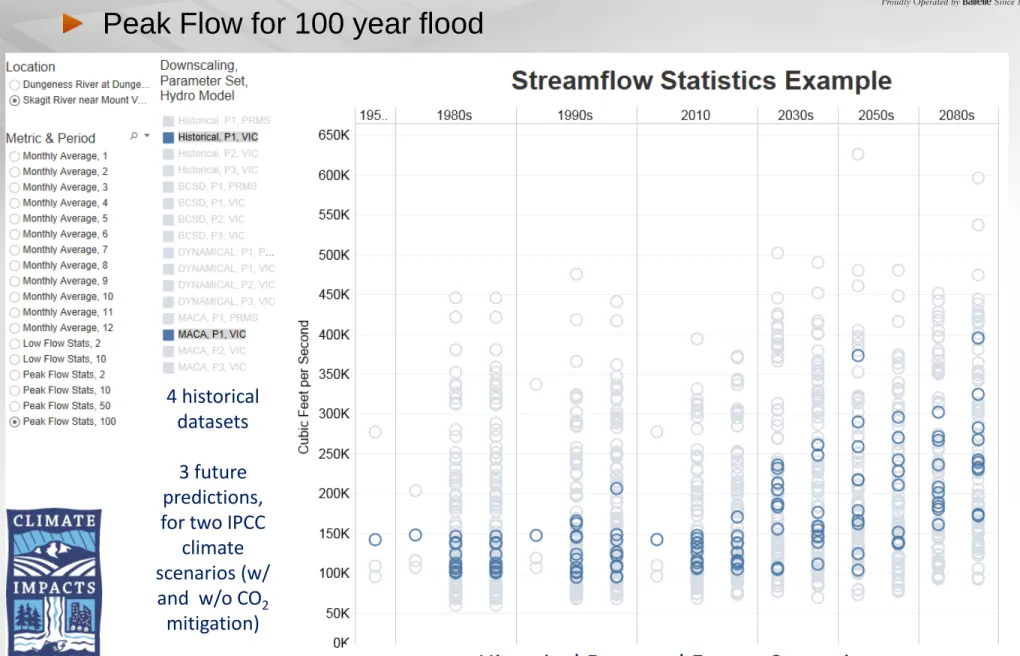
Tableau tool - Skagit
14
Peak Flow for 100 year flood
Historical Data and Future Scenarios
4 historical datasets
3 future predictions, for two IPCC
climate scenarios (w/
and w/o CO2 mitigation)
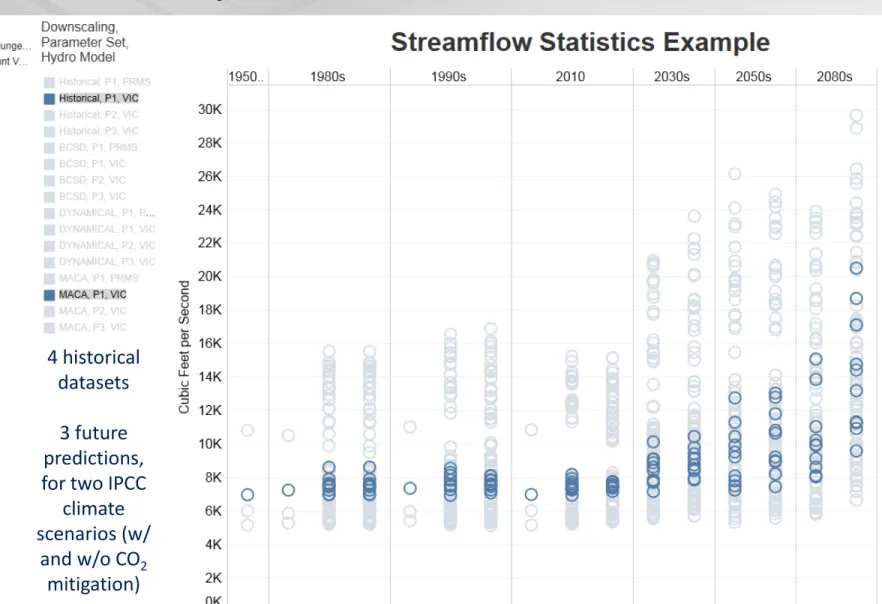
Tableau tool - Dungeness
15
Peak Flow for 10 year flood
4 historical datasets
3 future predictions, for two IPCC
climate scenarios (w/
and w/o CO2 mitigation)
Outcomes and Next Steps
16
Finishing up outputs
Webinar for stakeholders in May/June
Develop and test outputs
Likely interactive, web-based, but functionality will be decided by stakeholders
Limitations
Metrics that this project couldn’t address
Unable to model certain outcomes due to available models and/or time limitations
Thank you!
17
We gratefully acknowledge the support of the NOAA Climate Program Office and our program officer, Nancy Beller-Simms.
Andrea Copping
Pacific Northwest National Laboratory [email protected]
+1.206.528.3049 Zhaoqing Yang
Pacific Northwest National Laboratory [email protected]