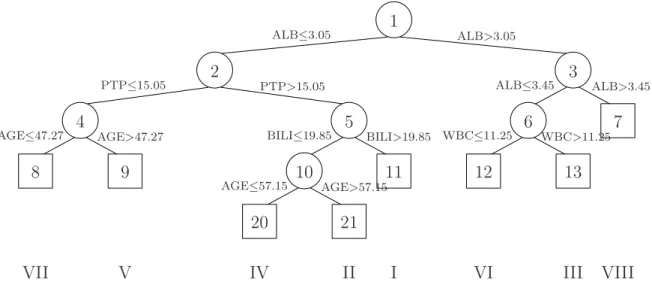
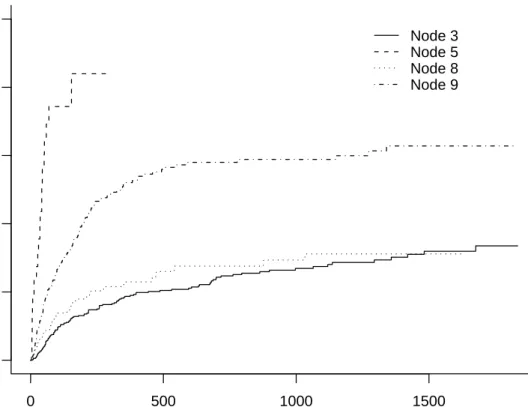
CLASSIFICATION TREES FOR SURVIVAL DATA
WITH COMPETING RISKS
by
Fiona M. Callaghan
M.S., Carnegie Mellon University, 2002
M.A., Carnegie Mellon University, 2000
B.A. (Hons.), University of Canterbury, 1998
B.Sc., University of Canterbury, 1997
Submitted to the Graduate Faculty of
the Department of Biostatistics
Graduate School of Public Health in partial fulfillment
of the requirements for the degree of
Doctor of Philosophy
University of Pittsburgh
2008
UNIVERSITY OF PITTSBURGH
GRADUATE SCHOOL OF PUBLIC HEALTH
This dissertation was presented
by
Fiona M. Callaghan
It was defended on
April 15th, 2008
and approved by
Dr. Mark Roberts, M.D., M.P.P.
Professor, Department of Medicine, School of Medicine
University of Pittsburgh
Dr. Abdus Wahed Ph.D.
Assistant Professor, Department of Biostatistics, Graduate School of Public Health
University of Pittsburgh
Dr. Lisa Weissfeld Ph.D.
Professor, Department of Biostatistics, Graduate School of Public Health
University of Pittsburgh
Dissertation Advisors:
,
Dr. Chung-Chou Ho Chang Ph.D.
Research Assistant Professor, Department of Medicine, School of Medicine,
University of Pittsburgh
Dr. Stewart Anderson Ph.D.
Professor, Department of Biostatistics, Graduate School of Public Health,
University of Pittsburgh
CLASSIFICATION TREES FOR SURVIVAL DATA WITH COMPETING
RISKS
Fiona M. Callaghan, PhD
University of Pittsburgh, 2008
Classification trees are the most popular tool for categorizing individuals into groups and
subgroups based on particular outcomes of interest. To date, trees have not been developed
for the competing risk situation where survival times are recorded and more than one
out-come is possible. In this work we propose three classification trees to analyze survival data
with multiple competing risk outcomes, using both univariate and multivariate techniques,
respectively. After we describe the method used in growing and pruning the classification
trees for competing risks, we demonstrate the performance with simulations in a variety
of competing risk model configurations, and compare the competing risk trees to currently
available tree-based methods. We also illustrate their use by analyzing survival data
con-cerning patients who had end-stage liver disease and were on the waiting list to receive a
liver transplant.
Public Health Significance: Competing risks are common in longitudinal studies. The
clas-sification tree for competing risks will provide more accurate estimates of risk in distinct
subpopulations than the current tree techniques can provide.
TABLE OF CONTENTS
PREFACE
. . . .
viii
1.0 INTRODUCTION
. . . .
1
2.0 MOTIVATION: THE LIVER TRANSPLANT DATA
. . . .
3
3.0 LITERATURE REVIEW
. . . .
8
3.1 CLASSIFICATION METHODS
. . . .
8
3.2 CLASSIFICATION AND REGRESSION TREES
. . . .
10
3.3 SURVIVAL TREES
. . . .
11
3.4 COMPETING RISKS
. . . .
14
3.4.1 Summary Curves for Competing Risks
. . . .
15
3.4.2 Regression Analysis for Competing Risks
. . . .
17
4.0 OUTLINE: CLASSIFICATION TREES FOR COMPETING RISKS
.
20
5.0 UNIVARIATE CLASSIFICATION TREES FOR COMPETING RISKS
22
5.1 INTRODUCTION
. . . .
22
5.2 TREE TO MAXIMIZE BETWEEN-NODE HETEROGENEITY
. . . .
24
5.2.1 The Growing Stage
. . . .
24
5.2.2 The Pruning Stage
. . . .
27
5.3 TREE TO MAXIMIZE WITHIN-NODE HOMOGENEITY
. . . .
30
5.3.1 The Growing Stage
. . . .
30
5.3.1.1 Sum-of-squares impurity function.
. . . .
30
5.3.1.2 Absolute value impurity function.
. . . .
31
5.3.2 The Pruning Stage
. . . .
31
5.4.1 Performance of Splitting Methods
. . . .
34
5.4.2 Performance of Methods to Detect Data Structure
. . . .
37
5.5 APPLICATION TO DATA FROM THE LIVER TRANSPLANT WAITLIST
41
5.6 DISCUSSION
. . . .
45
6.0 MULTIVARIATE TREE METHOD
. . . .
52
6.1 INTRODUCTION
. . . .
52
6.2 THE GROWING STAGE
. . . .
53
6.3 THE PRUNING STAGE
. . . .
56
6.4 SIMULATIONS
. . . .
59
6.4.1 Performance of Splitting Methods
. . . .
59
6.4.2 Performance of Methods to Detect Data Structure
. . . .
66
6.5 APPLICATION TO LIVER TRANSPLANT WAITLIST
. . . .
82
6.6 DISCUSSION
. . . .
88
7.0 FUTURE WORK
. . . .
91
7.1 DISTANCE FUNCTIONS: BETWEEN- AND WITHIN-NODE
. . . .
91
7.2 VARIANCE-BASED WITHIN-NODE UNIVARIATE TREE
. . . .
92
7.2.1 Review: Variance-based Univariate Survival Tree.
. . . .
92
7.2.2 Growing, pruning and selection for variance-based tree.
. . . .
93
7.3 WITHIN-NODE MULTIVARIATE TREE FOR COMPETING RISKS
. . .
94
7.4 OTHER ISSUES
. . . .
97
APPENDIX. SIMULATION PROGRAM
. . . .
99
LIST OF TABLES
1
Number of Adult Candidates Removed from Liver Transplant Waiting List
.
7
2
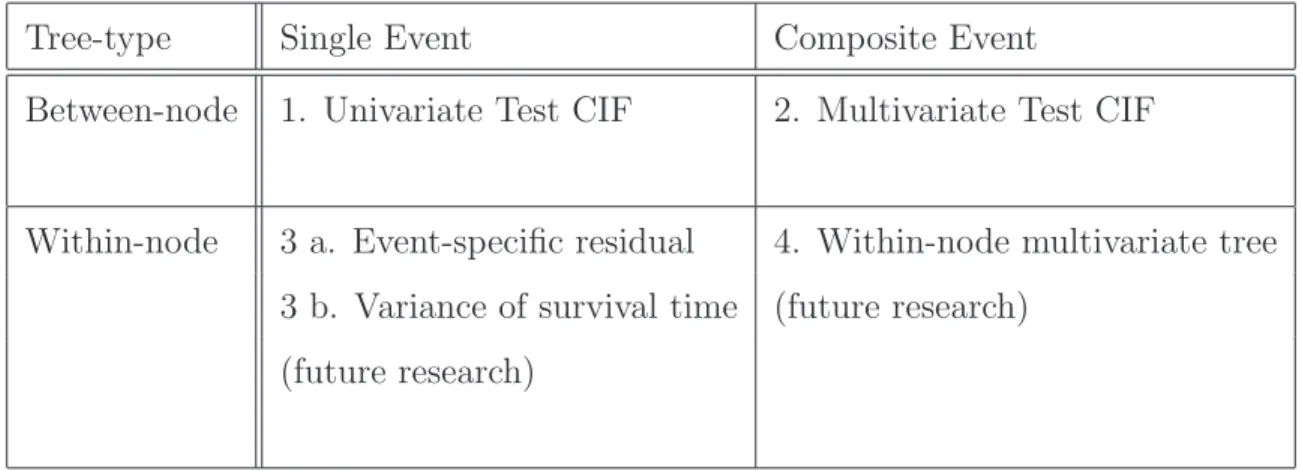
Proposed survival trees for competing risks
. . . .
21
3
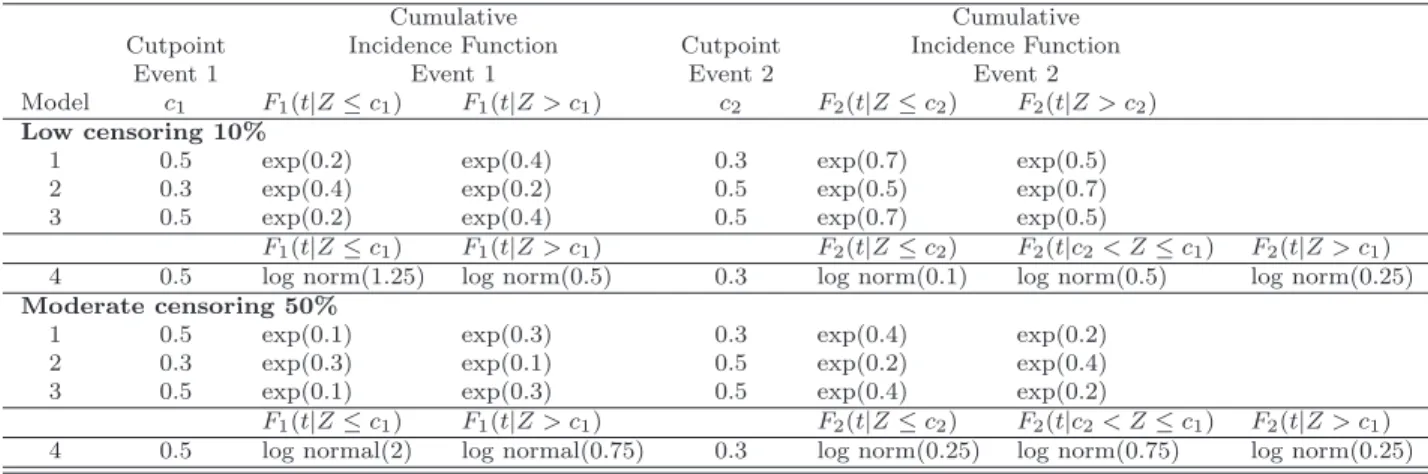
Description of simulations for splitting, univariate methods
. . . .
35
4
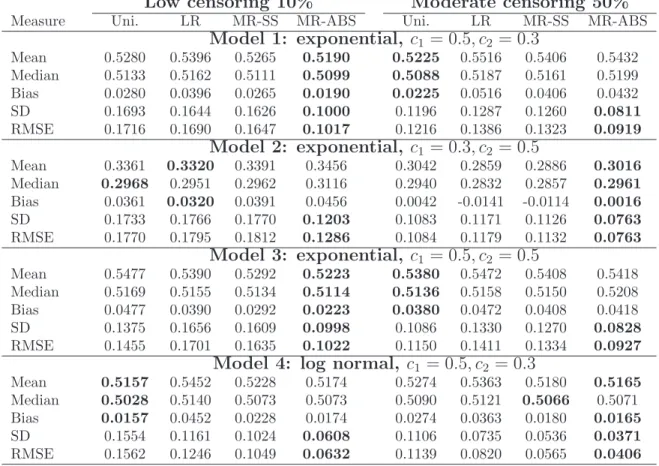
Estimated cutpoint from various methods, where one event of interest
. . . .
36
5
Description of models used in univariate simulations for data structure
. . . .
40
6
Investigating tree structure with one event-of-interest, N=500
. . . .
42
7
Investigating tree structure with one event-of-interest, N=1000
. . . .
43
8
Summary of between- and within-node trees for liver transplant data.
. . . .
46
9
Description of simulations for splitting, multivariate method
. . . .
62
10 Estimated cutpoint, multiple events of interest, Models 1–4.
. . . .
64
11 Estimated cutpoint, multiple events of interest, Models 5–6.
. . . .
65
12 Description of models used in simulations for data structure,1A–5B.
. . . . .
79
13 Investigating tree structure multiplicative models, 1A-5A.
. . . .
80
14 Investigating tree structure, additive models 1B–5B.
. . . .
81
15 Description of models used in simulations for data structure, 1C–2D.
. . . . .
83
16 Investigating tree structure with constant CIF for event 1, Models 1C–2D
. .
84
LIST OF FIGURES
1
A tree, subtree and branch.
. . . .
12
2
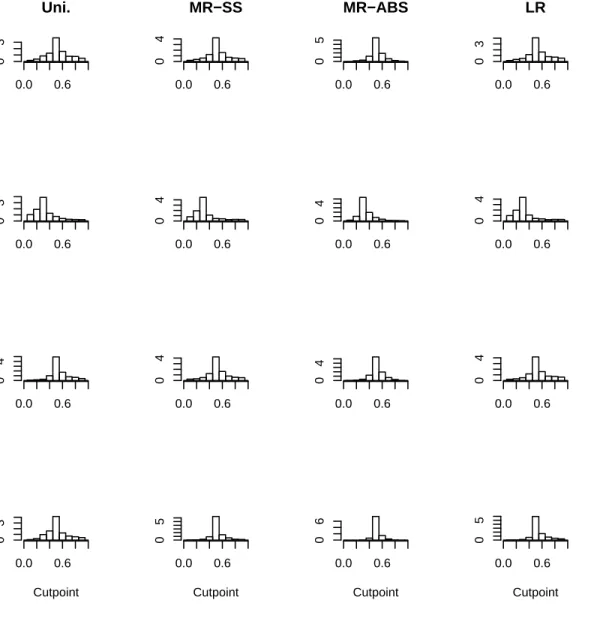
Univariate methods, distribution of estimated cutpoints, 10% censoring
. . .
38
3
Univariate methods, distribution of estimated cutpoints, 50% censoring
. . .
39
4
The between-node tree for data from the liver transplant waiting list.
. . . . .
47
5
The within-node tree for data from the liver transplant waiting list.
. . . .
48
6
CIF of pre-transplant death for each terminal node of the between-node tree.
49
7
CIF of pre-transplant death for each terminal node of the within-node tree.
.
50
8
Distribution of estimated cutpoints, Model 1 Low Censoring
. . . .
66
9
Distribution of estimated cutpoints, Model 1 Moderate Censoring
. . . .
67
10 Distribution of estimated cutpoints, Model 2 Low Censoring.
. . . .
68
11 Distribution of estimated cutpoints, Model 2 Moderate Censoring.
. . . .
69
12 Distribution of estimated cutpoints, Model 3 Low Censoring.
. . . .
70
13 Distribution of estimated cutpoints, Model 3 Moderate Censoring.
. . . .
71
14 Distribution of estimated cutpoints, Model 4 Low Censoring.
. . . .
72
15 Distribution of estimated cutpoints, Model 4 Moderate censoring.
. . . .
73
16 Distribution of estimated cutpoints, Model 5 Low Censoring.
. . . .
74
17 Distribution of estimated cutpoints, Model 5 Moderate Censoring.
. . . .
75
18 Distribution of estimated cutpoints, Model 6 Low Censoring.
. . . .
76
19 Distribution of estimated cutpoints, Model 6 Moderate Censoring.
. . . .
77
20 The multivariate classification tree for patients on liver transplant waitlist.
. .
87
PREFACE
I would like to thank my advisors – Dr Joyce Chang and Dr Stewart Anderson – and the
committee for their help and support in producing this dissertation. I would also like to
thank the Institute for Clinical Research Education and the Department of Biostatistics for
their support both financial and otherwise. My time at the University of Pittsburgh has
been an enjoyable one and this is due in no small part to the people I have worked with and
the friends I have made over the years. Finally, I would like to thank my family and, above
all, my partner Matthew Jackson for all his love and support.
1.0
INTRODUCTION
In the United States, the number of patients who have a serious liver disease and require a
liver transplant is far greater than the number of organs available for transplantation. It is
therefore important to allocate organs in an optimal manner. One goal is to identify groups
at risk from death while on the waitlist (pretransplant death). The method currently used
to allocate organs to patients on the waiting list for a liver transplant is based on scores
derived from a model for end-stage liver disease (MELD). This model is a Cox proportional
hazards model that treats death before receiving a transplant (pretransplant death) as the
event of interest and treats competing events as censored. Patients with a higher risk of
pretransplant death have higher MELD scores (derived from the likelihood based on the
MELD model) and are thus more likely to receive a liver transplant.
One of the weaknesses of using a Cox proportional hazards model in estimating the
likelihood of pretransplant death is that it does not account for the various types of outcomes
that explain why a patient is removed from the waiting list. For example, although it
accounts for removal due to pretransplant death, it does not account for removal due to
receipt of a transplant or due to a health improvement that makes a transplant unnecessary.
Failure to account for these competing risks may result in biased survival estimates. There
are numerous methods for analyzing competing risks, but all of them involve restrictive
assumptions, some are difficult to interpret in a clinical situation, and none are classification
techniques, which would be the most appropriate techniques for identifying risk groups for
organ waiting lists and organ allocation problems.
In recent years, the classification and regression tree (CART) methods of Breiman et al.
[
2
] have been applied to survival data in several fields, including finance, engineering, and
health sciences. CART methods can be used to break data observations into similar groups
by means of a series of binary (yes/no) questions or covariates. Although CART has been
applied to univariate and multivariate survival data, it has not been applied to data with
competing risks. The goal of this study is to use various features of existing trees for survival
and nonsurvival data to develop a family of classification trees for data with competing
risks. Specifically, the objectives are to develop several methods for growing, pruning, and
selecting trees and to propose a schema for comparing the performance of different trees
through extensive simulations, to compare the performance of trees that do and do not take
competing risks into account, and to create available macros for the competing risk trees in
R.
2.0
MOTIVATION: THE LIVER TRANSPLANT DATA
About 16,900 adults are currently on the waiting list for a liver transplant in the United
States. Because this number greatly exceeds the number of organs that will become available,
it is crucial to allocate organs in a highly effective and appropriate manner. Scores derived
from the model for end-stage liver disease (MELD [
21
]) are currently used to prioritize the
order in which liver transplant candidates who are adults (18 years or older) will receive
transplants as donor organs become available. The MELD score is used to predict the
likelihood that a patient will die while awaiting a liver transplant (pretransplant death).
This likelihood is in turn used to rank the patient on the list of candidates awaiting liver
transplantation. The use of the MELD score in the organ allocation system is designed to
allow available organs to be given to transplant candidates according to the severity of their
liver disease, rather than the length of time that they have been on the waiting list.
The MELD uses a Cox proportional hazards regression model [
6
] and currently includes
the following covariates for each patient: the serum bilirubin level, the creatinine level, and
the international normalized ratio (INR) for prothrombin time. When the Cox model is used
to estimate the probability of pretransplant death via MELD scores, it treats transplant and
removal from the waiting list for other reasons (e.g. improvement in medical condition) as
censored events. In other words, it only takes into account the hazard rate of death before
receiving a transplant and ignores the hazard rates of other competing events. This is
prob-lematic because the presence of competing events may fundamentally alter the probability
of pretransplant death. Additionally, the events other than pretransplant death may be of
interest to the physician for their own sake, and not just as a confounding factor.
There is a need for a method to predict the risk of pretransplant death that also accounts
for the effect of the other risks, namely “recovery before transplant” and “transplant”. If we
ignore the competing risk aspect of the data and use techniques designed for one outcome,
we get biased estimates of risk. A secondary goal is to not only adjust for the presence of
other competing risk events, but also to predict the risk for more than one kind of event
simultaneously, when more than one kind of event is of interest to the physician. For instance,
we may no longer wish to simply adjust for the recovery outcome, but we may want to predict
it alongside the pretransplant death outcome.
When each subject at at risk from more than one kind of event, we say that competing
risks are acting on each subject. More formally, a situation is said to involve
competing
risks
when each observation can fail from one of
J
(
J
≥
2) causes and, furthermore, the
occurrence of one of these events
precludes
the observation of any of the other events (Klein
et al. [
17
]). This is the definition of competing risks that we will be using in this work.
One common method for analyzing competing risks data is a Cox model stratified on
different competing risk events. This model is based on the event-specific hazard function. In
general, hazard functions are more difficult to interpret in a medical setting than quantities
such as the cumulative incidence function or the survival function. Additionally, it is often
the case that the effect of a covariate on the cause-specific hazard is quite different to the
effect the covariate has on the cumulative incidence probability [
24
,
14
]. As a result, an
analysis of covariate effects using the cause-specific hazard function can be misleading if the
goal is to predict probability of risk. Additionally, the Cox model assumes the proportional
hazards assumption which can be difficult to verify and interpret.
An alternative to the event-specific hazard is the cumulative incidence function (CIF).
It is defined as the probability of an individual experiencing an event by time
t
when other
competing risks are acting on the individual. The cumulative incidence function models the
more “real world” situation and it is directly related to crude survival rates, so it is essential
to decision makers. However, many situations require more than just a summary measure;
some form of regression would be useful. To estimate failure in the presence of competing
risks, Fine and Gray [
10
] proposed a proportional hazards model for the CIF, and this
re-gression model has been used widely in medical research (e.g., Guardiola [
15
]; Rocha et al.
[
28
]; Clave et al [
5
]; Farag et al., [
9
]). Despite the merits of using a regression model based
on CIF when competing risks are present, this type of model has several limitations when
applied to the problem of estimating survival rates for patients who are awaiting an organ
transplant. For example, the model would be complicated to expand and difficult to
inter-pret if we wanted it to account for time-varying and nonlinear covariate effects and include
possible interaction effects among covariates. This type of model usually requires potentially
restrictive assumptions, such as the proportional hazards assumption. Furthermore,
regres-sion models such as the Fine and Gray model do not provide a clear method for classifying
patients into groups. Many problems are essentially classification problems where we wish
to assign patients to groups with different levels of risk.
It would be very useful to have a method that could answer the following questions:
What is the most likely outcome for this patient? Which treatment option should be used,
given the patient’s medical history? What are the subgroups in the the population with
most or least risk of pretransplant death (after accounting for the competing risks nature of
the data)? A classification method would be more suited to this problem than a regression
method. The classification and regression tree methodology adapted for competing risks
that we will develop in this research is an attempt to address these problems.
CART-style decision trees are a very popular tool in survival analysis. Like regression
techniques (such as the familiar Cox model) the researcher can use survival trees to create
a model that predicts the outcome using a range of covariates. However, survival trees
have several advantages over traditional regression techniques. Firstly, tree methods do not
require a functional form relating an outcome to the covariates. Survival trees do not require
a proportional hazards assumption, and in general require less assumptions than regression
techniques. They are more suited to classification of outcomes, which is a common goal for
survival analysis, for instance when we wish to predict treatment options or type of outcome
given a set of covariates. In this way, survival trees can be more suited to clinical practice than
regression. They are also easier to explain and interpret than regression based on hazards,
because they can be based on a range of non-hazard measures of risk (e.g. survival curve,
cumulative incidence function) and they can be easily represented graphically in the form of a
binary tree. They can also handle time-dependent covariates and high-level interactions with
relative ease. However, to date, there have been no survival trees developed for competing
risks. The purpose of this work is to extend the area of survival trees to the competing risk
setting.
For this dissertation, we will use the database from the Organ Procurement and
Trans-plantation Network (OPTN) portion of the United Network for Organ Sharing (UNOS)
database. The OPTN/UNOS database has the advantage of providing data on a national
sample of liver transplant candidates. However, because this database does not include
lab-oratory information for years earlier than 2002, it is necessary for us to also use clinical and
laboratory data from a more detailed database, the University of Pittsburgh Medical Center
(UPMC) database. Together the two databases will provide us with the information we need
to develop and evaluate our models.
UNOS is a U.S. nonprofit organization that manages the nation’s organ transplant
wait-ing lists, matches organs with the patients who need them, and maintains a national database
of pretransplant and follow-up information on every transplant recipient. Before the year
2002, the information included each patient’s socio-demographic data, etiology-based
cat-egory of liver disease, date of joining the transplant list, and date and reason for leaving
the transplant list. Beginning in 2002, the information collected also included the results of
serologic tests (e.g., serum creatinine and bilirubin levels) and liver function tests.
The most recent data available from OPTN/UNOS consists of information about
can-didates who were on the liver transplant waiting list at any time between 1995 and 2004.
Table
1
shows the number of adult candidates who were removed from the waiting list during
this period because of one of the following: (a) receipt of a transplant, (b) the occurrence of
death before receipt of a transplant, or (c) other reason (e.g. an improvement in health that
caused a change in the need or desire for a transplant).
Table 1: Number of Adult Candidates Who Were Removed from the Liver Transplant
Wait-ing List (1995-2004).
Year
Reason for
1995
1996
1997
1998
1999
2000
2001
2002
2003
2004
Removal
Transplant 3,298 3,393 3,487 3,816 4,117 4,311 4,527 4,812 5,137 4,332
Death
752
916
1,081 1,315 1,753 1,708 1,918 1,796 1,715 1,223
Other
488
706
637
671
791
1,111 1,217 2,497 1,603 1,055
Source: www.optn.org/data/
3.0
LITERATURE REVIEW
3.1
CLASSIFICATION METHODS
There are many techniques that have been designed to discriminate observations into groups.
The purpose of this dissertation is to develop a classification technique for competing risks
data, which combines features of multinomial data and time-to-event data. We are interested
in identifying groups of individuals that have similar survival patterns over time. When we
have a competing risks situation, each subject can experience one of a number of different
events and we are interested in the time to the event, as well as the type of event. The nature
of the outcome means that the current techniques for classification are not appropriate. We
wish to develop a method of classification that accommodates features unique to competing
risk data.
In the following, we look at some of the most commonly used techniques used for
fication of continuous, binary or multinomial random variables, and the discussion of
classi-fication as it applies to survival analysis will be left until after the discussion of competing
risks and time-to-event data (see Section
3.3
).
Logistic regression is a method commonly used to estimate odds, odds ratios, and
prob-abilities for binary outcomes and continuous or categorical predictors. Additionally, logistic
regression can be used for classification by using the predicted probability to indicate whether
an observation is more or less likely to be a “success” or a “failure”. If we let
pi
be the
pre-dicted probability of success for the
i
th observation (with
i
= 1
, ..., n
), then for some cut-off
value
p
we can classify any observation using the following rule: if ˆ
pi
≥
p
then the
i
th
observation is classified as a success; if ˆ
pi
< p
then the
i
th observation is classified as a
failure. Logistic regression is useful for classification of binary outcomes because it is a fairly
straight-forward method and it can utilize categorical and continuous information to predict
the outcome.
Potentially, we have an infinite number of possible decision rules corresponding to the
infinitely many possible cutoff values for
p
. To help us choose the best classification rule,
we can calculate the sensitivity,
P r
(classify as success
|
observed success), and specificity,
P r
(classify as failure
|
observed failure), for each value of
p
= ˆ
pi
, based on our data. Ideally,
we would like to have a sensitivity and specificity close to 1, but this is not possible –
sensitivity increases as
p
increases, whereas specificity decreases with increasing
p
. We
choose a value of
p
that corresponds to acceptable levels of sensitivity and specificity. The
ROC curve (receiver operating characteristic curve) is a plot of 1-specificity versus sensitivity.
The area under this curve is a statistic used to give an overall measurement of how well the
logistic regression model predicts the outcome, or, in other words, how well it classifies the
observations as successes or failures.
An important weakness of logistic regression involves regression’s usefulness in modeling
conditional relationships among the predictor variables. If the effect of one variable depends
upon the values of another variable then we model this by way of an interaction effect
between two predictors, and we proceed similarly for 3- or 4-way dependencies. However,
these dependencies can be difficult to identify and the inclusion of many interactions or
multi-level interactions leads to a complicated model that can be difficult to fit and to
interpret. However, the main limitation for logistic regression is that can only be used
for binary outcomes and cannot be used to handle the complexities of time-to-event data.
Recall that competing risks data generally has multiple possible outcomes and time-to-event
information. We can only apply logistic regression to survival data if all the subjects are
observed for the same amount of time and we only have two possible outcomes (success and
failure).
To accommodate multiple outcomes we could use multinomial logistic regression, which
is form of regression designed to handle the situation where there are three or more
categor-ical outcomes. Suppose we have
i
= 1
, ..., N
subjects and each will have one of
j
= 1
, ..., J
possible outcomes. With multinomial logistic regression we can use continuous and
cate-gorical information about each subject to generate predicted probabilities ˆ
pij
that subject
i
will experience event
j
. Once we have these probabilities, we can assign any number of
classification rules, for instance we may say that if ˆ
pij
is the largest predicted probability
for subject
i
, then we predict outcome
j
for that individual. There has been some research
into ROC-style curves for more than two outcomes, and multinomial logistic regression is a
technique that might be used to handle competing risks data, but, as with logistic
regres-sion, we would need to have observed all the subjects for the same length of time, which is a
serious limitation. Furthermore, even if patients were observed for the same amount of time,
neither the logistic nor multinomial models take into account the failure-time data.
3.2
CLASSIFICATION AND REGRESSION TREES
Regression trees were introduced by Morgan and Sonquist [
23
], and became very popular
with the introduction of CART (Classification and Regression Trees) by Breiman, Friedman,
Olshen and Stone [
2
]. Regression trees help us to identify groups of subjects with similar
outcomes, based on the subjects’ covariates. They require very few statistical assumptions,
can handle many kinds of data type and they are relatively easy to interpret.
The central idea behind CART is to use binary partitions to create mutually exclusive
groups of observations that are homogeneous with respect to the outcome. We start with
the covariate space
X
and split this into two
daughter nodes
, say
X
1
and
X
2
, with the goal of
trying to make the subsets more homogeneous than the previous set. We further split
X
1
and
X
2
into two parts to get
X
1
,
X
2
,
X
3
,
X
4
and continue doing this until we have a collection of
subsets
X
1
, ...,
X
k
of
X
such that all or most of the subjects in each subset are very “similar”,
by some measurement.
In the language of trees, a subset
X
k
of
X
defined by a binary split is called a
node
.
The final subsets that we end up with when we have finished splitting the tree are known
as
terminal nodes
. An
internal node
is any node of a tree that is not a terminal node. The
root node
is the first node of the tree, before we have split the data, and is equivalent to
X
. The terminal nodes form a partition of
X
. Each terminal subset is designated by a class
label, and there may be two or more terminal nodes with the same class label. A
branch
of
T
is a tree that has an internal node of
T
as a root node, and contains all of the subsequent
daughter nodes below that node in
T
. Finally, a
subtree
T
∗
of
T
shares the root node of
T
,
but may not share all the subsequent branches of
T
. See Figure
1
.
The CART algorithm involves calculating the change in homogeneity from parent node
to daughter nodes for each potential split, in order to pick the best split at each node of the
tree. This is measured with the change in impurity function
φ
. CART focuses on minimizing
within-node difference (impurity). A common measure of impurity is within sums of squares
of the outcome, if the outcome
y
is continuous. For example, for node
p
,
φ
(
p
) =
P
i
∈
p
(
yi
−
y
¯
)
2
.
The change in impurity from parent node
p
to the left daughter node
L
and right daughter
node
R
using split
s
is therefore
φ
(
p, s
) =
φ
(
p
)
−
φ
(
L
)
−
φ
(
R
). The aim of the CART
algorithm is actually to
maximize
this reduction in impurity at each step.
In general, there are four main steps to growing a tree. The first step involves selecting
an appropriate measure of “homogeneity” or “impurity” for the outcome. The second step is
deciding on a methodical way of growing the tree and some kind of stopping-rule (for instance,
we stop when the sample size is very small in each terminal node, or the observations in each
terminal node have identical covariates). The third step is to prune the large tree that we
grew in the previous step, in such a way that we generate an ordered list of trees from largest
to smallest (root node only). In the fourth step (tree selection) we have a criteria to choose
the “best” tree; the goal is to find the simplest tree that still categorizes the observations
effectively.
In the following sections, we will look at some of the different applications of within-node
classification trees and between-node classification trees, firstly for non-time-to-event data
and then incorporating survival times, multiple event survival times and finally competing
risks.
3.3
SURVIVAL TREES
In recent years, there have been many applications of regression trees to survival analysis.
Survival analysis techniques are very common in medical research and there is also a desire
A.
1
2
3
4
5
8
9
B.
1
2
3
4
5
C.
2
4
5
8
9
Figure 1: A tree, subtree and branch.
A.
A tree. Node 1 is the root node; Nodes 1, 2 and 4 are internal nodes; and Nodes 3, 5, 8,
and 9 are terminal nodes. The numbering of the nodes is as follows: the left daughter node
of node
n
is node 2
n
and the right daughter node is node 2
n
+ 1.
B.
A subtree of the tree
in A.
C.
A branch of the tree in A.
on the part of physicians to have decision rules for diagnosis. Hence, these two factors
have provided a strong motivation for developing regression trees for survival analysis. In
the area of univariate survival analysis (one subject, one possible outcome, all independent
observations) there have been two main approaches.
The first approach is analogous to CART method of Breiman, et al. [
2
] The goal at
each step when growing the tree is to maximize homogeneity of the outcome within each
node. Many authors have taken this approach, including Gordan and Olshen [
13
], Davis and
Anderson [
7
], Therneau, Grambsch, and Fleming [
33
], Molinaro et al. [
22
] and LeBlanc and
Crowley [
18
]. Typically, the continuous outcome used in CART is replaced with martingale
residuals [
33
] or with deviance [
18
], and then sums of squares are formed by squaring and
summing the residuals. Another technique developed recently by Jin et al. [
16
] involves
calculating the sums of squares within a node using the variance of the survival times.
A second method has been to grow the tree maximizing between-node separation. This
is known as the “goodness-of-split” method, and generally uses a two-sample statistic, such
as the log-rank statistic, to measure between-node heterogeneity. For each potential split, a
two-sample statistic is calculated, and the “best” split is the one with the largest (or most
significant) statistic. Some authors who have developed and extended this technique include
Ciampi et. al.[
4
], Segal [
30
], and LeBlanc and Crowley [
19
]. This method of growing a tree
departs from the CART algorithm in growing the tree and in the methods for pruning and
selection.
Recently, survival trees have been used to model correlated, multivariate outcomes.
Cor-related outcomes generally occur in one of two possible ways. In the first case, each subject
can experience multiple events, such as recurrence of disease in a cancer study or recidivism
in crime statistics. The events occur serially in time and this kind of data is called
multiple
event time data
. The second kind of data is called
clustered failure time data
and it occurs
when the observations are naturally clustered, for instance when investigating disease among
families or time to decay of teeth, where we have multiple observations per individual. These
events occur a “parallel” manner in time.
Frailty models and Wei-Lin-Weissfeld marginal models are two approaches for handling
correlated data in survival analysis that have been adapted to regression trees. Su and Fan
[
32
] used gamma distributed frailty models to come up with a likelihood ratio test splitting
rule, while Gao, Manatunga and Chen [
11
] used a Wald test splitting rule and gamma
distributed frailty. Both sets of authors have also built trees with the Wei-Lin-Weissfeld
marginal method. Su and Fan [
31
] and Fan et al. [
8
] used a robust log rank statistic derived
from the marginal approach for the splitting rule, and Gao, Manatunga and Chen [
12
] used
the Wei-Lin-Weissfeld method to develop a survival regression tree with the property of
having proportional hazards over the whole tree, rather than just between daughter nodes.
All of these trees employ a maximizing-between-node-difference approach. A general “road
map” for how one might construct a multivariate regression tree for survival analysis using
the CART approach has been proposed by Molinaro et al. [
22
]. This approach involves
substituting the uncensored survival times into an appropriate loss function (eg. within
sums of squares). Censoring is adjusted for by incorporating IPCW or inverse probability of
censoring weights in the loss function.
None of these approaches considers the usual competing risks situation, where each
subject experiences only one event that could be one of several mutually exclusive types. In
Section
3.4
we review common techniques for analyzing competing risks data.
3.4
COMPETING RISKS
Competing risk data occurs when we have time-to-event data with more than one kind of
outcome. When we have competing risk data, the occurrence of the competing risk event
precludes
any other kind of event from happening. An alternative definition that is sometimes
used does not require the outcomes to be mutually exclusive (we can observe more than one
kind of event per individual). In this proposal, we will assume the former definition
(time-to-event data with mutually exclusive types of outcomes) of Klein and Moeschberger [
17
] and
Kalbfleisch and Prentice [
26
]. Typically, there is an “event of interest” (for instance, time to
transplant) that is the primary focus of the research, and competing risk events (for instance,
time to withdrawal from the study due to side-effects), that prevent us from observing the
true time to the event of interest for every subject. We may also have a “true censoring”
outcome: observations that are censored due to drop-out or to non-study related reasons.
However, it is not necessary to “privilege” one kind of event over another; we may have a
number of events of equal interest. In either case, if we want to estimate the probability of
an event, we will have to account for or adjust for the presence of the other events. There
is some debate in the literature over the best estimator to use when dealing with competing
risks data. The most common candidates are the cause-specific hazard function, and the
cumulative incidence function.
3.4.1
Summary Curves for Competing Risks
The following discussion uses the notation of Klein and Moeschberger [
17
]. Let
Xj
, j
=
1
, ..., J
be the potential, unobservable time to occurrence of the
jth
competing risk. What
we observe is the time to the first failure from any event
T
= min
j
(
X
1
, ..., XJ
) and
δ
, an
indicator which records which of the
J
competing risks caused the subject to fail (
δ
=
j
if
T
=
Xj
). We can think of each type of event as having a
cause-specific hazard rate for risk
j
defined as,
λj
(
t
) = lim
∆
t
→0
P
[
t
≤
T < t
+ ∆
t, δ
=
j
|
T
≥
t
]
∆
t
where
T
is the time to the event
j
. The cause specific hazard is the rate at which subjects
who have not yet experienced any of the competing risks are experiencing event
j
. The
overall hazard rate for the time to failure,
T
, is the sum of the
J
cause-specific hazard rates,
λT
(
t
) =
J
X
j
=1
λj
(
t
)
There are two important disadvantages to the cause-specific hazard rate. The first is problem
is interpretability: it is a difficult quantity to translate into something meaningful for
physi-cians. This is why some kind of probability is usually used (such as the survival function
or cumulative incidence function) to summarize the chance of a particular competing risk
occurring. The second problem relates to covariates. Covariates can have a very different
effect on the cause-specific hazard function compared to, say, the cumulative incidence
func-tion. This can be a problem because it is more natural to think of a covariates effect on the
risk or probability of an event, rather than the conditional rate of change of the probability
(hazard) and therefore it is easy to confuse the impact of a covariate on the hazard rate with
the impact of the covariate on the probability.
At first glance, a survival function seems like a good candidate to model competing risks
because it is a function that is used in other areas of survival analysis and the Kaplan-Meier
curve is a familiar and relatively simple estimator. Let
S
(
t
1
, ..., tJ
) =
P
[
X
1
> t
1
, ..., XJ
> tJ
]
be the
joint survival function of the
J
competing risks
. Then the
net survival function for
risk
j
,
Sj
(
t
), is the marginal survival function found from the joint survival function by
taking
ti
= 0 for all
i
6
=
j
, or
Sj
(
t
) =
S
(0
, ..., tj, ...,
0) =
P
[
X
1
>
0
, ..., Xj
> tj
, ..., XJ
>
0]
The interpretation of the net survival function is the probability of failure from event j in a
world where other competing risks are not present. Generally this is not a useful quantity
to estimate because it does not reflect the real world situation.
The
cumulative incidence function for risk
j
(also known as “crude probability” and
“cause-specific sub-distribution function”) is defined to be
Fj
(
t
) =
P
[
T
≤
t, δ
=
j
] =
Z
t
0
hj
(
u
) exp
{−
HT
(
u
)
}
du
where
HT
(
t
) =
P
J
j
=1
R
0
t
hj
(
u
)
du
is the cumulative hazard rate of
T
. The cumulative incidence
function is interpreted as the probability of failure by time
T
from event
j
in a world where all
the competing risks are acting on the individual. This is a useful interpretation that is more
easily applicable to the real world than that of the net survival function, and this accounts
for much of the popularity of the cumulative incidence function in modeling competing risks.
Fj
(
t
) depends on the hazard rates of the other competing risk events. This leads to
another advantage of the cumulative incidence function. Since the cause-specific hazard
rates can be directly estimated from the observed data,
Fj
(
t
) is also directly estimable
without making assumptions about the joint distribution of the potential failure times. It
should be noted that
Fj
(
t
) is non-decreasing and
Fj
(0) = 0, but it is not a true distribution
function since lim
t
→∞
Fj
(
t
) =
P
[
δ
=
j
]
<
1, hence the reason for
Fj
(
t
) also being called
“sub-distribution” function.
There are two other main candidates to model competing risks data: the
partial crude
sub-distribution function
and the
conditional probability function
. The partial crude
sub-distribution function
F
J
j
(
t
) is very similar to the cumulative incidence function, except that
a subset of the competing risks are removed from consideration. The interpretation of this
function is the probability of death from risk
j
in a world where only some of the competing
risks are acting on the individual.
Formally, let
J
be the set of risks that an individual can fail from, and
J
c
be the set
of risks that are removed. Let
T
J
= min(
Xj
, j
∈
J
). The
partial crude sub-distribution
function
is defined as,
F
J
j
(
t
) =
P
[
T
J
≤
t, δ
=
j
]
, j
∈
J
The other estimator that is sometimes used is the
conditional probability function
,
CPj
(
t
)
which is described by Pepe and Mori [
25
] as the probability of experiencing event
j
by time
t
given the subject has not experienced any other event by time
t
. For simplicity, suppose
that there is one event of interest
X
1
and one competing risk event
X
2
(however, all the
results and definitions can be generalized to
J
possible risks). Then
CP
1(
t
) is defined as,
P
[
X
1
≤
t, X
1
< X
2
|{
X
2
< t, X
1
> X
2
}
c
] =
F
1(
t
)
F
c
1
(
t
)
where
F
c
1
(
t
) denotes the complement of
F
1
(
t
).
3.4.2
Regression Analysis for Competing Risks
There are two popular methods for regression analysis when competing risks are present:
re-gression on cause-specific hazards using the competing risks analogue to the Cox proportional
hazards model, and the regression model for the cumulative incidence function proposed by
Fine and Gray [
10
].
In proportional hazards regression on the event-specific hazards we model the
cause-specific hazard for cause
j
for a subject with covariate vector
Z
as
where
λj
0
is the baseline cause-specific hazard rate for cause
j
and
βj
is the covariate effects
on cause
j
. This is a straight-forward application of stratified Cox-regression, however the
covariate effects require careful interpretation. Under the usual Cox regression situation (in
the absence of competing risks) two survival functions
S
1
and
S
2
based on covariate values
Z
1
and
Z
2
are related with the following formula,
S
2
=
S
exp(
β
T