Engagement in practice: Case studies of
teaching and learning at ECU
Iris Mao
∗Charn Nang
†∗Edith Cowan University, [email protected] †Edith Cowan University, [email protected]
Copyright c2009 by the authors. eCULTURE is produced by The Berkeley Electronic Press (bepress). http://ro.ecu.edu.au/eculture
Iris Mao and Charn Nang
Abstract
A paradigm shift to a life-long learning model has increased the demand for the Tertiary Education Institution to engage closely with external community in teaching and learning prac-tice. Engagement activities have been undertaken in universities across Australia but its type and scope varies across the universities. A need is identified to develop valid and reliable indicators to measure the level and value of engagement for the key stakeholders. This paper examines the theoretical aspects of engagement in teaching and learning and discusses issues and problems of the engagement activities at Edith Cowan University using two case studies. It aims to provide an overview and background to developing good engagement activities and possible solutions for issues encountered in the practice of incorporating engagement activities in higher education.
Engagement in Practice: Case Studies of Teaching and Learning at ECU
Iris Mao Charn Nang
Abstract: A paradigm shift to a life-long learning model has
increased the demand for the Tertiary Education Institution to engage closely with external community in teaching and learning practice. Engagement activities have been undertaken in universities across Australia but its type and scope varies across the universities. A need is identified to develop valid and reliable indicators to measure the level and value of engagement for the key stakeholders. This paper examines the theoretical aspects of engagement in teaching and learning and discusses issues and problems of the engagement
activities at Edith Cowan University using two case studies. It aims to provide an overview and background to developing good engagement activities and possible solutions for issues encountered in the practice of incorporating engagement activities in higher education.
Introduction
The concept and practice of engagement is definitely not new. With an increasingly globalized social and economic environment, higher education needs to be both locally and internationally relevant. According to Winter, Wiseman and Muirhead (2006), the
exhortation for universities to engage more fully with community needs, regional issues and economic development through local applicable research and teaching has gained increasing credence and support from community members, policy makers and many academics. A report by Australian Universities Quality Agency (2008) (AUQA) highlights that the
attention to community engagement is increasing in the higher education sector and to engage with the community has become an obligation. It is now commonly expressed in university policies as well as government policies such as the „Higher education at the crossroads‟ (Nelson, 2002). The strategic plan of Edith Cowan University (Hereafter, ECU), called “Engaging Minds, Engaging Communities. Towards 2020”, has defined “Engaging and serving our communities” as the first strategic priority area of ECU.
AUQA (2008) also states that many universities acknowledge that more work is needed to develop reliable indicators relevant to monitoring; the achievement of their community engagement goals and the benefits that flow from community and university partnerships. Most importantly, measurement of engagement should be gathered from the perspective all the key stakeholders involved. Currently, the measurement of engagement activities requires more research and development.
How can we gather the evidence to demonstrate the most effective activities and what engagement activities or combination of will best enhance student learning at Edith Cowan University? With these two questions in mind, this paper will first review the theoretical basis for engagement in teaching and learning, then critically evaluate the engagement activities undertaken to measure the level of engagement in the undergraduate curriculum at ECU and finally explore the issues encountered while undertaking engagement activities through in-depth analysis of two individual cases.
Literature Review
Defining engagement
Engagement is one of a number of terms that have entered the higher education debate as beyond the somewhat unsatisfactory „trinity‟ of teaching, research and service.
Engagement is an attempt to place the university role of service as the core function of teaching and research. The term “engagement” is used by contemporary universities to characterise their contribution to the communities in a way that recognises new, largely commercial imperatives rather than merely relying on the altruistic associations of service. Engagement involves responding to the needs of partners in business, government and the professions and the community sector and can profoundly inform universities‟ approaches to teaching and research as well as to service.
ECU has adopted the definition of engagement by Garlick and Langworthy (2004): “University-community engagement is defined by its focus on reciprocal, mutually-beneficial knowledge-driven relationships between the higher education institutions and community partners…..”
Therefore, engagement is interaction with the external community (ECU, 2008) and can be achieved through research, teaching and learning. Interaction with the external community aims to engage more fully with community needs, regional issues and economic development (Winter, Wiseman & Muirhead, 2006). External communities include regional partners, industry, government, alumni, indigenous communities, community organisations as well as other education sectors (AUQA, 2008). For example, engagement issues that are commonly addressed in tourism education research are community, industry issues and training needs. The key element for successful, meaningful and sustained engagement is the mutual benefits for all stakeholders involved including students, the university and the community (ECU, 2008).
Engagement in Teaching and Learning
There are many forms of engagement and examples include; work integrated learning, internships, international experiences and exposure to curricula that are informed by real world problems and solutions (Langworthy, 2009). The type and scope of engagement activities varies across universities in relation to the forms of civic and social engagement. Winter, Wiseman and Muirhead (2006) states that these activities are influenced by place, history and mission of the university. For example, universities in Victoria engage through teaching and learning in three ways: work based or service learning which aims to provide the student with vocational experience as well as a greater sense of social responsibility and civic engagement; curriculum design that aims to meet local needs; and the formal teaching of civics and democracy.
Work-based learning (WBL) schemes, implemented in the United States of America since 1906 and arguably earlier in Europe, was an effort to prepare students for the world of employment (Sovilla, 1998). Now it has become incredibly widespread as a component of higher education program.
Engagement through teaching and learning has the potential to increase students‟ employability and harbours the larger possibility of civic and social engagement. More specifically, documented benefits of engagement activities include skill development, deep learning and enhanced reputation for the university in the community (ECU, 2008). It is with these benefits in mind that many universities, internationally and nationally, are now placing a major effort as well as funding into the development and improvement of engagement
practices.
Analysis & Discussion:
There is a need to develop reliable indicators to assess the benefits of engagement activities. At the university level, universities are concerned with measuring levels of involvement with engagement activities for programs or courses but it is argued that consistent evaluation and feedback needs to be gathered in order to determine the value of particular engagement activities as well. Comparisons should be made between different forms of engagement activities to determine the advantages and disadvantages of
implementing particular activities.
It may be quite common that feedback is often not systematically gathered or only informally gathered. This notion may come from the perception that all engagement activities provide some sort of potential advantage and that there is no need to systematically evaluate or monitor the benefits of the activities. However, it is important to gather evidence to demonstrate effectiveness of activities for the purposes of best practice.
Many universities have developed their own methodologies for recording the level of engagement. There are guidelines as to how to measure engagement set up by ECU (2008) for each of the engagement activities relating to; course design, unit delivery, course products and services, workplace/community activity ad workplace integrated learning. The
information details questions to consider (E.g., Was the course design guided by strong industry/community input and involvement?) and also provides examples of what specific activities can be measured in frequency (E.g., guest lectures, students on field trips).
In order to quantify the form and level of engagement in the undergraduate
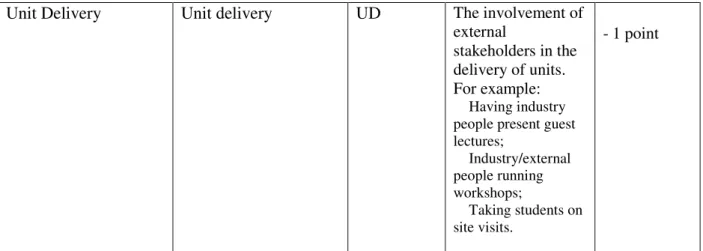
curriculum at ECU, the Engagement Mapping Activities was undertaken in December 2008 to implement a strategy that would provide an objective, valid and reliable measure for curriculum engagement. The element chosen to measure curriculum engagement included: Active consultative committee (ACC); Industry/community involvement in course design (ICD); Industry/community inputs and feedback (ICF); unit delivery (UD), course products and services (PS), workplace/community activity (WCA) and workplace integrated learning (WIL) (See Table 1).
Course products and services
Course products and services
PS The evidence of
opportunities for creation of products and services for external
stakeholders from learning activities. For example
Design students creating Web pages for external clients;
Advertising students undertaking advertising briefs for real clients;
Education students developing
curriculum
materials for use by teachers; WAAPA students presenting public performances. Workplace/community activity Workplace/community activity
WCA The involvement of students undertaking activities in the workplace and/or community. For example Psychology students working in primary schools providing advice to students; Law students working in an advisory capacity; Marketing students completing projects for clients; Students undertaking workplace projects for course credit.
- 5 points
Workplace
Intergrated-learning
Workplace Integrated-learning
WIL The existence of the opportunity for students to learn through experiences in workplace settings with formalised partnerships. For example: Nursing students undertaking practicum placements in hospitals Paramedical students undertaking pracs as ambulance drivers Teaching students undertaking practicum placements in Schools - 10 points
Course Design Active consultative committee
ACC Whether the course has an active consultative committee that has regular meetings. The score for this item should reflect the existence and activity of a Course Consultative Committee - 10 points Industry/community involvement in course design
ICD Whether the design of this course was guided by strong industry/community input and
involvement. The score reflects the level of
involvement and response to industry input in the course design. -0 point: for a Consultative Committee 0 meetings this year -3 points: for a Consultative Committee with 1 meeting this year -5 points: for a Consultative Committee with 2 or more meeting this year Industry/Community
inputs and feedback
ICF Whether there are industry/community inputs and feedback into the course that are used for continuous improvement. The score will reflect the scope and extent of such feedback and evidence of uptake in the course -1 point: for Consultative Committee input alone -3 points: for Consultative Committee input and demonstrable input from industry and employees -5 points: for industry accredited course
Unit Delivery Unit delivery UD The involvement of external stakeholders in the delivery of units. For example: Having industry people present guest lectures; Industry/external people running workshops; Taking students on site visits. - 1 point
Table 1: Current Engagement Mapping Activity at ECU (ECU 2008)
Case Studies
Two individual programs are chosen as case studies and are illustrative examples of how engagement activities are implemented through teaching and learning at Edith Cowan University. The case studies also aim to document some the challenges that arise through engagement activities as well as perceived benefits. The two programs are respectively the Hospitality and Tourism Management Program (HTM) at School of Marketing, Tourism & Leisure and Speech Pathology Program (SP) at School of Psychology and Social Science. HTM program has been running for many years but currently undertaking course review in order to offer quality products to meet off-shore demand while the SP program is a new program receiving its first-intake of students only in this year. It deems to cover a diverse range context under which engagement activities are being undertaken.
In order to analyse the current and proposed engagement activities of each program, each case study in the following report will first provide an overview of the program
structure, then summarise the engagement activities currently implemented with a statement of current progress. After that, a discussion will be provided on future engagement activities and proposed aims.
Case 1: Tourism Management Program
The Tourism Management Program (School of Marketing, Tourism and Leisure) currently provides three degree courses including Bachelor of Tourism Management, Bachelor of Hospitality and Tourism Management and Associate Degree of Tourism
Management. The Bachelor courses comprise a 16 unit-core, 8 unit-supplementary program; the Associate Degree courses comprise a 12-unit core, 4-unit supplementary program and the Majors an 8-unit structure. The Associate Degree course is base on the 1st/2nd year units of Bachelor degree course. It provides an optional entry/exit for people who do not qualify the entry requirement for Bachelor course or people who do not intend to spend time for three-year full-time study of Bachelor course.
Current or Completed Engagement Activities
The following part provides a discussion of the engagement practices currently employed by the Tourism Management Program, which have been categorised according to
the Edith Cowan University (2008) report on Engagement through Learning and Teaching.
Course Design – Consultation with Community
The current tourism program has a strong Consultative Committee consisting of industry leaders. The committee meet up at least twice a year. With the prospective of integrating tourism and hospitality management into a cohesive program, a new consultation committee has been formed in place in 2009 and members are current industry leader from either hospitality or tourism background at Western Australia.
The newly appointed Consultative Committee is actively involved in course design. As a result of an increased off-shore demand for these courses and a commitment to deliver a high quality product, a course review is being undertaken at School of Marketing, Tourism & Leisure to revise the structure and content of three undergraduate courses: Bachelor of Hospitality Management (BHosp), Bachelor of Tourism Management (BTsm) and Bachelor of Hospitality and Tourism Management (BHosp&Tsm).
Two committee meetings have been held respectively on 10th March and 19th March 2009. The first meeting is seeking feed-back from industry as to what they see as the key elements to be included in the courses in terms of „skills‟ and „knowledge‟. The second meeting is to assess the draft of these restructured undergraduate units/courses. In addition, the meeting also explores the opportunity of professional postgraduate courses (i.e. Graduate Certificate/Graduate Diploma/Masters) to address the regional demand.
These meetings, on one hand, incorporated industry input for us to provide quality courses of industry relevance. It also allows the university to produce graduates whom are highly employable and competitive in terms of skill and knowledge. On the other hand, it helps to identify niches and opportunities for the university to offer courses of high quality and high market demand. The meeting also offers networking opportunities to establish a positive partnership between the university and the industry.
Unit Delivery – Guest Lectures, Fieldtrips
Guest lectures and fieldtrips are integral part of most hospitality and tourism units. With highly practical orientation, the program provides plenty of opportunities for students to be exposed to up-to-date issues and real world situations by inviting industry partners to the classroom or taking students to the real work place. For example, cruise ship tourism where students visited a cruise ship and participated in a river cruise tour provided them with a real life context for the unit content.
Course Products and Services– Real World Projects
Students in some units in the program are required to participate in a real-world project and produce market reports or research reports to industry partners. For example, Tourism Research and Analysis (TSM2107) aim to provide students with research skills and experience through a real-world research project in the second semester of 2008. Students participated in questionnaire, data analysis and report writing. The challenge is to coordinate the semester time table with the project timetable of the industry partner. As there is no formal commitment, the projects are never guaranteed. It totally depends on lecturers‟ efforts to convince the stakeholder and secure the project, which is time-consuming and not
sustainable.
This is a current unit originally designed for hospitality students only. Even though it currently takes in tourism students, there is not much support for them. Feedback from tourism students are mainly concerned with the stress they experience with having to contact workplaces for placement themselves as there are not established partnerships between university and tourism sectors. In addition, some feedback from hospitality students shows that they learn very little from their placements as they were only given some trivial and non technical jobs in the back office.
Future Engagement Activities
Course Design
A regular meeting with Consultative Committee need be held at least twice a year to identify the need to course revision or provide direct input or feedback. Periodical course revision or benchmarking activities
Unit Delivery – Adjunct Lectures from Industry
Current level of engagement in unit delivery is adequate. Adjunct lecturers are appointed to strength this partnership with industry in unit delivery. Adjunct lecturers are current senior industry leaders who make formal commitment to provide their service by coming to the class and organizing workshops for the students by themselves or via their colleagues.
Course Products and Services– Real World Projects
A long-term collaboration with local hospitality and tourism industry partners should be established to ensure that plenty of real world projects are available for students to work on. It will also help to ensure the quality output of student projects if the projects are long-term collaborations. For example, the new unit Tourism and Hospitality Research
(TSM2211) unit should establish sustainable on-going research collaboration with a few local stakeholders in hospitality and tourism industry. Students who are learning research can actually carry on the real research under the supervision of lecturer by participating in research design, data collection, data analysis and produce research report for the industry partners. It makes the teaching and learning more interesting, challenging and relevant. It will be a valuable experience for students and the output can also be actually used by the industry partners.
The industry benefits from the intellectual resources of the university solving practical problems through research. The empirical data can be utilized to produce publication as research output for university with the consent of the industry partner.
Workplace Integrated Learning – Professional Industry Experience
This is an aspect that the program needs to enhance the most. The restructured unit will provide opportunity for both hospitality and tourism students to obtain industry
experience. It is important to compile a list of industry partners who make their commitment to provide on-duty training opportunities to our students through hands on practice or
observation. The new unit should provide more specific outcome based evaluation to ensure that students have received valuable experience at workplace.
Case 2: Speech Pathology Program
The Speech Pathology Program (School of Psychology and Social Science) received its first intake of students in 2009. Upon graduation of the four year undergraduate degree, students will be qualified speech pathologists eligible for membership with Speech Pathology Australia, the professional body for speech pathologists in Australia.
Current or Completed Engagement Activities
The following is a summary of the engagement practices currently employed by the Speech Pathology Program. They have been categorised according to the Edith Cowan University (2008) report on Engagement Through Learning and Teaching.
Course Design – Consultation with Community
The curriculum for the program was written before the current ECU speech pathology staff came onboard. However, as the program is still in its early days it still has some
flexibility for some changes to be made or ideas to be incorporated. In order to consider some feedback from the community, meetings with some clinicians working in the industry were conducted. ECU speech pathology staff members have met with the following groups to date:
Health Department Child Development Centre Clinicians Speech Pathology Australia WA Management Committee Paediatric Clinicians (Interagency Meeting)
Royal Perth Hospital, Speech Pathology Department Royal Perth Hospital, Medical Physics Department
Princess Margaret Hospital, Speech Pathology Department Therapy Focus Inc.
Fremantle Hospital, Speech Pathology Department
These meetings have allowed discussion of the program‟s curriculum with the clinicians including the program‟s major focuses of rural and remote health, indigenous health and a social approach to management. We have been able to gain perspectives from the clinicians as to what they believe would be important for our students to attain at their tertiary education. Most of the issues that were discussed included suggestions of what specific knowledge and skills students should have prior to commencement of clinical practicums, as well as discussions surrounding teaching approaches.
The meetings with the community clinicians have also assisted in developing initial relationships with ECU and the speech pathology community. Many of the clinical facilities we have met with so far were very enthusiastic and impressed by our willingness to spend some time networking and gaining feedback.
A disadvantage of gaining community feedback in regards to course design has been the number of ideas, potential projects and collaborations that have been identified. It has been somewhat challenging for ECU speech pathology staff to take on all the comments and ideas, and to translate these into practice will take time and much discussion.
Workplace Integrated Learning - Structured Observation Session
the practical work of a Speech Pathologist via a Structured Observation Session. The major aim of the observation was for students to learn about the speech pathology setting and profession and observe the work of a speech pathologist in a day. Clinical facilities were contacted and requests were made for some available observation sessions. Securing these placements was dependent on the personal networks that the lecturer had as there are no official agreements in place. Students attended the observation session in pairs for
collaborative learning purposes. It also helped the students to feel more comfortable about attending an unfamiliar and professional setting.
This early exposure to the industry in which our graduates will eventually work in received much positive feedback both from the students and the clinical supervisors. Students completed, as part of an assessment, a poster and oral presentation of their experience at the observation day. It was demonstrated that the students found the whole experience highly valuable. This is an official statement from a First Year Speech Pathology student in response to the question:
What do you consider the best or most beneficial aspect of your course so far?
“I really find that practicals are very valuable as they provide so much on hands learning in such a short period of time. You get to actually see the things you are studying.” (Joan, personal communication, April 2009)
In addition, in conjunction with the meetings described previously with community clinicians, early contact with clinical facilities and the new program at ECU has been
instrumental in developing an initial working relationship with clinical facilities. All of these clinical facilities will hopefully be involved in the ECU program at a deeper level in
particular with providing our students with clinical practicums in the near future. The preparation time required to provide students with the experience of an
observation day was significant. Firstly, ECU staff was required to compile documentations of all the pre-clinical requirements a student needs to have met before going out on a
placement. This involved research into the immunisation, police clearance, first aid and other requirements of the clinical facilities (Department of Health, Department of Education and other private organisations). A number of agencies were contacted to develop our own pre-clinical requirements as well as contacting other pre-clinical courses available at ECU (E.g., nursing and occupational therapy).
The final item which required significant commitment was looking for and securing observation days for the students. We relied on ECU staff and their current contacts and also many emails/phone calls out to significant community clinicians.
Future Engagement Activities
Course Design – Consultation with Community
The program is in the process of composing a Consultative Committee. The purpose of this committee is aligned with the Edith Cowan University Policy for Consultative Committees – Industry/Employer Advisory Mechanisms (2003, p. 1) which states that the purpose is “To provide a consultative process which results in the University receiving advice from industry, employers and the community on its course, teaching, research and
professional community engagement”.
Course Delivery - Guest Lecturers
Next semester (2009) the program has no specific speech pathology related units. We would like to keep the students in close contact with each other so we have arranged a
the process of finalising guest speakers to come and lecture to the students during these meetings. Students have been encouraged to come along and hear from a number of
significant people in the speech pathology setting. We will be scheduling in a representative from Speech Pathology Australia (professional body for speech pathologists), a clinician working in disability, a clinician working in rural and remote health and a consumer/person with a communication disorder.
Course Products and Services – Developing Programs
Speech Pathology students will be required to develop programs in the later years of the program. These may be educative packages for teachers, parents, community groups or other consumer groups of speech pathology services.
Workplace Integrated Learning
Our students will need to complete clinical practicums in the community to obtain their occupation specific competencies for graduation. This is a requirement of the
professional body – Speech Pathology Australia. They will have formal clinical supervisors who will grade them on their learning. Therefore in the later years of the program our students will be placed in clinical facilities which include – Department of Health,
Department of Education, Private Organisations, Non-for-Profit Organisations to complete workplace integrated learning.
Table 3 summarises the engagement activities discussed above for the HTM and SP program.
Action Tourism & Hospitality Management Speech Pathology ACC Active Consultative Committee Current A Consultative Committee is currently in place, which should require regular meeting at least twice a year.
A Consultative Committee has been collated and will have its first meeting in 2009
Future Regular meeting with
Consultation Committee at least twice a year
Regular meetings will be conducted
ICD
Industry/community involvement in course design
Current Input from consultative
committee in course design
Input from industry employees through formal meetings
Future Input from Consultative
Committee, industry employee (alumnus) or professional organization on course design. Developing industry accredited course
Input from industry employees through formal meetings for course design/content, Consultative Committee, industry accredited course ICF Industry/community inputs and feedback
Current Feedback from industry
to Course Coordinator during the year
None
Future Periodical course/unit
revision or
Ongoing input from industry employees
benchmarking with input from industry to meet the up-to-date demand from the industry.
through formal meetings
UD
Unit Delivery
Current Guest lecturers
Field trips
None
Future Adjunct lecturer from
industry was appointed in 2008
Guest lecturers Field trips
Guest lecturers (areas)
WCA
Workplace/community activity
Current Some units have
incorporated real-world projects as an
assessment such as Tourism Research and Analysis, Hospitality & Tourism Marketing.
None
Future Continues the practice
of incorporating real work project into teaching. Clearly outline the outcome and
responsibility of stakeholders. None WIL Workplace integrated learning
Current HOS 2700 Hospitality
Industry Experience
Structured observation days
Future A new unit TSM3300
Professional Industry Experience for both hospitality and tourism students will be introduced in the 1st semester of 2010. This unit provides a professionally supervised work integrated learning experience in the hospitality and/or tourism industries.
Clinical practicums for which our students will be marked according to the industry
competencies standards
Table 3: Summary of Engagement Activities: Hospitality and Tourism Management Program (HTM) vs.
Speech Pathology Program (SP)
ECU Mapping Engagement Activity
The data from current Engagement Mapping activity at ECU has demonstrated current level of engagement through teaching and learning for both programs (see Table 2). As a brand new program, the Bachelor of Speech Pathology course has not been evaluated in this activity this year. Therefore data is only available for the hospitality and tourism program in the table. For the interpretation of the data, the university denoted that 30 points and below are considered unsatisfactory; 31-50 points are satisfactory; and 50 points and above are above
satisfactory. The data shows that courses in hospitality and tourism management program are in general satisfactory.
Courses Indicators
ACC ICD ICF UD PS WCA WIL TOT
HTM BTsmMgt 3 3 1 9 0 10 10 36
BHosp&TsmMgt 3 3 1 8 5 10 10 40
BHospMgt 3 3 1 9 5 0 10 31
AsDegTsmMgt 3 3 1 9 0 10 10
AsDegHospMgt 3 3 3 2
Table 2: Engagement Mapping Data: Hospitality and Tourism Management Program (HTM) vs. Speech
Pathology Program (SP) 3.3 Summary
It is evident from the two case studies presented above that the fundamental principles of engagement are the same for these two very different bachelor-level programs. The
activities are also quite similar and aim to achieve similar outcomes. The two case studies also demonstrate a variety of different ways to incorporate engagement activities and this is dependent on a number of issues specific to the industries and communities relevant to each program. For example, the SP course has to work closely with the national body for speech pathologists in Australia; Speech Pathology Australia for accreditation purposes to allow ECU graduates to work in the field as graduates, whereas the HTM program works with individual businesses and organisations at individual levels. The accreditation requirements Speech Pathology course will guide many of the engagement activities that the program will utilise as well as how the activities are conducted.
One issue that the two courses do have in common is to do with the challenges with engaging the community/industry to provide students with work place integrated practices, which depend largely on the personal relationships of academics with industry professionals in order to secure placements.
Critical Evaluation of the ECU Engagement Mapping Activities
Upon examination of The ECU Engagement Mapping Activities, the procedure for certain allocation of the evaluation points to different elements of engagement activities is unclear. This quantification method has ignored the disciplinary difference among various courses. For example, some courses might have one or two semester(s) of work placement or internship or apprenticeship (i.e. nursing, law, catering) while others are much more
theoretically oriented (i.e. mathematics, physics and chemistry etc.). No specific guideline is provided as to how and when points are allocated for engagement activities. For example, 5 points were given if large scale inputs from industry and community used for benchmarking and course improvements. In reality, benchmarking and course revision are important
practices but they are not normally very regular practices. It could be a periodical practice for a longer period for example, on a 3-year basis across the faculty or on a 5-year basis across the university.
The Engagement Mapping Activities methodology allows for quantifiable data to be collected however it lacks direct evaluation and feedback from students and the community.
It measures the existence and occurrence of engagement activities however it does not allow for specific information to be gathered about the quality of the relationship or the value of the engagement activity for the university, the student or the community. Such information is crucial for a comprehensive evaluation of the successfulness of engagement activities when the definition of its success is the mutual benefits for all stakeholders involved. It will also be essential for the comparison of engagement activities at all levels of education in the higher sector; namely within and across courses, schools, faculties, or universities.
How do we know that the activities are adding value to the students, university and to the community? How can we measure this more systematically and document this more objectively? These questions will help to answer the first two questions presented at the beginning of this paper:
How can we gather the evidence to demonstrate the most effective activities?
What engagement activities or combination of will best enhance student learning at Edith Cowan University
It is envisaged that the first question would help to answer or guide the second question. Once data is collected about specific engagement activities and documented, comparisons between them can be made. It is envisaged that different programs may have different engagement activities that work best for them.
To evaluate the quality of engagement activities for the stakeholders involved the following methodologies can be utilised:
NA SD D N A SA DK
Having student involvement for our project/facility has benefited us We would like to conduct a similar Engagement Activity in the future with this university
We are satisfied with this
Engagement Activity
I had a clear idea about the aims, learning, schedule and content of this Engagement Activity
I had a clear idea of the practical tasks/jobs I needed to do for this Engagement Activity I found this Engagement Activity enhanced my learning of theoretical concepts I gained new skills from this Engagement
Activity that will be useful for my employability
I gained new knowledge from this Engagement Activity I am satisfied with this Engagement Activity
1. Conduct pre-, ongoing and post- engagement activity surveys or feedback sessions. Such data would be useful for the evaluation and monitoring of a particular engagement activity and modification of how an activity is conducted can be executed if necessary. A pre- engagement survey can be useful to determine expectations and goals of stakeholders for participating in a particular engagement activity. A post- survey can be useful to determine if those goals have been met. In addition, the surveys can be quantified and statistical analyses be conducted to determine differences.
2. Conduct focus group discussions with stakeholders. This should be facilitated with the use of structured questions and qualitative research methodology.
An example of how an evaluation form can include is provided below. The format it is in is adapted from many common surveys. One of which is very common to Edith Cowan University staff is The Unit and Teaching Evaluation Instrument (UTEI). The following survey will be refined and tested in the HTM and SP programs to find out more about the quality of the engagement activities employed.
Conclusion
Engagement should not be a fancy rhetoric used by universities to attract students and also should not be conducted to score points on the overall trend of higher education. It involves substantial work for the benefit of all stakeholders including students, university and industry/community. It is real partnership between tertiary education and the wider
community. It includes inviting the industry/community to provide input to university curriculum, course delivery, and workplace learning experience of students etc. It provides students a chance to bridge theory and practice and for them be more prepared to join the workforce after their graduation. On the other hand, it is also about the university being able to provide services using its education facilities and research strengths for the benefit of the wider community, an ultimate value of higher education. This value should be passed on to the students through the engagement activities. Students, as end products, will integrate to society carrying this value and create a positive impact. With more sophisticated and developed methods of measuring engagement in the future, these benefits will be consolidated.
References
Australian Universities Quality Agency (2008). Community Engagement and Inclusion in Australian Higher Education: A thematic analysis of AUQA’s cycle 1 audits.
Australian Universities Quality Agency, Melbourne.
Edith Cowan University (2008). Engagement through Learning and Teaching.
Retrieved from http://www.ecu.edu.au/CLT/engagement/engagement-explained
Garlick, S. & Langworthy, A. (2004) Building a Culture of Improvement in University – Regional Community Engagement. Paper presented at AUCEA Conference, Bathurst, July, 2004.
Langworthy, A. (2009) University-community Engagement. A draft discussion. Nelson, B (2002). Higher Education at the Crossroad: An overview paper. Canberra: Department of Education, Science and Training.
Joan (2009). Student Testimonial. Personal Communication, April 2009. Winter, Wiseman & Muirhead, (2006) University-community engagement in Australia: Practice, policy and public good. Education, Citizenship and Social Justice, 1, 211-230.
Tribe, J. (2005). Overview of research. In Airey, D. & Tribe, J. (Eds). An International Handbook of Tourism Education. Page 25-43. UK: Elsevier.
Busby, G. (2005). Work experience and industry links. In Airey, D. & Tribe, J. (Eds).