CO-TEACHING AS A CLINICAL MODEL OF STUDENT TEACHING: PERCEPTIONS OF PREPAREDNESS FOR FIRST YEAR TEACHING
_____________________________________________________________
A Dissertation presented to
the Faculty of the Graduate School at the University of Missouri-Columbia
___________________________________________________________________________ In Partial Fulfillment
of the Requirements for the Degree
Doctor of Educational Leadership and Policy Analysis ____________________________________________________________
by
ABBY VOLMER May 2018
The undersigned, appointed by the dean of the Graduate School, have examined the dissertation entitled
CO-TEACHING AS A CLINICAL MODEL OF STUDENT TEACHING: PERCEPTIONS OF PREPAREDNESS FOR FIRST YEAR TEACHING
presented by Abby Volmer,
a candidate for the degree of doctor of Educational Leadership and Policy Analysis, and hereby certify that, in their opinion, it is worthy of acceptance.
__________________________________________________________________ Dr. Sandy Hutchinson __________________________________________________________________ Dr. Barbara Martin __________________________________________________________________ Dr. Steve Ritter __________________________________________________________________ Dr. Doug Thomas
DEDICATIONS
I would like to thank the Cohort Nine group of women who provided me with guidance, support, and laughter throughout our doctoral program. Most importantly, however, I would like to thank my husband Lynn Volmer for his patience and
encouragement in my crazy and amazing endeavor during this autumnal season of our lives.
ACKNOWLEDGEMENTS
I would like to thank Dr. Sandy Hutchinson for her unfailing support and
guidance throughout my doctoral process. I would also like to thank Dr. Michael Wright, the Dean of the College of Education at the University of Central Missouri (UCM), for his open communications regarding the history and implementation of the co-teaching model of student teaching at UCM. Additionally, I would like to thank Dr. Joanie Hartnett for her insight and research in the implementation process of the co-teaching model for student teachers. Finally, I would like to thank all the student teachers,
cooperating teachers, and supervising teachers who took their time to reflect upon the use of the co-teaching model of student teaching and share their perceptions of how well the co-teaching model prepares teachers for their first year of teaching.
TABLE OF CONTENTS
ACKNOWLEDGEMENTS ………...…....………ii
LIST OF TABLES………...……….……...…………..vi
LIST OF JOURNAL ARTICLE TABLES………..….………vii
LIST OF APPENDIX ARTICLE TABLES………..……….……...viii
LIST OF ABBREVIATIONS………..………..…..…...ix
ABSTRACT…….…….……….………..…..…………xi
SECTION 1: INTRODUCTION TO DISSERTATION…………...….………1
Background………..……2
Statement of the Problem……….4
Purpose of the Study ………...4
Research Questions………..…5
Definition of Terms………...6
Conceptual/Theoretical Frameworks………...7
Design of the Study………..9
Data Analysis………...17
Limitations, Assumptions, and Design Controls………...22
Significance of the Study……….……….….22
Summary……….………...24
SECTION 2: PRACTITIONER SETTING FOR THE STUDY………...28
Organizational Analysis………...31
Leadership Analysis………...32
Implications of Research in the Practitioner Setting………...………..36
Summary………....37
SECTION 3: SCHOLARLY REVIEW FOR THE STUDY………. ……….……..39
Introduction………40
Models of Co-Teaching…………...………..41
Co-Teaching Skill Sets and Roles……….………..………..43
Teaching Issues and Stressors………...……….…………..…..44
Benefits of Co-Teaching………....46
History of Student Teaching………..48
Scholarship Research in Relation to Research Questions………...…..52
Summary……….……...57
SECTION 4: CONTRIBUTION TO PRACTICE………...…..……60
Plan for Dissemination of Practitioner Contribution……….61
Type of Document……….61
Rationale for Contribution Type………61
Executive Summary……….………..62
Practitioner Presentation……….……….………..65
SECTION 5: CONTRIBUTION TO SCHOLARSHIP……….………..…116
Target Journal………..117
Plan for Submission……….…117
Journal Submission……….……….117
SECTION 6: SCHOLARLY PRACTIONER REFLECTION………150
REFERENCES…...……….………….…156
APPENDIX………..163
A. CONSENT FORM……….…..……163
B. SURVEY AND INTERVIEW QUESTIONS AND PROMPTS RELATE TO RESEARCH QUESTIONS………..….……….……..…..…..…165
C. QUANTITATIVE SURVEYS………..………..….…….…167
D. QUALITATIVE INTERVIEW PROMPTS/QUESTIONS: STUDENT TEACHER…….………..………….184
E. QUALITATIVE INTERVIEW PROMPTS/QUESTIONS: COOPERATING TEACHERS………..………..………..186
F. QUALITATIVE INTERVIEW PROMPTS/QUESTIONS: UNIVERSITY SUPERVISORS………..………….…….………188
G. FINDINGS………..………..………190
LIST OF TABLES
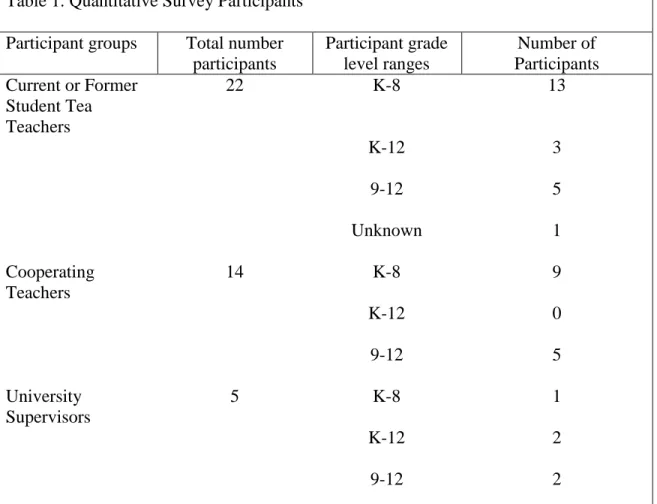
Table Page 1. Quantitative Survey Participants……….………..…...….12 2. Qualitative Interview Participants: Current and Former Student Teachers……..……….…....13 3. Qualitative Interview Participants: Cooperating Teachers……….………..……13 4. Qualitative Interview Participants: University Supervisors……….…………14 5. Respondent Groups’ Perceptions of Effectiveness of Co-Teaching Model of Student Teaching………..18
LIST OF JOURNAL ARTICLE TABLES
Table Page 1. Quantitative Survey Participants………..……….….126 2. Respondent Groups’ Perceptions of Effectiveness of Co-Teaching Model of Student Teaching………131 3. Student Teachers/Cooperating Teachers Group Perceptionst-Test Descriptive Table…….132 4. Student Teachers/University Supervisors Group Perceptionst-Test Descriptive Table....…132 5. Cooperating Teachers/University Supervisors Group Perceptionst-Test Descriptive
LIST OF APPENDIX TABLES
Table Page G1. Respondent Groups’ Perceptions of Effectiveness of Co-Teaching Model
of Student Teaching………...….191
G2. Respondent Group (Roles) Perceptions One-Way ANOVA Descriptives Table………..….192
G3. Respondent Group (Roles) Perceptions One-Way ANOVA Result Details Table…………192
G4. Student Teachers/Cooperating Teachers Group Perceptionst-Test Descriptive Table…….193
G5. Student Teachers/University Supervisors Group Perceptionst-Test Descriptive Table…...193
G6. Cooperating Teachers/University Supervisors Group Perceptionst-Test Descriptive Table……….….…194
G7. Respondents’ Perceptions by Grade LevelOne-Way ANOVA Descriptives Table………195
G8. Respondents’ Perceptions by Grade Level One-Way ANOVA Result Details Table………….…..196
G9. Grades K-8/K-12 Respondents t-Test Descriptive Table……….…….197
G10. Grades K-8/9-12 Respondents t-Test Descriptive Table………...………..197
G11. Grades 9-12/K-12 t-Test Three Descriptive Table……….……..198
G12. Respondents’ Perceptions by Educational Concepts Summary of Data……….…..199
G13. Respondents’ Perceptions by Educational Concepts: One-Way Repeated Measures ANOVA Results Details……….…….199
LIST OF ABBREVIATIONS
AACTE…….The American Association of Colleges for Teacher Education ANOVA……Analysis of Variance
CK/IS……….Content Knowledge/Instructional Strategies CM………….Classroom Management
COE…………College of Education
CR/LP………Curriculum/Lesson Planning
DESE……….Department of Elementary and Secondary Education ELL…………English Language Learner
GRR………...Gradual Release of Responsibility
IDEIA……….Individuals with Disabilities Education Improvement Act INTASC……..Interstate New Teacher and Assessment Support Consortium JTE…………..Journal of Teacher Education
LEA………….Local Education Agency LSD………….Least Squared Differences MKO…………More Knowledgeable Other
NCATE………National Council for Accreditation of Teacher Education NCLB………..No Child Left Behind
PR………Professionalism
SLG………….Student Learning Goals
SPSS…………Statistical Package for the Social Sciences TQE………….Teacher Quality Enhancement
UCM…………University of Central Missouri YMCA…….Young Men’s Christian Association ZPD………..Zone of Proximal Development
CO-TEACHING AS A CLINICAL MODEL OF STUDENT TEACHING: PERCEPTIONS OF PREPAREDNESS FOR FIRST YEAR TEACHING
Abstract
College of Education faculty members at the University of Central Missouri found that public school teachers and administrators from surrounding schools were reluctant to hand over classrooms of students to novice teachers for student teaching. With high stakes accountability for test scores, teachers voiced their need to be present in the classroom, particularly during spring semester of statewide testing (Diana, 2014). The university adopted a co-teaching model of student teaching to prepare its teaching
candidates for the first year of teaching while allowing the cooperating teacher to stay in the classroom throughout the student teaching term. The problem-of-practice addressed in this study focuses on the need to determine if a co-teaching student teacher model provides university students an adequate amount of clinical experience and preparation to support a successful first year of teaching.
The purpose of this study is two-fold: 1) analyze the perceptions of former and current student teachers, cooperating teachers, and university supervisors on the co-teaching model of student co-teaching and 2) assess the model’s effectiveness in preparing student teachers for their first year of teaching. To this end, the research questions are as follows:
Research Question 1. What are the perceptions of University of Central Missouri current and former student teachers on the co-teaching student-teaching model’s ability to prepare student teachers for their first year of teaching?
university supervisors on the co-teaching student-teaching model’s ability to prepare student teachers for their first year of teaching?
Research Question 3. What are the perceptions of cooperating teacherson the co-teaching student- co-teaching model’s ability to prepare student teachers for their first year of teaching?
The research questions were answered through an analysis of the data collected via a quantitative survey followed by a qualitative interview. The quantitative survey asked respondents to rate items on a Likert-type scale (Fink, 2013) as to how well they perceived the co-teaching model of student teaching prepares student teachers to meet Missouri Teaching Standards. The qualitative survey asked respondents to discuss their perceptions of how well the co-teaching model of student teaching prepares student teachers for their first year of teaching based on their personal experience.
The responses indicated that the co-teaching model scored higher in first year teacher preparation by elementary teachers and elementary supervisors than by secondary teachers and supervisors. Responses also indicated that student teachers and cooperating teachers perceived the co-teaching model as more positively preparing student teachers for their first year of teaching than do university supervisors. Additionally, responses indicated that the co-teaching model of student teaching closely aligns to the Gradual Release of Responsibility theory of learning (Pearson & Gallagher, 1983) with the co-teaching model of student co-teaching strengths as follows: extensive modeling by a More Knowledgeable Other (Vygotsky, 1978), extensive professional reflection and immediate feedback, a narrowing of focus, professional collaboration, and building of confidence in the student teacher. Due to the student teacher never solely taking over the classroom
responsibilities in a co-teaching model of student teaching, the model’s barrier for preparing student teachers for their first year of teaching centers on the student teacher not receiving a fully realistic teaching experience in a classroom without a co-teacher.
On this basis, it is recommended that universities and school districts adopt the co-teaching model of student teaching to provide a strong base of teaching background for the student teacher through the Gradual Release of Responsibility. The student
teacher should also receive two to three weeks of sole classroom responsibility and all the duties in that role as to provide a realistic experience of teaching without a co-teacher present. Further research could synthesize the perceptions of the same group of participants in this study regarding a model similar to the one recommended.
SECTION ONE
Background
The University of Central Missouri’s teacher preparation program was struggling to find enough school districts to participate in the student teaching program. Upon informal investigation, the university’s College of Education found local public school teachers and their administrators were reluctant to hand over classrooms of students to novice teachers. With high stakes accountability for test scores, teachers voiced their need to be present in the classroom, particularly during spring semester statewide testing (Diana, 2014). Within this same time of struggling to find cooperating teachers, the Blue Ribbon Panel of the National Council for Accreditation of Teacher Education (NCATE, 2010) published a national report calling for PK-12 teachers and teacher preparation programs to see teacher preparation as a shared responsibility. So began a study by the university’s College of Education leaders in the use of a co-teaching model for clinical practice for student teachers.
Introduction to Co-Teaching Applications and Context
Co-teaching, also called team-teaching or collaborative teaching, became a viable method of inclusive instruction in the special education discipline to access the regular classroom setting and curriculum. Co-teaching, as defined by Villa, Thousand, and Nevin (2008), is an instructional model whereby two or more people of equal status share the responsibility of planning for, instructing, and assessing some or all of the students in a classroom. Higher education teacher preparation programs followed suit by
implementing the co-teaching model in teacher preparation programs to prepare their student teachers to meet the needs of diverse student populations by modeling the teaching partnership (Nevin, 2009). Finally, in a lesser-researched application, the
co-teaching model was implemented into clinical practices of regular education teacher preparation programs whereby regular education student teachers team-taught with their mentor teachers throughout their student teaching experience.
University of Central Missouri Student Teaching Background
The University of Central Missouri (UCM) currently offers the co-teaching clinical model as their student teaching model in the College of Education. Hartnett, Weed, McCoy, Theiss and Nickens (2013) note that UCM developed this clinical model, in part, as a response to a call to university institutions by the Blue Ribbon Panel of the National Council for Accreditation of Teacher Education (NCATE). The NCATE report called for clinical experiences of student teachers that would increase the learning and achievement of students and empower “teachers to meet the urgent needs of schools and the challenges of the 21st Century Classroom,” (2010, p. ii). The report recommended universities view the clinical experience of student teachers as a shared experience
(Harnett et al., 2013). Additionally, the state of Missouri’s Department of Elementary and Secondary Education was asking universities to clearly articulate the clinical practices of their institution. Finally, a local challenge was emerging for UCM’s College of
Education. Partnering school districts accepting student teachers were exhibiting concern with leaving classrooms in full control of student teachers in lieu of the accountability of high stakes testing. Having the mentor teacher and student teacher team-teach seemed a positive solution for both the partnering school districts and the National Council of Accreditation of Teacher Education (NCATE). A co-teaching clinical model from St. Cloud State University in Minnesota was closely researched by UCM staff (Hartnett et al., 2013) and a strategic action plan was set in place to educate UCM stakeholders and
facilitate the piloting and implementation of a co-teaching model in partnering districts. Statement of the Problem
The problem-of-practice in this study addressed in this study lies in the need to determine if a co-teaching student teacher model provides university students an appropriate amount of clinical experience and preparation necessary to support a successful first year of teaching. Public school teachers are held accountable for the success of their students, and thus are somewhat reluctant to release instructional time to a student teacher. Student teaching is generally the last opportunity universities have to help prepare students for teaching. Does the use of a co-teaching clinical model support both parties’ needs?
A gap in the research literature exists regarding the level of readiness the co- teaching student teaching model provides student teachers and first- year classroom teachers. The research available on co-teaching as a model of student teaching generally focuses on the co-teaching process, professional development of co- teachers, and the benefits of co-teaching partnerships to stakeholders.
Purpose of the Study
The purpose of this study is to determine and analyze the perceptions of current and former student teachers, cooperating teachers, and university supervisors on the co-teaching model of student co-teaching and its ability to prepare student teachers for their first year of teaching. Analyzing the perceptions of current and former student teachers, cooperating teachers who have experienced the co-teaching model, and university supervisors who have overseen the co-teaching clinical experience determined this level of readiness.
The state of Missouri provides Missouri Teacher Standards that outline the qualities of best practices in the field of teaching (Missouri Department of Elementary and Secondary Education, 2013). The Missouri Teacher Standards guide the quantitative criteria for this study when determining levels of readiness for teaching by both current and former student teachers. The Missouri Teacher Standard categories are as follows: content knowledge aligned with appropriate instruction; student learning growth and development; curriculum implementation; critical thinking; positive classroom environment; effective communication; student assessment and data analysis;
professionalism; and professional collaboration. Quantitative and qualitative data were collected from both current and former student teachers who have experienced the co-teaching student co-teaching model and each sample’s perceptions of how well their student teacher experience prepared them for their first year of teaching. Cooperating teachers and supervising teachers also provided quantitative and qualitative data on their perceptions of how well their mentees or subordinates from the co-teaching student teacher models appear prepared to teach.
Research Questions The research questions guiding this study are as follows:
1. What are the perceptions of University of Central Missouri current and former student teachers on the co-teaching student-teaching model’s ability to prepare student teachers for their first year of teaching?
2. What are the perceptions of University of Central Missouri university supervisors on the co-teaching student-teaching model’s ability to prepare student teachers for their first year of teaching?
3. What are the perceptions of cooperating teachers who work with University of Central Missouri student teachers on the co-teaching student-teaching model’s ability to prepare student teachers for their first year of teaching?
Definition of Terms
The following terms were defined to help in understanding the constructs of this inquiry:
Cooperating Teacher: The cooperating teacher is a veteran teacher employed in a
school district who receives a student teacher assignment. He or she works as a mentor in the clinical setting. Cooperating teachers have typically been teaching at least three years.
Co-teaching Student Teaching Model: A student teaching model in which the
student teacher and the cooperating teacher plan and teach in tandem. The cooperating teacher does not leave the classroom for extended periods, but rather works
collaboratively with the student teacher in both planning and implementing instruction throughout the student teaching experience.
Gradual Release of Responsibility (GRR): A model of instruction theorizing that
a more skilled peer leads a learner through explicit instruction and, with guidance, gradually releases the responsibility of the determined skill or strategy until the learner is capable of independently applying the skill to new situations.
More Knowledgeable Other (MKO): A more skilled peer or mentor who works to
support a learner in mastering a skill or strategy.
Preservice teacher: The preservice teacher is a teacher candidate who is currently
enrolled in university course work to become a certificated teacher. The preservice teacher could be a student teacher but could also be a student accepted into the College of
Education as a sophomore. junior, or senior who has not yet entered into the student teaching experience.
Student teacher: The student teacher is a university senior student. He or she is in
the final clinical stage of teacher preparation whereby he or she is assigned a position in a neighboring school district with a veteran teacher, typically for a semester.
Traditional Student Teaching Model: A student teaching model in which the
student teacher observes the cooperating teacher for approximately two weeks, teaches the class for approximately one week while being observed by the cooperating teacher, teaches without the cooperating teacher’s presence for the rest of the clinical experience, and gradually gives the responsibility back to the teacher.
University Supervisor: The university supervisor is an employee of the university
from which a student teacher is enrolled. His or her responsibility is to oversee the clinical practice of the student teacher.
Zone of Proximal Development (ZPD): The Zone of Proximal Development is a
theory first produced by Vygotsky (1978) that describes a range in learning that occurs when a learner is unable to accomplish a skill or task without the support of a more skilled or knowledgeable other.
Conceptual/Theoretical Frameworks
The theoretical framework guiding this study is the Gradual Release of
Responsibility (GRR), first coined by Pearson and Gallagher (1983) and based upon the work of Vygotsky (1978). The GRR model of instruction theorizes that the more skilled peer or, as Vygotsky termed, More Knowledgeable Other (MKO), leads the learner through explicit instruction and guidance. The MKO gradually releases the responsibility
of the determined skill or strategy until the learner is capable of independently applying the skill to new situations. Fisher and Frey (2008) define four phases of the GRR model based upon Vygotsky’s theory. The first phase provides the learner with explicit
instruction from the MKO. Fisher and Frey (2008) refer to this stage as a Focused Lesson or the “I do it” portion of instruction in which “I” refers to the MKO. The next stage of GGR is Guided Instruction or the “We do” phase of learning. This stage is based heavily on Vygotsky’s idea of instructional scaffolding in which the lesson provides adult and peer support for performing the skill or strategy. During instructional scaffolding, the MKO works with the learner/s in a place of learning in which the novice must rely on support from the MKO or collaboration with peers to perform the targeted skill.
Vygotsky refers to this place of learning as the Zone of Proximal Development (ZPD). The next phase of the GRR model is the collaborative phase or “You do it
together” phase. This stage is the beginning of the transfer of learning in which the MKO pulls away from a central role and becomes an observer of the learning. The learner must independently apply the skill or strategy while still engaged with peers. The last phase of the GRR model is the independent phase in which the learner applies his or her new learning to a new situation. The role of the MKO is to observe the independent work of the learner.
The GGR model is applicable to the co-teaching model of student teaching if applied appropriately for independence. In the co-teaching model of student teaching, the senior teacher does not leave the room. Rather, the goal of the co-teaching student
teacher model is to reach the GRR Independent Phase in a Teaming or Collaborative Model. The teaming or collaborative model as defined by Easterby-Smith and Olve
(1984) and Pugach and Blanton (2009) means sharing the responsibility of teaching equitably in lesson planning, instruction, and assessment. The Teaming or Collaborative Model assumes the independent application of needed skills and strategies by junior teachers within a teaming setting and the novice teacher is an equal partner with the expert teacher.
Experts in the field of co-teaching have defined various models of co-teaching in the fields of special education and higher education. These models can be applied to the stages of GRR and the co-teaching model of student teaching. For instance, Friend and Cook (2010) and Bessette (2008) define various co-teaching models as follows: (1) one teach, one observe; (2) one teach, one drift; (3) alternative teaching; (4) parallel teaching: (5) station teaching; and (6) team teaching. The “one teach, one observe” and “one teach, one drift” models can be used in the Focused Lesson phase of GRR during the
co-teaching student co-teaching. The “alternative co-teaching” and “parallel co-teaching” models are used in the collaborative phase of GRR in student teaching. The “station teaching” is used in the guided practice phase of GRR and the “team teaching” is the independent phase of GRR in the co-teaching student teaching model. Team Teaching in this instance is defined as the independent application of skills or strategies in which both the senior and junior teacher share all responsibility equitably.
Design of the Study Setting/Context
The College of Education at the University of Central Missouri produces approximately 250 Bachelor of Science in Education degrees per year in various
of Central Missouri as a whole has an enrollment count of approximately 12,500 with 54% female and 66% white non-Hispanic students. The average age of the UCM undergraduate is 22.9 and the student/faculty ratio is 16.8.
The University of Central Missouri’s (UCM) College of Education fully
implements the co-teaching model of student teaching. By enlisting participants involved in this one university, the researcher was able to identify the perceptions of the level of teaching readiness based more distinctly upon the student teaching experience rather than on background knowledge from previous university work varying universities might have provided. Participants for each group were purposefully selected based upon preset criteria. Ultimately, being able to use one university helped to eliminate other
background experiences students from varying universities might have received. Because of this unique ability to more closely cue into the influence of the student teaching
experience, the researcher solicited student teaching participants solely from the University of Central Missouri.
The current or former student teacher participants experienced the co-teaching model of clinical practice while a student at the University of Central Missouri. The current student teacher participants completed a full semester of student teaching but have not yet experienced a first year of teaching. The former student teacher participants are all currently employed in a school district and have experienced at least one full year of teaching. The size and demographics of the employing school districts were randomly based upon the employment of the UCM students. The University supervisors are
employed by UCM, but the district cooperating teachers come from various Central and Western Missouri school districts where student teachers have been assigned to complete
their student teaching. Participants
The current and former student teacher participants enlisted for this study are K-12 UCM regular education classroom current or former student teachers. The researcher received names and emails of student teachers from the UCM College of Education and independently contacted the students via email requesting permission for the study by way of an electronic consent form. The consent form (Appendix A) outlined the purpose of the study, the involvement required of the participants, the voluntary nature of the study, and the confidentiality of identifiable data from the university, cooperating teachers, university supervisors, and employers. The current or former student teachers consented participation via an electronic consent form sent by the researcher. A total of 296 consent forms were sent to current and former student teachers who experienced the co-teaching clinical model of student teachers. There were 23 responses.
The university supervisors were employed by UCM. They were contacted by the researcher via email. The researcher outlined the purpose of the study, the involvement of the supervising teachers, the voluntary nature of the study, and the confidentiality of identifiable data from the students, university, cooperating teachers, and school districts. University supervisors either gave consent to or refuse participation via an electronic consent form sent by researcher. Twenty-eight University of Central Missouri (UCM) student teaching supervisors were sent a survey with 5 responding.
The cooperating teachers came from various assigned school districts located in Central and Western Missouri. The researcher received names and emails from the UCM College of Education and independently contacted 128 cooperating teachers via email
requesting permission for the study by way of an electronic consent form. The consent form outlined the purpose of the study, the involvement required of the participants, the voluntary nature of the study, and the confidentiality of identifiable data from the student teachers, the university, the supervising teachers, the school district in which they work, and future employers of the students. Fourteen cooperating teachers responded.
Table 1
Quantitative Survey Participants Participant groups Total number
participants Participant grade level ranges Number of participants Current or former student teachers 22 K-8 13 K-12 3 9-12 5 Unknown 1 Cooperating Teachers 14 K-8 9 K-12 0 9-12 5 University Supervisors 5 K-8 1 K-12 2 9-12 2
Table 2
Qualitative Interview Participants: Current and Former Student Teachers Name Grade Level of
Certification
Number of Years Teaching Student Teacher 1 9-12 0 Student Teacher 2 1-6 2 Student Teacher 3 3-5 2 Student Teacher 4 1-6 0 Student Teacher 5 1-6 2 Student Teacher 6 9-12 2 Student Teacher 7 1-6 3 Student Teacher 8 6-8 3 Student Teacher 9 1-6 1 Table 3
Qualitative Interview Participants: Cooperating Teachers Name Grade Level
Teaching
Student Teaching Models Supervised Traditional Co-teaching Cooperating Teacher 1 1-6 No Yes Cooperating Teacher 2 1-6 No Yes Cooperating Teacher 3 3-5 Yes Yes Cooperating Teacher 4 1-6 Yes Yes Cooperating Teacher 5 1-6 Yes Yes Cooperating Teacher 6 9-12 No Yes
Table 4
Qualitative Interview Participants: University Supervisors Name Grade Level
Teaching
Student Teaching Models Supervised Traditional Co-teaching University Supervisor 1 K-8 Yes Yes University Supervisor 2 9-12 Yes Yes University Supervisor 3 9-12 Yes Yes
Data Collection Tools
Quantitative Data Collection. The purpose of this study is to derive an understanding of the perceptions of current and former student teachers, university supervisors, and cooperating teachers on the co-teaching model of student teaching and its ability to prepare student teachers for their first year of teaching. The researcher used a mixed method approach to research. By combining descriptive statistics, using an
analysis of variance on SPSS, ANOVA data, and t-Test data from survey responses and open-ended participant responses from interview questions, the research results reflect the perceptions and belief systems of the participants.Each survey item and interview question or prompt was used to answer particular research questions (Appendix B).
Prior to survey administration, each survey was reviewed by people who met participant qualifications but were not participating in the research study. These persons took the survey and provided feedback to the researcher on question clarity. The mean and mode were determined for each item and for categorical groups of items. The survey was then given as a retest and again the mean and mode were determined for each item and for categorical groups of items. Items showing a large variance from test to retest
All research participants (n=44) completed an anonymous survey (Appendix C) consisting of 25 belief statements regarding the perceived level of readiness the co-teaching experience provided or provides new teachers. Each survey was specific to the participant group (current or former student teachers, cooperating teachers, and university supervisors). Catego1-6rical rating scales (Fink, 2013) included identifying the role of the participant and the level at which he/she works; however, names and locations were excluded to ensure confidentiality of participants.
Fink (2103) noted that the terms or concepts measured by the survey must be clearly defined. She recommends consulting with experts in the field to clearly define those terms. To define the concept of “level of readiness for first year of teaching,” the survey belief statements were based upon the Missouri Teacher Standards (DESE, 2013), the rationale being standards for teachers serve as benchmarks for teacher quality, thus are representative of a well-prepared teacher. To develop the survey, each standard was tied to a lead-in statement or item stem that asked the participant to note how well he or she perceives the co-teaching model prepares the first year teacher for his or her first year of teaching. For example, one Missouri Teacher Standard states the effective teacher will engage in reflective practice in order to modify future instruction (Department of
Elementary and Secondary Education, 2013). For current and former student teachers, this standard was phrased in a belief statement to be scored on a Likert-type scale as follows. The co-teaching model positively prepared me for my first year of teaching in the following way: to engage in reflective practice in order to modify future instruction.
The survey participant then marked his or her level of belief on a scale of 1 (Not at all) to 9 (A good deal). For supervising and cooperating teachers, the same standard was
phrased as follows. The co-teaching model positively prepares student teachers for their first year of teaching in the following way: to engage in reflective practice in order to
modify future instruction. The participant from this group then marked his or her level of
belief on a scale of 1 (Not at all) to 9 (A great deal).
Participants marked their perceived level of readiness for each standard on an ordinal, Likert-type (Fink, 2013) one-to-nine scaled survey formatted to resemble that of the Teachers’ Sense of Efficacy Scale developed by Tschannen-Moran and Woolfolk Hoy (2001). A (1) represents the answer “Not At All,” a (3) represents “Very Little,” a (5)”Some,” a (7) “Quite A Bit,” and a (9) represents the answer “A Great Deal.” Since the ranking of (5) was considered “Some,” the researcher used that mean number as the cutoff for perceiving the model as “effective” on that item and when means were averaged.
Qualitative Data Collection. Following the quantitative survey, eighteen qualitative neo-positive interviews (Merriam, 2009) were conducted on the perceived level of preparedness the co-teaching model provides first year teachers in relation to the Missouri Teacher Standards. Participating groups consisted of current or former student teacher (Appendix D), cooperating teacher (Appendix E), and university supervisor (Appendix F) agreeing to an interview. Patton (2002) noted a person’s feelings, thoughts, and perspectives cannot be observed. Thus, open-ended interviews are a means of
providing this information. Open-ended questions in a semi-structured interview structure (Merriam, 2009) allowed for insight and feedback and focused on the student teaching process and experience and its perceived impact on the student teachers’ readiness for his or her first year of teaching. The questions were largely guided by a preset list of
questions but included a mix of less structured questions. The order of the questioning was dependent upon the data received from respondents.
Data Analysis IRB and Ethics
Each interview participant read and signed a consent form (Appendix A)
explaining the purpose of the study and participants’ rights. Survey participants received an electronic consent form. The consent form identified the researcher and institutions from which the research comes: University of Missouri in conjunction with the
University of Central Missouri. The form provided the purpose of the study and a request for participation. The participant was ensured that not participating would in no way penalize him or her and he or she can choose to stop, not answer particular questions, or withdraw their data at any time. No participants were under the age of 18 and a brief description of the research methods was provided. Interview data were audio recorded and transcribed (Krueger & Casey, 2009). Any participant or K-12 institution names were changed during transcription and data analysis so as to protect participant privacy (Creswell, 2012; Merriam, 2009). The risks associated with participating in this study were similar to the risks of everyday life (Merriam, 2009) and benefits of participating were to add to the body of research on co-teaching as a student teaching model. Quantitative Data Analysis
Descriptive statistics, One-Way-ANOVA, One-Way Repeated measures
ANOVA, and t-Tests were used to analyze the quantitative survey results (Appendix G). The Likert-type responses were treated as continuous (Fink, 2013) and each participant group’s (current and former student teachers, cooperating teachers, university
supervisors) set of data was entered into a spreadsheet. The median, mode, and mean were determined in the frequency distribution of the data (Field, 2013).
To determine if the respondent groups of student teachers, cooperating teaches, university supervisors, and the total response group perceived the co-teaching model as effective in preparing the student teacher for first year teaching, the researcher ran a Single Sample t-Test. Each respondent’s overall mean value was compared in this test to a rating of five or above on the Likert-type scale. The labeling of the Likert-type scale named a (5) as “somewhat effective.” A (5) and above was considered the range for perceiving the co-teaching model as effective. The (5) mean was then compared to each group member’s overall mean. If the test found the results Significant, the group results were determined to be high enough to perceive the co-teaching model of student teaching as effective in preparing student teachers for their first year teaching. The results
determined that University Supervisors did not perceive it as effective; however, the co-teaching model of all respondent groups was perceived as effective.
Table 5
Respondent Groups’ Perceptions of Effectiveness of Co-Teaching Model of Student Teaching
Respondent Group t-Value p-Value Significant Effective
Student Teachers 4.80 9.6E-05 YES YES
Cooperating Teachers 8.57 .00001 YES YES
University Supervisors -0.12 0.91 NO NO
Total Respondent Group 5.64 .00001 YES YES
concerning how well the co-teaching model of student teaching prepares student teaching candidates for their first year of teaching, the One-Way ANOVA statistical analysis was used. The overall survey mean values for all respondents in each of the three separate participant groups were calculated. Each participant group’s overall mean values were entered in the One-Way ANOVA calculator for comparison to determine if there was a significant difference in how respondents in each participant group perceived the co-teaching model as preparing the new teacher for first year of co-teaching. A significant difference between participant group’s perceptions was determined.
Because a significant difference was determined, the researcher wanted to
determine between which participant groups there was a significant difference, so three t-Tests were run. The t-t-Tests compared two participant group results at a time: Student Teachers to Cooperating Teachers, Cooperating Teachers to University Supervisors, University Supervisors to Student Teachers. A significant difference was found in two of the t-Tests: University Supervisors to Student Teachers and University Supervisors to Student Teachers. There was no significant difference in perceptions between Student Teachers and Cooperating Teachers.
To compare the overall perceptions between participant groups divided into the grade levels with which they work, the One-Way ANOVA statistical analysis was used again. The respondents were divided into three grade range groups with which they work: K-8, 9-12, and K-12. A significant difference between the three groups was again
determined.
Because a significant difference was determined, the researcher ran three new t-Tests. The respondents’ group results were compared in sets of two: K-8 to 9-12, K-8 to
K-12, K-12 to 9-12. There was significant difference in perceptions of how well the co-teaching model prepared first year teachers between those who worked with K-8 and those who worked with 9-12, as well as those who worked with K-8 and those who worked with K-12. There was no significant difference between the perceptions of those who worked with 9-12 and those who worked with K-12.
Finally, in relation to the Missouri Learning Standards educational categories of professionalism and collaboration, classroom management, content knowledge and instructional strategies, student learning goals, and curriculum and lesson planning a One-Way Repeated measures ANOVA test was performed to compare the participant means in each educational concept category. It was determined that there was no significant difference between educational concept category scores.
In summary, the quantitative data revealed that the total respondent group perceived the co-teaching model to be an effective model of student teaching. The data also provided evidence that student teachers and cooperating teachers perceived the co-teaching model as supporting first year teachers significantly more than did university teachers. The quantitative data revealed a significant difference in K-8 perceptions of the co-teaching model’s ability to more positively support first year teachers than did K-12 or 9-12 respondents. A more detailed narrative of the qualitative data analysis and findings can be found in Appendix G.
Qualitative Data Analysis
Qualitative interviews were conducted with 18 participants: nine current or former student teachers; six cooperating teachers; and three university supervisors. The
The researcher followed the six step coding process for qualitative data (Creswell, 2014). Step 1: The researcher organized and prepared the notes. Step 2: The researcher looked for data consistency within and across the groups. Step 3: The researcher began to group common observations into generalization categories. Step 4: The researcher generated a descriptive theme or themes based on generalizations. Step 5: The researcher created a narrative passage to describe the themes represented in the data (Appendix G). Step 6: The researcher interpreted the qualitative data couched in personal understandings and comparison to literature and known theories.
In summary, the qualitative research data unfolded three findings. First, the co-teaching model of student co-teaching highly supports the growth of student teachers in preparation for their first year of teaching. General categories that supported this finding were that the co-teaching model provided the following components of the Gradual Release of Responsibility (Pearson & Gallagher, 1983) model of instruction and learning for the student teacher: extensive modeling, immediate feedback and professional
reflection, the ability to have a singular foci, and collaboration. Another finding emerged reflecting the strength of the co-teaching student teaching model’s ability to build the student teacher’s self-confidence. A third and final finding was the common perception that the co-teaching model does not provide the student teacher with a realistic teaching experience in a classroom that does not employ another co-teacher. A more detailed narrative of the qualitative data analysis and findings can be found in Appendix G. Recommendations
Based upon the research data collected and findings presented, the researcher recommends that colleges of education implement the co-teaching model of student
teaching. The researcher also recommends that the student teacher be allotted an
extended period of time of two-three weeks in which the student teacher fully takes over the classroom planning, instruction, and management. The co-teacher should meet daily with the student teacher for reflection and feedback; however, the student teacher proceeds as the sole instructor for the allotted period of time.
Limitations, Assumptions, and Design Controls
Limitations of this study relate to the survey instrument as well as the study’s design and setting. The researcher created surveys to collect quantitative data (Appendix C). The instruments’ reliability and validity have not been empirically tested.
Additionally, transferability of findings across other institutions will be limited as this study specifically explores UCM’s co-teaching clinical model and students who have attended UCM’s pre-service courses.
Finally, the present research proceeds under the assumption that each pre-service student teacher is at a somewhat equal level of preparedness as other student teachers before the co-teaching clinical experience begins. This assumption stems from the
application of common coursework of all pre-service education students within the UCM College of Education.
Significance of the Study
This study provides empirical evidence of the perceptions of current and former student teachers, cooperating teachers, and university supervisors on the co-teaching model’s ability to prepare student teachers for their first year of teaching. The findings in this study reveal that critical stakeholders in the student teaching experience find the co-teaching model of student co-teaching highly effective for preparing student teachers for
their first year of teaching.
The findings of this study will benefit university colleges of education by providing key stake holder perceptions of the effectiveness of the co-teaching student teaching model in preparing first year teachers for their first year of teaching. The findings can be a component in determining whether the co-teaching model of student teaching is implementing in the university’s teacher preparation program.
Cooperating school districts supporting university students will also benefit from this study. If the co-teaching model of student teaching is incorporated into the student teaching experience, cooperating teachers will not need to relinquish their classrooms to novice teachers for extended periods of time. This may support student achievement on standardized testing since veteran teachers will continue to be a part of instruction.
Cooperating teachers themselves will benefit from the results of the study. Findings show that cooperating teachers begin to see the student teacher as an equal in the classroom. The qualitative findings show that the cooperating teacher and student teacher gain more collaboration time together to learn from one another.
Students in cooperating teacher classrooms will also benefit from the study. With the cooperating teacher not relinquishing the classroom to a novice teacher for an
extended period of time, the students will receive instruction from their veteran teacher as well as the student teacher. This may affect student achievement.
Additionally, first year teachers will benefit from this study. Findings show that first year teachers perceive the co-teaching model of student teaching as a highly effective teacher preparation model. It might be inferred that the more highly prepared for teaching the first year teacher is, the more likely the first year will be a positive
experience for the teachers.
Finally, students of the prepared first year teacher will benefit from this study. Findings show that the first year teaching who experienced the co-teaching model of student teaching highly rate the model as preparing them for classroom management and instruction. This may, in turn, benefit the students of their first year classroom in both classroom behaviors and achievement.
Summary
Many universities struggle to place student teachers in local districts due to teachers’ apprehension in relinquishing their classrooms to a novice teacher while high stakes testing occurs each spring (Ellis & Bogle, 2008). The Blue Ribbon Panel of the National Council for Accreditation of Teacher Education (NCATE, 2010) published a national report calling for PK-12 teachers and teacher preparation programs to see teacher preparation as a shared responsibility. With these two factors in mind, the University of Central Missouri (UCM) began the study and implementation of co-teaching as a student co-teaching clinical model.
Co-teaching was originally an instructional model most frequently applied to PK- 12 settings involving a general and special educator. Co-teaching also became an
instructional model in higher education courses whereby the faculty would model the co- teaching process with their students. A few universities began to explore co-teaching as a student-teaching model. UCM became one such university.
Experts in the field of co-teaching have defined various models of co-teaching in the contexts of special education and higher education. These models can be applied to the stages of Gradual Release of Responsibility (GRR) and the co-teaching model of
student teaching. For instance, Friend and Cook (2003) and Bessette (2008) defined various co-teaching models as follows: (1) one teach, one observe; (2) one teach, one drift; (3) alternative teaching; (4) parallel teaching: (5) station teaching; and (6) team teaching. The “one teach, one observe” and “one teach, one drift” models can be used in the Focused Lesson phase of GRR during co-teaching student teaching. The “alternative teaching” and “parallel teaching” models are used in the collaborative phase of GRR in student teaching. The “station teaching” is used in the guided practice phase of GRR and the “team teaching” is the independent phase of GRR in the co-teaching student teaching model. Team Teaching in this instance is defined as the independent application of skills or strategies in which both the senior and junior teacher share all responsibility equitably.
The purpose of this study was to determine and analyze the perceptions of current and former student teachers, cooperating teachers, and university supervisors on the co-teaching model of student co-teaching and its ability to prepare student teachers for their first year of teaching. This study used a mixed-methods research approach. Participants included current and former student teachers, cooperating teachers, and university supervisors from the University of Central Missouri. Quantitative data from surveys administered to student teachers, cooperating teachers, and university supervisors who experienced the co-teaching model eliciting perceptions of the level of preparedness the co-teaching model provides student teachers for their first year of teaching. The
quantitative surveys provided data on each participant group’s perception of the benefits and/or weaknesses of the co-teaching models of student teaching. Qualitative data from one-on-one interviews were collected from each participant group. Participant data were analyzed to determine the overall perceived impact of the co-teaching model of student
teaching on the level of preparedness for the first year teacher. Participant group data were cross-analyzed to determine any similarities or disparities in perceptions between participant groups.
The quantitative data revealed that the total respondent group perceived the co-teaching model to be an effective model of student co-teaching. The data also showed that student teachers and cooperating teachers perceived the co-teaching model as supporting first year teachers significantly more than did university teachers. The quantitative data revealed a significant difference in K-8 perceptions of the co-teaching model’s ability to more positively support first year teachers than did K-12 or 9-12 respondents.
Qualitative research data unfolded three main findings. First, the co-teaching model of student teaching highly supports the growth of student teachers in preparation for their first year of teaching. General categories that supported this finding were that the co-teaching model provided the following components of the Gradual Release of Responsibility (Pearson & Gallagher) for the student teacher: extensive modeling, immediate feedback and professional reflection, the ability to have singular foci,
collaboration. Another finding emerged reflecting the strength of the co-teaching student teaching model’s ability to build the student teacher’s self-confidence. A third and final finding was the common perception that the co-teaching model does not provide the student teacher with a realistic teaching experience in a classroom that does not employ another co-teacher.
Based on the research data, it is the recommendation of the researcher that the co-teaching model be implemented by universities due to the strength in its learning
SECTION TWO
History of the Organization
The University of Central Missouri (UCM) is located in Warrensburg, Missouri, approximately 50 miles from the Kansas City metro area (University of Central Missouri Fact Book, 2017). UCM offers 150 undergraduate and graduate areas of studies. The fall of 2017 enrollment notes 12,333 students. The undergraduate student body is composed of 9801 students who are 44% male, 56% female, 14% minority, and 27% international students. There are approximately 944 undergraduate and graduate international students, with 79% of the graduate students coming from India. UCM employees approximately 494 full-time faculty and has an 18:1 student-to-faculty ratio.
The University of Central Missouri began as the two-year State Normal School for the Second Normal District in Missouri when it was founded in 1871; originally created for teacher preparation, the university has evolved into a multi-programmatic, multi-college institution. The name of the institution has changed four times in its 136 year history; each name change signified a change in the mission and service of the University. The first name change occurred in 1916 when the State Normal School became Central Missouri State Teachers College. In 1946 it became Central Missouri State College, and became authorized to offer Master of Science in Education degrees beginning in 1947 and Master of Arts and Education Specialist degrees a few years later. In recognition of the changing role and importance of the college, the General Assembly granted permission in August 1972 for university status to be adopted and the name of the college was changed to Central Missouri State University. In 2006 the university changed its name once more, to University of Central Missouri (UCM), to reflect the newly defined mission of becoming a nationally recognized university that delivers a
world-class education. However, throughout this evolution, teacher education has remained one of UCM’s primary academic functions; it continues to be recognized as a cornerstone of UCM, contributing to the mission and vision of the University. University of Central Missouri has an excellent reputation as a teacher education institution and is the longest continuously NCATE-accredited public institution in the State of Missouri. University of Central Missouri College of Education
The UCM College of Education (“College of Education,” 2015) has been in place for more than 140 years. It offers over 39 undergraduate and 16 graduate degrees. As with all Missouri teacher candidates, education students must pass a content area exam prior to certification. Additionally, candidates must hold a cumulative GPA of 2.9 or higher and a Content GPA of 3.0 or higher with no Professional Education course grade lower than a C. As of August, 2014 co-teaching is the mandatory student teaching model for all teacher candidates.
University of Central Missouri College of Education Co-Teaching Model
In the spring of 2011, the Dean of the College of Education sent five individuals to the St. Cloud State University co-teaching model training (Harnett, et al., 2013). The group of professors included two faculty from elementary education, one faculty member from art education, one faculty from middle school education, and one faculty member from mathematics education. As a follow-up, the attending faculty group presented training information to the Professional Education Faculty and potential school district members in the fall of 2011. Additionally, they completed visits with faculty from various teacher education programs on campus. From October 2011 to February 2012, group members identified school districts, cooperating teachers, university supervisors,
and teacher candidates for participation in the fall 2012 pilot of the co-teaching model. By May of 2012, training for pilot programs began and in August of 2012 the first pilot began with 18 students and six school districts. Various trainings, presentations, and pilot options followed at state, university, and district levels and by November of 2013 the Campus Teacher Education Council voted to make the co-teaching model the official model of student teaching for all teacher candidates effective the fall of 2014. By January of 2015, 180 student teachers were placed in 44 school districts.
Organizational Analysis
The UCM College of Education (COE) is structured according to a combination of a Professional Bureaucracy organizational model and a Divisionalized Form
organizational model (Bolman & Deal, 2008). As in the Professional Bureaucracy model, the Dean of the COE represents the strategic apex. Supporting technostructures are small by comparison to the operating core of faculty. These technostructures include
departments such as Information Technology and administrative staff. There are few managerial positions between the Dean and faculty, thus creating a decentralized system. Control of curriculum lies heavily on faculty expertise. While this free application of expertise allows for individualized creativity, giving the professionals space to do what they do best, it also makes quality control and coordination difficult.
The UCM COE is unique to the other UCM colleges in that it is also a Divisionalized Form structure. While the Dean oversees the COE, many education students’ coursework is provided outside the COE within their colleges of content specialty (M. Wright, Personal Communication, November 3, 2015). For example, education students of art, music, PE, math, and science are housed in the college of that
discipline. Thus, the Dean of COE must work closely with the Deans and faculty of those colleges to coordinate curriculum and clinical practices. So while each college is its own separate division, a tight coupling of the Deans and faculty is necessary to provide a unified program for UCM education students.
Leadership Analysis
Dr. Michael Wright, UCM Dean of the College of Education, came into his position eight years ago with a single focus: to improve the teacher education process (M. Wright, Personal Communication, November 3, 2015). He strongly believed more field experience was necessary to improve teacher candidates’ abilities and began to focus on the clinical experience of the preservice teachers. After two years as Dean, he proposed a clinical experience plan that included more field experiences during a preservice
teacher’s sophomore, junior, and finally senior years. Each field experience would be a progressive step that built upon each other yearly. The drawback, however, was that by implementing more field experience, the number of courses offered would need to be cut. The proposal was rejected by course professors. This first rejection, however, did not deter Dr. Wright from continuing to seek improvements in the overall good of the teacher education process.
While attending a conference in Washington D.C, Dr. Wright saw a presentation by faculty members of St. Cloud State University in Minnesota. St. Cloud’s researchers presented data on how the implementation of the co-teaching model in student teaching not only increased the performance of the student teacher, but also increased the
achievement of the K-12 students with whom they worked. There was significant credibility to their program.
Dr. Wright returned to UCM excited about what he had seen. He gathered a group of faculty he believed were open to new ideas and concepts. Because the Dean of the College of Education not only oversees elementary majors, but also oversees education students in the Department of Computer Science and Math, College of Arts, Humanities, and Social Science, and the Department of Music, Dr. Wright appointed to his committee two faculty from elementary education, one faculty member from art education, one faculty from middle school education, and one faculty member from mathematics education. This group traveled to St. Cloud State University and attended training in the use of the co-teaching model for student teaching.
The co-teaching training committee returned to UCM excited and full of ideas for the COE. They wanted to design a pilot project using co-teaching as the clinical
experience, and Dr. Wright was willing. However, Dr. Wright knew a larger vision was necessary to effect authentic change and improved outcomes. Dr. Wright knew that it was from his faculty that real change would occur. He enlisted the support of his staff in creating a program that would blend classroom experiences with field experiences.
Together they built a pilot program that began a student’s sophomore year and progressed through his or her senior year. The faculty worked on a sequenced, unified curriculum that balanced coursework and field experiences to bring deeper meaning to the learning process.
Along with a change in curriculum and field experience, Dr. Wright enlisted the support and advice of the cooperating public school districts. Instead of continuing student placement in the 100+ school districts used previously, he decided the COE would concentrate on 13 primary districts. An advisory board included a representative
from each partnering district as well as the COE staff of clinical services and certification. From this advisory board, problems and issues of clinical practice and services were discussed and decisions are made.
As with most new initiatives, roadblocks occurred. Although there were to be higher costs for transportation for increased field experiences, no more money was being placed in the COE budget. Dr. Wright was told by a source that the changes he was enacting would not be possible without the $10,000,000 grant that was provided to St. Cloud State University for their initial work. Dr. Wright did not believe that to be true. It has taken creativity and critical thinking of various stakeholders, but the co-teaching clinical experience blended with progressive field experiences have now been fully implemented since Fall semester of 2014. Dr. Wright’s single focus, to improve the teacher education process, is in action.
Through this change process, Dr. Wright exhibited characteristics of a
transformational leader (Northouse, 2013). According to Northouse, a transformational leader is concerned with emotions, values, standards, and long-term goals. The vision “emerges from the collective interests of various individuals and units in an organization” (p. 200). Dr. Wright held to a vision that embraced the “collective good” (p. 187) of the teacher education program by looking beyond the walls of the COE and enlisting support and resources outside the university campus. By his drive to balance coursework and field experience, he held to a high level of standards and made sure that group actions were directly tied to long-term goals and achievements.
Northouse (2013) also noted a transformational leader engages with others and creates a connection that raises the level of motivation and morality in both the leader
and the follower. This type of leader is attentive to the needs and motives of followers and tries to help followers reach their fullest potential.
Dr. Wright engaged with his faculty committee around training on the co-teaching clinical experience. He not only engaged with the COE building faculty, but intentionally enlisted professors involved with education students from the areas of art, music, and math. Dr. Wright, through his own enthusiasm, inspired and motivated this group of teachers, but allowed them to reach their full potential through the united efforts of creating a pilot project and allowing them to lead the charge of developing training timelines. Additionally, Dr. Wright inspired the work of his followers by developing a diverse advisory board including stakeholders outside the university, allowing for a gain in the sense self-efficacy.
While there was an initial roadblock of self-interest by several professors who hesitated about losing coursework to field experience, Dr. Wright motivated them to respond to the greater good of the student education process. Bass (1985) believed followers are motivated to do more than expected when transformational leaders are able to raise the level of awareness about the importance and value of goals. This happens when followers can set aside self-interest to see the greater good of the organization and when followers personally gain a higher-level of needs. Through motivation and allowing faculty a sense of ownership to new ideas, Dr. Wright was able to accomplish a
transformation in the belief system of the staff regarding high quality clinical
experiences. Dr. Wright encouraged his faculty to be “creative and innovative and to challenge their own beliefs and values as well as those of the leader and the organization” (Northouse, 2013). Through vision, goal setting, and inspiration, the UCM teacher
education program was transformed from a traditional format to its more current leveled field experience and co-teaching clinical model.
Implications for Research in the Practitioner Setting
There are seven distinct groups of stakeholders within the practitioner’s setting affected by the level of preparation the co-teaching model provides first year teachers: (a) university teacher education faculty and staff, (b) student teachers, (c) cooperating
teachers and districts, (d) students of student teachers, (e) first-year teachers, (f) districts of first-year teachers, and (g) students of first-year teachers. The research within this study can be used to determine the perceptions of how deeply the co-teaching model prepares first-year teachers, thus affecting all stakeholders.
Using this research at the university level, universities can determine whether the co-teaching model is a viable model for clinical experience. School districts and
cooperating teachers can understand the perceptions of whether or not the co-teaching model is an effective model for teacher preparation in which cooperating teachers should participate. Districts hiring first year teachers who have come from a co-teaching model of clinical practice can have background on the level of perceived preparation the co- teaching clinical model provided potential employees. Finally, while this study does not measure the effect of the co-teaching model on students of student teachers and first year teachers, it does provide perceptions of the level of preparation the model provides the first year teacher in relation to the current Missouri Teacher Standards (Department of Elementary and Secondary Education, 2013) which will hopefully in turn translate to student achievement.