Procedia Computer Science 17 ( 2013 ) 306 – 313
1877-0509 © 2013 The Authors. Published by Elsevier B.V.
Selection and peer-review under responsibility of the organizers of the 2013 International Conference on Information Technology and Quantitative Management
doi: 10.1016/j.procs.2013.05.040
Information Technology and Quantitative Management (ITQM2013)
Using fuzzy
ff
integral approach
a
to enhance site selection
assessment a case study of the optoelectronics industry
d
Yao-Chen Kuo
a*, Shih-Tong Lu
a, Gwo-Hshiung Tzeng
a,b, Ying-Chieh Lin
a,
Yu-Shyang Huang
aaInstitute of Innovation and Project Management, Kainan University, No. 1 Kainan Rd., Luchu, Taoyuan 338, Taiwan b Institute of Management of Technology, National Chiao Tung University, Ta-Hsuch Road, Hsinchu 300, Taiwan Abstract
The policies deployed by the government in Taiwan determine dramatically affect the development of a sector. In the past three decades, the high-tech industry has contributed to the prosperity of the economy for Taiwan. The focus of potential sectors includes green energy, optoelectronics, biotechnology industry, and agricultural science and technology industries. This study is to develop an enhanced assessment approach to evaluate candidate sites for building an optoelectronics factory. Traditionally, the assessment approach was conducted by ignoring the multiplicative effects of explored selection criteria in the real world. In order to resolve the above inadequacy on site selection assessment, fuzzy integral method (FIM) and consistent fuzzy preference relations (CFPR) were integrated to the proposed assessment approach to enhance the site selection assessment. Two optoelectronics sites were evaluated by employing the proposed assessment approach. The results through implementing the proposed approach not only could benefit decision makers to facilitate the site selection but also be more effective in real operations than tradition additive aggregate method. The results of the sensitivity analysis on FIM results were also more effective to plan the improvement strategies for the targeted site.
© 2013 The Authors. Published by Elsevier B.V.
Selection and peer-review under responsibility of the organizers of the 2013 International Conference on Information Technology and Quantitative Management
Keywords:Site selection, fuzzy preference rff elations, fuzzy integralff , MCDM (multiple criteria decision making)
1. Introduction
The optoelectronic industry in Taiwan has continued to flourish in recent years. In addition to self-ff sustaining, and insight into the opportunities of the industry itself, the government s supports via deployed policies enable the industry to be a major provider in the current highly competitive global optoelectronic market. The industry will sustain its improvements and maintain the leading role globally. The development in the technology industry is required to go through the stage of plant construction, and then enter the production stage. How to
*
Corresponding author: Yao-Chen Kuo, Tel.: +886-928-905336
E-mail address: [email protected]; [email protected]; [email protected]; [email protected]; [email protected]; [email protected]
Open access under CC BY-NC-ND license.
choose suitable conditions for the development and building of the company's plant houses has become an important issue in the optoelectronic industry. An appropriate factory site should be selected firstly, and then a plant construction project was initiated and expected to be completed on time or even ahead of time. By doing so, the factory may successfully enter mass production, not only can increase the company's revenue, but also seize the initiative; as a result, the company may have momentum to expand its market share. Moreover, the company may create its competitiveness in the market for enlarging more power from their competitors in industry.
The data on site location assessment for any company in the optoelectronic industry are often considered as confidential. Only the staffs involved in the site selection or plant-construction project can access to the relevant information. In other words, site selection processing materials are extremely important for the business operation to the companies in the optoelectronic industry. Current selection models of plant location contain the assessment factors generally sorted out subjectively by the company itself. In view of candidate site locations, various factors are first evaluated, and then weighted scores or average scores are applied to do statistical computation. The priority was obtained according to the score calculation results. The site with highest total score was usually selected as the new factory site.
In current approaches, all evaluation factors evaluated for the candidate future plant site on the impacts of business operations were assumed to be independent. However, it was believed that each assessed factor has multiplicative effects with other factors on business operations. Traditional additive-assessment methods do not consider the multiplicative effects on future business and possibly produce scoring bias leading to making inappropriate decision on site selection in real world. In order to resolve this kind of biased assessment, this study uses consistent fuzzy preference relations (CFPR) and Fuzzy Integral Method (FIM) to construct a state of the art assessment model for the site selection for a new optoelectronic factory.
In advance of the decision on a new factory site, a company will make a comprehensive site study based on the characteristics of the belonging business operations. Selecting a plant location for a newly established company will be more relevant to near an industrial cluster area and have overall lower cost of plant construction since these companies have limited capital and often encounter short-term shortage of operating income contribution.
In response to market demand, an existent company usually needs expansion of old plant to expand its production capacity. For these companies, the strategies on determining a new plant site, the nearby venues of the existing plants will be mostly put into the top priority. The reason is that the factory operation requires maintaining a certain degree of manpower both in the direct production units and other non-production support units. Sufficient manpower can ensure the smooth operation of a new production line. Nevertheless, other non-production units, unless it is necessary, should not add too much manpower. The needed manpower of support units can be supplied by the nearby existing factory. Therefore, the new plant is in the nearby of the existing plants, it can not only reduce the cost of manpower but strengthen the related manpower support in scheduling. If a new site location is far from any existing plant, the supporting mobility of human resources can be negatively affected. In addition, there are also significant negative effects on availability of seed technicians who can provide assistances of equipping with the production capacity and technology establishment for the newly-recruited staff in a new plant.
Consequently, criteria employed to select a site location for either a newly established company or an expansion of an existent company will be highly related to individual needs of each company. This study aims to build up a more practical and useful model to enhance site selection assessment process for the optoelectronics industry with the consideration of multiplicative effects of investigated factors on plant construction, and future business operations.
2.Literature Review
Site location has been identified as one of the key factors to achieve the desired organizational performance and strategic objectives when a new industrial plant was built [1, 2-6]. The site location of a plant is often related to the distance, humanities, environment, cost, geology, topography, infrastructure and equipment. The selection criteria of a new plant site should account for the characteristics of the product, the way of the process, as well as the culture of the company. This study aims to construct a systematic mechanism of site selection assessment. An initial depth discussion is given to explore potential criteria for the selection of a plant site. In the past studies, there was few regarding site selection assessment for building an industrial plant especially in the optoelectronics industry. This study therefore integrates the explored site selection criteria in different industries and put into the considerations of the characteristics of the optoelectronics industry products, the general characteristics and culture of the optical power plant in business operation, the experiences participated in construction projects and operation management of the optoelectronic industrial plant and expert interviews to establish the hierarchical framework of criteria on selecting the site location for optoelectronic industrial plants.
Construction Industry Institute (CII) developed a pre-project planning tool, named as Project Definition Rating Index (PDRI) [1] to guide and facilitate pre-project planning of a new industrial construction project. This tool can also be used to review the degree of completeness or risk of an industrial project at the plan and design phase. The six relevant factors addressed in the PDRI for industrial projects regarding site selection include site location, survey and soil tests, environment assessment, permit requirements, utility supply conditions, and fire protection & safety considerations. Among them, the site location addresses significant issues regarding whether the location of a newly-built plant will meet the requirements of owners or the maximum benefit for the company. Therefore, evaluating site location criteria should take into account for the long-term or short-term operating needs of the company. In the surveys and soil tests dimension, an industrial plant site prior to be settled is required to assess its geology, topography, existing pollution, load-carrying capacity, infrastructure proximity and other factors in view of the impact on construction of a plant and future operations. In the environmental assessment dimension, the main considerations are placed on assessing the impacts of environment, land uses and distances from residential area on plant construction and future operations.
impacts on construction and operation of the plant. At the aspect of infrastructure supply condition, water, electricity, and other infrastructure providing the basic functionality directly and indirectly will affect the construction of the plant as well as the operation and management of the future plant.
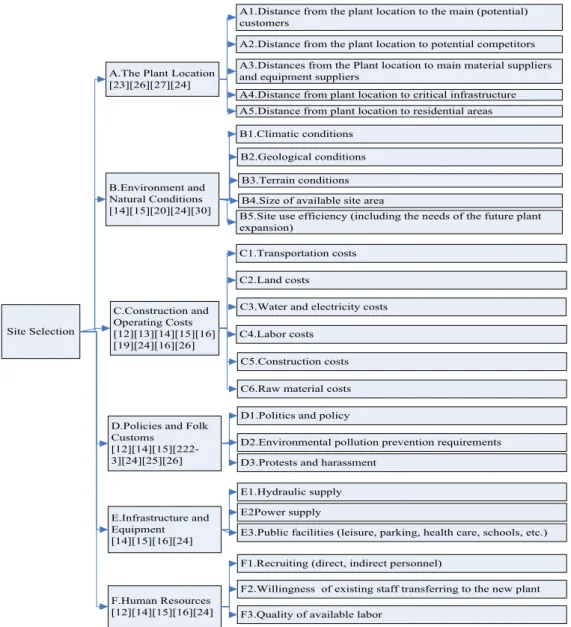
Site selection criteria and dimensions were explored and arranged as Fig. 1 based on the literature reviews [1~14], and expert interviews. The framework of site selection assessment criteria includes six dimensions which are plant location , environment and natural conditions , construction and operating costs , infrastructure and equipment , and human resources . Total of 25 criteria included in all six dimensions were finalized as the site selection assessment criteria in the proposed framework.
Site Selection
A3.Distances from the Plant location to main material suppliers and equipment suppliers
A2.Distance from the plant location to potential competitors A1.Distance from the plant location to the main (potential) customers
A4.Distance from plant location to critical infrastructure A5.Distance from plant location to residential areas A.The Plant Location
[23][26][27][24]
B.Environment and Natural Conditions [14][15][20][24][30]
D.Policies and Folk Customs [12][14][15][222-3][24][25][26] C.Construction and Operating Costs [12][13][14][15][16] [19][24][16][26] E.Infrastructure and Equipment [14][15][16][24] F.Human Resources [12][14][15][16][24] B1.Climatic conditions B2.Geological conditions B3.Terrain conditions B4.Size of available site area
B5.Site use efficiency (including the needs of the future plant expansion)
C1.Transportation costs C2.Land costs
C3.Water and electricity costs C4.Labor costs
C5.Construction costs C6.Raw material costs D1.Politics and policy
D2.Environmental pollution prevention requirements D3.Protests and harassment
E1.Hydraulic supply E2Power supply
E3.Public facilities (leisure, parking, health care, schools, etc.) F1.Recruiting (direct, indirect personnel)
F2.Willingness of existing staff transferring to the new plant F3.Quality of available labor
Fig. 1. Hierarchical Framework of Site Selection Assessment Criteria
3.Research Methods
To enhance and simplify the operations of analytic hierarchical programming(AHP), researchers proposed a consistency fuzzy preference relations (CFPR) approach to deal with the issue of inconsistency on data collection and reduce number of the required comparisons for the implementation of AHP. Therefore, this study employs CFPR to evaluate relative effects of identified site selection assessment criteria for further FIM applications.
The CFPR were proposed for constructing the decision matrices by pairwise comparisons based on additive transitivity [15, 16]. The concept and steps of using CFPR is referred to Herrera-Viedma s article [15].
3.1.Fuzzy Integral FIM
In reality, site selection assessment criteria are existing the interrelationship of multiplicative effects on plant construction cost and future plant business operations; the results of multiplicative effects could be much larger than the additive effect of an individual criterion. Ignorance of the multiplicative effects could produce bias site selection assessment and lead to ineffective decisions on site selection. Sugeno (1974) [17] proposed the fuzzy integral method which applies fuzzy measures to investigate the level of multiplicative effects among events, and then applied the results of fuzzy measures to assessment of the performance for interested alternatives [18]. In this study, the fuzzy integral approach is applied to construct the site selection assessment process in order to yield more realistic results for site selection assessments.
3.2. Fuzzy Measure
The fuzzy measure approach uses monotonicity in replacement of the additive approach to consider potential multiplicative effects of the investigated criteria on the targeted performance [18]. The -fuzzy measure was employed to examine multiplicative effects on various dimensions and criteria to future plant operations in this study. The fuzzy measure parameter, denoted as , describes the degree of additive the fuzzy measure holds. Based on the concept of the fuzzy measure, g is defined as the set function of a power set P( )x , where
1 2 { , , , }n
X x x x is a limited set. A -fuzzy measure g is a fuzzy density with the following properties:
, ( ),
A B P X A B , g A B( ) g A( ) g B( ) g A g B( ) ( ),for 1 (1)
Fuzzy measure densitygi g ({ })xi can be expressed as: 1 1 1 2 1 2 1 2 1 1 1 2 1 1 1 1 { , ,..., } ... ,..., (1 i) 1 , n n n n n n i i i n g i i i i i g x x x g g g g g g for 1 (2)
According to the property of , there are three possible conditions of the multiplicative effects between A and B:
1. If 0, theng (A B) g ( )A g ( )B . This means that the effect evaluation of the set {A, B}
is larger than the sum effect evaluations of sets {A} and {B}. The performance assessment should
include the positive multiplicative effects of A and B, when both A and B are satisfied.
2. If 0, theng (A B) g ( )A g ( )B . This means that there is no multiplicative effect of {A,B}.
3. If 0, theng (A B) g ( )A g ( )B . This means that the effect evaluation of the set {A, B} is
smaller than the sum effect evaluations of the sets{A} and {B}. The performance assessment should
include a negative multiplicative effect of A and B, when both A and B are satisfied.
3.3.Fuzzy Integral
The concept of the fuzzy integral proposed by Choquet is a nonlinear and non-additive decision analysis technology since it considers and includes the multiplicative effects of different criteria [14]. Through the investigation of fuzzy measures and its utilization, the estimated performance can be closer to
the actual performance. Let h be a measurable function from X to [0, 1]. Assuming
1 2
( ) ( ) ( n)
1 1
( ) (n n) ( n ) ( ) (n n )
hdg h x g H h x h x g H ... h x( )1 h x( ) (2 g H1)
h x( ) (n g Hn) g H( n1) h x( n 1) (g Hn1) g H( n 2) ... h x g H( ) (1 1) (3)
4.Results and Discussions
4.1.Results in FPR and Fuzzy Integral Analysis
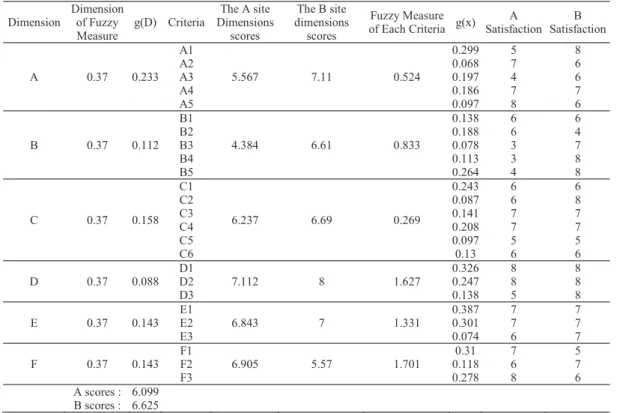
Consistency Fuzzy Preference Relations was applied to determine the weights of site selection dimensions and criteria on a business operations. The weighting results, obtained from the CFPR analysis, are under the assumption of all evaluated criteria being independent and having on multiplicative effects on plant construction cost and business operations of the future plant. In realistic conditions, multiplicative effects of interested criteria on an objective function are considered in selection-typed decision makings. Therefore, it is more realistic to include the analysis of multiplicative effects into the assessment and decision-making mechanism. This study employed the weighting results from consistency fuzzy preference relations and applied the fuzzy integral method to include the multiplicative effects to the scoring mechanism of site selection assessment. This study will address two factory sites to conduct the scoring analysis through the proposed assessment approach, and then relevant site selection and further improving decision is made based on the results. The empirical analysis results with fuzzy integral (FIM) are obtained in Table 1. The score of site A is 6.099; the score of site B is 6.625. The site B is the best choice with the considerations of the multiplicative effects of criteria and dimensions.
Table 1 Scoring comparison of fuzzy integral (FIM) at site A and site B.
Dimension Dimension of Fuzzy Measure g(D) Criteria The A site Dimensions scores The B site dimensions scores Fuzzy Measure of Each Criteria g(x) A Satisfaction B Satisfaction A 0.37 0.233 A1 5.567 7.11 0.524 0.299 5 8 A2 0.068 7 6 A3 0.197 4 6 A4 0.186 7 7 A5 0.097 8 6 B 0.37 0.112 B1 4.384 6.61 0.833 0.138 6 6 B2 0.188 6 4 B3 0.078 3 7 B4 0.113 3 8 B5 0.264 4 8 C 0.37 0.158 C1 6.237 6.69 0.269 0.243 6 6 C2 0.087 6 8 C3 0.141 7 7 C4 0.208 7 7 C5 0.097 5 5 C6 0.13 6 6 D 0.37 0.088 D1 D2 7.112 8 1.627 0.326 0.247 8 8 8 8 D3 0.138 5 8 E 0.37 0.143 E1 6.843 7 1.331 0.387 7 7 E2 0.301 7 7 E3 0.074 6 7 F 0.37 0.143 F1 6.905 5.57 1.701 0.31 7 5 F2 0.118 6 7 F3 0.278 8 6 A scores : 6.099 B scores : 6.625
4.2.Discussions for Comparing FPR guidelines weights and FIM sensitivity analyses
There are considerable differences, shown in Table 2, in the comparison of the results of the FPR weighting analysis and the sensitivity analysis using FIM scoring method. Without the consideration of multiplicative effects, A1, E1, and F1 were considered as the three most critical criteria to be improved to enhance the business operations of the new plant. After the multiplicative effects were included in the scoring process, A1, A3, and A4 become the three most critical criteria for site A to be improved, and F1, A1, and A4 are for site B.
Table 2 Comparison of FPR weighting and FIM sensitivity analysis results.
Rank Global weight(FPR) Rank Sensitivity Analysis (FIM) (Plant A) Rank Sensitivity Analysis (FIM) (Plant B)
A1 0.094 A1 0.116 F1 0.013 E1 0.083 A3 0.089 A1 0.116 F1 0.072 A4 0.063 A4 0.096 E2 0.064 F2 0.055 F3 0.091 F3 0.064 F1 0.051 E1 0.086 A3 0.062 E1 0.05 A5 0.073 A4 0.058 C1 0.049 E2 0.073 C1 0.048 E2 0.043 A2 0.063 D1 0.046 F3 0.041 D1 0.057 B5 0.043 C4 0.037 A3 0.05 C4 0.041 B5 0.034 D2 0.05 D2 0.035 A5 0.031 F2 0.05 B2 0.031 B2 0.031 C1 0.042 A5 0.031 D1 0.028 C2 0.042 C3 0.028 D3 0.026 B2 0.041 F2 0.027 C3 0.025 D3 0.041 C6 0.026 C6 0.025 E3 0.039 B1 0.023 A2 0.023 B5 0.038 A2 0.021 E3 0.023 B1 0.032 D3 0.019 C5 0.021 C4 0.029 C5 0.019 D2 0.021 B4 0.024 B4 0.019 B4 0.018 B3 0.023 C2 0.017 C2 0.017 C6 0.019 E3 0.016 B1 0.014 D5 0.017 B3 0.013 B3 0.012 D3 0.015
5.Conclusions and remarks
The study aims to apply a fuzzy integral method to conduct new plants' site selection assessment in the optoelectronics industry. We can get a general understanding of the relative importance of each dimension and criteria. However, if a researcher intends to carefully assess two similar programs or in considerations of improving the suitability of the site location, the multiplicative effects may be put into consideration to have more appropriate selection of site location in reality. The sensitivity analysis results could be further used to improve the features of the elected site location for better business operations. In future, in view of more important criteria, DANP + VIKOR can be applied to conduct exploration and make comparisons with the findings in this study.
References
[1] -
[2] Mai, C. C. (1981), Optimal location and the theory of the firm under demand uncertainty, Regional Science and Urban Economics, 11(4), 549-557
[3] Korucu, M. K. and Erdagi, B, (2012), A criticism of applications with multi-criteria decision analysis that are used for the site selection for the disposal of municipal solid wastes. University of Kocaeli, Department of Environmental Engineering, 41380 Kocaeli, Turkey [4] van Haaren, R. and Fthenakis, V. (2011), GIS-based wind farm site selection using spatial multi-criteria analysis ( SMCA ): Evaluating
the case for New York State. Center for Life-Cycle Analysis, Department of Earth and Env. Eng., Columbia University. [5] Chase, R. B. and Aquilano, M. J. (1995), Porduction and Operations Management Manufacturing and Services, 7th ed, Irwin
Professional Publishing, Chicago.
[6] Stevenson, Willian J. (1996), Production/Operations Management, Richard D. Irwin, Inc.
[7] Guneri, A. F., Cengiz, M. and Seker, S. (2008), "A fuzzy ANP approach to shipyard location selection." Expert Systems with Applications: An International Journal, vol. 36, no. 4, pp. 7992 7999.
[8] Braun, B. M. and McHone, W. W. (1992). "Science parks as economic development policy A case study", Economic Development Quarterly, vol. 6, no. 6, pp.135-147.
[9] Cho, C. S., Furman, J. C. and Gibson, G. E. (1999). Development of the Project Definition Rating Index (PDRI) for Building Projects, A report to the Construction Industry Institute, The University of Texas at Austin, Research Report, pp.11-155, 1999
[10] Choudhary, D, and Shankar, R. (2012), An STEEP-fuzzy AHP-TOPSIS framework for evaluation and selectionof thermal power plant location: A case study from India. Department of Management Studies, Indian Institute of Technology Delhi, Hauz Khas, New Delhi 110016, India.
[11] Nixon , J. D., Dey, P. K. and Davies, P. A. (2012), The feasibility of hybrid solar-biomass power plants in India. Sustainable Environment Research Group, School of Engineering and Applied Science, Aston University, Aston Triangle, Birmingham B4 7ET, UK.
[12] Kim , J. Y., Oh, K. Y., Kang, K. S. and Lee, J. S. (2012). Site selection of offshore wind farms around the Korean Peninsula through economic evaluation. KEPCO Research Institute, Daejeon 305-760, Republic of Korea.
[13] Leslie, W. R. and Lloyd, L. B. (2004), Management: Skills and Application (11th ed.), McGraw-Hill/Irwin, New York. [14] Tompkins, J. A. and White,
[15] Herrera-Viedma, E., Herrera, F., Chiclana, F. and Luque, M. (2004), "Some issues on consistency of fuzzy preference relations, European Journal of Operational Research, vol. 154, no. 1, 98-109.
[16] Wang, T. C. and Chang, T. H. (2007),
f Operational Research, vol. 182,no. 3, pp. 1313-1329.
[17] Sugeno, M. (1974), Theory of fuzzy integrals and its applications. Tokyo, Japan: ph.D. thesis, Tokyo Institute of Technology. [18] Sugeno, M., and Kwon, S. H. (1995). A clusterwise regression type model for subjective evaluation. Journal of Japan Society for
Fuzzy Theory and Systems vol. 7, no. 2, pp.291 310. [19] Sugeno, M., Narukawa, Y. and Murofushi, T. (1998),
and Systems, vol. 99, no. 2, pp. 205-211.
[20] Chen, Y. W. and Tzeng, G. H. (2001), as-signment
-664.
[21] Chiou, H. K. and Tzeng, G. H. (2002), multiple-criteria decision-making approach for industrial green e Environmental Management, vol. 30, no. 6, pp. 816-830.
[22] Chiou, H. K., Tzeng, G. H. and Cheng, D. C. (2005), Evaluating sustainable fishing development strategies using fuzzy MCDM approach Omega (The International Journal of Management Science), vol. 33, no.3, pp. 223 234.
[23] Liou, J. H. and Tzeng, G. H. (2007), A non-additive model for evaluating airline service quality Journal of Air Transport Management, vol. 13, no.3, pp. 131-181.
[24] Larbani, M., Huang, C. Y. and Tzeng, G. H. (2011), A novel method for fuzzy measure identification International Journal of Fuzzy Systems, vol. 13, no. 1, pp. 24-34.
[25] Tzeng, G. H, Ou Yang, Y. P, Lin, C. T. and Chen, C. B. (2005), Hierarchical MADM with fuzzy integral for evaluating enterprise intranet web sites Information Sciences, vol. 169, no. 3/4, pp. 409-426.
[26] Chen, T. Y., Wang, J.C. and Tzeng, G. H. (2000), Identification of general fuzzy measures by genetic algorithms based on partial information, IEEE Transactions on Systems, Man, and Cybernetics, vol. 30, no. 4, pp. 517 - 528.
[27] Hu, S. K., Chuang, Y. C., Yeh, Y. F. and Tzeng, G. H. (2012), hybrid MADM with fuzzy integral for exploring the smart
phone improvement in M-g -214.
[28] Ishii , K. and Sugeno, M. (1985), Studies, vol. 22, no. 1, pp. 19-38.
[29] Dan, M. - -79.
[30] Laulajainen, R. and Stafford, H. A. (1995), Corporate Geography, Kiuwer Academic Publishers.